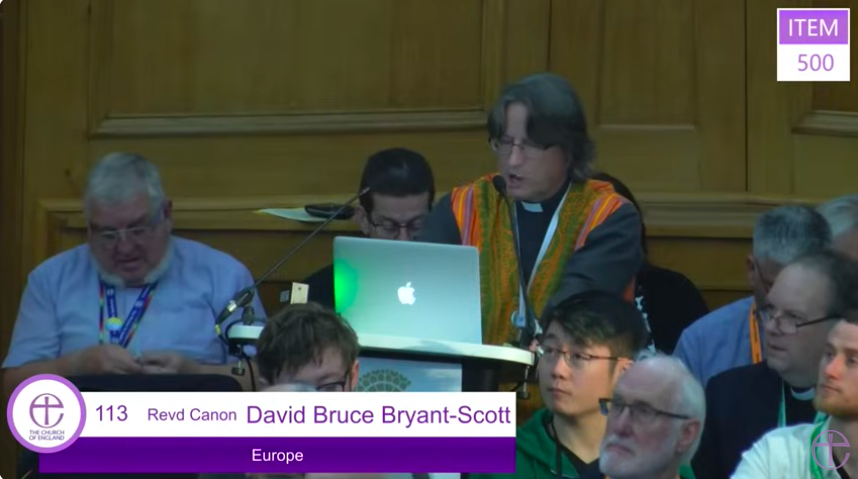
I am a member of the General Synod of the Church of England, which is the legislative body of that denomination in which I work. I am one of three clergy elected from the Diocese in Europe, and along with three laity also elected, plus our Diocesan Bishop, the Rt Rev Dr Robert Innes, we are the seven person team from the nearly three-hundred congregations across Europe, Asian Turkey, and western North Africa. We meet in General Synod, usually twice a year, with a meeting in February in Church House, a purpose built meeting space and office building next to Westminster Abbey, and another in the University of York in July. This year we had a third meeting in Westminster in order to deal with the Redress Schemeand with theLiving in Love and Faithproposals.
There are three hundred of us at General Synod, and it can be hard to get recognised by the chair to speak to a motion. Somehow I got recognised not just once, but twice. Here are the YouTube videos of the speeches I gave.
The first is from Tuesday morning, 14 November 2023. In it I argue for the proposed Redress Scheme for survivors of sexual abuse by people in the church. Click on this link, and it should open a new window in which you can run the video.
In this second speech on Wednesday afternoon, 15 November 2023, I talk about how we might trust the Bishops more and affirm them in their work on Living in Love and Faith. Again, click on this link to watch the video.
In September 2023 we started an in-person Small Group Bible Study here in the Anglican Church of St Thomas the Apostle, Crete, and we meet at 4:00 PM every Monday at a congregant’s home. The group decided to study the Gospel According to Mark, being a relatively short and “simple” gospel, and perhaps one of the earliest witnesses to the good news about Jesus. If you are in Crete, contact me and I will tell you how you can join us.
An Ancient Text
Before I make any posts with some notes about the various chapters, I will start with some general ones about the Gospel, as well as the New Testament.
The Christian Bible, with its two parts we call the Old Testament and the New Testament, is probably the oldest text that most people in Western society will ever read. Unless they are type of folks who enjoy reading Homer or Julius Caesar, or are adherents of Confucianism reading The Analects, or just a reader having a go at a translation of the Epic of Gilgamesh, the Bible is likely the only ancient work that they look at. So, I suggest, we need to consider the fact that it is not a text like one produced in modern times – it is not a novel like the ones written by Charles Dickens, or an historical document like constitution of the United States, or a history like the one Winston Churchill wrote about the Second World War. The conventions around such texts were unknown in the first century when the gospels were written, and the expectations that the readers had and the assumptions of the writers were also different.
Among those assumptions are these:
Most people experienced the text not as readers, but as listeners. They probably listened to someone reading the text.
The text may well have been read in one go. It might take ninety minutes to two hours to read something like the Gospel according to Mark.
The author was anonymous, and the identity of the author was not as important as the content. The earliest attribution to John Mark, mentioned in Acts, dates from the late second century. The earliest record of the title with the text dates from the fourth century. This anonymous character is true of all four gospels. Thus, we only have the text.
Mark is considered to be the first of the four gospels that was written, and Matthew and Luke demonstrate that they used Mark as a written source for their versions of the life of Jesus. Thus, it is important to know that this was a new genre – there were no preconceptions from the first readers/listeners about what form this text should take, or how the story should go.
The listeners would not have expected the text to be literally true, in the sense that it was in a historical sequence; rather, they were looking for the truths that mattered to them.
The first readers/listeners would not have considered the gospels to be sacred, in the same sense that the Torah or the Prophets were holy writings – but they would have considered the object of the story told as sacred.
At best the readers/listeners were ambivalent about the Roman Empire, and more likely considered it to be the means of oppression by an elite. The first readers/listeners did not speak Latin, the language of the Empire, but Greek, and were probably not citizens, but subjects, including freedmen and slaves.
Transmission
Let’s consider its transmission history. This is some 1900 years long – a tremendously long time. Initially it was probably written on papyrus, a kind of paper hand made from the pith of Cyperus papyrus, a kind of reedy plant. Papyrus paper does not last in most climates, as humidity and the ordinary ravages of time destroys it, so most of what we have comes from the dry climate of Egypt. These have been found in graves, buried in the sand, and occasionally reused for various purposes. The oldest fragment of the gospel appears to be something scholars catalog as P.Oxy LXXXIII 5345 from late second to early third century A.D. Below is a photo of the two sides of the fragment from the scholarly report about it, and the little piece, about an inch (two cm) tall, is, as you can see, just a scrap. Despite that, it is identifiably from Mark 1.7-9, 16-18. It is, of course, written in Hellenistic Greek, or koiné.
In the time of Jesus all manuscripts were on scrolls – sheets of papyrus joined together in a long roll, and written on only on one side. Indeed, to this day, in synagogues Jews read from Torah scrolls. In the two centuries after Jesus a new technology emerged, called a codex – a bound manuscript with many individual pages sewn together and written on both sides of the paper. As used as we are to these codices, which we think of when we thing of books, someone had to invent them, and when invested they quickly caught on, largely because they were more cost effective (using both sides of the paper) and more easy to use, as one only had to flip pages instead of scrolling along and rolling and unrolling the book. We can tell that P.Oxy LXXXIII 5345 above is from a papyrus codex because it is written on both sides.
We do not start finding complete manuscripts until the Fourth Century. By then there is usually a title attached, commonly at the end of the gospel. These are often written on vellum – sheep skins that have been treated to form a kind of canvas on which a scribe can write something. Vellum was very expensive, and complete Bibles would have cost a king’s ransom. The two oldest more or less complete Bibles are on vellum and have names – Codex Vaticanicus, because it is in the Vatican Library, and Codex Sinaiticus, because it was found in the Monastery of St Catherine at the foot of Mount Sinai. It is not an accident that these codices were written only after Christianity was legalised, and they were probably financed by Imperial patronage or some other wealthy aristocrat. Codex Sinaiticus may well have sat in the monastery in Sinai from the 4th Century until it was “rediscovered” in the late 19th century. Likewise, while Vaticanus was known to exist in the 16th century, it was only in the late 19th Century that a copy of it was published. A third great Bibe, the Codex Alexandrinus, appears to date from the Fifth Century. Both Alexandrinus and Sinaiticus are in the British Library, and are on display physically in its gallery of treasures, and they have been made available digitally in whole or in part. If you are wondering how they are dated, it is done by an analysis of the writing (paleography) and the material it is written on.
It needs to be kept in mind that these were written by hand. The hands in these codices are identifiable. Because the codices were handwritten, moveable type not reaching Europe until the 15th century, it means that variations occurred. Sometimes the variations were due to mistakes, such as skipping a line or a word. In other cases the copier might not have been able to make out what a word was in the text they were working from, so made a guess. Often the scribe disbelieved what a text wrote, and so smoothed it out, or made additions. Over time these variations accumulated. Because the texts were copied repeatedly, there developed “families” of manuscripts. In the late fourth century one family of texts, known as the Byzantine, began to predominate. These were the types of texts that were rediscovered in the early modern period (sixteenth century) and became known in Western Europe as the Textus Receptus, or the received text. In the 19th century, as older manuscripts were found, it was determined that the Byzantine family of texts did not always preserve the very best readings, but the accumulations of errors and editorial changes. Thus, starting in the mid- to late 19th century, critical editions of the New Testament emerged that were based on Vaticanus, Alexandrinus, and Sianaiticus. These were supplemented by even older papyrus fragments of scrolls, which continue to be unearthed to this day. As well, there are very old translations into Syriac, Latin, Coptic, Ethiopic, Armenian, and Georgian which may preserve variant readings from Greek originals that no longer exist, or which preserve older readings that disappeared in the Byzantine family of manuscripts.
Modern textual criticism deals with all of this, and sifts through all the variants and makes educated guesses at the best readings. Most modern translations of the New Testament use the Novum Testamentum Graece (The New Testament in Greek) that is now in its 28th Edition; as the original editors were two men named Eberhard Nestle and Kurt Aland, it is known as NA28. The United Bible Societies have a less heavily footnoted version of NA28, now in its fifth edition, and is known as UBS5. There is also a commentary in English on the text, noting the most important variants, why the editors preferred one reading over others, and the strength of that conviction (listed as A, B, C, D, where A is quite certain, and D means they really don’t know what was in the original). Some Bible translators continue to use the Textus Receptus (the New King James Version is an example of that), but they are in the minority and, in my opinion, just wrong.
The Art of Translation
Unless you are fluent in Koine Greek (pronounced “Kee-neh”) you are dependent on translators; I am not fluent in either Koine (or Standard Modern Greek), but I know enough to be able to distinguish between translations that I think are good and accurate and those that are not.
Translation is an art. Sometimes it is simple enough, but it becomes more complex when the grammar and vocabulary in the original text are different from that in the target language. English has a massive vocabulary that allows for many shades of meaning, Koine Greek, not so much. Word order in English is very important, whereas in a highly inflected language like Greek playing the word order is much more flexible. Further, because of the inflection, what we in English would consider as run-on sentences are perfectly allowable in Koine Greek.
There are three basic types of translation. One aims for word-for word translation. In English the King James Version is the best example of that – where a word is translated one way in a text, it is probably translated the same way elsewhere. This can be problematic, because the word in English may not have exactly the same range of meaning as the word in Greek. Thus, πνεύμα in Greek can be translated as “breath”, “spirit”, “wind”, and “ghost.” As well, and particularly in Paul, the KJV sometimes reproduces the Greek syntax and word order, which makes it less than fluent English. More recent translations in the last hundred years have used a broader vocabulary, works to get fluent English word order, and breaks up the sentences into digestible lengths. These types of translations are often called “literal” in that they try for a great degree of accuracy.
A second type of translation is called “dynamic equivalence”. This type of translation attempts to find equivalent phrases in a language to match phrases or words in the original. In Hebrew, for example, if someone is standing before someone else, they “before the face of” that person; in English instead of the literal translation one can simply say, “in front of.” This, of course, allows for greater judgement on the part of the translator.
A final type of translation is a paraphrase, where the translator will use modern idioms or situations to give the meaning to the original. While many people find these kinds of translations helpful, they are very interpretive and often demonstrate the translator’s biases. I personally avoid paraphrases. I have been in too many Bible studies where people think they understand a difficult passage because their paraphrase phrases it in a particular way, but what they fail to understand is that it may just be an obscure passage in the original, too, or it is so far removed from our experience that we do not get the meaning. Often the translators using paraphrase remove ambiguity where the author intended it.
Translation gets very difficult indeed when it is poetry, because much of the effect is built up in compact sentences with poetic meters and sounds. The Gospel according to Mark does not have poetry in it, and there are debates about how much is in the New Testament, but it is definitely present in the Hebrew Bible.
One of the important things to know about the Gospel of Mark is that much of it is written in the present tense of Koine Greek. This is the difference between, “I threw the ball to Billy” and “I throw the ball to Billy.” Now, while it is not unknown in modern English literature (John Updike’s Rabbit, Run is in the present tense) it is not common. This gives it an immediacy, but most translations put the verbs into the various forms of the past tense, as that is more conventional in English narration. So, right there, we have lost a major stylistic decision of the author.
A Sermon preached on The Thirteenth Sunday after Trinity at The Anglican Church of St. Thomas the Apostle, Kefalas, Crete on September 3, 2023, at 11:00 am
“If they ask me, ‘What is his name?’ what shall I say to them?” God said to Moses, “I am who I am.”
Exodus 3.13-14
Moses and the Burning Bush by Marc Chagall (1966)
God has many names. God, Elohim, Θεός.
But in today’s first reading God identifies himself with a name that is pretty obscure to most people, or if they know it, follow the tradition of treating it as too holy to pronounce. That name is Yahweh, and in the Hebrew Bible that is the way the God of the Israelites is addressed. You may recall when Roman Catholic English translation of the Bible, The Jerusalem Bible, came out in 1966, it used that name. In the psalm as we read this morning we heard, as is found in the translation given in “Common Worhsip” (2000):
O give thanks to the Lord and call upon his name . . Seek the Lord and his strength,
but in “The Jerusalem Bible” (1966) it reads
Give thanks to Yahweh, call his name aloud . . . Seek Yahweh and his strength,
Yahweh is the name of God. It occurs over 6000 times in the Hebrew Bible, what we call the Old Testament. It even has a short form: Yah, and it shows up in the word “Hallelu-Yah” which simply means “Praise Yah”. Our reading from Exodus gives the name an origin. Moses asks, who shall I say sent me? And God answers, אֶהְיֶה אֲשֶׁר אֶהְיֶה ’ehye ’ăšer ’ehye, which is translated into English as, “I am who I am”. However, it’s a bit ambiguous in the original ancient Hebrew, and other scholars have translated it as: I am who is”, “I will become what I choose to become”, “I will be what I will be”, and even “I create what I create”. It is likely that the name “Yahweh” predates the story of Moses being commissioned by God, and the giving of the name ehye ’ăšer ’ehye; it is a etymology which sounds right and is theologically meaningful, but was probably a creation of the author of Exodus, or a tradition about the name which was passed down through the ages.
So, if God has a name, why do we not use it? Why do we not call the Divine Yahweh, or Yah? After all, Moses did, and all the prophets did so. What happened?
Sometime, perhaps three centuries before the time of Jesus, pious Jews began to feel that the personal name of God was so holy that it should not be spoke aloud, not even when reading the Torah in the Synagogue. In reading the Torah and other parts of the Hebrew Bible in the synagogue readers started to replace the name “Yahweh” with “Adonai”, which simply means, “the Lord”. This is what was carried over into the Septuagint, the Greek translation of Bible done a century or two before Jesus. Today pious Jews consider even Adonai too sacred, and will simply refer to God as “Ha shem”, or the Name. This practice was carried over into the Greek New Testament, and virtually all English translations. Look in the Old Testament of your Bible – a printed one, as digital ones may not be so precise, and you will see “The Lord” typically printed all in capital letters – and this signifies that it replaces Yahweh in the original Hebrew.
Now, I personally do not have a problem using the name of God, but I can understand that after more than twenty centuries some people find it a bit odd, if not sacrilegious. Certainly, many people found The Jerusalem Bible, with its consistent use of Yahweh, a bit disconcerting. Indeed, in 2008 Pope Benedict XVI had the Congregation for Divine Worship and the Discipline of the Sacraments instruct the Roman Catholic Church to cease using the divine name in translations, as well as songs and psalms.
There are two ways in which the name Yahweh carries over into the New Testament. First, the name Jesus. In Greek it is Ἰησοῦς, and over time, through Latin and Old Germanic, vowel shifts and so forth, it became our “Jesus. Ἰησοῦς is the Greek form of the Hebrew and Aramaic יֵשׁוּעַ (Yeshuaʿ/Y’shuaʿ), a shorter form of יְהוֹשֻׁעַ (Yehoshuaʿ), or Joshua. Now, all Biblical names seem to have meanings. יְהוֹשֻׁעַ is usually translated into English as “The Lord saves” but it literally is, “Yah saves” – that short name of God. So, every time we use the name Jesus, we use the personal name of God. It’s been garbled in its journey from Hebrew to English from Yeshuaʿ to Jesus, but it’s still there.
The other way in which “Yahweh” really shows up in the New Testament is in the Gospel according to John. There Jesus regularly makes what are called the “I am” statements. In the original Greek it is an emphatic I am: Ἐγώ εἰμί. And they are bold claims:
I am the Bread of Life (John 6:35)
I am the Light of the World (John 8:12)
I am the Door (John 10:9)
I am the Good Shepherd (John 10:11,14)
I am the Resurrection and the Life (John 11:25)
I am the Way and the Truth and the Life (John 14:6)
I am the Vine (John 15:1,5)
Unless you believe that I am, you will die in your sins” (John 8:24)
Before Abraham was, I am (John 8:58)
In all these uses and appearances the author of the gospel is building on the claim that shows up at the start of the book:
In the beginning was the Word, and the Word was with God, and the Word was God.
John 1.1.
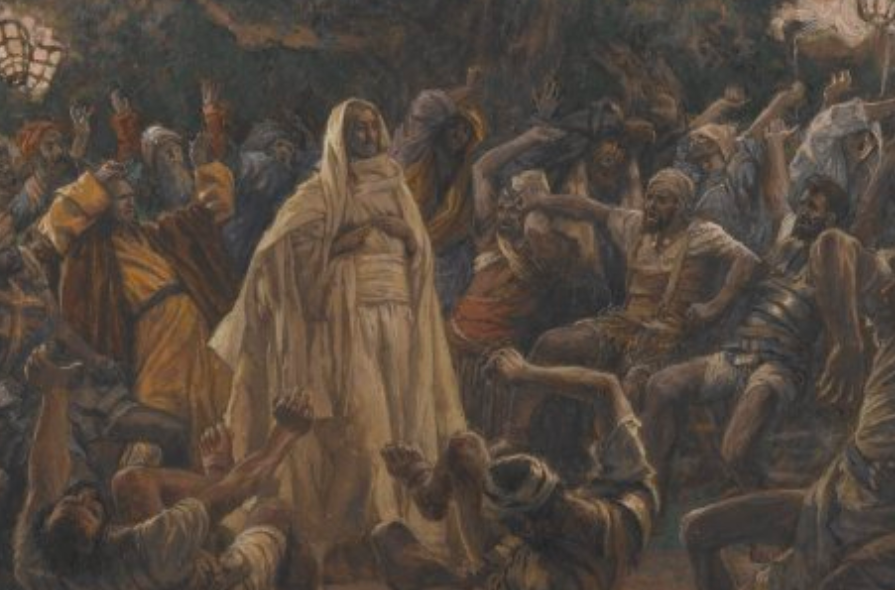
Jesus is not just the son of God, like the Roman Emperors of the time claimed, not is he somewhat semi-divine, like the Greek hero Hercules. He is not merely another prophet sent to save the people. The use of all these “I am” statements mean that he is God – he is fully divine. The continued use of Ἐγώ εἰμί I am is a reference back to ’ehye ’ăšer ’ehye, and the name has power. This is seen in chapter 18, when the police and the chief priests and the Pharisees arrest him.
Detail from The Guards Falling Backwards by James Tissot (c.1886/1894)
Jesus, knowing all that was to happen to him, came forward and asked them, ‘For whom are you looking?’ They answered, ‘Jesus of Nazareth.’ Jesus replied, ‘I am. Judas, who betrayed him, was standing with them. When Jesus said to them, ‘I am he’, they stepped back and fell to the ground.
John 18.4-6
Jesus in this telling literally knocks people of their feet with “I am.”
But our gospel reminds us of the nature of this power. It is a power which empties itself, and we have heard today,
Jesus began to show his disciples that he must go to Jerusalem and undergo great suffering at the hands of the elders and chief priests and scribes, and be killed, and on the third day be raised.
Matthew 16.21
and
If any want to become my followers, let them deny themselves and take up their cross and follow me. For those who want to save their life will lose it, and those who lose their life for my sake will find it.
Matthew 16.24-25
So, my friends, in Jesus we see the nature of the name of God, the one who is, the one who saves, the one who in human flesh pours out himself for all humanity. Let us let go of the temptations of power, and follow Jesus, the one through whom we know the true character of Divinity.
In the past the tradition in Roman Catholic churches as well as in many Anglo-Catholic parishes, was, on the four Sundays of Advent, to preach about the Four Last Things. The Four Last Things are: Death, Judgement, Heaven, and Hell – just the kind of things you want to hear about while in preparation for Christmas. Of course, if you’ve already heard Mariah Carey sing Santa Baby once too many times, or Last Christmas by George Michael for the hundredth time, you may feel that anything would be preferable. Now, I preached about Death two weeks ago, so perhaps I will get a jump on things and talk about Judgement today as I’m going to miss out on one Sunday’s opportunity for preaching because of the Carol Service on the 17th. Y’all want to hear a sermon about Judgement, don’t you?
A few considerations.
First, we are all judged, for we all have sinned and we all fall short of the glory of God. That’s a simple statement of Christian doctrine, derived from Paul in his Letter to the Romans but part of Christian teaching from the very beginning. It is rooted in the Hebrew Bible – God calls us to be faithful and obedient, and we all fail. Only in Christ do we see someone who was faithful and obedient, even unto death.
The Good News, and I really mean the Good News, evangelion, is that God has already forgiven us. When the Divine looks upon us, God sees us as the Body of Christ. I would disagree with the strict Calvinists and say that this is not just imputed to us, but by God’s free gift the Holy Spirit is working in us, making us ever more like Jesus. Thus, however you see yourself in relationship to the Divine, if you are in Christ you are forgiven. That begs the question about what it means to be in Christ, of course. For evangelicals it is having faith in Christ. For Catholics and Orthodox it is about being part of the Church and progressing in sanctification and theosis. Universalists would say that God’s love and grace are even more indiscriminate, and offered outside of the bounds of the Church. The point I would make is that the Church teaches that we are all somewhat depraved, and need God’s grace. Whether some of us are so depraved that God’s love cannot redeem us is a question I will leave for another time.
A second consideration. God’s love and mercy does not allow us to escape the consequences of our actions in this life. By the Holy Spirit we may indeed experience healing and reconciliation, and the new life of the resurrection, all of which are foretastes of what we are to become. We might even develop a kind of stoic dispassion towards illness, chaos, and violence. But this does not mean that we do not encounter it, any more than Jesus avoided his Passion and own Death. We live in a broken and fallen world, lovely yet fragile.
We see this personally. Too often we refuse to accept responsibility, we seek to control those whom we love, and we are blind to our own motivations. We reject the need to change and repent and place ourselves in the hand of God instead relying on or own limited knowledge, our compromised power, and our arrogance.
We see this collectively in the consequences of industrialization and globalization. A pandemic like Covid-19 went around the world in a matter of weeks, not months or years as with previous plagues. Climate change affects us here in Greece, where one olive picker noted that this year was the first he’d ever harvested the trees in a heat wave. The olive harvest was earlier, shorter, and hotter. In the Holy Land people became inured to the daily violence of everyday life. For the recent right-wing Israeli government of Benjamin Netanyahu it meant ignoring a long-term settlement with the Palestinians, assuming that the periodic low-grade violence of “mowing the grass” was preferable. For the radical terrorist group of Hamas violence against civilians, feeding on the despair of Palestinians, and preaching a vision of hate and genocide is preferable to making a compromise with Israelis. Neither side was willing to engage in a discussion around a two-state solution and the establishment of real peace, and the result has been a greater escalation of violence.
A final point may be the most important. We are called to heal and reconcile. Jesus calls us not to judge, lest we be judge, to forgive as we have been forgiven. While sometimes some of us must act on behalf of the common good, we should be wary of judging, and prompt to bite our tongue. We do not judge another in gossip or out of unreflective reaction, but only according to commonly agreed upon processes.
This is hard, but sometimes it is hard to stay awake. As we prepare to welcome the birth of Jesus among us, let us also prepare to welcome his return, and his judgement of us. Let us awaken to our call to healing and reconciliation, to our need to face up to the consequences of our actions both personally and collectively, to be faithful and obedient, even as Christ was for us.
For my reflections on George Herbert’s poem “Judgement”, click here. For my thoughts on Judgement in the Book of Revelation, click here.
I am getting ahead of myself. In the Roman Catholic Church, and in many Anglo-Catholic parishes it used to be the case that on the four Sundays of Advent the sermons would be based on the Four Last Things, namely: death, judgement, heaven, and hell. Well, here it is, two weeks before Advent, and I am going to preach about death. Perhaps in two weeks I’ll preach about judgement, eh?
So. What happens when we die?
Well, obviously, we stop breathing and our body begins to decay, and if we have loved ones, they are greatly upset. The survivors may do a number of things – they may cremate the body (as is common in western Europe and in India), or expose it in special open-air buildings to be consumed by vultures (the practice of the Parsees), but the traditional thing to do for Christians, Jews, and Muslims is to bury the body. Here in Greece, after a period of time, we dig up the body and the bones are washed and placed in a silver box in the grave.
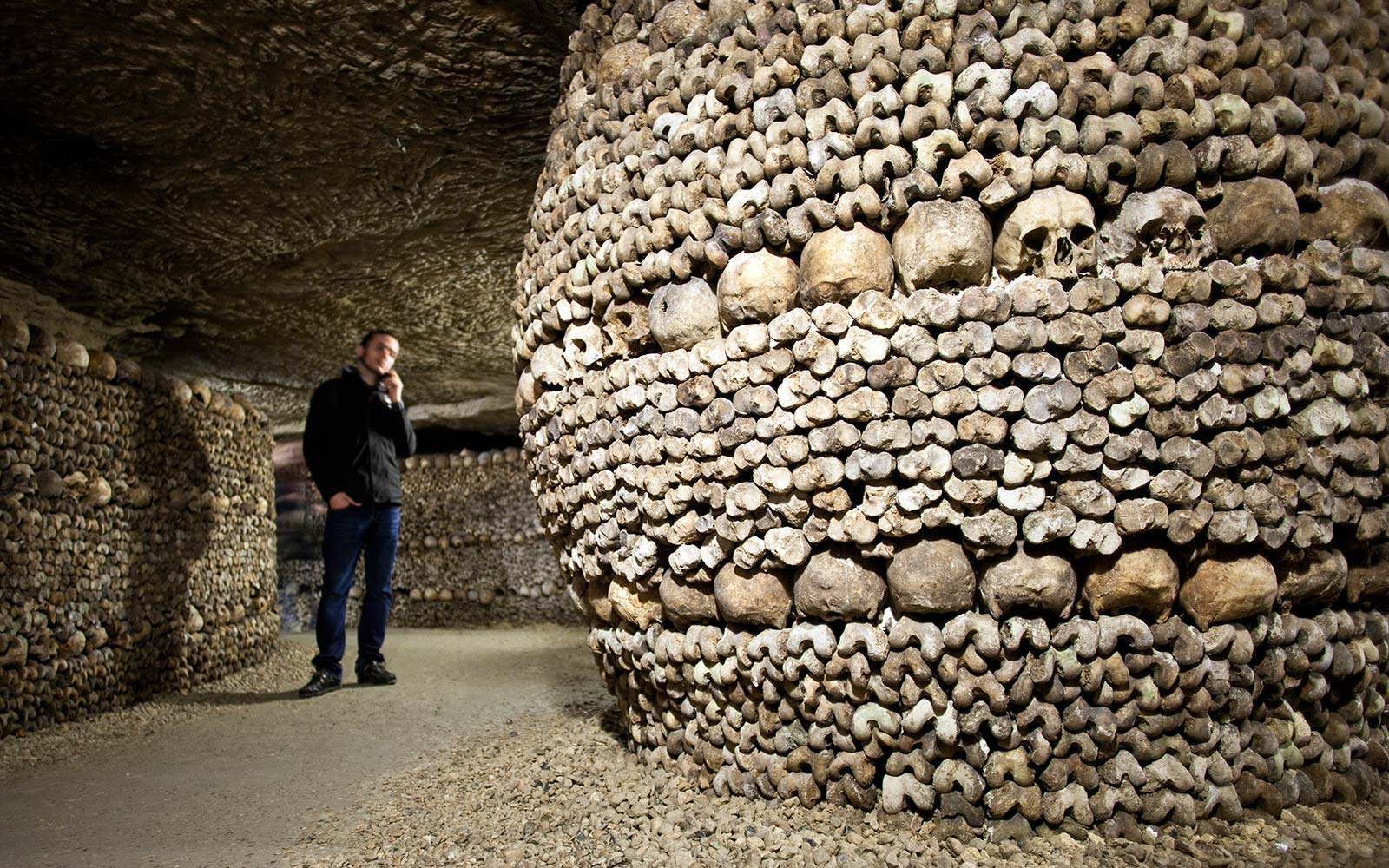
In Paris, by 1800 the graves had all become so full that the city authorities ordered that the graves be dug up and all the bones interred underground, in mines under the city excavated centuries before. It is estimated that between 1774 and around 1820 some six million people had their earthly remains reinterred. You can now visit the so-called “Catacombs of Paris” as my son and I did a decade ago. So, what happens when you die? Well, you may wind up being part of a tourist attraction.
Paris, Ile-de-France, France, Europe
Three Biblical Ideas about Death
Let us move from bones to the scriptures. There are varieties of ideas in the Bible about life after death. As is so often the case, the sacred texts speak in a polyphony, but the voices all point to a great sacred mystery, which is not so much a puzzle to be solved, but a meaning beyond ordinary human understanding.
First, the oldest parts of the Bible, in the Old Testament, simply refer to Sheol, a place of shadowy existence. Remember what it is like when we slowly die, slowly fade. Sheol is like that, only more so. It is only a partial kind of existence, and i the psalms we read that the dead in Sheol do not praise, they just are dead.
Second, there is heaven. Now, in the Hebrew Bible, heaven is where God is, and from whence come the angels, the messengers of God. It is not really a place for humans, although we do hear of a couple of people there – Enoch, and Elijah – but they are very special.
The idea of heaven developed in post-exilic Judaism, perhaps under the influence of Zoroastrianism. Sheol becomes not just the place where the dead normally go, but a place of punishment and pain. Heaven becomes a kind of Elysium, where the heroes go. Thus in the New Testament in the story of Lazarus and the Rich Man, the rich man, having enjoyed wealth in life but having had no mercy, goes to a rather hot hell. Lazarus, having enjoyed no riches in life, is in heaven, in the bosom of Abraham. So you can have a fun time imagining where you belong, and what one might have to do to avoid one and get in the other.
But a third fate after death is mentioned, and that is the resurrection of the dead. Resurrection was the post-exilic Jewish answer to what happens to good people who are faithful, and yet nevertheless suffer for doing the right thing. God will raise them up from death, whether conceived of as heaven and hell or from the more ambiguous existence of Sheol. God will raise up all who have lived for judgement, the judgement of the living and the dead. As we can see in our reading in 1 Thessalonians Jesus is described as coming in glory. The resurrection of all life is seen as a two-stage event – first those who have died in Christ, who are described in Greek as having fallen asleep, a nice image of death that is somewhat closer to Sheol than heaven and hell. The dead in Christ are raised up and those followers of Jesus who are alive at the time will join with them and meet the Lord in the air, and “we will be with the Lord forever.” Then will follow a more general resurrection, of all who have lived, and Jesus will judge them. I personally expect God will be mostly gracious and forgiving, but others through the ages have seemingly relished the vast numbers of people who will be condemned to eternal damnation and pain.
It all sounds quite fantastic, doesn’t it? In an age of technology and science can we really believe all this? I know that I do, and would be quite happy to take it all literally, but I know that not everyone does. The fact that scripture speaks in several voices about life after death suggests to me that whatever is meant by “He will come to judge the quick and the dead” and “I believe in the resurrection” is more complex and mind-blowing than we can imagine. However, it all points to the idea that when we die, God is not done with us.
If so, then parable of the wise and foolish bridesmaids in our gospel reading tells us the subsequent point. However we imagine it, we need to be ready. As followers of Jesus, we are called to prepare ourselves for death, and for the coming of Jesus.
How do we prepare?
Practically, talk about death and what you want to have happen. Talk to your friends and children. Funeral arrangements. Have a will. For God’s sake, write down all your passwords! Perhaps have a look at the website GYST (Get your SH*T Together ) and work through its short checklist, or its longer one.
Talk to me, or some other minister. What do you want to have happen at your funeral?
How do you want to meet your maker? Is there anything unresolved that you need to deal with? Do you need to make a confession? Is there somebody with whom you need to be reconciled? Are there any amends you might want to make?
The parable tells us that time is short. The day is not long. Our psalm suggests that the normal life-span is three-score and ten, or maybe four-score – and some of us here have passed both of these numbers. So it is time. Prepare your lamps for the wedding feast. Let us be ready when the bridegroom knocks on the door.
For my reflections on the poem “Death” by George Herbert click here.
Today’s poem, like yesterday’s, is a two-parter, and there is a well-documented evolution of it in the two manuscripts known to scholars as “W” and “B”. The changes are well described well by Drury (pp. 142-143) who likes this poem much more than Good Friday. The published version merges what are presented as two poems in the earlier manuscripts. Think of it as a volley-ball set-up – the first three stanzas are popping the ball into the air and the second three knock it over the net for a point. The first part address the heart and lute for a song, and the last three stanzas are that song.
It is more than likely that Herbert had a tune in mind, perhaps one of his own making, as Izzak Walton describes him as a musician of considerable skill.
Easter
Rise heart; thy lord is risen. Sing his praise Without delays, Who takes thee by the hand, that thou likewise With him mayst rise: That, as his death calcinèd thee to dust, His life may make thee gold, and much more just.
Awake, my lute, and struggle for thy part With all thy art, The cross taught all wood to resound his name Who bore the same. His stretchèd sinews taught all strings, what key Is best to celebrate this most high day.
Consort, both heart and lute, and twist a song Pleasant and long; Or since all music is but three parts vied, And multiplied; O let thy blessèd Spirit bear a part, And make up our defects with his sweet art.
I got me flowers to straw thy way; I got me boughs off many a tree: But thou wast up by break of day, And brought’st thy sweets along with thee.
The Sun arising in the East, Though he give light, and th’ East perfume; If they should offer to contest With thy arising, they presume.
Can there be any day but this, Though many suns to shine endeavour? We count three hundred, but we miss: There is but one, and that one ever.
The metre for the first three stanzas is 10.4.10.4.10.10, and for the last three it is 8.8.8.8, and the rhyme schemes are AABBCC and DEDE, respectively. If one is looking for a tune for the first half, SANDON, used with Unto the Hills and Lead, Kindly Light would work. 8888 is Long Metre (“LM”) and Ancient and Modern (2013) has no fewer than 56 hymn tunes of that length, including TALLIS’S CANON and OLD HUNDREDTH. Perhaps more interesting is Ralph Vaughan Williams’ setting of the second part as one of his Five Mystical Songs (1911):
In the first part the poet address his heart and his lute. There is a sense of movement in that Herbert frequently starts a sentence on one line and continues it on the next – a practice called enjambment. The resurrection of Jesus results in the rising of the the poet, too, and his death and resurrection result in the alchemical transformation of the heart into dust and then gold. The lute, made of wood and strings of catgut (not really from cats, but goats and sheep) is said to have been taught by the wood of the cross and the sinews of Christ’s body stretched out – and so Herbert commands it to “celebrate this day.” In the third and last stanza of the first part heart and lute consort together to sing a song, and Herbert invokes the Holy Spirit to complete what they lack.
In the second part the poet sings about collecting flowers and boughs, just as Jesus was welcomed on Palm Sunday, only this time Jesus was up earlier and has already brought “sweets” or fragrant things with him – new life, salvation, communion with the divine. Not even the sun can compete with this rising, and the day of resurrection is greater than any other.
The key thing about the resurrection of Jesus is that it begins the process of God’s renewal of the cosmos. “Behold, I am making all things new” says the one seated on the throne in Revelation 21, and it begins with the resurrected body of Jesus Christ. The resurrection is the defeat of death, because love is stronger than death. The fullness of the transformation is not yet here, but it proceeds in the world through God’s grace and in the body of Christ, which is the church. This is why it is the Day of Days, outshining any sun. Every Sunday is a little Easter, memorializing the resurrection of Jesus, and that is why the followers of Jesus meet weekly on that day.
Herbert’s poem captures the transcendent significance of Easter. It was utterly unexpected. No one was waiting at the tomb for his rising. All his disciples had fled, and even the women who had watched him die assumed he would remain dead. When they experienced him as risen, it changed their understanding of his death, and of themselves.
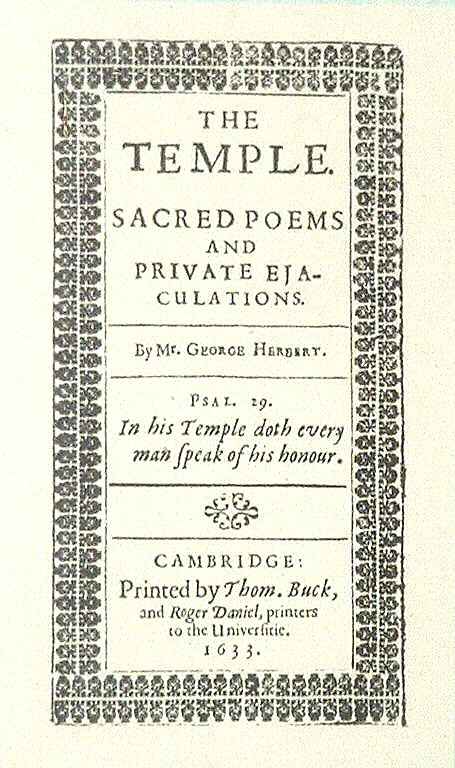
George Herbert (1593-1633) was a Welsh-born English poet, the younger son of a wealthy family that owned much land. As a younger son he had minimal expectation of inheriting any of it so long as his elder brother Richard lived and had sons of his own, which he did. Thus, George Herbert had to make his own way in the world, albeit supported by his family and its political connections. As a young man he went to Trinity College, Cambridge, and subsequently taught rhetoric there and became the Public Orator, giving speeches on behalf of the University at graduations and visits from Very Important People. He served in the English Parliament and hoped for a career in government, but gave up on the idea after the death of James I & VI in 1625. Herbert then began a career in the Church of England, something for which he was eminently suited given his piety and education. Ordained deacon in 1626, married in 1628, and ordained again as a priest in 1629, he became rector of Fugglestone St Peter with St Andrew’s, Bremerton, both then just outside Salisbury. He served for only three years and a bit, dying of tuberculosis at the age of 39. After his death his friend and colleague Nicholas Ferrar (of Little Gidding fame) received his papers, and he arranged for their publication. Among them were two works that are still in print and read today: The Temple: Sacred Poems and Private Ejaculations (1633), and A Priest to the Temple or the Country Parson (1652). The latter is a prose work offering advice to rural clergy, and following the Restoration in 1660 is was (and is) used as a manual for Anglican clergy. The book of poems is even more widely read, being part of the canon of English poetry.
While many post-Restoration High Church Anglicans, as well as 19th and 20th century Anglo-Catholics, read Herbert as a forerunner of their variety of Christianity, more recent historical work seeks to restore the poet as an ordinary Protestant divine. He was not adverse to the then High Church Archbishop of Canterbury, William Laud, but neither was he a follower. Likewise, he was no Puritan, accepting the Book of Common Prayer and the reformed Church of England as it was. However, his theology does appear to be very much closer to that of the reformers and Puritans than some later readers would care to admit. Unlike some Anglo-Catholics, he saw the English Reformation as a good thing, and saw no need to restore some of the pre-Reformation ritual and theology. He had strong opinions about the importance of preaching, of the responsibility of a cleric for the care and admonition, of everyone in his parish, and of the necessity of salvation.
It is with this in mind that we look at the poem for today. Despite it’s name, it is not about the events of Good Friday, but rather it is about the Atonement and how the poet – the first person narrator of the poem – responds to Christ’s death. Have a read:
Good Friday
O my chief good, How shall I measure out thy blood? How shall I count what thee befell, And each grief tell?
Shall I thy woes Number according to thy foes? Or, since one star show’d thy first breath, Shall all thy death?
Or shall each leaf, Which falls in Autumn, score a grief? Or cannot leaves, but fruit be sign Of the true vine?
Then let each hour Of my whole life one grief devour: That thy distress through all may run, And be my sun.
Or rather let My several sins their sorrows get; That as each beast his cure doth know, Each sin may so.
Since blood is fittest, Lord to write Thy sorrows in, and bloody fight; My heart hath store, write there, where in One box doth lie both ink and sin:
That when sin spies so many foes, Thy whips, thy nails, thy wounds, thy woes All come to lodge there, sin may say, ‘No room for me’, and fly away.
Sin being gone, oh fill the place, And keep possession with thy grace; Lest sin take courage and return, And all the writings blot or burn.
First, a few technical observations. The poem is a double poem – indeed, the second section stood on its own in the earlier draft known to scholars as “W”. All the stanzas are in the rhyme pattern of AABB – we just have to work at understanding that “good” and “blood really did rhyme in the early17th century. The first five stanzas are made more interesting in that the first and last verses have only four syllables, and the middle two have eight, i.e. 4884. The poem ends with the second section in 8888 – interest created by the shift.
John Drury in Music at Midnight:The Life and Poetry of George Herbert (London UK: Penguin Books, 2014, p. 271) finds it “particularly disappointing” as the title would suggest something better and more epic that what he finds. However, the title may well have been added after the verses were written – so perhaps it is best to take it as it is.
In the first line Christ is addressed as the poet’s chief good, and Herbert wonders “how to measure out they blood?” – in other words, how to comprehend its magnitude, the sacrifice of his lord and master. As Jesus’s blood was shed for the sins of the world, his suffering and grief are many. The poet contemplates various measures – 1) the number of foes Christ had, 2) the stars of the sky, 3) the leaves that fall in Autumn, 4) the fruit that ripens, or 5) the hours of his life. He plays with the idea that, Christ as the true vine (John 15.1), bears fruit, and that fruit is found in the lives of his followers (“You will know them by their fruits.” Matthew 7.16). Thus, Christ’s distress runs through the poet, although all the hours of his life could account for but one grief borne by Jesus. In the final 4884 stanza, he bids Christ give the poet the sorrow required for each of his sins.
In the second part of the poem Herbert plays with Paul’s description of the Corinthians:
You yourselves are our letter, written on our hearts, known and read by all, and you show that you are a letter of Christ, prepared by us, written not with ink but with the Spirit of the living God, not on tablets of stone but on tablets that are human hearts. 2 Corinthians 3.2-3
If the human heart is a letter, then perhaps the ink is blood – the blood of Christ, even though Paul describes it as being written with the Spirit of the living God. Herbert slides around this by stating that, “Since blood is fittest, Lord to write/ Thy sorrows in” that Christ could write upon the poet’s heart with blood, too, filling it with “Thy whips, thy nails, thy wounds, thy woes” so that sin would have no room. Then grace – God’s favour – would fill it.
We are a long way’s away from the simplicity of Antiphon (1) and the two “Easter-wings” poems, and Drury finds the equating of the heart with a writing box just a little too precious. However, the Cambridge Orator would have been expected to develop precisely such precious imagery for his speeches, and in his poetry he played with such similes and word-pictures just as often as he invoked plain, earthy images; perhaps it is just not to our modern tastes.
What I find interesting is that Herbert’s meditation on the blood of Jesus is a poetic counterpart to the Baroque Catholic paintings and statues of a bloody, suffering Jesus. It is for many people uncomfortable imagery, and they do not like to equate the suffering of Jesus with any sense that God was punishing Jesus on our behalf. The atonement is viewed not as a penal substitution, but as a ransom from the devil (or perhaps God?), or a battle between Jesus and the forces of evil behind human oppression, or as a new Exodus, or as a witness to God’s identification with the poor and all who suffer oppression. However that might be, that is not how Herbert saw things. He felt the weight of his personal sin, and considered himself worthy of eternal damnation, and is saved only by God’s gift demonstrated love in offering his son in his place. In viewing things this way, Herbert exhibited the theology expected of a Protestant in his day.
This is the challenge to reading Herbert. He is not an Anglo-Catholic, and he is not an 20th Century Evangelical either. He is a priest in the Church of England that underwent a transformation in its restoration in 1660 after the Commonwealth, and continued to be changed by Evangelicalism in the 18th century, Anglo-Catholicism in the 19th century, and Ecumenism and the Liturgical Renewal movement in the 20th. When we read his poems we hear a voice from the past.
However, let us listen. Let us acknowledge the distance between us, but also our common language. Let us be informed, reassured, and challenged, all at once. Above all, let us be motivated to know Jesus better.
In Lent 2019 and Advent 2021 I blogged on poems from the Rev’d George Herbert (1593-1633). I did this primarily as my own seasonal discipline, a devotion which might be of interest to others. As it turns out, some of them are – the post on Avarice, for example, has been read some 2138 times this year alone.
I started doing them consecutively, but then I started jumping around, and now I have plum forgot which ones I have done and which I have not.
So, Dear Reader, below is a list of the poems on which I have commented, in the order in which they are found in The Temple. They are hyperlinked to the relevant blog post.
God willing, each day in this Advent 2022 I will reflect daily on the poems I have not already studied. I will not post a poem commentary on Sundays, as that may be filled with a sermon instead. That will still be some twenty-four posts – it is a long season of Advent, four full weeks. I have so far commented on only 59 of the poems of the 162 in The Temple so there is still much more on which to reflect!
If I find the time, I may add a column with the poems in alphabetical order. Then, after Advent 2022, I will add the poems which I have talked about and update the list.
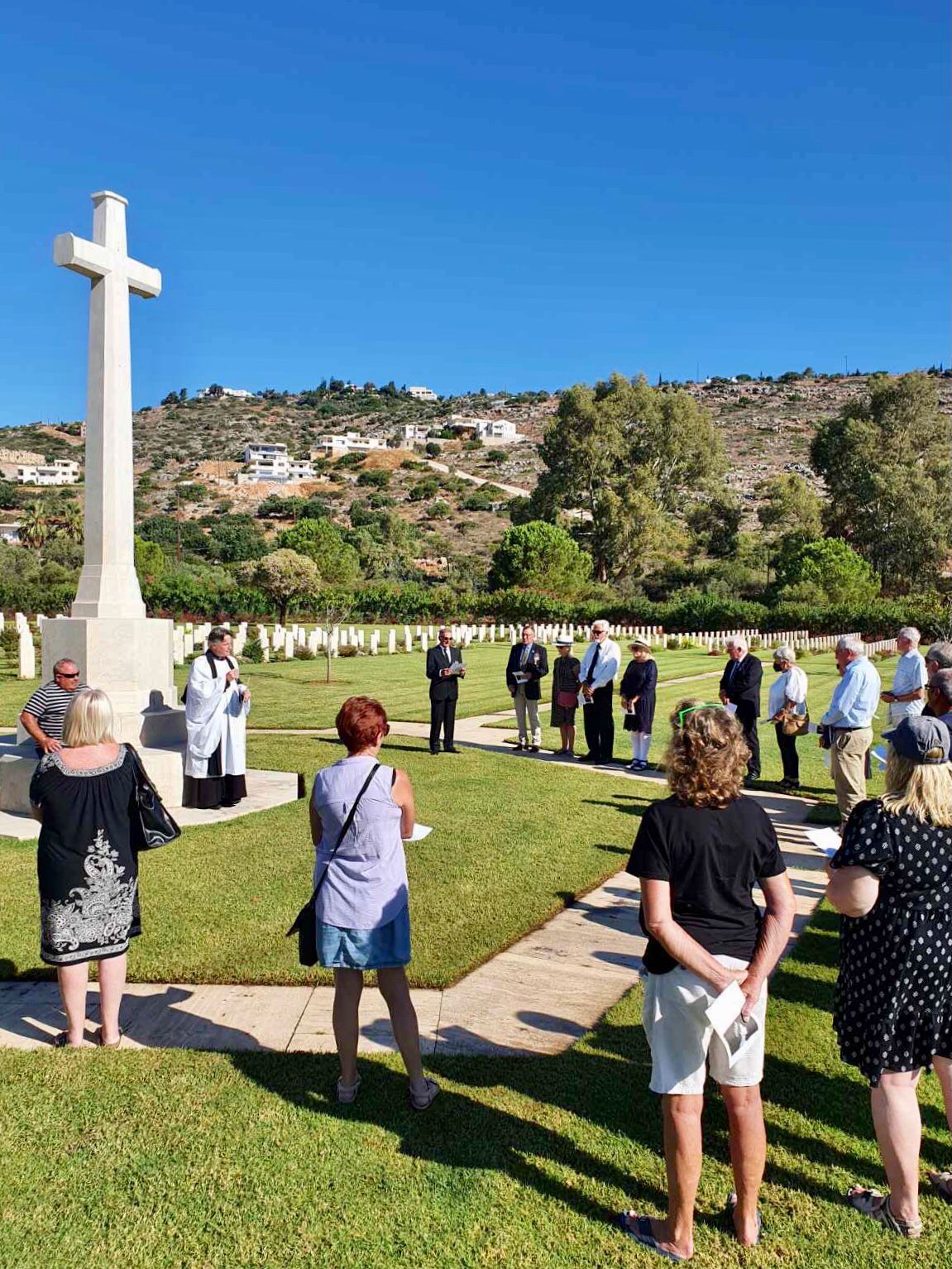
Delivered at Souda Bay Commonwealth War Graves Cemetery, Souda, Crete, Greece September 16, 2022, 10:00 am
Second Subaltern Elizabeth Windsor receives vehicle maintenance instruction on an Austin 10 Light Utility Vehicle while serving with No 1 MTTC (Motor Transport Training Centre) at Camberley, Surrey. From here.
We are gathered here on hallowed ground – ground that is holy not because of consecratory prayers made by a vicar or chaplain, or because it was a gift from the Greek nation to the Commonwealth War Graves Commission, but because it contains the earthly remains of over 1700 young men who made the ultimate sacrifice while serving in the Armed Forces of the United Kingdom, Australia, and New Zealand, as well as other parts of the Commonwealth.
For that reason it is right for us to gather here to give thanks for the life, service, and witness of Her Majesty Queen Elizabeth the Second. There is no place on this island that has a stronger connection to the Crown.
A second reason for us to gather in this place is that Her Majesty was the Commander-in-Chief of the various armed forces. She was the Colonel-in-Chief of multiple regiments, both in the UK and in other nations of the Commonwealth. She was the wife, mother, and grandmother of people who served in the Forces. She presented new regimental colours and annually trooped the colours of her guards. She attended countless commemorations of battles and wars. She attended military graduation ceremonies, and those serving made their oaths to her. All officers’ commissions were given in her name. She was the lead mourner on Remembrance Day. I suspect that in her weekly meetings with UK Prime Ministers she was a quiet advocate for the serving members of the Armed Forces and veterans. In a multitude of ways she supported those who defended the nation.
But there is a third reason as to why it is right for us to gather in the presence of those buried here in this cemetery – she, also, served in the Second World War. Of course, as a teenager and a female her service was restricted, and she never saw battle. However, she participated as much as she could – as part of the Auxiliary Territorial Service. I would not be surprised if, of all of the ranks she carried in her long life, she was most proud of having been a Second Subaltern and Junior Commander in the ATS.
So let us give thanks and commit to God Junior Commander Elizabeth Alexandra Mary Windsor, our late Sovereign Lady, Queen Elizabeth.
Part of those in attendance at the short service. About forty people attended, mostly veterans.
Prayers and Blessing
1 – A prayer of thanksgiving
Eternal God, our heavenly Father, we bless your holy name for all that you have given us in and through the life of your servant Queen Elizabeth.
We give you thanks: for her love of family and her gift of friendship; for her devotion to the United Kingdom and the nations of the Commonwealth; for her grace, dignity and courtesy and for her generosity and love of life.
We praise you for: the courage that she showed in testing times; the depth and of her Christian faith; and the witness she bore to it in word and deed.
Accept our thanks and praise, we pray, through Jesus Christ our Lord. Amen.
2 – A prayer of commendation
God our creator and redeemer, by your power Christ conquered death and returned to you in glory.
Confident of his victory and claiming his promises, we entrust your servant Elizabeth into your keeping in the name of Jesus our Lord, who, though he died, is now alive and reigns with you and the Holy Spirit, one God now and for ever.
Amen. Common Worship*
3 – A prayer for those who mourn
Father of all mercies and God of all consolation, you pursue us with untiring love and dispel the shadow of death with the bright dawn of life.
Give courage to the Royal Family in their loss and sorrow.
Be their refuge and strength, O Lord; reassure them of your continuing love and lift them from the depths of grief into the peace and light of your presence.
Your Son, our Lord Jesus Christ, by dying has destroyed our death, and by rising, restored our life.
Your Holy Spirit, our comforter, speaks for us in groans too deep for words.
Come alongside your people, remind them of your eternal presence and give them your comfort and strength. Amen.Common Worship*
4 – A prayer for the new King
Lord God, you provide for your people by your power, and rule over them in love:
Grant to your servant our King the Spirit of wisdom and discernment, that being devoted to you with his whole heart, he may so wisely govern, that in his time we may live in safety and in peace; through Jesus Christ our Lord. Amen. Adapted from the Coronation Service 1953
Blessing
God grant to the living, grace; to the departed, rest; to the Church, the King, the Commonwealth, and all humankind, peace and concord; and to us and all his servants, life everlasting; and the blessing of God almighty, the Father, the Son, and the Holy Spirit, be among you and remain with you always. Amen.
Dismissal
May the memory of our late Sovereign Lady Queen Elizabeth the Second, whom we honour this day, be a blessing for us this day and always. Go in peace, in the name of Christ. Amen.











 The Island Parson