You are the Coin in this Scenario

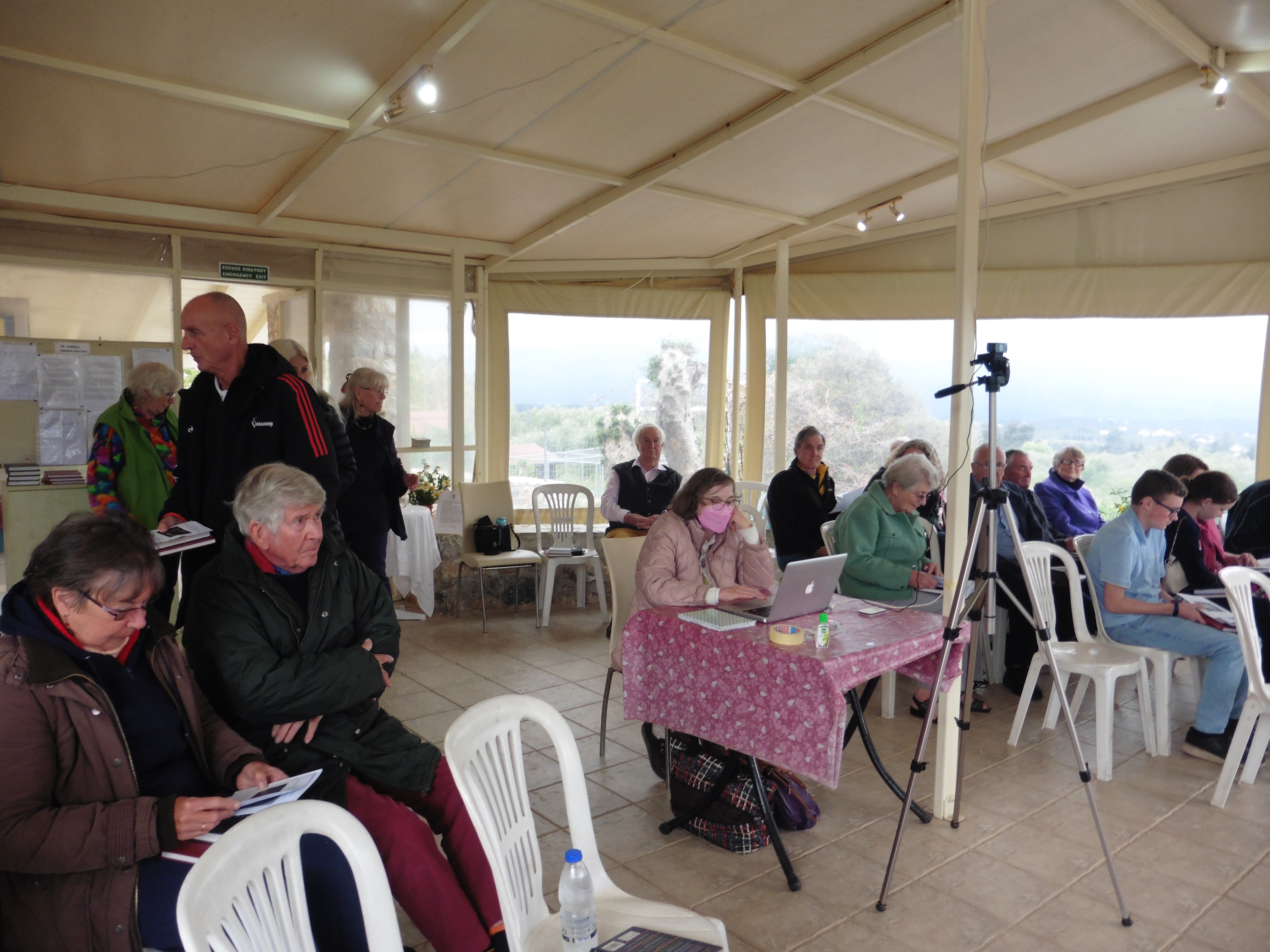
A sermon preached on 14 September 2025 at the Anglican Church of St Thomas the Apostle, Kefalas, Crete, Greece, a chaplaincy of the Diocese in Europe in the Church of England.

The readings were: 1 Timothy 1:12-17, Psalm 51:1-11, and Luke 15:1-10

In the movie When Harry met Sally (1989) Harry (played by Billy Chrystal) and Sally (played by Meg Ryan) have the following conversation at the wedding of their close friends Jess and Marie. Harry is the best man and Sally is the maid of honour. It’s important to know that Sally and Harry have had a falling out and haven’t spoken for weeks.

Harry Burns: You know how a year to a person is like seven years to a dog?
Sally Albright: Is one of us supposed to be a DOG in this scenario?
Harry Burns: Yes.
Sally Albright: Who is the dog?
Harry Burns: You are.
Sally Albright: I am? I am the dog? I am the dog?

I thought of this passage while reading the gospel this morning: 

Which one of you, having a hundred sheep and losing one of them, does not leave the ninety-nine in the wilderness and go after the one that is lost until he finds it? . . . Or what woman having ten silver coins, if she loses one of them, does not light a lamp, sweep the house, and search carefully until she finds it?

In these scenarios, you are the coin, you are the sheep. In the Kingdom of Heaven God is portrayed in these two short parables as anxious and desperate, something I preached about nine years ago when I was the interim priest in charge at the Anglican Church of St John the Baptist in Cobble Hill, South Cowichan, on Vancouver Island in British Columbia. You can read what I preached then in the link, but today I want to focus on being lost.

We are the Lost Coin. We are the Lost Sheep.

There are so many ways in which we might consider ourselves to be lost.

Spiritually

We might find ourselves lost spiritually, which is often the only way these two parables are read. Perhaps we have lost faith in God, or never had it. Perhaps we have lost the presence of God in our lives, as Mother Teresa experienced. Perhaps it is an intellectual problem leading to a spiritual one. Many divinity students arrive in theological schools with a naive idea of the scriptures, and are startled to encounter historico-critical methods that reveal the human nature of Biblical texts and call into question their inerrancy and infallibility; reconstructing a more complex understanding of divine inspiration in conjunction with an understanding of salvation being through belief in Christ and not in a particular understanding of scripture usually follows. Then again, perhaps we have experienced abuse in the church, and the way in which this abuse happened and the way it was dealt with by officers of the church may affect one’s faith. In the gospels the lost are often correlated with sinners such as sex workers, publicans, tax collectors, and so forth, although the elites, such as Pharisees and scribes, the Sanhedrin, and wealthy Jewish landlords, are often described as blind and misleading, although they believed themselves in the right. However, they may also be those who have been oppressed by the powers that be, including religious authorities. Through no fault of our own, we may find ourselves estranged from God. Thus, whether we are at fault or someone else has so traumatised us that we are removed from the divine, we are all lost and in need of being found by God. We believe that in Christ we are found – God takes the initiative and we respond.

Mentally

We may be lost mentally, through no fault of our own. Paul writes in his First Letter to Timothy

I was formerly a blasphemer, a persecutor, and a man of violence. But I received mercy because I had acted ignorantly in unbelief

Paul has a very clear view of what he was, and while his First Century context does not allow for him to psychologise himself, he understands the grace that he has received as something granted because he was just ignorant and unbelieving.

We may also be caught up in alcoholism or other addictions, which is a range of diseases that afflicts perhaps up to 25% of the population. It is hard to get spiritual when one’s highest power is alcohol, cocaine, or opioids.

We may be traumatised and perhaps have lost confidence in ourselves and others, and have developed behaviours that impede us accepting the good news and to trust in a generous God.

Politically

We may find ourselves having lost faith in the political systems and being filled with despair. Part of this is undoubtedly a function of both our traditional media and more recent social media. The traditional media always seemed predisposed to highlight bad news – “It it bleeds it leads” is an old journalistic adage. One only needs to have read the headlines of the London dailies to see how vituperative the authors and publishers can be. Likewise, social media takes up all the oxygen in the room with false news and conspiracy theories, and makes the old newspapers look gentlemanly in comparison.

And so we we are painfully aware of what is going wrong in politics and diplomacy, and of the human cost in lives and degradation. We do not hear the good news – the number of people that have been lifted out of extreme poverty, the general increase in wealth in the post-war era, or the extent to which violence in war has become the exception and not the rule throughout the world. Bad news generates passion and votes in a way that sunny messages do not, and so manipulative autocrats get people to act on their fears and not the better angels of their nature. And so perhaps we give up, failing to engage in civil action or even vote.

Environmentally

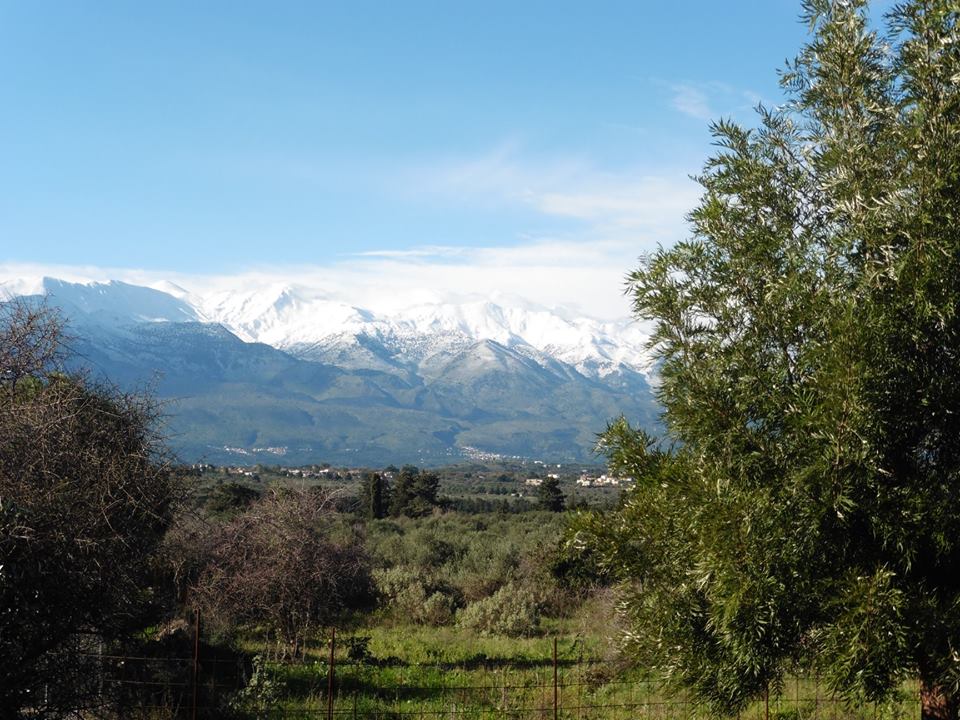
And associated with political despair is concern for the planet, something which seems to have disappeared in the past few years. Whether it is the rise of governments that deny climate change, or, as in my home country of Canada, regimes that seek to expand the sale and distribution of petroleum products, it is a depressing time. Here on Crete we see olive farmers having to harvest their trees earlier and in warmer climates. The snowfall on the mountains seems to be less and less, and the temperature in Athens in the summer seems to be climbing.

The White Mountains (Λευκά Όρη) from St. Thomas’s. Photo by David Hurley.

This environmental degradation has been going on a long time. We look out from this Tabernacle and see a beautiful scene of valleys and mountains, but the fact is we are looking at a view that has been transformed by human beings over the millennia. In the period of the Roman Empire the number one export was not olive oil, but lumber. We do not think of this island of Crete as being heavily forested, but it was, and the trees here served to build the apartments in Imperial Rome and the ships of the fleets that brought wheat from Egypt and North Africa. After the trees went, erosion wore down the soil, so that trees will no longer grow all the way to the tops of the mountains. The plains of Chania and Rethymno, which used to be fields with various grains such as wheat and barley, and now paved over with concrete for Cretans and tourists, creating situations that result in flash floods.

Physically

Of course, most of us here are older people and we may be entirely too caught up in the ravages of age. I spent three weeks earlier this year on sick leave, and some of us here are experiencing cancer in ourselves or in our close family. We literally do not bounce back like we used to, as I found out when I hurt myself jumping down from one path to another in Gibraltar in early March, resulting in a need for crutches. We eat the wrong things, carbohydrates and junk food, too much fat and sugar, and develop diseases such as Type II diabetes. We are far too sedentary. We may be lost in bad behaviours that we could get away with as young adults but are not reaping consequences in chronic conditions. Our environment plays into this, of course; microplastics are everywhere, including our brains, and we really have no sense of what effects they are having on us.

I Once Was Lost, But Now am Found

The good news is that despite all these ways of being lost, God is at work in the world and among us. God has not abandoned the world but in the person of Jesus Christ has come among us, and deigns to eat and drink with tax collectors and sinners. Every Sunday we are bidden to eat at his table and be refreshed for the coming journey, to hear his word and be inspired to be made new in the image of Christ. The Christian hope is an impossible hope, in taht it is rooted in the belief that Christ rose from the dead. It is a hope in the face of despair, and promise of being found despite the sense of being lost.

We believe that in Jesus God has already acted to rescue us from being lost politically, spiritually, physically, mentally, and environmentally. We are called to open ourselves to God’s healing grace and be made different from what we were. The Kingdom of this World is by no means the Kingdom of God, but as part of the Body of Christ we can begin the work of making it so, bot individually and collectively. You were a lost coin, but now you are found. We were lost sheep, but the shepherd has collected us. Heaven rejoices, and so should we.

Posted in Crete, Sermons | Tagged , , , , , , , , | 2 Comments

The Cost of Discipleship

A Sermon preached on the Twelfth Sunday after Trinity (Proper 18), September 7, 2025, at the Anglican Church of St Thomas the Apostle, Kefalas, Crete, Greece, a chaplaincy of the Diocese in Europe.

The readings were: Philemon 1-25, Psalm 1, and Luke 14:25-33

One of the longest-running programmes on US television is a game show called “The Price is Right.” Originally broadcast from 1957-1965, it started up again in 1972 with the host Bob Barker, and it continued with him until 2007, a remarkable thirty-five year run. Since then the comedian Drew Carey has been the host, and it is now entering its fifty-fourth season. The gist of the show is that contestants must guess the costs of particular items without going over the retail price. There are a variety of games within the show. I did not know this, but apparently it has been exported or imitated in some fifty-one countries, including versions on an English-language network in Canada (with host Howie Mandel) and French-speaking Canada, as well as the United Kingdom (with a variety of hosts, including the well-named Bruce Forsyth).

I never got into the show, and never understood the attraction, and as a kid glued to the television I preferred Bob Barker’s earlier show Truth or Consequences. Well, as the phrase goes, De gustibus non est disputandum – in matters of taste there is no arguing.

One price that the show never addressed, though, is the cost of discipleship. What does it cost to follow Jesus?

Cheap Grace and Costly Grace

The German Lutheran pastor and theologian Dietrich Bonhoeffer (1906-1945) in 1937 published a book that has since become a classic, The Cost of Discipleship. In the first chapter he contrasts what he calls cheap grace with costly grace. It is an idea he first came across when attending an Afrrican-American church in Harlem, while at Union Theological Seminary in New York City. Interpreting it for his German Lutheran audience he wrote:

Cheap grace is the preaching of forgiveness without requiring repentance, baptism without church discipline. Communion without confession. Cheap grace is grace without discipleship, grace without the cross, grace without Jesus Christ, living and incarnate . . [It is to hear the gospel preached as follows: ] “Of course you have sinned, but now everything is forgiven, so you can stay as you are and enjoy the consolations of forgiveness.

Costly grace is the acceptance by a believer that with the gift of salvation, given in the life, death, and resurrection of Jesus, that one is transformed. Salvation is not something just imputed to the person and otherwise leaves them unchanged, but it should radically change the way in which a person behaves. As Paul writes in 2 Corinthians 5:17,

So if anyone is in Christ, there is a new creation: everything old has passed away; look, new things have come into being!

Christian discipleship calls into question, then, the way of the world – politics, mores, values, behaviours – and puts them under the powerful light of Christ. 

For Bonhoeffer this was more than just a theological idea. He lived in the era of the rise of Adolf Hitler and the Nazis in Germany. Although he had the opportunity of living outside of the Third Reich, he chose to return to Germany and live in dissent from the Nazi regime. While Hitler tried to force all Protestant churches into one organisation under a German National Bishop, Bonhoeffer and others founded what they called the Confessing Church, which rejected government control, as well as many of the violent racist policies that had been decreed since 1933. Bonhoeffer taught at its underground seminary and built networks across the country. Ultimately Bonhoeffer became involved in the resistance, and sought to communicate with the Allies in 1943, mainly by meeting Bishop George Bell of the Church of England in Sweden. Apparently he was aware of various plots to assassinate Hitler, and while he struggled with the violence this required, he was not a pacifist. He was arrested in 1943 and judicially murdered  in April 1945, not long before the end of the war. Bonhoeffer knew that the price of discipleship was one’s life, one’s soul and body, and in his case he was willing to be literally put to death for following his Lord. 

The Cost of Obedience

The gospel reading from Luke puts the cost in strong terms:

“Whoever comes to me and does not hate father and mother, wife and children, brothers and sisters, yes, and even life itself, cannot be my disciple. Whoever does not carry the cross and follow me cannot be my disciple. . . . So therefore, none of you can become my disciple if you do not give up all your possessions.”

The Disputation in the movie version of “The Name of the Rose” (1986)

Is this to be taken literally? One commentator suggested that Hebrew and Aramaic may not have had the shades of meaning that English has that allow one to rank virtues, and so one has to use the extreme language or nothing. Perhaps. It may simply be hyperbolic language, deliberately overstating the case in order to make a point. Or, it may need to be taken literally. St Francis of Assisi was famously in great conflict with his father over his choice to live in poverty and literal obedience to the commandments of God. It was not that he hated his father, but his disobedience appeared that way. Likewise, he and the Franciscans gave up their belongings and lived by begging. Some ultra-Franciscans, known as Spirituals, were adamant about owning absolutely nothing. You may recall that in Umberto Eco’s book “The Name of the Rose” the ecclesiastics gathered in the library-monastery in order to debate whether Christ owned his own clothes.

Most of us have implicitly chosen not to take this commandment literally, but it does raise the question about our values. Do we own our possessions, or are we owned by them? To what extent is our consumer society warping our ability to live Christian lives? Is God more important than family, or do we somehow transform the values so that they considered equivalent? What cost are we willing to bear to follow Christ, as individuals and collectively?

The Cost of Freedom

It is not often that we read a whole book of the Bible in one go, but that is what we did this morning when Barbara read the Letter of Paul to Philemon. I do recall that at a Clergy Conference in the Diocese of Niagara my friend and Hebrew scholar Walter Deller had the attendees, on the first night, read the whole of the Book of Deuteronomy; I think it took them some two and a half hours, and some of the clergy were not happy! Well, fortunately, Philemon is only twenty-five verses long and Barbara’s reading was pretty normal in length. It may have been written on a single sheet of papyrus, the First Century equivalent of a postcard.

Papyrus 87 (𝔓87), containing fragments of the Letter to Philemon 13-15.

It is not immediately clear what is going on in the letter until one reads it several times. The letter is from Paul to Philemon. Both are Christians, and Paul evidently played a major role in Philemon’s becoming a follower of Jesus, for he writes of the recipient’s “owing me even your own self.” Philemon owned a slave named Onesimus whose name means “Useful”. Onesimus has run away from Philemon and woulnd up in the same place as Paul, whether by accident or design. Onesimus has now become a Christian, and while the slave has been useful to Paul in his imprisonment, probably bringing food and carrying out other tasks, he is now being sent back to Philemon. However, Paul urges him to accept Onesimus back not as a slave but as “more than a slave, a beloved brother” – implicitly telling Philemon to free him.

The freeing of slaves was fairly common in the ancient Roman Empire – slavery was not based on ethnic or racial lines, but on the vagaries of war – if you lost a war and were not killed, you were usually sold by the conquerors for profit; Julius Caesar made his fortune primarily by selling Gauls as slaves. Household slaves, like the type that Onesimus probably was, were more likely to be freed than those working in the fields, and freedmen automatically gained the citizenship of their owners, and were in a client-patron relationship with them.

Paul uses a variety of arguments to persuade Philemon to do his bidding. He asserts that he could command him to do it, but says he wants Philemon to do it voluntarily (this is like being “voluntold” to do something). He invites Philemon to treat Onesimus as he would treat Paul, and he points out his suffering as an old man and as a prisoner for Christ.

While we have no direct evidence of the outcome, Ignatius of Antioch (who died circa 108 CE) mentions an Onesimus who was an early bishop in Ephesus. Was it the same person?

In any case, the cost of discipleship for Philemon is clear – the cost of the slave Onesimus. The price for a healthy slave varied, but 2000 denarii is what one might have paid for a labourer in the early Empire; the translation of this sum into modern values is sheer speculation, but as a denarius is a day’s wage, 100,000 Euros might be an approximation. By any standard, this is a lot of money. How would you feel if your pastor wrote you to say that you need to spend 100,000€ in obedience to Christ?

The Personal Decision to Pay the Cost

While people might make suggestions to us about what we might do in obedience to Christ, the understanding today is that each of us needs to make a personal decision about what that is. We recognise that we may not necessarily get it right, but we trust that God has already forgiven us as we proceed in faith and get it wrong. Having been saved, we need to still work out our salvation in fear and trembling, and to pay the costs that that work demands.

For some of us it may simply be living in the world apparently normal lives, but sanctifying the relationships we have. As a young man Martin Luther thought that, like Francis of Assisi, he needed to join a religious community which enjoined celibacy, prayer, and poverty, in his case, the Augustinian Friars (the same order to which the current Pope, Leo XIV, belongs). In the midst of the Reformation, and after many trials and much progress, Luther turned towards married life in 1525 by marrying an ex-nun, Katharina von Bora, who bore him six children. His example not only inspired other parts of Europe to have clergy be allowed to marry (such as the Church of England), but also presented a model and argument for the holiness of family life that was so often deprecated by the religious orders.

How might we work out that salvation in fear and trembling? Here are a few suggestions.

  • Make time for prayer. It can be simple, like the Lord’s Prayer three times a day. It can be contemplative prayer (meditation) in which one says a prayer phrase repeatedly to enter a state in which the soul listens. Perhaps we might say the Daily Offices of Morning Prayer and Evening Prayer. Perhaps we might follow the Ignatian practice of examining every evening the events of the day. The cost for any of these is the time and effort to make this a regular practice.
  • Study. The cost might again be time, but also the cost of engaging in conversation with other Christians about scripture or theological issues. There may be a cost for materials, such as books, or residency at a workshop.
  • Action. How do we act on our personal beliefs? This might involve the cost of making a donation to a charity or a group that advocates for particular causes, such as Médecins Sans Frontières (Doctors without Borders), A Rocha UK, or Amnesty International. We might get involved in their campaigns lobbying politicians. As people in Europe we are blessed with civil rights to do more than just vote, but to organise and act. How do we speak truth to power? How do we collectively, whether through government or non-governmental agencies, reach out and help our neighbours, especially those most marginal in our society?

In all of this you will see that I am not directive, although I probably could be! I believe, though, that the cost of discipleship will look different for each of us, just as it did for Bonhoeffer, and for Philemon and Paul. My hope and prayer is that in all of this we are truly transformed, and as individuals and collectively we become ever more like Jesus Christ, and that people will see our good works and give God glory.

Posted in Sermons | Tagged , , , , , , , , | Leave a comment

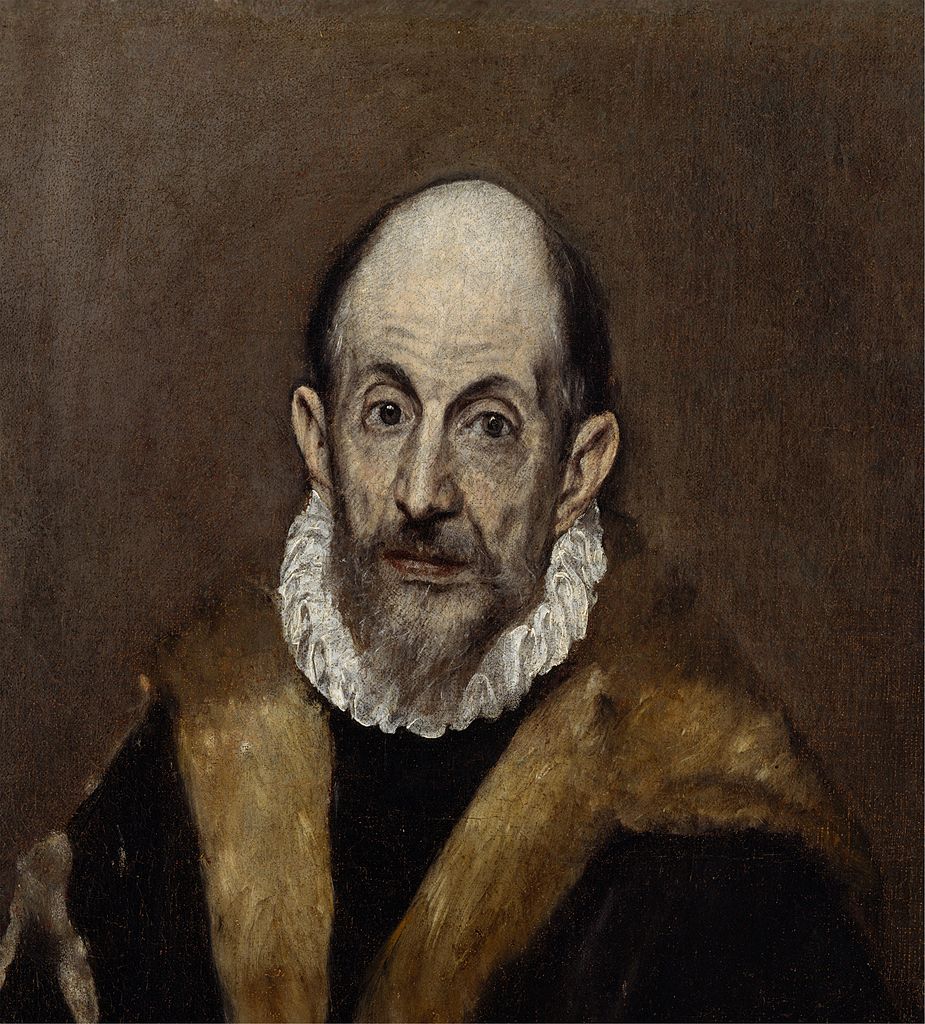
Me and Domenikos in Toledo

View of Toledo, Domenikos Theotokopoulos (El Greco)

I’ve just spent two-and-a half days in Toledo, Spain, which was, for the last thirty-seven years of his life, was the home of Domenikos Theotokopoulos, better known to people then and now who cannot wrap their tongues around Greek names as “El Greco” – “the Greek”. An ambitious man, he was born and raised on the island of Crete outside of what was then called Candia and is now known as Irakleio. He learned to paint there, but in Greek Orthodox Crete that meant “writing” icons. Two of those icons are at the Benaki Museum in Athens, and neither are in good condition, nor show any sign of greatness.

Crete at the time had been under the control of the Venetian Republic for several centuries, and he would have been exposed to western, Catholic styles. Wanting to learn from the best, he went to the big city, which for him meant Venice, where he learned to paint in the “Mannerist” style. While he appears to have had modest success there, he wanted greater things, and so went to Rome. He did not achieve the success there he desired, but he did make the acquaintance of a Spanish cardinal, and so made his way to the cultural centre of Spain, the Imperial City of Toledo.

The Disrobing of Christ, 1577-1579, The Sacristy of the Primatial Cathedral of Toledo

There are dozens of his works in Toledo, many of them forming retables or reredoses behind altars built in churches and monasteries of the late 16th century and early 17th. His work stands out from those by other painters that went before and after. The ones before were not particularly realistic, and the ones afterwards tended to be quite realistic; the vast majoity are not very interesting. The paintings of Theotokoupolis are striking and impressive for two, perhaps three reasons. First, the personages in it often appear elongated, long and thin, especially if they are the central character. It is suggested that this makes them appear more holy, although there is also the effect that as one’s eyes scan these painted bodies one’s perception is that the body is floating and ascending. Second, his colors are bold, especially the greens, the reds, and the blues. More subtly, the reddish-brown background that is used as a foundation on the canvas is not always overpainted, but allowed to show through, thus creating a sense of depth. Third, in his large paintings (not his portraits of apostles or commissions of living figures), they are heavily populated; this can be seen in the Burial of Count Orgaz and the Disrobing of Christ (above).

The paintings of Theotokopoulos are like figure skating. Just as the elite skaters at the top of the field are excellent technicians and makes it look easy, so it is easy to think that his paintings are simple. It is only when you look at the works of his students or others of his time that you realise how good he is. There is a freshness to his paintings that inspired the Impressionists. His paintings, while firmly in the expected genres of his time, still look out of place. There is a weird, uncanny quality. When I see his work I constantly think, “How did he get away with that?” 

Part of this may go back to his experience as an icon painter. Icons, notoriously to western viewers, do not have perspective. Theotokopoulos can do perspective, but he is not wedded to it. His painting of Toledo is not what Toledo actually looked like, but the painting captures somehow exactly what I remember it looking like. He is more interested in the spiritual meaning of what he is painting than being rigidly tied to renaissance ideals of perspective. Thus, he warps perspective to bring things into play, highlighted here, diminished there. Furthermore, his faces are paradoxically both non-realistic and very realistic. At first glance they look almost generic, quickly painted portraits. However, I found that the longer I gazed at them the more real they seemed, and conveyed something of the character the Cretan was trying to portray.

The same is true of his portraits. The picture at left, often identified as a self-portrait, captures the assymetry of a true face, and the clear-eyed repose of someone who knows a thing or two. There’s no flattery, and it is neither a mere sketch or a hyper-realistic portrait. It catches a moment in the man’s life,no more and no less.

Theotokopoulos is unique and left no school to follow him, but he inspired the Impressionists in the 19th century and after a couple of centuries of neglect he received great attention from the beginnings of the 20th century. He used to be characterised as a mystic, but art historians over the past one hundred years, looking at the documentary evidence of his contracts, his lawsuits about fees, and his marginalia in contemporary books on art, find him to be an artist of strong opinions about technique and his own worth, and not given to ethereal musings. Since the last quarter of the 20th century he has become the centre of a small tourist industry in Toledo and the great museums of the world, where ordinary people briefly look at his paintings, and art historians write vast tomes that discuss everything about hos context and the history of the painting, but don’t explain why it is important. My own view is that we see in his work someone who had a particular vision and figured out how to express it in canvas and paint, uprooting himself several times to do so, and thriving despite his striking style. I am glad that he was celebrated in his day and has left us so much to continue to inspire us.

Posted in Culture | Tagged , , | Leave a comment

A Necessary Competency in any Bishop

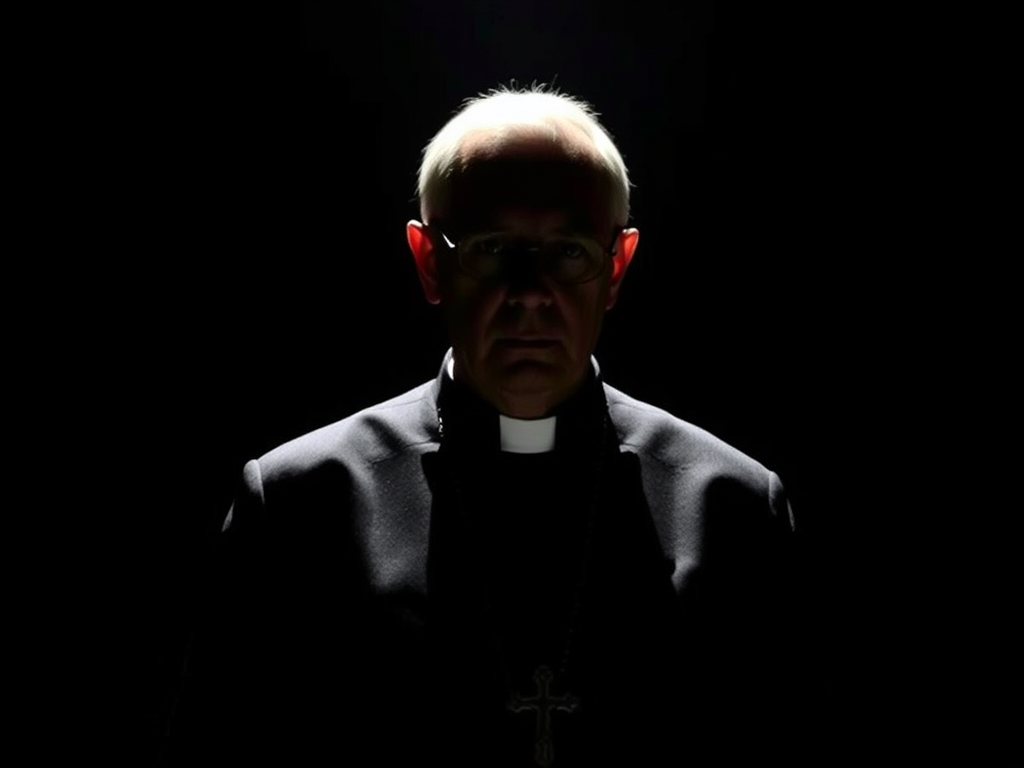
Being a priest on the island of Crete, I am far from the centre of things in the Church of England; I rather revel in being the priest of a peripheral congregation in the diocese no one remembers is part of the Church of England (that would be the Diocese in Europe). Nevertheless a number of people here on the island – admittedly UK citizens living here – have asked what I thought about the recent resignation of Justin Welby, the Archbishop of Canterbury. These queries have come from both regular members and people who have never been to the Anglican Church here on Crete.

My response is, “He had to.” It is a question of competence. There is no excuse for a bishop or anyone else in a position of authority to tolerate a sex offender in a position of trust in the church; it is a necessary competency to be able to act decisively to prevent harm, deal with abusers, and provide redress for victims.

My experience in the Anglican Church of Canada is that, even if there are good reasons for the police or the Crown not to go forward with criminal charges and a trial, the church authorities nevertheless should make its own investigation of the facts, determine any required discipline and action to prevent the individual from harming others, and generously support the victims of abuse.

  • If they hear rumours, or receive a formal complaint, they must be investigated. In the Church of England each diocese has a Safeguarding Officer and a Diocesan Safeguarding Team, with responsibilities for prevention, training, and responding to allegations. There is also a National Safeguarding Team with responsibility over National Church Institutions.
  • If it is an alleged criminal offense, it must be referred to the police.
  • And one’s responsibility does not stop there – it must be followed up.

Now, I served in Canada for thirty years before coming to the Church of England six years ago. The church cultures around safeguarding and discipline are a little different. In Canada, upon receiving a formal, written complaint about sexual misconduct, the diocese I worked in would initially determine what kind of category the abuse was.1

  • If it was criminal and involved sexual assault, or abuse of children, it was always referred to the police, while not abdicating any responsibility to pursue church procedures. The individual was invariably suspended pending the outcome of the situation (if employed, suspended with pay). The vast majority of such formal complaints were upheld, and the person’s employment or volunteer position was terminated; if ordained, the individual lost their license and the permission to officiate. Indeed, in most cases the person was advised not to dress as a minister when on the properties of the church, and some clergy were invited to relinquish their orders, or were formerly considered to have abandoned ordained ministry by their misconduct.
  • Sexual Exploitation involved sexual relations between two adults but was not criminal, the critical question being whether this was a fiduciary relationship, and could consent be meaningfully given. Was one of the persons in a relation of trust with the other, or was there a power differential? For example, a priest is in a fiduciary relationship with any parishioner or someone who comes to the church for help. If the priest then uses that relationship to satisfy his or her own perceived relational needs (such as sex), then that is exploitation of a position of trust. This was also true of choirmasters, youth leaders, and others in positions where power could be exercised. Following a formal complaint, the alleged offender was suspended pending determination of the facts. The fundamental issue is whether consent can be meaningfully given.
  • If it was harassment or bullying of a sexual nature, this was sexual harassment. While a person might be suspended, generally they were cautioned about interaction with the alleged victim, and resolutions were found through professional mediators.

Now, here’s the problem as I understand it. Justin Welby, when he became Archbishop of Canterbury in 2013, was informed of a host of complaints against John Smyth, a barrister who ran the Iwerne Camps for teenage boys from English “Public Schools” (i.e. expensive private boarding schools), often at Winchester College, where they were presented with a series of talks on the gospel from a conservative Evangelical perspective. The goal was to turn the young male elite of the nation into Evangelical Christians, so that, when they inevitably advanced in business, the church, and government, they would be Evangelicals in prominent places. As the Wikipedia article on Smyth notes, “An independent review published in 2024 concluded that he subjected more than 100 boys and young men to “traumatic physical, sexual, psychological and spiritual attacks” over a period of four decades.” The Iwerne Trust was made aware of the abuse in the early ’80s, but did not refer it to the police for thirty years. He attempted to be accepted as a candidate for ordination in the late ’70s and early ’80s, but was refused, leading many to think that the abuse he perpetrated was known to Church authorities. Likewise, he had qualified as a Lay Reader in the Diocese of Winchester, and thus licensed to preach and lead worship services as a non-ordained person, but this ceased in the early ’80s – again, did someone remove him as a Lay Reader because of whispered rumours? After Smyth was confronted with the allegations he moved to Zimbabwe in 1984 and South Africa in 2001, and continued his abuse there. He died in 2018 having never faced any kind of charges. His own son said his father was “the most prolific abuser connected to the Church of England.” Ironically, this abuser was a campaigner against human rights for LGBTQ+ persons and acted as a barrister for Mary Whitehouse in lawsuits around blasphemy and gross indecency.

Welby’s error in 2013 was that he personally did not ensure that the allegations were followed up. There are a couple of reasons he may have failed in this. First, he was all too content to let others handle it in a confidentiality that passed over into secrecy, when he should have been on top of it and ensuring transparency about the complaints and prompt redress for the victims. A second reason may be that he personally knew Smyth and considered him “charming” and “delightful”. Indeed, Welby himself attended an Iwerne Camp as a teen from Eton, and volunteered at them for three years in the ’70s. He says he never heard any rumours about Smyth, despite being involved in the camps and the Iwerne Trust as a teenager, a businessman, and and divinity student. He did not expose Smith, nor did he contact his episcopal colleagues or the police in Zimbabwe and South Africa, to where Smith had moved, of the danger that he presented. This failure is the reason he had to resign.

I am not sure that Welby understands this. While he accepted responsibility and resigned, the impression one gets, especially from his tone-deaf valedictory speech in the House of Lords, is that he saw himself as being the one who takes the fall for the good of the church – a vicarious victim to the systematic abuses of the Church of England. Those of us who pay attention to such things have yet to receive the comprehensive statement about why he did not act more appropriately in 2013. It looks like a reckless disregard for ensuring that the complaints were properly dealt with – and that is his personal failure, not just the result of a systemic problem.

Do others need to resign over similar neglect? People have pointed to Stephen Cottrell, the Archbishop of York, who as Bishop of Chelmsford in the 2000s allowed a priest, David Tudor, who had been charged with sexual assault back in 1988, to continue in ministry in a parish – and indeed, was made an honorary canon after serving as an area dean. Despite he having paid compensation to a victim – an effective admission of abuse – Tudor was allowed to work in the church. Supposedly there was a safeguarding agreement in place that mitigated any threat, but (surprise!) he was subsequently found guilty of sexual misconduct with two more women, and was banned for life after an ecclesiastical trial (finally). At least seven more people have come forward alleging misconduct. While he was acquitted at trial in 1988, the church authorities are not obligated to treat this as a sign of innocence, but rather simply that the Crown prosecutor did not convince a judge that there was sufficient evidence to convict and imprison the man. Now, there is a huge difference between imprisonment – the loss of one’s liberty – and losing one’s office – a matter of employment; instead of using the same standard of proof necessary to imprison Tudor, the Bishop should have erred on the side of caution and refused to license the man.

I have read somewhere that some bishops feel that they have their hands tied because of the rules around the tenure of clergy in the Church of England and the inability of the Church Discipline Measures to allow a bishop to act decisively in the absence of a conviction. This may be so, but this just suggests that clergy have more rights than are justified. Frankly, my advice to Cottrell, had he asked it back when dealing with Tudor, would have been to withhold a license from Tudor regardless of what legal advice he was given. If Tudor felt he was truly wronged he could complain to the church courts, and I wonder whether any Chancellor would have felt it was morally right to put an abuser in a position of trust.

Now, I know that this kind of mitigation did happen decades ago. When I was an archdeacon in the Diocese of British Columbia I helped negotiate a settlement with a victim of sexual abuse in the late 1950s; in that case, as far as I can tell, the priest was moved and simply told to behave. Before I attended Bishop’s College School in Lennoxville, Quebec, a chaplain there in the 1960s, Harold Forster, abused a number of boys, and whenever found out the man simply moved from one elite boarding to school to another (including Harrow and Eton), until he was killed in a train accident in England. As well, I knew of any number of clergy in the ’70s and ’80s who were moved or obliged to resign because of allegations. The Canadian churches have had to deal with the legacy of genocide perpetrated under the “Indian Residental Schools” which were paid for and established by the Canadian federal government, but operated by the churches; among the crimes perpetrated were sexual and physical abuse of children by clergy and laity working there. But all of that was then, when coverups, denial, and minimising were the norm across society. 2013 is the recent now – there is no excuse for quietly covering up abuse, or mitigating a scandal.

Well, there are, unfortunately many other stories like this in the Church of England. Those in leadership need to understand that this is the biggest crisis in the Church of England in a century. The Church of England is facing increasing secularism in England and an ongoing drop in attendance. The news reports around this are devastating, and just as sexual abuse scandals have devastated the Roman Catholic Church in the USA and Ireland, and is contributing to the decline of Southern Baptists in the States, so this underminds the mission of God in the Church of England. Due attention to safeguarding, discipline, and the needs of the abused is essential to the gospel, not something to hope others are dealing with.

Now, I am sure Justin Welby and Stephen Cottrell are otherwise good people, and they do indeed have many competencies, as I have witnessed as a member of the General Synod of the Church of England. Justin Welby leaves behind several good initiatives – the Community of St Anselm at Lambeth Palace, The Difference Course, and the maintaining of ecumenical relations with the Roman Catholic and Eastern Orthodox communions. Cottrell is an inspiring preacher and a deeply spiritual man. However, it is a necessary competency for any bishop that they follow up on complaints and deny the privilege of ministry to those who have abused that trust. For having failed in that regard, Welby was right to resign, and it may well be the case that Cottrell – and some others bishops, too – need to go.

  1. I do need to say that the Anglican Church of Canada (“ACC”) does not have a National Safeguarding Policy, a policy that is the same in every diocese, every Ecclesiastical Province, and all parts of the General Synod structure. In my time in the Diocese of British Columbia we used a slightly modified version of the Sexual Misconduct Policy of the Diocese of Toronto, and it was jointly administered by the Canon for the Sexual Misconduct Policy” and the Diocesan Archdeacon (which was me between 2004 and 2013). It is a robust policy that, unfortunately, has been used hundreds of times across Canada. It requires complainants to make formal, written complaints. The bishop of the diocese can also make a complaint about a perceived abuse if she or he feels it necessary. The policy was not as comprehensive as the Church of England Safeguarding policies, as it focused only on sexual misconduct and not the variety of types of abuse. However, the dioceses of the ACC has been more effective in disciplining clergy and laity, partly because clergy are considered employees and bishops there have more power. In the Church of England the focus is more on whether an individual is an immediate threat to the well-being of vulnerable people. Thus, it is possible that an individual, if they have a safeguarding agreement, might continue in ministry despite admitting sexual assault or exploitation. ↩︎
Posted in Anglican Church of Canada, Church of England, General Synod Church of England | Tagged , , , , | 1 Comment

The Last Honest President

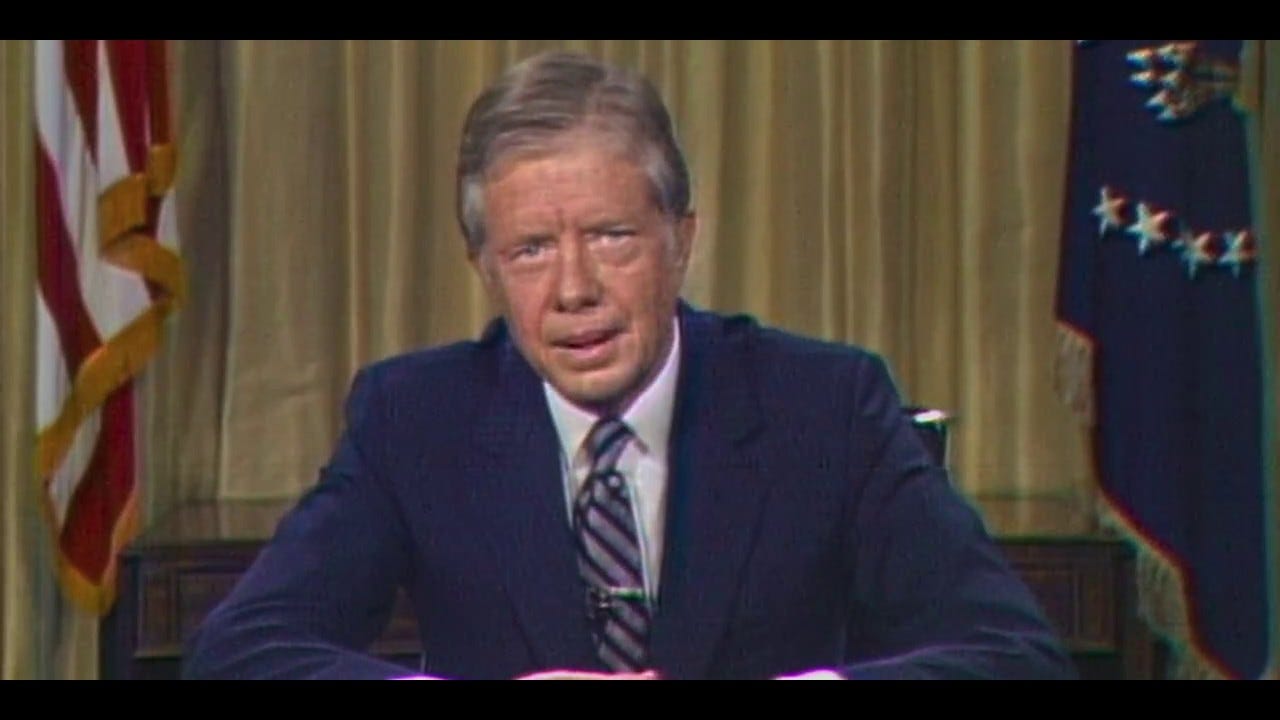
I was a teenager when Jimmy Carter was president of the United States. I became aware of US politics during the presidency of Richard Nixon, and the bad taste for Republicans that his corrupt leadership led to could not be overcome by the decency of Gerald Ford. Jimmy Carter was thus elected very much in reaction to a low point in American politics, when the lies of its leaders reduced confidence in government. Jimmy Carter came to political power promising never to lie and to be straight with the American public, and he was. On July 15, 1979 he gave his television talk that has become known as the Malaise speech, in which he tried to put the energy crisis of the ‘seventies on a moral and civic pane. He pointed out that change was required, and that this would demand some sacrifice from the US public. It was an address that was deeply rooted not only in his political values, but in his Christian values.

His failure to be reelected in 1980 demonstrated that the US public really did not want sacrifice, nor did the want some speaking the truth to them. Instead they elected in Ronald Reagan, a nominal Christian and a former actor, who promised a strong military and a balanced budget, and that economic recovery from stagflation and recession would come from his leadership. He told people what they wanted to hear, rather than what they needed to hear; the American public preferred a hopeful fantasy instead of the honest exhortation to hard work.

Ironically, it was Carter who had already begun that economic recovery. In appointing Paul Volcker to be chair of the Federal Reserve President Carter put in place an economist who would make the hard decisions to tame inflation that previous chairs had avoided because of the inevitable result of increased unemployment. Reagan wisely kept Volcker in place, and, after the Fed raised the prime interest rates, inflation fell from 14.8% to under 3% in three years.

In energy policy Carter deregulated much of the industry, beginning the movement towards the United States becoming a major oil producer again. He also recognised the importance of alternative energy sources, symbolised by placing solar energy panels on the White House.

Likewise, it was Carter who challenged the Soviet Union after the detente of the Nixon and Ford years. In the last two years of his administration the expenditure on the US military increased significantly, again a trend that Reagan continued. While there is a myth that Reagan’s military budget increases somehow caused the fall of the Soviet Union and the Berlin Wall, a real factor in the collapse of communism was that the Soviets lost the war in Afghanistan, and it was Carter who began aiding the Afghan militias and increasing the military budget.

It is hard to think of another President who had as much success in the politics of the Middle East than Carter. He brought together the leaders of Egypt and Israel and ensured that they made peace in the Camp David Accords. There has not been anything like this since.

Carter was unable to solve the problem of the Iranian Revolution and the kidnapping of hostages from the US Embassy in Tehran. Resentment at US interference in Iranian politics boiled over in 1977, and the new Iranian rulers would not negotiate in good faith or respect international norms. Carter did attempt a rescue operation, but the military failed to carry out the objective. The Iranian leadership cynically ensured that the hostages were not released until the day Reagan became president, denying Carter any kind of relief in the eyes of the American people.

With the election of Reagan the US public voted in a supposed Cold War warrior, whereas they replaced an Annapolis graduate and naval officer with someone who played naval officers in the movies. Whereas US Evangelicals, including Jerry Falwell, voted for Carter in 1976, they switched to the much more conservative Reagan in 1980 because he endorsed Southern white anger against welfare and civil rights under the rubrics of “less government” and “rule of law”. The “Southern Strategy” devised by the Nixon campaigns was perfected under Reagan, and the dominance of the South by Republicans began.

Since Carter US presidents have repeatedly lied and broken laws, or been compromised by their financial supporters. Reagan ordered that arms be illegally sold to Iran in the Iran-Contra scandal. George H. W. Bush, unable to convince a wary American public and Senate that it needed to liberate Kuwait from the Iraq invasion, repeatedly told an unfounded story about Iraqi soldiers killing babies, in order to inflame opinion. Bill Clinton sexually exploited a vulnerable intern and then lied about it. George W. Bush ignored intelligence about Saddam Hussein not having weapons of mass destruction, and about having no connections with Al Qaeda, and instead fabricated a justification for the conquest of Iraq. With both Obama and Biden we have individuals who are personally honest, but who hesitated to speak the truth about economics and civil rights to the US public, and are undoubtedly compromised by their dependence on the 1% for election campaigns, and are hamstrung by intransigent members of Congress. And Trump, of course, lies so much that not even his supporters believe him.

Thus we have our unhappy situation today in the United States with a polarised public and a divided opposition. The US public, in electing Trump, have demonstrated their preference for a lying nihilist, a convicted felon who in his business dealings repeatedly failed to pay his contractors; they prefer the liar who makes them feel good rather than a person who tells them the hard truth. This outcome has been in the making for forty-five years.

Today we mourn a president who is lauded for what he did after his presidency. Personally, I also mourn the death of a man who was a far better president than the American public want to admit. May Jimmy Carter rest in peace, and rise in glory.

Posted in Politics | Tagged , , | Leave a comment

Purity and Trees

A Sermon Preached on the 14th Sunday after Trinity in the Season of Creation
at
the Anglican Church of St Thomas the Apostle, Kefalas, Crete, Greece
on September 1, 2024, 11:00 am.

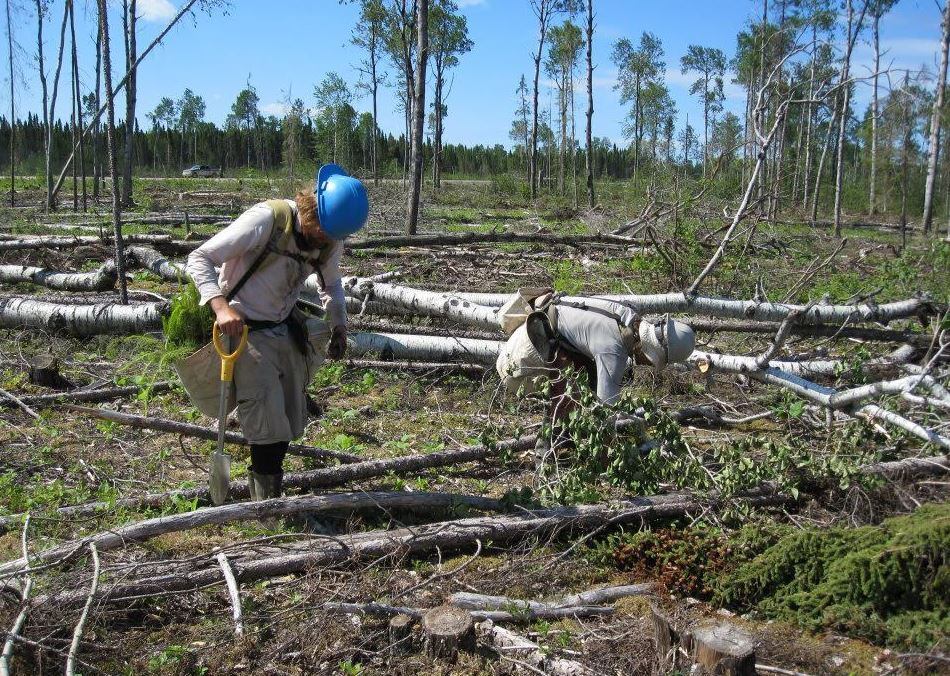
Two tree-planters in a clear-cut near Hearst, Ontario

The readings were: James 1:17-27, Psalm 15, and Mark 7:1-8, 14-15, 21-23.
 

Purity and Grace

The theme in the readings today all relate to purity and impurity, grace and behaviour, true religion and faithless, false unrighteousness.

  • The passage from the Letter of James focuses on the behaviour of Christians – “let everyone be quick to listen, slow to speak, slow to anger; for your anger does not produce God’s righteousness.” This is accomplished through “the implanted word that has the power to save your souls.” Thus, “Religion that is pure and undefiled before God, the Father, is this: to care for orphans and widows in their distress, and to keep oneself unstained by the world.” James writes that Christians are to “be doers of the word, and not merely hearers”. Later, he writes that “faith without works is dead.”
  • Psalm 15 describes those worthy of entering the Tabernacle and of going up to God’s holy hill as being “Whoever leads an uncorrupt life  
    and does the thing that is right;
    Who speaks the truth from the heart 
    and bears no deceit on the tongue.
    Who does no evil to a friend 
    and pours no scorn on a neighbour;
    In whose sight the wicked are not esteemed, 
    but who honours those who fear the Lord.
    Whoever has sworn to a neighbour  
    and never goes back on that word;
    Who does not lend money in hope of gain,  
    nor takes a bribe against the innocent . . .
  • The passage from the Gospel of Mark has Jesus telling his fellow Galileans, challenging the Pharisees and scribes from the Judeans, about what makes a person defiled. It is not the washing of hands or implements so much as what comes out of one’s heart: “fornication, theft, murder, adultery, avarice, wickedness, deceit, licentiousness, envy, slander, pride, folly.”

Now, all of this can be quite challenging. As Paul said in Romans 3:23, “All have sinned and fallen short of the glory of God,” and while I suspect few of us here are truly evil, all of us can identify some way in which we have fallen short. Riffing off of James, I know that I have been slow to listen and quick to speak in anger. I confess that I have not thought much about orphans and widows this week. While mostly honest, I may have been deceitful in some small ways, both to others and to myself. There are always things we have left undone that we ought to have done, and things we have done which we ought not to have done. We have sinned against our neighbour and our God. That is why we usually begin each service here , after the opening hymn, with a confession of sin.

We come here, to this 21st Century Tabernacle in this little Greek village, not out of any conviction about our righteousness or purity, but because we trust in the mercy and goodness of God. We have gathered here not so much as a collection of holy saints as students in a school for sinners, in need of forgiveness and sanctification. We come together to become the Body of Christ not on our own merits but in the goodness we bring as having been created in the image of God and now being recreated in the image of God’s beloved risen Son. We are saved not by our own efforts but by the unmerited free gift of God, offered to us in the sacrificial life and death of Christ Jesus.

So much so far is familiar. The good news is that as we walk through life we boldly put our hand into that of Jesus, and we act knowing that we will be forgiven for sins confessed, unintended errors, and unexpected bad consequences.

And the paradox is that, although we cannot help ourselves, we are nonetheless exhorted to holy action, true religion, and good deeds. Martin Luther, building on St Augustine, famously understood that we are saved, not by works, but by the faith of Jesus Christ. James suggests otherwise – that our faith without works is dead. For this reason Luther did not like the Letter of James, and even thought about excluding it from his translation of the Bible (until he admitted that was not his decision to call). It is not really either/or but both/and – it is both the faith of Jesus Christ and the behaviour that flows from that.

Forestry

The Wood Pile at the Pulp & Paper Plant, Grand-Mère, Quebec, Canada, circa 1920. Behind on the St-Maurice River are floating logs held in booms; these logs floated down the river from further north to supply four factories manufacturing newsprint. I grew up listening to the constant dropping of logs on the pile. My father and grandfather were both engineers and general managers of this plant.

So, now I am going to take a sharp ninety degree turn.

I am the product of the forestry industry in Canada, as both my father and grandfather were mechanical engineers who worked in the pulp and paper industry. What wealth I have I largely inherited from my parents, and it was derived from a combined two generations and some seventy years of labour in making newsprint for newspapers. The trees that were cut down and used largely came from northern Quebec, and were floated down the St Maurice river to four different paper plants. I spent a summer in one of them, in my home town of Grand-Mère, in 1981, hauling logs into a large boxes where they were ground up into raw pulp. Another summer I was in Northern Ontario planting trees. If memory serves correctly, the seedlings were all Black Spruce, beloved of both the lumber industry and the mills for newsprint. I lasted all of two weeks before giving up – it was hard, monotonous work, and I had the opportunity of going to London instead, which I took – but I briefly participated in a massive aspect of the forest industry, which was the replanting of areas that had been clear-cut. As my father once said, forestry was really just the same as farming, it was just that the crop took eighty years before it was ready for harvesting.

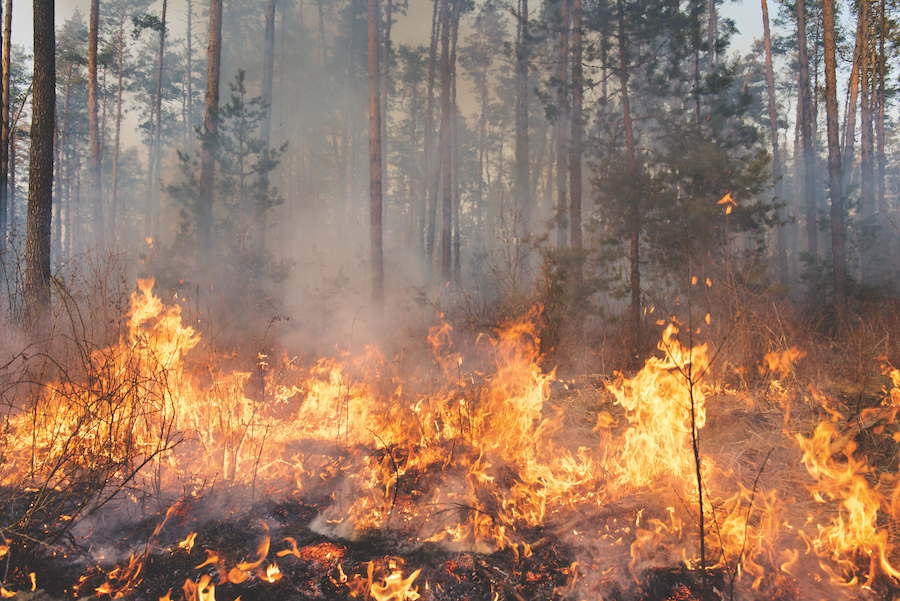
Now, as a Canadian, and as someone with a link to the forestry industry in Canada, it is likely that I have a carbon footprint larger than anyone of you. That’s because last year a combined are of Canada the size of Ireland burned down in forest fires. Most of these fires were not in forests that were old growth but second growth – planted forty, sixty, or eighty years ago. Instead of being woods with a mix of hard and softwoods, of different species, they tended to be monocultures. As managed timber lots they were often sprayed with pesticides to kill bushes and hardwoods, like aspen. If they were Black Spruce, they were also more flammable than old-growth or mixed forests.

Last year the forest fires in Canada produced a greater addition to greenhouse gases than all the airlines in the world did. The decisions that were made decades ago by Canadian foresters and government agencies has led to the situation where forests are more likely to burn. This probability is only increased by global warming, and thus we have a reinforcing loop. It makes one weep for all the minor efforts we as individuals and as groups make to combat global warming. Not surprisingly, the federal and provincial governments of Canada do not include the burning forests in the count of greenhouse gases towards the national carbon footprint, as it would increase it by several magnitudes and make Canada’s already poor reputation in this matter look even worse.

I say all of this not to say that I feel particularly guilty about all of this, but rather that it is incumbent upon me as a Canadian and as a Christian to be responsible, despite the complexity of the challenge of forest fires and global warming. This is the Season of Creation, a month in which we focus on environmental issues and celebrate what God has done in Earth. Lest you think this is some newfangled social justice thing from the left wing of the church, I hasten to point out that it started when the then Ecumenical Patriarch of Constantinople, Archbishop Dimitris, inaugurated it in 1989. Subsequently it was picked up and endorsed by Pope Francis for Roman Catholics, and it has since spread to Methodists, Lutherans, other members of the World Council of Churches, and, of course, the Anglican Communion. Concern for the Earth in the midst of global warming is a Christian value. This chaplaincy, as part of the EcoChurch programme, is working towards getting its Bronze Award, as are many the Diocese in Europe. Some have already moved up to the Silver, and a few have the Gold.

So what am I to do as a responsible Canadian and Christian? Apart from attempting to reduce my personal carbon footprint, I need to be engaged in civil society and working to convince the forest industry and the governments in Canada to change its policies and regulations. Some forest fires are natural and part of the way the ecosystem functions, but the burning of monoculture forests is not and needs to change. Advocating for biodiversity in Canada’s woodlands can be Christian action. As Christians in the modern world we are empowered through democracy and civil rights in a way unimaginable in the First Century when the New Testament authors lived under Roman Imperial despotism. So we (and I) need to be engaged. If I want to be a doer of the word and not merely a hearer, if I want to do what is right, if I want to let go of pride, avarice, and folly, I need to act. This is an issue of care for others as well, for as Pope Francis pointed out in Laudato Si, the climate crisis will affect the poorest of the earth in the least developed countries, especially those lying only a few metres above sea level, or are subject to desertification. If we care for the poor and disadvantaged, and if we have a global perspective, we will see the need to act.

But this is my story. You have a different one, but there may be things about which you have some responsibility and capacity to act. It may be directly in areas of Christian ethics, and about what you say and the care of orphans and widows, and those But it may also be in the care of creation, and the celebration of all that is good in it. So may we be forgiven by God, may we be transformed by the Holy Spirit, so that we might have the mind of Christ and be the holy Body of Christ in the world, cooperating with the divine in the transformation of the cosmos.

Posted in Canadian Issues, Sermons | Tagged , , , , , | Leave a comment

After Ten Sessions on Revelation, These are Some of the Outstanding Issues

The online Wednesday Night Small Group Bible Study at the Anglican Church of St Thomas, Kefalas, Crete, recently spent some ten sessions going through the twenty-two chapters of the Book of Revelation. We approached the text with an open mind, keeping in mind some of the past interpretations, but also some of the scholarship done in the last half century (some of which is noted in a previous Advent blog series which you can find here). We did not look for an authoritative interpretation, but asked ourselves how God was speaking to us and to our current 21st Century concerns.

In general, we approached the book from a historico-critical perspective: we noted that the book was written by a man named John who was exiled on the island of Patmos, and most likely composed late in the first century, perhaps around the year 90. We did not identify this John with the anonymous author of the Gospel according to John, nor with the the author of the three short Johannine epistles, although we did note that all these texts do seem to be related, perhaps emerging from a community or a set of churches in western Anatolia at different stages in the second half of the first century. When John speaks of visions of Babylon and various evil beasts we understood these as veiled references to the Roman Empire and its leadership – the same imperial power that killed Jesus, which continued to persecute his disciples, and exiled John to a little island.

We found some parts of Revelation challenging and disturbing. Here is a short list of some of the issues which are still very open for us. We will be discussing these at our next session.

The Wrath of God

A persistent theme in Revelation is the punishment of sinners both spiritual and human. The physical world suffers significantly in all of this. In the Hebrew Bible the wrath of God was aimed at Adam and Eve because of their disobedience, and against the people of Babel for their presumption at becoming like God. God was angry with those who worshipped idols, and so he cleared Canaan of the nations who blindly followed Baal and the other competing deities. Israelites who worshiped idols and did not trust in his promises also were deserving of his wrath, as were corrupt judges and those who oppressed the orphans, widows, and strangers among them. The books of Samuel and Kings deal with how the leadership turned away from God’s ways and how the kingdoms of Judah and Israel were punished by God through the nations of Assyria and Babylon. How do we understand this punishment?

This continues in the New Testament. The early church understood Gentiles as being idol worshippers and consequently utterly depraved in any number of ways (see Romans 1), and deserving of the coming wrath of God. It was subsequently underlined by the antagonism between Jews and the Empire that erupted in the Jewish War of 66-70, in which hundreds of thousands died and during which Jerusalem and the Temple were destroyed. It continued in the strong reaction to the demands that Gentile Christians observe the rituals of the Imperial cult, such as offering a sacrifice to the genius of the Emperor, or acknowledging the divinity of the Imperial succession. There seemed to be a clear division between the depraved idol-worshipers on the one hand and the holy followers of the Israelite God and those who found the fulfillment of the Torah in Jesus.

The early church followed in the passive resistance of Jesus, not failing to speak truth to power, but not reacting in defense with violence. Thus, they saw their vindication as something that would come later and would be done by God: Vengeance is mine, says the Lord, as it is written in Deuteronomy. When Christ came again, they believed, he would judge the living and the dead. This shows up in the letters of Paul and in the gospels. Revelation is another understanding of what that might look like, in the form of a series of vision seen by John of Patmos.

Within the group we struggled to understand this. Yes, we have all sinned and fallen short of the glory of God, but are people to be condemned simply because they happened to be born in an ethnic group that worships the wrong gods? Are subject peoples to be condemned for the failings of their leaders? How do we square this with the generous forgiveness of God as shown in Jesus?

Punishment

How do we understand the punishments that are meted out in Revelation? Does God get angry and then bring about various kinds of pain and suffering upon the wicked, such as famine, war, and plague?

Or do we see these punishments as a kind of “what goes around comes around”, as if it is hard-baked into the world that those who do evil will eventually have evil done to them? One thinks of how slave-owners in the southern United States suffered economic disaster during and after the US Civil War, or how the Nazi Germans were defeated in the Second World War, and many of those who survived were then tried and punished with death or imprisonment.

On the other hand, the wicked frequently in this life go unpunished – Stalin and Mao died in their beds, despite their murderous actions. Will they be raised to judgement and then be flung into the lake of fire?

Prophecy and Time

How are we to understand the series of visions contained in Revelation? They are highly structured, yet seem to repeat themselves. Are they to be understood as different versions of the same thing, or discrete events?

As well, given that the victory has already been won by Christ upon the cross and in his resurrection, is Revelation really just the consequences of that victory delayed for a time, during which the gospel may be preached to all peoples?

And to what extent do we see these prophecies realised in our own time? Is climate change and the environmental degradation not a kind of fulfillment of the woes described in Revelation?

Assuming that John was indeed talking about the Roman Empire and its leaders when he wrote about Babylon and the world, how do we see this applying to our situation 1930 years later? Is there a strict correspondence between what John describes and the present day, or do we take his predictions more typologically?

Do we too often take literally that which should be read metaphorically and spiritually, and take metaphorically that which we should take literally? Given the way in which the heavens are described in a pre-scientific way, how do we read these disasters?

Christology

The Jesus in the Book of Revelation is both in continuity with the Jesus described in the letters of Paul and the Gospels and also different, because he is presented as coming to judge the living and the dead. He is the Son of Man as described in Daniel, and in the vision of heaven he is pictured as the Ancient of Days, one seated on a throne, and as a wounded lamb. How does this add or detract from how we normally understand Jesus, and how we are to follow Christ? What difference does this make to our understanding of the Kingdom of God?

Posted in Bible, Revelation | Leave a comment

St George & the Good Shepherd

A Sermon Preached on The Fourth Sunday of Easter (commonly known as Good Shepherd Sunday), which is also the Sunday before St George’s Day (23 April), at
The Anglican Church of St. Thomas the Apostle, Kefalas, Crete
on the 21st of April 2024
.

The readings were Acts 4:5-12, Psalm 23, and John 10:11-18, and we sang two paraphrases of Psalm 23 (“The Lord’s My Shepherd” and “The King of Love My Shepherd Is”) and two patriotic hymns (“I Vow to Thee, My Country” and “And Did Those Feet in Ancient Times”).

This morning I am doing what the kids call a “mashup” where you take two things that are not necessarily related and see what happens when you put them together – in this case, Good Shepherd Sunday and the Festival of St George, Patron Saint of England. I feel obliged to talk a bit about St George after having had a brief presentation about St David of Wales around March 1st, and a discussion of St Patrick of Ireland around March 17th; at this rate I will have to preach about St Andrew come November 30th. In any case, I have never preached about St George before, so i may as well now, eh?

There are many things we can say with certainty about St George and his patronage of England.

  • He was not English (I know, shocking).
  • His name is Greek, Γεώργιος.
  • The first documented mention of him was in the late 5th century, where he is in a list of martyrs whose names are known but who actions are otherwise known only unto God.
  • Despite his story being unknown in Rome, a century later, in the early 6th century, his relics are associated with a church in Lydda, now called Lod, near where the modern Ben Gurion airport is in Israel.
  • A story of his life was written in the late 6th century or early 7th century. It suggested that he was a Roman soldier from Cappadocia in Anatolia, and that he was put to death for his faith around the year 304 on April 23rd in the Diocletian persecutions. However, as this was written 200-300 years after his supposed death, these facts may be more imaginative than rooted in historical fact.
  • He did not kill a dragon. That only became part of the story in the 12th century. Powerful image, though, eh?
  • As a soldier saint he was associated with a St Theodore Toro, who was depicted killing a dragon, representing evil. The two soldier saints were often depicted together, and George was illustrated killing human enemies of God. In time Theodore and the human foes dropped out, leaving just George lancing the snakey one.
  • Because he was a soldier, he became a patron saint of soldiers, especially those in the Crusades. The plain red on white cross was the flag and shield of the crusaders, and this became associated with St George.
  • The Golden Legend of 1260 told an elaborate story of George killing a dragon in Libya. A town there was besieged by dragon, and the townspeople bought it off by feeding it two sheep a day. They eventually went through all their livestock, and so had to start offering children. Finally the king’s own daughter was obliged to offer herself (you cannot have a story about a dragon without a princess, right?). Just as the princess was about to be eaten, George shows up, woulds the dragon with his lance, and then chops off its head. In some versions of the story the town then converts to Christianity, and George marries the princess. This story gave rise to all kinds of paintings and etchings.
  • When Edward III of England founded the Order of the Garter in 1348, he made George its patron saint, and built the Chapel of St George in Windsor Castle as the home of the order. They adopted the design of the red cross on the white background, whether on shield or flag, as the symbol of the English king, and hence of the English realm. This red on white design began to be used to represent England.
  • Shakespeare immortalized St George in Henry V: “Cry ‘God for Harry, England, and Saint George!” Of course, fans of the Bard know that he was supposed to be born on April 23.
  • George is immensely popular throughout Europe and beyond. In Georgia there are supposedly 365 churches named in his honour, one for every day of the year; most Georgians think the country was named after St George (although the country’s name probably comes from Persian). Malta, Portugal, Bosnia, Aragon, Austria, Catalonia, as well as Brazil and Ethiopia, all have a special devotion to the saint.
  • In Great Britain/the UK and Canada we have had six kings named George, and if you live long enough you might see Prince George of Wales ascend the throne as King George VII.
  • Greece, of course, has had two King Georges, the first one of which was assassinated, and the second of which was deposed, restored by a dictatorship, exiled after the Nazi invasion, and then restored by the Allies.
  • To sum up, there is very little we can really say with any certainty, except that he probably existed, and was remembered because he was put to death for his faith. He is like hundreds of thousands of martyrs through the centuries – a name.

If this is so, we can say further that St George is like Jesus. Like Jesus, he laid down his life. By what power or by what name did he do this? He stood before his persecutors by the name of Jesus Christ of Nazareth, who had been crucified, but whom God raised from the dead. George, like all martyrs, witnessed to the hope of the resurrection in Jesus Christ – indeed, the term “martyr” means “witness”. He hoped that, as Jesus was, he would be also. He would have known Jesus as the stone that was rejected but had become the cornerstone of the whole building of God, and his place as a stone within it.

This is an era of martyrs.

Here is a random list of some recent ones.

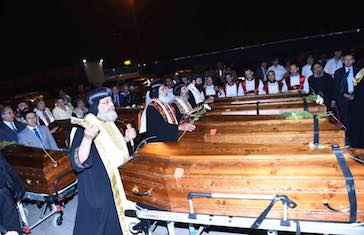
The bodies of the 21 Coptic Martyrs return to Egypt from Libya.
  • 2004 Kim Sun-il, a South Korean translator and Christian murdered by the terrorist group Jama’at in Iraq.
  • 2005 Ghorban Tourani was murdered in Iran for having converted to Christianity and having started a church in
  • 2008 Son Jong-nam, North Korea, murdered for bringing Bibles into the country.
  • 2008 Gayle Williams, or British and South African citizenship, was killed by the Taliban in Kabul as she worked for a Christian social service agency. 
  • 2015 Twenty Egyptian Coptic Christians killed by the Islamic State, as well as a Ghanian man named Matthew Ayariga.
  • On Easter Sunday 2019 three Christian churches in Colombo, Sri Lanka , were bombed. Over 238 people were killed, including dozens of children.

There are many more, so many that their names barely register when reported in the media. And yet, their faith and actions are known to God.

And us?

We who do not live with the fear of persecution are called upon to defend the dignity of all peoples. For whatever religion they are persecuted, they are still people made in the image of God and are the children of God for whom Christ died, and alongside whom Christ died. Inasmuch as Christ was vindicated by being raised from the dead, so will they be honoured for their faithfulness. All religions seem to have had violent extremes, and terrorists have often used their radicalized faith to justify killing others. Whatever the extremes, the mainstream leaders of all the great religions have always emphasised the protection of the vulnerable and respect for others.

We pray that God will work through politicians and diplomats, armed forces and the United Nations, non-governmental agencies and people of good will, to end violence and war against people on account of their faith. We know that all of these people and institutions are fragile vessels and often are compromised, yet they are the means we have to achieve peace. May we remember all those whose faith is known only unto God, and may we, empowered by the faith of the resurrection, work to save those who continue to be challenged and persecuted, as Γεώργιος was, as our Good Shepherd, Jesus of Nazareth, was. May all the witnesses of God rest in peace, and at Christ’s coming, hear his voice, and rise in glory. 

Posted in Sermons | Tagged , , , , , , , , , | Leave a comment

Indigenous Justice & Theology: An Eclectic, Annotated Bibliography

I was asked at a Racial Justice conference in November 2023 if I would put together a bibliography on Indigenous Justice and theology, and so here it is. Rather than just give the bare references, I have included annotations.

This list is derived from the bibliography created for my dissertation Unsettling Theology: The Theological Legacy of the Indian Residential Schools of Canada 1880-1970, which was submitted in an amended form to the University of London in April 2021. These are the documents, articles, and books that, in the second part of the dissertation, allowed me to draw an outline of theological ideas that justified colonization, slavery, and genocide. It includes works on anthropology, sociology, pedagogy, research methods, as well as discussions of racism, slavery, decolonization, and post-colonial theory. The bibliography also includes some works of Indigenous theology and those allied with Indigenous justice activists which I used in the third part of my dissertation. I have removed the texts on other matters that my dissertation dealt with, such as the philosophy of Emmanuel Levinas (1906-1995) (that was the focus of the first part) and kenotic theology (which was the theme of the third part). I think most of the hyperlinks are active, but let me know if one becomes dead.

Alexander VI, Intera caetera from  https://en.wikisource.org/wiki/Inter_Caetera, accessed January 17, 2017. This is the famous bull from Pope Alexander VI in which he draws a line between Portugal and Spain as they discover and conquer new lands.

Alfred, Taiaiake, Peace, Power, Righteousness: An Indigenous Manifesto, Second Edition (Don Mills/Toronto ON: Oxford University Press, 2009).

Anglican Video, https://www.anglican.ca/primate/tfc/drj/doctrineofdiscovery/ (Toronto ON: The Anglican Church of Canada, 2019). This is a good video about the Doctrine of Discovery.

Aristotle, Politics 1254b-1255a translated by Benjamin Jowett (Oxford UK: Clarendon Press, 1885). This is the passage in which Aristotle justifies slavery.

Atwood, Margaret, Survival: A Thematic Guide to Canadian Literature (Toronto: House of Anansi, 1972). An old but still relevant review of Canadian literature, largely adhering to the “garrison mentality” of Canadians, in which authors typically viewed the land and indigenous peoples as threatening and unforgiving.

Barrera, Jorge, “Author Joseph Boyden’s shape-shifting Indigenous identity”, at  https://aptnnews.ca/ 2016/12/23/author-joseph-boydens-shape-shifting-Indigenous-identity/ accessed April 23, 2021. Joseph Boyden is a prize-winning Canadian author who falsely claimed to have an indigenous background.

Battiste, Marie, Decolonizing Education: Nourishing the Learning Spirit (Saskatoon SK: Purich Publishing Limited, 2013).

Beaudoin, Gérald A. , & Michelle Filice, “Delgamuukw Case”, The Canadian Encyclopediahttps://www.thecanadianencyclopedia.ca/en/article/ delgamuukw-case, accessed December 9, 2018. Delgamuukw is the key case establishing “aboriginal title”.

Berger, Thomas W., A Long and Terrible Shadow: White Values, Native Rights in the Americas since 1492 (Vancouver: Douglas & MacIntyre, 1999).

Bevans, Stephen, “From Edinburgh to Edinburgh: Toward a Missiology for a World Church” in Mission after Christendom: Emergent Themes in Contemporary Issues (Louisville KY: Westminster John Knox Press, 2010), pp. 1-11.  I include a number of books from and about the 1911 World Missionary Conference in Edinburgh because it is a snapshot of the state of mind of missionaries at that time.

Biggar, Nigel, Ethics and Empire, http://www.mcdonaldcentre.org.uk/ethics-and-empire, accessed January 31, 2018. Biggar is a Church of England priest and theologian who is trying to defend Britain’s colonial history.

——————, “Don’t feel guilty about our colonial history” The Times,  November 30, 2017 https://www.thetimes.co.uk/article/don-t-feel-guilty-about-our-colonial-history-ghvstdhmj, accessed January 31, 2018. 

Blackburn, Carole, Harvest of Souls: The Jesuit Mission and Colonialism in North America 1632-1650 (Montreal QC & Kingston ON: McGill-Queens University Press, 2000). This is a brilliant book.

Brean, Joseph, “Cultural genocide’ of Canada’s indigenous peoples is a ‘mourning label,’ former war crimes prosecutor says”, National Post, January 15, 2016, http://news.nationalpost.com/news/canada/cultural-genocide-of-canadas-indigenous-people-is-a-mourning-label-former-war-crimes-prosecutor-says, accessed May 22, 2017.

Brébeuf, Jean de, “‘Twas in the Moon of Wintertime” translated by Jesse Edgar Middleton, Hymn 146 in Common Praise: Anglican Church of Canada (Toronto ON: Anglican Book Centre, 1998). For Wyandot/Huron original see “Huron Carol Translation With Pronunciation Guide” at https://penguinpoweredpiano.wordpress.com/2013/05/03/song-translation-huron-carol-by-heather-dale-huronwendat-and-canadian-french/ accessed 26 April 2021. Every Canadian child probably learned this hymn.

Brett, Mark G., Decolonizing God: The Bible in the Tides of Empire (Sheffield UK: Sheffield Phoenix Press, 2009).

Brown, Stewart J., Providence and Empire, 1815-1914 (London: Routledge, 2013).

Canada’s Missionary Congress: Addresses Delivered at the Canadian National Missionary Congress, Held in Toronto, March 31 to April 4, 1909, with Reports of Committees (Toronto ON: Canadian Council, Laymen’s Missionary Movement, 1909).

CBC News (Canadian Broadcasting Corporation), “A timeline of residential schools, the Truth and Reconciliation Commission”, http://www.cbc.ca/news/canada/a-timeline-of-residential-schools-the-truth-and-reconciliation-commission-1.724434, accessed October 23, 2017.

Carleton, John, “John A. Macdonald was the real architect of residential schools” The Toronto Star, July 9, 2017, from https://www.thestar.com/opinion/commentary/2017/07/09/john-a-macdonald-was-the-real-architect-of-residential-schools.html, accessed April 22, 2021. John A. Macdonald was the founding Prime Minister of Canada.

Carlson, Keith Thor, The Power of Place, The Problem of Time: Aboriginal Identity and Historical Consciousness in the cauldron of Colonialism (Toronto ON: University of Toronto Press, 2010).

Carruthers, Amy, Kevin O’Callaghan, and Madison Grist, “Canada: Federal Government Introduces UNDRIP Legislation” 16 December 2020, at https://www.mondaq.com/canada/indigenous-peoples/1016528/federal-government-introduces-undrip-legislation%20accessed%20April%2022, accessed April 22, 2021.  UNDRIP is the United Nations Declaration on the Rights of Indigenous Peoples (2007).

Castro, Daniel , Another Face of Empire: Bartolomé de Las Casas, Indigenous Rights, and Ecclesiastical Imperialism (Durham NC: Duke University Press, 2007). Bartolomé de las Casas (1484-1556) was a Dominican Friar and Roman Catholic Bishop who was the first person to effectively object to the Spanish Crown that the Spanish Conquest of Mexico and other parts of the “New World” was problematic and injurious to indigenous peoples and the truth of the gospel. He famously engaged in a debate with Juan Ginés Sepúlveda in 1550 on Indigenous rights, colonization, and evangelism.

Charles, Mark and Soong-Chan Rah, Unsettling Truths: The Ongoing Dehumanizing Legacy of the Doctrine of Discovery (Downers Grove IL: InterVarsity Press, 2019). This is co-written by Mark Charles, a Navaho man who comes from an Evangelical perspective.

Christophers, Brett, Positioning the Missionary: John Booth Good and the Confluence of Culture in Nineteenth-Century British Columbia (Vancouver BC: University of British Columbia Press, 1998). John Booth Good was an Anglican priest who established a mission to the Nlha7kápmx on the Fraser River near what is now Lytton.

Coates, Ken, “McLachlin said what many have long known”, The Globe and ail, May 29, 2015 https://www.theglobeandmail.com/opinion/mclachlin-said-what-many-have-long-known/article24704812/, accessed May 22, 2017. The Chief Justice of the Supreme Court of Canada calls the “Indian Residential Schools” a kind of genocide.

Cone, James, “Whose Earth Is It Anyway?” in Earth Habitat: Eco-Justice and the Church’s Response, eds. Dieter Hessel and Larry Rasmussen (Minneapolis MN: Fortress Press, 2001). James Cone (1938-2018) was an American theologian who created the discipline of Black Theology.

——————, “God and Black Suffering: Calling the Oppressors to Account”, The Anglican Theological Review, Volume 90:4 (Fall 2008), pp. 701-712. 

——————, The Cross and the Lynching Tree (Maryknoll NY: Orbis Books, 2011).  

Cooper, James Fennimore, The Last of the Mohicans, A Narrative of 1757 (originally published in 1826) in James Fenimore Cooper: The Leatherstocking Tales Vol. 1 (LOA #26) (New York NY: The Library of America, 1985). One of the myths in the 19th century is that the Indigenous peoples where disappearing because of illness, war, and assimilation. This novel is an example of the myth. Some 3000 Mohicans are still very much in existence in upstate New York and western Massachusetts.

Culhane, Dara, The Pleasure of the Crown Anthropology, Law and First Nations (Vancouver BC: Talonbooks, 1998).

Darymple, William, The Anarchy: The Relentless Rise of the East India Company (London UK: Bloomsbury Publishing, 2019).  This history clarifies how the East India Company ravaged India in search of profits.

Daschuk, James, Clearing the Plains: Disease, Politics of Starvation, and the Loss of Aboriginal Life (Regina SK: University of Regina Press, 2013). A somewhat controversial history laying out how epidemics in 19th century western Canada resulted in the movement of various First Nations and the ease of British colonists in taking the land.

Deloria, Jr, Vine, God is Red: A Native View of Religion, Second Edition (Golden CO: North American Press, 1992). An eccentric pioneering work. Deloria was the son and grandson of Lakotan Episcopalian priests and himself studied with Lutherans in Chicago. While given to sweeping essentialist claims about both Christianity and “Native American Religion”, he was among the first to identify the destructive effects of Christian evangelism among Indigenous peoples in what became the USA and Canada.

Diamond, Jared, Guns, Germs, and Steel: The Fates of Human Societies (New York, NY: W.W. Norton, 1997). Why did the Europeans “discover” and “conquer” the world, and not Asians, Africans, pre-Columbian Indigenous peoples in the Americas, or Pacific islanders? This book examines the influence of geography and the availability of domesticated species on history.

Diocese of New Westminster, Monthly Record 1889, 1890, 1893, 1894, 1895. Archives of the Diocese of New Westminster, Vancouver BC. I used the archives to verify some theses arising out of secondary literature.

Dixon, David, Never Come to Peace Again: Pontiac’s Uprising and the Fate of the British Empire in North America (Norman OK: University of Oklahoma Press, 2005).

Dodds Pennock, Caroline, “Mass Murder or Religious Homicide? Rethinking Human Sacrifice and Interpersonal Violence in Aztec Society”, Historical Social Research / Historische Sozialforschung, Vol. 37, No. 3 (141), Controversies around the Digital Humanities (2012), pp. 276-302. One of Sepulveda’s arguments against Bartolomé de las Casas was that the practice of human sacrifice by the Aztecs required an intervention by the Spanish Crown. This sociological work re-casts human sacrifice as a more common practice than is often admitted, and formulates a theory that it reinforces structures in society.

Dunbar-Ortiz, Roxanne, Loaded: A Disarming History of the Second Amendment (San Francisco CA: City Lights Books, 2018).  This book makes the argument that the Second Amendment of the US Constitution, the right to bear arms, is an endorsement of the right of “white” persons to organise and “defend” themselves against African-American slave uprisings and Indigenous peoples’ attacks.

Dussel, Enrique, A History of the Church in Latin America, Colonialism to Liberation (1492-1979) translated and revised by Alan Neely (Grand Rapids MI: William B, Eerdmans Publishing Company, 1981).

Edmondson, Mika, The Power of Unearned Suffering: The Roots and Implications of Martin Luther King, Jr.’s Theodicy (Lanham MD: Lexington Books, 2017).

Ellis, Ian M., A Century of Mission and Unity: A Centenary Perspective on the 1910 Edinburgh World Missionary Conference (Dublin IE: The Columba Press, 2010).

Fanon, Frantz, The Wretched of the Earth translated by Cobstance Farrington (Harmondsworth UK: Penguin Books, 1967). This is one of the classics of Decolonial texts.

Ferguson, Niall, Civilization: The West and the Rest (New York NY: Penguin Books, 2011). Ferguson writes a biased history justifying the pre-eminence of the West.

Fernandez, Manuel Giménez “Fray Bartolomé de Las Casas: A Biographical Sketch” in Bartolomé de Las Casas in History: Toward an Understanding of the Man and His Work edited by Juan Friede and Benjamin Keen, (DeKalb IL: Northern Illinois University Press, 1971), pp. 67-126.

Fisher, Robin, “Review of Tom Swanky, The True Story of Canada’s “War” of Extermination on the Pacific plus the Tsilhqot’ in and Other First Nations Resistance” in BC Studies 182 (Summer 2014), pp. 217-218.

François 1er (France), Commission à Jacques Cartier pour l’établissement du Canada, 17 octobre 1540, from https://biblio.republiquelibre.org/Commission_de_Fran%C3%A7ois_1er_%C3%A0_Jacques_Cartier_pour_l’%C3%A9tablissement_du_Canada,_17_octobre_1540, accessed February 14, 2016.

Gagnon, Lysiane, “McLachlin’s comments a disservice to her court, and to aboriginals”, The Globe and Mail, Jun. 10, 2015 https://www.theglobeandmail.com/opinion/mclachlins-comments-a-disservice-to-her-court-and-to-aboriginals/article24879482/, accessed May 22, 2017.

Geddes, Gary, Medicine Unbundled: A Journey Through the Minefields of Indigenous Health Care (Victoria BC: Heritage House Publishing Company Limited, 2017).

Gilley, Bruce, “The Case For Colonialism”, Third World Quarterly, 2017 at https://doi.org/10.1080/01436597.2017.1369037 (accessed January 31, 2018). A notorious article justifying 500 years of European colonialism.

Gottschalk, Peter, Religion, Science, and Empire: Classifying Hinduism and Islam in British India (Oxford UK: Oxford University Press, 2013).

Grant, John Webster, Moon of Wintertime: Missionaries and the Indians of Canada in Encounter since 1534 (Toronto: University of Toronto Press, 1984).

Grau, Marion, Rethinking Mission in the Postcolony: Salvation, Society and Subversion (London UK: T&T Clark, 2011).

Gray, Robert, A Good Speed to Virginia (London England: William Welbie, 1609), quoted in John Parker, “Religion and the Virginia Colony 1609-10” in The Westward Enterprise: English Activities in Ireland, the Atlantic, and America 1480-1650 edited by K. R. Andrews, N. P. Canny, and P. E. N. Hair (Liverpool UK: Liverpool University Press, 1978), pp. 245-270.

Guyatt, Nicholas, Providence and the Invention of the United States, 1607–1876 (Cambridge UK: Cambridge University Press, 2007).

Hanke, Lewis, All Mankind is One: A Study of the Disputation Between Bartolomé de Las Casas and Juan Ginés de Sepúlveda in 1550 on the Intellectual and Religious Capacity of the American Indians (DeKalb IL: Northern Illinois University Press, 1974).

Heinrichs, Steve, editor, Buffalo Shout, Salmon Cry: Conversations on Creation, Land Justice, and Life Together (Waterloo ON: Herald Press, 2013).

——————, editor Unsettling the Word: Biblical Experiments in Decolonization (Maryknoll NY: Orbis Books, 2018).

Henry VII (England), Letters Patent to John Cabot , 5 March 1496 from http://www.bris.ac.uk/Depts/History/Maritime/Sources/1496cabotpatent.htm, accessed January 20, 2017.  

Higham, Carol L., Noble, Wretched, & Redeemable: Protestant Missionaries to the Indians in Canada and the United States, 1820-1900 (Albuquerque NM: University of New Mexico Press & Calgary AB: University of Calgary Press, 2000). A brilliant study.

Hills, George (1st Bishop of British Columbia), Columbia Mission Special Fund (London, 1860), Archives of the Diocese of New Westminster, Vancouver BC.

Idle No More website. http://www.idlenomore.ca/, accessed October 29, 2018.

Indigenous Reporters Program of Journalists for Human Rights, Style Guide for Reporting on Indigenous People (December 2017), 1-8, http://icht.ca/style-guide-for-reporting-on-indigenous-people/, accessed January 10, 2018.

Jones, Evan T., and Margaret M. Condon, Cabot and Bristol’s Age of Discovery: The Bristol Discovery Voyages 1480-1508 (Bristol UK: University of Bristol, 2016),

Joseph, Bob, 21 Things You May Not Know About the Indian Act: Helping Canadians Make Reconciliation with Indigenous Peoples a Reality (Port Coquitlam BC: Indigenous Relations Press, 2018).

Kampen, Melanie, Unsettling Theology: Decolonizing Western Interpretations of Original Sin, Unpublished MTS thesis (Waterloo ON: Conrad Grebel College in the University of Waterloo, 2014).

Kan, Sergei, Memory Eternal (Seattle WA: University of Washington Press, 1999). This is a fascinating history of the Russian Orthodox mission to the Tlingit people of what is now the Alaskan panhandle, and how the Tlingit became more Orthodox when Russia transferred Alaska to the United States.

Keddie, Grant, Songhees Pictorial: A History of the Songhees People as seen by Outsiders 1790 – 1912 (Victoria: Royal BC Museum, 2003). The Songhees were the people who inhabited (and continue to live in) what became Victoria, British Columbia, where most of my dissertation was written.

Khan, Sahar, “The Case Against “The Case for Colonialism”” (at https://www.cato.org/publications/commentary/case-against-case-colonialism, accessed January 31, 2018).

King, Thomas, The Truth About Stories (Toronto ON: House of Anansi Press, 2003). Tom King is one of the funniest commentators on the situation of Indigenous peoples in North America. A good introduction if one is new to the topic.

——————, The Inconvenient Indian: A Curious Account of Native People in North America (Toronto ON: Doubleday Canada, 2012).

Klassen, Pamela E., The Story of Radio Mind: A Missionary’s Journey on Indigenous Land (Chicago IL: University of Chicago Press, 2018). The story of the eccentric Frederick Du Vernet, Archbishop of Caledonia in northeastern British Columbia, among the Ts’msyen, Nisga’a, and Haida.

Lagace, Naithan and Niigaanwewidam James Sinclair, “The White Paper, 1969”,

The Canadian Encylopedia, https://www.thecanadianencyclopedia.ca/ en/article/the-white-paper-1969, accessed December 9, 2018. The White Paper of 1969 argued for the abolition of the Indian Act and the full assimilation of Indigenous peoples into the majority settler population of Canada. The opposition to this marks the rise of Indigenous rights in Canada.

Lalemant, S.J., Jérôme in Jesuit Relations 20:71, in Carole Blackburn, Harvest of Souls: The Jesuit Mission and Colonialism in North America 1632-1650 (Montreal QC & Kingston ON: McGill-Queens University Press, 2000).

Las Casas, Bartolomé de, In Defense of the Indians translated and edited by Stafford Poole (DeKalb IL: Northern Illinois University Press, 1974), quoted in Lewis Hanke, All Mankind is One: A Study of the Disputation Between Bartolomé de Las Casas and Juan Ginés de Sepúlveda in 1550 on the Intellectual and Religious Capacity of the American Indians (DeKalb IL: Northern Illinois University Press, 1974).

Le Jeune SJ, Paul. Jesuit Relations 5:177 in Carole Blackburn, Harvest of Souls: The Jesuit Mission and Colonialism in North America 1632-1650 (Montreal QC & Kingston ON: McGill-Queens University Press, 2000).

Lemkin, Raphael, Axis Rule in Occupied Europe: Laws of Occupation – Analysis of Government – Proposals for Redress (Washington, DC: Carnegie Endowment for International Peace, 1944), p. 79, quoted in Haifa Rashed & Damien Short “Genocide and settler colonialism: can a Lemkin-inspired genocide perspective aid our understanding of the Palestinian situation?”, The International Journal of Human Rights, 16:8, (2012), 1142-1169; p. 1143.  This was the book that first used the term “genocide”.

Losada, Ángel, “The Controversy between Sepúlveda and Las Casas in the Junta of Valladolid” in Bartolomé de Las Casas in History: Toward an Understanding of the Man and His Work, edited by Juan Friede and Benjamin Keen (DeKalb IL: Northern Illinois University Press, 1971), pp. 279-308.   

MacDonald, David B. & Graham Hudson, “The Genocide Question and Indian Residential Schools in Canada” in Canadian Journal of Political Science/Revue canadienne de science politique 45:2 (June/juin 2012), 427-449; p. 433.

MacDonald, Jake, “How a B.C. native band went from poverty to prosperity”, The Globe and Mail, Report on Business Magazine, May 29, 2014, updated June 19, 2017, https://www.theglobeandmail.com/report-on-business/rob-magazine/clarence-louie-feature/article18913980/, accessed July 28, 2018.

McEachern, Allan, Delgamuukw v British Columbia quoted in in Delgamuukw v. BC, Supreme Court of Appeal, June 25, 1993 [210] https://www.courts.gov.bc.ca/jdb-txt/ca/93/04/1993bcca0400.html, accessed November 21, 2018.

Mackey, Eve, “Unsettled Expectations: Uncertainty, Land and Settler Decolonization (Black Point NS: Fernwood Publishing, 2016).

McInnis, Edgar, Canada: A Political and Social History, Third Edition (Toronto ON: Holt, Rinehart and Winston of Canada, Limited, 1969). This was a classic textbook that hewed to the “disappearing Indian” mythology, barely mentioning Indigenous peoples after the middle of the 19th century.  

McMillan, Allan D. Native Peoples and Cultures of Canada, 2nd ed. (Vancouver BC: Douglas & McIntyre, 1995).

Mann, Charles C., 1491: New Revelations of the Americas Before Columbus, 2nd Edition (New York NY: Vintage Books/Random House, 2011). This is a brilliant summary of archaeology, sociology, anthropology, and other fields of work done on the Americas before 1492. Another good introduction.

Manuel, Arthur & Ron Derrickson, Unsettling Canada: A National Wake-Up Call (Toronto: Between the Lines, 2015).

Marshall, John, Johnson v. M’Intosh 21 U.S. (8 Wheat.) 543 (1823) at https://supreme.justia.com/cases/federal/us/21/543/#tab-opinion-1922743 accessed July 29, 2020. The cornerstone of US property law, this case was the first in American jurisprudence to identify “The Doctrine of Discovery”.

M’baye, Babacar “The Economic, Political, and Social Impact of the Atlantic Slave Trade on Africa” European Legacy (2006), 11:6, pp. 607-622.

Menocal, María Rosa, The Ornament of the World: How Muslims, Jews, and Christians Created a Culture of Tolerance in Medieval Spain (New York NY: Back Bay Books/Little, Brown and Company, 2002). A bit of an idealised history, it nevertheless demonstrates the greater degree of multiculturalism and tolerance that was in existence in Spain before the Reconquista.

Michalopoulos, Stelios and Elias Papaioannou, “The Long-Run Effects of the Scramble for Africa”, The American Economic Review, July 2016, Vol. 106, No. 7, pp. 1802-1848.

Miller, J. R., Shinguak’s Vision: A History of Native Residential Schools (Toronto ON: University of Toronto Press, 1996).

——————, Skyscrapers Hide The Heavens: A History of Native-Newcomer Relations in Canada, 4th Edition (Toronto: University of Toronto Press, 2018).

Milloy, John S., A National Crime: The Canadian Government and the Residential School System 1879-1986 (Winnipeg MB: The University of Manitoba Press, 1999).

Monchalin, Lisa, The Colonial Problem: An Indigenous Perspective on Crime and Justice in Canada (Toronto ON: University of Toronto Press, 2016). Like many lands where the settlers outnumber the Indigenous population, the incarcerated population of Indigenous is out of proportion to their part in the nation’s population; this argues that the criminal justice system is structurally biased against them.

Moore, Dene, “B.C. First Nations mark small pox anniversary” published in Metro News/Canadian Press, August 06 2012, http://www.metronews.ca/news/canada/2012/08/06/b-c-first-nations-mark-small-pox-anniversary.html, accessed January 16, 2017.

Morton, Desmond, A Short History of Canada, Fifth Edition (Toronto ON: McClelland & Stewart Ltd., 2001). Another very-euro-centric history of Canada.

Mott, John H., The Decisive Hour of Christian Missions (Toronto ON: The Missionary Society of the Methodist Church, The Young People’s Forward Movement Department, 1910). John Mott was the moving force behind the 1910 World Missionary Conference in Edinburgh.

Newcomb, Steven T., Pagans in the Promised Land: Decoding the Doctrine of Christian Discovery (Golden CO: Fulcrum Publishing, 2008). Newcomb, a Shawnee/Lenape legal scholar, deconstructs the Christian origins of the Doctrine of Discovery.

Nicholas V, Dum Diversas from http://unamsanctamcatholicam. blogspot.ca/2011/02/dum-diversas-english-translation.html, accessed January 17, 2017.

——————, Romanus Pontifex, from http://www.nativeweb.org/pages/legal/indig-romanus-pontifex.html, accessed January 17, 2017.

Niezen, Ronald, Truth and Indignation: Canada’s Truth and Reconciliation Commission on Indian Residential Schools, Second Edition (Toronto ON: University of Toronto, 2017).  The first major work examining the effects of the Canada’s Truth & Reconciliation Commission on Residential Schools.

Nunn, Nathan, ‘The Long-term Effects of Africa’s Slave Trades’’ The Quarterly Journal of Economics (2008) 123, pp. 139–76.

Parkinson, Robert G., The Common Cause: Creating Race and Nation in the American Revolution (Chapel Hill NC: Omohundro Institute of Early American History and Culture and the University of North Carolina Press, 2016). This is a brilliant work rooted in the newspapers of the era surrounding the US War of Independence. Parkinson demonstrates that persistent ideas of “white”, “Indian”, and “black” were created in the context of the British Crown encouraging Indigenous allies and slave uprisings during the war.

Peers, Michael, Apology to Native People: A message from the Primate, Archbishop Michael Peers, to the National Native Convocation, Minaki, Ontario, Friday, August 6, 1993, from https://www.anglican.ca/tr/apology/, accessed November 21, 2018. 

Pennington, Loren E., “The Amerindian in English Promotional Literature 1575-1625” in The Westward Enterprise: English Activities in Ireland, the Atlantic, and America 1480-1650 edited by K. R. Andrews, N. P. Canny, and P. E. N. Hair (Liverpool UK: Liverpool University Press, 1978), pp. 175-194. Pretty much every aspect of English and British colonization in North America was tried first in the plantations of Ireland in the 16th century.

Proceedings of the Church Missionary Society Annual Sermons and Reports from North-West Canada Missions and British Columbia Missions in 1869, 1894, 1897, 1903, 1915. Archives of the Diocese of New Westminster, Vancouver BC.

Ranger, Terrence , “Christianity and the First Peoples” in Indigenous Peoples and Religious Change (Studies in Christian Mission) edited by Peggy Brock (Leiden NL: Brill, 2005), pp. 15-32.

Ray, Arthur J., An Illustrated History of Canada’s Native Peoples: I Have Lived Here Since the World Began, 2nd Edition (Toronto ON: Key Porter Books, 2005).

Regan, Paulette, Unsettling the Settler Within (Vancouver BC: University of British Columbia Press, 2010). A settler researcher for the Canadian Truth & Reconciliation Commission reflects on the need to rewrite history.  

Report of the Executive Committee to the Synod of the Diocese of New Westminster, 1901. Archives of the Diocese of New Westminster, Vancouver BC.. 

Robertson, Leslie A., with the Kwagut’ł Gixsam Clan, Standing Up with Ga’axsta’las: Jane Constance Cook and the Politics of Memory, Church (Vancouver BC: University of British Columbia Press, 2012).

Robinson, Andrew, Lost Languages: The Enigma of the World’s Undeciphered Scripts (New York NY: Thames & Hudson, 2009). More interested in scripts than Indigenous justice, the book has chapters of Mayan writing and the Inca string records.

Royal Proclamation 1763https://www.aadnc-aandc.gc.ca/eng/1370355181092/1370355203645, accessed November 13, 2017. The Royal Proclamation is the foundation of Indigenous rights in British/Canadian law.

Said, Edward W., Orientalism (25th Anniversary Edition) (New York NY: Vintage Books, 1994). Another classic in post-colonialism.

——————, Culture and Imperialism (New York NY: Vintage Books, 1994).

Scotland, Nigel, “John Bird Sumner in Parliament”, Anvil Vol. 7, No. 2, 1990. John Bird Sumner was an evangelical Archbishop of Canterbury in the middle of the 19th century, and among other things was an advocate of laissez faire political policies. Thus, he considered poverty and famine (including the Great Famine in Ireland) as part of the natural order.

Scott, Duncan Campbell, National Archives of Canada, Record Group 10, volume 6810, file 470-2-3, volume 7, pp. 55 (L-3) and 63 (N-3). Scott used to be best known as a poet, but he is now better known as the deputy superintendent of the Department of Indian Affairs in the first half of the 20th century, and the administrator of its racist policies.

Sepúlveda, Juan Ginés de, Demócrates, Segundo o las justas causas de la guerra contra los indios edited by Angel Losada (Madrid: Consejo Superior de Investigaciones Cientifícas, Institutio Francisco de Vittoria, 1951), quoted and translated in Lewis Hanke, All Mankind is One: A Study of the Disputation Between Bartolomé de Las Casas and Juan Ginés de Sepúlveda in 1550 on the Intellectual and Religious Capacity of the American Indians (DeKalb IL: Northern Illinois University Press, 1974).

Slattery, Brian, “Paper Empires: The Legal Dimensions of French and English Ventures in North America” in John McLaren, A. R. Buck, and Nancy E. Wright, Despotic Dominion: Property Rights in British Settler Societies (Vancouver: University of British Columbia Press, 2005). This article clarifies how the Doctrine of Discovery actually played out.

Society for the Propagation of the Gospel, The Mission Field 1862, 1863, 1870. Archives of the Diocese of New Westminster, Vancouver BC.

Special Fund Obtained During a Ten Months’ Appeal by the Bishop of Columbia since his Consecration in Westminster Abbey on the Twenty-Fourth of February, 1859, with a Statement of the Urgent Need Which Exists For Sympathy and Support in Aid of The Columbia Mission (London UK: R. Clay, 1860), from the Archives of the Ecclesiastical Province of British Columbia & Yukon.

Spivak, Gayatri Chakravorty, “Can the Subaltern Speak”, Colonial Discourse and Post-Colonial Theory: A Reader, edited by Patrick Williams and Laura Chrisman (New York NY: Columbia University Press, 1994), pp. 66-111. Yet another classic text in the post-colonial canon.

Stanley, Brian, The World Missionary Conference 1910 (Grand Rapids MI: William B. Eerdmans Publishing Company, 2009).

Sumner, John Bird, Treatise on Creation, Vol. II, quoted in Nigel Scotland, “John Bird Sumner in Parliament”, Anvil Vol. 7, No. 2, 1990.

Swanky, Tom, The True Story of Canada’s “War” of Extermination on the Pacific plus The Tsilhqot’in and Other First Nations Resistance (Burnaby BC: Dragon Heart, 2012). The article documents what was, at best,  a reckless disregard by British colonial authorities for spreading disease among Indigenous communities, and at worst, was a deliberate policy of germ warfare.

Tharoor, Shashi, Inglorious Empire – What the British Did to India (London UK: Hurst Publishers, 2017). An expanded argument made at the Oxford Union on the devastating legacy of colonialism in India.

The Bishop’s Address to the Synod of the Diocese of New Westminster, 1902., Archives of the Diocese of New Westminster, Vancouver BC.

The Mission Field Vol. VII, April 1, 1862 from the Archives of the Ecclesiastical Province of British Columbia & Yukon.

The Truth and Reconciliation Commission of Canada, Final Report of the Truth and Reconciliation Commission of Canada. Volume One: Summary. Honouring the Truth, Reconciling for the Future (Toronto ON: James Lorimer & Company, Ltd: 2015).

Thielen-Wilson, Leslie, “Troubling the Path to Decolonization: Indian Residential School Case law, Genocide, and Settler Illegitimacy” in Canadian Journal of Law and Society/Revue Canadienne Droit et Société Volume 29, no. 2, pp. 181-197.

Tinker, George, “The Full Circle of Liberation: An American-Indian Theology of Place” in Ecotheology: Voices North and South edited by D. C. Hallman (Geneva CH: WCC Publications, 1994), 218-226. Tinker is an Indigenous theologian.

——————, “Towards an American Indian Indigenous Theology”, The Ecumenical Review (12/2010, Volume 62, Issue 4), pp. 340-351.

——————, “Decolonizing the Language of Lutheran Theology: Confessions, Mission, Indians, and the Globalization of Hybridity”, Dialog, 2011, Volume 50, Issue 2.

Travis, Sarah, Decolonizing Preaching The Pulpit as Postcolonial Space (Eugene OR: Wipf & Stock Publishers, 2014).

Tucker, L. Norman, Handbooks of English Church Expansion: Western Canada (Toronto ON: The Musson Book Company Limited and London UK & Oxford UK: A.R. Mowbray & Co. Ltd., 1908).

Tuhiwai Smith, Linda, Decolonizing Methodologies: Research and Indigenous Peoples, Second Edition (London UK: Zed Books, 2012 and Dunedin NZ: Otago University Press, 2012). Mostly concerned with how Indigenous scholars, activists, and communities can decolonize, it also has significance for settler peoples and those trying to deal with the legacy of imperialism.

Twells, Alison, The Civilizing Mission and the English Middle Class, 1792-1850: The “Heathen” at Home and Overseas (Basingstoke UK: Palgrave Macmillan, 2009).

Twiss, Richard , Rescuing the Gospel from the Cowboys: A Native American Expression of the Jesus Way, edited by Ray Martell and Sue Martell(Downers Grove IL: InterVarsity Press, 2015). Another Indigenous Theology.

UN Convention on Genocide (1947), http://www.hrweb.org/legal/ genocide.html, accessed on May 22, 2017.

University of Victoria, Faculty of Law, https://www.uvic.ca/law/admissions/jidadmissions/index.php,  accessed April 20, 2024. The Faculty of Law at UVic now offers a Joint Degree Program in Canadian Common Law and Indigenous Legal Orders, the first of its kind.  

Urton, Gary, Inka History in Knots: Reading Khipus as Primary Sources (Austin, TX: University of Texas Press, 2017). The definitive text in the Incan record system.

Varacalli, Thomas Francis Xavier, “The Thomism of Bartolomé de Las Casas and the Indians of the New World” (2016). Louisiana State University Doctoral Dissertations. 1664. http://digitalcommons.lsu.edu/gradschool_dissertations/1664

Vickers, Patricia, Ayaawx (Ts’mseyn ancestral law): the power of Transformation unpublished doctoral dissertation (Victoria BC: University of Victoria, 2008).

Vowel, Chelsea , Indigenous Writes: A Guide to First Nations, Métis, and Inuit issues in Canada (Winnipeg MB: HighWater Press, 2016).  A great introduction.

——————, “A rose by any other name is a mihkokwaniy” <http://apihtawikosisan.com/2012/01/a-rose-by-any-other-name-is-a-mihkokwaniy/ >, accessed January 10, 2018.

Watson, Blake A., “The Impact of the American Doctrine of Discovery on Native Land Rights in Australia, Canada, and New Zealand”, Seattle University Law Review, Vol. 34, pp. 507-551

Watts, Joseph, Oliver Sheehan, Quentin D. Atkinson, Joseph Bulbulia, and Russell D. Gray, “”Ritual human sacrifice promoted and sustained the evolution of stratified societies”, Nature Vol. 532 (Apr. 14, 2016) pp. 228-231.

West, Gerald O., “Review of Grau, Marian, 2011. Rethinking Mission in the Postcolony: Salvation, Society and Subversion,” Journal of Theology for Southern Africa 146 (July 2013), pp. 170-171.

——————, “White Theology in a Black Frame: Betraying the Logic of Social Location”, Living on the Edge: Essays in Honour of Steve De Gruchy, Activist and Theologian, edited by James R. Cochrane, Elias Bongmba, Isabel A. Phiri and Desmond P. van der Water (Pietermaritzburg: Cluster Publications, 2012).

Williams, Jr., Robert A., The American Indian in Western Legal Thought: The Discourse of Conquest (New York NY: Oxford University Press, 1990). This landmark book was the first to root American law in Christian political theology of the Medieval era.

Winthrop, John, General Observations (1629),p. 113, quoted in Nicholas Guyatt, Providence and the Invention of the United States, 1607–1876 (Cambridge UK: Cambridge University Press, 2007).

Wiseman, Travis, “Slavery, Economic Freedom, and Income Levels in the Former Slave-exporting States of Africa” Public Finance Review 2018, Vol. 46(2) pp. 224-248. 

Woodley, Randy S., Shalom and the Community of Creation: An Indigenous Vision (Grand Rapids MI: Wm. B. Eerdmans Publishing Co., 2012). Another Indigenous theology.

Woolford, Andrew ,“The Next Generation: Criminology, Genocide Studies and Settler Colonialism” in Revista Critica Penal y Poder  2013, No. 5 (September), 163-185.

World Missionary Conference, 1910: Reports of Commissions I-VIII and vol. IX The History and Records of the Conference together with Addresses Delivered at the Evening Meetings (Edinburgh & London: Oliphant, Anderson, and Ferrier; and New York, Chicago, and Toronto: Fleming H. Revell Company, 1910). Yellow Bird, Michael, Indigenous Social Work (Aldershot UK: Ash

Posted in Anglican Church of Canada, Canadian Issues, Unsettling Theology | Tagged , , , , , , , | 2 Comments

The Organization of the Book of Psalms

I did the above graphic over twenty years ago, back in the day when I used WordPerfect on my Apple computer. I think it holds up pretty well, and so I have uploaded it for general consumption here on the blog.

A few comments to explain things.

  • The Book of Psalms was written in Biblical Hebrew. Some of the psalms show evidence of being older than most (Psalm 68 exhibits some archaic features of the language, mainly rare words), and others display evidence of being later than others (Psalm 119).
  • The critical text that is used for translations from the original Hebrew is that of the Biblica Hebraica Stuttgardensia (“BHS”), which is based on the Leningrad Codex, a manuscript of the entire Hebrew Bible (also known as the Tanach or Old Testament) made in Cairo in 1090 CE. The critical text also draws on other Masoretic texts and the Dead Sea Scrolls and compares it with the Greek translation of the Second Century BCE known as the Septuagint, and other ancient translations.
  • The Book of Psalms is a collection of collections. While the psalms were written individually, at some point editors began putting them together in groups. These groups appear to include “The Psalms of David” which ends at Psalm 72.10, the psalms of Asaph (73-83), and the Songs of Ascent (120-134). These groups or collections were then put together in larger groups. The evidence for this is the replication (with slight variations) of a couple of psalms – Psalm 14 shows up as Psalm 53, and part of Psalm 40 reappears as Psalm 70. This suggests that later editors, even if they saw the repetition, were loathe to challenge the integrity of the earlier collections.
  • At some point, perhaps building upon earlier arrangements of collections, an editor organised the psalms into five books. This undoubtedly is an echo of the Five Books of the Torah, and is a correspondingly late construct. This organization underlines the use of the psalms as Torah, or instruction, prophecy, and law. Each of the books, except the last, has a doxology at the end that begins, “Blessed be . . .” The books are not all the same length – an indication of their relative lengths is suggested by the hight of the columns in the graphic.
  • We do not know exactly how the psalms were sung, or the original context for their singing – we have neither the tunes nor their place of use. Any suggestion otherwise is just speculation, although there is evidence to suggest that many were originally used in the worship of the Jerusalem Temple.
  • That said, it does appear that the psalms used refrains, and that there was a call and response between a cantor and a choir, or perhaps two choirs.
  • The psalms in the original Hebrew do not have metre as such, as we associate with hymns and songs, but rather, they emphasise parallelism, where a thought is expressed and then re-expressed in different words or in a new way in the second half of a verse. This is sometimes expanded upon a third time.
  • At least some of the psalms appear to have been accompanied by lyres, psalteries, trumpets. ram’s horns, tambourines, and other percussion instruments.
  • Biblical Hebrew distinguishes between prose and poetry by the verb forms used. Whereas in prose Hebrew will use the waw/vav consecutive in narrating past events, this is absent in poetry. While it is still usually pretty clear what is untended, this occasionally introduces a degree of ambiguity that the author might be deliberately playing with.
  • An important issue is that originally the psalms would have be sung, and so the primary experience for Israelites would have been of “hearing” the psalms, not reading them, as we do. The person singing the psalm may have worked off of a text, but there may have been the freedom for the cantor or choir to engage in “composition in performance.” This term was devised by Milman Perry and Albert Lord to describe how illiterate Serbian poets created long epic sung poems, and that ancient Greek epics such as the Iliad and the Odyssey were composed the same way. Thus, the psalms originated in a culture that was primarily oral. Thus, the later writing down of the psalms and their collection and editing suggests a shift in how the psalms were experienced, and the increase in the authority of a set text over that of the cantor. The use of the Book of Psalms as a source of Torah and prophecy is the end result of this process.
  • Many of the psalms have ascriptions in the Masoretic text, sometimes as simple as “Of David” but sometimes suggesting the tune, or explaining the context of the psalm with reference to an historical incident elsewhere in the Bible. In the first three books of the Psalms over 90% have such ascriptions, but the latter two books have far fewer. Most scholars believe theascritions were added as part of the editorial process.
  • A couple of the psalms appear to have been divided in their transmission, namely psalms 9 and 10, and psalms 42 and 43. Neither 10 or 43 have ascriptions, and they carry on the style and thought of the previous psalm.
  • Psalm 1 and 2 do not have ascriptions – Stanley Walters, my Old Testament as Scripture professor, suggested that these function as an introduction to the Book of Psalms.
  • In Book One the name of God is consistently “Yahweh” (the personal name of God, Yahweh, almost always replaced with LORD in English translations), whereas in Book Two it is consistently “Elohim” (usually simply translated “God”). It has been suggested that an editor may have gone through the collections to make sure the address to God was the same throughout. Other scholars have suggested that some psalms may have originally been addressed to Baal or other Canaanite gods, and that they were adapted for Israelite use by replacing the name of the God.
  • Among the Dead Sea Scrolls the most common biblical texts were the psalms. Owing to the fragmentary nature of the psalm scrolls recovered from the caves in the Judean desert it is not clear whether these were scrolls that were the actual Book of Psalms, or selections from the psalms made for liturgical use or study. The order of the psalms in the scrolls usually follows that found in the Masoretic text, especially in Books One through Three, but in the latter two books the order varies significantly, and psalms that are not in the canonical text are included. This instability of the text towards the end suggests that the Book of Psalms was, at the time the Dead Sea Scrolls were hand-written, still a work in progress. Psalms might have been added, and others removed, and the actual text might have changed.
  • The academic books that I use the most in reading the psalms are: William L. Holladay, The Psalms through Three Thousand Years: Prayerbook of a Cloud of Witnesses (Minneapolis MN: Augsburg Fortress Press, 1993) and Peter W. Flint, The Dead Sea Psalm Scrolls & the Book of Psalms (Leiden, The Netherlands: Brill, 1997).

Posted in Bible | Tagged , , , , , | Leave a comment