Willem Dafoe as Jesus and David Bowie as Pontus Pilate in Martin Scorcese’s The Last Temptation of Christ (1988).
Centurion: what is next on the docket?
Ah, right. That Galilean. Bring him in.
So, you are . . . Jesus of Nazareth. It says here that you have just been condemned by an extraordinary meeting of the Sanhedrin, and they request that I, Pontius Pilate, governor of Judea, put you to death.
Ah, I see. You claim that you are the King of the Jews. Well, that is a problem. You see, there’s really only one ruler here, and that is Rome, and we cannot have anyone setting themselves up against us. We might have kings under us – Herod the Great was one of ours, you know, nasty piece of work he was. We’ve got one of his family up your way, a tetrarch, although everybody calls him king to his face. You probably know about him, also named Herod. Well, whatever they call themselves, they only rule because we say so. Same with the Sanhedrin. We use them to govern Judea, but we appoint the high priest, and if on the council give us any trouble, out they go.
So, are you the King of the Jews? Tell me, because I am not a Jew. Your own nation and the chief priests have handed you over to me, so you must have done something to really upset them. So tell, me, what have you done?
What’s that? You are a king? Your kingdom is not of this world? Well, that’s rather airy-fairy, isn’t it? I must say, it’s pretty gutsy of you to call yourself King of the Jews when you haven’t any followers, much less an army. What do you expect, that your god will somehow come down from heaven and install you on the throne, and defeat the legions of Rome? If you think that, you’re crazy.
Well, you just might be crazy. It says here that you said that you would tear down the Temple and then after three days build it up again. Yeah, like that’s going to happen.
Sorry, speak up. What’s that you say? Truth? What is truth? I’ll tell you what truth is – it’s whatever Rome says it is. And at the moment, I am Rome in this place, so I am truth.
Where are you from, Galilee, right? You could beg for mercy. After all, you’re probably harmless. You never had that many following you, and those that did have scattered like sheep. I was told one of your followers turned you in, right? What, do you refuse to speak to me? Too proud to ask for mercy from Imperial Rome? Do you not know that I have power to release you, and power to crucify you?
Alright, look, today might be your lucky day. So, there’s this thing I do on this feast of yours where I release a prisoner. It shows that we are merciful, not all that bad. But there’s this other guy, a bandit, a revolutionary, that some people think I should free, too. Let’s see if the crowd wants you or him.
Behold the man!
Oh, bad luck, old chap, they wanted the other guy. So, it’s off to Golgotha with you. We do need to set an example that Rome cannot be trifled with, and crucifixion is so very good for that. Useful to teach a lesson to slaves and other conquered peoples. Must keep order.
So, you’ve lost. You do understand that, right? Whatever you were trying to do has utterly failed.
You’re not very talkative, are you? Well, you won’t be talking at all in a few hours. Soon you will be silent forever. You’ll be forgotten and just a pile of bones, end of story. Just another troublesome religious rebel, like that John the Baptist that your King Herod took care of. Meanwhile Rome and the Emperor and our gods will go on and on and on.
Although, I must say, the way you’re bearing up and the way you look at me almost makes me believe it could be otherwise. But, of course, that would mean that I am in the wrong. But that never happens, I’m usually right. Might makes right, you know. So, off you go. Pray to your god, and die, just like those innocent lambs they are sacrificing all day long, right?
Well, that’s over and done with. All right, centurion, what’s next?
In addition to being Israelites and prophets, and being present in the glory of the Transfiguration, they had this in common: they all experienced oppression by and persecution by the powers of the time.
Moses, even in birth, was persecuted, because he was supposed to be put to death in infancy. He fled into exile in Sinai after killing an overseer who was abusing an Israelite slave. He was then sent by God back to Egypt, to Pharaoh, King of Egypt, to demand that he free the people of Israel from slavery. He relented only after the ten plagues, and even then, after letting them go, he changed his mind and pursued them with chariots and horses. Moses also suffered for the failings of the people of Israel in the desert, and he himself never entered the Promised Land, but only saw it from a distance.
Elijah, in the 9th Century before Jesus, spoke truth to power. He lived in the northern kingdom of Israel and called to account King Ahab and his wife Queen Jezebel, and the way they followed the Canaanite god Baal instead of the Israelite god Yahweh. Elijah flees from Ahab to Beersheba in southern Judah, and prays for death, but an angel tells him to eat and drink, because he has work to do. Later he challenges Ahab for having committed murder to get Naboth’s vineyard.
Jesus, of course, challenged both Roman power and their collaborators among the Jewish leadership. He simultaneously called the people to repentance and a higher righteousness while at the same time proclaimed God’s mercy on Israel. To the vast majority of Israel and beyond Jesus’s words were indeed good news. To the Romans and their friends among the powerful priests and teachers in Jerusalem, it was judgement. And so he, too, was persecuted. In his case, his obedience to his father was such that he suffered death, even death on the cross.
So what kind of glory is being shown in the Transfiguration? It is described as a “transfiguration”, and in the Greek the word is Μεταμόρφωση, or metamorphosis. May I suggest to you that in Christ, as in Moses and Elijah, we see revealed the true nature of glory – not power over overs, not a kind of raw unrestrained dominion, but rather the paradoxical power of those who, in following the ways of God, suffer for it. It is the power of those who are powerless, or who advocate for the powerless – the widows and orphans, the enslaved, those who are murdered for their property, those possessed by what appear to be demons, the strangers in our midst, those marginalized by illness and death, the poor who are still taxed by the rich and violent, those imposing the false ideology of Empire and Emperor.
Modern Transfigurations
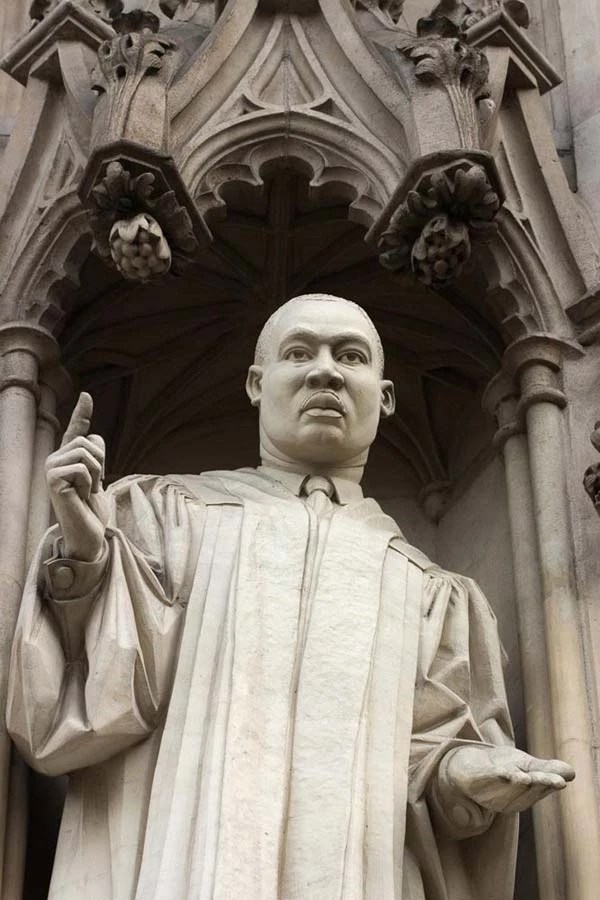
The statue of Martin Luther King, Jr., from the from of Westminster Abbey, one of the Ten Martyrs of the 20th Century depicted there.
This is still relevant today. Many people suffer, and many of them have suffered unjustly. What is one to do with such unearned suffering? Some people just try to avoid it, or deaden themselves to it through alcohol, drugs, or other addictive things. However, some people have decided that if they are going to suffer, they should try and make it meaningful.
This is where two heroes of the past century illuminate this. Martin Luther King famously used civil disobedience as a means of showing up the violent structures of the United States in the 1950s and ‘60s. He thought this through carefully, drawing not only on the tactics of Mohandas Gandhi, but also the liberal protestant theology of the first half of the twentieth century, and the theology of the historic Black churches, best found in their music and preaching. As a Black man in the southern US he knew that he would be discriminated and abused as a matter of course, and he resolved to make use of that to change things.
Prison photograph of Václav Havel, 1979
Another man who understood this is Vaclav Havel, the Czech playwright and dissident, who challenged the Soviet-era oppression in Czechoslovakia. He was repeatedly imprisoned for not falling in line and being silent. In 1978 he wrote the extended paper, “The Power of the Powerless” which indicated just how ordinary people can dethrone the high and mighty in the conceits of their hearts and send them empty away. The paper, passed around in mimeographed copies and translated into various East Bloc languages, was considered a theoretical basis for the Solidarity movement in Poland.
Ultimately both King and Havel succeeded. The Voting Rights Act was passed in the mid-1960s, and a generation later a Black man was in the White House as President. Martin Luther King received glory in the form of the Nobel Peace Prize, and his birthday is today a national celebration in the USA. His life was cut short by his assignation, but his campaign for civil rights and justice continue. Likewise, after the miraculous, peaceful fall of communism in the Soviet Bloc, Havel was unanimously elected President of Czechoslovakia by the Federal Assembly, and then after the dissolution of the country, became President of the Czech Republic for two terms. His awards are too many to recount, but among others he was given a knighthood in the Order of the Bath and the Order of Canada.
Both segregation in the United States and communism in eastern Europe seemed permanent, and many people could imagine that only violent revolution would bring about change. And yet, as we know, these apparently marginal figures led movements of the seemingly powerless to transform society. In the same way Moses sought to transform the situation of the Israelites, Elijah to reorient the northern kingdom of Israel, and Jesus the hearts of Jews and Gentiles. They each suffered for it, but their suffering led to change into something better. If Jesus were to be transfigured today, perhaps it would be King and Havel meeting him on the mountain top.
The power of the powerless is the glory of God. It is what is revealed in the Transfiguration. As we enter into Lent, how shall we be transfigured? Where will we find our power, our meaning, and our glory? As the collect for today prays:
Almighty Father, whose Son was revealed in majesty before he suffered death upon the cross: give us grace to perceive his glory, that we may be strengthened to suffer with him and be changed into his likeness, from glory to glory; who is alive and reigns with you, in the unity of the Holy Spirit, one God, now and for ever. Amen
Back in Advent 2020, when we were in lockdown, I wrote no fewer than twenty-four posts on the Book of Revelation. I had sort of forgotten I had written so many, but I had a look today, as one of the Bible Studies at the Anglican Church of St Thomas, Crete, is reading and discussing its way through the book. To get all these posts in an easily accessible place, here are the links and titles. It is more of a topical set of posts than a consecutive reading. Enjoy.
A Sermon Preached on the Presentation of Christ in the Temple (also known as Candlemas) (transferred from February 2) at The Anglican Church of St. Thomas the Apostle, Kefalas, Crete on Sunday, 28 January 2024.
This morning I want to think about the psalm, Psalm 24, so you may want to pull out your psalter and have a look.
Some General Comments about the Psalms
They were sung, usually accompanied. We have no good idea what the tunes were, or how they were composed, or in what circumstances they were sung.
We do know that there were choirs and instrumentalists in the Temple in Jerusalem. It appears that perhaps they used double choirs, calling and responding, or perhaps with a soloist and a choir.
We read in 2 Samuel 6:16: David and all the house of Israel were dancing before the Lord with all their might, with songs and lyres and harps and tambourines and castanets and cymbals. There are also references elsewhere to ram’s horns and trumpets.
The style of singing the psalms was probably more ecstatic and less meditative – not so much Gregorian Chant and Anglican Chant, and so perhaps not King’s College Chapel style, but more like popular music.
The psalms come from an oral culture – and so the psalms may have been composed freely, on the spot, and shaped by repeated performance, and only later written down. Imagine Lennon and McCartney composing a song nose to nose, or a song being created in a sound check.
The original language is Hebrew, and it is identifiable as Hebrew from the way it constructs verbs (technically, the waw/vav-consecutive formation used in narrative prose is absent). Because Hebrew is inflected by prefixes and suffixes, more can be said in fewer words than in English. Hebrew is typically a very concrete language, with fewer abstractions than Greek, Latin, French, or English.
The verses have no set length, they do not rhyme, and the beats or emphases in the lines vary. The way in which they were sung somehow accommodated all this.
The name of God, YHWH, is used, wherever you see LORD.
After composition and use in the Temple, the psalms were later collected, and the book as we have it appears to be a collection of collections, perhaps edited 700 years after most of the individual psalms were written. Some of the later psalms – Psalm 119 and 146 – are probably later and are the product of a culture where writing was more common.
In the Second Temple era the Jews read the psalms as a poetic form of the Torah, or instruction. Hence, there are five divisions within the Book of Psalms, just like the five books of the Torah.
Christians, following on the use of the psalms in the New Testament, read the book as a witness or a testimony to Jesus, and it is in this context that we use it today.
A Reading of Psalm 24
Psalm 24 from the Biblia Hebraica Stuttgartensia, the standard critical edition of the Hebrew Scriptures.
The first section of two verses affirms the ownership and sovereignty of Yahweh over the earth and all that is in it.
The next section of four verses asks a question and then answers it.
Who can ascend the hill of YHWH? The hill of YHWH is Zion in Jerusalem, and the holy place is the Temple.
And the answer is that it is the pure, those who do not worship idols, or swear falsely. It refers to the company of those who seek God – perhaps the very people singing and listening to this psalm, who are the children of Jacob.
There is a sense of movement here – beginning with the whole world, then ascending into the mountain, and entering into the holy place, just like that passage I quoted from 2 Samuel 6.
The last section is well known as a chorus from Part II of Handel’s Messiah. The libretto was supplied to George Handel by Charles Jennens, who extensively used the psalms.
The gates and doors of Jerusalem and of the Temple are personified – they have heads to be lifted up.
The question and answer comes back, repeated. Probably soloist and choir.
YHWH is identified as a warrior king, strong and mighty in battle, YHWH of hosts.
Scholars speculate that this is a psalm used when the Ark of the Covenant was taken out to battle.
What might Psalm 24 have to do with the Presentation of Christ in the Temple?
Mary and Joseph can be seen as being pure of heart and clean of hands.
Simeon and Anna are also clean and pure, and offer the blessing on behalf of YHWH.
Jesus, then, is the King of Glory. Jesus is the warrior, fighting not against Canaanites or Syrians, but against, as the Letter to the Hebrews puts it, the one who has the power of death, that is, the devil, and free those who all their lives were held in slavery by the fear of death.
In Malachi, Jesus is seen as the one who has suddenly come to his Temple, and the day of his coming is challenging, but will purify and refine. He will come again, as an adult, to offer himself as a sacrifice in his death and resurrection.
So let us present ourselves to God, ourselves, our souls and bodies, as a whole and acceptable offering in Jesus. May we be purified and refined, so that we might be Christ in the world. May we challenge all that is evil and free those who are enslaved. May we lift up our heads and see the King of Glory!
Adapted from a sermon preached on The Second Sunday after Epiphany at The Anglican Church of St. Thomas the Apostle, Kefalas, Crete 17 January 2024
The readings used were1 Corinthians 6:12-20, Psalm 139:1-9, andJohn 1:43-51. See the note at the end of this post to see why the selection of readings differed slightly from what the Common Worship suggested.
Introduction
I am a member of the General Synod of the Church of England. One of the issues that we have spent much time on is what we can do pastorally for people who are in same-sex relationships. For some the answer is that we should advise them to get married, and, either in the service of Holy Matrimony or in a service of following a civil marriage, receive God’s blessing. Others see homosexual relations as sinful and counter to God’s written word and the teaching of the church, and so such proposals for blessing are unacceptable. Given this division within the Church of England the House of Bishops has proposed a compromise, in which the individuals in the couple are blessed, but not as a sexually active couple as such. The proposed blessings bless all that is good in the relationship, but there are no vows, no rings, no pronouncement that they are married. The proposals are silent about whether the couple are in a platonic relationship or sexually active, and whether they are married, in a civil union, or “just good friends”. These proposals are very optional, and no cleric is obliged to use them.
For some in the church this is still too much, a defining moment as to whether we follow scripture or whether we abandon it in favour of the mores of a depraved world. For others it is the most pastoral thing to do, given the circumstances of a divided church where no change to the marriage liturgy would be approved by the necessary 2/3rds super-majority of the three houses of General Synod. For many it is too little, too late. Of course, many people do not have a strong opinion one way or another, and would rather focus on other issues.
I do have an opinion. Personally I am in favour of such blessings, and while in Canada as a part of the Diocese of British Columbia, before moving to the Diocese in Europe and the Church of England, I blessed two same-sex marriages. Why do I feel this way? My reasons for doing so are, contrary to what some conservative Evangelicals or conservative Anglo-Catholics might believe, grounded in scripture, and especially in today’s first reading, 1 Corinthians 6:12-20. So let me give you my understanding of Christian ethics – how we make decisions about what the right thing to do is.
Paul’s Ethic of Freedom
My understanding of Christian ethics is specifically Pauline, and arises out of a problem he had with the members of the church in Corinth. We read in today’s first reading,
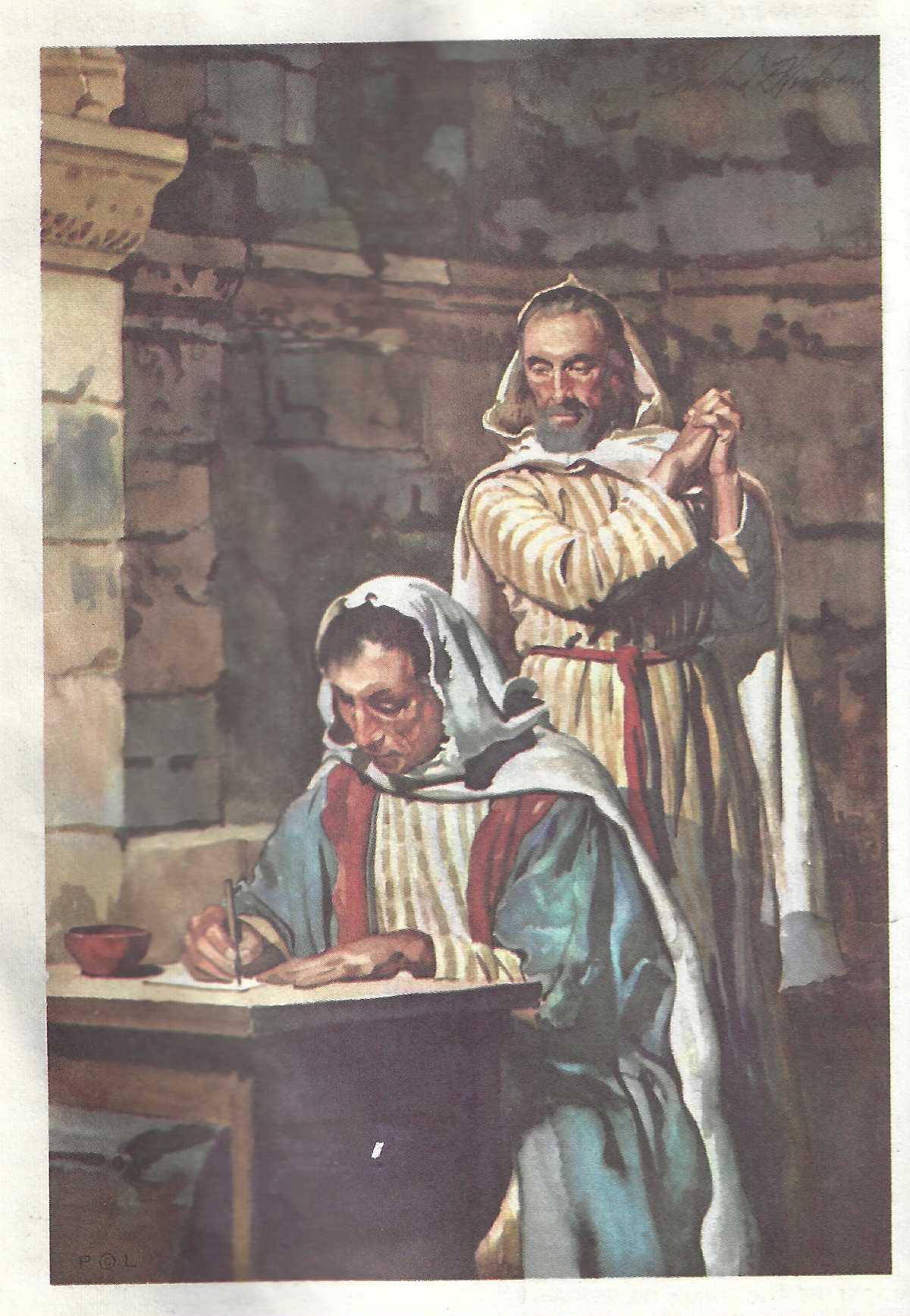
A mid-Twentieth Century depiction of Paul dictating one of his letters.
‘All things are lawful for me’, but not all things are beneficial. ‘All things are lawful for me’, but I will not be dominated by anything.
1 Corinthians 6.12 (NRSV)
Now, in most modern translations, “‘All things are lawful for me’” is in quotation marks, because Paul appears to be quoting something he had said to the church in Corinth, and had written in a previous letter to them, a letter which he refers to but is no longer extant.
‘All things are lawful for me’ is a powerful principle, and is rooted in the idea that in Christ believers are freed from the dictates of the Torah, and inspired by the Holy Spirit to do what God wants. In the gospel Jesus’s Jewish disciples are not portrayed as particularly observant, and in the Acts of the Apostles chapter 15 we read how Gentile converts are not required to be circumcised, how they need not follow the dietary rules, but just to avoid food sacrificed to idols, to avoid eating things strangled and food made out of blood, and avoid what in Greek is called τῆς πορνείας.
Well, some of the Corinthians appear to have been at least confused, and perhaps thought that anything goes. So Paul comes back in the First Letter to the Corinthians, and says, “not all things are beneficial” and “I will not be dominated by anything.”
This, then, appears to set the criteria by which Christians act – does it build up? Is a particular habit or behaviour create a form of domination over the Christian believer? The criteria are rooted in a sense that the Christian houses the Holy Spirit like the Temple in Jerusalem housed the Presence of God. Therefore the body is holy, and one should act in ways that glorify God.
So what rules must one follow? Obviously the ones which glorify God, which build up the individual and the church and the community, and those in which God is central, and something worldly does not take precedence. For the first Christians, for example, this meant that military service in the armies and navies of the Roman Empire was not acceptable, because its object was to glorify Rome, the Emperor, and his selfish, pagan goals. As well, the Empire was violent, and violence does not build up but is destructive. After all, it executed Jesus.
The Canadian Biblical scholar Peter Richardson wrote:
It is essential to note that primitive Christian communities did not adopt a laissez-faire attitude toward ethics. Behaviour was extremely important. Improper behaviour was condemned and good behaviour praised. It was not enough for Paul simply to leave them on their own with the Holy Spirit. Important as the Spirit was in directing the morality and conduct of Christians, advice, exhortation, and encouragement from those more mature was still necessary because of the struggle between flesh and Spirit, between law and license. Consistently maturing behaviour was most important. Basically the goal was to be an imitator of Paul, an imitator of Christ, filled with the fruit of the Spirit.
Peter Richardson, Paul’s Ethic of Freedom (Philadelphia PA: The Westminster Press, 1979), p. 82
First Corinthians deals with a variety of ethical issues, including: lawsuits between Christians before pagan judges; divisions in the church rooted in charismatic leaders; whether to eat food offered to idols or accept dinner invitations from pagan friends; a kind of sexual immorality that Paul does not name but may have involved incest; and whether to get married. He also deals with more doctrinal issues, such as the resurrection of the dead, gifts of the Holy Spirit, and how to manage the Lord’s Supper. In all of these cases he seems to apply the ethical principles suggested above, warning and admonishing the congregation in Corinth as they struggle with the flesh and the Spirit.
We can see this in chapter 7 of First Corinthians. In that previous letter to the Corinthians he appears to have written “It is good for a man not to touch a woman.” They must have written back with some confusion, asking if he was serious that they should not marry. Thus he replies that “because of cases of sexual immorality, each man should have his own wife and each woman her own husband.” He encourages them to give themselves to each other equally in an egalitarian description of sexual relations. He then goes on to say, “To the unmarried and the widows I say that it is good for them to remain unmarried as I am. But if they are not practicing self-control, they should marry. For it is better to marry than to be aflame with passion.” Here we see Paul giving advice, but then almost immediately qualifying it. Even while advising the congregation, he is respectful of the free choice of the members. He then notes situations where one of the couple is an unbeliever. He advises that if both are Christian they should not separate and remarry others, but live chastely and work on reconciliation. However, if an unbelieving spouse divorces the believing one, then the Christian ex-spouse is free to remarry. One gets the impression that Paul is working this out as he dictates the letter to his amanuensis.
A reconstruction of Corinth during the Roman Empire, circa 11 CE.
So what about other sexual relations? Τῆς πορνείας, one of the things forbidden in Acts 15, can be translated as fornication, but I suggest, based on a careful reading of related passages in the New Testament, that we need to read that in the context of slavery and patriarchy. In the Greek and Roman establishment slaves had no rights, and the owners of slaves, particularly the male ones, used them for sexual gratification, regardless of what the slaves themselves thought. Likewise, women had no rights, and were potentially subject to the whims of their paterfamilias – who they would marry, how often they would have sex, whether the new-born children would be kept or exposed, and so forth. In contrast Paul and Jesus transgresses the lines separating male and female, slave and free, not to abuse or separate oneself from them, but to treat them as equals and work collectively to God’s glory. Thus, Paul’s concerns might be that Christian men might, if frustrated sexually with their wives, might take advantage of their slaves, or rape their wives; as well, most sex workers in that time were enslaved, and trafficked by their owners. According to the pagan mores of the times a male having sex with a slave or forcing his wife to have sex was just fine. So, In First Corinthians 7 Paul responds with an emphasis upon partners freely giving themselves to each other, coming to agreements about when not to have sex, and staying faithful within the marriage. Likewise, the prohibition in Acts 15 against τῆς πορνείας may have had a similar connotation. There Christian attitudes would have struck pagan outsiders as very peculiar.
Note that Paul does not quote legal passages from the scriptures and then develop an application for the rule. Paul does quote scripture, often, but he does it in support of the Christian ethic of freedom described above. An example of this is his use of Psalm 24.1 in 1 Corinthians 10.26. Christian ethics, then, is not the simple following of rules derived from passages extracted from the Bible, treating scripture as if it were a civil and criminal code, but rather it is based on the holy understanding of the centrality of honouring the divine, of building up the body of Christ, and extending the kingdom. It is rooted in an understanding of who Jesus is and how we are transformed by his example – a self-sacrificing person who is non-violent and loving, critical of those who are in power and lifting up the poor and hungry, who pours himself out for others. We are called to be imitators of him, and by God’s grace we are becoming what he already is.
No Easy Answers
Now, the challenging thing about this ethic of freedom is that it means we need to work out our salvation and what we will do. It is not just blindly following rules. Interestingly, the church has moved on in issues that in the early church were considered non-negotiable.
Thus, going back to the expectation of early Christians that one could not serve in the armed forces of the Roman Empire, what do you do if the empire has become led by Christians, as it did with Constantine the Great and his successors in the Fourth Century CE? Is it permissible for Christians to engage in a defensive war? Can the sovereign engage in an offensive war for defensive purposes? Is violence justified in the name of evangelism? It was questions like this that led Augustine of Hippo in the early Fifth Century to develop his “just war theory” which continues to influence international conflict to this day. Of course, some, like Quakers and Mennonites, affirm that pacifism is the only true Christian way, and that the Fifth Commandment “You shall not kill” is absolute; I wish I had the radical courage to be a pacifist, but the truth is that I do believe people do have the right to defend themselves and that killing enemies may in some cases be justified.
For centuries Christians were forbidden to lend money at interest; both the Roman Catholic Church and the churches of the Reformation believed that a loan any interest rate other than 0% was unacceptable. In the Middle Ages with the rise of banks in Italian city states this prohibition was defined so that what was forbidden was usury, or lending money at extortionate rates. In the early modern era, with the establishment of private banks and national banks, the prohibition was viewed as naive and not informed by modern economics. Most Christians today would say that earning interest and giving loans at interest is just part of the economy.
Slavery is another issue where the Christian consensus has moved. The Hebrew Bible and the New Testament, for the most part, accept slavery as a universal institution. There are exceptions – Israel’s slavery in Egypt is unacceptable, and God commands Moses to help free his people from Pharaoh’s yoke. Paul does advise slaves to avail themselves of gaining their freedom if they can, and in the Letter to Philemon he more or less orders the recipient to free Onesimus, a slave who had run away. That said, freedom from slavery in Christian history was all too often spiritualised into freedom from sin and death – important enough, but a severe minimization of the oppression of slavery and the benefits of actual freedom. Only in the Nineteenth Century did radical Christians – often Quakers and Unitarians – begin to advocate not only for the freedom of some slaves, but for the abolition of it as an institution. Under the influence of leaders such as William Wilberforce in England and William Lloyd Garrison in the United States abolitionism became mainstream. It is unthinkable now that any true Christian would justify slavery.
So, how do we decide what’s the right thing to do? Well, one thing that is obvious to me is that we do not just quote passages from scripture and then build up on argument on them. We engage with scripture, but in a critical way, beginning with the historico-critical methods available to us. We consider the context of when a particular passage was written, and what the words might have meant at that time. I know some people claim that they just follow the “pain meaning” of scripture, but too often I find the “plain meaning” rather elusive. It is indeed be the case that “all scripture is inspired by God and is useful for teaching, for reproof, for correction, and for training in righteousness” (2 Timothy 3.16), but that begs the question that we know how to read the scripture correctly. Certainly Paul is flexible in his use of the Old Testament, deriving Christological and ethical principles that are surprising and sometimes contrary to what some have read out of them. In the same way that he justified his ministry to the Gentiles and their freedom from the Torah, so the Church has felt free to change its mind on lending money, on taking up arms in defense of one’s country, and on slavery. Christ is the same yesterday, today, and tomorrow, but the way the Body of Christ is in the world will change, devolve, and evolve.
In deciding what to do we may begin with scripture, but we do not stop there. We also engage with the Christian system of thought and prior theologies of good and evil, right and wrong. Thus, we look to the words of Jesus and the principles behind them, as well as those of the prophets and the apostles. We consider what previous theologians and ethicists have said, and enter into dialogue with them.
As well, we engage with various philosophies of ethics. Since before the time of Christ philosophers have advocated a variety of methodologies to determine what is right. Michael Sandel in his 2009 book Justice: What’s the Right Thing to Do? notes the major kinds of ethical systems popular in Western society today, among them utilitarianism, libertarianism, deontology (consistent following of rules derived from reason), consequencialism, “justice as fairness”, virtue ethics, and communitarian liberalism. The most developed Christian ethical system is probably that of Thomas Aquinas, which is based in Aristotle, scripture, Augustine, and some original thought, always but rooted in his particular understanding of an individual’s salvation from sin and death and sanctification in life. Aquinas is a typical Christian ethicist in that it has a strong metaphysical component. Lutheran and Calvinist ethics are likewise complicated in their dependence on scripture and tradition, their understandings of salvation, and the metaphysics inhering in all of that,
In truth, Christians rarely agree on what the right thing to do is. Thus, we disagree and differ. This is not necessarily a problem, unless it descends into violence and schism. It was in argument and disagreement that some of the best theology was formed. We should not be surprised that in our day there are disagreements, just as there were back in the days when slavery was considered part of the accepted order, when banks did not exist in Christian realms, and all Christians were pacifists.
It is on this basis that I have gone ahead and blessed same-sex two couples who were legally married by civil authorities. Just as it was allowed in my old Diocese of British Columbia, so I advocate that it should be allowed in the Church of England. I do not foresee this happening any time soon, but it may yet come to pass. I expect that some of you reading this may disagree with my opinion, but please do me the favour of not insulting me by saying that I am somehow being unbiblical or unfaithful to Christian tradition. I believe that my advocacy of same-sex marriage and same-sex blessings is very much rooted in the Bible, specifically a Pauline approach to ethics, and that my approach (and that of others) fits with many changes in teaching doctrine that were once considered unacceptably radical, but are now mainstream. If we disagree, let us remain in dialogue, and pray that the Holy Spirit unfolds the truth before us.
A note on the readings: I usually follow the Common Worship Lectionary, which is a modified version of the Revised Common Lectionary. Some Sundays I might omit the first reading from the Old Testament/Hebrew Bible or the second reading from Acts/Epistles/Revelation, leaving just two readings, always including the appointed gospel. Most of the time the Common Worship Lectionary and the Revised Common Lectionary are identical, but sometimes they differ a bit. This was one of those times! Had I properly followed the Common Worship Lectionary I would have chose two readings from 1 Samuel 3.1-10 (11-20); Psalm 139.1-5, 12-18 (139.1-9); Revelation 5.1-10; John 1.43-end; instead, I looked at an Episcopal Church website which had a different second reading, namely, 1 Corinthians 6:12-20. So, that is why our congregation wound up having a reading that day which probably no one else in the Church of England did. It was an honest mistake!
A Sermon Preached on Christmas Day 2023 at The Anglican Church of St. Thomas the Apostle, Kefalas, Crete The readings were Isaiah 9:2-7, Psalm 96, Titus 2:11-14, and John:1-18.
John Mordhorst. as he was in 1979
Do you like camping? I used to do a lot of it, often on shelters and cabins, but sometimes in tents. Groups from my school went camping for cadets and as hiking in the Green Mountains of Vermont. I knew a guy named John Mordhorst, who was one of my instructors when I did Outward Bound, canoeing for a month in Northern Ontario in 1979. A couple of years before this Outward Bound gig, he, along with three others, had travelled from the height of land in the Yukon to Hudson’s Bay, about 1500 miles (2400 km). It took them something like a year and a half, and involved canoes and dog-sleds. While on the trip he discovered a downed Russian satellite, which interrupted their trip as they had to be flown to Edmonton to be checked out for radiation exposure, but otherwise they were in the wilderness constantly. He was a real outdoorsman, living mostly in tents. I remember he told us that he had not slept indoors in a bed for years. He said that when he did once, he was so uncomfortable that he had to pull out his sleeping bag.
Jesus: A Big Fan of Tenting
This is what happens when you ask AI to give you a picture of Jesus in a tent.
Someone else who liked tents was Jesus. Verse 14 in our gospel this morning reads in the original Greek: Καὶ ὁ λόγος σὰρξ ἐγένετο καὶ ἐσκήνωσεν ἐν ἡμῖν – and our translation and most other English versions translate this as “the Word became flesh and dwelled among us.”
The Greek verb ἐσκήνωσεν is usually translated as “dwelled” but the word literally means “put up a tent” or “tented” – and in modern Greek the word is σκηνή. This is the same word that is used in the ancient Greek translation of the Hebrew Bible (our Old Testament) for the Tabernacle, the tent where God met Moses. A large chunk of the Book of Exodus describes how it was to be constructed. This tabernacle is the place before which sacrifices were made, offerings of incense and freshly baked bread were offered inside. Inside the tent was the Ark of the Covenant, in which were the tablets of the Ten Commandments. When the people journeyed from Mount Sinai to the the Promised Land the Israelites would deconstruct it and carry it along, and then reconstruct it wherever they camped. King David, we are told in the Books of Samuel, brought this holy tent and its contents to Jerusalem. Solomon constructed the Temple, which was a stone version of the Tabernacle, only about twice the size.
One reconstruction of what the Tabernacle looked like. See Exodus 25–31 and 35–40.
This is probably why the gospel author used this phrasing. The Word of God pitching a tent among us represents a living, breathing Temple – the presence of God, the shekinah among us. What the sacred Temple was to Israelites, Jesus is for us – the place of sacrifice, the place of meeting God, the place of reconciliation, the place of glory. What the psalms say about the Temple we can now say about Jesus. As the Letter to the Hebrews explains, Jesus is both the great High Priest and the sacrificial victim, offering himself once for all in heaven and on earth. Jesus explicitly identifies himself with the Temple when he says in John 2.19-21 “Destroy this temple, and in three days I will raise it up” and the gospel then explains “. . . he was speaking of the temple of his body.”
The Tabernacle in Kefalas. Not as fancy as the one God commanded the Israelites to fabricate.
Let’s draw out a couple of more implications. Here, in this place, this church in Kefalas, we meet in the name of Jesus. Jesus promised us that whenever two or three gathered in his name, he is present. Now, this could happen anywhere, but we have set aside for this purpose this tent-like structure which we call “The Tabernacle.” This is where, in the Liturgy of the Lord’s Supper, in the hearing of scripture and the outpouring of the Holy Spirit, we meet Jesus, and in Jesus we know the Father. So it is good and right that we call this The Tabernacle, not that it is any more special than any other building or tent, but because it is here that we become mindful of God’s presence among us.
But it is also here that we become the Body of Christ. As Christ dwells within us we become that Tabernacle, too, not made of canvas and metal and wiring, but of our selves, our souls and bodies. In offering up to God all that we are and all that we have we allow ourselves to be transformed into the image of God, so that we can look into the eyes of our neighbour here and encounter the divine. It is like the ancient Celtic hymn from St Patrick’s Breastplate:
Christ be with me, Christ within me, Christ behind me, Christ before me, Christ beside me, Christ to win me, Christ to comfort and restore me, Christ beneath me, Christ above me, Christ in quiet, Christ in danger, Christ in hearts of all that love me, Christ in mouth of friend and stranger.
So, on this day of Christ’s mass, in which we celebrate his birth, may we once again allow him to be born is us, as individuals, and as a church, as a communion around the world, as this body of saints that is now twenty centuries long and some seven billion souls, living and dead. Let us become, like him a tent for the dwelling of the divine. Come, Lord Jesus, and the renew the face of the earth.
I am a little anxious this morning. This happens every Christmas. It is a bit like what the late American literary critic Harold Bloom called “the anxiety of influence”: how can this preacher standing before you live up to this moment? How can I possibly do justice to the Christmas story? How might I say anything new, something you’ve not heard before? If you’re not a regular church goer, how might I say something that might inspire you to become one? If you are one of those people for whom this Christmas is hard, because you are missing loved ones, how might I comfort you? Ah, anxiety!
Or, I could just talk about the Bible and let God worry about what goes on in your hearts and minds. Let’s see how that goes.
It is Still Good News
Kelly Latimore’s 2016 icon of La Sagrada Familia
I want to suggest to you that the news of Jesus Christ is good news, and that it is news that this broken, fallen, sinful world needs.
In the Gospel of Matthew we hear of how that old tyrant King Herod the Great sought to destroy every person he thought might be a threat to his rule. Having heard that a king was to come from Bethlehem, he sought to kill that child. Thus, male children around Bethlehem suffered innocent deaths because of his depraved fears. Jesus and his parents became refugees, having been warned in a dream. Now, there is nothing sweet and heart-warming about this part of the story. What the story does tell us is that Jesus is with the innocent victims, with the murdered and displaced. At a time like this, the good news speaks to those suffering and says, God is on your side, and God will see justice done.
Have I shared with you the good news about Caesar Augustus, the Victorious Saviour, Son of God?
In this morning’s gospel reading from Luke we hear how “a decree went out from Emperor Augustus that all the world should be registered.” Isn’t that so typical of dictators? The imperial might of Rome exercises itself in a census of its subject peoples, creating great inconveniences. This Emperor Augustus is acclaimed in various obsequious inscriptions in the Greek language as a saviour, whose victories were considered to be good news, and he is described elsewhere as the adopted son of Julius Caesar, who was considered a god after his death; thus, Augustus was considered to be a son of God. It is not an accident that the humble birth of Jesus begins with this decree from Augustus, for in invoking his name it forces a contrast and the questions: who is the real saviour? Who is the true son of God? Whose coming is the real good news?
For people like the shepherds and those like Joseph and Mary, displaced by the whims of the powerful, the coming of Augustus is not good news. But the birth of the son of God in a humble stable is.
A Nativity Scene in the Lutheran Church of Bethlehem, 2023
We are now in a time when it is strange and hard for some to sing about Bethlehem. The Christian churches in Bethlehem, which are mostly Palestinian, have suspended public Christmas services in this time of war. How can we sing about the birth of Jesus when children are dying, when both sides are traumatized, and when their leaders are sending bombs and armed forces after each other?
Jesus offers an alternative to violence. All three of the Abrahamic faiths, Judaism, Christianity, and Islam have in common the values of care for others and living in peace with neighbours. The vast majority of the people in those religions do live and let live, getting on with life and seeking to live up to their ideals. All too often, though, extremists are allowed to prey on the fears of their co-religionists, and justify the violence of pogroms, crusades, and terrorism. Jesus, who suffered at the hands of violent Roman soldiers at the command of Pontius Pilate and with the encouragement of a collaborationist religious leadership, appears to have lost and been defeated. But the good news is that the love of God in Christ is stronger than death, greater than the violence that was meted out to him, and more powerful than any empire, authority, party, army.
The reading from Isaiah envisages a kingdom where the root of Jesse assembles the dispersed people of Israel and all the nations, and where all live in peace, even the animals and children:
The wolf shall live with the lamb; the leopard shall lie down with the kid . . . The nursing child shall play over the hole of the asp . . . the earth will be full of the knowledge of the Lord as the waters cover the sea.
We are not there yet. But God has begun to make all things new, beginning with the resurrection of Jesus, continuing on the day of Pentecost, and continuing through the past twenty centuries in the lives of holy men and women, people from every nation. We haven’t always got it right, and sometimes we have gotten it very wrong. But we hold before us this vision of what God calls us to be.
Questions
So, the question for us on this Christmas Eve morning, perhaps, is this: Are you going to be full of despair at the state of our fallen world, or do you have hope that God will break through? Do you continue in difference, or do we allow Christ, by the Holy Spirit, to fill our hearts with love, so that we can seek justice, and love kindness, and walk humbly with our God? Whose side are you on? Herod and Augustus? Or the babe born in Bethlehem?
The Anglican Church of St. Thomas the Apostle, Kefalas, Crete
24 December 2023 11:00 am
Open
I am a little anxious this morning. This happens every Christmas. It is a bit like what the late American literary critic Harold Bloom called the anxiety of influence: how can this preacher standing before you live up to this moment, and do justice to the Christmas story? How might I possibly say anything new? If you’re not a regular church goer, how might I say something that might inspire you to become one? If you are one of those people for whom this Christmas is hard, because you are missing loved ones, how might I comfort you? Ah, anxiety!
Or, I could just talk about the Bible and let God worry about what goes on in your hearts and minds. Let’s see how that goes.
Assertion
I want to suggest to you that the news of Jesus Christ is good news, and that it is news that this broken, fallen world needs.
In the Gospel of Matthew we hear of how that old tyrant King Herod the Great sought to destroy what he saw as a threat to his rule, and so tried to kill Jesus. His parents became refugees, and male children around Bethlehem suffered innocent deaths because of his depraved fears. There is nothing heart-warming about that. Jesus is with the innocent victims, with the murdered and displaced. At a time like this, the good news speaks to those suffering and says, God is on your side, and God will see justice done.
In this morning’s gospel reading from Luke we hear how “a decree went out from Emperor Augustus that all the world should be registered.” Isn’t that so typical of dictators? The imperial might of Rome exercises itself in a census of its subject peoples, creating great inconveniences. This Emperor Augusts claimed to be a saviour, whose victories were considered to be good news, and as the adopted son of Julius Caesar was considered to be a son of God. It is not an accident that the humble birth of Jesus begins with this decree from Augustus, for in invoking his name it forces a contrast and the question: who is the real saviour? Who is the true son of God? Whose coming is the real good news?
Jesus is on the side of people like the shepherds and those displaced by the whims of the powerful.
We are now in a time when it is strange and hard for some to sing about Bethlehem. The Christian churches in Bethlehem, which are mostly Palestinian, have suspended public Christmas services in this time of war. How can we sing about the birth of Jesus when children are dying, when both sides are traumatized, and when their leaders are sending bombs and armed forces after each other?
Jesus offers an alternative to violence. All three of the Abrahamic faiths, Judaism, Christianity, and Islam have in common the values of care for others and living in peace with neighbours. The vast majority of the people in those religions do live and let live, getting on with life and seeking to live up to their ideals. All too often, though, extremists are allowed to prey on the fears of their co-religionists, and justify the violence of pogroms, crusades, and terrorism. Jesus, who suffered at the hands of violent Roman soldiers at the command of Pontius Pilate and with the encouragement of a collaborationist religious leadership, appears to have lost and been defeated. But the good news is that the love of God in Christ is stronger than death, greater than the violence that was meted out to him, and more powerful than any empire, authority, party, army.
The reading from Isaiah envisages a kingdom where the root of Jesse assembles the dispersed people of Israel and all the nations, and where all live in peace, even the animals and children:
The wolf shall live with the lamb;
the leopard shall lie down with the kid . . .
The nursing child shall play over the hole of the asp . . .
the earth will be full of the knowledge of the Lord
as the waters cover the sea.
We are not there yet. But God has begun to make all things new, beginning with the resurrection of Jesus, continuing on the day of Pentecost, and continuing through the past twenty centuries in the lives of holy men and women, people from every nation. We haven’t always got it right, and sometimes we have gotten it very wrong. But we hold before us this vision of what God calls us to be.
Invitation
So, the question for us on this Christmas Eve, perhaps, is this: Are you going to be full of despair at the state of our fallen world, or do you have hope that God will break through? Do you continue in difference, or do we allow Christ, by the Holy Spirit, to fill our hearts with love, so that we can seek justice, and love kindness, and walk humbly with our God? Whose side are you on? Herod and Augustus? Or the babe born in Bethlehem?
While written for the late summer, it seems appropriate to publish this thirteen days before Christmas, when many of us are scurrying around looking for gifts, and wondering what we might get from our loved ones.
Let us spend a little time talking about gifts. Gifts in general, in human society, and gifts as understood in Christian teaching.
Gifts are – pun very much intended – part and parcel of human society (see what I did there?). Some societies are grounded in gift-giving. The indigenous peoples in British Columbia and the northwest of the United States are such societies. Among the Tlingit, Tsimshian, Nisga, Kwakwakewakw, and Coast Salish there are great feasts at which leaders and celebrants will give out many things – canned fish, oolichan grease, copper shields, bracelets, rings, masks, carvings and paintings. Non-tangible things are given as well, such as dances and songs, Sometimes the feast is to celebrate the giving of a storied name to a chief who has earned her or his status. At other times it is to celebrate a marriage. The feasting is, as one would expect a something called a feast, surrounded by food, largely salmon and other local delicacies; at one feast I attended I had some sealion stew. It is not at all unusual for well over a hundred people to attend, and for the hosts to prepare for over a year. The amount one gives away is correlated to one’s status. With the arrival of Europeans in the 19th century the resources available to be acquired and given away expanded, and the feasts became much greater events than before contact. The way in which some of the leadership seemingly impoverished themselves so shocked British and American officials and missionaries that in the early 20th century they banned the potlatch, as they called the feasts. In the past seventy-five years they have been restored as a central part of these First Nations’ culture, and it is an honour for an outsider to be invited, as I was.
Peace dance at Kwaxalanukwame’ ‘Namugwis, Chief William T. Cranmer’s potlatch, 1983.
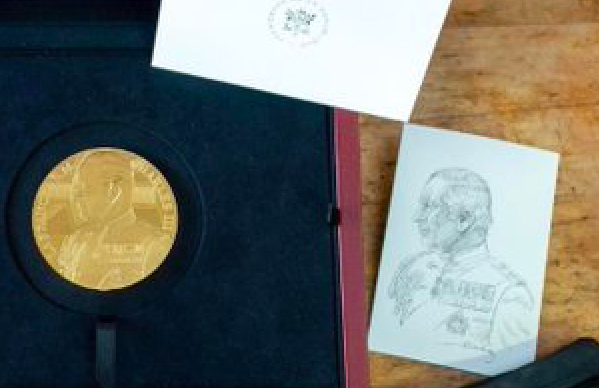
President Macron’s Gift to King Charles III on his visit to France, September 2023: a gold medal to celebrate his accession to the throne and Franco-British friendship
We see gift-giving in Western and international societies. Doweries used to be very important, and still, in marriage engagements, a ring is offered, and at marriage rings are exchanged. Bridal showers and wedding gifts remain a thing. At summits and in diplomatic meetings gifts are exchanged, and much attention is paid to whether the gift is just right, and whether a snob is intended or the proper respect is being paid. And then there is Christmas, where the duty to buy presents seems to have more to do with keeping the economy going than generosity.
In some Continental philosophy the gift became an important issue. Is it a gift if we are tied up in expecting it to be reciprocal? Do we require thanks? Is it really a gift if the present comes with strings attached? If we look a gift horse in the mouth, are we truly grateful? Obviously in this kind of thinking we are a long ways away from coastal British Columbia.
Christian gifts can be looked at few ways. First, there is the gift of creation and of our existence, and the challenge of what to do with our lives. Then there is the gift of redemption, in which God in Christ reaches out to us in a freely offered self-sacrifice and letting go, and invites us into the mystery. When Paul uses the word “gift” or χάρισμα he is usually thinking of spiritual gifts, and a non-exhaustive list includes:
faith;
prophecy;
leadership;
diligence;
encouragement;
ministry;
teaching;
compassion;
cheerfulness
tongues;
discernment;
interpretation of tongues;
powerful acts;
hospitality;
and the crafting of things
As you hear me listing some of these you might be thinking, well, so-and-so has always had that gift. Well, perhaps so, but the gift that they have naturally is no less a gift of God from being there from birth or childhood. And, some people, in coming to faith, receive gifts of compassion that leads them from self-concern to being concerned for others. It’s like the so-called Prayer of St Francis:
Lord, make me an instrument of your peace. Where there is hatred, let me bring love. Where there is offence, let me bring pardon. Where there is discord, let me bring union. Where there is error, let me bring truth. Where there is doubt, let me bring faith. Where there is despair, let me bring hope. Where there is darkness, let me bring your light. Where there is sadness, let me bring joy.
O Master, let me not seek as much to be consoled as to console, to be understood as to understand, to be loved as to love, for it is in giving that one receives, it is in self-forgetting that one finds, it is in pardoning that one is pardoned, it is in dying that one is raised to eternal life.
We pray this to God not because we have never done these things, but because if we are to continue to do them consistently we need the power of Holy Spirit within us and the gracious favour of God to persist and do the right thing. If we rely on ourselves and do not look to Jesus, we are liable to go off track, make compromises, and fall into self-justification.
What I notice is that when someone has identified their spiritual gifts, they realise that this is what they are really passionate about. We get the spiritual gifts we need to fulfill our Christ-like calling.
So, my friends, if you have not already done so, consider what gifts God has given you, and make your lights so shine that others may see your good works, and give God glory.
I have not written about the poems of George Herbert in over a year, so I will have a go during this Advent, perhaps Herbert wrote once or twice, perhaps more. We shall see.
Herbert wrote no fewer than five poems with the title “Affliction”. I have already written about the first one in The Temple, known as “Affliction (1)”, and in this post I will look at “Affliction (2). Whereas the first “Affliction” may be Herbert’s most autobiographical, the second is much shorter and more focused on Jesus compared with generic human suffering. Behind that may be Herbert’s genuine suffering – his consumption and his failure to achieve a position at court, but in the poem itself there is little that might not apply to any other person’s suffering. Here is the poem:
Affliction (2)
Kill me not ev’ry day, Thou Lord of life; since thy one death for me Is more than all my deaths can be, Though I in broken pay Die over each hour of Methusalem’s stay.
If all men’s tears were let Into one common sewer, sea, and brine; What were they all, compar’d to thine? Wherein if they were set, They would discolour thy most bloody sweat.
Thou art my grief alone, Thou Lord conceal it not: and as thou art All my delight, so all my smart; Thy cross took up in one, By way of imprest, all my future moan.
So, let’s begin with the technical issues. The lines are not all the same length. Each verse has syllables in the the pattern of 6/10/7/6/10. The rhyme is ABBAA. As is usual, Herbert mostly uses short words of one or two syllables, with “Methusalem” standing out with its four syllables.
The true artistry, as Anne Pasternak Slater points out, is in his use of metric harmony and disharmony to mirror spiritual states. She writes,
The poem wobbles at the start with its reversed first foot (‘Kíll mē’) to settle into a regular iambic beat thereafter, only breaking down again after the warning ‘broken pay’ of the penultimate line. The natural stresses, prompted by the sense (and italicized below) fall quite differently from the expected iambic template (also marked below) – so that, in effect, the line can only be spoken (heavily) as prose.
Diē óvēr eách hoūr of Mēthúsalēm’s stáy.
George Herbert, The Complete English Works (Everyman Library 204), New York NY: Knopf/Random House, 1995, p. li.
The poem, then, wobbles, settles down, and then breaks down into what is effectively prose. This happens three times, once in each stanza.
The theme of the poem is to “compare Christ’s suffering with the vast inadequacy of the Christian’s reciprocal grief.” (Pasternak Slater, p. 419).
In the first stanza the poet begs Christ not to afflict him with death every day. Presumably “death” here is not actual death, but suffering, but even if it were death, Jesus’s one death is greater in value than if the poet were to die every hour for the length of Methuselah’s life. Now, Methuselah is described in Genesis 5:27: “all the days of Methuselah were nine hundred sixty-nine years.” Twenty-four hours times nine-hundred and sixty-nine is 23,256, but the number is not so important as the disparity; some theologians would suggest that the death of the incarnate Word of God, fully human and fully divine, without sin, is infinite in its value. Whatever massive number the poet conceives, the value of Christ’s death, sufficing for all of humanity and the fallen cosmos, is greater.
In this Herbert demonstrates just how much of a Protestant he really is. While some commentators retroprojected onto him a High Church aspect, in valuing the death of Jesus as having a value greater than any one human death or many tens of thousands, he is referring to the penal substitution theory of atonement.
In the second stanza (I want to call it “the second verse”, but that’s more the sense of “verse” in hymnody than in poetry) the metaphor of suffering’s tears are used, and these are found to be less than that of Jesus’s bloody sweat. This is a reference to the the description in some ancient manuscripts of the Gospel according to Luke of Jesus in the Garden of Gethsemane: “In his anguish he prayed more earnestly, and his sweat became like great drops of blood falling down on the ground” (Luke 22.44). Now, while modern scholarship since the middle of the 19th century notes that this verse is not in the best and oldest copies (notably Sinaiticus, Vaticanus, and Alexandrinus, as well as many 3rd century papyri), and so may not be original with the author of the gospel, Herbert would not have known this, having depended on the Textus Receptus, the Vulgate, and various early modern English translations that included it.
What I find strange is that humanity’s tears would discolour Jesus’s bloody sweat; I would have thought that if the disparity were infinite then there should have been no discolouration. Perhaps I am misreading it, and Herbert is suggesting that the bloody sweat would discolour humanity’s tears, but that’s not the obvious sense of the words.
The third stanza identifies the poet’s suffering with that of Jesus: “Thy cross took up in one . . . all my future moan.” Only in becoming identified with Jesus does the affliction become bearable, “as thou art/ All my delight, so all my smart.” One cannot have the delight without the affliction, because the goodness and glory of the divine leads to the cross, and the cross leads humanity back to the Good and the Glorious. “Imprest”, Pasternak Slater tells us, is the same as a deposit on a loan.The deposit, again, is of far greater value than all of the poet’s future suffering, or “moan”.
I personally have not encountered much suffering. I am, after all, a “white” male from the upper middle class, from a country where they speak English. I have experienced some depression, a few illnesses, one case of sexual assault when I was a minor, and some grief over the death of close ones, but that’s it. I have never experienced war, hunger, violence, repeated sexual abuse and exploitation, harassment, and the like of which is all too well known by persecuted minorities or innocents caught in the wrong place at the wrong time. This might explain why I never get too excited by the theology around “the blood of Christ”. I do not identify with a suffering Jesus, although I certainly see him as a persecuted First Century colonised subject of the Empire, abandoned by his disciples, denied by one and betrayed by another, and turned on by the collaborationist forces of Jerusalem and Judea. This simply encourages me to ensure that I am an ally on the side of those who are suffering.
The penal substitution theory of atonement does not appeal to me, either. I can give notional assent to it as being meaningful for others, but for me it is but one metaphor among meany that describe the ultimate meaning of the death of Jesus.
Thus, while I can admire the artistry of this poem, it is not one that really speaks for me. Perhaps Affliction (3) might be different?
A Sermon preached on The Second Sunday of Advent at The Anglican Church of St. Thomas the Apostle, Kefalas, Crete, on the10th of December 2023, at 11:00 am.
I’ve now done two sermons on the Four Last Things, on Death and Judgement, so I really should do the next one on Heaven, and the one after that on Hell. The problem is, there’s no way to make the connection given what the readings are doing.
So, how about I preach on repentance instead, eh?
John the baptizer appeared in the wilderness, proclaiming a baptism of repentance for the forgiveness of sins. And people from the whole Judean countryside and all the people of Jerusalem were going out to him, and were baptized by him in the river Jordan, confessing their sins.
So, we read in verses four and five of the first chapter of Mark. Repentance here seems to mean confessing sins, being baptized, and being forgiven as a result.
Harry Dean Stanton (right) as John the Baptist in Martin Scorcese’s 1988 film The Last Temptation of Christ. Even Jesus (left, played by Willem Dafoe) looks a little freaked out by him.
John has been described as a homeless man, someone who lives off whatever is at hand, whether honey or locusts (” a spoonful of honey helps the locusts go down . . .”) , and he is definitely not part of the establishment or conventional society. And yet he is clearly charismatic (in the secular sense), drawing people to himself, somehow getting them to tell him their most secret and scandalous doings, and then offering them God’s forgiveness. He doesn’t make it easy – they have to go to him, presumably some distance; it’s a little over fifty km from Jerusalem to the traditional site of where he baptised. He does all this without the imprimatur of the religious elite in Jerusalem, or from the scribes, the Pharisees, the Saducees, or the Essenes, the Herodians, the Zealots, or any of the other Jewish groups in Judea. He is sui generis, in a class of his own (although he does have his disciples). He offends all of the groups in Judea, Samaria, and Galilee, and in time one party, the Herodians, are so ticked off that they imprison him, and ultimately put him to death.
The gospel portrays him as a prophet, and as the one who foretells of the coming of one who is greater than he and who will baptize with the Holy Spirit.
How does this all fit together?
Repentance is subversive. It subverts our fallen nature. Our fallen nature, our warped instincts, do not want us to be aware of our defects and faults, but wants us to continue as we are. If we become aware of our arrogant pride, our greed, our anger, our envy and jealousy, our lust and unhealthy desires for things and using people as objects, our gluttony and our sloth, well, maybe we will begin to think they are unhelpful, unnatural, and maybe we will want to live and become the beautiful creatures God has made us to be.
The problem is that it is hard to let go of these things. Indeed, some of us think we are defined by the mix of all these characteristics. What will be left if we lose these things? Won’t we just become empty shells?
And that’s where Jesus comes in. By being baptized with the Holy Spirit, we let go. John the Baptist and his baptism with water for the forgiveness of sins takes us part way, but not all the way. God may forgive us, but God wants to do more with us. God wants to change us, to renew us, to resurrect this fallen humanity into something like the image of Christ Jesus.
The Greek word μετάνοια, metanoia is usually translated as repentance in English, but it literally means “change of mind”. Our minds need to be refreshed by purity of desire, a willingness to restrain oneself, love filled with empathy and care, diligence and responsibility, patience, kindness, and humility. And these characteristics, which we can associate with Jesus, is what we want to be filled with. We want to be filled with Jesus.
John the Baptist prepares the way for Jesus, but we as individuals need to prepare ourselves, our souls and bodies, to receive Jesus as the one who sends the Holy Spirit into us and makes him like himself, his very body. But we cannot do it on our own. We need God to act – in the person of Jesus, in what has already been accomplished, and in the person of the Holy Spirit, filling us up.
Okay, maybe that’s what heaven really is – being in the presence of the Divine, “who art in heaven”, and being subject to God’s rule and will “on earth as it is in heaven.” We find heaven on earth by experiencing the transforming grace of God, something that begins with repentance as usually understood, but does not end with our action, but with God’s. So on this Second Sunday of Advent let us indeed repent and confess our sins, alone to God or to another person, but let us open ourselves to the one whose sandals we are not worthy to stoop down and untie, and, when we nevertheless try to do so we cannot, because we find him already kneeling before us in sacrificial love, washing our feet, redeeming us, giving himself and his life for us, and making us whole.