
Based on a Sermon preached on the Second Sunday after Trinity,
14 June 2026,
at the Anglican Church of St Thomas the Apostle, Kefalas, Crete, Greece
(Diocese in Europe | Church of England).
The readings used that day were: Romans 5:1-8, Psalm 100, and Matthew 9:35-10:23.

Introduction
This morning I want to focus on the reading from Paul’s Letter to the Romans. In particular, I want to consider the first verse from Chapter Five: “Therefore, since we are justified by faith, we have peace with God through our Lord Jesus Christ . . .”
These words are central to the thought of Martin Luther (1483-1546). As a result of his careful reading of Paul’s Letter to the Romans he wrote his Ninety-Five Theses (1517), which set off the Protestant Reformation and transformed Europe.
I will attempt to stick to talking about this for just fifteen minutes, but to be honest, to give the topic its due, I should lecture for an hour now and then have you come back twice weekly for the next twelve weeks; I suspect that is not possible, so I will just preach now. But, I assure you, the reading and interpretation of Paul’s Letter to the Romans is that complex and that important, both in Christian and European history as well as in Christian theology.
What I will do is present two rather different approaches to this passage from Romans, first Luther’s own reading, and then a later, modern reading that comes from what has been call “The New Perspective on Paul”. Then I will connect this to the gospel reading from Matthew, and speak of how this might be relevant to us today.
The Textbook Approach
This letter is truly the most important piece in the New Testament. It is purest Gospel. It is well worth a Christian’s while not only to memorize it word for word but also to occupy himself with it daily, as though it were the daily bread of the soul. . . St. Paul, in writing this letter, wanted to compose a summary of the whole of Christian and evangelical teaching. Martin Luther, Preface to Romans (1522), translated by Andrew Thornton, for the Saint Anselm College Humanities Program. (c)1983 by Saint Anselm Abbey.
As the above quotation suggests, Martin Luther saw the Letter to the Romans (also called the Epistle to the Romans) as the preeminent text in the New Testament, a light that enlightens everything else. I well remember the Evangelical historian James Packer (1926-2020), following Luther, describing it to an Anglican Essentials Conference around 2001 in Langley BC as the key to understanding the Bible.
This is what I would describe as the “textbook” approach to reading Romans. It imagines Paul trying to tell his hearers and readers the core of the good news of Jesus Christ. Luther writes that it is “the richest possible teaching about what a Christian should know: the meaning of law, Gospel, sin, punishment, grace, faith, justice, Christ, God, good works, love, hope and the cross.” While there may have been an occasion and reason for Paul to write this particular letter to the house churches in Rome, this recedes into the background as one considers its universal importance.
Martin Luther was an Augustian Friar (the same as Pope Leo XIV, five centuries later). Before entering the friary he was trained as a lawyer. He subsequently studied scripture and theology, becoming a Doctor of Theology and professor in 1512. He began lecturing on Romans in 1515-1516, posted his 95 Theses in 1517, and it was promptly published in Latin and German. That new technology, the printing press, meant that his ideas had a rapid impact across the Holy Roman Empire. The Pope excommunicated him in 1520. Luther wrote his brief Preface to Romans in 1522. The Reformation was off and running, and various states adopted what became known in German as the Evangelische Kirche (in the Anglosphere, Lutheranism). Other reformers followed Luther’s lead but developed their own approaches, especially in Switzerland, with Jean Calvin publishing his Institutes of the Christian Religion in 1536.
Therefore being justified by faith, we have peace with God through our Lord Jesus Christ: By whom also we have access by faith into this grace wherein we stand, and rejoice in hope of the glory of God. Romans 5:1-2 AV/KJV (1611)
Martin Luther read Romans 5:1-2 as a key text. As someone trained in law, he read the phrase “justified by faith” in a legalistic way. Justification for Luther means “to be made just” in the eyes of God. However, since “all have sinned and fallen short of the glory of God” human beings are incapable of being just on their own merits, or by their good works. Whatever motivation they might have to do good things, they are also motivated to do bad things, or leave undone those things which they ought to have done. Thus we are, as Calvin put it later, a “massa damnata”, a damned mass of humanity. However, the gospel, the good news of Jesus Christ, reveals that in his suffering and death Jesus has paid the penalty of sin for us, and that our sins have died with him. If we hear the word of God and the grace – free gift of forgiveness – offered by believing in this, then by faith we are made just, and by the Holy Spirit we are empowered by love to do good works.
Context is important. Martin Luther lived in one of the most penitential of ages. People were often convinced of their personal sinfulness and of the sins of humanity. Penance was a regular practice, the confession of one’s sins to a priest, followed by being given a particular penance. It was thought that by doing this regularly one could forgo time in Purgatory, that liminal space on the doorstep of heaven where saved souls purged themselves of all unspiritual character. This could also be done by pilgrimages to holy places, or by engaging in crusades. By the 16th Century these indulgences had been commodified – by paying money, instead of actually performing a penance or going on a pilgrimage, one could receive remission for one’s sins (and along the way help to pay for the building of the new St Peter’s Basilica in Rome).
Luther’s insight was that if one had faith all of this industry of penance was irrelevant and misleading. people should not be focused on their efforts to receive remission of sins by their works, but on their faith and to trust that God sees them as justified, even if they continued in occasional sinful acts. God could not be bought off – that would impugn the gracious majesty of the divine as well as the satisfaction offered by Jesus in his death.
So strongly did Luther feel about the singular importance of faith that when he translated the New Testament into German in 1522 (he published the rest of the Bible in 1534) he translated Romans 5:1 as “Therefore being justified by faith alone,” adding that word alone in German, allein. He justified this on the grounds that ordinary German required it. From the Latin this principle of “faith alone” was known as sola fide.
Thus, Lutherans will emphasise the event of justification, which comes in baptism and is manifested in the faith of a believer; Evangelicals will tend to diminish the sacramental importance of baptism, seeing it mainly as a sign, and will highlight the actual event of the coming to faith in Christ. The danger here is that the faith of an individual can thus be perceived as a kind of work of the intellect, and many Evangelicals forget about the absolute givenness of grace and worry about whether their faith is sufficient or of the right sort; ironically, this shifts attention from the action of God in Christ to the intellectual probity of the individual Christian. A proper Lutheran approach would understand that even faith itself is a gift from God. A Catholic understanding (and Orthodox, as well) would understand a more dynamic approach to faith, where faith, while originating in the prevenient grace of God, is subsequently formed by good deeds.
The Reformation resulted in the Roman Catholic Counter-Reformation. When it came to faith versus works, in some circles Catholics bore down on the efficacy of good works, and reveled in indulgences. In more recent times Catholic theologians have considered the Lutheran point about faith more deeply, and the Joint Declaration on the Doctrine of Justification by The Lutheran World Federation and the Roman Catholic Church (1999) notes that, for Catholics,
good works, made possible by grace and the working of the Holy Spirit, contribute to growth in grace, so that the righteousness that comes from God is preserved and communion with Christ is deepened. When Catholics affirm the “meritorious” character of good works, they wish to say that, according to the biblical witness, a reward in heaven is promised to these works. Their intention is to emphasize the responsibility of persons for their actions, not to contest the character of those works as gifts,or far less to deny that justification always remains the unmerited gift of grace. (Para. 38; 4.7)
It is probably absolutely correct to say that Paul believed that people were saved from the justifiable wrath of God by the grace of God – the free gift of forgiveness in Christ Jesus. Catholics and Protestants agree on this. However, whereas Protestants (and among them, Evangelicals) would emphasise faith alone, sola scriptura, Catholics and Eastern & Oriental Orthodox would call attention to how faith in the believer is formed by doing good works. Luther sees faith as a singular event, whereas Catholics and Orthodox see it as a dynamic evolving thing, one that might begin as a infant at baptism and be appropriated as one grows up, and repeatedly renewed at the sacrament of the Holy Eucharist. Given that Catholics make up about 50% of all Christians, and Orthodox another 12%, I would argue that it would be sheer arrogance to dismiss 1.5 billion people as all being misled.
Luther’s approach, then, is one way to read Romans 5. Certainly, it is a popular and revolutionary one. In the reign of Elizabeth I it was adopted as Article XI of the Church of England’s Articles of Religion: Wherefore that we are justified by faith only is a most wholesome doctrine, and very full of comfort. To this day sola scriptura remains central to Evangelical thought. So if this is the faith as you understand it, then you stand in a great tradition.
But did Luther get it right? Is there another way (or other ways) to read Romans?

Historical-Critical Approaches
In the past five-hundred years – the time since Martin Luther began the Reformation with his reading of Romans – the study of scripture has developed. Much of this work since the 18th Century has been done by pastors and scholars in the Lutheran tradition. Starting with the Enlightenment some scholars began to use the methods of historical literary criticism to understand Holy Scripture; putting aside the question of divine inspiration, it is manifest that these are texts written by human beings, and so should be susceptible to the techniques of literary and historical criticism. Following G. W. F. Hegel, scholars began to perceive that stories, doctrines, interpretations, and ideas evolve through history. Recognising that there are always multiple ways of reading a text, they began to live with the ambiguity. Academia might move towards a consensus, but there will always be differences. Using various methodologies – text criticism, form criticism, rhetorical criticism, source criticism, sociology, anthropology, archaeology, and history, we in the 21st Century have many more tools at hand when attempting to figure out what was happening in First Century Christianity and Early Christian Texts such as Romans.
When it comes to the Letters of Paul, there have been several revolutions.
- One of them is to recognise that if we want to have a biography of Paul, we need to start with the Letters, as they are primary documents. Most understandings of Paul have been drive by the biography in The Acts of the Apostles, but it is a secondary source, written as it was by an anonymous author some forty years after the Letters (although it is traditionally attributed to Luke). The author had his own intentions in writing it, and among other things, he plays down the conflict between Paul and Peter (evident in Paul’s Letter to the Galatians and also emphasises the authority given to Paul by other apostles, whereas Paul is adamant this his mission to the Gentiles is derived from God alone, and not any human authority. Thus, the portrait of Paul in Acts differs in some significant ways from what comes from his own voice and pen in the Letters – for one, there is no mention of Paul dictating Letters!Many people mentioned in the Letters do not show up in Acts and vice-versa. This historical approach, using the Letters alone to construct a chronology of Paul, and only afterwards using Acts, was inaugurated by the American biblical scholar John Knox (not the Scottish reformer) in his Chapters in a Life of Paul in 1950; his student John Hurd (who taught me in the mid-80s) published The Origins of First Corinthians in 1965, and Gerd Lüdemann in his trilogy of Paul, Apostle to the Gentiles (German 1980/English 1984), Opposition to Paul in Jewish Christianity (1983/1989), and Early Christianity according to the Traditions in Acts: A Commentary (1987/1989) constructed a chronology of Paul’s ministry that still stands. While this does not directly affect our interpretation of the today’s passage from Romans, it means that we need to read Acts critically in the light of the Letters, and not the other way around.
- Another shift is the recognition of the Jewish roots of the New Testament, and the taking seriously of Paul as a Jewish author. Jewish scholars such as Daniel Boyarin in A Radical Jew (1994) and Pamela Eisenbaum in Paul was not a Christian (2009) have dragged modern Christians into acknowledging the diverse and rich culture out of which early Christianity came. First Century Judaism was far more complex than Luther ever imagined.
- A third revolution has been to recognise that there is a degree of ambiguity in the meaning of the Pauline phrase πίστις Χριστού (pistis Christou) – should it be read as faith in Christ, or faith of Christ? Richard B. Hays in The Faith of Jesus Christ: The Narrative Substructure of Galatians 3:1-4:11 (1983/Revised Edition 2002) examined the ways in which Paul used this phrase in his Letter to the Galatians, and concluded that Paul used it to mean the faithful obedience of Christ, and not necessarily a believer’s faith in Jesus as their saviour. While there has been considerable pushback by Evangelical scholars wishing to maintain the old Lutheran approach, this feels like special pleading. I wrote about this earlier this year in Geeking Out over the Grammar of πίστις Χριστού.
- A fourth revolution is to recognise that Paul uses the forms of Greek rhetoric, the nuances of which are missed by translators. Krister Stendahl in his essay “The Apostle Paul and the Introspective Conscience of the West” (1963) demonstrated that translators and theologians read into Romans (especially Romans 7:13-25) their own moral challenges and their own troubled consciousnesses. The passage, Stendahl argues, is actually Paul adopting the character of someone prior to coming to faith in Christ, a “speech-in-character” to use the rhetorical term. Thus, the following description of someone who knows what the right thing to do is but chooses to do the wrong is not the portrait of a troubled follower of Christ, but of a person prior to faith and before the love of God being poured into the person by the Holy Spirit. This calls into question the framework for Luther’s understanding of faith its relation to the troubled conscience.
- Finally, I list as a fifth revolution in what is sometimes called The New Perspective on Paul. This recognises that Jesus, Paul, and Early Christianity all developed in the context of Imperial oppression, and that the gospel was subversive of Imperial propaganda. Common New Testament terms such as ευαγγελιον (evangelion = gospel/good news), υιος Θεου (son of God), παρουσία ([second] coming), and Σώτερ (Saviour) were all previously used in the cult of the Emperor, whether in coinage or in inscriptions, and in other ways that have not survived the past twenty centuries. Using these terms with reference to Jesus undercuts the claims of the oppressive Empire and its elite collaborators. Jesus and his disciples were put to death by Rome for a reason, and that reason was that they were seen as dangerously counter-cultural. Although not themselves violent, early Christians were viewed as disruptive to the social order.
There are other changes and transformations in the scholarship of Early Christianity, but these should help you see how much things have changed. Martin Luther was brilliant in his time, but the study of the New Testament has moved on in the past five centuries. The only way one can hold onto his precise formulations and theology is by disregarding these evidence-based approaches, which takes one perilously close to Fundamentalism.
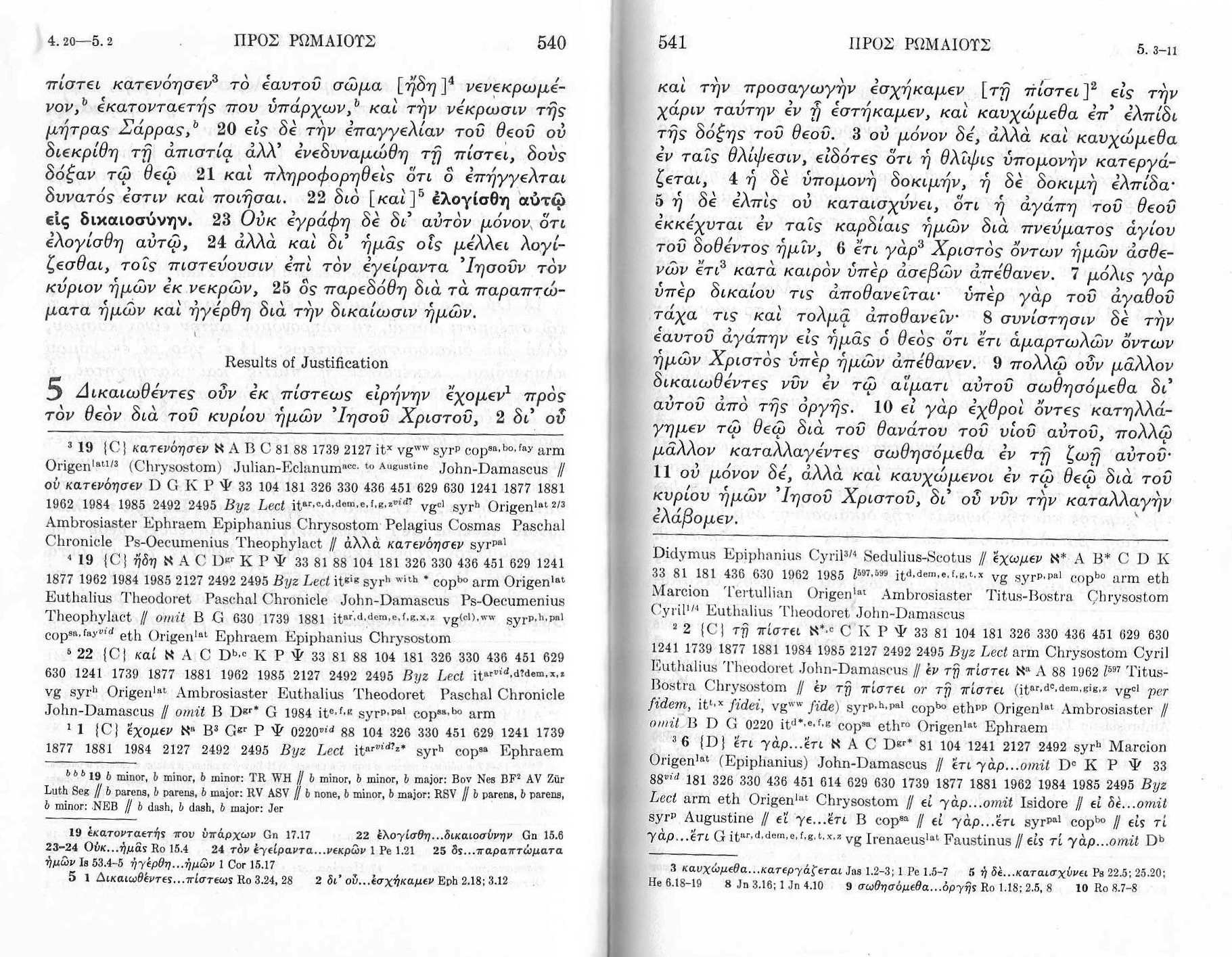
So what do the results of these five centuries of Biblical study say about today’s reading?
The first thing of significance is textual criticism of Romans 5:1. The critical edition pictured above is assembled from literally thousands of manuscripts and hundreds of papyrus fragments. Some of the manuscripts and fragments are considered more important than the rest because of their age and the apparent care they took in copying. There is a significant variation in the manuscripts for chapter 5 verse 1: is it ἔχομεν or ἔχωμεν? The only difference is the middle letter, omicron or omega. In the Koine Greek of the New Testament they would have sounded the same, as they do in a Modern Greek pronunciation. However, the meaning is a little different – the first means “we have” and the latter is “let us have.”
Interestingly, the textual apparatus gives ἔχομεν a “C” rating, meaning “that there is a considerable degree of doubt whether the text or the apparatus contains the superior reading” (USB3 xiii). In fact, the editors have done a rare fudge – the reading in the apparatus, ἔχωμεν (“let us have”), is far better attested, being in the original manuscripts of Sinaiticus, Vaticanus, Alexandrinus, Ephraem Rescriptus, and Bezae Cantabrigientus, various later Greek manuscripts, as well as a host of early translations and quotations in Church Fathers (including Tertullian, Origen, John Chrysostom, Cyril of Alexandria, and John of Damascus). Bruce Metzger, in A Textual Commentary on the Greek New Testament (London & New York: United Bible Societies, 1975; p. 511) observes that the manuscript evidence suggests ἔχωμεν over ἔχομεν, but states that “only the indicative is consonant with the apostle’s argument.” In other words, since they followed Luther’s interpretation of Romans, they chose a reading that went against the evidence.
This is where the second point comes in. Paul did not know that he was writing scripture. He thought he was writing a letter that would be read aloud and heard by believers in Roman house churches, not a theological tract that would be poured over and lectured upon by Martin Luther fourteen centuries later, or by us twenty centuries later. Paul clearly thought his letter was important, because it is so long, but why is it important? While it is important to us as a witness to Paul’s thought, for him it was because he was planning to come to Rome, and from there travel on to Spain, and he hoped that he would be welcomed.
That reason alone would not take up the over seven-thousand words of the letter. The length of the letter may be accounted for because Paul had heard of divisions in the various house churches in Rome. Some thought themselves better than others. This is an issue Paul discussed for several chapters in First Corinthians (2-4, 12-14); because he had participated in founding the church in Corinth, he did not hesitate to criticise the Corinthians for it. His audience in Rome was different – he did not found and did not know the churches in Rome (although he knew a surprising number of people there). Thus he was perhaps more careful, more theological, and more rhetorical in how he phrased his critique of divisions. Now, scholars argue about what the division exactly was – we do know that there were those who were “stronger” and those who were “weaker,” and he admonished the stronger. Some have seen this as a division between Jewish Christians and Gentile Christians, others as between Jews and Christians generally, and still others between Torah observant Gentile Christians and non-Torah observant Gentile Christians. Regardless, he challenges the pride and hubris of the “stronger” side, and called them to humility and unity.
So, if he was concerned that the house churches in Rome were disparaging each other and falling out of love, a more accurate translation of the first verses of Romans chapter 5 is likely to read,
Therefore, having been made righteous “by faith”, let us have peace with God through our Lord Jesus Christ, through whom we also have gained access in the faith to this grace in which we have stood; let us also boast in the hope of the glory of God; not only that, but let us also boast in our afflictions . . . because the love of God has been poured into our hearts through the Holy Spirit that was given to us. Romans 5:1-3a, 5b (Robert Jewett, Romans: A Commentary (Hermeneia Series) (Minneapolis MN: Fortress Press, 2007), p. 344.
Several key words leap out (and here I am drawing on Jewett’s commentary): προσαγωγὴν “access”, καυχᾶσαι “boast”, and ἀγάπη “love”.
- προσαγωγὴν “access”: In the First Century Roman Empire “access” to one’s patron or that principle citizen, the Emperor, was an important thing. If you had access, or you knew one who did, then they were important and could get things done, telling others what to do. Paul here seems to be using “access” here in a subversive way, referring it to God. Our Lord Jesus Christ is someone who can get it for us, and by whom we get the grace of forgiveness.
- καυχᾶσαι “boast”: Romans boasted of many things – their power, their wealth, their divine favour, the size of their Empire, the comparative weakness of their enemies, their dignity. Paul subverts this by encouraging the members of the Roman House Churches to boast only of their afflictions, their sufferings for Christ.
- ἀγάπη “love”: The love which Paul describes is, properly, divine love. It is the love which he knows in Jesus and in the community of the church, the body of Christ. Again, this is not just a loving relationship between God and the forgiven sinner, but between all believers and with God. The Romans would not be sympathetic to this kind of love, as it is the kind of thing that gets in the way of earning wealth, reputation, and power. Paul best described this love in First Corinthians chapter 13:
If I speak in the tongues of humans and of angels but do not have love, I am a noisy gong or a clanging cymbal. And if I have prophetic powers and understand all mysteries and all knowledge and if I have all faith so as to remove mountains but do not have love, I am nothing. If I give away all my possessions and if I hand over my body so that I may boast but do not have love, I gain nothing.
Love is patient; love is kind; love is not envious or boastful or arrogant or rude. It does not insist on its own way; it is not irritable; it keeps no record of wrongs; it does not rejoice in wrongdoing but rejoices in the truth. It bears all things, believes all things, hopes all things, endures all things.
Love never ends. . . And now faith, hope, and love remain, these three, and the greatest of these is love.
The way Paul speaks here can be difficult to follow, but to my mind, if we understand that the apostle is calling the Christians in Rome to unity, the choice of his words make more sense than if he was dictating some kind of First Century, 7000 word Summa Theologica.
A Tension
The readings we used today are not supposed to be about the same thing, and, indeed, they are not. The way the lectionary is constructed, now that we are in “Ordinary Time” (that is, counting Sundays after Trinity in Year A of the three-year cycle), is that the Gospel reading is from Matthew and the other New Testament reading is from Romans. The readings are continuous, picking up where last week’s reading ended. Any thematic relationship is accidental. However, a preacher is liable to see connections, since, in theory, all scripture is interrelated. There may be similar themes, or there may be obvious or implied tensions.
Today I see a tension between Romans and Matthew. Today’s gospel reading is from the so-called Missionary discourse, one of five extended speeches by Jesus in the Gospel according to Matthew which seem to parallel the Five Books of Moses in the Torah; the first discourse is the Sermon on the Mount, the Missionary Discourse is the second, another is parables, and the last is about Last Things. In the Gospel according to Matthew Jesus is portrayed as the one who fulfills the Torah:
Do not think that I have come to abolish the Law or the Prophets; I have come not to abolish but to fulfill. For truly I tell you, until heaven and earth pass away, not one letter,not one stroke of a letter, will pass from the law until all is accomplished. Therefore, whoever breaks one of the least of these commandments and teaches others to do the same will be called least in the kingdom of heaven, but whoever does them and teaches them will be called great in the kingdom of heaven. For I tell you, unless your righteousness exceeds that of the scribes and Pharisees, you will never enter the kingdom of heaven. Matthew 5:17-20
Indeed, he not only does not do away with it, but calls his followers to a higher righteousness; this is very apparent in 5:21-48. Jesus does not sound like someone who is exhorting his disciples just so they can fail, as Luther’s construction of sin and grace, Law and Gospel would have it; rather, Jesus expects his followers to “be perfect, therefore, as your heavenly Father is perfect” (5:48). Jesus is a new, more demanding Moses here, to whom all authority has been given, and calls his disciples to, “Go therefore and make disciples of all nations, baptizing them in the name of the Father and of the Son and of the Holy Spirit and teaching them to obey everything that I have commanded you.” There is nothing here about the binaries of Luther.
The first half of today’s reading is judged by most scholars to go all the way back to Jesus. His instructions to the Twelve reflect a very early stage of mission work, as it is only to the Jews and not to Samaritans and Gentiles. It is a straight-forward economy of mission – the disciples preach the good news, “‘The kingdom of heaven has come near.’ They cure the sick, raise the dead, cleanse the lepers, and cast out demons. In return, they are fed and housed by those who welcome them. There is no sense that they are establishing any permanent institutions, such as an assembly or church.
What is striking is that the Mission of the Twelve is not what Paul is doing in Romans. Jesus does not tell the disciples to preach about justification by faith alone, but to proclaim the proximity of the Kingdom of God. Like Paul, it is a subversive message, undercutting the Imperial Rule of Rome and the Emperor. It is a proclamation that is demonstrated in acts of power – the lepers are healed, the dead are raised (!), and demonic powers driven out. All of these are signs of the kingdom, where death and disease are defeated. It feels as if we are in a different world from Martin Luther’s interpretation of Paul, in that the emphasis in Matthew is more on a Christus Victor type of narrative, where Jesus and his disciples are combating the powers and principalities of the tempter. There is no mention of faith or justification, just the good news, implying the coming condemnation of eveil.
To me this suggests that what we have in the New Testament and the whole of the Bible is not one theology that can be summed up in the way that Luther thinks, but a polyphony of various themes and approaches. God calls us to mission and by the Holy Spirit empowers us. It may take the form of evangelical conversion, in which one is convicted of sin, repents and confesses Christ, and is thereby saved, but it may also be a faith who’s origin is not remembered but has been nourished in the sacraments and the life of the assembly of God, and where one’s sinfulness is mild in comparison to what is condemned in scripture.
Invitation

Our salvation comes to us by grace alone, and while this is signified by the faith given to us, this faith can be seen as a dynamic, evolving thing. It can be a faith that acknowledges ambiguity and grey areas, while still certain that in Christ we have found the Truth. It is rooted more in a relationship with God in Christ and less in the intellectual assent to propositions.
It is a faith that calls us to unity. In the past century we have made great strides as Anglicans, Catholics, Orthodox, Lutherans, and Calvinists in understanding and appreciating each other. As the church in Rome had its issues already in the First Century, so we continue with divisions twenty centuries later. May we continue in dialogue, exhortation, forgiveness, and mission so that glory may be given to God.


