
A Sermon preached on The First Sunday after Trinity at
The Anglican Church of St Thomas the Apostle, Kefalas, Crete, Greece
The Diocese in Europe | The Church of England
7 June 2026 11:00 am EEST
The readings used were: Romans 4:13-25, Psalm 50:7-15, and Matthew 9:9-13, 18-26.

Introduction
As advertised, this morning I will talk a bit about Paul’s Letter to the Romans. Over the next six weeks five of the first non-Gospel readings will be from Romans, so I will focus on that Letter in my preaching.
The interpretation of this letter has been contested over the centuries, and this disagreement has had some serious consequences. Martin Luther’s lectures on Romans in 1515-16 led directly to his formulation of the 95 Theses and the unexpected launch of the Protestant Reformation. Arguably, differences over how to read Romans have contributed to the violence of the Peasants War in the Holy Roman Empire (1524-25), the Thirty Years War (1618-1648), the English Civil Wars (1639-1653), Wars of Independence in the Netherlands (1566-1648), among others. So, some have taken it very seriously, to the point of arming in militias and armies to defend its principles.
Catholics and Protestants no longer take up arms to settle their issues, but Romans continues to be a disputed text. Some serious ink has been spilled and large forests have been processed into paper in order to publish comments on the letter. Above is a picture of Robert Jewett’s 2007 commentary, which I read through shortly after it came out, and which has influenced me significantly. Historically, Karl Barth’s The Epistle to the Romans was published in German in 1918, and launched the school of theology known as Neo-orthodoxy. Barth subsequently revised and expanded the book, so that there were no fewer than six editions. Despite its prominence in the New Testament and its significance to the Protestant Reformation, some issues defy consensus, as witnessed by the title of Mark Nanos’s book The Mystery of Romans: The Jewish Context of Paul’s Letter (Minneapolis MN: Fortress Press, 1996).
I intend in this sermon to give a brief introduction to the Letter to the Romans, and then comment a bit on the reading today from Romans 4:13-25.
Fun Facts
- The Letter to the Romans is long – 16 chapters, over 7000 words. Paul did have a tendency to write long letters – First Corinthians and Second Corinthians are also long, and Philippians and Galatians are several chapters long – but Romans was the longest. Paul could write briefly – Philemon was probably on one sheet of papyrus. I do not know about you, but even back in the day I did not often write letters that long. George Kennan’s “Long Telegram” from 1946 – the longest diplomatic telegram ever sent in the history of the US State Department, and which laid out the policy containment for the USA towards the Soviet Union over the next forty-five years – was five thousand words long.
- Paul’s Letter to the Romans‘ purpose not as clear as it might have been. Some suggestions coming from the text include (and they are not necessarily mutually exclusive):
- “I’m coming to you as I go to take the good news Spain. Please welcome me.” Romans 15:22-29
- “I’ve heard that there are some divisions amongst you. Stick together, don’t judge, and don’t be so proud.” Romans 2:1, 15:1-2, 16:7
- “I want to talk to you about faith and works, Law and Gospel, so listen carefully.” Romans 2-11
- “I want to talk to you about what I understand is the extension of the good news of Jesus to the Gentiles, but that does not overturn the promises God made to Abraham, Jacob, and Israel.” Romans 9-11
- “Here’s a long list of people to whom I want to say hello.” Romans 16:1-16
- Paul dictated the letter, and it was written by a scribe named Tertius (Romans 16:22). It was meant to be read by someone who had studied it and could read it aloud accurately, so most people undoubtedly encountered it aurally. Given the length, listening to the whole thing might have taken forty-five minutes to an hour.
- The language is Koine Greek. Already by the First Century Greek had lost the tonal quality of Classical Greek, and sounded much like Standard Modern Greek. The grammar of the Greek language has changed significantly in twenty centuries since, but a modern Greek speaker can still make sense of it. It’s a bit like us English-speaking people trying to understand Chaucer in the original.
- The letter shows great evidence of an understanding of oral rhetoric and its use (see especially Jewett’s commentary, which gets into a score of things which most of us text-based people miss). The rhetoric suggests that it is aimed at persuading the audience to the author’s argument; to consider it like an academic text-book is anachronistic.
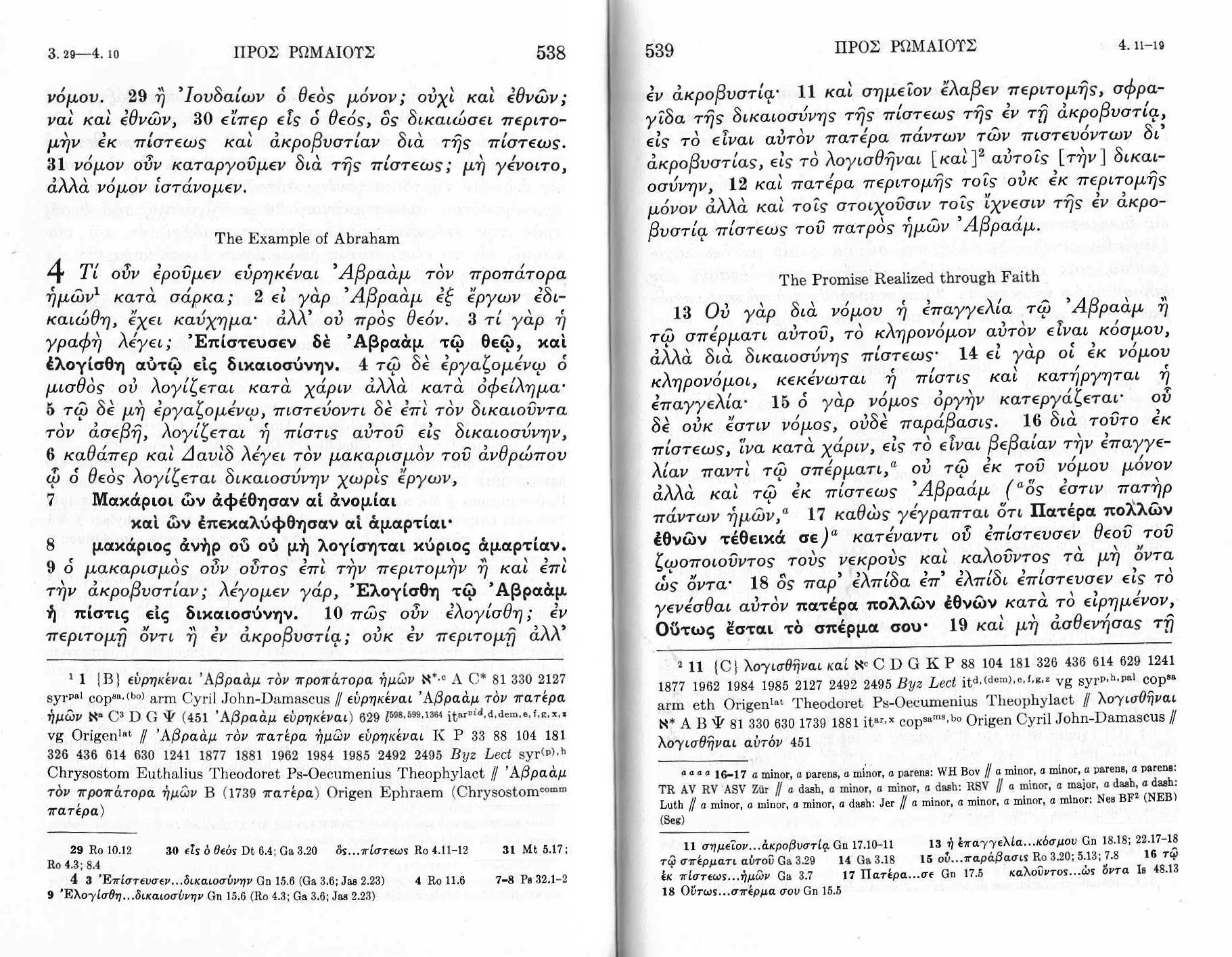
- The oldest copies that we have now are manuscripts, sometimes complete, sometimes in fragments, written on vellum or papyrus. The manuscript known as P46, partly housed at the Chester Beatty Library in Dublin (where I saw it on dissplay), is the oldest known manuscript, dated to around 200 CE.
The Promise Rests on Grace
For this reason it depends on faith, in order that the promise may rest on grace and be guaranteed to all his descendants, not only to the adherents of the law but also to those who share the faith of Abraham (for he is the father of all of us, as it is written, “I have made you the father of many nations”). Romans 4:16
Today’s passage from Romans comes in Chapter Four. Paul has already said a lot. He begins in Chapter One with a great long introduction: worth reading:
Paul,
a slave of Jesus Christ,
called to be an apostle,
set apart for the gospel of God,
which he promised beforehand through his prophets in the holy scriptures,
the gospel concerning his Son,
who was descended from David according to the flesh
and was declared to be Son of God with power
according to the spirit of holiness
by resurrection from the dead,
Jesus Christ our Lord,
through whom we have received grace and apostleship
to bring about the obedience of faith among all the Gentiles
for the sake of his name,
including yourselves who are called to belong to Jesus Christ Romans 1:1-7
This is a subversive introduction. Paul humbly acknowledges that he is a slave of Jesus Christ, but pointedly does not mention his Roman citizenship. Roman citizenship was something significant and which conferred rights and status above non-citizens. As might be expected, the proportion of citizens to the whole population was highest in the city of Rome, where it would have been 55%, although in the eastern Roman Empire, from which Paul came, it might have been as low as 1%; given that many of the members of the House Churches in Rome were Greek-speaking Jews and Gentiles, who presumably did not have deep roots in the city, the proportion of citizens among them may have been lower than among the Latin-speaking population in the city generally. The only case in which claiming to be a slave of someone conferred status was if one claimed to be the slave of the Emperor. In that case if they were acting or saying something, they were doing so on behalf of the Emperor. By claiming to be a slave of Jesus Paul subverts the power hierarchy of the Empire. He furthers his claim to authority within the church by describing himself as called to be an apostle (one who is sent), which was a special class of disciples. Paul knows who he is and whose he is.
The second half of Chapter One gets into apocalyptic language: “the wrath of God is revealed from heaven against all ungodliness and injustice of those who by their injustice suppress the truth.” Paul understands that from the time of Creation human beings had the rational ability to know God as their Creator (and thus laying the foundation of Natural Theology so beloved of Thomas Aquinas). However, they went down paths that led them away from the Creator. They “exchanged the glory of the immortal God for images resembling a mortal human or birds or four-footed animals or reptiles.” The result of this idolatry is that they become depraved:
They were filled with every kind of injustice, evil, covetousness, malice. Full of envy, murder, strife, deceit, craftiness, they are gossips, slanderers, God-haters, insolent, haughty, boastful, inventors of evil, rebellious toward parents, foolish, faithless, heartless, ruthless. They know God’s decree, that those who practice such things deserve to die, yet they not only do them but even applaud others who practice them. Romans 1:29-32
So, idolatry leads to sinful, horrible behaviour. I find it interesting that this is not the story of the Fall as we have it in Genesis 2-3, not about Adam and Eve, but rather a story of how bad reasoning led to idolatry, and idolatry led to depravity. Like most Jews of his time, Paul viewed the Gentiles as extremely depraved, and this depravity was part and parcel of the Roman Empire.
At the beginning of Chapter Two Paul plays a rhetorical trick on his readers:
Therefore you are without excuse, whoever you are, when you judge others, for in passing judgment on another you condemn yourself, because you, the judge, are doing the very same things. Romans 2:1
Clearly he is accusing those listening in the various house churches in Rome of being judgemental. Who are they judging? Perhaps Jewish Christians, perhaps the larger community of Jews, perhaps Jewish Gentiles who obswrve some or all of the Torah. It does seem that the letter is addressed to Gentiles who feel superior to another group.
In Romans Chapter Fourteen Paul writes,
Welcome those who are weak in faith but not for the purpose of quarreling over opinions. Some believe in eating anything, while the weak eat only vegetables. Those who eat must not despise those who abstain, and those who abstain must not pass judgment on those who eat, for God has welcomed them. Who are you to pass judgment on slaves of another? It is before their own lord that they stand or fall. And they will be upheld, for the Lord is able to make them stand.
Some judge one day to be better than another, while others judge all days to be alike. Let all be fully convinced in their own minds. Those who observe the day, observe it for the Lord. Also those who eat, eat for the Lord, since they give thanks to God, while those who abstain, abstain for the Lord and give thanks to God . . .
Why do you pass judgment on your brother or sister? Or you, why do you despise your brother or sister? . . .
Let us therefore no longer pass judgment on one another, but resolve instead never to put a stumbling block or hindrance in the way of a brother or sister. Romans 14:1-6, 10a, 13
This is not the first time he has found himself obliged to tell a group of people to smarten up. In Paul’s First Letter to the Corinthians he hears that there are divisions, for a couple of reasons. First, in chapters two to four he hears that some people are claiming to be better because they had a baptism from Apollos, or Paul, or Peter (Cephas), or Christ. Paul berates them for this. He concludes by stating:
So let no one boast about people. For all things are yours, whether Paul or Apollos or Cephas or the world or life or death or the present or the future—all are yours, and you are Christ’s, and Christ is God’s. First Corinthians 4:21-23
Later in First Corinthians Chapters 12 to 14 he talks about spiritual gifts, and he has also heard that some of them, because they speak in tongues, believe themselves to be more gifted than others. Again he challenges them, and asserts that tongues are wonderful, but clear preaching or prayer in understandable language is better, and that love cancels out any sense of being better than other.
Love is patient; love is kind; love is not envious or boastful or arrogant or rude. It does not insist on its own way; it is not irritable; it keeps no record of wrongs; it does not rejoice in wrongdoing but rejoices in the truth. It bears all things, believes all things, hopes all things, endures all things. 1 Corinthians 13: 4-7
Romans appears to be similar, only instead of people feeling superior because of who baptised them or because of how spiritual gifts are manifested among them, Paul is critiquing them because it appears some in Rome thought they were stronger than others, namely, that they had a freedom in Christ while others felt bound by Torah commandments.
Starting in Romans Chapter Two Paul begins a long description of the benefits and challenges of the Torah and of being the people of Israel. Paul in Philippians 3:6 describes himself before he knew Jesus “as to righteousness under the law, blameless,” but he is happy to let go of any pride he had in that compared to the knowledge that he has received the free grace of God through Christ.
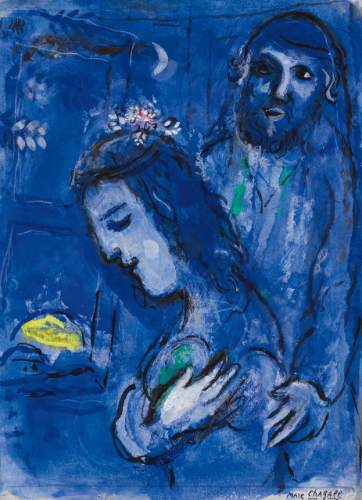
In today’s reading Paul brings up Abraham, to whom God made promises. Abraham lived long before the giving of the Torah on Mount Sinai. Thus, he is like the Gentile followers of Jesus, in that they are not bound by the Torah, but have a faith that saves. Abraham received his promises, but not because of anything he had done. His obedience was in response to the free gift, a covenant made between him and the Lord God, but that is not what made him righteous. His righteousness was a fift of God – grace. Paul pushes the text of Genesis 15 to make Abraham the father not only of Isaac, the grandfather of Israel, but of all nations – including English, Irish, Scots, Welsh, Greeks, Americans, and even Canadians. His faith, his belief, is not simply assent to some proposition, but a kind of experienced trust, even in the face of what seems impossible. For us who are Christians this has already been accomplished for us by Jesus in that we and our sins die with him on the cross, and we are raised with him to a new life and we are viewed and renewed as if we were with him reigning from on high.
So you can see where being judgemental is problematic. It suggests that one is falling back into old ways: Paul is suggesting that the Gentile followers in Rome may be no better than their old selves – filled with every kind of injustice, evil, covetousness, malice, full of envy, murder, strife, deceit, craftiness, gossip, slander, God-haters, insolent, haughty, boastful, inventors of evil, rebellious toward parents, foolish, faithless, heartless, ruthless. He’s not mitigating this in any way. Paul’s remedy for being judgemental is to be humble and recognise that we are saved by the free gift of God which is given to us by the faithfulness of Jesus and lives in us by his Spirit by evidence of faith, gentleness, care, love, humility, and generosity.
Invitation:
We are adopted children of Abraham, grafted onto the vine of Israel. Let us not become arrogant in our faith, for it is the faith of Jesus. Let us not denigrate others, such as Jews, for God loves them as well. Let us work for justice and peace and reconciliation, for that is what our Lord did and has accomplished in Christ Jesus. Remember that “it depends on faith, in order that the promise may rest on grace.”


 The Island Parson