Love’s Discipline

An Advent Retreat with George Herbert:
Monday after the First Sunday of Advent

To start this retreat let’s begin with Herbert’s Discipline.

Discipline

Throw away thy rod,
Throw away thy wrath:
                  O my God,
Take the gentle path.

For my heart’s desire
Unto thine is bent:
                  I aspire
To a full consent.

Not a word or look
I affect to own,
                  But by book,
And thy book alone.

Though I fail, I weep:
Though I halt in pace,
                  Yet I creep
To the throne of grace.

Then let wrath remove;
Love will do the deed:
                  For with love
Stony hearts will bleed.

Love is swift of foot;
Love’s a man of war,
                  And can shoot,
And can hit from far.

Who can ’scape his bow?
That which wrought on thee,
                  Brought thee low,
Needs must work on me.

Throw away thy rod;
Though man frailties hath,
         Thou art God:
Throw away thy wrath.

Title

The title might make the reader think that it is a celebration of God’s discipline, understood as punishment, but it is not. My sense is that the word “discipline” had a pluriform meaning in the early 17th century, as it does now. As a verb or as a noun we might understand it to be the punishment from a teacher to a wayward student; hence, it may involve a beating with a rod or a strap, on the hand or one’s backside. In its simpler sense, though, it may merely be the becoming a disciple, adopting the rigors of training in order to master a field of study. This kind of discipline may be challenging, sometimes costly, but it is not a punishment, merely the price of admission to a guild.

Biographical Speculation

We do not know when Herbert wrote this poem, but that doesn’t have to stop us from speculating and interpolating biographical detail into its meaning. We know enough of Herbert’s biography to imagine that he may be expressing in this poem his exasperation with disappointment. Most of his adult career was focused on finding an important position in government, perhaps even at court, hopes that ended when James VI and I of Scotland and England died in 1625. He did not intend for a career in the church, and delayed ordination until the age of thirty-six; in all likelihood never expected he to be the incumbent priest of a small parish outside Salisbury. As well, he had health issues, including tuberculosis, which led to his early death at the age of thirty-nine after only three years of ordained life.

Technical Issues

Whatever Herbert was thinking, a close reading on the poem and see what its internal structure reveals. Regarding the poetic meter, Ann Pasternak Slater notes that it is

metrically interesting, each stanza alternating between an urgent trochaic trimeter catalectic ( ‘ ˘ ‘ ˘ ‘ ) in the long lines slowed by a molossus ( ‘ ‘ ‘ ) in the short third line. (George Herbert, The Complete English Works, p. 482)

Yeah, I need a dictionary to figure out what she is saying, too.

  • So, the stanzas are the four line sections, with two long lines, one short third line, but then another long line (although none of them are very long.
  • If something is trochaic then it is made up of trochees (of course). A trochee is “a metrical foot consisting of one long syllable followed by one short syllable or of one stressed syllable followed by one unstressed syllable” (Merriam-Webster). You are probably more familiar with iamb, which consists of one short or unstressed syllable followed by a long or stressed syllable; it is sometimes suggested that English is naturally iambic. A foot in English poetry usually consists of two syllables, but sometimes, following Greek and Latin poetry, may have three.
  • Trimeter means there are three metrical feet. Shakespeare usually wrote in iambic pentameter – five feet of iambs. Herbert is not Shakespeare, and so plays with a wide variety of poetic forms.
  • Catalectic indicates that the last foot is missing a final syllable.

So, putting this all together, Pasternak Slater, in saying that the first, second, and fourth lines are each a trochaic trimeter catalectic, she means that each line has five syllables ending on an accent, represented symbolically by ‘ ˘ ‘ ˘ ‘ . We can see this in the first line: Thrów awáy thy ród.

  • Finally, a molossus is just a foot of three long syllables: ‘ ‘ ‘ : O my God, It does indeed interrupt the trochees. In terms of content the third line sets up the fourth, and the third and fourth either contrast with the first two lines, or expands upon those first two. Finally, the rhyme structure is simple enough, ABAB, CDCD, etc.

Themes

In the first few stanzas the poet pleads with God to “Throw away thy rod . . . thy wrath.” The speaker in the poet does not want God to act in anger, but to recognise that they have already turned to God. The poet is all too aware of how far they fall short of the glory of God.

Then, in the fifth stanza – just after the midpoint of the poem – he introduces the figure of Love – capital “L” Love. Love will remove love, and is described as having a bow and a “man of war.” There is some connection here to Cupid/Eros, who shoots arrows of romantic love, although we are not to imagine this Love as being a chubby boy with wings or someone whose projectiles result in romantic love between humans, but between God and human. Really, Herbert here imagines Love as someone quite different. Not the image at left, but more like the one on the right.

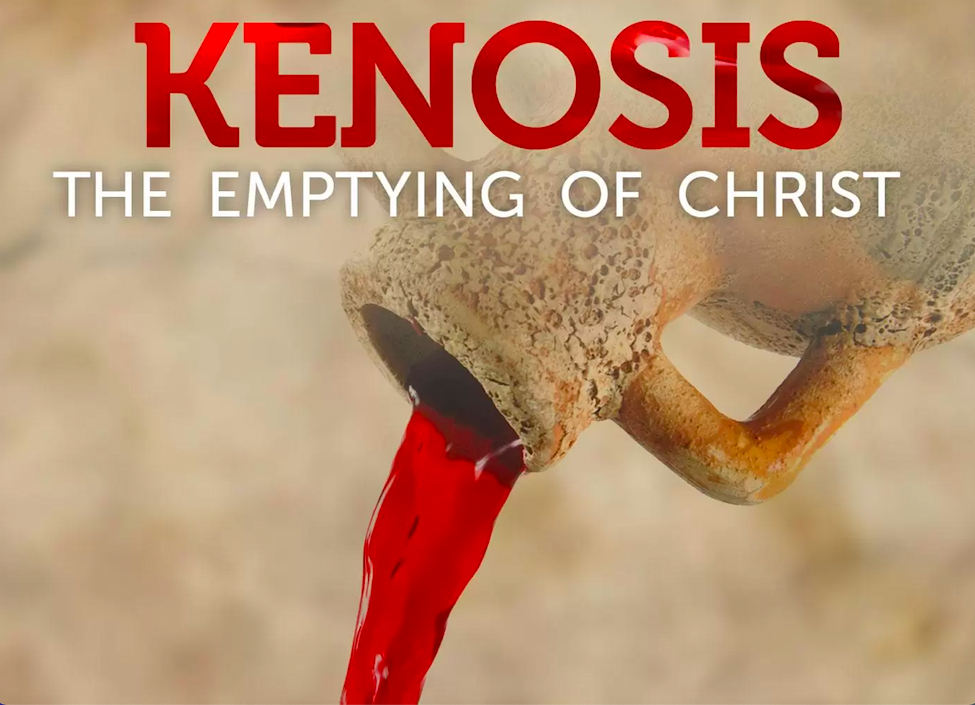
Indeed, not even God escapes this Love. Herbert writes, “That which wrought on thee/Brought thee low” – a reference to the fact that in love God emptied the Word into human form and death on the cross. The poet desires that this same kind of love work on him. The final stanza restates the first and generalizes this desire for Love’s arrows all humankind.

Perhaps, then, this is another kind of discipline, a discipline of love. It has an erotic dimension, not in some fetishized way, but as an ascetic practice that makes the “stony hearts” bleed.

Reflection

In my own life punishment or the fear of it has never featured very greatly; perhaps that speaks to the privilege that I as an upper-class “white” male enjoy. I have never felt the whip to be much of a goad to action, but the promise of recognition or simply the pleasure of achieving something has always been more influential. For much of my life that manifested itself as being competitive, as I attempted to climb the career ladder, such as it was in the Anglican Church of Canada. Now it mostly shows itself in a desire to be of use to others, whether in the parish in which I work, to my family, to the church in general, or the community in which I live. I like to tell myself that this is more of a discipline of love, which is itself grounded in the love of God. The discipline is kenotic – as Christ is poured out from divinity to humanity, from life to death, so I am called to let go of things to which I am attached in order to be able to give of myself completely.

Of course, Love has its erotic dimension as well, which Herbert would have appreciated. C. S. Lewis famously differentiated between “eros” and “agapē” in his book The Four Loves (1960), and argued that only the latter was divine love. However, in both the pre-Christian Jewish-Greek translation of the Hebrew Bible (known as the Septuagint) and in the New Testament the division is not so obvious – divine love is described using both terms. And it may be that Herbert sees the Love that makes a stony heart bleed is a positive thing – that one wants to change, that one will do something against one’s predisposition for love of another, whether a spouse, a child, or God. In terms of carrots and sticks, Gods wrath is a stick, but God’s Love is a carrot and is more powerful.

“Love needs work on me.” I am not fully there, but “my heart’s desire / Unto thine is bent”. “Though I fail . . Though I halt in pace / Yet I creep / To the throne of grace”. I’ve never been big on the wrath of God, and I was not raised to understand God as a wrathful judge. I do not see people’s misfortunes and automatically think that God is judging them (although I do believe the world is set up in a way such that evil deeds will usually cause an evildoer’s downfall). My God has always been a loving God who gives of God’s own self from creation to redemption and everything in between. So the discipline I desire is that of Love.


Posted in Poetry and Novels | Tagged , , | 1 Comment

A Slave of God?

A Sermon Preached on the First Sunday of Advent
November 28, 2021, at 11:00 am
at The Anglican Church of St. Thomas the Apostle, Kefalas, Crete.
The sermon was interrupted by a stray dog just as I was reaching the conclusion.

This is not the Advent Retreat with the Poems of George Herbert – that starts tomorrow, Monday November 29, 2021!

The readings we used were from Wilda Gafny’s A Woman’s Lectionary for the Whole Church, Year W: A Multi-Gospel Single-Year Lectionary (New York NY: Church House Publishing, 2021). They were Genesis 16.7-13, Psalm 71.4-11, Philippians 2.5-11, and Luke 1.26-38.

Annunciation (1980) by Raphael Soyer

Annunciations

Over the next few Sundays we will be looking at annunciations – situations in which God speaks to human beings. The Annunciation par excellance is that of the Angel Gabriel to Mary, who is told that she is to become Theotokos, the Mother of God. But with the lectionary we are using starting this Sunday we hear of other annunciations, and this week it is the annunciation to Hagar. Hagar is the slave of Sarah, the wife of Abraham. Abraham, as was normal for his time, takes his wife’s slave as a concubine. Whether Hagar agreed or not we are not told; by today’s standards, a slave cannot give meaningful consent, given the power differential between a master and a slave. Hagar conceives the child who, when born, is Abraham’s eldest child Ishmael. Sarah has not conceived, and in the patriarchal society of the day, this is an embarrassment and was frequently seen as the disfavour of the gods, or, in this case, YHWH. Slaves, like survivors everywhere, are not above taking advantage of new situations, and to Sarah it seems that she is exalting herself over her mistress because she has given Abraham a son and Sarah has not. So Sarah abuses her, and Hagar runs away. And then God speaks to her. God asks her to go back to her abusive mistress – perhaps so that she can give birth safely and have this strong child, who becomes the ancestor of the Arabian people.

But what is a slave?

We are used to thinking of slaves in terms of racism. But that is not the ancient understanding. In Greek, Roman, and even more ancient times a slave was simply a person who was on the losing side of a war. They were not necessarily physically different from the people by whom they were conquered, and sometimes they were indeed of the same ethnic and linguistic group.

When a people or a nation or a city lost a war or a siege the winners often executed the men and male children, as they were the potential future enemies. Women, children, and some of the men were saved from death, but they entered the living death of being a slave. They were sold as labourers, and many families became rich from the proceeds of conquest this way.

Julius Caesar is probably the best example of this. In his Gallic War he claims to have killed off 900 thousand Gauls, and enslaved another million. This allowed him to buy the loyalty of his troops and laid the foundation for his victory in the Civil Wars and his subsequent dictatorship, as well as that of his heir Augustus.

Hagar was a slave in this way. Mary, who while not a citizen of the Roman Empire, was still a subject – but not a slave. But at the end of the Annuciation she says, in Greek, Ἰδοὺ ἡ δούλη κυρίου · γένοιτό μοι κατὰ τὸ ῥῆμά σου. “Here I am – the slave of the Lord. Let it happen to me according to your word.” Now, the word δούλη is usually softened to servant, or handmaid, but the simplest understanding of it is “slave”. Just as Hagar accepts her servitude at the request of God, so does Mary. And this is not unusual in early Christian circles – Paul also describes himself as a slave of the Lord, and when writing his letters frequently implies that his readers are slaves, too.

And perhaps most shocking of all is the idea that the Word of God is poured out, emptied out into human form and is also a slave – one that is humble, obedient, even unto death.

The Paradox of Hagar, Mary, and Jesus

Of course, the key factor with all of these examples is that these persons accept their slavery, Hagar voluntarily returns to Sarah. Mary accepts her call to be the Mother of God. Jesus voluntarily empties himself, not grasping onto divinity. This is the paradox of the incarnation and of the Christian life – we choose to be slaves. In the 1st century people became slaves involuntarily, as the alternative to a violent death. In Jesus’s case, as well as that of Paul’s, it is an acceptance of slavery that leads to death.

That’s what we are called to. To be slaves of God. To offer everything we have to God, to submit totally. God will not overwhelm us – God wants us to choose this life of obedience and humility.

And, again, the paradox is that this kind of enslavement is utterly unlike the slavery of the world. It is joyful, we are fulfilled in becoming the wonderful creatures God created us to be. In God’s service we find perfect freedom. God offers God’s own self to us, and we give ourselves back.

So this Advent, let us be poured out from our attachments into the form of Jesus Christ, and be made new.

A Note on the Lectionary

At my request, and with the approval of the Chaplaincy Council, we will, for this year only, use a new lectionary created by the Reverend Professor Wilda Gafny: A Woman’s Lectionary For The Whole Church.  This new set of readings follows the calendar of the Church of England, but it provides a somewhat different set of bible readings – passages which have often been overlooked, perhaps because they feature women. Thus, the readings this Advent season feature annunciations – not just to Mary by the angel Gabriel, but also to Hagar, Sarah and Abraham, the mother of Samson, and Hannah.

As Prof Gaffny notes, the various committees that created the Common Worship lectionary and its precursors were all dominated by men, and unconsciously projected a masculine perspective. There is nothing hallowed or sacred about any lectionary  except the fact that it is a list of readings of scripture, and while scripture is holy, the schedule of readings list not!

Wilda Gaffny is a professor of Hebrew Bible at Brite Divinity School in Fort Worth, Texas. She is a priest of The Episcopal Church of the USA, and has served as an Army chaplain and congregational pastor in the AME Zion Church. She has also provided brilliant new translations of the Bible selections in her lectionary, and I hope to use them often.

Posted in Advent, Sermons | Tagged , , , , , , , | Leave a comment

An Advent Retreat with George Herbert

Some of you may recall that in Lent 2019 I did a blog series on the poems of George Herbert, one a day during the forty days (not including the Sundays in Lent). I would like to do this again for Advent, although I may miss a day or two when I travel to London to attend the graduation ceremony of the School of Advanced Study, University of London.

Herbert’s The Temple has over one-hundred and sixty-four poems, and I covered only something like forty in my previous foray. So starting on Monday, November 29th I will begin another excursion, perhaps looking at twenty-three more poems before Christmas is upon us.

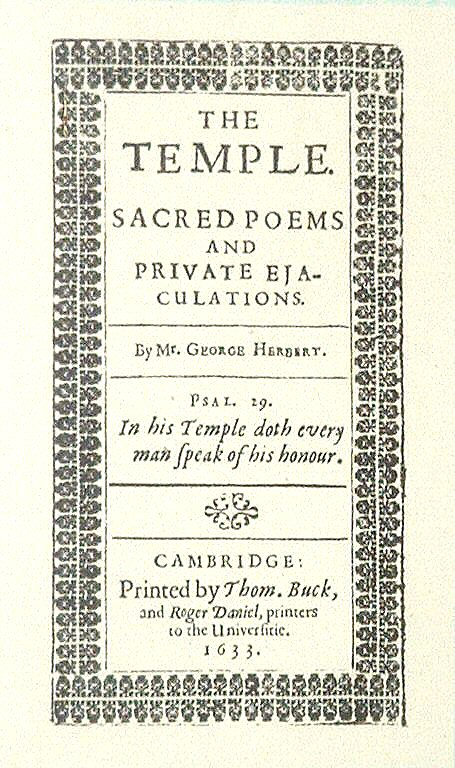
As before, the edition I am using is the Everyman’s Library volume, edited by Ann Pasternak Slater  (New York/London/Toronto: Knopf/Borzoi, 1995). This excellent volume also contains The Country Parson, selected letters, Herbert’s will, and Isaak Walton’s short biography. I will also refer to my copy of Arnold Stein’s George Herbert’s Lyrics (Baltimore: Johns Hopkins University Press, 1968), which, while old, is a comprehensive analysis of his English poems.

In my previous effort I dealt with the following poems; they are listed in the order in which they are printed in Pasternak Slater’s edition, and are hyper-linked to the appropriate post. I confess that it is strange to see these posts after more than two years – many of them I do not remember writing!

The Dedication
The Church-Porch (Peirirrhanterium)
Superliminare
The Altar
The Sacrifice
Redemption
Easter Wings (1)
Easter Wings (2)
Affliction (1)
Prayer (1)
Antiphon (1) Let All The World In Every Corner Sing
Jordan (1)
Employment (1)
Praise (1)
Mattins
Even-song
Church Monuments
The Church-floor
The Windows
Humility
Sunday
Avarice
Anagram
To Saints and Angels
The World
Coloss. 3.3
Lent
Justice (I)
Mortification
Decay
The British Church
Business
Hope
Sin’s Round
Divinity
The Pilgrimage
Praise (2)
The Call
A Dialogue-Anthem
Love (3)


Posted in Advent, Poetry and Novels | Tagged , , | 3 Comments

General Synod of the Church of England November 2021: A Comparison with the General Synod of the Anglican Church of Canada

This past summer I was elected to be a clerical representative (technically known as a “proctor”) from the Diocese in Europe to the General Synod of the Church of England (“CoE”). As I had already been a member of the General Synod of the Anglican Church of Canada, as well as the Provincial Synod of the Ecclesiastical Province of British Columbia and Yukon, and the Diocesan Synods of Niagara (1988-1995) and British Columbia (1995-2018), you might say I am a synod hack. I even wrote a guidebook for the Synod of the Diocese of BC, which is still used in a rewritten format (they took out all the jokes and digressions, which I thought were the most interesting parts).

Me and my ID card. I did look like that three days before I arrived in Westminster. The Archbishop of Canterbury looked at it and said, “That’s just sheer deception!”

Here are some thoughts and comments about my first direct experience when we met on November 16-17.

What’s a Synod?

It comes from the Greek word η σύνοδος meaning meeting, or assembly. A diocese – a unit of a national church – will have a diocesan synod. The synod of an independent autonomous part of the Anglican Communion – a big “P” “Province” – is often called a General Synod, although in The Episcopal Church it is “General Convention”. A small “p” province – a subdivision of the national church consisting of several or many dioceses – may have a provincial synod, in between the diocesan synods and the General Synod – thus, in the Church of Nigeria there are fourteen ecclesiastical provinces, the Church of England has two, and the Anglican Church of Canada has four. Synods may range in size from a couple of dozen members to several hundred. In The Eastern Orthodox churches the synods are almost always composed of bishops assisted by a few high ranking priest-monks; thus, the Holy Synod in Athens is the governing body of the Orthodox Church of Greece.

The Holy Synod of the Church of Greece meeting in Athens. Not Anglican.

The Diocese in Europe sends seven people to the General Synod – one diocesan bishop, three laity, and three clergy. There are 467 members, divided into three houses:

  • fifty bishops (out of about 117 diocesan and suffragan bishops);
  • 197 clergy (elected from the 20,000 clergy serving in the 42 dioceses, and also elected from Cathedral deans, from clergy teaching in universities & colleges, from chaplains of the Armed Forces and Prisons, and from ordained persons in religious communities); and
  • something like 265 laity (elected from the dioceses, from among the 1.7 million active members of the Church of England i.e. those on the parish rolls and who actively worship, as opposed to the 26 million baptised members).

While the three houses usually meet together and vote together, they can and do occasionally meet separately – the House of Bishops meets separately once or twice a year, and the House of Laity met immediately after this November’s sitting was prorogued. They meet to discuss matters and elect officials, like procurator and so forth.

So here are some differences and similarities between the two General Synods of which I have been a member.

Similarities

First, some similarities. Both are composed of three “houses” – bishops, clergy, and laity. For some votes a simple majority of everybody in attendance is necessary, but for more important ones a majority in all three houses is necessary, and for the most important a 2/3rds majority is required. In both Canada and England votes are often done by raised hands, but recorded votes are done with “clickers” – electronic devices that record your individual vote, which is then recorded and ultimately published several weeks later.

Both General Synods elect members to committees that run the business of the General Synod and the National Church. As well, members are appointed to a plethora of committees, commissions, and task groups. Both General Synods have representation from the chaplains of the Armed Forces and religious communities, as well as youth (although whereas Canada has a youth delegate from every diocese, i.e. thirty in total, England only has three). Both have presentations on the work of the church on which votes are not normally taken. There is a large number of reports produced in preparation for the meetings, but in an effort to save paper these are now distributed electronically. Motions are usually brought by bodies internal to the General Synod and proposed by their chair or another member, but motions can also come from diocesan synods and ordinary members. The whole operates according to parliamentary procedure as laid out in standing orders and similar to the Parliaments of the nation. Both synods operate in English (although the Canadian one occasionally has people speaking in French, Cree, Inuktitut, or some other vernacular).

Both General Synods seem to be very concerned with marriage, and whether it should be restricted to heterosexual couples or extended to any couple composed of any gender identity. If there are “parties” within the General Synod of the CoE they seem to have been elected along these lines. Both are frustrated with the declining relevance of the church in their home countries, as well as the decline in numbers of attendance and finances; there is much discussion of how to accomplish mission.

Both the CoE and the Anglican Church of Canada are concerned with representing the diverse membership of their active members, especially visible minorities and marginalized peoples in the General Synod. In England over the summer there was an effort to encourage young people and those of African and Asian heritage to run for election. That seems to have had some success, although I would say that the make-up of the General Synod of the CoE is still pretty “white bread” and skews to the over-fifty crowd. I did have a lovely conversation with Karowei Dorgu, the Bishop of Woolwich (Diocese of Southwark), who came from Nigeria to the London area as a medical doctor in 1987 but followed a call to ordained ministry. The General Synod of the Anglican Church of Canada likewise is pretty skewed to an older representation of people of British background, but there is always a treasured membership made up of Indigenous bishops, priests, and laity, as well as a few delegates whose forebears were from Asia, Latin America, Africa, and Continental Europe.

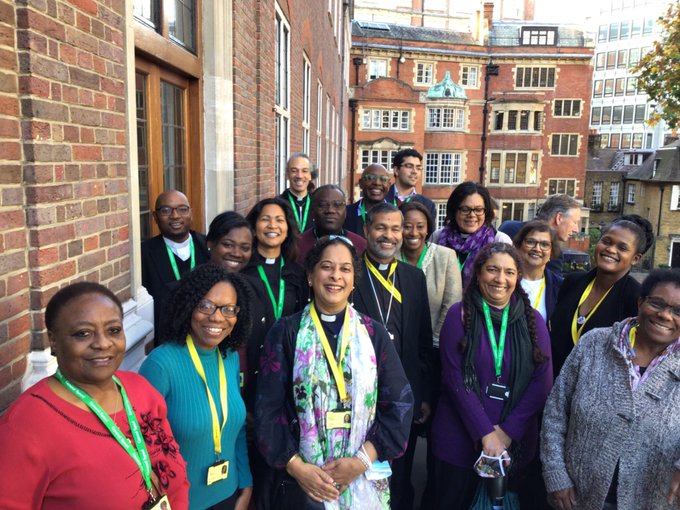
Some of the folk at General Synod of the Church of England November 2021. The Rev Canon Smitha Prasadam, Chaplain of St Alban’s Copenhagen, and representative from the Diocese in Europe, is front and centre.

As mentioned, both General Synods have gone paper-less, using websites and special apps to provide members and interested folk with the masses of documents that used to fill a binder. Both also live-stream the proceedings, and use large screens in the assemblies themselves to project the person speaking.

A floor view of the Assembly Hall of General Synod at Church House in Westminster

There are huge differences. The most important is that England’s General Synod is a statutory body – it makes law for the realm of England. As the Church of England is an established church, it’s actions must be approved by the Sovereign via the Parliament. Thus, when a “Measure” or “canon” is approved by General Synod it goes to a committee of the Houses of Parliament that then either recommends its approval by the House of Lords and the Hose of Commons, or its rejection. A Measure from General Synod is almost always presented for approval, and after motions from Parliament doing so, the Queen signs her consent. It then comes back to General Synod for implementation. Obviously there is no separation between church and state as is understood by the US Constitution, although it would be going too far to say that the Church of England is just another branch of the government; it is better to say that the Church of England as the official church in the realm enjoys certain privileges and obligations that other faith groups do not, and as such is subject to the will of the people as expressed through Parliament.

In Canada the General Synod of the Anglican Church of Canada, while incorporated by an Act of Parliament, is merely one unestablished faith group among many, and its actions govern only those who voluntarily submit to them. As a result, ecclesiastical law in Canada is a small subset of administrative law for non-profits and charities, whereas in England it has an extensive body of legislation and case history.

The Queen addresses the opening session of the General Synod of the Church of England sometime in the 1990s. This year she was advised not to attend for reasons of health, so the Earl of Wessex, the Prince Edward, did so on her behalf. Security was very stringent. This is a view from the press gallery.

Since Canadian bishops are elected from by the synods their dioceses and ratified by the provincial Houses of Bishops, there is a sense of ownership and loyalty of these bishops by the dioceses. English bishops are nominated by a confidential Crown Appointments Commission and ratified by the UK Prime Minister’s office, after which they are appointed by the Queen who directs an body to elect a particular individual. Since the great body of the ordinary clergy and people have no say in who the bishops are, there is no rooted loyalty to them. Also, the dioceses are far larger in England than in Canada, and so it is much harder to have much of a personal relationship. Thus, not surprisingly, I have heard from my clergy colleagues a greater distrust of the bench of bishops in the Church of England than I ever experienced in the Anglican Church of Canada (or The Episcopal Church).

The General Synod of the Anglican Church of Canada was created in 1893 by the two Ecclesiastical Provinces of Canada and Rupert’s Land, along with three western dioceses. Subsequently the Ecclesiastical Province of Ontario was carved out of “Canada”, and British Columbia and Yukon was created out of the western dioceses that were part of no province. Each of these provinces have an archbishop and its own provincial synod, and the chair of General Synod is the Primate of Canada who is also an archbishop. Further, the National Indigenous Bishop was raised to being the National Indigenous Archbishop. Thus Canada has five to six archbishops, offices that were all created in the last 150 years or so.

England, on the other hand, has only two archbishops, York and Canterbury, both of which go back some 1400 years. In medieval times the bishops and clergy of the two ecclesiastical provinces of York and Canterbury had separate provincial “convocations” which from the 17th century until the 20th century hardly ever met. Legislation for the Church of England was dealt with by Parliament itself until the early 20th century, when it devolved authority to a “Church Assembly” which included laity for the first time. This was reorganised by Act of Parliament into General Synod only in 1970. Thus, the Canadian General Synod is older by some 77 years.

Differences: 2) Organization

The Canadian General Synod has an executive called the Council of General Synod, or CoGS, which consists of some thirty members elected from General Synod itself, and there are a number of committees which report to CoGS and whose membership is largely elected from GS. There is no such body in the Church of England, although one is being proposed by the Governance Review Task Group. Instead, at the moment, there are no fewer than seven national bodies with national executive responsibility, and some 120 committees, tasks groups, and commissions working away at important issues, whose interrelations are complex. There are proposals to reorganise and simplify all of this.

The English General Synod is much larger than the Canadian one, consisting of 467 members elected to a five year term, whereas that of Canada is something like 287 and they serve only for three years. The Canadian one meets only once every three years for a week to ten days, whereas the English one meets twice a year for two to five days. The English synod meets in the Assembly Hall of the purpose built Church House in London, adjacent to the Palace of Westminster and Westminster Abbey, as well as at the University of York, whereas the Canadian General Synod moves from city to city across the country and gathers in rented facilities – usually hotels and universities. While services often take place in cathedrals or other large churches, this is not always the case – in 2016 everything was done in a hotel ballroom in a suburb of Toronto.

Differences: 3) Culture

The biggest difference in culture between the two churches is that while both have “parishes” they understand the term differently. In theory both have a geographical meaning. In Canada parish boundaries are largely ignored. While a parish church may be rooted in a particular neighbourhood or city, members will travel across those boundaries to go to the church they like. There is a sense of obligation to the community around them, but it is not defined by any diocesan definition of its territory. In England there is a strong sense that the incumbent, clergy, and lay leadership on the Parochial Church Council has a responsibility to everybody within the parish boundaries, regardless of whether they are active in the church or belong to any faith group. This is manifested by the legislated requirement that the incumbent must baptise, marry, or bury any individual or couple that present themselves for these sacramental acts. In Canada there is no such legal obligation.

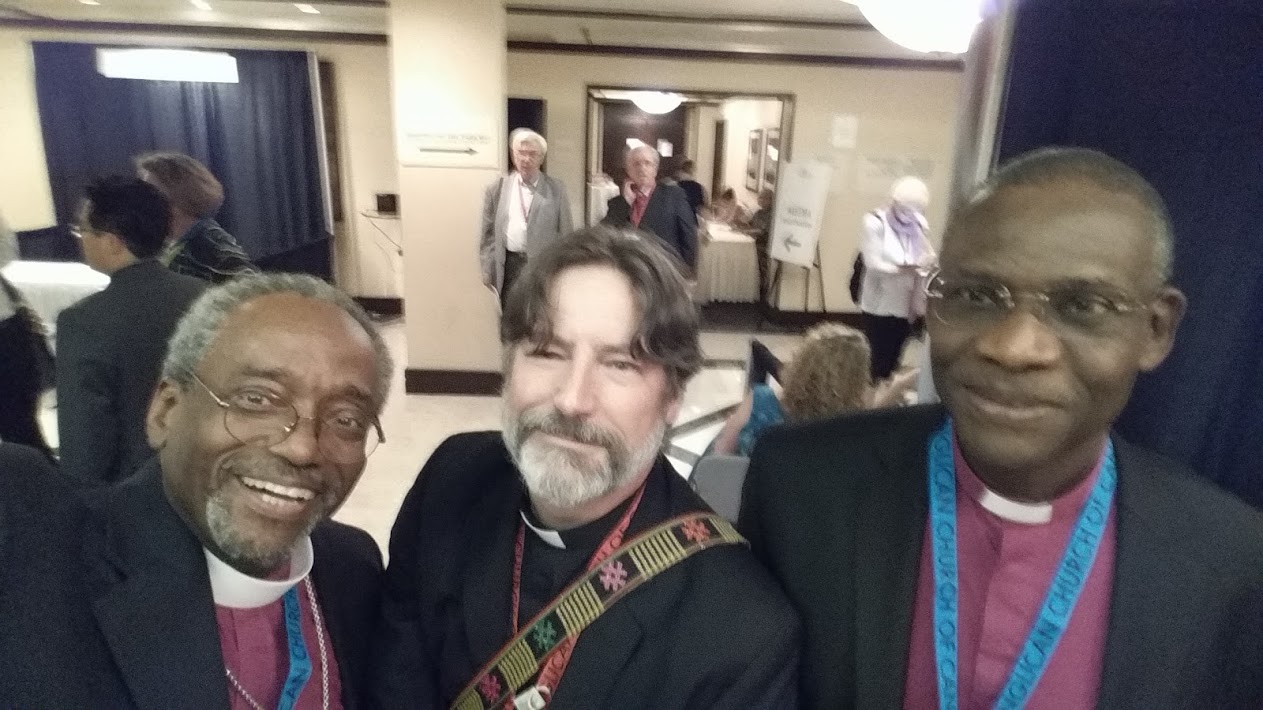
Fan boy moment at the General Synod of the Anglican Church of Canada 2016. The Most Rev. Michael Curry, Presiding Bishop of the Episcopal Church on the left, and the Most Rev. Josiah Idowu-Fearon, Secretary General of the Anglican Consultative Council. I’m the guy in the middle.

Another cultural difference is that I have yet to see any highlighting of ecumenical or Anglican Communion links in the General Synod of the CoE, whereas they are always visible in the Canadian one. The Canadian General Synod invariably had prominent visitors from other parts of the Anglican Communion – the Presiding Bishop of the Episcopal Church, the General Secretary of the Anglican Communion, and the Archbishop of York. Likewise we had at least two joint meetings with the Evangelical Lutheran Church in Canada, and presentations from the United Church of Canada and representatives of the Roman Catholic Church. I have only been to one sitting of this General Synod of the CoE, and it may yet happen, but I have yet to see anything like this there. There were ecumenical guests, but only two or three. I was obliged to be absent from Tuesday’s proceedings (I was self-isolating because of what was later determined to be a false positive Covid-19 test), so I may have missed the parts where their presence was noted. Nevertheless, the impression given is that the General Synod does not pay much attention to the Communion or other churches; as the established Church of England, it can be quite insular. You would never know that there are other Anglican Churches in the United Kingdom, such as the Church in Wales, The Scottish Episcopal Church, and the Church of Ireland.

Differences 4) Superficial

There are a number of superficial differences.

  • The Canadian General Synod meets at tables, not chairs.
  • The Primate in Canada usually chairs most of the proceedings, whereas in England each item has its own chair, and it is not clear to me if the person chairing is always a member of General Synod.
  • The legal counsel attending and advising Synod in England are obvious, as they are in their legal robes and wigs. In Canada lawyers never wear wigs, and the Chancellor and Registrar only dress up for formal services, like the installation of a new primate.
  • I understand that at the summer sitting in York the dress can get pretty casual, but what I saw in Westminister was that clergy dressed up as clergy and laity often wore ties and “smart casual”.
  • In Canada we have but one Primate, but England has two, the Archbishop of York who is the Primate of England, and the Archbishop of Canterbury, who is the Primate of All England. They seem to function very much as a tag team, and they both give the Presidential Address. With the National Indigenous Archbishop in the Anglican Church of Canada we come close to this, but he does not have the formal role in General Synod that the Archbishop of York does in his.
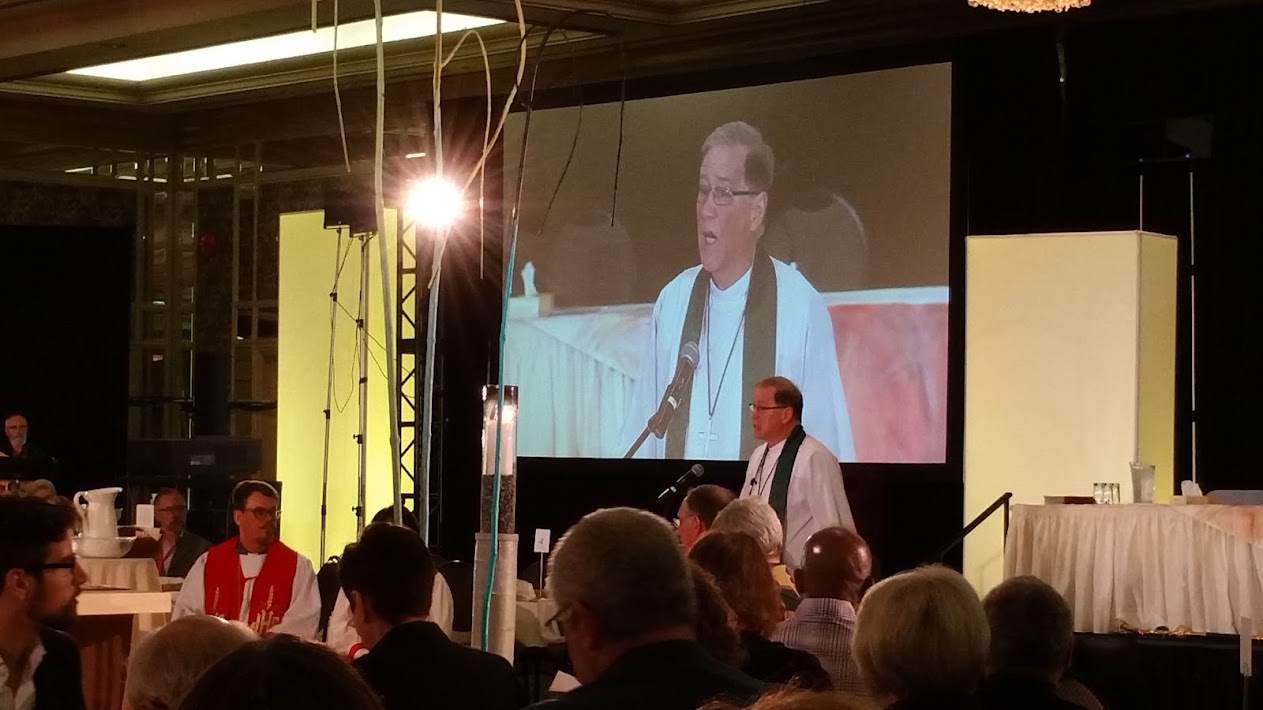
The Most Rev Fred Hiltz preaches at the General Synod of the Anglican Church of Canada in 2016 in a hotel ballroom in Richmond Hill, Ontario.

The Church of England carries the burden of 1420 years of institutional history, one that has carried it from Augustine’s monks meeting in the tiny little ruin of St Martin’s Church in Canterbury in the Kingdom of Kent in 597, to the Synod of Whitby in 664 in which the pre-existing Celtic Church conformed to Roman practice, through the Reformation in the 16th Century, the Civil Wars of the 17th Century, down to the present day and the disestablishment of the church in Wales and Ireland. If given a clean sheet of white paper nobody would design a structure for a national church that looks like the one that the Church of England has (as is evident from the structures in other Provinces of the Anglican Communion). Nevertheless, it is much loved by its members, and resists major change. One of my concerns is how much this impedes the effectiveness of carrying out the mission of God.

If this comparison of two General Synods does anything perhaps it is that it describes some of the culture shock I am experiencing as a new member of the English General Synod and as a long-ordained priest new to the Church of England. English Anglicans look and talk like Anglicans elsewhere, but in many ways (of which I suspect they are only dimly aware), they do think and act differently from most Anglicans in the Communion. That said, I appreciate the opportunity to attend on behalf of the Diocese in Europe, and pray that I might in some small way be able to influence its proceedings in a positive way.

Posted in Anglican Church of Canada, General Synod Church of England | Tagged , , , | 6 Comments

God and COP 26

A Sermon Preached on The Last Sunday after Trinity
(the Twenty-Second Sunday after Pentecost)
October 24, 2021, at 11:00 am
at The Anglican Church of St. Thomas the Apostle, Kefalas, Crete.

The readings we used were Job 42:1-6, 10-end, Psalm 126, and Mark 10:46-52.

Does God have anything to do with COP 26? It is now one week before the beginning of the United Nations Climate Change Conference known as COP 26 (i.e. the “Conference of Parties”, and in the 26th year since governments, NGOs, trade unions, businesses, and everyone else with any interest in climate change have met to review and negotiate global action). COP 26 is being hosted by the UK in Glasgow, in partnership with Italy.

Isn’t this just a political-economic-environmental issue that the church should stay out of?

Not according to the major Christian leaders of the world. God is deeply concerned with how we steward creation. Last month the Pope, the Ecumenical Patriarch of Constantinople, and the Archbishop of Canterbury issued an historic letter to the leaders of the world, all Christians, and all people of good will. Between the three of them – Pope Frances, Patriarch Bartholomew, and Archbishop Justin Welby – they speak on behalf of 1.6 billion Christians, or two out of every three people who claim to be followers of Jesus Christ.

The insignia and title of the Joint Statement

In any case, I am a priest of the Church of England – a church established in the realm of England where twenty-four bishops and two archbishops sit in the House of Lords and speak regularly on legislation. So, in law and practice, there is no separation of church and state, the temporal and spiritual. Every matter under heaven is potentially within the competence of the church to discuss.

The main theological points in the joint statement are:

  • God calls upon us to choose life, according to the Book of Deuteronomy. You will recall that God speaks through Moses to the people of Israel. He has given them his instruction in the Torah on how to live. Today God speaks to us through the Book of Creation and the science is clear – our current trajectory of consumption and carbon gas production will have devastating results for the sustainability of life.
  • Jesus calls us to be mindful of the poorest among us, to treat them as if they were the Lord himself, as seen in Matthew 25. It is likely that you and I will be okay, and our grandchildren and great-grandchildren will probably be all right as well; after all, we belong to the developed world, and we can adjust. However, we are already seeing how extreme weather and environmental degradation is affecting the poorest of us in the world, the people living off of less that a pound sterling a day – cyclones are flooding parts of Bangladesh and India, and the rise of ocean levels will literally cover certain island nations in the Pacific.
  • Using a parable of Jesus, the three leaders caution us against building our house on sand instead of solid rock, by adopting short-term and seemingly inexpensive approaches to the stewardship of the world. They also refer to the wasteful and profligate expenditure of the prodigal son, who ends up hungry. They point to the farmer who has a barn full of grain and thinks all is well, but does not consider his own finitude and mortality. The three church leaders are concerned that this generation has maximized wealth and our own interests at the expense of future generations. Frankly, we are not responsible, we are not thinking ahead.
  • The three leaders direct us to understanding stewardship not as an unbridled license to exploit the world, as a dominion over all living things to our own exclusive benefit, as Genesis 1 has often been interpreted, but as Genesis 2 suggests, fellow workers with God with respect to creation, tillers of the soil.
  • They call us to repentance, a change of mind that leads to choosing to live, eat, travel, spend, and invest differently.

The only thing I might add is that this is a call to us as well to have the mind of Christ, as in Philippians 2.5-11, who does not grasp on to power and majesty, but empties himself into humanity. As a human being he becomes humble and obedient, thus transforming our understanding of the glory of God, as well as what we as human beings, made in the image of God, are called to do (this is called kenotic theology, from the Greek word for emptying).

However, I suspect that even we as Christians, some 2.4 billion, cannot do it alone. We need all the peoples of the world, whether of different faiths or of none, to act. While the theological points above may be persuasive for Christians, we need the political leaders of the world to act.

The top five emitters, in order, are China at 28%, the United States at 15%, and then India, Russia, and Japan in the single digits. These first three countries create 50% of the carbon gasses causing global warming, and none of them are doing much to lessen their impact. The EU’s total is some 18%, so combine China, the US, India, and the EU, and we have 2/3rds of the total emissions. The UK is only 1%, but my home country of Canada, with half the population of Britain, has a terrible footprint of about twice of what the UK produces – a per capita footprint four times the size of the average Brit. 

Of course, some politicians deny climate change, just as some Christians do. These are the same people who might deny that smoking causes cancer, or that evolution and quantum physics are just theories. They have the right to their opinions, but they are wrong, and their opinions tend to be self-serving.

As individuals we can lobby our governments. We can pray. We can try to examine our own life.  Like the story told in the Book of Job, this is a time of testing for us, and an opportunity to be faithful, and hopeful.

As Christians, we are a people of hope. As Psalm 126 says:

Restore our fortunes, O Lord, / like the watercourses in the Negeb.
May those who sow in tears/ reap with shouts of joy.
Those who go out weeping, / bearing the seed for sowing,
shall come home with shouts of joy, / carrying their sheaves.

As God restores Job, so may we be restored, so that our latter days are greater than our beginning.

May we all, like Bartimaeus in our gospel reading, be healed from our blindness, so that we can see and follow Jesus on the way.

Posted in Sermons | Tagged , , | Leave a comment

What’s Your Super Power?

A Sermon Preached on The Eighth Sunday after Trinity
(the Ninth Sunday after Pentecost)
July 28, 2021, at 11:00 am
at The Anglican Church of St. Thomas the Apostle, Kefalas, Crete.

The readings we used were Ephesians 3:14-21, Psalm 14, and John 6:1-21.

What’s your super power?

We all know that Superman can fly, in invulnerable to bullets, has x-ray vision, and spectacular strength. The Flash can run very quickly. Peter Parker, thanks to being bitten by a radioactive spider, has acquired heightened athletic abilities and can cling to walls. Batman doesn’t have any super powers, but he is fabulously wealthy, so he can create or purchase all kinds of tech that makes it seem like he has super powers.

In popular culture and in social media, asking someone, “What’s your super power?” is a way of asking what it is that which sets you apart from other folk and sets you up for greatness. And so, the Washington Post, writing about Giannis Antetokounmpo, the Greek basketball player on the Milwaukee Bucks basketball team, said that his “superpower is that he possesses the kind of short-memory fearlessness required for greatness. He won’t be shamed into the shadows. The possibility of conquering those challenges and shining is much more appealing.”

People on internet talk about more mundane things as if they were super powers. On Twitter some people said that their super power was:

  • “I got adopted by a dog!”
  • [I am] “Efficient, practical, and a master in the art of lipstick.”
  • “I can scroll the internet for hours!”
  • “I make spanakopita, lamb and cute kids.” [obviously a Greek American]
  • “The Oxford comma.”

A medical doctor wrote, “My superpowers are empathy humour, and perfectionism. These are also my weaknesses.”                                 

So, how would you answer the question? What are your super powers?

Divine Powers       

In our gospel reading today Jesus walks on water and multiplies bread. Those miraculous acts might look like super powers, but to call them such is a genre error. Super powers are almost always acquired by otherwise ordinary people. The miraculous abilities of Jesus merely attest to who Jesus is: the son of God, the Messiah, the prophet promised of old who is to come into the world. His powers are inherent in who he is as the one who is fully human and fully divine – he is like us in every way but sin, and yet is also the one through whom all things were made and for whom all things were made. Thus he can command the winds and the water, and multiply material things. The disciples are terrified by Jesus walking on the water, and merely confused by the feeding of the five thousand. Jesus calms the disciples with his words, “It is I; do not be afraid” and goes on i the Gospel of John to explain what he has done. Perhaps we can consider his calming presence and ability to instruct super powers as well.

So, what are your super powers? 

As Christians, our super power is that we can do more than we can ask for or imagine. Paul in Ephesians writes:

Now to him who by the power at work within us is able to accomplish abundantly far more than all we can ask or imagine, to him be glory in the church and in Christ Jesus to all generations, forever and ever. Amen. Ephesians 3.20- 21 NRSV

In the Anglican Church of Canada this doxology, in slightly different wording, is used at the end of the Holy Eucharist: 

Glory to God, whose power, working in us, can do infinitely more than we can ask or imagine. Glory to God from generation to generation, in the Church and in Christ Jesus, for ever and ever. Amen. BAS translation

All ow me to describe three examples of this.

  • Our parish vision is to radiate God’s love in Jesus Christ on this island and beyond. We are radiating beyond the island via Zoom, something that we never imagined when putting this vision statement together just before the pandemic. The power of God is at work in us, doing more than we can ask or imagine.
  • I just heard that my friends Zak and Hind, living in suburban Vancouver, have just become Canadian citizens. Zak and Hind were in Mosul in northern Iraq when ISIS came and took over the city, incorporating it into their supposed caliphate. Zak was a pediatric nurse, but was confronted at gunpoint and told he must now work at their soldiers’ infirmary. They immediately left the city on foot, leaving everything behind, crossed over into Jordan, claimed refugee status, and in time were sponsored by a congregation in the Refugee Program in my old diocese of British Columbia. Now they are employed in fields related to what they were trained for, paying taxes, and have a new son. I had a small hand in helping this come about. They and we could never have imagined this course of events. The power of God is at work in us, doing more than we can ask or imagine.
  • Do you remember the Millennium Goals? These were a set of eight goals to be achieved by 2015. Goal One was: Eradicate extreme poverty and hunger. As you may recall, an intense effort achieved spectacular results:
    • The proportion of people living in extreme poverty declined by half at the global level.
    • In developing regions, the proportion of people living on less than $1.25 a day fell from 47 per cent in 1990 to 22 per cent in 2010, five years ahead of schedule.

That said, while the proportion of undernourished people globally decreased from 23.2 per cent in 1990-1992 to 14.9 per cent in 2010-2012, this still leaves 870 million people—one in eight worldwide—going hungry. There is still work to do but these achievements demonstrate that the power of God is at work in us, doing more than we can ask or imagine.

With Great Power Comes Great Responsibility

Although we are Christians, too many of us miss the fact that God is at work in us – that the same power which raised Christ from the dead is at work in us individually and collectively, as the body of Christ. By the power of the Holy Spirit all of us have been given gifts, perhaps for the building up of the church, the body of Christ, but also to carry out the ministry entrusted to us by Jesus at Easter: “As the the Father sent me, so I send you.” Today we are faced with many challenges. They might seem overwhelming. They might not seem directly related to the church, as they are environmental, political, and economic. But by the Spirit of God we have this power to do more than we can ask or imagine. Let us use them to radiate God’s love on this island and beyond.

Posted in Sermons | Tagged , , , , | Leave a comment

Some Notes on Philippians

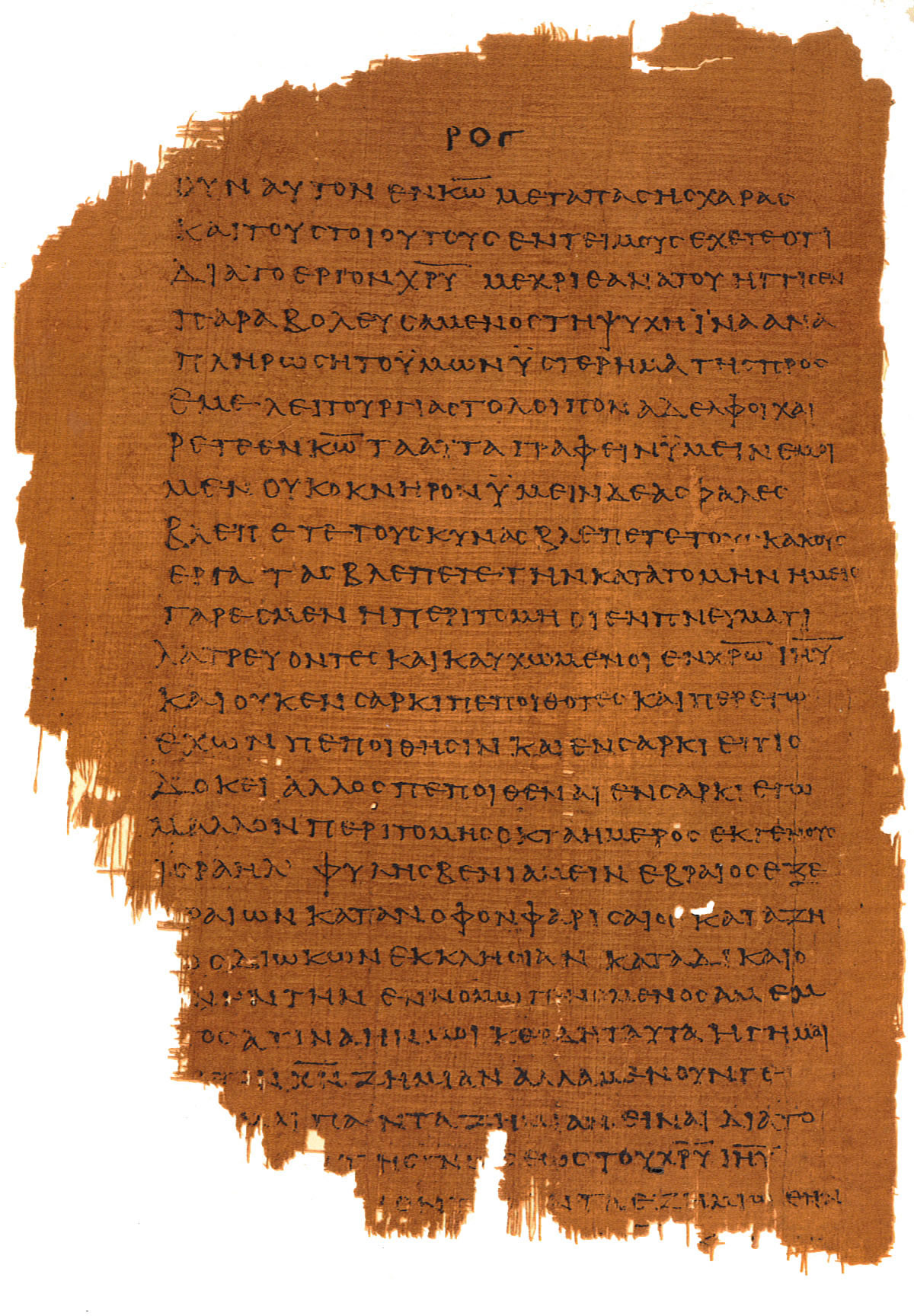
A page from Papyrus 46 (abbreviated as “p46” or “{\mathfrak {P}}46″), containing part of the beginning of Paul’s Letter to the Philippians. It is dated between 175 and 225 CE. Its precise origin is not absolutely clear, as it was sold by a dealer in Cairo in the illegal antiquities market in the 1930s, but it is undoubtedly from Egypt. Papyrus 46 consists of ninety-six pages from a codex (a bound book) of Paul’s letters, estimated to originally have been 104 pages long. P46 is divided between the Chester Beatty Library in Dublin and the University of Michigan in Ann Arbour.

The Small Group Bible Study of the Anglican Church of St Thomas met last Thursday (June 16, 2021) and read through the whole of the letter. We made some general observations about the “who, what, where, why, when, and how”, as revealed by the text. Here they are, with a few additions, in summary form.

What

Paul’s Letter to the Philippians comes to us as a “book” in the printed, translated Bible. According to one source, it is 2183 words long, in one-hundred and twenty-four verses spread across four chapters. In my NRSV large-print Bible it takes up five pages of double columns. We read it aloud in English, as a group, in about twenty minutes, I think. So it is not long – about the length of this blog post, in fact!

Originally the Letter to the Philippians was not in English, nor did it have chapters, verses (a medieval addition), and section headings. For the first 1400 years of its existence it was not typeset, but rather it was copied laboriously by hand.

Above you can see one of the oldest manuscripts preserving part of it. It is likely a copy of a copy, many times over, and just as a photocopy starts to degrade over multiple copies, so errors and omissions enter in. Textual scholars, comparing many old versions, note the presence of several copying errors already in this manuscript.

The text is in Hellenistic Greek (also called Koiné Greek), and it is undoubtedly the language in which it was composed. If you can read the Greek alphabet you may be able to make out a few words of the first two lines in the photograph above. It reads,

οὖν αὐτὸν ἐν κῷ μετὰ πάσης χαρᾶς,
καὶ τοὺς τοιούτους ἐντίμους ἔχετε ὅτι

or in English translation

him then in the Lord with all joy,
and honor such people because

In the manuscript the words all run together, there is no punctuation, it is all in capitals, and the script uses abbreviations such as κῷ for common words like κυρίῳ. Nevertheless, it is plainly from Philippians 2.29-30.

Scholars and preachers today use printed critical editions, such as the United Bible Societies Greek New Testament. While such critical editions notes variant readings across hundreds and thousands of manuscripts, they do express opinions on what the original reading probably was. The English translations we use today are based on these critical editions, and generally seek to express the sense of the Koiné Greek as directly as possible.

Who

As 1.1 states, it is a letter from Paul and Timothy to the church in Philippi, σὺν ἐπισκόποις καὶ διακόνοις (“with the bishops/overseers and deacons/helpers”). In all probability the church to which Paul wrote was small, perhaps no bigger than our own church at St Thomas’s. They likely met in private homes, or maybe a rented hall, or a courtyard. You can see that we are already into issues of translation with this first verse – do we see the words used by Paul for leadership in Philippi as technical terms, early versions of our own orders of ministry, or as something different?

A reconstruction of ancient Philippi and the modern, excavated ruins

Philippi, about 160 km east of Thessaloniki and 20 km inland from the sea, is now in ruins, but in Paul’s time it was a major city in eastern Macedonia. It had been founded in the 4th Century BCE by settlers from Thasos, itself a colony from the Cycladian island of Paros in the 7th Century BCE. Its original name was Krenides, meaning “fountains” or “springs”, but it was almost immediately renamed by Phillip II of Macedon after he conquered it in 360 BCE. Philip II was the father of Alexander the Great, and consolidated Macedon and extended his control over Greece. It was on a strategic route between the Adriatic and the north Aegean, and after the Romans conquered Macedon, they rebuilt the road as the Via Egnatia (parallelled today by the modern highway E90, the Egnatia Odos). It was also close to gold mines, making it a wealthy city. Octavian (later known as Augustus) fought a major battle here against Brutus and Cassius, the assassins of Julius Caesar. He then settled many legionnaires there, and it was rebuilt as an echo of Rome. While the population probably spoke mostly Greek, in Paul’s time I imagine that there were still many there whose first language would have been Latin. In the course of time Christians did build structures in Philippi, but they date from centuries after the time of Paul.

While the letter is from Paul and Timothy, it is very much in Paul’s voice. Timothy was with Paul, and Paul talks about someone named Epaphroditus who had travelled from Phillipi to wherever they were. Paul mentions Clement as well, who is not much more than a name in the New Testament; he appears to be in Philippi with two women named Euodia and Syntyche.

Why

Why is Paul writing the Philippians?

  • Essentially, the letter is a thank you note. In 4.18 he notes that the church there has sent gifts to Paul.
  • The verse at 4.2 reads, “I urge Euodia and I urge Syntyche to be of the same mind in the Lord” and this echoes 2.5, “Let the same mind be in you that was in Christ Jesus.” It may be that Paul had heard from Epaphroditus of some minor disagreement between the two women, and in as positive a way possible was trying in the letter to help them get along.
  • The Philippians are worried about Paul, and so he writes to try and reassure him that he is fine. He is quite ambivalent about whether he lives or dies: “my desire is to depart and be with Christ, for that is far better;  but to remain in the flesh is more necessary for you.” (1.23-24).
  • In chapter 3 there is some invective against “the dogs, . . . the evil workers, . . . who mutilate the flesh” who are probably conservative Jewish Christians who believe that Gentile followers of Jesus must become Jews, and the males must be circumcised. These opponents of Paul also show up in the letters to the Galatians and in 1 & 2 Corinthians. Some scholars have suggested that this is a fragment of another letter that got inserted here, but the change in tone may just be Paul trying to say to the Philippians what he has said to other churches.
  • Finally, this is a letter full of joy. Paul was simply expressing his joy in Christ and the fellowship he had with the church in Philippi.

Where

We know where Philippi is, or at least where it was. But where was Paul when he wrote the letter?

In 1.13 he refers to the good news of Jesus becoming known τῷ πραιτωρίῳ to the Praetorium, or the “Imperial guard” as the NRSV translates it. It originally referred to the tent of the commander of a Roman army in the encampment. It is derived from the word”praetor”, which in Latin was the equivalent to “general”. As the Romans established a permanent presence in various territories, it also referred to the governor’s headquarters. Thus, in the gospels, Pontius Pilate rules from the Praetorium in Jerusalem. The penultimate verse of the letter reads, “All the saints greet you, especially those of the emperor’s household.”

In 1.7 he describes himself as being imprisoned, and in 4.14 he describes his situation as being “in distress”. This is no metaphor, then – he is a “guest” of the Roman army – in a prison. He is awaiting judgement; prison was not punishment, put the prelude to it. Punishment involved a different range of things – it might have involved physical beating, execution, exile, loss of property, and so forth – but not jail time. As well, the Romans would not have done much to make Paul comfortable, so the gifts sent by the Philippians by Epaphroditus undoubtedly did much to make Paul’s situation livable. Presumably it was money, and so Paul was probably able to have food brought to him by Epaphroditus and Timothy.

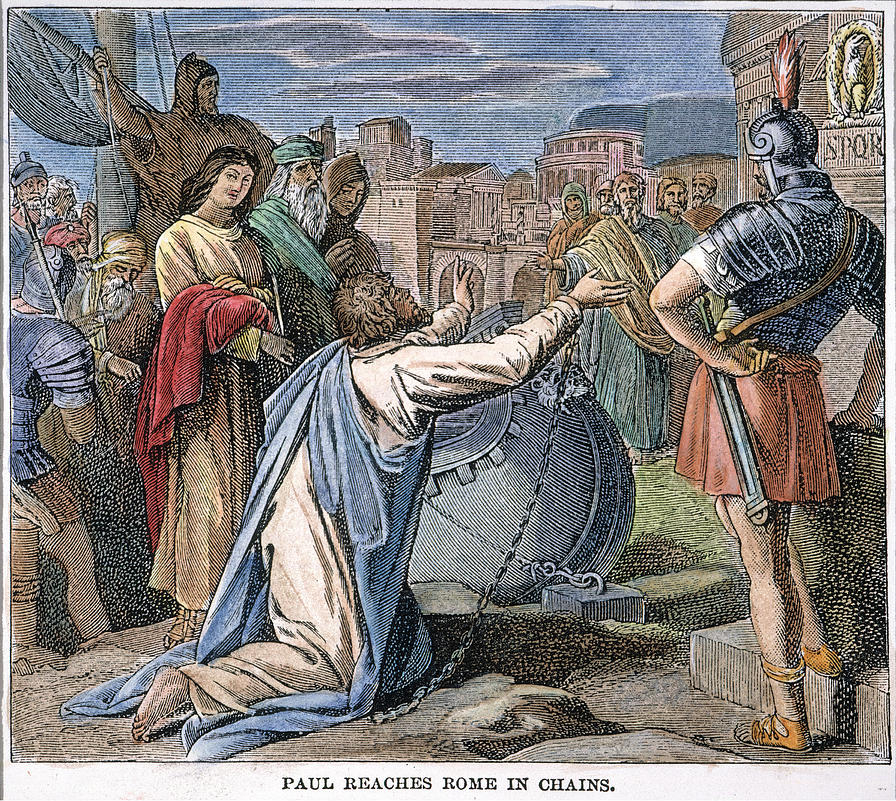
Where was he? Some have suggested Ephesus, in what is now the south-west coast of Turkey. Another suggestion is that he was in Caesarea Maritima, the great Roman port built in Judea by Herod the Great for his imperial overlords. Acts tells us he went to Rome for judgement by Caesar, and that

He lived there two whole years at his own expense and welcomed all who came to him, proclaiming the kingdom of God and teaching about the Lord Jesus Christ with all boldness and without hindrance. (28.30-31)

So, he may have been in Rome. We cannot be sure, but he was in prison, and while he depreciates how horrible it is for him, the reality is that wherever he was it was awful.

How

We are so used to sending messages by email or SMS that we forget that it would have been difficult to communicate in the 1st Century. There was no internet, no telephone, and no Royal Post or ΕΛΤΑ to carry letters and packages. Rather, if you wanted to get something like money or a letter to someone, you had to personally engage someone do it for you, and to make the journey. In this case it is obvious that Epaphroditus was the person who carried the money, and it is likely that he brought the letter back with him to Philippi.

Paul probably dictated the letter, as he expressly did in other cases. In one or two of the letters he notes that he is writing he conclusion with his own hand, in big, big letters. Perhaps this indicates a visual problem, or just that he is not that used to writing compactly. While the original letter is long gone, it undoubtedly looked much like the copy in the photograph above. This made it challenging to read, so Paul probably coached Epaphroditus in how to read it aloud to the community, if he was in fact the person who read it to them there on his delivery of the letter.

The letter would have been read aloud to the community when they assembled, presumably on the Lord’s Day when they gathered for their communal meal held in memory of Jesus’s death and resurrection. While a fair percentage of the population may have been literate, books were expensive, and most interactions were done orally. So one must imagine this being read aloud.

Paul dictates a letter.

I do not know enough to know whether this would have been on a scroll, written on one side of a long strip of paper, or on several pieces of papyrus, using both sides. Certainly by the the time that the earliest copies we have were made, dating from more than a century after it was written, the letters were already collected together and being published in bound manuscripts, or codices, and not scrolls.

When

Establishing a timeline for Paul is fraught. It used to be that scholars would fit the historical evidence of the Letters into the Acts of the Apostles. Then, as historico-critical methods were applied to the New Testament, it was pointed out that the Letters are the primary historical documents, and Acts is the secondary history, written thirty to forty years later. It would be like reading a history of the Second World War written in 1980 and ignoring things written in the 1940s, such as Churchill’s directives and other archival documents. You don’t get the full history from the archival documents, but if the 1980 book is to be accurate, it should be based on those pieces of paper. The author of Acts seems to have based his narrative on oral traditions, and gives no indication of knowing that Paul wrote letters. Because of the gap in time, there are a number of discrepancies.

The good news is that most of this is irrelevant to the interpretation of the Letter to the Philippians. Interestingly, the letter does not seem to be aware of the collection that is being taken up for poor Jewish Christians in Jerusalem, which is mentioned in Galatians and in 1 & 2 Corinthians. So, either Paul is writing before the Jerusalem Conference (Acts 15), during which he was asked to “remember the poor”, or he is writing some time after he went to Jerusalem to deliver the money.

We know that Paul is an adult, and a contemporary of Simon Peter and James the brother of the Lord. Thus, he might be roughly the same age as Jesus, perhaps younger, perhaps older, had Jesus not been crucified. Paul was not in Jerusalem when Jesus was crucified, which suggests that he was a younger man, having not yet left Tarsus to make his name in the City of David. However, we really don’t know.

Jesus was executed in the year 30 CE – maybe 33. The Jerusalem Conference was held around 49 CE or 50 CE. If Paul was writing before it, then he was writing in the mid to later 40s, perhaps. If he was writing after it, it would have been in the 50s, probably.

Posted in Philippians | Tagged , | Leave a comment

“As you have sent me into the world, so I have sent them into the world.”

A Sermon Preached on The Seventh Sunday of Easter
(following the Julian Calendar used to calculate Easter in Greece)
June 13, 2021, at 11:00 am
at The Anglican Church of St. Thomas the Apostle, Kefalas, Crete
.

The readings we used were Acts 1:15-17, 21-26, Psalm 1, and John 17:6-19.

Obsolescence

It is a truth generally acknowledged that many of the great products of the world become obsolescent.

How many of you ever had a typewriter? When was the last time you used it? We have the one on which Frances’s father’s PhD dissertation was typed out – by her mother.

When was the last time you used a phone book? I don’t even know if there is one for Apokoronas. I sometimes dream about them, but I haven’t used one since moving here.

Speaking of phones, how about rotary phones? I remember last having one in the early 1990s. I got really good at using a pen or pencil to dial.

How about cameras with film? The Eastman Kodak Company last made film in 2009. Remember going to photo shops to get film developed? Do you want doubles?

I think music has gone through more formats than just about anything. 78s, 45s, and 33s, then reel to reel for the real aficionados, eight track for folks in cars, then cassettes, CDs, and finally MP3. And those are just the main ones – I haven’t even talked about cylinders or player piano rolls.

Even books change. In the first few centuries after Jesus there was a huge technological change when people stopped using scrolls and started using codices – a codex being a bound book, with writing on both sides. Much more efficient. Then came printing, and suddenly books were less expensive, and more people could own one or two. Literacy went up. Nowadays books come in digital form that you can read on a Kindle, or a Nook, or even your phone. So long as you have internet access, in theory you can read almost any book ever published.

The Twelve and Obsolescence

I say all of this to preface the fact that the Twelve Disciples did not plan for their own obsolescence. In the days after the Ascension they undoubtedly thought to themselves, “Well, Jesus called twelve of us, one of us is now gone, so we need a replacement.” So they found two candidates from among the one hundred and twenty of them, drew lots, and Matthias was the lucky winner.

And then, if you have paid attention to Acts, quick as a flash, we never hear of him again. Indeed, we hardly ever hear of any of the Twelve again apart from Simon Peter and James, the brother of John. Yes, later on pious legends came to be affixed to the Twelve, especially around how they each died – Thomas went to India, Simon and Andrew went to Georgia in the Caucasus – but in the New Testament they just kind of never get mentioned again. After Simon Peter escapes persecution in Jerusalem the church there is led by a brother of Jesus named James, who is not the same James as the one in the Twelve, the brother of John. Acts talks extensively about Simon Peter, and a bit about Philip, and the death of James the brother of John, but from chapter 10 to the end, the story is dominated by someone who is not even one of the Twelve, namely Paul of Tarsus. It’s as if God looked down from heaven and saw what the Twelve were up to, or rather, what they were not up to, and so recruited Paul – and this time it worked.

In other words, while Matthias may have been a wonderful person and a fervent disciple of Jesus, this is the only time the author of the Acts of the Apostles mentions him. His interest lay elsewhere.

The truth is that Christianity was already spreading across the eastern Mediterranean without the Twelve, and before Paul. Before Paul got to Damascus, there were already Christians there. Before he went to Rome there were already Christians there. When he arrived in Corinth, there were already Christian refugees from Rome there. How did the faith get to all these places? We do not know their names, but somebody obviously took the faith there. This bizarre new group grew because of countless unknown Christians sharing their faith wherever they went. The Acts of the Apostles highlights Paul, and Paul is remembered because of his letters, but he was not the first evangelist or the only one.

Arguably, the Twelve were already obsolescent by Easter Sunday. Mary Magdalene, we are told, was the one who first saw Jesus and brought the good news to the rest of the followers of Jesus. On the Day of Pentecost he Holy Spirit came down upon all of the church, not just the eleven, as Peter, quoting the Book of Joel, notes:

and your sons and your daughters shall prophesy,
and your young men shall see visions,
    and your old men shall dream dreams.
Even upon my slaves, both men and women,
    in those days I will pour out my Spirit

Are We Trying To Hold Onto Something That God Has Already Moved On From?

Some things stay the same. The centrality of Jesus. The importance of scripture. The two sacraments. Bishops, priests, and deacons.

But beyond these things the Church of England has moved on in so many ways. The Church of England now relies on the over 7000 retired clergy with PTO and some 3000 unpaid clergy to supplement the 7700 of us who are paid; it is hard to imagine how the work of the church would get done without them. A third of the clergy are female, ranging from our own curate to the Bishop of London – and this is but a recent development. The centre of the Anglican Communion, as well that of Christianity in general, has moved to the Global South. We no longer need to evangelise Africa; they are sending evangelists to England.

Things change. What do we need to let go of? Here are some controversial suggestions.

  • Nationalism, perhaps? Is Anglicanism really about “national” churches? Our own Diocese in Europe is anything but “national.” It covers forty nations and most congregations are cosmopolitan, made up of multiple citizenships and ethnicities. Increasingly the clergy and laity are not English, or British, but from all over the world.
  • Buildings? They are both historical treasures and awfully useful. But they are also a burden, and the early church seemed to get by for three hundred years without any permanent abodes. In France any churches more than 120 years old belong to the state, who then give them to churches to use. Notre Dame in Paris is being rebuilt by the French Republic, not the Roman Catholic church. Can we let go of our historic buildings?
  • Establishment? Does it benefit the Church of England in its mission to be the national church of one part of the UK, when it is demonstrably in decline? Is it one big distraction? I grew up in a church that was not established, and the growing parts of the church around the world does not need government endorsement?
  • Education? Does our involvement in schools build up the faith, or does it merely inoculate a generation into thinking they already know enough about the church to reject it?

Many people would describe the above as core characteristics of ministry in the Church of England. But are they really part of the mission of God that has been given to us, or obsolescent vehicles for the gospel?

Are we continuing to appoint Matthias to the Twelve, when God has already moved on to pour out the Holy Spirit on everybody? If Jesus says, “As you have sent me into the world, so I have sent them into the world”, are we not all, in a sense, apostles?

Posted in Easter, Sermons | Tagged , , | Leave a comment

“. . . that your joy may be complete.”

A Sermon Preached on The Sixth Sunday of Easter
(following the Julian Calendar used to calculate Easter in Greece)
June 6, 2021, at 11:00 am
at The Anglican Church of St. Thomas the Apostle, Kefalas, Crete
.

The readings we used were Acts 10:44-48, Psalm 98, and John 15:9-17.

“I have said these things to you so that my joy may be in you, and that your joy may be complete.” Jesus at the Last Supper, according to John 15.11

Are you feeling joyful?

Maybe. Maybe not. We are here, we are alive.

Some of us are in pain, and rightfully so. Some of us are mourning the dead, whether they left us a few days ago or whether it was years ago. We are sad. It is hard to sing alleluia when we are spiritually at the graveyard, when we are lonely and bereft.

Some of us are traumatized by past and current events. A physical or sexual assault, perhaps. Perhaps we were verbally abused as a child or as an adult. While we did our best to put a bright face on things, and not appear as a victim, the scars are still there.

Some of us are worried about our loved ones – our spouses, our children, our elderly parents. Some of them have physical illnesses, some are sliding into dementia, others are having money problems, or personal conflicts.

Some of us grieve broken relationships – with our former spouses, our friends and families. We grieve our part in the breakdown, and we lament the part we did not contribute. And even if we remember the good things, they seem overshadowed by tragedy and suffering.

Most of us are just plain sick and tired of this pandemic, and what seems to be a lost year – or will it be two – of what limited time we have on this good earth.

I looked up antonyms to “joy” and here is what I found:

misery, agony, anguish, cheerlessness, dejection, despondency, disheartenment, dispiritedness, doldrums, downheartedness, gloom, gloominess, plaintiveness, unhappiness, woefulness, despair, ill-being, sadness, wretchedness, grief, sorrow, tribulation, depression, discouragement, dislike, melancholy, lethargy, listlessness, sluggishness, apathy, dullness, lifelessness

So many words to describe the opposite of joy!

So what is this joy that Jesus talks about?

The Greek word used here is χαρά, and I do not get the sense that the meaning has changed much in 2000 years.

However, in the Gospel of John everything with an ordinary everyday meaning always has a deeper level. For Jesus joy is achieved in his union with the Father, and is expressed in his obedience and love. Jesus gives his disciples his joy, and we express it by our obedience and love. It is a deeply mystical thing, which may be characterised by emotion, but goes far beyond that.

  • It is a joy that begins in baptism and is celebrated in Holy Communion.
  • It is communicated to us in the words of scripture, in our prayers and in our meditations on it
  • by the Holy Spirit flowing from accepting a relationship with Jesus as the risen and ascended Lord.
  • It is expressed in praise, in hymns and music, in approaching God in prayer, in working with others in ministry and the ordinary things of life.
  • It is seen in creation and in the renewal of creation begun in Jesus.
  • It is found in our hope that after death God is not done with us.
  • It is seen in the repentance of a sinner and the restoration of an outcast.
  • It is acted out in being hospitable, especially to strangers.
  • It is heard in the bells of a church and in the telling of tales about people.
  • It is knowing that service to God is perfect freedom.
  • It is in the smile of a child, and the snuggle from a pet

Joy in the Midst of Despair

The reality is that the joy described by Jesus is something we can experience even as we undergo sorrow, depression, or other forms of sadness. It is hope in the midst of calamity and joy undermining despair. It is laughing while crying and somehow going on when one is utterly wiped out. It is taking up one’s heavy cross, and finding that the great weight is at the same time mystically light. It is the antidote to the depravity of the world around us, allowing us to see its beauty. It is awe in the mundane, it is wonder at the ordinary.

So have this joy. It is ours, just as it is God’s. It is being completed in us, slowly, quickly, step by step, suddenly making great strides. Hold onto your agony while telling out your joy for all to hear.

Posted in Easter, Sermons | Tagged , , | Leave a comment

“For God so loved the world . . .”

A Sermon Preached on The Fourth Sunday of Lent
(following the Julian Calendar used to calculate Easter in Greece)
April 11, 2021, at 11:00 am
for an Online Service with The Anglican Church of St. Thomas the Apostle, Kefalas, Crete
.

The readings were: Numbers 21:4-9 (the serpent of bronze); Psalm 107.1-3, 17-32 (“Those who go down to the sea in ships”); Ephesians 2:1-10 (God made us alive together with Christ); and John 3:14-21 (the Son of Man must be lifted up).

This may not be the most effective way to spread the gospel.
However, it is a great way to get tasered!

Οὕτως γὰρ ἠγάπησεν ὁ θεὸς τὸν κόσμον ὥστε τὸν υἱὸν τὸν μονογενῆ ἔδωκεν, ἵνα πᾶς ὁ πιστεύων εἰς αὐτὸν μὴ ἀπόληται ἀλλὰ ἔχῃ ζωὴν αἰώνιον.

For God so loved the world that he gave his only Son, so that everyone who believes in him may not perish but may have eternal life. John 3.16

Let us parse this well known verse.

The words are familiar, but we may not be reading them the way the author intended.

The Son here is Jesus of Nazareth. We already know from the first verses of the first chapter of John’s gospel that the Word is divine, and is God, and the Son here is the Word made flesh.

God here means God the Father. So we see the first person of the Holy Trinity giving the second person of that same Holy Trinity to the world.

Giving in John means the incarnation, the Word being made flesh, so that we can see the glory of God. When Jesus speaks, when he heals, when he turns water into wine, and when he drives out demons, we are seeing the glory of God in the human being called Jesus. When Jesus is lifted up in his crucifixion, it as similar to the bronze serpent that was also lifted up, and was held to have healing powers.

Love in the gospel of John means that selfless offering of oneself. It is not an annihilation of one’s self. It is a sharing that transforms a person, that adds to one’s life, that completes you.

“Only,” in the term “only Son,” refers to the unique relationship Jesus has with the Father. We are told that we can only know the Father through the Son. Jesus, then, is a special revelation, apart from the revelation given to us in scriptures or in nature.

The world in John’s gospel is not all of creation, but the human world, which can respond to the Son who is given.

Belief is mainly a response to seeing the glory of God. It is not so much giving acknowledgement to a proposition as it is to respond with trust and worship. It is fundamentally relational, and should be understood as full of praise and thanksgiving. It is rooted in the Incarnation, in the Crucifixion, and the Resurrection, as well as what Jesus taught and what he did, and how we read the Hebrew scriptures in relation to him and how we see the history of the church and humanity since then.

Perish could also be translated as “lost.” It refers to what happens when one sees the light of God in Christ, but rejects it. One is lost to God, to the true nature of creation, and one’s place in it.

Eternal life in John does not refer to heaven, but to the life of the divine, in which we can share. Obviously, God does not live the way we do, as biological creatures, so this is an analogous meaning. But the Biblical witness is that God is the life-giver, the one who breathes life into the primordial human being named Adam. Jesus says elsewhere that he came to give life, and that those who have it might have it in abundance (John 10.10). Faith in Jesus, responding to his glory, and trusting in him gives us access to this eternal life, this life of God. It is not something that is “pie in the sky” but something we can access right here and now. The fullness will come later, but we can begin now.

This is reinforced by the passage in Ephesians which states:

God, who is rich in mercy, out of the great love with which he loved us even when we were dead through our trespasses, made us alive together with Christ

We are alive now. We have already been lifted up into the heavenly places with Christ. In the times to come we will see what the riches of that heavenly, eternal life are. And all of this is the free gift of God, given to us in Christ Jesus, not on the basis of anything we do, but out of absurdly generous, forgiving, desperate and spendthrift love.

How Big is God’s Love?

Consider the revelation of God in creation.

  • Up until the 1920s it was thought that there was only one galaxy, our own, the Milky Way, which is in itself an amazing sight. But we now know that there are 200 billion galaxies. TWO HUNDRED BILLION. Each one of those galaxies contains billions of galaxies. The small ones, dwarf galaxies, have only a few billion. Some massive elliptical galaxies have over one hundred trillion stars. The number of stars in the Universe is beyond human imagination. That’s how much God loves you.
“This . . . image [from the Hubble Deep Field], consisting of a region of space barely a thousandth of a square degree on the sky — so small it would take thirty-two-million of them to fill the entire sky — contains a whopping 5,500 galaxies, the most distant of which have had their light traveling towards us for some 13 billion years, or more than 90% the present age of the Universe. Extrapolating this over the entire sky, we find that there are 170 billion galaxies in the observable Universe, and that’s just a lower limit.” Ethan Siegel
  • The earth we walk on, the bodies we have, every living creature around us, and the planets and even the Sun – all were forged out of the material of stars that exploded billions of years ago and then, under the force of gravity, came together again to make our solar system and this planet earth. Except for hydrogen and helium, all the elements were created in the hearts of the sun using fusion, at 16 million degrees. That’s how much God loves you.
The core of a high-mass star creates elements by fusion, the result of a combination of gravity and heat; the deeper in the star, the greater the capacity to create elements with higher molecular weight.
  • It is thought that on earth there are some estimated to be between 8 and 8.7 million species. This includes everything from the bacteria that turns goat’s milk into yogurt to the bugs living in your intestine and helping you to break down your breakfast. They are the fish at the bottom of the ocean withstanding massive pressures, and birds that fly eleven km in the air. They make cute pets and ferocious apex predators. Of these 8 million or so species, only about 14% of these had been described by biologists. This incredible diversity – that’s how much God loves you.
  • The human brain is the most complex thing on earth. There are 86 billion nerve cells in the average human brain, giving us the capacity to speak, to work, to dream. While we have made great strides in understanding the brain, we really have no idea how this conglomeration of nerve cells allows things like consciousness or language to emerge. And yet, this 1.3 kg lump of flesh has given rise to the drama of a Shakespeare, the compassion of a Florence Nightingale, the brilliance of an Albert Einstein, the mysteries of Agatha Christie, the depravity of Hitler, Stalin, and Mao, and the ordinary love of a parent for a child, or exhilaration two people who have just discovered each other. That’s how much God loves us.

As Christians, as a people journeying to Holy Week and the narratives of the Passion of Christ, we believe that God loves us so much that in Christ Jesus he was reconciling the world to himself. We believe that in Jesus we see the Father, and that in his death and resurrection we have already died to sin and death and are raised to eternal life. That’s how much God loves us. May we respond with faith and praise.

Posted in Lent, Sermons | Tagged , , , , | Leave a comment