Day Six of an Advent Calendar: Anthropology is Theology

December 2, 2016     Friday after the First Sunday of Advent
Isaiah 3.8–15
1 Th 4.1–12
Lk 20.41—21.4
The text of the readings follows after the comments.

trinity-sketch-william-blake

A Sketch of The Trinity, by William Blake

The thing about a lectionary is that it takes you places you don’t expect. I did not intend to spend yesterday musing about celibacy as a subversive act of faith challenging the role of marriage in a patriarchal society, but that’s where the readings seemed to lead me. And today is similar. In the second reading we find, “For this is the will of God, your sanctification: that you abstain from fornication; that each one of you knows how to control your own body in holiness and honour, not with lustful passion, like the Gentiles who do not know God; that no one wrongs or exploits a brother or sister in this matter . . .”. So, we’re back to sex, again. So why is Paul saying this?

When I was studying Divinity in 1987 I saw a course in the calendar listed with the name: “Ante-Nicene Anthropology, Part Two” It was such a bizarre title I had to take it. It was taught by Father John Egan SJ at Regis College, the Jesuit college within the Toronto School of Theology. The subject matter was really the theological writings of Origin of Alexandria,  who worked in the early party of the Third Century. One of the things that became very clear in this course is that how we think about God has implications for how we think about human beings, and vice versa. Genesis 1.27 reads: “So God created humankind in his image, in the image of God he created them; male and female he created them.” As a result of this theologians have reflected over thirty centuries about what this might mean. Some saw it in rationality, others in complementary masculine and feminine aspects, some in creativity, and still others in the ability to control the environment. So our anthropology says something about how we understand God, and our theology always has implications for how we understand humanity. Origin of Alexandria had some rather interesting ideas – the pre-existence of souls, and a double creation of the invisible and visible, for example – and these were all derived from his Neoplatonic conception of God.

Human beings are inherently sexual creatures. We don’t see God as sexual, but what is common to both human sexuality and the human relation to God is desire. Sarah Coakley in her recent book God, Sexuality, and the Self: An Essay on the Trinity  makes this point, and according to Tina Beattie in a recent review, “Coakley turns Freud “on his head” by insisting that God rather than sex is the source and focus of erotic desire: “Instead of ‘God’ language ‘really’ being about sex, sex is really about God” (316). If genital sex occupies a less central role in this than it does in our sex-obsessed culture, the eroticism associated with sexual desire is inseparable from our experience of desire for God.”

This puts today’s passage from 1 Thessalonians into perspective. Paul knows that in the past the recipients of his letters have been pagans and worshiped idols, and either knows or assumes that they followed a sexual morality at odds with what he knew of in Judaism. To his mind this kind of lustful passion is out of control, and I find it interesting that he wants his readers to avoid wronging or exploiting another member of the church. What that suggests is that he is fully aware of both the power and the danger that comes with sexual relations, and that there is always the possibility of harming another person through sexual assault or exploitation. In the rigidly hierarchical society of the ancient Roman Empire a woman or a slave had no rights over their bodies, and their “superiors” regularly used them for their own sexual gratification. Paul, as imperfect an egalitarian as he was, had a more non-hierarchical understanding of relations, in which in Christ there was no Jew or Greek, slave or free, male or female. In Paul’s view uncontrolled lust that led to exploitation came from worshiping idols, whereas a focus on the true God leads to the desire to be holy and honourable, with the expectation that one will not assault another person or sexually exploit them. The admonition against fornication is not prudery as such, it is about not harming another person, and about rightly using desire.

Let’s see where tomorrow takes us, eh? God be with you.

Isaiah 3.8–15
For Jerusalem has stumbled
and Judah has fallen,
because their speech and their deeds are against the Lord,
defying his glorious presence.

The look on their faces bears witness against them;
they proclaim their sin like Sodom,
they do not hide it.
Woe to them!
For they have brought evil on themselves.
Tell the innocent how fortunate they are,
for they shall eat the fruit of their labours.
Woe to the guilty! How unfortunate they are,
for what their hands have done shall be done to them.
My people—children are their oppressors,
and women rule over them.
O my people, your leaders mislead you,
and confuse the course of your paths.

The Lord rises to argue his case;
he stands to judge the peoples.
The Lord enters into judgment
with the elders and princes of his people:
It is you who have devoured the vineyard;
the spoil of the poor is in your houses.
What do you mean by crushing my people,
by grinding the face of the poor? says the Lord God of hosts.

1 Thessalonians 4.1–12
Finally, brothers and sisters, we ask and urge you in the Lord Jesus that, as you learned from us how you ought to live and to please God (as, in fact, you are doing), you should do so more and more. For you know what instructions we gave you through the Lord Jesus. For this is the will of God, your sanctification: that you abstain from fornication; that each one of you knows how to control your own body in holiness and honour, not with lustful passion, like the Gentiles who do not know God; that no one wrongs or exploits a brother or sister in this matter, because the Lord is an avenger in all these things, just as we have already told you beforehand and solemnly warned you. For God did not call us to impurity but in holiness. Therefore whoever rejects this rejects not human authority but God, who also gives his Holy Spirit to you.
Now concerning love of the brothers and sisters, you do not need to have anyone write to you, for you yourselves have been taught by God to love one another; and indeed you do love all the brothers and sisters throughout Macedonia. But we urge you, beloved, to do so more and more, to aspire to live quietly, to mind your own affairs, and to work with your hands, as we directed you, so that you may behave properly towards outsiders and be dependent on no one.

Luke 20.41—21.4
Then he said to them, ‘How can they say that the Messiah is David’s son? For David himself says in the book of Psalms,
“The Lord said to my Lord,
‘Sit at my right hand,
until I make your enemies your footstool.’ ”
David thus calls him Lord; so how can he be his son?’
In the hearing of all the people he said to the disciples, ‘Beware of the scribes, who like to walk around in long robes, and love to be greeted with respect in the market-places, and to have the best seats in the synagogues and places of honour at banquets. They devour widows’ houses and for the sake of appearance say long prayers. They will receive the greater condemnation.’
He looked up and saw rich people putting their gifts into the treasury; he also saw a poor widow put in two small copper coins. He said, ‘Truly I tell you, this poor widow has put in more than all of them; for all of them have contributed out of their abundance, but she out of her poverty has put in all she had to live on.’

Posted in Advent | Leave a comment

Day Five of An Advent Calendar: Sex and Idolatry

Thursday December 1, 2016     Thursday after the First Sunday of Advent
Is 2.12–22
1 Th 3.1–13
Lk 20.27–40The text of the readings follows after the comments.

YHWH & Asherah.jpg

The passage from Isaiah inveighs against the arrogant who follow idols. The people living in Judea and Israel in the 8th century BC worshiped YHWH (the name of God in the Hebrew Bible usually replaced in English translations with “the LORD”), but they also worshiped other gods, most notably Asherah, who many considered to be the consort of YHWH. Asherah seems to have been closely connected to trees and in imitation of the trees, posts in temples. David and Solomon sought to centralize the worship of YHWH in the Temple at Jerusalem, but this was resisted by the northern kingdom of Israel that broke away from Judea after Solomon; apart from Israel’s official temples in Shechem it appears that the ordinary people continued to worship idols in groves of trees and on high hills. I think this is why Isaiah challenges the cedars of Lebanon and the oaks of Bashan, and the high mountains and the lofty hills, because they represent to him idolatry and a turning away from YHWH, the one God, who cannot be represented by an idol. I love the idea that the idols will be tossed to the moles and the bats.

We have idols today as well, only they are not Asherah. Our idols are political, economic, and sociological. And just as YHWH and Asherah were combined and many saw no problem with that, so today people conform our religion to these dominant systems of thought. However, if one takes it apart we see that it is idolatry. The arrogant pride we have in the our nations can be idolatry. The material wealth we have accumulated can be idolatry. Our physical appearance, r our standing in the world can be idolatry. What is not idolatry is our relationship with God, without which we will find it hard to see creation in the right way. If we are idolatrous, we will privilege natural resource development over the long-standing grievances of indigenous people. If we are idolatrous we will emphasise security in immigration to the reduction or elimination of offering help to refugees.

In the reading from Luke Jesus is teaching in the Temple, and a series of people seek to confront Jesus and trap him into saying something that would justify action against him. In today’s reading the Sadducees  challenge him on a point about the logic of the resurrection. Among the Jewish people in general (and the surrounding Hellenistic and Roman cultures) marriage was a central value. The purpose of sexuality in First Century Palestine was not self-expression or even necessarily joy, but the making of alliances through marriage and the propagation of those relationships through the procreation of children. Marriage was such a central fact of society and such an important value that the Sadducees could not imagine that it would not persist into the resurrection (even though they did not believe in it). So they posed their question to Jesus, and you can see the response. Basically, marriage, which seems to be such a cosmically ordained factor in human existence, just will not be of any important in the the new creation.

Marriage, which is “an honorable estate”, can become an idol as well as anything. The kind of culture Jesus was in so valued marriage that it overwhelmed many other aspects of human relationships. We might not think of this as having much to do with “sexuality” as we understand it in the 21st century, but it does – who we are as sexual and gendered beings are determined by these kinds of relationships. Marriage as understood in the 1st century was not really about love, or sexual expression, human fulfillment, or care and affection, it was about the extended family. As a result some of these other aspects were repressed.

It’s in this light that we can see the emergence of celibacy as a virtue. Celibacy was a subversive challenge to the idolatry of marriage, the belief that nothing was more important than making a good marriage and having lots of children. It created a space in which other aspects of the individual could flourish in ways that they might not in a traditional marriage. It called into question the presumptions of patriarchy and clan association.

Such was the case in the early centuries of the faith. What are the idolatries of today that need to be challenged?

Isaiah 2.12–22
For the Lord of hosts has a day
against all that is proud and lofty,
against all that is lifted up and high;
against all the cedars of Lebanon,
lofty and lifted up;
and against all the oaks of Bashan;
against all the high mountains,
and against all the lofty hills;
against every high tower,
and against every fortified wall;
against all the ships of Tarshish,
and against all the beautiful craft.
The haughtiness of people shall be humbled,
and the pride of everyone shall be brought low;
and the Lord alone will be exalted on that day.
The idols shall utterly pass away.
Enter the caves of the rocks
and the holes of the ground,
from the terror of the Lord,
and from the glory of his majesty,
when he rises to terrify the earth.
On that day people will throw away
to the moles and to the bats
their idols of silver and their idols of gold,
which they made for themselves to worship,
to enter the caverns of the rocks
and the clefts in the crags,
from the terror of the Lord,
and from the glory of his majesty,
when he rises to terrify the earth.
Turn away from mortals,
who have only breath in their nostrils,
for of what account are they?

1 Thessalonians 3.1–13
            Therefore when we could bear it no longer, we decided to be left alone in Athens; and we sent Timothy, our brother and co-worker for God in proclaiming the gospel of Christ, to strengthen and encourage you for the sake of your faith, so that no one would be shaken by these persecutions. Indeed, you yourselves know that this is what we are destined for. In fact, when we were with you, we told you beforehand that we were to suffer persecution; so it turned out, as you know. For this reason, when I could bear it no longer, I sent to find out about your faith; I was afraid that somehow the tempter had tempted you and that our labour had been in vain.
But Timothy has just now come to us from you, and has brought us the good news of your faith and love. He has told us also that you always remember us kindly and long to see us—just as we long to see you. For this reason, brothers and sisters, during all our distress and persecution we have been encouraged about you through your faith. For we now live, if you continue to stand firm in the Lord. How can we thank God enough for you in return for all the joy that we feel before our God because of you? Night and day we pray most earnestly that we may see you face to face and restore whatever is lacking in your faith.
Now may our God and Father himself and our Lord Jesus direct our way to you. And may the Lord make you increase and abound in love for one another and for all, just as we abound in love for you. And may he so strengthen your hearts in holiness that you may be blameless before our God and Father at the coming of our Lord Jesus with all his saints.

Luke 20.27–40
Some Sadducees, those who say there is no resurrection, came to him and asked him a question, ‘Teacher, Moses wrote for us that if a man’s brother dies, leaving a wife but no children, the man shall marry the widow and raise up children for his brother. Now there were seven brothers; the first married, and died childless; then the second and the third married her, and so in the same way all seven died childless. Finally the woman also died. In the resurrection, therefore, whose wife will the woman be? For the seven had married her.’
Jesus said to them, ‘Those who belong to this age marry and are given in marriage; but those who are considered worthy of a place in that age and in the resurrection from the dead neither marry nor are given in marriage. Indeed they cannot die any more, because they are like angels and are children of God, being children of the resurrection. And the fact that the dead are raised Moses himself showed, in the story about the bush, where he speaks of the Lord as the God of Abraham, the God of Isaac, and the God of Jacob. Now he is God not of the dead, but of the living; for to him all of them are alive.’ Then some of the scribes answered, ‘Teacher, you have spoken well.’ For they no longer dared to ask him another question.

Posted in Advent | Leave a comment

Day Four of An Advent Calendar: The Feast of St. Andrew

Wednesday, November 30, 2016     The Feast of St. Andrew
Morning:  Is 49.1–6      1 Cor 4.1–16
Evening:   Is 55.1–5       Jn 1.35–42
The text of the readings follows after the comments.

st

Today we take a break from Advent to mark the Feast of St. Andrew. Andrew is mentioned in the Gospels as one of the Twelve, a brother of Simon Peter and like him, a fisherman in Galilee. Whereas Mark and Matthew describe him as being called by Jesus in Galilee at the same time as Simon Peter, the Gospel of John describes him as a disciple of John the Baptist who decides to follow Jesus after the Baptist describes him as “the Lamb of God”(this is narrated in the gospel reading for today). After that there’s not much in the New Testament about him. He was one of the witnesses to the resurrection when Jesus appeared in the Upper Room, but we hear nothing after that. Pious legend suggested many things about him, perhaps the best known story being that he was too humble to suffer martyrdom on a cross that looked like the one Jesus died on, so the Romans in Greece executed him on an X shaped crucifix, instead of one that looked like the “t” of a Latin cross.  Subsequently certain nations adopted Andrew as their patron saint, including Scotland. As a result the pattern on the Scottish flag is an X shape known as the Saltire, which was subsequently incorporated in the Union Flag (“Union Jack”) of Great Britain and the United Kingdom.

As it is a feast day the Daily Office Lectionary prescribes two readings each for the morning and evening. In both cases the first readings are from what I described on Monday as “Second Isaiah” (i.e. Isaiah 40-66, or perhaps 40-55). In both cases you will see that dramatic difference between today’s readings and the passages from the past three days from the first chapter of Isaiah. Whereas Isaiah 1 is full of condemnation and warnings, here we have comfort and encouragement. The reading in the morning, Isaiah 49.1-6, is the second of the “Servant Songs”, passages which describe a servant who has suffered but who is called and exalted by God. Jewish rabbis and Christian biblical scholars have puzzled over the identity of the servant. Some have suggested Moses, maybe the prophet Isaiah himself, others a prophet yet to come, perhaps the coming Messiah, and still others see it as the personification of redeemed Israel, returning from exile to the Promised Land. Christians have always read the Servant Songs as a reference to Jesus of Nazareth, and the fourth (52.13-53.12″) seems to have influenced the narratives of the passion in the gospels.

The apostles, including Andrew, can also be seen as suffering servants. Like their master the suffer persecution for preaching the good news, and ultimately undergo martyrdom. The passage from First Corinthians echoes this theme when Paul describes himself and the other apostles: “we are hungry and thirsty, we are poorly clothed and beaten and homeless, and we grow weary from the work of our own hands. When reviled, we bless; when persecuted, we endure; when slandered, we speak kindly. We have become like the rubbish of the world, the dregs of all things, to this very day.”

Both readings from Isaiah pick up on the theme of evangelism: “I will give you as a light to the nations, that my salvation may reach to the end of the earth” (49.6) and  “See, I made him a witness to the peoples . . . See, you shall call nations that you do not know, and nations that do not know you shall run to you” (55.4-5). It is truly an outstanding vision, given that at the time this prophecy was made in the 6th century BC the whole of Judaism probably numbered in the tens of thousands, and yet it looks to a time when the God of Abraham, Isaac, and Jacob would be worshiped to the very ends of the earth (which I always understood to be British Columbia). This prophecy has been fulfilled.

– + –

Today is also the 40th anniversary of the Ordination of women to the presbyterate or priesthood in the Anglican Church of Canada. In four dioceses on November 30 a number of women and a few men were all ordained; the services were timed so that they all started at more or less the same time, and no one person could claim that she was the first woman to become a priest in the Canadian Church. I’m not sure why this date was chosen, as I see no obvious connection between St. Andrew and the ordination of women, so it was probably just a matter of logistics.

In November of 1976 I was quite oblivious to all this, being a 14 year old boy in a boarding school in Quebec, and I suspect the Anglican chaplain did not approve and made no note of it at the time. But I do remember meeting a United Church minister a couple of years before who happened to be a female, and even though the UCC had been ordaining women for decades it was something novel to me, and a little unusual. I did not meet my first female Anglican minister until I arrived as an undergraduate at Trinity College in the University of Toronto, and it was probably someone like Ansley Tucker (then a priest in a two-point rural parish north of Toronto) or Victoria Matthews (who I think was working on a Master of Theology). Later, when I was ordained in the Diocese of Niagara two of the first women ordained, Bev Shanley and Mary Lucas, were still very active in the Diocese –  it had still been only twelve years, after all. I say all of this because women as priests seems to be so much of a given in the Canadian Church today, but I remember when it was not. The Diocese of BC only ordained its first woman as priest in 1986, and it is only recently that we have seen women in senior church positions on Vancouver Island and the Gulf Islands. When I arrived here in 1995 there was still a sizeable minority of male clergy who were opposed to the ordination of women and refused to accept their ministrations. That is no longer the case, but what we think of now as “normal” was something that took a long time coming.

Today, although I am still on medical leave, I’ll make my way to Christ Church Cathedral for a service marking this 40th anniversary. I will celebrate the gift that ordained women have been to the church and the many ways in which female clergy – deacons, priests, and bishops – have challenged and encouraged me. At the same time I will also pray for ongoing change, so that we do not simply have women in male-patterned roles in leadership in our churches, but that we who are male are transformed by the full inclusion of all genders within the ordained.

 God be with you! Bruce +

Isaiah 49.1–6
Listen to me, O coastlands,
pay attention, you peoples from far away!
The Lord called me before I was born,
while I was in my mother’s womb he named me.
He made my mouth like a sharp sword,
in the shadow of his hand he hid me;
he made me a polished arrow,
in his quiver he hid me away.
And he said to me, ‘You are my servant,
Israel, in whom I will be glorified.’
But I said, ‘I have laboured in vain,
I have spent my strength for nothing and vanity;
yet surely my cause is with the Lord,
and my reward with my God.’

And now the Lord says,
who formed me in the womb to be his servant,
to bring Jacob back to him,
and that Israel might be gathered to him,
for I am honoured in the sight of the Lord,
and my God has become my strength—
he says,
‘It is too light a thing that you should be my servant
to raise up the tribes of Jacob
and to restore the survivors of Israel;
I will give you as a light to the nations,
that my salvation may reach to the end of the earth.’

1 Cor 4.1–16
Think of us in this way, as servants of Christ and stewards of God’s mysteries. Moreover, it is required of stewards that they should be found trustworthy. But with me it is a very small thing that I should be judged by you or by any human court. I do not even judge myself. I am not aware of anything against myself, but I am not thereby acquitted. It is the Lord who judges me. Therefore do not pronounce judgement before the time, before the Lord comes, who will bring to light the things now hidden in darkness and will disclose the purposes of the heart. Then each one will receive commendation from God.
I have applied all this to Apollos and myself for your benefit, brothers and sisters, so that you may learn through us the meaning of the saying, ‘Nothing beyond what is written’, so that none of you will be puffed up in favour of one against another. For who sees anything different in you? What do you have that you did not receive? And if you received it, why do you boast as if it were not a gift?
Already you have all you want! Already you have become rich! Quite apart from us you have become kings! Indeed, I wish that you had become kings, so that we might be kings with you! For I think that God has exhibited us apostles as last of all, as though sentenced to death, because we have become a spectacle to the world, to angels and to mortals. We are fools for the sake of Christ, but you are wise in Christ. We are weak, but you are strong. You are held in honour, but we in disrepute. To the present hour we are hungry and thirsty, we are poorly clothed and beaten and homeless, and we grow weary from the work of our own hands. When reviled, we bless; when persecuted, we endure; when slandered, we speak kindly. We have become like the rubbish of the world, the dregs of all things, to this very day.
I am not writing this to make you ashamed, but to admonish you as my beloved children. For though you might have ten thousand guardians in Christ, you do not have many fathers. Indeed, in Christ Jesus I became your father through the gospel. I appeal to you, then, be imitators of me.

Isaiah 55.1–5
Ho, everyone who thirsts,
come to the waters;
and you that have no money,
come, buy and eat!
Come, buy wine and milk
without money and without price.
Why do you spend your money for that which is not bread,
and your labour for that which does not satisfy?
Listen carefully to me, and eat what is good,
and delight yourselves in rich food.
Incline your ear, and come to me;
listen, so that you may live.
I will make with you an everlasting covenant,
my steadfast, sure love for David.
See, I made him a witness to the peoples,
a leader and commander for the peoples.
See, you shall call nations that you do not know,
and nations that do not know you shall run to you,
because of the Lord your God, the Holy One of Israel,
for he has glorified you.

Jn 1.35–42
           The next day John again was standing with two of his disciples, and as he watched Jesus walk by, he exclaimed, ‘Look, here is the Lamb of God!’ The two disciples heard him say this, and they followed Jesus. When Jesus turned and saw them following, he said to them, ‘What are you looking for?’ They said to him, ‘Rabbi’ (which translated means Teacher), ‘where are you staying?’ He said to them, ‘Come and see.’ They came and saw where he was staying, and they remained with him that day. It was about four o’clock in the afternoon. One of the two who heard John speak and followed him was Andrew, Simon Peter’s brother. He first found his brother Simon and said to him, ‘We have found the Messiah’ (which is translated Anointed). He brought Simon to Jesus, who looked at him and said, ‘You are Simon son of John. You are to be called Cephas’ (which is translated Peter).

Posted in Advent | Leave a comment

Day Three of An Advent Calendar: First Thessalonians

Tuesday, November 29, 2016     Tuesday after the First Sunday of Advent
Is 1.21–31
1 Th 2.1–12
Lk 20.9–18
The text of the readings follows after the comments.

1-thessalonians-2-1-2

1 Thessalonians 2.1-2 from the Codex Sinaiticus (c. 350 AD). http://www.codexsinaiticus.org/en/

The second reading is from Paul’s First Letter to the Thessalonians. Thessaloniki (as it is now properly written) is a city in the north of Greece in what was historic Macedon (from when Alexander the Great came). Colloquially it is known as Salonica, and it is now Greece’s second largest city. There are two letters in the New Testament written to the church in Thessalonica, but it is not clear which is older; as is typical in the Epistles, the letters are arranged according to length, not chronology. My Paul professor at Trinity, the Rev. Professor John C. Hurd, believed that the Second Letter was the earlier and the First was later. Both are considered to be early writings by Paul, if not the earliest, mainly because of the emphasis upon eschatology in both of them.

1 Th. 1.9-10 gives us the background we need to understand the relationship of Paul with the church of the Thessalonians: “For the people of those regions report about us what kind of welcome we had among you, and how you turned to God from idols, to serve a living and true God, and to wait for his Son from heaven, whom he raised from the dead—Jesus, who rescues us from the wrath that is coming.” The Thessalonians appear to have been non Jews and pagans, worshiping whatever deities were worshiped in that region. Paul came upon them, preached to them the good news of Jesus, and they responded favourably. Paul in time left them, but is receiving reports about them. They are being persecuted in some ways, and so Paul is writing to encourage them.

Paul believed that the Day of the Lord was imminent, but somewhat postponed. The purpose of the postponement was so that the people of Israel might prepare themselves and turn to God, and so that an extension of God’s promises might be proclaimed to non-Jews, to Gentiles. Paul believed that he had been called to proclaim this exceptional extension to the Gentiles, and was racing against time to get that good news out to as many people as he could. He believed that otherwise all the idol-worshipers were condemned, for he thought that idol worshiping warped the human soul and led to grave sins. As much idolatry was tied up with the cult of the emperor, he also believed that the whole Roman regime itself was corrupted by evil powers and principalities. His was a rescue mission, and he felt the press of time.

Paul contrasts the characteristics of Christian mission with those of the corrupt pagan society:
Paul comes with “courage”, is “pleasing to God”, “gentle”, “tenderly caring”, “sharing”, has “pure, upright, and blameless conduct”, and “urges and encourages and pleads;  he does NOT come with “deceit, impure motives, trickery”, is NOT “pleasing to mortals”, does NOT come “words of flattery or a pretext for greed”, does NOT “seek praise from mortals”, and is NOT a “burden”.
Western society is so formed by these Christian characteristics that we assume that these are normal and that all would deprecate the second set characteristics, but not so. Reading through the classical epics such as The Iliad or The Odyssey I find the latter set of characteristics well entrenched and re-framed as virtues. Given the trend of politics in the world one might conclude that this set of “virtues” is also in the ascendant today, and that gentleness, sharing, and truth telling is weak and naive.

As a Christian I choose what looks weak and foolish to the world to be my strength. In the long run such a course overcomes the apparently strong and wise, the arrogant and oppressive. May God bless you on this Third Day of Advent.

Isaiah 1.21–31
How the faithful city
has become a whore!
She that was full of justice,
righteousness lodged in her—
but now murderers!
Your silver has become dross,
your wine is mixed with water.
Your princes are rebels
and companions of thieves.
Everyone loves a bribe
and runs after gifts.
They do not defend the orphan,
and the widow’s cause does not come before them.

Therefore says the Sovereign, the Lord of hosts, the Mighty One of Israel:
Ah, I will pour out my wrath on my enemies,
and avenge myself on my foes!
I will turn my hand against you;
I will smelt away your dross as with lye
and remove all your alloy.
And I will restore your judges as at the first,
and your counsellors as at the beginning.
Afterwards you shall be called the city of righteousness,
the faithful city.

Zion shall be redeemed by justice,
and those in her who repent, by righteousness.
But rebels and sinners shall be destroyed together,
and those who forsake the Lord shall be consumed.
For you shall be ashamed of the oaks
in which you delighted;
and you shall blush for the gardens
that you have chosen.
For you shall be like an oak
whose leaf withers,
and like a garden without water.
The strong shall become like tinder,
and their work like a spark;
they and their work shall burn together,
with no one to quench them.

1 Thessalonians 2.1–12
You yourselves know, brothers and sisters, that our coming to you was not in vain, but though we had already suffered and been shamefully maltreated at Philippi, as you know, we had courage in our God to declare to you the gospel of God in spite of great opposition. For our appeal does not spring from deceit or impure motives or trickery, but just as we have been approved by God to be entrusted with the message of the gospel, even so we speak, not to please mortals, but to please God who tests our hearts. As you know and as God is our witness, we never came with words of flattery or with a pretext for greed; nor did we seek praise from mortals, whether from you or from others, though we might have made demands as apostles of Christ. But we were gentle among you, like a nurse tenderly caring for her own children. So deeply do we care for you that we are determined to share with you not only the gospel of God but also our own selves, because you have become very dear to us.
You remember our labour and toil, brothers and sisters; we worked night and day, so that we might not burden any of you while we proclaimed to you the gospel of God. You are witnesses, and God also, how pure, upright, and blameless our conduct was towards you believers. As you know, we dealt with each one of you like a father with his children, urging and encouraging you and pleading that you should lead a life worthy of God, who calls you into his own kingdom and glory.

Luke 20.9–18
He began to tell the people this parable: ‘A man planted a vineyard, and leased it to tenants, and went to another country for a long time. When the season came, he sent a slave to the tenants in order that they might give him his share of the produce of the vineyard; but the tenants beat him and sent him away empty-handed. Next he sent another slave; that one also they beat and insulted and sent away empty-handed. And he sent yet a third; this one also they wounded and threw out. Then the owner of the vineyard said, “What shall I do? I will send my beloved son; perhaps they will respect him.” But when the tenants saw him, they discussed it among themselves and said, “This is the heir; let us kill him so that the inheritance may be ours.” So they threw him out of the vineyard and killed him. What then will the owner of the vineyard do to them? He will come and destroy those tenants and give the vineyard to others.’ When they heard this, they said, ‘Heaven forbid!’ But he looked at them and said, ‘What then does this text mean:
“The stone that the builders rejected
has become the cornerstone”?
Everyone who falls on that stone will be broken to pieces; and it will crush anyone on whom it falls.’


Posted in Advent | Leave a comment

Day Two of An Advent Calendar

Monday, November 28, 2016     Monday after the First Sunday of Advent
Is 1.10–20
1 Th 1.1–10
Lk 20.1–8
The text of the readings follows after the comments.

great-isaiah-scroll

The Great Isaiah Scroll discovered at Qumran in 1947. Created c. 125 BC. From http://dss.collections.imj.org.il/isaiah#5:7

Isaiah, as Thomas Merton once said, is the prophet of Advent. So who is he? What are the texts speaking to?

The Book of the Prophet Isaiah is a large text, sixty-six chapters long. Most of it is poetry, and not all of it is clear on first reading, especially if one is not aware of the historical contexts to which the texts speak. It appears to be a composite text. The obvious break points are at Chapter 36 and chapter 40; chapters 36 to 39 are narrative prose and are copied out of the Second Book of Kings. Scholars call the section before chapter 40 “First Isaiah” and the section after “Second Isaiah” because they appear to have been composed at different times. First Isaiah speaks to the circumstances of the Kingdom of Judah in the 8th and 7th century BC, whereas Second Isaiah speaks to a situation around the late 6th century, when the Judeans had been defeated by the Neo-Babylonian Empire, taken into exile to the waters and canals of the Tigris and Euphrates in what is now Iraq, and then the Babylonians were conquered by the Persians. Whereas First Isaiah is full of dire warnings and call to repentance, Second Isaiah is filled with messages of comfort and encouragement.

There may well be further sub-dvisions. Chapters 60-66 are sometimes described as “Third Isaiah”, and some scholars see it coming from an even later time, when the Judeans have returned to Jerusalem, the Temple has been rebuilt, but the Kingdom of God has not returned. It is more apocalyptic in tone, looking for an intervention from God in a dramatic earth-transforming way. Within First Isaiah Chapter One seems to be a long introduction of themes, and Chapters Two through Twelve then is a majestic unfolding of those themes. The call of Isaiah himself is described in Chapter 6, and the text of 7-8 is mostly prose and in the first person discussing the interactions of Isaiah and KIng Ahaz. One of my old professors suggested that the historical core prophecy of the actual man Isaiah is in Chapter 1 through 12, although it may continue beyond that.

A prophet, as the Greek word suggests, is “one who speaks on behalf” of another. The prophet usually speaks on behalf of God to rulers and the people, but may also speak on behalf of the ruler and people to God. A prophet is an intermediary who warns and speaks truth to power. Prophets in the Hebrew Scriptures usually have followers, and it is thought that some of them were literate and would have written down what they heard. These texts were then sifted, organized, and circulated. The author of Second Isaiah would have lived many generations after the historical Isaiah, but the older texts inspired them to write, or there was an actual transmission of discipleship from the older followers to the new. Because of the interpolation of 36-39 from Second Kings the final editing probably took place in the 4th or 3rd century BC. The many fragments of Isaiah (one being a complete book) that were found in the Dead Sea Scrolls (manuscripts written c. 150 BC – 60 AD) were essentially the same as the texts that we already had, so the text had stabilized well before that time.

The passage for today challenges the rulers and priests of Jerusalem and Judea. Apparently the liturgical and sacrificial schedule was being kept, but the weightier matter of justice was being ignored. So the prophet blasts them, and says: “learn to do good; seek justice, rescue the oppressed, defend the orphan, plead for the widow”. The call for fairness and justice resonates to this day, and is a challenge to all who seek to rule in the government, and those who presume to speak to God.

God be with you on this Second Day of Advent.

Isaiah 1.10–20
Hear the word of the Lord,
you rulers of Sodom!
Listen to the teaching of our God,
you people of Gomorrah!
What to me is the multitude of your sacrifices?
says the Lord;
I have had enough of burnt-offerings of rams
and the fat of fed beasts;
I do not delight in the blood of bulls,
or of lambs, or of goats.

When you come to appear before me,
who asked this from your hand?
Trample my courts no more;
bringing offerings is futile;
incense is an abomination to me.
New moon and sabbath and calling of convocation—
I cannot endure solemn assemblies with iniquity.
Your new moons and your appointed festivals
my soul hates;
they have become a burden to me,
I am weary of bearing them.
When you stretch out your hands,
I will hide my eyes from you;
even though you make many prayers,
I will not listen;
your hands are full of blood.
Wash yourselves; make yourselves clean;
remove the evil of your doings
from before my eyes;
cease to do evil,
learn to do good;
seek justice,
rescue the oppressed,
defend the orphan,
plead for the widow.

Come now, let us argue it out,
says the Lord:
though your sins are like scarlet,
they shall be like snow;
though they are red like crimson,
they shall become like wool.
If you are willing and obedient,
you shall eat the good of the land;
but if you refuse and rebel,
you shall be devoured by the sword;
for the mouth of the Lord has spoken.

1 Thessalonians 1.1–10
Paul, Silvanus, and Timothy,

To the church of the Thessalonians in God the Father and the Lord Jesus Christ:
Grace to you and peace.

We always give thanks to God for all of you and mention you in our prayers, constantly remembering before our God and Father your work of faith and labour of love and steadfastness of hope in our Lord Jesus Christ. For we know, brothers and sisters beloved by God, that he has chosen you, because our message of the gospel came to you not in word only, but also in power and in the Holy Spirit and with full conviction; just as you know what kind of people we proved to be among you for your sake. And you became imitators of us and of the Lord, for in spite of persecution you received the word with joy inspired by the Holy Spirit, so that you became an example to all the believers in Macedonia and in Achaia. For the word of the Lord has sounded forth from you not only in Macedonia and Achaia, but in every place where your faith in God has become known, so that we have no need to speak about it. For the people of those regions report about us what kind of welcome we had among you, and how you turned to God from idols, to serve a living and true God, and to wait for his Son from heaven, whom he raised from the dead—Jesus, who rescues us from the wrath that is coming.


Luke 20.1–8
One day, as he was teaching the people in the temple and telling the good news, the chief priests and the scribes came with the elders and said to him, ‘Tell us, by what authority are you doing these things? Who is it who gave you this authority?’ He answered them, ‘I will also ask you a question, and you tell me: Did the baptism of John come from heaven, or was it of human origin?’ They discussed it with one another, saying, ‘If we say, “From heaven”, he will say, “Why did you not believe him?” But if we say, “Of human origin”, all the people will stone us; for they are convinced that John was a prophet.’ So they answered that they did not know where it came from. Then Jesus said to them, ‘Neither will I tell you by what authority I am doing these things.’

Posted in Advent | Tagged , , | Leave a comment

First Sunday of An Advent Calendar

Sunday November 27, 2016     The First Sunday of Advent
Is 1.1–9
2 Pet 3.1–10
Mt 25.1–13
The text of the readings follows after the comments.

crab_nebula

Composite photograph from NASA’s Hubble Space Telescope of the Crab Nebula, a six-light-year-wide expanding remnant of a star’s supernova explosion. Japanese and Chinese astronomers recorded this violent event nearly 1,000 years ago in 1054, as did, almost certainly, First Nations.

In Advent we spend a lot of time looking at the Last Days.

We start with Isaiah, the great Hebrew prophets who lived in the time when the kingdoms of Judah and Israel were threatened by the Assyrians in the 8th century. In the passage we hear both the word of the Lord and comments from the prophet. Israel and Judah and Jerusalem (Zion) are described as a rebellious nation, who are corrupt and have cut themselves off from God. In the understanding of the Book of Isaiah, and in accordance with the theology seen in the Torah, Joshua, Judges, 1 & 2 Samuel, and 1 & 2 Kings, this kind of disloyalty has consequences. The assaults by Assyria and the wasting of the land are seen as the action of God to bring the disobedient back to God.

Actions have consequences. This is a theme that also runs through to the New Testament as well. Some people like to contrast the Old Testament with the New as if in the Old God is a vengeful judge and in the new the Divine is merciful and forgiving, full of love, but that is a gross misreading. Actions have consequences in the New Testament as well – those who exploit the poor, rule unjustly, refuse to have mercy and do not forgive, oppress the widows and children, those who are hypocrites and liars – they will be judged as well. If they are not judged in this life, they will be judged at the resurrection of the dead, which is the day of the Lord, when the Son of Man comes in glory.

The implication in the second and third readings, from 2 Peter and Matthew, is that while the Day of the Lord has been postponed, it will come, and that it will come suddenly, catching people by surprise.

How do we interpret this? Some of us functioning in a pre-enlightenment perspective will read this literally, and wait with expectation for Judgment Day which could be soon or sometime afar off. Some, contrary to the reading, will develop very complicated timetables and will mislead people by claiming to know more than other people. Others will adopt a liberal modern understanding and say that, of course, we cannot read this literally, but that following Bultmann we must demythologize this expectation. Thus, we see the last days as being this day – even if we don’t believe in a literal Day of Judgment, that Jesus will return, we interpret it spiritually. Thus today is the Day of Judgment, determined in how we relate to God and our neighbor, or the day of our death is the day of judgment.

I like to think of myself as post-modern, which means I hold both the pre-modern and modern in paradoxical tension and accept the unresolvability. It matters less to me what the metaphysical truth is of these narratives, than the fact that there is a truth and a reality in them that speaks more loudly than a tables and chairs understanding of the cosmos. Despite the unbelievable nature of what is being suggested, I find it to be a pragmatic truth that helps me know what it is that I am to do in the world.

And this is the truth that I know – that actions do have consequences, and that I must live as though Judgment Day is upon me. God calls me to repentance, to turn to the Divine, and, in the words of Micah, “to seek justice, and love kindness, and walk humbly with my God”.

God be with you in this Advent season.

 Isaiah 1.1–9
The vision of Isaiah son of Amoz, which he saw concerning Judah and Jerusalem in the days of Uzziah, Jotham, Ahaz, and Hezekiah, kings of Judah.

Hear, O heavens, and listen, O earth;
for the Lord has spoken:
I reared children and brought them up,
but they have rebelled against me.
The ox knows its owner,
and the donkey its master’s crib
but Israel does not know,
my people do not understand.

Ah, sinful nation,
people laden with iniquity,
offspring who do evil,
children who deal corruptly,
who have forsaken the Lord,
who have despised the Holy One of Israel,
who are utterly estranged!
Why do you seek further beatings?
Why do you continue to rebel?
The whole head is sick,
and the whole heart faint.
From the sole of the foot even to the head,
there is no soundness in it,
but bruises and sores
and bleeding wounds;
they have not been drained, or bound up,
or softened with oil.
Your country lies desolate,
your cities are burned with fire;
in your very presence
aliens devour your land;
it is desolate, as overthrown by foreigners.
And daughter Zion is left
like a booth in a vineyard,
like a shelter in a cucumber field,
like a besieged city.
If the Lord of hosts
had not left us a few survivors,
we would have been like Sodom,
and become like Gomorrah.

2 Pet 3.1–10
This is now, beloved, the second letter I am writing to you; in them I am trying to arouse your sincere intention by reminding you that you should remember the words spoken in the past by the holy prophets, and the commandment of the Lord and Saviour spoken through your apostles. First of all you must understand this, that in the last days scoffers will come, scoffing and indulging their own lusts and saying, ‘Where is the promise of his coming? For ever since our ancestors died, all things continue as they were from the beginning of creation!’ They deliberately ignore this fact, that by the word of God heavens existed long ago and an earth was formed out of water and by means of water, through which the world of that time was deluged with water and perished. But by the same word the present heavens and earth have been reserved for fire, being kept until the day of judgment and destruction of the godless.
But do not ignore this one fact, beloved, that with the Lord one day is like a thousand years, and a thousand years are like one day. The Lord is not slow about his promise, as some think of slowness, but is patient with you, not wanting any to perish, but all to come to repentance. But the day of the Lord will come like a thief, and then the heavens will pass away with a loud noise, and the elements will be dissolved with fire, and the earth and everything that is done on it will be disclosed.

Mt 25.1–13
[Jesus said]‘Then the kingdom of heaven will be like this. Ten bridesmaids took their lamps and went to meet the bridegroom. Five of them were foolish, and five were wise. When the foolish took their lamps, they took no oil with them; but the wise took flasks of oil with their lamps. As the bridegroom was delayed, all of them became drowsy and slept. But at midnight there was a shout, “Look! Here is the bridegroom! Come out to meet him.” Then all those bridesmaids got up and trimmed their lamps. The foolish said to the wise, “Give us some of your oil, for our lamps are going out.” But the wise replied, “No! there will not be enough for you and for us; you had better go to the dealers and buy some for yourselves.” And while they went to buy it, the bridegroom came, and those who were ready went with him into the wedding banquet; and the door was shut. Later the other bridesmaids came also, saying, “Lord, lord, open to us.” But he replied, “Truly I tell you, I do not know you.” Keep awake therefore, for you know neither the day nor the hour.

Posted in Advent | Tagged , | Leave a comment

An Advent Calendar 2016

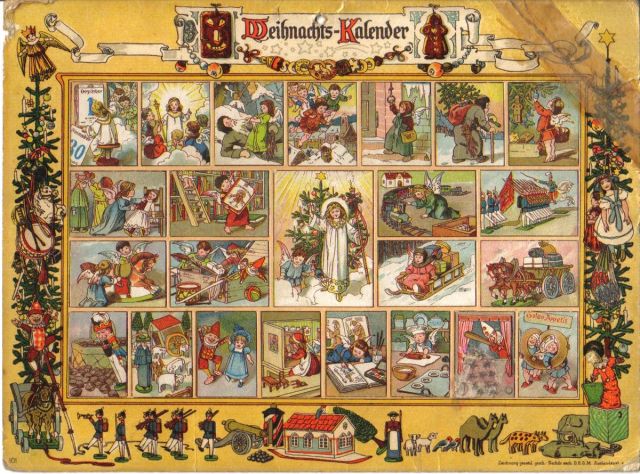
advent-calendarThe tradition of the Advent Calendar goes back to German Lutherans of the 19th century. It was a fun way for children to mark the four Sundays of Advent and the days leading up to Christmas. In the post-war era the tradition has spread widely into other denominations, and thanks to commercialization, has become as disconnected from the religious origins as Santa Claus is from the birth of Jesus. Many children (and adults) will be  starting an Advent calendar on December 1 and counting down the days to Christmas, opening doors and seeing pretty pictures, or, more likely, finding and rapidly eating chocolate, or perhaps even finding  Star Wars Lego. For Christians Advent starts tomorrow (arguably this evening, at sunset) on its earliest possible date, November 27. Thus, we’ll have a full week following each Sunday, with Christmas itself coming seven days after the Fourth Sunday of Advent.

As some of you know I have been on a medical leave of absence for the past four weeks. While I am making progress, it will likely be a while before I am back to work. During my time off I have been unusually disciplined in my prayer life, becoming more deeply grounded in discursive, reflective, and contemplative forms of prayer. One of my practices is to say the Divine Offices of Morning and Evening Prayers. Part of that is the recitation of psalms, and part of that is also three readings from the Daily Office Lectionary (“DOL”). The First Sunday of Advent begins a new church year, and so tomorrow I flip from page 494 of the Book of Alternative Services to page 452, and start reading from the passages prescribed for Year 1; the DOL is on a two-year cycle, and in theory over two years almost alll of the Bible is read. There are three readings for each day – one from the Hebrew Scriptures or Old Testament, one from the non-gospel parts of the New Testament, and one from the four gospels. The readings are thematic, associated with the season. I usually read the first two in the morning, and save the gospel reading for the evening.

What I propose to do is write a short post each day during these four weeks of Advent commenting on one or more of the readings, a kind of lectio divina. The Lectionary is set up so that most of it is continuous reading from day to day. On Sundays the second and third readings are not in sequence with what what went before and follows in the week, but they do follow from Sunday to Sunday, on the theory that people might be attending Sunday evensong and might benefit from that continuity. There is one interruption in the lectionary for the major feast day of St. Andrew on November 30 (which, in the Anglican Church of Canada, is also the 40th anniversary of the ordination of women to the priesthood).

This may be my own Advent devotion of no interest to anyone else, but feel free to join in as I reflect on these passages from the Scriptures. God be with you as we prepare to remember the coming of Jesus, and may his first Advent be the reminder of our need to be ready for the second.

Posted in Advent | Leave a comment

On Humility

exalted-and-humbled

Preached on the Twenty-Third Sunday after Pentecost (Year C), October 23, 2016 at The Parish of St. Matthias, Victoria BC (Diocese of British Columbia, Anglican Church of Canada).

Some of you may recall this song by Mac Davis from 1980. I can’t forget it, because my father used to sing it, always with a twinkle in his eye:

Oh Lord it’s hard to be humble
When you’re perfect in every way.
I can’t wait to look in the mirror
Cause I get better looking each day
To know me is to love me
I must be a hell of a man.
O Lord it’s hard to be humble
But I’m doing the best that I can.

https://www.youtube.com/watch?v=RCyYuLQ7_Ws

Well, while the song is framed as a prayer, its not a very earnest prayer. And in any case, Jesus showed us another way.

In the gospel according to Luke Jesus tells the following story (Luke 18.9-14)

Jesus told this parable to some who trusted in themselves that they were righteous and regarded others with contempt: “Two men went up to the temple to pray, one a Pharisee and the other a tax collector. The Pharisee, standing by himself, was praying thus, `God, I thank you that I am not like other people: thieves, rogues, adulterers, or even like this tax collector. I fast twice a week; I give a tenth of all my income.’ But the tax collector, standing far off, would not even look up to heaven, but was beating his breast and saying, `God, be merciful to me, a sinner!’ I tell you, this man went down to his home justified rather than the other; for all who exalt themselves will be humbled, but all who humble themselves will be exalted.”

“God, be merciful to me, a sinner!”
What does this say to us about humility?


First, humility is about a relationship with God.
It is knowing that there is a Creator and that you are part of the created.
It is about knowing that the Creator is The Merciful One, and that we are people who need mercy.
It is about knowing that God is The Righteous One, and that we have fallen short of that righteousness, that we are sinners in need of forgiveness, mercy, and transformation.  Humility is about knowing who we are, and whose we are.

And God expects much of us. We are created in the image of God, but we fall short of living up to that image. We have tarnished the gift of being made i God’s image. We have need of God, to raise us up, to challenge us, to make us more like Jesus and less like some idol on the television.


Second, consider the meaning of the word humility. It’s related to the word in Latin for “ground”, and it means “lowly”. But it can also be understood as being grounded. One who is humble is grounded, and is well rooted in the ground. A humble person has a good sense of who they are.


Third, there is a difference between being humility and humiliation. Humility is that grounded sense of self, having a good sense of who one is with all your knowledge, skills, and abilities. Humiliation is what a person does to another, denigrating them, abusing them, making them less than what they actually are. It is good to be humble, it is not good to humiliate others, usually because those who are humiliated are vulnerable and defenseless. Humiliation is the reduction of a relationship to having power over others. It’s often the default position of the rich and powerful. We do not humiliate others, and we should resist being humiliated. But we are called to be humble.


Fourth, the Gospel vision is one in which the arrogant are taught humility, and the humble are celebrated. Consider the radical words of Mary in the Magnificat:

For he hath regarded the lowliness of his handmaiden.
For he that is mighty hath magnified me;
He hath scattered the proud in the imagination of their hearts.
He hath put down the mighty from their seat,
and hath exalted the humble and meek.
He hath filled the hungry with good things;
and the rich he hath sent empty away.

Or the words of Jesus repeated through the gospels:

                  But many who are first will be last, and the last will be first. (Mark 10.31)


This is not new with Jesus. It is grounded in the teachings of the prophets. Humility is knowing who you are, whose you are, and knowing that you are. Joel writes, probably some 700 years before Jesus’s time,

You shall know that I am in the midst of Israel, and that I, the Lord, am your God and there is no other. And my people shall never again be put to shame. (2.27)

As a sign of God’s love and care the Holy Spirit falls upon all God’s people, not just prophets and kings. Joel writes:

Then afterward I will pour out my spirit on all flesh;
your sons and your daughters shall prophesy,
your old men shall dream dreams,
and your young men shall see visions.
Even on the male and female slaves,
in those days, I will pour out my spirit. (2.28-29)

God empowers all people, from the lowliest to the highest.


So embrace humility.
In doing so you will become like Jesus.
In doing so you will become like God,
self-giving and deigning to become human.
In doing so, you will become the person God created you to be

Posted in Sermons | Tagged | Leave a comment

It Was More Like 80%

equal-anglicansIt Wasn’t Two-Thirds, It Was More Like 80% That’s the conclusion that I’ve reached about the level of support for the First Reading of the Amendment to the Marriage Canon. As most Canadian Anglicans know, the motion required a two-thirds majority in each of the houses at General Synod – that is, the houses of the bishops, the clergy (i.e. priests and deacons elected or appointed as delegates), and the laity. Despite issues with coding for the electronic voting, the result in the end was that there was more than 2/3rds support in the laity, and a bare 2/3rds in both the houses of bishops and clergy. So the motion passed, barely.

But, as described in the previous blog post, depending on where you come from you as a member of General Synod might “represent” 67 average diocesan attendance, or 1538 in average diocesan attendance. So the 2/3rds majority is probably not an accurate representation of the support for this in the Anglican Church of Canada. Was it more or less than that, or exactly that? Unless someone crunches the numbers, we cannot know.

Now, the interesting thing is that the vote was “a recorded vote”. A recorded vote can be requested in advance of that vote upon the request of three members, and this happened. As well, a motion was passed to distribute the record of the vote prior to prorogation. So  I’ve crunched the numbers – I’ve looked at that vote and matched the votes with dioceses. Here are the results, not differentiating for what house the vote was in.

Yes No
4 2 Algoma
0 7 Arctic
0 6 Athabasca
3 2 Brandon
7 1 British Columbia
0 6 Caledonia
3 5 Calgary
5 0 Cariboo (APCI)
2 4 Central Nfld.
7 0 Eastern Nfld. & Lab.
6 0 Edmonton
1 7 Fredericton
13 0 Huron
6 0 Kootenay
0 4 Mishamikoweesh
6 0 Montreal
3 2 Moosonee
8 0 New Westminster
10 0 Niagara
8 0 N.S. and PEI
4 1 Ontario
10 0 Ottawa
2 4 Qu’Appelle
3 0 Quebec
7 1 Rupert’s Land
1 6 Saskatchewan
3 2 Saskatoon
19 2 Toronto
5 0 Western Nfld.
0 5 Yukon

A few observations on this result. First, what would have happened if a vote had been called by diocese? In the rules of General Synod when a vote by orders passes those opposed have the option to ask for a vote by dioceses. In that case the dioceses would caucus, and whatever the majority was in the diocesan caucus would count as one vote for or against. As the vote would already have had the required two-thirds majority in every house, this vote would only require a simple majority of dioceses (ties would not enter into the counting).

As you can see, if people had voted as they had the first time, there would have been no ties, and twenty votes would have been for and ten against. Even though a simple majority would have been all that was required, the further vote by dioceses would still have passed with a two thirds majority.

Of the thirty dioceses seventeen voted unanimously, five against, and twelve in favour. Thirteen of the thirty dioceses had split votes. Of these thirteen, eight were in favour, and five opposed. The only major urban diocese to vote against the motion was Calgary (unless you want to consider Fredericton a major urban diocese . . . in which case it is two).

In the previous post I noted that delegates represented wildly different numbers of people attending church. If you multiply the attendance per delegate by the votes, you get the following table (I’ve rounded off the decimals, so the math is not utterly exact, but at least your eyes won’t be bothered by endless numerals after the decimal point):

Votes/Pop (rounded) Yes No Votes/Pop: YES Votes/Pop: NO
833 4 2 Algoma 3332 1666
552 0 7 Arctic 0 3868
137 0 6 Athabasca 0 821
200 3 2 Brandon 599 399
767 7 1 British Columbia 5368 767
113 0 6 Caledonia 0 679
696 3 5 Calgary 2087 3480
137 5 0 Cariboo (APCI) 684.375 0
674 2 4 Central Nfld. 1348.875 2698
1122 7 0 Eastern Nfld. & Lab. 7852.25 0
754 6 0 Edmonton 4523.75 0
867.25 1 7 Fredericton 867.25 6071
1242 13 0 Huron 16149.125 0
379 6 0 Kootenay 2275.5 0
833 0 4 Mishamikoweesh 0 3332
752 6 0 Montreal 4514.125 0
999 3 2 Moosonee 2997 1998
1151 8 0 New Westminster 9208 0
1101 10 0 Niagara 11012 0
940 8 0 N.S. and PEI 7527 0
470 4 1 Ontario 1878.4 469.6
1055 10 0 Ottawa 10547 0
315 2 4 Qu’Appelle 629 1258
833 3 0 Quebec 2499 0
641 7 1 Rupert’s Land 4488 641
165 1 6 Saskatchewan 165 988
199 3 2 Saskatoon 596 397
1538 19 2 Toronto 29227 3077
686 5 0 Western Nfld. 3429 0
67 0 5 Yukon 0 335
696 Subtotal 133804.9738 32943.52619
Percentage 0.802435847 0.197564153

So, what is the grand conclusion here? It is that the motion to amend the Marriage Canon did not just have two-thirds of the votes in each of the three houses of General Synod, but those two-thirds majorities cumulatively represent just over four-fifths of the total attending population of the church. In other words, the vote was not only two-thirds, arguably it was also 80% in favour.

By any metric this is a very high majority. While we might wonder whether doctrine and worship should be determined by votes, for better or for worse this is the system we have in the Anglican Church of Canada. The First Reading of the Amendment of the Marriage Canon passed by a two-thirds majority in three houses representing 80% of the church, and that is a very strong mandate indeed.

Posted in Anglican Church of Canada | Tagged , , , | Leave a comment

Not All Delegates are Alike

general-synod-2016

General Synod 2016 Richmond Hill ON

General Synod Delegates and the Populations They Represent

In the last blog post I reviewed the raw statistics collected by the General Synod in order to determine the number of clergy and lay delegates each diocese could send to General Synod. I also quoted the rules for that determination, so I won’t repeat it here.

The number of how we get the total delegates is a bit more complicated. First of all, every active bishop in the Anglican Church of Canada is a member of General Synod. Most dioceses have their “Ordinary” or diocesan bishop, but some have more than one. The Diocese of the Arctic have two bishops, as does the Diocese of Saskatchewan, and the Diocese of Toronto normally have five (one Diocesan and four “Area” bishops). Some dioceses had just elected co-adjutor bishops, such as Quebec. Also, the Bishop Ordinary of the Canadian Armed Forces is a member, as is the National Indigenous Anglican Bishop, and, of course, the Primate.

Second, each diocese sends a youth delegate. These are usually all non-ordained, and their votes get counted with the laity.

As well there are the two delegates from the religious orders, who may or may not be laity (this year they both were). The chancellor of General Synod and the General Secretary are ex officio with votes (the former is lay, the latter clergy). The Canadian Armed Forces also send two clergy, two laity, and a youth delegate (they function like a small diocese). Add in the delegates determined by the attendance figures and you get the grand total.

Now, as mentioned in the previous blog, there is a huge difference in the size of the dioceses – the Diocese of Toronto has roughly 100 times more people in church on Christmas than does the Diocese of Yukon. However, the Diocese of Toronto does not have 100 times as many delegates. While the apportionment does pay some attention to the principle of “representation by population” it’s pretty loose. But just what is the relative difference?

Well, you’ll be pleased to know I’ve crunched the numbers, and here are the results!

Diocese Attendance/Delegate
Toronto 1538.31
Huron 1242.24
New Westminster 1151.00
Eastern Nfld. & Lab. 1121.75
Niagara 1101.18
Ottawa 1054.70
Moosonee* 999.00
N.S. and PEI 940.84
Fredericton 867.25
Mishamikoweesh* 833.00
Quebec* 833.00
Algoma* 833.00
British Columbia 766.92
Edmonton 753.96
Montreal 752.35
Average 696.43
Calgary 695.91
Western Nfld. 685.73
Central Nfld. 674.44
Rupert’s Land 641.17
Arctic 552.52
Ontario 469.60
Kootenay 379.25
Qu’Appelle 314.67
Brandon 199.58
Saskatoon 198.73
Saskatchewan 164.61
Athabasca 136.88
Cariboo (APCI) 136.88
Caledonia 113.13
Yukon 66.93

A few observations might be made here. First, obviously the large urban dioceses are underrepresented on the basis of “representation by population”. A vote by any member or delegate from Toronto stands for 1538 parishioners, whereas a vote by a delegate from the Anglican Parishes of the Central Interior has only 136 in attendance behind them.

Second, that’s OK. Our General Synod was not founded on a principle of absolute democracy, but on having the various stake holders present. Our system undoubtedly over-represents rural people and indigenous peoples. That’s all right – we need those voices at the table. We probably over-represent youth at General Synod, too, compared to the demographic reality of our attendance. So, too, do we include the voices of religious orders and those associated with the Canadian Forces.

Third, there are some really weird results when looking at attendance per delegate. The four dioceses with asterisks did not send any statistical information into the Office of the General Secretary, so God only knows what the real numbers are. I generously assumed the maximum in each case (4,999) and divided by the number of delegates – six for Mishamikoweesh, Quebec, Algoma, and five for Moosonee. This undoubtedly is too high for Moosonee and Quebec, and I really could not say if the number generated for Mishamikoweesh and Algoma bears any relation to reality.

Finally, in terms of attendance per delegate, Calgary is the closest to being the average diocese.

In the next blog I’m going to look at how the votes for the First Reading of the Amendment to the Marriage Canon relates to this.

Posted in Anglican Church of Canada | Tagged , , , | 1 Comment