What Does Kenosis Solve and Not Solve? Part 1

What Does Kenosis Solve & Not Solve?                                                                                 David Bruce Bryant-Scott BA MDiv ThM                                                                                     PhD student, Heythrop College, University of London                                                             June 5, 2015 11:00 am The Campion Room

kenosis

Good morning. My name is Bruce Bryant-Scott, and I am working on a dissertation under the supervision of Professor Johannes Hoff. I am one of those rare things here at Heythrop College,[1] a part-time distance research student. I live 7000 km away in Victoria British Columbia, Canada, where I am a priest in the Anglican Church of Canada at a parish church.[2]

My dissertation is about decolonizing theology. I want to find a theology that does not lend itself to justifying the colonization, exploitation, marginalization, and murder of people in the name of Jesus and progress. Kenotic theology may be a good candidate. This morning I want to talk about kenosis as it is discussed by New Testament scholars and by theologians, and then briefly say how I intend to use it.

  1. Kenosis and the New Testament Scholars

Discussion of kenosis is tied to Paul’s use of the word ἐκένωσεν in Philippians 2.7, as seen in Handout 1. For the record, ekenōsen is a 3rd person singular indicative active aorist of κενόω. Kenosis is a perfectly ordinary Greek word meaning “emptiness”; cognates translate into English as vacate, evacuate, deplete, and deplete.

Hand-Out 1 (Heythrop June 5 2015)

Why does Paul bring in this theme of self-emptying? In the context of Philippians it is evidently a form of encouragement to them, to, as the preceding verses put it,

be of the same mind, having the same love, being in full accord and of one mind. Do nothing from selfish ambition or conceit, but in humility regard others as better than yourselves. Let each of you look not to your own interests, but to the interests of others. (Philippians 2.2-4)

The exhortation continues afterwards:

Therefore, my beloved, just as you have always obeyed me, not only in my presence, but much more now in my absence, work out your own salvation with fear and trembling; for it is God who is at work in you, enabling you both to will and to work for his good pleasure. Do all things without murmuring and arguing, so that you may be blameless and innocent, children of God without blemish in the midst of a crooked and perverse generation, in which you shine like stars in the world. (2.12-15)

In the rhetorical structure of a letter the description of Christ’s kenosis is part of the paraenesis or moral exhortation. Paul writes the letter while he is in prison (1.13), and the Philippians are concerned and send financial aid (4.18). As well, Paul is opposed by Jewish-Christians having authority from the Jerusalem church, and this opposition is creating divisions in the churches for which Paul felt responsible.[3] This has not created divisions in Philippi yet, but Paul is worried about it, and so he mentions them in 1.15-17, 1.28, 3.2, and believes that only if the Philippians continue to follow Paul and the example of Jesus will they be able to work out their salvation with fear and trembling (1.12). Paul’s use of this passage, then, is primarily ethical – by being like this, his readers will have God working within them, enabling them “both to will and to work for his good pleasure” (2.13).

Following Lohmeyer’s essay Kyrios Jesus (1927) a majority of 20th century scholars and current scholarship would argue that Philippians 2.5b-11 is pre-Pauline and probably a hymn sung by the early Christians; this is still the belief of many influential living scholars, such James D. G. Dunn and John Reumann.[4] If this is so, then the immediate ethico-rhetorical use of Paul recedes, and it becomes more of a doxological, soteriological, and thus implicitly a Christological work (as the title of the 1998 collection Philippians 2: Where Christology Began suggests);[5] who Christ Jesus is becomes more important. Handout 2 reproduces a chart created by N. T. (Tom) Wright which presents the variety of opinion about the “Philippian hymn” and the impact it has on the translation into English of key words. Some see the hymn as being derived from pre-Christian gnostic mythology, others accept a Jewish gnostic influence, others regard it as more influenced by a transformation of Adamic typology, and “equality with God” is variously interpreted as referring to attributes, status, and humanity in the image of God.

Hand-Out 2 (Heythrop June 5 2015)

Now, N. T. Wright is not convinced that there ever was a “Philippian hymn”, and on the basis of linguistic and stylistic evidence questions those who construct a pre-Pauline Christology[6] (there is, of course, no documentary evidence for a pre-Pauline hymn). Likewise, Gordon D. Fee points out five problems with the case for the “pre-existence” of the hymn: 1) there’s really nothing like it in either Greek or Hebrew poetry; 2) poetic language is not necessarily poetry; 3) ὃς (hos or “who” in 2.6) is perfectly normal and not an awkward connective indicating a quotation (as in other supposed parallels); 4) these passages read as structured prose, not poetry; and 5) some of the “lines” lack verbs, and are likely more the product of biblical scholars than any ancient writer.[7] [8]

In a measured statement Peter Oakes (currently Greenwood Senior Lecturer in the New Testament at Manchester) writes:

I think that Paul has taken his beliefs about Christ’s self-lowering (2 Corinthians 8.9), his obedient death (Rom. 5.19), and his exaltation (1 Corinthians 15.24) and has carefully crafted a rhetorically powerful Christological reinforcement to his call in 1.27-2.4 to stand firm and united.[9]

While the New Testament scholarly consensus is less monolithic than it once was, it is clear that the passage does several things: it is doxological, an exhortation to particular ethical behaviour, and Christological.

Regardless of what one makes of the original text in Philippians, it is evident that the theme of humility and lowering oneself for others is present in other parts of the New Testament. Thus, Paul writes:

For you know the generous act of our Lord Jesus Christ, that though he was rich, yet for your sakes he became poor, so that by his poverty you might become rich. 2 Cor 8.9

For Jews demand signs and Greeks desire wisdom, but we proclaim Christ crucified, a stumbling-block to Jews and foolishness to Gentiles, but to those who are the called, both Jews and Greeks, Christ the power of God and the wisdom of God. For God’s foolishness is wiser than human wisdom, and God’s weakness is stronger than human strength. Consider your own call, brothers and sisters: not many of you were wise by human standards, not many were powerful, not many were of noble birth. But God chose what is foolish in the world to shame the wise; God chose what is weak in the world to shame the strong; God chose what is low and despised in the world, things that are not, to reduce to nothing things that are, so that no one might boast in the presence of God. 1 Cor 1.22-29

The synoptics have the theme as well:

Whoever wants to be first must be last of all and servant of all. Mark 9.35 & parallels

To the rich young man: You lack one thing; go, sell what you own, and give the money to the poor, and you will have treasure in heaven; then come, follow me. Mark 10. 21 & parallels (A very literal understanding of letting go!)

You know that among the Gentiles those whom they recognize as their rulers lord it over them, and their great ones are tyrants over them. But it is not so among you; but whoever wishes to become great among you must be your servant, and whoever wishes to be first among you must be slave of all. For the Son of Man came not to be served but to serve, and to give his life a ransom for many. Mark 10.42-45 & parallels

Throughout the Gospel according to Luke Jesus is presented as humble, obedient, and meek, and this quality is extolled in Mary and others. The Gospel according to John is fundamentally a gospel of glory, but glory is coincident in the cross. Kenotic humility, then, whether by that name or implicit, is found throughout the early Christian writings.

What is not clear is whether Paul has a belief in the pre-existence of Christ, and if so, what the nature of that pre-existence is. It is also not absolutely clear what the nature of “form” of God is and what “equality with God” entails; one can read a reconstruction of Middle Platonism into it, but that just begs the question.[10]

Next Post: Part 2, Kenosis and the Theologians.

[1] http://www.heythrop.ac.uk/

[2] The Parish of St. Matthias, Victoria, The Anglican Diocese of British Columbia
600 Richmond Avenue, Victoria, British Columbia, Canada V8S 3Y7
Parish Website: http://stmatthiasvictoria.com/
Cell: 250-889-8917    Parish Office: 250-598-2833
bbryantscott@bc.anglican.ca    Twitter: @bbryantscott
Blog: https://brucebryantscott.wordpress.com/

[3] Gerd Lüdemann, Opposition to Paul in Jewish Christianity (Minneapolis MN: Augsburg Press,1989), translated from Paulus, der Heidenapostel. Bd. 2: Antipaulinismus im frühen Christentum (Göttingen 1983).

[4] Carolyn Osiek calls it the “general consensus” in Philippans Philemon (Nashville TN: Abingdon Press, 2000), p. 56. See also R. P. Martin, Carmen Christi, Philippians ii.5-11 in Recent Interpretation and in the Setting of Early Christian Worship (Cambridge UK: Cambridge University Press, 1967); F. W. Beare, A Commentary on The Epistle to the Philippians (London: Adam & Charles Black, 1959); Ralph P. Martin & Brian J. Dodd, eds., Where Christology Began: Essays on Philippians 2 (Louisville KY: Westminster John Knox Press, 1998) (which includes an essay by James D. G. Dunn which affirms the pre-Pauline character); John Reumann, Philippians (Anchor Yale Bible Vol. 33B) (New Haven CN & London UK: Yale University Press, 2008).

[5] Ralph P. Martin & Brian J. Dodd, eds., Where Christology Began: Essays on Philippians 2 (Louisville KY: Westminster John Knox Press, 1998).

[6] N. T. Wright, “ἁρπαγμός and the Meaning of Philippians 2.5-11”, Journal of Theological Studies, New Series Vol. 37, Pt. 2, October 1986, pp. 321-343; 342-343.

[7] Gordon D. Fee, Paul’s Letter to the Philippians (The New International Commentary on the New Testament) (Grand Rapids MI: William B. Eerdmanns Publishing Company), pp. 40-46.

[8] A further problem for those who claim influence from “Gnosticism” is that the “Gnosticism” to which they refer in all probability also never existed as such, but is a scholarly reconstruction of the 19th and 20th Centuries that collects into one category a vast variety of writings that in retrospect came to be seen as not “orthodox” and “catholic”, thus reproducing the biases of the modern scholars. See Karen King, What is Gnosticism (Cambridge MA: Harvard University Press, 2005).

[9] Peter Oakes, Philippians: From people to letter (Cambridge UK: Cambridge University Press, 2001), p. 210.

[10] Probably the way forward into understanding the context of Hellenistic Judaism for Paul on this is found in Daniel Boyarin, “The Gospel of the Memra: Jewish Binitarianism and the Prologue to John”, The Harvard Theological Review, Vol. 94, No. 3 (Jul., 2001), pp. 243-284.
Posted in Uncategorized | Tagged , , , | Leave a comment

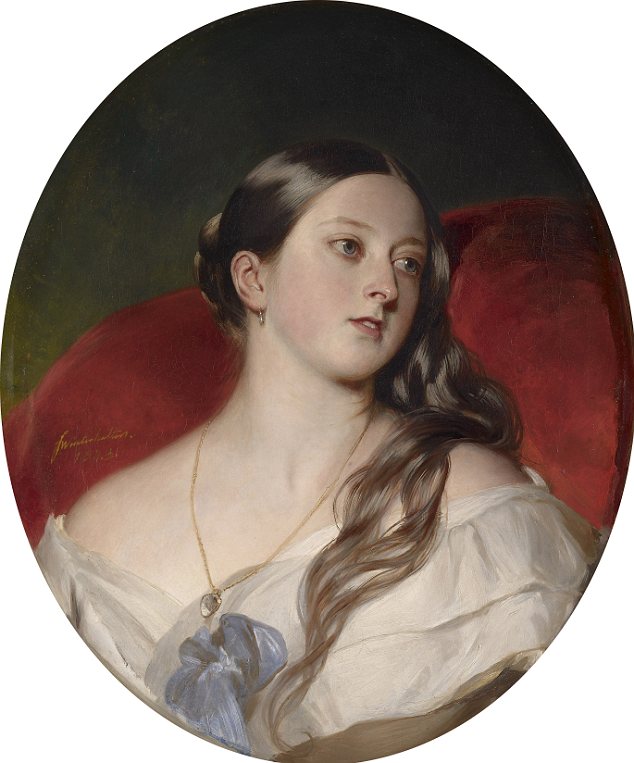
Victoria’s Two Bodies

queen-victoria

A portrait of Queen Victoria painted in 1843 by Franz Xaver Winterhalter.

I am a monarchist.

Not one of those singular people  who join the Monarchist League, or who buy Hello magazine with its cover picture of This week’s Royal. And while I admire our Sovereign Lady Queen Elizabeth II, it’s really not about her personally.

What convinces me to be a monarchist is the political idea that the monarch has two bodies. Not in the way Tatiana Maslaney plays multiple characters in Orphan Black, nor some weird science fiction idea of one person with two actual bodies, but in the way that the monarchy actually works in Canada, the United Kingdom, and other places.

Originally it was a theological idea used to support the rule of princes. The monarch had a physical body, which could be strong or frail and was identified with a particular person who was born, lived, and died. The other body was a spiritual one, which inhered in that particular individual while they reigned, but never died. When that monarch’s physical body died, the spiritual body continued on to the heir to the throne. Thus, the principle is that the throne is never empty, and the king never “dies”.

This theological abstraction became a rather secular principle in British and Canadian law. While the monarch may change, and may even be unknown, contested, a minor, or senile, the authority of the monarch remains the same and is continuous. In practical terms the authority is exercised by the Prime Minister and Premiers who “advise” the monarch or her representatives – advice that is always accepted. As the spiritual body, then, is controlled by elected representatives, the authority of the monarch is democratically controlled (including, as has happened in any number of Commonwealth states, the abolition of the monarchy for that country).

In Canada the physical body of the monarch is quite restricted. Because she is represented by the Governor General and Lieutenant Governor, there is no practical reason for her to be physically present. She (and members of her family) only come when invited by the governments, federal and provincial. She may be on our currency, but she will not set foot in Canada unless specifically requested by the Canadians who run the government. When she does come everything she says and does in public is arranged and vetted by Canadian officials.

It actually works very well. Everybody knows that the governments are ultimately responsible to the people, and every four to five years we electors have the opportunity to kick the bums out. Public land is called “Crown Land” and is in fact a trust held for the benefit of all (subject to the settlement of First Nations claims and the negotiation of treaties). We have all the benefits of the monarchy without too many of the hassles.

Some would advocate for Canada to become  republic. If we must, can we separate the Head of State from the Head of Government, as Germany, Ireland, Israel, and India do, with  figure-head presidents? The union of the Head of State and Head of Government in powerful presidents, as in Russia, the US, and France fills me with distaste. To attack the president would seem to also be an attack on the state and people as well – something that is not so much the case in these other previously mentioned nations.

Canada will probably not become a republic, though, as such a change would require the unanimous consent of the federal government and all ten of the provincial governments. As we have seen from Meech Lake (1987) and the Charlottetown Agreement (1992) unanimous consent is not easy, and many Canadians have a strong emotional attachment to the monarchy. Politicians may feel better at leaving sleeping dogs lie and use their political capital on more important issues.

On this official birthday of the Queen, Victoria Day, may we celebrate the two bodies of the Queen – the one long gone when Victoria herself died in 1901 and the other continuing on in her great-granddaughter, Elizabeth the Second.

Posted in Uncategorized | Tagged , , , , | Leave a comment

Schism in the Church

Drawing by Leonard Rosoman from the cover of Raymod Brown's Anchor Bible Commentary on The Epistles of John (1982).

Drawing by Leonard Rosoman from the cover of Raymond Brown’s Anchor Bible Commentary on The Epistles of John (1982).

It was a difficult time in the congregation. After a period of solid teaching and achievement a split came about – a schism in the community. The schism hearkened back to the holy writings, and a divergence of opinion in how best to interpret, understand, and apply these teachings. It appears that in some ways the split was over how the church was to understand the nature of Jesus and his saving work. It also appeared to be about leadership. The ones left behind felt that the ones who left claimed to be followers of Christ, but in fact acted like hypocrites, saying one thing and yet doing another.   Now, you might think I am talking about some place very close to you. But this is not a description of any parish you have ever been a part of, or think you know. The church I am describing is  – let us call it  – the “Community of the Beloved Disciple”, the 1st Century community which produced The Gospel according to John, and the three short letters known as the First Letter of John, and the Second letter of John, and the Third Letter of John (and quite probably gave rise to The Revelation to John).   And because in its wisdom the church has determined that these writings are now scripture, and as “all scripture is given by inspiration of God, is profitable for doctrine, for reproof, for correction, for instruction in righteousness, that we may be perfect, thoroughly furnished unto all good works” – we should ask ourselves what lessons might be learned from these letters which as part of the canon of the Bible present this schism frozen in time.   But first, a few reminders about these works. Everything I say is part and parcel of mainstream scholarship, and is derived from the scholarship of Raymond Brown (1928-1998), a Roman Catholic priest and New Testament scholar, and author of several books including the Anchor Bible Commentaries on The Gospel According to John (two volumes), commentaries on The Death of the Messiah (two volumes), The Birth of the Messiah (one thick volume of 752 pages), The Epistles of John (840 pages on seven chapters total), and a series of short popular pamphlets such as An Adult Christ at Christmas.   Let’s start with the major Johannine work: The Gospel according to John. Like the other three gospels, it is anonymous – nowhere in any of the gospels do the authors identify themselves by name. Later traditions ascribed two to apostles or people mentioned in Acts and Paul’s Letters, but this appears to be an attempt to claim apostolic authority for the writings when some people might have rejected them.  In the case of the fourth gospel later tradition ascribed it to the apostle John. Now the Letters are also anonymous, but the author identifies himself as a priest or elder (presbuteros), which does not sound very apostolic. The Revelation to John is delivered to someone named John, but John was a common name, and even ancient tradition was not unanimous in declaring that the author of Revelation was the same person responsible for the gospel – Revelation was thus attributed to St. John the Divine, who is differentiated from St. John the Apostle. But in the text of the gospel nowhere is it claimed that someone named John wrote it. A disciple is highlighted – but he is also anonymous, and simply called “the disciple whom Jesus loved.” Brown speculates that this unnamed disciples was the person around whose preaching and example a church developed, perhaps one with its centre in the city of Ephesus, in what is now Turkey, with some outlying satellite communities. Thus Brown calls it “The Community of the Beloved Disciple”. Now, The Gospel of John has a curious style, in that it takes up a topic, seems to conclude, and then takes it up again in a different way. Brown suggests that there were two written editions of the gospel, and earlier one of which no trace is found, and a later expansion. The Beloved Disciple himself may have been responsible for both of them, or perhaps only the earlier one and then the expansion was done by  a successor who so imbibed the style of the Beloved Disciple that it may as well have been the same person. The whole of the gospel is in simple but powerful Koine Greek.   II John & III John are two short letters or epistles of one chapter each. They are that short because they were undoubtedly written on single sheets of papyrus – the norm for writing ordinary letters.. As mentioned the author describes himself as “the elder” or “presbuteros” – a priest. II John seems to be a letter sent out to a daughter church warning against certain antichrists – opponents of the author. III John is about a particular individual, Diotrophes, who challenges the authority of the author and is making false accusations against him. I John, seemingly by the same author, comes across as a kind of commentary on certain issues in the Gospel of John – how to understand the nature of Jesus in the incarnation, the importance of loving the members of the church. The author accuses the people who split apart of not acknowledging that they are capable of sin, of a failure of love, and that they are antichrists – opponents of Christ. The style is not as good as that of the Gospel, and Brown suggests that it was written by someone within the Community of the Beloved Disciple some years after – maybe ten? – who knows the gospel and echoes it in 1 John. Whereas The Gospel according to John has little to say about divisions in the church, the Letters of John seem to be about nothing else.   So what are we to make of this?   First, divisions happen in the church, and have happened since the very beginning. Even earlier than 1 John  we have the Letters of Paul: in 1 Corinthians Paul hears that there are divisions in the church in Corinth; in Galatians and 2 Corinthians he is opposed by men sent out from the church in Jerusalem, and in Galatians Paul describes a split between himself and Cephas/Peter. Splits are not new, and are to be expected in the Body of Christ because it is made up of fallible, sinful, broken people. Yes, we are the Body of Christ, and we do more than we can ask or imagine by the power of God working in us. But when we come to the church door we are not magically transformed into wonderful people. We are alcoholics and people with addictions, folks with mental health issues, persons who have been abused physically and sexually, and we may be the abusers themselves. We are bullied children and the bullies themselves. We bring our hurts, our grudges, our scars, our brokenness, our sinfulness. By the power of God we heal somewhat, and amongst the saints of God there are indeed some truly holy people. But for the most part our repentance is not complete, and our transformation is unfinished. We long for the resurrection to be made visible within us, but so often we encounter nothing but our old, decaying selves. And so the church is split and riven. There are supposedly 41,000 separate Christian denominations – not a great witness to the power of Jesus’ prayer: “May they be one, even you and I are one”. In Victoria BC alone there are over one hundred churches, and I dare say forty to fifty denominations. Even we Anglicans are divided: there is the Anglican Church of Canada, the Reformed Episcopal Church, the Anglican Catholic Church of Canada, the Anglican Network in Canada, the Anglican Mission in Canada, the Anglican Province of Christ the King, and the Anglican Ordinariate within the Roman Catholic Church. And that’s just Victoria.   So, yes, it is a tragedy and a scandal that there is division in the church. But it is nothing new, and to be expected in this broken and fallen world. I don’t say “Get over it” but I do say, “Don’t be surprised.” Second, long after the schism no one remembers who the people were – who seceded and who stayed, or whether their congregations thrived or perished. We simply don’t know. It becomes irrelevant. We don’t know what happened to the two Johannine communities – perhaps both carried on and forgot about the split, or perhaps the both died out. But their writings endured.   What seems so important to us, where our emotions become so deep and raw, in time looks so strange. Christians in the 19th century tied themselves up in knots on the two sides of the question about slavery. No one defends slavery any more. Anglicans in the 16th and 17th century had strong theologies on the divine right of kings. Now – who cares? The judgment of history often finds such controversies alien and bizarre. God looks on our piety, and is probably either sad or amused.   In the long run what is probably important is our relations, our love for one another and our love shown in mercy and care for others.   My third point is this: despite these tragic circumstances, God still manages to redeem the situation. But we do have these writings which gained greater circulation in the church in the 2nd century, and a few decades after their writing the Gospel of John was included on everybody’s list of canonical gospels, and a bit later, so were the Letters.   And we get these remarkable words: Beloved, let us love one another, because love is from God; everyone who loves is born of God and knows God. Whoever does not love does not know God, for God is love. God’s love was revealed among us in this way: God sent his only Son into the world so that we might live through him. In this is love, not that we loved God but that he loved us and sent his Son to be the atoning sacrifice for our sins. Beloved, since God loved us so much, we also ought to love one another. No one has ever seen God; if we love one another, God lives in us, and his love is perfected in us.   We are a church which has experienced the profound trauma of schism. And yet, nevertheless, we seek to proclaim God’s love in word and deed with abandon and glee. May God continue to bless us as we seek to be beloved disciples.

Posted in Uncategorized | Tagged , , , , , , | Leave a comment

Music for 18 Musicians

musical_quote
Probably the most prominent and prolific “minimalist” composers is Philip Glass, and I own a lot of CDs with his music, but in the long run I expect that Steve Reich will be remembered as the more brilliant of the late 20th century composers; as Bach was to counterpoint and the Baroque, so Reich is to minimalism and post-modern classical music.

Reich’s music really doesn’t sound like anything else, and it is varied. Music for 18 Musicians from 1974 is his first great masterpiece. If you have never listened to it, you owe it to yourself to take an hour and listen to it. Here it is, in a new version by Ensemble Signal. It is both simple and complex, joyful and serious. If you feel like it, stand up and dance with it – I won’t tell anybody.

Posted in Uncategorized | Leave a comment

A Eucharistic Prayer

The Lord be with you.     And also with you.

Lift up your hearts.      We lift them to the Lord.

Let us give thanks to the Lord our God. It is right to give our thanks and praise.

Spring of time, God before being, molder of matter, breather of life: We do not know how to pray to you, but your Spirit within us makes us bold to speak. We stand in wonder that we are in your Image, and we see your Spirit at work in everything that is made.

You blew a wind over the first waters, and breathed life to our African mothers and fathers. As our forebears spread into Asia and Europe, Australia and Pacific Islands, and last of all, the distant shores of the Americas, your Spirit spoke to many families and they knew you as Creator. In the fullness of time you made an oath and pledge with Abraham and his children forever. By the Spirit you taught Moses and the people of Israel, you led David to dance before the Ark, and to sing of your mercy and strength. When pride leads us astray your wind blows us straight: your prophets see visions and dream dreams, and speak your word to challenge those in power, and comfort to the wounded and those in need.

And so with all your children from every age and place, and with all that is made, both seen and unseen, we sing:

Holy, holy, holy Lord, God of power and might, heaven and earth are full, full of your glory. Hosanna in the highest.

Blessed is the One who comes in the name of the Lord. Hosanna in the highest.

We give thanks for Jesus, born of Mary, Word made flesh, on whom your good will fell. He was driven by the Spirit to face temptation and evil, and was not overcome. He announced your peace with power and stories that open our souls to the coming of that Spirit in our midst. In humility and care he gave himself for all, even into the hands of those who would hurt him and kill him. By a love stronger than death he rose from the tomb and so he changed us all.

On the night he was betrayed Jesus took bread, gave thanks to you, broke it and gave it to his friends, saying, “Take and eat: this is my body which is given for you. Do this for the remembrance of me.” After supper, Jesus took the cup of wine, gave you thanks, and said “Drink this all of you, this is my blood of the new covenant which is shed for you and for many.”

As Jesus took bread and wine, so we take this loaf [these loaves] and this cup [these cups]. As he said the blessing, so we say this prayer. As he broke bread with his followers, so we follow his example. As he shared the bread and wine with the hungry, so our hunger is fed by him and our and thirst is slaked. In eating his body, we become the Body of Christ. In drinking his blood, we join him in the rule of God. Breathe on this offering of bread and wine so thatwe may be the ‘body of Christ’ loving God with all our hearts, with all our souls, with all our minds, and with all our strength, and neighbour  as ourselves.

Gather all your people into your Holy Feast so that we all shall know you, from the least to the greatest. For in this meal we are joined with you in love and glory, our beginning and our end, through Jesus your son, with your Holy Spirit, now and for ever. Amen.

Posted in Uncategorized | 1 Comment

Doubting Thomas, Diversity, and Nag Hammadi

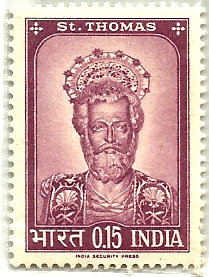
St.Thomas, Apostle to India, Stamp from India 1964 15p

A JOKE

St Peter was at the pearly Gates of Heaven when someone arrived. Peter said, “Now, before I can let you in you just have to answer this simple question. How are we saved?”

The newly deceased but eager person replied, “As a Bible believing Christian and a fundamentalist conservative Evangelical Christian that’s easy – we are saved by our faith in the inerrant inspired word of the Bible.”

“Nope!” said Peter, and the candidate was flung off to some place warmer than heaven.

A second person arrived. Peter again said, “”Now, before I can let you in you just have to answer this simple question. How are we saved?”

This person replied, “As a faithful child of the church and a life-long Catholic, that’s easy – we are saved by accepting the guidance of Mother Church and every word of the Holy Father in Rome.”

“Nope!” said Peter, and the candidate was likewise flung off to some place that was very hot.

A third person, newly dead, arrived. Peter asked the same question. The person thought for a bit, and said, “Hmmm. As an Anglican born and bred I have been taught and do believe that we are saved by the grace of God, unearned and unmerited, which in Christ Jesus was reconciling the world to God’s own self.”

Peter was surprised and said, “Well done, good and faithful servant! Enter into the rest of God your Father. You have answered correctly!”

And the thoughtful Anglican walked through the gates into heaven. As he did  so he turned and said, “But, you know, on the other hand . . .”

Thomas

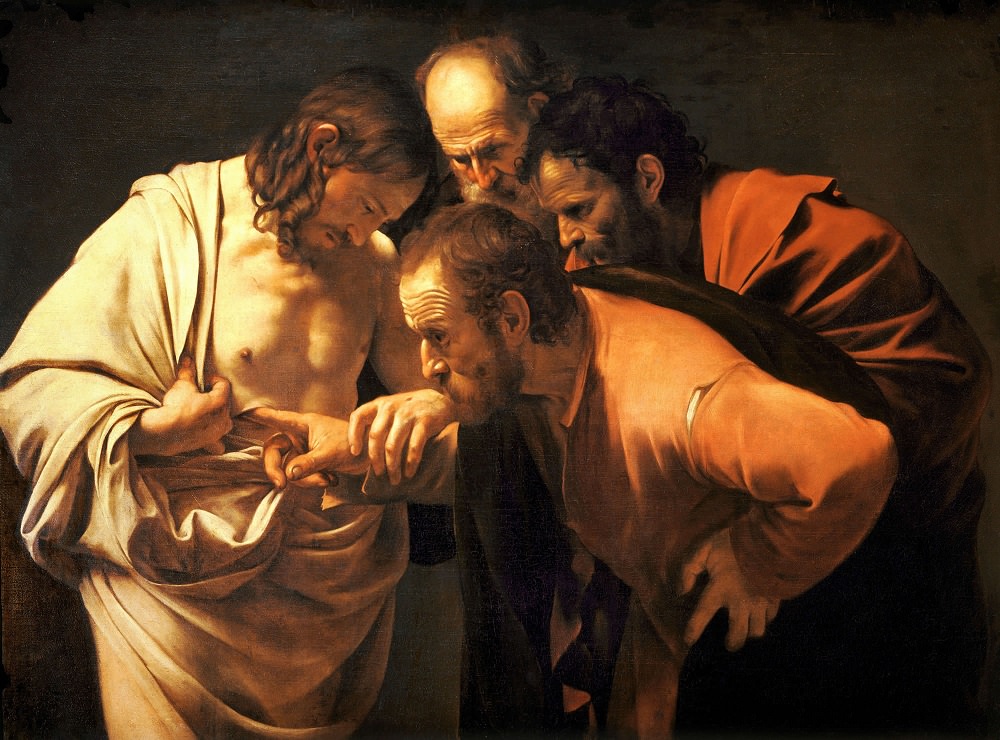
Ba-dum-dum! Anglicans are renowned for being able to see every side of an issue, and even creating new perspective which none had seen before. We revel in ambiguity and complexity, and it has sometimes been said that our patron saint is Doubting Thomas. The gospel for the Second Sunday of Easter has the story of Thomas and his doubt:

When it was evening on that day, the first day of the week, and the doors of the house where the disciples had met were locked for fear of the Jews, Jesus came and stood among them and said, “Peace be with you.” After he said this, he showed them his hands and his side. Then the disciples rejoiced when they saw the Lord. Jesus said to them again, “Peace be with you. As the Father has sent me, so I send you.” When he had said this, he breathed on them and said to them, “Receive the Holy Spirit. If you forgive the sins of any, they are forgiven them; if you retain the sins of any, they are retained.”

But Thomas (who was called the Twin), one of the twelve, was not with them when Jesus came. So the other disciples told him, “We have seen the Lord.” But he said to them, “Unless I see the mark of the nails in his hands, and put my finger in the mark of the nails and my hand in his side, I will not believe.”

A week later his disciples were again in the house, and Thomas was with them. Although the doors were shut, Jesus came and stood among them and said, “Peace be with you.” Then he said to Thomas, “Put your finger here and see my hands. Reach out your hand and put it in my side. Do not doubt but believe.” Thomas answered him, “My Lord and my God!” Jesus said to him, “Have you believed because you have seen me? Blessed are those who have not seen and yet have come to believe.”

The Incredulity of Thomas, by Caravaggio (1601-1602)

The Incredulity of Thomas, by Caravaggio (1601-1602)

Now Jesus did many other signs in the presence of his disciples, which are not written in this book. But these are written so that you may come to believe that Jesus is the Messiah, the Son of God, and that through believing you may have life in his name.

A Discovery in the Desert

codicesThe desert. 1945. In a pottery jar there is a great discovery of papyrus. But this is not the story of the discovery of the Dead Sea Scrolls. The Dead Sea Scrolls were discovered a couple of years later, in the Judean Desert, in caves. And the Dead Sea Scrolls were scrolls, – books written on one long piece of papyrus, with text on one side and rolled up when stored. They were written in Hebrew, apparently in the century before the time of Jesus and up until 66 AD/CE. No, this story is about the discovery of some ancient books in Egypt that were codices (singular codex, plural codices) – what we today normally consider books – handwritten on both sides of the papyrus, sewn together and folded over once, and bound in leather. They were found in a place called Nag Hammadi, a village in Upper Egypt, about 80 km northwest of Luxor, or Thebes (which is today a city of over half a million people). It is a small library of twelve volumes, containing 52 separate works. According to epigraphy and dating systems the codices were physically created somewhere in the 4th Century – the 300s. That is the era in which  that Christianity became the religion of the majority of people in the Roman Empire, and when it was legalized by Constantine the Grea,t and made the official imperial religion by his successors. So these books date from the beginnings of Christendom, when it passed from being a persecuted cult to a religion favoured by the powerful. They are all written in Coptic, an old Egyptian language, which died out some centuries ago, but is still used by Coptic Christians in Egypt in their liturgies, as Latin was used by Roman Catholics until the liturgical reforms of Vatican II, or as Old Church Slavonic in used in some Russian Orthodox churches. Although in Coptic the scribes used Greek letters, much as English uses the Latin alphabet. The style of the translations suggest that they were translated from Greek, and, indeed, some of the texts are referred to and quoted by ancient writers, and we have a few fragments of papyrus of the original texts in Greek.

Nag Hammadi map

And what are these works?

They are usually characterized as “gnostic” – that is, supposedly secret teachings that if given to someone would result in their illumination and salvation. According to many scholars the Gnostics were a movement that was part of  early Christianity but ultimately was condemned and disappeared from the historical record. The books of the Nag Hammadi library are their books, and the speculation is that they were hidden in the late 4th century or early fifth century because of persecutions by orthodox, official Christians.

That said, there is another approach to these texts, which is to say that they come from a time when Christianity was much more in flux and more diverse than anyone really imagined. Throughout history clergy and ecclesiastical prelates like to tell simple stories about the origins of Christianity, on the assumption that a complex tale is too much for the simple people in the pews, and might detract from the acceptability of the faith. Thus the declaration is made that the true faith is that which has been taught at all times in all places and believed by all (quod ubique, quod semper, quod ab omnibus creditum est). Thus the dogma of the Nicene Creed, the Chalcedonian Definition of the Two Natures of Christ, the 39 Articles of Religion, the Five Fundamentals, and the Catechism of the Catholic Church are read back into the Scriptures and the history of the church, as if these doctrines arose naturally from primitive Christianity. While some may indeed wish to think that, the historical record does not actually bear that out, and as John Henry Newman demonstrated when he was still an Anglican, the only proper way to understand any doctrine, dogma, or proclamation of the Christian faith is to see its development within a historical context.

The scholars who do not see the Nag Hammadi library as “Gnostic” argue that “Gnosticism” is a category created largely by 19th century scholars to include a broad range of heresies identified in the first five centuries of Christianity. While the Nag Hammadi library does contain some pretty exotic and esoteric books by the standards of modern Christianity, to call them “Gnostic:” is to force a category of interpretation on them that doesn’t really work.

The texts – which were indeed lost for well over 1500 years – are clearly associated with Christians.  The titles include:

  • The Gospel of Truth
  • The Gospel of Philip
  • The Gospel of Mary
  • The Acts of Peter

and exotic titles such as

  • Thunder, Perfect Mind
  • The Hypostasis of the Archons
  • The Apocalypse of Adam

The Gospel of Thomas

The end of The Gospel of Thomas from the Nag Hammadi Library.

The end of The Gospel of Thomas from the Nag Hammadi Library.

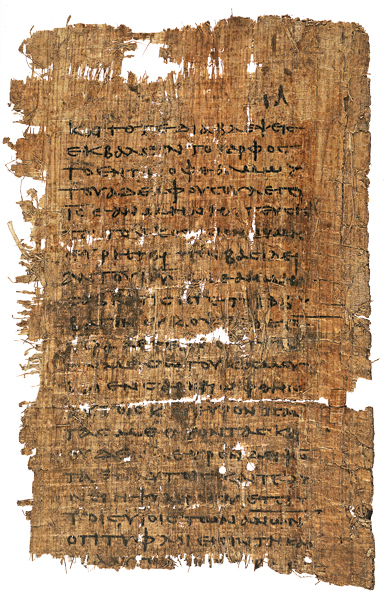
However, the greatest of interest is in one text – The Gospel of Thomas. From papyrus scraps in Greek found in another place in Egypt  (Oxyrhynchus) it is known that this was used in the 2nd century – before the year 200. There is a consensus that it is the oldest work in the Nag Hammadi library. It appears to have been written in Greek. It is a collection of 114 sayings attributed to Jesus, and there is no narrative – no narrative structure as in the four gospels in the New Testament, so no life of Jesus, no scenes by the wayside, no tales of the sea. There is nothing like the infancy narratives of Matthew and Luke. There is no mention of Jesus being the anointed one of God the Messiah, the Christ. Perhaps most strikingly, there is no passion narrative – no cross, and no resurrection. Jesus simply teaches. Many of the sayings are parallel to sayings of Jesus in Matthew, Mark, Luke, and John, but are simpler, and rarely have any interpretation or explication.

A Fragment of The Gospel of Thomas in Greek (P. Oxyrhynchus 1, found in 1897)

A Fragment of The Gospel of Thomas in Greek (P. Oxyrhynchus 1, found in 1897)

Scholars fall into two groups about when the original text was written – some say it was written around the same time as the New Testament, sometime in the latter half of the First Century,  and other say some significant time afterwards, in the 2nd century. The scholars who argue for an earlier dating suggest that it is thus an early independent witness to the teachings of Jesus, albeit transmitted and transformed by a Christian community very different from that of which Paul was a member and from that which produced the gospels. They note that a most scholars accept that Matthew and Luke used a “Sayings Gospel” (commonly called Q), and The Gospel of Thomas, while not it, is very much like what the reconstruction would look like. The later dating school, on the other hand, presumes that the significant number of parallels suggests a literary dependence of The Gospel of Thomas upon the four gospels, a relation to the 2nd century Syriac harmonization of the gospels known as the Diatessarion, and that it is thus much later.

Diversity and Charity

What are we to make of all this?

Well, to begin with, one can make too much of it. Most of the texts in the twelve books of the Nag Hammadi library are Christian works, and all of them were read by Christians. Some are exotic, some show signs of thinking that was then and later denounced as heretical, but much of the stuff is pretty normal fare for the times (if not for our own) – there is even a passage from Plato’s Republic in the library, as well as some other classical authors. Although it does not sit well with the four Gospels of the New Testament, the Gospel of Thomas is not a gnostic work, just another text about Jesus that needs to be carefully read if we want to relate it back to the historical Jesus.  The remarkable finding is that after one has done that work there really isn’t anything that remarkable – at best we might have one or two sayings that go back to Jesus that we might otherwise not have – nothing too revolutionary. What is striking to me is the absence of so many things that clearly were part of early Christianity as evidenced by the letters of Paul and the four gospels. The Gospel of Thomas presents a Jesus with no mention of the cross, no ministry of proclamation and healing and exorcism, no sense that Jesus is the Messiah, the Christ, no sense that he will come to judge the living and the dead, and no resurrection. There is no Christmas, no Good Friday, and no Easter in the Gospel of Thomas.

Among the group of scholars who argue for an early dating of the Gospel of Thomas are those who  believe that the Gospel of Thomas and the Gospel of John were in conversation. Did some disciples, claiming a genealogy of teaching from Thomas , deny the Resurrection? Were their emphases of teaching found in The Gospel of Thomas? Was the passage in the Gospel of John about the doubts of Thomas  written to challenge these supposed followers of Thomas? So they suggest.

I am not convinced about the early dating of the Gospel of Thomas, and so I do not accept this proposal.But what is clear is that by the middle of the Second Century there was a diversity in early Christianity that was previously unthought of. Subsequent to this diversity the power of the Empire was used to enforce uniformity, and ultimately it was the dogma of the Nicene Creed and Chalcedonian Definition of the Two Natures of Christ that prevailed. Retrospectively we can tell who ultimately were judged heretics and who were not. At the time, for Christians living in Upper and Lower Egypt, it was not so straight forward.

The dogmatic teachings of the church were hammered out on the forges of controversy. For that to happen means that there has to be a diversity of opinion, and from the earliest letters of Paul we know that there was diversity and controversy in the churches. For the most part, I think the orthodox came up with the right answers – because these are answers that produce powerful explanations of how God acts in the world, how God is in Christ reconciling the world to God’s own self. It’s why I will prefer the New Testament to the Nag Hammadi library as a source of spiritual teaching and salvation – the New Testament is much richer, and speaks to me in a language that I can sy=till understand twenty centuries after it was written, whereas much that is in the Gospel of Thomas leaves me cold. But rather than pounding people over the head with dogma and doctrine, I would rather be charitable and welcoming of the diversity of opinion, recognizing that no one person has a monopoly on the truth.

Which brings us to the gospel reading today. Thomas doubts, and with good reason. People do not just rise from the dead. And so he says: “Unless I see the mark of the nails in his hands, and put my finger in the mark of the nails and my hand in his side, I will not believe.” And so Jesus is revealed, and he is invited to put his fingers in the holes in his hand, and his hand in his side. His response is, by our anachronistic reading, entirely orthodox: “My Lord and my God!”

As Thomas may have inspected the holes and wounds, so we need to wrestle with these ideas. They may be commonplace now, part of our culture, but to make them ours we need to not only receive them, but to mull them over, meditate on them, critique them, bear down upon the texts more with study, and see what they mean in practice.

The other reason I like the New Testament is that the people who wrote it sought to live the Resurrection – they believed that the same power which raised Jesus from the dead was at work in them. And so they put that into practice. From Acts we read:

Now the whole group of those who believed were of one heart and soul, and no one claimed private ownership of any possessions, but everything they owned was held in common. With great power the apostles gave their testimony to the resurrection of the Lord Jesus, and great grace was upon them all. There was not a needy person among them, for as many as owned lands or houses sold them and brought the proceeds of what was sold. They laid it at the apostles’ feet, and it was distributed to each as any had need.

This is pretty radical stuff. Jesus said to Thomas: Blessed are those who have not seen and yet have come to believe. May we wrestle with the Resurrection, acknowledging our doubts with charity and care, and may we know the power of the risen one in our practice as well as our faith. 

Posted in Uncategorized | Tagged , , , , , , | 2 Comments

Vimy Ridge, April 9, 1917 – Easter Monday

My grandfather, Beverley Scott, was part of the McGill Battery, Siege Artillery in the latter half of the Great War. He was at Vimy Ridge, and these are two pages from his diary. Click on the pictures to bring up a readable, full-size image.

The #7 (McGill) Siege Battery, in the Artillery of the Canadian Expeditionary Force (CEF) was formed April 25, 1916 16 from graduates and undergraduates of McGill University; Bev Scott was one of the latter.

Scan 1Scan 2 Scan 3I visited Vimy Ridge in 1982. It was a very peaceful place, with a glorious monument. What struck me the most was how close the trenches were to each other.

Posted in Uncategorized | Tagged , | 4 Comments

Leave it to Beaverbrook

Leave ItNot too many people under 60 in Canada will have any idea who Lord Beaverbrook is, unless they are from New Brunswick. Even in Great Britain, where he spent most of his life, I suspect the memory of him is fading. But in his day he was a giant:

  • a self-made millionaire by the age of thirty who left his native Canada for the Imperial metropolis of London in 1910 for even greater success;
  • the owner and publisher of the Daily Express, the London paper which at one point had the highest circulation in the world;
  • an MP in the UK parliament, a knight, and the original Fleet Street press baron;
  • Minister of Information in the first Lloyd George cabinet during the First World War;
  • an author and journalist in his own right;
  • a close friend of Winston Churchill, and served in his cabinet throughout the Second World War, notably as Minister of Aircraft Production through the Battle of Britain;
  • his biography was written by the eminent English historian (and his friend) A. J. P. Taylor; and
  • founder and donor of the Beaverbrook Art Gallery in the provincial capital of Fredericton, New Brunswick (where I got the t shirt with the image above by Charles Pachter).

When put that way, he sounds like a great man, and in many ways he was. That said, there was always a air of scandal about him. His ownership of the Daily Express was not known throughout much of the First World War, and Beaverbrook used it to secretly criticize a government that he was part of – including playing a role in the downfall of Asquith, the Prime Minister through the first three years of the war. The Daily Express was then, as now, not a paper found in the best of homes, being oriented to scandal-mongering and being economical with the truth. Beaverbrook really saw it as a means of propaganda and money-making, not a noble trust. When he was a young man based in Halifax and Montreal he made his fortune in Canada in mergers and acquisitions, but the means by which he did it were considered a bit shady, and he was more or less obliged to sell his Canadian holdings and leave the country in 1910. The character of Rex Mottram in Brideshead Revisited is said to be based on him.

He was born Max Aitken in 1879 in Maple, Ontario (now best known for being the home of Canada’s Wonderland, north of Toronto), the son of a Scottish-born Presbyterian minister. His father accepted an appointment to the Presbyterian church in Newcastle New Brunswick on the shores of the Miramachi river, and he grew up there. He always saw it as his home town, and later endowed it with a library and various other public buildings. When he was proposed in 1916 to be made a baron he originally wanted to be Baron Miramachi, but apparently too many Brits mispronounced it (probably with a hard ch as in church and not the correct ch as in chef). So he chose another place for his peerage: Beaverbrook. And could anything sound so Canadian as BEAVERBROOK?

But where is Beaverbrook? Well, here it is (the Google maps view):

Beave Brook

Not very impressive, is it? Basically, it is just a whistle stop on the old Intercolonial Railway that ran from Quebec to Halifax and was built as a result of the negotiations around Confederation in 1864 through 1867. That particular section of track was built in 1875, and the final link between the Maritime Provinces  and Quebec was completed the following year. But I can imagine a young Max Aitken playing out along the woods and tracks, and when obliged to find a place name for his peerage chose a an evocative if not distinguished one.

My great-grandfather Thomas G. Scott (1854-1923) was a locomotive engineer on the old Intercolonial, doing the run between Campbellton and Moncton for forty years. Born in Bathurst NB he was a pious Presbyterian, the superintendent of the Sunday School, and described in his obituary as the minister’s right hand man. I can well imagine that he knew Beaver Brook Station the place.

Locomotive engineers had big heavy boxes that they took with them into the engine cab. They kept the records of their journeys in them. This is my great-grandfather’s:

Thomas G Scott box closed

It’s not much to look at, but when you open it up there are treasures:

Thomas G. Scott box open

Mostly it is old logs with handwritten notes about the weather and the train he was driving. But it also had a medal Thomas Scott got for service in the Intercolonial during the Great War, an old psalter, as well as an article about his funeral in 1923, and his last letter to his youngest son, my grandfather. My grandfather inherited it, and he kept some of his old school records in it, as well as a notarized release that allowed my granddad as a young university student at McGill to ride in the engine with his father.

It is doubtful that Beaverbrook ever met my grandfather – while they started out in similar circles they certainly did not end up in the same ones. But I can imagine that at some point in the 1880s my grandfather would have sounded the whistle around Beaver Brook Station and Newcastle to force the boys off the tracks, and that young Max Aitken was one of them.

While I started reading Taylor’s 892 page opus on Beaverbrook, I confess I did not finish it. Most of the facts here are from the wikipedia entry. 

Posted in Uncategorized | Tagged , , | Leave a comment

Jesus’ Radical Politics

This is a well thought out essay from the Boston Globe that deserves wide readership. I even quoted it in my Easter sermon.

http://www.bostonglobe.com/opinion/2015/04/01/jesus-radical-politics/txdjkQSMn3BWPBgciEbgZP/story.html

Posted in Uncategorized | Tagged , , , | Leave a comment

Are You a Recovering Fundamentalist?

I’m not. I grew up in the United Church of Canada and the Anglican Church of Canada, which are for the most part middle-of-the road mainline denominations.

However, I have met some very conservative people in both denominations who adhere to the historic five fundamentals. many of these people have an addiction to being right, to certainty, and blast anyone who admits of ambiguity or problems in the Christian faith. I’ve also met  many people in the Anglican Church who were formerly members of conservative denominations and can no longer abide the narrowness of their upbringing, but still see themselves as Christians, and have found a home in Anglicanism.

Mark Alan Schelske in a recent blog explained what he meant by describing himself on Twitter as “a recovering fundamentalist”. You might find it congruent with your experience.

Posted in Uncategorized | Leave a comment