The Brain as a Model for Prophecy in Isaiah

Day Nineteen of “Through Advent with Isaiah”

I warn you, this is a weird post.

Thinking About Brains.

Once upon a time, not so long ago, scientists who studied the human brain said that it had a triune nature. By this they did not mean that it was like the Holy Trinity, but rather that the human brain had three parts, the lowest part leading up to the highest part.

triune-brain

The brain stem and cerebellum was thought to be an artifact of our primitive ancestors and very much like a reptile brain. It responds to gross stimuli, and is concerned with threats to survival, the need for food, and so forth. As the image above suggests, it is our “lizard brain”. In the brains of mammals we find an area developed above it, called the limbic system, and scientists have determined that it is the part of the brain which controls emotion, behavior, motivation, long-term memory, and smell. The neocortex, which is found in all mammals, is most highly developed in primates and human beings. It is strongly correlated with our ability to use language, think in images, reason, and so forth.

This tripartate description of the human brain was popular in the ’60s and ’70s, but began to fall apart as neurology advanced. As Julian Kiverstein and Mark Miller put it in their 2015 article, “The embodied brain: towards a radical embodied cognitive neuroscience” (found here),

Why assume however that the only parts of the human brain to undergo change over the course of evolution were those located in the cortex? An alternative co-evolutionary hypothesis is that both cortex and sub-cortex underwent changes in a coordinated fashion. Those brain structures with major anatomical and functional links most likely evolved together. . . . Pessoa has suggested, in line with the co-evolutionary hypothesis we just sketched, that this increase in size in the amygdala is likely to be linked to the degree of connectivity with other brain structures. . . . Parvizi (2009) offers an important critique of this “corticocentric myopia”. In his words “higher functions of the brain are made possible by a reciprocal interconnection between cortical and subcortical structures rather than being localized only in the upper tip of the vertical neuroaxis”.

This picture of higher cognitive systems and lower emotional systems as being “vertically” integrated and tightly coordinated strongly argues against a corticocentric myopia. It suggests instead a view of cognitive and emotional processes as strongly interdependent.

This is fascinating. We can imagine our distant ancestors of hundreds of millions years ago having relatively simple brains, well adapted for their circumstances. As natural selection drove evolution and circumstances changed, the limbic system developed, at the same time changing in some ways how the brain stem and cerebellum functioned. As our ancestors developed into mammals a simple neocortex emerges, which in one trajectory – ours- it grows phenomenally, likewise interacting with the limbic system and cerebellum in new ways.

Of course, as much as we know about the brain, there is still much that we do not understand. We have a good idea of how nerve cells interact and what chemicals are involved. We also have a good idea of what parts of the brain do what, and how they evolved into what they are today. What we do not have is a good theory of how chemical interactions at the cell level produce what we know, how we think, and what we see with “the mind’s eye”. We do not have a good account for how the brain produces the phenomenon of what we know subjectively as thought, or being human. In the past many approached the brain as if it were just a complex computer, but that is now seen as a gross simplification and rather unhelpful metaphor. Our brains do not encode data as 0s and 1s, as computers do, nor have any computers come out with emergent consciousnesses – our brains are much more complex and weirder than that.

embodiedcognition

Isaiah as a Brain

Now, consider what we know about the Book of Isaiah. Bernard Duhm suggested in the 1890s that there were three sections of the book corresponding to three different authors.

This is a bit like the now discredited triune brain theory. Scholars in the hundred-plus years since his time have complexified his theory and taken it apart. Some have found that the last part of the book to be written was in chapters 24-27, not 56-66. Some see additions from the exilic and post-exilic all over First Isaiah. Scholars argue over the context in which First Isaiah emerged – was it from the prophet himself, a Josianic recension of the prophet’s sayings, or from the fourth century? How were the concerns of the exilic community in Second Isaiah read in the post-exilic era?

It seems to me that the complexity of Isaiah is a bit like the complexity of the brain. We have the final product, but we do not know how it got there. Indeed, because the process of its creation is an historical event and process lost in the mists of time, we may never be able to recover what really happened. We can speculate, but never really know.

That said, we can see how the rhetoric and structure of Isaiah works. There is the interaction between Second Isaiah and First Isaiah, on either side of the trauma of the conquest of Judea and Jerusalem, the destruction of the Temple, and the Exile. There is warning and hope, repentance and folly. Third Isaiah also builds on this, as ideas of servanthood and who Israel is grow and are transformed. In the era after the book received its final form we can see how all of these elements were then reinterpreted and functioned in Judaism and Christianity. All parts of the book evolve – perhaps materially, by the addition of words and verses, but also by being in relation with later passages elsewhere in the book. It also evoleves in the history of interpretation – and they are then used by other authors, such as those behind the Dead Sea Scrolls and the New Testament.

You may not see this as a helpful metaphor, but thinking about Isaiah as being like a human brain allows me to engage with the text of Isaiah in a new way. Yes, it has a reasonably stable text and content, but it is also something that has demonstrably changed over several hundred years, and its interpretation did not sit still even when finished. Kind of like human beings.


Posted in Advent, Isaiah, Uncategorized | Tagged , | 1 Comment

Visioning Sunday Responses

ChapelDecember 1, 2019 – The First Sunday of Advent
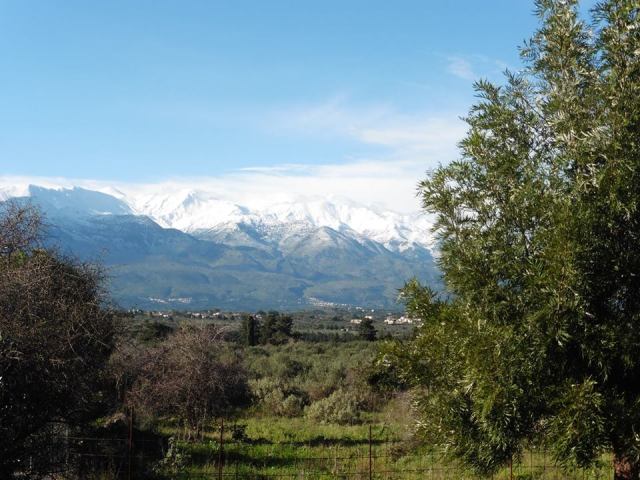
The Anglican Church of St Thomas the Apostle, Kefalas
Apokoronas, Crete, Greece
Diocese of Europe | Church of England


In place of a sermon time the people present at the regular 11:00 am service were asked the following questions, and they answered as follows. We sat in four table groups. Answers have been transcribed from the newsprint sheets on which were recorded each table’s answers.

The stated theme for the Visioning Day, the First Sunday of Advent, was:
What do we need to do to be ready?

Complete the questions, and write your answers on the newsprint, please!

1.   At St Thomas’s we are passionate about . . .

  • God’s message.
  • The survival of our church x 2
  • Growing congregation
  • Increasing giving – time and talents
  • More cash to keep church solvent
  • The setting of St Thomas’ and The Garden
  • I don’t really sense “passion here. We want to see our passion for the gospel more reflected. At times we have experienced a passion here for prayer, fellowship, sharing the gospel – we’d like more.

2.   What really excites me about Sunday morning is . . .

  • Music x 2
  • Fellowship x 2
  • Meeting friends
  • Enthusiastic singing
  • Communicating with God and with others
  • Wrestling with the scriptures
  • Sermons x 3
  • Looking forward to the services.
  • Sacramental presence.
  • Location

3.   I love Crete because . . .

  • Mountains x 2
  • Sea x 2
  • Food x 2
  • Cretan people x 2
  • The weather x 2
  • The countryside
  • It gives us time and space to reflect
  • Community spirit

4.   My favourite time at St Thomas’s was when . . .

  • We joined
  • The Sunday services X 2
  • Fellowship time
  • Pilgrimage and retreat at Loutro x 2
  • Carol service in the hotel at Almyrida x 2
  • Renewal of marriage vows

5.   If the church wasn’t there I would miss . . .

  • Sunday service x 2
  • Fellowship x 3
  • Feeling of belonging x 2
  • Friendliness
  • Opportunity for worship

6.   God is calling us to . . .

  • Pray x 2
  • Be a community church x 2
  • Be more open x 2
  • Radiate God’s love to the wider/outer community x 2
  • Have the light and love of Christ shining in Crete (Acts 1.8).
  • Worship, pray together, spread his word
  • God is calling us to save the planet”
  • Surrender to love and transforming love

7.    Outside of church, my favourite thing to do is . . .

  • Walking x 2
  • Walking the dogs
  • Eating out x 2
  • Being outside
  • eating and drinking
  • Socialise x2
  • Entertaining friends x 2
  • Communicate (deeply) with people
  • Time to think, meditate, read
  • Enjoy the view, beauty
  • Gardening
  • Cooking
  • Reading
  • Relaxing
  • Sleep
  • Raising funds for local charities

8.    What’s really different about St Thomas’s is . . .

  • Open air worship – it’s a tent! x 2
  • It is outside
  • Feel like I’m part of God’s creation
  • The history x 2
  • Tony’s vision x 2
  • Location + The setting (but some drawbacks)
  • Moveable space
  • Made to feel welcome, included
  • Emotionally “warm”
  • I feel accepted as I am, and accepting of others
  • Casual in dress (which is good), but serious about faith
  • Accommodating to different denominational backgrounds
  • It’s the only Anglican Church on Crete.
  • More opportunity to participate.
  • Mobile congregation.

9.    Something I really want to say is . . .

  • We need to reach out to more of the ex-pat community x 2
  • We need to be more outward looking
  • Time to be more outward looking
  • We need to work on publicity x 2
  • Develop more welcoming events such as the coffee mornings x 2
  • I’m welcoming the changes.
  • Excited about what the vision will be.
  • I feel burdened by the property and ownership. Worried that we are identified as the building and not as much as the Body of Christ.
  • I question is the building is in the right place to serve those it should (i.e. holiday makers w/o cars (so how cane we compensate for the negatives?)
  • Improve communication and planning.
  • Transformation of the garden is a great transformation.
  • Thanks to everyone who contributes.
  • How lucky we are to have a wonderful place so close to our homes.
  • We worry that we are only accessible by car.

Church with a View

What’s Next?

  • The Church Council, at its next meeting, will decide whether to work on the Vision Statement all together or delegate it to a small group to develop. The mission statement may be developed at the same time.
  • After it has been approved for presentation by the Church Council, the Vision Statement will be presented to a short special meeting of the Congregation for discussion and a motion will be made to adopt it.
  • A detailed plan with goals and measureable objectives for the next five years will be developed by the Assistant Chaplain and the Church Council. After approval for presentation by Church Council it will be presented at the Annual Meeting for approval.
  • Implementation of the congregational plan will follow, monitored by the Church Council at every meeting.
  • Each year it will be reviewed and changed as needed, with reports to the Annual Meeting.


Posted in Sermons | Tagged , , | Leave a comment

God’s Story: It’s Always Jesus!

A Sermon Preached On
Christ the King: The Sunday Before Advent
Sunday, November 24, 2019, 11:00 am
also being The Fourth Sunday in a Season of Visioning
at the Anglican Church of St Thomas, Kefalas, Crete, Greece.
Somewhat expanded and changed since it was preached.

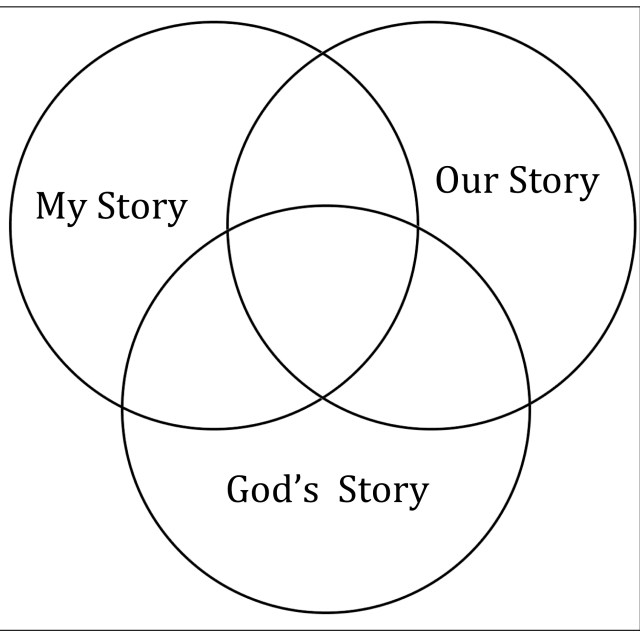
This is the Fourth Sunday in our Season of Visioning. It is a season in which we pray and reflect, and open ourselves to the Holy Spirit. Here again is this Venn diagram:

Three Stories - Us, Our, God's

You’ll recall last week I told the story by Ian Dingwall:

When I was a young priest in Vancouver there was a Sunday School teacher in my parish who was talking to a group of pre-adolescents. She was saying, “Well, boys and girls, I was in Stanley Park the other day, and as I was walking though the forest and the giant redwoods and Douglas firs, I saw a rustling among the bushes. I walked over to it, and as I got closer I saw what it was. Do you know what I saw, boys and girls?” I think she was talking about a rabbit, but before anybody could say anything one child said, “It was Jesus. Its always Jesus!”

Its always Jesus! Well, who is Jesus for us? Here, in no particular order, is what the congregation said:

  • peacemaker
  • messiah
  • lover
  • arbitrator
  • scapegoat
  • Jewish
  • Galilean
  • friend
  • lamb
  • sacrifice
  • shepherd
  • miracle worker
  • brother
  • family
  • father,
  • king
  • rod of Jesse
  • holy
  • resurrection
  • firstborn of creation
  • challenger
  • preacher
  • teacher
  • healer
  • saviour
  • leader
  • comforter
  • God
  • divinely inspired man
  • servant
  • the suffering servant
  • Word of God made flesh
  • a rebel put to death
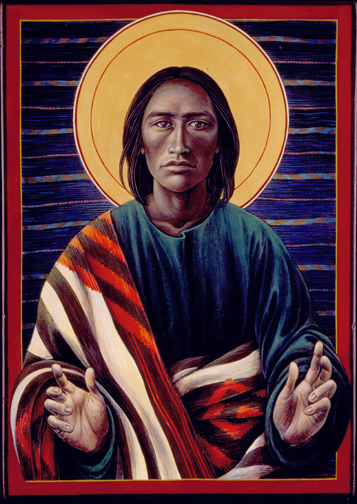
  • an icon
  • an indigenous man put to death by a colonizing empire
  • an historical figure

These descriptions, categories, and names, as powerful as they are for us, do not encompass who Jesus was, for he transcends and escapes any bounds or boxes we might put him in. Part of the challenge of bringing God’s story to others, and seeing where it intersects with our own as individuals and churches or communities, is that we can never quite sum him up. There is always more to be said, and what has already been said is found to be paradoxical (a father and a brother??? human and divine???) or contradictory. Jesus subverts our seemingly concrete categories and ways of thinking.

John Giuliani_Compassionate Christ

Posted in Sermons | Tagged , | 1 Comment

The Texts of Isaiah

Day Eighteen of “Through Advent with Isaiah”

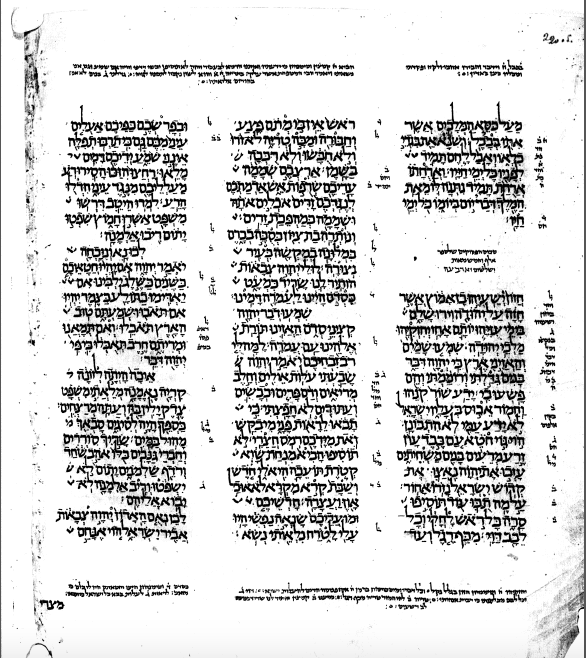
Although parts of the Book of Isaiah go back as far as the eighth century BCE – 2700 years or so – the oldest complete manuscripts are only about a thousand years old. The two main manuscripts of the Tanach (Hebrew Bible) are both codices – that is, they are bound pages with writing on both sides, and not scrolls. The older one is the Aleppo Codex, which dates from the late 10th century, and the other one is the Leningrad Codex from the year 1008 CE. Both are high quality specimens of what is called the Masoretic text.

The Masoretes were a movement of Jewish textual scholars and scribes based at Tiberias in Galilee in the last centuries of the first millennium. As Hebrew ceased to be a spoken language they made an effort to collate the very best readings of the manuscripts available to them. Hebrew writing often does without vowels – they are indicated by helping letters like Aleph or Ayin, or you just know them from using the words and knowing how to pronounce them.  This, as the Masoretes knew, becomes problematic when Hebrew is no longer a living language, and so they indicated the vowels with signs above and below the consonants, as well as including signs as to how it should be chanted, with various other notes. The result is a very accurate text of the books of the Bible, with lots of notes and information.

Aleppo Codex - First Page of Isaiah

Aleppo Codex– First Page of Isaiah

The Aleppo Codex was written in Galilee, but made its way to Cairo, where the famed rabbi Maimonides saw it and attested to its quality. The Leningrad Codex (also known as the Cairo Codex) was copied from manuscripts in Cairo and checked against the Aleppo Codex. The first printed Hebrew Bibles were based on later manuscripts into which the inevitable copying errors had entered. When the German biblical scholar Rudolf Kittel decided to revise his critical edition of the Hebrew Bible in 1921 he wanted to use the Aleppo Codex, but the Jewish community in Aleppo were so protective of their great treasure that they refused him access. So he turned to the Soviet Union, which as the heirs of the Russian Empire had the Leningrad Codex, which had been bought from a collector in the 1860s.  The 3rd edition of the Biblia Hebraica (“BH”) was based on it, and reporoduced all the Masoretical notes and markings. When a revision was done after the Second World War – the Biblia Hebraica Stuttgartensia (1968-77) (“BHS”) it also followed the Leningrad Codex; that’s the Hebrew Bible I have at home.

Leningrad Codex - First Page of Isaiah

The first page of the Book of Isaiah from the Leningrad Codex.

Between the BH and BHS two major things happened. First, in the immediate post-war era the Dead Sea Scrolls were discovered in caves just to the northwest of the Dead Sea. Second, in the wake of the establishment of the State of Israel the Aleppo synagogue was attacked, and the Aleppo Codex disappeared for a few years, and then reappeared in Israel. Unfortunately, when it reappeared, major portions of the book were missing, including most of the Torah. While there were photographs made of the missing pages, they were not of the highest quality, nor were they comprehensive. The Aleppo Codex has now been issued in part in a critical edition by Hebrew University, and it provides the basis for a standard text of the Hebrew Bible known as The Jerusalem Crown (2000). This has now become the official Tanach in Israel, used in the Knesset and to administer oaths of office.

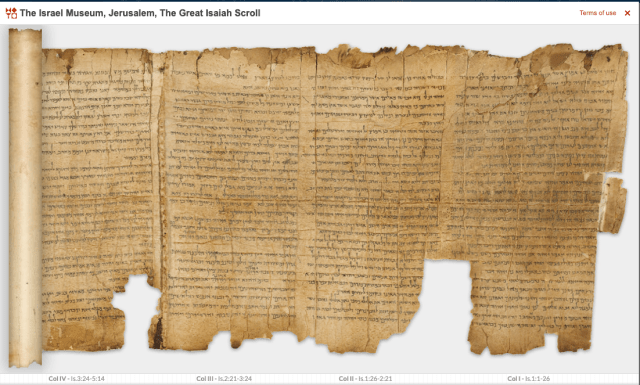
Great Isaiah Scroll

The Great Isaiah Scroll (1QIsaa) • Qumran Cave 1 • 1st century BCE • Parchment • H: 22-25, L: 734 cm • Government of Israel • Accession number: HU 95.57/27 From the Digital Dead Sea Scrolls

The Dead Sea Scrolls consist of a wide variety of Jewish religious manuscripts that appear to have been hidden in caves during the Jewish revolution against Rome in 66 CE – 70 CE. Many of scrolls are Biblical texts, and although fragmentary they form an important source for modern textual criticism. The only scroll of a complete text (with a few damaged areas) is that of Isaiah found and named 1Qlsaa, (i.e. 1Q = “in the First cave at Qumran”, “Isa” = Isaiah,  a = a letter distinguishing it from other Isaiah texts). It is also known as the Great Isaiah Scroll, because it is very large.

What was surprising to biblical scholars was that the text of 1Qlsaa was not very different from that of the Masoretes a thousand years later, as evidenced in the Aleppo and Leningrad Codices. There were some differences, of course. Some were obvious errors of manual copying, and some were just variations in spelling. A few of the differences actually clarified obscure passages in the Masoretic text, suggesting that the Masoretes had inadvertently preserved some corrupted words in the text.

Again, some of these differences corresponded to translations in the Greek Septuagint. The Septuagint was a translation of Jewish scriptures into Hellenistic Greek, done in the second and first centuries BCE. While undoubtedly used extensively by Greek speaking Jews across the eastern Mediterranean, its use by Christians in the centuries after Jesus led to it being abandoned by them.

In practice the BHS uses the Leningrad Codex as its text, but its critical apparatus notes differences with the Dead Sea Scrolls and the Aleppo Codex. As a result, the translator has the opportunity of making her own judgement as to what the probable original text was, and can translate accordingly. Isaiah seems to have had a remarkable textual stability through its 2500 year history.

Posted in Advent, Isaiah | Tagged , , , , | Leave a comment

The Servant of God in Isaiah

Day Seventeen of “Through Advent with Isaiah”

Bernard Duhm (1847-1928) wasn’t a liturgist, but his work has influenced the lectionary used in the Catholic, Protestant, and Anglican churches. In Holy Week the readings from the Hebrew Bible, traditionally called the Old Testament, are what he identified as the four “Servant Songs“.

Monday in Holy Week Isaiah 42:1–4 Quoted in Matthew 12:16-21.
Tuesday in Holy Week Isaiah 49:1–6 49:6 is quoted by Simeon in Luke 2:32.
Wednesday in Holy Week Isaiah 50:4–7 An allusion in Luke 9:51 to Isaiah 50:7.
Good Friday Isaiah 52:13–53:12 Jesus quoted this as referring to himself in Luke 22:37; also used in Matthew 8:17, Mark 15:28, John 12:38, Acts 8:32–33, Romans 10:16, 15:21 and 1 Peter 2:22.

For good measure, the first reading for the Sunday of the Passion, after the Liturgy of the Palms, is the third Servant Song, Isaiah 50.4-9a. As Christians we read these passages in the context of Jesus’s suffering and death, as testimony to him. Based on their use in the Greek New Testament we see them as prophecies about him. But what did Isaiah — or rather, the author of II Isaiah — think he was doing here? Who is the servant for him?

Ebed

Servant in Hebrew, pronounced “Evedh” or “Ebed”.

Duhm was a German Lutheran biblical scholar who used historical-critical methods and ended up teaching in Basel, Switzerland. His 1892 commentary Das Buch Jesaia (Gottingen: Vandenhoeck & Ruprecht, 1892) was the first to suggest that Isaiah had three divisions and was written over several centuries. He identified the four servant songs, and noted a common theme of suffering that was developed within them. The Wikipedia article on Duhm has a useful summary by Joseph Blenkinsopp (who used to teach at Notre Dame):

[Duhm’s] conclusions may be summarized as follows:

  • the “Servant songs” were composed by a member of a Jewish community, but not of the diaspora, during the first half of the fifth century, between the composition of Job and Malachi;
  • the author drew on Jeremiah, Deutero-Isaiah, and Job and in his turn influenced Trito-Isaiah and Malachi;
  • the protagonist of the “songs” was a historical figure, a teacher of the law who suffered abuse, first of all from his own people;
  • the “songs” are distinguished from their Deutero-Isaian context by a more deliberate and sober style, more regular prosody, and especially by the contrast with Deutero-Isaiah’s description of Israel as ebed they originally formed one composition, together with editorial additions (42:5-7; 50:10-11);
  • they were inserted into Deutero-Isaiah by a later hand wherever there was space on the papyrus copy.

It would be safe to say that none of these conclusions would pass unchallenged today.
Blenkinsopp, Joseph. “Isaiah 40–55: A New Translation with Introduction and Commentary. Anchor Bible 19A.” (2000): pp. 76-77.

So far, then, we have two candidates for the servant of God – the traditional understanding of Jesus as the suffering servant, and Duhm’s teacher of the law in the post-exilic Judea. But there are other candidates.

The most obvious one, and the one usually identified by the Jewish tradition, is that it is the whole of Israel. Chapter 41.8 explicitly identifies Israel as the servant of God:

8 But you, Israel, my servant,
Jacob, whom I have chosen,
the offspring of Abraham, my friend;
9 you whom I took from the ends of the earth,
and called from its farthest corners,
saying to you, ‘You are my servant,
I have chosen you and not cast you off ’;
10 do not fear, for I am with you,
do not be afraid, for I am your God;
I will strengthen you, I will help you,
I will uphold you with my victorious right hand.   – Isaiah 41.8-10

The only way to deny this would be to suggest, as Duhm does, that the four servant songs were not written by the same person who wrote the rest of II Isaiah. He reads the following as having a different subject:

1 Here is my servant, whom I uphold,
my chosen, in whom my soul delights;
I have put my spirit upon him;
he will bring forth justice to the nations.
2 He will not cry or lift up his voice,
or make it heard in the street;
3 a bruised reed he will not break,
and a dimly burning wick he will not quench;
he will faithfully bring forth justice.
4 He will not grow faint or be crushed
until he has established justice in the earth;
and the coastlands wait for his teaching.  — Isaiah 42.1-4

This doesn’t sound too different from the passage quoted above, although Duhm argues from the original Hebrew that there are stylistic differences. The Catholic writer Jimmy Akin notes in a great summary that “servant” has many uses in the book of Isaiah as a whole:

The Hebrew word for “servant” used in the key passages of Isaiah is ‘ebed. This word appears 40 times in the book, in 36 verses.

In some cases, it refers to the servants of human beings:

  • Isa. 14:2 refers to unnamed foreigners who will become the servants of Israel.
  • Isa. 24:2 refers to the slaves of human masters.
  • Isa. 36:9 and 37:24 refer to servants/subjects of the king of Assyria
  • Isa. 36:11 has several figures referring to themselves politely as “your servants” when talking with an Assyrian official
  • Isa. 37:5 refers to the servants/subjects of King Hezekiah of Judah
  • Isa. 49:7 refers to an unnamed, despised figure who is “the servant of rulers”—i.e., a subject of foreign leaders. . . .

Many of the uses of ‘ebed in Isaiah are in the plural and refer to God’s servants collectively. This theme emerges in chapter 54 and is especially prominent in the final four chapters of the book:

  • In such passages, the servants of God seem to refer to the righteous of Israel (Isa. 54:17, 65:8, 13-15, 66:14).
  • They are expressly identified with “the tribes of your heritage” in Isa. 63:17, and with descendants of Jacob and Judah inIsa. 65:9.
  • However, Isa. 56:6 makes it clear that they also can include foreigners who come to worship God and thus become “his servants.”

We thus see that in Isaiah God actually has many servants.

Akin also notes that:

Not all uses of ‘ebed are in the plural, and there remain 22 uses which speak of individual servants of the Lord. Four of them are named:

    • The first to be named is Isaiah himself. Isa. 20:3 refers to “my servant Isaiah.”
    • The second is Eliakim son of Hilkiah (Isa. 22:20), who was a man that God called to be the chief steward of the house of David.
    • The third is David himself (Isa. 37:35).
    • And the fourth is the corporate figure of the nation of Israel/Jacob, who is named as God’s servant in multiple passages. A typical example is Isa. 41:8, which speaks of “you, Israel, my servant, Jacob, whom I have chosen” (cf. Isa. 41:9, 44:1-2, 21 [2 references], 45:4, 48:20, and 49:3).

Akin then deals with ten passages that use “servant” that are not immediately clear.

It appears that at least some of the passages refer to a servant other than Israel. With one exception, all of the Hebrew manuscripts of Isaiah 49:3 identify Israel as the servant of that verse, but just a few verses later we seem to be reading about a different servant:

And now the Lord says, who formed me from the womb to be his servant,
to bring Jacob back to him, and that Israel might be gathered to him,
for I am honored in the eyes of the Lord, and my God has become my strength—

he says: “It is too light a thing that you should be my servant
to raise up the tribes of Jacob and to restore the preserved of Israel;
I will give you as a light to the nations, that my salvation may reach to the end of the earth” (Isa. 49:5-6).

If the identification of Israel as the servant of verse 3 was in the original Hebrew text (something some scholars have disputed), then it seems that we are reading about a different servant in verses 5 and 6, since this servant has a mission to Jacob/Israel.

Summarising the scholarship on who this might be, he notes three possibilities:

  • The prophet Isaiah himself (as the Ethiopian eunuch in Acts 8 guesses)Cyrus the Great
  • Darius (550 BCE – 486 BCE) the successor to Cyrus, conqueror of Egypt, and the first Persian invader of Greece, defeated at Marathon.
  • Jewish governor Zerubbabel, who appears as an adult who led the exiles from Babylon to Judea in 538 BCE and is last heard of rebuilding the Temple in Jerusalem in 520 BCE.

I am inclined to read the servant songs not as interpolations in the text of some early version of II Isaiah, nor strictly as a reference to either Jesus, as tradition would have it, or the whole of Israel. Rather, the ambiguity is inherent in the text. It is ALL of these. Not all attributions fit as well as some, but I think we miss the way prophecy functions if we try and reduce it to a single solution.

We’ll have another go at this tomorrow.

Posted in Advent, Isaiah | Tagged , , , | Leave a comment

Isaiah and His Kings: Cyrus the Great

Day Sixteen of “Through Advent with Isaiah”

The scholarly consensus is that the Book of Isaiah was written over a period of several centuries, beginning with the prophet and his immediate disciples in the late 8th century BCE, continuing through the ending of the Babylonian exile in the late 6th century, and finishing sometime after, when the exiles returned and rebuilt Jerusalem, the Temple, and Judea – sometime in the 5th century.

The main reason that virtually all scholars accept the idea that more than one person wrote it over several centuries is that it names Cyrus the Great in two passages. Cyrus was a Persian king who lived from something like 600 BCE to 530 BC.

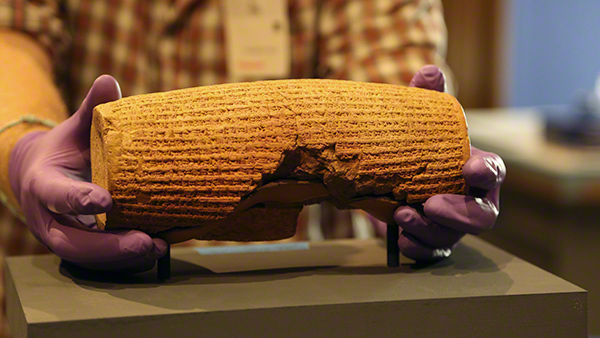
cylinder_install_back

The Cyrus Cylinder, from after 539 BCE. Clay, currently in the British Museum, but originally in Babylon. As Wikipedia says, “The text on the Cylinder praises Cyrus, sets out his genealogy and portrays him as a king from a line of kings. The Babylonian king Nabonidus, who was defeated and deposed by Cyrus, is denounced as an impious oppressor of the people of Babylonia and his low-born origins are implicitly contrasted to Cyrus’ kingly heritage. The victorious Cyrus is portrayed as having been chosen by the chief Babylonian god Marduk to restore peace and order to the Babylonians.”

The Persians are an Indo-European language speaking people who we now know as the Iranians, and it is thought that their forebears came from the Indo-European homeland somewhere near modern day Ukraine into Iran sometime in the 2nd millennium BCE. The proto-Persians were a widely dispersed people, from what is now Hungary across the steppes of Russia to the Iranian plateau. One group of these Old Persian/Iranian peoples settled in what is called Media, in what is now north-west Iran,and are known as the Medes; they are known to have been a vassal kingdom under the Neo-Assyrian Empire by the 8th century BCE. Another group settled in south-west Iran in an area called Persis, and were known as the Persians. They, too, were subject to the Neo-Assyrians. The Medes and Babylon revolted against the Assyrians and between 616 BCE and 609 BCE they destroyed the Assyrian Empire and split down the middle.

The king of Persia, Cambyses I, married a granddaughter of Cyaxares, the king who established the Median Empire; this was a subsidiary part of the Median Empire. They had a son who was named 𐎤𐎢𐎽𐎢𐏁 Kūruš; Kourosh, and this has come down to us through Greek as Cyrus (which is how Herodatus knew him). It is not clear if Cyrus revolted against the Median Empire or if the Median King attacked him for some offense, but the reslt was a civil war that lasted for three years, at the end of which Cyrus reigned supreme over the whole of the Median Empire. The Lydian Empire in western Anatolia (today’s Asian Turkey) saw Cyrus as a threatening upstart, and so attacked what was now being called the Persian Empire. The king was the proverbially wealthy Croesus, and sent to the Greek oracle at Delphi to find out if he should form an alliance with Cyrus or attack him. Herodatus reports that he was told that if he attacked the Persians a great empire would fall, and so he did attack. Unfortunately for Croesus, the empire that fell was the Lydian one, not the Persian one, and after several battles and sieges Cyrus extended his empire to the shores of the Aegean Sea. The Lydians spoke their own language, Lydian, of which we have only a few remnants now – but Cyrus had pushed his rule up against the multitude of Greek city-states, which would occupy his successors for many years to come.

Cyrus then turned his attention to the Neo-Babylonian Empire. He fought one massive battle in a place called Opis, about 50 km north of modern Baghdad, and then more or less took over the rest of the cities in a peaceful, negotiated triumph.

The author of II Isaiah (40-55) saw Cyrus as the tool of God. We read in chapter 45:

1 Thus says the Lord to his anointed, to Cyrus,
whose right hand I have grasped
to subdue nations before him
and strip kings of their robes,
to open doors before him—
and the gates shall not be closed:
2 I will go before you
and level the mountains,
I will break in pieces the doors of bronze
and cut through the bars of iron,
3 I will give you the treasures of darkness
and riches hidden in secret places,
so that you may know that it is I, the Lord,
the God of Israel, who call you by your name.
4 For the sake of my servant Jacob,
and Israel my chosen,
I call you by your name,
I surname you, though you do not know me.
5 I am the Lord, and there is no other;
besides me there is no god.
I arm you, though you do not know me,
6 so that they may know, from the rising of the sun
and from the west, that there is no one besides me;
I am the Lord, and there is no other.
7 I form light and create darkness,
I make weal and create woe;
I the Lord do all these things.      – Isaiah 45.1-7

and

13 I have aroused Cyrus in righteousness,
and I will make all his paths straight;
he shall build my city
and set my exiles free,
not for price or reward,
says the Lord of hosts.           – Isaiah 45.13

The author knows that Cyrus worships other gods – “I arm you though you did not know me” – but this does not stop him from seeing Cyrus as a liberator of the Jews in Babylon. He is not named but is surely described in chapter 41:

2 Who has roused a victor from the east,
summoned him to his service?
He delivers up nations to him,
and tramples kings under foot;
he makes them like dust with his sword,
like driven stubble with his bow.
3 He pursues them and passes on safely,
scarcely touching the path with his feet.
4 Who has performed and done this,
calling the generations from the beginning?
I, the Lord, am first,
and will be with the last.
5 The coastlands have seen and are afraid,
the ends of the earth tremble;
they have drawn near and come.       – Isaiah 41.2-5

Indeed, while the historical record shows that Babylon was not besieged or destroyed, but rather surrendered without the letting of blood, II Isaiah seems to have hoped that it would have had a terrible end:

14 Thus says the Lord,
your Redeemer, the Holy One of Israel:
For your sake I will send to Babylon
and break down all the bars,
and the shouting of the Chaldeans will be turned to lamentation.   – Isaiah 43.14

But Cyrus is God’s anointed one – previously a term applied only to the kings of Israel and Judah, and properly only applied to the House of David.

This is a major shift. The king is no longer a man of the tribe of Judah, but a foreigner, which seems to be fine so long as the people can return to Jerusalem, rebuild the Temple, and worship in peace.

II Isaiah also talks about the servant of God, one who suffers. I will get to that before Advent is over.

The point for today, though, is to note the dramatic shift in theology, from a hope for an anointed one from the House of David to an acceptance that God has acted through unbelieving foreigners, and that is okay. The House of David was extinct, it seemed. A new approach was available.


Posted in Advent, Isaiah | Tagged , , | Leave a comment

Thomas Merton on Isaiah

Day Fifteen of “Through Advent with Isaiah”

Thomas Merton wrote in The Waters of Siloe, pp. 295-296:

The whole harmonious structure of the simple observances, the monastic life we have been discussing, the simple round of prayer and labor and reading, the life of the cloisered cenobite, far from the activities of the world, close to nature and with God in solitude — all this was saturated in Scripture and the liturgy.  . . .

In other words, the Cistercian really worked his way through the liturgy of the fundamental seasons — Advent, Christmas, Septuagesima, Lent, Easter, and post-Pentecostal — in all their fulness. The mighty lessons taught by the Church in every Nocturn and every Mass had a chance to work themselves right into the blood and marrow of the monk’s existence. In Advent he virtually lived and breathed Isaias. The words, which he knew by heart, sang themselves over and over in his mind and soaked themselves into the landscape of the season and its weather and its every aspect, so that when December came around, the very fields and bare woods began to sing the Conditor alme siderum and the great responsories of the night offices.

Waters of Siloe

An aged dust cover on the hardcover printing of “The Waters of Siloe” by Thomas Merton (Garden City, NJ: Garden City Books, 1951). The book was originally published two years earlier by Harcourt, Brace & Company. It is a history of the Trappists (the Order of Cistercians of the Strict Observance) – the monastic order that Merton had joined in 1941 – that he was commanded to write by his superiors at the Abbey of Our Lady of Gethsemani.

Posted in Advent, Isaiah | Tagged | Leave a comment

Justice in III Isaiah

Day Fourteen of “Through Advent with Isaiah”

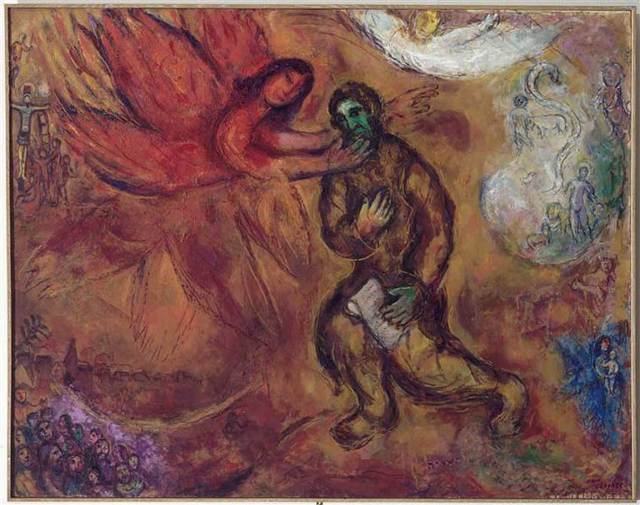
prophet-isaiah-1968_painter-marc-chagall__56656__51868__93213.1566787043

Prophet Isaiah 1968 By Marc Chagall

Whereas justice in II Isaiah deals with the cost of being faithful to Yahweh and ministering to the poor, the widowed, the orphan, and the powerless, justice in III Isaiah seems to be concerned with expanding who forms part of the people of God -an inssue of inclusion and exclusion.

Thus we find in Isaiah 56:

1 Thus says the Lord:
Maintain justice, and do what is right,
for soon my salvation will come,
and my deliverance be revealed.

2 Happy is the mortal who does this,
the one who holds it fast,
who keeps the sabbath, not profaning it,
and refrains from doing any evil.

3 Do not let the foreigner joined to the Lord say,
‘The Lord will surely separate me from his people’;
and do not let the eunuch say,
‘I am just a dry tree.’
4 For thus says the Lord:
To the eunuchs who keep my sabbaths,
who choose the things that please me
and hold fast my covenant,
5 I will give, in my house and within my walls,
a monument and a name
better than sons and daughters;
I will give them an everlasting name
that shall not be cut off.

6 And the foreigners who join themselves to the Lord,
to minister to him, to love the name of the Lord,
and to be his servants,
all who keep the sabbath, and do not profane it,
and hold fast my covenant—
7 these I will bring to my holy mountain,
and make them joyful in my house of prayer;
their burnt-offerings and their sacrifices
will be accepted on my altar;
for my house shall be called a house of prayer
for all peoples.
8 Thus says the Lord God,
who gathers the outcasts of Israel,
I will gather others to them
besides those already gathered.               – Isaiah 66.1-8

This is a striking passage because we see two previously excluded classes of peoples – foreigners and eunuchs – now admitted to the Temple. As Andreas Schuele suggests in his article “Who is the True Israel? Community, Identity, and Religious Commitment in Third Isaiah (Isaiah 56–66)” (Interpretation: A Journal of Bible and Theology 2019, Vol. 73 (2) 174–184), part of the justice to be maintained by Israel is the inclusion of these peoples into Temple worship. This is different from Ezra-Nehemiah, where membership is determined by ethnicity, and foreigners are to be avoided. Schuele sees III Isaiah and Ezra-Nehemiah being part of a longer conversation around whether Judaism could become a missionary religion, and not just the faith of a group of people descended from a common ancestor. This builds on the vision of Isaiah 2.1-5 in a practical way:

2 In days to come
the mountain of the Lord’s house
shall be established as the highest of the mountains,
and shall be raised above the hills;
all the nations shall stream to it.
3   Many peoples shall come and say,
‘Come, let us go up to the mountain of the Lord,
to the house of the God of Jacob;
that he may teach us his ways
and that we may walk in his paths.’     – Isaiah 2.1-3

As well, in chapters 65-66, Schuele believes that despite the presence of

. . . a clear sense of “us” versus “them,” of true allegiance and loyalty to God versus infidelity and moral depravity . . . this is not Israel versus other nations; rather, the focus seems to have shifted, since this dichotomy applies to “all flesh,” meaning all of humankind.

Right at the second to last verse of the book we read:

23 From new moon to new moon,
and from sabbath to sabbath,
all flesh shall come to worship before me,
says the Lord.                             – Isaiah 66.23

The theme of justice, then, is central in Isaiah, but develops through the book. And it has continued to develop in the interpretation of the book.


Posted in Advent, Isaiah, Uncategorized | Tagged , , | Leave a comment

Justice in II Isaiah

Day Thirteen of “Through Advent with Isaiah”

I found the reference to the development of the idea of justice in Isaiah. It was in a review by Eryl W. Davies in The Journal of Theological Studies (59:1, April 2008, p. 230) of the book Rhetoric and Social Justice in Isaiah by Mark Gray (London and New York: T & T Clark International, 2006). Davies writes that

Mark Gray

This guy: The Rev Dr Mark Gray, the Minister at Bannside Presbyterian Church in Northern Ireland.

Gray argues that scholars who have rather blandly asserted that the establishment of justice was Isaiah’s mission to the world have been too naively idealistic and have failed to pay sufficient attention to the nuances of the text. While it is true that passages such as Isa. 1:16–17 may imply that the prophet was a great advocate of justice, Gray argues that he was able only to ‘discern and denounce what was wrong in society’ but, due to the ‘under-development of the concept of social justice in the traditions on which he was drawing’ (p. 49), he did not come close to proposing measures that would rectify the situation of the poor. Turning to Isaiah 58, on the other hand, Gray is struck by the way in which this chapter develops and deepens the concept of social justice presupposed in Isaiah 1, for in the former passage there is a pronounced emphasis on the importance of solidarity with the poor, the significance of suffering on behalf of others, and the imperative to give generously to those in need.

Fascinatingly, Gray

argues that the text of the later chapters of Isaiah is more pondering and questioning than has often been allowed, and he suggests that the justice of the divine punishment announced in Isaiah 1–39 is subtly called in question in the rest of the book as doubts are raised about the benevolent nature and character of God. In this regard, Gray succeeds in bringing to the fore dimensions of the text that are often overlooked and in doing so he demonstrates that the text of Isaiah 40–66 is more nuanced and subversive than is usually supposed.

This sounds like a book I should order, eh? Let’s have a look at Isaiah 58. It starts with a condemnation:

1 Shout out, do not hold back!
Lift up your voice like a trumpet!
Announce to my people their rebellion,
to the house of Jacob their sins.      – Isaiah 58.1

But then it notes that it is not the case that they do not care about God or righteousness.

2 Yet day after day they seek me
and delight to know my ways,
as if they were a nation that practised righteousness
and did not forsake the ordinance of their God;
they ask of me righteous judgements,
they delight to draw near to God.
3 ‘Why do we fast, but you do not see?
Why humble ourselves, but you do not notice?’    – Isaiah 58.2-3a

The issue of fasting, in response to having committed sin, is raised, but it is not enough. Why does not God honour their humility? Yahweh responds:

Look, you serve your own interest on your fast-day,
and oppress all your workers.
4 Look, you fast only to quarrel and to fight
and to strike with a wicked fist.
Such fasting as you do today
will not make your voice heard on high.
5 Is such the fast that I choose,
a day to humble oneself?
Is it to bow down the head like a bulrush,
and to lie in sackcloth and ashes?
Will you call this a fast,
a day acceptable to the Lord?    – Isaiah 58.3b-5

Screenshot 2019-12-13 at 17.29.22This type of fasting and humility is manipulative and fruitless. Instead, Yahweh requires true fasting:
6 Is not this the fast that I choose:
to loose the bonds of injustice,
   to undo the thongs of the yoke,
to let the oppressed go free,
   and to break every yoke?
7 Is it not to share your bread with the hungry,
   and bring the homeless poor into your house;
when you see the naked, to cover them,
   and not to hide yourself from your own kin? Isaiah 58.6-7

This action, which we anachronistically but correctly label “social justice”, results in action from God.

8 Then your light shall break forth like the dawn,
and your healing shall spring up quickly;
your vindicator shall go before you,
the glory of the Lord shall be your rearguard.
9 Then you shall call, and the Lord will answer;
you shall cry for help, and he will say, Here I am.     – Isaiah 58.8-9a

You will recall in chapter 6 God calls to Isaiah and he replies in Hebrew: הִנְנִ֥י “Hi-nen-ni”, which I always want to translate as “Yo!”, but is more conventionally “Here I am.” Now Yahweh says, “Here I am” and acts to restore the people of Israel.

If you remove the yoke from among you,
the pointing of the finger, the speaking of evil,
10 if you offer your food to the hungry
and satisfy the needs of the afflicted,
then your light shall rise in the darkness
and your gloom be like the noonday.
11 The Lord will guide you continually,
and satisfy your needs in parched places,
and make your bones strong;
and you shall be like a watered garden,
like a spring of water,
whose waters never fail.
12 Your ancient ruins shall be rebuilt;
you shall raise up the foundations of many generations;
you shall be called the repairer of the breach,
the restorer of streets to live in.                – Isaiah 58.9b-12

The benefit of social justice is light, guidance through the wilderness, and the restoration of Jerusalem and Judah. This is not a libertarian view, but communal. It is the responsibility of the whole people of God to satisfy the needs of the afflicted and feed the hungry.

The chapter concludes with a passage about the Sabbath.

13 If you refrain from trampling the sabbath,
from pursuing your own interests on my holy day;
if you call the sabbath a delight
and the holy day of the Lord honourable;
if you honour it, not going your own ways,
serving your own interests, or pursuing your own affairs;*
14 then you shall take delight in the Lord,
and I will make you ride upon the heights of the earth;
I will feed you with the heritage of your ancestor Jacob,
for the mouth of the Lord has spoken.           – Isaiah 58.13-14

This might strike us as curious, except that the commandment about the sabbath is to do no work, which means it is a day of rest not only for the wealthy, but everybody in the household, even the animals:

12 Observe the sabbath day and keep it holy, as the Lord your God commanded you. 13For six days you shall labour and do all your work. 14But the seventh day is a sabbath to the Lord your God; you shall not do any work—you, or your son or your daughter, or your male or female slave, or your ox or your donkey, or any of your livestock, or the resident alien in your towns, so that your male and female slave may rest as well as you. 15Remember that you were a slave in the land of Egypt, and the Lord your God brought you out from there with a mighty hand and an outstretched arm; therefore the Lord your God commanded you to keep the sabbath day.         – Deuteronomy 5.12-15

Thus, the words about the Sabbath in Isaiah 58 continue the theme of justice.

How is this a development from what we saw yesterday in chapter 1 of the Book of Isaiah? From a close reading of the text Gray (channelled through Davies) concludes that

Previous commentators have not adequately captured ‘the depth of pain that will be involved in enacting the prophetic message, the sense that embarking on a course of behavior characterized by generosity towards the poor (58:7, 9b– 10a) will not result in the warm glow of self-satisfaction or the commendation of wider society for performing good deeds, but the deep cry of anguish’ (p. 100). In this way Isaiah 58 challenges the conventional wisdom of the Hebrew Bible, for it refuses to accept wealth and poverty as inevitable phenomena in the natural order, and rejects the Wisdom notion of prudence as the best guide to human behaviour. True justice can only be established at a cost, and that cost involves a feeling of solidarity with the poor and a readiness to embrace their pain.

Justice in II Isaiah is probably connected with the idea of Israel as the suffering servant of God (we will get to the theme of the Suffering Servant next week). Commitment to God involves a commitment to justice on a communal and individual level, and this can be expensive. Gray emphasises that this is a kind of fast, which is costly.

Christians, of course, see Jesus as the Suffering Servant, and Dead Sea Scrolls suggest that in the century or two before Jesus the Book of Isaiah was being read messianically. The theme of justice, then, developed in Isaiah and continued to influence varieties of First Century Judaism. When Jesus talks about social justice in Matthew he is continuing the prophetic message of  Isaiah:

“I was hungry and you gave me food, I was thirsty and you gave me something to drink, I was a stranger and you welcomed me, 36I was naked and you gave me clothing, I was sick and you took care of me, I was in prison and you visited me.” 37Then the righteous will answer him, “Lord, when was it that we saw you hungry and gave you food, or thirsty and gave you something to drink? 38And when was it that we saw you a stranger and welcomed you, or naked and gave you clothing? 39And when was it that we saw you sick or in prison and visited you?” 40And the king will answer them, “Truly I tell you, just as you did it to one of the least of these who are members of my family, you did it to me.”  – Matthew  25 .35-40

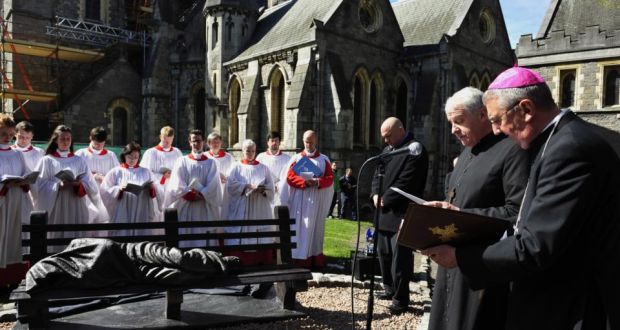
Homeless Jesus

The dedication of “Homeless Jesus” by Canadian artist Tim Schmaltz, at Christ Church Cathedral, Dublin

If anyone is a follower of Jesus, social justice is not an option, but a necessity. And if any nation claims to embody values influenced by Jesus and Isaiah, then care for the most vulnerable is a political imperative. Good news for dark days.

Posted in Advent, Isaiah | Tagged , , , , | Leave a comment

The Idea of Justice in First Isaiah

Day Twelve of “Through Advent with Isaiah”

So far I have really been looking at the possible historical origins of the Book of Isaiah, but today I want to look at a basic theme in the book and how it develops, namely, justice.

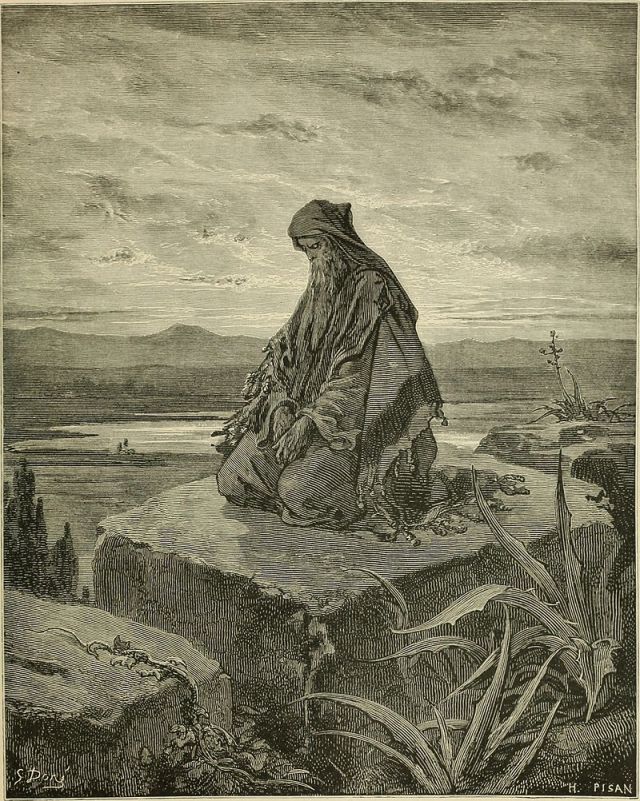
Isaiah Doré

“Isaiah”, wood engraving by Gustave Doré (1832–1883) from “La Grande Bible de Tours“, 1843.

The beginning on Isaiah in chapter 1 is one of condemnation:

2 Hear, O heavens, and listen, O earth;
for the Lord has spoken:
I reared children and brought them up,
but they have rebelled against me.
3 The ox knows its owner,
and the donkey its master’s crib;
but Israel does not know,
my people do not understand.
4 Ah, sinful nation,
people laden with iniquity,
offspring who do evil,
children who deal corruptly,
who have forsaken the Lord,
who have despised the Holy One of Israel,
who are utterly estranged!             – Isaiah 1.2-4

It is clear that this is not a problem of the wrong sacrifices being offered in the Temple:

12 When you come to appear before me,
who asked this from your hand?
Trample my courts no more;
13 bringing offerings is futile;
incense is an abomination to me.
New moon and sabbath and calling of convocation—
I cannot endure solemn assemblies with iniquity.
14 Your new moons and your appointed festivals
my soul hates;
they have become a burden to me,
I am weary of bearing them.
15 When you stretch out your hands,
I will hide my eyes from you;
even though you make many prayers,
I will not listen;
your hands are full of blood.     – Isaiah 1.12-15

So what is the problem? The problem is with the people and their leaders. The prophet, speaking the word of God to Jerusalem and Judah, says:

16 Wash yourselves; make yourselves clean;
remove the evil of your doings
from before my eyes;
cease to do evil,
17   learn to do good;
seek justice,
rescue the oppressed,
defend the orphan,
plead for the widow.                   – Isaiah 1.16-17

and

23 Your princes are rebels
and companions of thieves.
Everyone loves a bribe
and runs after gifts.
They do not defend the orphan,
and the widow’s cause does not come before them.     – Isaiah 1.23

Described here, justice is “doing good”, imagined in negative terms, such as not taking bribes, not committing murder. It concerns the marginalized – the oppressed, and the orphan and widow. When the princes ally themselves with thieves, nothing can redeem the worship of the Temple.

The failure of leadership also is noted in chapter 10:

Ah, you who make iniquitous decrees,
who write oppressive statutes,
2 to turn aside the needy from justice
and to rob the poor of my people of their right,
that widows may be your spoil,
and that you may make the orphans your prey!   – Isaiah 10.1-2

Chapter 2 describes other problems:

For you have forsaken the ways of your people,
O house of Jacob.
Indeed they are full of diviners from the east
and of soothsayers like the Philistines,
and they clasp hands with foreigners.
7 Their land is filled with silver and gold,
and there is no end to their treasures;
their land is filled with horses,
and there is no end to their chariots.
8 Their land is filled with idols;
they bow down to the work of their hands,
to what their own fingers have made.        – Isaiah 2.6-8

There is idolatry, there is the arrogance of wealth and military power, there is the use of soothsayers, and they rely on alliances with foreigners.

The injustice of certain property owners is delineated in chapter 5:

8 Ah, you who join house to house,
who add field to field,
until there is room for no one but you,
and you are left to live alone
in the midst of the land!           – Isaiah 5.8

Those who eat, drink, and are merry also are identified as subject to God’s wrath:

11 Ah, you who rise early in the morning
in pursuit of strong drink,
who linger in the evening
to be inflamed by wine,
12 whose feasts consist of lyre and harp,
tambourine and flute and wine,
but who do not regard the deeds of the Lord,
or see the work of his hands!           – Isaiah 5.11-12

And those who identify their practices with those of Yahweh, seeing themselves as the favoured ones, are also condemned:

18 Ah, you who drag iniquity along with cords of falsehood,
who drag sin along as with cart-ropes,
19 who say, ‘Let him make haste,
let him speed his work
that we may see it;
let the plan of the Holy One of Israel hasten to fulfilment,
   that we may know it!’
20 Ah, you who call evil good
and good evil,
who put darkness for light
and light for darkness,
who put bitter for sweet
and sweet for bitter!
21 Ah, you who are wise in your own eyes,
and shrewd in your own sight!
22 Ah, you who are heroes in drinking wine
and valiant at mixing drink,
23 who acquit the guilty for a bribe,
and deprive the innocent of their rights!    – Isaiah 5.18-23

And so what will God do? In chapters 1 and 2-12 Isaiah proclaims judgement on Judah and Israel. Israel ultimately is destroyed by the Assyrians, and its people taken into exile. The same might happen to Judah. And, in fact, it does come to pass, only the identity of the conquerors is different – the Babylonians in this case. Isaiah then foretells that a remnant will be gathered up and return, and the anointed one of God – the Messiah – will rule over them with righteousness.

2 The people who walked in darkness
have seen a great light;
those who lived in a land of deep darkness—
on them light has shined.
3 You have multiplied the nation,
you have increased its joy;
they rejoice before you
as with joy at the harvest,
as people exult when dividing plunder.
4 For the yoke of their burden,
and the bar across their shoulders,
the rod of their oppressor,
you have broken as on the day of Midian.
5 For all the boots of the tramping warriors
and all the garments rolled in blood
shall be burned as fuel for the fire.
6 For a child has been born for us,
a son given to us;
authority rests upon his shoulders;
and he is named
Wonderful Counsellor, Mighty God,
Everlasting Father, Prince of Peace.
7 His authority shall grow continually,
and there shall be endless peace
for the throne of David and his kingdom.
He will establish and uphold it
with justice and with righteousness
from this time onwards and for evermore.
The zeal of the Lord of hosts will do this.    – Isaiah 9.2-7

As noted in other posts, scholars have posited this anointed one as Hezekiah or Josiah, and there may be good reasons for doing so. However, after the destruction of the Temple and the double exile of Judah in the early 6th century BCE, these passages came to read in a different way.

We live in a very different world from that of Isaiah, his disciples, and the immediate generations following.  Of course we see injustice in accepting bribes, judging unfairly, failing to protect the most vulnerable, and in the arrogance of exploitative wealth and power. Indeed, we might even read it into the politics of our present situation. The condemnation of divination and idols seems less important, but only because we are products of a secular society where religion is seen as private and possibly frivolous. However, we live in a very different situation.

  • We do not believe in the divine right of kings, of the right of a particular family to rule (pace the House of Windsor, which as a monarchist I see as a useful constitutional device, not something God given) – yet the ideology of Isaiah is that it is precisely from the House of David that rule and salvation will come.
  • We have the right to engage in political processes – but only a small minority of Judah could do so.
  • We assume that government is there for the benefit of the people, but, as absolute monarchies, the realms of the ancient Near East were very much about “might is right”. Benevolence was a part of propaganda, to keep the peasants from revolting too often.
  • The understanding of suffering in Isaiah is very simple: “Good things happen to good people, and bad things happen to bad people.” If you are suffering, you must have done something bad to deserve it. This is also the theology in the Deutronomic History, and only gets challenged in some of the wisdom literature of the Bible, such as Ecclesiastes and especially the Book of Job. As well, apocalyptic literature called into question this theology, and developed the idea of the coming of the Son of Man and the General Resurrection of the Dead as ways of redeeming those righteous individuals who undeservedly suffered.
  • We do not normally see the hand of God in political events, but Isaiah sees everything in the control of God. Indeed, as II Isaiah says,

I am the Lord, and there is no other;
besides me there is no god.
I arm you, though you do not know me,
so that they may know, from the rising of the sun
and from the west, that there is no one besides me;
I am the Lord, and there is no other.
I form light and create darkness,
I make weal and create woe;
I the Lord do all these things.  – Isaiah 45.5-7

There is no sense here that God is opposed by evil powers or Satan – that is a later development in Jewish theology which Isaiah did not understand. Here, God is absolutely in charge. There is no sense of justice apart from God’s will.

  • For Isaiah the people and the king are one, and so they all suffer together. We would see this as unfair.
  • There is no sophisticated process of justice as would be  developed by the Rabbi’s in the Talmud, or in the civil law and common law traditions of Europe.

So, this is not exactly our understanding of justice today. Isaiah, speaking for God, is pretty clear on what he does not like. As a scholar (whose name I cannot remember) said, he is less clear on how to fix it. However, II Isaiah does develop the notion of justice a bit, and we’ll look at that tomorrow.


Posted in Advent, Isaiah | Tagged , | Leave a comment