Love in a Time of Pandemic

A sermon preached on The Third Sunday of Lent at The Anglican Church of St. Thomas the Apostle, Kefalas, Crete, March 15, 2020 11:00 am.

The readings (Revised Common Lectionary, Year A) were: Exodus 17:1-7, Psalm 95, Romans 5:1-11, and John 4:5-42.

4123881-CKYVYRZZ-7

The Suffering Painting by Ted Bolwell.

Since we are justified by faith, we have peace with God through our Lord Jesus Christ, through whom we have obtained access to this grace in which we stand; and we boast in our hope of sharing the glory of God. And not only that, but we also boast in our sufferings, knowing that suffering produces endurance, and endurance produces character, and character produces hope, and hope does not disappoint us, because God’s love has been poured into our hearts through the Holy Spirit that has been given to us.      Romans 5.1-5

The Effects of Covid-19

Well, how are we all doing? Is anyone here really suffering from Covid-19? Of course not, you’d be home in isolation, right? But this shouldn’t blind us to the fact that many are suffering:

  • People have had to change travel plans or cancel them. Some individuals cannot travel to the United States.
  • Many churches have chosen to not have services. While religious services are going on in Greece, they have been suspended by government order in Italy. Some of the larger congregations in the Diocese in Europe, where they get more than a couple of dozen people, have also suspended church services. This is also the case across Canada and the United States. And as for us, while we are here with strict precautions, we may decide not to meet next week.
  • I am doing a funeral tomorrow, and three of the children cannot travel from the UK to Crete.
  • The tourist industry has ground to a halt. Tours are cancelled, hotels are shuttered, and restaurants and cafés can only do delivery and take-out — and not all of them are set up for this kind of thing.
  • Some of us may be in a state of shock as we watch our net worth drop twenty percent and the exchange rate lessen the value of our income.
  • Teachers and children have had their school year suspended. University students are getting their courses online, if at all.Parents are scrambling to figure out how to provide childcare or home school.
  • Live entertainment venues such as sports arenas, theatres and cinemas are closed, putting not just the athletes and actors on hiatus, but all the people who work behind the scenes.
  • Doctors, nurses, and others in the health care system, already almost at full capacity, may be overwhelmed if things get out of control, as they have in Wuhan, Iran, and Italy. In Italy physicians are making decisions according to triage, because resources cannot be allocated to those who only have a slim chance of recovery; this sort of this normally only happens in battlefields or civil disasters.
  • And then, there are those who will die, many of them seemingly before their time. Even those who recover from major complications will have been through traumatic situations. And it is not just the elderly or immunity compromised. A story in the New York Times describes two health care workers in Wuhan, China, one a nurse and the other a doctor, who fell ill. One survived, and the other died, but both were healthy, vigorous people.

This is all going to get worse before it gets better. So how do we approach such suffering?

A Taxonomy of Suffering

In my dissertation I consider the problem of suffering, and I suggest that there are a variety of ways of categorizing them.

The first is useless suffering. This is the suffering experienced by the innocent – children, animals, the “collateral damage” of war and terrorism. There may be people causing the suffering and they have their reasons for inflicting it, but usually the objects of their malice and hate do not deserve it. The millions murdered by the Nazis fall into this category, as well as the millions taken into slavery between the 15th to the 19th century (and, under other forms, into the present). Suffering may be caused unintentionally, as when diseases spread among the indigenous peoples of North and south America, and killed off between 50 and 90 per cent of the population.  This suffering confronts us as injustice, to which the only answer can be that, however caused ,we need to help mitigate and end it.

The second type might just be the ordinary suffering of life and growing up, the suffering that we freely accept because of the ultimate end. A woman who knows the inconvenience of pregnancy and the pain of childbirth may quite willingly accept it because of the joy of having a child. Likewise, an athlete will push themselves to build up their cardiovascular system, and their muscles in order to become faster, stronger, more able. A student will endure the monotony of memorizing times tables to learn arithmetic, or flash cards to memorize the lexicon of another language. We endure the suffering because of the payoff. This is the kind of suffering which Paul may be alluding to, when he describes the suffering that produces endurance, and endurance that produces character, and character that produces hope, and hope that does not disappoint us. Being called by God, Paul willing accepts the suffering that he experiences from others, knowing that in doing so he is following in the footsteps of Jesus, and that through it and despite it he will experience peace with God, grace and hope, and the glory of God, as well as the love of God given through the Holy Spirit. So that is ordinary suffering, which we freely accept or voluntarily seek out.

A third category is a hybrid of the two. It is what African-American theologians such as Martin Luther King, Jr., called “unearned suffering”. As a black man in the middle of the 20th century King knew that he was going to suffer discrimination and hatred, and quite possibly violence. His response was that if he was going to have to suffer, he may as well make the suffering count for something. In his practice of civil disobedience, of non-violent action against unjust laws and governments, he transformed that suffering into a challenge to the principalities and powers of the United States: “Do your worst, and your hypocrisy and your sins will be exposed to the light”.  His “food”, and that of all who in the name of Jesus Christ challenge the seemingly fixed boundaries of culture and society, is to do the will of God who sent him and to complete God’s work.

In our gospel reading Jesus reaches across those boundaries to the Samaritan woman – someone a proper Jew of his time would not normally speak to because she was a) a woman and b) part of what, for the Jews, was a heretical group. As well, she had c) been married multiple times. Rather than blaming the victim Jesus undoubtedly saw her as a woman who had been divorced summarily by a succession of men, and deserving of compassion and care. Despite these three boundaries, Jesus reaches over to take her as she is and allow her to see the salvation of God.

Showing Love and Care

This is where we have the opportunity to act. We do not deserve this pandemic (despite the wild musings of some extremists). But in the midst of it we have the opportunity to help others, to cross boundaries. It can be simple things.

  • We can telephone those who need to quarantine or isolate.
  • We can pray for those who are working directly with the sick in the healthcare system.
  • We can offer to get groceries and pharmaceuticals for those who cannot go out.
  • We can buy gift certificates at restaurants or businesses that are closed.
  • We can venture out into social media and BE POSITIVE, suggesting creative ways to engage each other, like virtual potlucks, streaming videos, or amusing Tik Toks.
  • We can practice social distancing and only undertake essential activities in public places.
  • We can check on our neighbours and friends.
  • We can even sing across alleys and courtyards!

I suspect this is all going to take longer than any of us can imagine. But when the question is asked, “Is the Lord among us or not?” let us answer with a resounding, “Yes!” as we reach out to others and do the simple things, just as Jesus did by asking for some water from the Samaritan woman. May God bless us in the days, weeks, and months to come.
Posted in Lent, Sermons | Tagged , , , , , | Leave a comment

The Grand Inquisitor and Us

A Sermon Preached on The First Sunday of Lent
at The Anglican Church of St. Thomas the Apostle, Kefalas, Crete
March 1, 2020 11:00 am

The readings for this Sunday were:Genesis 2:15-17; 3:1-7; Psalm 32; Romans 5:12-19; and Matthew 4:1-11.

wilderness

Jesus was led up by the Spirit into the wilderness to be tempted by the devil. Matthew 4.1

Shock

Has anyone here not heard this story before?

The story of the Temptation in the Wilderness is so familiar that we miss its shock value. Because shocking it is. Jesus rejects demonstrating his power, he refuses to show who he is.  He rejects the authority of the Great Tempter, but he does not assert his own dominion over the world. He refuses to show his divine superiority to Satan by casting himself of of a height, instead choosing remain in his human weakness.

51FIyYKsCXL._SX333_BO1,204,203,200_

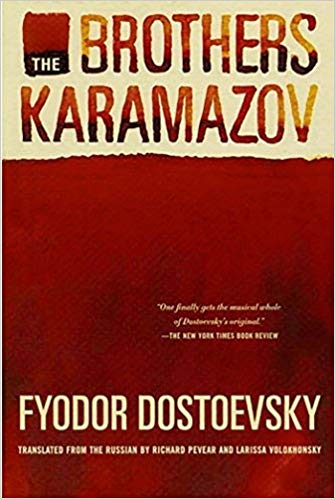
Let me as you another question. Have any of you read Fyodor Dostoevsky’s The Brothers Karamazov, and in particular, the chapter in which Ivan Fyodorovich Karamazov tells his younger brother Alexei the story of the Grand Inquisitor? If you were Russian you would have read it. Dostoevsky, along with Pushkin, Tolstoy, and Chekov, is to Russians what Shakespeare is to we who speak English. The Grand Inquisitor is one of the great passages of Russian literature, as central to them as Hamlet is to us.

The Brothers Karamazov is a great long book, with deep discussions of philosophy and theology. The ostensive hero, Alexei Fyodorovich Karamazov, is a young man of about twenty years of age, the youngest of three brothers, birthed by two different mothers. Their father is Fyodor Pavlovich Karamazov, a perfect buffoon of a man whose neglect of his sons leads them to be raised by various relatives. His only concern is with wealth and his own enjoyment. Alexei is testing whether he should become an Orthodox monk, and we encounter him in a monk’s habit. His spiritual father is the Elder Zosimus, who is gravely ill but is sought out for his prayers. The book describes the life of the three sons – Dmitri, Ivan, and Alexei, their servants and neighbours, and their love interests. About halfway through the book a shocking murder takes place, and so it also becomes a murder mystery of sorts.

The Grand Inquisitor

A quarter of the way through the book Ivan tells Alexei a story. He has not finished it, and it seems he intends to write it as a poem. Ivan is the most educated and philosophical of the three brothers. The story goes like this (and the quotations are from the brilliant Pevear/Volokhonsky English translation of 1990):

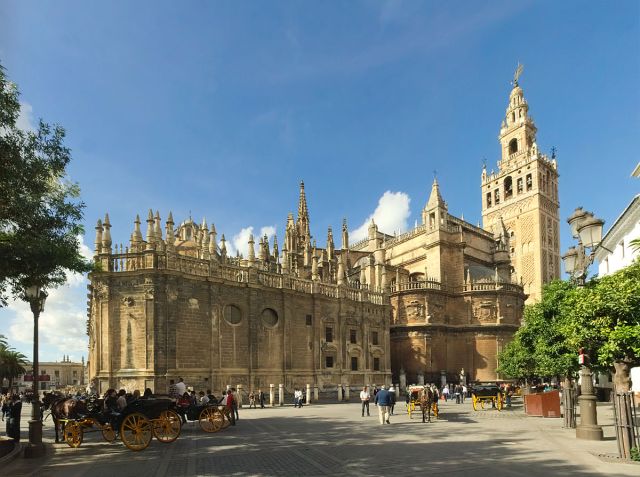
Sevilla_Cathedral_-_Southeast

We are in Spain, in the early 16th century. The scene is Seville, not yet famous for its Barber. The Spanish Inquisition was all too expected in that era. The square before the Cathedral is still scorched from the burning of one hundred heretics the day before, and the smell lingers in the air. Jesus arrives, but this is not the great second coming, but just a momentary visit. He comes “quietly, inconspicuously, but, strange to say, everyone recognized him.”

People are drawn to him by an invincible force, they flock to him, surround him, follow him. He passes silently among them with a quiet smile of infinite compassion. The sun of love shines in his heart, rays of Light, Enlightenment, and Power stream from his eyes and, pouring over the people, shake their hearts with responding love. He stretches forth his hands to them, blesses them, and from the touch of him, even only of his garments, comes a healing power. Here an old man, blind from childhood, calls out from the crowd: ‘Lord, heal me so that I, too, can see you,’ and it is as if the scales fell from his eyes, and the blind man sees him. People weep and kiss the earth he walks upon. Children throw down flowers before him, sing and cry ‘Hosanna!’ to him. ‘It’s he, it’s really he,’ everyone repeats, ‘it must be he, it can be no one but he.’ He stops at the porch of the Seville cathedral at the very moment when a child’s little, open, white coffin is being brought in with weeping: in it lies a seven-year-old girl, the only daughter of a noble citizen. The dead child is covered with flowers. ‘He will raise your child,’ people in the crowd shout to the weeping mother. The cathedral padre, who has come out to meet the coffin, looks perplexed and frowns. Suddenly a wail comes from the dead child’s mother. She throws herself down at his feet: ‘If it is you, then raise my child!’ she exclaims, stretching her hands out to him. The procession halts, the little coffin is lowered down onto the porch at his feet. He looks with compassion and his lips once again softly utter: ‘Talitha cumi’—‘and the damsel arose.’ The girl rises in her coffin, sits up and, smiling, looks around her in wide-eyed astonishment. She is still holding the bunch of white roses with which she had been lying in the coffin. There is a commotion among the people, cries, weeping, and at this very moment the Cardinal Grand Inquisitor himself crosses the square in front of the cathedral. He is an old man, almost ninety, tall and straight, with a gaunt face and sunken eyes, from which a glitter still shines like a fiery spark. Oh, he is not wearing his magnificent cardinal’s robes in which he had displayed himself to the people the day before, when the enemies of the Roman faith were burned—no, at this moment he is wearing only his old, coarse monastic cassock. He is followed at a certain distance by his grim assistants and slaves, and by the ‘holy’ guard. At the sight of the crowd he stops and watches from afar. He has seen everything, seen the coffin set down at his feet, seen the girl rise, and his face darkens. He scowls with his thick, gray eyebrows, and his eyes shine with a sinister fire. He stretches forth his finger and orders the guard to take him.

The Grand Inquisitor later comes to see Jesus in a jail cell. He says to Jesus,

‘Is it you? You?’ But receiving no answer, he quickly adds: ‘Do not answer, be silent. After all, what could you say? I know too well what you would say. And you have no right to add anything to what you already said once. Why, then, have you come to interfere with us? For you have come to interfere with us and you know it yourself. But do you know what will happen tomorrow? I do not know who you are, and I do not want to know: whether it is you, or only his likeness; but tomorrow I shall condemn you and burn you at the stake as the most evil of heretics, and the very people who today kissed your feet, tomorrow, at a nod from me, will rush to heap the coals up around your stake, do you know that? Yes, perhaps you do know it,’

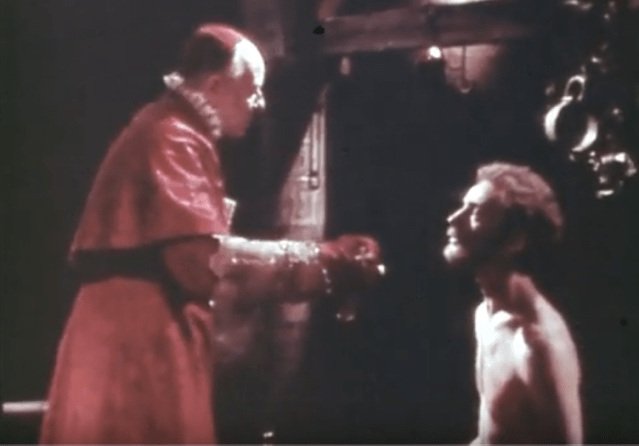
Screenshot 2020-03-01 at 8.28.35 PM

Sir John Gielgud as the Grand Inquisitor

The Grand Inquisitor goes on for many pages, ranting rationally at his silent prisoner. He recalls the story of the Temptation in the Wilderness, and says,

“‘Decide yourself who was right: you or the one who questioned you then? Recall the first question; its meaning, though not literally, was this: “You want to go into the world, and you are going empty-handed, with some promise of freedom, which they in their simplicity and innate lawlessness cannot even comprehend, which they dread and fear—for nothing has ever been more insufferable for man and for human society than freedom! But do you see these stones in this bare, scorching desert? Turn them into bread and mankind will run after you like sheep, grateful and obedient, though eternally trembling lest you withdraw your hand and your loaves cease for them.” But you did not want to deprive man of freedom and rejected the offer, for what sort of freedom is it, you reasoned, if obedience is bought with loaves of bread? You objected that man does not live by bread alone, but do you know that in the name of this very earthly bread, the spirit of the earth will rise against you and fight with you and defeat you, and everyone will follow him exclaiming: “Who can compare to this beast, for he has given us fire from heaven!” Do you know that centuries will pass and mankind will proclaim with the mouth of its wisdom and science that there is no crime, and therefore no sin, but only hungry men? “Feed them first, then ask virtue of them!”—that is what they will write on the banner they raise against you, and by which your temple will be destroyed.

Of course, some people do follow Jesus, and enjoy the perfect freedom which is the service of God. But the Grand Inquisitor says that they are a small minority, a few thousand.

You promised them heavenly bread, but, I repeat again, can it compare with earthly bread in the eyes of the weak, eternally depraved, and eternally ignoble human race? And if in the name of heavenly bread thousands and tens of thousands will follow you, what will become of the millions and tens of thousands of millions of creatures who will not be strong enough to forgo earthly bread for the sake of the heavenly? Is it that only the tens of thousands of the great and strong are dear to you, and the remaining millions, numerous as the sands of the sea, weak but loving you, should serve only as material for the great and the strong? No, the weak, too, are dear to us. They are depraved and rebels, but in the end it is they who will become obedient.

The logical  and reasonable thing to do, says the Grand Inquisitor, would have been to take the Tempter’s offer:

Had you accepted the world and Caesar’s purple, you would have founded a universal kingdom and granted universal peace. For who shall possess mankind if not those who possess their conscience and give them their bread? And so we took Caesar’s sword, and in taking it, of course, we rejected you and followed him.

The Grand Inquisitor and people like him took the offer centuries before when they seized temporal power and began to govern like ordinary princes. In his mind he knew he was making a deal with the Devil, but it was worth it. The lofty ideal of freedom and the life of the Spirit was too abstract for humanity, which needed rulers who would offer them authority with demonstrations of “mystery” and “miracle”.

Ivan ends the story this way:

When the Inquisitor fell silent, he waited some time for his prisoner to reply. His silence weighed on him. He had seen how the captive listened to him all the while intently and calmly, looking him straight in the eye, and apparently not wishing to contradict anything. The old man would have liked him to say something, even something bitter, terrible. But suddenly he approaches the old man in silence and gently kisses him on his bloodless, ninety-year-old lips. That is the whole answer. The old man shudders. Something stirs at the corners of his mouth; he walks to the door, opens it, and says to him: ‘Go and do not come again … do not come at all … never, never!’ And he lets him out into the ‘dark squares of the city.’ The prisoner goes away.”

Who Is The Grand Inquisitor?

The temptation which Jesus overcomes in the desert is the temptation of power: of overwhelming the other by one’s ability, of gaining authority by the simple satisfaction of hunger and other basic needs. It is the way of the world, of goodness corrupted. It is the promise give to us by ideologies and economics, and it has led to totalitarianism and cruel, genocidal exploitation. It is the promise given to us in a fallen world by political ideologies.

And yet, these are the powers and principalities that humans have bowed down to in generation after generation. Indeed, at times we become the Grand Inquisitor. As Dostoevsky writes him he is very rational, very persuasive, and even if we disagree with him he nevertheless makes good points. And we are people of the world, even if we aspire for the way of Jesus. The way of the world is the way of power, which is very seductive. It justifies itself as doing the right thing. The Grand Inquisitor is persuasive, and believes that he is right to set fire to hundreds of lives and go on to do so again. This whole passage by Dostoevsky, written around 1880, is eerily prescient of the Bolshevik Revolution that killed millions in the name of the future happiness of the proletariat.

As Dostoevsky writes it, and as the gospels describe it, Jesus overcomes this rationalistic, evil folly with love. By rejecting power, by pouring the divine out into frail human flesh, Jesus shows that true divinity is to be found in sacrificial love, and not just brute power, a love which risked the creation of the world and possible rejection, a love which took on human form in order to serve others. And that, my friends, is how the Church has always persisted in the face of opposition, and how it thrived even when it was compromised. And today, when confronted with indifference, ridicule, and ignorance, it is how we continue: listening, understanding, probably disagreeing, and responding with care for the other.

This is brought home in a passage later in Matthew:

Jesus called them to him and said, ‘You know that the rulers of the Gentiles lord it over them, and their great ones are tyrants over them. It will not be so among you; but whoever wishes to be great among you must be your servant, and whoever wishes to be first among you must be your slave; just as the Son of Man came not to be served but to serve, and to give his life a ransom for many.’ Matthew 20.25-28

On this First Sunday of Lent, between the fourth day and the fifth, may we not be overcome by the powers that would tempt us, but become like the one who loves even those who persecute him.

Posted in Lent, Sermons | Tagged , , , , | 1 Comment

Blessed is the One Who Comes in The Name of the Lord: A Close Reading of Psalm 118

A Close Reading

Every time we celebrate the Lord’s supper, we say or sing a verse from Psalm 118: “Blessed is the one who comes in the name of the LORD.” Every time we mark Palm Sunday, we remember how the people sang (according to Mark 11.9-10)

Hosanna! Blessed is the one who comes in the name of the Lord!
Blessed is the coming kingdom of our ancestor David!
Hosanna in the highest heaven

Indeed, in some places, on Palm Sunday the psalm is sung as one processes into the church from some place outside of it.

And then there are the hymns that were inspired by it.Two are:

  • This is the day that the Lord hath made.
  • Christ is made the sure foundation, Christ our head and cornerstone.

According to the New Testament Jesus quoted from this psalm, and the disciples formed an understanding of who Jesus was from certain verses of it.

In this blog post (based on a group study I led with parishioners at St. Thomas, Kefalas, Crete during Lent 2019) I want to do a “close reading” of the text of this psalm. “Close reading”, as the Wikipedia article states,

is the careful, sustained interpretation of a brief passage of a text. A close reading emphasizes the single and the particular over the general, effected by close attention to individual words, the syntax, the order in which the sentences unfold ideas, as well as formal structures. A truly attentive close reading of a two-hundred-word poem might be thousands of words long without exhausting the possibilities for observation and insight.

My understanding is that “close reading” emerged in the middle of the Twentieth Century as a reaction to interpretations to texts that paid more attention to supposed facts about the authors, or the motivations for writing a passage. Biographical information about why, say, T. S. Eliot wrote The Wasteland is not irrelevant, but it does not necessarily explain why the modernist poem caught the tenor of the times when it was published. Similarly, when close reading a biblical text one pays attention first and foremost to the words, only using historical information and anagogical elaboration afterwards.

The Text of Psalm 118

So let’s jump in. It’s a long poem. Below is the English of the NRSV, only I have substituted the four letters YHWH where the English has the LORD. In the original Hebrew the divine name is written  יהוה and is probably pronounced “Yahweh.” Since before Jesus’s time pious Jews would not pronounce the name, instead saying אֲדֹנָי Adonai “the Lord” (and these days rather than say even that Orthodox Jews will say “Ha-Shem” or “the name”). Since the original text uses a personal name I’ve put it back in.

Psalm 118

1 O give thanks to YHWH, for he is good; *
his steadfast love endures forever!
2 Let Israel say,*
“His steadfast love endures forever.”
3 Let the house of Aaron say,*
“His steadfast love endures forever.”
4 Let those who fear YHWH say,*
“His steadfast love endures forever.”

5 Out of my distress I called on YHWH;*
YHWH answered me and set me in a broad place.
6 With YHWH on my side I do not fear.*
What can mortals do to me?
7 YHWH is on my side to help me;*
I shall look in triumph on those who hate me.
8 It is better to take refuge in YHWH*
than to put confidence in mortals.
9 It is better to take refuge in YHWH*
than to put confidence in princes.

10 All nations surrounded me;*
in the name of YHWH I cut them off!
11 They surrounded me, surrounded me on every side;*
in the name of YHWH I cut them off!
12 They surrounded me like bees;
they blazed like a fire of thorns;*
in the name of YHWH I cut them off!
13 I was pushed hard, so that I was falling,*
but YHWH helped me.
14 YHWH is my strength and my might;*
he has become my salvation.

15 There are glad songs of victory in the tents of the righteous:*
“The right hand of YHWH does valiantly;
16 the right hand of YHWH is exalted;*
the right hand of YHWH does valiantly.”
17 I shall not die, but I shall live,*
and recount the deeds of YHWH.
18 YHWH has punished me severely,*
but he did not give me over to death.

19 Open to me the gates of righteousness,
that I may enter through them*
and give thanks to YHWH.

20 This is the gate of YHWH;*
the righteous shall enter through it.

21 I thank you that you have answered me*
and have become my salvation.
22 The stone that the builders rejected*
has become the chief cornerstone.
23 This is YHWH’s doing;*
it is marvelous in our eyes.
24 This is the day that YHWH has made;*
let us rejoice and be glad in it.
25 Save us, we beseech you, O YHWH!*
O YHWH, we beseech you, give us success!

26 Blessed is the one who comes in the name of YHWH.*
We bless you from the house of YHWH.
27 YHWH is God,*
and he has given us light.
Bind the festal procession with branches,*
up to the horns of the altar.
28 You are my God, and I will give thanks to you;*
you are my God, I will extol you.

29 O give thanks to YHWH, for he is good,*
for his steadfast love endures forever.

Unattributed

This psalm is unattributed; some editions and translations may give it a title – the NRSV labels it “A Song of Victory”, but this is a 20th century editor’s description, and it is not there in the original Hebrew. However, in the ancient text of the Hebrew original many of the psalms are attributed – to David, to Solomon, Moses, and the sons of Asaph. But not here. What does it mean that the author is not identified? Many Biblical scholars suggest that the attributions of the psalms date from after the time that the texts themselves were written. They are thus a guide to interpreting them that reflects a later stage in the canonization process. This psalm is not attributed to David or the sons of Korah, or Asaph or Moses, or to anyone. The original anonymous compiler(s) of the psalms perhaps received this text unattributed and chose not to make any guess as to who wrote it. So we do not receive any internal guidance to the interpretation that way.

A Key: Who Is Speaking, And What Are They Doing

To grasp what is going on I suggest we first look at who is speaking, and parse the verbs.

  1. In the first four verses the main verbs are in the imperative or subjunctive mood – which is a fancy way of saying that someone is expressing a command or wish. Thus, the psalmist says, “Give thanks . . .” once and and “Let . . . say” three times. It is the voice of the psalmist, or the voice of those reciting the psalm as if it were their own voice.
  2. Verses 5 to 7 are in the first person, and describe a person in distress calling out to God.
  3. Verses 8 and 9 are in the third person, and affirm YHWH as a better refuge than mortals. It may be an impersonal aside, or it may be a statement by the speaker of verses 5-7.
  4. Verses 10 to 14 clarify that the speaker of the earlier verses was under attack, quite literally in battle. In the first person singular the speaker cuts them off – using a sword presumably – in the name of YHWH, and YHWH helps him in this. YHWH is the speaker’s strength, help, and now is his salvation, or help.
  5. Verses 15 to 18, in third person, says that something is said in the tents of the righteous, and then switches to the first person to voice what is said. It is similar to what is said in verses 10 to 14. One gets the impression that the battle was hard fought, and the speaker(s) were close to death, but they exult in victory instead, and look forward to proclaiming that victory.
  6. If the earlier verses describe someone in distress on a field of battle and in the tents of an army, the next verse, verse 19, advances to “the gates of righteousness”; in the first person the speaker asks for the gates of a fortress or city to be opened. In verse 20 the gate is opened.
  7. Verses 21 and 25 are in the first person, and seems to bracket 22 through 24. It begins with a thanksgiving that God has answered the psalmist – for delivering the speaker in battle, presumably. Then follows in third person a proverb, which seems to suggest that the speaker or his comrades had appeared to be rejected, but now had become very highly valued; a useless stone was now being used as the cornerstone of a building on which everything else would be built. YHWH is identified as the one who is doing it in verse 23, and the very day on which YHWH has done this is a day of rejoicing and gladness. Verse 25 appears to be the call that the speaker may have made back in verse 5.
  8. Verse 26 appears to be in the second person – someone is speaking a blessing on another. If the psalmist back in verses 19 and 20 is entering the gates of a city or fortress, then someone is greeting them. They come in the name of YHWH, and these new speakers bless them in the name of YHWH, recognising that the Lord is working through them.
  9. Verse 27 is odd. There is the statement that YHWH is אלהים Elohim, God,which is a statement of identity, and is clear enough; it is a standard statement of who Israel’s God is – not Ba’al or Dagon or Melqart, who are the gods of other peoples. Light here may be literal, but it also may stand for the victory God has given the psalmist. The second half of the verse seems like an interpolation, and instruction of what to do. However it is read, it locates the place of the psalmist in a temple, in a joyful procession, going towards an altar.
  10. In verse 28 the psalmist directly addresses YHWH directly, identifying him as his own personal deity, and offering thanks and exaltation.
  11. Verse 29 returns to the language of the first three verses, thus bookending the psalm and bringing it to a conclusion.

From the Midst of Battle to the Altar of Thanksgiving

Wilshire Battle

A Battle Between Israel and Judah, from the Warner Murals at Los Angeles’ Wilshire Boulevard Temple, c.1929. Description From the Lectures of Rabbi Edgar F. Magnin, 1929-1930: “This panel depicts the wars of Israel and Judah with the surrounding nations between the 11th and 9th century BCE. During this period there was continued strife, both defensive and offensive, with the Philistines, Moabites, Edomites, Arameans and Assyrians.”

By now you should be able to see that there is a progression and a narrative in the text of Psalm 118. Verses 1 to 9 set up the scene: this is a psalm of praise, but it arises out of a time of distress, when the speaker seeks refuge in YHWH in the midst of a battle.

In verses 10-14 we are in the battle, and the speaker is hard pressed, but trusts in YHWH to give victory. Verses 15-18 is immediately after the battle, and victory has been won and is being proclaimed. In verses 19-20 the speaker (and the army) advances to the gates of their home city and passes through the gates, singing songs of victory to YHWH. In verse 26 they are greeted by the priests and are blessed, and they pass on to the altar of a temple, where they offer sacrifice and praise. The psalm then concludes.

Who is the psalmist, the first person speaker? As it appears that this is the person making thanksgiving, receiving blessing, and offering sacrifice, it is presumably a general or a king. This would have been a psalm with an aura of royalty about it.

The psalm, then, has a narrative structure – it is not a haphazard bunch of verses, but tells a story mainly in the first person.

So, What Does It Mean For Us?

The psalm has its literal meaning, which is simple praise following a hard fought victory. In that sense it might be appropriated by 21st century people who are serving in armed forces and who rely on the God of Abraham, Isaac, and Joseph.

Perhaps the interesting thing is that it has also been interpreted in other ways. One of them is prophetic. By the time of Jesus the Psalms were being read by Jews as both Torah and as prophecy. Thus, verse 22 The stone that the builders rejected * has become the chief cornerstone is applied by New Testament Christians not to a warrior leader, but to Jesus, who turns the other cheek and suffers and dies at the hands of a cruel empire and its collaborators. Verse 26, Blessed is the one who comes in the name of YHWH, is sung by the people as Jesus enters Jerusalem. The royal aura of the psalm now becomes messianic, as the words applied to the entry of a warrior king centuries before are now put on Jesus of Nazareth.

Jesus, then, is in a battle, but a spiritual one with the personified forces of evil in the world, foremost among them sin and death. His struggle begins, according to the Gospel of Mark, with the temptation in the desert, and continues as evil spirits taunt Jesus even as he exorcises them from possessed individuals. They work through Herod the Great and the chief priests and scribes, who are puppets and collaborators with the evil Roman Empire. Finally, death itself seems to overcome Jesus in the cross, and he is laid in the grave. However, that most finite thing called death cannot encompass the infinite and unbounded God, and so Christ rises triumphant to new life, the first fruits of a new creation in which all things are being made new.

The psalm, then, is applied to Jesus not literally but spiritually. Thus Blessed is the one who comes in the name of the Lord is sung as the Benedictus immediately after the Sanctus (from Isaiah 6), as praise of Christ in his victory over the grave, and as a sign of his perpetual entry into our lives in the sacrament of the Holy Eucharist.

Christians have sung and said this psalm as a prayer for twenty centuries. Monks, since the 3rd century, have sung this psalm daily or weekly as they work their way through the psalter. St Benedict in his Rule prescribed it for the service of Lauds every Sunday. I suspect that these pacifist monks used this psalm not only Christologically, but also in reference to their own personal struggles, as they sought through discipline and spiritual exercises to let go of the world and be filled with the Holy Spirit. In that sense, we can also pray it, making the “I” of the psalm our selves.

Posted in Lent, Prayer | Tagged , , , | 3 Comments

“I, I will begin again . . . “: New Year’s Day

Originally published in the January 2020 newsletter of the Anglican Church of St Thomas, Kefalas, Crete, Greece.


Calendars are funny things. Our civic year begins on January 1st, and many of us mark it by staying up the night before and partying with friends, singing “Auld Lang Syne”, and making resolutions. Others of us see it simply as another click on the odometer and go to bed at 9:30 PM as usual. Others of us read the newspapers and think of the U2 song with it’s lyric, “Under a blood red sky”.

Religious New Years

As Christians we say that the ecclesiastical year begins on the First Sunday of Advent, which moves around a bit on the calendar as the date of Christmas moves through the week; however, while we may begin a new cycle of annual readings on that day, we do not actually treat it as “New Year’s Day”. The Islamic calendar has a New Year’s Day that, over decades, moves through the seasons, because it is a purely lunar calendar that ignores the sun (except for marking the individual day). The Jewish calendar has Rosh Hoshannah (literally, “Head of the Year”), and it moves around, too, because it’s is also lunar. Unlike the Islamic calendar the Jewish one accommodates itself to the solar year by having a leap month every two or three years, according to a complex formula. Thus it moves around, but only over the space of a month or so, going back and forth.

Fiscal New Years: Jan 1, April 1, and . . . April 6???

The governments of the UK and Canada run a fiscal calendar of 1 April to 31 March. As a Canadian my tax year is the same as the civic calendar, January 1 to December 31. Many of you reading this have, or still are, paying taxes in the UK, and I believe your tax year is 6 April to 5 April, right? Why such an arbitrary date such as April 6? The reason has to do with New Year’s Day.

You may recall that up until 1752 the New Year was considered to begin on March 25 (the Feast of the Annunciation, or Lady Day). In Great Britain on March 25 the account books for the previous year were closed and new ones begun. Now, Easter is considered to be the first Sunday following the full moon which falls on or after the spring equinox. However, it was becoming apparent by the 16th century that the calendar used throughout Europe had a major problem. It had last been revised under Julius Caesar, and the clever thing about the Julian calendar was that it accommodated the fact that the solar year was not exactly 365 days long, but more like 365¼ days long. It did this by including a leap year day, February 29, every four years. Unfortunately, the Julian calendar was not clever enough.

us-calendar-september-1752

It was a short month. Did people still pay a full month’s rent?

The solar year it turns out, is actually 365.2425 days long, and over decades and centuries that 0.0075 day started to add up. By 1582 the astronomical vernal equinox was coming ten days before the supposed one, and Easter was being celebrated too late. Pope Gregory instituted the Gregorian calendar that year, requiring Catholic Europe to go directly from Thursday, 4 October 1582 to Friday, 15 October 1582, and with the rule that years divisible by 100 but not by 400 would not be leap years. Thus, 1700, 1800, and 1900 were not leap years, but 1600 and 2000 were (you remember, right?); this makes up for the annual extra minutes that over four centuries amounts to a day. A final change was that the New Year would be observed on January 1, which was the old Roman custom that was grounded in it being the day when the consuls of the republic took their offices.

Of course, as this came from Rome, the Gregorian calendar was seen as a Popish plot by Protestants and an arrogant move by the Eastern Orthodox churches. Thus, the Russian Empire stayed on the Julian calendar up until the Soviets took over – and that is why a revolution that took place in November 1917 is remembers as the October Revolution – the Julian calendar was by then thirteen days behind. Greece as a nation did not move to the Gregorian calendar until 1922.

Meanwhile, Great Britain and Ireland observed the Julian calendar, but as its empire grew and tolerance for other Christian denominations developed, it was decided to  fall in line in 1752. By then the calendar was eleven days behind, so Wednesday, 2 September 1752, was followed by Thursday, 14 September 1752. Accountants, in their typical conservative fashion, simply adjusted their fiscal year from beginning on March 25, Old Style, to what that now was in the New Style, April 5. Further, there were enough of them who knew that under the Julian calendar there would have been a February 29, 1800, although there was not under the Gregorian calendar; they just adjusted their books to start the fiscal year on April 6. This was not done for 1900, and April 6 it remains.

Julian, not Gregorian

For the most part, Eastern Orthodox Christians now use the Gregorian calendar for fixed feast days such as Christmas, Epiphany, the Annunciation on March 25 and the feast of Mary’s “Falling Asleep” on August 15. However, some groups in Orthodoxy are opposed to the “new” calendar, feeling that only an ecumenical council could require them to adopt it. Thus, if you were to go to Mount Athos in northern Greece the monasteries there are all on the Julian calendar, thirteen days behind us. Likewise, the Orthodox churches in Russia and Ukraine observe the Julian Calendar for these fixed festivals, so what we in Canada call “Ukrainian Christmas” fell on January 7 this year, and our New Year’s Day was only December 19, 2019.

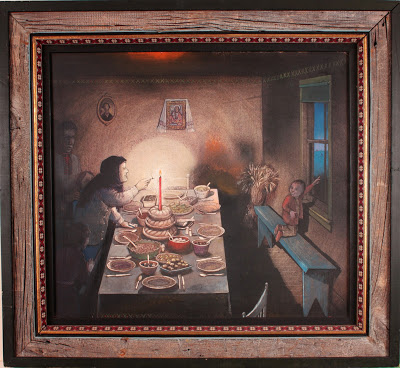
KurelekUKRXmas

“Ukrainian Christmas Eve” by the Ukrainian Canadian artist William Kurelek (1927 – 1977)

As a compromise with the Old Calendarists most Orthodox churches use the Julian calendar to calculate Easter. Because full moons (even notional ones) will occur on different dates after the spring equinox, sometimes the Orthodox Easter will share the same day as Western Gregorian Easter, as it did in 2017 and will again in 2025. Most years it comes later. In 2020 our Easter is on April 12, and Orthodox Easter is a week later, on April 19.  In 2021 our Easter is on April 4, whereas the Orthodox will have it on May 2 – four weeks later!

Closing the Books

Arguably this is all arbitrary. However, there is something powerful about the change of a year, as many of us who remember December 31, 1999 might attest. It does suggest closing one set of books and opening another, and that can be true of us spiritually just as it can be fiscally. My hope and prayer for 2020, as we move into our vision and a mission plan for our congregation here at St Thomas’s, is that God will bless us, and we will see that in God in Christ we are each being made anew. Happy New Year!

Posted in Random Personal Notes | Tagged , | Leave a comment

Some Reflections on the Political Murder of Innocents

A Sermon Preached on The First Sunday of Christmas
at The Anglican Church of St. Thomas the Apostle, Kefalas, Crete
December 29, 2019 11:00 am

The readings (according to the Common Worship lectionary of the Church of England, which diverges from the Revised Common Lectionary) were: Isaiah 63.7-9, Psalm 148, Hebrews 2.10-18, and Matthew 2.13-23.

1024px-Pieter_Bruegel_the_Elder_-_Massacre_of_the_Innocents_-_Google_Art_Project

The Massacre of the Innocents (1600) Pieter Bruegel the Elder.

[Herod] was infuriated, and he sent and killed all the children in and around Bethlehem who were two years old or under.           Matthew 2.16b

Herod then with fear was filled;
‘A prince’, he said, ‘in Jewry!’
All the little boys he killed
at Bethl’em in his fury,
at Bethl’em in his fury.
— Unto Us A Boy Is Born (1928) 15th century Latin carol, translated by Percy Dearmer (1867-1936)

Well, that’s a dark story, isn’t it? And yet it speaks to the reality of Christmas.

It is not just a simple story of the birth of an enlightened being who comes to show the truth and help us get through life, but the story of someone who was opposed and in danger of his life.

As I mentioned on Christmas Eve, according to Raymond Brown, the eminent New Testament scholar, the events and characters in the Infancy Narratives prefigure Jesus in his later life. They also call back to Jewish tradition.

Thus

  • Herod represents the later Roman authorities and the corrupt Judean leadership that seeks the death of Jesus, and are not particular about collateral damage.
  • Jesus finding safety in Egypt is like the sons of Jacob finding a refuge in Israel, prepared for them by Joseph. It is the proverbial place of refuge for those escaping tyranny in Israel, including the prophet Jeremiah.
  • Jesus is called out of Egypt, as Israel was called out of slavery, and Jesus is to prepare his own exodus or salvific exit.
  • The Holy Innocents represent all those who would die on account of Jesus and the intervention of God in history, beginning with Stephen the Deacon, the first Martyr, and on through millions more.
  • Rachel, the mother of the children of Israel, weeps for her children – and this represents the weeping to come.

So we have Jesus entering a dangerous world – which, without doubt, it was. After all, it tortured and killed him.

Of course, this is probably not our experience. Most of us experience indifference, not suffering. And yet it continues in the present day.

One could go on. But you get the picture. Christians are subject to attack by extremist groups.

So what is one to do? We have a variety of options.

  • Perhaps we could just ignore it all. Turn off the media, and just read books or stream Netflix. Yes, it is perhaps more comforting if we live in blissful ignorance, but I doubt that is what we are called to do.
  • Some would say that the problem is particular religions, but this ignores the fact that all religions (including Christianity) has had, or currently has, individuals and groups that believe violence is justified against other faiths. The number of these violent people is invariably small in comparison to the vast numbers who live quite peacefully, so it is probably not a problem with any religion’s beliefs, but the way they have been interpreted.
  • Some atheists suggest that all religions are inherently violent. Some believe that if we just all became good secular people then it would be fine. Well, no – just look at what secular regimeshave done in the Soviet Union, China, Cambodia, North Korea, and elsewhere. Unbridled capitalism or mercantilism similarly has little regardfor indigenous peoples.
  • Some would suggest that we need to support Christians being persecuted, as suggested by the newly re-elected Prime Minister of the UK, Boris Johnson, in  his Christmas message.

Yes, but that suggests we value Christian lives over those of others. And the point of the Holy Innocents and our commemoration of them is that they were not Christians in any sense. They were children under the age of two who were innocent victims. They were Judeans, children of Israel. And yet we celebrate them as being the first martyrs.

Therefore, as Christians, we are equally horrified when people are killed for any ideology and for any faith:

As Christians we are called to speak out on the value and dignity of all human life, and to challenge those who would divide people into us and them, and demean the others. Our western values, as enshrined in human rights, are deeply rooted in Christian values, and shared with peoples of many faiths. The enemy is violence and extremism in any faith or ideology that dehumanizes others in order to promote its own. We ought to be just as wary of Christian extremism as any other type.

We have many opportunities to act.

  • We can become active in and support non-governmental agencies that are concerned with human rights, among whom are:
  • Consider who to vote for – those of us who still have votes! Do the candidates or parties on the ballot have a robust support for human rights and democracies? This is not an issue of the left or the right – it is much much more basic than that.
  • We can engage in local inter-religious dialogue and community building. A few Saturdays ago three of us Anglican Christians met in the Jewish synagogue Etz Hayyim in Chania, with ordinary people in the region from the Orthodox church, the Catholic church, the synagogue, and the Sunni Muslim mosque. There was a consensus, in the shadow of the heavy history all around us, that we are called to be in relationship and to become friends, to learn and to break bread together. And so, I hope and pray that we will gather soon for a social occasion.
  • Finally, we should pray – for those undergoing persecution, for God to raise up tolerant leaders and democracies that uphold human rights, and for violence to be ended.

To do nothing is an option., I suppose. But as we celebrate the one who was born at Christmas, let us consider that do nothing two thousand years ago was also an option for God.  God nevertheless entered into history in the person of Jesus Christ in defiance of Herod and other corrupt rulers, and ultimately to confront sin and death itself on the cross delivered to him by Pontius Pilate. As we recall those innocent victims who died so long ago, let us work to stop the oppression of their brothers and sisters today.

Posted in Christmas, Sermons | Tagged , , | Leave a comment

Joy in the Ruins of Old Jerusalem

Day Twenty-Three of “Through Advent with Isaiah”

621px-Mystic_Nativity,_Sandro_Botticelli

The Mystic Nativityby Sandro Botticelli, 1500.

The first reading on Christmas Day (the third Eucharist of Christmas), from the Hebrew scriptures, is (no surprise) from Isaiah.

7 How beautiful upon the mountains
are the feet of the messenger who announces peace,
who brings good news,
who announces salvation,
who says to Zion, ‘Your God reigns.’
8 Listen! Your sentinels lift up their voices,
together they sing for joy;
for in plain sight they see
the return of the Lord to Zion.
9 Break forth together into singing,
you ruins of Jerusalem;
for the Lord has comforted his people,
he has redeemed Jerusalem.
10 The Lord has bared his holy arm
before the eyes of all the nations;
and all the ends of the earth shall see
the salvation of our God.       – Isaiah 52.7-10

In the context of Second Isaiah this announces the return of Yahweh to Jerusalem. Klaus Baltzer in his 2001 commentary believes that the structure is like that of a sunrise. First the mountains sees the sunlight, then the sentinels on the ruins of Jerusalem, and then the whole of the earth. He feels that this is an appropriation of the sun cult criticized by the author’s exiled contemporary, Ezekiel:

16 And he brought me into the inner court of the house of the Lord; there, at the entrance of the temple of the Lord, between the porch and the altar, were about twenty-five men, with their backs to the temple of the Lord, and their faces towards the east, prostrating themselves to the sun towards the east. 17Then he said to me, ‘Have you seen this, O mortal? Is it not bad enough that the house of Judah commits the abominations done here? Must they fill the land with violence, and provoke my anger still further? See, they are putting the branch to their nose!   – Ezekiel 8.16-18

Whereas Ezekiel condemns it and regards it as the cause of the downfall of Judah (among many other blasphemies), Isaiah subverts the cult and assumes it into the worship of Yahweh, from whom all things come. This is echoed in Third Isaiah:

1 Arise, shine; for your light has come,
and the glory of the Lord has risen upon you.
2 For darkness shall cover the earth,
and thick darkness the peoples;
but the Lord will arise upon you,
and his glory will appear over you.
3 Nations shall come to your light,
and kings to the brightness of your dawn.

The passage in chapter 52 is filled with sound:

  • the messenger
    • announces peace
    • announces salvation
    • says to Zion, ‘Your God reigns.
  • the sentinels
    • lift up their voices
    • they sing for joy
  • the ruins of Jerusalem
    • break forth together into singing

The victory has been won. There is no more war, it seems, for God has bared his arms, and God’s people have been comforted. The ends of the earth have seen the salvation of God; in the original Hebrew the word translated here as “salvation”  is יְשׁוּעַ֥ת (yesh-u-et), which might be more simply rendered as “help”.

Likewise מְבַשֵּׂ֗ר (mi-basher) which is here “who brings good news” might be translated as “who brings news” – the “good” is implied, and in other uses of the verb elsewhere, it is any kind of tidings or news. That said, the Septuagint translated it ὡς εὐαγγελιζόμενος ἀγαθά  os evangelizomenos agatha “as one preaching good news”, and it if you see the word “evangel” in the Greek you see the origin of the words “evangelism”, “evangelist”, and “evangelical” – all rooted in “good news”.

This is why it is used on Christmas morning. It is the good news of the birth of Jesus Christ that is being proclaimed. The kingdom of God is brought near in the life, teaching, death, and resurrection of Jesus of Nazareth, and made real in the lives of his followers by the power of the Holy Spirit.

We live in the ruins of old Jerusalem. We sense that we are exiles from a golden age that upon examination, never really was. Nevertheless, we are strangers in a strange land. Our hearts are restless until they find their rest in God, and God is found preeminently in the revelation of Jesus. And so we rest in Christ, who explodes every category we might apply to him, and we find that our joy is in conformity to who he is, and in becoming like him.

This brings us to the end of this passage through Isaiah in Advent. Thank you to those who have been following along and to everyone who visits. May the glory of the one born in Bethlehem shine on you in the midst of this dark world, and give comfort and help.


Posted in Advent, Isaiah | Tagged | Leave a comment

For Unto Us A Child Is Born

Day Twenty-Three of “Through Advent with Isaiah”

Here is the reading from Isaiah that is appointed for the first Eucharist of Christmas, and which will be used in millions of churches on Christmas Eve at the “Midnight Mass”.

1 But there will be no gloom for those who were in anguish. In the former time he brought into contempt the land of Zebulun and the land of Naphtali, but in the latter time he will make glorious the way of the sea, the land beyond the Jordan, Galilee of the nations.


2 The people who walked in darkness
have seen a great light;
those who lived in a land of deep darkness—
on them light has shined.
3 You have multiplied the nation,
you have increased its joy;
they rejoice before you
as with joy at the harvest,
as people exult when dividing plunder.
4 For the yoke of their burden,
and the bar across their shoulders,
the rod of their oppressor,
you have broken as on the day of Midian.
5 For all the boots of the tramping warriors
and all the garments rolled in blood
shall be burned as fuel for the fire.
6 For a child has been born for us,
a son given to us;
authority rests upon his shoulders;
and he is named
Wonderful Counsellor, Mighty God,
Everlasting Father, Prince of Peace.
7 His authority shall grow continually,
and there shall be endless peace
for the throne of David and his kingdom.
He will establish and uphold it
with justice and with righteousness
from this time onwards and for evermore.
The zeal of the Lord of hosts will do this.  – Isaiah 9.1-7

In its original context this might have referred to Hezekiah, or perhaps Josiah. Centuries later it was being read messianically, and was thus applied to Jesus, especially when verse 1, which is prose, is read as referring to the following poetry.

maps-master-archeological-bible-study-borders-twelve-12-tribes-israel-promised-division-divided-land-joshua13-22-conquest-1400BC

Jesus came from the area around Galilee, a village called Nazareth. According to Joshua the twelve tribes of Israel invaded Canaan and took the lands, killing off the previous inhabitants. The book of Judges suggests that the previous local inhabitants were not actually killed off. The archaeological record does not suggest any large scale invasion in the era before the kings – no destroyed cities, mass graves, evidence of depopulation. The reality behind the confused traditions of Joshua and Judges is that there probably was a Hebrew speaking population that escaped from some form of slavery in Egypt and came to settle in Canaan, but they were probably many thousands, not the 610,000 suggested by Numbers. These people lived side by side with the Canaanites, intermarried, worshipped with them, and over time some kind of twelve member confederation developed which acknowledged Yahweh as their god. Eventually the united kingdoms of Saul, David, and Solomon emerged out of these groups. Around 920 BCE these separated into the two kingdoms of Israel and Judah. Israel fell to the Assyrians and its people were deported from about 740 BCE to 722 BCE. Although the peoples in the north ceased to be Israelites (or, perhaps, the peoples left behind, who were not deported, became the Samaritans), the Judahites continued to know them by their old tribal names. 9.1 seems to look towards the time when it would be restored.

The ten tribes of Israel never did return. However, in the two centuries before the time of Jesus Jews began to migrate north from Judea and settle in the areas around Galilee. Thus the lands of Galilee – including Zebulon and Naphtali – actually had followers of the Lord God there after many years of there being none. Reading the poetic passage that follows either gave the early Christians a proof text that the Messiah would come from Galilee, or perhaps created the expectation among some people prior to the time of Jesus that the anointed one would be from the old area of the Kingdom of Israel.

Handel’s Messiah uses Isaiah extensively, including this passage. Here is an extremely unusual staged version of 9.2:

A more conventional performance of 9.6 is this one done by The London Symphony Orchestra:

Posted in Advent, Isaiah | Tagged | Leave a comment

Who Is The Servant in Isaiah?

Day Twenty-Two of “Through Advent with Isaiah”

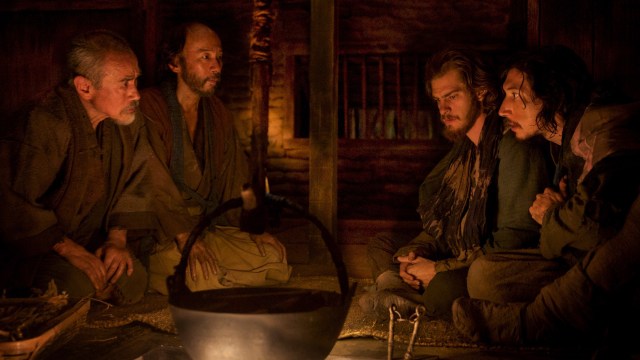
Silence

A scene from Martin Scorsese’s 2016 film “Silence”, from the 1966 novel by Shusako Endo. In the film two Jesuit priests go to Japan, now forbidden to outsiders, in order to find out what had happened to an earlier Jesuit missionary, and to minister to Japanese Christians.

As discussed in earlier posts, the “servant” of God is a major theme in the Book of Isaiah. Much of the time the servant is identified:

  • Descendants of Jacob and Judah (65:9).
  • The righteous of Israel (54:17, 65:8, 13-15, 66:14).
  • Israel/Jacob (41:8, 41:9, 44:1-2, 21, 45:4, 48:20, and 49:3
  • David(37:35).
  • Isaiah (20:3).
  • Eliakim son of Hilkiah (22:20)the chief steward of the house of David.
  • Foreigners who come to worship God (56:6)

Bernard Duhm identified the suffering servant in Second Isaiah. In addition to the collective of the people of Israel, the servant has been identified with

  • Moses.
  • An unnamed individual in the immediate post-exilic age.
  • Cyrus
  • Darius
  • Zerubbabel
  • The historical prophet Isaiah
  • A coming Messiah

Christians use the passage in the very last sense, as a reference to Jesus. Thus, on Good Friday and in the evening office tomorrow night we read the Fourth Servant Song:

13 See, my servant shall prosper;
he shall be exalted and lifted up,
and shall be very high.
14 Just as there were many who were astonished at him
—so marred was his appearance, beyond human semblance,
and his form beyond that of mortals—
15 so he shall startle many nations;
kings shall shut their mouths because of him;
for that which had not been told them they shall see,
and that which they had not heard they shall contemplate.

53Who has believed what we have heard?
And to whom has the arm of the Lord been revealed?
2 For he grew up before him like a young plant,
and like a root out of dry ground;
he had no form or majesty that we should look at him,
nothing in his appearance that we should desire him.
3 He was despised and rejected by others;
a man of suffering and acquainted with infirmity;
and as one from whom others hide their faces
he was despised, and we held him of no account.

4 Surely he has borne our infirmities
and carried our diseases;
yet we accounted him stricken,
struck down by God, and afflicted.
5 But he was wounded for our transgressions,
crushed for our iniquities;
upon him was the punishment that made us whole,
and by his bruises we are healed.
6 All we like sheep have gone astray;
we have all turned to our own way,
and the Lord has laid on him
the iniquity of us all.

7 He was oppressed, and he was afflicted,
yet he did not open his mouth;
like a lamb that is led to the slaughter,
and like a sheep that before its shearers is silent,
so he did not open his mouth.
8 By a perversion of justice he was taken away.
Who could have imagined his future?
For he was cut off from the land of the living,
stricken for the transgression of my people.
9 They made his grave with the wicked
and his tomb with the rich,
although he had done no violence,
and there was no deceit in his mouth.

10 Yet it was the will of the Lord to crush him with pain.
When you make his life an offering for sin,
he shall see his offspring, and shall prolong his days;
through him the will of the Lord shall prosper.
11   Out of his anguish he shall see light;
he shall find satisfaction through his knowledge.
The righteous one, my servant, shall make many righteous,
and he shall bear their iniquities.
12 Therefore I will allot him a portion with the great,
and he shall divide the spoil with the strong;
because he poured out himself to death,
and was numbered with the transgressors;
yet he bore the sin of many,
and made intercession for the transgressors.    – Isaiah 52.13-53.12

It is hard for those of us who are Christians to not see the passion of Jesus in this passage. Of course, it is probably the case that the passage influenced the telling of the suffering and death of Jesus. It is also probably the case that Jesus saw himself as the servant of Isaiah, so his disciples likewise saw him as such, and this is captured in the New Testament.

The passage is what certain literary critics would describe as “the fecundity of the text.” It admits many meanings.

One person that I have not seen suggested is an obvious one, but hidden from immediate view – the reader herself or himself. In a time of trauma and suffering, when there is injustice and oppression, to dare to speak truth to power is costly. If one appropriates the vision of Second Isaiah one will sense a call to justice, to defend the orphan and widow, the poor, and the stranger in one midst. One will absorb the critiques of the whole of the book directed at unjust rulers and tyrannical regimes. Suffering comes upon such a person, and it seems as though she or he takes on the sins of the whole people.

Of course, Jesus was just such a person. However, the call of Jesus is not that we sit at the foot of the cross and say, “Thank you for suffering on my behalf” and then go on with our lives unchanged. The call is to take up our cross – which is his cross – and to join with him in challenging sin, death, and the oppressive powers and dominions in this world. Many might see this as purely spiritual, but the fact is that throughout history Jesus’s followers have suffered because of challenging the political powers. Jesus was put to death by a colonizing imperial power, as have many of his disciples through the centuries.

The suffering servant, then, can also be you and me. We may not necessarily suffer for following in the way of Jesus and proclaiming the kingdom of God, but we may need to be prepared to do so. As Matthew tells us, this danger of suffering was present to Jesus even when he was an infant, when Herod sought his death. The Christmas story is a nice story of a child’s birth, but it is also a story set in a real world, where terror and injustice seeks to destroy the good that comes from God. As we prepare to enter into this story once again, let us recall that it is a story, if understood, comes with a cost and a call.


Posted in Advent, Isaiah | Tagged , , | 1 Comment

A Kingdom Without a King

Day Twenty-One of “Through Advent with Isaiah”

One of the most striking things about the transition from First Isaiah to Second Isaiah is the shift in interest in the Davidic monarchy. In First Isaiah the prophet begins in 1.1 and 2.1 by placing himself temporally in the reign of kings. He interacts with King Ahaz in chapters 7 and 8, and King Hezekiah in 36-39. The child Immanuel in chapter 7 is thought by some scholars to be King Hezekiah himself. In chapter 9 there is a king who breaks the rod of the oppressor:

6 For a child has been born for us,
a son given to us;
authority rests upon his shoulders;
and he is named
Wonderful Counsellor, Mighty God,
Everlasting Father, Prince of Peace.
7 His authority shall grow continually,
and there shall be endless peace
for the throne of David and his kingdom.
He will establish and uphold it
with justice and with righteousness
from this time onwards and for evermore.
The zeal of the Lord of hosts will do this.     – Isaiah 9.6-7

This king is identified by Christians as Jesus, of course, but Isaiah scholars believe that in its original context it referred to Hezekiah, or perhaps Josiah.  Chapter 11 identifies a Davidic king as a the one who will gather the scattered people of Israel (and/or Judah) back to Jerusalem:

A shoot shall come out from the stock of Jesse,
and a branch shall grow out of his roots.
2 The spirit of the Lord shall rest on him,
the spirit of wisdom and understanding,
the spirit of counsel and might,
the spirit of knowledge and the fear of the Lord.
3 His delight shall be in the fear of the Lord.

10 On that day the root of Jesse shall stand as a signal to the peoples; the nations shall inquire of him, and his dwelling shall be glorious.

11 On that day the Lord will extend his hand yet a second time to recover the remnant that is left of his people, from Assyria, from Egypt, from Pathros, from Ethiopia, from Elam, from Shinar, from Hamath, and from the coastlands of the sea.    – Isaiah 11.1-3, 10-11

Chapters 40-55 and thereafter shows no interest in any of this. Cyrus is the one anointed by God, and the returned exiles seem to be quite happy to acknowledge him as the ruler, provided they were free to do as they believed God wanted them to act. While there is discussion of the servant of God (the identity of which there is no scholarly consensus), there is no obvious connection between this servant and the House of David.

Kingdom

Not this Queen, nor these three potential future kings.

There is, in fact, a real ambivalence in the Tanach around royalty. In 1 Samuel we read:

Then all the elders of Israel gathered together and came to Samuel at Ramah, 5and said to him, ‘You are old and your sons do not follow in your ways; appoint for us, then, a king to govern us, like other nations.6But the thing displeased Samuel when they said, ‘Give us a king to govern us.’ Samuel prayed to the Lord, 7and the Lord said to Samuel, ‘Listen to the voice of the people in all that they say to you; for they have not rejected you, but they have rejected me from being king over them. 8Just as they have done to me, from the day I brought them up out of Egypt to this day, forsaking me and serving other gods, so also they are doing to you. 9Now then, listen to their voice; only—you shall solemnly warn them, and show them the ways of the king who shall reign over them.’

10 So Samuel reported all the words of the Lord to the people who were asking him for a king. 11He said, ‘These will be the ways of the king who will reign over you: he will take your sons and appoint them to his chariots and to be his horsemen, and to run before his chariots; 12and he will appoint for himself commanders of thousands and commanders of fifties, and some to plough his ground and to reap his harvest, and to make his implements of war and the equipment of his chariots. 13He will take your daughters to be perfumers and cooks and bakers. 14He will take the best of your fields and vineyards and olive orchards and give them to his courtiers. 15He will take one-tenth of your grain and of your vineyards and give it to his officers and his courtiers. 16He will take your male and female slaves, and the best of your cattle and donkeys, and put them to his work. 17He will take one-tenth of your flocks, and you shall be his slaves. 18And in that day you will cry out because of your king, whom you have chosen for yourselves; but the Lord will not answer you in that day.’

19 But the people refused to listen to the voice of Samuel; they said, ‘No! but we are determined to have a king over us, 20so that we also may be like other nations, and that our king may govern us and go out before us and fight our battles.’ 21When Samuel had heard all the words of the people, he repeated them in the ears of the Lord. 22The Lord said to Samuel, ‘Listen to their voice and set a king over them.’ Samuel then said to the people of Israel, ‘Each of you return home.’    – 1 Samuel 8.4-22

The rest of the books of Samuel and Kings tells of the anointing of Saul as king, and then David. David is described as an excellent king until he sexually exploits or rapes Bathsheeba, and kills her husband Uriah to cover it up. Solomon is widse and builds the Temple in Jerusalem, but he also exploits the people and lives a lavish lifestyle at their expense. Problematic as they were, the Judah kings afterwards, until Hezekiah and Josiah, never reach the heights of David and Solomon.

Scholars speculate that the Deuteronomic History (Deuteronomy, Joshua, Judges, 1 & 2 Samuel, 1 & 2 Kings) was compiled from a variety of sources from Judah and Israel and perhaps reached its first edition in the reign of Josiah. The passages calling into question the monarchy would not have been part of that earlier version. Josiah met an untimely end in a battle with Egypt, but the size and importance of the History was so significant that a later hand finished it up to the end of the monarch just two short decades after the great king it was supposed to celebrate. This later hand, perhaps in the Exile but more likely in the returned community, incorporated the same bias that Second Isaiah had against monarchy – it was an experiment that was shown to be deeply problematic. Neither Second Isaiah or the second edition of the Deuteronomic History seems to advocate the reestablishment of the House of David.

Instead, Yahweh is the king. He is identified as such in 41.21:

21 Set forth your case, says the Lord;
bring your proofs, says the King of Jacob.  – Isaiah 41.21

Klaus Baltzer in his Heremaneia commentary (2001) on Deutero-Isaiah sees the servant as Moses. For him, Second Isaiah regards the pre-monarchial system in Israel as a golden era. Second Isaiah describes Yahweh as the only God and sovereign over every land and nation, even if they do not know him. However, Yahweh is known in Jerusalem, where his Temple is, and he is the one who redeems the city:

7 How beautiful upon the mountains
are the feet of the messenger who announces peace,
who brings good news,
who announces salvation,
who says to Zion, ‘Your God reigns.
8 Listen! Your sentinels lift up their voices,
together they sing for joy;
for in plain sight they see
   the return of the Lord to Zion.
9 Break forth together into singing,
you ruins of Jerusalem;
for the Lord has comforted his people,
he has redeemed Jerusalem.
10 The Lord has bared his holy arm
before the eyes of all the nations;
and all the ends of the earth shall see
the salvation of our God.     – Isaiah 52.7-10

This desire to go back to the old days without kings sits uneasily with the monarchial system extolled elsewhere in the Tanach. It is there in the Deuteronomic History, and it is present in the Book of Isaiah taken as a whole. As well, there is a downside to being a province of an empire. A benevolent despot can be succeeded by a terrible one. One still has to pay tribute, and that may or may not be adjusted according to the quality of the crops or the economy. Empires can be conquered, and new rulers may have an agenda to destroy the liberal policies of the old rulers. This happened when Alexander the Great destroyed the Persians and his successors attempted to introduce Hellenistic culture to the Judeans. Revolts have to be led by someone, and in the case of the revolt against Antiochus Epiphanes it was the Hasmoneans – a non-David family – who set themselves up as kings of Judea. Despite a great beginning, they fell into party intrigues and civil war, which prompted the attention of Pompey the Great of Rome. After they were conquered by the Roman Empire puppet kings and governors ruled, until the Jewish Revolt of 66 CE-70CE, which ended when the Romans destroyed Jerusalem and the Temple.

In the context of imperialism and colonization it is only natural to have the desire to be Maîtres chez nous. The desire for a just ruler became idealized as the longing for the Messiah, the anointed one of the House of David who would expel the foreign rulers. As this developed in the post-exilic era, older texts began to be read for indications of what the messiah might be like. Thus, ironically, passages in Second Isaiah began to be read messianically. It is probably this which led to the authors of the New Testament to read the servant songs as references to the Messiah, to Jesus. Indeed, it is quite probable that Jesus read these passages this way himself. This would appear to be reading the passages against the grain, but already in Jesus’s time this was pretty normal.


Posted in Advent, Isaiah | Tagged , , , | 1 Comment

Highways in Isaiah and the Gospels

Day Twenty of “Through Advent with Isaiah”

12309128493_bb471023a7_o

As is well known, the synoptic gospels quote Isaiah 40 in reference to John the Baptist. In Isaiah 40 we read:

1 Comfort, O comfort my people,
says your God.
2 Speak tenderly to Jerusalem,
and cry to her
that she has served her term,
that her penalty is paid,
that she has received from the Lord’s hand
double for all her sins.

3 A voice cries out:
‘In the wilderness prepare the way of the Lord,
make straight in the desert a highway for our God.
4 Every valley shall be lifted up,
and every mountain and hill be made low;
the uneven ground shall become level,
and the rough places a plain.
5 Then the glory of the Lord shall be revealed,
and all people shall see it together,
for the mouth of the Lord has spoken.’

The anonymous author of the Gospel according to Mark begins his gospel this way:

1 The beginning of the good news of Jesus Christ, the Son of God.

2 As it is written in the prophet Isaiah,
‘See, I am sending my messenger ahead of you,
who will prepare your way;
3 the voice of one crying out in the wilderness:
“Prepare the way of the Lord,
make his paths straight” ’,
4John the baptizer appeared in the wilderness, proclaiming a baptism of repentance for the forgiveness of sins.

Verse 3 is clearly a quotation from Isaiah 40.3, but the first bit is actually from  Malachi 3.1:

See, I am sending my messenger to prepare the way before me.

The consensus of most scholars is that the gospels of Matthew and Luke incorporated Mark in their versions of the good news. The anonymous author of Luke edits out the quotation from Malachi, but Matthew keeps it and the misattribution to Isaiah. So much for inerrancy.

The important point is that Mark and then Luke and Matthew reuse the prophecy. What did they think they were doing?

A recent article by Edward Meadors of Taylor University in Upland IN (“Isaiah 40.3 and the Synoptic Gospels’ Parody of the Roman Road System”, New Testament Studies (2020), vol. 66, pp. 106-124), suggests that the use of the passage from Isaiah is a parody. For modern readers a parody is a type of college humour that sometimes funny and often not, but it has roots in ancient times. Meadors writes:

I use the term ‘parody’ in reference to ‘any cultural practice which provides a relatively polemical allusive imitation of another cultural production or practice’ (S. Dentith, Parody (London: Routledge, 2000, 9). The terms παρῳδία, παρῳδός and παρῳδή share a complex, dynamic semantic history with origins as early as Aristotle 384 -322 BCE and as contemporary as post-modernism. The early Christian usage we envision constructs its message upon corrective polemical comparison but without the comic nuances that characterise most literature that has been classified as parody throughout literary history.

The New Testament uses parody in this sense quite a bit, and the polemic – its argument – is with the pretensions of the imperial cult. There is a broad consensus across evangelical and main stream biblical lines of scholarship that there is a subversive political undercurrent in the New Testament. Jesus, after all, was an indigenous man put to death by a colonizing empire. Meadors begins:

This article builds on scholarship that identifies Matthew, Mark and Luke as each replacing Roman imperial propaganda with gospel correctives. Each promoted Jesus as σωτήρ, ὁ υἱὸς τοῦ θεοῦ , ὁ κύριος, inaugurator of τὸ εὐαγγέλιον and herald of ἡ βασιλεία τοῦ θεοῦ , each honours setting right the false pretentions of the Roman emperor cult. The practice was not so much of redefining previously unconsidered Roman categories but of asserting that these shared categories had their epistemologically valid conceptual backgrounds in Israel’s sacred scriptures, which had now been fulfilled in Jesus Christ.

Words that we have become so used to that we automatically associate them with Jesus were, at that time, primarily used by the empire in its promotion of the cult of its leader.The chart below shows six Greek words or phrases that were used extensively in the Eastern Mediterranean to do so – and all of them are also used extensively in the New Testament in reference to Jesus of Nazareth. The New Testament, then, is a counter-imperial narrative.

Greek term Transliteration Meaning
σωτήρ sotēr “saviour”
ὁ υἱὸς τοῦ θεοῦ o yios tou theou “the son of God”]
ὁ κύριος o kyrios “the lord”
τὸ εὐαγγέλιον to evangelion “good news”
ἡ βασιλεία τοῦ θεοῦ ē vasileia tou theou “the kingdom of God”],
παρουσία parousia “coming, advent”

An example of the parody is the entry of Jesus into Jerusalem. Whereas the emperor or a governor would enter riding a horse with soldiers, staff, and a large baggage train, Jesus enters with his impoverished disciples, he himself riding not a horse but a donkey.

In Second Isaiah the highway being proclaimed is a highway for God’s people to return from Babylon to Jerusalem and Judea. Now, the problem with travel between those two places is that there is a large inhospitable desert between them. The exiles, when deported forty or fifty years earlier, would not have travelled directly east, but they would have been forced to march north through Syria into the former kingdom of Assyriah, to the northern sections of the Tigris and Euphrates, and then southeast down the rivers. There were royal roads built and rebuilt by successive empires, and used for the rapid movement of troops and tribute. But there was no road across the desert between what is now eastern Jordan and eastern Iraq. There may have been caravans that went between oases, but these would have been unsuitable for large numbers of people. Isaiah’s vision is that God creates this highway, and ensures that there is water and food along the way – a recreation of the exodus from Egypt, in a way.

I doubt that the gospel writers knew that they were taking this passage out of its original context. They would have seen the Hebrew scriptures as allusive and pregnant with meaning. They also would have had in their face the mileage markers of the Roman imperial highway system, which proclaimed its builders and was part of the imperial propaganda. When they came across a passage in the Prophets that mentioned a highway, they associated it with the highways they knew.

Meadors refers to any number of milestones to make his point, but now that I live in Crete, I have a local example.

Screenshot 2019-12-20 at 16.49.02

From Martha W. Baldwin Bowsky and Vanna Niniou-Kindeli, “On The Road Again A Trajanic Milestone and the Road Connections of Aptera, Crete” Hesperia: The Journal of the American School of Classical Studies at Athens, Vol.75, No. 3 (Jul. – Sep., 2006), pp. 405-433; p.417.

The picture above is from a milestone that was recovered no far from here. While severely weathered, traces of paint are to be found in the lettering. The inscription reads, with abbreviations expanded:

Imp(erator) N(erv)a Traianus Caesar Aug(ustus) Germ(anicus) divi Nervae f(ilius) pontif(ex) max(imus) trib(unicia) pot(estate) III pater patriae co(n)s(ul) II. dedit. VI.

or, in English: “Given by the Emperor Nerva Trajan Caesar Augustus Germanicus, son of the divine Nerva, greatest priest (pontifex),  tribune for the third time, consul for a second time. Mile 6”. Thus the mile marker dates from the time of Trajan, emperor from 98 CE to 117 CE, just as the canon of the New Testament was being completed;Bowsky and Niniou-Kindeli date it to before December 102 CE.

The milestone describes the road as given by the emperor, who is the son of his divine predecessor Nerva. Trajan was actually adopted by Nerva, but as he was deified after his death, this makes Trajan the son of  a god. He is also described as the greatest priest in the empire (pontifex maximus). While not verbose, the claims to divinity and religious power are there, and would have been considered blasphemous by Jews and Christians.

When John the Baptist appears he is identified as the one who tells people that the real road builder is coming, the real son of God and the real high priest.

Meadors concludes:

Read in the first-century context of the Roman Empire, Isaiah 40.3, when applied to John the Baptist, asserted that John’s message of repentance was the exclusive entry ramp to the glory of God’s salvation, which had arrived in the person of Jesus, the true Son of God. For their gospel to be true, Greco-Roman ideology had to be false, as the author of Luke-Acts made explicit through the preaching of Stephen and Paul – the true God (singular) ‘does not dwell in houses made by human hands’ (Acts 7.48; 17.24).


Posted in Advent, Crete, Isaiah | Tagged , , , , , | 1 Comment