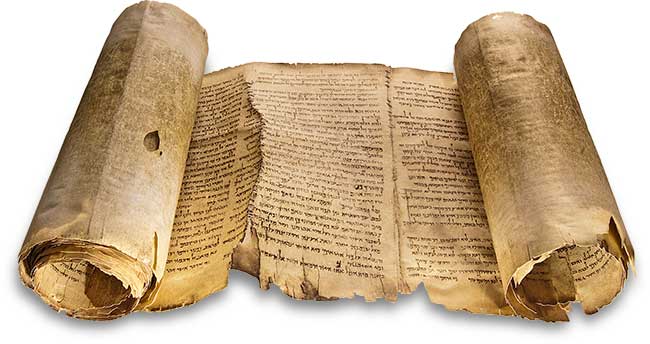
What is the Meaning of this Text? (Part of A Study on the Servant Songs of Isaiah, Session Two)

isaiah-scroll.l“What is the meaning of this passage?”

There have been many ways of answering this question. Indeed, there is a whole science called Hermeneutics that looks at how to interpret things (check out http://en.wikipedia.org/wiki/Hermeneutics). Anglo-American Analytical philosophy is entirely about language and meaning, and continental philosophy is arguably about hermeneutics.

In the past the meaning of a text was often determined by authority. Thus, the king or a judge interpreted a passage of written law, or the church said what an extract from the Bible meant. You could disagree, but it was not just a matter of opinion, but of challenging power. The rabbis discussed what the interpretation of Torah was, and their deliberations were codified in the Mishnah and the commentary on the Mishnah known as the Gemara. Together they are the Talmud, and there are commentaries on them. Sometimes a text from the Torah, after being worked on in the Mishnah, Gemara, and commentaries, would be seen to mean something completely different from the plain reading – but it was the Talmudic interpretation that was authoritative.

In ancient times and medieval period Christian scholars developed a four-fold approach to the meaning of scripture. First was the historical, which was the least interesting and meaningful – it was just data. Second was the moral meaning, the message about how we might live our lives. This was good for the common folk and those who were barely nominal Christians. The third approach was typological, which looked to see Christ in all things, allegories that instructed religious monks and nuns, clergy and pious laity. Finally, and most important, were the spiritual meanings, which led to understanding the metaphysical and spiritual nature of the cosmos and God, the soul, salvation, and the divine. This last assists one in contemplative prayer and spiritual union with God.

Luther, Calvin, and their followers tried to sweep all that away. During the Reformation they claimed that the Word of God spoke for itself in its plain meaning. This approach underlies much conservative evangelical hermeneutics today, and it certainly challenged some of the wilder interpretations of scripture that medieval scholars and mystics were coming up with. But it begged the question that we could in fact discern the plain meaning of texts. This is apparent in Luther’s translation of the Bible into German, a work so influential that it may be said that in so doing he created German as a literary language. Unfortunately, some of his translations were influenced by his conflict with Catholicism, his growing anti-semitism, and his  misreading of Paul in Romans.

In modern times (let’s say Shakespeare is early modern) people began to think the proper way to understand a text was to look at who the author was – biography as interpretation. Thus, if we want to understand Shakespeare’s plays and poetry, we need to know who he was and who he associated with. Was he a secret Catholic? Who is the dark lady in the sonnets? What is the importance of his relationship with his son, who died young and was named Hamnet? Was he really the actor from Stratford, or was he really some better educated aristocrat? Or, if applied to scripture, who was Paul? Who was Isaiah? Did Moses write the Torah, and if not, who did?

Modern Biblical scholarship went through several cycles of trying to find the “original” (and therefore more “authentic”) meaning. Thus, textual criticism compared manuscripts, and tried to determine what the original autograph might have looked like. To this day, the standard Greek text of the New Testament is determined by scholars who, when there are variations in a passage,  vote on what they think is the best reading (and they have rules and criteria for deciding). Source criticism tried to determine what the sources for the texts originally were. Thus in the early 19th century German biblical scholars began to feel that the parallels in the first three gospels indicated literary dependence. The authors of Matthew and Luke, they thought, had the Gospel according to Mark in front of them, which they edited and rewrote, as well as another written source that has not been preserved called Q (from the German Quelle or source). Form-criticism (as originated by Rudolf Bultmann in the early 20th century) tried to determine the evolution of a passage, working backwards from the text through its sources to the original oral form. Redaction criticism, in reaction to this concern with origins,  looked not to the original form of the story, but the final form in the text as we have it. Thus, rather than atomizing a text like Luke into various constituent parts, a redaction critic asks what the overall message is in the text as it is.

Redaction criticism is closely related  to the early 20th century literary approach called “close reading” which itself was a reaction to more biographical approaches. Do we understand T.S. Eliot’s The Wasteland by knowing about his disastrous first message, or do we focus on the relations of the words internally to each other?

Several other approaches also developed in the 20th century. Reader response was developed by Stanley Fish in the 1960s as he taught John Milton’s epic poem Paradise Lost. The late-18th century poet and graphic artist William Blake famously noted that the first two books of Paradise Lost, featuring Satan and Hell, were much more interesting than Book III where he writes about God and Heaven. Blake concluded: ‘The reason Milton wrote in fetters when he wrote of Angels and God, and at liberty when of Devils and Hell, is because he was a true Poet and of the Devil’s party without knowing it.” Fish said that the absorbing rhetoric and charisma of Satan was not some unconscious favouritism of Milton, but a deliberate attempt by the poet to seduce and manipulate the reader. The issue for Fish is not what Milton consciously or subconsciously thought he was doing, but rather the response generally evoked in the reader by the style and rhetoric of the text. The reader is an active participant in the creation of meaning.

Another 20th century approach is Critical Theory, which emerged in Germany and spread into English faculties in the UK and North America as a blend of Marxian theories and Freudian analyses. It is typically looking at power relations in texts and the construction of realities. Some aspects of it have been taken up in post-colonial theory, feminist literary theory, and Queer theory, although most of them would abjure the Marxist and Freudian designations.

Russian and French literary theorists developed the idea of intertextuality which positions a text as relating to and always being an interpretation of another text. Thus, Jane Austin’s Northanger Abbey needs to be read as a parody of late 18th century Gothic novels. James Joyce’s Ulysses must be read in relation to a whole library of books – The Odyssey, Irish newspapers, Hamlet, Irish drinking songs, romantic novels, catechisms, Anglo-Saxon, and, of course, the Bible.

Associated with the French philosopher Jacques Derrida is the movement known as Deconstructionism or Post-Modernism. This approach holds that a text kind of deconstructs itself – that within the surface meaning are implications that subvert that meaning. Thus, while we assume a work is coherent, that is actually an assumption a reader imposes on a text. We talk blithely about the author, whereas the author is really a function a reader uses to impose unity and coherence o a text. Roland Barthes in 1967 wrote his most important essay called the Death of the Author which lays this out. S/Z is a phenomenological analysis of a French short story in which he sees how the universe of that story is created with all its ambiguity and direction.

All of these literary approaches have been applied to the Bible, and the contradictory approaches makes one’s head spin. I remember being at Harvard in 2002-2003 and the eminent historian of early Christianity Karen King had the Graduate New Testament seminar read a library of French literary theory and try to apply it to various Christian texts. It was like trying to teach cats synchronised swimming. So what’s a simple student of the Bible to do?

My own approach is to heed all of these approaches, and recognise that while any number of interpretations are possible, not all are equally valid, and many are limited. Often various interpretations are best held in tension.

I begin with the fact that paper, ink, and binding does not have an inherent meaning, but only becomes a passage of scripture when I read it and my brain processes it. The meaning is not “out there”, some objective truth in Plato’s universe of ideas, but rather it is created subjectively within me as I read, as I mull it over, re-read, and relate it to other things I know. Martin Heidegger described the hermeneutical circle, in which a person or community reads a text and that reading is informed by everything that they bring to it. But the reader or community of reading is changed by that reading, which means when they come back to it they read it differently. As Christians we continually return to the same texts, the same ideas, over and over again, and we bring new experiences to them as we are transformed by them. As human beings, then, we are incapable of having a definitive meaning to any text, because meaning is historically conditioned. This is not relativism, because relativism says anything goes, but rather a recognition that we have a shifting set of criteria to determining meaning depending on who we are and the reasons we are reading. The reality is few people read scripture as if it were a detective novel or a thriller. We read it from positions of faith or from some intellectual curiosity.

Let me introduce the concept of time. Right now, as you read this, the past and the future does not exist. The only thing that exists is the present, not a moment but an incessant forward motion that is not past or present. The past exists only inasmuch as it is present now in its effects now and in the future. We can reconstruct the past through memories, physical evidence, texts in our hands, but all of this is a reconstruction. To ask “What really happened in Jerusalem in the 8th century BCE” is to ask “What does our best reconstruction look like?” All interpretation is this kind of reconstruction. To ask what a text is to say, “If I use the best criteria for interpreting this, what do I get?” Now, right now, here and in this place, you do have some scope of command and control. You can read a passage as emancipatory, you can be inspire to do something, you can relate it to other texts, you can ignore it, or just enjoy it. Reading is action and in time, and meaning is an action in you.

Biblical texts are important for me as a Christian because not only because they are historical documents addressing 1300 years of God and people, and which have been influential for 3000 years, but because I choose to see God speaking to me from them. I am inspired when I read the Bible, when I translate the Hebrew into English, when I preach on it, when I act in relation to others and with others, and when I allow it to inform my prayers. Indeed, subjectively it feels as though I am not making a choice, or allowing anything that happens, but that God has gone before me to create these texts to come alive in me and in the community of faith.

And God speaks in pluriform voices and in the mouth of friend and stranger. It is by encountering other people and their opinions that I come closer to what the meaning of a text might really be. The meaning of a text, ultimately, is incarnate in human flesh, mine and others, which is undoubtedly connected to the Christian dogma that in Christ the Word became flesh and dwelt among us. We are a historical religion, we are a faith of the present looking to the future, we are a religion that cherishes materiality, and we should not have it any other way.

Posted in Uncategorized | Tagged , , , , , | Leave a comment

A Study on the Servant Songs Session One November 25, 2014

A Study on the Servant Songs          Session One   November 25, 2014

Parish of St. Matthias, Victoria BC       Diocese of British Columbia, Anglican Church of Canada

This session is about setting the context for looking at the Servant Songs. The Servant Songs are: Isaiah 42:1-4; 49:1-6; 50:4-9; and 52:13—53:12. These notes reflect what was discussed and presented on November 25.

What do we already know about Isaiah? He is a prophet, one who speaks on behalf of God to the people, and one who may speak on the people’s behalf to God (Moses being the model). The image of the Servant is one that influenced the Christian understanding of who Jesus is, and may well go back to Jesus himself. The image of a servant is also critical for any Christian’s self-understanding.

Isaiah is the source of much of The Messiah (1741) by Georg Händel (and from the Servant Songs: 21. Aria He Was Despised (Isa. 53:3; Isa. 50:6); 22. Chorus Surely He Has Borne Our Grief (Isa. 53:4-5); 23. Chorus And with His Stripes (Isa. 53:5); 24. Chorus All We Like Sheep (Isa. 53:6); 29. Recitative He Was Cut Off (Isa. 53:8)).

As Christians we need to remember that we tend to read a text like this in a way that is different from Judaism, and perhaps different from the original author. On the first day of classes a professor in an Introductory Course to the Hebrew Bible asked: “What is the Hebrew Bible about?” The students replied variously, “Torah!” “The Covenant” “Exodus and the People of Israel”, all of which the professor nodded at and affirmed. “What is the New Testament about?” he asked. “Jesus!” they answered. “Excellent. Now, what is the Old Testament about?” This puzzled the students, as they thought that they had already answered that. “Torah?” said one. “No!” said the professor. “The Covenant?” said another. “No!” he said again. Then one particularly bright student said, “Jesus?” to which the professor said, “Yes, exactly, Jesus. For Christians the Old Testament, as well as the New, testifies to Jesus. But the Hebrew Bible, with a different arrangement from the Old Testament, with a separate history of interpretation for over two-thousand years, is not the same. Further, modern historico-critical methods of scholarship (i.e. most scholarship of the past two hundred years) will not assume a context of faith, but treat biblical texts as historical documents; the assumptions and interpretation will then be somewhat different from either Judaism or traditional Christianity. Part of the task of our reading is to note the different interpretive contexts and to hold them in creative tension.

The Hebrew Bible is known in Judaism as the Tanakh, an acronym taken from the first letters of the three major divisions: Torah (Law, or Instruction), Nevi’im (Prophets), and Kethuvi’im (Writings). Some of the contents of these divisions are counterintuitive to Christians – historical books such as Joshua, Judges, 1 & 2 Samuel and 1 & 2 Kings are part of the Nevi’im, and Daniel is in Kethuvi’im. Part of this is a function of the development of the Hebrew canon – the Torah was completed and stabilized first, followed by the Nevi’im, and the Kethuvi’im was still somewhat open in Jesus’ time. This disconcerting lack of a stable canon can be demonstrated in two ways. First, when Jews in Egypt translated the Hebrew sacred scriptures into the Greek version we know as the Septuagint, it included many books which ultimately were not included in the Tanakh: Ecclesiasticus (Sirach), 1 & 2 Maccabbees, Wisdo, and Tobit, for example. The texts were part of Christian scriptures, both Greek and Latin, until the Reformation in the 16th century when their status was questioned; Catholics continue to regard them as part of the canon, but acknowledge them as the “deutero-canon”, whereas Reformation Christians consider them exra-canonical or apocryphal. The Hebrew originals were lost until the discovery of the Dead Sea Scrolls in 1946-1956, among which were portions of some of the deutero-canonical texts. Second, amongst the Dead Sea Scrolls were many biblical texts that have always been part of the canon – the psalms, Jeremiah – but their arrangement and specific wording was often different from what was in the Hebrew canon. Thus, as we approach these texts, we must acknowledge that not only are there a variety of ways to read them (Jewish, Christian, historico-critical), but that the texts themselves may vary.

Interestingly, this is not so much of an issue with the text of Isaiah. The oldest manuscript of the Tanakh is Codex Leningradensis (1008 CE/AD), and the standard critical edition of the Hebrew Bible (Biblia Hebraica Stuttgartensia 1977) is based on it. Interestingly, the Dead Sea Scrolls versions of Isaiah (http://dss.collections.imj.org.il/isaiah there were some twenty scrolls, including one virtually complete dating from about 150 BC/BCE, as well as several commentaries) are in substantial agreement with Leningradensis. Thus, the text of Isaiah was well stabilized by the middle of the 2nd Century BC/BCE.

A cursory overview of Isaiah reveals a varied text. Some of it is poetry, some is prose. There is no real sense of narrative – no beginning, middle, or end. Some sections have titles. Here is a summary:

Chapter, Verse and Description Title in text [or description]
“First Isaiah” 1.1       [Introduction] The vision of Isaiah son of Amoz, which he saw concerning Judah and Jerusalem in the days of Uzziah, Jotham, Ahaz, and Hezekiah, kings of Judah.
2.1         [The “Core” of Isaiah’s Prophecy] The word that Isaiah son of Amoz saw concerning Judah and Jerusalem.      
[Oracles Against the Nations]   13.1 The oracle concerning Babylon that Isaiah son of Amoz saw.
14.24 [Oracle concerning Assyria]
14.28 [Oracle concerning Philistia]
15.1 An oracle concerning Moab.
17.1 An oracle concerning Damascus.
18.1 [Oracle concerning Ethiopia]
19.1 An oracle concerning Egypt.
19.8 [An oracle concerning Egypt, Assyria, and Israel
21.1 The oracle concerning the wilderness of the sea. [Babylon, Edom, and Arabia]
22.1 The oracle concerning the valley of vision
23.1 The oracle concerning Tyre.
24 – 35              [Varied Judgment & Hope] Now the Lord is about to lay waste the earth and make it desolate
36 – 39     [Passage from II Kings 18-20]  
“Second Isaiah” 40 – 54 Comfort, O comfort my people, says your God.
55 – 66

“Third Isaiah”

Soon my salvation will come,
and my deliverance be revealed

While the text of Isaiah was stable by the middle of the 2nd Century BC/BCE, a review of its contents suggests that it is a collection of prophecies. Chapters 36-39 are mostly prose, and appear to be taken from II Kings. The interpolation of this text forms a bridge between 1-35 and 40-66. Whereas the first section is filled with warnings and judgments, with a small amount of comfort, 40-66 is mostly comfort with a minority of warnings and judgments.

It is not clear who wrote down the visions. Isaiah is sometimes in the first person (Chapter 6), at other times he is referred to in the third. Most of the time it is God who is speaking, not Isaiah.

Chapter 40-66 refers to a situation that assumes the deportation of the Judean ruling class and much of the population to Babylon following the fall of Jerusalem in 597 BC/BCE (as does Psalm 136: “By the waters of Babylon we laid down and wept.”). Cyrus II, the Persian king who conquered Babylon in 540 BC/BCE and issued an edict in 536 BC/BCE allowing the Judeans to return and rebuild the Temple; Cyrus is mentioned by name in 45.1: Thus says the Lord to his anointed, to Cyrus . . . This suggests that these passages were indeed written during the Exile or soon after. The highway in the desert described in Isaiah 40 is a means for the Judeans to return to Judea from Babylon, not by the long route up the Euphrates and Tigris to northern Syria and then south to Jerusalem, but miraculously through the uninhabited desert of what is now western Iraq and eastern Jordan.

Thus, to put things in a chronology:

1000 BC/BCE United Kingdom of Judea and Israel

David 1000-960

Solomon 960-920

Breakup of kingdom into two in 920

Kingdom of Judea   (Jerusalem)

Kings are all from the House of David

Kingdom of Israel

(Samaria)

Kings are a series of dynasties, repeatedly usurped

900
800 Uzziah 783-742

Jotham 742-735

Ahaz 735-715

Hezekiah 715-687

Isaiah

722 Fall of Samaria

End of the Kingdom of Israel

722 Assyria conquers Israel, 701 invades Judea

700 Manasseh 687-642

Amon 642-640

Josiah 640-609

Book of the law “discovered” in the Temple – 1st version of Torah?

Jehoahaz 609

Jehoiakim 609-598

Jeremiah

605 Subjugation of Jerusalem by Babylon

612 Babylon conquers Assyria

600 Jehoiachin 598

Zedekiah597-587

596 First Deportation

586 Judean Revolt. Destruction of Jerusalem & the Temple. Second Deportation. End of the Kingdom of Judea


520 (?) Rebuilding of Jerusalem and the Second Temple

III Isaiah ?

Haggai   Zechariah

596/586 Exile in Babylon

II Isaiah

Ezekiel

Psalm 136

539 Cyrus the Persian conquers Babylon

536 Edict of Cyrus. Exile over. Many Jews return, many stay in Mesopotamia.


Traditions behind the Babylonian Talmud are developed.


500 Nehemiah Ezra
400 Final redaction of the Nevi’im (Prophets)

325 Alexander the Great conquers Persians. Hellenistic Empires of the Ptolomies rule Judea from Egypt.

300
200 200 Hellenistic Empire of the Seleucids rule Judea from Antioch

168 Maccabean Revolt, Judea achieves autonomy

150 BC/BCE Earliest known copy of Isaiah

100 63 Pompey the Great conquers Judea for the Roman Empire
1 AD/CE 4 BC/BCE (?) Jesus born

30 (?) Jesus is crucified. Resurrection.

33 (?) Calling of Paul. The Letters of Paul

60 (?) Paulis executed.

65 (?) Gospel of Mark

66 Judea revolts.

70 Jerusalem destroyed. Second Temple destroyed. Dead Sea Scrolls hidden.

75 (?) Gospel of Luke, Matthew, Acts

90 (?) Gospel of John, Revelation

BC/BCE: “Before Christ”/”Before Common Era”

AD/CE:     “Anno Domini Year of our Lord”/”Common Era”

Many scholars, then, believe that Isaiah 1-35 was written by the historical Isaiah and/or his immediate disciples who lived towards the end of the 8th Century BC/BCE; this is commonly known as First Isaiah. 40-66 is the result of a later author or authors, from the time of the Babylonian Exile in the 6th Century BC/BCE or later. Chapters 55-66 is thought by some scholars to reflect the disappointment of some of the returned exiles, and reflects a more apocalyptic perspective that earlier chapters; this is commonly known as Third Isaiah. It is notable that the Hebrew is not as good in 55-66 as in the earlier chapters.

These, of course, are scholarly conjectures. Conservative evangelicals will argue for the modern idea that there must be one single author named Isaiah, and that in the 8th century the historical Isaiah was divinely inspired to name the Persian King who would conquer the Babylonians in 520 and end the exile. Scholars arguing for multiple authors note that ideas of “the author” were different in ancient times than today.

Having set up some contexts for interpretation, next week we will get into the text of the first two Servant Songs.

Posted in Uncategorized | Leave a comment

A Guide for Members and Delegates to the Synod of the Diocese of British Columbia

Cover

The eighth edition of the ever popular Synod Guide by yours truly is now available. You can download it at http://bc.anglican.ca/page/synod-2014 or it is available for download here.

Posted in Uncategorized | Leave a comment

Prolegomena to Any Future Marriage Canon That Will Be Able to Present Itself as Biblical and Theological

A Submission to the Commission on the Marriage Canon,
Anglican Church of Canada

by

The Reverend David Bruce Bryant-Scott BA MDiv ThM, Rector, The Parish of St. Matthias, Victoria, The Diocese of British Columbia, September 29, 2014

This paper presents an argument for the amendment of the marriage canon in the form of a series of disparate thoughts and questions related to it. I have not read through many other submissions, and I hope that I am not repeating too many of the points others have made with greater eloquence and evidence. I pray that it might be useful to the Commission as it goes about its work. May God bless the members of the Commission, and General Synod 2016.

  1. The Change in the Anglican Theology of Marriage

The fact is, the theology of marriage has changed over time in the Anglican Church. We need only look at the Book of Common Prayer (“BCP”) and the Book of Alternative Services (“BAS”) to see this.

In the BCP of 1549 we read:

DEERELY beloved frendes, we are gathered together here in the syght of God, and in the face of his congregacion, to joyne together this man and this woman in holy matrimonie . . . Duely consideryng the causes for the whiche matrimonie was ordeined. One cause was the procreacion of children, to be brought up in the feare and nurture of the Lord, and prayse of God. Secondly it was ordeined for a remedie agaynst sinne, and to avoide fornicacion, that suche persones as bee maried, might live chastlie in matrimonie, and kepe themselves undefiled membres of Christes bodye. Thirdelye for the mutuall societie, helpe, and coumfort, that the one oughte to have of thother, both in prosperitie and adversitie.

Thus, in brief, the purposes of marriage are 1) procreation, 2) chastity, or a remedy against sin (i.e. sexual relations outside of marriage), and 3) mutual society, help, and comfort. This order of purposes was maintained in the 1552, 1549, and 1662 BCPs, which would have been authoritative in any Anglican service held in Canada until 1918.

In the 1918/1921 Canadian BCP there is a significant change in wording:

Matrimony was ordained for the hallowing of the union betwixt man and woman; for the procreation of children to be brought up in the fear and nurture of the Lord; and for the mutual society, help, and comfort, that the one ought to have of the other, in both prosperity and adversity.

Thus the purposes enumerated are 1) hallowing the union of the man and woman, 2) procreation, and 3) mutual society, help, and comfort. Why is there this change? The word “hallowing” is much more positive than “a remedy against sin”. Perhaps it has to do with the raising up of the role of the officiant of the marriage, who offers a matrimonial blessing. Perhaps it has to do with the greater valuation of the blessing and what it might signify as a sacramental act (corresponding to the influence of Tractarians and Anglo-Catholics within Anglicanism). I would hope that the Commission has access to an historian who can illuminate them on this subject. In any case, a change did take place, and it suggests that procreation is no longer the primary reason for marriage. This change in wording was carried over to the 1959/1962 Canadian BCP.

The marriage service in the 1985 BAS presents another striking change:

The union of man and woman in heart, body, and mind is intended for their mutual comfort and help, that they may know each other with delight and tenderness in acts of love [and that they may be blessed in the procreation, care, and upbringing of children].

“Mutual comfort and help” is moved to first place from third. Language about “Hallowing” is dropped, and instead in second place sexual relations are described as “acts of love” which involve delight and tenderness (and arguably may actually include more than sexual), and procreation is demoted to third place, clearly optional depending upon the circumstances.

I do not believe that these are insignificant changes. Rather, they reflect the church’s mind about marriage over 450 years. Insofar as lex orandi, lex credendi is a fundamental character of Anglicanism, it suggests shifts in the Anglican theology of marriage. It is clear that over time the procreation of children is not the foremost aspect of marriage, but rather “mutual comfort and help”. Sexual relations, in 1552 a behaviour that is sinful outside of marriage but remedied within it, becomes in 1918 something which is hallowed (like the name of Our Father?), and in 1985 an act of love containing delight and tenderness.

The point I am making here is that as our theology of marriage has changed in the past, so we are not precluded from changing it with good reason in the present and the future.

And I haven’t even mentioned marriage after divorce . . .

  1. Blessing is not Magical But Apocalyptic

What happens when we bless something? One way of imagining it is that it is a bestowing or infusion of some kind of holiness on something. Thus, when a priest or bishop blesses a congregation, the blesser invokes God’s favour upon the blessed. The nuptial blessing is the climax of a wedding, after vows have been made and a symbol or symbols of the marriage have been exchanged. When someone sneezes we bless the person, as if some sort of exorcism was taking place. The English word “bless” appears to be a cognate with “blood”, suggesting some ancient connection with blood sacrifices and the benefits that flow from such. In Christianity when the bread and wine is sacramentally blessed at communion, we intentionally act in accordance with Christ’s command, and invoke the Holy Spirit to come upon the congregation and the elements, that they might be the body and blood of Christ.

But this is too close to magic – “Hoc est corpus” becomes “Hocus pocus”. It elevates the role of the officiant and diminishes the work of the people. Also, this idea of blessing – as a simple bestowing of God’s favour, working some kind of transformation in the thing or person(s) blessed, leads us down the route of fruitless arguments over the nature of that change (transubstantiation, anyone? receptionism?). Also, it fails to deal with the ubiquitous phraseology of scripture in which God’s divine self is blessed: Bless the Lord, O my soul” (Psalm 104.1) “Blessed are you, O Lord” (Psalm 119.12). If a blessing bestows some kind of holiness, or is about God’s favour, how does that fit when psalmist’s soul blesses God? Is anything added to God? Surely not!

Blessing is really about a recognition of the divine being present – either directly in the Lord God’s own self, or indirectly in creation. Thus, when a congregation is blessed, it is a communal recognition of the activity of God amongst the congregation, that whenever two or three are gathered Christ is present amongst them, and that the Spirit is at work both dramatically and subtly. The priest officiates at a communion service not as a magician who transforms bread and wine into the body and blood of Christ, but as the designated representative of both the people and bishop who on their behalf takes bread and wine, says the blessing, breaks the bread, and distributes it, the whole action of the people with the officiant being the transformative act that recognizes that when the community gathers and does this the presence of God is celebrated in the elements and in the community.

Blessing is not magical, but apocalyptic. Ἀποκάλυψις means “revelation”, and literally is “unveiling”. The last book of the New Testament is The Revelation to John and because it deals with the Day of the Lord and the terrible end of God’s enemies the word “apocalyptic” has a negative sense for most people. I’d like to reclaim “apocalypse” as a profoundly positive word for Christians, in the sense that God’s revelation is good news. When something or someone is blessed, the goodness of God in that thing or person is unveiled and revealed, not as some passive infusion of grace, but as a complex, dynamic interaction between the divine and creation.

So what happens in marriage? Surely, when the congregation gathers and a member of the clergy officiates, it is not they who effect the marriage, but the couple who are marrying. As Christians we recognize that God is at work within the couple. The ring is blessed, but as a symbol of the vows the couple have made, and of what God is doing with the two people. The couple receives a nuptial blessing, and again it is an apocalyptic revelation of God’s love working itself in the two who have become one.

I see blessing and sacrament on a continuum. We bless things, and we consecrate the elements of bread and wine in the eucharist. We bless animals and cars and ordain clergy and solemnize marriages.

We can come up with sharp definitions that would distinguish a blessing from a wedding. For example, when two people who happen to be in a monogamous, life-long relationship, have had a civil marriage, but are of the same sex ask for a blessing from a priest, we call it a blessing. When two people of different sexes make vows, exchange rings, and are blessed by a priest or bishop, then we will call it the sacrament of Holy Matrimony. Such definitions strike me as more political than theological. If it looks like a duck, quacks like a duck, walks like a duck, then why do we go to such lengths to deny its duckyness and say it’s really a horse? As members of the Commission may recall, the first draft of the rite for the Blessing of a Same-Sex Couple was rejected by the then bishop because it looked too much like the The Celebration and Blessing of a Marriage in the BAS. I think that it says a lot that the clergy and liturgists involved had to have a second go at it in order that it might not offend those who would be pacified by the notional distinction between blessing and sacrament.

  1. All Things are Lawful, but Not Everything Builds Up

Scripture says many things about marriage, sexual acts, and what we now name as “gender”. The question of interpretation is what to do with all of this.

My own hermeneutical stance is that of Paul in 1 Corinthians 7.12: Πάντα μοι ἔξεστιν, ἀλλ’ οὐ πάντα συμφέρει. πάντα μοι ἔξεστιν, ἀλλ’ οὐκ ἐγὼ ἐξουσιασθήσομαι ὑπό τινος. “All things are lawful unto me, but all things are not expedient: all things are lawful to me, but I will not be brought under the power of any.” (AV/KJV). Συμφέρει is also translated as “helpful”, “edify”, and “build up.” Paul boldly proclaims a radical ethical freedom in Christ Jesus, but clarifies that when acting out of this freedom the criteria of what is “helpful” or “builds up” to needs to be applied; if the criteria leads to being brought under the power of anyone or anything then it is not “expedient.” Paul explicitly applies this approach in his First Letter to the Corinthians to ethical questions regarding sex and food offered to idols, and it is clear to him that some things really do not build up: incest, sex with prostitutes, and the flaunting one’s freedom before those with greater scruples. He also appears to apply it to other issues – divisions in the church, lawsuits between believers brought before pagan judges, worship, and the exaltation of some spiritual gifts over others. Sometimes he struggles with the application.

Nowhere is this most obvious in chapter 7 of 1 Corinthians, when he discusses the marriage of women and men. Paul appears to have a continuum of sexuality, in the context of the nearness of the Day of the Lord. At one extreme end incest and sex with prostitutes is clearly bad, and at the other end celibacy (so as to be free to serve others), as he himself lived, was clearly best. In between was marriage. He grudgingly says it is better to marry than to burn, suggesting he was chagrined at his brothers’ and sisters’ insistence on conjugal sex. Also, despite a clear word from the Lord (i.e. an oral tradition ascribed to Jesus, placed in the mouth of Jesus in the Gospel according to Mark) that divorce is forbidden, he allows for believers to separate from non-believers, and judges that they “are not bound.” The impression one gets is that Paul is inventing this advice as he dictates it.

In the Bible we see several types of marriage, always between people of different sexes: monogamy, polygamy, and concubinage. The latter two appear only in patriarchal times and amongst the rulers of Judah and Israel. By the time of Jesus monogamy was normative, and in Ashkenazi Judaism polygamy was outlawed in the 11th century (and is virtually unheard of in the other branches of Judaism). Within the Hebrew Bible, then, the relationship between woman and man in marriage is the ideal. Once one is married sex outside of marriage is unacceptable. Pre-marital sex is not encouraged, especially among women – but this may have more to do with patriarchal values about women as possessions than any actual valorization of celibacy as such, as happened later within Christianity.

Within Christianity we do see the rise of a cult of virginity, higher than the traditional high status of marriage. Jesus appears never to have married, and Paul was likewise an unmarried apostle (unlike Peter). The idea (ascribed to Jesus) that in the resurrected life men and women are not given in marriage may have influenced this trend.

So what are we to do with same-sex blessings? Again, given our radical freedom in Christ, what is helpful and expedient? Neither Paul nor Jesus was ever directly confronted with the question of whether marriage and sexual relations between same-sex Christians was acceptable. We can well imagine that, as 1st century Jewish men, they might not have been terribly impressed by the idea, but the fact is that we have no direct scriptural warrant against it. Perhaps such a scriptural lack is providential, for it may allow us at this time to say that whatever may have been the case in the past, now is the time to affirm that such relationships is helpful, does build up, and is expedient.

Some will say, however, that our freedom in Christ is constrained and guided by the moral law as contained within scripture. Article VII of the Articles of Religion states:

Although the Law given from God by Moses, as touching Ceremonies and Rites, do not bind Christian men, nor the Civil precepts thereof ought of necessity to be received in any commonwealth; yet notwithstanding, no Christian man whatsoever is free from the obedience of the Commandments which are called Moral.

By this argument, then, same-sex relations are explicitly forbidden in Leviticus 18 and 20, and Paul implicitly included this in his condemnation of fornication (ἀρσενοκοῖται) in 1 Corinthians 1.9. I reply to such an objection by re-affirming the Pauline principle that, “All things are lawful unto me, but all things are not expedient: all things are lawful to me, but I will not be brought under the power of any.” The division of Torah into ceremonial, civil, and moral is alien to Jewish thought, and a relatively late Christian hermeneutical principle; it also begs the question as to what is moral and what is not. Arguably the prohibitions from Leviticus are grounded in language of ceremonial purity, not morality. The prohibitions likewise may have played an important role in civil differentiation between Israelites and others, as did dietary regulations. The Articles of Religion are not binding upon the Anglican Church of Canada; should 21st Century Anglicans “be brought under the power” of a medieval hermeneutic of Old Testament?

In the contemporary Anglican understanding of marriage the primary purpose is “mutual help and comfort”, and the second purpose listed in the BAS is “acts of love” i.e. sexual affection. Procreation is valued, but not as highly in the past, undoubtedly the result of a) birth control and the corresponding loss of inevitable procreation; b) the tendency in countries with rising incomes and educations to have lower birth rates; and c) the increasing number of seniors who are beyond having children. Scripture speaks powerfully about this erotic love that is now at the centre of marriage, nowhere more so than in the Song of Songs. Historically this was a book cherished by Jewish rabbis, celibate monastics, and sexual Puritans, as it was seen as an allegory of the love of God for his chosen people and the love of Christ for the Church. While the personages in the Song of Songs are male and female, there is nothing within those passages that in principle might not be also said by a lover to another of the same sex. With the normalization of same-sex relations and marriage by law and culture in Canada, this forces us to wonder whether the Anglican Church of Canada will continue to be a trailing indicator of our society, or whether our faith allows us to take a step forward in recognizing in the love of a same-sex couple the reflection of God’s love for us.

  1. In Canada We Have Several Types of Marriage

Marriage in Canada is complex. To begin with, marriage is a provincial jurisdiction, so each province (and the territories under the federal government) have their own rules and regulations. While they have tended to be similar to one another, significant differences exist, in particular between Quebec and the other provinces. Marriage is not only covered by “Marriage Acts” but also by “Family Acts” that deal with what happens when marriages break down. As well, issues of inheritance, property, pension benefits, and the like have significantly different rules depending on relations of marriage or their absence.

Perhaps the most significant fact is that we effectively have two types of marriage – what one might call “statute marriage” in which one is married by an official commissioned by the government, and “common law marriage” in which one’s living situation results in a “marriage like” relationship. Statute marriage is readily understood as requiring some sort of ceremony and registration with the government, and is effective the day of the ceremony.

Common law marriage is more complicated, largely because it has been established by case law first and then codified into statute. For the purposes of immigration the Government of Canada considers common law marriage to be established if one has been living in a marriage-like relationship for at least twelve months. The Canada Revenue Agency also recognizes twelve months of living together as establishing a marriage-like relationship, and further, if a couple living together adopt or naturally have a child, they are considered a family and in a marriage-like relationship regardless of the amount of time. Ontario, Alberta, and New Brunswick require three years of cohabiting to be recognized as common law marriage under their various acts; British Columbia and Nova Scotia require only two years. There is no true common law marriage in Quebec, as it is governed by a civil code, like most of Europe, but it does have “civil unions” which are virtually the same as traditional marriages.

Christian marriage in the Anglican Church of Canada today is invariably “statute marriage” although we also have The Blessing of a Civil Marriage in Occasional Celebrations. Historically the requirement that Christian marriage needs to be somehow regulated by the government or church is a recent phenomenon. “Until the twelfth century the Church (i.e. the Latin Western Church) held that marriage was valid if entered into by mutual consent and then sealed by sexual intercourse.”[1] Canon law of the Church of Rome, and then the canon laws of the reformed Church of England regulated marriage rather hit and miss until 1753, when the Marriage Act was passed by the Parliament of Great Britain for England and Wales, requiring all legal marriages to take place in churches (Scotland had its own laws, and well into the 20th century there were a variety of “irregular marriages” not sanctioned by the church which were recognized as legal). This carried over to colonial British North America and into modern times, and the remarkable popularity of civil marriages today is a recent phenomenon. To this day clergy officiating at marriages are, like civil marriage commissioners, licensed by the jurisdiction in which they minister, and act as registrars of marriage.[2]

Marriage, then, comes across as a vitally important institution both today as well as in the past. It is not just about love, mutual comfort and help, or sexual affection. As far as the law is concerned, it is about the creation of families, the conferring of rights and obligations (especially as concerns children), taxes, pensions, life insurance, inheritance, and what happens to assets if the relationship is dissolved. Hollywood stars and anarchic rebels may claim that “I don’t need a piece of paper to say I love you!” but the state says that it gets involved the minute a child is born or adopted, or a certain (variable) time has passed.

Given the rising numbers of cohabiting partners, the decline in persons wishing to be married in church buildings or by clergy, and the rise in the number of children born out of wedlock, it seems to me that the church needs to have some serious reflection not only on love, sex, and sexuality, but also on the complex human relationships we get ourselves into. We can try and emphasise our older understanding of marriage, but this may not be helpful as we move into an era when the majority of people we are trying to evangelise have not been married in church, and many are the product of what would be described as “non-Christian” marriages. Perhaps it is helpful to see marriage as apocalyptic and not magical, as an unveiling of God’s action already at work in a couple and a family.

Frankly, our theology of marriage is rather “thin.” We need to have what anthropologist Clifford Geertz would recognize as a “thick description.”


  1. My Personal Position

I believe that it is right and good that the Marriage Canon of the Anglican Church of Canada be amended to permit two individuals to be married within the church, according to the law of the territory or province within which the marriage is held. The simple way to do this is to change the language within the canon so that it is not assumed that the persons marrying are not of different sexes or genders.

As a priest of the Diocese of British Columbia I have already blessed one same-sex couple, two men who had been living together for a quarter of a century. This was done with the permission of the bishop, and after the parish in which I ministered approved such blessings unanimously. The couple was married by a marriage commissioner earlier that day.

People who were at the General Synod in 2001 may recall that I stated on the floor that I was in favour of same-sex marriage, provided that General Synod authorized it. Since then a lot of water has gone under the bridge, and my views have evolved. If I were a bishop and had ius liturgicum I would empower any cleric within the diocese to go forward and marry same sex couples. Bishops within The Episcopal Church have already done this without waiting for an amendment to their Marriage Canon.[3] Given that the Canadian and American churches are already condemned by conservative evangelical Anglicans in North America and by prominent ecclesiastics and provinces in the Anglican Communion, what do we have to lose? The bonds of affection have already been strained to the breaking point. I have personally dealt with the results of radical conservatives breaking away, despite great restraint by the bishop and synod of the Diocese of British Columbia around the issue of same-sex blessings.

Arguably the General Synod of the Anglican Church of Canada does not forbid same-sex marriage, but merely endorses different-sex marriage; if the church does not forbid something explicitly, can it condemn those who do it? I recognize that this is a radical position, but after encouraging restraint and instead receiving nothing but vituperation and schism from my more conservative brothers and sisters in Christ, I see no reason not to move forward.

However, I am not a bishop, but merely a priest who has sworn to follow the direction of my bishop. Thus, I will not move to preside at a same-sex marriage. My more measured recommendation is that the Commission prepare the amendments to the canon as requested, with the required theological rationale, and let General Synod make its informed decision.

[1] Stephanie Coontz, Marriage, a History: from Obedience to Intimacy, or How Love conquered Marriage (New York NY: Viking, 2005), p. 106.

[2] This is not the case elsewhere. For example, I presided at a wedding in New York State, and did not have to have a license. Officiants simply have to be a mayor, a judge, a marriage officer, a member of the clergy, or recognized as a spiritual leader of some community.

[3] Namely, the dioceses of: Bethlehem, Central New York, Connecticut, Long Island, Massachusetts, New Hampshire, Rochester, San Joaquin, Vermont, Washington, and Western New York. http://www.integrityconnecticut.org/officiate.htm I am also personally aware of a same-sex marriage that took place in the Diocese of New York.

Posted in Uncategorized | Leave a comment

Signing Off

In the old days we signed letters laboriously by hand, writing, “Yours sincerely, ” or “Yours truly,” to those we knew and loved, “Love,”.  If you were truly formal, you might sign, “I remain, Sir, your faithful and obedient servant,”. Indeed, there is a whole wikipedia article about how people signed letters and notes: http://en.wikipedia.org/wiki/Valediction . 

Most people these days have some kind of sign off for e-mails, and even (occasionally) text messages. Amongst clergy and devout Christians you’ll see, “Shalom”, “Peace”, or “Yours in Christ,”. I’ve used a variety of these, but now I think I have found one I like.

“God be with you.” It’s simple, it’s a genuine wish, and it’s probably the case anyway. Also, it’s very traditional. Our phrase “Good bye” comes from it, at least according to the Oxford English Dictionary:  “Etymology:  A contraction of the phrase God be with you (or ye ); see god n. 8. The substitution of good- for God may have been due to association with such formulas of leave-taking as good day, good night, etc.” So I am really saying both “Good bye” and “God be with you.” I like that. So I am using it. 

God be with you!

Posted in Uncategorized | Tagged , , | Leave a comment

Open Source Church: Chapter One

opensource

What would happen if Christianity was like open source software (prominent examples are Java and OpenOffice, as well as the Firefox browser)? What would happen if the church was run like Wikipedia? The answer to this question is found in Open Source Church.

Landon Whitsitt is a Presbyterian minister in Liberty MO and the author of a recent book entitled Open Source Church: Making Room for the Wisdom of All (Herndon VA: The Alban Institute, 2011). He asks these questions, and then goes on to describe what might be the result. The book builds upon the ideas behind open-source software programming and crowd sourcing projects such as Wikipedia. It is deeply influenced by James Surowiecki’s book The Wisdom of Crowds (New York: Anchor Books, 2004). Whitsitt’s claim is that not only can Christianity be “open source”, but that it should be, as it is the faith in which “the truth shall set you free” and that grace and salvation are granted freely by God. For Whitsitt this double idea of freedom – freely given, free to act – is at the core of the good news of Jesus Christ.

The basic idea behind open-source programming and crowd-sourcing is that the collective intelligence and knowledge of a group is greater than that of any one individual. For example, in the show Who Wants to Be a Millionaire the contestant has a choice of four answers to a question and has to pick the correct one to advance to the next stage. In the course of the game she had three life-lines – call a friend, eliminate half of the incorrect answers (“50/50”), and ask the crowd. The friend was as often as not worse than useless, and the 50/50 still left an incorrect answer on the board, but the audience was brilliant, getting the correct answer virtually all the time. As the answers were solicited by simple, secret, electronic votes – no time for discussion or “group think” to emerge – it really reflected the collective wisdom of the crowd. And it was usually right.

Open Source technology uses the wisdom of crowds to collaboratively build great software. To do so it requires that software code is available to anyone and can be modified for anyone, subject to certain protocols of the Open Source Definition (“OSD”). OSD was created in 1989 by an American named Bruce Perrins. OSD sets ten criteria which  should be required for anything to be considered “open source.” Whitsitt calls these the 10 Commandments of Open Source, and he has adapted them for use by Christians.  He has also elaborated on the practical way in which these work. So here they are:

Open Source Definition (Perrins 1989) Gospel Commandment (Whitsitt 2011) In Practice (Whitsitt 2011)
1. Free Redistribution: one can make as many copies as one wishes, and sell as many or give away as many as one wishes. Thou shalt freely give what thou hast freely received. (p. 12) The gospel is freely received and freely given; you do not have to pay for it. The gospel sets you free. There is no requirement to receive the gospel, and one can freely proclaim it.
2. Access to source code is unrestricted. Thou shalt not restrict access to Jesus Christ, the Word of God. (p. 14) No one can claim to speak unequivocally for God or offer the last word on biblical interpretation.
3. Derived Works: Anyone can modify the received program and they can redistribute the modified program under the same terms by which they have received it. Thou shalt celebrate the gospel by celebrating contextualization. The gospel needs to live in and draw on real communities, which may be different from each other.
4. Integrity of the author’s source code: modified works must carry a different name from the original. Thou shalt respect the integrity of the person and work of Jesus Christ. No one person or group is in possession of the original, correct, or sole understanding of Christ’s person and work.
5. No discrimination against people or groups. No one can be excluded from receiving or proclaiming the fullness of the gospel. (p. 20) No exclusion, an acceptance of diversity.
6. No discrimination against fields of endeavor. You are free to use the software for any purpose. A commitment to neither restrict nor inhibit the actions of any person or group working to bring about freedom. Acceptance of diverse theologies. Conversations about freedom.
7. Distribution of License: The license accompanying the program must grant that the benefits of that license apply to all to whom the program is redistributed. The faithfulness of God in the covenant of freedom granted in Christ does not depend upon requisite behavior of the one who receives it.
8. License must not be specific to a product. A specific configuration of the program is not required for the OSD to be transmitted. The freedom promised in Christ’s gospel does not depend upon a particular understanding of that theology. No theology, creed, confession, doctrine, or statement of faith can claim, or can be said to be vested with, a total embodiment of freedom. The totality of the gospel will never be found in a particular, contextualized expression of it.
9. License Must Not Restrict Other Software. No terms and conditions for other software interacting with it or on the same system. God’s covenant with the body of Christ does not deny the truth and benefit found in other religious and wisdom traditions. As freedom is the primary concern of God in Christ, our bold proclamnation is always tempered with humility.
10. License must be technology neutral. Not restricted to any individual technology or interface, such as computer or operating system. The covenant of God is not restricted by the existence or actions of a particular church or gathering of believers. All gatherings of God’s people have the potential to actualized the freedom promised.

These protocols make up the first chapter of Whitsitt’s book. I’ll take up his description of “Church as Wikipedia” in another post.

Posted in Uncategorized | Tagged , , | Leave a comment

Levinas’ or Levinas’s ?

Emmanuel Levinas
Part of my PhD dissertation is about the philosophy of Emmanuel Levinas (1906-1995). A critical issue in any English language discussion of this philosopher is this: what is the correct possessive to use with the philosopher’s last name? Is it “Levinas’ philosophy” or “Levinas’s philosophy”?

Both occur in the literature. Ask an Anglophone Canadian and they will usually answer that it should be “Levinas’ ”. This attitude can be traced to the Canadian Style Guide which states:

Regarding the appropriate form for singular words that end in a sibilant, pronunciation is again the determining factor. If it would be natural to pronounce an extra s, add ’s; if an additional s would be difficult to pronounce, add only an apostrophe:

  • Joyce’s Ulysses
  • Ulysses’ wanderings
  • Brussels’ bureaucrats
  • the boss’s office[1]

However, when one actually reads the literature, the overwhelmingly preferred form  “Levinas’s”.[2]It is also used by translators such as Michael B. Smith, Gary D. Mole, Bettina Bergo, Barbara Harshaw, Alan Bass, Annette Aronowiscz, André Orianne, Michael Kigel & Sonja M. Embree, and Nidra Poller. Notably Levinas Studies published by Duquesne University uses “ ’s” as does Alphonso Lingis, translator of both Totality and Infinity and Otherwise than Being. So that should settle it, right?

No. Maddeningly, “Levinas’ ” is used by a minority: Toby Foshay, Richard A. Cohen in Ethics and Infinity, Merold Westphal in Transcendence and Self-Transcendence, Ernst Wolff in Political Responsibility for a Globalised World: After Levinas’ Humanism, the editors of Levinas and the Ancients, Alain Mayama in Emmanuel Levinas’ Conceptual Affinities with Liberation Theology, and Simon Glendinning in In the Name of Phenomenology. So which is correct?

The style guide I am required to use – MHRA (Modern Humanities Research Association) gives the following guidance:

  1. 5.2 Proper Names The possessive of proper names ending in a pronounced -s or -z isformed in the normal way by adding an apostrophe and s:

Alvarez’s criticism, Berlioz’s symphonies, Cervantes’s works, Dickens’s characters, in Inigo Jones’s day, Keats’s poems, Dylan Thomas’s use of language

French names ending in an unpronounced -s, -x, or -z also follow the normal rule and take an apostrophe and s:

Rabelais’s comedy, Descartes’s works, Malraux’s style, Cherbuliez’s novels

The possessive of names ending in -us also conforms to the normal rule:

Claudius’s successor, Herodotus’s Histories, Jesus’s parables, an empire greater than Darius’s

However, the possessive of Moses and of Greek names ending in -es (particularly those having more than two syllables) is usually formed by means of the apostrophe alone:

under Moses’ leadership, Demosthenes’ speeches, Sophocles’ plays, Xerxes’ campaigns

The Chicago Manual of Style also gives some guidance. “Levinas” ends with an “s” and normally a silent “s” is followed by “ ’s”; thus, one would write “Albert Camus’s novels”. However, the name “Levinas” was not originally a French name, and the “s” is pronounced[3]. Since it is pronounced, the following should apply:

  1. 18 Possessive of names like “Euripides”

In a departure from earlier practice, Chicago no longer recommends the traditional exception for proper classical names of two or more syllables that end in an eez sound. Such names form the possessive in the usual way (though when these forms are spoken, the additional s is generally not pronounced).

Euripides’s tragedies, the Ganges’s source, Xerxes’s armies[4]

*sigh*

This is a change from an earlier practice is which Biblical and classical names which ended in –s or –x simply had an apostrophe with no “ ’s”. Thus, it is traditionally “Jesus’ ” and not “Jesus’s”. However, as the 16th edition of the Chicago Manual suggests, this is the exception, and is no longer extended to classical names.

The Economist Style Guide[5] states: With singular words and names that end in s: use the normal possessive ending ’s: boss’s, St James’s, caucus’s, Jones’s, Delors’s, Shanks’s

Thus, while it looks ugly, “Levinas’s” will be used in the dissertation, in deference to the majority of authors, scholars, and modern style guides. But I don’t like it.

[1] Canadian Style Guide (Toronto ON: Dundurn Press & Public Works and Government Services Canada, 1997), 7.56.

[2] Namely, by: Adriaan Peperzak, Robert Bernasconi, Edith Wyschgorod, Diane Perpich, Judith Butler, Hilary Putnam, Roger Burggraeve, John Caputo, Seán Hand, Simon Critchley, Merold Westphal, Dermot Moran, Richard E. Cohen, Robert Gibbs, Ze’ev Levy, Robert Eaglestone, Samuel Moyn, Slavoj Žižek, Graham Ward, Nathan Ross, Stephen Hendley, Jane Hiddleston, Jeffrey Bloechl, J. Aaron Simmons, Corey Beals, Tamsin Jones, B.C. Hutchens, Phillip Blond, David Appelbaum, Megan Craig, Ira F. Stone, Michael Morgan, Diane Moira Duncan, Manuel P. Arriga, Jill Robbins, and Peter E. Gordon.

[3] To add to the confusion, it is written in French as both “Levinas” and “Lévinas”

[4] The Chicago Manual of Style 16th edition (Chicago: The University of Chicago, 2010)

[5] p. 114.

Posted in Uncategorized | Tagged , , | Leave a comment

. . . and My Reply to Mr. McConaghy.

Dear Mr. McConaghy:

Thank you again for your e-mail to me. It is always helpful when Christians have the opportunity to discuss their differences. It allows us to re-examine our rationales for particular conclusions, and acknowledges the paradox of diversity and unity which we find in Christ.

I see that you copied the Primate and the Anglican Church of Canada’s Special Advisor on Government Relations on your letter. I should say again that the people who signed the statement do not speak for anyone other than themselves – not our particular parishes, our dioceses, our places of employment or study, the national church, or any other body. I did discuss this with my own bishop, the Right Reverend Logan McMenamie, Bishop of British Columbia (i.e. Vancouver Island and the Gulf Islands), and while he encouraged me to go forward he himself is not a signatory. I have copied him, as well as four of the signatories, two of whom, along with me, were interviewed by Macleans. For your information I have attached the statement with an updated list of signers. Because of interest in this issue, I would like to be able to post your e-mail and this response to my weblog; please let me know if this is not acceptable.

Thank you for acknowledging my sincere interest in assisting sex workers. I applaud your work in Cambodia with Ratanak International, especially with those who are trafficked and those in child sex slavery. I certainly do not dismiss you out of hand, which I trust is evident in my rather lengthy response.

As I have mentioned to a number of people, I have been doing a “crash course” on the sex trade in Canada, and on legislation in various countries around the world. As you suggested, I have taken “another long hard look at this issue.”  However, the deeper I get into it, the more I am convinced that Bill C-36 is not the right response to issues of violence and exploitation in sex work.

In brief, I have reached two conclusions. First, violence against men and women in the sex trade is already illegal, as it is against any person in Canada. Likewise, the purchasing of sex from a minor is automatically an offense under the Criminal Code, because of the lack of consent. Finally, trafficking for any purpose is illegal as well. Thus, it seems to me that issues of violence and exploitation is already covered by the existing legislation. The issue is the implementation of the current law, and efforts by governments on prevention of violence and trafficking. The proposed legislation does not seem to add anything to the implementation of these laws. Indeed, the new provisions may actually divert attention from issues of trafficking, violence, and the abuse of minors. The proposed legislation has the potential to exacerbate existing antagonism between police and sex workers, and create it where relations are currently good.

As was evident from the “Forsaken” report, it was antagonism like this that allowed Robert Pickton to get away with his predatory behaviour for so long. I think that it is important to listen to the relatives of those victims. Maggie de Vries, whose sister, Sarah de Vries, was one of serial killer Robert Pickton’s victims, said she opposed the bill, asked to appear before the Justice Committee, but was not invited.  She has stated: “As I got a sense of how things unfolded I began to suspect that the powers that be may not have wanted a family member of a murdered sex worker speaking out against the bill.” Her written brief to the Committee on Justice and Human Rights read: “It is clear to me that criminalizing sex work in any way brings danger to sex workers and diminishes all of us by reinforcing our prejudices. I was glad when the laws were struck down last year, and I am appalled by the laws that are now lined up to take their place. These new laws will make life harder for sex workers, bring more violence their way, and make it more difficult for those who would like to change their lives to do so.” http://www.cambridgetimes.ca/news-story/4633506-prostitution-bill-hearings-had-strong-evangelical-voice/  For the life of me, I can see no way in which Bill C-36 would have done anything to prevent the murders of Robert Pickton.

The second conclusion I have reached is that those of us who do have an interest in assisting sex workers need to do so from a non-judgmental basis. This is extremely difficult, because in fact we make judgements all the time, but it is especially necessary because of the historic stigmatization of sex work. However, as Christians, it is what we are called to do: “Do not judge, so that you may not be judged. For with the judgement you make you will be judged, and the measure you give will be the measure you get. Why do you see the speck in your neighbour’s eye, but do not notice the log in your own eye?” (Matthew 7.1-3); “Let anyone among you who is without sin be the first to throw a stone at her. . . .  Neither do I condemn you.” (John 8.7,11). I do not think that Jesus calls us to never make judgements, or to refrain from condemning sin, but that the arrogance of righteousness frequently gets in the way of establishing anything like a meaningful relationship with people. The sex trade is deeply suspicious of us Christians because a) some prominent Christians condemn the sex trade but then secretly purchase their services (Jimmy Swaggart, Jim Bakker, and so on – just google it), and so we are all labelled hypocrites; and b) if we start from the assumption that all sex work is exploitative in a negative sense, that all sex workers are victims, and that prostitution is inherently wrong, then we have pigeon-holed sex workers and fail to attend to what many of them are really saying.

The model for this non-judgmental approach is, of course, Jesus Christ. In Luke 7.36-50 (text below my signature) we find the story of a female sinner – which I read as a euphemism for a prostitute – who comes to Jesus in the house of Simon the Pharisee. I find it striking that at no point does Jesus condemn the sinner, and no confession of sin is made by the woman. Indeed, she seems to say nothing, but simply kisses his feet, weeping, and anoints them. The Pharisees are outraged by this peculiar behaviour, but Jesus interprets it as hospitality, and challenges Simon on his lack of it. Jesus forgives the woman without extracting a promise that she not sin again. This is a striking passage of God’s unconditional love and grace.

We hear no more of the woman, although tradition conflated her with Mary Magdalene – a nice, pious tradition, but not actually in the gospel. It is as though readers could not handle the radical nature of God’s forgiveness, and had to have proof of the woman’s transformation – Mary Magdalene as the reformed prostitute. Can we read these biblical passages without reading our expectations into them? Can we as Christians actually engage with sex workers without at first condemning them, or characterizing them as victims even when they don’t see themselves as such? I believe that a non-judgmental  approach will reap greater benefit to these people and lead more to leave sex work than external classification, condemnation, and punitive legislation.

Can we have an agent-centred approach? The recent book Human Trafficking Reconsidered (Kimberly Kay Hoang and Rhacel Salazar Parreñas, editors; New York: IDEBATE Press, 2014) describes recurrent problems amongst those who are most zealous to deal with trafficking of sex workers. Describing research into trafficking into the United States (New York City and Washington DC) Dr. Alicia Peters notes that, “All the survivors I spoke with attributed their suffering to fear, isolation, deceit, and threats to their families as opposed to sexual victimization emphasized by antiprostitution advocates, the media, the general public, and even many law ebforcement officials” (p.35). In our efforts to help these people are we listening to them?
I do not deny that life is grim for many sex workers. The danger is that one can extrapolate from a minority and project a grim reality that is in fact false. The truth is that it is very hard to get good, unbiased data. I have no doubt that in your twenty-two years as an RCMP officer that you encountered much that was depraved, indifferent, violent, and horrific. But I am not sure that one can legitimately extrapolate from that personal experience, where police are left with cleaning up the social ills of society, to society in general. I spent eight and a half years as the Executive Officer of the Anglican Diocese of British Columbia. As such, I got to deal with the “dark side” of the church among both clergy and laity – sexual misconduct, sexual assault on minors from decades past, physical violence, bullies, financial misconduct, breach of trust, and general incompetence. If I were to generalize from those experiences I would have no hope for the church. The good news is that I already knew from parish experience and some of the more positive activities as Executive Officer that those horrific crises were not indicative of the whole organization, but only a small part.

Better research is needed into the sex trade in Canada. Too much information in the public discourse comes from secondary sources that quote other secondary sources, and so on until one finds that the information is improperly researched. Good research has been done by Prof. Cecelia Benoit and her colleagues here at the University of Victoria. In what is probably the most comprehensive study ever carried out in Canada they found that the vast majority – 80% – of sex workers feel that they are “empowered to set the terms and conditions of the service. Further, it shows that for buyers and sellers, advertising—internet advertising in particular—acts as a safety mechanism.” The average age of entry into sex work is not, as many sources authoritatively state, age 13, but 23 (I can link you to the academic articles, if you wish). I have also had the opportunity to speak with staff and clients at PEERS Victoria, and their experiences echo this research. So I have taken a hard look at the situation in Canada, and what I find is that the approach stated in both the preamble and in the body of C-36 is based on inaccurate data and assumptions.

I have watched the video you suggested. I wish I could have watched more of the testimony from other days. I was particularly taken with the testimony of Emily Symons representing Prostitutes of Ottawa-Gatineau Work Educate & Resist and Robyn Maynard of the group Stella, l’amie de Maimie. There was a credibility to their words which could not be denied. Likewise, one’s heart breaks at the testimony of Casandra Diamond from BridgeNorth, but my question would be whether she is extrapolating from her own horrific experience to an unwarranted generalization about all sex work. I found José Mendes Bota’s testimony problematic. He admitted he was unaware of the Bedford decision, and so he could not comment on how the proposed legislation might address the concerns of the Supreme Court. He acknowledged the need for better data. He has adopted the position of the Nordic model and bases his opinions, as he stated, from conversations with politicians, law enforcement, and academics. He seems to be unaware of the work of Jay Levy and Pye Jakobsson which finds that “there are no reliable data demonstrating any overall decline in people selling sex” but rather that “the law has resulted in increased dangers in some forms of sex work.” Eilis Ward and Gillian Wylie, working in Ireland, have found that the Swedish model of “neo-abolitionism, as a discourse of certainty, was intolerant of contingency, complexity and ambiguity, all of which in our view more accurately reflected the reality of the sex trade.”

I would say that I have thus also taken a hard look at the situation in the nations that have adopted the Nordic model, and I find the results problematic. At best the data is equivocal, because research is policy driven and not free from the dominant abolitionist discourse.

As a Christian there are many things which I do not approve of. I do not approve of adultery, casinos, infidelity, spendthrifts, or intoxication. That said, I do not think we should have laws against such things, but rather programs and economic policies that support families and those afflicted with addictions. If we outlaw such things we merely drive these activities underground. The United States tried Prohibition and as we know all too well it resulted in a decline for the respect of the law and the rise of organized crime. As Jesus pointed out in Matthew 12.43-45, sometimes when you drive out a demon it returns with seven more, and “and the last state of that person is worse than the first.” Punitive criminalization, to my mind, does exactly this.

Good people can hold immoral positions. I am currently working on a PhD through the Heythrop College at the University of London. The dissertation focuses on the legacy of Canadian churches’ participation in the Indian Residential Schools. What kind of theology of mission allows good Christian missionaries to be involved in what was effectively a genocide? My Christian forebears sought to assimilate the indigenous peoples of Canada so that there would never be an “Indian problem” again. Some of these schools had unacceptably high mortality rates of 50% or more. The RCMP as agents of the state apprehended children from their parents and transported them hundreds of miles from their parents. Sexual predators were allowed easy access to vulnerable children. Experiments in malnutrition were performed secretly in some schools. Children were beaten for speaking their native language, and were told that their families were savages, demon possessed, and ignorant. Their understanding of God was derogated. Children at a certain age were forced to work for their own upkeep. People who spoke out against these practices were dismissed from positions and silenced. Our Christian brothers and sisters sought to remake these generations of children in their own image, and did not attend to the real needs of this vulnerable population. They thought they were doing God’s work, but it was anything but.

I am concerned that many good people, including Christians, are doing a similar thing in supporting this legislation. They are not radical, irrational, superficial in knowledge, nor uncompassionate – they are just wrong. And sometimes the certainty of a particular passionate discourse overrides the complexity of a particular situation. I believe that this legislation is immoral because “it increases the potential for dangerous situations.”

The legislation will undoubtedly pass. I hope I am proved wrong about its detrimental effects. I fear I am all too right. May God be with us.

Yours sincerely,

Bruce +

The Reverend Bruce Bryant-Scott BA MDiv ThM
St. Matthias Anglican Church
600 Richmond Avenue
Victoria, BC V8S 3Y7
Office: 250-598-2833
Cell: 250-889-8917
Twitter: @bbryantscott
Blog: https://brucebryantscott.wordpress.com/

Luke 7.36-50
One of the Pharisees asked Jesus to eat with him, and he went into the Pharisee’s house and took his place at the table. And a woman in the city, who was a sinner, having learned that he was eating in the Pharisee’s house, brought an alabaster jar of ointment. She stood behind him at his feet, weeping, and began to bathe his feet with her tears and to dry them with her hair. Then she continued kissing his feet and anointing them with the ointment. Now when the Pharisee who had invited him saw it, he said to himself, ‘If this man were a prophet, he would have known who and what kind of woman this is who is touching him—that she is a sinner.’ Jesus spoke up and said to him, ‘Simon, I have something to say to you.’ ‘Teacher,’ he replied, ‘speak.’ ‘A certain creditor had two debtors; one owed five hundred denarii, and the other fifty. When they could not pay, he cancelled the debts for both of them. Now which of them will love him more?’ Simon answered, ‘I suppose the one for whom he cancelled the greater debt.’ And Jesus said to him, ‘You have judged rightly.’ Then turning towards the woman, he said to Simon, ‘Do you see this woman? I entered your house; you gave me no water for my feet, but she has bathed my feet with her tears and dried them with her hair. You gave me no kiss, but from the time I came in she has not stopped kissing my feet. You did not anoint my head with oil, but she has anointed my feet with ointment. Therefore, I tell you, her sins, which were many, have been forgiven; hence she has shown great love. But the one to whom little is forgiven, loves little.’ Then he said to her, ‘Your sins are forgiven.’ But those who were at the table with him began to say among themselves, ‘Who is this who even forgives sins?’ And he said to the woman, ‘Your faith has saved you; go in peace.’

Posted in Uncategorized | Leave a comment

A Response to That Article In Maclean’s

With permission, I am posting a response I received to the article that appeared in Maclean’s http://www.macleans.ca/news/canada/red-light-from-the-church/ My reply will be in the next post on this blog.

Macleans Photo

The e-mail is from Mr. Brian McConaghy of Ratanak International www.ratanak.org . Mr. McConaghy is a retired RCMP constable, and his organization is a Christian charity  that works exclusively in Cambodia helping the country rebuild after decades of revolution, civil war and genocide. Among its several programs is its anti-exploitation work which seeks to remove people from human trafficking and sex slavery through prevention, rehabilitation, and reintegration. Mr. McConaghy was one of the witnesses at the Committee on Justice and Human Rights of the House of Commons of Canada.

Dear Rev.Bryant-Scott,

I have just read the Macleans article “Anglican clergy calls prostitution bill immoral” ( http://www.macleans.ca/politics/ottawa/anglicans-call-prostitution-bill-immoral/ ) and your associated open letter.

Allow me to first indicate that I totally disagree but in an effort to not contribute to the terribly polarized opinions regarding Bill C-36 even within the Christian community allow me first to acknowledge your sincere motivation to assist those in prostitution. We are so often apt to attribute negative motivations to those who disagree with our position particularly on an issue of such importance. I choose not to do this.

I would ask that you take another long hard look at this issue. The circumstances of prostitution are nowhere near as clear as the article and your letter would indicate. I come to this issue as a Christian who has spent much time dealing with those prostituted, both children and adults, in Asia through the work of an NGO I founded which is dedicated to the rescue and rehabilitation of those prostituted. But I am unusual in that as well as running a Christian NGO I also spent 22 years in the RCMP and worked files that involved prostitution both in Canada and internationally. I was responsible for, and had custody of, the body parts of the women murdered by Willy Pickton and have seen more than my share of the results of prostitution in Canada. If nothing else, I would hope such experience would afford me the privilege of not being dismissed out of hand because I would disagree with your analysis as the above noted article would tend to indicate. I am neither radicle nor irrational but have concluded the opposite to yourself. This is not an easy issue and careful analysis while allowing me to enthusiastically support Bill C-36 does leave me with grave concerns regarding section 213 of the legislation. I believe I have a carful response based on the best available evidence. I believe our response needs to be careful and measured while being tolerant of those who would seek to bring remedy by means we ourselves would not support.

Thus, while respecting your opinion and motivation I would urge you to look once again at the balance of evidence. I would draw your attention to the testimony of just one of the witnesses who presented compelling arguments that should cause us to pause before being too strident or dogmatic in our criticism of Bill C-36.

I would direct you to the testimony of José Mendes Bota, General Rapporteur on Violence Against Women for the Parliamentary Assembly of the Council of Europe. I think his evidence is cause for much concern re any form of legalization. http://www.cpac.ca/en/programs/in-committee-house-of-commons/episodes/33908773/ his testimony starts at 16:14. The breadth of his study is very significant and he asks very serious questions regarding the utility of legalization in relation to the protection of those in the sex trade. His answer to the question put in 87:14 is startling in anyones estimation.

I would ask that all concerned in this debate draw from the balance of evidence available to us. This evidence, including many anecdotal experiences of those in prostitution, presents a very grim picture of of what I firmly believe to be a life of abuse for the majority of those we seek to protect.

As one who is motivated by a compassion and careful evaluation of the evidence presented, and the experience of dealing with many prostituted, I would urge against the temptation to presume this is simple and that those in disagreement with with your position are somehow superficial in our understanding or un-compassionate, blindly driven by doctrine. Such would be a grotesque caricature of many who seek to be a blessing the disadvantaged women around them. The words for Rev. David Opheim   “There’s a large number of people who follow a particular Christian doctrine who feel they must impose all of their dogma on everybody else” in this context, are singularly unhelpful and appear dismissive of any who would apply their faith, dispassionately study the evidence and form opinions at variance with his. Perhaps his opinions would be moderated if he had seen as many rescued from sex slavery as I have or held as many dismembered body parts as I have been forced to examine.

I would urge caution and respect in our discourse.

Respectfully submitted.

Brian McConaghy MSM, BA.

www.ratanak.org

Posted in Uncategorized | Tagged , , , , , | Leave a comment

The Value of Paying Attention #2 (The Limits of Blogging)

Attention and Media: Christopher Page responds to a comment I made on his blog.

Christopher Page's avatarIn A Spacious Place

Two interesting responses to yesterday’s post on “The Value of Paying Attention”.

View original post 593 more words

Posted in Uncategorized | Leave a comment