Mardi Gras and Pancakes

A Facebook Q&A between me and my Brother-in-Law:

  • Mike Bryant
    Mike Bryant

    Hi. This is a Canadian and Anglican question. A fellow Canadian asked at a meeting if there were plans for Shrove Tuesday. I recognized the term but did not know what to was. Clearly no one here is familiar with the term. Is it Canadian or Anglican or Both? Is it the same as Fat Tuesday/Mardi Gras?

  • Bruce Bryant-Scott
    Bruce Bryant-Scott

    Yes, it is the same. Shrove Tuesday is the day on which in pre-reformation England (i.e. before 1549) confessions were made by the faithful in preparation for Lent – and thus they were “shriven”.

    Part of traditional Lenten discipline is to give up meat or butter. A by-product of cooking meat is grease or oil, and so the tradition arose of using up the last of the oil on the Tuesday before Ash Wednesday.
    Hence, Fat Tuesday or Mardi Gras. In some countries it was the last day to eat meat before Easter, so “Carnival.” In Germany the day was simply known as “Fastnach” or “Fasting night”.
    Latin Americans in Rio have wild Carnival parades, folks in New Orleans and Continental Europe go crazy with Mardi Gras or Fastnach, wearing costumes, singing wildly, drinking, and so forth.
    English affiliated people, like Anglicans . . . well, they eat pancakes, supposedly using up the oil or butter before Lent. In many places in England there are pancake races.

    Scots don’t celebrate Shrove Tuesday with pancakes because, being dour Presbyterians (Calvinists) they don’t observe Lent or Easter or Christmas – well, they do now, but historically they did not.

  • Bruce Bryant-Scott
    11:53

    Bruce Bryant-Scott
  • Here’s a video of the end of Mardi Gras in New Orleans. It comes as a great shock to many tourists that Mardi Gras stops quite suddenly at 12:00 midnight with the police clearing the streets and telling people to go home. https://www.youtube.com/watch?v=y6Cj_wCSbFA
Posted in Uncategorized | Tagged , , , | Leave a comment

Verbs in Biblical Hebrew (Really)

Dead Sea Scolls

Shrine of the Book, at the Israel Museum, Jerusalem

There are probably few issues in the church that are less urgent, than how to translate verbs, but the question of how to translate Biblical Hebrew verbs did come up in a recent Bible Study, so here are a few comments.

Biblical Hebrew, unlike Modern Hebrew or English, does not have what we might consider to be a proper tense structure. A tense structure means that the form of a verb  corresponds to the time when the action took place. Thus, in English the verb to go has an irregular form, but I will go refers to a future action, I go and I am going refers to action in the present, I went to the past, and I have gone to the completed past.

In Biblical Hebrew it is different. As the venerable Gesenius Kautzsch Cowley puts it:

While the Hebrew verb, owing to these derivative forms or conjugations, posesses a certain richness  and copiousness, it is, on the other hand, poor in the matter of tenses and moods. The verb has only two tense-forms (Perfect and Imperfect . . .) [1]

These two basic verb forms  perform a variety of functions. The imperfect verb form can express present, future, and in poetry, the past. The perfect verb form expresses past perfect, but could also denote present and future. If this sounds confusing, it is because it is non-intuitive for people who only speak English. It also does not help that the grammatical terms perfect, imperfect, future and so forth developed in relation mainly to Latin, was subsequently applied to other languages like French and English, but they do not transfer well to Semitic languages like Hebrew. Indeed, some modern scholars prefer to abandon such terminology and instead use yqtl to denote the imperfect, qtl for the perfect, and wyyqtl and wyqtl for the verb forms in prose narrative formed by the combination with the letter ו, pronounced waw or vav. [2], verb forms that don’t correspond to anything in Latin, English, and French.

It is hard to discuss translation issues without getting really technical. Anyone reading this blog is undoubtedly fluent in English or some other language, but unless one is a linguist or a grammarian one is probably utterly unconscious about the parts of their language. Can you remember what the difference between aorist and perfect is, or jussive and imperfect? Can you describe how tense, aspect, and mood work in English? There ya go, eh? You think you know it, and then you get tangled up.

The basic point to be made is that verbs have forms, both regular and irregular, and those forms relate more or less to how the verb is used and its meaning. Confusion arises when we refer to these verbs as, say, an imperfect in form, but the function of the imperfect in the language being discussed is different from what we expect in English or some other language we have studied. A good, concise but technical discussion on verbs in Biblical Hebrew may be found at may be found at Berith Road  (although I must confess my head hurt a bit after reading it).

Most of the time the translation is pretty straight forward, especially if it is prose. Thus, the peculiarity of Biblical Hebrew not having a proper tense structure is not that problematic – context determines what tense one would translate a verb into English.  The authors of the Hebrew scriptures were not dislocated from time because of their language, they just expressed it in a different way (as opposed to a strong version of the Sapir-Whorf hypothesis). That said, there are some cultural differences that are expressed idiomatically – for English speaking people the past is behind us and the future before us, whereas for Biblical Hebrew authors the future is not seen, and so our backs are turned to it and it is behind us, and it is the past is in front of us. But these are not grammatical differences, but just idioms and concepts.

Where Biblical Hebrew verbs get interesting is that fact that sometimes the context is not as determinative as one might expect – the meaning is a bit ambiguous, at least at first glance. Now, ambiguity is part and parcel of Biblical Hebrew. It has a far smaller vocabulary than English, and so a word may be capable of being translated into two or more different English words. Ruach, for example, can be wind, breath, and spirit; nefesh can mean throat or soul.  The imagery used in Biblical Hebrew tends to be concrete and not abstract, but English allows for shades of meaning that run the spectrum of from the tangible to the non-physical. This is not an issue for the original author, but it is an issue for us, because we sense a huge difference between our very material throat, and our immortal soul. The best choice in an English translation would to use a similarly ambiguous word, but we often don’t get to do that.

So, is there also ambiguity in the Hebrew Bible tense forms? One might think so, because in Biblical Hebrew poetry some of the markers for tense drop out – the variations on imperfect and imperfect in prose narrative, or wyyqtl and wyqtl, are not always present in poetry.

Dr. Andrew Bowling in an article in 2007 [3] argued that this ambiguity is reduced if one recognises that there are four different ways Biblical Hebrew presents speech, and that the verb forms are subordinate to the type of speech; Bowling calls these “macrotypes”. One of the macrotypes is what one finds in wisdom literature such as the Book of Proverbs, what he calls “general/gnomic”. [4] He points out in some passages in Isaiah that while the verb forms are different and contrasting – qtl/perfect and yqtl/imperfect – they are actually exact parallels and should be translated into English with the same tense; “there is no discernible difference in meaning.” Thus, one should not see the verb forms as necessarily prescribing a tense, but that one must see them in the larger context, partly by determining what macrotype of speech is being used.

If you find this all rather confusing, let me leave you with a couple of thoughts. The first is that we are indebted to scholars to making sense of these texts, and there are issues in translation that most of us aren’t even aware of, much less capable of struggling through. Thank God that these translators have done this work, and continue to plug away at it.

The second thought is that most translations are reasonably trustworthy (when they are real translations, like the NIV, NRSV, KJV, the Jerusalem Bible, or the NREB, and not paraphrases like Eugene Peterson’s The Message or The Living Bible, which are suitable for private devotion but not for use in worship or serious Bible Study). That said, there is no such thing as a final or ultimate translation – there is nothing like dealing with the original Hebrew and Greek of the Bible. The Talmudic scholar Daniel Boyarin was once asked how he would translate a text from the Talmud, and he said that he wouldn’t – he’d provide a paragraph in the original and then append twenty pages of notes discussing its meaning. That could be said of most Biblical texts as well, which is why commentaries on a short book of the Bible can run hundreds of pages. The “plain meaning” of a passage is never all that plain.

1. Gesenius, Kautzsch Cowley is THE grammar book for Biblical Hebrew. Wilhelm Gesenius (1786 – 1842), Professor of Hebrew and Old Testament at the University of Halle in eastern Germany, published his Hebräische Grammatik in 1813. The book went through many editions and Emil Friedrich Kautzsch (1841 – 1910), Professor at Leipzig, Basel, Tübingen, and Halle was responsible for the 22nd through 28th editions. It was translated into English in 1909 by Sir Arthur Cowley (1861-1931), a Semitic scholar and the head of the library system at the University of Oxford. It was revised in 1910 and corrected in subsequent printings. My copy from 1985 is the eighteenth printing,and despite its age and the fact that scholarship has advanced, it remains a standard reference for most English-speaking students of the Old Testament. The quotation is from Gesenius’ Hebrew Grammar as edited and enlarged by the Late E. Kautzsch, 2nd English Edition, translated by A. E. Cowley (Oxford: Clarendon Press, 1910), p. 117.

2. The Hebrew letter ו is pronouned in Modern Hebrew as “vav” or “vau”, but English speaking scholars of Hebrew will pronounce it at “waw” or “wow”. In text it normally  functions as the word “and”, but when before a verb it acts as a marker of the meaning and actually inverts the sense. As wikipedia points out,

it indicates consequence of actions and reverses the tense of the verb following it: * when placed in front of a verb in the imperfect tense, it changes the verb to the perfect tense. For example, yomar means ‘he will say’ and vayomar means ‘he said’; * when placed in front of a verb in the perfect, it changes the verb to the imperfect tense. For example, ahavtah means ‘you loved’, and ve’ahavtah means ‘you will love’. http://en.wikipedia.org/wiki/Waw_(letter)

This is called “waw-consecutive” and is critical to understanding the sense of the verb. Older translations systematically translated the verb forms as if they corresponded to Indo-European language tenses, and the waw was always translated as “and”, leading to the certain stylistic monotony of “And Moses did this, and Pharaoh did that, and the Hebrews did another thing, and, and, and . . .” Contemporary translations avoid this.

3. Andrew Bowling, “The General/Gnomic Usage of Hebrew Morphologies in the Book of Isaiah” GIALens (published online by Graduate Institute of Applied Linguistics, Dallas TX) (2007):2 http://www.gial.edu/gialens/vol1num2/

4. Not a reference to short characters in The Hobbit or a Dungeons and Dragons game, but a grammatical feature (which may refer to aspect, mood, and/or tense) that expresses general truths or aphorisms. Some languages have disctinctive forms to express this, but most don’t. More about this obscure bit of grammar as it functions in English can be found at Gnomic Present.

Posted in Uncategorized | Tagged , , , , | Leave a comment

The Failure of Jesus

A useful reminder of the difference between Proclamation about the Kingdom and the implementation of it’s coming. Thank you, Christopher!

Christopher Page's avatarIn A Spacious Place

Jesus was a failure in ministry.

View original post 792 more words

Posted in Uncategorized | Leave a comment

Slug | What is your spirit animal (EXTREMELY accurate)

Umm, not what I was expecting.

Slug

Yeah, OK, this is not real, I just threw it together in five minutes based on a “real” Facebook quiz. I just googled an image of a slug and copied and modified the text in the real quiz. I even made sure I got the right font for Facebook (tahoma, apparently). But I think  it’s hilarious.

Posted in Uncategorized | Leave a comment

A Subversive Text: The Gospel According to Mark

A sermon preached on the Third Sunday after Epiphany Year B    January 25, 2015

St. Matthias, Victoria BC CANADA

“The time is fulfilled, and the kingdom of God has come near; repent, and believe in the good news.” Why should we bother to read this thing called “The Gospel according to Mark”?

Several points to be made.

  1. Try reading it in one sitting. It’s not all that long. It is a relatively straightforward narrative (at least compared to some books of prophecy, Paul’s letters, or the Book of Revelavtion). But as you read it, perhaps read it aloud, because originally it would have been performed. This is pointed out by Richard Horsley in his book Hearing the Whole Story: The Politics of Plot in Mark’s Gospel (Louisville KY: Westminster John Knox Press, 2001).  The Gospel according to Mark shows oral aspects: i) repetition of certain words such as “and” “immediately”; ii) sandwiches of a story inserted into another story; iii) chiastic structures; and iv) quotations from the scriptures that are not quite right;  Typically of oral stories, there is almost no character development. Perhaps we should spend a Sunday just reading it aloud- get the some of the students from the canadian College of Performing Arts to PERFORM it?
  2. It’s anonymous. Nowhere in the text does the author identify themselves, and the person named Mark never shows up. Later tradition ascribed it to a colleague of Paul’s, supposedly at the dictation of Peter. But not actually in the text, and highly unlikely.
  3. It should feel foreign and strange. We’ve domesticated it, and read into it 19 centuries of theology that may not be there. When Mark was written there was no New Testament, no Christian scriptures, and the author did not know he was writing something that would be read for 20 centuries. We read into it theology derived from Paul, the other gospels, Revelation, early Christian theology, Augustine, medieval systematics, Aquinas, Luther, Calvin, BCP, modern historico-criticism. Hard to hear it as it is. But it is strange – in another language, talking about a situation in villages in a very minor place long ago. These are not people just like us – they are poor farmers and fishermen, occupied by a foreign power, and beset with rebellions and brutal repression. Control was in hands of puppet kings and Roman governors, as well as collaborators amongst the educated elites – Pharissees, scribes, and the Sanhedrin at the Temple.
  4. It’s missing things we might think it should have. No infancy narrative – no birth in Bethlehem. No story of the resurrection – ends abruptly with the empty tomb, and an angel telling the women who find the tomb empty to go to Galilee where they will find Jesus having gone ahead of them. No beginning or end. Disciples are utter dolts – well, the male ones. No explicit theology explaining the cross, unlike Paul, or even Luke and John. His death is not clearly an expiation or satisfaction.
  5. Forget our understanding of “religion” and “politics”. The term “Judaioi” in Mark is a geographical term, and Jesus and his followers are called “Galileans”. Judaism as we understand it  – focused on the written and oral Torah – did not exist. rather, there were many Judaisms, as Daniel Boyarin would put it: the worship centred on Temple in Jerusalem led by the Sanhedrin, the priestly Saducees, , the apocalyptic Essenes in the desert who rejected the authority of those at the Temple, John the Baptist and his followers, collaborationist Herodians, violent zealots, excluded Samaritans, educated and elitist Pharisees, Jews of the diaspora in Egypt and Mesopotamia and Rome, and more groups that  history has not preserved. Each of these groups might look like they were “religious”, but their religious perspective was every bit political as spiritual. When Jesus opposes the scribes and the Pharisees it is not necessarily about religion and how to live in God’s way. Rather, it is opposition to oppression.
  6. What is the Gospel according to Mark about? Biography? Not really – missing things we might expect. Discipleship? That’s an old favourite, but it doesn’t work well. The disciples are idiots, who misunderstand him, criticise children and others for approaching him, and one betrays him, Peter denies him three times, and the rest abandon him. Only the women stick by him and seem to get him. Perhaps it is a Christology, a gospel about Jesus? But it’s all over the place – a Messiah who abjures power, a Son of Man who is a peasant, a Son of God who never talks about it and tells his disciples to keep it secret, a new Moses or a new Elijah who suffers and dies, and so on. Ever title given him is subverted.So maybe it’s not really about the salvific status of Jesus for us.
  7. It’s really about the kingdom of God – that’s what the parables are about, it’s what Jesus, like John the Baptist, proclaimed, and the healings and exorcisms are sign of its coming. The verse quoted at the beginning of this post are the first words we hear from Jesus, so they are important: “The time is fulfilled, and the kingdom of God has come near; repent, and believe in the good news.” The Gospel of Mark – this good news – is about the coming kingdom. Only subsequently did it become about Jesus. In Mark everything still points to the kingdom, even though Jesus’ ministry, teaching, death, and resurrection are the means by which it is proclaimed. The kingdom – God’s rule – is coming. As Paul says, “the appointed time has grown short” and “the present form of this world is passing away.” An apocalyptic expectation – The Romans would be judged, the peasants would receive their reward, and God would rule humanity without some elitist intermediaries.

So why bother reading this?

  1. It calls into question our assumptions. We are rich, privileged, autonomous, and really good at justifying the status quo with economics and political science, nationalism and sociology. The prophetic challenge of an oppressed people continues to ring down through the ages.
  2. It’s values have resonated through the centuries: justice, loyalty, non-violent resistance, freedom, healing, challenging evil powers, challenging the oppressors, care for the poor, letting go of inequality and elitism.
  3. It calls for justice in the public sphere: “Justice is what love looks like in public, just as tenderness is what love looks like in private.” – Cornel West
  4. Moves us from concern with certitude to action: We can talk about theology all night, but in the morning we need to feed the hungry, clothe the naked, care for the sick, and call the powerful to account.

My hope and prayer is that as we work our way through Mark in bits and pieces you hear the whole story, and repent, and turn.

Posted in Uncategorized | 2 Comments

Francis Speaks to the Ecclesiastical Bureaucrats in the Vatican, Dec 22, 2014 (English Text)

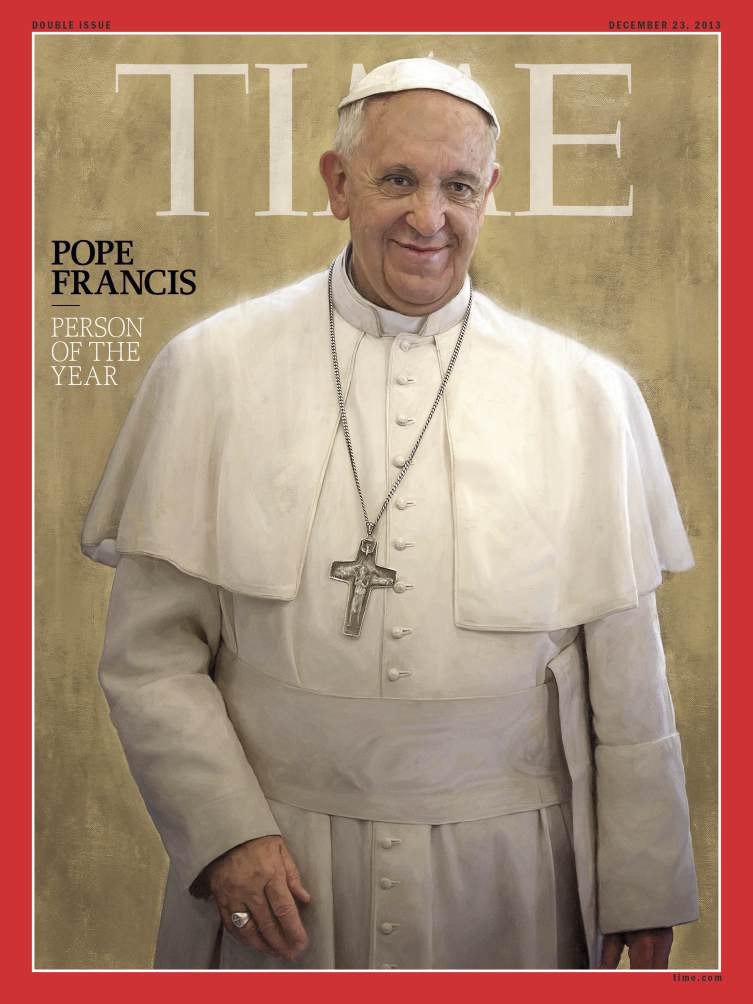
time-person-of-the-year-cover-pope-francisHere is a link to the official English translation of what the Pope said to the Roman Curia a few days ago. This is important reading for anyone involved in church leadership and administration.

http://www.news.va/en/news/to-the-roman-curia-on-the-occasion-of-the-presenta

Posted in Uncategorized | Leave a comment

A Christmas Sermon by The Rev. Canon Bill Morrison

As I am on a medical leave of absence I did not preach at St. Matthias, Victoria this Christmas Eve or Christmas Day – but the Reverend Canon William (Bill) Morrison did, and here is what he had to say:

Christmas Eve

“When the angels went away from them into heaven, the shepherds said to one another, ‘Let us go now to Bethlehem, and see this thing that has taken place, which the Lord has made known to us.”

And so the shepherds came to Bethlehem, to the town whose name, Beth-lechem, is Hebrew for “House of Bread.” There was no glorious sight for them to see, no mind-boggling spectacle. No. Hidden away in that House of Bread they saw a baby, a baby less than ordinary, cradled in a poor stable. But, with eyes of faith opened by the word of God made known to them, and with hearts trusting in the God who will redeem his people, they saw, in that baby less than ordinary, the Saviour of the world, come to dwell among them
.
And now it us our turn to come to Bethlehem, to come to our Bethlehem, our House of Bread, here, at the Lord’s table. Here again is no glorious sight for us to see, no mind-boggling spectacle. Here is only bread, bread less than ordinary, cradled in our poor hands. But, with eyes of faith opened by the word of God made known to us, and with hearts trusting that God does indeed come and dwell with us, we see, in this bread less than ordinary, the Saviour of the world, come to dwell in us.

Such is God’s love, to give us “heaven in ordinarie,” God the Word-made-flesh made bread for us, to nourish our souls, to inebriate our spirits, to make us alive with God, to build his House of Bread in us, that, as he dwells in us, we might dwell in him.

Let us then come to Bethlehem, to God’s House of Bread, and taste and see how gracious the Lord is.

Christmas Day

My favourite part of Christmas has always been the Christmas tree, especially at night with its lights all aglow. At home, from the time I was seven or eight, it was me who decorated the tree. I would take great care getting the lights just so, so that there would be no dark patches in the tree, rearranging bulbs so that there wouldn’t be two bulbs of the same colour next to each other. At night, after the tree was decorated, I would make some finishing touches so that it looked just right; and I could sit for hours looking at it.

The Christmas tree, with its lights shining in the darkness—because it would not do to have other lights on in the room, they spoiled the effect—had a beauty, a mystery, a “presence” that was somehow just right for Christmas. Things were quite different in the austere light of day. The tree looked lost, bare, exposed, revealed for what it was, a few thin branches hung with some wan looking baubles. It looked a little forlorn, like it was waiting for the night to come again, for it to return to its element, the atmosphere in which it “shines,” metaphorically as well as literally. Christmas, it seems to me, is made for what Dylan Thomas, at the end of A Child’s Christmas in Wales, calls “the close and holy darkness.” The story of the child born in a manger, and angels appearing to shepherds in their night-time fields, is a story to be told in the darkness, by candlelight, the way we did last night.

But the austere light of Christmas morning calls us to a bigger landscape, to look beyond the stable and the manger and the shepherds and the angels, and the cosy feeling of being nestled together in the “close and holy darkness” of Christmas Eve.

The daylight is for the cosmic sweep of “In the beginning was the Word, and the Word was with God, and the Word was God.” The day is for “In these last days God has spoken to us by a Son, whom he appointed heir of all things, through whom he also created the worlds.”

The day is for words like “incarnation” and “paradox” and “mystery”—not of the kind of mystery shrouded in darkness but of the kind enveloped in unendurable light. And, Bruce’s favourite, “kenosis,” God’s self-emptying.

The day is for remembering that what we are celebrating is not the birth of a baby, but of the birth in time of the timeless Son of God. That in this birth all the great ontological opposites—heaven and earth, God and humanity, eternity and time, feeble sinfulness and the over-arching perfection of truth, goodness and beauty—are reconciled and brought together—made one—in this child, this man, who, though one person, is both fully human and perfectly divine, the human and the divine utterly distinct yet absolutely inseparable.

The day is for hearing that in Christ God becomes human so that we humans may become gods. That God emptied himself and came down to earth to live life as we humans know it, so that we might be filled with all the fullness of God and be raised up to heaven, to live with him, in him, in God, forever.

The day is for remembering that the birth we celebrate is, paradoxically, our birth; that the mystery we celebrate is that in Christ God gives us “power to become children of God, born, not of blood or of the will of the flesh or of the will of man, but of God.”

The day is for falling on our knees before the truth that, with the birth of this child, with the incarnation of God in human being, God and human are now forever one, no longer distinct and separated, but one. This is the day for remembering that in Jesus, the human incarnation of God, born in the stable of Bethlehem of Mary his mother and now raised from death to new life in eternity—in him our humanity is forever conjoint with the Godhead, the divinity now human, the humanity divine, the risen humanity of Christ forever before the throne of God interceding on our behalf to the Father of lights, in whom there is no shadow of darkness.

Posted in Uncategorized | Tagged , , , | Leave a comment

The Christmas You Need: Choose from Five

nativity_james-b-janknegt Ah, the Christmas story. We’ve seen it in pageants, in children’s Christmas books, in movies telling the story, narrated in Christmas carols, and parodied by Monty Python and thousands of others. We think we know it.

And yet, when we actually turn to the Bible, to the New Testament accounts, we find that it is actually a number of stories that have been melded together by church teaching, theological reflection. The voices might be complementary, but they are distinct and very different.

Tonight I want to take you through not one or two Christmas narratives, but five. And I hope that as you hear about them, you may find the Christmas you need.

 Luke

  • First, Luke, chapter’s one and two. This is the story of Jesus being born in the stable in Bethlehem. Their parents are residents of Nazareth, but a Roman census requires them to travel to Joseph’s ancestral city of Bethlehem. There is no room for them in the inn, and so they bed down in the stable. Before all of this, nine months before, an angel appears to Mary, and announces to her that she has been chosen to bear the Messiah, and she consents. Later she meets her cousin Elizabeth, who is pregnant with John the baptist. John the Baptist leaps in her womb, and Mary replies with the Magnificat. This is the story of the shepherds, and the angels announcing to them the great joy of the Messiah’s birth. And so they run down to Bethlehem, see the new born child, and tell everyone about it.
  • This is a joyful gospel. It is full of hope. It is optimistic. It is a gospel for the poor of the world, the simple laborers like Mary and Joseph, and for the shepherds. This is a story in which the Holy Spirit is present, inspiring Zechariah, Elizabeth, and Mary to speak forth hymns that have been sung for thousands of years: the Beneditus, part of the Hail Mary or Ave Maria, and the Magnificat. This is the Christmas story from Mary’s perspective – the woman’s narrative.
  • This is a Christmas story for those who are marginalized, who need hope, who are looking for the Spirit of God transforming things. We see in Mary a servant of God, choosing to bear the Messiah, prefiguring the service her son would give.

 Matthew

  • Next, there is the infancy story in the Gospel according to Matthew.
  • It sounds both familiar and strange. There is no mention at first of Nazareth – Jesus’ parents appear to live in Bethlehem. An angel appears, but this time to Joseph. There is a potential scandal about Mary’s unexpected pregnancy, but the angel tells Joseph that the child has been conceived by the power of the Holy Spirit.
  • There is no Roman census, no Roman emperor, but there is King Herod, an evil man if there ever was one. Wise men, pagan astrologers come to him from the East – Persia, perhaps – looking for the newborn king of the Jews. They follow a star to Bethlehem, and offer gifts. Then Herod seeks to destroy the child, and massacres the innocent male children of the town. Joseph, warned in a dream, escapes to Egypt for a time, and eventually settles in hiding in Nazareth after Herod dies.
  • This is a Christmas for those who find the world a dark place, where even the son of God needs protection from evil for a time. It is a gospel rooted in the Hebrew Bible, and as Moses came out of Egypt to deliver his people and give the Torah, in five books, so Jesus comes out of Egypt as a second Moses, and in five major discourses later in the gospel of Matthew, the first one being the Sermon on the Mount, Jesus claims the Torah and reinterprets it for God’s people.
  • This is a gospel of continuity and transformation, rooted in ancient scriptures but pointing to the reception of the good news by non-Jews, like the Magi from Persia.

Mark

  • Maybe you don’t like these stories. They are inconsistent, as many scholars point out, and they only complement each other if you force them.
  • Maybe you just don’t like the whole Christmas thing. I know a lot of people who cannot stand it, don’t care for the virgin birth thing, and wish they didn’t have to mark it.
  • Well, there is a gospel of Jesus Christ that knows nothing about the birth of Jesus, namely the Gospel according to Mark. It has no infancy narrative, no beginning with the birth of Jesus. It starts with the proclamation of John the Baptist, when Jesus is already an adult.
  • Also, the early church did not always commemorate Jesus’ birth. Indeed, it appears in old documents only in the 3rd century, and did not become generally celebrated until the 4th. Even then there were arguments about when to do it – December 25th, or January 6th? It was all pretty arbitrary.
  • So this is the Gospel for people who struggle with church doctrines, with the artificial nature of the church calendar, and with the whole Christmas thing. You don’t like Christmas? Fine, then skip it. You have my permission.

Revelation

  • Maybe, though, you want Christmas, but maybe a new one. Well, may I suggest that you look at the Revelation to John, the last book of the Bible, in Chapter 12. Let me read to you:
  • A great portent appeared in heaven: a woman clothed with the sun, with the moon under her feet, and on her head a crown of twelve stars. She was pregnant and was crying out in birth pangs, in the agony of giving birth. Then another portent appeared in heaven: a great red dragon, with seven heads and ten horns, and seven diadems on his heads. His tail swept down a third of the stars of heaven and threw them to the earth. Then the dragon stood before the woman who was about to bear a child, so that he might devour her child as soon as it was born. And she gave birth to a son, a male child, who is to rule[a] all the nations with a rod of iron. But her child was snatched away and taken to God and to his throne; and the woman fled into the wilderness, where she has a place prepared by God, so that there she can be nourished for one thousand two hundred sixty days.”
  • A little psychedelic, eh? Here, in great allegorical language, is the story of Jesus on earth, but described as part of a cosmic battle between evil and good, between the powers of this earth and the power of God.
  • Who is the woman? Is it Mary, or is it the representation of the people of God? Who is the dragon? The evil one, or is it the Rome, with its seven hills and 10 emperors?
  • Well, I’ll let you puzzle over that. This is the Christmas story as a part of a cosmic narrative, which leads to a new heaven and a new earth. The birth of Jesus is an apocalyptic event, revealing the in-breaking of God in Christ into the world. For many of us in despair, surrendering to God and awaiting this unveiling of God’s power, this is the gospel we need. God is in control, evil will be defeated, and his kingdom will come on earth as in heaven.

 John

  • Then there is the gospel of the incarnation. This is the traditional gospel for Christmas Day, even though there is no birth in Bethlehem – no wise men and shepherds, no Emperor Tiberius or King Herod, no Mary and Joseph, no stable or flight into Egypt, and certainly no dragon.
  • But it speaks the profound message that “In the beginning was the Word, and the Word was with God, and the Word was God. And the Word became flesh and dwelled among us.”
  • It is the message that God has become human, the ultimate paradox, in which God seems to no longer be God. Divinity is poured out, emptied out into humanity.
  • But the purpose of this message was summed up three centuries later by Athanasius of Alexandria, when he said, “God became human so that we humans might become divine.” This is not a kind of monism – we do not become one with God, and the absolute difference between creator and created is sustained – but as beings created in the image of God we discover, insofar as it is achievable by humans, to fulfill that being icons of the unseen God by being part of the Body of God, Jesus Christ.
  • In Christ we see the real essence of God, that God is love, and becomes one of us so that we might become more like the divine in love. In Christ we are shown what it is to be truly human, in the image of God – a servant, a healer, a bearer of good news, a lover, one who gives himself in that love for us.

So, on this Christmas night, we celebrate the Mass of Christ. Our Christmas may be that of the story from Matthew and Luke, or maybe we don’t want any story at all. Perhaps we need the profound symbols of Revelation, calling us forward to the New Heaven and a New Jerusalem, or maybe we simply need to be transfigured by Christ and his dwelling with us. However you find Christmas, may you find what you need, arrive at the destination you seek, and receive the gift of what you desire. May the birth of Jesus herald a new birth in all of us of God’s love.

I’ve preached this sermon several times – once twenty or so years ago in the Parish of Pender and Saturna Islands, at the 9:00 PM December 24 2013 Christmas Eve service at the Parish of St. Mary the Virgin, Oak Bay, at a 2017 Christmas Eve service at St Dunstan’s Gordon Head in Victoria, and more recently at the Anglican Church of St Thomas, Kefalas, on Crete. I’m done with it now.

Posted in Christmas, Sermons | Tagged , , , , , , , , , , | 1 Comment

Violence Against Women, 25 Years on: A Sermon Preached on December 7, 2014

Where were you 25 years ago? Where were you 25 years ago when you hear the news that fourteen young women, engineering students at the Ecole Polytechnique at the Universite de Montreal? What did you feel at that time?

Of course, some of you were not even born yet. But if you are over the age of thirty you may have some memory.

I was newly ordained, serving a curacy in St, David’s Church in Welland ON. But the Universite de Montreal was in my brother’s neighbourhood, and I had been at a pub on campus a few years before. It was a place I knew. I had written a sermon, but after these horrific events I had to write another one. How could this have happened? How could this have happened in Canada?

It was then, as now, the week in which a story about John the Baptist was the reading. He was a man of anger and wrath at what was being done to his people. He preached personal transformation and subversively threatened the status quo.This passage from Matthew 3 captubres his fiery appeal:

But when he saw many Pharisees and Sadducees coming for baptism, he said to them, ‘You brood of vipers! Who warned you to flee from the wrath to come? Bear fruit worthy of repentance. Do not presume to say to yourselves, “We have Abraham as our ancestor”; for I tell you, God is able from these stones to raise up children to Abraham. Even now the axe is lying at the root of the trees; every tree therefore that does not bear good fruit is cut down and thrown into the fire.

 ‘I baptize you with water for repentance, but one who is more powerful than I is coming after me; I am not worthy to carry his sandals. He will baptize you with the Holy Spirit and fire. His winnowing-fork is in his hand, and he will clear his threshing-floor and will gather his wheat into the granary; but the chaff he will burn with unquenchable fire.’

Jesus followed in his footsteps, feeding on the same disquiet and anger, sadness and frustration, proclaiming that God’s reign was near. His gospel was non-violent, and did not use the same angry metaphors, but it was no less subversive and unsettling.

So I wondered then, how can we channel those same emotions to address this national disaster? And now, twenty-five years later, I ask the same question?

We are called not just to change ourselves, but to challenge systems of discrimination. The murderer was not just mentally disturbed, but predisposed as a man and by society to think that anger and violence against women was a rational thing. Rejected by the Ecole Polythenique he sought revenge on the women whom he thought had unjustly taken his place. How do we challenge this kind of thinking, which remains rampant in our society still to this day, as anyone looking at the comments on an internet article about attacks on women will see? Then there are the facts.

  • On average, every six days a woman in Canada is killed by her intimate partner.  In 2011, In 2011, from the 89 police reported spousal homicides, 76 of the victims (over 85%) were women.
  • On any given day in Canada, more than 3,300 women (along with their 3,000 children) are forced to sleep in an emergency shelter to escape domestic violence. Every night, about 200 women are turned away because the shelters are full.
  • Each year, over 40,000 arrests result from domestic violence—that’s about 12% of all violent crime in Canada. Since only 22% of all incidents are reported to the police, the real number is much higher.
  • About half (49%) of all female murder victims in Canada are killed by a former or current intimate partner. In contrast, only 7% of male murder victims were killed by intimate partners.
  • As of 2010, there were 582 known cases of missing or murdered Aboriginal women in Canada.

So what do we do?

First, recognise that despite all the progress in women’s rights and women’s status, we still have a long way to go. We cannot afford to be bystanders. If we as Christians claim that we genuinely care for those who are mistreated and oppressed, this is an issue we must attend to. We need to be people of comfort and justice. We need to look to build those highways in the desert, no matter how daunting they may seem. We begin by educating ourselves. If we are men, we begin by listening.

Second, join with others in action. Support the Victoria Women’s Sexual Assault Centre. Question laws that contribute towards violence against women, such as the legislation that came into effect yesterday that criminalizes sex workers rather than helps them. Advocate for a change in the way police departments deal with all women, but especially the marginalized. If you are male, join the “Don’t be a Bystander” campaign that encourages men not to put up in silence with violence and harassment.

Third, as Christians, challenge theologies that inscribe patriarchy. Every theology is also an anthropology, and what we say about God is a reflection of what we think about humanity. Do we challenge ourselves with new metaphors and images of God, such as God our mother? Do we see women as weaker vessels, failed males, or do we see in both male and female the image of the fullness of God? In our ecclesial politics do we not only invite women to be bishops, priests, and deacons, but encourage them to transform the male-patterned hierarchies into egalitarian servanthoods that recognise the diversity of gifts and ministries?

Posted in Uncategorized | Leave a comment

Who Is the Servant Of Isaiah 40-55?

SufferingServant

(Notes from The Other Part of a Study on the Servant Songs of Isaiah, Session Two)

As one reads over Isaiah 40-43 and listens to it, what themes and impressions come across?

  • It is concerned with issues of power, punishment, and relief.
  • Humans are lowly and small – maggots!- while God is the powerful one who created everything.
  • The impression of the creator God speaking here is similar to how God comes across in the Book of Job when he answers out of the whirlwind.
  • There are great swings and contrasts.
  • Various people speaking. The prophet. God. The Nations.
  • God will literally create a highway in the desert so that the Judean exiles in Babylon will take the straightest most direct route back to Jerusalem. Exile is over, salvation is here.
  • People are identified – “the one from the North” (probably Cyrus the Great), “those who worship idols”, “Israel and Jacob”, a proclaimer, a voice, “coastlands/isles”, “nations”.
  • The servant described comes across as
    • a philosopher king?
    • a spokesman
    • an interpreter
    • Israel
    • ambiguous, being both a person and a community
    • in communion with God
    • something evolving and changing
  • Who speaks in the four servant songs?
    • 42.1-4: God
    • 49.1-6: the servant
    • 50.4-9: the servant
    • 52.13-53.12: God (verse 13 certainly, perhaps 52.13-15); otherwise “We”, “Us all”
  • So who is the servant?
    • It is not clear if he is a particular individual, who is a representative for Israel, or the community that hears these words.
    • Is is Deutero-Isaiah, or Israel?
    • As prophetic words, does it apply only to a particular people of God – late 5th century BCE Jews, or to all people of God, including us?
  • What is the meaning of “servant”?
    • The word in Hebrew is ‘ebed, in Greek it is doulos. The Hebrew word is related to the root word for “to work”. Thus, a servant is a worker, but not a hired worker (that’s a “sakhir“). Thus ‘ebed could be translated as slave.
    • In the ancient Middle East and in Greco-Roman times slavery was not ethnically, religiously, or “racially” based, as in modern times in British North America, pre-1865 USA. In ancient times people usually were slaves because of conquest, debt, indenture, or because of  being born to slaves. Israelites and Jews could have Israelite and Jewish slaves, although they had to be freed after six years. Most slaves were agricultural workers. Alien slaves could be held in perpetuity.
    • Kings are frequently described in scriptures as the slaves of God. Paul describes himself as a slave of God, and Gentiles as enslaved to sin.
    • A slave is part of a household. Even a freed slave remains in a patron/client relationship.
    • Interestingly, the Septuagint (LXX) translates ‘ebed as pais – as child.
    • For more on slavery in Judaism see http://www.jewishvirtuallibrary.org/jsource/Judaism/slavery.html
Posted in Uncategorized | Tagged , , , | Leave a comment