Macleans interviews Some Anglicans about Bill C-36 and Sex Workers

Along with Sister Elizabeth Ann SSJD and the Rev. David Opheim of Toronto, I was interviewed about Bill C-36 for an article in Macleans. Here’s the article.

Anglican clergy calls prostitution bill immoral

Posted in Uncategorized | Tagged , | Leave a comment

On Being Human

A long, long time ago – 1995 – Joan Osborne became a one-hit wonder with a song called “What if God was One of Us? Maybe you remember it. It is marked by Ms. Osborne’s remarkable voice, Eric Bazilian’s brilliant guitar playing (he also wrote the song), the ironic tone of the lyrics, and an earnest inquiry about the nature of God and humanity.

I am always a little frustrated by the lyrics, though. There’s a slight nod to Christianity:

If God had a face, what would it look like?
And would you want to see
If seeing meant that you would have to believe
In things like heaven and in Jesus and the saints
And all the prophets?

But that’s it. It suggests that thinking about such things is fraught with tension, because if you ask these questions – if you see the face of God – would one have to move from simple curiosity to faith in something much bigger? Or would God somehow be reduced in humanity:

What if god was one of us
Just a slob like one of us
Just a stranger on the bus trying to make his way home.

And when I hear that question as a Christian I want to respond, “But he did become one of us!” I don’t know if Jesus was a slob, although a lot of people denigrated him for hanging out with the wrong crowd, and when he was arrested he had to be pointed out by Judas because he was indistinguishable from his disciples or other Jews of the time. While we might have this image of a movie-star Jesus in our head – Jeffrey Hunter, Willem Dafoe, Max von Sydow, or James Caviezel, perhaps – we really have no idea what he looked like, although all the evidence is that he was quite ordinary. No, he did not take a bus, but like ordinary folk, he would have walked everywhere. And the reaction to Jesus was all over the map: faith, consternation, anger, wonder, pain, gratitude, curiosity, devotion, betrayal, superiority, and indifference. There was no necessary reaction to encountering the face of God in Jesus.

Of course, in a little over four minutes one cannot expect a deep theological treatise. And yet, I wish Mr. Bazilian had paid a little attention to some elements of Christology, because for 20 centuries it has asked precisely his question. In the first chapter of the Gospel according to John we read “In the beginning was the Word, and the Word was with God, and the Word was God. . . . And the Word became flesh and lived among us, and we have seen his glory . . .”. On the basis of this passage and similar ones in the New Testament Christians have been proclaiming that in Christ God became human. The incarnation (“enfleshment”) tells us something about God, and it also tells us something about humanity. Christology tells us about both theology and anthropology.

In the second chapter of Paul’s Letter to the Philippians he tells us that Jesus, though he was in the form of God, did not consider divinity something to be grasped onto or exploited . . .

but emptied himself,
   taking the form of a slave,
   being born in human likeness.
And being found in human form,
   he humbled himself
   and became obedient to the point of death—
   even death on a cross. 

The Greek word translated “slave” here is δοῦλος (doulos), which is sometimes translated as “servant”. The point of this passage is that the incarnation was not just about God trying out humanity for their own selfish purposes, as the Greek myths sometimes have their gods do. Rather, Christ empties himself to become human to be a servant, one who is humble and obedient to the point of death. One could slide into substitutionary atonement here, but I don’t think that that is what Paul is getting at.  The point is that the divine reaches out in abject humility in servanthood to humanity, subverting the stereotypes of God – “Immortal, invisible, God only wise, in light inaccessible, hid from our eyes” – to show us something more profound about divinity.

Orthodox theology has always held that in the Incarnation humanity is transformed. Thus, to become like God one is transformed into the image of Christ – a servant, humble, living for others. This does not sound like the kind of person we are told by society we need to be – powerful, autonomous, rich and famous. It subverts our 21st century ideas of what it is to be human just as much as it undid 1st century ideas in Greco-Roman society about the importance of dignitas.

Orthodox theologians describe the process of becoming like God, or being sanctified in God’s image, as theosis. So, what if God was one of us? How would we change if we truly accepted the radical nature of the incarnation?

Posted in Uncategorized | Tagged | 1 Comment

No Saints, No Heros, No Martyrs

I spent ten years as the rector of the Parish of Pender & Saturna Islands. By all accounts it was a good incumbency, and we did many good things. But, a few years after I left, it all started to unravel. In retrospect, perhaps what they are doing now is what I should have been doing then – collective leadership, appreciative inquiry, generative conversation, and the talking stick. Come to think of it, perhaps I should be doing it now in my new parish. Hmmmmmm. Read the article!

http://www.ecfvp.org/vestrypapers/leading-change/no-saints-no-heros-no-martyrs/

Posted in Uncategorized | 1 Comment

On Hearing That Letter From Paul to the Romans

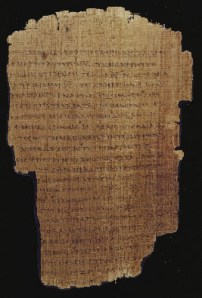
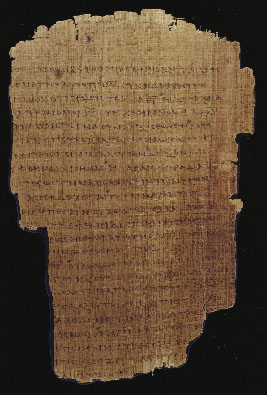
The Letter to the Romans Greek text on papyrus c.AD 180-200 Egypt CB BP II (P46) f.11r

The Letter to the Romans
Greek text on papyrus c.AD 180-200 Egypt
CB BP II (P46) f.11r

My name is Hermes. I am a freedman of the household of Aristobulus in the city of Rome, in the neighbourhood of Subura. I want to tell you about something that happened.

A letter came from Paul from back east. Can anything good from back east? It was carried and read by Phoebe, a deacon from Cenchreae. It was a long letter, and it took over an hour to read. Phoebe is a good reader, though, and she was coached by Paul in how to read it. She has been reading it to all of the gatherings of Christians here in Rome.

We had long wondered about this Paul. We had heard that he persecuted the followers of Jesus. We had heard that he now proclaimed the one whom he had despised. We had also heard that he had argued with Peter in Antioch, and with people who came from the church in Jerusalem. So many of us were not inclined to welcome his words.

But his letter came to us with much power and wisdom, breathed in by the spirit of God. I have been told that Paul is not an impressive speaker, but he knows how to write. He knows the Torah and the Prophets, and he also knows the conventions of Greek rhetoric. He claims to be one of those sent by Jesus to proclaim the good news of Jesus to Gentiles, and after hearing Phoebe read it I do believe it is so.

It is an elegant letter, carefully structured. In it Paul leads us in one direction and then surprises us by going in a completely unexpected one. I did not understand all of it at once, and I want to hear it again. But this is what I heard.

First, Paul is planning to come to Rome, and then on to Spain. He has not been here before, although he knows some dozen or so of us Christians. I think he wrote the letter to prepare the way for him to come here, and to get support for his mission in Spain. But first he is going to Jerusalem to deliver a collection to the poor there.

Second, he knows a lot about us – who we are, who the leaders are, and in whose homes the churches gather. I think he heard about us from Prisca and Aquila. They have a house church here in Rome now, and they were amongst the first to receive the good news when it came to us so many years ago. Just as now, people would gather in their home for a meal on the day of Resurrection, Sunday. Over bread and wine Prisca or Aquila would remind us of how Jesus died on the cross for us. Then we would have a psalm, a prophecy, someone might speak in tongues and another would translate, and we would pray over one another. Because they were leaders they were forced to flee to Corinth during the persecution of Nero. But they have been back now for some months. As you know, there are some 200 of us here in Rome, virtually all Greek speaking, all rather poor, living cheek by jowl in the tenement. The first of us were Jews who had moved here from elsewhere in the Empire, and brought the good news with them, but now many of us are non-Jews.

Paul also knows that we have divisions between those who are Jewish and those of us who are Gentiles. He repeatedly tells us Gentiles not to be too proud and to feel so strong in comparison to the Jews who follow Christ. He tells us that if they continue to follow the commands of Moses we should not judge them for having feast days and eating only certain kinds of food, but withhold judgment and love them.

I said that the letter was well written. Phoebe even did voices, taking on the character of Paul before he became a Christian, when he was a zealot persecuting the followers of Jesus. I almost laughed, because in the zeal of his words I could hear an echo of some of our more enthusiastic brothers and sisters. And in taking on this character, I think he was trying to cool down some of our hottest members.

Here’s what he said:

I do not understand my own actions. For I do not do what I want, but I do the very thing I hate. 

That is, his zeal led to unfortunate consequences. He persecuted the Messiah! Of course, he thought Jesus was a false Messiah, but nevertheless he was doing evil. His religious zeal led to violence! He goes on,

For I do not do the good I want, but the evil I do not want is what I do.

He attacked the followers of the Way. He did not know he was doing evil, but he was.

Now if I do what I do not want, it is no longer I that do it, but sin that dwells within me.

So he is saying that if the consequences are violence and conflict, although it might look like someone is religious, in fact they are possessed by demonic sin.

So I find it to be a law that when I want to do what is good, evil lies close at hand.  For I delight in the law of God in my inmost self, but I see in my members another law at war with the law of my mind,making me captive to the law of sin that dwells in my members.

Wretched man that I am! Who will rescue me from this body of death?  Thanks be to God through Jesus Christ our Lord!

Well, thanks indeed, eh? For we do have some divisions among our little house churches. Some do think they are better than others. But this can become a body of death instead of the body of Christ. God will rescue us!

He says later on in his letter this:

For by the grace given to me I say to everyone among you

                  not to think of yourself more highly than you ought to think,

                  but to think with sober judgment,

                  each according to the measure of faith that God has assigned.

For as in one body we have many members,

                  and not all the members have the same function,

                                    so we, who are many, are one body in Christ,

                  and individually we are members one of another.

We have gifts that differ according to the grace given to us:

                  prophecy, in proportion to faith;

                                     ministry, in ministering;

                  the teacher, in teaching;

                                    the exhorter, in exhortation;

                  the giver, in generosity;

                  the leader, in diligence;

                  the compassionate, in cheerfulness.

This is good stuff. I can hear myself and our community described in this letter. It’s so good I think we should keep the letter, copy it, and share it with other churches in other cities, and keep on listening to it.

May God bless Paul in his journey to Jerusalem, and may he be brought safely to us to share the good news of Jesus Christ. Amen.



Posted in Uncategorized | Tagged , | Leave a comment

My Ten Top Reasons Why Canada is Great

10. We’re Post-National.

Which is to say, we used to worry about what our national identity was. Were we British? Pseudo-Americans? Two nations? Too nice? Too violent (i.e. our passion for hockey)? Too diverse?

Now, not so much. We’re a nation of individuals who can claim many different identities that all co-habit in this place. Sometimes we argue, but compared to other places, we’re a model of peaceful co-existence.

9. We Are Dealing With Our Past.

My dad used to say that the difference between Canada and the US was that the Americans killed their Indians while we just put them on reserves. Well, that kind of mythology is breaking down. The reality is that our forebears in New France, British North America, and the Dominion of Canada mercilessly pushed aside First Nations, Metis, and Inuit in the great land grab of the 18th and 19th centuries. They saw as providential the massive mortality among aboriginal peoples due to infectious diseases from the Old World. They cleared the valleys of Ontario and the plains or the Prairies, making treaties and not honouring them. They tried to assimilate them through the Indian Residential Schools. On any number of counts, it was a genocide.

But now? We have had the apologies from religious leaders and the Prime Minister. We have had the Truth and Reconciliation Commission. Scholars are unearthing the truth. The aboriginal peoples have greater self-determination than at any time in the past 190 years. The Supreme Court has asserted the reality of aboriginal title. To me this is progress.

8. We’re Diverse and We Like It

I live in a town that is pretty “white bread”, but I rejoice in the fact that we still find many immigrants from non-European countries here. Elsewhere it is even more so. Half of Toronto’s population is foreign born, and just under 50% of the total population is a visible minority. And yet, when riots break out in our major cities of Vancouver, Toronto, and Montreal, they are not driven by ethnic differences but by (respectively) hockey, globalization, and tuition costs. I’m not in favour of riots at any time, but at least they’re not about “race” or “religion” (unless you consider “hockey” a religion).

While we have two official languages, I like the fact that I can watch a hockey game with the commentary in Cree. Quebec likes to describe itself as a “distinct society” but arguably the same thing is even more true of Newfoundland and Labrador (eh boy?).   I especially like the fact that the people of Quebec voted down Pauline Marois’s ill-conceived Charter of Quebec Values.

7. We Get to Watch the Americans

Some Canadians are really anti-American. Usually what that really means is that they do not like the US government, its foreign policy, its sheer power in the world, and the extremism of the NRA. On the other hand, scratch a Canadian and you’ll probably find a rabid consumer of American culture – its music, literature, television, film, and so forth. If we lived close enough to the border we used to (before 9/11) zoom through immigration with ease, stocking up on cheap milk, clothes from the factory outlets, and filling ourselves with over-sized portions at the chain restaurants that hadn’t made it across to the land of the Red and White. Because we are the mouse sleeping next to the elephant we know far more about the big beastie than it knows about us. We can withdraw into smug self-assurance that we are more humble, not recognizing that Americans really don’t need to know very much about us.
Olympic & Leg
I really like the view of the Olympic Mountains from Victoria – much better than the other way around. Oh, and some of us marry Americans!

6. Canadian Writers

Alice Munro. Gabrielle Roy. Yann Martel. Margaret Atwood. David Fennario. Robertson Davies. Roch Carrier. Leonard Cohen. Mordecai Richler. Douglas Coupland. Michael Ondaatje.  You get the point.

5. Canadians are Funny

Catherine O’Hara. Dan Ackroyd. Wayne and Shuster. SCTV. Lorne Michaels. Jim Carrey. Tommy Chong.Kids in the Hall. Michael J. Fox. Cathy Jones. This Hour Has 22 Minutes. Rick Mercer. Mike Myers. The Frantics. And so on. Some would add Calgary native and Texas senator Ted Cruz to this list, but I don’t think he means to be funny.

4. Rocks and Trees

. . . and WATER!

3. Snow!

Lyrics and translation at http://lyricstranslate.com/en/mon-pays-my-country.html-1 .

2. Musicians and Artists

k. d. lang. Robert Lepage. Great Big Sea. The Group of Seven (and Tom Thomson). Healy Willan. Serena Ryder. The Watchmen. Guy Maddin. Bill Reid. Stan Rogers. Victor Reece. USS. City and Colour. Norval Morrisseau. The Tragically Hip. Emily Carr. Alex Colville. Atom Egoyan. Bruce Cockburn. Crash Vegas. Paul Halley. Bruce McDonald. Susan Point. Tegan and Sara. Christopher & Mary Pratt. Harmonium. Sara McLachlan. Cordell Barker. Cirque de Soleil. Blue Rodeo. Denys Arcand. Neil Young. Ken Danby. Broken Social Scene. William Kurelek. The Pursuit of Happiness. CHOM 97.7 Montreal (in the ’70s). CFNY 102.1 Toronto (in the ’80s & ’90s). The Zone 91.3 VictoriaCJZN (now). I’ll also admit to being proud of Avril Lavigne and Rush (but do not talk to me about Justin, Celine, or Nickelback).

1. Our Heroes

Canadian heroes tend not to be politicians, military types, or athletes- although many of them are, but their modesty and achievements explode those categories.

Take Terry Fox, for example. Few paid attention to the 21 year-old when he began his fund-raising cross-country run April 12, 1980 (although I do vaguely remember seeing a CBC news item about him dipping his foot into the Atlantic in St. John’s, but this was probably several weeks after). On his artificial leg he ran the equivalent of a marathon each day. He never finished his run across Canada, being taken down by a recurrence of his cancer just outside Thunder Bay on Labour Day weekend. He died less than a year later, but by then, through the money he raised on the road and in a telethon following his departure for treatment, some $23 million had been raised for cancer research. Over thirty years later Canadians around the world still join in Terry Fox runs, and over $600 million has been raised.

About a block from my house sits the Nellie McClung library. Born in 1873 McClung started off simply enough as a relatively uneducated woman on a homestead in Manitoba, but worked to become a teacher. Upon marriage she became active in the Women’s Christian Temperance Union, which was allied with women’s suffragette movement. She played a leading role in the “Persons Case” in which the Judicial Committee of the Privy Council (then the last court of resort) overruled the Supreme Court of Canada and asserted that “[t]he exclusion of women from all public offices is a relic of days more barbarous than ours.” McClung lived in Edmonton then, but sensibly moved to Saanich BC and wrote her memoirs here, dying in 1951. Her legacy is the equal treatment of all women in our society, ultimately enshrined in our Constitution.

A third and final example of a Canadian hero is Roméo Dallaire. Born in 1946 as the son of a French-Canadian soldier and a Dutch mother, he followed his father into the Canadian Army and was commissioned as an officer in 1970. He rose through the ranks and in 1993 he was assigned the role of Major-General of UNAMIR, the United Nations Assistance Mission for Rwanda. From April to July of 1994 the mass slaughter of Tutsi and moderate Hutu in Rwanda took place – the Rwandan Genocide. Despite pleas to the outside world, neither the United Nations nor the US, France, or Belgium chose to intervene. Between 500,000 and one million were killed, and two million person became refugees. Despite the thankless situation, the withdrawal of troops by Belgium, and the unresponsiveness of the UN, Dallaire consolidated his troops and managed to directly save the lives of some 32,000 people. Subsequently he returned to Canada, served in command and staff positions, and retired in 2000. He suffered from post-traumatic stress disorder, attempted suicide and suffered from alcoholism. He recovered, and was appointed to the Canadian Senate, where he has been an outspoken advocate for conflict resolution and veterans.

One could, of course, celebrate others – sports stars such as Wayne Gretky, politicians like Pierre Trudeau and John A. Macdonald, and soldiers such as Victoria’s Arthur Currie (Canadian military commander in WW I) and Andrew McNaughton (Minister of Defense in WW II), but somehow these three I just discussed and other like them seem to epitomise what I like about Canada.

God bless Canada on this Canada Day 2014!


Posted in Uncategorized | Tagged , , , , , , | Leave a comment

Sacrificing our Sons

The Problem of the Akedah

Image
In Genesis 22 we find the story of the Binding of Isaac, known in Hebrew as the Akedah. It is the part of the saga of Abraham in which God tests Abraham and says to him, “Take your son, your only son Isaac, whom you love, and go to the land of Moriah, and offer him there as a burnt offering on one of the mountains that I shall show you.” It is a masterful narrative, as seen in the way in which the author builds up the intensity of Abraham’s attachment to Isaac:  “Take your son . . . your only son . . . Isaac . . . whom you love . . .” But it is also one of those readings which the Biblical scholar Phylis Trible calls a “text of terror.” The original audience just as much as we do should recoil in horror from the story. After all, what kind of God asks a man to sacrifice his son?

Admittedly, in the time of the patriarchs, such a thing was not unthinkable. The ancient Israelites believed that the Phoenicians and Carthaginians sacrificed children to Moloch. Human sacrifice in ancient Rome was rare but documented. If we were feeling humorous, we might say that as parents we have sometimes thought of sacrificing a child. But the fact is, this is a very serious matter, and its really hard to make fun of it.  The problem with this story is that it is not simply the story of a deity some 4000 years ago, but it is for Jews, Christians, and Muslims (who tell the story with some differences) a story about our God. How do we deal with this story?

Four Approaches

To wrestle with this text I am going to consider the comments of three Jewish authors and one Danish Christian philosopher.

The 12th Century Spanish Rabbi Mosheh ben Maimon, known as Maimonedes, emphasized the faithfulness of Abraham. The faith of Abraham is stronger than anything else. Despite hoping for a son through Sarah, and despite receiving Isaac in his old age, Abraham is willing to submit himself to God’s command and lose it all, perhaps hoping beyond all evidence that God would somehow redeem the situation.

The 19th century Danish philosopher Søren Kierkegaard wrote a book which was published in 1843 called Fear and Trembling. He focused not only on the faithfulness of Abraham, but also the anxiety that he felt that Abraham must have experienced. Kierkegaard was well aware that the killing of a son could only be considered murder by any standard of ethics, but in the face of a subjective experience of God commanding one to act in contravention of the rules, one has a choice to be faithful to God, that profound, inward calling to which one responds, “Here I am” or to deny that God and submit to what the world calls moral and ethical. In this choice is the meaning of existence. Kierkegaard wrote, “Therefore, though Abraham arouses my admiration, he at the same time appalls me.” The tension of this faithfulness with anxiety is characteristic of any life, in his opinion. Are we doing the right thing? Are we doing the wrong thing? Where do we find truth, inwardly or outwardly? But we need to make that choice, and act.

The Jewish philosopher Franz Rosenzweig who lived and wrote in the first four decades of the 20the century believed that God tempted human beings in order to ensure that humans were free. Thus the Binding of Isaac is about people being free to make decisions, and not mindless automatons acting out of timidity and fear.

The 20th century French Jewish philosopher Emmanuel Levinas was quite horrified by Kierkegaard’s approach. He found that Kierkegaard’s description of subjectivity and the truth it produced was formless and amoral. He was shocked by the violence that Kierkegaard seems to celebrate, as a precursor to Nietzsche will to power that was beyond all ethics, any sense of good and evil. Levinas located God in the ethical relationship one has with another person – that you, right here and now, in all of your individual need, has an ethical claim upon me that is infinite. When looking at this story Levinas points out that God, having tempted Abraham, realizes that Abraham’s conception of God is indeed amoral, unethical, and monstrous, which is why God intervenes to provide the ram, and Abraham again responds, “Here I am.” He was not so set upon the first command that he could not hear the second. Kierkegaard makes the mistake in finding the transcendent in the claim that goes against ethics, whereas Levinas finds it in the persecuted humility of the obedience to the other.

The Akedah and the Cross

Christians have long seen the parallels between the Binding of Isaac and the passion of Christ. In each a father is seemingly sacrificing his som in obedience to a divine command. The differences is that in the Akedah human death is avoided, whereas Jes us did die, and in the Genesis account God and Abraham are distinct, but in the New Testament narrative God the Father requires Jesus to sacrifice himself. Some have thus claimed that the death of Jesus is thus the murder of the son by the father. But perhaps these differences are critical. As Christians we celebrate a man who was obedient unto death, even death upon the cross, butperhaps in this broken, fallen world being true to the compassionate self-emptying love of God inevitably leads to death. Perhaps the death of Christ is not the forensic substitutionary atonement so beloved of conservative evangelical theology, but an act which reveals the extremes to which God goes in the identification and sanctification of humanity, remade in resurrection. Jesus’s obedience, then, was not the Kierkegaardian type. Rather, Jesus offers himself in this broken world for others, serving others, forgiving them and setting them free from the oppression of society.

But We Would Never Sacrifice our Children, Would We?

Now, all of this is rather highfalutin and abstract. So let’s make it real.

One hundred years ago on June 28 the heir to the Austro-Hungarian throne was assassinated in Sarajevo. A century seems like a long time, but perhaps not. It is hard to talk about those events dispassionately. I naively think that a century might have allowed us some distance, but the fact is my grandfather fought in World War I, and many of us have similar connections. The effects of the war continue to reverberate in Ukraine, Iraq, Syria, Israel and Palestine, and the Balkans.  On Remembrance Day we honour the dead of the war, and quite appropriately suspend historical critical investigation.  We surround the memories of the dead and our grandfathers and forebears who survived with prayers and great hymns.

But what was it all about? Ten million military personnel and about seven million civilians died in this Great War. Some 64,000 Canadians died in the conflict. Most of those who died were young, in their late teens and twenties. What did they fight for? In some cases it was a war about national pride – a powerful motivator in Germany and Russia.If Russia did not act in support of Serbia, it was thought at the time, no one would take the Empire seriously as a first rank power. In Germany the feeling was that Britain had kept their Empire from its proper place in the son, and that if it did not act to win a war now it would be permanently restrained. France fought to regain the provinces of Alsace and Lorraine, lost to Prussia in 1870. Some fought for King and Country, as was the motto of the British recruiting posters. Some fought in response to atrocities. Some saw it as a God given crusade, as the Bishop of London proclaimed it. Some saw it as an opportunity for territorial expansion.  Many saw war as a good thing in a time when many had become well off and soft – something that would stiffen the backbone of the nation. When it came down to the men in the trenches, they did it from duty and because they owed it to the fellow beside them. As the Canadian historian Margaret MacMillan has made it clear in her recent book, The War That Ended Peace: The Road to 1914, the various leaders did not fall into this war by accident, but made calculated decisions, knowing full well that once war began no one really knows how it might end. They nevertheless, repeatedly, chose to roll the dice over the summer months and into the autumn of 1914.

In MacMillan’s opinion it was all a terrible waste. Regardless of the virtuous motives of politicians the end result was a Europe in incomparably worse shape than when the war began. Four empires fell, the British Empire was close to being bankrupted, and economic development in Russia and eastern Europe was set back a decade or more. The regimes that succeeded the old Entente powers were unstable, such as the Weimar Republic or the weak post-war government of Italy, and gave way to Fascism in Germany and Italy, or Communism in Russia.  And  the nations were bled dry.

Europe in 1914 heard their gods – nation, king, old grudges, fear – and went ahead and sacrificed their sons upon a much bloodier altar than any Abraham built. Unlike Abraham they did not hear the voice of God calling them to another sacrifice. They did not hear the words of Jesus calling them to peace.

And now, 100 years later, what are the gods that call to us to sacrifice?

Let us hear God speak to us in the life and witness of Jesus, and present our members as slaves to righteousness for sanctification. Let us offer ourselves, our souls and bodies, as a reasonable, holy, and living sacrifice unto God.

This was preached as a sermon at St. Matthias Anglican Church, Victoria BC Canada, on June 29, 2014.

Posted in Uncategorized | Tagged , , , , , | Leave a comment

Against Bill C-36

So I am gathering signatures for this. Let me know if you want to add yours, eh?

We, ordained ministers of various faith groups and denominations, wish to express our concerns regarding Bill C-36 “Protection of Communities and Exploited Persons Act” now before the House of Commons of the Parliament of Canada.

We wish to make it clear that we continue to uphold marriage as an ideal and as the normative place for sexual relations. We have great concerns about the commodification of sex in our economy, and the exploitation and abuse of vulnerable women and men who are sex workers.

That said, we cannot support Bill C-36, for the following reasons.

First, we believe that it infringes upon the human rights of sex workers to health, safety, and life. It disregards the issues raised by the Supreme Court of Canada when it struck down the provisions of the Criminal Code that target sex workers. It simply re-inscribes the old provisions in different language, and will result in immediate legal challenges. This does not further the welfare of sex workers, but continues their marginalization.

Second, the proposed Bill C-36 will drive sex workers and their clients further underground, putting sex workers at even greater threat of violence.

Third, there was almost no consultation with sex workers or their advocates prior to the drafting of this bill; the viewpoints shared in the online consultation by these parties were not duly considered. The provisions of this bill run counter to a considerable body of sex work research conducted in Canada and other jurisdictions. The provisions of the bill are not based on evidence, but unproven assumptions.

Fourth, there is no meaningful provision to deal with the underlying economic and social conditions that drive many people enter sex work. This bill continues to criminalize poverty, especially amongst indigenous peoples, youth coming from government care, women with disabilities, and lower income single mothers, who are all disproportionately represented among sex workers.

This is a moral issue. While we can debate the pros and cons of sex work in our Canadian society, and bring our religious beliefs to bear upon both sides of this question, we are all agreed that this proposed legislation does nothing to advance the welfare of sex workers and in fact, it increases the potential for dangerous situations. This is amoral.

We urge the Justice Minister Peter MacKay, the Members of the House of Commons on the Standing Committee on Justice and Human Rights, and the Parliament to withdraw this proposed bill. We believe broader, meaningful consultation is required for any future legislation, not only so that it will be an act which will stand up in a court of law, but so that it serves the fundamental needs of this vulnerable population.

Posted in Uncategorized | Tagged , , , , | 3 Comments

The Island Parson: Not George Herbert

herbertparson George Herbert (1593 – 1633) was a poet and priest of the Church of England. By all accounts he was a brilliant man. He came to maturity in the reign of James I, studied at Trinity College, Cambridge, and continued his academic career as a Fellow and Reader at Trinity, and then was appointed Public Orator in the University, a role in which he put to use his fluent knowledge of Latin and Greek. He looked to a career at court in diplomacy, and to further that possibility he served as a Member of parliament in 1625.

After the accession of Charles I his mind turned from matters of state to those of the church. In 1629 he was ordained a priest (he would have been a deacon since 1616 in order to teach at Cambridge) and moved to his only church position,  Fugglestone St Peter with St. Andrew’s, Bemerton just outside of Salisbury, Wiltshire. After just three years of ministry, he died of tuberculosis as the age of 39.

Herbert is known today for two works read by very different audiences. The more famous is a  book of poetry which was posthumously published as The Temple: Sacred Poems and Private Ejaculations in 1633. Repeatedly published, anthologised, studied in English classes, and set to music, his poetic works continue to resonate today. Profoundly religious, the works are studied by students religious and secular to discover the characteristics of his use of metre and language. TS Eliot wrote that Herbert is “a master of the simple everyday word in the right place, and charges it with concentrated meaning.”

Kill HerbertThe other work is A Priest to the Temple, or The Country Parson, His Character and Rule of Life, published in 1652. The term parson (cognate with person)appears to go back to the 11th century, and referred to any clergy working in parishes that received an income. Its publication in Commonwealth England was a subversive action, as it looked to a generation earlier when the Church of England had the king as governor, the Book of Common Prayer, and the three-fold ministry of bishops, priests, and deacons. Under Cromwell there was no king, but merely a despotic Lord Protector, no Prayer Book, and arguments between Baptists and Presbyterians about what form the Church of England should take. It all ended in 1660 with the restoration of Charles II, and the return of the Prayer Book and the episcopal system of church governance. The High Church party within the C of E, closely allied with the royal court, promoted The Country Parson as the model of an effective and faithful church that owed nothing to the Puritans. Subsequent generations of Anglican clergy have turned The Country Parson to find a manual on how to be a faithful parish priest.

However, as Justin Lewis-Antony, a C of E vicar in Canterbury, has pointed out in his book If You Meet George Herbert on the Road, Kill Him there are some problems with Herbert’s vision of priestly ministry. The most profound is how idealistic it is. Herbert died young and never had to contend with the political crises that came shortly after in the Civil War. In addition to the endowed income of the parish he was independently wealthy, and not dependent upon the sacrificial giving of his parishioners. He only served for three years, and that in a parish of some 200 souls, with the aid of a curate. His description of the parson is someone who is bold and compassionate, highly educated yet capable of speaking simply to simple people, temperate and holy, full of prayer and admonishing the wayward, and correcting false doctrine and teaching obedience to the king. It is a projection of Herbert’s own excellent qualities that has stood as an unattainable ideal for 350 years as clergy have sought to translate The Country Parson to more complex times and more challenging situations. It is for this reason that Lewis-Antony named his book as he did – riffing off the old Buddhist maxim that “If you meet the Buddha on the road, kill him” because it is probably the case that your vision of the Buddha is a projection of your own fantastic prejudices than anything to do with the Enlightened One.

I spent much of my twenty-five years (so far) as a parish priest trying to live up to this ideal, always aware that I was never living up to it, no matter how successful others seemed to think I was. I also spent eight and a half years as an Executive Officer and Archdeacon in the Diocesan Office working closely with the Bishop, and encountering any number of ways that the model was falling apart. There are many good things in The Country Parson but it can no longer work, even historically, as a model for priestly ministry.

Lewis-Antony tries to radically re-think what priestly ministry is. He uses some lectures by Rowan Williams, who was Archbishop of Canterbury from 2002 to 2012, as his starting point, but I found it unsatisfying. Part of it is that I feel that any ordained ministry has to be integrally related to the ministry of all the baptised, and Lewis-Antony don’t seem to do that. He doesn’t go into how the three orders of bishop, priest, and deacon are supposed to work in coördination in servant leadership of the church. I also find that the death of Christendom is not as large a theme as it should be, a long lingering death that will have to give birth to a kind of church that looks quite unlike anything we’ve really seen. Lewis-Antony just isn’t radical enough.

I have begrudgingly begun to start calling myself post-modern, which is a fancy way of saying that I acknowledge the deconstruction/destruktion of old models of being church – baptised and ordained – and that I am seeking something new, ironically, by looking backwards past modernism, past the Enlightenment, the Reformation, the Middle Ages and late Antiquity, to the early centuries of Christianity, when little was settled, Christianity was marginalised, and laity were the anonymous evangelists.

I’ve now begun a new ministry in a 99-year-old parish – St. Matthias, in Victoria, British Columbia. It is a parish that suffered a schism some five years ago, and has slowly tried to come back. It was making some progress when another crisis hit it, and when the dust settled the rector had moved on and the parish was stuck in transition for over a year. Last Sunday we had 43 souls in church, including some six children. The parish leadership and those who attend are committed and faithful, but it is really too small to be financially sustainable. I laughingly tell my colleagues that I only have to triple the average Sunday attendance in the next couple of years and everything will be just fine, but I am well aware of how difficult this will be. And yet, I love being there – I really feel called to parish ministry, and I am having fun.

I am starting this blog, no so much as a parish blog as an attempt to publicly discuss what ministry, both lay and ordained, might look like today. I suspect it will be post-modern, post-Christendom, decolonizing (hard to be post-colonial when you’re the descendent of colonists who never left), humble, vulnerable, spiritual and religious, grounded in the old orthodox teachings framed by historical analysis, ethical, just, compassionate, bold, concerned with the oppressed and wounded, and . . . well, in short, to be like Jesus as described in the New Testament and proclaimed by twenty centuries of witnesses.  I hope you enjoy the ride.

Posted in Uncategorized | Tagged , , , , , | 3 Comments