Lenten Readings: Day 15

Creating Dilemmas

cry

In today’s second reading in the Daily Office Lectionary Paul continues to build up the consequences of relying on good conduct before the Judgement of God. In the first paragraph today (Romans 2.25-29) Paul uses circumcision as the sign of a Jew and obedience to the Torah, and applies it metaphorically to Gentiles who are following the inner law written on their hearts and a Torah abiding Jew. Simply being a Jew with the marks of circumcision does not necessarily mean that one is righteous before God. As Paul argues, true circumcision “is a matter of the heart—it is spiritual and not literal.” In Paul’s writings “the heart” means more than an emotional seat of the body’s pump for blood, but stands for the whole intellectual and moral mind of a person.

Rom 2.25—3.18
Circumcision indeed is of value if you obey the law; but if you break the law, your circumcision has become uncircumcision. So, if those who are uncircumcised keep the requirements of the law, will not their uncircumcision be regarded as circumcision? Then those who are physically uncircumcised but keep the law will condemn you that have the written code and circumcision but break the law. For a person is not a Jew who is one outwardly, nor is true circumcision something external and physical. Rather, a person is a Jew who is one inwardly, and real circumcision is a matter of the heart—it is spiritual and not literal. Such a person receives praise not from others but from God.

In the second paragraph Paul anticipates a couple of questions from his rhetorical interrogator. He states that the faithfulness of God to Israel is not contingent upon the faithfulness of the people.

Then what advantage has the Jew? Or what is the value of circumcision? Much, in every way. For in the first place the Jews were entrusted with the oracles of God. What if some were unfaithful? Will their faithlessness nullify the faithfulness of God? By no means! Although everyone is a liar, let God be proved true, as it is written,
‘So that you may be justified in your words,
and prevail in your judging.’

But this does not give license for the recipients of the Torah and the followers of Jesus to do anything. In the next paragraph Paul reports an accusation made against him – that he encourages people to do evil so that the grace of God might abound in forgiveness.

But if our injustice serves to confirm the justice of God, what should we say? That God is unjust to inflict wrath on us? (I speak in a human way.) By no means! For then how could God judge the world? But if through my falsehood God’s truthfulness abounds to his glory, why am I still being condemned as a sinner? And why not say (as some people slander us by saying that we say), ‘Let us do evil so that good may come’? Their condemnation is deserved!

Paul is creating a number of dilemmas here for his listeners, setting them up for the argument that righteousness before God depends not upon works but faith, and that good works come from having the right faith. The right faith is coincident with having the Spirit, and with dying and living with Christ.

What then? Are we any better off? No, not at all; for we have already charged that all, both Jews and Greeks, are under the power of sin, as it is written:

It’s not clear to me who the “we” is here. Is it Gentiles? Is it Jews? The point is moot because both are subject to “the power of sin”. For Paul being under the power of sin is not some abstract ontological state, but a malevolent force that is active and dynamic in the world. It is the powers and principalities that rule through emperors who oppress and religious leaders who are corrupt. It is the predisposition of humanity which has fallen in Adam to choose idols and wickedness. Only a God-given faith can help.

Paul then quotes from memory several passages from the Greek translation of the scriptures, to demonstrate that the depravity of both Jew and Greek has already been proclaimed. The first is Ecclesiastes 7.20 (all references are to the passages as might be found in the NRSV – especially with the psalms, versification and numbering can sometimes be different in various versions):

‘There is no one who is righteous, not even one;
   there is no one who has understanding,
there is no one who seeks God.

The next is a paraphrase of Psalm 14.1-3:

All have turned aside, together they have become worthless;
there is no one who shows kindness,
there is not even one.’

Then phrases from Psalms 5.9, 139.4, and 10.7:

‘Their throats are opened graves;
they use their tongues to deceive.’
‘The venom of vipers is under their lips.’
   ‘Their mouths are full of cursing and bitterness.’

A short passage from Isaiah 59.7-8:

‘Their feet are swift to shed blood;
   ruin and misery are in their paths,
and the way of peace they have not known.’

Finished with a phrase from Psalm 36.1

 ‘There is no fear of God before their eyes.’

A key question as we go forward is how we see the grace of God being manifested to Jew and Gentile. Yes, it depends on faith, and the faith of the believer is somehow related to the faithfulness of Christ and the faithfulness of God in general. Judgement is a part of that faithfulness, in that those who have done evil will be punished and those who have suffered in faith will be raised up. Paul has a pretty negative idea of Gentiles in general and so presumes that most of them are a massa damnata, as Augustine would have put it. He’s not overly impressed with the compromised Jews who are in leadership under the Romans, seeing them as saying one thing and doing another. But he has a very positive idea of the Torah and Judaism in general, and described himself as blameless under the Law. He also has a compulsion to preach the good news of Jesus to the Gentiles, so that they might accept Christ and so escape the judgement that is coming to all Gentiles, and he sees this as a good thing. These are his basic insights, and as simple as they seem it proves complicated for him to work out what this looks like in practice. He is opposed by more conservative Jewish Christians and bedeviled by Gentile Christians who (as seen in First Corinthians) see their new freedom in Christ as a license for incest, boasting in their newfound spiritual gifts, and arrogance towards those with scruples. Paul really wants to live in the fullness of the kingdom, but the traces of sin that new Christians bring in to church with them continues to erupt and unexpected and unpleasant ways.

Posted in Lent | Tagged , , , , | Leave a comment

Lenten Readings: Day 14

How To Make It Hard To Understand Romans

P113-Rom-2_12-13-POxy-4497-III

P. Oxy. 4497. A fragment containing the Greek Romans 2:12-13,29, dated to the 3rd century. It was found at Oxyrhynchus, Egypt and is now at Sackler Library, Oxford UK.

One of the reasons I wanted to do reflections in Lent on the second reading from the Daily Office Lectionary was because I saw that for most of the season it was working methodically through Paul’s Letter to the Romans. Romans is not my favourite letter by Paul – that would be First Corinthians, with Philippians close behind. Romans is challenging because it carries the weight of interpretation by Augustine, Martin Luther, and Karl Barth, and has been used to justify anti-Judaism, antisemitism, and supersessionism. It has been influential in debates about predestination and free will, law and gospel, and the authority of scripture. Karl Barth’s revolutionary commentary (more of a theological reflection than a true biblical commentary) created what others called neo-orthodoxy, in which the revelation of God in Christ “overthrows any attempt to ally God with human cultures, achievements, or possessions.”

Perhaps the most important essay on Romans in the past century is Krister Stendhal’s “The Apostle Paul and the Introspective Conscience of the West” (1963). Stendahl, originally from Sweden, taught at Harvard Divinity School and later became Archbishop of Stockholm in the (Lutheran) Church of Sweden. (Digression: – he and his wife retired to Cambridge, Massachusetts and he continued to be active in the Harvard community. Among other things they attended an early Friday morning Anglican Eucharist in the Harvard Divinity School Chapel, and I had the honour of preaching at one when I was student there in 2002-2003. Immediately afterwards the good Archbishop critiqued me, thinking I was just a little too ebullient for an early morning service!) Stendahl argues that Romans has been misinterpreted by everyone from Augustine on because they miss the rhetorical tools Paul uses, and psychologise him. When Paul is entering on a diatribe against someone the object of his speech is an imaginary locutor, not an actual person. For example, when Paul below turns to accuse “yourself a Jew” he is not imagining anyone in particular, but a hypothetical hypocrite who says one thing and does another. This was part of normal first century rhetorical practice, but by the fifth century and even more so much later this was missed by later Christians. At points in the letter Paul seems to be wrestling with his conscience – but, again, that is a rhetorical device, where he adopts a persona to bring out his point and perhaps speak to the situation of his hearers/readers. This was missed by later readers like Augustine and Luther, and as a result their exegeses of Romans went off on trajectories that said more about them and not so much about Paul or the message of Romans.

Let’s complicate interpretation even more. Martin Luther read the Pauline letters as distinguishing sharply between Law and Gospel, Judgement and Grace. Simply put, when God gave the Torah at Mount Sinai all people, both Jews and Gentiles, stood condemned by it, subject to eternal damnation. The Gentiles were damned because they were idolators, outside the covenant, and incapable of acting justly because of their idol-perverted minds. The Jews were condemned because no sooner did they receive God’s instruction than they ignored it, or brazenly defied it. When Jesus Christ came and died for our sins according to the scriptures the good news was proclaimed to both Jew and Gentile that if they accepted in faith that Jesus was Lord and had saved them that they would be spared eternal death, and instead would be raised up to new life like Jesus.

The problem with this is that there are several scholars say that this is a misreading of Paul, that Paul never put law and gospel into this kind of opposition, and that he believed that Torah observant Jews would receive the promises of God whether or not they accepted the good news. These scholars include several Jewish professors trained in the Talmud and who are reading Paul and the rest of the New Testament as non-canonical first-century Jewish literature.

A further issue is the influence of the Acts of the Apostles on the interpretation of Paul’s letters. The vast majority of scholars past and present have tried to fit Paul’s letters into the timeline described in Acts. The problem with this is that the letters are primary historical documents – kinda like your diary, or birth certificate, a recording of a speech, or a – wait for it – letter. Good historical method suggests that you should always go to the primary historical documents rather than secondary materials; it is better to write a history of Abraham Lincoln based on what he said and wrote and contemporary documents, and not rely on an oral history published in 1910. Acts is like that oral history, written many decades after Paul’s life and death. Logic suggests that one construct a timeline and history for Paul based upon the letters alone, and then carefully sift Acts through the sieve of that timeline. That is not what most people have done or continue to do, and so instead of discerning what Paul says in his letters, Acts is read into it and it prejudices the interpretation. One obvious difference is that Paul’s opponents in Acts are all non-Christian Jews, whereas in the letters it is clear that they are Jewish Christians originating from the church in Jerusalem.

There is also the fact of bias. The top-notch biblical scholars from the late Eighteenth Century up to the end of the Second World War – the folks who brought us the historico-critical method – were all male German Protestants, and while they thought they were being scientific and objective in fact many of them were profoundly biased, especially refusing to see anything positive about the Jewish roots of Christianity. They were in the thrall of Hegel, and so saw early Christian development as the unfolding of dialectic, thus prejudging Paul as an antithetical development to the work of Jesus (the myth that Paul invented Christianity). They read Lutheran theology into their biblical exegesis, not seriously considering alternatives. Being members of an educated elite paid by the government, they failed to see the subversive anti-Imperialism of the gospel proclaimed by Paul.

Finally, there is the assumption that Paul ‘s theology is well developed and coherent. However, my impression is that, although genuinely inspired, deeply steeped in the scriptures, and brighter than me, Paul nevertheless was making up a lot of his theology on the fly. We cannot blame him – he was the first significant writer in Christian history, and so he was the first to think about some of these things or to face the problems created by the gospel. Sometimes I think we need to be honest and say that although Paul did his best, theology has moved on.

Whether we like it or not these issues affect translations and the filters we bring when we try to read these texts. It does make reading Romans very hard.

Romans 2.12–24
All who have sinned apart from the law will also perish apart from the law, and all who have sinned under the law will be judged by the law. For it is not the hearers of the law who are righteous in God’s sight, but the doers of the law who will be justified. When Gentiles, who do not possess the law, do instinctively what the law requires, these, though not having the law, are a law to themselves. They show that what the law requires is written on their hearts, to which their own conscience also bears witness; and their conflicting thoughts will accuse or perhaps excuse them on the day when, according to my gospel, God, through Jesus Christ, will judge the secret thoughts of all.

But if you call yourself a Jew and rely on the law and boast of your relation to God and know his will and determine what is best because you are instructed in the law, and if you are sure that you are a guide to the blind, a light to those who are in darkness, a corrector of the foolish, a teacher of children, having in the law the embodiment of knowledge and truth, you, then, that teach others, will you not teach yourself? While you preach against stealing, do you steal? You that forbid adultery, do you commit adultery? You that abhor idols, do you rob temples? You that boast in the law, do you dishonour God by breaking the law? For, as it is written, ‘The name of God is blasphemed among the Gentiles because of you.’

The first paragraph illustrates the problems. Are the Gentiles that Paul refers to all Gentiles in general, or Gentiles who have accepted Christ? Is the Jew Paul refers to in the second paragraph a Jewish Christian, or just an ordinary Jew? Are these real persons Paul is talking about, or rhetorical personages? Are Gentiles excused on the day of God’s judgement if they acted in accordance with the law written on their hearts? Paul seems to suggest that it is more than a technical possibility. Likewise criticises the Jew in the second paragraph for hypocrisy, but he would know many Jews who, like himself, had been blameless in the law (Philippians 3.6). How then does this fit with the grace of God and the faith of a believer?

These are all great, difficult problems. I hope to get deeper into them over the remaining days of Lent. We’re heading into a desert, folks, and we may be tempted, but God will help us through it and send angels to assist us!


Posted in Lent | Tagged , , | Leave a comment

St. Patrick, Missionary Bishop to Ireland

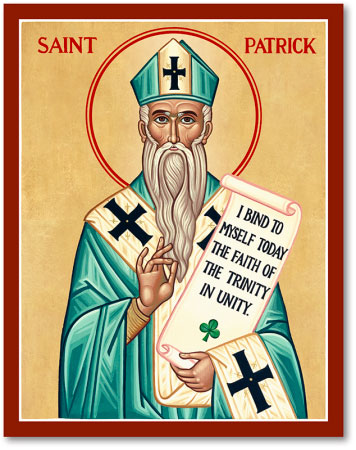
st-patrick-icon-421

St. Patrick of Ireland with shamrock and the opening line of St. Patrick’s Breastplate. We have no idea what he looked like, he probably did not dress in medieval episcopal robes, there is no reliable evidence that he used the shamrock to explain the Trinity, and he did not write the hymn attributed to him.

[This blog posting is heavily in debt to Thomas O’Loughlin’s Discovering Saint Patrick (New York NY/MahwahNJ: Paulist Press, 2005). If you are serious about Patrick you’ll read this book]

There are few historical figure burdened with more legends, myths, and traditions than St. Patrick. The first life of Patrick was written a couple of centuries after the saint died, by the Irish monk Muirchú moccu Machtheni in the 7th century.It seems at times that you cannot throw a rock in Ireland without hitting some landmark associated with Patrick – a well, a church, a hill, a cross, an island, or a lake. Ask about what he did and people will say that he converted all of Ireland from pagan ways to Christianity; that he used a shamrock to explain the Trinity; and that he drove the snakes out of Ireland. They will say that he wrote several hymns, including the one known as St. Patrick’s Breastplate. The Irish diaspora turned his feast day, March 17th, into a celebration of Ireland complete with marching bands, leprechauns, green beer, and in Chicago, a green river. In response to the demands of American tourists Dublin began holding St,. Patrick’s Day parades in 1931; it is only recently in Ireland that the day morphed from a religious celebration to a secular celebration. As important as all this is, it is doubtful that it bears much relation to the historical Patrick.

The interesting thing about Patrick is that we do have an historical core – two writings by the man himself. One is the Confessio in which he gives an account of his life, as a defense against his detractors. The other is the Epistola Militibus Corotici or The Letter to the Soldiers of Coroticus; to call them soldiers is not quite right, as they were really Pictish and Irish slavers. The letter is itself an excommunication of Coroticus and an appeal to the soldiers and all faithful Christians to abandon him. For obvious reasons there is more biographical information in the Confessio, but nothing that can be pinned down in terms of dates. As best as we can tell, Patrick lived in the 5th century, but some scholars push him back into the fourth century, and it is possible he worked into the sixth century. We really do not know when he lived, and precise dating is at best an informed guess.

What we do know is this. He was born and raised on the west coast of Britain and raised as a Christian. His father was a deacon and his grandfather a priest. They owned property. It is likely that at that time the Roman authorities and their armies had left Brittannia, but Romanized Britons were the dominant population; the Angles, Saxons, and Jutes had not yet arrived to make most of Britannia into England, and the Scots were still in Ireland. Christianity was reasonably well established in Britain for over a century, although it lived alongside older Celtic religions, Roman cults, and religious practices brought from across the Empire and beyond. Ireland had never been part of the Roman Empire, and was considered a barbarian land, like the highlands of what became Scotland.

Patrick likely spoke an archaic form of Welsh, and he knew how to speak and write late Roman Latin (the two works we have are in Latin). At the age of sixteen his learning came to a sudden end when he was captured by an Irish raiding party, and he and others were taken to Ireland and sold as slaves. For many years he worked as a shepherd, and learned the Irish language. While not a particularly devout teenager, he fell on the God of his youth while in slavery, and God directed him in a vision to escape to a ship that was by the shore. He made his escape, and the ship took him away, perhaps to what is now Brittany or Normandy. After many adventures he eventually he made his way home. In the years that followed he deepened his faith and was made a bishop. It is not clear if he would have gone through a cursus honorium of being a deacon and priest or any other rank – it was not yet a requirement. Further, while later generations assumed that as a cleric he would have been celibate, such a practice was by no means universal at the time – most bishops were married and had children, as Patrick’s grandfather had been. Patrick might have been married at some point, but as he makes no mention of a spouse or children, it is reasonable to assume that he was following the newer trend advocated by St. Jerome and others that clergy should leave such earthly attachments behind. Likewise, while Irish Christianity became centered on monasticism (derived from St. Martin of Tours and the Egyptian Fathers and Mothers), Patrick gives no indication of being a monk himself.

While in Britannia Patrick received the call to go to Ireland. It appears that this was as much an internal, spiritual call, one which he did not really want. The call was confirmed by the Christian community around him, and it may have been on this basis that he was made a Bishop. He left for Ireland, and proceeded to travel around preaching the good news in Irish, making disciples, and baptizing them. In all probability Patrick was neither the first Christian nor the first missionary in Ireland. The fifth century author Prosper of Aquitaine noted that his near contemporary Palladius was ordained a bishop and sent by the Bishop of Rome to Ireland. As well, other Christians were undoubtedly brought in as slaves or came as merchants, and they may have made converts. However, as none of them left a written record but Patrick did, Muirchú chose to write a life of the saint that portrayed him as the apostle to all Ireland. Patrick’s own writings do not have such a portrayal – he is simply sent to the Irish who have not heard the good news. Patrick never identified any places where he ministered, but it is clear that he was itinerant and travelled widely. Undoubtedly the apostle Paul was the model for his work, as well as the itinerant ministry of Jesus himself.

And Patrick had great success. God only knows what the population of the island was then – 200,000 to 500,000 might be a good guess – but he says he baptised several thousands. This suggests that the island was very receptive to Christianity, and within a few generations it was the dominant religion, focused on monastic communities. Like compound interest that accumulates slowly but surely over the long run, so the individual conversions to Christianity grew.

One of the ironies of Patrick’s writings is that he apologises for the quality of his Latin as compared with his contemporaries in Britain. However, his are the only writings that have survived from Roman Britain and the immediate post-Roman Britain (apart from inscriptions and occasional scraps of merchant’s records) – everything else has perished. We have only the vaguest idea of who the people were and what they thought, and we do not even know the names of Patrick’s eloquent detractors. Such is history.

Perhaps the most interesting thing about Patrick was his theology of mission. Patrick understood himself to be an instrument of God. At the end of the Gospel according to Matthew the disciples of Jesus are commanded to

Go therefore and make disciples of all nations, baptizing them in the name of the Father and of the Son and of the Holy Spirit, and teaching them to obey everything that I have commanded you. And remember, I am with you always, to the end of the age.

Thomas O’Loughlin argues quite persuasively that Patrick believed that “the end of the age” would come when the gospel had been preached to the ends of the earth. Once all had heard it, and those who accepted it had been baptised, there would be no reason for the divine to delay the coming of the Son of Man. For Patrick, a civilized Roman Briton, Ireland was at the ends of the world. His efforts were not to enfold Ireland into the bosom of Rome, but to hasten the day of Judgement, after which justice would reign, Christ would be seated in the New Jerusalem, and God would be all in all. A bit of a ways, methinks, from green beer and leprechauns.

Posted in Lent, Sermons | Tagged , , | Leave a comment

Lenten Readings: Day 13

Wrath and Judgement

The Great Day of His Wrath 1851-3 by John Martin 1789-1854

John Martin “The Great Day of His Wrath” by John Martin (1789–1854 ), 1851–3. Tate Gallery, London UK

Paul leaves what he understands to be “sexual depravity” to speak of depravity in general in the last few verses of Chapter 1. The failure to acknowledge God by the light of natural reason and turning to the worship of idols leads to warped thinking and a long list of painful consequences. Many of the things Paul lists would have been condemned in Greek and Roman cultures as well as in Judaism and among followers of Jesus. That said, the leaders of the Empire were not seen as upholders of these classic virtues, but corrupt, power hungry oppressors.

I read over Robert Jewett’s comments of this passage and yesterday’s in his 1143 page commentary on Romans in the Hermenaia series (2007). Jewett pointed out that Roman society was profoundly hierarchical, and most people were clients or slaves of others. Even free born citizens were obliged to submit to their patrons. It is also clear from Roman and Greek literature of the time that sexual submission was expected. A patron – always a male – could demand sexual satisfaction from his slaves, as well as from his spouse, and any of his clients, whether male of female. It was an exercise of power as much as anything. What we understand as sexual exploitation, sexual assault, and sexual harassment was part and parcel of the way things were; it was only illegal if a slave or a person of lower status sexually assaulted a Roman citizen of higher status. Jewett speculates that part of the disgust Paul expresses about pagan same-sex behaviour may be because it so often was actually rape. Again, Paul was probably not aware of any same-sex relations which functioned on the principle of mutual love, respect, and equality.

Rom 1.28—2.11
And since they did not see fit to acknowledge God, God gave them up to a debased mind and to things that should not be done. They were filled with every kind of wickedness, evil, covetousness, malice. Full of envy, murder, strife, deceit, craftiness, they are gossips, slanderers, God-haters, insolent, haughty, boastful, inventors of evil, rebellious towards parents, foolish, faithless, heartless, ruthless. They know God’s decree, that those who practise such things deserve to die—yet they not only do them but even applaud others who practise them.

Therefore you have no excuse, whoever you are, when you judge others; for in passing judgement on another you condemn yourself, because you, the judge, are doing the very same things. You say, ‘We know that God’s judgement on those who do such things is in accordance with truth.’ Do you imagine, whoever you are, that when you judge those who do such things and yet do them yourself, you will escape the judgement of God? Or do you despise the riches of his kindness and forbearance and patience? Do you not realize that God’s kindness is meant to lead you to repentance? But by your hard and impenitent heart you are storing up wrath for yourself on the day of wrath, when God’s righteous judgement will be revealed. For he will repay according to each one’s deeds: to those who by patiently doing good seek for glory and honour and immortality, he will give eternal life; while for those who are self-seeking and who obey not the truth but wickedness, there will be wrath and fury. There will be anguish and distress for everyone who does evil, the Jew first and also the Greek, but glory and honour and peace for everyone who does good, the Jew first and also the Greek. For God shows no partiality.

At the beginning of Chapter 2 Paul suddenly unleashes his rhetorical wizardry. After leading his readers (really, listeners) down the garden path of judgement he turns on them to say that they are in no position to judge others. A common theme in the gospels is that Christians should refrian from judgement and be quick to forgive. Thus, in the Sermon on the Mount Jesus says:

Do not judge, so that you may not be judged. For with the judgement you make you will be judged, and the measure you give will be the measure you get. Why do you see the speck in your neighbour’s eye, but do not notice the log in your own eye? Or how can you say to your neighbour, “Let me take the speck out of your eye”, while the log is in your own eye? You hypocrite, first take the log out of your own eye, and then you will see clearly to take the speck out of your neighbour’s eye. (Matthew 7.1-5)

In the Lord’s Prayer we pray that we might be forgiven our sins as we forgive others. In the Gospel of John we are told that Jesus came into to the world not to condemn the world, but to save it. The story of the woman caught in adultery in which Jesus tells the crowd that those without sin could cast the first stone (and no one can, of course) also emphasises this principle. Judging others was not a good thing in the early Christian communities, and both Paul and the recipients of his letter know this.

Paul has apparently heard that some of the Christians in Rome are quite judgmental. They are showing “a hard and impenitent heart” with their condemnation. Whether one is Jewish in origin or Gentile in origin makes no difference – harsh judging will result in a harsh judgement from God.

How are we to envisage the wrath of God? I think there are two or three ways. First, we can imagine it as an apocalyptic breaking in of God in which those who have suffered (including the righteous dead, who are raised to new life) are raised up and come to live eternal life, in something that might look like the New Jerusalem. Those who caused the suffering – emperors, murderous soldiers, cruel masters of slaves, those who exploited others without regard for their humanity – they are also raised to new life, only in this case they are brought low and punished, perhaps in something that looks like a burning fire of pitch. Or, again, one might see these very graphic descriptions as depictions of that which is strictly speaking beyond words and physical understanding, but contains spiritual truths. Or, once again, one might say that in this life even in oppression we can experience the new life in Christ, and those who are not in Christ are already in a form of hell.

It is hard not to judge. Indeed, many of us have to make judgements about people all the time. Are they good employees? If this person has done something bad how do I bring the consequences of their action to bear upon them, so that they cannot harm again? Is this a good piece of art? Is this food good for me? Am I safe around this person? Am I being manipulated?

Perhaps what Jesus and Paul are getting at is that we can become obsessed by judging others, particularly when we have no need to judge them. Rather than finding a way to live with people who are different from us, or hold different ideas from us, we raise ourselves up by putting them down. We do this with “race”, ethnicity, religion, nationality, education, sex and gender, parentage, social status, economic status, where we live, where we’ve come from, and so forth. It’s the kind of judging that we associate with internet trolls, or hyperbolic politicians. Christians are called to let go of all that and to be at peace. Even if they have suffered mightily they need to forgive, otherwise the trauma of the abuse will continue to have a hold on them; that is not to say that the perpetrator should not face the consequences of their actions, but that the person abused needs to work through their pain regardless of what happens to the perpetrator. It may not always be possible to find justice in this life, but one might find a modicum of peace. This is a foretaste of eternal life, of divine life.

Posted in Lent | Tagged , , , | Leave a comment

Lenten Readings: Day 12

Roman Idol

casting-idols-740x340

Having introduced himself and his various themes with elaborate rhetoric, Paul then goes on to state his main theme, lest anyone forget it: the good news of Jesus Christ “is the power of salvation to everyone who has faith, to the Jew first and also to the Greek.”

He then moves into describing how the wrath of God will come to the ungodly and evil. For a born Jew like Paul the biggest difference between Jews and non-Jews was that the Jews worshipped a God of whom no image could be made, whereas the Gentiles worshipped images and idols that looked like humans or snakes or other beasties. Paul believes that all human beings have a knowledge of God that is shown in creation and in the dynamism of the world, as well as revealed in the history of the Jews. Paul believes that it is equally evident that this God is invisible. Instead of worshipping an invisible deity obvious to them through natural theology, they imagine the divine creator to look like the creature. They missed what Karl Barth called “the wholly other” – that the creator is utterly different from the creation, and cannot be represented.

In Paul’s mind idolatry is so awful and such a fundamental mistake that it leads to further wickedness. For an otherwise conservative Jew like Paul this manifests itself in what he sees as degrading unnatural relations.

Romans 1.16 – 24 (25-26)

For I am not ashamed of the gospel; it is the power of God for salvation to everyone who has faith, to the Jew first and also to the Greek. For in it the righteousness of God is revealed through faith for faith; as it is written, ‘The one who is righteous will live by faith.’

For the wrath of God is revealed from heaven against all ungodliness and wickedness of those who by their wickedness suppress the truth. For what can be known about God is plain to them, because God has shown it to them. Ever since the creation of the world his eternal power and divine nature, invisible though they are, have been understood and seen through the things he has made. So they are without excuse; for though they knew God, they did not honour him as God or give thanks to him, but they became futile in their thinking, and their senseless minds were darkened. Claiming to  be wise, they became fools; and they exchanged the glory of the immortal God for images resembling a mortal human being or birds or four-footed animals or reptiles.

Therefore God gave them up in the lusts of their hearts to impurity, to the degrading of their bodies among themselves, because they exchanged the truth about God for a lie and worshipped and served the creature rather than the Creator, who is blessed for ever! Amen.

[For this reason God gave them up to degrading passions. Their women exchanged natural intercourse for unnatural, and in the same way also the men, giving up natural intercourse with women, were consumed with passion for one another. Men committed shameless acts with men and received in their own persons the due penalty for their error.]

Two things stand out for me. First, there is a sense that the gospel is somehow shameful in the eyes of the world, a kind of foolishness. This is undoubtedly due to the fact that it proclaimed that a crucified peasant had been raised from the dead and was proclaimed as kurios or Lord. This was a bizarre claim to make in the context of the Roman Empire, and somewhat subversive of the true lords, the Roman Empire and its leaders. As well, the followers of Jesus came out of Judaism, and that was viewed as a strange cult in the Empire with its refusal to worship the Emperor and its hatred of divine images, as well as customs around food, Sabbath days, and circumcision. But Paul is clear that he is not ashamed of the gospel – indeed, he celebrates the death of Jesus, and has a well developed theology of the cross. To follow Jesus is a topsy-turvey experience, where what is approved of in the world is rejected by Christians, and what is considered wisdom is treated as foolishness.

Second, Paul assumes the sexual norms of Judaism and so sees any kind of same-sex sexual activity as contrary to the will of God. He links in the passage that is read today (and in the paragraph that is not included in the lectionary) that idolatry leads to such behaviour. What he is probably incapable of imagining is a devout follower of Jesus who is also in a same-sex sexual relationship. In fact, he so does not imagine it that he does not mention the possibility.

We are today a long way away from the first century. Over the past generations we have developed concepts of identity, sexuality, and gender. We have reflected on all of these as having a range and variations. When we see the committed love between two persons, we hold it up and see little difference between the commitment of different-sex couples and same-sex couples. When we see problems in sexual relations this is due less to the sexual identity of the partners and more to do with how they treat each other. Are they loving or antagonistic? Do they show affection or is one or both of them violent and abusive? Do they build each other up or tear each other down? Are they faithful or are they breaking the trust and vows established in marriage?

Clearly I am not a person who reads propositions out of scripture and then literally applies it out of context into my own situation. Paul was a first-century Jewish male, and the things he did and said were nevertheless radical for his times. In some respects he may not have been radical for us now in the 21st century, but behind his cultural assumptions we see radical principles. In his letter to the Galatians 3.27-28 he wrote,

As many of you as were baptized into Christ have clothed yourselves with Christ. There is no longer Jew or Greek, there is no longer slave or free, there is no longer male and female; for all of you are one in Christ Jesus.

What appears to be cosmic categories of difference become irrelevant in the light of he resurrection of Christ, and incorporation in Christ takes them and reveals them to be the cultural conditions they are, due to pass away in time. They are not unimportant, but they just don’t have the importance we so often give to them.

God gave us minds with which to think, and so we are called to examine and reflect on everything, including the Holy Scriptures. The challenge is to see how it applies to us now. I suspect that when people look back a century from now Christians will wonder about how people could denigrate gays and lesbians and how it was that the church was so divided over this issue. However, we were equally divided in the 19th century over slavery, as incomprehensible as that seems.

We don’t make idols of God – but we do have other idols that lead us into corruption, such as belief and kneeling down before the gods of the free market and the “invisible hand of God”. Marxism was “the God that failed”. Nationalism and “race” were gods for the German National Socialists, and we are seeing those ugly demons rise again. These are the things upon which the wrath of God will be visited, as markets crumble, walls fall down, and wars come to bigoted, hateful peoples. More on this tomorrow.


Posted in Lent | Tagged , , , , | Leave a comment

Lenten Readings: Day 11

Roman Holiday

Roman Capitoline

Italo Gismondi, scale model showing the Temple of Jupiter Optimus Maximus on the Capitoline Hill in Rome during the time of Constantine (early 4th century), abutting the Roman Forum (below, right) and Imperial Fora (to the right) (Plastico di Roma Imperiale. Particolare con il Campidoglio e l’Arce sormontata dal Tempio di Giunone Moneta), 1933-1955, gesso (Capitoline Museums, Rome)

Today we begin reading Paul’s Letter to the Romans, and over the next four weeks we will work our way from the very beginning to the end of chapter eleven. We then pick it up later in Eastertide through the end of chapter 15 (In Year 2 of the Daily Office Readings we read the whole letter in the weeks after Pentecost).

The Letter was written before Paul’s final visit to Jerusalem, where he was arrested, imprisoned, brought before the a Council of Jewish leaders, the Roman governors, the Tetrarch Herod Agrippa, and sent to Rome for a final decision about his fate (see Acts 21-28). Unlike all his other letters that have survived, Paul is not writing to congregations that he had helped found. The Christian congregations in Rome had already been founded by anonymous Christians more than a decade earlier. Tradition states that Peter went to Rome, and tradition also states that both died martyr’s deaths in Rome, but these traditions date from decades after the writing of these letters. While there may be some truth in the tradition, it is not as historically significant as a primary document such as the Letter to the Romans.

Greek and Roman letter writing tended to follow a pattern, and Paul in Romans uses all his rhetorical abilities. Paul would have dictated the letter, but the letter is so well crafted that I suspect he revised it before approving a final version to be sent off. It is, after all, a small book that is as large as the Gospel of Mark in length. The Roman Empire did not have a postal system as we understand it; the letter would have been carried by a private individual, by foot, animal, or (most likely) ship, and that person would also be responsible for reading it to the audience.

In this first section we get the Paul’s salutation (1-7) and thanksgiving (8-15). Typically the themes of the letter are adumbrated in these sections.

Rom 1.1–15
Paul, a servant of Jesus Christ,
called to be an apostle,
set apart for the gospel of God,
which he promised beforehand through his prophets in the holy scriptures,
the gospel concerning his Son,
who was descended from David according to the flesh
and was declared to be Son of God with power
according to the spirit of holiness by resurrection from the dead,
Jesus Christ our Lord,
through whom we have received grace and apostleship
to bring about the obedience of faith among all the Gentiles
for the sake of his name,
including yourselves who are called to belong to Jesus Christ,

To all God’s beloved in Rome, who are called to be saints:

Grace to you and peace from God our Father and the Lord Jesus Christ.

First, I thank my God through Jesus Christ for all of you,
because your faith is proclaimed throughout the world.
For God, whom I serve with my spirit by announcing the gospel of his Son,
is my witness that without ceasing I remember you always in my prayers,
asking that by God’s will I may somehow at last succeed in coming to you.
For I am longing to see you
so that I may share with you some spiritual gift to strengthen you—
or rather so that we may be mutually encouraged by each other’s faith,
both yours and mine.
I want you to know, brothers and sisters,
that I have often intended to come to you (but thus far have been prevented),
in order that I may reap some harvest among you
as I have among the rest of the Gentiles.
I am a debtor both to Greeks and to barbarians,
both to the wise and to the foolish
— hence my eagerness to proclaim the gospel to you also who are in Rome.

One of the interesting questions which is hotly contested is the purpose of the letter. On the one hand, Paul is preparing to visit Rome, as he says, so that he might “share with you some spiritual gift to strengthen you—” and then says, a little more modestly, “or rather so that we may be mutually encouraged by each other’s faith, both yours and mine.” He wants to  “reap some harvest among you as I have among the rest of the Gentiles.” That much is clear, then. As well, in Romans 15 he writes:

23But now, with no further place for me in these regions, I desire, as I have for many years, to come to you 24when I go to Spain. For I do hope to see you on my journey and to be sent on by you, once I have enjoyed your company for a little while.

Paul, then, plans a trip to Rome on his way to Spain. He hopes to be sent on by the Romans – and perhaps desires both their moral and material support.

However, he is also aware that there are some divisions amongst the Christians in Rome, apparently between the Jewish Christians and the Roman Christians. The greater part of the letter, then, is a theological reflection on the good news as it applies to Jews and non-Jewish Gentiles. Some scholars believe that Paul was addressing himself primarily to the Gentile Christians who for some reason had got it in their heads that they were superior to the Jewish Christians. Before heading to Rome Paul wants to make sure that people know his thoughts on the matter.

Posted in Lent | Tagged , | Leave a comment

Lenten Readings: Day 10

The Great High Priest

melch-revenna-apoll

Melchizedek , Abraham, and Abel at the Altar. Basilica di Sant’Apollinare in Ravenna ITALY. 6th century.

Today’s second reading in the Daily Office Lectionary is our last from Hebrews this Lent until Holy Saturday, the final day of the season. Starting next week we begin reading our way through most of Paul’s Letter to the Romans until Holy Week, when we read passages from Philippians 3 & 4. Tomorrow, being the Second Sunday in Lent, is not counted among the forty days, and so I will not post a blog tomorrow.

The theme now is Jesus as a great high priest. This is a spiritual metaphor. In his earthly life Jesus was not of the tribe of Levi, and he was not a descendant of Zadok the Priest, and so was in no way qualified to be selected to be a priest or a high priest in Jerusalem at the Temple.

Heb 5.1–10
Every high priest chosen from among mortals is put in charge of things pertaining to God on their behalf, to offer gifts and sacrifices for sins. He is able to deal gently with the ignorant and wayward, since he himself is subject to weakness; and because of this he must offer sacrifice for his own sins as well as for those of the people. And one does not presume to take this honour, but takes it only when called by God, just as Aaron was.

 So also Christ did not glorify himself in becoming a high priest, but was appointed by the one who said to him,
‘You are my Son,
today I have begotten you’;
as he says also in another place,
‘You are a priest for ever,
according to the order of Melchizedek.’

In the days of his flesh, Jesus offered up prayers and supplications, with loud cries and tears, to the one who was able to save him from death, and he was heard because of his reverent submission. Although he was a Son, he learned obedience through what he suffered; and having been made perfect, he became the source of eternal salvation for all who obey him, having been designated by God a high priest according to the order of Melchizedek.

Jesus is described here as having been chosen as a priest by God, and having been appointed a priest in his being begotten of the Father. The reference to Melchizedek is interesting, because he was not an Israelite priest, but a Caananite priest of El-Elyon ‘the most high God”. Some scholars speculate that various cults of Yahweh, El, and El-Elyon merged sometime before or after the time of David (1000 BC) and that this story is a remnant from a time when El-Elyon was recognised as identical with Yahweh.

One needs to separate out two separate meanings of priest in English which in Hebrew and Greek are two separate words. The Hebrew זָקֵן (zaqen) means elder. It was translated into Greek as πρεσβύτερος (presbuteros), and it means elder as well.In the centuries before Jesus the synagogues were usually ruled by a council of the senior men of the community, and they were also called elders. This kind of council was taken over into early Christianity, and so its ordained leadership was also called presbuteroi.  This word came down, through Latin and Germanic to Old English and got somewhat mangled, but is now pronounced “priest”, although it is sometimes transliterated as “presbyter”. These leaders were concerned with preaching and leading the individual communities. Very different are the כֹּהֵן (cohen) or ἱερεύς (hierus) who offer sacrifices in Temples. Zadok and Caiaphas were cohens and hieruses, not zakenim or presbuteroi.English conflated these two sets of terms into one word, priest, and began to look at the Holy Eucharist as a sacrifice of a sacrifical priest, rather than the presidency of an elder priest. As Catholics and Reformers tried to deal with the clericalization of the church they changed the names for the ordained, so that now we have a plethora of them: priest, presbyter, elder, pastor, minister, parson, and so on.

Christianity, influenced by Hebrews and other portrayals of Jesus, see him as the only cohen/hierus; alternately, there is also the  sense that all believers are priests, as we are the body of Christ. Jesus is outside the Levitical or Aaronite succession – he is like Melchizedek, chose by God to be a priest. His offering – himself – will be discussed later in the letter as an offering than makes any further offerings superfluous. Chjrist’s offering becomes once and for all.

If we are the body of Christ, then we are part of the sacrifice, part of the offering, as well as part of the redemption. Our sins are propitiated by our incorporation in the offering of Jesus. As Christ is then raised from the dead, so we participate in the power which lifted him up from the grave.

Posted in Lent | Tagged , , | Leave a comment

Lenten Readings: Day 9

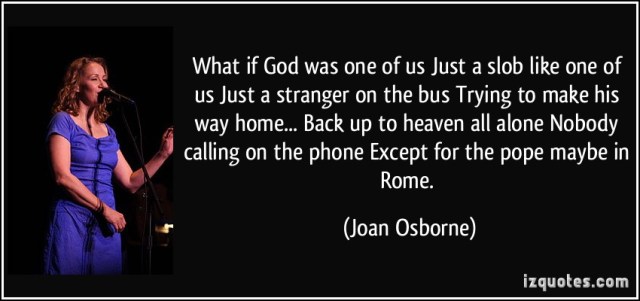
What If God Was One Of Us?

quote-what-if-god-was-one-of-us-just-a-slob-like-one-of-us-just-a-stranger-on-the-bus-trying-to-make-his-joan-osborne-308942

I’ve always had a love/hate relationship with this song from 1995. Written by Eric Bazilian and sung by Joan Osborne, it asks an important question without really engaging with the fact that Christianity proclaims that in Christ God did become one of us. It describes a God seemingly unconcerned with humanity, just trying to go home to heaven. While the song acknowledges various existential questions for the listener – “If seeing meant that you would have to believe In things like heaven and in Jesus and the saints and all the prophets?” – it doesn’t bear down on how that might relate to twenty centuries of reflection on the fact for Christians that God did become one of us. It’s a great song with excellent singing and a god guitar solo, but it bothers me. Indeed, this is the second blog where it has popped in as a topic (here’s the first, almost three years ago). But, then, you can only do so much in a five minute pop song.

The text from Hebrews in the Daily Office Lectionary for today does get into what it means that God became one of us.

Heb 4.11–16
Let us therefore make every effort to enter that rest, so that no one may fall through such disobedience as theirs.

Indeed, the word of God is living and active, sharper than any two-edged sword, piercing until it divides soul from spirit, joints from marrow; it is able to judge the thoughts and intentions of the heart. And before him no creature is hidden, but all are naked and laid bare to the eyes of the one to whom we must render an account.

Since, then, we have a great high priest who has passed through the heavens, Jesus, the Son of God, let us hold fast to our confession. For we do not have a high priest who is unable to sympathize with our weaknesses, but we have one who in every respect has been tested as we are, yet without sin. Let us therefore approach the throne of grace with boldness, so that we may receive mercy and find grace to help in time of need.

The reading today contains a division in topic. In the first two paragraphs (4.11-13) the author is finishing off his reflections on Psalm 95 and entering into God’s rest. He then takes up the topic of Jesus as a great high priest, which continues to the end of chapter five.

Hebrews 4.14-16 asserts that God was one of us, subject to temptation and who knows our weaknesses. The great high priest Jesus and the total offering he made of himself in the Cross is not distant from us, but part of us and one who speaks and acts on behalf of us. If God was one of us, atonement is achieved in Jesus’s incarnation, life, death, and resurrection. Estrangement between God and humanity is overcome, and humanity is transformed and re-created to be what God created us to be. We grow into this through prayer and meditation, reflection on scripture, and by reaching out towards our neighbours and lifting them up through compassionate empowerment.

What Eric Bazilian/Joan Osborne does capture well is the sense of challenge that someone facing God might experience. The reading from Hebrews gets that, too, when it describes the word of God as, “living and active, sharper than any two-edged sword, piercing until it divides soul from spirit, joints from marrow; it is able to judge the thoughts and intentions of the heart.” The author here sounds positively Johannine, like the author of the Fourth Gospel, but it may simply be that he sees the word of God as that inspiration which came to the prophets and now inhabits every person. It might come from reading scripture, it might come from contemplating the incarnate Word of God, and it might come from the face of Christ reflected in our neighbour on the bus. This is the challenge to any human being, and especially to any Christian: since God has become one of us, what are you now going to do? We can speculate about what might be going on in the mind of Christ, or we can resolve to act like the renewed person Christ makes us be.

Posted in Lent | Tagged , | Leave a comment

Lenten Readings: Day 8

Rest/Restless

Restless-Heart

The quotation is from Augstines Confessions c.400. The sign itself is more recent.

The passage from Hebrews today continues to riff off of the passage in Psalm 95 quoted in the past two days: “As in my anger I swore,“They will not enter my rest.””. The image is of a very anthropomorphic God, angry because of the people of Israel rejected him. My reading of this (perhaps not put as well yesterday as I could have said it) is that this is an anthropomorphic description of the consequences of rejecting God, and that, from a less anthropomorphic more objective perspective, “a life without the divine leads to restlessness, a long time in a forbidding wilderness  and the inevitable unsatisfying death.” We cannot enter into “the rest” of God because we have rejected God. That’s less a result of any imagined anger of God than a logical consequence of the rejection.

Heb 4.1–10
Therefore, while the promise of entering his rest is still open, let us take care that none of you should seem to have failed to reach it. For indeed the good news came to us just as to them; but the message they heard did not benefit them, because they were not united by faith with those who listened. For we who have believed enter that rest, just as God has said,
‘As in my anger I swore,
“They shall not enter my rest” ’,
though his works were finished at the foundation of the world. For in one place it speaks about the seventh day as follows: ‘And God rested on the seventh day from all his works.’ And again in this place it says, ‘They shall not enter my rest.’ Since therefore it remains open for some to enter it, and those who formerly received the good news failed to enter because of disobedience, again he sets a certain day—‘today’—saying through David much later, in the words already quoted,
‘Today, if you hear his voice,
do not harden your hearts.’
For if Joshua had given them rest, God would not speak later about another day. So then, a sabbath rest still remains for the people of God; for those who enter God’s rest also cease from their labours as God did from his.

So what is “the rest” of God? It clearly is related to the Sabbath rest, bit it probably means more in the passage. In the Hebrew of Psalm 95 the word is מְנוּחָתִֽי (mč-no-akh-i). It is a feminine noun related to the verb for “to rest”. It can be understood literally that no one of that generation would enter the Promised Land – their children did, but they did not. Hebrews takes it further, though. I think it can be read eschatologically, referring to the Kingdom of God that will come to pass with the revelation of Jesus as the Son of Man at his second coming. One might retroproject a later Christian emphasis on heaven as what the author means, but the eschatological perspective is closer to where the early Christians were. A fourth way to read it is the Augustinian way, which is to say we can enter into the rest of God today by stopping our pointless scurrying and busy-ness and resting in the Divine. Let’s go there!
Posted in Lent, Uncategorized | Tagged , , | Leave a comment

Lenten Readings: Day 7

Rejection

rejected

All of us have experienced rejection. Some of us have experienced it in jobs, relationships, school, and in other circumstances. Some of us have experienced it in church, when we have been told that people like us have no place in the community of the faithful, or we have a place but we must keep silent, or so transform ourselves that we no longer look like the wonderful creatures God us made us to be.

In the reading below God does not reject people, although people might want to interpret it that way. God has already accepted us as we are. In the reading he has already chosen the people of Israel and has brought them out of slavery into freedom. He has promised them a new land where they might settle. This looks like a good deal, but many of the people turned aside to worship idols, complain about the food, acted out of fear, and challenged the leadership of Moses. They rejected the mercy and care of God. Well, actions have consequences, and a life without the divine leads to restlessness, a long time in a forbidding wilderness  and the inevitable unsatisfying death. The Israelites chose this, though they did not appreciate the consequences in so doing.

Hebrews 3.12-19
Take care, brothers and sisters, that none of you may have an evil, unbelieving heart that turns away from the living God. But exhort one another every day, as long as it is called ‘today’, so that none of you may be hardened by the deceitfulness of sin. For we have become partners of Christ, if only we hold our first confidence firm to the end. As it is said,
‘Today, if you hear his voice,
do not harden your hearts as in the rebellion.’
Now who were they who heard and yet were rebellious? Was it not all those who left Egypt under the leadership of Moses? But with whom was he angry for forty years? Was it not those who sinned, whose bodies fell in the wilderness? And to whom did he swear that they would not enter his rest, if not to those who were disobedient? So we see that they were unable to enter because of unbelief.

The point about Christian grace is that it is freely offered by God in Christ. It has already been done, before any of us were born, regardless of how warped and broken we might grow up. It is not God who rejects us, but we who reject God. We might be deceived by our own love affair with sin, attacking others and blaspheming against the love of God. We might have hard hearts – calcified, prone to disease, misfunctioning.

So the author encourages his readers to do what they can to turn to the loving God. The first confidence we had in hope of God in Christ is our present hope, and that which will sustain us.

Posted in Lent | Tagged , , | Leave a comment