Lenten Readings: Day 23

Martin Luther and the Introspective Conscience of the West

quote-our-vision-is-more-obstructed-by-what-we-think-we-know-than-by-our-lack-of-knowledge-krister-stendahl-54-83-53

Martin Luther loved Paul’s Letter to the Romans. He thought Christians should study it every day and memorize every word. He wrote in the Preface to his Commentary on the Epistle to the Romans (1522):

We find in this letter, then, the richest possible teaching about what a Christian should know: the meaning of law, Gospel, sin,punishment, grace, faith, justice, Christ, God, good works, love,hope and the cross. We learn how we are to act toward everyone,toward the virtuous and sinful, toward the strong and the weak,friend and foe, and toward ourselves. Paul bases everything firmly on Scripture and proves his points with examples from his own experience and from the Prophets, so that nothing more could be desired. Therefore it seems that St. Paul, in writing this letter, wanted to compose a summary of the whole of Christian and evangelical teaching which would also be an introduction to the whole Old Testament. Without doubt, whoever takes this letter to heart possesses the light and power of the Old Testament.Therefore each and every Christian should make this letter the habitual and constant object of his study. God grant us his grace to do so. Amen.[1]
[Emphasis Added]

Whereas yesterday I noted that modern biblical scholars believe that Paul often used the norms of Greco-Roman rhetoric to present “in character” speeches, Luther reads the “I” statements as examples Paul is making concerning himself, in the present day. Thus, on Chapter Seven he writes:

Then St. Paul shows how spirit and flesh struggle with each other in one person. He gives himself as an example, so that we may learn how to kill sin in ourselves. He gives both spirit and flesh the name “law,”so that, just as it is in the nature of divine law to drive a person on and make demands of him, so too the flesh drives and demands and rages against the spirit and wants to have its own way. Likewise the spirit drives and demands against the flesh and wants to have its own way. This feud lasts in us for as long as we live, in one person more, in another less, depending on whether spirit or flesh is stronger. Yet the whole human being is both: spirit and flesh. The human being fights with himself until he becomes completely spiritual. [Emphasis added]

Martin Luther was himself profoundly transformed when he gave a lecture series at Wittenburg on the text, and it bore fruit when he posted the 95 Theses two years later. His approach to Romans set the template for classic Lutheran teaching for the next five centuries (generations of Lutheran pastors were taught that sermons should have a two-fold structure, in which Law is used to condemn sin in the believer, and Gospel to elicit faith). He influenced Anglican theology and Calvinism (i.e. Reformed and Presbyterian theology). Roman Catholicism had its Counter-Reformation precipitated by Luther’s theological protests, and while not a negative image of Protestantism (the Counter-Reformation included many historical influences that were already in ferment before 1517), much of its agenda was determined by the need to challenge Luther and those who followed after him. Karl Barth, the so called “neo-orthodox” theologian of the first half of the Twentieth Century, reinterpreted Lutheran theology for a modern era with his Epistle to the Romans in 1919.

Who would dare challenge this deep and profoundly influential interpretation? And who would listen? Well, ultimately it fell to a Swedish Lutheran scholar working at Harvard Divinity school by the name of Krister Stendahl, who later became the Archbishop of Stockholm in the very Lutheran Church of Sweden. He gathered up the rhetorical evidence and determined that Paul was not talking about himself in Chapter 7. As mentioned earlier in this series of Lenten readings, in 1963 he published an article entitled “The Apostle Paul and the Introspective Conscience of the West”. Unfortunately it is still very much under copyright, so it is not accessible via the Internet unless you have access through an academic library. But let’s first see what Paul says in the passage before getting on to what the archbishop said.

Rom 7.13–25
Did what is good, then, bring death to me? By no means! It was sin, working death in me through what is good, in order that sin might be shown to be sin, and through the commandment might become sinful beyond measure.

For we know that the law is spiritual; but I am of the flesh, sold into slavery under sin. I do not understand my own actions. For I do not do what I want, but I do the very thing I hate. Now if I do what I do not want, I agree that the law is good. But in fact it is no longer I that do it, but sin that dwells within me. For I know that nothing good dwells within me, that is, in my flesh. I can will what is right, but I cannot do it. For I do not do the good I want, but the evil I do not want is what I do. Now if I do what I do not want, it is no longer I that do it, but sin that dwells within me.

So I find it to be a law that when I want to do what is good, evil lies close at hand. For I delight in the law of God in my inmost self, but I see in my members another law at war with the law of my mind, making me captive to the law of sin that dwells in my members. Wretched man that I am! Who will rescue me from this body of death? Thanks be to God through Jesus Christ our Lord!

So then, with my mind I am a slave to the law of God, but with my flesh I am a slave to the law of sin.

Stendahl writes:

Judging from Paul’s own writings, there is no indication that he had “experienced it [“a plagued conscience”] in his own conscience” during his time as a Pharisee. . . If that is the case regarding Paul the Pharisee, it is, as we shall see, even more important to note that we look in vain for any evidence that Paul the Christian has suffered under the burden of conscience concerning personal shortcomings which he would label “sins.” The famous formula “simul justus et peccator” – at the same time righteous and sinner – as a description of the status of the Christian may have some foundation in the Pauline writings, but this formula cannot be substantiated as the center of Paul’s conscious attitude toward his personal sins. Apparently, Paul did not have the type of introspective conscience which such a formula seems to presuppose.

So what is going on in the passage above? My take on it (not original, for sure) is that Paul has adopted the voice a a Gentile prior to becoming a Christian. Whether by the the law written of hearts or having become aware of God;’s commandments from Jews, the Gentile is aware of being at the mercy of sin. A Torah observant Jew as Paul had been would not be in such agony, because she or he would know that they are in a loving covenant relationship. The struggle takes place for a Gentile prior to being called and received as a follower of Christ, after which one lives by the Spirit, and not just by commandments. Paul as a Christian would think that  Torah observant Jew (such as Paul was in the past) should know from Moses and the Prophets that Jesus is the Messiah and the Son of God, but that is an error of judgement, not a sign of sin and depravity.

Martin Luther, like most of German biblical scholarship until the 1960s, was not a respecter of the Jewish people; in fact, he made a major contribution to anti-Judaism that later transformed into antisemitism. As a result when he read the passage above he assumed that it reflected the anguish he imagined all Jews with a conscience experienced, much as he himself as a devout young man had had. However, as Paul demonstrates in other writings (notably Philippians 3.6), he never really had that anguish. Luther conveniently ignored Philippians. Any guilt Paul experienced was perhaps after he became a Christian, but only for having persecuted the church as a zealous Pharisee. Paul was not anti-Jewish, but rather saw his mission to the Gentiles as an extension of God’s covenant with the people of Israel. Perhaps at most a few thousand people were Christians during Paul’s life – and these were mostly Jewish, they were all first-generation followers of Jesus, and most of them had come to faith as adults. Luther lived in a very different situation, where virtually all the people were Christian, sixty generations had passed since Jesus, and everyone was baptised as a child. Piety had turned inward instead of outwards, and the emphasis was on the acceptance of intellectual propositions rather than God’s prevenient grace in covenant and the Holy Spirit. No wonder Luther got this wrong. Notwithstanding his achievement in beginning the Reformation, after 500 years it is time to let go of his interpretation.

[1]The Preface can be found here . “This translation was made by Bro. Andrew Thornton, OSB, for the Saint Anselm College Humanities Program. (c) 1983 by Saint Anselm Abbey. This translation may be used freely with proper attribution.

Posted in Lent | Tagged , | Leave a comment

Lenten Readings: Day 22

In Which I Am Confused By The Apostle Paul

total-confusion-tamra-davisson

Total Confusion, a woodcut print by Tamra Pfeifle Davisson

Today’s second reading from the Daily Office Lectionary is a strange one. Listen in:

Rom 7.1–12
Do you not know, brothers and sisters—for I am speaking to those who know the law—that the law is binding on a person only during that person’s lifetime? Thus a married woman is bound by the law to her husband as long as he lives; but if her husband dies, she is discharged from the law concerning the husband. Accordingly, she will be called an adulteress if she lives with another man while her husband is alive. But if her husband dies, she is free from that law, and if she marries another man, she is not an adulteress.

In the same way, my friends, you have died to the law through the body of Christ, so that you may belong to another, to him who has been raised from the dead in order that we may bear fruit for God. While we were living in the flesh, our sinful passions, aroused by the law, were at work in our members to bear fruit for death. But now we are discharged from the law, dead to that which held us captive, so that we are slaves not under the old written code but in the new life of the Spirit.

The point is clear enough. We who have been baptised into Christ’s death have died to the law. Whereas previously we were stimulated by our perversity into doing as many things wrong possible, now we are living in the Spirit and bearing fruit for God. But I have two questions. First, what is the law that Paul is eliciting here? Is it the Torah, the instruction given by God to Moses and the people of Israel at Sinai, or is it the law written on the hearts of Gentiles? Second, why does Paul use the analogy of marriage for life when under both Jewish and Roman law divorce is permitted?

John A. . Robinson in his 1979 commentary Wrestling With Romans suggests that Paul is being a bit slippery with the way he uses the term νόμος (nomos). Ats the chapter begins it appears to be law in general, whether Roman of Jewish, but by the middle of the chapter it seems to be just the Torah. He also suggests that the marriage analogy is not a good one. It is not clear who the Christian (here a woman) is married to in her unredeemed state – the law, sin, or the flesh? Also, one moment it is the husband qua law/sin/flesh that dies, and then it suggests that the Christian (i.e. the wife) has died to sin. The analogy breaks down when written down and analyzed, although Paul gets away with it in oral rhetoric.

Paul also has a peculiar understanding of the law, in that he sees it as something that incites us to sin. It is also not at all clear who is talking here. In the next few verses Paul starts using “I” language.  Is Paul speaking for himself? Is Paul putting himself in the position of a Jew under the law or a Gentile under the law, or both?

What then should we say? That the law is sin? By no means! Yet, if it had not been for the law, I would not have known sin. I would not have known what it is to covet if the law had not said, ‘You shall not covet.’ But sin, seizing an opportunity in the commandment, produced in me all kinds of covetousness. Apart from the law sin lies dead. I was once alive apart from the law, but when the commandment came, sin revived and I died, and the very commandment that promised life proved to be death to me. For sin, seizing an opportunity in the commandment, deceived me and through it killed me. So the law is holy, and the commandment is holy and just and good.

Comparative analysis with Greco-Roman rhetoric suggests that Paul is “speaking in character”. That said, who is the character, and how much of it is autobiographical? There is absolutely no consensus on this. One view is that Paul may be describing his own situation prior to his calling by Jesus, seen from his perspective as a Christian no longer required to be Torah observant (so says Robert Jewett in his Hermenaia Commentary). Another very influential view is that of Martin Luther, that Paul was describing his present state – that after his “conversion” he was still nevertheless a sinner, so that the law still condemned him. Still others see Paul as putting on the perspective of a Gentile Christian, or a Jewish Christian. One theory that occurred to me that others had also come up with was that Paul was taking on the voice of the primordial human being, Adam. Adam was “once alive apart from the law” but “when the commandment came” – that is, the commandment not to eat from the Tree of the Knowledge of good and Evil – “sin revived and I died”. The commandment and all laws are good and holy but since Adam we have a proclivity to try and break these rules, even if they are demonstrably for our benefit.

The interpretation of the passage is rather muddled. One really wishes Paul had had a good editor. That said, people have presumed coherence in this passage and throughout Romans, and so, in my opinion, have imposed interpretations on these difficult passages (sometimes warping the translations, especially in some evangelical versions that are more like paraphrases than true translations). Over the next few days I will try to establish what I think Paul was trying to say. My basic assumption is that Paul was trying to describe a profound spiritual experience and that words simply do it justice. One can identify a number of spiritual insights, however, and see if they somehow relate to each other in some systematic way.

Posted in Lent | Tagged , | Leave a comment

Lenten Readings: Day 22

Beyond Good and Evil?

tumblr_n0oj5tzZ4j1tre84mo1_400

Otto of A Fish Called Wanda reading Beyond Good and Evil by Friedrich Nietzsche

Today is March 25, 2017, so strictly speaking the readings from the Daily Office Lectionary today are not those for the Saturday after the Third Sunday in Lent, but those for the Feast of the Annunciation (it’s only nine months to Christmas!). However, I want to maintain continuity as I read and reflect on the lectio continua of Paul’s Letter to the Romans.

In the passage below Paul is again mainly addressing Gentile Christians (and this, by the way, is a contested matter). The Gentiles, having been idolators and complicit with pagan morals and cults, were under the dominion of sin; that is, they were slaves to this power of sin. By faith in Christ they have now been transferred to the dominion of righteousness. They also know that they are Gentile Christians and not Jewish Christians, and so are not subject to the Torah with its many elaborations. They are under grace, not the law. So are they then free to do anything? Are they beyond good and evil?

Rom 6.12–23
Therefore, do not let sin exercise dominion in your mortal bodies, to make you obey their passions. No longer present your members to sin as instruments of wickedness, but present yourselves to God as those who have been brought from death to life, and present your members to God as instruments of righteousness. For sin will have no dominion over you, since you are not under law but under grace.

What then? Should we sin because we are not under law but under grace? By no means! Do you not know that if you present yourselves to anyone as obedient slaves, you are slaves of the one whom you obey, either of sin, which leads to death, or of obedience, which leads to righteousness? But thanks be to God that you, having once been slaves of sin, have become obedient from the heart to the form of teaching to which you were entrusted, and that you, having been set free from sin, have become slaves of righteousness. I am speaking in human terms because of your natural limitations. For just as you once presented your members as slaves to impurity and to greater and greater iniquity, so now present your members as slaves to righteousness for sanctification.

When you were slaves of sin, you were free in regard to righteousness. So what advantage did you then get from the things of which you now are ashamed? The end of those things is death. But now that you have been freed from sin and enslaved to God, the advantage you get is sanctification. The end is eternal life. For the wages of sin is death, but the free gift of God is eternal life in Christ Jesus our Lord.

Paul regularly sets things in opposition. In the passage above we can see the following antimonies:

Sin Righteousness
Death Life
[Works] Grace
Slaves of Sin Slaves of Obedience

Slaves of Righteousness

Enslaved to God

Free from righteousness Free from Sin
Impurity, Iniquity Righteousness for Sanctification
Sin => Death Gift of God => Eternal Life in Christ Jesus

Paul’s point is that because of grace the Gentile Christians (and Jewish Christians, presumably) are no longer under the dominion of sin, but that does not mean that they can do anything. In First Corinthians Paul addresses much the same issues relating to the eating of food and sexual morality. There he says, “All things are lawful, but not everything builds up”. The Christian is free from sin, but is still called to righteousness in such a strong way that he or she may be considered a slave of obedience, righteousness, or God. Having received the free gift of grace, a Gentile Christian should not try to become a Jew, but to live in obedience to the Holy Spirit at work in them. A Jewish Christian, being part of the covenant people of Sinai, can express her or his faith in terms of the Torah, as is most likely to build up the faith.  In First Corinthians 9 Paul writes:

19 For though I am free with respect to all, I have made myself a slave to all, so that I might win more of them. 20To the Jews I became as a Jew, in order to win Jews. To those under the law I became as one under the law (though I myself am not under the law) so that I might win those under the law. 21To those outside the law I became as one outside the law (though I am not free from God’s law but am under Christ’s law) so that I might win those outside the law. 22To the weak I became weak, so that I might win the weak. I have become all things to all people, so that I might by any means save some. 23I do it all for the sake of the gospel, so that I may share in its blessings.

Friedrich Nietzsche (1844-1900), the son of a Lutheran pastor and at one time studying theology, came to reject the Christian faith. In On The Genealogy of Morality (1887) he described Christianity as having a slave morality – one which “values things like kindness, humility, and sympathy”. The morality of the master, on the other hand, “values pride, strength, and nobility.” While Nietzsche felt both moralities had their issues, he thought that the slave morality was more deeply problematic. In a way pre-figuring Foucault, he believed that all moralities were social constructs, and rejected the deontology (i.e. rule based ethics) of Immanuel Kant. His own view was that humans needed to be beyond simple questions of “good” and “evil” and focus on the consequences of their actions, as part of a process which would allow them to create values that would ennoble them. Rather than identify abstract values, Nietzsche pointed to geniuses such as Goethe or Beethoven (and himself) as fully actualized persons, and that humanity ought to be like them.

Paul would reject this, of course. While in some ways his understanding of grace releases people from just following rules, for him it is the power of the Holy Spirit was that enables a person to be obedient and moral. Through the Holy Spirit  God directs the one who follows Christ. To become fully human is to become Christ-like – kind, humble, sympathetic, compassionate, and self-sacrificing.

Posted in Lent | Tagged , | Leave a comment

Lenten Readings: Day 21

Burial by Water

water-splash-wide

Neil Gaiman writes incredibly creepy stories, and in his landmark “Sandman” comic series one of the creepiest is Cerements (Sandman #55, collected in World’s End). It describes a city called Litharge, somewhere that is not quite this world. Litharge is a city totally dedicated to the rituals of death and the reverent disposal of the dead. Its citizens are all master undertakers, and people send their bodies to Litharge for burial. There are five types of burial, as young apprentice Petrefax rehearses to his master Klaproth: burial by earth, burial by fire, burial by mummification, burial by air, and burial by water. There are variations on each of these.

How do you wish to be buried? In our society most people go for interment in the ground, or cremation. I usually tell people I want to have my own plot six foot by two, on which my weeping widow and children can fling themselves, and I don’t care for cremation for myself because there are more green ways to reverently dispose of a body. But I am also somewhat intrigued with burial at sea, where a body is slid into the ocean – but I am not aware of any funeral home or burial society offering that option.

But, of course, I’ve already been buried – buried with Christ by baptism into his death. This is described in today’s second reading from the Daily Office Lectionary.

Rom 6.1–11
What then are we to say? Should we continue in sin in order that grace may abound? By no means! How can we who died to sin go on living in it? Do you not know that all of us who have been baptized into Christ Jesus were baptized into his death? Therefore we have been buried with him by baptism into death, so that, just as Christ was raised from the dead by the glory of the Father, so we too might walk in newness of life.

 For if we have been united with him in a death like his, we will certainly be united with him in a resurrection like his. We know that our old self was crucified with him so that the body of sin might be destroyed, and we might no longer be enslaved to sin. For whoever has died is freed from sin. But if we have died with Christ, we believe that we will also live with him. We know that Christ, being raised from the dead, will never die again; death no longer has dominion over him. The death he died, he died to sin, once for all; but the life he lives, he lives to God. So you also must consider yourselves dead to sin and alive to God in Christ Jesus.

Baptism is a burial by water, and this is most obvious when one is baptised by immersion. One goes under the water and comes up again, corresponding to death and resurrection. This death does not replace the death of the body that we must still face, but it is the means by which we join with Jesus in his dying to sin and rising to new life. Whatever dominion sin had over us is negated, and we are free from its effects.

What does it mean to say that we are to consider ourselves “dead to sin and alive to God in Christ Jesus”? The freedom we now have is a freedom to do good works, to worship God in Christ without fear, and to assist our neighbours near and far. It is not a license to act as if we are beyond good and evil, but an encouragement to live as if the fullness of the resurrection is already here, and the day of judgement has arrived. So we share our goods, inviting all who can to join us at the feat of the table of the Lord. Cosmic categories seemingly from creation collapse, and we act as if in Christ there is no Jew or Greek, slave or free, male or female. The gifts of the Spirit come to each of us and we use them for building up the body of Christ. This is not a mere imputation of righteousness – the sanctification of the person is what the resurrection looks like in the remainder of this life. We become more Christ-like.

I don’t worry much about death. Not that I do not have life insurance or a will, and I don’t take unnecessary chances while crossing the street; I do not want to die early, and I do want my affairs in order. I am probably more concerned about those who live after me and who love me. But I do not worry about what will happen to me, because I have the hope of the resurrection and the knowledge of a merciful God. I know that I have sinned and gone astray, but the God revealed to me in Christ is one who forgives me in spite of all that. When I die, God will not be done with me, although what will happen after that is, in most senses, beyond words. But having been buried with Christ I seek to walk by the newness of life.

Posted in Lent | Tagged , | Leave a comment

An Introduction to Levinas (Part Six-A)

Presence

cover_2551922102016_r

Album Art by Hipgnosis for “Presence” by Led Zeppelin (1976)

Note: This is the first half of the sixth part in an ongoing commentary on Emmanuel Levinas’s essay “God and Philosophy” (1974).

a) In this section Levinas draws on Husserl and Heidegger to describe “consciousness of . . .”. Rather confusingly, in this section he just calls it “consciousness”. A key theme comes through this section, which is that of “presence” (which is not, despite the nostalgic picture above, a black object that somehow when astray from 2001:a Space Odyssey).

6. Consciousness has already broken with this dis-interestedness.  Consciousness is identity of the Same, presence of being, presence of presence. It is necessary to think of consciousness starting from this emphasis of presence.[6]
[6]Which is required by justice, itself required by vigilance, and thus by the infinite in me, by the idea of infinity. [Author’s note]

b) “Consciousness of . . . “, here called simply “consciousness”, breaks with the disinterestedness of insomnia or wakefulness. It is interested or has care for the content of the phenomena it perceives. In consciousness the self intuits the presence of some thing. It is the “identity of the Same” in that “I think this,” or “I perceive that”; the subject and object are united. It is the “presence of being” in that what is thought or perceived is given and has meaning for the conscious self. The word presence, both in English and French, goes back to Latin, namely the prefix pre- (before) and the present participle of esse (to be), which is ens. Slap an -s- in between the prefix and the word it modifies, and you get presence – being before. The “presence of presence” has the quality of “in the face-ness” in the conscious human.

c) Consciousness has this quality of presence to me. This is what I hear around me, this is what I smell before me, this is what I feel beneath me. This is my thought here and now. I may have heard it from you or read about it,  but even then I was making it my own. Consciousness in a non-derogatory way is selfish, because it is about what is present to me, even if I forget its mine-ness and simply see the perception as an objective object or a commonly shared thought.

d) Footnote 6 creates a set of dominoes that we have already glimpsed in the previous part, but here in reverse. The idea of infinity is an idea that I can have, but as Levinas will explain in later parts of the essay, the idea of the infinite is greater than what I can think, and ruptures thought, just as the Other wakens the self in insomnia. This wakefulness results in the call of justice, which then moves from the unsaid to the spoken, or as Levinas will call it later in the essay, the Saying and the Said. Justice becomes a theme which moderates the substitution of the self for another (Otherwise than Being p. 159). Justice is rooted in this vigilance and not in some kind of social contract or historical accident. As a theme it may be socially constructed, but even that social construction is subject to the vigilance of the dis-interested self.

Presence can only be as a return of consciousness to itself, outside of sleep.

e) That is, presence is always something present to me.

In this sense, consciousness goes back to insomnia even if this return to itself, as consciousness of self, is only the forgetting of the Other who wakes the Same from within; even if the freedom of the Same is still only a waking dream.

f) I think that what Levinas means here is that “consciousness of . . .” presumes tbat the Self has been wakened by the other, even if this is forgotten in full wakefulness. The belief that the Self is completely free is only possible in this forgetful wakefulness, and Levinas calls it ironically “a waking dream”.

Presence is only possible as an incessant recovery of presence, as an incessant re-presentation. The “with- out-ceasing” of presence is a repetition; it is its recovery, its apperception of representation.

g) The nature of presence is that something is repeated throughout the time in which we are fully awake. Presence means that some content is given to us, and so includes the object and the subject.

Yet the recovery does not describe re-presentation. Re-presentation is the very possibility of the return, as the possibility of the always, or of the presence of the present.

h) Levinas seems to be making a distinction between “recovery” and “re-presentation”. I am not quite sure what that means. Re-presentation may be the persistence of the given in time, whereas recovery may be the activity of the self which receives the given, the present. This is an opaque sentence, but the next sentences suggests that this might be it.

The unity of apperception, the “I think” – which is to be discovered in re-presentation, and to which a role has thus devolved – is not a manner of making presence purely subjective. The synthesis accomplished by the unity of the I think, behind experience, constitutes the act of presence, or presence as an act, or presence in action.

i) “Re-presentation” assumes the self which is a thinking self, but does not make it explicit. What is thought is not purely subjective. The “objective” given and the “subjective” self need each other to have an “act of presence”, for something to be present. We know that something is present; by comparison, a rock does not know that it is bumping up against another rock. We derive the idea of persistence – that the rock is there whether we are there to perceive it or not – from the repeated re-presentation of that rock to us.

This encompassing movement is accomplished by the unity that has become a core [noyautee] in the “I think” and which, as synopsia, is the structure necessary to the actuality of the present.

j) What is a “synopsia”?? It is apparently an old 19th century psychiatric term for what is now called “synesthesia” in which an object results in unexpected sensations. For example, one sees a yellow colour but experiences a bitter taste, or one feels a rough edge and hears a particular sound. For Levinas synopsia refers to the process by which the self unifies the incessant moments into a continuous passage through time, or diachrony. Thus, for us to have a “present” we must have this unifying core.

The operative concept of transcendental idealism which is the “activity of mind” does not rest upon some empirics [empirie] of the deployment of intellectual energy. It is rather the extreme purity – extreme to the point of tension – of the presence of presence, which is Aristotle’s being in act, a presence of presence; an extreme tension to the point of the bursting of presence into an “experience had by a subject” in which presence precisely returns upon itself and fills itself up and is fulfilled.

k) “Transcendental idealism” is the epistemology of Immanuel Kant. Kant believed that mere sensations needed to be constructed by the human self into experience. Thus, we experience reality as a representation to our selves in which we supply basic categories such as space and time. However, contrary to some interpretations of Kant, this is not a subjective exercise. Rather, doing a rather Heideggerian reading of Kant (probably indebted to his Kantbuch), this is in the nature of “being in act”. It is a like a bubble held by surface tension over a pocket of air. One moment it appears to be a separate thing, then suddenly it collapses, and the resolves into a sharp distinction between water and air. In the in-between state when it bursts there is the “experience had by a subject” neither bubble nor just water and air resolved into two separate things.

The psychic life [psychisme] of consciousness is this emphasis of being, this presence of presence; an overbidding of presence with no way out, with no subterfuge, with no possible forgetting in the folds of some sort of implication that could not be unfolded.

l) In other words, consciousness is always consciousness of something. This is the basic postulate of phenomenology going back to Husserl, and Levinas here reads it in a Heideggerian mode. If we are awake we will always be aware of Being.

The “without-ceasing” is a making explicit, without any chance of being dimmed [estompement]. It refers to an awakening in the form of lucidity, but also to a keeping watch over being. It is an attention to … , and not an exposition to the other, which is already a modification of Insomnia’s formalism without intentionality.

m) The nature of being’s presence to the self is that it is lucid (i.e. bright and clear) and the self has concern for it. It is intuited directly, and has not yet been explicated into language, which presumes the existence of the other; such an exposition to the other is actually a development of simple content-less consciousness that is experienced in insomnia.

The fact remains that through consciousness nothing in being can dissimulate itself.

n) The content of phenomena is real; even if produced by mental illness or psychedelics there is something factual taking place for the self. Being does not lie, and is directly accessible.

Consciousness is a light that illumines the world from one end to the other; all that sinks into the past is remembered [se sou-vient] or is rediscovered by history. Reminiscence is the extreme consciousness that is also universal presence and ontology: all that which is able to fill the field of consciousness was, in its time, received, perceived, and had an origin. Through consciousness the past is but a modification of the present. Nothing can, or could, come to pass without presenting itself. Nothing can, or could, smuggle itself into consciousness without being declared, without showing itself, and without letting itself be inspected as to its truth. Transcendental subjectivity is the figure of this presence: no signification precedes that which I give.

o) Consciousness unites the past to the present and makes everything united under the banner of objective history; all phenomena fits into it somewhere. It becomes a totality united in the subject; transcendental subjectivity creates the objective truth and reality which is based on that which is given in experience.

Posted in Levinas, Philosophy | Tagged , , | Leave a comment

Lenten Readings: Day 20

Dominion

nl-dominion-old-1960s

For some (well, Star Trek fans) the Dominion is an evil empire from the Delta Quadrant that fought the Federation in Deep Space Nine. For Canadian constitutional historians it is the original name of Canada – the Dominion of Canada – a designation which largely fell out of favour in the post-war era as the British Empire fell apart and Canada asserted its distinctiveness and independence from Mother Britain. And, for some of us of a certain age, it is a Canadian grocery store chain that ended rather abruptly in the 1960s in western Canada and in the 1980s in Eastern Canada (except in Toronto, where they remained until 2008, and in Newfoundland, where they still operate as a part of Loblaws).

Dominion is, of course, a much older word, and it means the power of the Dominus or Lord. In the passage today from the second reading in the Daily Office Lectionary several things are described as having dominion : death, “the abundance of grace and the free gift of righteousness,” and “sin”. In case you did not notice, these things are somewhat different from each other.

Rom 5.12–21
Therefore, just as sin came into the world through one man, and death came through sin, and so death spread to all because all have sinned— sin was indeed in the world before the law, but sin is not reckoned when there is no law. Yet death exercised dominion from Adam to Moses, even over those whose sins were not like the transgression of Adam, who is a type of the one who was to come.

For Paul, “sin” is not just a theological concept and “death” is not just a natural phenomenon. For Paul sin came into the world by the actions of Adam (he’s curiously silent on Eve), and the consequence of that first disobedience is death. Both sin and death are active, malevolent powers in the world. In First Corinthians 15 Paul writes in a similar vein about how resurrection will unfold:

20 But in fact Christ has been raised from the dead, the first fruits of those who have died. 21For since death came through a human being, the resurrection of the dead has also come through a human being; 22for as all die in Adam, so all will be made alive in Christ. 23But each in his own order: Christ the first fruits, then at his coming those who belong to Christ. 24Then comes the end, when he hands over the kingdom to God the Father, after he has destroyed every ruler and every authority and power. 25For he must reign until he has put all his enemies under his feet. 26The last enemy to be destroyed is death.

Death is described in First Corinthians as an enemy, and is included with “every ruler and every authority and power”. Who are these enemies? In all probability they are the fallen angels, the devil and the demons who exert power over the oppressive rulers of the world and lead people astray. As sin came into the world through Adam, human beings are now predisposed to be ignorant of God’s ways and to find novel ways to sin. These evil Domini will attract humans to idols to entrench their warped thinking, and lead them to social evils such as covetousness, leading to theft and the exploitation of the vulnerable, the widow and orphan.

But the free gift is not like the trespass. For if the many died through the one man’s trespass, much more surely have the grace of God and the free gift in the grace of the one man, Jesus Christ, abounded for the many. And the free gift is not like the effect of the one man’s sin. For the judgement following one trespass brought condemnation, but the free gift following many trespasses brings justification. If, because of the one man’s trespass, death exercised dominion through that one, much more surely will those who receive the abundance of grace and the free gift of righteousness exercise dominion in life through the one man, Jesus Christ.

Death exercises dominion over humanity. I read the story of the fall in Genesis 2-3 not so much as literal history, but as a description of our human situation. I find it to be a fact that we experience death as something unfair and absurd, no matter how much science might tell us that it is natural. I find it to be a fact that we are predisposed to do that which is hurtful to others and to be able to justify murder and genocide. Given an opportunity by God, human beings will find a way to abuse it. Power corrupts, and no matter how much we might own and possess we are never happy. As Augustine says, “We are restless until we find our rest in you, O God”.

God reaches out to us in Jesus Christ. Paul’s comment that “the free gift is not like the trespass” is a distinction in kind and amount; in kind, in that the gift brings justification, not condemnation, and in number in that the gift is greater than all the sin in the world and overflows so that “the abundance of grace and the free gift of righteousness exercise dominion in life through the one man, Jesus Christ.” Paul knows himself to be under that dominion, and that the God’s love has been poured into his heart. It means that he has become a slave of Jesus Christ – he has surrendered himself to him – but paradoxically he experiences this servitude as liberty, because it is freedom from sin and death.

Now, the next few verses raises an interesting question.

Therefore just as one man’s trespass led to condemnation for all, so one man’s act of righteousness leads to justification and life for all. For just as by the one man’s disobedience the many were made sinners, so by the one man’s obedience the many will be made righteous. But law came in, with the result that the trespass multiplied; but where sin increased, grace abounded all the more, so that, just as sin exercised dominion in death, so grace might also exercise dominion through justification leading to eternal life through Jesus Christ our Lord.

While it is evident that sin prevails throughout humanity, and especially among the pagan Gentiles, Paul suggests that Christ’s self-offering “leads to justification and life for all”.  What does “for all” mean? Does it mean that all people can access this grace, or does it mean that independent of anybody’s faith that Christ has justified everybody? If I were a Universalist I would seize on this verse as a proof text that God wills everyone to be saved; this is an approach that goes all the way back to Origen in the 3rd century. But I suspect that is too strong a reading of the word “all” – yes, in theory Christ’s sacrifice is sufficient for all of humanity, but many will reject the gift and persist in violence and perversity despite knowing all about it.

It is important to note that while justification leads to eternal life, that is not its only benefit. While Protestants will emphasise that justification is only an imputation of righteousness, Catholics will point out that the abounding grace leads to sanctification. If in baptism humans die to sin and rise to new life, and internal and spiritual grace is at work and it is not a mere sign. Justification when accepted brings about a change in a person – perhaps dramatically in the case of Paul, more subtly for other folks. While still subject to temptation and sin, there is still a sense that a follower of Christ is transformed as he was, and is a new creation; that the same power which raised Jesus from the dead is at work in us. Eternal life should not be construed just as being in “heaven” – that’s a limited, warped understanding – but rather it is life with God in Christ. We have entered a new Dominion, one which will never be closed or taken over.

Posted in Lent | Tagged , , | Leave a comment

Lenten Readings: Day 19

Justification By Faith

luther-at-wittenberg

Martin Luther posts the 95 Theses at Wittenburg, October 31, 2017.

The text from today’s second reading of the Daily Office Lectionary is a passage central in Christian theology, particularly for the reformation. While it was not one of Martin Luther’s 95 Theses (October 31, 2017), the phrase “justification by faith” became the central slogan of the Reformation.

Luther’s context was very different from ours. He lived in a Europe which would not have characterized itself as “Western civilization” (a term which only came into common use 150 years ago) but as “Christian”. The Catholic Church had an established role in the state and community; there was no separation between church and state. There was only one church, one faith, and it was the role of the secular rulers to support the ecclesiastical leaders in suppressing heresy, false faiths, and novel ideas. While frequently ecclesiastics and sovereigns clashed over religious matters, it was usually over power and the question of who gets to say what the one church would be. Individuals – as saintly figures – were important as examples to the whole people of God, but individuality and non-conformity itself was not celebrated or prized; people defined themselves in terms of where they were from, who they were related to, and what their socio-economic class was. While not everyone was a saint, everyone thought of themselves as Christians.

Luther’s take on Paul’s Letter to the Romans changed all of this. While there had been opponents to the hegemony of the Roman Catholic church before, Luther and his successors managed to unleash an energy that created lasting competition for the proclamation of the gospel. As Europe (both Catholic and Protestant, contra Weber) became more wealthy, the role of individual faith and responsibility became more important. The question was less the faith of the ruler than the individual’s faith; it did not matter which denomination one belonged to but whether one had the right kind of faith.

Small libraries have been created over the questions of the relationship of faith, justification, grace, and atonement, and I don’t intend to repeat them here. Instead, looking at the reading, what jumps out for me is that what follows of faith and justification is the identification of the believer with Jesus Christ, so that they boast in sharing the glory of God and in the sufferings that parallel Jesus’s own.

Rom 5.1–11
Therefore, since we are justified by faith, we have peace with God through our Lord Jesus Christ, through whom we have obtained access to this grace in which we stand; and we boast in our hope of sharing the glory of God. And not only that, but we also boast in our sufferings, knowing that suffering produces endurance, and endurance produces character, and character produces hope, and hope does not disappoint us, because God’s love has been poured into our hearts through the Holy Spirit that has been given to us.

When Paul uses the term “we” here he is rhetorically putting himself in the place of Gentile Christians. Paul, prior to being called by direct revelation of Jesus to be an Apostle to the Gentiles, would have understood himself as being a faithful Jew and blameless under the law, and thus being justified already. Having been called and subsequently baptised Paul no longer felt himself constrained by Torah observance, except when it served his purposes.

For while we were still weak, at the right time Christ died for the ungodly. Indeed, rarely will anyone die for a righteous person—though perhaps for a good person someone might actually dare to die. But God proves his love for us in that while we still were sinners Christ died for us. Much more surely then, now that we have been justified by his blood, will we be saved through him from the wrath of God. For if while we were enemies, we were reconciled to God through the death of his Son, much more surely, having been reconciled, will we be saved by his life. But more than that, we even boast in God through our Lord Jesus Christ, through whom we have now received reconciliation.

Several insights emerge in this passage. First, the death of Jesus is seen as the means by which the ungodly are reconciled to God. The  ungodly are those of no faith, and so have no good works either – people self-condemned by not following the Torah (if they are Jews) or the law written on their hearts (if they are Gentiles). But Paul sees the number of the godly – whether Jew of Gentile – at best as pretty minuscule (and later interpreters understood it as being none). Addressing Gentiles here Paul claims that the death of Jesus is an atonement between these ungodly and God. Again, when Paul uses the term “sinners” he is really thinking of the Gentiles, who unbelieving, idolatrous, and perverse, were subject to the coming wrath of God. Paul riffs off of the atonement as “reconciliation”, “salvation”, “justification”, and “peace with God”. It is difficult to say if Paul clearly distinguished between these words. It may simply be that he piles them on in order to get at the mystery of the Atonement.

Paul talks about how “God’s love has been poured into our hearts through the Holy Spirit that has been given us.” Again, is this a consequence of justification by faith, or is it coincident and an aspect of the same phenomenon? I tend to think it is the latter – we want Paul to be more precise, but when talking about Atonement precision of language becomes very difficult. Paul and other Christians were dealing with profound spiritual experiences which they sought to put in words but could not be captured by any particular language. Thus they saw Christ’s death upon the cross as a “sacrifice”, “expiation”, “a ransom”, a “glorification”, and a “deliverance from sin and death”. We need to be careful not to read Augustine, Luther, or Calvin into Paul’s language, where they sought clarity when there was simply rhetorical force. The disputes that theologians dealt with in their own time might not be resolvable by an appeal to scripture, because in their urgency to find arguments and explanations to help them they may have misread the passages.

What is clear to me is that I am justified by faith in Christ, and that the love of God has been poured into my heart. I do not worry about whether I am right with God, because I know that God loves me, and had acted in my favour centuries before I was born. For me the issue is how to respond in faith in a way that would in some way match the matchless gift.


Posted in Lent | Tagged , | Leave a comment

Lenten Readings: Day 18

Hoping Against Hope

Photograph by Boris Dmitriev of Russia. Taken with a Canon 6D camera and a Vixen Polarie star tracker mount.

In today’s second reading from the Daily Office Lectionary Paul continues his argument that the faith of Abraham is very different from works, and that grace comes about not by works but through faith. He sees salvation as a zero sum game – it is either accomplished through works or through faith, but it cannot be a bit of one and a bit of the other.

Rom 4.13–25
For the promise that he would inherit the world did not come to Abraham or to his descendants through the law but through the righteousness of faith. If it is the adherents of the law who are to be the heirs, faith is null and the promise is void. For the law brings wrath; but where there is no law, neither is there violation.

So the promise depends on faith, not works. The grace of God comes to Abraham and his descendants on the basis of faith.

For this reason it depends on faith, in order that the promise may rest on grace and be guaranteed to all his descendants, not only to the adherents of the law but also to those who share the faith of Abraham (for he is the father of all of us, as it is written, ‘I have made you the father of many nations’)—in the presence of the God in whom he believed, who gives life to the dead and calls into existence the things that do not exist.

Paul here is referring to a passage in Genesis 17:

17When Abram was ninety-nine years old, the Lord appeared to Abram, and said to him, ‘I am God Almighty; walk before me, and be blameless. 2And I will make my covenant between me and you, and will make you exceedingly numerous.’ 3Then Abram fell on his face; and God said to him, 4‘As for me, this is my covenant with you: You shall be the ancestor of a multitude of nations. 5No longer shall your name be Abram, but your name shall be Abraham; for I have made you the ancestor of a multitude of nations. 6I will make you exceedingly fruitful; and I will make nations of you, and kings shall come from you. 7I will establish my covenant between me and you, and your offspring after you throughout their generations, for an everlasting covenant, to be God to you and to your offspring after you. 8And I will give to you, and to your offspring after you, the land where you are now an alien, all the land of Canaan, for a perpetual holding; and I will be their God.’

In Genesis 22, after testing Abraham with the Binding of Isaac, God says to him: “I will make your offspring as numerous as the stars of heaven and as the sand that is on the seashore.” Paul builds on this to suggest that the true fatherhood of Abraham is not through actual descent, but through faith. The fact that he was graced by God before being given the covenant of circumcision means that he is the forefather of both the circumcised and the uncircumcised – if they have faith. But what is the nature of that faith?

Hoping against hope, he believed that he would become ‘the father of many nations’, according to what was said, ‘So numerous shall your descendants be.’ He did not weaken in faith when he considered his own body, which was already as good as dead (for he was about a hundred years old), or when he considered the barrenness of Sarah’s womb. No distrust made him waver concerning the promise of God, but he grew strong in his faith as he gave glory to God, being fully convinced that God was able to do what he had promised.

If you have been raised in the English language you probably know what “hoping against hope” means – hoping against all reasonable expectations for an unlikely result. But if you look at the words themselves it is a really strange idiom – how can a person hope against hope? Don’t they cancel each other out? Is this even a proper phrase?

The reason it is so strange is because it’s playing on an ambiguity in Greek that does not translate into English. When the Greek was translated into Tudor English for the Authorised Version/King James Bible they tried to follow whenever possible the principles of word for word translation, and generally using the same word in translation whenever it appeared in Greek. This usually works well, but sometimes the word in Greek doesn’t correspond well or map to an English word. As a commentator “fdp” noted on the English Language and Usage Stack Exchange noted:

[A previous commentator] has pointed out correctly that this phrase is a quotation from the Bible (Romans 4:18), or, more precisely from the 17th-century King James version (“Who against hope believed in hope..”). The Greek original has: ὃς παρ᾽ἐλπίδα ἐπ᾽ἐλπίδι ἐπίστευσεν, where the Apostle plays with the double meaning of ἐλπίς, which can mean both (positive) “hope” and (neutral) “expectation”. In older English “hope” also had both meanings, but the latter is now obsolete. A modern English literal rendering might then be: “Who against expectation believed in what he hoped for”. 

Abraham and Sarah were VERY old according to the narrative in Genesis. They should have had no hope of having children together. Nevertheless, Sarah conceived and bore a child, Issac.

Therefore his faith ‘was reckoned to him as righteousness.’ Now the words, ‘it was reckoned to him’, were written not for his sake alone, but for ours also. It will be reckoned to us who believe in him who raised Jesus our Lord from the dead, who was handed over to death for our trespasses and was raised for our justification.

The content of our faith is different from Abraham’s; Abraham had faith that through God Sarah would have a child Isaac, and that he would become the father of many nations, and his descendants would possess the land of Canaan. The Christian faith is that we believe in the one who raised Jesus from the dead, who suffered and died for us and was raised to glory for us as well. The form is the same – trust in the God of Abraham (and Isaac, and Jacob) and placing ourselves in God’s hands. What is sometimes forgotten is that the precision of the content of our faith is less important that what we have faith in God. The Divine will not condemn us for weakness of intellect or a lack of dogmatic precision.

Posted in Lent | Tagged , , | Leave a comment

Lenten Readings: Day 17

Was Abraham a Gentile?

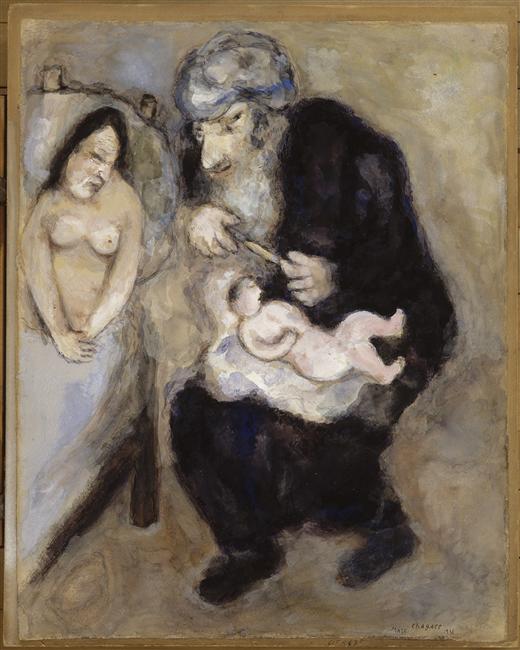
Marc Chagall (1887-1985), “Circumcision Prescribed by God to Abraham, Genesis XVII.10”, 1931

At first glance it seems a strange question. Abraham a Gentile? As the patriarch of patriarchs, the person from  whom all Jews claim descent, one would have described Abraham also as a Jew. And yet, Arabs and Samaritans also claim descent from Abraham, Jews and Samaritans through Sarah his wife and Arabs through Hagar.

Furthermore, the term “Jew” only came into use after the return from the exile in Babylon in the late 6th century BC. It is a variation on “Judean” which referred to the people who lived in the southern kingdom of Judah, the remnant of the United Kingdom of David and Solomon that remained faithful to the House of David when the northern kingdom of Israel broke away around 920 BC. Judah was made up mostly of the people from the tribes of Judah, Levi, and part of the Benjaminites, while the other nine tribes were mostly in Israel. After Israel was conquered by Assyria in 722 Judah absorbed many refugees from the northern kingdom, people fleeing deportation to Assyria and replacement by other peoples. So, before the Jews there were the Judeans, and before them the Twelve Tribes of Israel – and Israel was the grandson of Abraham and Sarah. To call Abraham a Jew or even an Israelite is anachronistic.

Today’s second reading from the Daily Office Lectionary pivots on this point. The story of Genesis from chapters one to twelve is a series of  narratives about how humanity fall away from God, over and over again. First there was the Garden of Eden and the eating from the Tree of the Knowledge of Good and Evil. Then there was Cain’s murder of Abel. Then Lamech also murdered someone. There was the depravity of humans who mated with the semi-divine creatures. Then there is The Flood, and Ham’s dishonoring of his father Noah. Finally there is the Tower of Babel. God then reaches out to one person, Abram (later re-named  Abraham) in Harran, in what is now south-east Turkey and not so far from war-torn northern Syria. He is described in Deuteronomy 26.5 as “a wandering Aramean”. Aram was never a kingdom as such, but referred to an area in what is now Syria which sometimes included Damascus. Aramaic was the dominant language of the Middle East until the rise of Arabic and Islam in the 7th century AD; Jesus spoke Aramaic, and parts of Daniel and Ezra are written in it. It is closely related to Hebrew, Arabic, and Phoenician. Hebrew actually uses an alphabet devised for Aramaic. It remains a living language for Christians in Iraq and Syria, but is now endangered as many of them have fled persecution and are using the languages of the countries they now live in (such as English). So its reasonable to think that, if he was a wandering Aramean, he spoke an archaic form of Aramaic, perhaps a form the developed into Aramaic in Syria and Hebrew in the Holy Land.

So was he a Gentile? In a sense, no, because Gentile is usually used in a sense that means “non-Jewish”, and it would be just as anachronistic to call him that as to call him a Jew. But he is described as having lived centuries before the Torah was given in Sinai, perhaps something like 1800 BC to 1600 BC. Of course, it begs the question that there was a person who existed named Abraham. Many scholars of the Hebrew Bible/Old Testament doubt that there was any such person, and is as historical as Helen of Troy or Romulus and Remus. Perhaps there is an historical kernal somewhere there, but it has been transmitted and transformed over the centuries that one cannot from the Biblical record adduce anything certain (unless one is a conservative Christian who assumes the historical veracity of everything in the scriptures).

Paul was trained in what eventually became the methodology of the Mishna. He assumed the historical fact of Abraham. He carefully looked at scripture as jumping off points to assist in making his argument, but not as uncontestable proofs. He jumps off on the citation from Genesis 15.6: “And he believed the Lord; and the Lord reckoned it to him as righteousness. ”

Romans 4.1-12
What then are we to say was gained by Abraham, our ancestor according to the flesh? For if Abraham was justified by works, he has something to boast about, but not before God. For what does the scripture say? ‘Abraham believed God, and it was reckoned to him as righteousness.’ Now to one who works, wages are not reckoned as a gift but as something due. But to one who without works trusts him who justifies the ungodly, such faith is reckoned as righteousness.

Paul here defines “wages” as what one receives as one’s due and and “righteousness” as what receives as a result of sheer trust. The word “reckoned” is a passive in the Greek in Paul,  as well as in the ancient Greek translation of Genesis 15.6 and the Hebrew original. So who is doing the reckoning? The next verse clarifies that.

So also David speaks of the blessedness of those to whom God reckons righteousness irrespective of works:
‘Blessed are those whose iniquities are forgiven,
and whose sins are covered;
blessed is the one against whom the Lord will not reckon sin.’

This is Psalm 32.1 which is attributed to David. In this passage Paul clearly attributes the reckoning to God. In the New Revised Standard Version it is translated from the Hebrew as “Happy are those whose transgression is forgiven, whose sin is covered. Happy are those to whom the Lord imputes no iniquity.” In the original Hebrew the word means “think X towards person Y” and it does not have the precision of “impute”, which is how it is sometimes translated – reckon gets it pretty well.  Curiously, Paul does not quote the ancient Greek translation of the Septuagint – it has a subjunctive where Paul uses a passive – but he may be quoting from  memory, or using another translation that is no longer extant.

An now Paul gets to his point: Abraham was not yet circumcised when he was reckoned as righteous.

Is this blessedness, then, pronounced only on the circumcised, or also on the uncircumcised? We say, ‘Faith was reckoned to Abraham as righteousness.’ How then was it reckoned to him? Was it before or after he had been circumcised? It was not after, but before he was circumcised. He received the sign of circumcision as a seal of the righteousness that he had by faith while he was still uncircumcised. The purpose was to make him the ancestor of all who believe without being circumcised and who thus have righteousness reckoned to them, and likewise the ancestor of the circumcised who are not only circumcised but who also follow the example of the faith that our ancestor Abraham had before he was circumcised.

The work of circumcision – the defining sign of the covenant between Abraham and God (and not something lightly undertaken!) – comes after God thinks righteousness towards the patriarch. God chooses Abraham, not the other way around. He may have been a good man, but there may have been other good people as well. Perhaps God “thought well as well him as another“.

Posted in Lent | Tagged , , | Leave a comment

Lenten Readings: Day 16

Grace and Belief: Which Came First?

grace-kelly-image-487x600

Not this Grace.

Grace, apart from being a lovely name for a beautiful actress, is the term that is used for the favour of God. Grace might be offered in response to something done, but in the context of Paul’s Letter to the Romans it always means unmerited favour. And, being God’s grace, it has the nature of salvation, in that one is rescued from pain and suffering, not only that caused by oppressive rulers and wicked people but also  the consequences of one’s own sinful actions. One is forgiven not on the basis of anything one has done, but in virtue of Jesus’s sacrifice.

Paul is, I think, using strong language in today’s reading to assert that human beings will be saved from destruction not by anything they themselves do, but by the action of God. This is a classic apocalyptic insight. The breaking in of God into human time is accomplished in the coming of Jesus. His whole life and death is seen as the equivalent to what the priest does on Yom Kippur, the Day of Atonement, when sacrifices were offered for the sins of Israel. Jesus’s sacrifice is one for all, though, and does not need to be repeated. A second insight is that those who have faith in Jesus Christ and his atoning sacrifice will be the ones who accept it for themselves; those who do not accept it will not be able to partake of it.

Paul’s emphasis upon grace means that he has to assert that “all have sinned and fallen short of the glory of God”. This is not to say that all are equally wicked, but simply that all humanity is in need of God’s grace; by their own efforts they cannot help themselves to achieve righteousness before God. Fair enough – but, then, what is faith? Is it a kind of work, being the intellectual assent to a proposition, or is faith itself merely a gift of God given to a person by the divine, a sign of the salvific grace given by God? Is faith a kind of work, or a result of grace? Which came first, the chicken or the egg?

Rom 3.19–31
Now we know that whatever the law says, it speaks to those who are under the law, so that every mouth may be silenced, and the whole world may be held accountable to God. For ‘no human being will be justified in his sight’ by deeds prescribed by the law, for through the law comes the knowledge of sin.

But now, irrespective of law, the righteousness of God has been disclosed, and is attested by the law and the prophets, the righteousness of God through faith in Jesus Christ for all who believe. For there is no distinction, since all have sinned and fall short of the glory of God; they are now justified by his grace as a gift, through the redemption that is in Christ Jesus, whom God put forward as a sacrifice of atonement by his blood, effective through faith. He did this to show his righteousness, because in his divine forbearance he had passed over the sins previously committed; it was to prove at the present time that he himself is righteous and that he justifies the one who has faith in Jesus.

Then what becomes of boasting? It is excluded. By what law? By that of works? No, but by the law of faith. For we hold that a person is justified by faith apart from works prescribed by the law. Or is God the God of Jews only? Is he not the God of Gentiles also? Yes, of Gentiles also, since God is one; and he will justify the circumcised on the ground of faith and the uncircumcised through that same faith. Do we then overthrow the law by this faith? By no means! On the contrary, we uphold the law.

Paul was not thinking of these things when he wrote Romans, but they came to the fore in the early fifth century controversies between Pelagius and Augustine. Pelagius was a well educated Briton who travelled to Rome and Jerusalem. He saw the free will of human beings as a gift from God, and emphasised the ability of Christians to chose to walk in God’s ways, and to accept grace. Augustine, on the other hand, saw this as infringing on the power and grace of God, and originated the doctrine of original sin to say that all human beings from conception and birth are caught up in sin and cannot help themselves without the grace of God. This led to Augustine stressing pre-destination, a theme which Calvin picked up and which seemed to eliminate human beings choice in the matter.

Paul holds the two ideas in tension and leaves them unresolved. Perhaps that is where we should leave it, as well, as a pardoxical mystery. It may also have to do with perspective. From a phenomenological point of view human beings are active and making choices. From the construction of an objective “God’s perspective”, from the viewpoint of eternity, it is God’s action alone. The two are not necessarily in contradiction, any more than the fact that in physics light can be described mathematically as both a particle and as a wave. From our human domain we think that it has to be one or the other, but both may in some senses be true.

At some point I will also have to get into the distinction between the objective genitive and the subjective genitive of “pistis Iesou Christou”, as that is also a factor. Also, what is the faith of the Jews? Is it only the faith of Jewish Christians, or is it the faith of faithful Torah-abinding Jews, whose works are a sign of a lively faith?

Posted in Lent | Tagged , , | Leave a comment