Lenten Readings: Day 6

Faithful

old-faithful

The theme in the text today is faithfulness. Moses was faithful, Jesus was faithful, and we who follow Jesus are called to be faithful.

Hebrews 3.1-11
Therefore, brothers and sisters, holy partners in a heavenly calling, consider that Jesus, the apostle and high priest of our confession, was faithful to the one who appointed him, just as Moses also ‘was faithful in all God’s house.’ Yet Jesus is worthy of more glory than Moses, just as the builder of a house has more honour than the house itself. (For every house is built by someone, but the builder of all things is God.) Now Moses was faithful in all God’s house as a servant, to testify to the things that would be spoken later. Christ, however, was faithful over God’s house as a son, and we are his house if we hold firm the confidence and the pride that belong to hope.

Therefore, as the Holy Spirit says,
‘Today, if you hear his voice,
do not harden your hearts as in the rebellion,
as on the day of testing in the wilderness,
where your ancestors put me to the test,
though they had seen my works for forty years.
Therefore I was angry with that generation,
and I said, “They always go astray in their hearts,
and they have not known my ways.”
As in my anger I swore,
“They will not enter my rest.” ’

The reference to Moses is from Numbers 12.7, and in the original Hebrew it literally says, “In all my house he is faithful”; this is perhaps better translated as the NRSV has it as “he is entrusted with all my house.”

The faithful are described as a house built by and belonging to Christ. The author then urges the readers of the letter to hold firm in hope, and not to be like the rebellious of Israel when they were in the desert – the scriptural passage is from the Venite, Psalm 95.

How are we saved? In the Reformation era a great emphasis was placed upon personal faith, and an understanding that we are saved by faith alone. However, there is also an older understanding in the scriptures that even our faith is not enough, imperfect and subject to uncertainty – we are saved by the faith of Christ. This is the famous contrast between the subjective and objective genitive where one can translate pistis Christou as either “faith in Christ” or “faith of Christ”. The ambiguity has polarized some Christians, wanting to read in one interpretation or another. My own feeling is that a) I am certain that I am saved by the faith/faithfulness of Christ and b) my faith in Christ is a sign of that healing salvation, but the strength of it should not be considered an indication of quality of that saving grace.

Posted in Uncategorized | Leave a comment

Lenten Readings: Day 5

Atonement

aganai

Aganai (Chinese character for “Atone”)

In this week after the First Sunday in Lent we read some passages from the Letter to the Hebrews. Hebrews is an anonymous letter, although it was sometimes attributed to Paul. However, early manuscripts do not have such an attribution, and ancient Christians did not always assume it. As Origen pointed out, the style is much more polished that Paul’s usual rhetoric.

Hebrews 2.11-18
For the one who sanctifies and those who are sanctified all have one Father. For this reason Jesus is not ashamed to call them brothers and sisters, saying,
‘I will proclaim your name to my brothers and sisters,
in the midst of the congregation I will praise you.’
And again,
‘I will put my trust in him.’
And again,
‘Here am I and the children whom God has given me.’

Since, therefore, the children share flesh and blood, he himself likewise shared the same things, so that through death he might destroy the one who has the power of death, that is, the devil, and free those who all their lives were held in slavery by the fear of death. For it is clear that he did not come to help angels, but the descendants of Abraham. Therefore he had to become like his brothers and sisters in every respect, so that he might be a merciful and faithful high priest in the service of God, to make a sacrifice of atonement for the sins of the people. Because he himself was tested by what he suffered, he is able to help those who are being tested.

The author is working hard to emphasise the humanity of Jesus. This may sound strange to us, but there is a tendency in Christianity to either overemphasise his humanity to the point that his divinity disappears, or to stress his divinity so that he seems other than human, some kind of superman.

The author bolsters his argument with quotations from the Hebrew scriptures, namely Psalm 22.22, Psalm 56.3 (or perhaps Psalm 18.2), and Isaiah 8.18. As far as the author is concerned, these passages refer to the Messiah, and the common humanity he shares with other people. The author has previously declared that the Messiah was not an angel, but human.

The author has a strong theology of atonement. The fifth century Greek theologian Gregory of Nazianzus wrote, “What has not been assumed has not been healed.” Jesus shared in our humanity, and so was able to act on our behalf to destroy the evil in this world, including death. Death is seen as a kind of slavery, and in his death Jesus overcomes the one who controls it, the devil.

Jesus is compared to a high priest making a sacrifice on the Day of Atonement (Yom Kippur). Instead of sacrificing animals Jesus himself is the victim. Theology of the Atonement can sometimes be a bit confusing, ricocheting between substitutionary sacrifice and Christus Victor theology. I recommend viewing it not as a logical systematic theology, but something that is narrative and whose logic works on an emotional level. The early Christians in the wake of the cross and the resurrection, were struggling to understand the power of what had happened and how they were transformed by it. They knew three things, for sure: 1) that Christ had died for them, 2) that they were forgiven, and that 3) by the Resurrection and consequent flowing of the Holy Spirit, they were empowered to preach the good news of Jesus Christ. Is this what we take from the death and resurrection of Jesus?

Posted in Lent | Leave a comment

Lenten Readings: Day 4

Snapshot

james-vi-i

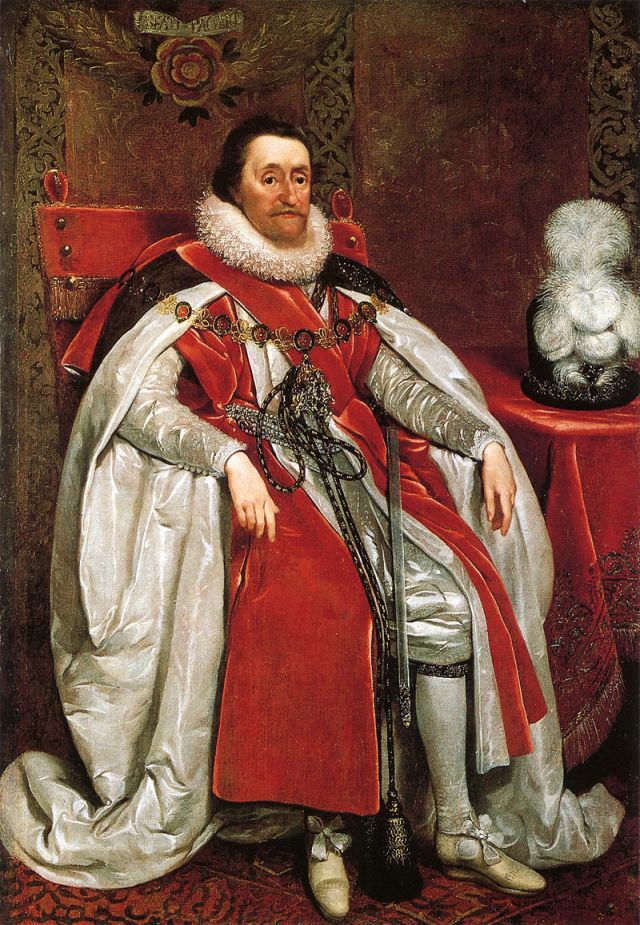
James VI of Scotland & I of England, by Daniel Mytens, 1621

Titus 3.1 is a favourite one of rulers, as they could direct their clergy to preach on it. Rulers, such as James VI & I liked it, because it gave him the final word.

Biblical scholars see this as another sign of the late non-Pauline authorship of the letter. Whereas both the gospels and the undoubtedly genuine letters of Paul are subversive of the Roman Empire, this passage recommends obedience. Arguably, in the wake of the Jewish Rebellion of 66-70 and intermittent persecutions of Christians, this approach of subservience had much to recommend it as a strategy of survival. That said, Christianity remained in conflict with the Roman authorities off and on through to the early fourth century. Rather than see this as a binding rule, I see this as a minority strategy among several demonstrated within the Christian scriptures. As all early Christians were non-violent pacifists, armed rebellion was not an option, but non-violent resistance tended to be more common. Only when the Roman Imperial leadership itself became Christian did the passage about being obedient become a more dominant strain. For those of us within democratic nations, where loyal opposition is encouraged, this passage has a much less important meaning.

The passage does have a clear statement about how Christians are saved. It is not by any work or effort on the part of the one being saved, but by the gift of God granted through baptism and the Holy Spirit. Jesus saves through his appearance and manifestation. There is no theology of the cross in this letter – at most it says Jesus “gave himself for us” but this can be read as referring to the emptying out of the Word into human form, as in Philippians 2 – and this can be seen as another sign of non-Pauline authorship. The language of salvation here sounds more like the Gospel according to John.

Titus is a snapshot of a church a few generations after Jesus. It is getting organized with “bishops” and “priests”, and is working out its relation to the Empire. While it awaits the Second Coming, there is also a great emphasis on personal conduct. This is not unusual in new religious movements after several decades, when there is a less committed group on the margins of the community that are members by birth and association, and less by personal conversion. There is a curious mingling of an appeal to the authority Paul combined with theology that sounds like John.

Some nineteen centuries and change later, we are also sorting things out – how to relate to the local imperium, the role of the ordained in the community of faith, and how to balance personal piety with eschatological action.

Note: Tomorrow is the First Sunday in Lent, and is technically not one of the forty days in Lent. Therefore I will NOT be commenting on the second Daily Office Lectionary text, but I’ll be back on Monday for Day 5.

Titus 3.1–15
Remind them to be subject to rulers and authorities, to be obedient, to be ready for every good work, to speak evil of no one, to avoid quarrelling, to be gentle, and to show every courtesy to everyone. For we ourselves were once foolish, disobedient, led astray, slaves to various passions and pleasures, passing our days in malice and envy, despicable, hating one another. But when the goodness and loving-kindness of God our Saviour appeared, he saved us, not because of any works of righteousness that we had done, but according to his mercy, through the water of rebirth and renewal by the Holy Spirit. This Spirit he poured out on us richly through Jesus Christ our Saviour, so that, having been justified by his grace, we might become heirs according to the hope of eternal life. The saying is sure.

I desire that you insist on these things, so that those who have come to believe in God may be careful to devote themselves to good works; these things are excellent and profitable to everyone. But avoid stupid controversies, genealogies, dissensions, and quarrels about the law, for they are unprofitable and worthless. After a first and second admonition, have nothing more to do with anyone who causes divisions, since you know that such a person is perverted and sinful, being self-condemned.

When I send Artemas to you, or Tychicus, do your best to come to me at Nicopolis, for I have decided to spend the winter there. Make every effort to send Zenas the lawyer and Apollos on their way, and see that they lack nothing. And let people learn to devote themselves to good works in order to meet urgent needs, so that they may not be unproductive.

All who are with me send greetings to you. Greet those who love us in the faith.

Grace be with all of you.

Posted in Lent | Tagged , , | Leave a comment

Lenten Readings: Day 3

Submission to Power

shutterstock_296720219_0_1

I once had a conversation with Trudy Lebens when she and I were both clergy in the Diocese of Niagara. She had been around for a few years and I had been ordained just two or three, and I was very much a young, naive person. I said that I was not adverse to using the traditional patriarchal language, on the basis that the scriptures and christian tradition were so shaped by patriarchy that it could not be removed without seriously warping the good news. “What do we have left after we taken out patriarchy out of the Gospel?” I asked. “The Truth!” she said.

She had a point.

All Christians pick and choose texts in scripture to interpret other texts, and all of them read those texts in tension with their culture. Despite what “Back to Scripture” Christians might think, no one today lives or thinks the way that Christians did in the first generation or two after; we cannot recover “primitive Christianity” because we no longer live in that world. Rather, we receive the traditions and seek to live as best as we can in modern culture (even absenting ourselves from the present culture, as the Amish and monastics seem to do, is a reaction to the present day).

Titus is thought by modern biblical scholars not to be written by Paul because it is so different from the Christian community described by Paul. In the universally accepted letters (Romans, 1 & 2 Corinthians, Galatians, Philippians, and Philemon) Paul describes a spirit-filled community of equals, whereas this letter demonstrates a hierarchy with presbyters and overseers (priests and bishops, if you will). Whereas in the genuine letters we can discern an equality of sexes, where a woman can be a co-worker with Paul, this letter describes who should submit to others. Whereas Paul tells Philemon that he should free Onesimus the slave, slavery is endorsed in the text.

In today’s second reading the older men are at the top of the heap. The older women are to mentor the younger women, who are to be submissive to their husbands (there is not of the confusion about young women in 1 Corinthians 7). The concern is that if wives are not submissive to their husbands then the gospel might somehow become discredited – among the non-Christian community, I suppose. Slavery is accepted and slaves are told to be submissive to their master.

The letter seems to suggest that Christians are just passively waiting for the Second Coming of Jesus; this is in contrast to the sense that the transformation of the world has begun in the Resurrection of Jesus, and that all things are being made new. The transformation of disciples seems to be domesticated and made very much a distant prospect.

Paul wrote in First Corinthians 5:  “‘All things are lawful for me’, but not all things are beneficial.” The criterion for whether an activity is to be recommended is not whether there is some directive, but rather if it helps build up the person in their relationship with God and their neighbour. While there may have been a time the majority would have said that slavery was good and submission of wives to their husbands was likewise part of the cosmic order, even in early Christianity this was questioned. Paul wrote in Galatians 3, “There is no longer Jew or Greek, there is no longer slave or free, there is no longer male and female; for all of you are one in Christ Jesus.” Cosmic categories are subverted by participation in Christ, they are no longer beneficial.

As Christians we do not sit and wait for the Last days. We seek to live in the Apocalypse, that is, the restoration of humanity through Christ and the making all things new. While we await the full physical manifestation of Resurrection, the same power that raised Christ from the dead is now at work in us, transforming our “inner natures.”

There is nothing wrong and much good in being “temperate, serious, prudent, and sound in faith, in love, and in endurance.” What is different now is that we have moved beyond where the Cretan Christian community was in the letter to Titus. By the Holy Spirit we are rising towards God, and being reshaped in the image of Jesus.

Titus 2.1-15
But as for you, teach what is consistent with sound doctrine. Tell the older men to be temperate, serious, prudent, and sound in faith, in love, and in endurance.

Likewise, tell the older women to be reverent in behaviour, not to be slanderers or slaves to drink; they are to teach what is good, so that they may encourage the young women to love their husbands, to love their children, to be self-controlled, chaste, good managers of the household, kind, being submissive to their husbands, so that the word of God may not be discredited.

Likewise, urge the younger men to be self-controlled. Show yourself in all respects a model of good works, and in your teaching show integrity, gravity, and sound speech that cannot be censured; then any opponent will be put to shame, having nothing evil to say of us.

Tell slaves to be submissive to their masters and to give satisfaction in every respect; they are not to answer back, not to pilfer, but to show complete and perfect fidelity, so that in everything they may be an ornament to the doctrine of God our Saviour.

For the grace of God has appeared, bringing salvation to all, training us to renounce impiety and worldly passions, and in the present age to live lives that are self-controlled, upright, and godly, while we wait for the blessed hope and the manifestation of the glory of our great God and Saviour, Jesus Christ. He it is who gave himself for us that he might redeem us from all iniquity and purify for himself a people of his own who are zealous for good deeds.

Declare these things; exhort and reprove with all authority. Let no one look down on you.


Posted in Lent | Tagged , , , | Leave a comment

Lenten Readings: Day 2

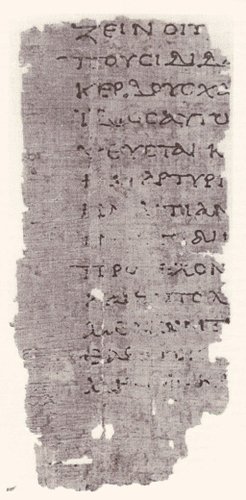
p032-tit-1_11-15-ii

Titus 1.11-15, Papyrus Rylands 5, ca. 200, Greek, Found in Egypt, Now at John Rylands University Library (Manchester UK), Size: 10.6 x 4.9 cm

Discord

In the “epistle” text for the Daily Office Lectionary (see below) today I am brought head to head with discord among God’s people.

First, there is substantial modern disagreement about whether this is in fact by Paul. Most New Testament scholars using historico-critical methods read this as being a late letter written a generation or two after Paul’s death and written in Paul’s name. They base their conclusion on the type of language and the content of the letter. Conservative Christian scholars, concerned that the veracity of God is impugned if there are pseudopigrapraphical writings in it, assert the tradition of Pauline authorship and point out that it was never questioned in ancient times.

Second, the letter itself describes an antagonistic situation which the author sees as unacceptable. The letter assumes that its recipient, Titus, is on the island of Crete. There one might find “many rebellious people, idle talkers and deceivers” within the Christian community. Many are Jewish Christians “of the circumcision party”, probably similar to the ones who opposed Paul and were described in his Letter to the Galatians. The author also quotes the famous line that, “All Cretans are liars!” (which is a paradox if a Cretan themselves says it).

This is why the author sets standards for the Overseer, the Bishop. Popularity is not sufficient, and any number of circumstances might disqualify someone. One normally does not make rules for something unless there is a problem, and so I suspect that somewhere on Crete, sometime between 80 and 150 AD, there was a candidate for the episcopate who was liable to blame, married more than once, with rebellious, pagan children, arrogant, quick-tempered, violent, greedy, and an alcoholic. It might have seemed difficult to remove the person until this old letter from Paul showed up. Hmmmm.

I do not like dissension and discord, but I’ve rarely been anywhere where it has not existed. We can see this as simply as the reality of a broken, fallen world. Christians bring this brokenness into the church, and we should not be surprised by it. We will disagree, and we will disagree about things that matter. Sometimes discipline is required when clergy and laity cross a line; actions have consequences. My hope and prayer is that those who are involved in such disagreements will be guided by the Holy Spirit to know where those lines are, and work to figure out how we live together in the tension of diversity and disagreement.

Titus 1.1–16
Paul, a servant of God and an apostle of Jesus Christ, for the sake of the faith of God’s elect and the knowledge of the truth that is in accordance with godliness, in the hope of eternal life that God, who never lies, promised before the ages began— in due time he revealed his word through the proclamation with which I have been entrusted by the command of God our Saviour,

 To Titus, my loyal child in the faith we share:

Grace and peace from God the Father and Christ Jesus our Saviour.

I left you behind in Crete for this reason, that you should put in order what remained to be done, and should appoint elders in every town, as I directed you: someone who is blameless, married only once, whose children are believers, not accused of debauchery and not rebellious. For a bishop, as God’s steward, must be blameless; he must not be arrogant or quick-tempered or addicted to wine or violent or greedy for gain; but he must be hospitable, a lover of goodness, prudent, upright, devout, and self-controlled. He must have a firm grasp of the word that is trustworthy in accordance with the teaching, so that he may be able both to preach with sound doctrine and to refute those who contradict it.

There are also many rebellious people, idle talkers and deceivers, especially those of the circumcision; they must be silenced, since they are upsetting whole families by teaching for sordid gain what it is not right to teach. It was one of them, their very own prophet, who said,
‘Cretans are always liars, vicious brutes, lazy gluttons.’
That testimony is true. For this reason rebuke them sharply, so that they may become sound in the faith, not paying attention to Jewish myths or to commandments of those who reject the truth. To the pure all things are pure, but to the corrupt and unbelieving nothing is pure. Their very minds and consciences are corrupted. They profess to know God, but they deny him by their actions. They are detestable, disobedient, unfit for any good work.


Text

Posted in Lent, Uncategorized | Tagged , , | Leave a comment

Lenten Readings: Ash Wednesday

ashes

Discipline

For Lent I am going to reflect on and daily blog about the second reading from the Daily Office (i.e. the list of scriptural readings from the Book of Alternative Services for the Anglican Church of Canada for Morning and Evening Prayer. Here’s today’s reading:

Heb 12.1–14
Therefore, since we are surrounded by so great a cloud of witnesses, let us also lay aside every weight and the sin that clings so closely, and let us run with perseverance the race that is set before us, looking to Jesus the pioneer and perfecter of our faith, who for the sake of the joy that was set before him endured the cross, disregarding its shame, and has taken his seat at the right hand of the throne of God.

Consider him who endured such hostility against himself from sinners, so that you may not grow weary or lose heart. In your struggle against sin you have not yet resisted to the point of shedding your blood. And you have forgotten the exhortation that addresses you as children—
‘My child, do not regard lightly the discipline of the Lord,
or lose heart when you are punished by him;
for the Lord disciplines those whom he loves,
and chastises every child whom he accepts.’
Endure trials for the sake of discipline. God is treating you as children; for what child is there whom a parent does not discipline? If you do not have that discipline in which all children share, then you are illegitimate and not his children. Moreover, we had human parents to discipline us, and we respected them. Should we not be even more willing to be subject to the Father of spirits and live? For they disciplined us for a short time as seemed best to them, but he disciplines us for our good, in order that we may share his holiness. Now, discipline always seems painful rather than pleasant at the time, but later it yields the peaceful fruit of righteousness to those who have been trained by it.

Therefore lift your drooping hands and strengthen your weak knees, and make straight paths for your feet, so that what is lame may not be put out of joint, but rather be healed.

Pursue peace with everyone, and the holiness without which no one will see the Lord.

Lent is about discipline. In ordinary English the primary meaning of that term is “punishment” or “chastisement”, and that is clearly referenced in the reading. Inappropriate action has to be challenged by its consequences, and every parent knows something about that. But discipline means much more.

The root of discipline is a Latin word for “teaching” or “instruction”. If one is taught by a master one is a disciple, and if one studies a particular field in school or university one is receiving instruction in an academic discipline. Learning is hard work for most of us, and so it requires some discipline – study habits, learning methods of research, solving problems, interacting with those who hold different views, sheer brute memory work, making mistakes, writing essays, making oral presentations, et cetera.

In Lent we who follow Jesus try to be teachable. We slough off unhelpful old habits and try to pick up new ones – not just for for forty days, but hopefully for life. Our instructor in prayer is the Holy Spirit in prayer, in theology it is the Word of God as mediated by scripture, and we hear the voice of Christ in the mouth of friend and stranger. It’s a time to be challenged, to make more with less, and to quiet one’s soul. It is a time to “pursue peace with everyone, and the holiness without which no one will see the Lord.”

Posted in Lent | Tagged , , | Leave a comment

An Introduction to Levinas (Part Five-B)

Insomnia

insomnia

Note: This is the second half of the fifth part in an ongoing commentary on Emmanuel Levinas’s essay “God and Philosophy” (1974). It’s longer than usual.

This next paragraph is even more dense than usual, so I will take it a sentence or two at a time.

It is as a modality or a modification of insomnia that consciousness is consciousness of… , an assembling in being or in presence that – up to a certain depth of vigilance, where vigilance must clothe itself in justice – has import for insomnia.[2]
[2]See Otherwise than Being, or Beyond Essence, pp.153-162, Autrement qu’être ou Au-delà de l’essence pp. 195-207 [239-253].[Author’s note]

a) Between 1940 and 1945 Emmanuel Levinas was a prisoner of war of the Germans. Some texts refer to him as an officer, but he was in fact a sergeant, a non-commissioned officer in the French army. He was captured along with 1.5 million soldiers in the collapse of the Battle of France. Under the terms of the armistice Germany kept these soldiers as prisoners of war, although between 1940 and 1944 about half a million were released. Levinas was never afforded this opportunity, as he was a Jew. Under the Geneva Convention and the terms of the Armistice of 1940 Levinas was protected from being sent to a death camp, but he was made to go to a special camp for Jewish French POWs where he worked at felling timber and chopping wood. He was not released until the end of the war, and it was only then that he found out that his family in Lithuania – his parents and his brothers and their families – had been murdered when the Germans invaded in 1941. His mother-in-law in France had been captured by the police of Vichy France, sent to a concentration camp, and murdered. His wife and child survived by being hidden, first by his friend Maurice Blanchot, and then by a Catholic religious order for women. It was during this time of captivity, when he had no news from his family, that he drafted Existence and Existents, which was published in 1947. In this work he provides his first phenomenological analysis of insomnia, which he reiterates here as he approaches the disruption of conditioned meaning.

b) Levinas subsequently dealt with insomnia in the 1974 essay “From Consciousness to Wakefulness : Starting with Husserl” which was included with “God and Philosophy” and other essays in the book Of God Who Comes to Mind (1986). Despite Levinas’s reference to Otherwise than Being he does not refer to insomnia in that text, but he does talk a bit more about consciousness; I’ll try and feed insights from that opus as necessary. He also talked about insomnia in a lecture entitled “In Praise of Insomnia” (delivered as part of his last lecture series at the Sorbonne in 1976 on “God and Onto-Theology”collected in God, Death, and Time); this lecture replicated pretty much this section of the essay.

c) The key words in this complicated sentence are “insomnia”, “consciousness”, “consciousness of . . .”, “vigilance”, and “justice”.

d) We’ll get to “insomnia” in a moment. Levinas distinguishes between “consciousness” as such and “consciousness of . . .”. The former is a general category, or as he will suggests, a meta-category. “Consciousness of . . .” is a sub-category or “category” of “consciousness”. “Consciousness of . . .” is what most of us thing of as thinking – paying attention to things, thinking them through, getting on with life in a wide awake world. In phenomenological terms, it is the human being being aware of the content in its perceptions and thought, and perhaps being aware that it is aware. “Consciousness” includes this, but “consciousness of . . .” is “a modality or modification” of consciousness. It is the presumption of a conscious being, but without assuming that there is intentional content in the awakening subject.

e) Levinas recognised that not all human experience is consciousness of something – sometimes it is just consciousness, a wakefulness without any intentional content. As mentioned in Part Five – A, phenomenology can consider any number of phenomena. In his pre-war book On Escape Levinas considers nausea, and in Existence and Existents he discusses fatigue, effort, and insomnia. As well as mentioning it here he also discussed insomnia.

f) Levinas describes insomnia alternatively as “wakefulness” and “vigilance”. “Vigil” comes from the Latin for “wakefulness”, so they sort of mean the same thing. However, in English “vigilance” also has this sense of watching or waiting. However, whereas “consciousness of . . . ” has intelligible content, insomnia does not. As he wrote in Existence and Existents, “It is not that there is my vigilance in the night; in insomnia it is the night itself that watches. It watches. In this anonymous nightwatch where I am completely exposed to being, all thoughts of insomnia are suspended on nothing.” The being that Levinas refers to in this passage is not the intelligible being of Heideggerrian attention, but the rustling of there is (it sounds better in French:  il y’a). It is the vigilance of the night where “an undetermined menace of space itself” evokes a horror that “strips consciousness of its subjectivity.”  “One watches on when there is nothing to watch and despite the absence of any reason for remaining watchful. The bare fact of presence is oppressive; one is held by being, held to be.” So this is not the insomnia created by squirrelly brains obsessively worrying about particular matters better left to the day, this is an insomnia that unbearable particularly because it is about nothing in particular but the incessant wakefulness. The outside world, amorphous and in general, is there, and there is no respite from this through attending to something in particular, through rest, or sleep.

g) Vigilance – that is, wakefulness, or insomnia – can “clothe itself in justice”. “Justice” for Levinas is not another theme for philosophy, as in Michael Sandel’s wonderful book Justice: What’s the Right Thing to Do which describes a variety of ethical systems in Western thought, including Kantian rule-based ethics (deontology), consequentialism (including utilitarianism), libertarianism, liberal economics, and Aristotelian virtue ethics. Levinas looks at “justice” from a perspective that will unfold as we work through the essay. For the moment it is sufficient to know that Levinas sees “justice” as non-thematic and the origin of all significance (yes, that’s paradoxical).

Far from being defined as a simple negation of the natural phenomenon of sleep, insomnia – as wakefulness or vigilance – comes out of the logic of the categories, prior to all anthropological attention and dullness.

h) In between sleep and being fully conscious Levinas finds this middle state for which he claims the name “insomnia”. It is not just the absence of sleep, but this this vigilance or wakefulness that can inhabit a consciousness quite involuntarily. It’s this lack of choosing that is significant for Levinas: I do not choose to be awake, but I am, despite myself. It’s not the consciousness of attention, nor is it the consciousness of inattention -inattention is what I think that is what he means by “dullness”, and it might be comparable to falling asleep. No, it’s that inchoate sense of “I’m here – where am I?”

Always on the verge of awakening, sleep communicates with wakefulness; while attempting to escape from it, sleep remains attuned to it in obedience to the wakefulness that threatens and calls to it, the wakefulness that demands.

i) Levinas here is not providing a psychological analysis of sleep – he’s not interested in sleep cycles and REM. Phenomenological method does not allow for “objective” analyses of phenomena, but calls upon the reader to engage in an intuitive reflection on one’s own thought processes. Levinas does a  phenomenological analysis of insomnia and sees a categorical difference between sleep and insomnia, or dormancy and vigilance. However, the categories are connected, in that wakefulness/insomnia/vigilance calls to sleep, and sleeps seeks to escape for it. Wakefulness is a demand upon sleep, for one cannot be both waking and sleeping at the same time. The call is a call that wants obedience – be vigilant! It is disruptive to sleep (arguably, sleep is in a similar relationship to the consciousness that is “conscious of . . .” in that it cannot be denied forever, although Levinas does not make that observation).

The category of insomnia cannot be reduced to the tautological affirmation of the Same, or to the dialectical negation, or to the “ecstasy” of thematizing intentionality. Keeping awake [veiller] is not equivalent to attending to [veiller à] … , where there is already a searching for the identical, rest, and sleep.

j) The essay is, among other things, a critique of Heidegger and it won’t make much sense if you haven’t studied him, but I will try to explain. There are at least four issues in making sense of this long paragraph: first, why is Heidegger so important to Levinas? Second, what is it in Heidegger that Levinas is critiquing? Third, what is Levinas’s critique? And fourth, does the critique work?

k) Why is Heidegger so important to Levinas? Levinas began studting philosophy at the University of Strasbourg (France) in 1923. He moved on to his PhD and spent a year at the University of Freiburg (Germany) in 1928-1929. By this time he was working on his dissertation on Edmund Husserl and his theory of intuition in phenomenology. Husserl was in his last year as a professor at Freiburg, and he and Levinas became quite friendly; Levinas tutored Frau Husserl in French and was sometimes a dinner guest. However, as Levinas said, “I came for Husserl but found Heidegger. It was Husserl who founded the entire procedure – the high art – of phenomenology. Heidegger took it up and made it sparkle.” The danger of Husserl’s subjective approach to phenomenology that it had tendencies to slide into a kind of solipsism, where nothing can be known beyond the self. Husserl denied that his technique slid into solipsism, but it was and is a common critique, so much so that most phenomenologists have moved on from Husserl. Heidegger used phenomenology but started with the fact that humans are in the world, shifting the question from concerns about the epistemological conditions of knowledge which predominated in Husserl to the question of beings and Being in the world. By that move Heidegger transformed the problematic issues around reason and empiricism by shifting from epistemology and metaphysics to ontology. Levinas was so taken with Heidegger that his dissertation was very much written from that perspective.

l) Shortly after Levinas received his doctorate he began to work on a book about Heidegger. However, he began to hear that Heidegger had become a member of the Nazi Party and was using fundamental ontology to justify its ideology. This profoundly shook Levinas, and he felt he needed to move from the climate of his thought. In 1934 he wrote an essay on “Hitlerism” which critiqued the crude program of the National Socialist Party, but was very much a reaction to intellectuals like Heidegger who supported it.

m) Levinas’s thought evolved in the next forty years, between 1934 and 1974. By the time he wrote “God and Philosophy” he had thought long and hard about what was wrong with Heidegger. First, he saw it as a form of totalizing thought. Totalizing thought ignored the call of the other, but sought to reduce and categorize all beings within some overall framework. For Hegel that framework was the dialectic of Spirit/Mind, for Heidegger it was fundamental ontology. In Heidegger transcendence as such was destroyed and reduced to the mundane world in which human consciousness finds itself, a being among beings. Objective constructs such as race, nation, culture are used as determinants to define what human consciousness should value and in which meaning is found. Blood and soil becomes more attractive than liberty, equality, and fraternity, and democracy with all its failings is despised in favour of a strong, intuitive leader in whom being is expressed. Meaning is found in subjecting oneself to that leader. The individual becomes less and less important as national goals are expressed and implemented.

n) Apart from his critique of fundamental ontology, Levinas developed a positive metaphysics of ethics. Part of that development involved calling into question the  presuppositions of Heidegger, such as the nature of consciousness. In the two short sentences above Levinas does this by saying that insomnia is i) not “the tautological affirmation of the Same”, or ii) “the dialectical negation”, or iii) the “ecstasy” of thematizing intentionality.

o) The “tautological affirmation of the Same” is, I think, what Levinas would see as the search for foundations in Western philosophy, a reduction of all things to categories. Thales of Miletus in the 8th century said “All things are water.” Descartes, through doubt, came up with the Cogito “I think, therefore I am” thus equating thought and being. As Levinas reads Heidegger, anything that is other than me becomes a part of my world – so that it is no longer truly other, but part of the totality of being. Insomnia cannot be reduced in this way because it is not consciousness of anything in particular, but consciousness in general.

p) “The dialectical negation” is a reference to Hegel. As he said above, it is not a simple negation of being asleep. That would be to drive insomnia into a predetermined dialectical schema, whereas a phenomenological analysis takes the thing as it presents itself without presuppositions, perhaps even suspending them.

q) The “ecstasy” of thematizing intentionality” is a direct reference to Heidegger. Ecstasy here is understood in its literal Greek meaning, that is “standing outside”. In normal everyday English someone who is ecstatic is in “The state of being ‘beside oneself’, thrown into a frenzy or a stupor, with anxiety, astonishment, fear, or passion” (OED). It is sometimes used to describe mystical states (as in the Ecstasy of St. Theresa) and more commonly a state of heightened joy, whether induced by drugs like MDMA or more natural means. None of that is what Heidegger means, and maybe to disassociate us from those thoughts it would be better to spell it ekstasis. In Heidegger’s philosophic usage it means the movement of consciousness in the world projecting itself temporally a) into the possibilities of the future, b) into the past, and c) alongside various entities in the present. Each of these ecstatic projections of the self reaches a horizon or a limit, and comes back to itself. These horizons form a transcendent unity which we understand as the world, and which we thematize in the intentionality of the phenomena of knowledge; we are in the world and we objectify its entities, whether past, present, or future. Insomnia is not a temporal projection for Levinas; rather, it is more like something is projected into the subject, this vigilance.

r) Levinas then draws a distinction between keeping awake and attending to . . . Levinas is paying close attention to the similarity and the difference between the words in French, namely  veiller (keeping awake) and  veiller à … (attending to . . .).  With the preposition it has content, and can attend to themes such as the Same, rest, and sleep. When simply keeping awake there is no such intentionality.

It is in consciousness alone that the keeping awake [Ie veiller], already paralyzed, is inflected toward a content that is identified and assembled into a presence, into the “gesture of being,” and is absorbed in it.

s) He describes veiller (keeping awake) as a kind of paralysis. Vigilance or wakefulness is then modified or inflected; this is just the nature of human consciousness in the world, in the course of everflowing time it becomes aware of its surroundings and thinks things. The ekstasis  of thematizing intentionality is that presence, and as Levinas states, its is absorbing. However, Levinas will see eventually describe an aspect of wakefulness as carrying on through to attendingn to . . .  ; he will describe it variously as Infinity or Justice.

Insomnia as a category
– or as a meta-category
(but it is by way of it that the meta takes on a meaning)
– does not come to be inscribed in a table of categories
starting from a determining activity exerted upon the other as a given,
by the unity of the Same
(and all activity is only
identification and crystallization of the Same against the Other,
although affected by the Other)
in order to assure to the Other,
consolidated in a being, the gravity of being.

t) This quotation above is one sentence; it is the kind of sentence your composition teachers warned you never to write, because it is long, with many clauses. I’ve broken it down into sense lines. Levinas deliberately adopts this kind of writing, because, as we will see, he knows that the minute one puts things into words you’ve subjected something about human consciousness to being an object of discussion, of being an item in an ontological discussion. He is trying to get at the pre-conscious, and so says things repeatedly in different ways, like waves on a shore slowly grinding stone to sand. He’s not writing obscurantist poetry, but it feels like it. In fact, he is speaking about that which is unspeakable, that which when thematized is transformed beyond recognition. Wittgenstein said famously at the end of the Tractatus Logico-Philosophicus (1921): “Whereof one cannot speak, thereof one must be silent.” “Wovon man nicht sprechen kann, darüber muss man schweigen.” The early Wittgenstein felt that in philosophical terms his early philosophy was pretty limited and that the things of real value – literature, politics, religion – was not subject to philosophical analysis. Levinas would agree that it is in the unspeakable that value emerges, but unlike Wittgenstein he is bold enough to try to use language to get at what cannot be spoken. So, yes, this is very weird. 

u) To figure out what is going on here let’s keep it simple. The verb is a passive negative: “does not come to be inscribed”. The subject is “Insomnia as a category”.  The object is “a table of categories”. To paraphrase, The category of insomnia is not a category that can be catalogued like other categories of consciousness. The first interjection suggests that it is better to call it a “meta-category”; “meta-” simply means “after” or “beyond”, and the relationship of insomnia to other types of consciousness is what gives “meta-” real meaning – it’s not a throwaway phrase in a hierarchy, but insomnia is actually beyond those other types of consciousness, or otherwise. The “table of categories” has within it the types of consciousness that involve “attending to . . .” and I imagine that Levinas here is thinking of Heidegger’s moods, such as fear or anxiety.

v) Here Levinas introduces the Other, but in the context of Heidegger. The other is perceived by a subjective consciousness as being given to that self. The other is a theme of an intentionality, which is to say that it is an object for that consciousness that can be discussed and engaged with in any number of ways. The Same – that is, the self or I – engages in this very ordinary kind of ontological activity in order to differentate itself from the other, and perhaps to resist being affected by the other. The table of categories – the moods – are a means by which the Self can assure the Other of the gravity of being, of what is most important in fundamental ontology.

Insomnia – the wakefulness of awakening – is disturbed at the heart of its formal or categorial equality by the Other who cores out [dénoyaute] all that which in insomnia forms a core as the substance of the Same, as identity, as repose, as presence, as sleep. It is cored out by the Other who tears this rest, who tears it from the inner side [de l’en-deçà] of the state where equality tends to settle.

w) Insomnia seeks rest, but something picks at it and keeps it restless and vigilant. The Same seeks “identity”, “repose”, “presence”, “sleep” but in vigilant wakefulness the substance of all of this is removed and replaced by the Other. The Other in wakefulness is at least an equal with the Same, and cannot be dismissed.

There precisely lies the irreducible, categorial character of insomnia: the Other in the Same who does not alienate the Same, but precisely wakes him.

x)  The Other wakes the Same. Descartes thought the paradigm of philosophical  method was to sit in a cozy warm room and use radical doubt to find out what was certain. Levinas has the Other knocking on the door or rustling the Self from sleep. It is a wakefulness that does not even know who it is that is doing the awakening, but it is the Other already in the Same. the Same is not even alienated, because it has not had time to to even know the Other is there.

This awakening is like a demand that no obedience equals, and no obedience puts to sleep: a “more” in the “less.” Or, to utilize an antiquated language, there lies the spirituality of the soul which is ceaselessly awakened from its state of soul [état d’âme], in which the staying awake itself already closes up on itself or goes to sleep, resting within its state’s boundaries.

y) These two sentences are a bit obscure to me, but I think that what Levinas is saying is that there is no satisfying the call of the Other that is the vigilant awakening of consciousness in insomnia. Unthematized and not yet spoken, it is nevertheless incessant and unanswerable. There’s no satisfying this demand; the vigilance never stops. There’s no permission to go back to sleep.

This is the passivity of Inspiration, or the subjectivity of a subject sobered up from its being.

z) Levinas uses two words here that are very important in his thought. First, insomnia is passive, and the Self is not in control here, or active in any sense. Second, it is an Inspiration, a “breathing in” of the Other in the place of the Self. Prior to becoming concerned with being or becoming drunk with the moods, it is sobered up by this coring out by the Other.

Here we find the formalism of insomnia, more formal than that of any form that defines, delimits, encloses; formally more formal than that of the form that encloses in presence and in esse, filling itself with content.

aa) Levinas sees insomnia as a meta-category because it is out of this kind of wakefulness or vigilance that value and meaning emerge, and it is precisely this Other in the Same that wakes him or her that is the meta-form. Because presence and content have value, it is ultimately derived from that meta-category.

This is insomnia or wakefulness, but it is a wakefulness without intentionality, dis-interested. An indetermination – but one that is not an appeal to form, one that is not materiality. A form not fixing its own pattern as a form, not condensing its own emptiness into content. A non-content – Infinity.

bb) Wakefulness or vigilance, being without content, has neither form or content. There is no pattern to it, no tangible object. The Other in the Same that awakens is Infinity, about which more will be said starting in Part 10 of the essay.


 

Posted in Levinas, Philosophy | Tagged , , | Leave a comment

An Introduction to Levinas (Part Five-A)

Spirits of the West

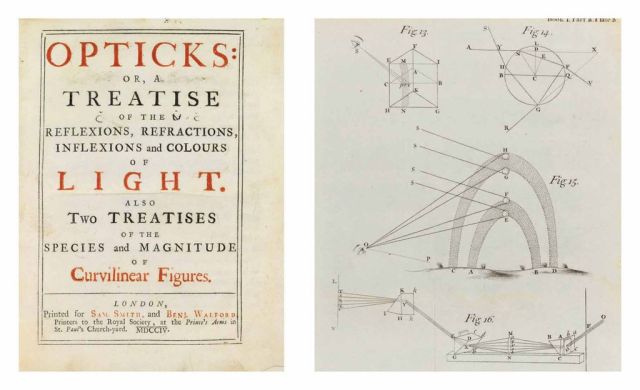
newton_sir_isaac_opticks_or_a_treatise_of_the_reflexions_refractions_i_d5388551g

Note: This is the first half of the fifth part in an ongoing commentary on Emmanuel Levinas’s essay “God and Philosophy” (1974).

The Priority of Ontology and Immanence
5. We have said that for Western philosophy meaning or intelligibility coincides with the manifestation of being, as if the very affair of being led, in the form of intelligibility, toward clarity, and thence became intentional thematization in an experience. This is a thematization from which derive, or to which are susceptible, all the potentialities of experience, as they press toward it or await thematization. In the thematic exposition the question of being or of truth is exhausted. But if being is manifestation-if the exertion or action of being comes back to this exhibition- then the manifestation of being is only the manifestation of “this exertion.” That is, it is a manifestation of manifestation, a truth of truth. Philosophy thus finds in manifestation its matter and its form. Philosophy would thus remain in its attachment to being-to the existent or to the being of the existent-an intrigue of knowledge and truth, an adventure of experience between the clear and the obscure. It is certain that this is the sense in which philosophy carries the spirituality of the West, wherein spirit remained coextensive with knowledge. But knowledge [savoir]-or thought, or experience-should not be understood as some sort of reflection of exteriority in an inner forum. The notion of reflection, an optical metaphor borrowed from thematized beings or events, is not the characteristic of knowledge. Knowledge only comprehends itself in its own essence, starting from consciousness, whose specificity eludes us when we define it with the aid of the concept of knowledge, which itself supposes consciousness.

Comments
a) Did your eyes glaze over? This is a dense passage that is probably incomprehensible unless the reader has read other texts by Levinas, and has a good understanding of Heidegger. So don’t feel bad if this paragraph comes across as gobbledygook. Ironic, isn’t it, that it deals with the intelligibility of being?

b) This paragraph is a set-up for the one following, the second paragraph of section 5 of the essay. The paragraph above is describing how the human consciousness is in the world and how things are disclosed to it in a manifestation of being. It seems that Levinas has three philosophical references in this paragraph: i) Heidegger and the ontology of meaning, ii) a quick bounce off of Hegel and The Phenomenology of the Spirit, and iii) a brief critique of representationalism.

c) The description and critique of Heidegger is in the first seven sentences, down to the word “obscure”. It is a restatement of what has already been said in the essay, and something which Levinas believed as a young man in the 1920s – that Western Philosophy reached a kind of culmination in the fundamental ontology of Heidegger. Meaning or intelligibility is manifested in being. This manifestation or disclosure of being leads through ordinary intelligibility to the clarity of philosophy, and this clarity is expressed in thematizations derived from experience. One of the striking things about Husserl’s phenomenology is that it focused  on the content of phenomena, and so potentially was not about abstractions but could be about everyday things. Levinas’s first published work in 1932 was his dissertation on intutition in Husserl. It was written very much from a Heidegerrian point of view. A young Jean-Paul Sartre was introduced to phenomenology through this text, having become aware that one could make a philosophy out of ordinary phenomena and not be weighted down with Cartesian doubt and Kant’s concern with whether we can know the thing-in-itself.

d) Levinas critiques Heidegger by suggesting that ontology gets stuck at being concerned with the manifestation of being. It cannot get beyond the manifestation, and what is seen on the surface of things is really all that there is, as that’s all that can be discussed intelligibly. Philosophy, then, is a manifestation of manifestation, a truth of truth. There is no Kantian “thing-in-itself” beyond perceptions, there is just the thing itself as it is disclosed to us. Philosophy – or any other type of rational knowledge – is wedded to this understanding of being, and at best all we can do is clarify the clear from the obscure. “Philosophy thus finds in manifestation its form and content.”

e) Levinas then suggests that in “the spirituality of the West . . . spirit remained coextensive with knowledge”. This is probably an allusion to Hegel and his 1807 opus “The Phenomenology of Spirit”. This rather strange book examines how consciousness unfolds and evolves through history, culminating in the Napoleonic era and the philosophy of Hegel. In some respects Hegelianism is the totalizing philosophy par excellence, as it seems to encompass everything visible and invisible and put it in its place of dialectical triads. The word Geist in German means both “mind” and “spirit”, and so to talk about “the spirituality of the West” is in a sense to talk about what it thought about consciousness. For Levinas historically, from the Greeks through Descartes to Kant and Hegel up through Husserl and Heidegger, this meant knowledge. Heidegger radically reinterpreted knowledge in terms of being, but it was still about knowledge. What Levinas wants to do is to call this long tradition into question.

f) Before he moves on to the major move in his philosophy, Levinas makes a very Heidegerrian point in stating that knowledge is not a reflection of exteriority in an inner forum. Going back to Locke representationalism bedeviled philosophy. It was clear that human beings receive sense data, and then somehow use it to interact with the world through vision, touch, smell, hearing, and tasting. Vision became the dominant metaphor, and philosophers engaged in what looks a lot like psychological speculations to understand how sense data became perceptions and how the mind used them. That it sounds to our ears like psychology is understandable, because up until around 1900 psychology and philosophy were one discipline. Kant in particular worried over this, and eventually concluded that there was the thing-in-itself and the thing-as-it-appears, and we can only know the latter. Analytic philosophy to this day relies on representationalism; it’s a pretty powerful idea still. As noted above, Heidegger simply said that the phenomenal world is the world. We do not have a little homunculus inside of us taking the data and turning it into a representation of the world for consciousness to look at. Much of Being and Time deals with how human consciousness deals with the world, and Heidegger’s descriptions do not assume some kind of reflection being generated inside consciousness; he actually leaves it rather vague as to how disclosure happens. Richard Rorty (1931-2007) in Philosophy and the Mirror of Nature (1979), a book that incorporates both Heidegger and Wittgenstein, makes a devastating attack upon representationalism.

h) The final point that Levinas makes is another Heidegerrian one, which is that the concept of knowledge presumes a conscious knower. This creates a circular problem in that consciousness is consciousness of something, which is presumably knowledge, but the actual nature of the consciousness knowing is rather opaque or hidden from us. Phenomenology tries to get behind that to understand the characteristics of consciousness. Heidegger came to one conclusion in Being and Time, to which Levinas adhered for a time, but eventually found that he needed to leave that climate.

Posted in Levinas | Tagged , , , | Leave a comment

An Introduction to Levinas (Part Four)

Beyond the Polarity of Faith and Reason

polarity-beyond

A Mobius Nautilus – A compound mobius strip created out of 36 interlocking mobius strips. 3d printed out of a sintered vinyl plastic, which makes it very resilient and bendable.

Note: This is the fourth part in an ongoing commentary on Emmanuel Levinas’s essay “God and Philosophy” (1974).

4. One can, to be sure, also claim that the God of the Bible has no meaning; that is, he is not thinkable properly speaking. This would be the other term of the alternative. “The concept of God is not a problematic concept, it is not a concept at all,” writes Jeanne Delhomme in a recent book, prolonging a major line of the philosophical rationalism that refuses to receive the transcendence of the God of Abraham, or of Isaac and Jacob, among those concepts without which there would be no thought. That which the Bible raises above all comprehension has here not yet reached the threshold of intelligibility!

The problem that is posed, consequently, and which shall be out own, consists in asking ourselves whether meaning [Ie sens] is equivalent to the esse of being; that is, whether the meaning which, in philosophy, is meaning is not already a restriction of meaning; whether it is not already a derivation or a drift from meaning; whether the meaning equivalent to essence-to the gesture of being, to being qua being-is not already approached in the presence which is the time of the Same. This supposition can only be justified by the possibility of going back, starting from this allegedly conditioned meaning, to a meaning that would no longer express itself in terms of being, nor in terms of beings. We must ask ourselves whether, beyond the intelligibility and the rationalism of identity, of consciousness, of the present and of being-beyond the intelligibility of immanence-the significance, the rationality, and the rationalism of transcendence are not themselves understood. Our question is whether, beyond being, a meaning might not show itself whose priority, translated into ontological language, will be called prior to being. It is not certain that, going beyond the terms of being and beings, one necessarily falls back into the discourse of opinion or of faith. In fact, while remaining outside of reason, or while wanting to be there, faith and opinion speak the language of being. Nothing is less opposed to ontology than the opinion of faith. To ask oneself, as we are attempting to do here, whether God cannot be uttered in a reasonable discourse that would be neither ontology nor faith, is implicitly to doubt the formal opposition, established by Yehuda Halevy, and taken up by Pascal, between, on the one hand, the God of Abraham, Isaac, and Jacob, invoked without philosophy in faith, and on the other the god of the philosophers. It is to doubt that this opposition constitutes an alternative.

a) In this fourth section of the essay Levinas contemplates a standard polarity between rationality and faith. Philosophers such as Jeanne Delhomme[1] call into question the very intelligibility of God, declining to call it even a concept. Others are less critical of faith, but do see a true difference. Levinas invokes Yehuda Halevy (also spelled Judah ha-Levi) (1075-1141) as the Jewish philosopher from Spain who first posed the opposition. He also refers to Blaise Pascal, the 17th century Christian mathematician, physicist, and theologian from France. The rationalists (Rene Descartes, Baruch Spinoza, Gottfried Liebnitz) attempted to understand God by reason alone, but in so doing did not arrive at the God of either Judaism or Christianity, but a deity that at best was conformable to monotheism. The empiricists (John Locke, David Hume) believed that our knowledge of the world was based upon experience and habit; while Locke accepted that we might be able to have an empirically based belief in God, Hume did not. Kant tried to overcome the split between rationalism and empiricism by demonstrating through the antimonies that certain opposing propositions  (such as the existence/non-existence of God) cannot be ascertained by either reason or experience.

b) Levinas deals with this by calling into question the polarity. As will be seen as he develops the idea in the rest of the essay, he reinserts the concept of transcendence into human discourse as something which disrupts the hegemony of reason. Philosophers,  by defining “meaning” as that which emerges from the gesture of being as an essence, have predermined the outcome of their investigations by restricting the meaning of “meaning”. So Levinas asks: Is there meaning prior to being?

c) Levinas here describes what he about to do – asking about a priority of meaning that is prior to being – as a translation into ontological language. The translation here is twofold, I think. First, it is that translation of the transcendence of the God of Abraham, Isaac, and Jacob into terms that do not require an adherence to Judaism or any other religion. In other words, his translation is not a Jewish philosophy, but something of universal significance. The other way in that it is a translation is that it is a movement from the “Saying” to the “Said”, about which he will elaborate later in the essay.

d) Levinas suggests that faith and opinion in fact speak the language of being, that it is not as opposed to philosophy as Halevy and Pascal and so many others suggest. This is a consequence of his thinking around the Saying and the Said. Human speech is always a “thematization” of something, and that thematization presumes the language of ontology. For Levinas this is just an observable fact, and the role of philosophy is to deconstruct the overwhelming claim of ontology in favor of what is prior to being, namely ethics. In the same way that the later Wittgenstein saw the role of philosophy as untangling us from the bewitching of language, so Levinas sees his meta-ethics, only with higher stakes.

e) An example of “thematization” might be to consider the word “tool” much as Wittgenstein does in Philosophical Investigations. We use the word “tool” all the time and we might even have a definition in our mind that is pretty close to the dictionary entry. A philosopher might call this the “essence” of what a tool is. A Platonist would suggest that there is an ideal form of toolness that exist independently of any particular tool and is in some sense more real than material tool. An Aristotelian would suggest that “tool” is just an abstraction from the tools in the world, and it is a name. Wittgenstein would say that all of this is misleading. The meaning of the word “tool” is defined by its use within a particular form of life. It will have many uses and many types of application, and there is a family resemblance between the uses. It is neither an ideal form nor an abstraction, but an item we use in human communication. we know we have used the word correctly if the other person responds in the expected or desired way. For Levinas the “thematization” takes place when a philosopher takes a word out of its polyvalent usage and sees it as an ideal, as an abstraction, as a definition, as an essence, or some kind of gesture of being.

f) Levinas always distinguished between his philosophical texts and what he called his “confessional writings”. Although he claimed to be no expert, he studied the Talmud extensively in the 1950s and became a noted expositor in his annual Talmudic Readings at gatherings of French Jewish Intellectuals. He also commented on any number of other Jewish topics, as well as the relation of Judaism to Christianity. In his confessional writings Levinas suspended any philosophic reservations and engaged in issues, usually in the spirit of argumentation found in the Talmud. Levinas always related the practice of the Jewish faith to ethics, and was not overly concerned with the ontology or epistemology of what was in the Bible or the Talmud. He recognised that the language which he received had these ontological propositions, but what was more important was how the transcendence of God and of the other person disrupted those propositions. This led him not to a God hat was a mere negation of these propositions (which would be nothing, a nihilistic conception of the divine) but to the true significance of the disruption, which is ethical. While Levinas would not say that one has to be religious in order to be ethical, In his own life he lived out his ethics in a religious mode.

[1] Jeanne Delhomme (1911-1983) was a Professor of Philosophy at Université de Poitiers (1957-1969), and Paris X- Nanterre (1970-1981), where she was in both places a colleague of Levinas.

Posted in Levinas, Philosophy | Tagged , , | Leave a comment

An Introduction to Levinas (Part Three)

A Destruction of Transcendence

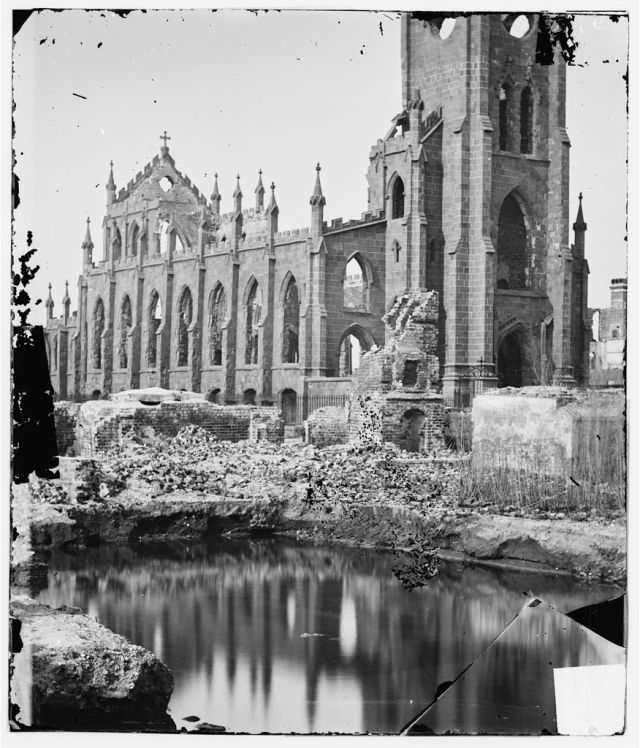
destroyed-church

Roman Catholic Cathedral of Saint John and Saint Finbar, Charleston SC, USA, destroyed by a fire in 1861. Picture taken in 1865 after bombardment of the city by the US Navy.

3. Philosophical discourse must therefore be able to embrace God of whom the Bible speaks – if, that is, this God has a meaning. But once thought, this God is immediately situated within the “gesture of being.” He is situated therein as a being [etant] par excellence. If the intellection of the biblical God-theology-does not reach the level of philosophic thought, it is not because theology thinks God as a being without making clear to begin with the ‘being [être] of this being,” but because in thematizing God, theology has brought him into the course of being, while the God of the Bible signifies in an unlikely manner the beyond of being, or transcendence. That is, the God of the Bible signifies without analogy to an idea subject to criteria, without analogy to an idea exposed to the summons to show itself true or false. And it is not by accident that the history of Western philosophy has been a destruction of transcendence. Rational theology, fundamentally ontological, endeavors to accommodate transcendence within the domain of being by expressing it with adverbs of height applied to the verb “to be.” God is said to exist eminently or par excellence. But does the height, or the height above all height, which is thus expressed, still depend on ontology? And does not the modality that this adverb asserts, borrowed from the dimension of the sky stretched above our heads, govern the verbal sense of the verb “to be,” to the point of excluding it – as ungraspable – from the esse that shows itself, that is to say, that shows itself as meaningful in a theme?

Note:  In this Introduction to Levinas I intend to go paragraph by paragraph through his essay “God and Philosophy” and to make comments on it. This will be a long series! I will assume that you’ve scanned over the previous sections.

a) Levinas continues his brief description of Western philosophy by introducing the God of the Bible. Being Jewish he naturally means the God of the Torah, the Prophets, and the Writings, as interpreted and argued about by the Talmud. However, he uses the ambiguous phrase “God of the Bible” to also include the Christian Bible of the Old Testament and the New. The God being discussed here is not the incarnate Word or the Holy Spirit. God is presented in the Bible as a transcendent being – uncreated, powerful, creator, source of laws and instruction. However, the minute philosophy gets its hands on the divine it begins to destroy this transcendence, to domesticate it in terms of being.

b) Does “God” have a meaning in philosophy? Logical positivism would, of course, say that it is meaningless, as it is unverifiable by empirical evidence. However, that’s not the point that Levinas is making here. Rather, following on the previous paragraph the term or idea would only have meaning if it can be thought, if it is inherently intelligible, if it can be situated within the gesture of being.

c) Historically there were two approaches to this. Duns Scotus argued that anything that might be said of God might also be said of things in creation. Thus, if God is good and a person is good, the word “good” has the same meaning, although there may be a difference in degree. On the other hand Thomas Aquinas would have said that what can be said of both created things and God are analogous; if a person is good it is because that persons’s goodness participates in the goodness of God, but they are not the same thing. Thus, when it comes to “being”, the being of a creature is like the “being” of God, but it is not the same thing.  For Duns Scotus, who holds to the univocity of being, they are the same thing.

d) Now, Aquinas works hard to demonstrate that we cannot really know God. As creatures we are limited, and God’s being is unknowable to cognition, but it can be known by a beatific vision that is beyond words. Aquinas, then, does allow for transcendence. For more on this see Analogy in Theology.

e) Levinas describes the general trend of Western Philosophy as a destruction of transcendence. Philosophy takes God as a theme and absorbs it into its discourse, and in so doing cuts it off from its Biblical roots, where transcendence is repeatedly affirmed. In the Reformation analogical theology ceased to be practiced, and the existence of God is affirmed by using adverbs such as “par excellence” and “eminently” – but even those words suggest a height that is transcendent. Thus there is always a hint in the philosophy discourse of God that there is something that escapes the grasp of being, that is otherwise than being, or beyond essence.

f) The problem with theology, as Levinas sees it, is that it is fundamentally ontological. Now, Levinas was not an historian of medieval theology, and probably did not understand the nuances of Thomist theology. However, the idea of the Summa Theologica – that one begins by proving the existence of God in a variety of ways and then moving on – was an ontological starting point that Levinas could not accept. For him a proper metaphysics does not start with being and existence, but with ethics.

g) The problem with philosophical discourse of the type that Levinas describes is that it is totalizing. Levinas took his critique of totalizing thought from Franz Rosenzweig (1886-1929) and developed it in Totality and Infinity. In a lecture in 1959 he summarised Rosenzweig this way:

Thales assertion that `everything is water’ is, according to Rosenzweig, the prototype of philosophical truth. It denies the truth of experience, reducing dissimilarities, saying what all reality encountered is fundamentally, and incorporating all phenomenal truth into this Whole.

Everything, in fact, for ancient cosmology, is reduced to the world; for medieval theology, to God; for modern idealism, to man. This totalization culminates in Hegel: beings acquire meaning only from the Whole of history, which measures their reality and encapsulates men, states, civilizations, thought itself and thinkers. The person of the philosopher is reduced to the system of truth of which the person is but a moment.[1]

h) For Levinas, this is not an abstract issue. He believed that Heidegger’s ontology in Being and Time led to him adopting the goals and aims of Nazi Germany. For Levinas ontology supports war, violence, and the degradation of the individual:

The visage of being that shows itself in war is fixed in the concept of totality, which dominates Western philosophy. Individuals are reduced to being bearers of forces that command them unknown to themselves. The meaning of individuals (invisible outside of this totality) is derived from the totality. The unicity of each present is incessantly sacrificed to a future appealed to to bring forth its objective meaning. For the ultimate meaning alone counts; the last act alone changes beings into themselves. They are what they will appear to be in the already plastic forms of the epic.[2]

i) Levinas sometimes said that in his philosophic work he was trying to translate Hebrew into Greek. What he meant by that was that while knowledgeable and aware of the discourse of western philosophy (which started with the Greeks) he intended to disrupt its totalizing trend with transcendence (which he finds in “the God of the Bible”). However, his philosophy is not a Jewish philosophy or a Judeo-Christian philosophy, much less a theological sheep in a philosophical wolf’s clothing. Rather, he is critiquing the ontological discourse of the past 2500 from within that tradition. This gets developed later in the essay.

[1] Emmanuel Levinas, “`Between Two Worlds’ (The Way of Franz Rosenzweig)” from a lecture originally given September 1959, in Difficult Freedom, Essays on Judaism translated by Seán Hand (Baltimore MD: The Johns Hopkins University Press, 1990), pp. 181-201, p. 188.

[2] Levinas, Totality and Inifinity, p. 21-24.

Posted in Levinas, Philosophy | Tagged , , | Leave a comment