Conditional Thomas, Unconditional Jesus

A Sermon Preached on The Second Sunday of Easter
The Anglican Church of St. Thomas the Apostle, Kefalas, Crete
April 28, 2019 11:00 am

Scripture readings may be found here.

the-old-pearly-gates-looked-nice-mike-twoh

Χριστός ἀνέστη! Ἀληθῶς ἀνέστη!
Alleluia! Christ is risen. The Lord is risen indeed. Alleluia!

Last week I preached a long sermon. Today’s will be short.

I’ll start with a joke. I cannot promise it is a good one.

A Baptist, a Catholic and an Anglican were standing before the pearly gates.

St. Peter himself met them: To the Catholic he said “I have one question that you must answer: who do you say that Jesus is?” The Catholic replied, “The church teaches . . .” Peter interrupted, “I didn’t ask about the church, I asked about you! You may not enter!”

To the Baptist he said, “I have one question that you must answer: who do you say that Jesus is?” The Baptist replied, “The Bible says . . .” Peter interrupted, “I didn’t ask about the Bible, I asked you! You may not enter!”

Finally he said to the Anglican, “I have one question that you must answer: who do you say that Jesus is?” The Anglican then said, “He is the Christ, the Son of the Living God, the Word made flesh, the Alpha and the Omega!” Jesus said, “Yes, that is correct! You may enter!” The Anglican then continued, “Now, on the other hand . . .”

Thomas is the disciple who always seemed to be the skeptic, and who can always see the other side of any questions. We are very good at seeing multiple sides of everything. But in the end the issue is less the propositions we believe in that the relationship we have with God in Christ.

Thomas put obstacles in the way of that relationship, and that can be a problem. He put demands on it. “Unless I see the mark of the nails in his hands, and put my finger in the mark of the nails and my hand in his side, I will not believe.”

Well, the only absolute precondition to a relationship is showing up. So a week after, Jesus shows up, and submits to Thomas’s demands. “Put your finger here and see my hands. Reach out your hand and put it in my side. Do not doubt but believe.” Thomas believes, removes the obstacles to the relationship, and confesses him as “My Lord and my God!” And he says to the disciples, “Peace be with you. As the Father has sent me, so I send you.” They receive the Holy Spirit, and are sent.

This is a world that is often hostile to God and God’s peoples. Over 250 Christians were murdered last Easter Sunday while they worshipped. This was supposedly in reaction to massacre of fifty Muslims in Christchurch NZ. This morning we heard of the hate crime and murder in a synagogue in San Diego, in imitation of the murder of eleven people attending worship at the Tree of Life Synagogue in Pittsburgh. These attacks are not acts of faith, but terrorism that is antithetical to the will of God. How do we respond to such hostility? Our model is Jesus Christ. The cycle of violence will continue until humans allow God to break through, and the obstacles to the power of the resurrection are taken away.

For us as Christians that means having a relationship with God in Christ, and in deepening that relationship.

  • It means knowing Jesus
    • as Leader and Saviour, as Peter says before the Sanhedrin
    • as the rejected stone that is now the chief cornerstone, as Psalm 118 puts it.
    • as the one who is and who was and who is to come, as Revelation states.
    • As the faithful witness, the firstborn of the dead, and the ruler of the kings of the earth.
    • who loves us and frees us from our sins by his blood, and made us to be a kingdom of priests
    • the one who is the Alpha and the Omega,
    • with Thomas, as our Lord and our God,
    • as the Messiah, the Son of God,
  • It means breathing in that Holy Spirit that is breathed upon us.
  • It means that we are people of peace, as Jesus greets us with, Shalom.
  • It means that by eating the bread of life and drinking the cup of salvation we become in human form the body and blood of Christ.
  • It means by being in relationship with others we are the body of Christ.
  • It means that we are sent even as Jesus sent us.
  • It means breaking cycles of violence, just as Jesus did.

May the same power which raised Jesus Christ from the dead work in us, that we may show forth the glory of God’s power.

Alleluia! Christ is risen. The Lord is risen indeed. Alleluia!

Posted in Easter, Sermons | Tagged , , , | Leave a comment

Resurrection is What God’s Love Looks Like in Public

A Sermon preached on The Sunday of the Resurrection: Easter Sunday
at
The Anglican Church of St. Thomas the Apostle, Kefalas, Crete, Greece
The Diocese in Europe|The Church of England
April 21, 2019, 11:00 am.

Scriptural Readings: Isaiah 65.17-25, Psalm 118: 1-2, 14-24, Acts 10.34-43, & Luke 24.1-12 may be found here.

This is essentially the same sermon I preached last year at St. Dunstan’s, Gordon Head, in Victoria, British Columbia, Canada, with a few tweaks. Next year I promise to come up with a new sermon!
1032727_1_0321-Israel_Jesus_Tomb_Restoration_standard

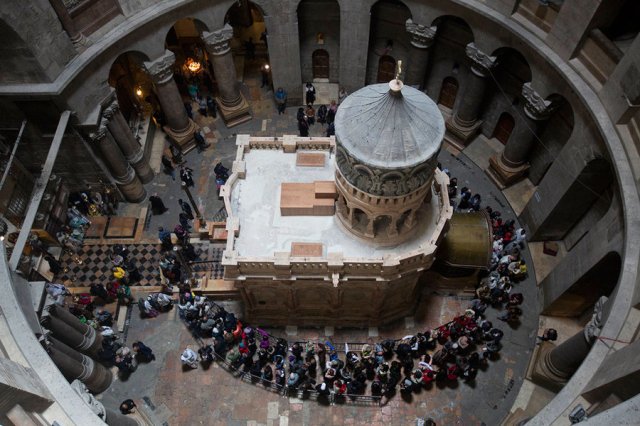
The Edicule (shrine) over the stone over which the body of Christ was laid, and from which Christians believe he was raised. In the Church of the Resurrection/The Church of the Holy Sepulchre in Jerusalem.

Alleluia! Christ is risen.  The Lord is risen indeed. Alleluia!

I believe in the resurrection.

The resurrection is the centre of the Christian faith. We affirm it in our baptismal vows, and in their renewal, in the creeds, and in our liturgies, and on this the most holy of days, the Sunday of the Resurrection, which in English we call Easter. We say that we believe that on the third day after his death (counting inclusively), God raised Jesus from the dead. We also say that we believe in the resurrection of the dead and the life everlasting – that all humanity will be raised from the dead. This is the general resurrection.

What does this mean? What difference does it make to my life?

Resurrection Is About Justice

The resurrection of Jesus is about justice – of God’s justice, and of justice in the world. This is probably not how you think of it. How is the resurrection about justice?

To understand why it is about justice one has to go into the history of Hebrew and Jewish thinking about the afterlife, and to recognize that there were a variety of views.

Shadowy-figure_288x288The earliest view is the concept of Sheol. Sheol is a shadowy existence after death, a place for all the dead, the good and the bad. What is left of the person is a bare remnant, without strength or power. The Torah (the continuous narrative of Genesis, Exodus, Leviticus, Numbers, and Deuteronomy) does not really talk about any other type of afterlife, and the Sadducees, the Zadokite priests who were powerful in the Temple in Jerusalem, denied the resurrection, as they only accepted the Torah as scripture, and not the Prophets and the Writings. This was a very simple theology, in which God acts in the lives of human beings, and does not wait for their death to offer rewards and punishments. Thus, God rewards the righteous in life and punishes the wicked in life as well. This approach to existence after death is well attested in the psalms, where the psalmist says, for example in Psalm 30.9,  “What profit is there in my death, if I go down to the Pit? Will the dust praise you? Will it tell of your faithfulness?” The dead cannot even praise God, and the psalmist asks that he stay alive so that he might do so.

8495105_f520Later on the idea of Heaven and Hell developed. The personality of the dead is less shadowy and more defined. God punishes and rewards the dead; God brings the good into the divine presence, and the wicked go to a place of punishment, of God’s wrath, often called Gehenna. In all probability the development of these alternate fates was influenced by the Persian state religion of Zoroastrianism.This paralleled the development of Satan as a fallen angel in rebellion to God, a source of evil which is an active principle in the world; before then God, as omnipotent, was held to be the creator of good and evil (see Isaiah 45.7: “I make peace, and create evil” AV/KJV).

Belief in resurrection emerged relatively late, only 150 to 200 years before the time of Jesus, and in the whole of the Hebrew Scriptures (Old Testament) was only explicit in the Book of Daniel, which was written at about that time. By Jesus’s time it was a common belief amongst many Jewish groups, and it is described as a belief of the Pharisees. Resurrection addressed the issue of God’s justice – when the righteous follow the ways of God but still suffer, where is the justice of God? The horrific story of the martyrdom of seven brothers and their mother (c. 168 BC) in 2 Maccabees 7 describes how one after one they are murdered by Antiochus Epiphanes because they refused to transgress the rules of their forebears. They state their hope in the resurrection, and taunt the king: “‘One cannot but choose to die at the hands of mortals and to cherish the hope God gives of being raised again by him. But for you there will be no resurrection to life!” (2 Maccabees 7.14).

In the Book of Daniel the Son of Man is described as a divine being who is sent by God to judge the world. By the time of Jesus this was combined with other eschatological and apocalyptic expectations for the Day of the Lord, which was the breaking in of God into worldly affairs to turn the world right-side up. The righteous will finally be rewarded and the wicked will finally be punished. John the Divine described this in great, if sometimes confusing detail, in the Book of Revelation. In chapter 18 Babylon, which stands for the city and empire of Rome, falls, and among those most distressed are the merchants and sailors who deal in luxuries, animals, and human slaves. God’s judgment is described in Matthew 25 like the separating of the sheep from the goats, and it is connected to how people dealt with the hungry, the thirsty, the stranger, the sick, the naked, and those in prison – the poor and oppressed people of society. The belief, then, was that resurrection was a matter of justice, of righting wrongs, of reward and punishment.

The Resurrection Of Jesus is About Justice

I believe in the resurrection.

The resurrection of Jesus Christ is part of that eschatological breaking in of God into the world. His birth, his teaching, his miracles, his healings, his exorcisms, his suffering, his death, are all part of God coming into the world, the Word becoming flesh and dwelling among us. The way in which the world reacts to this divine presence in human form brings about judgment, either being lifted up with Jesus into new life, or condemnation by joining with those who attacked him.

The resurrection of Jesus Christ is the beginning of God’s re-creation of the world, of transformation, of a new heaven, a new Earth, and a New Jerusalem, where all God’s sons and daughters rejoice in the light of the one who sits on the throne and declares, “Behold, I make all things new.” (Revelation 21).
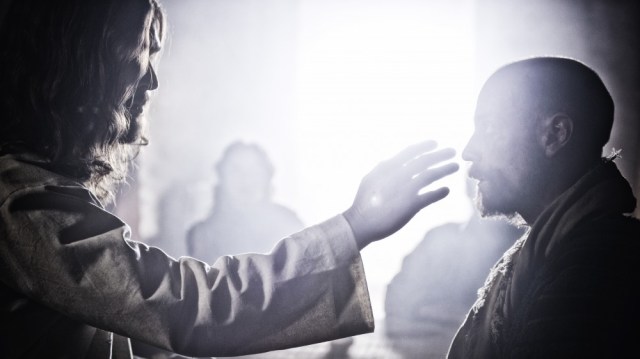
jesus-resurrection-thomasThis is seen in his resurrected body. It is described as both physical, something you can touch, and yet spiritual, something which will not perish. It appears suddenly in one location and then disappears. It can eat, speak, and be heard. Sometimes people recognize it, sometimes they do not. When Jesus addresses people by name, they know him. In Emmaus he is known to the two disciples “in the breaking of bread.” This is not some kind of Zombie Jesus, as modern day detractors of Christianity sometimes suggest. This is not the reanimation of a dead body, mindless, rotting, and doomed to perish again.This is something different.

Original Testimony

I believe in the resurrection.

It is not easy to believe in the resurrection. After all, in ordinary experience, dead people do not rise from their graves in new and glorious bodies. The resurrection of Jesus is an event that is outside known physics, chemistry, and biology. The resurrection of Jesus is not an historically verifiable fact, because it is extra-ordinary and not part of the normal course of events. We can assert that it is an historical fact that the disciples believed that Jesus rose from the dead, but we cannot say that it is a historical event in the same way that we can say that Julius Caesar crossed the Rubicon, or that William Duke of Normandy conquered England in 1066. There is no archaeological evidence or secondary literature to confirm this miraculous happening.

And yet, today we heard the early witness of Paul, himself an eye-witness to the resurrection. In First Corinthians Fifteen he lists all the people who were also witnesses, and while some of them had died, all of the others were around to be questioned:

For I handed on to you as of first importance what I in turn had received:
that Christ died for our sins in accordance with the scriptures,
and that he was buried,
and that he was raised on the third day in accordance with the scriptures,
and that he appeared to Cephas (i.e. Peter)
then to the twelve.
Then he appeared to more than five hundred brothers and sisters at one time,
most of whom are still alive, though some have died.
Then he appeared to James,
then to all the apostles.
Last of all, as to someone untimely born, he appeared also to me.

This ancient witness dates to perhaps 50 AD – about two decades after the event itself. Paul emphasises that he is telling them something he told them earlier, and that his knowledge of the witnesses is a tradition that was handed on to him. The gospels, written a couple of decades later, assert that Mary Magdalene and Mary the mother of James were the first witnesses. There were skeptics even then, we are told, but there is still this testimony.

A couple of things happen to the witnesses. When they see Jesus they are immediately struck with their own unrighteousness; after all some of them had abandoned Jesus, one had denied knowing him, and one had betrayed him. Their sense of sin bubbled up in the presence of the glory of the resurrected Jesus. But, at the same time they also experienced forgiveness and empowerment. Thus, when Jesus appears in the upper room in John 20 he breathes on them, and just before says, ” Peace be with you. As the Father has sent me, so I send you.” They become Christ in the world, proclaiming the kingdom of God, healing illness and driving out evil, and living as though they had already been resurrected, guided by the Spirit. The communal feast on Sunday became a time when Christ was made known in the breaking of bread, a foretaste of the heavenly banquet.

The Power of the Resurrection

I believe in the resurrection.

I have seen the power of the resurrection at work today. It is not something simply about some future, unbelievable event.

Fresco_showing_the_baker_Terentius_Neo_and_his_wife,_from_Pompeii,_House_of_Terentius,_Naples_National_Archaeological_Museum_(14655900927)

I have seen it in history, as the gospel spread rapidly from one anonymous Christian to another. It is infectious. Yes, we celebrate the apostles like Peter and Paul, but before either of them got to Rome other Christians had already arrived and started several small churches in that great city. When Paul came to Corinth around 50 AD a Jewish-Christian couple by the names of Prisca and Aquila were there, having been expelled from Rome by the Emperor Nero because of their Christianity.

That gospel spread rapidly through Gaul, across the channel into Britain, and then leapt across the Irish Sea to Ireland. In the fourth century Patrick, a Roman Briton captured as a slave, then escaped and made his way back home. After a few years of preparation Patrick was sent back to the land of his slavery as a missionary bishop. A few centuries later the gospel moved into Scotland and Northern England through the islands of Iona and Lindisfarne.

1200px-Canterbury_St_Martin_close

St. Martin’s Church, Canterbury. When St. Augustine came to Kent in 597, it was already there. Although much modified over 1400 years, the foundation dates back to Roman times.

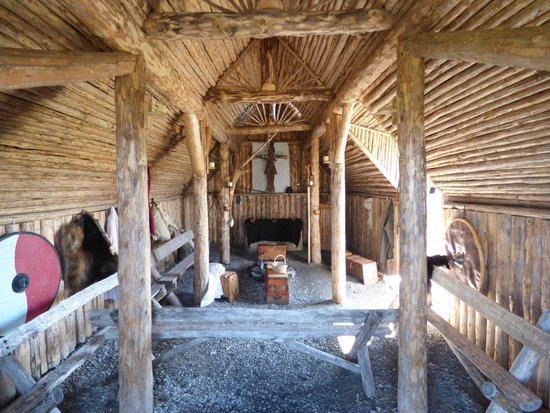
At roughly the same time Augustine landed in Canterbury in south-east England in an effort to proclaim the gospel to the pagan Anglo-Saxons. In the opposite direction the gospel spread east through the Church of the East, through Persia and into India, and then through Afghanistan into the far East, reaching China by the 7th century. By the year 1000 new converts to Christianity from Greenland and Iceland arrived in what they called Vinland, what we now know is Newfoundland, and there are at least two baptisms recorded in the sagas.
norstead-viking-village

A reconstructed Viking church in Norstead Viking Village, adjacent to L’Anse aux Meadows, Newfoundland and Labrador.

As with anything involving peoples, institutions became complacent and corrupt. Already in the third century radical Christians in Egypt gave away their belongings and headed out into the desert to pray. They came together in communities, and thereby monasticism was begun. In the medieval era St. Francis of Assisi and St. Dominic began preaching orders that celebrated poverty and sought to preach the gospel to ordinary folk.

500 years ago through Luther and Calvin in the Reformation and people like Ignatius Loyola in the Counter-Reformation the Church pulled itself out of corruption and bad theology into a new respect for holy scripture and the role of the laity. In the past century the Christian faith has gone from being primarily a European religion, compromised by imperialism and colonialism, to one that is most vibrant in Africa and Asia. Africa went from nine million followers in 1900 to 380 million in 2000, most of them in indigenous denominations unknown in the West. Korea is on the verge of becoming a majority Christian nation, and there are more Presbyterians in South Korea than in Scotland. All of this flows from the same power which raised Jesus from the dead.

The Power of the Resurrection In Parishes

I believe in the resurrection.

I have seen the power of the resurrection give new life to old churches.

  • The parish where I was last a regular lay person is the Church of the Redeemer in Toronto. In 1980 it voted to disestablish itself as a self-governing parish and ask the Diocese of Toronto to step in. The vote passed by something like eleven votes to four! The diocese did not give up, but sold the land of the parish hall, sold some air rights, and jump-started the place. It is now one of the most active churches in Toronto, with four services a Sunday, a diverse music program, and a soup kitchen that serves 150 people five days a week.

    Redeemer

    Church of the Redeemer, Toronto, at an Easter Vigil

  • My daughter’s parish in New York City is St. Mark’s in the Bowery. The parish is ancient, dating back to a chapel erected by Petrus Stuyvesant on his farm in 1660. It is now in the centre of the East Side, entirely built up. For almost a century the Bowery was a district that was better known for tenements and punk rock. For fifty years the parish survived by renting out its spaces and selling off land. In 2009 it was down to about 20 people on a Sunday. The Diocese of New York put in a dynamic priest who was intent on growing the parish as a radical justice oriented place. Now it has an average Sunday attendance of over a hundred, and it is indeed renowned for their social justice ministries; on Palm Sunday they not only marched in commemoration of Jesus’s entry into Jerusalem, but to advocate for gun control and Black Lives Matter.

    Easter-2018-web-924x345

    Easter 2018 at St. Mark’s in the Bowery. My daughter is the one with flowers in her hair.

  • The parish where I was working immediately before coming here was St. Dunstan’s, in the neighbourhood of Gordon Head, in Victoria, British Columbia. It was down to some 20 people 23 years ago. The Bishop put the Reverend Canon Bill Morrison in the place, and it doubled in average Sunday attendance. When the Rev. John Alfred Steele came in 1995 it doubled in size again. Now it has a  new incumbent who has come, from of all places, England. Its future is promising!

All of this growth flows from the same power which raised Jesus from the dead.

The Power of the Resurrection in the World

I believe in the resurrection.

Christians have been in the forefront of social change, whether acknowledged by secular society or not. The African-American theologian and philosopher Cornel West says that love in public looks like justice. The power of the resurrection is what God’s love looks like in public.

  • The Sunday School movement, which started in the 18th century, was initially as much about teaching people to read as teaching them about scripture;.
  • William Wilberforce and the efforts to abolish, first, the slave trade, and then, by 1834, slavery itself.
  • Anglo-Catholics were not just about ecclesiology and nice liturgy, but went into slums, educating people, and religious orders worked to provide nursing and midwives, as the television show “Call the Midwife” describes.
  • Civil rights in the USA were advanced by groups largely led by Christian clergy, such as Martin Luther King, Jr., whose death is being commemorated this coming week.  Christians continue in leadership for human rights in America, and unique theologies of liberation have developed in reaction to the fact that there have been 400 years of systematic oppression against African-Americans. Look up the Black Theology of James Cone and Cornel West, or the Black Feminist approach advocated by Alice Walker and integrated into Christian thinking as Womanist theology, whose major theologians are  Jacquelyn Grant, and Delores Williams.
  • In Athens the Anglican Church of St. Paul’s has been a leader in working with refugees and migrants.

All of this flows from the same power which raised Jesus from the dead.

Invitation

I believe in the resurrection.

The resurrection is about God’s justice breaking into our world, and that in-breaking is a manifestation of God’s love for a world, created by the divine and now being recreated in love.

How is God’s love breaking into you? How is that same power which raised Jesus Christ at work in us here at St. Thomas’s, Kefalas? If you are visiting, how are you going to take that transformative love with you when you go home?

Alleluia! Christ is risen.  The Lord is risen indeed. Alleluia!

Posted in Easter, Sermons | Tagged , , , , | Leave a comment

Love Bade Me Welcome

Through Lent With George Herbert
Holy Saturday – Easter Eve

This is the last poem for this series of posts. This day, Holy Saturday, is the last day of Lent, the fortieth day from Ash Wednesday. Yesterday was Good Friday, when Jesus was crucified. Tomorrow is Easter, and Lent will be over. Today is an in-between time, when Christ is in the tomb.

This is also the last poem in The Church, the long middle section of the The Temple, which is the proper name for the whole book, being book-ended by The Dedication and The Church Porch at the beginning (and arguably, Superliminare) and concluded outside The Church by The Church Militant and L’Envoy.


Love (3)
Love bade me welcome. Yet my soul drew back
                              Guilty of dust and sin.
But quick-eyed Love, observing me grow slack
                             From my first entrance in,
Drew nearer to me, sweetly questioning,
                             If I lacked any thing.
A guest, I answered, worthy to be here:
                             Love said, You shall be he.
I the unkind, ungrateful? Ah my dear,
                             I cannot look on thee.
Love took my hand, and smiling did reply,
                             Who made the eyes but I?
Truth Lord, but I have marred them: let my shame
                             Go where it doth deserve.
And know you not, says Love, who bore the blame?
                             My dear, then I will serve.
You must sit down, says Love, and taste my meat:
                             So I did sit and eat.


Ralph Vaughn Williams set this piece to music as one of the Five Mystical Songs. A decent performance of it can be found above. The first four pieces are meditative, and include The Call, and it concludes with the exultant Let All The Earth In Every Corner Sing. While that piece and The Call can be sung as hymns, this piece is more like a lieder, and so is not so well known outside of being an anthem or a concert piece. When I was part of the Niagara Chamber Choir in the early ‘nineties we sang all five pieces in a concert.

The poem is a dialogue, like yesterday’s poem, only told in the first person. Here the dialogue partner is not Death, but Love. Given that God is Love, this is a way for Herbert to personify God without falling into the language of Father, Son, and Holy Spirit, or naming God as God, or Jesus. It allows for him to approach God in a different kind of way.


static1.squarespace.com

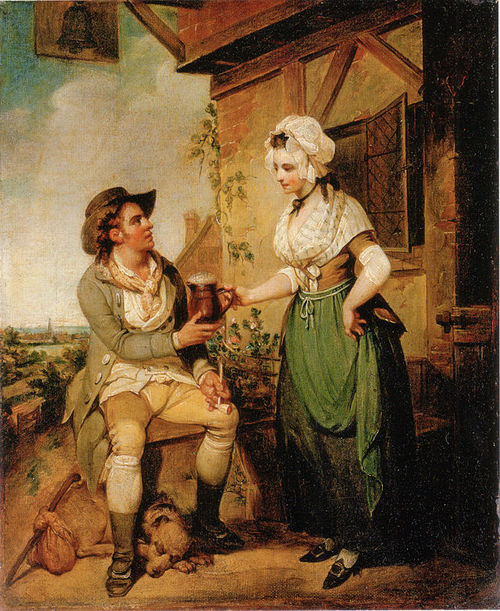
Henry Singleton, “The Ale-House Door”, c. 1790.

Indeed, Love here, while never exactly given a gender, may well be feminine in Herbert’s mind; while amor is mascuine in Latin, αγάπη in Greek is feminine. Love questions “sweetly”, and the guest addresses the host(ess) as “dear”. It is not explicit, but the impression is given of a woman who runs an inn, who welcomes the guest, and pays close attention to his needs. Her invitation to eat and be her guest is very ordinary – but also extraordinary, given that she is Love.

The guest in the poem feels unworthy. He is “guilty of dust and sin”, “unkind, ungrateful”, who has marred creation (his eyes), full of shame, and he cannot bear to look upon Love. Love counters by welcoming him, observing him, drawing closer, sweetly questioning about what he needs, takes him by the hand, smiles at him, and reminds him of truths that he already knows: that she created his eyes, as Creator, and bore the blame of his sins, as Christ. The guest says, “My dear, then I will serve” but it is Love who is the servant here, and bids the guest sit down and eat, and he does just that.

C.A. Patrides (quoted in Ann Pasternak Slater’s notes to The Complete English Works) thinks that
The poem celebrates not the sacrament in the visible Church but the final communion in heaven when God “shall gird himself and make them sit down to meat, and will come forth and serve them.” (Luke 12:37)
This is surely not correct, and John Drury agrees with me:
the Church’s great sacrament of eating and drinking, the Holy Communion, is powerfully present.  (Music at Midnight, p. 3)
As Drury notes, all time seems to be summed up in this short poem. In the second line the guest is like Adam, who was made from dust and was guilty of sin. Yes, the sitting down of the guest and eating is the banquet at the end of time referred to in Luke 12.37, but it is also the making present of Jesus in the memorial of the Lord’s Supper; they are effectively the same.
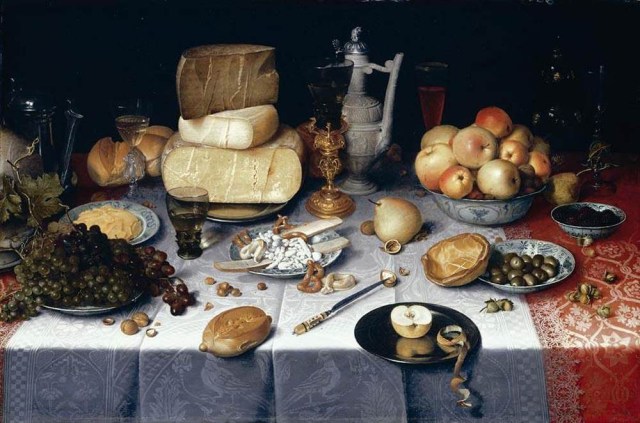
Floris_van_Dyck_-_Still-Life

Floris van Dyck (1575-1651)

The feast of God is not just the eschatological banquet or the Lord’s Supper. It is also the rich fare shown forth in the lives of God’s holy people. George Herbert’s poetry is one of the dishes at the table of the Lord, seemingly too rich and yet quite wonderful once one sits down to partake. For those who have been dipping in to my Lenten devotions based on Herbert’s poetry, I hope and pray that you have caught a glimpse of the divine.
Posted in Lent, Poetry and Novels | Tagged , , , , , | 3 Comments

Poor Death: George Herbert’s “Dialogue-Anthem” with Death

Through Lent With George Herbert
Good Friday

24056371.6fbbb49b.640

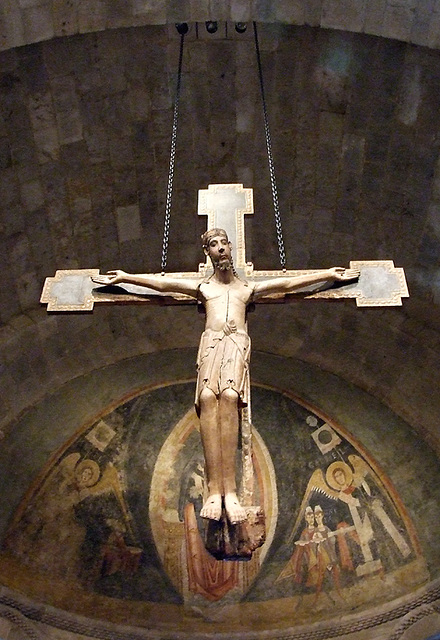
Christ on the Cross, made in Tirol or Salzburg (Austria), ca. 1125-1150, now in the the Fuentiduena Chapel in the Cloisters, Metropolitan Museum of Art, New York NY

Herbert wrote a poem with the title Good Friday, as well as one on The Cross, but the short poem I have chosen for today, although rarely commented on by scholars, will do just as well. Herbert imagines a faithful Christian in a dialogue with a personified Death.

A Dialogue-Anthem
Christian Death.

Chr.

Alas, poor Death !  where is thy glory? Where is thy famous force, thy ancient sting?

Dea.

Alas, poor mortal, void of story!
Go spell and read how I have killed thy King.

Chr.

Poor Death! and who was hurt thereby? Thy curse being laid on him makes thee accurst.

Dea.

Let losers talk, yet thou shalt die ;
These arms shall crush thee.

Chr.

                                              Spare not, do thy worst. I shall be one day better than before; Thou so much worse, that thou shalt be no more.

The scripture standing behind this is 1 Corinthians 15, that great passage by Paul in which he asserts the centrality of the Resurrection of Jesus and of all humanity to those in Corinth who think they get by without it:

51Listen, I will tell you a mystery! We will not all die, but we will all be changed, 52in a moment, in the twinkling of an eye, at the last trumpet. For the trumpet will sound, and the dead will be raised imperishable, and we will be changed. 53For this perishable body must put on imperishability, and this mortal body must put on immortality. 54When this perishable body puts on imperishability, and this mortal body puts on immortality, then the saying that is written will be fulfilled:
‘Death has been swallowed up in victory.’
55 ‘Where, O death, is your victory?
Where, O death, is your sting?’
56The sting of death is sin, and the power of sin is the law. 57But thanks be to God, who gives us the victory through our Lord Jesus Christ.

The Christian begins with a pun; according to Inge Leimberg, in 1630 the word “poor” would have been pronounced very similarly to “power”. Thus, Christian calls into question the power of Death by calling it poor, and questioning its glory, force, and sting. Death is none too bright in this poem. It accuses the mortal of having no story, and tells it to go read that very story in which Jesus is killed. Herbert has Death offer a pun in return, although unwittingly: “Go spell” is pronounced “Gospel”, or good news. Death is reduced to calling the Christian names and making threats, which create no fear on the part of the faithful. This rather pathetic personification of death is very much in line with the mocking of death that comes with the Day of the Dead in Latin America, where Death is seen less as a threat than something with which to have some fun. Until Hollywood got hold of All Hallow’s Eve and turned it into a horror show, Halloween was something like that, too.

ingmar_bergman_death_acourseindying

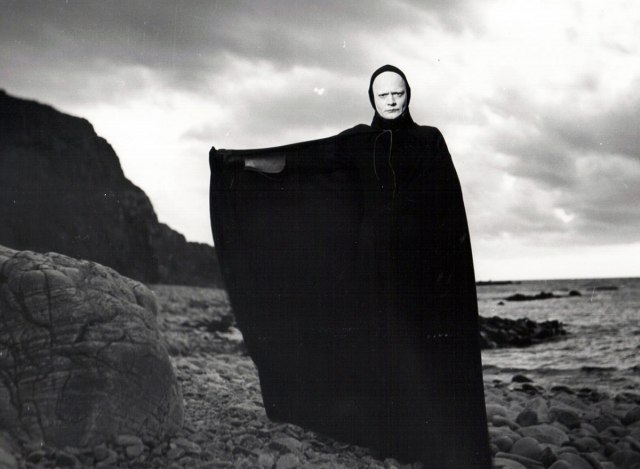
Bengt Ekerot as Death in Ingmar Bergman’s “The Seventh Seal” (1957).

On a day when we contemplate the death of Jesus, we are reminded that despite much suffering it is not the end. Although Jesus cries out, “My God, my God, why have you abandoned me?” the Father is not done with him, nor is the Holy Spirit. Following scripture and the Apostles’ Creed, we assert that he has descended to the dead, and that this was truly death, that the one person who is both fully divine and fully human has experienced that very human death and all that it means. But this person, this Word made flesh, is also the utterly transcendent and infinite, and when it encounters the very mundane and finite death, it overwhelms it. Death is undone, it is accursed, it loses its power, and while it still affects us, we look past it to the resurrection.

This is why this day is “Good Friday”. Sin is borne by the scapegoat of God, Jesus of Nazareth, a pure, unblemished sacrifice for all humanity. Sin and death no longer have the power to separate us from God. The Holy Spirit is unleashed in the resurrection of Jesus, and the same power which raises Jesus from the dead is at work in us.

There is another poem in which a believer speaks to death. There is a good chance that George Herbert may have known it, as it is by his mother’s friend John Donne (1572-1631), Dean of St. Paul’s, London. That said, although it was written in 1609, it was not published until 1633, when both Donne and Herbert were dead. It is still well known. It is one of Donne’s Holy Sonnet’s and expresses similar thoughts, and I leave you with it on this Good Friday 2019.

Death, be not proud, though some have called thee
Mighty and dreadful, for thou art not so;
For those whom thou think’st thou dost overthrow
Die not, poor Death, nor yet canst thou kill me.
From rest and sleep, which but thy pictures be,
Much pleasure; then from thee much more must flow,
And soonest our best men with thee do go,
Rest of their bones, and soul’s delivery.
Thou art slave to fate, chance, kings, and desperate men,
And dost with poison, war, and sickness dwell,
And poppy or charms can make us sleep as well
And better than thy stroke; why swell’st thou then?
One short sleep past, we wake eternally
And death shall be no more; Death, thou shalt die.
Posted in Lent, Poetry and Novels | Tagged , , , , , | 3 Comments

Thirty Years a Priest

Through Lent With George Herbert
Maundy Thursday

Priesting

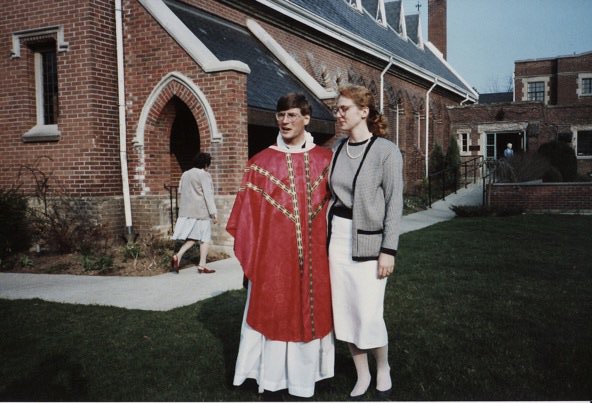
April 30, 1989, St. Jude’s, Oakville (a suburb of Toronto on Lake Ontario), just after I was ordained to the priesthood by the Most Reverend John Bothwell, Archbishop of Niagara & Metropolitan of Ontario. I was all of twenty-six years. The young woman on my left is Frances Bryant-Scott.

I have been a priest for almost thirty years now. When I was ordained there were a variety of models of how to be a priest, and there are more now. These models include the priest as:

  • counsellor;
  • teacher;
  • trainer;
  • church-building entrepreneur;
  • social worker;
  • scholar;
  • “Father”;
  • “Pastor”; “
  • Vicar” (a particular English variety);
  • youth leader;
  • liturgist;
  • administrator;
  • servant leader;
  • moralist;
  • team leader;
  • canon law legislator;
  • conflict manager;
  • reconciler;
  • preacher;
  • evangelist;
  • spiritual guide; and
  • “gentleman”.

Priests tend to be one or more of these but not all of them, but even being a few of them can lead to serious burnout. A few of these models are quite problematic, reinforcing patriarchy and hierarchy, and allowing foe abuse of trust. Thank God so many of the churches in the Anglican Communion (including the Church of England) now ordain women to the priesthood, thereby subverting the worst of these.

The very word “priest” is problematic. In English it is derived from the the Greek πρεσβύτερος (presbyteros) which means “elder”. In the New Testament it initially referred to the leaders of the synagogues, and it carried over to the leaders of the first Christian congregations. The presbyteroi, along with the ἐπίσκοπος epískopos, or “overseer”, and the διάκονοι (diákonι), the “servants“, were the leaders of the congregation. The different denominations argue about what these all correspond to, and to what extent they overlapped. By the fourth century, at least, there appeared to me a three-fold order of distinctive ministries, namely, the presbyterate, the bishops, and the deacons. While one could move from being a deacon to becoming a priest, it was not necessary, and it is clear that some deacons jumped straight into becoming bishops. Indeed, it appears that Ambrose of Milan was ordained directly to the episcopate shortly after being baptised. Anyway, πρεσβύτερος made its way into the Latin speaking west as “presbyter”, and then via old Germanic to Old English, by which time it had become prēost; this is now our modern English “priest”.

“Priest” translates another Greek word, ἱερεύς (ierefs in modern pronunciation), which referred not to elders in a congregation, but the people officiating at sacrifices in the pagan temples and at the Temple in Jerusalem.  Already by the 3rd century the sense of the presbyter also being an ierefs was emerging. Thus, since ancient times there has been this double role – elder of the congregation, but also the one who offers sacrifices. The Reformation reformulated this, so that the Presbyter was seen fundamentally as a preacher, and the one who presides at the memorial of Christ’s death, the one sacrifice once offered. Protestants and Catholics argued at great length over whether the Mass was a sacrifice in any sense, and in what way Christ’s presence was made real in the sacrament. Protestants tended to call their clergy “ministers of word and sacrament”, while Catholics vehemently called their clergy “priests” and asserted that their saying of mass was a sacrifice. Lutherans called them pastors, and Presbyterians used presbyter or minister. Anglicans struck a middle way, officially calling them “priests” in the Book of Common Prayer, but also ministers, and often calling them something else, like “Vicar” or “Parson”.

It is interesting, then, to find Herbert quite clearly identifying himself as a “priest”. In a few years, after his death, the priesthood was abolished by the Commonwealth, along with the monarchy, the episcopate, the Book of Common Prayer, and Christmas. Under the Commonwealth there were only ministers. Herbert missed all that because of his early death, which may have been a blessing. Here is his meditation on the subject:

The Priesthood.

Blest Order, which in power dost so excel,
That with th’ one hand thou liftest to the sky,
And with the other throwest down to hell
In thy just censures; fain would I draw nigh,
Fain put thee on, exchanging my lay-sword
For that of th’ holy Word.

But thou art fire, sacred and hallow’d fire;
And I but earth and clay: should I presume
To wear thy habit, the severe attire
My slender compositions might consume.
I am both foul and brittle; much unfit
To deal in holy Writ.

Yet have I often seen, by cunning hand
And force of fire, what curious things are made
Of wretched earth. Where once I scorn’d to stand,
That earth is fitted by the fire and trade
Of skilful artists, for the boards of those
Who make the bravest shows.

But since those great ones, be they ne’re so great,
Come from the earth, from whence those vessels come;
So that at once both feeder, dish, and meat
Have one beginning and one final sum:
I do not greatly wonder at the sight,
If earth in earth delight.

But th’ holy men of God such vessels are,
As serve him up, who all the world commands:
When God vouchsafeth to become our fare,
Their hands convey him, who conveys their hands.
O what pure things, most pure must those things be,
Who bring my God to me!

Wherefore I dare not, I, put forth my hand
To hold the Ark, although it seems to shake
Through th’ old sins and new doctrines of our land.
Only, since God doth often vessels make
Of lowly matter for high uses meet,
I throw me at his feet.

There will I lie, until my Maker seek
For some mean stuff thereon to show his skill:
Then is my time. The distance of the meek
Doth flatter power. Lest good come short of ill
In praising might, the poor do by submission
What pride by opposition.

It is a simple enough poem – seven stanzas of six lines each in ABABCC rhyme in 10.10.10.10.10.7 meter, more or less in iambs. Herbert describes the priesthood as:

  • blessed by God;
  • having the great power to lift people to heaven or drive them to hell;
  • dressed with a severe (i.e. plain) attire;
  • holy vessels of God;
  • servants of God;
  • holders of holy things (i.e. the consecrated body and blood of Christ in the Holy Communion); and
  • meek and submissive to God’s will.

In The Country Parson Herbert describes at far greater length a multitude of expectations of clergy. Herbert had a high ideal of ministry, and was undoubtedly grieved at how so many of his colleagues did not meet his minimal standards; for everything he encourages priests to do one can assume that there are those who do not do anything of the sort.

In the poem Herbert describes his own sense of unworthiness, that he is “foul and brittle”, “mean stuff”  and of the earth. However, alluding to both Isaiah and Jeremiah who use the image of a potter as a metaphor for God, he knows that earth can be made into marvelous earthenware, and so submits to being used by God for these holy purposes. There Ann Pasternak Slater suggests, there is probably an allusion here to Adam as well, the primordial human being who was created out of earth and breathed into life by God.

indiana_jones_and_the_raiders_of_the_lost_ark_belloq_toht_ark_opening_toys

The recovered Ark of the Covenant,from “Raiders of the Lost Ark”, just before it melts their faces. I don’t think this effect of the Ark on people is scriptural.

He refers to Holy Communion, comparing it to the Ark of the Covenant in which was found the presence of God. A box covered in gold, and containing the two tablets of the covenant that Moses gave at Sinai, it was dangerous to touch, and had to be carried about by poles. He makes a contemporary reference – usual for him – to the “old sins and new doctrines of our land” that are shaken by arguments about the Lord’s Supper. For Herbert Communion is not a mere memorial, but “our fare” and “feeder, dish, and meat”.

There is a sense of awe in the poem at what the priest is called to do in preaching, pastoring, and presiding at the Holy Eucharist. Herbert falls at the feet of God, and finds that whether one is meek and submissive, or proud and imitating the majesty of God, one acknowledges divine power.

Herbert does not have a well developed baptismal theology, and so he misses the connection between the ministry of all three ordained orders and that of the priesthood of all believers (but that’s what 400 years of theological reflection does). The ministry of clergy arises from the baptismal calling and the covenant made between God in Christ with God’s people. The clergy exist to empower all the baptised to be the body of Christ in the world, and they do so in different ways. A priest presides at the table of the Lord in virtue of what they do throughout the week – they are not ordained to preside, but they preside because of what they do. If anything, this heightens the responsibility of the clergy, as they are not only concerned with salvation, but the spiritual development and sanctification of the people.

I like being a priest. It has been an honour to serve many congregations and individuals over the years. People have expected much of me, and I have not always lived up to those hopes, but then, I look back and I see all kinds of things that have come to pass, partly because I was in a certain place and time. It is a glory to plumb the depths of the Bible with people and to help them pray, to be with them at important milestones such as births and marriages, and to be with some of them as they take their last breath. It is an immense privilege to be able to speak on a weekly basis to people and remind them things about God that they already know. In all of this I have grown, although it really is not about me. I look forward to what the next thirty years may bring me in this calling.


Posted in Lent, Poetry and Novels | Tagged , , | 1 Comment

Sing This At My Funeral

death-burial-and-the-afterlife-in-ancient-greece-essay-the

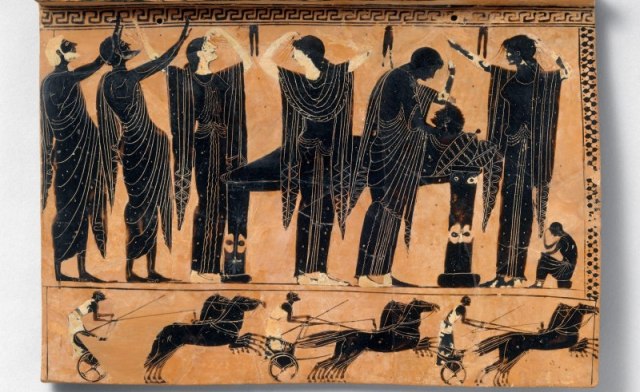
Ancient Greek professional mourners. We won’t need them at my funeral, because everyone will be genuinely wailing, right?

As a priest I encourage each of my parishioners to think about their own death, and to make plans accordingly. This includes what kind of service they want, what they want done with their burial, the music to be sung and who might preside and speak. I also encourage them to have wills, life insurance where appropriate, and these days, to have all their computer and application passwords written down and in one, secure place. It is a kindness to those who survive us to do such thinking.

When I was newly ordained I had two colleagues who were, unusually, both assistant curates at the the same parish. Few Canadian churches could afford one curate, let alone two, but this one did. As things played out, they fell in love, got married (and in due course, had a child). The rector was insistent that they each take their full vacation, but as he relied on them to cover for him when he was away, they could only take one week off together. One week, when the husband was on vacation, the wife in this scenario went looking for some material or book in her husband’s office at the church. While there she came across a brown manila envelope with, “In The Event of My Death” written on it. Being newly married and figuring people in love should have no secrets, and seeing that the envelope was not sealed, she opened it. Inside were six pages of single-spaced typed instructions on the funeral that her husband wanted, all in excruciating Anglo-Catholic detail. She told me about this at a Post-Ordination Training event that we were all at, and her husband was sitting beside her as she told me about this. “So, do you have your wills done, too?” I asked. “Umm, no . . . ”

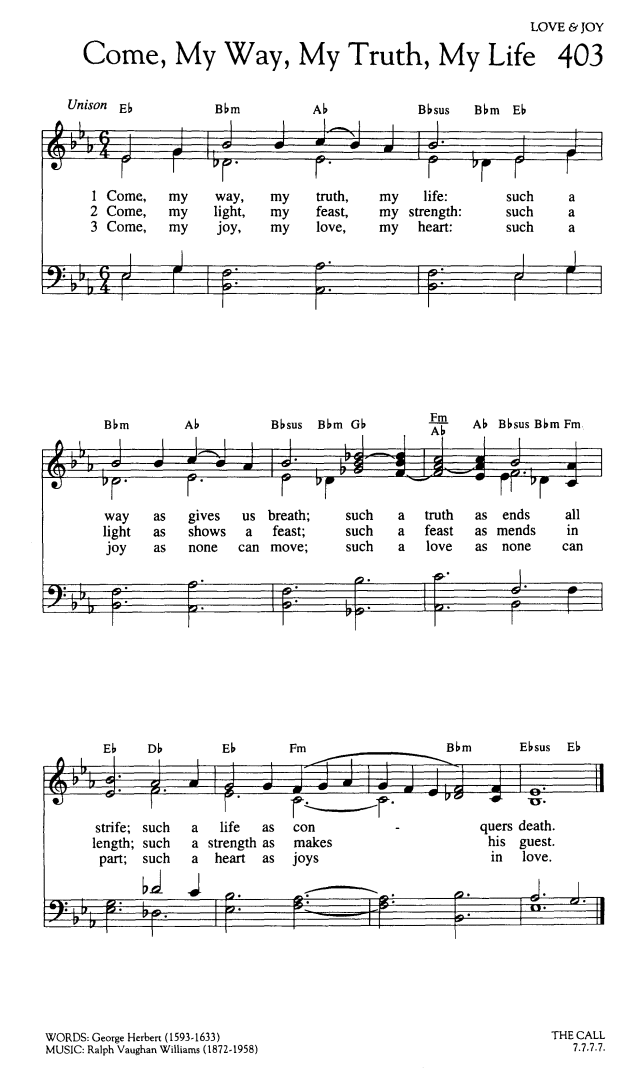
I have given some indications what I would like at my funeral. One of the things is that I would like this poem, set to music by Ralph Vaughn Williams, sung.

The Call

Come, my Way, my Truth, my Life:
Such a Way, as gives us breath:
Such a Truth, as ends all strife:
Such a Life, as killeth death.

Come, my Light, my Feast, my Strength:
Such a Light, as shows a feast:
Such a Feast, as mends in length:
Such a Strength, as makes his guest.

Come, my Joy, my Love, my Heart:
Such a Joy, as none can move:
Such a Love, as none can part:
Such a Heart, as joys in love.

Again, like yesterday’s poem, this is one of Herbert’s most popular poems that is sung, being found in 52 hymnals according to the excellent website hymnary.org. The inspiration is from the Gospel according to John, where Jesus says:

  • I am the way, and the truth, and the life. (14.6);
  • I am the light of the world. (8.12);
  • I am the bread of life. Whoever comes to me will never be hungry, and whoever believes in me will never be thirsty; and
  • I have said these things to you so that my joy may be in you, and that your joy may be complete. (15.11);

as well as the First Letter of John, where it is said,

  • God is love, and those who abide in love abide in God, and God abides in them. (4.16)

Herbert plays with paradox in this poem, for Jesus is the way – the walk – in which one is not winded, but gains breath, He is the life that destroys death, when the infinite encounters the absolute limitation of the dead. He presents Jesus as the ideal – a truth that ends all dissension, a joy that no one can take away, a love from which no one can separate us, echoing Paul  his Letter to the Romans:

For I am convinced that neither death, nor life, nor angels, nor rulers, nor things present, nor things to come, nor powers, nor height, nor depth, nor anything else in all creation, will be able to separate us from the love of God in Christ Jesus our Lord. (8.38-39)

This poem is remarkable for a number of reasons. First, every word except “killeth” in line four is but one syllable long. This is simplicity! Second, the wealth of images in such a short space, where three are enunciated in the first line of each stanza and then each developed in compact line. In the second and third stanzas the images are related. In the second stanza the light discloses the feast, and the strength is given to the guest of the feast. In the final stanza the final line weaves joy, love, and heart into “a Heart, as joys in love.” Third, as Arnold Stein points out, the structure of the poem creates an internal rhyme between the third line and the fourth of each stanza: strife:Life, length:Strength, and part:Heart. Indeed, words are echoed all over the place, binding it together tightly. fourth, the inital line’s “Come” followed by three “Such”s creates a rhthymic expectation. Finally, the use of catalectic trochaic tetrameter propels the reader along to a conclusion seemingly a little faster than iambic pentameter might have.

0451=445

In his setting of the poem Vaughn Williams puts a half note (or two quarter notes) on the stress in each foot, ending each line with a dotted half note. This gives it a graceful waltzing feeling.  It ends with the third to last syllable in the last line of each stanza over eight quarter notes, suggesting some sort of drawing out or hesitation, and echoing plainsong, as if this dance is older than one might imagine.

Jesus is no where mentioned, nor is God. Herbert does not feel the need to name the deity, allowing the imagination to play with the relationship with God. Thus he is not restricted to using anthropomorphic images, but sees Jesus as a road, or a feast, and so forth. This is not allegory, then, but something more allusive and less rigid.

A title like “The Call” suggests that it might be about vocation – but it is not God calling us to follow Jesus, but the poet calling to God in Christ. Herbert affirms that human beings have a natural desire for God. Augustine of Hippo wrote in the first chapter of his Confessions, some twelve centuries before Herbert, “You have made us for yourself, and our hearts are restless until they rest in you. [cor nostrum inquietum est donec requiescat in Te]. Herbert undoubtedly had read Augustine, in the original Latin, and would have agreed with this passage.

I believe we sang this at my ordination. Along with Vaughn Williams’ setting of “O God, Our Help in Ages Past” and “A Spendthrift Lover is Our God” you can sing this at my funeral, please.


Posted in Lent, Poetry and Novels | Tagged , , | 3 Comments

The Unbridgeable Gap at the End of All Praise

Through Lent With George Herbert
Tuesday In Holy Week

bahia-honda-state-park-pont-brise

An old railroad bridge in Bahia Honda State Park, in the Florida Keys.

Today’s poem is one of George Herbert’s most popular, appearing in over thirty hymnals. In my not-so-humble opinion, it should be sung to the tune by J.D. Jones named Gwalchmai, which is named either after a village in Anglesey, a 12th century court poet in Gwynedd, Wales, or the Welsh version of the legendary knight known in English as Gawain (there is also a football team in Wales with that name, but the tune was written long before it came into existence). Gwalchmai‘s  meter is 7676D, which simply means it is 7676 doubled. As there are seven 7676 stanzas in the poem, this means there is one too many (or one too few). The hymnals solve this by dropping the sixth stanza, thus making three 7676D. Here’s the full poem:

Praise (2)

KIng of Glory, King of Peace,
I will love thee:
And that love may never cease,
I will move thee.

Thou hast granted my request,
Thou hast heard me:
Thou didst note my working breast,
Thou hast spar’d me.

Wherefore with my utmost art
I will sing thee,
And the cream of all my heart
I will bring thee.

Though my sins against me cried,
Thou didst clear me;
And alone, when they replied,
Thou didst hear me.

Sev’n whole days, not one in seven,
I will praise thee.
In my heart, though not in heaven,
I can raise thee.

Thou grew’st soft and moist with tears,
Thou relentedst:
And when Justice call’d for fears,
Thou disentedst.

Small it is, in this poor sort
To enrol thee:
Ev’n eternity is to short
To extol thee.

The poem is more complex than it might appear at first glance, with it’s simple rhymes, many just being “thee” rhyming with “thee”. Arnold Stein, in George Herbert’s Lyrics notes a tension between the inadequacy of the love that the poet promises to offer and the love already received from God. The poet seeks to love God for all time, and to praise with the very best he has, the cream of the milk. But this praise only goes so far – his own heart – and not into heaven, and the praise is ultimately small, poor, and short lived. The principle of Justice should be creating fear, because the poet is aware of his shortcomings and deserved punishment – but God in Christ disagrees, and grants salvation instead. Thus, between the eternal love of God and the temporal love of the human there is a yawning gap, and even Herbert’s obsessive artistry cannot bridge it. Ironically, grief and suffering may lead to hope, as in Pilgrimage yesterday, but praise is not like that, as Stein points out; it only illuminates one’s limitations and God’s mercy.

There is a trend in many churches to begin worship services with fifteen minutes of what are commonly called “praise choruses“. These are usually led by charismatic singers with a band behind them, emulating pop music, only instead of love for a girl or a boy it is directed to God, and especially God as Jesus. The lyrics are often projected onto a large screen so that people can sing along without the need for hymn books, although the band and amplified singer can sometimes drown out the congregation. The lyrics are simple, the music can be repetitive, and it often builds up to a climax setting the scene for a preacher to give a message. I cannot deny the power of it all.  It is very accessible, largely because it is simple, very positive, and tends to use the language of “you” and “I” instead “God” and “the church” and so emphasises relations rather than doctrine. This is not dissimilar to what Herbert does in this poem.

That said, modern praise music can be profoundly individualistic, it can seem to be disconnected with the world outside the doors of the church, and it has a limited range of scriptural texts and themes – not much about lament, the subversiveness of the gospel, or the transformation of the world in Christ. It is disconnected from the the traditions of the church. It does not offer much for the seasons of the church. I do not mind some of it, but I could not deal with a steady diet of it – I need music from the best in English hymnody,  as well as music from Europe, the African-American traditions, modern hymns plumbing the depths of sacred scripture, and simple songs from Taizé and Iona.

The interest in Herbert is not so much theological, as it is spiritual and artistic. It transcends the failing of much of contemporary praise music in that it has a multitude of styles and moods, and there is more going on than what one sees at first glance. Herbert struggles to be “plain” and accessible, so that the simplest of his parishioners at Bemerton might gain something, but he cannot stop from using his skills. Quite correctly, he brings his best to God, and while it may never be enough to bridge the gap for God, it is a blessing for the rest of us.

Posted in Lent, Poetry and Novels | Tagged , , , | 2 Comments

George Herbert’s Restless “Pilgrimage”

Through Lent With George Herbert
Monday In Holy Week

Walking in a Winter Wonderland

Me, heading north on Highway 20 between Discovery Bay and Port Townsend on the morning of the third day of my pilgrimage in December 2016.

Pilgrimages are all the rage these days. I know many people who have walked the Camino de Santiago; Emilio Estevez even made a movie about it, starring his father, Martin Sheen, called The Way. I recently discovered that there is a path in Italy inspired by the life of St. Francis, called the Cammino di Francesco. In both of these paths the point is less the destination, no matter how spiritual and holy the end points might be, but the journey. People take a break from their regular lives, walk long distances, meet fellow pilgrims, and attempt to deepen their own spirituality. Sometimes people do not even know why they are walking, just that they needed to do something like it. I did something similar back in December 2016 I walked over eleven days from Victoria BC to Seattle WA (two of the days were rest days). I stayed in cheap motels and Air BnBs, and walked between ten and twenty-two miles a day (fourteen to thirty-five km). There was no great spiritual epiphany for me, and the International Hostel in old Seattle is not exactly a place known for being a “thin place“, but it was a good time for me to simply my life, if only briefly, and focus on spiritual practices. I called it the Camino del Mar Salish, the Way of the Salish Sea.

In other situations it really is about the destination. Muslim pilgrims fly to Mecca, when in previous centuries they would have walked or taken ships. I remember travelling from Kolkota in India to Yangon in Myanmar, and apart from the Bishop and myself most of the plane was filled with Buddhist monks from Myanmar; being a monk obviously doesn’t mean that one cannot use a jet. Then there is the trip I will take later this year. My wife and I will be going on a pilgrimage in June to Ireland, led by people from The Sacred Art of Living Center in Bend, Oregon. We won’t be walking there, but flying, and we’ll be staying in a hotel, not a hostel, and travelling from holy spot to sacred place in a bus.

In today’s poem Herbert compares the journey of life to a pilgrimage, and were he not writing fifty years before it was published you would think that Herbert had been influenced by John Bunyan’s Pilgrim’s Progress (published 1678).

The Pilgrimage

I travell’d on, seeing the hill, where lay
My expectation.
A long it was and weary way.
The gloomy cave of Desperation
I left on th’ one, and on the other side
The rock of Pride.

And so I came to fancy’s meadow strow’d
With many a flower:
Fain would I here have made abode,
But I was quicken’d by my hour.
So to care’s copse I came, and there got through
With much ado.

That led me to the wild of Passion, which
Some call the wold;
A wasted place, but sometimes rich.
Here I was robb’d of all my gold,
Save one good Angel, which a friend had ti’d
Close to my side.

At length I got unto the gladsome hill,
Where lay my hope,
Where lay my heart; and climbing still,
When I had gain’d the brow and top,
A lake of brackish waters on the ground
Was all I found.

With that abash’d and struck with many a sting
Of swarming fears,
I fell, and cry’d, Alas my King!
Can both the way and end be tears?
Yet taking heart I rose, and then perceiv’d
I was deceiv’d:

My hill was further: so I flung away,
Yet heard a crie
Just as I went, None goes that way
And lives: If that be all, said I,
After so foul a journey death is fair,
And but a chair.

The journey is not pleasant. An anonymous commentator at the website for Bemerton Church suggests that Herbert’s poetry sometimes seem to “remind us of the First World War poets in their bleak view of life.” The eminent divine John Drury in his celebrated 2013 biography/commentary on Herbert, Music at Midnight, puts it in the context of  “dissatisfactions”. Outwardly, Herbert appeared happy in his new life at Bemerton, with his new wife, two orphaned nieces, a few servants, and refurbishment taking place at St. Andrew’s and at another living, Leighton Bromswold. However, he was far from his friend Nicholas Ferrar at Little Gidding, (who later published The Temple), and Drury suggests that Herbert wanted to move closer to him.

This poem, as Drury points out, is hardly that of a placid and content man. The stations on the way to one’s expectations are:

  • the gloomy cave of Desperation;
  • the rock of pride;
  • fancy meadows;
  • care’s copse;
  • the wild of Passion – a wild place of robbery; and
  • a brackish water with swarming fears.

The actual destination is not where he thought it was – what he initially saw was a complete disappointment when he got there – and so it is all just a way of tears, both “the way and end”. The ultimate destination is reached only through death, which is fair after so horrible a journey, and the first opportunity to rest, in “a chair”.

Yeah, that’s pretty bleak. Herbert was restless and ambitious, and although he had turned to the life of an ordained priest from that of the university, politics, and the royal court, he remained who he was. He was not totally purged of ambition and desire. As well, he knew he was a sick man with a chronic disease that could end his life early – which it did, in the end. Someone so conscious of the shortness of life could express some bitterness about it, seeing it as a climb filled with bitterness and deception.

This is not the same as the modern pilgrimages I talked about above, or pilgrimages in the past. That said, actual pilgrimages may be motivated by that same kind of bitterness and uncovered deception, and thwarted desires and ambitions. Some folks might call this a “midlife crisis”, although it can come at any time from adolescence to old age. The challenge is to navigate one’s life so that one finds out what is most important. For many Christians this is the hope of new life which may be found in beliefs in heaven and the resurrection. For some, this is not enough – they need to see the power of heaven and the resurrection in this life – in manifestations of the Holy Spirit, in charismatic gifts, perhaps, For others the need to see the gospel applied to problems of social justice, in what is sometimes called the social gospel.

George Herbert was neither a charismatic nor a social justice warrior. His achievements in the community were

  • constructive – he repaired churches,
  • poetic – The Temple, and his Latin poetry, and
  • pastoral – his book The Country Parson was a guide to generations of Anglican clergy.

I am not convinced that all clergy can be what Herbert prescribed, as I wrote in one of my earliest posts on this blog. However, if I approach him as an exceptionally gifted colleague from the 17th people then I can benefit from what he says. I may not find life to be quite so bleak as he portrays it, but then, I live four hundred years after him and did not die at the age of thirty-nine; I recognise that for many life is quite bleak, and that in the midst of it, people still have hope. Pilgrimage ends with that hope.

Posted in Lent, Poetry and Novels | Tagged , | 3 Comments

Different Processions: A Sermon for Palm Sunday 2019

A sermon preached on The Sunday of the Passion (also known as Palm Sunday) at The Anglican Church of St. Thomas the Apostle, Kefalas, Crete on April 14, 2019, at 11:00 am.

The readings for the day may be found here.

x-entry-into-jerusalem 2

Why Does This Day Have Two Names and Two Themes?
Today’s worship is a merger of two traditions. The ancient tradition of Rome was to commemorate the Passion on the Sunday before Easter. As the Church of England is part of the western Church which inherited the traditions of Rome, we continue in this practice. But pilgrims from the Latin speaking West going to the Holy Land, as early as the 4th century, observed another tradition. In Jerusalem they re-enacted the last week of Jesus, celebrating entry of Jesus into Jerusalem on the Sunday before Easter, and remembering his institution of Holy Communion on the night before he was betrayed, and walking the way of the cross on Good Friday and reading the Passion of St John on that day. Gradually, this other practice was also observed in the western church, alongside the older tradition. And so we have Palm Sunday, which is also the Sunday of the Passion.

Something You May Have Missed
As you listened to the gospel of Palm Sunday which we read outside, you may not have been aware of it as a parody. For there was another entry into Jerusalem taking place at that time.

This procession originated on the ocean, in the city of Caeserea Meritima, the capial of Judea built by Herod the Great, and after his death, used by Roman governors. Herod and his successors had been replaced by the procurator Pontius Pilate, who normally resided in the good Roman surroundings of Caeserea Meritima, but was obliged to climb up into the hill country of the province of Judea to Jerusalem.

Caesarea Maritima

Caesarea Maritima. A very Roman city in Judea, with temples to various gods, including the deified Augustus, who was emperor when Jesus was born.

Imagine, if you will, the progress of the Procurator. As a soldier he rode a horse. He would have been followed by the government apparatus – clerks, military staff, advisors, assistants, trusted servants, slaves, and their families and clients. Hundreds of people, in other words, with much baggage. They would walk or ride along the main roads built by the Romans themselves, climbing upwards through the fields and forests, fearing nothing. As they walked through towns and villages, as the occupying force went by, parents would pull their children off the street. Then they would see Jerusalem in the distance, and as they approached they would be met at the gate by the leaders of the Temple and the city. The company of Romans, signifying the power of the Empire and the Emperor himself, would then process up to Herod’s old palace, right by the Temple itself.

Now, contrast that with the same entry by Jesus. Nobody would have feared him and his disciples as they walked towards the city from Galilee. In all probability they made their way along the Jordan valley, descending and then turning west to climb up to the city. Where Pilate was a military man seated on a horse, Jesus, we are told, rode on a donkey. He had no bodyguard, no armour, just the usual peasant robes. Where Pilate, as a Gentile would have avoided the Temple, Jesus went into it and by overturning the tables and driving out the money changers, claimed it as his own. Where Jesus was acclaimed by the people, Pilate received the sullen welcome due a conquering power. Whereas Pilate represented the son of the deified Caesar, Jesus was the son of David, the son of God. Whatever claim Caesar and the power of the Empire had, Jesus had a greater one. Thus, Jesus’s entry was a parody, subversive of Pilate and all that he represented.

The Model of Discipleship
Of course, the greatest difference is to be seen in their contrasting approaches to power. Jesus says in the Passion just read:

The kings of the Gentiles lord it over them;
and those in authority over them are called benefactors.
But not so with you;
rather the greatest among you must become
like the youngest,
and the leader
like one who serves.
For who is greater,
the one who is at the table
or the one who serves?
Is it not the one at the table?
But I am among you as one who serves.

The one who is truly great in the Kingdom of God is the one who serves. This paradoxical power of Jesus is seen in his being poured out for many. Paul writes in Philippians 2:

Let the same mind be in you that was in Christ Jesus,
who, though he was in the form of God,
did not regard equality with God
as something to be exploited,
but emptied himself,
taking the form of a slave
being born in human likeness.
And being found in human form,
    he humbled himself and became obedient to the point of death—
even death on a cross.

This is the same Jesus who as they take him to the cross says,

                  “Father, forgive them; for they do not know what they are doing.”

On the cross a thief recognizes Jesus as an innocent victim, a sacrifice, the suffering servant who is also the Messiah: “”Jesus, remember me when you come into your kingdom.” Jesus replies, “Truly I tell you, today you will be with me in Paradise.”

The same Jesus who was greeted by lowly shepherds at his birth, associated with fishermen, people possessed by demons, Samaritans, sex workers, the occasional Gentile, tax collectors, radical zealots, now grants mercy to a thief. In contrast, Pilate gives in to the lobbying of his collaborators among the chief priests and the scribes, and upgrades the punishment of the Nazarene from flogging to crucifixion.

Jesus comes, voluntarily, to serve and to die for us. This is the theme of the servant songs in Isaiah, and of which we heard part of the third today:

I gave my back to those who struck me,
and my cheeks to those who pulled out the beard;
I did not hide my face
from insult and spitting.
The Lord God helps me;
therefore I have not been disgraced;
therefore I have set my face like flint,
and I know that I shall not be put to shame;
he who vindicates me is near.

Jesus is obedient, and for the sake of God and humanity he is willing to undergo abuse and death, and he does not condemn his murderers, but intercedes for them. We kneel at the cross in awe, and we rise to be Christ in the world.

Where are you in this Passion?
Where are you in this Passion Play according to Luke?

  • Are you at supper with him, taking in his teachings about power and service?
  • Are you falling asleep in the garden?
  • Have you betrayed him, as Judas did?
  • Have you denied him, as Simon Peter did?
  • Are you accused him, as the chief priests and scribes did?
  • Have you condemned him, like Pontius Pilate?
  • Have you mocked him, as the soldiers and the mob did, and even as one crucified with him did?

Or

  • Have you suffered with Christ, carrying a burden you did not ask for, as Simon of Cyrene did?
  • Have you stood and watched from afar, as we are told the women from Galilee did, and wept?
  • Have you seen the injustice, even as the centurion did?
  • Have you believed in secret, as Joseph of Arimathea did?
  • Have you believed even in thee midst of shame and suffering, as the other thief did, saying, “Jesus, remember me, when you come into your kingdom”?
  • Have you died with Christ on the cross?

Let the same mind be in us that was in Christ Jesus, so that as we die with him, we may rise with him in glory. Amen.

Posted in Lent, Sermons | Tagged , | 1 Comment

The Subject of Divinity

Through Lent With George Herbert
Saturday After The Fifth Sunday Of Lent

17f732e34720218b2c91c6e182cc663e

I am getting ready to submit my PhD dissertation to the School of Advanced Study of the University of London. It is a 110,000 word monster I have been working on for the past six years, and combines history, theology, biblical studies and philosophy, on the topic of Unsettling Theology: The Theological Legacy of the Indian Residential Schools of Canada. 1880-1970. As I come to the close of this stage of the project I am reminded of the joke that when one gets a bachelors degree one realizes how little one actually knows about a particular field, namely, one’s major; when one finishes a master’s degree one realizes the same with respect to a subfield within a discipline; and when one gets a PhD one realizes how ignorant one is about a very small area of research. There is always more to learn, it seems, and yet, in theory, the quest for knowledge is to simplify things.

George Herbert was an exceedingly learned man, and had a gift with poetry in both Latin and English, but he never felt that there was anything so simple as the teachings of Jesus which could be conveyed to the least educated of persons. Theologians, however, were very good at complicating things, it seems, creating schisms, divisions, and even leading to violence. Today’s poem, “Divinity”, is about that.

Divinity

As men, for fear the stars should sleep and nod,
And trip at night, have spheres supplied;
As if a star were duller than a clod,
Which knows his way without a guide:

Just so the other heav’n they also serve,
Divinity’s transcendent sky:
Which with the edge of wit they cut and carve.
Reason triumphs, and faith lies by.

Could not that wisdom, which first broached the wine,
Have thickened it with definitions?
And jagged his seamless coat, had that been fine,
With curious questions and divisions?

But all the doctrine, which he taught and gave,
Was clear as heav’n, from whence it came.
At least those beams of truth, which only save,
Surpass in brightness any flame.

Love God, and love your neighbour. Watch and pray.
Do as ye would be done unto.
O dark instructions; ev’n as dark as day!
Who can these Gordian knots undo?

But he doth bid us take his blood for wine.
Bid what he please; yet I am sure,
To take and taste what he doth there design,
Is all that saves, and not obscure.

Then burn thy Epicycles, foolish man;
Break all thy spheres, and save thy head.
Faith needs no staff of flesh, but stoutly can
To heav’n alone both go, and lead.

He compares the field of divinity (i.e. theology) with that of astronomy. In the time of Herbert the old Ptolemaic understanding of the solar system and stars, with the earth at the centre of everything, still held sway. This is indicated by his reference in line 25 in the last stanza to “epicycles” which were modifications introduced to account for the strange movement of the planets, which usually went in one direction, but would then appear to go backwards (which was actually apparent motion, caused by looking at the other planets on an Earth orbiting the Sun). Copernicus was known among astronomers in Britain, but it was not until Galileo’s controversies with the Catholic Church became well known after his second trial in 1633 that the English and Scots began to talk and write about it. Ultimately, observations and Newtons physics ensured the triumph of the heliocentric model.

To keep track of the motions of the planets and the stars the astronomers built models, and they could become very complex. Herbert mocks these models and their makers, and compares them to those “men” who depend on reason and not faith to understand heaven.  He finds that a simple faith is sufficient to understand the ways of heaven, which are the ways of God, and that all that is required is clear:

Love God, and love your neighbour. Watch and pray.
Do as ye would be done unto.

Herbert sarcastically calls these “dark instructions; ev’n as as dark as day” and a “Gordian knot” which cannot be undone (but which is undone with a sword, as the story goes). Jesus bids us drink the wine of the communion table as his blood, and Herbert thinks little of the theologians who dispute over the process and metaphysics involved in such a transformation. Echoing a rhyme attributed to Elizabeth I (but probably not actually written by her) he thinks:

Twas God the Word that spake it,
He took the Bread and brake it:
And what that Word did make it,
That I believe and take it.

Herbert was never part of the guild of theologians, although he obviously was well skilled in theology, as demonstrated in his poetry. Methinks he doth protesteth too much, but perhaps this simply shows the weariness he had when confronted with theological difference of opinion. Had he not died in 1633 and lived a dozen more years he might have had a different opinion. The view expressed in the quatrain supposedly written by the late Queen became unacceptable under the Commonwealth. Even the idea that a person could “work out their salvation in fear and trembling” by loving God and their neighbour would become heresy to the strict Predestinarian Calvinists, for whom faith and good works were only signs of God’s favour, having nothing to do with salvation as such.

As someone about to get his fourth university degree (God and oral examiners willing) I obviously do appreciate learning. And yet, to paraphrase another movement, Christianity is a simple faith for complex people. We do theology, but we run up into a wall of mystery, where words fail and our ignorance is learned but still unknowing. By the grace of God we know God, primarily in Jesus, but also in our own limits,in creation, in wonder, and the sense of responsibility to an other person. And so, on this Eve of Palm Sunday, may we say, “Blessed is the one who comes in the name of YHWH. Hosanna in the highest!”


Posted in Lent, Poetry and Novels | Tagged , , , | 2 Comments