Weird Names

Day Eight of “Through Advent with Isaiah”

Edward_Hicks_-_Peaceable_Kingdom

Edward Hicks, (USA), “The Peaceable Kingdom”, 1826. Hicks was a Quaker artist who made at least 62 paintings of the Peaceable Kingdom. This one shows settlers signing a treaty with indigenous peoples.

Isaiah gives his children some strange names.

  • At some point Isaiah and his wife had a child, and named him Shear-jashub. This means “a remnant will return”. This is usually taken to be a prophetic sign, to wit, that from the exiles of Israel only a small portion would come back. This might be applied to the people of the northern Kingdom of Israel, but also to the future exiles of Judah.
  • If the woman in 7:14 is the wife of the prophet then he gave his second child another odd name, Immanuel, meaning, “God with us”. This was a sign that God was with the city of Jerusalem and and the people of Judah (and perhaps even Ahaz). The name does not seem weird to us, but that is only because Jews and Christians have been inspired to name our children that in various forms, for example, Emmanuel Tov (a prominent Israeli Hebrew and Greek scholar), Immanuel Kant, and Manuel II, the last King of Portugal.
  • In Chapter 8 we read:

1 Then the Lord said to me, Take a large tablet and write on it in common characters, ‘Belonging to Maher-shalal-hash-baz’, 2and have it attested for me by reliable witnesses, the priest Uriah and Zechariah son of Jeberechiah. 3And I went to the prophetess, and she conceived and bore a son. Then the Lord said to me, Name him Maher-shalal-hash-baz; 4for before the child knows how to call ‘My father’ or ‘My mother’, the wealth of Damascus and the spoil of Samaria will be carried away by the king of Assyria.    – Isaiah 8.1-4

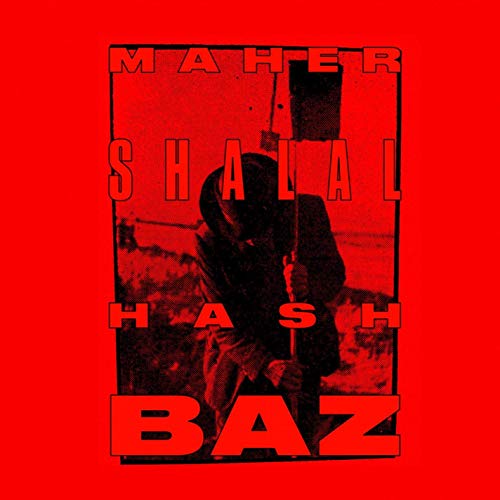
Maher-shalal-hash-baz means “the spoil speeds, the prey hastens”, which is pretty odd, and like Shear-jashub, never became the popular name that Immanuel did. That said, there is a very odd Japanese band with that name.

71SPWQDjoiL._SS500_

Now, most Hebrew names mean something.

  • יְשַׁעְיָהוּ Yesha’yahu is the Hebrew form of Isaiah, and means “Yah is my salvation” (Yah is the short form of the divine name “Yahweh”).
  • עֻזִּיָּהוּ ‘Uzzîyāhū, “Uzziah“, means “Yah is my strength”.
  • יוֹתָם Yotam, or “Jotham, means “Yah is honest/complete/perfect”.
  • יְהוֹאָחָז, Yehoaḥaz, or “Jehoahaz” is “Yah has held”; אָחָז Ahaz is the short form. Was something signified by the dropping of “Yah”?
  • חִזְקִיָּהוּ, Chizqiyahu (Ch as is “Loch”), is Hezekiah, and means “My God has strengthened”.

You can see that the use of “Yah” as part of people’s names was very common, and expressed hopeful or pious thoughts. .

What is different with Isaiah is that the names were not exactly hopeful. One hopes that his children went by something else as time went on.

Peaceable_Kingdom_of_the_Branch_Edward_Hicks

Edward Hicks, (USA) “Peaceable Kingdom of the Branch” 1826=1830. Reynolda House Museum of American Art, Winston-Salem, North Carolina. The pictures shows a stump produce a branch out of the root of Jesse in the redeemed kingdom.

The first reading of the Revised Common Lectionary this morning has another strange name:  שֹׁ֣רֶשׁ יִשַׁ֗י shareth yisai “Root of Jesse”. Jesse is the father of David, so we are talking about someone of the House of David, and in this case it is the ideal king: 

1 A shoot shall come out from the stock of Jesse,
and a branch shall grow out of his roots.
2 The spirit of the Lord shall rest on him,
the spirit of wisdom and understanding,
the spirit of counsel and might,
the spirit of knowledge and the fear of the Lord.
3 His delight shall be in the fear of the Lord.

He shall not judge by what his eyes see,
or decide by what his ears hear;
4 but with righteousness he shall judge the poor,
and decide with equity for the meek of the earth;
he shall strike the earth with the rod of his mouth,
and with the breath of his lips he shall kill the wicked.
5 Righteousness shall be the belt around his waist,
and faithfulness the belt around his loins.

6 The wolf shall live with the lamb,
the leopard shall lie down with the kid,
the calf and the lion and the fatling together,
and a little child shall lead them.
7 The cow and the bear shall graze,
their young shall lie down together;
and the lion shall eat straw like the ox.
8 The nursing child shall play over the hole of the asp,
and the weaned child shall put its hand on the adder’s den.
9 They will not hurt or destroy
on all my holy mountain;
for the earth will be full of the knowledge of the Lord
as the waters cover the sea.

10 On that day the root of Jesse shall stand as a signal to the peoples; the nations shall inquire of him, and his dwelling shall be glorious.        – Isaiah 11.1-10

This king is a greater king than Uzziah, Jotham, Ahaz, or Hezekiah. It is a king that is part of the restoration of Judah and Israel. He will not be corrupt as former kings were, or weak or fearful, but will destroy the wicked. Peace will follow, and even the animals will be at peace, and children will play with formerly dangerous critters. “The nations shall inquire of him”, meaning that his kingdom will be one respected and attended to by the world.

If this goes back to the prophet himself this indicates that he was the originator of messianic expectation. The actual Isaiah dealt with the kings he was given, but that did not mean that he was satisfied with them or was an uncritical supporter. Along with his condemnation of leaders, peoples, and nations, he provides a hope for an anointed one who will rule with righteousness, defending the poor and the meek of the earth. The king will be blessed with the Spirit of God so that he has “wisdom and understanding, counsel and might, the knowledge and the fear of the Lord.”

As Christians we see this in the person of Jesus of Nazareth. As we will see, II Isaiah sees this in Cyrus of Persia, and in the whole people of Israel.


Posted in Advent, Isaiah | Tagged , , , , , , , , , | Leave a comment

Isaiah and His Kings (II)

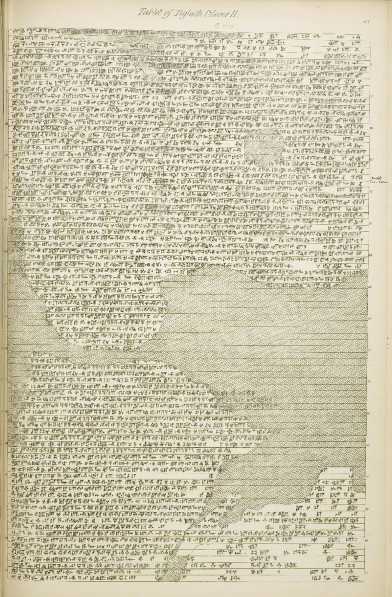
Yesterday I said that I would move on to talk about King Hezekiah, but I forgot that there is an important episode involving Isaiah with King Ahaz, Hezekiah’s father. As mentioned yesterday, Ahaz was challenged by Israel and Damascus, and turned to Assyria for help, and paid tribute to its king. This is verified by an ancient cuneiform tablet dug up in Nimrod in 1873 CE, where Ahaz’s longer name Jehoahaz is used.

Nimrud_Tablet_K_3751

Nimrud Tablet K 3751, from Henry Rawlinson, “The Cuneiform Inscriptions of Western Asia, Bd. III: A Selection from the Miscellaneous Inscriptions of Assyria, 1861 / 1866”.

This tablet was written in the seventeenth year of Tiglath-Pileser III (745 to 727 BCE), and part of it reads: “In all of the (foreign) lands that … [… I received the paymen]t of . . . Mi]tinti of the land Ashkelon, Jehoahaz of the land Judah, Qauš-malaka of the land Edom, Muṣ…[… of …, … of …, (and) Ḫa]nūnu of the city Gaza: gold, silver, tin, iron, lead, multi-colored garments, linen garments, the garments of their lands, red-purple wool, […, all kinds of] costly articles, produce of the sea (and) dry land, commodities of their lands, royal treasures, horses (and) mules broken to the yo[ke, …].”

The event described in Isaiah 7 does not show up in 2 Kings or 2 Chronicles:

1 In the days of Ahaz son of Jotham son of Uzziah, king of Judah, King Rezin of Aram and King Pekah son of Remaliah of Israel went up to attack Jerusalem, but could not mount an attack against it. 2When the house of David heard that Aram had allied itself with Ephraim, the heart of Ahaz and the heart of his people shook as the trees of the forest shake before the wind.

Then the Lord said to Isaiah, Go out to meet Ahaz, you and your son Shear-jashub, at the end of the conduit of the upper pool on the highway to the Fuller’s Field, 4and say to him, Take heed, be quiet, do not fear, and do not let your heart be faint because of these two smouldering stumps of firebrands, because of the fierce anger of Rezin and Aram and the son of Remaliah. 5Because Aram—with Ephraim and the son of Remaliah—has plotted evil against you, saying, 6Let us go up against Judah and cut off Jerusalem and conquer it for ourselves and make the son of Tabeel king in it; 7therefore thus says the Lord God:
It shall not stand,
and it shall not come to pass.
8 For the head of Aram is Damascus,
and the head of Damascus is Rezin.

(Within sixty-five years Ephraim will be shattered, no longer a people.)
9 The head of Ephraim is Samaria,
and the head of Samaria is the son of Remaliah.
If you do not stand firm in faith,
you shall not stand at all.                         – Isaiah 7.1-9

The Book of Isaiah does not talk about Ahaz in particular as a bad king, as 2 Kings and 2 Chronicles does, but simply describes him as being pretty shaky when Damascus and Israel come in a military alliance to attack Jerusalem. Isaiah meets him and tells him that the attempt of the two northern allies would “not stand”.

Then comes one of the most famous passages in the Book of Isaiah:

10 Again the Lord spoke to Ahaz, saying, 11Ask a sign of the Lord your God; let it be deep as Sheol or high as heaven. 12But Ahaz said, I will not ask, and I will not put the Lord to the test. 13Then Isaiah said: ‘Hear then, O house of David! Is it too little for you to weary mortals, that you weary my God also? 14Therefore the Lord himself will give you a sign. Look, the young woman is with child and shall bear a son, and shall name him Immanuel. 15He shall eat curds and honey by the time he knows how to refuse the evil and choose the good. 16For before the child knows how to refuse the evil and choose the good, the land before whose two kings you are in dread will be deserted. 17The Lord will bring on you and on your people and on your ancestral house such days as have not come since the day that Ephraim departed from Judah—the king of Assyria.’

The passage is very straightforward. Isaiah points to a pregnant young woman – perhaps the prophet’s own wife – and says that she will give birth. Before the child reaches a capacity for moral reasoning (five years? seven years?), both Damascus and Israel would be overwhelmed and conquered by Assyria, which will also threaten Judah.

I suspect the reason that this narrative is here, immediately after the call of Isaiah, is because it is the prophecy that made Isaiah’s name. It was relatively short term, and it came to pass.

Of course, this passage is famous not because of this, but because of its use in the Gospel according to Matthew:

18 Now the birth of Jesus the Messiah took place in this way. When his mother Mary had been engaged to Joseph, but before they lived together, she was found to be with child from the Holy Spirit. 19Her husband Joseph, being a righteous man and unwilling to expose her to public disgrace, planned to dismiss her quietly. 20But just when he had resolved to do this, an angel of the Lord appeared to him in a dream and said, ‘Joseph, son of David, do not be afraid to take Mary as your wife, for the child conceived in her is from the Holy Spirit. 21She will bear a son, and you are to name him Jesus, for he will save his people from their sins.’ 22All this took place to fulfil what had been spoken by the Lord through the prophet:
23 ‘Look, the virgin shall conceive and bear a son,
and they shall name him Emmanuel’,
which means, ‘God is with us.’

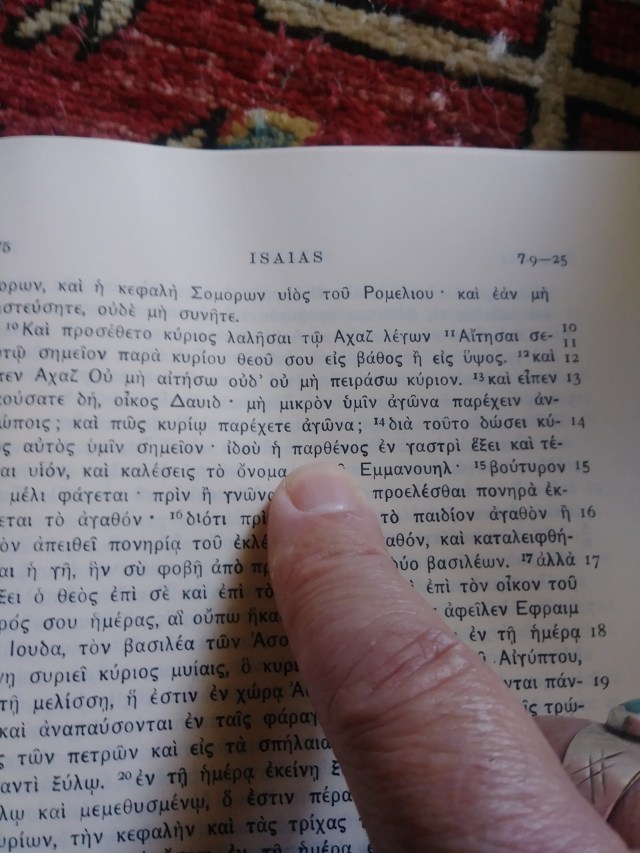
20191207_130603_Burst01

The problematic word in the Septuagint translation of Isaiah.

In the translation of the Hebrew text into Greek some 150 years before the time of Jesus took the word הָעַלְמָה ha almah “the young woman”, or “maiden”, and it was translated as η παρθένος ee parthenos “virgin”. Jewish and Christian scholars have argued over whether this is a legitimate translation, as obviously there is a difference between a virgin and a young woman. Stan Walters, who I studied with 33 years ago, suggests that this indicates that by the 2nd century BCE this passage and much of Isaiah was being read messianically – in terms of a prophecy about the restoration of the kingdom of David. If this is correct, then the first Christians did not innovate when they read this passage in isolation as being about the Messiah, but they did innovate in applying it to Jesus of Nazareth. 

This raises a key issue in Isaiah. As one reads through the book themes are raised, and then they are developed. When the book received its final form the way in which it was read also continued to develop.

  • This passage is keenly interested in the King of Judah and the survival of Judah.
  • II Isaiah (from 40 to 55) is not so interested in the monarchy or the independence of the Judeans, but seems quite happy to proclaim Cyrus of Persia as God’s anointed (despite being a Zoroastrian), and being ruled by governors as part of the Persian Empire. Instead the people of Israel are treated as the bearers of Judaism, as God’s servants – what was said about the kings is now said about all the people.
  • III Isaiah (56-66) likewise is unconcerned with the monarchy.
  • After the book received its final form it appears that some Jews were reading it messianically, perhaps as indicated by the translation into the Greek of the Septuagint.
  • More importantly, Isaiah was used messianically and apocalyptically in some of the non-scriptural texts found among the Dead Sea Scrolls. Shiu-Lun Shum writes:

I QSb, 4Q285 and 4Qplsa(4QI61), though very badly preserved, exhibit before us distinctive sectarian messianic beliefs, especially the role of the Davidic Messiah and his relation to other nations. These documents present such a Messiah as a political and military leader or king, who will come to liberate Israel by destroying Israel’s foreign oppressors and enemies in the eschatological battle in the end of days. In I QSb and 4Q285, the relation of this messianic figure to other nations is unclear, but in 4Qp1se it is clearly spelled out. In 4Qp1se we are told that the “shoot of David” will be strengthened by God Himself with a”mighty spirit” (cf. line 18) and will judge all the nations with his sword (line 21). This seems to suggest that his rule and the peace, righteousness, and faithfulness that he brings about on earth for Israel’s sake are established on the basis of his political and military power as well as divine inspiration and wisdom.
– Shiu-Lun Shum, The Use of Isaiah in the Sibylline Oracles, Qumran Literature and Romans (A Source-influence Study) (Unpublished Doctoral Thesis, University of Glasgow, June, 1999), p. 213.

Of course, some would argue that both the authors of the Dead Sea Scrolls and the author of Matthew misused the passage, taking it out of context. However, I suspect that this is begging the question about the proper use of prophecy. We may not like the way these passages are used, but it is unquestionable that faithful Jews used Isaiah in ways that might have surprised the prophet and his successors, but which they might not have considered illegitimate. The whole point of having a book of prophecy in which development over several generations is clearly indicated might be that this gives license to continued development of interpretation.

The oldest part of Isaiah is very concerned with the monarchy. By the end of the book that concern recedes, and it seems to see the whole of Israel as inheriting the role of the Messiah. In succeeding centuries this was re-conceived as an apocalyptic Messiah, a Son of David who would make all things right. This kind of evolution explains why the author of Matthew used Isaiah 7:14 the way he did.

Posted in Advent, Isaiah | Tagged , , , | Leave a comment

Isaiah and His Kings (I)

Day Six of “Through Advent with Isaiah”

The first verse of the Book of Isaiah starts:

The vision of Isaiah son of Amoz, which he saw concerning Judah and Jerusalem in the days of Uzziah, Jotham, Ahaz, and Hezekiah, kings of Judah.

It is not just a statement about when he is prophesying (they dated things by rulers in those days), but it is “concerning Judah and Jerusalem”. So Isaiah is a prophet speaking to the people of God about the Kingdom of Judah and its capital, Jerusalem. It is very political.

israel-judah-timeline-1.jpeg

From John Bright, “A History of Israel, Third Edition” (Philadelphia PA: Westminster Press, 1981), p. 470.

We do not have a good handle on when Isaiah was born or died. He must have lived somewhere around 760 BCE to 686 BCE, as he was born sometime in the reign of Uzziah and we last hear of him in the reign of Hezekiah.I t appears he was active for a very long time, perhaps living well into his eighties.  We read in Isaiah 6.1 that he received his call in the year Uzziah died, which most scholars set at 740 BCE.

Israel and Judah Timeline 2

From John Bright, “A History of Israel, Third Edition” (Philadelphia PA: Westminster Press, 1981), p. 471.

The Israelite kingdoms arose around the turn of the millennium, around 1000 BCE. The only sources we have of the earliest kings are the written ones in the Bible, and most scholars believe that these received their final form no earlier than the 5th century BCE (i.e after 400 BCE), so historians debate the quality of the written evidence. The earliest unquestioned archaeological evidence of a king described in the Tanach is that of a seal discovered with the name of Hezekiah.

1046px-Genealogy_of_the_kings_of_Israel_and_Judah.svg

From the Wikipedia article Kings of Israel and Judah

If the books of Samuel and Kings are to be believed, the first King of Israel was Saul, followed by David and Solomon. The United Monarchy broke apart after Solomon’s death, ten tribes forming the northern Kingdom of Israel, and the tribes of Judah and Benjamin remaining with the House of David the southern Kingdom of Judah. Isaiah, then, flourished some three centuries after Israel had its first kings, and some two hundred after the split between Israel and Judah.

The reason these kingdoms were able to be formed is because of the relative weakness of Egypt and the Assyrians. For two millennia before the United Monarchy armed forces from what is now Iraq and from Egypt fought against each other, and the plains and mountains of the eastern end of the Mediterranean, what we now know as Palestine and Israel, as well as Lebanon and Syria, were where they met in battle. Whoever controlled these lands controlled the gate to the other. In the time prior to Saul, David, and Solomon both Empires to the north and southwest were dealing with internal issues, and so the Israelites established themselves as a power.

Uzziah (Reign: 767–750 BCE)

2 Kings 15.1-7 says this about Uzziah (which it calls Azariah):

1 In the twenty-seventh year of King Jeroboam of Israel King Azariah son of Amaziah of Judah began to reign. 2He was sixteen years old when he began to reign, and he reigned for fifty-two years in Jerusalem. His mother’s name was Jecoliah of Jerusalem. 3He did what was right in the sight of the Lord, just as his father Amaziah had done. 4Nevertheless, the high places were not taken away; the people still sacrificed and made offerings on the high places. 5The Lord struck the king, so that he was leprous to the day of his death, and lived in a separate house. Jotham the king’s son was in charge of the palace, governing the people of the land. 6Now the rest of the acts of Azariah, and all that he did, are they not written in the Book of the Annals of the Kings of Judah? 7Azariah slept with his ancestors; they buried him with his ancestors in the city of David; his son Jotham succeeded him.   – 2 Kings 15.1-7

“He did what was right” – that is, he was faithful to the worship of Yahweh, and did not introduce the worship of other Gods. However, he allowed for worship of Yahweh (and possibly other gods) on “the high places”. These were the traditional places of sacrifice on hill tops that predated the centralization of worship in Jerusalem, which is a major concern throughout the “Deuteronomic History”. He came down with leprosy, and so his son led the country during his latter years.

Jotham (Reign: 750–735 BCE)

Probably Jotham was already regent by the time Isaiah came of age:

32 In the second year of King Pekah son of Remaliah of Israel, King Jotham son of Uzziah of Judah began to reign. 33He was twenty-five years old when he began to reign and he reigned for sixteen years in Jerusalem. His mother’s name was Jerusha daughter of Zadok. 34He did what was right in the sight of the Lord, just as his father Uzziah had done. 35Nevertheless, the high places were not removed; the people still sacrificed and made offerings on the high places. He built the upper gate of the house of the Lord. 36Now the rest of the acts of Jotham, and all that he did, are they not written in the Book of the Annals of the Kings of Judah? 37In those days the Lord began to send King Rezin of Aram and Pekah son of Remaliah against Judah. 38Jotham slept with his ancestors, and was buried with his ancestors in the city of David, his ancestor; his son Ahaz succeeded him.       – 2 Kings 15.32-38

Neither of this passages about Jotham or the one about Uzziah are much more than caricatures. The author refers the reader/listener to “the Book of the Annals of the Kings of Judah”, which was presumably a source, and is now lost. The author of II Kings is not interested in providing a full chronicle or history, but is setting out several theogico-political themes, the main one being: good things happen when good rulers follow the instruction of God and worship him alone in Jerusalem; bad things happen to bad rulers who tolerate corruption, do not defend the weak, and worship other gods.

The passage above does point to rising tensions between Judah and its northern neighbours, Israel and Damascus (Aram).

Ahaz (Reign: 735–716 BCE)

Ahaz is not a good king according to the author of II Kings:

1 In the seventeenth year of Pekah son of Remaliah, King Ahaz son of Jotham of Judah began to reign. 2Ahaz was twenty years old when he began to reign; he reigned for sixteen years in Jerusalem. He did not do what was right in the sight of the Lord his God, as his ancestor David had done, 3but he walked in the way of the kings of Israel. He even made his son pass through fire, according to the abominable practices of the nations whom the Lord drove out before the people of Israel. 4He sacrificed and made offerings on the high places, on the hills, and under every green tree.     – 2 Kings 16.1-4

One of the worst thing someone can be accused of is child sacrifice, and the author accuses Ahaz of doing this. This does appear to have been a practice of ancient Phoenicians and their descendants in Carthage, so it is not beyond belief that a King of Judah might do this. Whereas his father and grandfather simply did not remove the high places, the author says that Ahaz actively sacrificed there himself.

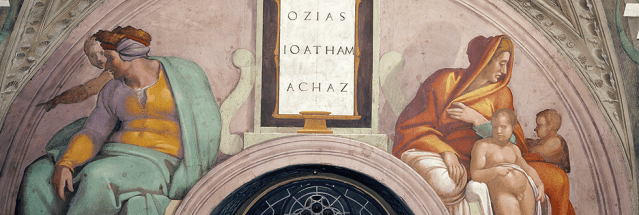
Uzziah, Jotham, Ahaz

A lunette by Michelangelo from the Sistine Chapel. On either side of a faux marble plaque with the Latinate form of “Uzziah, Jotham, and Ahaz” we see two figures, a man and a woman. “The man on the left, traditionally identified with Jotham, accompanied by his son Ahaz, wears a broad green cloak.” It is not clear if the woman and two children on the right represent anyone.

Ahaz was challenged by Israel and Damascus. We read:

Then King Rezin of Aram and King Pekah son of Remaliah of Israel came up to wage war on Jerusalem; they besieged Ahaz but could not conquer him. 6At that time the king of Edom recovered Elath for Edom, and drove the Judeans from Elath; and the Edomites came to Elath, where they live to this day. 7Ahaz sent messengers to King Tiglath-pileser of Assyria, saying, ‘I am your servant and your son. Come up, and rescue me from the hand of the king of Aram and from the hand of the king of Israel, who are attacking me.’ 8Ahaz also took the silver and gold found in the house of the Lord and in the treasures of the king’s house, and sent a present to the king of Assyria. 9The king of Assyria listened to him; the king of Assyria marched up against Damascus, and took it, carrying its people captive to Kir; then he killed Rezin. – 2 Kings 16.5-9

Judah is in a weakened state, and so it falls on the old practice of entering into alliances with growing powers – in this case, the Assyrian Empire. He becomes a vassal to the Assyrians, and pays the Assyrian King with gold and silver from the treasuries of the Temple (places of worship often functioned like treasuries in those days, as they still do in India). The bid for assistance works, but at a price. Assyria would have expected loyalty. As a sign of this Ahaz remodels the altar of the Temple in Jerusalem after the one in Damascus.

These are the first three kings Isaiah mentions in 1.1. The fourth, Hezekiah, son of Ahaz, is the most important one, and will be discussed in tomorrow’s blog.


Posted in Advent, Isaiah | Tagged , , , , , | 1 Comment

The Call of Isaiah

Day Five of “Through Advent with Isaiah”

I won’t comment on the readings today, but rather focus on Chapter 6 of Isaiah, the call of the prophet.

What is a prophet? The Hellenistic Greek word is προφήτης “pro-pheé-tees”, which means “the one who speaks on behalf of another”. A prophet speaks on behalf of God to God’s people, or their leaders; a prophet also speaks to God on behalf of the people. The Hebrew word is נְבִיָּא “Naw-vee”, and Wikipedia suggests it also means “spokesperson”, but I’m not convinced that’s where the word comes from, just what it came to mean. My copy of Brown-Driver-Briggs (the standard Hebrew lexicon, or at least what was when I studied Hebrew) sees the root as נבא, or “nva”, which in the related language of Arabic is the root of a word that means “utter in a low voice”. Wilhelm Gesenius and others thought it was related the the sense of “bubble up” or “pour forth”, words from a prophet being like the water of a spring. While this is debated, I kind of like that last idea, because it catches the sense of a prophet being one who has a kind of ecstatic experience, that the Spirit of God is giving a vision to the prophet, or the words are just flooding out.

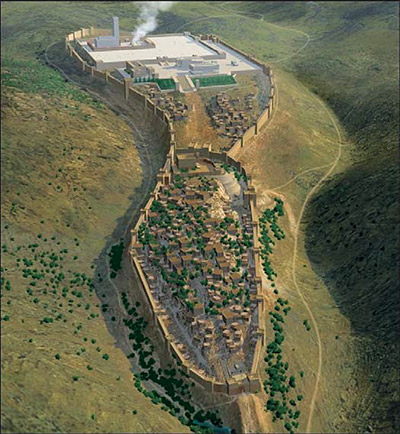
Jerusalem

Jerusalem, perhaps as it was in Solomon’s time. The Temple is at the top, on Mount Zion. The City of David is to the south, in the bottom of the picture. Over time the city shifted north, so that the edge of the Temple is now at the south of the modern Old City of Jerusalem; the City of David is now outside the medieval walls of the city.

In the Hebrew tradition Moses was the prophet par excellence. He received the Torah from God on Mount Sinai, but he also interceded for the people of Israel when God threatened to destroy them and start over with the descendants of Moses.

In the time of Samuel and David prophets were part of the royal court, and often seemed to band together. Prophets often foretold bad news that resulted from bad behaviour – Samuel to Eli, and Nathan to David. Prophets could get lost in ecstatic trances. In 1 Samuel 10, after Saul has been anointed King by Samuel, we read:

10When they were going from there to Gibeah, a band of prophets met him; and the spirit of God possessed him, and he fell into a prophetic frenzy along with them. 11When all who knew him before saw how he prophesied with the prophets, the people said to one another, ‘What has come over the son of Kish? Is Saul also among the prophets?’ 12A man of the place answered, ‘And who is their father?’ Therefore it became a proverb, ‘Is Saul also among the prophets?’ 13When his prophetic frenzy had ended, he went home.         1 Samuel 10.10-13

After the time of Solomon, when there were two successor kingdoms, Israel and Judah, the prophets were either at the court or were called by God to go to the court and speak truth to power. Elijah was definitely in the latter group, challenging Ahab and Jezebel in the northern Kingdom of Israel in the 9th century BCE.

4565801_f1024

A cutaway diagram of Solomon’s Temple. Most sacrifices took place at the outside altar, which also functioned as a kind of barbeque. Animal sacrifices were either burnt whole, or in part, with the cooked part being used for food for the priests and feasts for the people on behald of whom the priests were offering the sacrifices. The building of the Temple had two inner rooms, each separated by curtains. The first room is where incense and bread would be offered daily. The innermost room, the Holy of Holies, was where the Ark of the Covenant was, and only the High Priest would go in there, once a year on Yom Kippur (the Day of Atonement).

Isaiah was a prophet of the southern Kingdom of Judah. Chapter 6 of the book reads:

1 In the year that King Uzziah died, I saw the Lord sitting on a throne, high and lofty; and the hem of his robe filled the temple. 2Seraphs were in attendance above him; each had six wings: with two they covered their faces, and with two they covered their feet, and with two they flew. 3And one called to another and said:
‘Holy, holy, holy is the Lord of hosts;
the whole earth is full of his glory.’
4The pivots on the thresholds shook at the voices of those who called, and the house filled with smoke. 5And I said: ‘Woe is me! I am lost, for I am a man of unclean lips, and I live among a people of unclean lips; yet my eyes have seen the King, the Lord of hosts!’

Then one of the seraphs flew to me, holding a live coal that had been taken from the altar with a pair of tongs. 7The seraph touched my mouth with it and said: ‘Now that this has touched your lips, your guilt has departed and your sin is blotted out.’ 8Then I heard the voice of the Lord saying, ‘Whom shall I send, and who will go for us?’ And I said, ‘Here am I; send me!’ 9And he said, ‘Go and say to this people:
“Keep listening, but do not comprehend;
keep looking, but do not understand.”
10 Make the mind of this people dull,
and stop their ears,
and shut their eyes,
so that they may not look with their eyes,
and listen with their ears,
and comprehend with their minds,
and turn and be healed.’
11 Then I said, ‘How long, O Lord?’ And he said:
‘Until cities lie waste
without inhabitant,
and houses without people,
and the land is utterly desolate;
12 until the Lord sends everyone far away,
and vast is the emptiness in the midst of the land.
13 Even if a tenth part remains in it,
it will be burned again,
like a terebinth or an oak
whose stump remains standing
when it is felled.’
The holy seed is its stump.

This passage falls into two halves, the call and God’s words to Isaiah. Isaiah is a priest, being a descendant of Aaron and his sons. He was probably a farmer, but one month a year he would go to Jerusalem and take his turn making sacrifices in the Temple. In this passage he is offering the daily sacrifice of incense inside the first room. It may be that he can see into the Holy of Holies. It is probably there that he sees Yahweh enthroned. His immediate reaction before this vision is to have a deep sense of unworthiness. One of the seraphs – angels, it seems, who attend Yahweh as servants attend a king – hears Isaiah, and purifies him with a coal from the incense burner, which miraculously does not burn him.

The song of the angels inspired John of Patmos in his vision of heaven in Revelation. It also inspired Reginald Heber, first Bishop of Calcutta, in the hymn “Holy, Holy, Holy“, the first verse of which was sung virtually every Sunday at Bethel United Church in Grand-Mére, Quebec, where I was baptised.

God then asks, “Whom shall I send?” and Isaiah, now restored to grace before Yahweh, says, “Here I am, send me.” In these words Isaiah echoes Samuel’s call in 1 Samuel 3. In both cases “Here I am” is one word in Hebrew: הִנְנִ֥י “Hi-nen-ni”, which I always want to translate as “Yo!”. These two passages also inspired this hymn, beloved of ordinations services –  “I the Lord of Sea and Sky” or “Here I Am, Lord”:

The second half is a bit confusing.  God tells the prophet to say to the people:

“Keep listening, but do not comprehend;
keep looking, but do not understand.”
Make the mind of this people dull,
and stop their ears,
and shut their eyes,
so that they may not look with their eyes,
and listen with their ears,
and comprehend with their minds,
and turn and be healed.’

Why would God send the prophet on a fruitless mission? According to this Isaiah’s prophecies will not result in repentance or their being healed, but just the opposite, condemning them despite the warnings. It is even more confusing because we know that King Hezekiah did respond to some of what Isaiah said. However, it may be that the prophet believed that the people and leadership were so far gone that they were beyond turning. Alternatively, this may have been added at a later time, when it was known that Isaiah’s warnings did not change the downward trajectory of Judah.

Of course, a prophet is recognized as a true prophet because what they say comes to pass. It may be that others were prophesying at the same time, but their prophecies did not come true, whereas Isaiah’s did, and that is why he is remembered.

This confusing later section is taken up Matthew 13.14-15, where Jesus talks about the purpose of parables (which actually is the second reading this morning). With parables – stories with images and frequently outrageous aspects that related to the kingdom of God – Jesus subversively preached without directly challenging the powers that be. It was a kind of “plausible deniability” that allowed him to preach in public but not immediately bring condemnation down upon him.

What is interesting about Isaiah s that, as a priest, he was part of the hierarchy. Nevertheless he became one who challenged the people and the leadership, calling them back to the ways of God. He is part of a privileged group, but receives a higher calling directly from God. What exactly those are we will look at in a future post.


Posted in Advent, Isaiah | Tagged , | 1 Comment

Structure and Condemnation

Day Four of “Through Advent with Isaiah”

Screenshot 2019-12-03 at 17.23.23

While the full details of the internal structure of the Book of Isaiah is debated, the overall structure is relatively clear (to me, at least). And here it is, in the diagram above:

  • First Isaiah is yellow. This comes from the prophet himself, or his disciples soon after his time.
  • The prose interpolation from II Kings is grey.
  • “Second Isaiah”, from the time of the return from the Babylonian Exile, is the violet (or purple).
  • The conjectured “Third Isaiah” is light blue. It appears to from a time after the Jews had returned from exile.

The first thirty-five chapters appear to speak to the time of the prophet Isaiah, and much of it may date back to his time, although some see additions here and there. I have subdivided it, following some of the insights I gained thirty-three years ago in a class at Knox College, Toronto with Prof. Stanley Walters.

  • Walters noted that both chapters 1 and 2 began with the ancient equivalent of titles:

1.1 The vision of Isaiah son of Amoz, which he saw concerning Judah and Jerusalem in the days of Uzziah, Jotham, Ahaz, and Hezekiah, kings of Judah.

2.1 The word that Isaiah son of Amoz saw concerning Judah and Jerusalem.

Walters argued that this was a means of marking off two sections. Chapter 1 serves as an introduction to the whole book.

  • The next “title” does not come until chapter 13. Walters suggested that means chapters 2 to 12, although assembled from a variety of pronouncements, should be read as a unit. Whereas the prophets Jeremiah and Ezekiel have their call stories right at the beginnings of their books of prophecy, Isaiah’s comes in Chapter 6, which is the middle of 2 through 12.
  • The first half of what I have titled “The Old Core” is mostly condemnation and warnings (although the very beginning of chapter 2 is hopeful with its image of the nations coming to Jerusalem, and beating their swords into ploughshares). After the description of the call in chapter 6, the tone is more hopeful. Isaiah, then, is a prophet of both warning and hope.

Chapters 13 through 23 have titles scattered throughout, signifying Oracles, which are prophecies of doom against the nations. Thus we find

The oracle concerning Babylon that Isaiah son of Amoz saw.  13.1
An oracle concerning Moab. 15.1
An oracle concerning Damascus. 17.1
An oracle concerning Egypt. 19.1
The oracle concerning the wilderness of the sea. 21.1
The oracle concerning Dumah 21.11
The oracle concerning the desert plain. 21.13
The oracle concerning the valley of vision. 22.1
The oracle concerning Tyre. 23.1

As well, there are oracles without titles against Assyria and others. Because these are all oracles to the nations that do not follow the God of the Hebrews, these seem to have been collected by some editor (either Isaiah, one of his disciples, or a later redactor).

Oracle

Not this Oracle.

There is no clear demarcation with this next section, chapters 24 to 35 – the oracles against the nations just seem to flow into general warnings of coming destruction, admonitions, and hopeful promises of restoration and redemption. Indeed, I find this to be the most confusing section of the whole book, at least in terms of its organization.

As mentioned yesterday, 36 to 39 is prose and is taken from II Kings, a book which received its final form long after the time of Isaiah. The extract does describe events in Isaiah’s life, though. Chapter 39 relates a visit by an official from what was then a minor city which had once been the capital of a great empire, but was now part of the Assyrian Empire – Babylon. After the time of Isaiah, Babylon revolted and established the Neo-Babylonian Empire, and eventually conquered Judah and Jerusalem. The story told here foreshadows the Babylonian Exile.

Chapter 40 begins Second Isaiah with the words,

Comfort, O comfort my people,
says your God.
Speak tenderly to Jerusalem,
and cry to her
that she has served her term,
that her penalty is paid,
that she has received from the Lord’s hand
double for all her sins.

This is a collection of passages addressing the situation of the Babylonian Exiles, and is mostly full of hope. It also has what modern scholars have identified as the “Suffering Servant songs”, which I believe informed Jesus’s self-understanding of his mission; they were certainly used in the New Testament that way.

Many scholars do believe that chapters 56 to 66 forms yet another distinct collection from a later time after the return from exile. Paul D. Hanson of Harvard Divinity School (with whom I studied in 2002) described this section as “apocalyptic” and, reading it with Zechariah, developed a scenario in which these texts emerged. He suggests that the leaders of the returned exiles were divided, and that these chapters are by the disenfranchised.

So there is the structure of Isaiah – a roadmap, if you will.

————————————————————————————

The passage from Morning Prayer today is pretty typical of the kind of condemnation Isaiah comes up with:

1 Ah, the proud garland of the drunkards of Ephraim,
and the fading flower of its glorious beauty,
which is on the head of those bloated with rich food, of those overcome with wine!
2 See, the Lord has one who is mighty and strong;
like a storm of hail, a destroying tempest,
like a storm of mighty, overflowing waters;
with his hand he will hurl them down to the earth.
3 Trampled under foot will be
the proud garland of the drunkards of Ephraim.
4 And the fading flower of its glorious beauty,
which is on the head of those bloated with rich food,
will be like a first-ripe fig before the summer;
whoever sees it, eats it up
as soon as it comes to hand.

5 On that day the Lord of hosts will be a garland of glory,
and a diadem of beauty, to the remnant of his people;
6 and a spirit of justice to the one who sits in judgement,
and strength to those who turn back the battle at the gate.

7 These also reel with wine
and stagger with strong drink;
the priest and the prophet reel with strong drink,
they are confused with wine,
they stagger with strong drink;
they err in vision,
they stumble in giving judgement.
8 All tables are covered with filthy vomit;
no place is clean.

9 ‘Whom will he teach knowledge,
and to whom will he explain the message?
Those who are weaned from milk,
those taken from the breast?
10 For it is precept upon precept, precept upon precept,
line upon line, line upon line,
here a little, there a little.’

11 Truly, with stammering lip
and with alien tongue
he will speak to this people,
12   to whom he has said,
‘This is rest;
give rest to the weary;
and this is repose’;
yet they would not hear.
13 Therefore the word of the Lord will be to them,
‘Precept upon precept, precept upon precept,
line upon line, line upon line,
here a little, there a little’;
in order that they may go, and fall backwards,
and be broken, and snared, and taken.                – Isaiah 28.1-13

Following our roadmap, we are between the Old Core and Oracles, and the prose from II Kings – which is to say we are in a bit of a spaghetti junction, and I’m not quite sure what is going on.

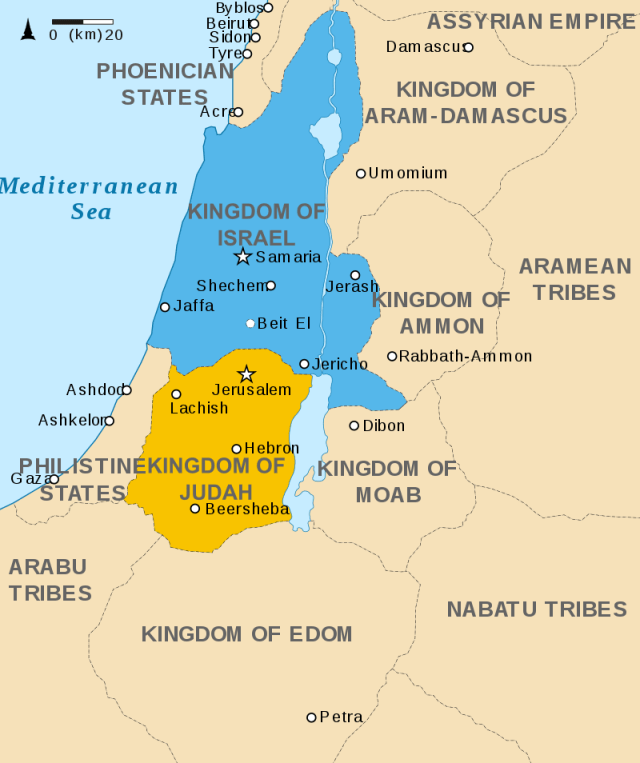
Kingdoms_of_Israel_and_Judah_map_830.svg

From Wikipedia; from here.

The prophet fulminates against Ephraim. Ephraim was the second son of Joseph, so a half-tribe of twelve tribes of Israel. In poetical works it usually is a reference to the northern Kingdom of Israel (c. 930 BCE – 720 BCE). It was founded when the ten tribes broke away from the House of David in Judah, and was was conquered by the Assyrians in 720 BCE. The city of Samaria was founded as its capital, in competition with Jerusalem. Much of its population was deported in 720 BCE, and exiles from other parts of the Assyrian Empire were settled in Samaria and the surrounding region.

Verses 7 and 8 are rather explicit, eh? Ephraim and its people are drunk and overfed, and not in a good way. This is the author’s way of describing how Israel – wealthy in comparison to Judah – satisfied itself with injustice and other gods. They are abandoning the Torah of Moses, and thus they do not hear God’s call to them.

Verses 5 and 6 sit uneasily here. Is it an interpolation of hope from a later author? Perhaps. If one reads the passage as applying to the whole people of Israel – both the northern Kingdom of Israel and the southern Davidic Kingdom of Judah – then the reference to the remnant begins to make sense in a time of exile. So condemnation and hope are mixed together.


Posted in Advent, Isaiah | Tagged , , | Leave a comment

Text and Claims

Day Three of “Through Advent with Isaiah”

What happens when we read?
How do we understand a text?

20180930_183038

I think it’s a washing machine.

We are such a literate culture that we take reading for granted; we really don’t know what it is like to live without writing. However, having just moved to Greece over a year ago, I have a bit of a sense. While I already knew the Greek alphabet I was not sure of the pronunciation and long words took awhile to piece together. In a grocery store I sometimes went by pictures as much as anything. When I first tried to use a washing machine I was completely baffled.

One of the assumptions we make is that there is meaning in a text. Yet, a biblical text is just ink and paper (or ink and vellum, or 1s and 0s in a computer creating an image on a screen). The material of the book (iPad, Kindle, smart phone) is not conscious – it does not know what it says. Rather, it encodes sounds I make when I speak (or silently create in my mind as if speaking, and sits there, waiting for someone to decode it and sound it again. If the creator of a text and the reader of a text share the same language and culture, generally speaking the code works and a person receives some information. The meaning is recreated each time a person reads it.

So where does the meaning reside? If it is simply encoded in the text, one might say it is there – but it is merely potential, not active, not alive and doing anything. We might argue that it sits in the reader who decodes the passage and understands it. However, I’ve often found that if you ask two people to read a text they will come up with different readings. Does it sit with the author? Perhaps, but that assumes the author knew what she was doing. The writers of song lyrics are notorious for not saying what a song is about, and often will say that it has multiple meanings depending on who’s doing the listening.
20191203_124845

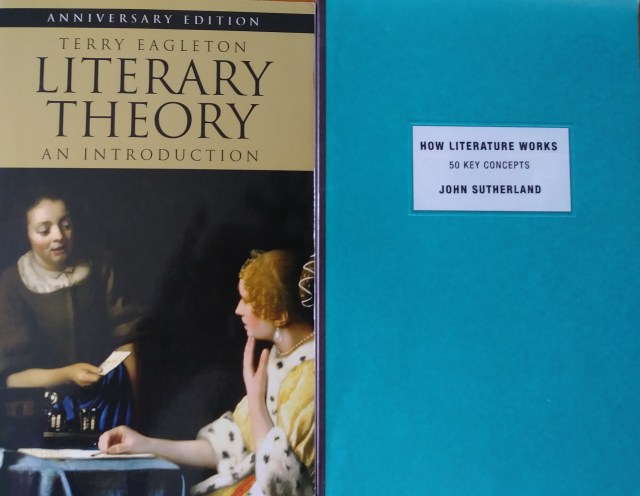
These books may help you understand literature.

Literary theory is all about understanding texts. However, there are many theories about how one should interpret a text.

  • Some theorists believe that one should simply look at a text and pay attention to the words themselves and the rhetorical devices used in prose and poetry. This is called “close reading” and is associated with people like T. S. Eliot (as a critic, not as a poet).
  • Others look at who the author is and ascribe great importance to authorial intention and background. The meaning of Eliot’s The Wasteland is illuminated by knowing that he was dealing with the breakdown of his marriage and his wife’s mental illness. Shakespeare’s Sonnets would be much clearer if we knew the identity of the Dark Lady, right?
  • Still others look at a text in process. Thus, the finished text of The Wasteland is an edited version of a much longer poem. Ezra Pound did most of the editing – is he to be considered an author as well? Do his intentions and background inform our reading of the text? W. H. Auden was notorious for rewriting his poems; is one more authoritative than the other? There are three very different versions of Hamlet – is one of them more authoritative than the others? What is the relationship between them?
  • A popular way of reading from a few generations ago was to apply a Marxian analysis, which is to say, to apply issues of class differences to understand what is happening. Thus, someone like Terry Eagleton would see literature as a place where a literary elite place value after the Enlightenment had dethroned religion and the divine right of monarchs; literature is the nearer of the new holy thing, culture. In a wealthy consumer society such as ours popular culture is raised up over the old elite literature, so that the music of the Beatles and Beyoncé is of greater importance than that of Ralph Vaugh Williams or Schumann.
  • Others apply a post-colonial analysis to the text. Jane Austin, whose books never refer to current events, has nevertheless been analysed this way. Where does the wealth of an upper-middle class family such as Jane Bennet’s come from? Do Mr Bennet and Mr Darcy work? Given that the wealth of much of England in the Regency era came from the work of slaves on sugar plantations in the West Indies, and from the ruthless exploitation of India, does this change at all how we read the book Pride and Prejudice?
  • Then, again, there is feminist analysis. We enjoy the novels of manners that Austen writes, but as we are 21st century readers we know that the situation of the women and men in those novels is very different from that of today. Given that, what is the significance of such texts for us? Are they merely entertainment, or are they more than that?
  • Others look at a text in relation to other texts, perhaps by other authors. The Wateland is a poem, but Eliot read James Joyce’s Ulysses and seems to have incorporated some of his styles in the poem. Cinema Show by the prog rock group Genesis is lifted right out of The Wasteland – what is the effect of this kind of transformation?

There are, you may be dismayed to know, even more approaches to interpretation than this. One might think that all of this is irrelevant to our ordinary lives, except that the study of interpretation – hermeneutics – is crucial in both law and Bible Studies.

In our common law tradition jurisprudence is the interpretation of statutes and precedent. In the United States many constitutional lawyers and judges subscribe to the idea that the Constitution or a law means what its original authors intended it to mean; if a judge establishes a precedent that seems to suggest that the Constitution evolves in any way other than constitutional amendment, or a law changes in any way other than by passing a statute in a legislature, then this is just judicial activism. Thus they object to the idea that same-sex marriage is somehow enshrined in the Bill of Rights, as the Framers would have been aghast at the idea.

In Canada we have what is called the Living Tree Doctrine of constitutional law. The Supreme Court of Canada has stated, referring to an originalist approach as “frozen concepts”:

The “frozen concepts” reasoning runs contrary to one of the most fundamental principles of Canadian constitutional interpretation: that our Constitution is a living tree which, by way of progressive interpretation, accommodates and addresses the realities of modern life.

These two approaches are incompatible. Which one do we choose, without our biases for particular outcomes getting in the way?

All of these issues show up in Biblical reading as well. Where is the authoritative reading of scripture? Is it in the work of biblical scholars using historico-critical methods? Is it found by ferreting out the author’s intention? Do we assume there is non-contradiction in the various texts of the Bible, and any apparent conflicts are just willful ignorance? Do we assume a “plain reading” of scripture, or do we use analogy and typology to get into the deeper meaning? If it appears that there are different sources in a text, as in, say, the Torah, where we might discern a Priestly author (P), the Yahvist (J), the Elohist (E), and the Deuteronomist (D), do we first need to fragment the texts and discern the author’s various theologies before trying to make sense of the whole? Or do we take the text as it is? How do we decide from the many ancient manuscripts and all their differences what the best text is?

My own belief is that we need to consider all of this. Every time I read a text I recreate it. Every time I re-read a text I recreate it anew, for I am a different person from the one who may have read this two years ago, and thirty years ago. I may even have been changed by the reading of a text, which means that I read other things differently in light of that text. I will probably talk more about this later.

————————————————————————————

In Evening Prayer this Tuesday after the First Sunday of Advent we read this passage from Isaiah 43.1-13:

43But now thus says Yahweh,
he who created you, O Jacob,
he who formed you, O Israel:
Do not fear, for I have redeemed you;
I have called you by name, you are mine.
2 When you pass through the waters, I will be with you;
and through the rivers, they shall not overwhelm you;
when you walk through fire you shall not be burned,
and the flame shall not consume you.
3 For I am Yahweh your God,
the Holy One of Israel, your Saviour.
I give Egypt as your ransom,
Ethiopia and Seba in exchange for you.
4 Because you are precious in my sight,
and honoured, and I love you,
I give people in return for you,
nations in exchange for your life.
5 Do not fear, for I am with you;
I will bring your offspring from the east,
and from the west I will gather you;
6 I will say to the north, ‘Give them up’,
and to the south, ‘Do not withhold;
bring my sons from far away
and my daughters from the end of the earth—
7 everyone who is called by my name,
whom I created for my glory,
whom I formed and made.’


8 Bring forth the people who are blind, yet have eyes,
who are deaf, yet have ears!
9 Let all the nations gather together,
and let the peoples assemble.
Who among them declared this,
and foretold to us the former things?
Let them bring their witnesses to justify them,
and let them hear and say, ‘It is true.’
10 You are my witnesses, says Yahweh,
and my servant whom I have chosen,
so that you may know and believe me
and understand that I am he.
Before me no god was formed,
nor shall there be any after me.
11 I, I am Yahweh,
and besides me there is no saviour.
12 I declared and saved and proclaimed,
when there was no strange god among you;
and you are my witnesses, says Yahweh.
13 I am God, and also henceforth I am He;
there is no one who can deliver from my hand;
I work and who can hinder it?

A few observations.
20191203_082654

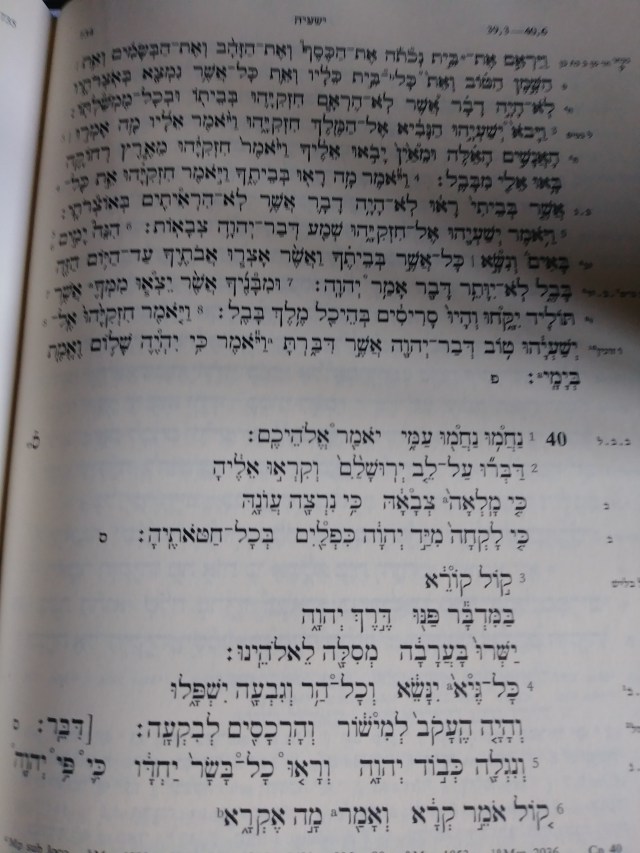
The transition from chapter 39 to 40 in Isaiah. Chapter 39 is prose, whereas 40 is poetry. The layout here, from the Biblica Hebraica Stuttgartensia (1977/1984) is taken from the manuscript known as the Leningrad Codex (1008 CE) of the Masoretic text. The Masoretic text is the text of the Tanach as established by Jewish scribes between the 7th and 10th century CE, based on older manuscripts. This layout is not found in the most ancient manuscripts, those of the Dead Sea Scrolls (1st century BCE), but it does reflect an understanding in the middle of the first millennium CE that there is a real shift in style.

First, this is poetry. Biblical Hebrew poetry is usually pretty obvious, as it is typically grammatically different from prose. As well, it has that parallelism that we see so often in the Psalms, where an idea is stated in the first part of a verse and it is then repeated or expanded in different words in the second (and sometimes third) part. Hebrew poetry does not rhyme and it does not have a set meter – at best it has a rhythm with similar beats or emphasis. Walt Whitman borrowed this style in Leaves of Grass.

Second, just to point out the obvious, this is a translation here, from the New Revised Standard Version (“NRSV”). It is contemporary late-20th century English, not the early 17th century English of the King James Version (“KJV”), or the mid-twentieth century English of the Revised Standard Version (“RSV”). Biblical Hebrew has a smaller vocabulary than contemporary English, and so the translator has to make some choices when translating. Does she seek word for word equivalence? Does she try to get the sense of a phrase or a sentence without sticking too close to the actual wording? Are obscure metaphors replaced by things in the modern world that the translator thinks still convey the sense if not the literal meaning? In any case, unless one is competent in Biblical Hebrew, one must depend on translators and the scholarship behind their choices.

Third ,I have changed the text – I have replaced “the Lord” with what is there in the original Hebrew , the personal name of the God of Israel, to wit: יהוה or Yahweh. This is always a bit jarring. Since the first century BCE the personal name of God was considered so holy that pious Jews would not say it, but replace it in speech by Adonai, or “the Lord”. The Greek translation of the Hebrew Tanacj did this, and Jesus did as well, so Christians carried on with that practice. However, it is sometimes good to be jarred back to the 5th century BCE, when God did have a personal name and a personal relationship with a particular people.

Fourth, this is a passage about the redemption of Israel. The Twelve Tribes of Israel have been scattered by the Assyrian and Babylonian exiles, as well as emigration by Israelites and Judeans from their inherited lands. Verses 5 through 7 speaks of an in-gathering of theses dispersed peoples  – the Diaspora – back to the Holy Land. This hope, seemingly announced back in 538 BCE or later, was partially realized as Jews returned from Babylon to Judea, and as they rebuilt the Temple. The full nature of this pronouncement  continued to be a dream for Jews for the next fifteen centuries, as they said at Passover, “Next year, in Jerusalem!” It drove Zionism in both its secular and religious forms, resulting in the establishment of the State of Israel by United Nations resolution in 1947. The power of these texts is great!

The first few verses speaks to Israel of their God as one who created them and who is with them through water and flame. For many Christians this will remind them of the middle verses of How Firm A Foundation:

3 “When through the deep waters I call you to go,
the rivers of sorrow shall not overflow;
for I will be with you, your troubles to bless,
and sanctify to you your deepest distress.

4 “When through fiery trials your pathway shall lie,
my grace, all-sufficient, shall be your supply;
the flame shall not hurt you; I only design
your dross to consume and your gold to refine.

Fifth, the latter part of the reading speaks to the growing assertion of Yahweh as the only God. In older scripture Yahweh is no more and no less than the God of Israel, as Marduk was the god of Babylon and Ba’al the god of the Caananites. By the time this text was written down we find the assertion that Yahweh is the only God – there are no others. At one time humanity knew Yahweh as God, but in the course of time they turned away, became blind, and worshiped idols. Now, as the one and only God he is seen to be all powerful as he does his mighty acts, working through unwitting rulers such as Cyrus, and brings the exiles home. If we retain the name of Yahweh here – as The Jerusalem Bible does, we have a sense of how this would have been jarring back at the turn of the fifth century BCE.

It is striking to see the vision of the author here, where all the nations become witnesses to Yahweh as he claims to be the only God, and not just the God of Israel or Judea. This passage of Isaiah raises the stakes.



Posted in Advent, Isaiah | Tagged , , , | Leave a comment

Isaiah: The Man, The Book, and The Feast On The Mountain

Day Two of “Through Advent With Isaiah”

Some Throat Clearing About Daily Office Lectionaries

In the Church of England we have two sets of lectionaries for Morning Prayer and Evening Prayer. One is that found in the Book of Common Prayer, and which is, despite many changes, more or less the one set up by Thomas Cranmer back in 1549. In the official BCP there is also an alternative daily office lectionary from 1922. I don’t use either.

Instead I use the resources of Common Worship, which came out shortly after the turn of the century after decades of innovation and cautious experimentation. These are several books (all available online), and one of the books is specifically The Daily Prayer – and it has its own lectionary. This is the one I use. It is supposed to be related to the one I’ve used in the Book of Alternative Services of the Anglican Church of Canada, and the Book of Common Prayer of The Episcopal Church, but it feels somewhat different.

Anyway, for the next three weeks solid it uses Isaiah in both the morning and evening. That’s a lot of Isaiah.

The Book and the Person

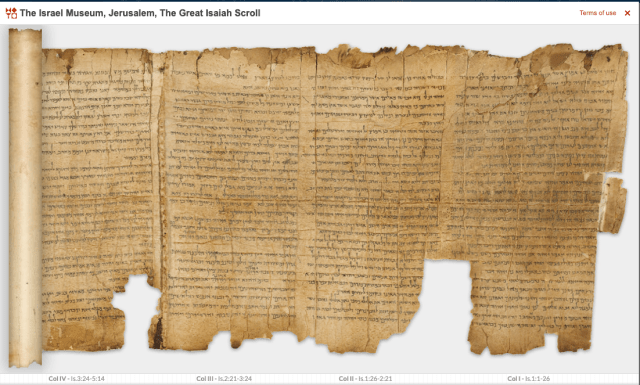
Great Isaiah Scroll

The Great Isaiah Scroll (1QIsaa) • Qumran Cave 1 • 1st century BCE • Parchment • H: 22-25, L: 734 cm • Government of Israel • Accession number: HU 95.57/27 From the Digital Dead Sea Scrolls

Yesterday I said that there was a person born in the mid-seventh century BCE named Isaiah. There is also a book named Isaiah. Do not confuse the two. The person may have written or dictated a large portion of the text we have in our Bibles, but there are undoubtedly large portions of it that he did not. How do we know this?

Well, to begin with, there are four chapters, 36 through 39, mostly prose, which are lifted right out of the Second Book of Kings 18.13-20.11 (there are some differences, but there is a clear written dependence). As the Second Book of Kings continues its narrative far past the time of Isaiah, so we may conclude that this section was not by him.

Second, once we start up in chapter 40 the tone is quite different.

  • The chapters from 1 to 39 address situations in and around the time of King Hezekiah (c. 739 BCE – c. 687 BCE).
  • Chapters from 40 on seem to address the exiles of Judah and tells them that their time of suffering in Babylon is over. This is a significantly later period. There were two deportations of Judeans from Jerusalem and Judah, one in 597 BCE, and a second in 587 BCE. As well, in 587 BCE Jerusalem and the Temple were destroyed by the Babylonians. The exile “by the waters of Babylon”, in what is now southern Iraq, lasted until 538 BCE, when King Cyrus of Persia, who had conquered the Neo-Babylonian Empire, encouraged the Judeans – the Jews – to return and rebuild. As Isaiah 45.1 refers to Cyrus as an anointed one of God, it seems reasonable to think that this latter part of the book dates from that time or later. The section from chapter 40 on is often called Second Isaiah.
  • Some scholars believe that chapters 55-66 is even later than 40-54, and relates to the situation of the Jews who have returned to Judea.

All of this suggests that the final form of the book we know as Isaiah was achieved well after the time of the return – perhaps in the 4th century BCE, or 3rd century BCE. The  process of composition is not clear, and neither is the editorial process. I will address different methods of interpreting the meaning in later posts.

The Feast of God

Meanwhile, here is the text for this morning:

Lord, you are my God;
I will exalt you, I will praise your name;
for you have done wonderful things,
plans formed of old, faithful and sure.
For you have made the city a heap,
the fortified city a ruin;
the palace of aliens is a city no more,
it will never be rebuilt.
Therefore strong peoples will glorify you;
cities of ruthless nations will fear you.
For you have been a refuge to the poor,
a refuge to the needy in their distress,
a shelter from the rainstorm and a shade from the heat.
When the blast of the ruthless was like a winter rainstorm,
   the noise of aliens like heat in a dry place,
you subdued the heat with the shade of clouds;
the song of the ruthless was stilled.


On this mountain the Lord of hosts will make for all peoples
a feast of rich food, a feast of well-matured wines,
of rich food filled with marrow, of well-matured wines strained clear.
And he will destroy on this mountain
the shroud that is cast over all peoples,
the sheet that is spread over all nations;
he will swallow up death for ever.
Then the Lord God will wipe away the tears from all faces,
and the disgrace of his people he will take away from all the earth,
for the Lord has spoken.
It will be said on that day,
Lo, this is our God; we have waited for him, so that he might save us.
This is the Lord for whom we have waited;
let us be glad and rejoice in his salvation.           — Isaiah 25.1-9

This is another positive text, and one that is inspiring even today. It’s speaks to what Liberation theologians call “the preferential option for the poor” in that God is concerned with all peoples, but especially the poor and needy. There is an apocalyptic tone here – God acts to destroy the ruthless aliens and put fear into the nations. Cities are destroyed and palaces pulled down – the powerful and rich who are indifferent to the Lord are no more. Death itself is destroyed, and we have a vision of a feast on the holy mountain. It is one image of justice, which echoes down to the Song of Mary in Luke 1. This imagery is picked up in the New Testament in general whenever the Lord’s Supper is mentioned or a banquet is described.  It is especially present in Revelation 21 and 22:

And I saw the holy city, the new Jerusalem, coming down out of heaven from God, prepared as a bride adorned for her husband. And I heard a loud voice from the throne saying,
‘See, the home of God is among mortals.
He will dwell with them;
they will be his peoples,
and God himself will be with them;
he will wipe every tear from their eyes.
Death will be no more;
mourning and crying and pain will be no more,
for the first things have passed away.’            — Revelation 21.2-4

The passage from Isaiah also looks back to Exodus and the meal the Israelites had on Mount Sinai when Moses receives the Torah. All of which indicates what French literary theorists called “intertextuality” – this prophecy interacts with other texts. Part of the reason it continues to be relevant today is because it is pregnant with meaning, relating to past and future texts that are important to us, and which inform us in our present circumstances. So that is why we read this ancient text.

Posted in Advent, Isaiah | Tagged , , , | Leave a comment

Through Advent With Isaiah

Jesaja_(Michelangelo)

“The Prophet Isaiah” by Michelangelo (c. 1511), one of the seven Old Testament prophets painted on the Sistine Chapel ceiling, in the Vatican

It’s the First Sunday of Advent. The Book of the prophet Isaiah is always one of the sources for readings in the season at Morning and Evening Prayer in Advent, and has been for a very long time. I will attempt in the next 24 days to briefly say a few things about the prophet and the texts as we work our way to Christmas.

The first reading today in the Revised Common Lectionary for Holy Communion is from Isaiah 2.1-5:

The word that Isaiah son of Amoz saw concerning Judah and Jerusalem.

In days to come
the mountain of the Lord’s house
shall be established as the highest of the mountains,
and shall be raised above the hills;
all the nations shall stream to it.
Many peoples shall come and say,
‘Come, let us go up to the mountain of the Lord,
to the house of the God of Jacob;
that he may teach us his ways
and that we may walk in his paths.’
For out of Zion shall go forth instruction,
and the word of the Lord from Jerusalem.
He shall judge between the nations,
and shall arbitrate for many peoples;
they shall beat their swords into ploughshares,
and their spears into pruning-hooks;
nation shall not lift up sword against nation,
neither shall they learn war any more.

O house of Jacob, come, let us walk
in the light of the Lord!

Isaiah identifies himself as the son of Amos. From other information we learn that he lived in the mid-8th on, perhaps from 740 BCE to about 686 BCE. There is no good reason to think that he was not an historical figure – he really did live.

This is a hopeful, forward looking vision. Isaiah sees Jerusalem not as it was in his time, a small town which served as the cultic centre of the small nation known as Judea, but as he hoped it would be – the pilgrimage destination of all the nations of the world, where peoples would gather to receive instruction from the Lord, leading to the resolution of conflicts and the coming of peace.

Jerusalem today is the a holy city and centre of three world religions – Judaism, Christianity, and Islam, whose total population today is some 3.8 billion. So Isaiah’s vision has been partially fulfilled. However, it is also a city of deep divisions, not just between these three religions of Abraham, but within them as well. Jerusalem has been fought over repeatedly in the past century, and in my living memory it was a divided city. The vision of Jerusalem as the City of Peace (one interpretation of its Hebrew name) is still a distant vision.

Curiously, this passage is also found, with some differences, in Micah 4.1-7 (which was today’s first reading at Morning Prayer). This suggests that the text is allusive and complex. Micah was a contemporary of Isaiah’s, but they do not refer to each other except by sharing this common text. The prophetic message of Micah is similar to what is in Isaiah, but the text of the book is much shorter, only seven chapters.

Isaiah is a prophet of hope. He is also a prophet of warning. We’ll start looking into this more tomorrow.

Posted in Advent, Isaiah | Tagged , | Leave a comment

God’s Story

A Sermon Preached On
The Second Sunday Before Advent
Sunday, November 17, 2019, 11:00 am
also being The Third Sunday in a Season of Visioning
at the Anglican Church of St Thomas, Kefalas, Crete, Greece.
Somewhat expanded and changed since it was preached.

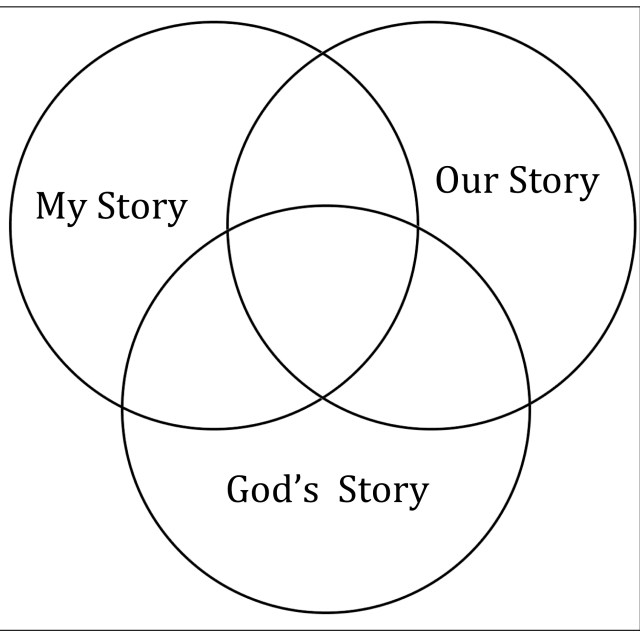
This is the Third Sunday in our Season of Visioning. It is a season in which we pray and reflect, and open ourselves to the Holy Spirit. Last week I introduced this Venn diagram:

Three Stories - Us, Our, God's

I suggest to you that it is a way of approaching what our vision might be at the Anglican Church of St Thomas, Kefalas. We each have our own story. The church, whether as a world-wide institution or this congregation, also has a story. Then there is God’s story, which is what we will focus on today. These stories intersect, and I believe that we will find God’s vision for us in the centre of this diagram, where the three stories overlap and intersect.

The Big Story

The story of God is to be found preeminently in the Bible (although we must always remember that God cannot be contained by mere words). Although it is really a collection of books, it has developed a narrative structure. This was pointed out by the Canadian literary critic Northrup Frye in his book, The Great Code, and it has been read primarily as a story with a narrative structure. Although it has many authors and many types of literature – stories, genealologies, laws, prophecy, poetry, chronicle, blessings and curses, letters, and so on – it all hangs off of a narrative thread telling one long story.

28924-1024__96040.1544284870

It has a beginning, a middle, and an end. The beginning is the creation of the world in Genesis, and the revelation of God to Abraham, and the promises made to his descendants, the people of Israel.  The middle is the coming of Jesus of Nazareth, the Word made flesh, the unexpected Messiah who was put to death and rose again. The end is the foretelling of his coming in glory, the destruction of all that is evil and is not of God, and the recreation of the world.

In Western society we are so used to this that it comes as a surprise when we discover that other faiths and religions do not have sacred scriptures like this. For example:

  • Judaism has the Tanach, the Hebrew scriptures what we now read as the Old Testament, but the reality is that for Jews this is read through the lens of Torah, God’s instruction or law, as discussed by the sages in the Talmud. There is a narrative, but it is overshadowed by the rabbis’ discussions of how to apply the Torah to everyday life.
  • The Qu’ran of Islam is a series of revelations from God to Muhammed, and it is organized according to length, from longest to shortest, not according to when they were disclosed. As a result, it does not ell a story, and the revelations themselves can be quite opaque.
  • The Analects of Confucius are a series of sayings by Master Kung, and do not tell a story but emphasise certain values and precepts.
  • The Pali canon, used by Theravedan Buddhists, consists of sermons, rules for Buddhist monastic communities, and Buddhist philosophy. It is all in aid of the central Buddhist practice of meditation.
  • The stories told by the Kwak’wala speaking peoples (who have lived from time immemorial in what we now call British Columbia) were usually about times in the distant past, and were descriptions of how human beings related to the land and the living things in it. These were transmitted orally until the turn of the 20th century.

Of course, the Big Story we find in the Bible is always complicated because it is actually a collection of stories and texts written over a 1300 year period, and which has been subject to various types of interpretation. Part of the joy I have is delving into the intricacies of the Bible, and figuring out how its story relates to me and the world.

The Big Idea

Ian Dingwall, who was an archdeacon in the Diocese of Niagara and who died a few years ago, used to tell this story:

When I was a young priest in Vancouver there was a Sunday School teacher in my parish who was talking to a group of pre-adolescents. She was saying, “Well, boys and girls, I was in Stanley Park the other day, and as I was walking though the forest and the giant redwoods and Douglas firs, I saw a rustling among the bushes. I walked over to it, and as I got closer I saw what it was. Do you know what I saw, boys and girls?” I think she was talking about a rabbit, but before anybody could say anything one child said, “It was Jesus. Its always Jesus!”

It’s always Jesus! Ultimately we as Christians always centre our stories and our lives on Jesus. We have two Testaments, the Old and the New, which both testify to Jesus. The Jews read the Hebrew Scriptures as their Tanach – Torah, Prophets, and Writings – but we read it as a prophecy about Jesus, his teachings, and his death for us and his resurrection. We read the patriarchs and kings as types that prefigure Jesus, so that he is a second Adam, a descendant of Abraham, Isaac, and Israel, a new Moses, a greater king that David or Solomon.

Screenshot 2019-11-30 at 11.33.23

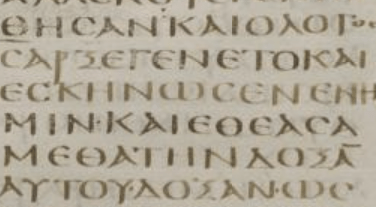
. . . και ο λογοϲ σαρξ εγενετο και εσκηνωϲεν εν η μιν · και εθεασα μεθα την δοξα αυτου . . And the Word became flesh, and tabernacled among us, and we beheld his glory,  . . From the early 4th century manuscript of John in the manuscript in the British Library known as Sinaiticus.

I suppose if we were to sum up the story in one sentence, it is that in Christ Jesus the Creator is recreating the world. What God created in the beginning, and which he saw as being very good, is not now quite what it was created to be. We humans are fallen, sinful, fragile, and predisposed to do the wrong thing, even when we know what the good is. All have sinned and fallen short of the glory of God. Having dug a hole that we cannot get out of, Jesus as the Son of God is sent by the Father so that we might be lifted up and restored, forgiven and empowered by the Holy Spirit. While we are not quite there, we are building Jerusalem here among these dark, satanic mills.

Where is the intersection?

Where do we find that our story intersects with God’s story? How does God’s story relate to the ups and downs of the story of the church, and to the story we tell ourselves about St Thomas’s, Kefalas? This is the work for the next two weeks. May God bless us as we continue to pray and reflect, may God grant us a vision for you, for me, and for us and this congregation.

Posted in Crete, Sermons | Tagged , , | Leave a comment

A Common History

A Sermon Preached On
The Feast of All Saints and All Souls (transferred from November 1 & 2),
Sunday, November 3, 2019, 11:00 am
also being The Second Sunday in a Season of Visioning
at the Anglican Church of St Thomas, Kefalas, Crete, Greece

Readings: Daniel 7:1-3, 15-18, Psalm 149, Galatians 4: 12-20, and Luke 6: 20-31.
Key Questions: What is the story of the church? What is the story of this church?

Last week we began our Season of Visioning here at St Thomas. We will spend four Sundays with special readings and me preaching, and then on December 1, the First Sunday of Advent, beginning of the new church year, we will have an extended service in which we begin to work on what our vision is, and then what our mission is.

In our first service in this Season of VisioningI suggested that we begin with our own stories – our individual journeys in life, our pilgrimages in faith. This week I want to talk about the story of the church, or the story of our community. Next week we’ll talk about the story of God, and begin to reflect on how these three types of stories intersect.

Three Stories - Us, Our, God's

Here again is the diagram of these stories. As we see, there are point where two of the stories intersect, and where the set of all three overlap. We will find our vision and mission in the overlap of all three.

What is our story – the story of the Church?

To answer this question I can only give a caricature. Diarmuid MacCulloch, in his A History of Christianity, took 1216 pages to cover it. And, of course, arguably it is much longer than the two thousand years since the time of Jesus of Nazareth, as the subtitle of McCulloch’s book suggests: The First Three Thousand Years. We cannot understand Christianity and the Church unless we see it as a development from 1st century Judaism, which itself was a development of the Israelite religion that was already over a thousannd years old.

While Jesus was actually born somewhere around 1 CE (most likely 6 BCE), and died some thirty years later (best guess – 30CE), the history of Christianity requires a knowledge of the story of Israel and Judaism, which pushes us back another another millennium (more like 1400 years).  When I was at the Toronto School of Theology in the mid ’80s just an introduction to the history was covered in four thirteen-week courses. And while history is involved with people, events, and the forces that swept them along in time, there is also the consideration of the history of the scriptures, the development of its interpretation over time, the history of various institutions in Christendom that may or may not be explicitly religious, and so forth. It’s a big, long story. But let’s try and summarise it in a few paragraphs, shall we?

The simple character of this story may be found in Acts 1.8:

But you will receive power when the Holy Spirit has come upon you; and you will be my witnesses in Jerusalem, in all Judea and Samaria, and to the ends of the earth.

The story is that of the good news of Jesus spreading from Jerusalem to the ends of the earth.

In the Acts of the Apostles the story begins in Jerusalem and ends in Rome, which, as the centre of the Empire, paradoxically stands in for the farthest reaches of human habitation. The good news is challenged and persecuted, but continues outwards. It is a simple but powerful story. That said, even in the New Testament – the letters, Revelation, and reading between the lines to see the situation of the people who wrote the gospels – the narrative is more complex:

  • At first it made its way into Judea, the area around Jerusalem.
  • Then to Samaria, to the north, and into Galilee.
  • We hear of an Ethiopian receiving the good news from Philip while driving a chariot, and presumably he takes it south via the Nile River.
  • When Paul comes to Damascus there are already Christians there, the faith having been brought there by people whose names we know not.
  • Likewise both Paul and Peter are early members of the church in Antioch, in the southwest of what is now the part of Turkey bordering Syria, whose foundation also seems anonymous.
  • At a certain point quite early on, the gospel is preached to non-Jews and readily accepted by many of them. Paul sees himself as specially sent to tell them that, in Christ, they may be grafted as wild branches onto the sacred vine of Israel. This exception, that Gentiles may be saved as well without becoming Jews, is opposed by more conservative Jewish Christians in Jerusalem and Antioch.
  • As we heard in the readings today, Paul starts a church in Galatia, in what is now the middle of Turkey, pretty much by accident. He states that he, Paul, fell ill while travelling through, and is obliged to rest – but not so ill as to fail to communicate the gospel. By such accidents the good news proceeds.
  • The Letter of Titus witnesses to early Christians being here on Crete.
  • When Paul arrives in Corinth to start a church he finds Prisca and Aquilia, two Christians who were obligated to leave Rome by the emperor, presumably Nero. Thus, already, long before Paul goes there, we hear of congregations in Rome, a fact confirmed by his Letter to the Romans.

What I find most striking is that the faith was transmitted by hundreds of unknown individuals. While we celebrate Peter and Paul, the good news was propagated many whom we know at best as names, and often only by inference and guesses. From the small group in Jerusalem the church grew, so that after a couple of generations it numbered a few thousand, and had the resources and inspiration to write the gospels, preserve the letters of Paul and other authors in the New Testament. As well, there are a host of other writings from the post-apostolic age.

We know that there were Christians in the Roman province of Brittannia – what became England, Wales, and Scotland – by the fourth century. This is evident both from archaeology and written records of bishops attending synods. The Emperor Constantine was born in the Balkans, but his mother Helen was a Christian, and both were in Eboracum – better known to us as York – when he was proclaimed Emperor in 306 CE, and he began his campaign to be the sole ruler of the Roman Empire. As well, Augustine of Hippo, the greatest Latin theologian, found himself arguing in the early fifth century against the heretical opinions of Pelagius, a British Christian. Constantine’s converted to Christianity and was baptised shortly before his death,and he is venerated as a saint in Eastern Orthodoxy. Many scholars believed that his conversion resulted in the conversion of the Empire to Christianity, as if it would not have happened had he done so, but such an understanding belongs to an older historiography. The American sociologist Rodney Stark and others have argued that by the turn of the fourth century (i.e. 300 CE) the Christian faith may already have been the religion of a majority of the Empire’s subjects; Constantine was following where the people went, not the other way around.

canvas

A manuscript of St Patrick’s Confessions from about about 830 CE, originally written c. 460-490 CE. From The Book of Armagh, Trinity College Library, Dublin, Ireland. Provenance: ca. 807 A.D., Armagh

In the fifth or sixth century the Christian faith reached what was thought to be the furthest ends of the earth. A young Roman Briton was kidnapped from the shores of what had recently been the Roman province of Britannia and taken to be a slave in Ireland. There he minded cattle and sheep. Being a Christian and the son of a deacon, he turned to his God, and in a vision saw a means of escape. He made his way to a port and took a ship, perhaps to Gallia (France), and then made his way home. Eventually he discerned a call to return to Ireland, to proclaim the faith to the people who had enslaved him. He was ordained a bishop by the church in Britain, and went across the sea. We have two writings from this man, whose name was Patricius, but whom we know as Patrick. In these writings he celebrates the fact that he had baptized thousands. He felt that his work of evangelism would hasten the coming of the Lord.

While pious tradition suggests that Patrick was responsible for the total conversion of Ireland, he was more likely just the best known of those who preached Jesus; because of his writings, he was remembered when others disappeared into the anonymity of time. In time Irish Christianity developed a strong culture centered on monasticism, which produced treasures such as The Book of Kells. Christianity moved north to evangelise the Picts and Gaelic speaking peoples of what later became known as Scotland. From there it moved south into the lands conquered by the Germanic-speaking invaders from the Angle, Jutland, and Saxony, and who were known as the English or Saxons. They were a polytheistic pagan people, speaking a strange language related to both Latin and Irish but unlike either. They came south through Northumbria.

68c2b80f6a254f1647912aa3ab4e1f70

The interior of the much remodelled and rebuilt St. Martin’s Church in Canterbury, Kent. The lower part of the walls are Roman.

There they met Christian missionaries from southern England, the second generation of Christians in what was now being called England. In 597 an Italian monk named Augustine came to Canterbury on a mission from the Pope. This Augustine (not the same as Augustine of Hippo) was ordained a bishop by Gregory the Great in Rome, and he and twenty other monks made their way to the capital of the Kingdom of Kent, in southeast England. King Æthelberht of Kent was not a Christian, but his Franksih wife from the Continent was, and Augustine and his companions were allowed to use an old British Christian church dedicated in honour of St Martin of Tours (it’s still there!). In time Æthelberht converted to Christianity. The monks started a monastery, and they built a wooden parish church with a seat or cathedra for Augustine. That parish church was eventually succeeded by grander buildings, and we know it as Canterbury Cathedral. Over the next two centuries Christianity made further inroads. When the pagan Norse attacked two centuries later the Christian faith was so well established that they could not dislodge it.

Fast forward to the fifteenth and sixteenth century, and Europe began to expand into the world. Christianity followed it, and the New World became effectively part of Christendom, while missions were planted in Asia and Africa. In the past century Europe seemed to take a turn to the secular, and the influence of the church on the state declined, and church attendance dropped like a rock. However, the faith grew by leaps and bounds in sub-Saharan Africa and parts of Asia. There are now more Presbyterians in South Korea than there are people in Scotland, and typical Anglican is African. There are now more than two billion Christians, and we are the largest faith group on the planet.

We must not get triumphalistic, for we have had our ups and downs. Christianity a thousand years ago was as wide-spread and prevalent through Asia as it was in Europe. The Church of the East, while always a minority among the many faiths and practices in Asis, spread through what is now Iraq to Iran, Afghanistan, and into China. In both North Africa and in Asia the Christian faith was pushed back or extinguished by various forms of Islam and Chinese religions. This was due not only because of the power of these other religious movements, but also because of the division and corruption among succeeding generations of Christian leaders.The Church has always needed reform.

As well, the history of the church is filled with stories of violence, slavery, murder, abuse, corruption, schism, genocide, and hatred. We do not have to look far to see the reason for this.  When people enter the church, they come as sinners and failures; we all fall short of the calling of the gospel. Perhaps more damning, we too often identify our native governments and cultures with the kingdom of God, justifying the very same forces that put our Lord to death.

The wonder of it all is that the high standards of the gospel and the demands for righteousness continue to ring out. As popular historian Tom Holland argues in his recent book, Dominion, what we consider to be the tenants of secular Western culture – human rights, democracy, the arts, the creation and sharing of wealth – are all derived from Christianity. If it is true, as Stephen Pinker suggests in The Better Angels of Our Nature, that the world has become less violent and more humane, then the rise of Christianity and the influence of its values has much to do with it. And, amazingly, it has inspired African-American slaves in their fight for freedom, both in the Civil War and Reconstruction, and in the 1960s Civil Rights era. It continues to inspire forces of liberation around the world.

This then is the story of the Church. It is not a simple story, and it is not a story of right overcoming evil, or progress – but it is the story of the growth.

What is our story – the story of this Church?

I asked people in the congregation what the story of St Thomas, Kefalas was. Here’s what they said (and if I have some facts wrong, pease let me know and I will correct them!):

  • It started with Tony Lane, who with his wife Suzanne, back in 2003, invited English-speaking people to their home next door for prayer and bible readings. The small Table Church grew, and in good weather, started meeting outside by the swimming pool, or in the carport.
  • After a year the group decided to formally affiliate with The Church of England’s Diocese in Europe. We came under the oversight of the Bishops of the Diocese in Europe – Geoffrey Rowell and David Hamid – and, more directly, Canon Malcolm Bradshaw of St Paul’s, Athens.
  • Tony Lane had studied some theology as a layman in Bristol. He trained as a Lay Reader, and was licensed as one in 2007. He was subsequently ordained a transitional deacon in 2009 and then a priest in 2010.
  • Canon Mike Peters from England came out in 2008 and supervised Tony’s training, while assisting the congregation in organizing itself as a proper church in the C of E.
  • Parallel to this was the development of some house groups, and Alison Collett played a leading role in the formation of these. Among other programmes, the Alpha Course was done.
  • When the congregation needed better space it tried meeting in the Kefalas community hall, but Tony decided to build a chapel on a property adjacent to his  the house. This chapel was dedicated to St Thomas the Apostle by Bishop Geoffrey in 2007. The area next to it was laid out as a patio, and after some experiments with large umbrellas, a permanent canvas tent structure was erected, with tough, plastic side-panels that could be rolled up in the summer. This was promptly christened, “The Tabernacle”.
  • Music varied over the years. Initially CDs were used, and then some people led with guitars, before we settled into using an organ. When Gina Zagni became our musician a few years ago she purchased an electric organ for use at the church services.
  • In the early years especially people would go out for meals afterwards. This helped to build up the sense of community.
  • There were some tensions between various people, as is normal in any organization. Some people left because they wanted a different style of worship.
  • Terry Wilcock served as the assistant chaplain from 2011 to 2014, and after a few months interregnum Philip Lambert succeeded him. As Philip’s wife became ill quite suddenly, he returned to England in June 2017, and there was a long interim period from then until October 2018 when Bruce Bryant-Scott was appointed. During that long period without a priest in charge, the Rev’ds Ian Brothwood and Tony Lane filled in, supported by a range of occasional clergy visiting Crete.
  • In Terry and Philip’s time “Helping Hands” began, which eventually evolved into the Social Supermarket.
  • Tony and Suzanne subdivided their property and sold their house, moving to a smaller place near Vrysses. Recently, they donated the church property and its buildings to The Anglican Church in Greece, which is the legal name for the Diocese in Europe as recognized by the Hellenic Republic. Thanks to this generous gift, we own and operate the property in which we worship.
20190630_115522516813484.jpg

Bishop David Hamid, Suffragan Bishop of the Diocese in Europe, ordains Julia Bradshaw as a deacon in June 2019. Julia is now our deacon and assistant curate. The Rev’d Frances Hiller, deacon and assistant to the Suffragan Bishop,  is holding the service booklet while the Bishop lays hands on Julia. Mr Aiden Hargreaves-Smith, Registrar of the Diocese in Europe, is behind in his solicitor’s legal robes, and the Rev’d Ian Brothwood is seated beside him.

St Thomas is typical of many church plants, going through phases of “Forming, Storming, and Norming“. We are reasonably solid, with a strong core of members and the ability to attract seasonal residents of Crete and English-speaking tourists. While we are mostly from England, we do have people attending who are Scots, Irish, American, Canadian, Greek, German, Norwegian, Armenian, and other nationalities.

What is the next chapter going to be about?

The story of St Thomas’s in Kefalas is one small part of the larger story of the Church, which is part of the larger story of humanity. It is a story of saints and sinners, of people who are legends to us, and people whom we knew. We are a young congregation in a two-thousand year old institution. We know where we come from – do we know where we want to go next? Are we open to the surprising movements of the Holy Spirit? What will be the next chapter in this story?

Next Sunday, November 10, we will take a break from the Visioning process as such to mark Remembrance Sunday down at the Suda Bay War Cemetery. We will resume in the next two Sundays after that to consider God’s story, and the story of Jesus. On December 1 we will begin to dream dreams and see visions, by trying to answer some questions about ourselves. From that I hope we will develop our vision statement.


Posted in Crete, Sermons | Tagged , , | 1 Comment