An Introduction to Levinas (Part Four)

Beyond the Polarity of Faith and Reason

polarity-beyond

A Mobius Nautilus – A compound mobius strip created out of 36 interlocking mobius strips. 3d printed out of a sintered vinyl plastic, which makes it very resilient and bendable.

Note: This is the fourth part in an ongoing commentary on Emmanuel Levinas’s essay “God and Philosophy” (1974).

4. One can, to be sure, also claim that the God of the Bible has no meaning; that is, he is not thinkable properly speaking. This would be the other term of the alternative. “The concept of God is not a problematic concept, it is not a concept at all,” writes Jeanne Delhomme in a recent book, prolonging a major line of the philosophical rationalism that refuses to receive the transcendence of the God of Abraham, or of Isaac and Jacob, among those concepts without which there would be no thought. That which the Bible raises above all comprehension has here not yet reached the threshold of intelligibility!

The problem that is posed, consequently, and which shall be out own, consists in asking ourselves whether meaning [Ie sens] is equivalent to the esse of being; that is, whether the meaning which, in philosophy, is meaning is not already a restriction of meaning; whether it is not already a derivation or a drift from meaning; whether the meaning equivalent to essence-to the gesture of being, to being qua being-is not already approached in the presence which is the time of the Same. This supposition can only be justified by the possibility of going back, starting from this allegedly conditioned meaning, to a meaning that would no longer express itself in terms of being, nor in terms of beings. We must ask ourselves whether, beyond the intelligibility and the rationalism of identity, of consciousness, of the present and of being-beyond the intelligibility of immanence-the significance, the rationality, and the rationalism of transcendence are not themselves understood. Our question is whether, beyond being, a meaning might not show itself whose priority, translated into ontological language, will be called prior to being. It is not certain that, going beyond the terms of being and beings, one necessarily falls back into the discourse of opinion or of faith. In fact, while remaining outside of reason, or while wanting to be there, faith and opinion speak the language of being. Nothing is less opposed to ontology than the opinion of faith. To ask oneself, as we are attempting to do here, whether God cannot be uttered in a reasonable discourse that would be neither ontology nor faith, is implicitly to doubt the formal opposition, established by Yehuda Halevy, and taken up by Pascal, between, on the one hand, the God of Abraham, Isaac, and Jacob, invoked without philosophy in faith, and on the other the god of the philosophers. It is to doubt that this opposition constitutes an alternative.

a) In this fourth section of the essay Levinas contemplates a standard polarity between rationality and faith. Philosophers such as Jeanne Delhomme[1] call into question the very intelligibility of God, declining to call it even a concept. Others are less critical of faith, but do see a true difference. Levinas invokes Yehuda Halevy (also spelled Judah ha-Levi) (1075-1141) as the Jewish philosopher from Spain who first posed the opposition. He also refers to Blaise Pascal, the 17th century Christian mathematician, physicist, and theologian from France. The rationalists (Rene Descartes, Baruch Spinoza, Gottfried Liebnitz) attempted to understand God by reason alone, but in so doing did not arrive at the God of either Judaism or Christianity, but a deity that at best was conformable to monotheism. The empiricists (John Locke, David Hume) believed that our knowledge of the world was based upon experience and habit; while Locke accepted that we might be able to have an empirically based belief in God, Hume did not. Kant tried to overcome the split between rationalism and empiricism by demonstrating through the antimonies that certain opposing propositions  (such as the existence/non-existence of God) cannot be ascertained by either reason or experience.

b) Levinas deals with this by calling into question the polarity. As will be seen as he develops the idea in the rest of the essay, he reinserts the concept of transcendence into human discourse as something which disrupts the hegemony of reason. Philosophers,  by defining “meaning” as that which emerges from the gesture of being as an essence, have predermined the outcome of their investigations by restricting the meaning of “meaning”. So Levinas asks: Is there meaning prior to being?

c) Levinas here describes what he about to do – asking about a priority of meaning that is prior to being – as a translation into ontological language. The translation here is twofold, I think. First, it is that translation of the transcendence of the God of Abraham, Isaac, and Jacob into terms that do not require an adherence to Judaism or any other religion. In other words, his translation is not a Jewish philosophy, but something of universal significance. The other way in that it is a translation is that it is a movement from the “Saying” to the “Said”, about which he will elaborate later in the essay.

d) Levinas suggests that faith and opinion in fact speak the language of being, that it is not as opposed to philosophy as Halevy and Pascal and so many others suggest. This is a consequence of his thinking around the Saying and the Said. Human speech is always a “thematization” of something, and that thematization presumes the language of ontology. For Levinas this is just an observable fact, and the role of philosophy is to deconstruct the overwhelming claim of ontology in favor of what is prior to being, namely ethics. In the same way that the later Wittgenstein saw the role of philosophy as untangling us from the bewitching of language, so Levinas sees his meta-ethics, only with higher stakes.

e) An example of “thematization” might be to consider the word “tool” much as Wittgenstein does in Philosophical Investigations. We use the word “tool” all the time and we might even have a definition in our mind that is pretty close to the dictionary entry. A philosopher might call this the “essence” of what a tool is. A Platonist would suggest that there is an ideal form of toolness that exist independently of any particular tool and is in some sense more real than material tool. An Aristotelian would suggest that “tool” is just an abstraction from the tools in the world, and it is a name. Wittgenstein would say that all of this is misleading. The meaning of the word “tool” is defined by its use within a particular form of life. It will have many uses and many types of application, and there is a family resemblance between the uses. It is neither an ideal form nor an abstraction, but an item we use in human communication. we know we have used the word correctly if the other person responds in the expected or desired way. For Levinas the “thematization” takes place when a philosopher takes a word out of its polyvalent usage and sees it as an ideal, as an abstraction, as a definition, as an essence, or some kind of gesture of being.

f) Levinas always distinguished between his philosophical texts and what he called his “confessional writings”. Although he claimed to be no expert, he studied the Talmud extensively in the 1950s and became a noted expositor in his annual Talmudic Readings at gatherings of French Jewish Intellectuals. He also commented on any number of other Jewish topics, as well as the relation of Judaism to Christianity. In his confessional writings Levinas suspended any philosophic reservations and engaged in issues, usually in the spirit of argumentation found in the Talmud. Levinas always related the practice of the Jewish faith to ethics, and was not overly concerned with the ontology or epistemology of what was in the Bible or the Talmud. He recognised that the language which he received had these ontological propositions, but what was more important was how the transcendence of God and of the other person disrupted those propositions. This led him not to a God hat was a mere negation of these propositions (which would be nothing, a nihilistic conception of the divine) but to the true significance of the disruption, which is ethical. While Levinas would not say that one has to be religious in order to be ethical, In his own life he lived out his ethics in a religious mode.

[1] Jeanne Delhomme (1911-1983) was a Professor of Philosophy at Université de Poitiers (1957-1969), and Paris X- Nanterre (1970-1981), where she was in both places a colleague of Levinas.

Posted in Levinas, Philosophy | Tagged , , | Leave a comment

An Introduction to Levinas (Part Three)

A Destruction of Transcendence

destroyed-church

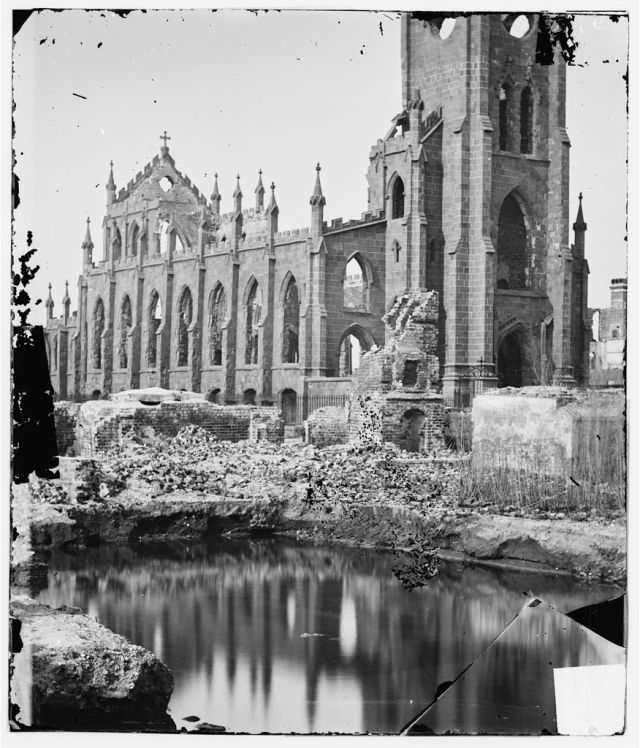
Roman Catholic Cathedral of Saint John and Saint Finbar, Charleston SC, USA, destroyed by a fire in 1861. Picture taken in 1865 after bombardment of the city by the US Navy.

3. Philosophical discourse must therefore be able to embrace God of whom the Bible speaks – if, that is, this God has a meaning. But once thought, this God is immediately situated within the “gesture of being.” He is situated therein as a being [etant] par excellence. If the intellection of the biblical God-theology-does not reach the level of philosophic thought, it is not because theology thinks God as a being without making clear to begin with the ‘being [être] of this being,” but because in thematizing God, theology has brought him into the course of being, while the God of the Bible signifies in an unlikely manner the beyond of being, or transcendence. That is, the God of the Bible signifies without analogy to an idea subject to criteria, without analogy to an idea exposed to the summons to show itself true or false. And it is not by accident that the history of Western philosophy has been a destruction of transcendence. Rational theology, fundamentally ontological, endeavors to accommodate transcendence within the domain of being by expressing it with adverbs of height applied to the verb “to be.” God is said to exist eminently or par excellence. But does the height, or the height above all height, which is thus expressed, still depend on ontology? And does not the modality that this adverb asserts, borrowed from the dimension of the sky stretched above our heads, govern the verbal sense of the verb “to be,” to the point of excluding it – as ungraspable – from the esse that shows itself, that is to say, that shows itself as meaningful in a theme?

Note:  In this Introduction to Levinas I intend to go paragraph by paragraph through his essay “God and Philosophy” and to make comments on it. This will be a long series! I will assume that you’ve scanned over the previous sections.

a) Levinas continues his brief description of Western philosophy by introducing the God of the Bible. Being Jewish he naturally means the God of the Torah, the Prophets, and the Writings, as interpreted and argued about by the Talmud. However, he uses the ambiguous phrase “God of the Bible” to also include the Christian Bible of the Old Testament and the New. The God being discussed here is not the incarnate Word or the Holy Spirit. God is presented in the Bible as a transcendent being – uncreated, powerful, creator, source of laws and instruction. However, the minute philosophy gets its hands on the divine it begins to destroy this transcendence, to domesticate it in terms of being.

b) Does “God” have a meaning in philosophy? Logical positivism would, of course, say that it is meaningless, as it is unverifiable by empirical evidence. However, that’s not the point that Levinas is making here. Rather, following on the previous paragraph the term or idea would only have meaning if it can be thought, if it is inherently intelligible, if it can be situated within the gesture of being.

c) Historically there were two approaches to this. Duns Scotus argued that anything that might be said of God might also be said of things in creation. Thus, if God is good and a person is good, the word “good” has the same meaning, although there may be a difference in degree. On the other hand Thomas Aquinas would have said that what can be said of both created things and God are analogous; if a person is good it is because that persons’s goodness participates in the goodness of God, but they are not the same thing. Thus, when it comes to “being”, the being of a creature is like the “being” of God, but it is not the same thing.  For Duns Scotus, who holds to the univocity of being, they are the same thing.

d) Now, Aquinas works hard to demonstrate that we cannot really know God. As creatures we are limited, and God’s being is unknowable to cognition, but it can be known by a beatific vision that is beyond words. Aquinas, then, does allow for transcendence. For more on this see Analogy in Theology.

e) Levinas describes the general trend of Western Philosophy as a destruction of transcendence. Philosophy takes God as a theme and absorbs it into its discourse, and in so doing cuts it off from its Biblical roots, where transcendence is repeatedly affirmed. In the Reformation analogical theology ceased to be practiced, and the existence of God is affirmed by using adverbs such as “par excellence” and “eminently” – but even those words suggest a height that is transcendent. Thus there is always a hint in the philosophy discourse of God that there is something that escapes the grasp of being, that is otherwise than being, or beyond essence.

f) The problem with theology, as Levinas sees it, is that it is fundamentally ontological. Now, Levinas was not an historian of medieval theology, and probably did not understand the nuances of Thomist theology. However, the idea of the Summa Theologica – that one begins by proving the existence of God in a variety of ways and then moving on – was an ontological starting point that Levinas could not accept. For him a proper metaphysics does not start with being and existence, but with ethics.

g) The problem with philosophical discourse of the type that Levinas describes is that it is totalizing. Levinas took his critique of totalizing thought from Franz Rosenzweig (1886-1929) and developed it in Totality and Infinity. In a lecture in 1959 he summarised Rosenzweig this way:

Thales assertion that `everything is water’ is, according to Rosenzweig, the prototype of philosophical truth. It denies the truth of experience, reducing dissimilarities, saying what all reality encountered is fundamentally, and incorporating all phenomenal truth into this Whole.

Everything, in fact, for ancient cosmology, is reduced to the world; for medieval theology, to God; for modern idealism, to man. This totalization culminates in Hegel: beings acquire meaning only from the Whole of history, which measures their reality and encapsulates men, states, civilizations, thought itself and thinkers. The person of the philosopher is reduced to the system of truth of which the person is but a moment.[1]

h) For Levinas, this is not an abstract issue. He believed that Heidegger’s ontology in Being and Time led to him adopting the goals and aims of Nazi Germany. For Levinas ontology supports war, violence, and the degradation of the individual:

The visage of being that shows itself in war is fixed in the concept of totality, which dominates Western philosophy. Individuals are reduced to being bearers of forces that command them unknown to themselves. The meaning of individuals (invisible outside of this totality) is derived from the totality. The unicity of each present is incessantly sacrificed to a future appealed to to bring forth its objective meaning. For the ultimate meaning alone counts; the last act alone changes beings into themselves. They are what they will appear to be in the already plastic forms of the epic.[2]

i) Levinas sometimes said that in his philosophic work he was trying to translate Hebrew into Greek. What he meant by that was that while knowledgeable and aware of the discourse of western philosophy (which started with the Greeks) he intended to disrupt its totalizing trend with transcendence (which he finds in “the God of the Bible”). However, his philosophy is not a Jewish philosophy or a Judeo-Christian philosophy, much less a theological sheep in a philosophical wolf’s clothing. Rather, he is critiquing the ontological discourse of the past 2500 from within that tradition. This gets developed later in the essay.

[1] Emmanuel Levinas, “`Between Two Worlds’ (The Way of Franz Rosenzweig)” from a lecture originally given September 1959, in Difficult Freedom, Essays on Judaism translated by Seán Hand (Baltimore MD: The Johns Hopkins University Press, 1990), pp. 181-201, p. 188.

[2] Levinas, Totality and Inifinity, p. 21-24.

Posted in Levinas, Philosophy | Tagged , , | Leave a comment

An Introduction to Levinas (Part Two)

ape-hand-reaching-out

The Gesture of Being

2. This dignity of an ultimate and royal discourse comes to Western philosophy by virtue of the rigorous coincidence between the thought in which philosophy stands and the reality in which this thought thinks.For thought, this coincidence signifies the following: not to have to think beyond that which belongs to the “gesture or movement of being [geste d’etre]”; or at least not to have to think beyond that which modifies a previous adherence to the “gesture of being,” such as ideal or formal notions. For the being of the real, this coincidence signifies: to illumine thought and what is thought by showing itself. To show itself, to be illumined, is precisely to have a meaning; it is precisely to have intelligibility par excellence, underlying any modification of meaning. Consequently, it is necessary to understand the rationality of the “gesture of being” not as an eventual characteristic that would be attributed to it [the gesture of being] when some reason comes to know it. Intelligibility is precisely that a thought might know the rationality of the gesture of being. It is necessary to understand rationality as the incessant upsurge of thought driven
by the energy of the gesture of being or by its manifestation, and we must understand reason starting from this rationality. Meaningful thought, thought of being: these would be pleonasms and equivalent pleonasms, justified, however, by the vicissitudes and privations to which this identification of the thought of the meaningful and of being is exposed de jure. (Emmanuel Levinas, “God and Philosophy” (1974))

Note:  In this Introduction to Levinas I intend to go paragraph by paragraph through his essay “God and Philosophy” and to make comments on it. This will be a long series! I will assume that you’ve scanned over the previous section.

a) This is the second section and third paragraph of the essay. As mentioned before, Levinas is describing the position which he wants to critique. Here he gets deeper into it. The position is essentially that of Heidegger.

b) In the first sentence Levinas states that Western philosophy sees a coincidence between “the thought in which this philosophy stands and the reality in which this thought thinks.” What does this mean? The rest of the passage helps to clarify.

c) The theory which Levinas will eventually criticize is description of being as being inherently meaningful and intelligible. Phenomena is not observed and then represented to us within our minds with intelligibility somehow added. Rather, an aspect of the world is shown to us, disclosed to us already with meaning. We can only think about those things that are already intelligible.

d) Levinas suggests that this approach sees human consciousness as driven by the energy of the gesture of being, and that the recognition of the intelligibility is a recognition of rationality, from which reason is derived.

e) This view turns Descartes upside down. Descartes abstracts himself from the world by a radical skepticism, and is driven in meditation to conclude that the only certain thing is that he, as a thinking thing, exists. Thus he relies on reason to build up the foundation of his philosophy and world. The view that Levinas is describing instead sees thought emerging from an engagement with an already meaningful world. Heidegger avoids the problems of Descartes that set up the developments of Empiricism and Rationalism down to the synthesis of Kant by dispensing with radical skepticism and describing what it is to be a conscious being in the world.

f) Levinas, still in a Heideggerian mode, describes “meaningful thought” and “thought of being” as “pleonasms”. A pleonasm is created when one uses two or three words when one will do; it is an inherently redundant phrase. Examples might include, “book filled library”, “tall skyscraper”, positive yes”, or “spiny vertebrate”. The extra words do not actually add to our knowledge of the subject, although they might act rhetorically to create emphasis or sound quality. “Meaningful thought” is a pleonasm in that all thought is meaningful, and if something is meaningful it can be thought. In “thought of being” likewise anything that is thought is a thought about being, and anything that is part of being can be thought. Levinas also seems to suggest that “Meaningful thought” and “thought of being” are equivalent in pleonastic meaning; both say in more words than is necessary the same thing.

g) We need to be careful that we do not attribute to this Heideggerian view that the meaning is necessarily the same for all conscious beings. Language can cover up the being of some phenomenon. To get at the truth of a phenomenon will usually require the exercise of a science of interpretation. This science of interpretation is called hermeneutics. If one does not have a good system of analysis for interpretation then one will indeed subject “meaningful thought” and “thought of being” to any number of “vicissitudes and privations”. Indeed, this is more common, which is why Levinas suggests (in a very sad joke) that this happens de jure, as if by law. True being is normally concealed. The philosophical method of phenomenology, as initiated by Husserl and continued in modified modes by Heidegger (and Levinas) seeks to uncover these truths from being hidden or buried. Phenomenology does not ask abstract questions about, “How do we know?” or “What is real?” Instead it but assumes that we are already in a meaningful world, and that we already have an understanding and concern for being/existence. The real questions, determined by attention to the content of the phenomena of consciousness, is to ask what are the conditions and forms for knowledge of the real; these are “the ideal or formal notions” of the gesture of being.

h) “Being” here is not something that is added on to something else, and it is not something abstracted from individual beings. Being is not a property, nor is it a category. Rather, as conscious beings we live in the world, and everything we do and think presumes being. Being is self-evident – I am here in this place at this time, and I am listening to this music and feeling this way and writing on this laptop. Even the way in which being is hidden or buried or is inauthentic makes use of being. Being is not something “other” than anything else, it is the precondition for considering any thing.

i) I may well have misinterpreted Heidegger here (he can be a bit slippery), and I may have misunderstood Levinas (he can be even more slippery), so I welcome corrections, objections, criticisms, and on-topic expostulations.

Posted in Levinas, Philosophy | Tagged , , , | Leave a comment

An Introduction to Levinas (Part One)

Emmanuel Levinas

A Commentary on “God and Philosophy”

The writings of Emmanuel Levinas (1906-1995) are difficult, whether in the original French or in translation. I’ve been asked innumerable times where one might begin with him. I don’t recommend starting with his book-length texts, whether Totalité et Infini: essai sur l’extériorité (1961; Totality and Infinity: An Essay on Exteriority) or Autrement qu’être ou au-delà de l’essence  (1974; Otherwise than Being or Beyond Essence). Rather, one might begin with one of his essays. I used to suggest the essay “Philosophy and the idea of the Infinite” as found with commentary in To The Other: An Introduction to the Philosophy of Emmanuel Levinas by Adriaan Peperzak. I used to think that it was the best, but now I am not so sure. The problem with this essay is that it is from the early middle time of Levinas’s philosophical writing, from 1957.  Totality and Infinity is an expansion of the ideas in that essay, but following a major critique from Jacques Derrida Levinas reformulated the ideas in Otherwise than Being. In my experience many commentators and many of those trying to make use of Levinas have never got past Totality and Infinity to the more nuanced ideas in the later works.

So I’ve now concluded that the best introduction is actually an essay from 1973-1974, published around the same time as Otherwise than Being. The essay is titled “God and Philosophy”. It is a lecture he gave four times in Europe while he was a Professor of Philosophy at the Université Paris-Sorbonne, and when he was in his late sixties. It reflects his mature thought, and is his most direct response to Derrida’s critique. It’s not a long paper, but it is dense. What I would like to do over several posts is put up a bit of text and then offer some comments.


The Priority of Philosophical Discourse, and Ontology
I. “Not to philosophize is still to philosophize.” The philosophical discourse of the West asserts the amplitude of an all-inclusiveness [englobement] or an ultimate comprehension. It compels every other discourse to justify itself before philosophy. Rational theology accepts this vassalage. If, for the benefit of religion, it pulls out some domain over which the supervision [contrale] of philosophy is not exercised, then this domain shall have been, on good grounds, recognized as philosophically unverifiable.

a) Levinas begins the essay in a characteristic way, which is to consider something that is the opinion of someone else  and then demolish it. Thus, the reader should be aware that this first section is NOT what Levinas himself believes.

b) The title of this section denotes the position he wants to critique. He does not believe that philosophical discourse is foundational or prior to all other types of discourse. This is exactly the claim that is often made by philosophers (not so much now, but certainly in the past). While this goes back to Plato and Aristotle and folks who write books about “First Things” it was also characteristic of modern philosophy, beginning with Descartes who wanted to find an Archimedian point of certainty from which he might build knowledge.

c) For Levinas modern philosophy is preeminently Martin Heidegger(1889 -1976), with whom he studied in 1928-1929 in Freiburg, Germany while working on his PhD on Edmund Husserl at the University of Strasbourg. Heidegger’s best known work, Being and Time had just come out, and Levinas devoured it and became known as an interpreter. Heidegger called his approach Fundamental Ontology; “ontology” is simply a word derived from Greek meaning “words about being/existence”, and for Heidegger the interesting thing about human existence is that we are concerned about existence as such (in a way that, presumably, a tree or a turtle is not).  Now, Heidegger a few years later joined the Nazi Party and sought to use fundamental ontology to ground the ideology of the National Socialism. Levinas, a Jew born in Russian Lithuania and a naturalized French citizen, was horrified, and began to question his attitude to Heidegger’s philosophy.

d) The first sentence is attributed to Aristotle (384 BC – 324 BC) and is apparently from an early work called Protrepticus that only exists in fragments. The basic point is that one cannot escape philosophy, understood by Aristotle as a rational investigation of some matter. Even when one does not do philosophy as an explicit subject, one has a philosophy standing behind it. To argue against doing philosophy, one must philosophize. Philosophy, then, is inescapable.

e) However, Levinas is not addressing Aristotle, but Jacques Derrida (1930 – 2004) who in 1964 published the essay “Violence et metaphysique: Essai sur la pensée d’Emmanuel Levinas” (translated by Alan Bass as “Violence and Metaphysics: An Essay on the Thought of Emmanuel Levinas” in Writing and Difference (Chicago: The University of Chicago Press, 1978), pp. 79-153.). In his very sympathetic critique Derrida quotes this fragment of Aristotle, arguing that Levinas claims to be leaving Heideggerian ontology in Totality and Infinity, but because of the necessity of expressing his thought in language he is actually unable to remove himself from the grasp of this type of philosophy.

f) Levinas clearly thought long and hard about this critique, and in a series of essays that were eventually recast as Otherwise than Being he tries to describe in  words what is prior to philosophy and meaning; the essay “God and Philosophy” incorporates and summarises this approach.

g) Levinas speaks of “the philosophical discourse of the West”. By this he means philosophy as it was normally taught in the 19th and 20th century, finding its roots in Greek philosophy and continuing with the Rationalists, the Empiricists, Kant, Hegel, Idealism, bouncing off of Nietzsche and down to Henri Bergson, Edmund Husserl and Martin Heidegger.  He seems to know little about the analytical tradition that dominated the second half of the 20th Century in English speaking world, whether logical positivism or the later Wittgenstein.

h) As he says, philosophy does indeed claim a universal comprehensiveness by virtue of its analysis and standards of rationality. If theology is to be rational, it must submit itself to philosophy. If theology claims a non-rational domain, then philosophy will simply have to be agnostic about those claims.

Posted in Levinas, Philosophy | Tagged , | Leave a comment

“Dear God. I am so lonely.” A response to Doug Coupland

Like 465,000 other people, I follow Douglas Coupland on Twitter. I like his writing. He remains best known for his first novel Generation X (1991), and I figure I have read at least seven of his novels and non-fiction works. Apart from his writing he is also an artist and a designer, and I appreciated his 2014 exhibit everywhere is anywhere is anything is everything at the Vancouver Art Gallery. In 2011 I attended an exhibit, also at the Vancouver Art Gallery, where he was one of three artists who engaged with Emily Carr. Coupland supports the Terry Fox Foundation and wrote The Book on that great Canadian. He is thoughtful, funny, creative, and a good observer of modern society. He’s a good guy.

On January 25 of this year (2017) he offered this tweet:
lonely-doug
As you can see, 275 people “liked”this post, 55 retweeted it, and 182 responded. Many of the responses were comments thanking him for his writing; Many more were invitations for coffee and dinner from all over the world. People were reaching out and offering care. My reply was this:
response-1
If you follow the link it takes you to the pet adoption page of the Vancouver branch of the BC SPCA. This probably reflects more about me than any need on the part of Coupland, as my dog died in the beginning of December, so I am feeling a little lonely as well.

Honestly, my first reaction was uncertainty. Was this Coupland speaking in his own voice? Was this some kind of quotation from a character in one of his novels, representing the zeitgeist of our technological era? I wasn’t sure, but I took it at face value and replied as I did. I’ll assume that Coupland read my reply, but I have no idea if he followed the link, much less got a pet (for all I know he already has two dogs, three cats, a parakeet, and a breeding pair of Vancouver Island marmots).

Today Coupland posted this:
coupland-ft-article
The link leads you to a column that he writes for the Financial Times. The article is a personal essay about identity in general and his in particular. He starts by saying that he once identified himself as “Moi” which an American did not understand and asked “Who is this Moy?”. He writes in the article, “Hi. I’m Moy and I never write about myself,” and then proceeds to write about himself, more or less for the first time in thirty-five years of publishing. The autobiographical, confessional style of Augustine never appealed to him before, but he felt moved to do so in this short column. He writes about his ambivalence about fame,  and giving interviews, and change. Towards the end he writes that he became single six months ago after twenty years of being in a relationship. This created a sense of isolation and loneliness which was not helped by new technology. He writes:

The past half year has been a series of nothing but crises for me, one after the other, and that’s life, so I’m not complaining. But what has surprised me is that the past half year has left me unsure if I believe in God and I wasn’t expecting that. All of us want the universe to be more than a cold dark void filled with frozen planets, dark matter and space junk. It has to be. To this end I felt the need to howl out into The Void, and so a few days back around 11am Pacific time I put a tweet on Twitter saying: “Dear God. I am so lonely.” I did this because I genuinely am so lonely — and also because sometimes we all need to howl.

What is nice is that The Void howled back, and The Void is not a void. I may be unsure about God but The Void is all of those Moys out there who wrote back to me, Moys who insist our lives have meaning, all those Moys who want you — me — and all of us to know that we are all real and that we will all, in some way, live for ever. And I wasn’t expecting that.

This got my attention. When a keen observer of modern society muses about God, as Coupland has, I tend to yake note. But he’s also commenting on how “The Void” – how some of the people following him on Twitter – replied with compassion and care.

To today’s twitter post I replied:
response-2
Twitter doesn’t allow for expansive explanations, so let me do that here.

Emmanuel Levinas (1906-1995) was a philosopher born in Lithuania under the Russian Empire and moved to France for university, where he became a naturalized citizen, and eventually a professor at the Sorbonne. He wrote two major books, Totality and Infinity: An Essay on Exteriority (1961) and Otherwise than Being, or Beyond Essence (1974). He argues that philosophy needs to start with ethics, instead of the usual entry points of epistemology, or metaphysics, or theories of being. Levinas describes the self as being in an asymmetrical relation with others. He makes it very personal – I, who am sitting here, have a an ethical obligation towards you, whose “face” is before me. I may respect that obligation and act, or I may choose not to, but the action that flows has an ethical nature. Levinas believes that this obligation is infinite, because the face of the other transcends my ability to know it. It has a profound height that creates a sense of awe, and a demand for a reply.

When Copeland posted his first tweet about being lonely it was addressed to God in form, but was communicated to his followers on Twitter. They felt compassion and an inclination to respond. This is really interesting, because none of these people presumably had any “need” to do so. I suspect that most of them do not know Coupland personally, but they heard a cry for help and they responded with, “Here I am”, inviting him for company and fellowship. And clearly it met a need that Coupland felt. He howled into the Void (shades of Ginsburg!) and the Void howled back with meaning (echoes of creation, the תֹ֙הוּ֙ וָבֹ֔הוּ there, whether intended or not).

Is there a God? Levinas was an Orthodox Jew, but he was the type that looked upon the mystical with suspicion. Following Kant and others he did not believe that one could prove the existence of God. Following his old teacher Heidegger (from whom he diverged and critiqued significantly) he questioned onto-theology, which sees God as Being itself and/or some kind of supernatural existant. In terms of philosophy Levinas believed that the only place one can rationally discuss the divine is in terms of the height of the other with respect to the self, the infinite incomprehensibility of the other which evokes an ethical response when needs are disclosed. Thus his statement in Totality and Infinity (p. 78): “The dimension of the divine opens forth from the human face.” If you want to understand God we could begin with metaphysics, or epistemology, or one could instead just look into the face of another. What people experienced in responding to Coupland was that experience of the holy. Coupland is not divine, but our sense of needing to reply to his needs at that moment was holy.

As the prophet Micah said 2700 years ago, “What does the Lord require of you but to do justice, and to love kindness, and to walk humbly with your God?” or as James said 750 years later, “Religion that is pure and undefiled before God, the Father, is this: to care for orphans and widows in their distress”. Experiencing the divine can be as simple as holding the door for another, and it may be as complicated as sponsoring a refugee from Syria – or it may be a response to a tweet, as a self hearing a cry of loneliness. We can call it ethics, but if we believe Levinas, it is the trace of God in the world.

Posted in Levinas, Poetry and Novels | Tagged , | Leave a comment

The Christmas You Need: Choose from Five

I posted this originally around Christmas 2014, when I was on a medical leave of absence from work. It’s a sermon I’ve preached several times – once some twenty years ago in the Parish of Pender and Saturna Islands in British Columbia, then at the 2013 Christmas Eve service at the Parish of St. Mary the Virgin, Oak Bay BC, at the 2015 Christmas Eve service at St Matthias, Victoria BC, at St Dunstan’s Gordon Head in Saanich BC in 2017, and most recently at the Anglican Church of St Thomas, Kefalas, Crete. I have now retired it!

The Mystic Nativity by Sandro Botticelli, 1500,

Ah, the Christmas story. We’ve seen it in pageants, in children’s Christmas books, in movies telling the story, narrated in Christmas carols, and parodied by Monty Python and thousands of others. We think we know it.

And yet, when we actually turn to the Bible, to the New Testament accounts, we find that it is actually a number of stories that have been melded together by church teaching, theological reflection. The voices might be complementary, but they are distinct and very different.

Tonight I want to take you through not one or two Christmas narratives, but five. And I hope that as you hear about them, you may find the Christmas you need.

 Luke

  • First, Luke, chapter’s one and two. This is the story of Jesus being born in the stable in Bethlehem. Their parents are residents of Nazareth, but a Roman census requires them to travel to Joseph’s ancestral city of Bethlehem. There is no room for them in the inn, and so they bed down in the stable. Before all of this, nine months before, an angel appears to Mary, and announces to her that she has been chosen to bear the Messiah, and she consents. Later she meets her cousin Elizabeth, who is pregnant with John the baptist. John the Baptist leaps in her womb, and Mary replies with the Magnificat. This is the story of the shepherds, and the angels announcing to them the great joy of the Messiah’s birth. And so they run down to Bethlehem, see the new born child, and tell everyone about it.
  • This is a joyful gospel. It is full of hope. It is optimistic. It is a gospel for the poor of the world, the simple laborers like Mary and Joseph, and for the shepherds. This is a story in which the Holy Spirit is present, inspiring Zechariah, Elizabeth, and Mary to speak forth hymns that have been sung for thousands of years: the Beneditus, part of the Hail Mary or Ave Maria, and the Magnificat. This is the Christmas story from Mary’s perspective – the woman’s narrative.
  • This is a Christmas story for those who are marginalized, who need hope, who are looking for the Spirit of God transforming things. We see in Mary a servant of God, choosing to bear the Messiah, prefiguring the service her son would give.

 Matthew

  • Next, there is the infancy story in the Gospel according to Matthew.
  • It sounds both familiar and strange. There is no mention at first of Nazareth – Jesus’ parents appear to live in Bethlehem. An angel appears, but this time to Joseph. There is a potential scandal about Mary’s unexpected pregnancy, but the angel tells Joseph that the child has been conceived by the power of the Holy Spirit.
  • There is no Roman census, no Roman emperor, but there is King Herod, an evil man if there ever was one. Wise men, pagan astrologers come to him from the East – Persia, perhaps – looking for the newborn king of the Jews. They follow a star to Bethlehem, and offer gifts. Then Herod seeks to destroy the child, and massacres the innocent male children of the town. Joseph, warned in a dream, escapes to Egypt for a time, and eventually settles in hiding in Nazareth after Herod dies.
  • This is a Christmas for those who find the world a dark place, where even the son of God needs protection from evil for a time. It is a gospel rooted in the Hebrew Bible, and as Moses came out of Egypt to deliver his people and give the Torah, in five books, so Jesus comes out of Egypt as a second Moses, and in five major discourses later in the gospel of Matthew, the first one being the Sermon on the Mount, Jesus claims the Torah and reinterprets it for God’s people.
  • This is a gospel of continuity and transformation, rooted in ancient scriptures but pointing to the reception of the good news by non-Jews, like the Magi from Persia.

Mark

  • Maybe you don’t like these stories. They are inconsistent, as many scholars point out, and they only complement each other if you force them.
  • Maybe you just don’t like the whole Christmas thing. I know a lot of people who cannot stand it, don’t care for the virgin birth thing, and wish they didn’t have to mark it.
  • Well, there is a gospel of Jesus Christ that knows nothing about the birth of Jesus, namely the Gospel according to Mark. It has no infancy narrative, no beginning with the birth of Jesus. It starts with the proclamation of John the Baptist, when Jesus is already an adult.
  • Also, the early church did not always commemorate Jesus’ birth. Indeed, it appears in old documents only in the 3rd century, and did not become generally celebrated until the 4th. Even then there were arguments about when to do it – December 25th, or January 6th? It was all pretty arbitrary.
  • So this is the Gospel for people who struggle with church doctrines, with the artificial nature of the church calendar, and with the whole Christmas thing. You don’t like Christmas? Fine, then skip it. You have my permission.

Revelation

  • Maybe, though, you want Christmas, but maybe a new one. Well, may I suggest that you look at the Revelation to John, the last book of the Bible, in Chapter 12. Let me read to you:
  • A great portent appeared in heaven: a woman clothed with the sun, with the moon under her feet, and on her head a crown of twelve stars. She was pregnant and was crying out in birth pangs, in the agony of giving birth. Then another portent appeared in heaven: a great red dragon, with seven heads and ten horns, and seven diadems on his heads. His tail swept down a third of the stars of heaven and threw them to the earth. Then the dragon stood before the woman who was about to bear a child, so that he might devour her child as soon as it was born. And she gave birth to a son, a male child, who is to rule[a] all the nations with a rod of iron. But her child was snatched away and taken to God and to his throne; and the woman fled into the wilderness, where she has a place prepared by God, so that there she can be nourished for one thousand two hundred sixty days.”
  • A little psychedelic, eh? Here, in great allegorical language, is the story of Jesus on earth, but described as part of a cosmic battle between evil and good, between the powers of this earth and the power of God.
  • Who is the woman? Is it Mary, or is it the representation of the people of God? Who is the dragon? The evil one, or is it the Rome, with its seven hills and 10 emperors?
  • Well, I’ll let you puzzle over that. This is the Christmas story as a part of a cosmic narrative, which leads to a new heaven and a new earth. The birth of Jesus is an apocalyptic event, revealing the in-breaking of God in Christ into the world. For many of us in despair, surrendering to God and awaiting this unveiling of God’s power, this is the gospel we need. God is in control, evil will be defeated, and his kingdom will come on earth as in heaven.

John

  • Then there is the gospel of the incarnation. This is the traditional gospel for Christmas Day, even though there is no birth in Bethlehem – no wise men and shepherds, no Emperor Tiberius or King Herod, no Mary and Joseph, no stable or flight into Egypt, and certainly no dragon.
  • But it speaks the profound message that “In the beginning was the Word, and the Word was with God, and the Word was God. And the Word became flesh and dwelled among us.”
  • It is the message that God has become human, the ultimate paradox, in which God seems to no longer be God. Divinity is poured out, emptied out into humanity.
  • But the purpose of this message was summed up three centuries later by Athanasius of Alexandria, when he said, “God became human so that we humans might become divine.” This is not a kind of monism – we do not become one with God, and the absolute difference between creator and created is sustained – but as beings created in the image of God we discover, insofar as it is achievable by humans, to fulfill that being icons of the unseen God by being part of the Body of God, Jesus Christ.
  • In Christ we see the real essence of God, that God is love, and becomes one of us so that we might become more like the divine in love. In Christ we are shown what it is to be truly human, in the image of God – a servant, a healer, a bearer of good news, a lover, one who gives himself in that love for us.

So, on this Christmas night, we celebrate the Mass of Christ. Our Christmas may be that of the story from Matthew and Luke, or maybe we don’t want any story at all. Perhaps we need the profound symbols of Revelation, calling us forward to the New Heaven and a New Jerusalem, or maybe we simply need to be transfigured by Christ and his dwelling with us. However you find Christmas, may you find what you need, arrive at the destination you seek, and receive the gift of what you desire. May the birth of Jesus herald a new birth in all of us of God’s love.

Posted in Sermons | Tagged | 2 Comments

The Last Day of An Advent Calendar: Christmas Day!

Sunday, December 25, 2016     Christmas Day
Zechariah 2.10–13
1 John 4.7–16
John 3.31–36
The text of the readings follows after the comments.

sahara-nativity-scene-rock-art

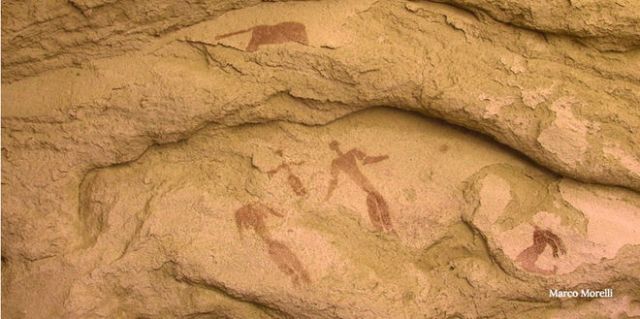
5000 Year Old Nativity Scene from the Sahara Desert http://www.livescience.com/57311-5000-year-old-nativity-scene-found.html

While I’ve been on medical leave I’ve been reading, among so many other things, The Iliad. Not in the original Greek, mind you, but in Robert Lattimore’s celebrated 1951 translation into English blank verse. While some people describe it as “the world’s greatest and  most disturbing poem” I’m finding it a bit of a slog. Not all Greek epic is this hard – the Odyssey is a much more interesting tale – but one tires of the arrogant stupidity of the brave Greeks and the irrational heroism of the Trojans. You really wish they’d just sit down and work out some compromise that wouldn’t destroy Troy and cast Greece into the dark ages. Well perhaps that’s the point, eh? Simone Weil wrote in 1940 an essay that the true subject of the poem was not heroism but force and the destruction it wreaks on both the person who wields it as well as the victim.  It’s a theme that Chris Hedges picked up in his remarkable book War is a Force that Gives Us Meaning (2003). Something that gives Weil’s approach some cogency is the fact that even the gods of Olympus seem overcome by force; Zeus rules not because of wisdom or popularity, but because he is stronger than all of the other gods and bullies and beats them into submission. The gods seem downright petty in their favours and petty arguments with each other, standing on pride and not above seduction and lies.

Then there is the God of Israel. As shown forth in Jesus of Nazareth the divine is seen as the all-mighty creator, but also as one who risks and sacrifices. If the kingdom of God is like a woman searching for a lost coin, or a shepherd searching for a lost sheep, God comes across as desperate and anxious for creation. This desperate attachment gives forth in the incarnation, a last ditch effort to reach out to humanity, to show the unshowable in human form.

This action is love. As the First Letter of John puts it today, God is love. This is not a metaphor, but rather an analogy, and what we know of love is in fact a reflection of the originary love of God that is inherent in God prior to creation. Love is the means by which we rest in God and God lives in us. People speculate about what it means to say that we are in the image of God, usually thinking it must have something to do with being a thinking creature with a mind and soul. Personally, I think it may have more to do with our capacity to love, to love God, to love people, and to love things. Love is not about possession, but about letting go while still remaining in relation. It is about surrender.

There is another well known passage in the New Testament that is about love. Paul’s 1 Corinthians 13 is often read at weddings (my mother read it at mine) and at funerals. However, the context is not that of a human couple or the life of a beloved friend, but that of a community arguing amongst itself about spiritual gifts and whether speaking in tongues makes one a better follower of Christ that others. Paul, who spoke in tongues and knew a thing or two about spiritual gifts, wrote:

If I speak in the tongues of mortals and of angels,
but do not have love,
I am a noisy gong or a clanging cymbal.
And if I have prophetic powers, and understand all mysteries and all knowledge,
and if I have all faith, so as to remove mountains,
but do not have love,
I am nothing.
If I give away all my possessions,
and if I hand over my body so that I may boast,
but do not have love,
I gain nothing.

Love is patient;
love is kind;
love is not envious or boastful or arrogant or rude.
It does not insist on its own way;
it is not irritable or resentful;
it does not rejoice in wrongdoing,
but rejoices in the truth.
It bears all things,
believes all things,
hopes all things,
endures all things.

Love never ends.
But as for prophecies, they will come to an end;
as for tongues, they will cease;
as for knowledge, it will come to an end.
For we know only in part, and we prophesy only in part;
but when the complete comes, the partial will come to an end.
When I was a child,
I spoke like a child,
I thought like a child,
I reasoned like a child;
when I became an adult,
I put an end to childish ways.
For now we see in a mirror, dimly,
but then we will see face to face.
Now I know only in part;
then I will know fully, even as I have been fully known.
And now faith, hope, and love abide, these three;
and the greatest of these is love.

When Paul wrote this passage I believe that he was speaking not of some theoretical love, like the speakers in Plato’s Symposium, but of the love which he had experienced from God in Christ. Likewise, the author of today’s reading from 1 John was also speaking of a divine love that had been poured in him through knowing Christ.

Of course, some would say that love is fine and dandy, but in the real world one has to be hard nosed and calculating. Love is for the young and dreamers, suitable for domestic arrangements, but not the basis on which to build a business, succeed in politics, or achieve anything of great significance. Don’t be naive! But at that point one is turning from God and giving in to other forces – undeniably present in the world, but often of human making, or utterly out of human control. The point about Christianity is that love is stronger than all of this.
+ It is a love which takes a small group of dejected disciples and leads them in three centuries to overcome the Empire which killed their master.
+ It is a love which inspired a host of saints over twenty centuries.
+ It is a love which propels us even now to offer refuge to peoples displaced by war and persecution.
+ It is a love that makes us want to work with the most despised people on the streets of our cities and the most forgotten in our care facilities.
+ It is a love that cares for creation and seeks to preserve it from corruption and pollution.
+ It is a love which is stronger than death.

The message of Christmas Day is that love is with us, and that we can dwell within it. May the light of the world, which is life and creation, who was born of Mary two thousand years ago, be within each of us and all whom we know, and bring us to the full reign of the one who is a servant.

—– + —–

This concludes An Advent Calendar. For those of you who have been with me on this trip, thank you for joining! God be with you.

Zechariah 2.10–13
Sing and rejoice, O daughter Zion! For lo, I will come and dwell in your midst, says the Lord. Many nations shall join themselves to the Lord on that day, and shall be my people; and I will dwell in your midst. And you shall know that the Lord of hosts has sent me to you. The Lord will inherit Judah as his portion in the holy land, and will again choose Jerusalem.

Be silent, all people, before the Lord; for he has roused himself from his holy dwelling.

1 John 4.7–16
Beloved, let us love one another, because love is from God; everyone who loves is born of God and knows God. Whoever does not love does not know God, for God is love. God’s love was revealed among us in this way: God sent his only Son into the world so that we might live through him. In this is love, not that we loved God but that he loved us and sent his Son to be the atoning sacrifice for our sins. Beloved, since God loved us so much, we also ought to love one another. No one has ever seen God; if we love one another, God lives in us, and his love is perfected in us.

By this we know that we abide in him and he in us, because he has given us of his Spirit. And we have seen and do testify that the Father has sent his Son as the Saviour of the world. God abides in those who confess that Jesus is the Son of God, and they abide in God. So we have known and believe the love that God has for us.

God is love, and those who abide in love abide in God, and God abides in them.

John 3.31–36
The one who comes from above is above all; the one who is of the earth belongs to the earth and speaks about earthly things. The one who comes from heaven is above all. He testifies to what he has seen and heard, yet no one accepts his testimony. Whoever has accepted his testimony has certified this, that God is true. He whom God has sent speaks the words of God, for he gives the Spirit without measure. The Father loves the Son and has placed all things in his hands. Whoever believes in the Son has eternal life; whoever disobeys the Son will not see life, but must endure God’s wrath.

Posted in Advent | Tagged , , | 2 Comments

Day Twenty-Eight of An Advent Calendar (Evening): Christmas Eve – Pouring Out Divinity into Humanity

Saturday, December 24, 2016 (Evening)     Christmas Eve
Isaiah 59.15b–21
Philippians 2.5–11
The text of the readings follows after the comments.

the-footwashing

Icon of the Footwashing

The reading from Philippians this evening is at the core of the third chapter in my PhD dissertation. So it’s kinda important to me.

The dissertation, which I am doing at Heythrop College, University of London, is on the theological legacy of the “Indian Residential Schools“. As Canadians are aware, from about 1880 until 1970 the Canadian federal government attempted to assimilate some 150,000 First Nations and Inuit children by apprehending them from their parents and sending the children to schools, frequently hundreds of miles from their families. They were not allowed to use their languages, practice their culture,or observe their ancient spiritual traditions. The older children were expected to work half the day. Nutritional standards were low. Mortality rates were high – in some years up to 50% of the population in some schools died. Physical discipline – caning, spanking, the strap, and worse – was used extensively for minor infractions, despite such discipline being largely foreign to the indigenous cultures. The schools were magnets for sexual predators to become members of the staff, and each predator had multiple victims. The stated purpose of the schools was to assimilate the indigenous population so that there would effectively be no indigenous people left in Canada. This fits the definition of genocide in the Convention on Genocide.

The federal government subcontracted the operation of these schools to the main church denominations in Canada at the time: Roman Catholic religious orders; Methodists, Presbyterians, and, after 1925, the United Church of Canada; Baptists; and the Anglican Church of Canada. The churches were enthusiastic supporters of these schools, believing that they were involved in civilizing mission to a savage and declining people. My dissertation asks why this is the case. While much can simply be blamed on colonial and imperialistic mindsets, I think that the churches were particularly motivated by their theology.

In the first chapter of the dissertation I develop, using the philosophy of Emmanuel Levinas (1906-1995) a critique of totalizing thought that leads to violence. At its most extreme, this leads to genocide. In the second chapter I describe the theologies of mission that informed the people operating the Residential Schools, and use the method developed in Chapter One to critique it.

Chapter Three asks if there are ANY theologies that might withstand the Levinasian critique. I offer up a theology based on Philippians 2.5-11 as one that does. This type of theology is called “kenotic theology” from the Greek word “kenosis” which means “emptying out”. I argue that a kenotic theology is more likely not to lead Christians into the kind of awful tragedy that the Residential Schools have been. The contrast between a kenotic theology and the theologies of the Residential schools can be seen as a series of opposites, including:

+ instead of power, a reliance on weakness;
+ instead of an inward emphasis upon personal salvation, an outward concern for the needs of others;
+ instead of uniformity, a celebration of plurality;
+ instead of a valorization of reason and “logical” argumentation, an acceptance of personal foolishness and the use of parabolic narrative;
+ instead of easy alliances with government, a suspicious or questioning of the state;
+ instead of some objective “Truth” being out there, authorized and promulgated, and understanding of “the Good” as reached through dialogue;
+ instead of understanding events in history as “providential”, looking for an eschatological and apocalyptic breaking of the divine into history; and
+ instead of the military metaphor of strategic deployment of resources, a spendthrift generosity that never asks if heaven can afford the cost.

This pretty much describes the mission of God in Christ. The Word made flesh comes to us not as one to be served but as a servant. The son of Mary does not run around claiming he is God or the Son of God and arrogantly overwhelms people with this datum, but instead demonstrates who is he by telling parables and healing the sick, driving out demons, and proclaiming the coming reign of God. He and his disciples subversively uses terms of the Imperial Cult like “Kingdom”, “Good news”, and “Coming” to describe what he was doing, as deconstructions of the false claims of the Emperors and the rule of the Empire. While not desiring death he accepts that being true to the calling of God leads to persecution, physical abuse, and ultimately death, even death upon a cross. But the love of God is as strong as death, and Jesus is raised up, and we who are in him are raised up with him. His early disciples (and we his later ones) sought to die to the world and then live the resurrected life as much as possible. This entailed a radical acceptance that overcame supposedly cosmic binaries of slave and free, gentile and Jew, woman and man.

On this Christmas Eve, then, as we head to “midnight masses” (or, as they increasingly seem to be, “It’s midnight in Toronto mass”), let us remember that Christmas is not just about a child in Bethlehem, but about each of us. What we think affects what we do. What theology do we have that will help us to become more like Jesus?

Isaiah 59.15b–21
The Lord saw it, and it displeased him
that there was no justice.
He saw that there was no one,
and was appalled that there was no one to intervene;
so his own arm brought him victory,
and his righteousness upheld him.
He put on righteousness like a breastplate,
and a helmet of salvation on his head;
he put on garments of vengeance for clothing,
and wrapped himself in fury as in a mantle.
According to their deeds, so will he repay;
wrath to his adversaries, requital to his enemies;
to the coastlands he will render requital.
So those in the west shall fear the name of the Lord,
and those in the east, his glory;
for he will come like a pent-up stream
that the wind of the Lord drives on.

And he will come to Zion as Redeemer,
to those in Jacob who turn from transgression, says the Lord.
And as for me, this is my covenant with them, says the Lord: my spirit that is upon you, and my words that I have put in your mouth, shall not depart out of your mouth, or out of the mouths of your children, or out of the mouths of your children’s children, says the Lord, from now on and for ever.

Philippians 2.5–11
Let the same mind be in you that was in Christ Jesus,
who, though he was in the form of God,
did not regard equality with God
as something to be exploited,
but emptied himself,
taking the form of a slave,
being born in human likeness.
And being found in human form,
   he humbled himself
and became obedient to the point of death—
even death on a cross.

Therefore God also highly exalted him
and gave him the name
that is above every name,
so that at the name of Jesus
every knee should bend,
in heaven and on earth and under the earth,
and every tongue should confess
that Jesus Christ is Lord,
to the glory of God the Father.

Posted in Advent | Tagged , , , , , | 1 Comment

Day Twenty-Eight of An Advent Calendar (Morning): The Invitation

Saturday,December 24, 2016 (Morning)     Saturday after the Fourth Sunday of Advent
Isaiah 35.1–10
Revelation 22.12–17, 21
Luke 1.67–80
The text of the readings follows after the comments.

invitation-to-managers

I’ll be doing two posts today, as the readings in the Daily Office Lectionary have one set for the morning and another for the evening. Liturgically, they are different days – a day begins, following Jewish liturgical tradition, at sunset the night before, and lasts until sunset of the next. Christmas begins this evening on the sunset of December 24, so Christmas Eve is the true beginning of Christmas. As Advent Calendars traditionally have a flap or box for Christmas Day itself, I’ll do one on the feast itself – and then I’ll be done!

—- + —-

The passage that grabs my attention today is the one from Revelation. We’re in the very last chapter of the Bible, and we read:
The Spirit and the bride say, ‘Come.’
And let everyone who hears say, ‘Come.’
And let everyone who is thirsty come.
Let anyone who wishes take the water of life as a gift.
It’s an invitation to salvation, a bidding to the New Jerusalem, a calling to change.

It’s somewhat in tension with the line a couple of verses before: “Outside are the dogs and sorcerers and fornicators and murderers and idolaters, and everyone who loves and practises falsehood.” I don’t think John here is making a clear statement about who gets in and who doesn’t – at the very least, I am guilty of lying a few time sin my life, and I know many good people who have repented of the rest of the things on this list, and I hope that they will all be called to the new life. The litany of sinners is really just a stereotyping of the kind of people who reject the Hebrew God, worship idols, and are thereby led to a multitude of sins. The people who would be excluded are those who, in spite of the invitation, are irredeemably attached to their old ways and cannot change. The invitation is a generous one – the city of the New Jerusalem is so massive it has room for every person who has ever lived – so we need to read these passages of condemnation in tension with the spendthrift love of God.

The passage from Isaiah imagines what the redemption will look like. The route from exile (whether in Babylon or Assyria) to Jerusalem is roundabout, following the fertile crescent up the Euphrates and Tigris rivers, past what is now northern Iraq and Kurdistan, skirting the modern day border of Turkey and Syria, and then south through the mountains of Lebanon to Galilee, then Samaria, then Judea. The prophet imagines a more direct route through the desert in what is now the Kingdom of Jordan, and there are flowing streams and flowering plants. Miraculous healing take place: the eyes of the blind shall be opened,
and the ears of the deaf unstopped; then the lame shall leap like a deer, and the tongue of the speechless sing for joy. In words that would influence Chapter 21 of Revelation John writes:
And the ransomed of the Lord shall return,
and come to Zion with singing;
everlasting joy shall be upon their heads;
they shall obtain joy and gladness,
and sorrow and sighing shall flee away.

So the question becomes, How do we respond to this invitation? And if we think we have responded with a yes, how then do we live this generosity in our own lives?

Isaiah 35.1–10
The wilderness and the dry land shall be glad,
the desert shall rejoice and blossom;
like the crocus it shall blossom abundantly,
and rejoice with joy and singing.
The glory of Lebanon shall be given to it,
the majesty of Carmel and Sharon.
They shall see the glory of the Lord,
the majesty of our God.

Strengthen the weak hands,
and make firm the feeble knees.
Say to those who are of a fearful heart,
‘Be strong, do not fear!
Here is your God.
He will come with vengeance,
with terrible recompense.
He will come and save you.’

Then the eyes of the blind shall be opened,
and the ears of the deaf unstopped;
then the lame shall leap like a deer,
and the tongue of the speechless sing for joy.
For waters shall break forth in the wilderness,
and streams in the desert;
the burning sand shall become a pool,
and the thirsty ground springs of water;
the haunt of jackals shall become a swamp,
the grass shall become reeds and rushes.

A highway shall be there,
and it shall be called the Holy Way;
the unclean shall not travel on it,
but it shall be for God’s people;
no traveller, not even fools, shall go astray.
No lion shall be there,
nor shall any ravenous beast come up on it;
they shall not be found there,
but the redeemed shall walk there.
And the ransomed of the Lord shall return,
and come to Zion with singing;
everlasting joy shall be upon their heads;
they shall obtain joy and gladness,
and sorrow and sighing shall flee away.

Revelation 22.12–17, 21
‘See, I am coming soon; my reward is with me, to repay according to everyone’s work. I am the Alpha and the Omega, the first and the last, the beginning and the end.’

Blessed are those who wash their robes, so that they will have the right to the tree of life and may enter the city by the gates. Outside are the dogs and sorcerers and fornicators and murderers and idolaters, and everyone who loves and practises falsehood.

‘It is I, Jesus, who sent my angel to you with this testimony for the churches. I am the root and the descendant of David, the bright morning star.’
The Spirit and the bride say, ‘Come.’
And let everyone who hears say, ‘Come.’
And let everyone who is thirsty come.
Let anyone who wishes take the water of life as a gift.

The grace of the Lord Jesus be with all the saints. Amen.

Luke 1.67–80
Then his father Zechariah was filled with the Holy Spirit and spoke this prophecy:
“Blessed be the Lord God of Israel,
for he has looked favourably on his people and redeemed them.
He has raised up a mighty saviour for us
in the house of his servant David,
as he spoke through the mouth of his holy prophets from of old,
   that we would be saved from our enemies and from the hand of all who hate us.
Thus he has shown the mercy promised to our ancestors,
and has remembered his holy covenant,
the oath that he swore to our ancestor Abraham,
to grant us that we, being rescued from the hands of our enemies,
might serve him without fear, in holiness and righteousness
before him all our days.
And you, child, will be called the prophet of the Most High;
for you will go before the Lord to prepare his ways,
to give knowledge of salvation to his people
by the forgiveness of their sins.
By the tender mercy of our God,
the dawn from on high will break upon us,
to give light to those who sit in darkness and in the shadow of death,
to guide our feet into the way of peace.”

The child grew and became strong in spirit, and he was in the wilderness until the day he appeared publicly to Israel.

Posted in Advent | Tagged , , , | Leave a comment

Day Twenty-Seven of An Advent Calendar: Jerusalem – Old, Current, and New

Friday, December 23, 2016     Friday after the Fourth Sunday of Advent
Isaiah 33.17–22
Revelation 22.6–11, 18–20
Luke 1.57–66
The text of the readings follows after the comments.

quds1

Even the road signs are contested. The Arabic name for Jerusalem, “Al Quds”, is put in brackets after the Hebraicised “Yerushalem” in Arabic.

People often ask me if I have been to the Holy Land, to visit Jerusalem, Bethlehem, and Nazareth. I never have. Many of my ordained colleagues have, and so have many laity I know. My former bishop, Bishop James Cowan, was there for Holy Week several years back. My friend and colleague Richard LeSueur lived there for three years at St. George’s College, an Anglican educational centre, and he continues to lead tours to Israel and Palestine. I am sure it is a good thing to do.

And yet I am reluctant to go. I don’t want to be just another holy tourist, visiting the sites and ignoring the present political situation. Like many people I am dismayed at the seemingly intractable conflict between Israelis and Palestinians. I support the right of the State of Israel to exist; as a matter of international law, it was created by the United Nations in 1947 as a homeland for Jews. The problem is that that same UN resolution also was supposed to create an Arab Palestinian state, but that never happened. The Arab nations of Jordan, Egypt, Lebanon, and Syria disregarded the resolution and sought to conquer the land. What territory was held by the Arab states was never given to the Palestinians to administer. The West Bank was administered as an integral part of Jordan – the Jordanian government did not recognise the Palestinians as a separate people (they later disavowed this in 1988). In 2011, the President of the Palestinian National Authority, Mahmoud Abbas, stated that the 1947 Arab rejection of United Nations Partition Plan for Palestine was a mistake he hoped to rectify.

I don’t think I could go to the homeland of Jesus and not be incredibly aware of this situation of low grade conflict. What few Anglican there are in Israel, the West Bank, and Gaza are Palestinians. The State of Israel has the upper hand with its military and security forces, and after peace negotiations that had very limited success the current government seems to have given up of further meaningful discussions. Instead, to minimise the opportunities of Palestinians killing Israelis they have built the wall between Palestinian communities and settlements in the West Bank. We regularly hear of new settlements established by Israelis in the West Bank, often ultra-orthodox Israel nationalists. These settlements are frequently considered irregular and illegal by the government, but in time they are incorporated into the rest of the nation as the wall is shifted to accommodate them. I don’t see any good solution. Neither the State of Israel or the Palestinian National Authority is well led, and opportunities for permanent peace have slipped through negotiators hands more often than we can remember.

What a contrast with the vision in Isaiah: Look on Zion, the city of our appointed festivals! Your eyes will see Jerusalem, a quiet habitation, an immovable tent, whose stakes will never be pulled up, and none of whose ropes will be broken. Jerusalem, the holy city of three faiths, is anything but a quiet habitation. Every block is contested. Every street in the old city has run with blood, going back to the conquests by the Babylonians, the Zealots, the Romans, Persians, Arab Muslims, the Crusaders, Kurdish Muslims, Egyptian Muslims, Ottoman Turks, the British, the civil war of 1947 and the Israeli War of Independence, the Six Day War, and the Intifadas.  “During its long history, Jerusalem has been destroyed at least twice, besieged 23 times, attacked 52 times, and captured and recaptured 44 times.” I’m not sure but that I would hear the bricks cry out of past traumas and injustices so often wreaked not on the perpetrators of violence but the peaceful and marginalized ordinary men, women, and children.

The Jerusalem I look for is the New Jerusalem, a city of peace, a heavenly Jerusalem that is the dwelling place of God. And yet in my hope for this and turning away from the earthly Jerusalem I wonder if there is a hint of abdication of responsibility. I don’t want to see the real Jerusalem that is on the earth and is a real city with millions of people, I feel helpless before the politics, and I just want to say, “A pox on both your houses” and get on with other things.

And yet . . .

There is the tradition that although we may not have the fullness of the New Jerusalem, we nevertheless work for it. As William Blake put it about his home and native land:
I will not cease from Mental Fight,
Nor shall my Sword sleep in my hand:
Till we have built Jerusalem,
In England’s green & pleasant Land.
The theme was picked up by British socialists in the late 19th century, culminating in Clement Attlee announcing in the 1945 General Election that he and the Labour party would build a New Jerusalem (an election which they won in a landslide, defeating Churchill and the Conservatives despite having led the UK to victory in World War II). It is still sung, to a tune by Hubert Parry, at the end of each UK Labour Party Conference. 

Tommy Douglas (1904-1986) – Baptist minister, Member of Parliament, Saskatchewan Premier (1944-1961), creator of Medicare, founding leader of the NDP (1961-1971), voted “the greatest Canadian” by a CBC show in 2004  – frequently referred to Milton’s poem in discussions and in political speeches. Indeed, his biography is called The Road to Jerusalem. Apparently as a young man he tired of other socialists spouting on about Marxist social policy without actually doing anything to help people. So he emphasised the Christian socialist perspective (which arguably is older than the Marxist one, and of which Marxism is a materialistic warping of the original). The poem by Milton caught what he wanted to do.

So. As a Christian I cannot withdraw from the world. Oh, I might do so for periods of time, to rest and prepare myself. But unless I am Amish or decide to live a monastic life, opting out of politics is not an option. God, who created this world and loves it, and who in that love sent his only son to be flesh and suffer with us on it, in order to begin its transformation, calls me and you to be part of that transformation which has begun in the resurrection, death, life , and incarnation of Jesus. So I need to be involved locally. And I might even become involved, if the Lord wills it, in the affairs of the city of Jerusalem. I cannot simply hope for a New Jerusalem while being indifferent to the current one. And by the power of the Holy Spirit, I just might be able to. To which I add my prayer, Amen. Come, Lord Jesus!

Isaiah 33.17–22
Your eyes will see the king in his beauty;
they will behold a land that stretches far away.
Your mind will muse on the terror:
‘Where is the one who counted?
Where is the one who weighed the tribute?
Where is the one who counted the towers?’
No longer will you see the insolent people,
the people of an obscure speech that you cannot comprehend,
stammering in a language that you cannot understand.
Look on Zion, the city of our appointed festivals!
Your eyes will see Jerusalem,
a quiet habitation, an immovable tent,
whose stakes will never be pulled up,
and none of whose ropes will be broken.
But there the Lord in majesty will be for us
a place of broad rivers and streams,
where no galley with oars can go,
nor stately ship can pass.
For the Lord is our judge, the Lord is our ruler,
the Lord is our king; he will save us.

Revelation 22.6–11, 18–20
And he said to me, ‘These words are trustworthy and true, for the Lord, the God of the spirits of the prophets, has sent his angel to show his servants what must soon take place.’

‘See, I am coming soon! Blessed is the one who keeps the words of the prophecy of this book.’

I, John, am the one who heard and saw these things. And when I heard and saw them, I fell down to worship at the feet of the angel who showed them to me; but he said to me, ‘You must not do that! I am a fellow-servant with you and your comrades the prophets, and with those who keep the words of this book. Worship God!’

And he said to me, ‘Do not seal up the words of the prophecy of this book, for the time is near. Let the evildoer still do evil, and the filthy still be filthy, and the righteous still do right, and the holy still be holy.’

I warn everyone who hears the words of the prophecy of this book: if anyone adds to them, God will add to that person the plagues described in this book; if anyone takes away from the words of the book of this prophecy, God will take away that person’s share in the tree of life and in the holy city, which are described in this book.

The one who testifies to these things says, ‘Surely I am coming soon.’

Amen. Come, Lord Jesus!

Luke 1.57–66
Now the time came for Elizabeth to give birth, and she bore a son. Her neighbours and relatives heard that the Lord had shown his great mercy to her, and they rejoiced with her.

On the eighth day they came to circumcise the child, and they were going to name him Zechariah after his father. But his mother said, ‘No; he is to be called John.’ They said to her, ‘None of your relatives has this name.’ Then they began motioning to his father to find out what name he wanted to give him. He asked for a writing-tablet and wrote, ‘His name is John.’ And all of them were amazed. Immediately his mouth was opened and his tongue freed, and he began to speak, praising God. Fear came over all their neighbours, and all these things were talked about throughout the entire hill country of Judea. All who heard them pondered them and said, ‘What then will this child become?’ For, indeed, the hand of the Lord was with him.

Posted in Advent | Tagged , , , | Leave a comment