Brodsky’s Epiphany: “Nativity Poem” (1989)


Brodsky

Nativity Poem
Joseph Brodsky (1940-1996)

I’ve posted this before, but its worth repeating.

Joseph Brodsky said about himself, “I’m Jewish; a Russian poet, an English essayist – and, of course, an American citizen.” Although born into a Jewish family, during the siege of Leningrad he was apparently baptized at the age of two in a country parish. He began writing poetry as a young man, and incurred the disapproval of the Soviet authorities. In 1972 he was expelled and, with W. H. Auden’s help, came to the United States. While he learned English and wrote essays in that language, his attempts at poetry in his adopted tongue were unsuccessful; he is thus known in English through skillful translations. He won the Nobel Prize for Literature in 1987. Starting in 1962 and continuing until his death he wrote an annual Christmas poem. While his own relationship to the Christian faith was ambiguous – he once joked that he was “a Christian by correspondence” – it is clear in his poems that he understood the implications of the Incarnation. He believed that “Christmas deals with the ‘calculation’ of life and the existence of the individual”. The following poem, written in Russian by Brodsky in 1989, was translated by the Irish poet Seamus Heany (himself the Nobel Prize for Literature 1995) and published in 2000 in The New Yorker.

Imagine striking a match that night in the cave:
Imagine crockery, try to make use of its glaze
To feel cold cracks in the floor, the blankness of hunger.
Imagine the desert – but the desert is everywhere.

Imagine striking a match in that midnight cave,
The fire, the farm beasts in outline, the farm tools and stuff;
And imagine, as you towel your face in the enveloping folds,
Mary, Joseph, and the Infant in swaddling clothes.

Imagine the kings, the caravans’ stilted procession
As they make for the cave, or, rather, three beams closing in
And in on the star, the creaking of loads, the clink of a cowbell;
(No thronging of Heaven as yet, no peal of the bell

That will ring in the end for the infant once he has earned it).
Imagine the Lord, for the first time, from darkness, and stranded
Immensely in distance, recognizing Himself in the Son
Of Man: His homelessness plain to him now in a homeless one.

Posted in Epiphany, Poetry and Novels | Tagged , , , , , , | Leave a comment

The Future of Orthodoxy in Greece: An Outsider’s Observations

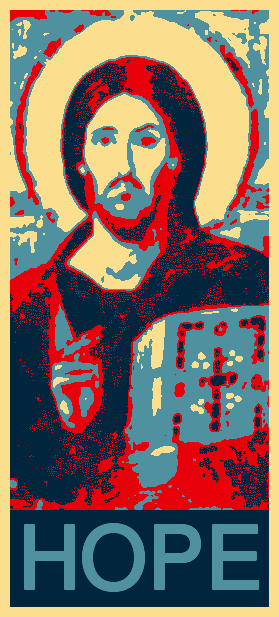
jesus-hopeIt is not by accident that I like living in Greece, A big part of it is I have an appreciation for the Eastern Orthodox Church. I own two true icons (“written” i.e. painted directly on wood, and not just photo-reproduced and pasted on). I took a course on the theology of icons when I was in Boston fifteen years ago. I love walking into Orthodox churches, reverencing the icons, lighting a candle, and saying a prayer. When I have attended Orthodox liturgies I enjoy trying to figure out what is happening. I am always impressed with the chanting of the cantors. I have studied Orthodox authors from the Syrian John of Damascus to the Russian Sergius Bulgakov. I pray using the Jesus Prayer, an Orthodox method developed on Mount Athos centuries ago. I appreciate their emphasis upon Trinitarian theology. There are a number of reasons as to why I would never seek admission to the Orthodox communion (their stance on the ordination of women being one), but I am an outsider who approves of much of what he sees.

It is a good thing I like the Orthodox church, because it is everywhere here. I can quite literally see one outside my window, and if I step outside I can see at least three more. Others are just hidden by buildings in the way. I find that this is pretty normal throughout the country. The Orthodox Church is established by law, and clergy are on the government payroll. For over a thousand years to be Greek was to be Orthodox. After the Great Catastrophe of the 1921-1922 war between Greece and Turkey the population exchanges were based not on language but religion – thus Turkish speaking Orthodox Christians were expelled from Cappadocia, where their ancestors had lived for 3000 years, and likewise most Greek speaking Muslims were expelled from the mainland and islands like Crete. Every store and offivce seems to have a collection of icons. Orthodox holy days and traditions are part and parcel of Greek culture.

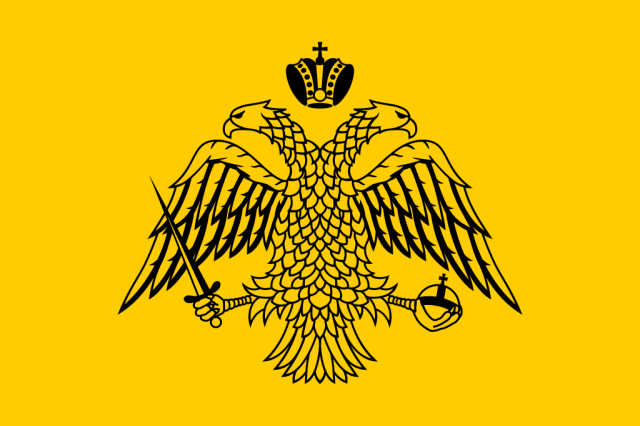
1024px-flag_of_the_greek_orthodox_church.svgOrthodox clergy are inherently conservative and resist change – and as evidence of this remember that the flag of the Orthodox Church is the double-headed eagle of the late Roman Empire (known to us in the West as the Byzantine Empire), which ended in 1452. When the Orthodox of Anatolia were expelled from Turkey and arrived in Greece they castigated the churchmen here for adopting western styles of painting for icons – since the 1920s an older style of iconography has returned.

Although the bells of the local church ring every Sunday and holy day, relatively few lay Orthodox attend church. This is not unusual, for identity and piety are not always the same. Greece is among the most religious countries in Europe, based on beliefs, according to the Pew Research Center, but that doesn’t mean that they are always in church. Despite the fact that the Prime Minister is an avowed atheist and was the first Greek PM not to take his vows of office on the gospels, the position of the Orthodox Church in Greece seems secure.

However, I wonder. The present has a habit of  rapidly unravelling. I see four possible futures.

In the first, things stay much the same. There is some tinkering with the status quo, but Greece neither becomes more pious nor less so, and the Church of Greece retains its privileged situation.

metaxas-religion1-650x300

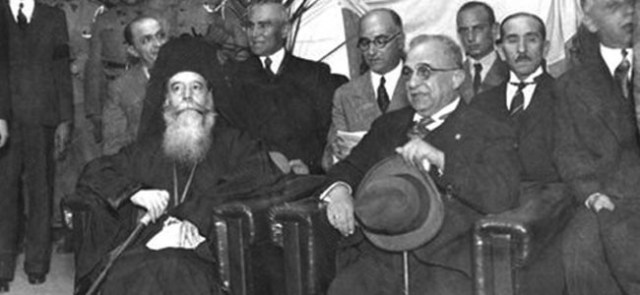
1940: Ioannis Metaxas, dictator of Greece, with the head of the Church of Greece, Archbishop Chrysanthus of Athens.

The second would be the most worrying. It might happen if a more conservative government is elected, one which leads the country down an anti-democratic route. This is what Vladimir Putin has done in Russia, and he has had the support of the Russian Orthodox Church in doing so. In Greece something like this has happened in the past, at least twice, first, with the dictatorship of Ioannis Metaxas from 1936 to 1941, and, second, with the military junta of 1967-1974. In both cases, the few explicitly opposed leaders in the Orthodox Church were removed and the institution as a whole became, at best, neutral, and at worst, complicit with the dictatorship. Although Greek society seems to be a solid liberal democracy since democracy was restored in 1974, and since it joined the European Community (now the European Union) in 1981, it is not impossible that there could be a reactionary movement that somehow gains power in the complicated electoral system, and then proceeds to eradicate its opponents (yes, I’m thinking of Golden Dawn) . I cannot help but think that it would try to enlist the Church as an ally. I do not see this as probable trajectory into the future, but then I did not think that the US would elect Trump.

catholic attendance in quebec

Source: Jean-François Nault, E.-Martin Meunier, “Is Quebec Still a Catholically Distinct Society within Canada? An Examination of Catholic Affiliation and Mass Attendance” Studies in Religion/Sciences Religieuses, Volume: 46 issue: 2, page(s): 230-248.

A third possibility is that Greece goes the way of Catholicism in Quebec. In Quebec in the 1950s some 80% of the Catholic affiliated population were in church every Sunday. The provincial government did not even have ministries of health or education, as they left those to the churches. Then in the 1960s Quebec nationalism arose in La Revolution Tranquille. In the 1960s and ’70s church attendance dropped like a rock to its present 5%. The government secularized itself, created a modern welfare state, and ignored the church leadership as it passed legislation. Quebec is now the most secular of the ten provinces. We now see, in reaction to the abuses of the Catholic Church in Ireland, a similar thing taking place in the Republic there, as influence wanes and attendance drops. I see no reason why a similar thing could not happen here in Greece. The Constitution could be amended. The clergy could be cut off from the government payroll and left to fend for themselves by  offerings from their supporters, as is the case in much of the Western world. Just as Thomas Cromwell seized the lands of the monasteries in England in the 1530s on behalf of King Henry VIII, and just as the French Republic took the properties of the Catholic Church in the 1790s, so a bold political leadership could nationalize the lands and use them to pay down debt or ramp up the economy. Religious privileges could be limited, and schools could move from the teaching of Orthodox religion to teaching about all religions. While I suspect that this would not happen in Greece all at once, I could see this happening slowly over several decades.

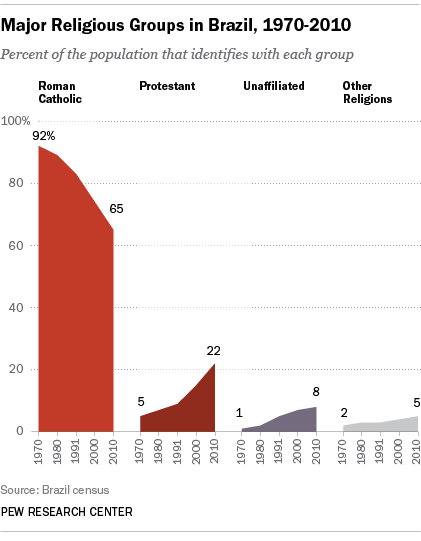
pf_13.07.15_brazilreligiouslandscape_1The fourth possibility is what is happening in Central America and parts of South America (especially Brazil). What was once virtually a Catholic monopoly has now been transformed into a multi-denominational landscape. In particular, the evangelical and charismatic churches have made serious inroads. Unlike the US, this is not necessarily correlated with the political spectrum, for just as the Roman Catholic church has its conservative and  socialist wings, so do the new churches. Interestingly, this has forced the Catholic Church in Latin America to up its game, and become more lively and attractive. Could this happen here in Greece? While the government of Greece makes it challenging for new churches, it is not impossible. I suspect the Orthodox Church of Greece would fight hard to retain its privilege, but it is hard in a liberal democracy to stop people voting with their feet.

It is undoubtedly a bit presumptuous for a non-Orthodox non-Greek who has only been in Greece for a little over three months to comment on such affairs. However, it is sometimes helpful for folks to have an outsider’s first impressions, and it is in this spirit I offer them. I welcome any responses, corrections, and admonitions, and where I have gone wrong I pray forgiveness.

Sig short

Posted in Crete, Greece | Tagged , , , , | Leave a comment

A Perfect Pop Song: “Nineteen” by Tegan & Sara

Okay, this post isn’t about Crete, but about one of those songs that is perfect.

juno-nominees-tegan-and-sara

Tegan Quinn and Sara Quinn are twin sisters from Calgary who front a band called, of all things, Tegan and Sara. Eleven years ago, when they were 28, they released an album called The Con. One of the songs on it is Nineteen by Tegan Quinn and it may be a perfect pop song. I am a little obsessed with it.

What makes a perfect pop song? Well, a few things. First, it needs to be playable on commercial radio, which means it should be less than four minutes, and maybe even less than three. The early Beatles songs all clock under four minutes. Nineteen in the studio is a mere 2.54, and live, rarely is more than four minutes. Second, it should be about young people and probably about love. Nineteen is that, because it talks about being in a relationship that began when the narrator-singer was that age. It is a song that looks back on the relationship which has now come to an end, but the narrator doesn’t want to let go. She’s full of anguish and is trying to figure how to put it back together.

Here’s the song in its polished studio format: “Nineteen” in the studio.

And here are the opening lyrics:
I felt you in my legs
Before I ever met you
And when I lay beside you
For the first time I told you
I feel you in my heart and I don’t even know you
And now we’re saying bye, bye, bye
There’s a lot going on in the song. It starts off simply with a single electric guitar, perhaps doubled, and Tegan Quinn singing her song alone. The description of “love at first sight” is not a thought but a feeling where the narrator literally goes weak at the knees. When she lies beside her love she expresses that bizarre mystery of loving someone you barely know, again, more of a feeling than a thought. This is all so corporeal, so immediate, so real. Sara Quinn joins in on the statement “I feel you in my heart” but not “and I don’t even know you”, perhaps suggesting that the awareness of not really knowing the beloved is not stated out loud, perhaps foreshadowing the bewilderment that comes with “now we’re saying bye”.   The drums and the bass also come in on “I feel you in my heart”, playing an interesting off-beat that, for me, raises the tension. The doubled guitars split at 0:21 when the twist “And now were saying bye” comes in, emphasising some kind of bitter-sweet divergence.
Then the lyric
I was nineteen, call me.
comes in, the refrain, really, which stretches out descends musically, and then stops abruptly.It’s an excuse – I was only nineteen – and a plaintive wail.
I felt you in my life before I ever thought to
I need to lay down beside you and tell you
I feel you in my heart and I don’t even know you
And now we’re saying bye, bye, bye
And now were saying bye, bye, bye
I was nineteen, call me.
The song returns to the verse, this time with keyboards added as a counterpoint to the melody. The second verse more or less repeats the sentiments of the first, only Tegan Quinn sings a little more plaintively. The impression of the narrator/singer here is of someone who is quite self-focused if not outright narcissistic, capable of expressing her own emotions but not saying much about the other person other than as an object of need. The narrator is caught in an emotional loop of anguish that she feels can only be relieved by a phone call and a reunion. It’s desperate, as only a lonely nineteen year old can be.
Then the song shifts tone, returning to just voice and guitar. Tegan sings of her plan:
Flew home, back to where we met
Stayed inside I was so upset
Cooked up a plan
It was good except I was all alone
You were all I had

It’s the kind of thing someone might do in a movie, but in real life is going to be disastrous. She thinks it’s a good plan, but we already know that whatever it is it is probably not going to work, and the narrator is frozen in the house.

Love me
I was yours right?
Love you
You were all mine
Love me
I was yours right?
I was yours right?

She sings the words of love in a ballad-like way, suggesting that it was a good plan, except that, barely discernible (but more obvious in live recordings), Sara Quinn is yelling out the words “I was yours right?”, undercutting the good intentions of the preceding lyrics.

An then it all falls apart. At the end of the first line of the chorus the guitar produces some feedback and the drums come crashing down, creating a discordant sense of dysfunctional desperation. The singer/narrator is doomed in this relationship, at the moment doesn’t see why, and can only focus on their own emotions and needs.

I was nineteen
Call me
I was nineteen
Call me

So why do I like this song so much? Probably because I’ve been there. I’ve been that nineteen year-old who is so unreflective that they don’t start with what led up to the breakup, but instead tries to devise a plan to get together. I’ve been that person who is more focused on the idea of being in love than with what love really demands. The object of the song is a cipher – we don’t know anything about who the other person is – but we probably know enough about the narrator that we should walk away very quickly, at least until she grows up a bit. I’ve been there, and done that. I don’t ever want to be that person again, but the song reminds me of the pleasure and pain of such narcissistic love.

Anyway, here’s the song live at Coachella: “Nineteen” live. 
And here’s an acoustic version: Acoustic “Nineteen”.
And, finally, here’s the song in its more recent live version, where it’s more keyboard oriented and feels a bit slower (but really isn’t): Piano Version


Posted in Music | Tagged , | Leave a comment

Some Frequently Asked Questions about Crete and Greece

20181225_094358_HDR

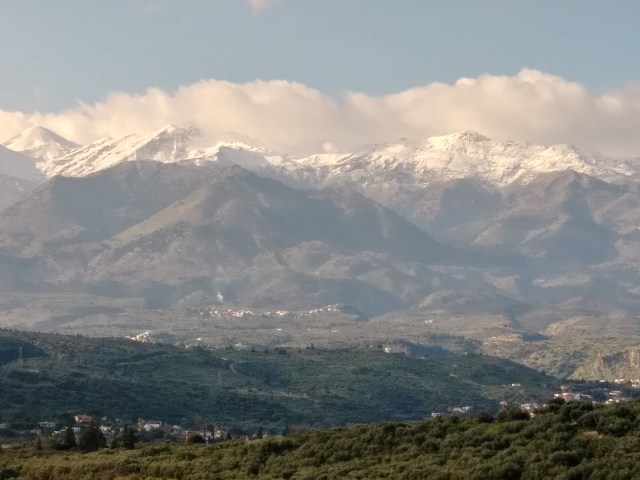
The White Mountains (Λευκά Όρη) of eastern Crete from above Kalyves on Christmas Day, 2018

My friend Michael Povey  a retired Episcopalian priest living in Florida who we got to know in Cambridge Massachusetts in 2002-2003, wrote,

Please, one of these days, tell us all a bit about Crete. How far is it from mainland Greece, what’s the population, how big is it (e.g. as compared with one of the Maritimes, or the smaller U.S. States).

Well, always seeking to please people, here are some answers to his and other folk’s questions.

1. Isn’t that place dangerous? I thought the island was divided.
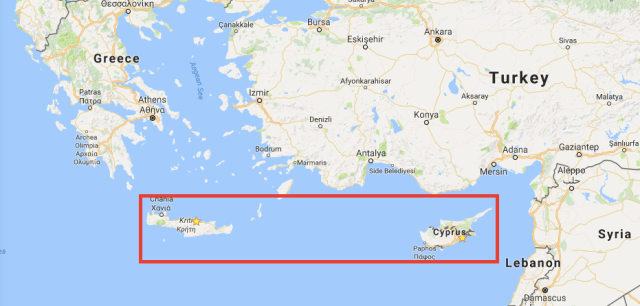
Crete Cyprus Map.png
You are thinking of Cyprus, an island that is 700 km east of us, and which is closer to Lebanon and Syria than Greece. Cyprus is its own nation, having gained independence from the United Kingdom in 1960, who took it from the Ottoman Empire in 1880. The majority of the people on Cyprus do speak Greek and are Greek Orthodox, but there is a sizeable Turkish population as well. The modern nation of Turkey invaded Cyprus in 1974 when the Cypriot Greeks, conspiring with the military junta then in power in Greece, sought to join the two countries. The invasion pretty much took the northern 40% of the island, and the Turks then set up an independent government in that part of Cyprus which only they recognise. Crete, on the other hand, became effectively autonomous in 1898 after a rebellion and intervention by the Great Powers (i.e. the UK, France, Italy, and Russia). It formally joined Greece in 1913, and the Muslim population was expelled 1922-1924 after the Catastrophe of the war between Greece and Turkey.  Over a million Orthodox Christians were expelled from Turkey, and some 300,000 Muslims from Greece, in an early version of diplomatic ethnic cleansing. The population is now relatively homogeneous, being almost entirely Orthodox Greeks. The Nazis invaded and conquered in 1941 and stayed until 1945. So, while the history of Crete has been violent and calamitous, it has been relatively peaceful here since after the Second World War.

2. How far is it from the mainland?
It’s a fair distance from the mainland. By boat, from Piraeus to Souda (respectively, the ports of Athens and Chania on Crete) it is 273 km, or 147 nautical miles, which makes for a nine hour ferry ride. We haven’t done that yet – we’ve always take the plane from the Chania airport (CHQ) to Athens (ATH); both airports are a fair distance outside of the cities they serve. By air it is 275 km or 171 miles, and about an hour in the air. The shortest distance between the mainland and the island is between the Malea peninsula in the southeast Peloponnese and the Rodopu peninsula in north-west Crete, about 54 nautical miles or 100 km. However, only someone with a private boat could make that trip, as both peninsulas are relatively unserved by roads and public transport.

3. How big is the island?
By Mediterranean standards it’s pretty big. As Wikipedia says, it is “the fifth largest island in the Mediterranean Sea, after Sicily, Sardinia, Cyprus, and Corsica.” The article then goes on to say, “The island has an elongated shape: it spans 260 km (160 mi) from east to west, is 60 km (37 mi) at its widest point, and narrows to as little as 12 km (7.5 mi) (close to Ierapetra). Crete covers an area of 8,336 km2 (3,219 sq mi), with a coastline of 1,046 km (650 mi)”. Compared with Vancouver Island it is roughly half as long, half as wide, and thus has about a quarter of the area. It’s somewhat longer and larger than Long Island or Prince Edward Island. It has mountains that are taller than the Olympics in Washington State, and taller than anything on Vancouver Island. The island is young geologically, as can be seen in the rocky terrain that has never been smoothed over by an Ice Age and has not had time to erode from other natural processes.

4. How many people live there?
According to Wikipedia, the population in 2011 was 623,065. During the summer, that undoubtedly goes up with the vast numbers of tourists looking for warm and sunny beaches. By comparison, Vancouver Island with four times as much space has 775,347, so the island has a more dense population that that BC isle; Long Island has 7,869,820 (mainly due to Queens and Brooklyn) and PEI has a mere 143,000. The population of Crete is split evenly between those who live in cities and those of us in the rural areas.  Greater Chania (pronunced “Haniá”), which is 35 minutes by car from us in Gavalohori, has around 108,000 inhabitants, whereas the capital city Iraklio (or Heraklion, as it is often transliterated into English), just two hours east of us, has 174,000. In many ways the island is a series of villages and towns with four majour urban centres, separated by olive groves, sheep, goats, and mountains.

If you have any questions, let me know.

Sig short

Posted in Crete, Greece | Leave a comment

Catching Up on the Last Nine Months

New on Greece

Happy New Year! 2019, eh? How did it get to be so late?

Since I last wrote something for this blog a lot has happened. To wit:

  • On April 6 my wife heard about a half-time position at an Anglican congregation based on the island of Crete. She told me to look into it, and I did.
  • On May 8 I was interviewed in Brussels and conditionally offered the position. I then went to Crete and visited with the good people of St. Thomas Anglican Church in Kefalas, Apokoronas, Chania, in the western part of the island. This was my first visit to Greece, and it was only 36 hours.
  • On August 17 we went to the Greek consulate in Vancouver and managed to get a six-month visa in preparation for moving to Greece.
  • In preparation for selling the house we had multiple garage/moving sales. By the time the movers came and left, our house was remarkably empty.
  • We sold our Nissan Leaf.
  • On September 24 we left Victoria, where we had lived for fourteen years, and left British Columbia, where we had lived for twenty-three years.
  • We are living in the top of a two-floor house, in what is basically a two bedroom apartment. It is in a village called Gavalohori, about five km from the church.
  • We have started taking Greek lessons twice a week.
  • Aodhán, our retired racing greyhound, joined us a few days after we arrived. We left our two cats in new homes in Victoria (where they are thriving).
  • Our empty house went on sale a week or so after we left, and sold quickly before the end of October.
  • On October 12 I was licensed to function as the Assistant Chaplain of the Greater Athens Chaplaincy serving at St. Thomas, Kefalas. The part of the Diocese in Europe, Church of England in Greece is formally known to the Greek authorities as the Anglican Church in Greece.
  • About two months after we arrived we received our two-year residency permits.
  • I am still not done my dissertation – but I am on the last 2000 words. It will be submitted by the end of this month, unless my supervisor tells me otherwise.
  • I have not had a haircut in over two years, so I’m a bit shaggy.

Why did we move? A few reasons.

First, my wife and I were feeling restless. The children were out of the house, and we felt that we had already done what we wanted to in British Columbia.

Second, I was not interested in applying for full-time permanent jobs in the Anglican Diocese of British Columbia. I wasn’t sure what I wanted to do, but doing what I had already done for many years in the same place was just not grabbing me. Or, to put it in theological language, I was not hearing God calling me to work in BC, or anywhere else in North America. When the possibility of making a dramatic shift to a new diocese, and a new country, I heard that quiet voice say that this might be a good thing. I had never particularly wanted to live in Greece, and I had never visited it, but it seemed like as good a place as any, and better than many.

Third, I was tired of carrying a mortgage and seeing most of my income go towards it. In addition to the small stipend the church on Greece pays me (and a house and a car), we are living off of the income from the proceeds of the sale of the house – and so we live debt-free.

Fourth, it was time for an adventure. We were not running away from anything, but running towards something new.

My hope is that I will be a bit more regular with posts, especially once I finish the dissertation. I intend to talk about Greece, the Greek language, the wonders of working in the Church of England when you’re not actually in England, as well as scripture, theology, music, and whatever else catches my interest. I hope you’ll join me.

Sig short

Posted in Random Personal Notes | Tagged | 2 Comments

Gender Fluidity in the Bible

What Happens When Queer Theory is Applied to Scripture?

A talk given on March 21, 2018 at the Anglican Parish of St. George the Martyr, Cadboro Bay, in the Municipal District of Saanich, a suburb within Greater Victoria, BC, as part of a series on Gender Diversity. This text is based on my notes and compared with what I also said, with some additions and hypertext links.  

Introduction
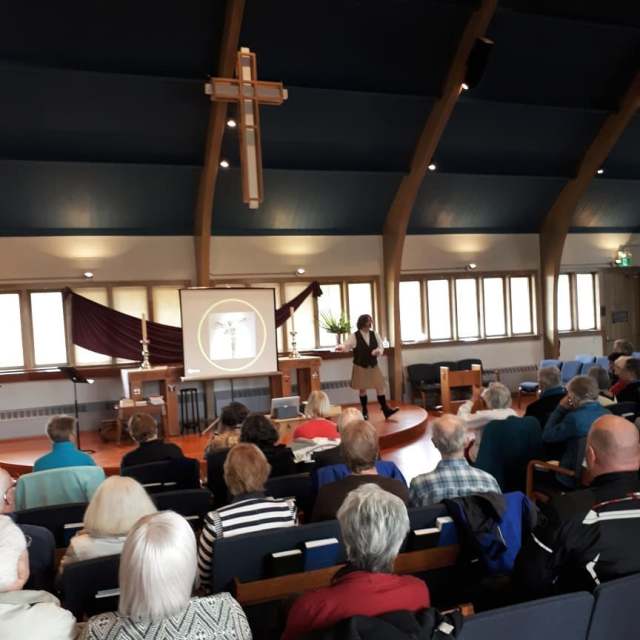
Me at St George'sGood morning! Many of you know me. I am Bruce Bryant-Scott, a 55 year old heterosexual male, born and raised in 1960s and 1970s Anglophone culture in Shawinigan, Quebec, which was as binary as all get out. I started as a child in the United Church of Canada but was confirmed in both the United Church and the Anglican Church in 1975, just before the great Plan of Union finally fell apart. I think you’ll notice that one of those confirmations really took. I have been ordained thirty years in June. I studied at the Toronto School of Divinity, on the campus of the University of Toronto, in Trinity Me at St GeorgesCollege, and at Harvard University. As mentioned, I am now undertaking a PhD in theology at the University of London, in England, and I hope to defend my dissertation “Unsettling Theology” this Fall. In Toronto I learned just enough Greek and Hebrew  to know that all translations are problematic. Thus when people say that they rely on the Bible, I have to ask which translation they are using, because the translations always inscribe the biases of their translators.
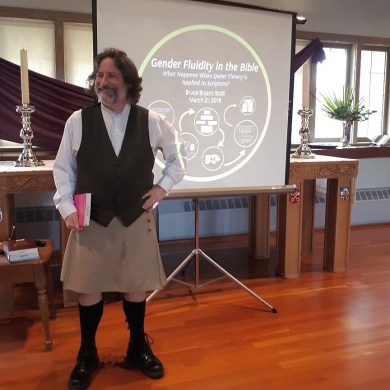
Let’s begin by acknowledging that we have gathered on the traditional territories of the Lekwungen speaking peoples of the Coast Salish First Nations of Songhees, Esquimalt, and W̱SÁNEĆ. For me these are not rote words.  My dissertation is on the theological legacy of the Indian Residential Schools – what kind of theologies got us into that mess, and what kind of theologies might help us avoid something like that now. I like to think that I work from a post-modern, post-colonial perspective.

I was raised in a highly colonized context on the lands of the St. Lawrence Iroquoians, the people who gave us words such as Canada and Quebec. They lived along the St. Lawrence River when Jacques Cartier came in the 1530s, but had disappeared by the time Champlain was establishing L’Habitation in Quebec. The land was subsequently settled and used by the Haudenosaunee from the south, the Abenaki from the East, and the Innu from the North. My understanding is that the St. Lawrence Iroquoians were probably wiped out by disease, and their survivors were taken in by these neighbouring peoples who subsequently became the land’s indigenous peoples.

Now, I am not the most likely person to give this talk. I was raised to think of same-sex attraction as a kind of psychological perversion. I still find myself struggling and reacting around trans people, at least thinking thoughts that I take care not to express, because they emerge out of that boy from the 1970s, not the man I am now. I am not an expert on Queer Theory and gender issues.
two-archbishops

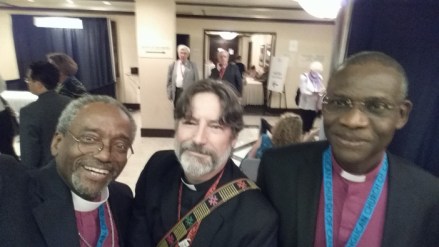
Total fan boy moment at the General Synod of the Anglican Church of Canada 2016 . On the right, the Most Reverend Dr. Josiah Idowu-Fearon, Secretary General of the Anglican Consultative Council. On the left (and graciously taking the picture) is the Most Reverend Michael Curry, Presiding Bishop of The Episcopal Church. That’s me, the Reverend Canon Bruce Bryant-Scott, in the middle.

So why am I here? Well, as in many things, we can blame the Bishop. When Elizabeth approached Bishop Logan about who might speak about this, he said, “Hmm, how about Bruce Bryant-Scott?” I think it’s because he heard me speak at General Synod in Richmond Hill two years ago. I did speak to the issue of gender fluidity in scripture during the debate on the amendment to the marriage canon. I referred people to the passage in Genesis 1.27: “So God created humankind in his image, in the image of God he created them; male and female he created them.” Now, you’ve heard of the passage in Revelation 22.13 where Jesus describes himself: “I am the Alpha and the Omega, the first and the last, the beginning and the end.” The terms here signify not just beginnings and endings, but every thing in Uppercase_Alpha_and_Omega_in_Times_New_Roman.svgbetween as well. It is a claim that all of creation and its purpose is oriented to Jesus. Now, when we see these kinds of binary opposites, I suggested that in Genesis 1 we might read it not simply as those opposites, but as everything along the spectrum of sexuality and identity. It was not a particularly good argument, but I thought that this was something we might consider. The Bishop heard this, of course, which is why I think he suggested I might be a good speaker.

Review

Now, you started two weeks ago with Kingsley Strudwick from Ambit Gender Diversity. KingsleySome of the things that emerged as he and you talked were:

  • It’s complex.
  • “Infinite possibilities.”
  • “It’s in the brain as opposed to between the legs.”
  • We learn about gender from our families.

He also talked about some important distinctions.

  • When we talk about the “sex” of someone we are generally referring to the range from how chromosomes, hormones, child-bearing and so forth are involved and are identified as characteristically male, female, or something else.
  • When we talk about “gender” we are discussing the categories of being male, female, trans, nonbinary, intersex, or queer. It’s about how one identifies oneself.
  • When we talk”sexual orientation” we are talking about same-sex attraction, different-sex attraction, bisexual, monosexual, or asexual. .
  • Then there are the cultural aspects, such as what it means to be masculine and feminine. We all have a sense of what a tom-boy is, or what it means when someone says they want to feel “girly”. There are subcultures, such as clones, bears, lipstick lesbians, butch, queer, etc.

But while all of this can be confusing, it is important that we are talking, and that’s good!

Waaseyaa_sin Christine SyLast week you had Waaseyaa’sin Christine Sy, a professor at the University of Victoria. Her points, among others were:

  • Territory is important. Place is sacred. The original peoples were deeply invested in their relationships with their traditional territories, and all the creatures within them. They learned from them and their traditional law was grounded in the land and its creatures.
  • Gender was socially constructed in different ways among the many diverse peopl
  • Colonization was gendered. The Indian Act is highly gendered, with different rules for women and men. It involved the erasure of what we now call two-spirited people, and replaced it with a normative binary. .
  • She said, “I’m learning, too. The young people are teaching us.”

Queer Theory
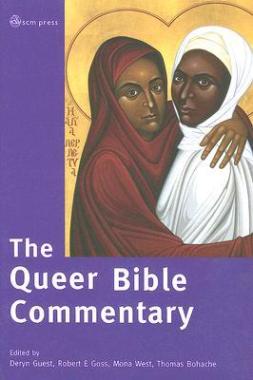
  • Queer BibleLet’s talk about Queer Theory. According to some, it initially emerged in 1990 and by 1994 was all the rage in the Humanities, although I was sort of aware of it already in the mid-1980s. Newish, but not new. The church and seminary, of course, got there later than everybody else, but by 2000 or so scholars were being appointed to major positions who were well acquainted with it.
  • Queer Theory might sound like a systematic approach to issues, but it’s, well, you know, queer, so it eschews systems and privileges perspectives, especially around gender, sexuality, and identity.
  • It’s cross disciplinary, drawing among other things, not only on psychology and biology but also philosophy, literature, critical theory, post-modernism, post-colonialism, and, most importantly, the lived experience of people who do not fit our cis-het binary structures.
  • It is thus inherently destabilizing, unsettling, and frequently mischievous, satirically, and outrageous.
  • It’s not for the faint of heart.

Brief Studies: The Names of God

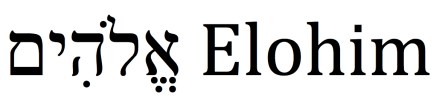
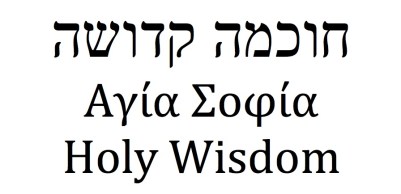
ElFirst, let’s think about God, and God as Trinity – you know, the Holy Trinity. In the Hebrew original God has many names: El, or God, which is masculine in grammatical gender; Elohim, the Elohimplural form of the word El, but which takes verbs in the singular male; YHWH, a name considered so sacred by Jesus’s time that it is not pronounced but is replaced with Adonai, Lord. In orthodox Christian thought God is a trinity, three YHWHhypostases in one ousia, usually translated as persons and substance. Forget the usual problems, and consider the gender. In Greek Father is Pater, and is masculine; the Son, the Word that was made flesh, is masculine; but the Holy Spirit, Trinity 21-38-34Hagia Pneuma, is neuter. In Hebrew it’s even more interesting. Both Av and Ben, Father and Son, are masculine, but the Holy Spirit is Ruach, and it is feminine. As well, the Logos or Word is considered by most orthodox theologians to be the equivalent of Holy Wisdom or Hochma Kadosh. A Cathedral in WisdomConstantinople was dedicated to Christ as Holy Wisdom – the Hagia Sophia in Greek, which is also feminine. So, when thinking of God. And considering grammatical gender, we have not only masculine, but feminine and neuter. So right from the get go in ancient orthodox Christian dogma we have a God who transcends and incorporates genders, and is far from binary. If humanity is made in God’s image, arguably we are just as far from binary as well.
To me, it all seems a little odd – queer almost, eh?

Brief Studies: The Song of Songs

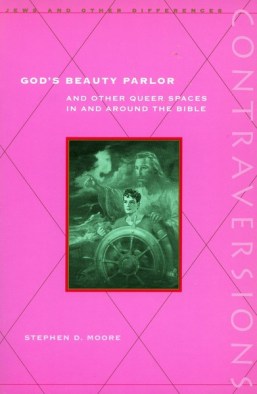
Second, Stephen D. Moore, an Irishman and a New Testament scholar at Drew University in New Jersey, has written a great book called “God’s Beauty Parlor and Other Queer Spaces In and Around the Bible”. It’s basically four essays, well worth reading. The first looks at The Song of Songs, or The Song of Solomon. Listen to this.

Rise UpRise Up My Love, by Healy Willan

Rise up, my love, my fair one, and come away.
For, lo, the winter is past,
the rain is over and gone;
The flowers appear on the earth;
the time of the singing of birds is come.
Rise up, my love, my fair one, and come away.

Now, who is singing here? As it turns out, this is a woman recounting her lovers words to her. Who is the woman? Who is the man? Tradition says Solomon and one of his seven hundred wives or three hundred concubines, but that’s probably a later attribution. In the text the two, a male and female, are unnamed.  This is one of the tamer passages – it becomes much more explicit later on. Now, the interesting thing is that the book does not mention God anywhere. It is clearly Israelite or Jewish, as it refers to Jerusalem and the Tower of David, but it does not read as a sacred text. What is erotic love poetry doing in the Bible? .

Throughout history, both Rabbis and Christian theologians have interpreted this allegorically.  Jews understood it as relating to God and Israel, while Christians say it as an image of Christ and the Church. It was a favourite text through the ages, with many, many commentaries, including the Puritans, Augustine, The Venerable Bede, Gregory the Great, Bonaventure, etc.

So here’s the Queer aspect. As a male hearing this, and along with saints and mystics like St. Bernard of Clairvaux and Origen, we are in the place of the woman being called. Who’s the woman in this scenario? It is us, we who are the brides of Christ. The overtly sexual descriptions of the woman describes an eroticized female-gender church. Mull that over.

Brief Studies: Insights and Social Constructions in Paul

Let’s jump to a brief study in the New Testament, specifically, the writings of Paul. In First Corinthians 6.12 Paul writes:

All things are lawful for me’, but not all things are beneficial.
‘All things are lawful for me’, but I will not be dominated by anything.

Paul appears to have written a previous letter to the Corinthians in which he wrote things like “‘It is well for a man not to touch a woman” (7.1) and “All things are lawful”. This led to confusion and a letter back to Paul, in which they appear to have asked, “Are you serious?” On the one hand they were hearing Paul describe a radical freedom in Christ, and on the other they heard him prescribing celibacy. Well, yes, Paul was serious, because he felt that in Christ Gentiles were saved, and they did not have to become Jews in order to be part of that salvation. Thus they had a radical freedom, as they were not under the Torah. But this did not mean they could do anything. He suggests that the new criterion for ethics will be whether it builds up, if it is useful and good. So, no, not anything goes. Regarding marriage, Paul seems to have been remarkably asexual, which he saw as a good thing in his evangelism, especially as he believed that the second coming of Jesus, as the Son of Man in judgment, was imminent.  However, he knew that other apostles travelled with their spouses, and he also was real enough to know that most Christians wanted to marry and have sex. So he said that it was better to marry than to burn.

Still, it’s a heck of a principle on which to build an ethical system.

Paul comes out with some remarkably narrow statements and then very radical ones. From Galatians 3. 16 we read

There is no longer Jew or Greek, there is no longer slave or free, there is no longer male and female; for all of you are one in Christ Jesus.

Paul is challenging the categories of the world that appear to most people to have been there since time immemorial, part of the created order. However, in the new creation inaugurated in the resurrection of Jesus Christ this changes. Paul is not saying that there are no differences – the Jews still have the Torah and the Greeks will still speak Greek, and Paul does not dream of a time when there is no slavery – but he does have an ideal of what the new creation looks like, and it is not like this broken, fragmented, sinful world. We can still be a diverse collection of people with ethnicities, genders, and sexed bodies, but in the light of the resurrection they are not as important or God-given as some might think. Arguably, they all becomes a little fluid, to coin a term.

But then there are times when he says something else, as we read in First Corinthians 11.13-16:

Judge for yourselves: is it proper for a woman to pray to God with her head unveiled? Does not nature itself teach you that if a man wears long hair, it is degrading to him, but if a woman has long hair, it is her glory? For her hair is given to her for a covering. But if anyone is disposed to be contentious—we have no such custom, nor do the churches of God.

Neither we nor many ages over the past two-thousand years have paid that much attention to the necessity for women to cover their head or men to cut their hair. Indeed, Jesus and the apostles are usually portrayed in art as long-haired freaks. Paul seems to think that somehow uncovered hair will corrupt angels, but nowadays we do not usually worry about such things. Again, this is probably a class thing – barbarians, slaves, and subject peoples did not probably cut their hair on a regular basis, whereas proper Romans and Greeks and those with money probably did. The issue with head coverings can also be read as patriarchal. Women’s hair – which Paul sees as their glory – was to be reserved for the immediate family only, preferably her husband. In the end most of us today would see this less as a faith issue as one of aesthetics.

Now, Paul also wrote the following, in Romans 1.26-27.

For this reason God gave them up to degrading passions. Their women exchanged natural intercourse for unnatural, and in the same way also the men, giving up natural intercourse with women, were consumed with passion for one another. Men committed shameless acts with men and received in their own persons the due penalty for their error.

This is the passage that is invariably used to suggest that same-sex sexual relations are forbidden and degrading, contrary to God’s law. However, as Stephen Moore points out, pid_3278the passage comes in the context that sees same-sex desire and same-sex sexual acts as the result of people having abandoned God for idols. Earlier in the chapter Paul describes an early history that is not commonly understood. After the Fall of Adam and Eve they and their first descendants continued to call upon God and sacrifice to the true divine. Only after some time had passed did they begin to make idols out of animals and human figures and combinations of humans and animals. These idols were an abomination to the God of Abraham, Isaac, and Jacob, and Israelites were forbidden to worship them. Because the non-Israelites and non-Jews persisted in this, God punished them by having them develop same-sex desires. In the strongly patriarchal societies of the Middle East and the Roman Empire real sex for men was understood to be sexual penetration. Among Gentile Romans it was irrelevant whether the subject of the penetration was male or female, or how exactly it was done, just that it was degrading to be on the receiving end. Thus, because women were on the “passive” side of penetration, they were not of as high status as men. Slaves and lower classes were suitable subjects of higher class sexual penetration. Sex was not only gendered, it was an act of power, class, and “dignitas”. This is why same-sex relations between women was so depraved – it undermined the status of phallo-centric men and the proper relation of men and women, citizen and subject, free and slave.
Needless to say, most people in the modern era are completely unaware of this. We miss the gender and power issues that were part and parcel of the ancient understanding of sex. We do not buy into the ancient history that Paul describes (unless we are Creationists) and we do not accept the hierarchies of power that depend upon fundamental inequalities.

So, what happens when we have otherwise faithful Christians (and Jews) who have same-sex desires and relations? Are they idolators? Apparently not. Paul was never asked the question, so he never dealt with it. Do we base our sexual morality on these ancient constructions, or do we say that Paul was culturally conditioned, and in this passage maybe he wasn’t inspired. After all, if we find that Christians in committed same-sex relations work to build up love and faithfulness, is that not beneficial and helpful?

Conclusion

I’ve circled around the Bible but I have not yet and will not be applying anything of Queer Theory as such to the person of Jesus Christ – time is up!. But here is a final query before we break: as we move into Holy Week, what is the significance that the Jesus who was crucified was male? What if Jesus had been female? Does it make a difference?

Christa

“Christa” (1975) by Edwina Sandys. This was displayed in the Episcopal Cathedral of St. John the Divine in New York City in 1984, to the consternation of many.

Posted in Anglican Church of Canada, Lent, Philosophy, Queer Theory | Tagged , , , , , | Leave a comment

Truth Considered as a Holy Currency

HC
This morning I want to talk about truth.

It is in the readings for today.

  • In the gospel reading from John Thomas discovers the truth of the resurrection. He hears the other disciples telling him that Jesus had appeared to them in glory, but he is a skeptic, the founding patron Saint of Anglicanism. He insists he will only believe when the resurrected Jesus stands before him and he can put his fingers in holes of the crucified hand, and his hand in the side of the slashed side.  Then the resurrected Jesus stands before him, inviting him to do so. He exclaims, “My Lord and My God”, now knowing the truth.
  • The early church described in the Acts of the Apostles lived out the truth of the resurrection and the coming of the reign of God by sharing with one another, so that not one of them was in need. The eucharist, where there was always room and food, prefigured the heavenly banquet. They lived as though they were already resurrected.
  • In the First Letter of John the author talks about truth. The truth is in us, he says, when we walk in the light that is God, who is revealed in the person of Jesus Christ.

But what is truth? This question was asked by Pontius Pilate in his examination of Jesus. But he did not get an answer. But what do we think truth is?

  • Something eternal, like God, or the Ten Commandments.
  • The facts of a situation.
  • Something that can be falsified or verified (otherwise it is just an opinion)
  • Something that can be true for one person and not for another.
  • Something trivial, like 2 + 2 = 4 (not so trivial for accountants and scientists and others who use numbers).
  • Something very personal, something that is true for me – in my heart or in my gut.
  • The beautiful, in music or nature.
  • Logical – the principle of non-contradiction, or the excluded middle.

I did my first degree in philosophy, and there I encountered the various theories about what it means to say that something is true:

  • Correspondence: a proposition or statement is true if it corresponds to the facts.
  • Semantic: a proposition is true only if it can be represented in symbolic logic/artificial languages; “truth” in artificial languages is precise and clear, whereas “truth” in natural languages is vague and unsystematic
  • Coherence: a set of statements in “natural” language fit together and do not cancel each other out. The postmodern variation is to suggest that truth is constructed by society, and that there are “regimes of truth”.
  • Pragmatic: a proposition is true if it is useful to believe it; utility is the best marker of truth.
  • Deflationary: Nothing of value is added when we say that something is true, except rhetorically; the statement “The grass is green” and “It is true that the grass is green” are effectively the same. We learn more about the speaker of the statement than about the reality to which the statement refers.

This can be mind-numbing, and one might wonder about how helpful this is in ordinary life. Ludwig Wittgenstein would have seen truth as one of those “bewitching” topics that we understand in ordinary speech but which philosophers turn into deeply problematic issues.

So, putting aside these philosophical thoughts, what might we make of truth in the church?

I want to suggest to you that truth is a currency. This is an idea described by in the book Holy Currencies by Eric Law, an Episcopalian priest who founded the Kaleidoscope Institute a few years ago. Eric believes that there are six currencies at work in the church, six holy currencies. These currencies are Relationships, Wellness, Time/Place, Gracious Leadership, Truth, and Money. Over the next few months I am going to talk to you about each one.

Now, any currency is a medium of exchange that needs to be given and received if it is to contribute to the spiritual and religious growth of a community. If we just hide currency, it cannot grow. It may even decrease in value.

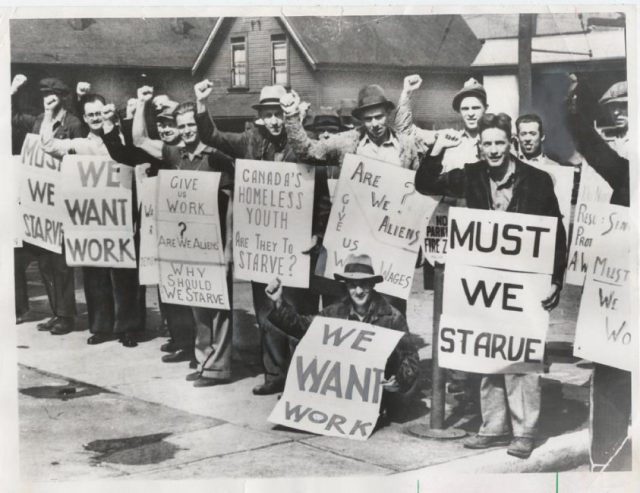
unemployed.jpg.size.custom.crop.843x650This was one of the great economic lessons from the Great Depression. The Crash of 1929 was pretty bad, but the US government through the Federal Reserve and other governments through their central banks exacerbated the situation and turned it into the Great Depression through their tight money policies. Banks were allowed to fail and businesses cut back on investment and costs. Money stopped moving, as people were afraid of losses and incurring debt. This is called a “tight money” policy, and political leaders congratulated themselves on running balanced budgets while the economy ground to a halt. As people lost jobs or were afraid of unemployment they sat on their money, in some cases literally putting it under their mattresses in some cases. While some governments attempted to stimulate the economy, the amounts were so low that it did not make a difference. Only with the coming of the Second World War did the economy start moving again with the massive investment in armaments and forces. The lesson was learned; in 2008 no banks were allowed to fail (well, one was, and that triggered the alarm), and the US government even bought out GM. The UK government took over several banks, and the movement of capital was ensured. While there was a short recession, the markets came back, and the economy never reached the level of the Great Depression.
If  truth is a currency it needs to be given away. And we do indeed give truth away. We preach the good news of Jesus Christ, of the forgiveness of sins and the resurrection of Jesus, of the re-creation of the world and transformation of lives. We can talk about the strength of this parish community and the good things that happen here – the youth ministry, the hosting of Guiding and Scouting, the celebrations of birth, entrance into the church through baptism, marriage, and the lives and witnesses of our local saints.  In Music we encounter another type of truth, which can go beyond words. This is a place where we can get past superficial conversation to talk about what really matters.

But if the exchange of truth is in just one direction, then we will be impoverished. Likewise, if we just take, take, and take, we’ll be morally bankrupt. Truth as a currency needs to be exchanged. We need to give and receive truth. This means not only proclaiming, but listening and paying attention, shutting up and attending to what people are saying.

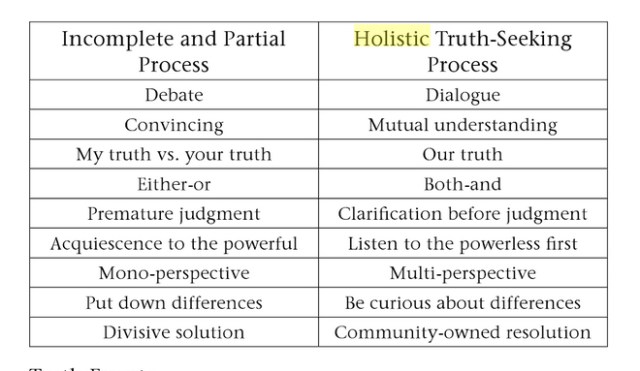
What processes do we follow? Eric Law sets out two contrasting approaches:Truth style

In our listening, whether to others in the church community or outside of ourselves, which approach do we use? Do we engage in a debate seeking to win, or are we in a dialogue, establishing a relationship despite differences? Are we more concerned with conveying our truth, or understanding the other person’s position? Is there a polarity of us and them, or a commitment towards a shared truth? Do we see it as a zero-sum game in which one person is right and the other wrong, or can we see it as a “both/and” situation where there is virtue on both sides? Do we allow ourselves to be overawed by the powerful, or do we seek out the quiet voices of the weak and marginalized? Do we try and raise a mono-culture of truth, or can we have multiple perspectives? Are we derisive of people who think differently from us, or are we curious?  Do we work towards an understanding of truth which divides us, or one that is common? Obviously, in the second set of approaches we will see a greater exchange of truth.

Gordon HeadWhat is true for you?
What is true for us as a church community?
What are the truths facing us here in Gordon Head, in Victoria and BC and Canada, in this world?

Now, as Christians, these truths need to be related to Jesus, who says, “I am the way, and the truth, and the life.” But the truth of Jesus does not replace these other truths, or overwhelm them, but it sheds light on them, and by the power of the resurrection gives hope in the midst of a broken world. So let us be people of truth. Let us walk by the light of God. Let the same power that raised Jesus Christ from the dead lift us up. Amen. Alleluia!

A sermon preached at the Parish of St. Dunstan, Gordon Head on the Second Sunday of Easter April 8, 2018. Gordon Head  is a neighbourhood located in the District of Saanich, which part of the Greater Victoria Region on Vancouver Island, British Columbia, Canada.

Posted in Holy Currency, Sermons | Tagged , , | Leave a comment

Resurrection is Justice

1032727_1_0321-Israel_Jesus_Tomb_Restoration_standard

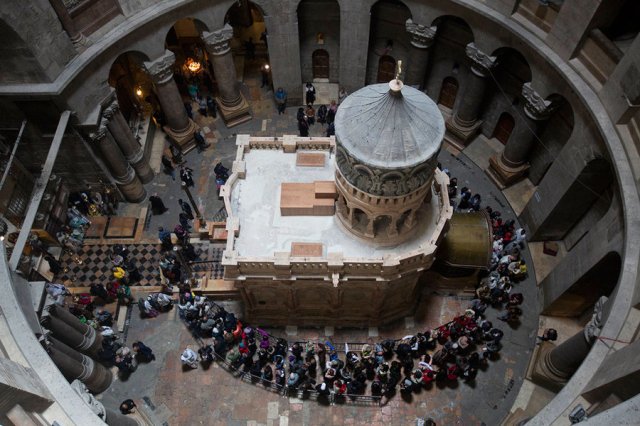
The Edicule (shrine) over the stone on which the body of Christ was laid, and from which Christians believe he was raised. In the Church of the Resurrection/The Church of the Holy Sepulchre in Jerusalem.

A sermon preached at the Parish of St. Dunstan, Gordon Head on Easter Sunday 2018. Gordon Head  is a neighbourhood located in the District of Saanich, which part of the Greater Victoria Region on Vancouver Island, British Columbia, Canada.

Alleluia! Christ is risen.  The Lord is risen indeed. Alleluia!

I believe in the resurrection.

The resurrection is the centre of the Christian faith. We affirm it in our baptismal vows, and in their renewal, in the creeds, and in our liturgies, and on this the most holy of days, the Sunday of the Resurrection, which in English we call Easter. We say that we believe that on the third day after his death (counting inclusively), God raised Jesus from the dead. We also say that we believe in the resurrection of the dead and the life everlasting – that all humanity will be raised from the dead. This is the general resurrection.

What does this mean? What difference does it make to my life?

Resurrection Is About Justice

The resurrection of Jesus is about justice – of God’s justice, and of justice in the world. This is probably not how you think of it. How is the resurrection about justice?

To understand why it is about justice one has to go into the history of Hebrew and Jewish thinking about the afterlife, and to recognize that there were a variety of views.

Shadowy-figure_288x288The earliest view is the concept of Sheol. Sheol is a shadowy existence after death, a place for all the dead, the good and the bad. What is left of the person is a bare remnant, without strength or power. The Torah (the continuous narrative of Genesis, Exodus, Leviticus, Numbers, and Deuteronomy) does not really talk about any other type of afterlife, and the Sadducees, the Zadokite priests who were powerful in the Temple in Jerusalem, denied the resurrection, as they only accepted the Torah as scripture, and not the Prophets and the Writings. This was a very simple theology, in which God acts in the lives of human beings, and does not wait for their death to offer rewards and punishments. Thus, God rewards the righteous in life and punishes the wicked in life as well. This approach to existence after death is well attested in the psalms, where the psalmist says, for example in Psalm 30.9,  “What profit is there in my death, if I go down to the Pit? Will the dust praise you? Will it tell of your faithfulness?” The dead cannot even praise God, and the psalmist asks that he stay alive so that he might do so.

8495105_f520Later on the idea of Heaven and Hell developed. The personality of the dead is less shadowy and more defined. God punishes and rewards the dead; God brings the good into the divine presence, and the wicked go to a place of punishment, of God’s wrath, often called Gehenna. In all probability the development of these alternate fates was influenced by the Persian state religion of Zoroastrianism.This paralleled the development of Satan as a fallen angel in rebellion to God, a source of evil which is an active principle in the world; before then God, as omnipotent, was held to be the creator of good and evil (see Isaiah 45.7: “I make peace, and create evil” AV/KJV).
Belief in resurrection emerged relatively late, only 150 to 200 years before the time of Jesus, and in the whole of the Hebrew Scriptures (Old Testament) was only explicit in the Book of Daniel, which was written at about that time. By Jesus’s time it was a common belief amongst many Jewish groups, and it is described as a belief of the Pharisees. Resurrection addressed the issue of God’s justice – when the righteous follow the ways of God but still suffer, where is the justice of God? The horrific story of the martyrdom of seven brothers and their mother (c. 168 BC) in 2 Maccabees 7 describes how one after one they are murdered by Antiochus Epiphanes because they refused to transgress the rules of their forebears. They state their hope in the resurrection, and taunt the king: “‘One cannot but choose to die at the hands of mortals and to cherish the hope God gives of being raised again by him. But for you there will be no resurrection to life!” (2 Maccabees 7.14).

In the Book of Daniel the Son of Man is described as a divine being who is sent by God to judge the world. By the time of Jesus this was combined with other eschatological and apocalyptic expectations for the Day of the Lord, which was the breaking in of God into worldly affairs to turn the world right-side up. The righteous will finally be rewarded and the wicked will finally be punished. John the Divine described this in great, if sometimes confusing detail, in the Book of Revelation. In chapter 18 Babylon, which stands for the city and empire of Rome, falls, and among those most distressed are the merchants and sailors who deal in luxuries, animals, and human slaves. God’s judgment is described in Matthew 25 like the separating of the sheep from the goats, and it is connected to how people dealt with the hungry, the thirsty, the stranger, the sick, the naked, and those in prison – the poor and oppressed people of society. The belief, then, was that resurrection was a matter of justice, of righting wrongs, of reward and punishment.

The Resurrection Of Jesus is About Justice

I believe in the resurrection.

The resurrection of Jesus Christ is part of that eschatological breaking in of God into the world. His birth, his teaching, his miracles, his healings, his exorcisms, his suffering, his death, are all part of God coming into the world, the Word becoming flesh and dwelling among us. The way in which the world reacts to this divine presence in human form brings about judgment, either being lifted up with Jesus into new life, or condemnation by joining with those who attacked him.

The resurrection of Jesus Christ is the beginning of God’s re-creation of the world, of transformation, of a new heaven, a new Earth, and a New Jerusalem, where all God’s sons and daughters rejoice in the light of the one who sits on the throne and declares, “Behold, I make all things new.” (Revelation 21).

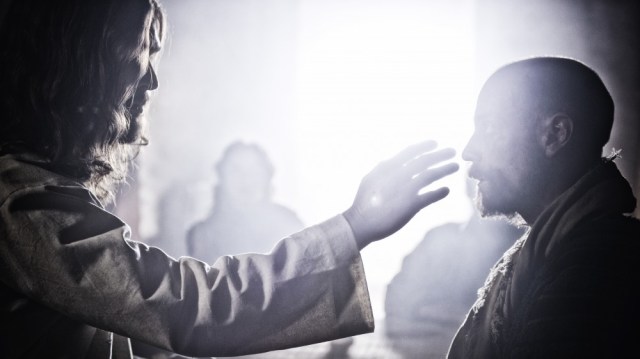
jesus-resurrection-thomasThis is seen in his resurrected body. It is described as both physical, something you can touch, and yet spiritual, something which will not perish. It appears suddenly in one location and then disappears. It can eat, speak, and be heard. Sometimes people recognize it, sometimes they do not. When Jesus addresses people by name, they know him. In Emmaus he is known to the two disciples “in the breaking of bread.” This is not some kind of Zombie Jesus, as modern day detractors of Christianity sometimes suggest. This is not the reanimation of a dead body, mindless, rotting, and doomed to perish again.This is something different.

Original Testimony

I believe in the resurrection.

It is not easy to believe in the resurrection. After all, in ordinary experience, dead people do not rise from their graves in new and glorious bodies. The resurrection of Jesus is an event that is outside known physics, chemistry, and biology. The resurrection of Jesus is not an historically verifiable fact, because it is extra-ordinary and not part of the normal course of events. We can assert that it is an historical fact that the disciples believed that Jesus rose from the dead, but we cannot say that it is a historical event in the same way that we can say that Julius Caesar crossed the Rubicon, or that William Duke of Normandy conquered England in 1066. There is no archaeological evidence or secondary literature to confirm this miraculous happening.

And yet, today we heard the early witness of Paul, himself an eye-witness to the resurrection. He list all the people who were also witnesses, and while some of them had died, all of the others were around to be questioned:

For I handed on to you as of first importance what I in turn had received:
that Christ died for our sins in accordance with the scriptures,
and that he was buried,
and that he was raised on the third day in accordance with the scriptures,
and that he appeared to Cephas (i.e. Peter)
then to the twelve.
Then he appeared to more than five hundred brothers and sisters at one time,
most of whom are still alive, though some have died.
Then he appeared to James,
then to all the apostles.
Last of all, as to someone untimely born, he appeared also to me.

This ancient witness dates to perhaps 50 AD – about two decades after the event itself. Paul emphasises that he is telling them something he told them earlier, and that his knowledge of the witnesses is a tradition that was handed on to him. The gospels, written a couple of decades later, assert that Mary Magdalene and Mary the mother of James were the first witnesses. There were skeptics even then, we are told, but there is still this testimony.

A couple of things happen to the witnesses. When they see Jesus they are immediately struck with their own unrighteousness; after all some of them had abandoned Jesus, one had denied knowing him, and one had betrayed him. Their sense of sin bubbled up in the presence of the glory of the resurrected Jesus. But, at the same time they also experienced forgiveness and empowerment. Thus, when Jesus appears in the upper room in John 20 he breathes on them, and just before says, ” Peace be with you. As the Father has sent me, so I send you.” They become Christ in the world, proclaiming the kingdom of God, healing illness and driving out evil, and living as though they had already been resurrected, guided by the Spirit. The communal feast on Sunday became a time when Christ was made known in the breaking of bread, a foretaste of the heavenly banquet.

The Power of the Resurrection

I believe in the resurrection.

I have seen the power of the resurrection at work today. It is not something simply about some future, unbelievable event.

Fresco_showing_the_baker_Terentius_Neo_and_his_wife,_from_Pompeii,_House_of_Terentius,_Naples_National_Archaeological_Museum_(14655900927)

Not Prisca and Aquila, but the baker Terentius Neo and his wife, from Pompeii. But Prisca and Quila probably looked something like this.

I have seen it in history, as the gospel spread rapidly from one anonymous Christian to another. It is infectious. Yes, we celebrate the apostles like Peter and Paul, but before either of them got to Rome other Christians had already arrived and started several small churches in that great city. When Paul came to Corinth around 50 AD a Jewish-Christian couple by the names of Prisca and Aquila were there, having been expelled from Rome by the Emperor Nero because of their Christianity.


That gospel spread rapidly through Gaul, across the channel into Britain, and then leapt across the Irish Sea to Ireland. In the fourth century Patrick, a Roman Briton captured as a slave, then escaped and made his way back home. After a few years of preparation Patrick was sent back to the land of his slavery as a missionary bishop. A few centuries later the gospel moved into Scotland and Northern England through the islands of Iona and Lindisfarne.

1200px-Canterbury_St_Martin_close

St. Martin’s Church, Canterbury. When St. Augustine came to Kent in 597, it was already there. Although much modified over 1400 years, the foundation dates back to Roman times.

At roughly the same time Augustine landed in Canterbury in south-east England in an effort to proclaim the gospel to the pagan Anglo-Saxons. In the opposite direction the gospel spread east through the Church of the East, through Persia and into India, and then through Afghanistan into the far East, reaching China by the 7th century. By the year 1000 new converts to Christianity from Greenland and Iceland arrived in what they called Vinland, what we now know is Newfoundland, and there are at least two baptisms recorded in the sagas.

norstead-viking-village

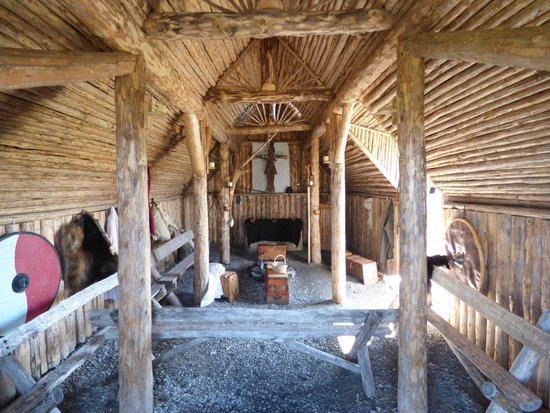
A reconstructed Viking church in Norstead Viking Village, adjacent to L’Anse aux Meadows, Newfoundland and Labrador.

As with anything involving peoples, institutions became complacent and corrupt. Already in the third century radical Christians in Egypt gave away their belongings and headed out into the desert to pray. They came together in communities, and thereby monasticism was begun. In the medieval era St. Francis of Assisi and St. Dominic began preaching orders that celebrated poverty and sought to preach the gospel to ordinary folk.

500 years ago through Luther and Calvin in the Reformation and people like Ignatius Loyola in the Counter-Reformation the Church pulled itself out of corruption and bad theology into a new respect for holy scripture and the role of the laity. In the past century the Christian faith has gone from being primarily a European religion, compromised by imperialism and colonialism, to one that is most vibrant in Africa and Asia. Africa went from nine million followers in 1900 to 380 million in 2000, most of them in indigenous denominations unknown in the West. Korea is on the verge of becoming a majority Christian nation, and there are more Presbyterians in South Korea than in Scotland. All of this flows from the same power which raised Jesus from the dead.

The Power of the Resurrection In Parishes

I believe in the resurrection.

I have seen the power of the resurrection give new life to old churches.

  • The parish where I was last a regular lay person is the Church of the Redeemer in Toronto. In 1980 it voted to disestablish itself as a self-governing parish and ask the Diocese of Toronto to step in. The vote passed by something like eleven votes to four! The diocese did not give up, but sold the land of the parish hall, sold some air rights, and jump-started the place. It is now one of the most active churches in Toronto, with four services a Sunday, a diverse music program, and a soup kitchen that serves 150 people five days a week.

    Redeemer

    Church of the Redeemer, Toronto, at an Easter Vigil

  • My daughter’s parish in New York City is St. Mark’s in the Bowery. The parish is ancient, dating back to a chapel erected by Petrus Stuyvesant on his farm in 1660. It is now in the centre of the East Side, entirely built up. For almost a century the Bowery was a district that was better known for tenements and punk rock. For fifty years the parish survived by renting out its spaces and selling off land. In 2009 it was down to about 20 people on a Sunday. The Diocese of New York put in a dynamic priest who was intent on growing the parish as a radical justice oriented place. Now it has an average Sunday attendance of over a hundred, and it is indeed renowned for their social justice ministries; on Palm Sunday they not only marched in commemoration of Jesus’s entry into Jerusalem, but to advocate for gun control and Black Lives Matter.

    Easter-2018-web-924x345

    Easter 2018 at St. Mark’s in the Bowery. My daughter is the one with flowers in her hair.

  • This parish of St. Dunstan’s was also down to some 20 people 23 years ago. The Bishop put the Reverend Canon Bill Morrison in the place, and it doubled in average Sunday attendance. When the Rev. John Alfred Steele came in 1995 it doubled in size again. What does the future hold? Where will the new incumbent lead us? banner-cropped

All of this growth flows from the same power which raised Jesus from the dead.

The Power of the Resurrection in the World

I believe in the resurrection.

Christians have been in the forefront of social change, whether acknowledged by secular society or not.

  • In the 1920s the Social Gospel was adopted by a young Baptist minister from the Prairies named Tommy Douglas. He later moved into politics, and as Premier of Saskatchewan introduced medicare in stages, starting in 1947. This model was extended to the rest of the country in 1966.
  • Civil rights in the USA were advanced by groups largely led by Christian clergy, such as Martin Luther King, Jr., whose death is being commemorated this coming week.  Christians continue in leadership for human rights in America, and unique theologies of liberation have developed in reaction to the fact that there have been 400 years of systematic oppression against African-Americans. Look up the Black Theology of James Cone and Cornel West, or the Black Feminist approach advocated by Alice Walker and integrated into Christian thinking as Womanist theology, whose major theologians are  Jacquelyn Grant, and Delores Williams.
  • In this country some of the strongest advocates for indigenous rights are indigenous Christians. I give thanks for the leadership of Bishops Mark MacDonald, the National Indigenous Bishop of the Anglican Church of Canada, and Lydia Mamakwa of the Indigenous Spiritual Ministry of Mishamikoweesh.

All of this flows from the same power which raised Jesus from the dead.

Invitation

I believe in the resurrection.

Cornel West says that love in public looks like justice. Well, the resurrection is about God’s justice breaking into our world, and that in-breaking is a manifestation of God’s love for a world, created by the divine and now being recreated in love.

How is God’s love breaking into you? May it utterly transform you. How is that same power which raised Jesus Christ at work in us? May it raise us up.

Alleluia! Christ is risen.  The Lord is risen indeed. Alleluia!

Posted in Anglican Church of Canada, Easter, Sermons | Tagged , , , , , , , | 2 Comments

Three Poems in Lieu of a Proper Sermon for Epiphany 2018

ts-eliot-9286072-1-402

Journey of the Magi                         T.S. Eliot (1888-1965)

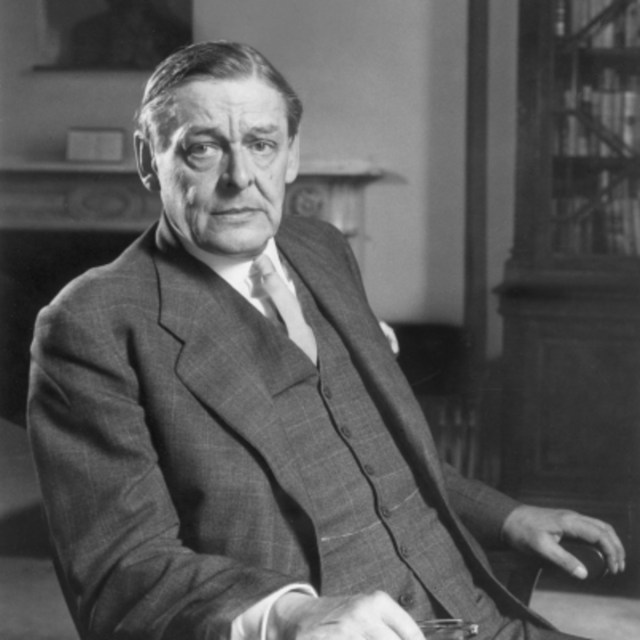
Eliot was born in St. Louis, Missouri and raised a Unitarian. After attending Harvard he went to Oxford in 1914 to work on a doctorate in philosophy. After his marriage in 1916 he had many many personal difficulties, which resulted in poems such as The Waste Land (1922) and The Hollow Men (1925). By the late twenties he was an Anglican, a UK citizen, and a monarchist. For many he may be best known for having written the book of light poetry which became the libretto for the musical Cats. Eliot won the Nobel Prize for Literature in 1948. This poem was written in 1927, a year after Eliot had converted to Christianity and had been baptized into the Church of England. The first lines echo a well known sermon by Lancelot Andrewes

A cold coming we had of it,
Just the worst time of the year
For a journey, and such a long journey:
The ways deep and the weather sharp,
The very dead of winter.
And the camels galled, sore-footed, refractory,
Lying down in the melting snow.
There were times when we regretted
The summer palaces on slopes, the terraces,
And the silken girls bringing sherbet.
Then the camel men cursing and grumbling
And running away, and wanting their liquor and women,
And the night-fires going out, and the lack of shelters,
And the cities dirty and the towns unfriendly
And the villages dirty and charging high prices:
A hard time we had of it.
At the end we preferred to travel all night,
Sleeping in snatches,
With the voices singing in our ears, saying
That this was all folly.

Then at dawn we came down to a temperate valley,
Wet, below the snow line, smelling of vegetation;
With a running stream and a water mill beating the darkness,
And three trees on the low sky,
And an old white horse galloped away in the meadow.
Then we came to a tavern with vine-leaves over the lintel,
Six hands at an open door dicing for pieces of silver,
And feet kicking the empty wineskins.
But there was no information, and so we continued
And arrived at evening, not a moment too soon
Finding the place; it was (you may say) satisfactory.

All this was a long time ago, I remember,
And I would do it again, but set down
This set down
This: were we led all that way for
Birth or Death? There was a Birth, certainly,
We had evidence and no doubt. I had seen birth and death,
But had thought they were different; this Birth was
Hard and bitter agony for us, like Death, our death.
We returned to our places, these Kingdoms,
But no longer at ease here, in the old dispensation,
With an alien people clutching their gods.
I should be glad of another death.

r1221044_16000519

From The Summons, in For the Time Being: A Christmas Oratorio
W. H. Auden (1907-1973)

The following lines of poetry, in the voices of the three wise men, is an extract from a long, long poem – 62 pages – which was written by Auden in the early 1940s and published in 1944. Born in 1907, Auden is perhaps best known for his poem Funeral Blues (“Stop all the clocks”) (1936) which was featured in the film Four Weddings and a Funeral. In the 1930s many in Britain considered him the modernist successor to T.S. Eliot, and to escape such pressure and the resulting stultifying atmosphere he emigrated to the United States in early 1939. When war broke out he contacted the British embassy and offered his services, but he was told that men of his age were not yet needed; ultimately he served in the US Strategic Bombing Survey. The grandson of Church of England clergymen, Auden renounced his High Anglican faith as a teenager. However, in November 1939 he went to a German cinema in New York City, and as Edward Mendelsohn put it in a review of the book Auden and Christianity, the theatre

was showing an official German newsreel celebrating the Nazi victory over Poland. (Until the United States and Germany declared war, German films could be shown freely in American theaters.) Auden was startled by the shouts of “Kill the Poles!” that rose from the audience of ordinary German immigrants who were under no coercion to support the Nazis. He told an interviewer many years later: “I wondered, then, why I reacted as I did against this denial of every humanistic value. The answer brought me back to the church.”[1]

He eventually found his way to the American version of the Church of England in the United States, the Episcopal Church, and became a parishioner at St. Mark’s-in-the Bowery. For The Time Being was written and dedicated to his mother. It’s nine sections review the different elements of the Christmas story in a modernist vein – from the Annunciation to the fleeing of the Holy Family to Egypt. This extract comes from the section about the Star of Bethlehem and the magi. The wise men are, in a sense, modern as well. The first, echoing Roger Bacon, extracts knowledge from Nature, seeking Truth. The second is more of a social scientist, analyzing time and history to finds its mechanisms. The third is a psychologist who reduces love to utilitarian passions. All are drawn unaccountably by the star, calling into question their assumptions and biases. The fourth part, where all three speak, is a clear echo of Eliot’s poem above.

 The First Wise Man

                        To break down her defenses
And profit from the vision
That plain men can predict through an
Ascesis of their senses,
With rack and screw I put Nature through
A thorough inquisition;
But she was so afraid that if I were disappointed
I should hurt Her more that Her answers were disjointed –
I did. I didn’t. I will. I won’t.
She is just as big a liar, in fact, as we are.
To discover how to be truthful now
Is the reason I follow this star.

The Second Wise Man

                        My faith that in Time’s constant
Flow lay real assurance
Broke down on this analysis –
At any given moment
All solids dissolve, no wheels revolve,
And facts have no endurance –
And who knows if this is by design pure inadvertence
That the Present destroys its inherited self-importance?
With envy, terror, rage, regret,
We anticipate or remember but never are.
To discover how to be living now
Is the reason I follow this star.

The Third Wise Man

Observing how myopic
Is the Venus of the Soma,
The concept Ought would make, I thought,
Our passions philanthropic,
And rectify in the sensual eye
Both lens-flare and lens-coma:
But arriving at the Greatest Good by introspection
And counting the Greater Number, left no time for affection,
Laughter, kisses, squeezing, smiles;
And I learned why the learned are as despised as they are.
To discover how to be loving now
Is the reason I follow this star.

The Three Wise Men

The weather has been awful,
The countryside is dreary,
Marsh, jungle, rock; and echoes mock,
Calling our hope unlawful;
But a silly song can help along
Yours ever and sincerely:
At least we know for certain that we are three old sinners,
That this journey is much too long, that we want our dinners,
And miss our wives, our books, our dogs,
But have only the vaguest idea why we are what we are.
To discover how to be human now
Is the reason we follow this star.

[1] Edward Mendelson,“Auden and God” reviewing Auden and Christianity, Arthur Kirsch (New Haven CT: Yale University Press, 2007) in The New York Review of Books December 6, 2007.

Brodsky

Nativity Poem
Joseph Brodsky (1940-1996)

Brodsky said about himself, “I’m Jewish; a Russian poet, an English essayist – and, of course, an American citizen.” Although born into a Jewish family, during the siege of Leningrad he was apparently baptized at the age of two in a country parish. He began writing poetry as a young man, and incurred the disapproval of the Soviet authorities. In 1972 he was expelled and, with W. H. Auden’s help, came to the United States. While he learned English and wrote essays in that language, his attempts at poetry in his adopted tongue were unsuccessful; he is thus known in English through skilled translations. He won the Nobel Prize for Literature in 1987. Starting in 1962 and continuing until his death he wrote an annual Christmas poem. While his own relationship to the Christian faith was ambiguous – he once joked that he was “a Christian by correspondence” – it is clear in his poems that he understood the implications of the Incarnation. He believed that “Christmas deals with the ‘calculation’ of life and the existence of the individual”. The following poem, written in Russian by Brodsky in 1989, was translated by the Irish poet Seamus Heany (Nobel Prize for Literature 1995) and published in 2000 in The New Yorker.

Imagine striking a match that night in the cave:
Imagine crockery, try to make use of its glaze
To feel cold cracks in the floor, the blankness of hunger.
Imagine the desert – but the desert is everywhere.

Imagine striking a match in that midnight cave,
The fire, the farm beasts in outline, the farm tools and stuff;
And imagine, as you towel your face in the enveloping folds,
Mary, Joseph, and the Infant in swaddling clothes.

Imagine the kings, the caravans’ stilted procession
As they make for the cave, or, rather, three beams closing in
And in on the star, the creaking of loads, the clink of a cowbell;
(No thronging of Heaven as yet, no peal of the bell

That will ring in the end for the infant once he has earned it).
Imagine the Lord, for the first time, from darkness, and stranded
Immensely in distance, recognizing Himself in the Son
Of Man: His homelessness plain to him now in a homeless one.

Posted in Poetry and Novels, Sermons | Tagged , , , | 4 Comments

Echoes of Grief: Remembrance Day 2017

A Sermon preached on the Sunday before Remembrance Day, November 5, 2017 at St. Dunstan’s, Gordon Head, Victoria BC

Grief.
Peace.
Nation.

These are the three overlapping themes of Remembrance Day; but the greatest of these is grief.

Grief was the first and primary purpose.

Soon after the ending of the Great War, beginning in 1919, people gathered to mark the end of the war, on the eleventh hour of the eleventh day in the eleventh month. From Canada some 620,000 men and women went forward, a remarkable number from a population of 8 million – 7%, or one out of every fifteen people in Canada. Some 250,000 of those 620,000 were wounded, and 67,000 were killed.

There were celebrations in 1918, of course. Crowds gathered in public squares and called back and forth, “Who won the war?” “We won the war!” The satirical song, “Lloyd George knew my father, Father knew Lloyd George” was also sung in tribute to the British Prime Minister.

But in the years following these gatherings were not so much celebrations of victory than the remembrance of the great cost of victory. The peace treaties had just been signed, and already they were being called into question by public intellectuals, such as John Maynard Keynes. Civil War continued in the former Russian Empire, the Soviets and Polish were fighting over territory, Turkey and Greece were fighting over boundaries and peoples, and there was turmoil in Germany. While there was peace in the British Empire, the USA, and France, it took another few years before the world settled down. While the legacy of the war was being debated, one thing was not in doubt: the cost in human life.

On November 11, 1920, the centre of the Empire experienced an extraordinary event. The remains of a British soldier were exhumed from the battlefields of France and transported to London for a full state funeral, with the King as the primary mourner. The unidentidfied soldier was buried with full military honours in a prominent place in the west end of the nave of Westminster Abbey. As the funeral procession from Victoria Station passed by Whitehall the King unveiled a cenotaph, a new word in 1920 which meant “empty tomb”, a gravestone to stand for all who the soldiers, sailors, and airmen who had died in the defense of the Empire.

After the funeral, conducted according to the Book of Common Prayer’s “The Burial of the Dead”, the body was laid to rest directly in front of the entrance at the west end of the nave of Westminster Abbey. A stone of black Belgian marble was placed over the grave, and although flush with the floor it remains the only grave in the Abbey over which it is forbidden to walk. The inscription reads:


Beneath this stone rests the body
Of a British warrior
Unknown by name or rank
Brought from France to lie among
The most illustrious of the land
And buried here on Armistice Day
11 Nov: 1920, in the presence of
His Majesty King George V
His Ministers of State
The Chiefs of his forces
And a vast concourse of the nation

Thus are commemorated the many
Multitudes who during the Great
War of 1914 – 1918 gave the most that
Man can give life itself
For God
For King and country
For loved ones home and empire
For the sacred cause of justice and
The freedom of the world

They buried him among the kings because he
Had done good toward God and toward
His house

Around the main inscription are four New Testament quotations:

The Lord knoweth them that are his (top; 2 Timothy 2:19)
Unknown and yet well known, dying and behold we live (side; 2 Corinthians 6:9)
Greater love hath no man than this (side; John 15:13)
In Christ shall all be made alive (base; 1 Corinthians 15:22)

Not long after the Great War memorial halls being built across Canada, such as the one down by the Cathedral. Likewise, cenotaphs were erected in the centres of every city, town, and village. Since those early post-war years hundreds and thousands have shown up to services that are chiefly about remembering the dead.

saanich-remembrance-day

The Saanich Municipal Hall Cenotaph

Our Remembrance Day services, then, are somber echoes of funerals from the past. They are times for the consolations of religion, and not for the celebration.

And of course we in the church know how to do grief. It was a good and natural thing for us to be part of these ceremonies. It is also around that time that Anglican churches began to bend a little, and allow prayers for the dead. Up until then it was not considered good protestant practice and theology to pray for the dead – after all, as reformed and evangelical Christians (in the Reformation sense of those words) our prayers would avail nothing of the dead. However, so great was the grief across the country that as a pastoral practice, and maybe because of a little Anglo-Catholic influence, such prayers now became a bit more common. Readings from the Apocrypha began to be used:

But the souls of the righteous are in the hand of God,
and no torment will ever touch them.
In the eyes of the foolish they seemed to have died,
and their departure was thought to be a disaster,
and their going from us to be their destruction;
but they are at peace.
For though in the sight of others they were punished,
their hope is full of immortality.
Having been disciplined a little, they will receive great good,
because God tested them and found them worthy of himself;
like gold in the furnace he tried them,
and like a sacrificial burnt-offering he accepted them.
In the time of their visitation they will shine forth,
and will run like sparks through the stubble.
They will govern nations and rule over peoples,
and the Lord will reign over them for ever.
Wisdom 3.1-8

Calls for Peace

But, of course, the War to End War, as H.G. Wells called it idealistically in 1914, was anything but. The First World War and the peace that followed saw the rise of fascism in Italy and Nazism in Germany, each with ideologies glorifying war and racism. The Second World War called forth Canada, now an independent Dominion, to enlist over 1.1 million soldiers, sailors, flyers, and others. 44,000 lost their lives. Although there has not been any war on a similar scale, we answered the call of the United Nations for the Korean War, with 26,000 participating, of whom 516 died. More recently over 40,000 personnel of the Canadian Armed Forces served in Afghanistan, and of them 159 were killed, along with six civilians.

Memorial-Inspiration

The Afghanistan Memorial in Victoria BC, east of the Law Courts and opposite Christ Church Cathedral and Pioneer Park. The inset photograph inspired the engraved figures. https://vicafghanistanmemorial.ca/

Because we live in a world where war still happens, because we live in a time when nuclear weapons have the capacity of wiping out the world’s population, many people in the generations since the Great War have used Remembrance Day as an opportunity to re-dedicate ourselves to peace and peacemaking.

Again, this is right and proper. As Christians we should have a very wary attitude towards war. Whereas conquest by war was considered a normal part of the ancient world and international law up until a hundred years ago, early Christians looked upon war as something which non-Christians did – you could not be a soldier and a Christian at the same time. St. Martin of Tours, the patron saint of soldiers and a man after whom many military chapels were named, himself renounced war when he became a Christian. The emperor Constantine was baptised only on his deathbed even though he had become a Christian several decades earlier, as he believed that his baptism would be compromised by the military role of an Emperor – only at death’s door could he give himself wholly over to a Christian life. St. Augustine in the early 5th century worked out the theory of just war, which essentially argued that the only just war is a defensive one, and that it is only acceptable if all other avenues of resolving the conflict have been exhausted. This Just Theory continues to be deeply influential in military science and international law.

That said, things changed. Byzantine emperors and kings in western Europe had no problem combining Christianity and military force in a way that would have startled the early Christians. Perhaps the worst example of this were the Crusades, which sought to liberate Jerusalem, but resulted in the massacre of tens of thousands and in petty squabbles over territory and tribute.

Most devout Christians were horrified by the massacres of the 20th century. In the UK, France, and Germany the decline in church attendance before the Great War only accelerated, as people wondered how supposedly faithful Christians could go to war with each other. In the middle of the Second World War George Bell, the Bishop of Chichester in the 1940s, made himself very unpopular by calling into question the morality of the fire-bombing of German civilians. In the post-war era many Christians followed the Anabaptist path and became pacifists. In the 1960s many Christians joined the Campaign for Nuclear Disarmament, and protested against the Vietnam War. Between the Korean War and the Afghanistan War many Canadian Christians lauded Canada’s military and leadership in peace-keeping.

At the same time Canada received many immigrants and refugees from places that had been torn apart by war and conflict: the displaced peoples of the Second World War from all across Europe; then, in the 1950s and 1960s, Hungarians and Czechs; in the early 1970s Asian-Africans driven from Uganda, where their ancestors had settled generations before; Vietnamese; persecuted peoples from Central and South America, from Myanmar, Sri Lanka, Somalia, and more recently, from Syria and Iraq. Christians have played the major role in welcoming these peoples, and helping them move through the trauma of war to becoming ordinary Canadians. For many, as the memory of total war receded and veterans passed away, the relevance of these other conflicts underlined the emphasis on peace and peace-keeping.

A Nationalistic Celebration?

In reaction to what many perceived as the marginalization of the Canadian Armed Forces and a growing disconnection from our military history, many in recent years have sought to re-centre Remembrance Day in that past, to create a national identity for Canada. Vimy Ridge began to be discussed as the place where Canada became a nation, even though there are any number of other battles or campaigns that are far less well known where the same point could be made – Hill 70, Passchendaele, the Hundred Days.

Many people are uncomfortable with this, preferring to keep these nationalistic aspects to a minimum. Unlike our neighbours to the south, we do not have a supposedly common civil religion around a flag and a constitution. Instead we are a remarkable mix of societies resistant to any melting pot: indigenous, Francophones; Anglophones, Newfoundlanders, African-Canadians descended from slaves, and more recently, people from all the nations on earth. Debates over national identity are settled by stating that we are post-national and multicultural. Yes, we have a constitution, a flag, a citizenship, a Charter of Rights and Freedoms, but we also have a lot of unfinished business. 

Knowing all this, perhaps Remembrance Day does have a role for Christians in Canada, to remind us to be engaged with our democratically chosen leaders, subjecting to examination their policies on foreign relations and the the role of the military.

Conclusion

That said, Remembrance Day remains fundamentally a time to grieve and remember the dead.

Grief. Peace. Nation. As Christians we can play a role in each of these ways to commemorate Remembrance Day.

  • We can celebrate our nation, fully engaging with the democratically elected leaders and debating the meaning of history and the mission of our Canadian Armed Forces today, and, as Jesus did, call into question the motivations of our leaders.
  • We can work for peace, recognizing that in our Lord and master Jesus Christ we have one who sought to overcome the violence of the Roman Empire with sacrificial love.
  • And we can mourn the dead, even as they recede into history. We remember that we walk in the light of the resurrection, and that, however horrible their deaths, God is not yet done with them, or us.


Posted in Canadian Issues, Sermons | Tagged , | 1 Comment