Communists say “No!”

One of the more striking things about living in Greece is the existence of a very active Communist party. Communism in Canada and the US was always something that happened elsewhere. Here it’s different. For example, in little villages like Gavalohori we find posters like this:
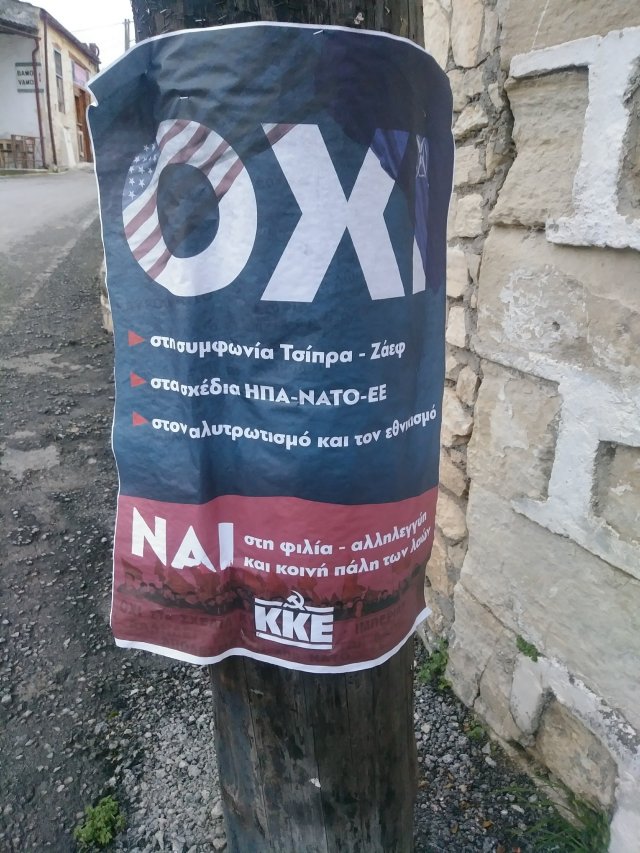
Here’s the same message in both English and Greek, beneath a well-known building in Athens:

Οχι (pronounced “O-hi”) means “No”. The word is politically resonant, as this was supposedly the one word answer given on October 28, 1941, by Ioannis Metaxas, Prime Minister of Greece, when Mussolini demanded that Italian troops be allowed to occupy certain strategic parts of the kingdom. There is now an “Οχι Day” every October 28 with much flag waving and parades. Of course, Metaxas was a fascist dictator himself, but the spirit of Οχι seems to transcend ideology.

In case you cannot read Greek, or the English below the Parthenon is too small, the posters say:

NO: to the Tsipras – Zaev agreement;
to the plans of USA – NATO – EU;
to irredentism and nationalism.
YES: to friendship – solidarity, and to the joint struggle of the people.

The Tsipras-Zaev agreement is the Prespa agreement, by which the Former Yugoslav Republic of Macedonia (otherwise known to the world as Macedonia) will be officially re-named “North Macedonia”. I wrote about this a few days ago.  Although some 70% of Greeks are opposed to the deal, Prime Minister Alexis Tsipras seems to have the votes in the Greek Legislature to get it passed. The newly renamed North Macedonia will then be able to enter NATO and the EU with Greece’s consent.

As Communists the Κομμουνιστικό Κόμμα Ελλάδας, or KKE for short, are opposed to anti-Soviet alliances such as NATO and capitalist unions like the European Union, and they blame the United States and its dastardly plans for all of this. I suspect the USA – NATO – EU are the bogey-men of the Greek left-wing, to be opposed until one is in government, when one suddenly realises the benefits of the alliances. The KKE is opposed to irredentism – that is, the claim of any nation to redeem territory that should belong to them but is occupied by another power. This is a bit bizarre  in a Greek context, because the history of Greece from the 1820s to 1947 has been about the nation reclaiming territory. The fear that somehow little FYROM/North Macedonia is going to take the Greek region of Macedonia from the heavily armed Hellenic Armed Forces is palpable but not realistic. Fearing North Macedonian irredentism is a populist nationalist ploy – but the KKE also says it is opposed to nationalism, so I am really unclear what they believe.

The KKE is now the oldest political party in Greece, just over a century. For most of its existence it was outlawed. With the rise of the Soviet Union they never got much purchase on the mostly rural, conservative population, especially when word came back of the Communist persecution of Russian Orthodox Christians.

Things became confusing in the late 1930s. Following the Comintern’s official policy they supported the right of ethnic groups to establish their own separate regional governments. Thus, they supported ethnic Macedonians in their desires for self government – the Slavic Macedonians, that is, not the Greek Macedonians. The Greek Macedonians had only become part of Greece in 1913, and were dead set opposed to the aspirations of the Slavic Macedonians. Thus, most Communists in that part of Northern Greece were not Ethnic Greeks, but belonged to the Slavic minority. Then in 1939 Stalin and Hitler agreed in the Molotov-Ribbentrop treaty to divide Poland and not go to war, and so the Greek Communists felt obliged to support Nazi Germany and its ally Fascist Italy. Then Mussolini issued his ultimatum, and the Greek Communists did not know what to do – support the Greek dictator Metaxas and go against Moscow, or break with the Comintern and join the popular defense? It did not help matters when the Germans invaded in the Spring of 1941 and rolled up the Allied opposition. It only got sorted out which side they should be on when Hitler broke his treaty with the Soviets and invaded Russia later in the summer of 1941.
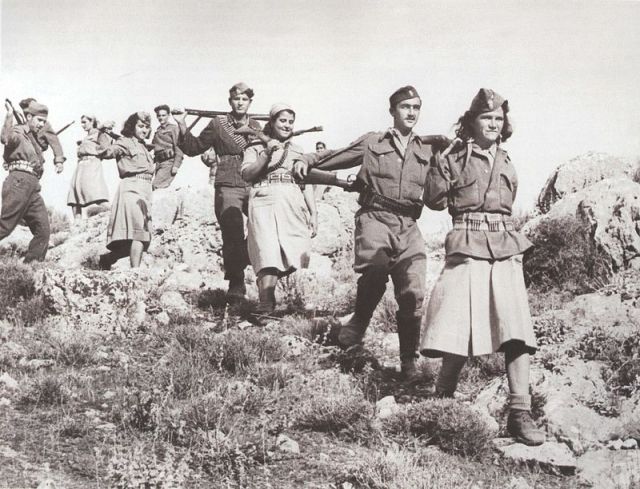
elas guerrillas 1943

Soldiers of the Communist controlled National People’s Liberation Army (“ELAS”), 1943.

The Communists in Greece were part of a very active resistance, not only attacking Germans but also building up an army that had a broad left-wing support, including some Orthodox clergy. They were also very good at “eliminating” in good Bolshevik fashion any rival leaders in the alliance so that they dominated the resistance throughout the country (except in Crete, where the British were active behind the lines). they were in an excellent position to rule the country after World War II except, alas, Stalin sold them out. At a conference in Moscow in October 1944 Stalin and Churchill divided up Eastern Europe into spheres of influence, supposedly using the back of a napkin, and the United Kingdom got “Greece  – 90% UK”. The British landed troops in Athens in late 1944 and the King and his government-in-exile returned.

The Communists launched a revolution in 1946 and this became a civil war that lasted for three long years with an estimated 178,000 deaths and over a million people displaced. While not adverse to Greece becoming Communist, Stalin did nothing to help, feeling bound by his agreement with Churchill. The UK and then the US assisted the Greek army in its battles, while the KKE received support from the communist-controlled nations of  Albania and Bulgaria , and especially Yugoslavia. At the end of the war much or Greece was in ruins and the KKE and its army was defeated. NATO was formed in 1949 and Greece (along with Turkey) joined in 1952.

The KKE remained underground for the 1950s and 1960s. As Greece industrialized and urbanized they gained a bit more support. The danger of a KKE revolt was used as an excuse in 1967 for the military to overthrow democracy and establish a dictatorship, but in reality the Communists were never in a position to threaten the country.

Finally, after the junta was overthrown in 1974, democracy was restored. The centrist politician Konstantinos Karamanlis returned from exile in France and became the Prime Minister of the transitional government. He legalized the KKE, supposedly in a attempt at inclusion, but I suspect he knew just how small the support for them was, and wanted that to be shown. They received just under 10% of the vote in the first democratic election in 1974, and while they have had seats in the Hellenic Assembly ever since, they have never received more than 13.1%.  In the last election mustered a mere 5.5%. While active and visible, and well supported by a small core of voters, they do not appear to be able to gain the support a significant part of the population.

Greeks, having suffered in living memory from a civil war caused by the Communists and having also endured military juntas, seem wedded to parties that are just left or right of centre. While the current Prime Minister, Alexis Tsipras, was in fact a member of the Communist Youth, he left the KKE and moved to the centre, and now supports Greece’s ongoing membership in both the EU and NATO. While the KKE may say “No!” to any number of things, the Greeks people are saying “No” to it.

Sig short

Posted in Uncategorized | Leave a comment

Paul Was Not A Convert

685px-conversion_on_the_way_to_damascus-caravaggio_(c.1600-1)

Caravaggio, 1601. Oil on canvas, 230 cm × 175 cm (91 in × 69 in), Location: Santa Maria del Popolo, Rome. Note that a horse is nowhere mentioned in scriptures about the event, so the Feast cannot be called “The Unhorsing of Paul” anymore than it should be named “The Conversion of Paul”.

Tomorrow is the Feast of the Conversion of Paul, celebrated in the Anglican Communion, the Lutheran/evangelische churches, and the Roman Catholic Church. The eucharistic readings for the feast vary, but in the Church of England is read the “Road to Damascus” account of Acts 9.1-22:

Meanwhile Saul, still breathing threats and murder against the disciples of the Lord, went to the high priest 2and asked him for letters to the synagogues at Damascus, so that if he found any who belonged to the Way, men or women, he might bring them bound to Jerusalem. 3Now as he was going along and approaching Damascus, suddenly a light from heaven flashed around him. 4He fell to the ground and heard a voice saying to him, ‘Saul, Saul, why do you persecute me?’ 5He asked, ‘Who are you, Lord?’ The reply came, ‘I am Jesus, whom you are persecuting. 6But get up and enter the city, and you will be told what you are to do.’ 7The men who were travelling with him stood speechless because they heard the voice but saw no one. 8Saul got up from the ground, and though his eyes were open, he could see nothing; so they led him by the hand and brought him into Damascus. 9For three days he was without sight, and neither ate nor drank.
10 Now there was a disciple in Damascus named Ananias. The Lord said to him in a vision, ‘Ananias.’ He answered, ‘Here I am, Lord.’ 11The Lord said to him, ‘Get up and go to the street called Straight, and at the house of Judas look for a man of Tarsus named Saul. At this moment he is praying, 12and he has seen in a vision a man named Ananias come in and lay his hands on him so that he might regain his sight.’ 13But Ananias answered, ‘Lord, I have heard from many about this man, how much evil he has done to your saints in Jerusalem; 14and here he has authority from the chief priests to bind all who invoke your name.’ 15But the Lord said to him, ‘Go, for he is an instrument whom I have chosen to bring my name before Gentiles and kings and before the people of Israel; 16I myself will show him how much he must suffer for the sake of my name.’ 17So Ananias went and entered the house. He laid his hands on Saul and said, ‘Brother Saul, the Lord Jesus, who appeared to you on your way here, has sent me so that you may regain your sight and be filled with the Holy Spirit.’ 18And immediately something like scales fell from his eyes, and his sight was restored. Then he got up and was baptized, 19and after taking some food, he regained his strength.

For several days he was with the disciples in Damascus, 20and immediately he began to proclaim Jesus in the synagogues, saying, ‘He is the Son of God.’ 21All who heard him were amazed and said, ‘Is not this the man who made havoc in Jerusalem among those who invoked this name? And has he not come here for the purpose of bringing them bound before the chief priests?’ 22Saul became increasingly more powerful and confounded the Jews who lived in Damascus by proving that Jesus was the Messiah.

Paul gives his own account of the event in Galatians 1:

11 For I want you to know, brothers and sisters, that the gospel that was proclaimed by me is not of human origin; 12for I did not receive it from a human source, nor was I taught it, but I received it through a revelation of Jesus Christ.
13 You have heard, no doubt, of my earlier life in Judaism. I was violently persecuting the church of God and was trying to destroy it. 14I advanced in Judaism beyond many among my people of the same age, for I was far more zealous for the traditions of my ancestors. 15But when God, who had set me apart before I was born and called me through his grace, was pleased 16to reveal his Son to me, so that I might proclaim him among the Gentiles, I did not confer with any human being, 17nor did I go up to Jerusalem to those who were already apostles before me, but I went away at once into Arabia, and afterwards I returned to Damascus.
18 Then after three years I did go up to Jerusalem to visit Cephas and stayed with him for fifteen days; 19but I did not see any other apostle except James the Lord’s brother. 20In what I am writing to you, before God, I do not lie! 21Then I went into the regions of Syria and Cilicia, 22and I was still unknown by sight to the churches of Judea that are in Christ; 23they only heard it said, ‘The one who formerly was persecuting us is now proclaiming the faith he once tried to destroy.’ 24And they glorified God because of me.

x400

You should read this book. Pamela Eisenbaum is a Jewish scholar of the New Testament and Christian origins teaching at a Christian divinity school, namely Iliff School of Divinity in Denver, Colorado.

The problem with all of this is the label the church gives to this event: The Conversion of Paul. The issue I have with this is indicated in the title of this post – Paul was not a convert! Search the two passages above, or any of the other accounts that relate to the revelation of Jesus to him, and you will not see the word “convert.” Yes, he changed, but as Pamela Eisenbaum argues in her brilliant book, Paul Was Not a Christian: The Original Message of a Misunderstood Apostle (New York: Harper Collins, 2009), Paul never stopped seeing himself as a Jew, and did not see Christianity as something separate from Judaism. Christianity, a category he did not know of, was not the successor religion to Judaism; rather, Jesus was the fulfillment of prophecy and promise, and through Jesus Gentiles could now be grafted onto the salvation promised to Jews. Paul did not convert to Christianity, because Christianity as we understand it did not exist. Paul was, however, called by God through the revelation of Jesus to him to be an apostle to the Gentiles, a kind of rescue mission to an otherwise depraved and damned population.

Of course, most Gentile Christians have not seen it that way. They retro-projected the rigid separation of Judaism and Christianity of their own day – medieval and modern – onto the early church. However, as a multitude of recent scholars have demonstrated, in books such as The Ways that Never Parted: Jews and Christians in Late Antiquity and the Early Middle Ages (edited by Adam H. Becker, Annette Yoshiko Reed; Minneapolis: Fortress, 2003), communities of Jews and Christians overlapped, went to each others services, and shared members throughout antiquity; what we now know as Judaism and Christianity emerged out of an older form of Judaism. Admittedly, from the 2nd Century CE on various leaders in both communities admonished their peoples not to attend each other services, but they had to do it for centuries because the people would not listen and kept on doing so. Christian leaders argued about the date of Easter and its difference from (but connection with) Passover, because Christians were partaking in Passover as well as Easter, and vice-versa; by setting up a separate date the two feasts were separated.

evwiii-conversion-of-st-paul.jpg?w=1200

Calling Paul a “convert” is as anachronistic as saying that he fell out of his car on the way to Damascus. Painting by Ernest Vincent Wood III.

So Paul did not convert, and he was never a convert. He was born a Jew, circumcised as a Jew, educated as a Jew, and died a Jew. He followed Jesus because he experienced a call from the Son of the God – a God he knew as the God of the Jews. He never repudiated God’s promises of faithfulness to the Jews, but rather saw them being extended, by special permission, to non-Jews.

The name of the festival is wrong. Paul did not convert, at least not in the usual meaning of that word in a religious context. Using that language encourages supersessionism, the belief that Christianity replaces Judaism – and this is a theology of which we who are Christians must repent. Paul was called, and for that reason I think liturgists and church leaders need to change the name of the feast tomorrow to The Calling of Paul. Over to you, bishops and archbishops, pastors and clergy, synods and liturgical committees.

Posted in Liturgy | Tagged , , , , , | Leave a comment

When I Pray

Prayer is fundamentally not about changing God’s mind, but about changing ours. It’s not as if we can change God’s mind, because talking about God having a “mind” is a rather anthropomorphic projection of how we think God works. Granted, there are lots of stories about Moses and prophets talking with God and persuading them not to take certain courses of action, and Jesus encourages us to persist in prayer – but I think that all of this discourse is simply talking because otherwise we could say nothing at all. In the face of the mystery of God someone like the philosopher Ludwig Wittgenstein might counsel us to say nothing, but we are wordy people, and so we use metaphors, analogies, similes, and stories to talk about our experience of the divine, always knowing that in the end these words are limited and must be negated.

prayer

Despite the masculine pronouns, I agree with Thomas Merton.

So it is with prayer. When we pray aloud or silently – we use our brains-topped bodies  and our minds (which I rather non-dualistically consider to be much the same things). If a person prays often and regularly, something may happen to that person. I find that I cease being so interested in controlling things and find myself more concerned with what little is actually within my scope of control. When I pray about what is beyond my scope of control, this says more about my level of concern about such things than my ability to change it – although God often then provides me with opportunities to influence situations, opportunities that I had not looked for or hoped for.

I have struggled with prayer over my life. I struggled to have a daily discipline, to be focused on the words and not drift even while reading or saying things. I have trouble walking and chewing gum at the same time, but I can easily think of two or three or even four things at once. People don’t have a stream of consciousness, they have multiple rivers flowing uncontrollably hither and thither, meandering here and carving out new channels. Prayer is a means of exercising some discipline over this.

My prayer is fairly simple. I meditate once a day for about twenty minutes using the Jesus Prayer, a practice hallowed by centuries in the Eastern Orthodox tradition. To time myself I use Insight Timer as an app on my phone, which is very useful at keeping track of one’s practice. Insight Timer has hundreds of guided meditation which I do not use so much, and for very reasonable fees it offers courses in meditation. It is an inter-faith online community that is very friendly. I usually meditate first thing in the morning, after feeding the dog and letting him out and boiling the water for the coffee (and letting the dog back in).

index

After breakfast I will say Morning Prayer, and sometime in the evening I will say Evening Prayer, sometimes adapted as Prayer at Late Night. When I was in Canada I used the forms in the Book of Alternative Services of the Anglican Church of Canada, but now that I am a priest of the Church of England I use Common Worship for Daily Prayer. Both the Church of England and the Anglican Church of Canada have similar Anglican principles, rooted in ancient monastic practices – psalms, readings from scripture, canticles, prayer on a number of subjects, finishing with the collect (a special prayer for the day or the week) and the Lord’s Prayer. It is all in books, but it, too is available as an app.

static1.squarespace.com

Maybe not the most comfortable position for prayer.

While it has taken me awhile to have this discipline, it does not make me particular holy. I still say stupid and offensive things, and there are many ways in which I fall short. However, I do think prayer has made me better – I am prompt to admit my mistakes, to acknowledge my character defects, and to try and do something about it. It has made me more sensitive to others. If I miss some part of this practice I do notice it. I think it helps to relax me and get me out of my own bubble. As I spend time on Twitter and Facebook and read a lot of news online, it also helps to re-centre me in the things that are the most important – scripture, tradition, silence, and ways to be open to the divine.

While I tend to have this daily practice on my own, I do have this sense of praying with the saints distant in time and space. It brings to a spiritual reality of the lines, “with saints and angels praising you . . .”.

Sig short

Posted in Liturgy, Prayer | Tagged , , , , , | 1 Comment

It’s All Greek To Me: PIE & Proto-Greek

Before Mycenean Greek, what did the Greeks speak? And how can we tell, given that no written or recorded evidence exists?

In 1786 William Jones, an British judge from Wales serving at Calcutta in Bengal, presented a paper to the recently formed Asiatic Society. In his paper he suggested that Latin, Greek, and Sanskrit all developed from a common ancestor. Being quite the linguist, he noted commonalities with the ancient Gothic language, Welsh, as well as Persian. While he was not the first to make such a proposal, his presentation was published and became well-known. As the new disciplines of philology and linguistics developed in the 19th century in Europe much of the work was focused on the Indo-European theory and working out how languages develop.

It had long been noticed that languages in Europe came in families, and in many cases their development could be traced in history. The Romance languages, for example, such as Portuguese, Italian, French, and Spanish, are descended from Latin. Welsh, Bretagne, the Gaelic of Scotland, and Irish – labelled the Celtic languages – were clearly related. Likewise the Slavic languages of Serbo-Croatian, Russian, Ukrainian, Czech, Slovakian, and Polish were another family. English is in the family of Germanic languages, along with Dutch, something that is more obvious in Old English.

ie_expansion

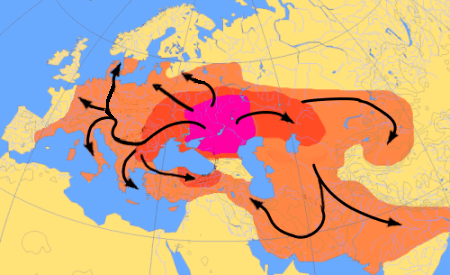
The Kurgan Hypothesis of the Spread of Proto-Indo-European

The connections are most obvious in some very basic words that every language has. Thus, “mother” in Latin, Greek, and Sanskrit are (respectively), mater, μητέρα (“metera”), and मातृ (“matar”). The Brothers Grimm, when not collecting fairy tales, studied phonetic change and came up with Grimms Laws which determines how consonants will change over time. Thus, over time bh becomes b, b becomes p, and p becomes ph. In Germanic languages such as English and German the Latin pater and Greek πατέρας became father and vater (“fa-ter”).

Today there is unanimous agreement that Jones, the Grimms, and their many colleagues were correct. Some time in the past there was a now lost language which is called Proto-Indo-European, or PIE for short. It is the ancestor of most European languages, as well as Persian/Farsi and Hindi. This family of languages is known as Indo-European.

300px-proto_greek_area_reconstruction

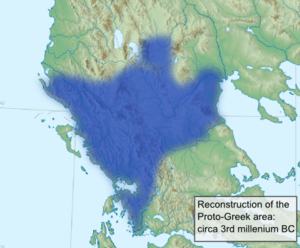
Greek is in a family all by itself. When scholars look at the written evidence of Ancient Greek they see a variety of dialects – Attic, Aolian, Doric, ancient Macedonian, and Ionic. Now, of course, they also include Mycenean, but it is not clear if that is another dialect or something that evolved into one of the classical dialects. Historical linguists posit that prior to these forms of known Greek there was a form of Proto-Greek. Waves of these Proto-Greek-speaking peoples entered into what we now call Greece over the thousand of years before Homer in the 2nd Century BCE. Prior to that was a common ancestor of both Proto-Greek and and an ancient form of Albanian, but the further the linguists look back the murkier it gets.

kurgan-sports-logo

When the Kurgans emerged out of the steppes north of the Black Sea they undoubtedly wore t-shirts with this on it.

Obviously if all these different languages had a common ancestor it must have been of a smaller but historically influential population that managed to spread into both Europe and through Iran into northern India. The most commonly accepted suggestion is the Kurgan Hypothesis, which Marija Gimutas suggested back in the 1950s. She believed that the speakers of PIE were from the steppe (i.e. prairies) north or north-east of the Black Sea. She named the people after the burial mounds she had excavated in that area, mounds known in Russian as kurgans. Based on words that seemed to be common across the languages the Kurgans were thought to be a horse culture, which would suggest mobility and perhaps an advantage in warfare. Genetic studies have borne out the the basic suggestion behind the hypothesis.

poem in proto-greek

Part of a Modern Poem in Reconstructed Proto-Greek

You can now get PIE dictionaries and books that explain how seemingly different words are in fact related to each other. One scholar has even written poems in Proto-Greek.

There is a dark side to the study of Indo-Europeans. Racists in the late 19th century in Germany and elsewhere connected the spread of language groups with the spread of “races”. Given the obvious success of PIE and its descendants in Europe and Asia white supremacists argued that the original Indo-Europeans were a blonde-haired “Aryan” race that conquered everything in their way, but that the purity of the Aryans in Germany and northern Europe was now threatened by lesser races. There is, in fact, no basis for this, race being a socially constructed category, but it obviously had and still has many adherents.

In a similar way Hindutva nationalists in India argue that the Indo-European languages originated in India, rejecting the idea that the historic Aryans (ancient Iranians) invaded and settled India. Selectively choosing their evidence and bending it to fit their narrative, they believe that “real” Indians have always lived on the Indian sub-continent, that the ancient Vedic religion developed locally. This “blood and soil” approach is all too familiar to historians of the 20th century Europe, and it is not accidental that Hindutva uses this narrative to attack the followers of foreign religions, such as Christians, Muslims, and Zoroastrians.

Sig short

Posted in Greece | Tagged , , , , , | Leave a comment

The Territorial Expansion of Modern Greece

concise

I recently finished A Concise History of Greece, Third Edition by Richard Clogg (Cambridge: Cambridge University Press, 2013). Clogg is a now a retired professor of modern Greek history, but previously lectured in London and Oxford. The book is just what it advertises – a concise history of modern Greece from 1770 up to the present time. It must be one of the standard histories on the subject as it has gone through eighteen printings in three editions, something any academic would envy. I am sure it is a textbook in universities, and anybody moving to Greece or just interested in the place would do well to read it.

Several themes emerge in the history of the past 250 years. First, repeatedly, the “Great Powers” of the day have been instrumental in the modern history of Greece, beginning in the 19th century with France, the UK, Russia, and continuing into the 20th Century with the Soviet Union, the United States, and the European Union. A second theme has been the see-saw politics between whether Greece would be a monarchy or a republic. The original Greek revolutionaries wanted a republic, but the Great Powers imposed a Bavarian prince on the infant nation of Greece in the 1830s. There have been various depositions, abdications, republics, and restorations since. The issue was only resolved in 1974 by a referendum on the question, which abolished the monarchy. A third, related theme has been the movement back and forth between military dictatorships and democracy. A fourth theme has been the threat of the Ottoman Empire, and then its successor state Turkey. A fifth theme has been the territorial expansion of the Greek nation (there are undoubtedly others, but this will do for now).

territorial_expansion_of_greece_from_1832–1947

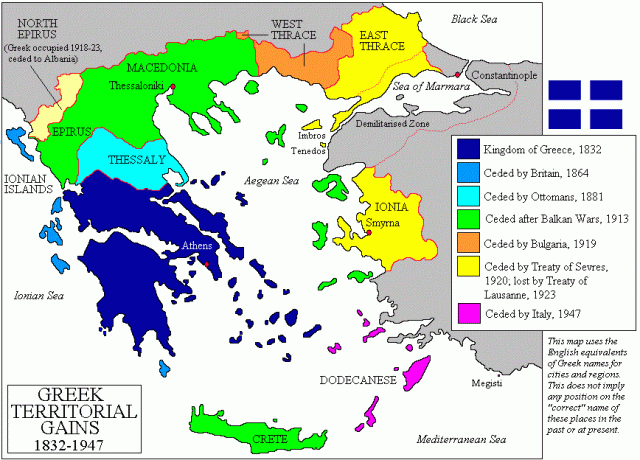
A useful map from Wikipedia: Credit

As the map above shows, the original Kingdom of Greece was less than half of its present territory. Greeks had risen up in revolt in 1821, and were supported by Philhellenes – literally, “Greek-lovers” – from Germany, the UK, France, and Russia. After many years of indecisive battle political leaders from those nations tried to negotiate some sort of a solution with the Ottoman Empire, and sent their fleets down to the area to keep an eye on things. It is not clear how deliberate it was, but the last decisive naval battle of the sail era was fought with the Ottoman-Egyptian navy at the port of Navarino on the west side of the Peloponnese, and the British and their friends pretty much destroyed the opposing naval force. The Ottoman Army, mostly made up of Egyptians, was stranded and unsuppliable, and peace was negotiated by the Great Powers over the heads of the Greek revolutionaries. The British insisted on setting up a monarchy and chose the son of the King of Bavaria to be that king.

At independence there were more Greek speaking peoples outside of Greece than inside it. Most of them were in the areas to the north, in Crete, in Constantinople, on the Aegean islands, and in Ionia in Anatolia. There were sizeable Greek communities on the south shore of the Black Sea around Trezibond, in Albania and Bulgaria, in Armenia and Russia, in Syria, Palestine, and Egypt, and Sicily and southern Italy. There were even ethnic Greek communities in Cappadocia in eastern Anatolia, where the people spoke Turkish but were ethnically Greek and Orthodox Christians.

The history of Greece is the story of additions to that original territory, to the point of over-reaching.

  • In 1864 the UK handed over the United States of the Ionian Islands, which they had been “protecting” since taking them over from Napoleon in 1815. Napoleonic France had taken them from the Venetian Republic, and interestingly they are the only part of Greece that was never part of the Ottoman Empire.
  • In 1881, after the Russo-Turkish War of 1877-78, Greece was given Thessaly, the area north of Central Greece.
  • In 1897 the Greeks of Crete erupted in rebellion against the Ottoman Turks (this had happened repeatedly the previous hundred years) and the Ottoman Turks, as usual, responded harshly. Mobs of angry Muslim Cretans attacked Greek Orthodox Cretans, and the Greeks responded in kind. The Muslim Turk vigilantes went too far, though, and a number of citizens of the Great Powers were murdered by mobs, including the British Consul in Crete. The Great Powers sent in their armed forces and forced the Ottoman Empire to grant almost complete sovereignty to the island, and the brother of the Greek king was made the governor.
  • In 1913, after two Balkan Wars Greece, Greece received Macedonia and Epirus, as well as formally annexing Crete.
  • After sitting out most of the First World War, Greece joined the side of the Allies (and eventually forced the abdication of the German-favouring king and replaced him with his brother). After the war, in 1919, the Kingdom of Greece received West Thrace from Bulgaria, which had been on the losing side with Germany and the Ottoman Empire.
  • As well, Greeks saw an opportunity to expand into East Thrace and Anatolia with the Treaty of Sevres which was imposed on the Ottoman Empire by the victorious Allies. The Ottoman Empire fell apart, but out of its ashes Kemal Ataturk formed the new, secular nation of Turkey, based in Ankara in central Anatolia. The new Turkish nation disavowed the Treaty of Sevres, and its new army challenged the Greeks for the territories in Anatolia. At first, in 1921, the Greek Army had success as they marched towards Ankara, but then lost a series of battles. Some 300,000 Greek Orthodox in Anatolia died, Smyrna burned, and the Greeks lost the war. With the Treaty of Lausanne in 1923 Greece conceded its losses, and the two nations exchanged populations – some 300,000 Muslims (many Greek-speaking) were expelled from Greece, and over 1,000,000 Orthodox (many Turkish speaking) were expelled from Anatolia. The dream of Greater Greece died in this, in what is now known in Greece as The Catastrophe.
  • In the Second World War, in October 1940, Greece was invaded by Italy from occupied Albania. Greece fought back so effectively that they controlled southern Albania, which many Greek nationalists thought should have belonged to them anyway. The Germans took over the war against Greece in the spring of 1941 and fairly quickly outflanked the Greeks and their British allies, and conquered the nation. The Germans only left after the unconditional surrender in May 1945.
  • In 1947 the Dodecanese (“literally, “Twelve Islands”) was yielded to Greece by Italy. Italy had taken the islands, the largest of them being Rhodes, in 1912, after the Italo-Turkish War (the one where the Italians conquered Libya). When the Italians in 1943 reversed sides the Germans promptly occupied the islands, and after Germany lost the war the British occupied them. When Italy signed a peace treaty with the victorious Allies in 1947 it was obliged to surrender all of its colonies, including the Dodecanese.
  • This was not the end to enosis, the desire to unite all Greeks into one country. The island of Cyprus had been a British colony since the 19th century but granted independence in the 1950s. While Cyrus had a majority Greek-speaking population, there was also a sizeable Turkish minority. In 1974 the military junta ruling Greece conspired with Cypriot Greeks to overthrow the government of Cyprus and effect a union of Cyprus with Greece. This resulted in an international crisis, the invasion of the Turkish army, the failure of the coup in Cyprus, the country being split into a Turkish north and a Greek-speaking south, and the fall of the junta in Athens. Cyprus remains its own country, but one divided. The only good thing that emerged out of this is that Greece turned its back on military rule and restored democracy.

Following the Catastrophe and with the cessation of the Dodecanese, the ordinary citizens of Greece ceased to have any more territorial ambitions. Their focus has shifted to defending what it has, building better relations with their neighbours, and developing the economy. However, given that the country had been conquered in living memory, and that it is not yet a century since the end of the dream of a Greater Greece on the eastern shores of the Aegean, the people are still sensitive about the integrity of its territory. This past explains much of the current foreign policy of the nation.

We live across Souda Bay from the Chania airport, which is also a NATO air force base and the second largest air base for the Greek air force. Military jets take off all the time, and I suspect most of them are heading off to challenge Turkish military jets entering disputed airspace. There is interest in both Turkey and Greece to drill for oil in the Aegean, but there is no agreement between the two nations as to where their respective maritime jurisdictions meet. Thus there is a large base at Souda for the Hellenic Navy. While the nations have not actually been to war since 1923, they have come awfully close, especially in 1974. While all out war is unlikely, both sides remain armed to the teeth. It makes for an interesting place to live.

Sig short

Posted in Crete, Greece, War | Tagged , , , | Leave a comment

Water Into Wine: The Miracle of Generosity

A sermon preached on The Third Sunday of the Epiphany at St. Thomas, Kefalas, Crete,  11:00 am January 20, 2019.

the_wedding_at_cana

Mla the Crow and Athanasius the Alpaca were making their way to St. Thomas’s Church in Kefalas, when Mla asked, “Do you believe in miracles?”

“Why, yes, I do believe I do. Don’t you?” Athanasius replied.

“I’m not sure. I’m a pretty practical bird,” said Mla. “I eat things, I fly around. I sit in trees. I gather with my sisters and my brothers and my cousins. Those humans at the church, though, talk about miracles. The Red Sea thing. A donkey talking. Walking on water. You know, unbelievable stuff.”

Athanasius thought for a moment, and then said, “Well, there’s one miracle that you cannot doubt, and it is the greatest of them all.”

“Oh, what’s that.”

“The world,” the alpaca said. “The cosmos. The starry heavens above and everything beneath it. You and me, and all our relations. The grass in the fields and the mountains covered in snow. It is all wondrous and beautiful. Even the humans.”

“The Creator created,” said Mla, “and he saw that it was very good. Yeah, I can buy that.”
Athanasius said, “Look at the birds of the air – like you. You neither sow nor reap nor gather into barns, and yet the Creator feeds you. That’s a great miracle. Or consider the lilies of the field, how they grow; they neither toil nor spin, yet I tell you, even Solomon in all his glory was not clothed like one of these.”

“Or just get a look at me – is there anything more beautiful than a crow, eh?” said Mla.

“Umm, prossibly not,” said Athanasisus. “But if we can accept the idea of a Creator, well then, the idea that God is manifested in creation in marvelous ways is just a matter of degree, not of kind.”

“You’ve been reading theology again, have’t you?” said Mla.


Do you believe in miracles?

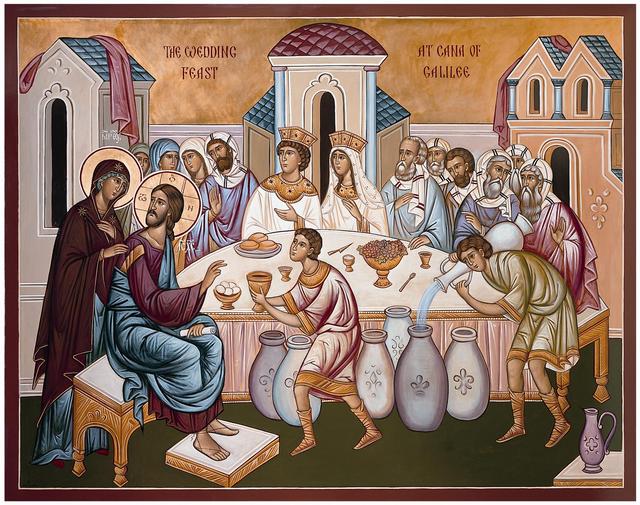
Our gospel reading today says Jesus turned water into wine. A LOT of water into a LOT of wine. The gospel states that this was the first sign from Jesus about who he was, accomplished at Cana of Galilee. Along with his walking on water and the feeding of the 5000, it is the proverbial miracle. Then there is the resurrection from the dead, the virgin birth, and all that.

As Christians we supposedly believe all of that. However, most of us are not only Christians, but people of the modern 21st century, practical and rooted in the earth. What are we to do with all those miracles, especially in a day when positivism and science is still the dominant way we approach the world?

A friend of mine – Elizabeth May, who just happens to be the leader of the Green Party in Canada, but was at one time pursuing ordination – pointed out in a sermon that we often say that only something miraculous will solve a problem, but when the problem is transformed and solved, we just explain them away.

In the realm of politics:

So miracles do happen. If we believe that God is behind the miracles, should we be surprised that God works through human beings to accomplish them?

In war, the miracle of Dunkirk. Did you see the film by Christopher Nolan with Kenneth Branagh, Mark Rylance, and Harry Styles? Partly filmed on the very beaches of Dunkirk, it told the story of how 300,000 British soldiers were evacuated against all odds. The movie cleverly presents on three time lines – an hour in the air, a day on a small boat at sea, and a week on the beaches.

Unlikely, but it all happened. We tend to explain miracles away, coming up with reasonable explanations. In the miracles of the feeding of the 5000 and the 4000 some liberal theologians of the 19th century just said, “Well, everybody just had food with them, they only started to share it when Jesus broke the loaves and started to distribute so little to so many.” With respect to today’s gospel reading perhaps they thought,  There was wine hiding somewhere in the village.

But if we believe in a God who can create the cosmos, larger than we can possibly imagine, then perhaps we can admit that sometimes God acts in ways that we will not understand, against all expectation, and with great timing. When I see miracles – healing, political, resolution of strife – I am interested in asking the how, but I am also simply grateful.

hqdefault

The Rev. Dr. Thomas Troeger, J. Edward and Ruth Cox Lantz Professor Emeritus of Christian Communication, Yale Divinity School.

Perhaps the real miracle is the generosity of God in such things. In the wedding at Cana Jesus’s first miracle is not about transmutation so much as generosity. There is more good quality wine than necessary.

Thomas Troeger, a musician and theologian who teaches at the Yale Divinity School, and who is both a Presbyterian minister and an Anglican priest, wrote one of my favourite modern hymns about God’s generous love. It goes like this.

A spendthrift lover is the Lord who never counts the cost
or asks if heaven can afford to woo a world that’s lost.
Our lover tosses coins of gold across the mid-night skies
and stokes the sun against the cold to warm us when we rise.

Still more is spent in blood and tears to win the human heart,
to overcome the violent fears that blow the world apart.
Behold the bruised and thorn-crowned face of one who bears our scars
and empties out the wealth of grace that’s hinted by the stars.

It’s a generosity seen in creation, in the speaking of God, “Let there be light”.

It’s a generosity seen in the Word of God poured out and made flesh.

It’s a generosity seen in the Holy Spirit being given to all God’s people for the common good.

So, even if you have intellectual problems with aspects of the Christian story, pay closer attention to the core narrative of God’s love and care for us. That is the more remarkable thing in the long term, and it is what we ought to be emulating.

How shall we love this heart-strong God who gives us everything,
whose ways to us are strange and odd; what can we give or bring?
Acceptance of the matchless gift is gift enough to give.
the very act will shake and shift the way we love and live.

Sig short

Posted in Sermons | Tagged , , , , , | Leave a comment

What’s in a Name: The Latest Political Crisis in Greece

alexander

Statue of Alexander the Great in Skopje, Republic of Macedonia

While much of the English speaking world has been focused on revelations of a criminal nature in Washington, and the failure of the May plan for Brexit in the UK, the Greeks are all bothered with a unique crisis: what to call the nation to the north of them.

macedonia_region_map_wikipedia

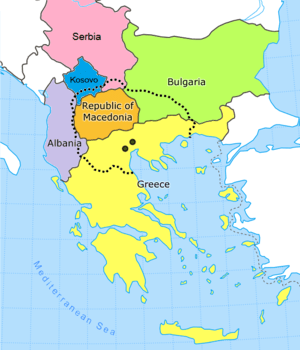
The Republic of Macedonia in relation to Greece. The dotted line represents an area known as Macedonia under the Romans. the two black dots in northern Greece are the two ancient capitals of the Kingdom of Macedonia.

The nation calls itself The Republic of Macedonia. It used to be part of Yugoslavia until that nation fell apart in 1991. It had been known as Socialist Republic of Macedonia within the Socialist Federal Republic of Yugoslavia, and under the non-Soviet communism of Marshal Tito it had its own constitution, president, ethnic institutions, and the right of secession. While there is a large Albanian minority within the country, the majority ethnic group calls themselves Macedonians, call their language Macedonian, and so call the nation Macedonia and its citizens Macedonians. The ethnic Macedonian are mostly members of the Macedonian Orthodox Church, while the Albanian Macedonians tend to be Muslim. The nation claims historical links back to the ancient Kingdom of Macedon – that little country which, under King Philip II in the 4th Century BCE, conquered Thessaly, Attica, and the Peloponnese, and from which Philip’s son, Alexander the Great, launched his conquest of the Persian Empire 2300 years ago. For that reason the modern Macedonians have erected a massive statue of Alexander in the capital city, Skopje. One would think that if anybody had a claim to the name Macedonia it would be the two million people living there.

Well, many in Greece beg to differ. They point out that the Macedonian language is not the language spoken by Alexander the Great. He would have spoken the language of his people, which, unfortunately, was never much of a written language, and so we do not have any records beyond a few inscriptions. We do know that in addition to ancient Macedonian he also spoke Attic Greek, for he was tutored by Aristotle himself. Most scholars believe that ancient Macedonian was related to Greek, and most ancient Greeks considered the Macedonians to be Greeks as well, if a bit strange-tongued and verging on being a little to much like the barbarians they bordered on. The ancient Kingdom of Macedonia was centered in the area around what is now the city of Thessalonica,what is now Greece’s second largest city. The sites of its old capital Aegae and newer capital Pella are both within the modern nation of Greece. Indeed, the area of northern Greece to the south of the Republic of Macedonia is known as Macedonia, and has been part of the Hellenic Republic since 1913, after the First Balkan War of 1912-1913. It is not at all unusual to meet a Greek speaking person who says that they come from Macedonia, and by Macedonia they definitely do not mean the Republic to the north.

The modern Macedonian language, they will point out, came to be written comparatively late, really only in the 19th century, and was otherwise considered to be a dialect of Bulgarian. Thus Greek Macedonians claim that the Macedonian Macedonians have no real claim to the name. Like the Bulgarians, Serbs, and Croats they are really southern Slavs (which is what Yugoslav means) whose ancestors came to the Balkans in the 6th and 7th centuries – 900 to 1000 years after Philip II and Alexander the Great. While the name Macedonia was used and extended by the Roman Empire to cover the area now occupied by the Republic of Macedonia, that was just a dumb jurisdictional decision – just the kind of thing one might expect those arrogant Latin-speaking Romans to do.

The independence and expansion of the modern Hellenic Republic is still sufficiently recent that the Greeks are very defensive of their territory. In 1913 they only just beat Bulgaria to controlling Thessalonica and the surrounding area. In the Second World War, after Germany conquered Greece, the Nazis gave Greek Macedonia to the Bulgarians to occupy. Given that that the Greeks believe that the Macedonians of Macedonia are really Bulgarians, they are deeply suspicious.

makflags

The old flag of Macedonia 1991-1995 on the left, and the new flag, adopted in 1995 and now in use. Greece blockaded the land-locked Republic of Macedonia because the old flag used the Vergina Sun. The symbol was found in the city of Vergina in northern Greece on grave steles of ancient Macedonian rulers and was considered by many to be an historic royal symbol of the old kingdom.

Many Greeks are convinced that the people and leaders of the Republic of Macedonia secretly want to take Greek Macedonia for themselves. For this reason the Greeks have thrown all their diplomatic efforts into insisting that the Republic of Macedonia be known internationally by the clumsy name The Former Yugoslav Republic of Macedonia (“FYROM”). This is the name by which it was admitted into the United Nations and the way it is marked on many maps. Greece, as a member of both the European Union and NATO has vetoed the membership of the FYROM until it formally changes what it calls itself. The Greeks are notable in spending more of their GDP on their military than any member nation other than the US; this is not so much to defend the country from Russia as a perceived threat from their NATO ally in Turkey. Presumably it would be useful in fighting off any nationalist Macedonians.

1200px-Потпишување_на_договорот_за_макед

Zoran Zaev (right) and Alexis Tsipras in Oteševo, Macedonia after signing the agreement.

This was the status quo for twenty-five years. In the past year the Prime Minister of Greece, Alex Tsipras, made efforts to reach a compromise with the government of the Republic of Macedonia. They have now both agreed to change the name to the Republic of North Macedonia. The deal, of 17 June 2018, and which contains certain clauses around culture and that huge statue in Skopje, was finalized at Prespa Lake, between the two countries, and so is known as the Prespa Agreement. Once the two countries ratify the agreement Greece will remove its objections, and the Republic of North Macedonia can apply to join NATO and the EU.

Although t has been hailed internationally, many people in the Republic of Macedonia and in Greece dislike the agreement intensely. Opponents in what might soon be called North Macedonia boycotted the referendum to ratify it, thus resulting in too low a participation rate to take effect. Instead, the legislature had to approve it. The Prime Minister of Greece, who leads a coalition, is opposed by the leading opposition party, and even the leader of his partner in the coalition has come out in opposition. There was a vote of confidence in the governing coalition a few days ago, but it survived, barely. What is not clear is if Tsipras has the numbers in the legislature to pass the ratification by Greece. I suspect the kind of horse-trading that went on in Spielberg’s Lincoln is taking place in Athens this week.

The controversy over the name is one aspect of nationalism. Both Greeks and Macedonians (excuse me – North Macedonians) began to construct their identities in the modern era, beginning with religion and language but recovering ancient history and symbols, as well as establishing jurisdictions where they are the majority. The Prespa Agreement is a step by both nations towards consolidating their respective identities while also living in a friendly peace with their neighbours. I hope it passes.

Sig short

Posted in Greece | Tagged , , , , | Leave a comment

It’s All Greek To Me: Byzantine Greek

In my previous posts on the history of the Greek language I talked about Mycenean Greek – the language that Greek speaking peoples spoke in the 2nd Millenium BCE – and three types of Ancient Greek, namely Homeric, Classical, and Hellenistic Greek. This post is about Byzantine or Medieval Greek (also called “Middle Greek”), which bridges the gap between Ancient and Modern Greek.

1148px-augustins_-_saint_jean_chrysostome_et_l'impératrice_eudoxie_-_jean_paul_laurens_2004_1_156

John “The Golden Tongued” Chrysostom (349-407), Archbishop of Constantinople, confronts the Empress Eudoxia (388-404). He thought she was a vain, power-hungry clothes-hound, no better than a pagan; she thought he was an unhinged fanatic with heretical tendencies (they were probably both right). They would have spoken an early type of Byzantine Greek. Painting (1893) by Jean-Paul Laurens.

The beginning and end points of Byzantine Greek are pretty arbitrary, as the language evolved slowly from Hellenistic Greek (what the New Testament was written in) into the form of Greek found in Late Antiquity and the Early Middle Ages. Indeed, both those terms – “Late Antiquity” and “Early Middle Ages” – don’t make a whole lot of sense when applied to Greek peoples and their language. This is because, as English speaking people whose scholarship is mostly derived from western Europe, we think of late antiquity as ending with the fall of the western Roman Empire in 476 CE and the Middle Ages beginning with its replacement by the rise of the rule of Franks, Lombards, and Anglo-Saxons. But in the Greek speaking east, the Roman Empire did not fall for almost another thousand years. Centered on the city of Constantinople, it continued to expand and contract in the Middle East, Anatolia, the Balkans, and North Africa. It battled the Persian Empire of the Sassanids, and then the Arab Empire of the Islamic Caliphate. While the Arabs were a mortal threat and conquered much of the late Roman Empire, they never actually conquered all of it. Damaged by Catholic Crusaders, the Empire carried on until 1453 when the Ottoman Turks, Muslims but decidedly not Arabs, finally overwhelmed Constantinople. The last bit of the Empire, Trebizond on the Black Sea, fell in 1461. The people in the Empire considered themselves Romans who happened to be Christian and Greek-speaking, and after their subjugation by the Turks they still considered themselves as such. Their identity as something called “Greeks” that hearkened back to Athens, Zeus, and Plato all developed later.

So, arbitrarily, we may say that Byzantine Greek began in 300 CE. Or how about 324 CE, when Constantine began to rebuild the already substantial city of Byzantium into the massive planned city of Nova Roma (but universally known as Κωνσταντινούπολις, the city of Constantine)? The end, also arbitrary because the language did not suddenly change, is the fall of the city in 1453.

Byzantine Greek grew out of Hellenistic Greek, which itself was mostly influenced by the Attic dialect of Classical Greek. Given the use of Hellenistic Greek in the New Testament and the Greek translation of the Bible known as the Septuagint, Byzantine Greek remained rooted to a static written form even as the spoken language changed. The changes included:

  • the loss of the dative (noun forms indicating the indirect object), being mostly absorbed by the genitive;
  • some of the sounds for the vowels and diphthongs merged, so that ι, οι, η, and υ all began to sound like “ee”;
  • υ in some cases began to be pronounced with a “v” or an “ff” sound. Ζεύς, which we anglophones pronounce “zoos”, was probably pronounced more like “dze-oos” by the ancients, was now pronounced (and still is in Modern Greek) as “zefs” (really).
  • β moved from a “b” sound to a “v” sound; δ began to be pronounced more as “dh”;
  • verbs with their inflected endings became far more regular;
  • the distinctive form for the infinitive disappeared;
  • the optative mood, expressing wish, and which was already on the way out with Hellenistic Greek, disappeared;
  • the future in Hellenistic Greek was replaced by a far simpler form;
  • some words were replaced – so οἶνος (wine) became an old-fashioned word for the more common κρασίον; and
  • by the fourth century CE Greek ceased to use pitched accents and simply used accents to mark stress; ancient Greek would have sounded rather sing-songy to Byzantine and Modern Greek-speakers.

[Most of this I stole from the far more detailed article on Wikipedia]

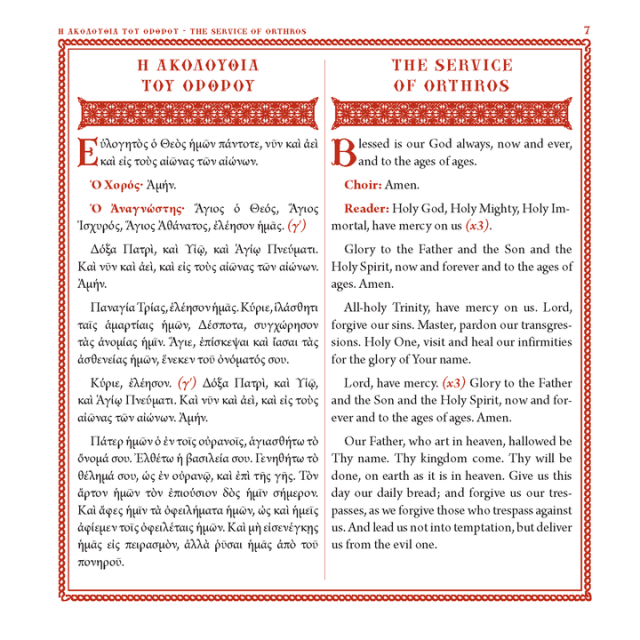
divine_liturgy_02152010_divine_music_page_007_720xByzantine Greek still exists. It is used by the Greek Orthodox Church in its liturgies. Because of the many differences with Modern Greek it is difficult for ordinary Greeks, today to understand it, as Chaucer would to our English ears. The Church of Greece, then, is in the strange position of celebrating its liturgies in a form of the language that most of its peoples struggle to understand. When they attend Catholic or Protestant services in contemporary Greek they are struck at the ease with which they can follow the worship. However, despite this, the Orthodox Church is not likely to change, as they believe it to be important to preserve the New Testament and the ancient liturgies in the forms in which they received them.

Sig short

Posted in Greece | Tagged , , , | Leave a comment

A Greek Cave Church

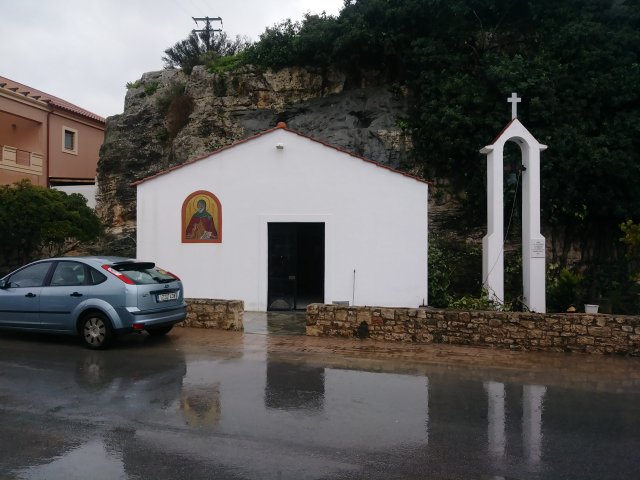
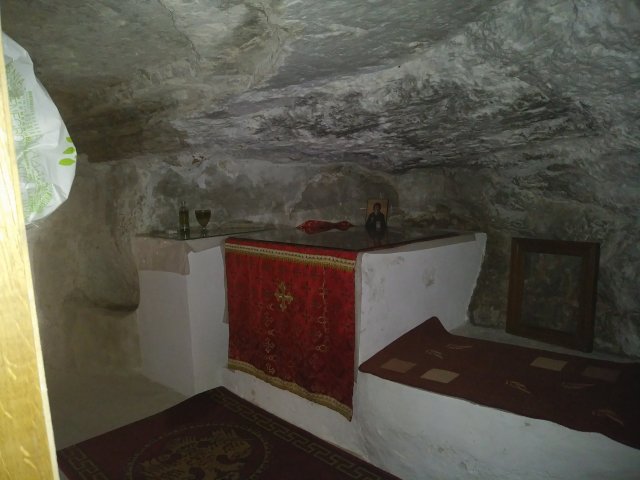
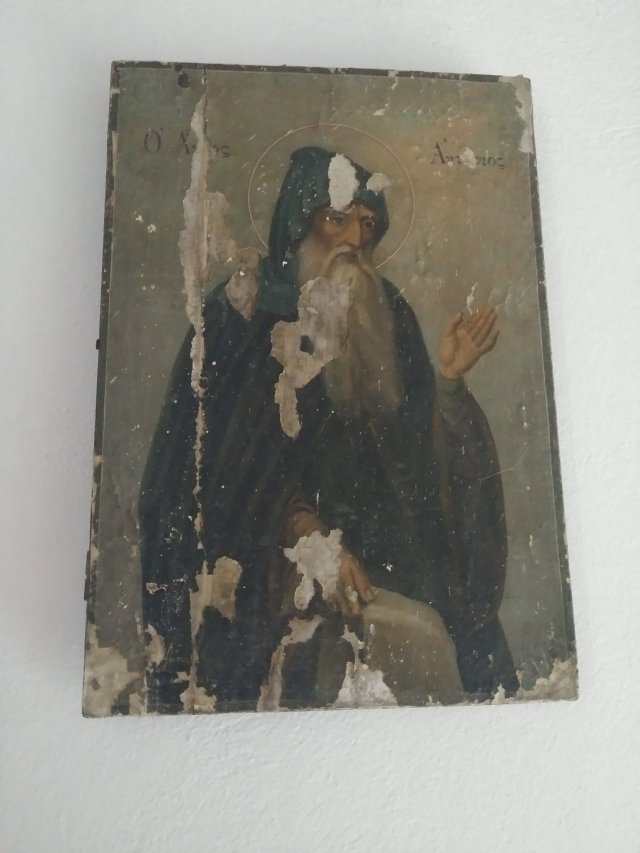
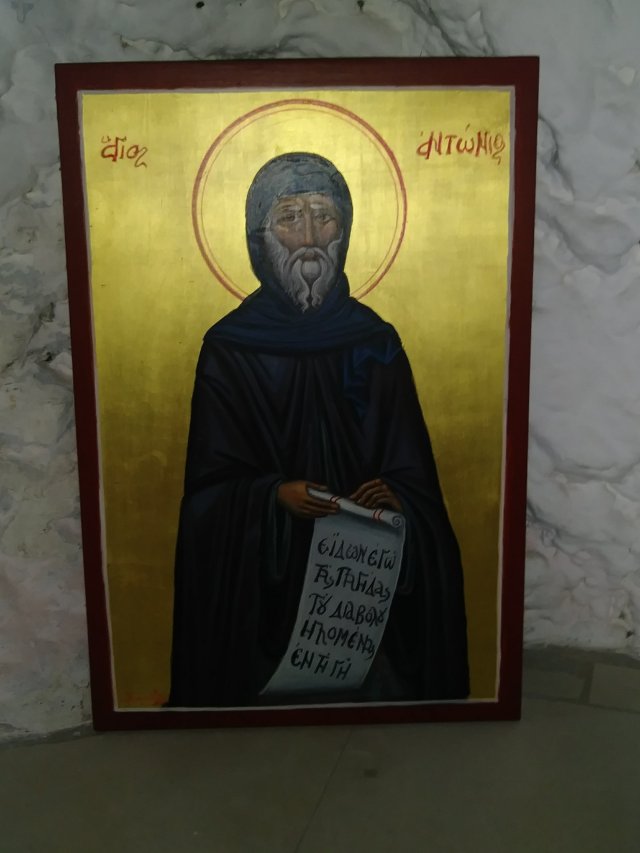
The Greeks have a habit of building chapels into caves. My wife visited a large one south of Chania, but one finds little chapels built into cliffs all the time. These are some photos I took on a rainy day in January of a chapel in Kalyves (a ten minute drive from where we live) dedicated to St. Anthony the Great of Egypt (251-356), considered to be the first of all monks. January 17th is his feast day in both Eastern Orthodoxy and the Catholic West (including the Anglican Communion). There will be a Divine Liturgy (i.e. Orthodox Holy Communion) there on that day.

Blink and you’ll miss it as you drive in. It’s across the street from a hardware store and a computer shop, a couple of doors down from the doctor and an auto repair shop. The chapel is about a decade old, probably built as an act of piety. It seems to be open to the public most days.


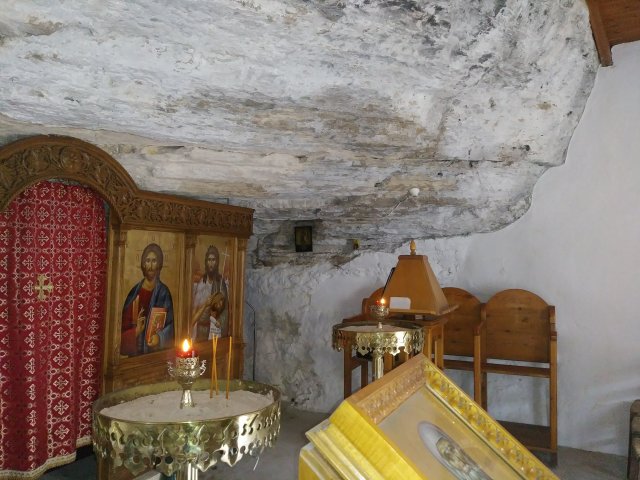
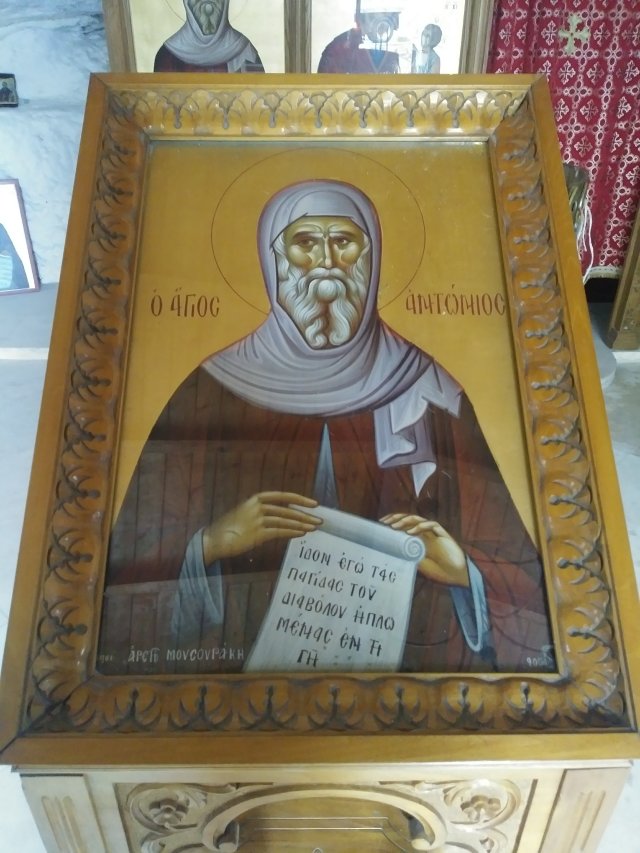
A somewhat distorted panorama view of the interior. The small iconostasis hides the altar. As is traditional, there are three openings, one on either side of the iconostasis, and the central one used for the administration of communion.There are chairs for the elderly, but at an Orthodox Liturgy most people would probably stand. As is usual in Orthodox places of worship, there is an icon on a stand representing the saint to whom the chapel is dedicated, conveniently placed so people may reverence it by bowing and kissing it.

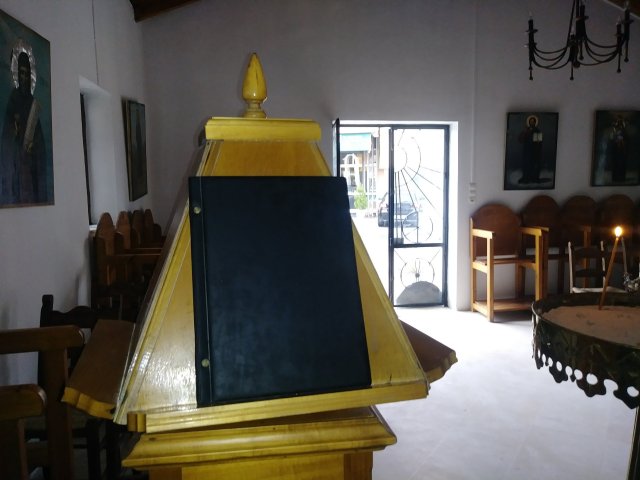
There are a couple of stands for candles and a lectern for the cantors. You can see how the cliff overhangs and provides about half of the ceiling of the chapel.

Not a lot of headroom! Looking behind the iconostasis one can see the altar in the centre. The two platforms on either side, one higher and one lower, are used during the liturgy to hold books and holy vessels.

Looking towards the street past the lectern. The books used by the cantors contain the texts for the 90-120 minute Liturgy – but no music; the cantors will know the chants from their training.

The icon of St. Anthony. The text is in Greek and says, “I saw the snares that the enemy spreads out over the world.” The full saying is, “+ St. Anthony said, ‘I saw the snares that the enemy spreads out over the world, and I said groaning, “What can get through from such snares?” Then I heard a voice saying to me, “Humility.”’”

Another icon of St. Anthony. The halo is metal, quite possibly silver.

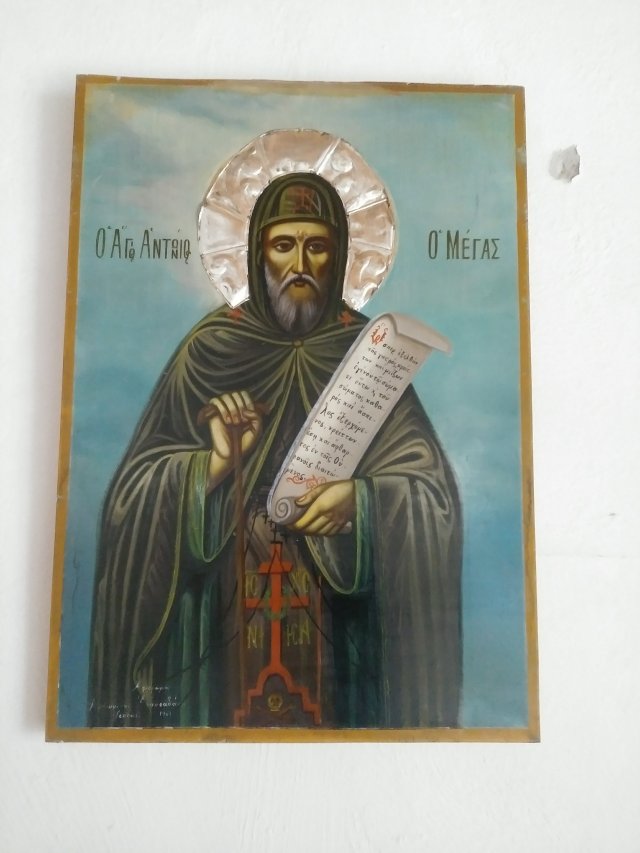
An old icon of St. Anthony. Given the relatively realistic style, it is probably a hundred or so years old. After the Great Catastrophe of the war between Greece and Turkey in 1921-1923, the two nations exchanged populations – over a million Orthodox Christians were expelled from Turkey, and some 300,000 Muslims from Greece. The newly arrived Orthodox brought an older Byzantine tradition with them, and were quite critical of the western-influenced style of the Greek icons that were influenced by “modern” styles of painting imported from “Frankia”. 

Yet another icon of St. Anthony, this one in a corner behind the iconostasis. This is probably a newer one, but in the ancient Byzantine style.

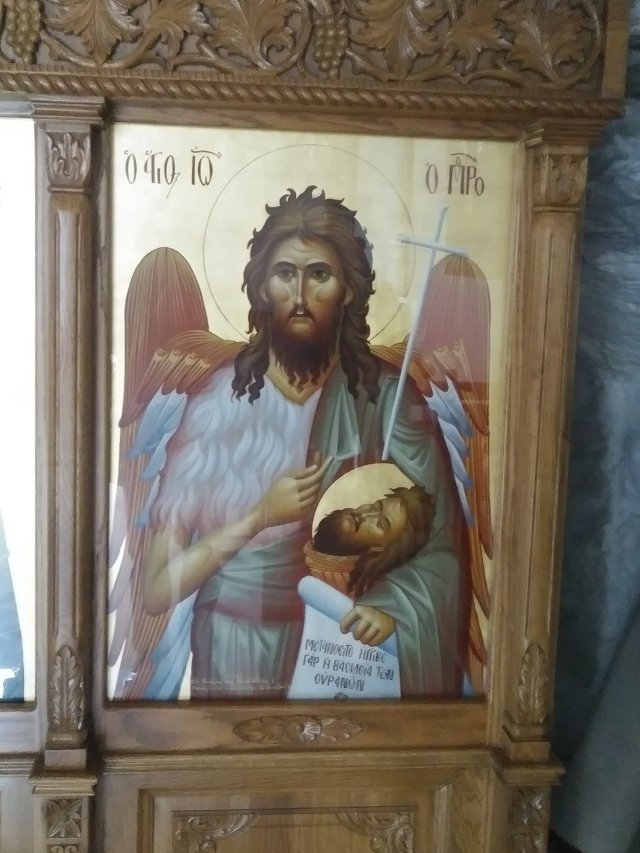
An icon of St. John the Baptist in the iconostasis. He appears to be holding his own head.

Posted in Crete, Greece | Tagged , , , , , , , | Leave a comment

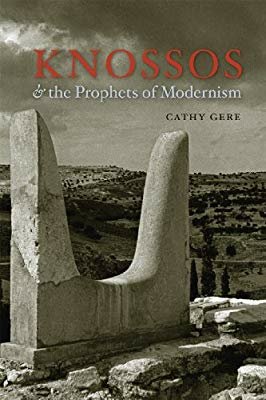
“Knossos and The Prophets of Modernism” by Cathy Gere: A Review


Just after Christmas my family and I visited Knossos in Greece. After seeing Sir Arthur Evans’s reconstruction I was curious about the thinking and evidence behind it. This book was available for download, so I bought it and I recently finished it.

Knossos is an ancient site on the island of Crete that Evans excavated from 1900 to the 1930s. He noted stages in construction and cultural artifacts that spanned almost a thousand years in the 2nd Millennium BCE. He knew that at some point the Myceneans – Greek speaking peoples from the mainland – came at some point towards the end of that time and most likely ended the rule of the previous population. He called this older civilization “Minoan”, and from bits and pieces deduced that it was a Goddess worshipping peaceful society, excelling in art, dance, and enlightened rum, all of which was ended with the arrival of the warlike Myceneans, who took over the buildings but could only be a poor echo of the Minoan glories.

This famous mural entitled “Ladies of the Minoan Court” was recreated in the 1930s by the father and son team who were both named Emile Gillieron. Note how little of the original fresco is actually there.

Professor Cathy Gere deconstructs all this in this book. Evans suppressed evidence of the martial activities of the Minoan and commissioned modern artists to complete murals that existed only in fragments. Not surprisingly, the reconstructed art matched what he thought the culture would produce, and Evans was subsequently taken in by several masterful forgeries. Gere runs through all the evidence and then shows how his reconstructions influenced such diverse people as Freud, Hilda Doolittle, and Robert Graves. The final chapter summarises the current state of archaeological knowledge about the Minoan culture, which has rejected many of his conclusions. This is the book that helps to tell what is Evans’s version of Knossos, and what the evidence actually says and does not say.

Minoan lady helping to sell Coca-Cola. It is evidently Ariadne, given the ball of twine that young Theseus used to find his way out of the Labyrinth in the legend of the Minotaur.

Perhaps the greatest legacy of Evans’s reconstruction is not to be found in arcaheology but in popular culture. His actual finds are in the the Archaeological Museum of Heraklion where the labels and explanations are all considerably more restrained thatn presented in his written reports. However, Minoan themes are found everywhere on Crete. If much of the modern western world seized on Classical designs based on the Parthenon to built banks , universities, and legislatures, the people of Crete have used Minoan themes in their banks and public buildings, and, as seen above, to help sell foreign brands of carbonated

Posted in Uncategorized | Leave a comment