The Sacrifice

Through Lent With George Herbert
(Monday after the First Sunday of Lent)

Passing ByThe third poem of The Church, the fifth poem of The Temple (or sixth, if you include  the Dedication), is The Sacrifice. This makes sense, following after The Altar, for it is on an altar that one makes sacrifices. However, the sacrifice here is not the poet’s heart or that of the reader, but of Jesus Christ in his suffering and in his death. It becomes the reader’s and the poet’s by incorporation into Christ.

The Sacrifice, unlike the majority of Herbert’s poems, is long – 252 lines, or eight pages. It is in triple rhyme, that is, three lines that all rhyme. This gives it, as Ann Pasternak Slater points out, “a remorseless, driving intensity”. Each stanza ends with a fourth line that is almost always the same: the plaintive Was ever grief like mine? This refers to the Lamentations of Jeremiah, which read during Holy Week during Morning Prayer or Matins, and is the basic text that is sung at Tenebrae. “Is it nothing to you, all you who pass by? Look and see if there is any sorrow like my sorrow” (Lamentations 1.12).

The poem is in the voice of Christ and is addressed to the indifferent people passing by:

Oh all ye, who pass by, whose eyes and mind
To worldly things are sharp, but to me blind;
To me, who took eyes that I might you find:
Was ever grief like mine?                                  (vv. 1-4)

It recounts the Passion of Jesus from his perspective, as though on the cross. As the reader we are engaged by asking if what Jesus is addressing us. The references Herbert makes in the voice of Jesus will be familiar to anyone who recalls a recitation of the one of the passion narratives. In the Book of Common Prayer communion lectionaries, a schedule of readings that Herbert would have used, these gospel passions are all read during Holy Week.

The poem is filled with irony that arises from the paradox of the incarnation, in which the Word of God becomes human flesh, and the infinite is joined with the limited. Thus, following Luke, Herbert has Jesus say,

Herod in judgement sits while I do stand;
Examines me with a censorious hand:
I him obey, who all things else command:
Was ever grief like mine?                              (vv. 81-84)

Jesus the narrator points out hypocrisy of Judas, who accepts thirty pieces of silver to betray Jesus, but objected at the cost of the nard which was used to anoint his feet:

For thirty pence he did my death devise,
Who at three hundred did the ointment prize,
Not half so sweet as my sweet sacrifice:
Was ever grief like mine?                              (vv. 17-20)

At two points the refrain switches from Was ever grief like mine? to Never was grief like mine. The first is the point at which, according to Mark and Matthew, Jesus exclaims “My God, my God, why have you forsaken me?” This is a haunting cry of desolation, perhaps tinged even with a sense of betrayal. It is a reference to Psalm 22.1, and in the passions demonstrates the paradox of the enfleshed divinity experiencing the absence of divinity, as well as being on the verge of losing humanity through death.

But, O my God, my God! why leav’st thou me,
The son, in whom thou dost delight to be?
My God, my God ——————-
Never was grief like mine.                          (vv. 212-216)

The third line of the stanza (line 215) is left unfinished, and the reader needs to complete it, as if Jesus runs out of strength and breath to even say it, but is carried on by the believer.

The theme that Jesus’s suffering is unique emerges,for while the benefits of Jesus’s obedience is available to the world, it is not available to him. Early in the poem Jesus recalls sweating blood in the Garden of Gethsemane (Luke 22.44). His suffering is a balsam – a balm – that combined with repentance heals the broken world’s two hemispheres, and can do little to mitigate the fear of Jesus’s human fears.

These drops being temper’d with a sinner’s tears,
A Balsam are for both the Hemispheres:
Curing all wounds but mine; all, but my fears,
Was ever grief like mine?                          (vv. 25-28)

The final line repeats the otherwise unique refrain of line 216:

But now I die; now all is finished.
My woe, man’s weal: and now I bow my head.
Only let others say, when I am dead,
Never was grief like mine.                        (vv. 249-252)

The lament in The Sacrifice is, as Arnold Stein observes, a complaint about the brokenness of the world. The ironies and hypocrisies of humanities sinful dispositions and actions is only overcome by the desperate paradox of the incarnation and cross, in which the impassable suffers pain and desolation. Confronted with ignorance and indifference God replies in Christ with profound knowledge of the hearts of human beings and a passionate desire for reconciliation.

The art in the poem is in the urgency of the triple rhyme, the relentless movement from betrayal to death, and that fact that the density of biblical allusions does not overwhelm the pace. It conveys the several theologies of atonement without sounding like a theological treatise. It is a lament, a reproach, that is filled with compassion, and marvels at the particularity of its situation. Whereas The Church-porch is long and a bit off-putting, this poem draws the reader in, and overcomes indifference, calling forth a variety of responses. In the following series of poems Herbert attempts to deal with those responses.

Posted in Lent, Poetry and Novels | Tagged , | 3 Comments

In The Wilderness

A sermon preached on The First Sunday of Lent at the Anglican Church of St. Thomas, Kefalas, Crete, Greece, at 11:00 am on March 10, 2019.

Finding-wilderness-in-southern-Jordan-Valley-in-Aqaba-mountains-towards-Red-Sea-Photo-credit-Leon-McCarron

After his baptism, Jesus, full of the Holy Spirit, returned from the Jordan and was led by the Spirit in the wilderness . . . (Luke 4.1)

A key point in today’s gospel is that Jesus was led into the desert by the Holy Spirit. He did not just accidentally arrive there, it was meant to be.There he prepared for his earthly ministry. There he was tempted by the embodiment of evil and by the power that is wielded in this broken world, a power that appears attractive, quotes authoritatively from scripture, speaks rationally, and seems quite generous. The Holy Spirit leads us into dangerous places, it seems. The wilderness is a place where one is challenged.

Of course, wilderness is a relative concept. An indigenous person on Twitter said, “What you call wilderness is my home and was the home of my ancestors since time immemorial”. And indeed, what might look bleak or foreboding to those of us raised in farmed lands or cities is in fact bursting with life. Even deserts bloom majestically after a great rain.

What is your wilderness? Where is the Spirit leading you, me, us?

It is not always a “nice” place, but perhaps it is the challenging we need.

  • It might be a place of promise but with many unknowns. In our reading from Deuteronomy (we heard about how Abraham and Sarah, wandering Arameans, followed the promise of God to a land that would be lived in by their descendant.
  • It might be a place of deliverance. The people went down to Egypt in a famine, but were enslaved and oppressed, and the people cried out and were led into the wilderness of Sinai.
  • It might be a place of great fruitfulness, a Promised Land, that once achieved becomes taken for granted, so that it becomes all too easy to forget how you got to where you are, all too easy to forget to give thanks.
  • It may be a place where you confront evil. A place where there are temptations. A place where people authoritatively quote scripture to justify betraying God.

So where is the Spirit leading us?

  • Perhaps the Spirit is leading us into the wilderness to confront evil. It might be the evil of poverty, or of war, of racism, of bigotry.
  • Perhaps the Spirit is leading us into the wilderness to refine us, to test us, to make us stronger. To be tempted by external things so as to return to that which is most valuable.
  • The Spirit may be leading us into the desert to be taught, even as the people of Israel were taught through the giving of the Torah at Mount Sinai, in the Ten Commandments and the other instructions.
  • The Spirit may keep us in the wilderness to learn patience, even as the people of Israel spent forty years, and being transformed from the mentality of slaves to a people of deliverance.

Well, my impression is that we have been in a few wildernesses.

  • Those of us who are British may feel that we are in the wilderness of Brexit, not knowing what is going to happen. Some of us are fine with the current uncertainty, others less so. “What do I have to do with my dog?” said one concerned person.
  • Perhaps as we look at the politicians and get frustrated with the whole lot of them, whether in Athens, Brussels, London, Washington, or Ottawa. We might feel quite alienated from the whole bunch, just wishing they had the common sense to sort it out. If only we were in charge, eh?
  • As Christians, watching the decline of the faith at home and elsewhere in Europe and North America, we may feel thrust out into a deserted place, where no one sees you or hears us.
  • Perhaps the people of this chaplaincy of St. Thomas, Kefalas feel as if we’ve been in a bit of a wilderness in this chaplaincy, as we had a long eighteen month interim. Are we on the verge of entering a Promised Land? Perhaps, if we are faithful.

But the point of the wilderness is that it is unknown, there are wild beasts, there are temptations, there is not always certainty. It forces us to turn inwards and to work on ourselves.

My hope and prayer in this season of Lent is that we have just the kind of wilderness experience that the people of Israel had, and that Jesus had – that we emerge re-created, ready for ministry, firmly grounded in prayer and scripture, and thankful.

Posted in Lent, Sermons | Tagged , | Leave a comment

Superliminare & The Altar

Through Lent With George Herbert
(Saturday after Ash Wednesday)

Lintel 2

Superliminare

Thou, whom the former precepts have
Sprinkled and taught, how to behave
Thyself in church; approach, and taste
The churches mystical repast.

Avoid, profaneness; come not here:
Nothing but holy, pure, and clear,
Or that which groaneth to be so,
May at his peril further go.

Superliminare is the Latin word for what in English we call a lintel. A lintel is the structure above a door or a window. In Latin super means “above” and “liminare” means “door”. Lintels can be very plain, as in the picture above. They are structural, maintaining the weight of what is above it and distributing it to the walls. Doors and windows built without lintels may contribute to cracks or the catastrophic failure of the walls. It may be part of the door frame, or immediately above it. In the picture above it is made of wood, which is pretty common in this part of Greece. It may also be of stone, or these days, concrete or steel.

Lintels may also be decorated. In the picture below the lintel of the door into the Vaishnavite Temple is particularly ornate.

Door_jamb_and_lintel_over_entrance_into_Lakshmi_Narasimha_temple_at_Vignasante

Lakshmi Narasimha temple in Vignasante, Tumkur district, Karnataka state, India. It was built in 1286 CE during the rule of the Hoysala Empire King Narasimha III.

They may also have writing on them. It may simply be the year it is built, or the name of the family, or perhaps a motto or a coat of arms. It may also be a warning. Perhaps the best known warning on a lintel is that in Dante’s Inferno Canto III.  The poet passes through the Gate of Hell on which is inscribed (translation by John Ciardi):

I am the way into the city of woe,
I am the way to a forsaken people,
I am the way into eternal sorrow.

Sacred justice moved my architect ,
I was raised here by divine omnipotence,
Primordial love, and ultimate intellect.

Only those elements time cannot wear
Were made before me, and beyond time I stand.
Abandon all hope ye who enter here.

Well, that’s pretty bleak, but Herbert can be, too. His liminal poem is both encouragement and admonition.In two simple AABB verses he encourages those who live a disciplined life to come in and read and enjoy a mystical meal. Those who are profane – unholy, stained, murky, and whiny – may only bring down condemnation upon themselves, their sins crying out an indictment. As I stated yesterday, Herbert takes poetry seriously. Long before Stanley Fish described Reader-Response Criticism Herbert expects the reader to be truly engaged in mind, body, and soul.

The Altar
The Altar

This poem begins The Church. As is obvious from the above, it’s fun for typesetters. It uses a method Herbert uses in other poems, in that he uses text to literally construct a picture, which serves as a metaphor.

The altar in the poem is neither a stone altar of the Israelites (or the altar in the Jerusalem Temple) nor the Lord’s Table. Perhaps the placement of the poem here is meant to parallel the way in which the stone altar of the ancient Israelites were in front of the Temple proper, or the manner in which medieval church buildings were all oriented on the old stone altars. In all probability the old stone altars had been removed in Herbert’s time, and a plain wooden table would have been used for the Lord’s Supper.

The altar is made of the poet’s heart (which, when we read it, is our heart). The altar is broken and repaired. The heart is the seat of the person’s soul, and not just a pump for sending blood around the body. It has been made and unmade by God, but repaired by tears of contrition and regret. Thus the altar is fit to sing God’s praises, and the poet/reader bids God to accept such praises as a sacrifice, and that the altar belong to God. As the prayer after communion in the Book of Common Prayer puts it,

accept this our sacrifice of praise and thanksgiving . . . And here we offer and present unto thee, O Lord, ourselves, our souls and bodies, to be a reasonable, holy, and lively sacrifice unto thee . . .

Posted in Lent, Poetry and Novels | Tagged , , | 8 Comments

Women’s Ways of Knowing

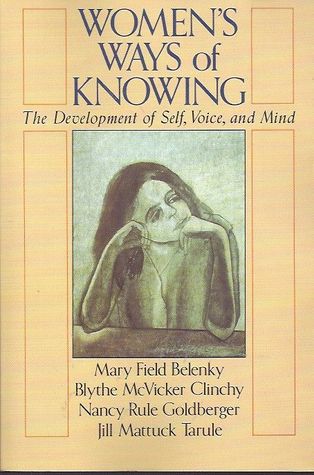
BookOn this International Woman’s Day (March 8, 2019) I would refer my male friends to the book, Women’s Ways of Knowing: The Development of Self, Voice, and Mind. I read it back in the ’80s, and if I was not a feminist before I certainly was one afterwards. Reading it I recognised my own privilege as a white, educated male in North America, and began to see that what I considered “normal” was not so for everybody.

First published in 1986, it was written by four researchers, Mary Field Belenky, Blythe McVicker Clinchy, Nancy Rule Goldberger, and Jill Mattuck Tarule. The four authors interviewed one hundred and thirty-five women from their teens into their sixties. From these interviews they inductively derived five ways of knowing, or perspectives:

  • Silence
  • Received Knowledge: Listening to the voices of others
  • Subjective Knowledge: The inner voice
  • Procedural Knowledge: Separate and connected knowing
  • Constructed Knowledge: Integrating the voices

The Wikipedia article is a pretty good summary. Of course, the other thing I might suggest to my male friends is to listen to women around them today, and not to speak too much!


Posted in Philosophy, Random Personal Notes | Tagged | Leave a comment

The Church-porch

Through Lent With George Herbert
(Friday after Ash Wednesday)

Church Porch

The Church-Porch (Peirirrhanterium)

As Arnold Stein points out in the first chapter of George Herbert’s Lyrics there is a plainness about Herbert’s poetry. The plainness is both obvious and concealed, though, and demonstrate great technical skill. He uses plain and easily understood metaphors, but often the metaphors admit of more than one meaning. Herbert wants his poems to be understood, and so his lyrics are in what for him was contemporary, modern language, and not the already archaic language of the Book of Common Prayer and the Authorised Version of the Bible commissioned by James VI & I. He does not create the Latinized English of John Milton (a generation later) and he does not emulate the classical poets. He does not show off his artistry, as Shakespeare so often does (the Sonnets are harder to read through than the poems of The Temple). This plainness of style, veiling deeper meanings that reveal themselves with re-reading, is actually quite hard, and show Herbert to be quite accomplished.

One aspect of Herbert’s plainness in the service of accessibility is the use of the architecture and furniture of the church building as themes for poems. Thus, the second poem is labelled with the Latin term Superliminare, which is the lintel or top frame of the door to the church. The third poem is labelled The Altar. There is also Church-lock and key, The Church-floor, and The Windows. It is as if the reader enters into a church building, and everything is pregnant with meaning. The sight of each of these is a jumping off point for a meditation or devotion.

The first poem is called The Church-porch. The second is the door, and The Church proper begins with The Altar and ends with Love (3) one hundred and fifty-one pages later, and is then followed by a very early poem called The Church Militant. This first poem, The Church-porch, then, is an introduction, a preparation for entering The Church; Superliminare is the transition between the two. The Church-porch has a second name, Perirrhanterium – not exactly a common word. Indeed, the digital Oxford English Dictionary doesn’t condescend to acknowledge it as an English word worthy of inclusion. It means “sprinkler” in ancient Greek, and is what we would normally call an aspergillium, a piece of holy hardware used to sprinkle holy water. In Roman Catholic masses and in some Anglo-Catholic Anglican parishes holy water is sprinkled upon the attendees at the beginning of the service, partly to remind them of their baptisms, but also to symbolically wash their sins away, even as the ancient Israelite priests would sprinkle the blood of sacrifices on the faithful. This first poem, then, is a preparation and a purification.

As Carole Kessner notes in “Entering “The Church-porch”: Herbert and Wisdom Poetry” [George Herbert Journal, vol. 1 no. 1, 1977, pp. 10-25], this poem is a bit of an embarrassment to  Herbert enthusiasts:

Long, ponderous, didactic, structurally rigid, sometimes repetitious, it is altogether unlike the intimate, deeply moving, frequently charming, varied lyrics of the devotional second section, “The Church.”

It’s certainly not where one should first encounter Herbert. We no longer desire teaching from poetry, but epiphanies and enlightenment, or perhaps acute observations.However, didactic poetry has a long tradition in the Classics, whether it was Hesiod in Works and Days, or the philosophy of Parmenides, or Virgil’s Georgics which is all about farming. In Jewish and Christian scriptures Proverbs and other wisdom literature seeks to instruct.

It is 462 lines arranged in six-line verses, in the pattern of ABABCC. In the first lines Herbert writes to the reader,

Hearken unto a Verser, who may chance
Rhyme thee to good

The second verse warns the reader from lust, the second advocates chastity, the fourth and several following warns against drinking too much wine, the tenth against swearing, and so forth. It is didactic in a way that modern poetry never is. Herbert comes across as an even duller Polonius, giving little indication of what is beyond the Superliminare.

However, this preparation has a purpose. Herbert is well aware that there is a strong connection between spirituality and discipline. If one does not have some sort of Rule of Life one will not be able to grow towards God or one’s neighbour. For the most part the advice is given in The Church-porch is good advice that I myself try to live. It is generous advice, knowing the imperfections of people high and low, but assuming the possibility of change in everyone. As the final couplet notes,

If thou do ill; the joy fades, not the pains:
If well; the pain doth fade, the joy remains.

This is not some gloomy Puritanism – Herbert was certainly not a Puritan – but the advice of someone who has read the scripture and lived life. Herbert had participated in the exercise of power and the ascent to high dignity, and had a mature appreciation of it all. Having moved into ministry in a peripheral rural parish Herbert had let go of what the world celebrated. In words that might apply today he writes,

O England! full of sin, but most of sloth;
Spit out thy phlegm, and fill thy breast with glory:
Thy Gentry bleats, as if thy native cloth
Transfus’d a sheepishness into thy story:
Not that they all are so; but that the most
Are gone to grass, and in the pasture lost. (91-96)

Herbert encourages us, then, to move from a complacency, an idleness about our spiritual condition, to something that allows grace to work within us. May it be so.


Posted in Lent, Poetry and Novels | Tagged , , | 3 Comments

Through Lent With George Herbert

HerbertSince 2002 or so I’ve had a copy of the The Complete English Works of George Herbert, the English poet and clergyman who lived during the reigns of Elizabeth I, James VI & I, and Charles I. While I have dipped into it every so often, I’ve never read it all. This Lent I will try to do just that. There are some 184 pages of poems, so divide that by the 40 days of Lent, I need to go through 4 or 5 pages a day. I invite you to join me in this blog as I do so. I won’t comment on every poem, but I will stop and reflect on at least one each day.

The edition I am using is the Everyman’s Library volume, edited by Ann Pasternak Slater  (New York/London/Toronto: Knopf/Borzoi, 1995), which also includes The Country Parson, selected letters, his will, and Isaak Walton’s short biography. I also have a copy of Arnold Stein’s George Herbert’s Lyrics (Baltimore: Johns Hopkins University Press, 1968), which while old, is a comprehensive analysis of his English poems. Herbert also wrote in Latin, and supposedly he was excellent in that language as well, but I suspect the number of people reading those poems is at best in the hundreds, and the number of studies are even fewer.

Although born in Wales he was part of the English aristocracy, albeit the poorer end of it. He was educated at the prestigious Westminster School and Trinity College, Cambridge. He was the Public Orator at Cambridge from 1620-1627, which meant that he gave speeches in Latin at ceremonial events  such as graduation ceremonies, convocations, and the visits of royals. He attempted a political career, serving in Parliament and receiving the notice of the King, but when James VI & I died he shifted to an ecclesiastical career. Having already been made a deacon in 1624, he was ordained in 1629, and served at the small rural parish of Fugglestone St Peter, with the chapel of St. Andrew’s at Bemerton, just outside of Salisbury. He only served three years when he died of tuberculosis in 1633. He left the manuscripts of his poetry to his friend Nicholas Ferrar of Little Gidding, who put them in order and arranged for their publication as The Temple later that year.

Tomorrow I will consider his opening poem, the 462 line The Church-Porch. For the moment consider the following:

The Dedication

Lord, my first fruits present themselves to thee;
Yet not mine neither: for from thee they came,
And must return. Accept of them and me,
And make us strive, who shall sing best thy name.
Turn their eyes hither, who shall make a gain:
Theirs, who shall hurt themselves or me, refrain.

Herbert, in his first lines, addresses God, not with the flowery invocation found in the classical epics (and emulated by Milton in Paradise Lost) but in the simple language of the psalms. The rhyme is simple enough – ABABCC. Herbert is aware of the quality of what he wrote, but surrenders them to God, and claims that anything that is in them comes from God – “All things come of thee, O Lord, and of thine own have we given thee”, as 1 Chronicles 29.14 puts it. He bids God accept his poems and himself, encouraging those who dare to sing praises to continue to strive. Then follows two simple requests to God.  First, that God would lead those who might benefit from the poems to them, but, second, that those who would stand condemned by God’s truth revealed in them, or who would misconstrue their meaning to Herbert’s detriment, would not. Herbert had a high understanding of the truth of God, whether revealed in the person of Jesus Christ, the text of scripture, or mediated by a sermon or poem.

For Herbert devotional poetry was a serious business, not trivial. With that in mind, let us continue.

Posted in Lent, Poetry and Novels | Tagged , | 3 Comments

The Poems You Would Have Written

On Ash Wednesday 2019

Postscript Auden on MacNeiceW. H. Auden, from the epilogue to his elegy to Louis MacNeice in his book of poetry, About the House(1965), 23.
Posted in Poetry and Novels, Sermons | Tagged , | Leave a comment

Desire and Obedience

A sermon preached on the Second Sunday Before Lent at the Anglican Church of St. Thomas the Apostle, Kefalas, Crete, Greece, 11:00 am on Feb 24, 2018.

NG 2112

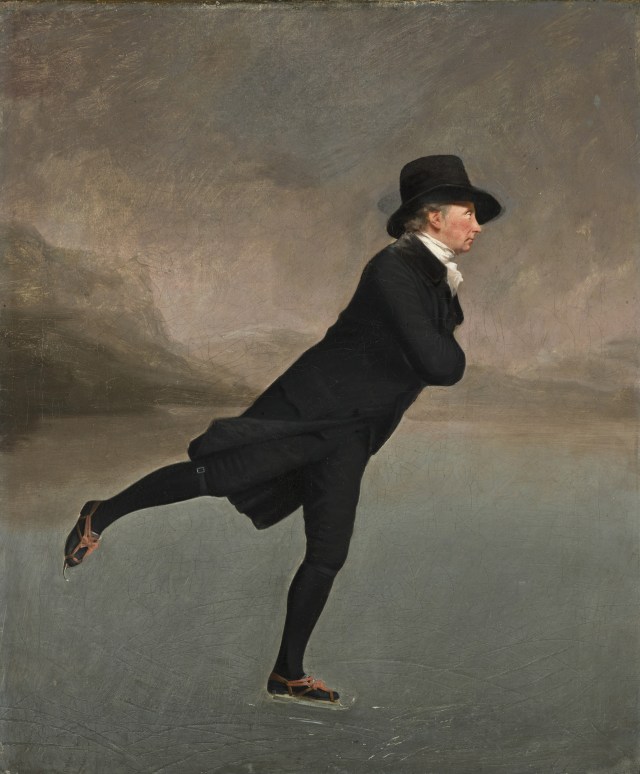
“The Reverend Robert Walker Skating on Duddingston Loch” (also known as “The Skating Minister” by Henry Raeburn, circa 1790. National Gallery of Scotland.

Once upon a time there was a Church of Scotland minister who had to skate to get to his church. He lived in a manse that was some ways away from the church building itself. He woke up one morning and there was snow all over the ground, accompanied by a strong wind that set up tall drifts alternating with clear icy patches. He knew that there was no way his poor horse would be able to get through it. However, he noted that the river nearby, which ran by both the church and the manse, was clear. Having been a bit of an athlete in his day he strapped on his skates, rather primitive things by today’s standards, but good enough. He got down to the river and in a matter of a few minutes he had skated the distance and went inside. This created a problem for the elders of the church, as it was forbidden to play sports on the Sabbath, and ice-skating clearly was a sport. The elders demanded to meet with the young minister after the service, and while he waited outside they debated among themselves whether the man had broken the Sabbath and could continue. Finally, they agreed on a question to pose to him, a query which would settle the issue. They brought him in and said, “Did you enjoy it?”

This morning I want to talk about obedience and desire.

Obedience to God is always presented in the Bible as a good thing. Obedience in the Hebrew scriptures is rewarded with land and sheep and long life. Jesus is the example of obedience in that he carries out his Father’s will, even to death, even to death on a cross. In the Garden of Gethsemane he prays that he might be spared the results of such obedience, of being bound to death in order to overcome it, but his final wish is not his personal will to avoid pain and suffering, but that “thy will be done”.

Disobedience is not a good thing. In the Hebrew scriptures disobedience is punished with invasions and lives cut short, with exile and the loss of land. Adam and Eve are the examples of disobedience, given just one rule – do not eat of the tree of the knowledge of good and evil – and they go and mess that up. While we do not read this literally, it is an accurate description of human depravity – give us a rule and we’ll be predisposed to break it; show us what is good for us, and we’ll take the option that shows independence of mind, no matter the downside.

And that creates the need for God’s intervention. Because independence of mind no matter the downside leads to death, whether it be the living death of discord and conflict, or looming death from total war and ecological disaster. And so God enters into this world in the person of Jesus of Nazareth, the human united with the divine, the finite and the infinite paradoxically made one, and descends into the void of sin and death. Being finite he dies, but being infinite he overflows it and is not overcome. He rises to new life, restoring and transforming our humanity. And we who are in Christ become obedient to God’s will not out of some abstract command to do something, but out of love, out of desire.

Many Christians are uncomfortable with desire, seeing in it something erotic and dangerous, a means by which to manipulate others, or something that is gross and physical. And yet desire is good. We see in the reading from Genesis that the primordial human, Adam, neither male nor female, has a desire for companionship, but cannot find it among the animals. While perhaps surprising to those of us who are quite content to live alone with cats and dogs, it again speaks a non-literal truth, that we humans do need each other. When that strange, God-inflated human is transformed into the binaries of male and female it speaks to the fact that we are not complete without each other, and that our myriad differences are all God-given, and that only in the collective of humanity do we find the image of God. And in the story of the one made two we hear how one half of humanity desires the other. In that desire we see the desire for completion, a reflection of the human desire for God.

I believe that we are here because of love, in this place and in this worship, because of desire for God and our desire for community. It’s a rare thing in today’s instrumental world, where we are seen as means to ends, reduced to being consumers and producers, objects of surveillance that is packaged, aggregated, and sold to online retailers and political parties. In pure desire we desire each other, our souls and bodies, and offer them up to each other and to God, in what the BCP Collect for Peace describes as “whose service is perfect freedom”. We are not the wind and the water, which mindlessly obey the lord of all creation. We obey out of loving desire, inspired by the Holy Spirit to become like Christ as he was on Earth and as he is now.

But of course, as with any good thing, desire can be abused, as can obedience. The conference taking place this weekend in Rome between the Pope and several hundred bishops from 130 countries from around the world is addressing the crisis of sexual abuse by Catholic clergy. I have personally dealt with many complaints of sexual abuse within the Anglican Church of Canada and I have, on behalf of the Church, offered to cover professional counseling and significant financial compensation for victims. I have been involved in disciplining the perpetrators and dealing with the devastating fallout in the parishes where they served. So do not get me wrong – I am not naïve about what inappropriate desire can do. Loving desire, whether towards God or another human being, whether sexual or non-sexual, will always be filled with trust, honour, dignity, respect, tenderness, offering, and meaningful consent. Or, as Paul puts it in his First Letter to the Corinthians:

Love is patient; love is kind; love is not envious or boastful or arrogant or rude. It does not insist on its own way; it is not irritable or resentful; it does not rejoice in wrongdoing, but rejoices in the truth. It bears all things, believes all things, hopes all things, endures all things.

This kind of love, this kind of pure desire, is from God and of God, but is also so very human.

So my brothers and sisters, let us be passionate Christians, obedient to the will of God and considerate of the wishes of others not out of compulsion or the dread of consequences, but because of our Spirit-filled desire for God and for the image of God that we find in community with others. Let us be very careful, taking seriously the trust given to us, so that we might like Christ follow in the path of serving and not focusing on being served. Let us be bold in Christ, and not ashamed. And when our lives are over and we stand before the judgement of God, and we are asked, “Did you enjoy it?”, may our response be, “Yes, my Lord, we did!”

Posted in Sermons | Tagged | Leave a comment

It’s All Greek To Me: The Greek Letter Υ

I’m sitting in the Chania Airport for what should be a short hop to Athens, but for some reason – perhaps the Saharan sand in the air combined with rain – our plane is not here, and one flight tracker is suggesting that the delay will be 2 hrs 40 min. *sigh* At least my next flight is not until the evening – tomorrow evening, that is. And, hey, it gives me time to post this!

The most interesting letter in the Greek alphabet is, I think, upsilon. It upper case it looks like the Latin letter Y. Confusingly in lower case it looks like this: υ, or if it is accented, ύ. Why is it interesting? Because it does so much!

  • At first glance it looks like it should be a y sound, and sometimes it does have that sound, as in the Greek name for New York, Νέα Υόρκη. But that is more an accident of transliteration. Υόρκη really should have started with a soft gamma followed by a iota, as Γιόρκ, which is indeed the accepted way of writing the name in Standard Modern Greek of the original York in Yorkshire, England. The common greeting Γεια σας begins with the “yah” sound.
  • The usual pronunciation is with an “ee” sound. We English-speakers pronounce the name of the letter as “up-sígh-lawn”, but the Greeks say “eép-see-lon”. Thus, the word for dog in Greek is σκύλος, pronounced “skee-lohs”.
  • When combined with the letter omicron it creates the “oo” sound, as in φούστα “foosta”, skirt.
  • Here’s where it gets fun. Υ or υ can also sound like “fff”. That god on Olympus, the one with the thunderbolts, married to Hera but with lots of children by others, including Leda the swan? His name is Zeus, and we pronounce it “Zooss” or maybe we dipthong t a bit and elide the “eu” into a fast “eeoo”. However, the Greeks know hims as Ζευς and pronounce it “Zeffs”. Αυτός, αυτή, αυτό – the Greek for he, she, and it – is pronounced “aff-toess”, “aff-tee”, and “aff-toe”. The Greek word for automobile is αυτοκίνητο, “aff-toe-kee-ne-toe”. Australia, where many Greeks have settled, is pronounced “Aff-sta-lee-ah”.
  • Oh, and it can also sound like “vvv”. The Greek word for “tomorrow” is αύριο – “av-ree-oh”. However, if that syllable is accented, the accent is put on the ύ, even though it is functioning more like a consonant, and accents usually go on vowels.

I find all of this fascinating, although it does mean I regularly mispronounce Greek words.

sig short

Posted in Greece | Tagged , , | 1 Comment

Lessons from the Great War: The Will to Fight

Canada Troops WWI

Canadian Troops go over the top in World War I

This is my fourth post on Lessons from the Great War.

  • The first raised four questions.
  • The second addressed one of the questions – why did the war end? The answer was that the Allies on the Western Front had finally devised a strategy and tactics that consistently kept the German troops under pressure and pushed them back. There was no breakout, but it was clear that eventually the Germans would run out of men or territory. Meanwhile the Allies had a small but growing army of Americans that would be ready to carry the war into Germany. Confronted with these facys, the military leadership – which in Germany was also the political leadership – became convinced that they had lost the war, and so lost the will to fight. The troops of the Central Powers likewise began to realise that defeat was the likely result, although they never abandoned the battlefield in significant numbers. Knowing this, the various leaderships of the Central Powers asked for an armistice.
  • The third post examined why the war began, and highlighted how the characteristics of individual political and military leaders combined with fear, honour, and national interests.

Why did the war last so long?

Having considered why the war began and how it ended, this post is about why the two sides continued the war after September 1914 despite a stalemate on the Western Front. Until August 1918 there was no decisive movement on the Western Front, just the exchanges of small amounts of territory at a great cost. The answer, simply, is that both sides had the will to fight, and determined that the cost of fighting on did not outweigh the unknown result of suing for peace. In retrospect we know that they did not have the tactics, strategy, and resources to force an end until the beginning of the Hundred Days in August – November 1918, but the leadership did not know that then.

The Germans in September 1914 had not defeated the French Army and the British Expeditionary Force, but they stood almost on French and Belgian land and could adopt a defensive posture and wait for the Allies to attack. As attacks were always more costly in material and lives than defense, they expected the Allies to be ground down, and eventually determine that they would not be able to overcome the German lines, and so blink first. The Allies did attack, again and again through 1915, 1916, and 1917. In 1917 the French Army mutinied, but the generals and politicians successfully managed to keep this secret. As a result the French went on the defensive for a long time. The British took over the weight of the offensive, fighting several massive battles in Belgium, all without achieving any significant result.

The important thing to note in this is that neither side lost the will to fight. Indeed, as the war went on the politicians and generals felt that after the already spent cost in lives that only victory could justify continuing on – negotiating a settlement to bring about peace between equals was no longer acceptable – there had to be a victor and a loser.

440px-Russian_poster_WWI_043

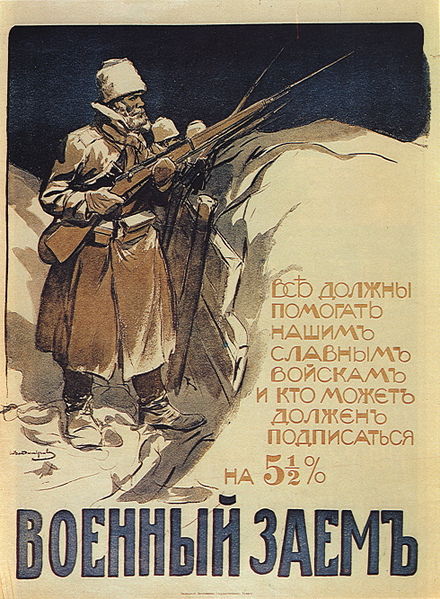
A Russian Poster from 1916

Why the war in the east ended in early 1918

In the East it was a somewhat different story. The Russians initially advanced into German Prussia, but were then expelled after the Battle of Tannenberg. In 1915 the joint German-Austro-Hungarian armies drove the Russians out of Russian Poland. In 1916 the Russians had some success with the Brusilov offensive, However, the war was grinding down the various belliegerants in the East, especially Austro-Hungary and Russia, and neither Empire was able to contemplate such an offensive in the future. The cost of the war affected the massive peasantry and the smaller industrial working class with food scarcity and the loss of millions of their young sons. Dissatisfaction with the course of the war and domestic policies resulted in mass demonstrations and the turning of the middle classes and urban elite against the Tsar and the Tsarina, resulting in his abdication and their replacement with a Provisional Government, eventually led by the socialist Alexander Kerensky; this is the first revolution in Russian, known as the February Revolution. Kerensky continued the war against the Central Powers, but his authority was challenged by the Petrograd Soviet, which sought to undermine the hierarchy of the armed forces by creating committees (in Russian, “Soviets”) that would speak on behalf of the military and participate in governing the nation. The Bolsheviks under Lenin and Trotsky conspired to use the Petrograd Soviet as the launching pad for a second revolution. The armed forces had little if any enthusiasm for continuing a war that was perceived to belong to the old regime, and looked for peace. In October 1917 (Old Style Julian Calendar – actually November in the rest of the world) the October Revolution took place, removing the Provisional Government. Soviet-style Bolshevik led governments spread from Petrograd to the rest of the country, and Lenin asked for peace terms. The Germans imposed the Brest-Litovsk peace treaty in which Russia lost Finland, the Baltic States, Belarus, and Ukraine. Finland became independent and the rest was to be controlled by the German Empire.

Looking, then, at the Eastern Front, we see that a belligerent will continue with a war as long as a) the army still exists and is in the field and b) the political leadership believes it is in their interests to continue i) on the defensive until the situation improves, or ii) on the offensive when there is an opportunity of victory, local or ultimate. The Russian army remained in the field, but there was a serious question at home about the cost of the war. When the Provisional Government failed to end the war, a revolution took place which established a government that would make peace, even if the cost in territory was massive.

Germany’s great hope

Peace in the East freed up men and equipment for the East, and the German leadership knew that this presented an opportunity that they would not see again. The British and the French appeared to be exhausted after multiple battles in which the Germans withstood, maintaining the stalemate. However, the USA had entered the war, and while having to build up an army from practically nothing, were well on their way to putting a million men in Europe by the end of 1918 and millions more in 1919. The Germans transferred troops from the now peaceful Eastern borders to the Western Front and launched the Spring Offensive of 1918. At first their numbers overwhelmed the defensive, and there was a real possibility of a breakthrough, but after more than three months of battle the onslaught was stopped by the Allies and their depth of defense. The German’s, depleted and occupying land not easily defended, were forced to fall back on the defensive.

Looking then, at the Western Front, we see that the Germans stayed in the war because they thought until the summer of 1918 that they had a good chance of breaking out and destroying either the British or the French armies, if not both. Having achieved victory in the East and gained vast territories they now wanted to secure those gains. Having had success in the East, they hoped to accomplish the same in the West.

france_germany

The Allies will to fight

Their were any number of nations involved as the Allies on the Western Front, but the chief were the British Empire and the French Republic. Unlike the German and Austro-Hungarian Empires, or the Russian Empire on the Allied side, France and Britain could and did change its political leadership during the war. Thus in Britain Asquith was pushed aside because of a failure of trust (and a marked inability) to lead the government in wartime, and Lloyd George came into power at the head of a coalition government. In France there were some five Prime Ministers during the course of the war, but this kind of revolving door was fairly natural even in times of peace during the Third Republic. Also, both the French and the British changed their military leadership, finally arriving at a unified command under Marshal Foch, which was one factor in the victory in the autumn of 1918. The governments of the two countries, dependent on electoral support in the UK and Britain, were sensitive to the needs of the people, especially concerning food. Lloyd George actually demanded more from the British people than Asquith did by converting the economy to a total war economy, but this just increased his level of popular support. Thus, at no time did the general population or the political leadership seriously consider asking for peace terms. In the armies, as mentioned, significant numbers the French troops mutinied and refused to fight offensive battles, but this only lasted from May 1917 until the German Spring Offensive. By Autumn 1918 they were fully returned to offensive capabilities.

The Allies on the Western Front, then, never saw the cost of continuing the war as outweighing the cost of making peace with the Central Powers. As well, being both colonial empires, they saw nothing but upsides as the Ottoman Empire appeared to collapse. They were aware of the human cost in lives and wounded, and the material costs, but they recognised that if war was to be fought in that era lives would be lost and the government would run up great debts. It was only after the war, as the trauma of battle became generally known, as people felt free to express their anguish at the loss, and the results of “victory” seemed so meagre, that people in Britain began to seriously question the cost that had been expended.


Posted in War | Tagged , | Leave a comment