That Other Blog I’ve Been Working On

blog

I haven’t posted much on this blog lately because I’ve been posting on another blog – the Diocese of BC at GS2016. It’ll give you a partial view of the 41st meeting of the General Synod of the Anglican Church of Canada from the perspective of the delegates from the Diocese of British Columbia (i.e. Vancouver Island and the Gulf Islands).

Full coverage by the Anglican Journal may be found here.

Posted in Anglican Church of Canada | Tagged , , , | Leave a comment

Refugee Settlement Update June 21, 2016, Refugee Program of the Anglican Diocese of British Columbia

cropped-germany-word-refugee-day-2Part of my life is being the Refugee Coordinator for the Anglican Diocese of British Columbia. When I took this on in February 2015 we had only one settlement of a family taking place, and it was soon completed. We had five or six cases submitted to what was then called Citizenship and Immigration Canada  (“CIC”), and another five or so being prepared.

Things have changed! Here’s an update I have prepared to illustrate where we are at in terms of the work done by the Refugee Program right now. This does NOT include all of the good work done by other Sponsorship Agreement Holders on Vancouver Island, such as the Inter-Cultural Association of Greater Victoria (“ICA”), the United Church of Canada, or the Cowichan Intercultural Society, nor does it include numbers about the Government Assisted Refugees settled in Victoria and the rest of the island. That said, here we go:

Arrived since Sept 1, 2015:
• 73 individuals.
• 14 cases/families.
• Country of origin (numbers of individuals): Afghanistan 2; Eritrea 2; Gambia 1; Iraq 2; Syria 66.
• 35 are Blended Visa Office Referrals (“BVORs”) and 38 are local referrals (i.e. we found out about these refugee cases from people here on the islands, such as friends and relatives).
• Settlements are in Campbell River, Comox, Ladysmith, Nanaimo, Port Alberni, Salt Spring Island, and Victoria.

Applications Accepted and Being Processed by Immigration, Refugees, and Citizenship Canada (“IRCC”) through the Central Processing Office in Winnipeg (“CPO-W”) and overseas Visa Offices.
• 117 individuals.
• 29 cases/families.
• Country of origin (numbers of individuals): Afghanistan 1; Colombia 9; Congo 4; Eritrea 20; Ethiopia 4; Iraq 33; Myanmar (Burma) 8; Syria 37.
• 40 are BVORs, 77 are locally referred.
• Settlements will take place in Campbell River, Central Saanich, Cedar, Colwood, Comox, Nanaimo, Parksville, Pender Island, Port Alberni, Qualicum Beach, Sooke, and Victoria.

Applications Being Prepared and Constituent Groups Organizing
• 30 more individuals.
• 7 cases/families.
• Country of origin (numbers of individuals): Iraq 11; Palestine 3; Somalia 6; Syria 10.
• All are locally referred.
• Settlements will take place in Comox, Nanaimo, and Victoria.
• 4 Constituent Groups are organizing or trying to obtain BVORs.
• We have a waiting list of locally referred cases.

Totals
• 73 people have arrived. Applications for 117 individuals have been submitted. So, in total, 190 here or applied for.
• Applications for 30 more being worked on. So, in total, we are trying to help 220 people. We have capacity at the moment for at least another 14 people beyond that.

To help with settlement and become part of a Constituent Group, please go to https://refugeesforvi.wordpress.com/ . Kudos to the over 1000 volunteers who have made this all possible. Many thanks to Rebecca Siebert and Tony Davis for their amazing staff work!

Posted by Bruce Bryant-Scott, Refugee Coordinator

Posted in Anglican Church of Canada, Refugee Program | Tagged , , | Leave a comment

Dublin by Stephen James Smith

I recently went to Dublin to meet up with my son and to participate in Bloomsday 2016. One of the Bloomsday events was a three hour reading of excerpts of Ulysses in Temple Bar Square by a variety of actors, diplomats, and other notables. One of the highlights of that gathering was the recital of a poem, Dublin, by its author, the remarkable Stephen James Smith. Have a listen. It’s not Joyce, but it’s just as good.

Posted in Poetry and Novels | Tagged , , | Leave a comment

On Being a Priest

Ordination

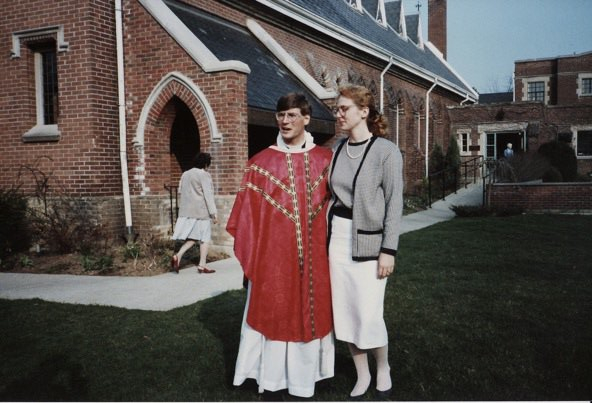
My Ordination to the Priesthood, April 1989, St. Jude’s Church, Oakville, Ontario, Canada. That’s me on the left, Frances on the right.

At the age of twenty-six I became an elder. Not an elder in age, of course, but I was ordained to be an elder in the church. Elder in  the Greek of the early church is πρεσβύτερος or presbuteros. This Greek word has come down to us over the past twenty centuries via Latin, Old Germanic, and Old English as priest (yeah, really). Now, I had been ordained a deacon in the church (the word means “servant”) a little less than a year before (June 1988), but from years before I felt that I was called to be a priest, a call that was confirmed when the Most Reverend John Bothwell, Archbishop of Niagara and Metropolitan of Ontario, ordained me as such in April of 1989. I did try to persuade the Archbishop to ordain me directly to the priesthood, but the tradition and practice of the church for the past fourteen hundred years required that I pass through a transitional stage as a deacon.

I think of these things as tomorrow, May 29, 2016, my friends Selinde Krayenhoff and Craig Hiebert are to be ordained to the presbyterate (i.e. the priesthood).  As well, Gillian Hoyer and Matthew Brown will be ordained as transitional deacons, with the expectation that, as I was, and as Selinde and Craig are to be, they will be ordained priests after some six months to a year. Then there are the three individuals who will be ordained as deacons, sometimes called “permanent deacons” or “vocational deacons”, or as I like to call them “real deacons”. They are Bill Poppy, Marg Misener, and Patrick Sibley (Marg has just completed an eleven month internship  with us at St. Matthias, Victoria – a great person!). While it is not impossible that these three might someday be ordained as priests or even as bishop, the expectation is that they will remain as deacons and serve as such for the rest of their lives.

In theory, deacons, priests, and bishops, the three orders of ministry, are all ordained to different ministry. The bishop is the leader of Christians in a geographic area, with oversight of the ordained and lay in the parishes and ministries of the places. Deacons are called to be servants, with a special concern for the poor and marginalized – a first century version of a social worker re-imagined for the present day. The role of priests, however, is more confused and debatable.

Priests are usually thought of as ministers in parishes, and this paradigm drives many of the models below. However, I’ve known priests outside of parishes – as academics, as administrators (I was one for almost ten years), and in very active retirement, in secular employment, and even in unemployment. The way in which priests live out their callings is manifold and various. That said, amongst the models of what priests are supposed to be are:
Priest as deacon: Sometimes priests never stop acting as deacons, being focused on social action, the poor, the elderly, and the disadvantaged.
Priest as extension of the Bishop: In theory, all priests act vicariously on behalf of the bishop, and accept and receive her or his direction. A parish priest, when the bishop shows up on a Sunday, doesn’t have much to do – the bishop presides at the Eucharist, preaches, baptises, and so forth. However, once the Bishop leaves, the priest is back in the leadership role.  A special case is when a priest is appointed the Commissary for the Bishop, when she or he is out of the Diocese. Then the priest, on behalf of the Bishop, can appoint clergy, remove them as necessary, intervene in crises in parishes and programs, and generally exercise episcopal oversight until the “boss” shows up. A Commissary is generally reactive and hopes not to have to do much of anything, whereas a Bishop clearly can act proactively and is expected to take the initiative, but sometimes commissaries do need to act in the absence of the bishop.
Priest as Preacher: This is the Reformation ideal of what a minister should be – someone learned in the scriptures, adept at public speaking, and brilliant in applying the lessons of scripture to the present day. This model usually assumes that the primary event is the Sunday service and the priest is preaching to the assembled community, almost all of whom are Christian already, if not necessarily very pious.
Priest as Evangelist:This is a more modern variation on the model of the priest as preacher, which is grounded in Evangelicalism, and the belief that the great mass of the people need to be converted from nominal Christianity, other faiths, or no faith at all. This involves not just preaching, but a variety of methods to reach out and make disciples.
Priest as Sacerdos or Hieretic Priest: Sometimes the emphasis is upon the liturgical action of the priest, presiding at the Lord’s Supper and officiating at a variety of sacramental acts and offices. This is a popular model in high church or Anglo-Catholic circles, and has come to the fore since the ’70s when the Eucharist became the regular Sunday service. It tends to separate the clergy from the laity, de-emphasise the priesthood of all believers and identify the priesthood of the presbyterate with the priesthood of Jesus.
Priest as Educator: Quite apart from clergy in academia, many clergy working in parishes see themselves as educators, seeking to impart knowledge to others or facilitating continuing education for the people.
Priest as Pastor/Counsellor:  This was a big one in the ’80s, the idea that we were just like clinical psychologists, counselling people with addictions, troubled marriages, and other personal issues. Think Lucy van Pelt with a collar.
Priest as the Holy Man or Holy Woman: This has variations – sometimes we are the repository for prayer and mediation, and at our best we empower others on their spiritual  journey. Sometimes we are the local shamans. At worst, we are pious on behalf of the people – because they do not pray or think good thoughts, the clergy do it for others.
Priest as CEO: This model was popular in the ’90s and continues to be today, where the priest is the leader of an organization (usually a parish) and is responsible for planning, building a team, being an entrepreneur, communicating the mission, and evaluating the methods. The unstated goal is “Build us a mega-church”.

There are probably some models that I haven’t identified, but as you might imagine no one person can possibly live up to all of these ideals, although many clergy have burnt themselves out trying to do so. While we might be trained in a plethora of things, most priests are good at only a few of them, and we will typically play to our strengths, which can sometimes be problematic and disappointing.

There are a couple of key things that I try to keep in mind as I live out my call.

The first is that my primordial call is the baptismal one. Anything I do as an ordained priest grows out of the priesthood of all believers. If I provide leadership in a parish or ministry of the church, it’s not so much because the Bishop tells me to, but because that comes out of the responsibility of all the baptised for that area of work. I have just been set aside in particular to help deal with it.  My understanding of ordination is that it is a bottom-up thing, not top-down. Even the bishop, when she or he lays hands on an ordinand, does so on behalf of all the baptised, not simply on his or her own authority.

The second thing is that as the baptised we are seeking to be icons of Jesus. Having been created in the image of God, which the Orthodox understand as the Word of God which was made flesh in Jesus of Nazareth, we are recreated in that image in baptism, a re-creation which begins in the death and resurrection of Jesus and is described mystically in the new heaven and new earth of Revelation 21-22. As a priest I seek to be Christ-like in empowering the people of God to be disciples. As an “elder” I am called to help show the way.

I can never remember the date of my ordinations. But I do remember the date I was baptised – December 23, 1962. My hope and prayer for all those being ordained tomorrow is that they will be recalled back to their baptismal calling even as they are set aside for particular ministries, and that they may find their way to serve and lead like Christ, to the glory of God.


Posted in Anglican Church of Canada | Tagged , , , | 2 Comments

Will Our Bishops Have Faith?

Birmingham-The-Magic-City-365x426

I feel sorry for C. C. J. Carpenter, who was a bishop in the Episcopal Church of the US between 1938 and 1968. He was undoubtedly a decent man and an effective leader. But that is not what he is remembered for.

Charles Colcock Jones Carpenter was a graduate of Princeton and the Ivy League wrestling champion. He stood six foot five and had a large booming voice and a patrician accent. He looked like what people expected in an Episcopalian bishop in the mid-20th century. He was able to take advantage of the Baby Boom in the post-war era and during his time many parishes were founded and became self-sufficient. A church camp was founded and was well established. His diocese was in the South, but he sought to encourage overcoming the divisions of segregation within the churches, which earned him the enmity of the Ku Klux Klan.

However, Carpenter is not remembered for any of this. Carpenter was the Episcopal Bishop of Alabama, and is today mainly remembered for being the first name on a list of eight clergymen who signed their name to an open letter published on April 12, 1963 in Birmingham Alabama. The title of the letter was “A Call for Unity” and in addition to Carpenter it was signed by a rabbi, a Catholic bishop, Methodists, a Baptist, and a Presbyterian. The letter was directed at the demonstrations being planned by against racism and racial segregation in Birmingham, Alabama, protests that were part of a nonviolent campaign being coordinated by the Alabama Christian Movement for Human Rights and the Southern Christian Leadership Conference. An injunction had been obtained from a judge to prevent “parading, demonstrating, boycotting, trespassing and picketing”. The leaders of the campaign said that they would not obey the injunction, and would move forward with their protest. On Good Friday, April 12, the leader, the Rev. Dr. Martin Luther King, along with Ralph Abernathy and other leaders were arrested and thrown into jail.

What got to King in jail was not the brutal and demeaning treatment he received at the hands of the racist Birmingham police – he expected that – but the failure of moderate religious leaders to give the campaign support. He received a smuggled copy of the letter criticizing him and others as an outsider and condemning his methods of non-violent protest. In response King wrote on scraps of paper a “Letter from Birmingham Jail”. It is a remarkable piece of writing and still relevant today.

He wrote:
I must confess that over the past few years
I have been gravely disappointed with the white moderate.
I have almost reached the regrettable conclusion
that the Negro’s great stumbling block
in his stride toward freedom
is not the White Citizen’s Counciler or the Ku Klux Klanner,
but the white moderate
who is more devoted to “order” than to justice:
who prefers a negative peace
which is the absence of tension
to a positive peace
which is the presence of justice;
who constantly says:
“I agree with you in the goal you seek,
but I cannot agree with your methods of direct action”;
who paternalistically believes
he can set the timetable for another man’s freedom;
who lives by a mythical concept of time
and who constantly advises the Negro to
wait for a “more convenient season.”
Shallow understanding from people of good will
is more frustrating than
absolute misunderstanding from people of ill will.
Lukewarm acceptance is much more bewildering
than outright rejection.

So, why do I bring this up?

As you may know, there is a meeting of the General Synod of the Anglican Church of Canada this July in Richmond Hill, Ontario. You are probably also aware that one of the motions to be presented is a request to change the Canon on Marriage to empower bishops to allow their clergy to preside at same-sex marriages. I will be there, and I intend to vote in favour of it.

However, in February of this year (2016) the House of Bishops met and communicated to the Council of General Synod that they did not believe that the House of Bishops had the necessary 2/3rds majority. In other words, the message seems to be, “Don’t get your hopes up.”

Well, for many of us this is a justice issue. Unfortunately, unlike in King’s case, we are not in the vanguard of justice, but trailing in the rear. As Anglicans, years after same-sex marriage became the law of the land, we have been hiding behind the shields of religious belief, justifying the lack of change because of the necessity of placating our privileged, conservative brothers and sisters rather than hearing the pain and exclusion of LGBTQ sisters and brothers.

But I am tired and I am impatient. As Executive Officer & Archdeacon of the Diocese of British Columbia for nearly ten years I went through the schisms, seven parishes in this diocese, with lawsuits and anguish, and this after trying hard to persuade people to remain because, after all, we had not even started blessing same-sex relations. And still we were condemned both locally and internationally. Well, I have had enough. I will go to the General Synod and vote my conscience and vote for inclusion and the amendment to the marriage Canon.

To the best of my knowledge Bishop Carpenter never repented of having signed “A Call to Unity.” I do not know how he reacted to the “Letter from Birmingham Jail.” But the question I put to the Canadian House of Bishops, these shepherds of the church is this – which side of history will they be on? Will they be like those many Episcopalians who supported Martin Luther King? Or will they be like Bishop Carpenter, who in the name of a supposed unity wanted to delay justice? Will they have sufficient faith to choose seek justice?

My prayer is that the House of Bishops will have that faith – that there will be enough of them who will choose to be on the side of justice, on the side of compassion and mercy, and that there will be enough and more  votes to pass the amendment. Justice delayed is justice denied.

.

Posted in Anglican Church of Canada | Tagged , , , | 1 Comment

There Will Be Same-Sex Marriages in the Anglican Church of Canada

Ready for Change 2

If you are a member of the Anglican Church of Canada, you probably know that there is a meeting of the General Synod this July in Richmond Hill, Ontario. You are probably also aware that one of the motions to be presented is a request to change the Canon on Marriage to empower bishops to allow their clergy to preside at same-sex marriages. This would only be the First Reading – because it deals with a change to doctrine and worship it requires being passed at two consecutive General Synods, and with a 2/3rds majority in the “houses” of laity, clergy, and bishops; thus, it would not only have to be passed at this General Synod, but at the next one in 2019 (and even then, according to the draft motion, it would only come into effect on January 1, 2020).  In February of this year (2016) the House of Bishops met and communicated to the Council of General Synod that they did not believe that the House of Bishops had the necessary 2/3rds majority.

It does look bleak, eh? 2/3rds is pretty high bar, and while the guessing is that the motion would pass in the two “lower” houses, the message from the bishops to those who want to change the canon is “Don’t get your hopes up.” That said, lobbying has begun. A Facebook group with over 1400 members has started to gather advocates for the change (and somehow I got named as one of the admins). Its members have sent to every bishop copies of Michael Coren’s book on how he changed his mind on the issue. There will be a booth at General Synod 2016. Most importantly, written letters have been sent to bishops asking them to consider voting in favour of the change, and frequently these letters have spoken of personal experiences of how the Anglican Church of Canada has excluded them.

If I were offering odds I would give the motion a one in three chance of passing. I’ve argued elsewhere that we might still get the 2/3rds in the House of Bishops but it will be close. I would not be surprised it it failed, but gratified if it passes. And if it fails, that would seem to be the end of it, right? Because, after all,  General Synod has jurisdiction over doctrine, worship, and discipline. The liturgies we use (BCP 1962 and BAS 1985) were developed and authorized by General Synod. The Marriage Canon was written and amended by General Synod. And the discipline canon, as well as the canon on the relinquishment of ordained ministry, was written and authorized by General Synod. So it would appear that General Synod is the place to change things if one wants to have same-sex marriages, and if it doesn’t then we’re hooped.

Except, . . . . maybe not. Pace the delegated powers of General Synod over doctrine and worship, and the great deference people give it, that may not be the end of it. There are other options.

If a bishop wanted to empower his or her clergy to marry same-sex couples here’s what they could do.
First, ask the chancellor to review the marriage canon to come up with a legal opinion on the following questions:
1) Is there anything in the Marriage Canon of the General Synod explicitly forbidding same-sex marriage?
2) Does the ius liturgicum of the Ordinary permit the bishop to authorise rites that are not otherwise addressed by the General Synod?
Then, assuming the answer of the chancellor is respectively “no” and “yes”, the bishop might then authorise such a rite. Even better, the bishop might confer with other like minded colleagues in the House, and agree to act together. Given the importance of bishops working synodically, laity and clergy in the diocese(s) concerned should be consulted, perhaps in a synod, but certainly through the various structures and committees of the diocese.

As an armchair canon lawyer I would argue that a case can be made that there is no prohibition in the Marriage Canon against same-sex marriage. The canon obviously presumes that different-sex marriage is the norm – male and female – but it never actually addresses same-sex marriage. There are things that it does prohibit, and they are identified: In section I.3. the prohibitions based on consanguinity and adoption are in place; and in I.4 the marriage of anyone who is under the age of sixteen is forbidden. I.10 states that “No minister shall solemnize matrimony between two persons neither of whom has been baptized.” I.9 used to prohibit the remarriage of anyone who was divorced while their former partner was still living, but this was changed in 1967 to read “9. Certain Marriage Forbidden   Except as provided in part III or part IV of this Canon, no minister shall solemnize the marriage of two persons one of whom has been a party to a ceremony of marriage with a third person now living.” Parts III and IV deal with how divorced persons whose former partners are living can nevertheless be married according to the rites of the church.

An old principle of English civil law is that “everything which is not forbidden is allowed”.  This principle was defended as being applicable to church issues by the theologian Richard Hooker in the reign of Elizabeth I, in that while scripture contained all things necessary to salvation, it did not rule on all aspects of human behaviour.  Hooker’s opponents, the Puritans, wanted to abolish things in the Church of England which were not expressly supported by scripture – and so they opposed the office of bishops, the use of the sign of the cross in baptism, rings in marriage, and baptism by laity. James I and his bishops at the Hampton Court Conference of 1604 adopted the late Hooker’s approach, and the Puritan agenda was frustrated for a generation.

That principle is still at work today. Whether we are conservative, liberal, evangelical, charismatic, high church or low church, Anglo-Catholic, we are doing things that are not covered by the express warrant of scripture, the rubrics of the prayer books, or the canons of the church. A “children’s time” on a Sunday morning is not allowed in any of the authorities I know, and yet it is a common practice. Balloons on Pentecost likewise are common, but are not addressed by our formularies. So it is worthwhile to ask whether this general principle applies to the Marriage Canon.

The second question for a chancellor refers to what is known as ius liturgicum, or the liturgical jurisdiction of the Diocesan Bishop (who in technical church language is known as the Ordinary). If you ever use a liturgy that is not in the BCP or the BAS or has not been expressly authorised by General Synod, but has been authorised by the local bishop, then you are operating under her or his ius liturgicum. In the Diocese of British Columbia we use Iona liturgies and Liturgy for the Islands, with the permission of the Bishop. I have written a Eucharistic Prayer and I have the permission of the bishop to use it in my parish. All of this is legal and canonical. So I would expect that the answer to this question is “yes”.

So, what I am suggesting is that even if the vote fails at General Synod 2016, bishops of the Anglican Church of Canada would  be on solid canonical ground to authorise the marriage of same-sex couples.

However, even if no bishops authorise same-sex marriages, there will still be same-sex marriages in the Anglican Church of Canada, for the simple reason that they have already happened. I know of two documented cases, and I am aware of others that were “under the radar”. In the documented cases the two officiants – one a cathedral dean and the other a retired archbishop – had their provincial licenses to officiate at weddings suspended for a time. Both are still active in their dioceses, preaching and presiding.

I expect that this kind of thing will become more common. In a recent article in the Anglican Journal the Primate notes that some bishops are already concerned about “the possibility that some priests may go ahead and marry gay couples in the event that a resolution changing the marriage canon to allow same-gender marriages is rejected”.  The Primate then raises the possibility of discipline. Discipline, I expect, would vary from diocese to diocese. In some cases, after a clear, documented order by a bishop to the clergy that same-sex marriages are forbidden, it could result in suspension or dismissal. In others it may result, as in the two previous cases, in suspension of the provincial marriage license for a time. It may mean a verbal admonishment from the bishop and a written letter in the personnel file. The cleric concerned could demand an ecclesiastical trial, with all the attendant publicity and cost. It also creates a problem for the bishop, in that if she or he removes a priest, they then have to find a replacement, and also deal with a furious parish. If half a dozen or more clergy in a diocese all act together then the Bishop is faced with finding numerous replacements in a large number of parishes – and the parishes will really not welcome these new priests-in-charge. This would be a nightmare for all concerned, but it is not impossible.

I am urging all bishops and delegates at General Synod 2016 to vote in favour of changing the Marriage Canon. However, if it does not pass, I fully expect that we will soon have same-sex marriages in parts of the Anglican Church of Canada, and perhaps sooner than the January 1, 2020 date that an orderly amendment of the canon would project. From what I know of the issue and the Anglican Church of Canada, it’s not a question of “if”, but “when”.


Posted in Anglican Church of Canada | Tagged , , , | 2 Comments

Advocates for Changing the Marriage Canon

The Beginning is Near

I did not draft the following letter, but I support what it says, and I am honoured to been asked to append my name to it.

March 30, 2016

To Members of the House of Bishops of the Anglican Church of Canada

On February 29, 2016 you released a statement indicating that it was unlikely there would be the required 2/3 approval in the House of Bishops to pass the proposed change to the Marriage Canon at the upcoming General Synod.

We thought you should be aware that, in response to your statement, a Facebook Group has been formed called Advocates for Changing the Marriage Canon. To date there are over 500 members of our church, clergy and lay, from Newfoundland to British Columbia, who have joined this group and a very vigorous conversation is occurring on social media.

There has been much anger expressed. People question the theological and doctrinal reasons that are offered to prohibit full inclusion of LGBTQ persons accessing the full sacramental rites of the church. Some are concerned about the exercise of episcopal authority. We understand that there are those whose conscience may well exclude them from participating in the solemnization of matrimony between Christians of the same gender, but there is confusion as to why this must prevent those are called to offer sacramental marriage to same gender couples from moving forward.

Members of the group want General Synod 2016 to pass the proposed change to the Canon so as to allow this conversation to continue for the next 3 years in dioceses across the country. We appreciate the work represented by the excellent report This Holy Estate. We are moved by the theme of the upcoming General Synod You are My Witnesses—and want the Bishops of our church to know that we have heard—and will not ignore—a call from God to witness to a church that can celebrate and solemnize the marriages of all duly qualified Canadians.

Yours in Christ,

The Reverend Bruce Bryant-Scott, Diocese of British Columbia
The Very Reverend Peter Elliott, Diocese of New Westminster
Ms. Marion Jenkins, Diocese of Brandon
The Reverend Canon Mark Kinghan, Diocese of Toronto
The Reverend Dawn Leger, Diocese of Toronto
The Reverend Jon Martin, Diocese of Ottawa
The Reverend Brian Pearson, Diocese of Calgary
The Venerable Geoff Woodcroft, Diocese of Rupert’s Land

Administrators of the “Advocates for Changing the Marriage Canon” Facebook group
On behalf of the 500 members of the “Advocates for Changing the Marriage Canon” Facebook group


Posted in Anglican Church of Canada | Tagged , , , | 2 Comments

Seven Things Men Can Do after the Ghomeshi Verdict

It’s one thing to complain about the failure of the Canadian criminal justice system to adequately address sexual assault (especially sexualized violence against women). It’s another to accept that as a human being and as a male I have a responsibility to do my part to help stop violence against women. So here’s a few simple recommendations to my fellow men:

  1. Understand the concept of consent, and what sexual assault and its variants are. Educate yourself by reading something like this. If you think you want sex with another person, prepare for it as if you were to get a learner’s driver’s license. Just as you need to know the rules of the road, so you need to know the rules around sexual activity. And, no, despite what you might think, this does not “ruin” the moment. As the bumper sticker says, “Consent is Sexy” – and it’s mandatory, too.
  2. The right way to deal with someone who is  drunk or high is to let them enjoy it until they come down, or perhaps take them home, or tuck them in for a good sleep, or feed them snacks. Being high or stoned does not make you sexy, nor is it an invitation on the part of the other person to have sex with them. In all probability the other person cannot give consent (see #1 above), and so if you go ahead and try it’s probably sexual assault. If you get arrested, being high or drunk is not a valid legal defense. So think this way: if you think it’s a good idea to have sex when someone is high or drunk, then wait until when you are both sober and then see if it’s still a good idea. If it’s not a good idea when you are sober, it’s probably a really bad idea when you are drunk or high.
  3. Treat people like the incredible multi-dimensional creatures they are. If you are attracted to someone, get to know them. Find out who they really are. Don’t take one aspect of who they are and reduce them to that one aspect, and then use them for your own selfish purposes. In other words, men, don’t objectify women. Yes, a woman can be sexually attractive – but there is so much more going on with her that is wonderful and alluring.
  4. Learn about sex with your sexual partner by talking about it and trying things out. You will be pleasantly surprised and you will have a lot of fun. It’s highly unlikely that you will learn anything useful about sex from pornography. Pornography is to real sexual activity as “The Avengers” is to real life in New York City. It’s fake, fantasy, and facile. Be real.
  5. If someone says or does something objectionable, call them out on it. In the immediate moment you might not be popular, but in the long run it’ll make the other guy think twice. Don’t be a bystander.
  6. Make a financial contribution to the local sexual assault centre ( in Victoria that’s the Victoria Sexual Assault Centre).
  7. Raise your sons to be feminists.

Now some people might think that because I am a Christian I should just say, “Wait until marriage” but that’s not realistic. The vast majority of people who come to me wanting me to officiate at their wedding are already in committed sexual relationships (sometimes with children and mortgages). It would also be hypocritical, as I was sexually active before marriage. In any case, the above recommendations are just as important within the bonds of matrimony as they are outside; consent and care are just as important inside a marriage as in non-marital relations.

Posted in Canadian Issues | Tagged , , , | Leave a comment

A Failure of Justice in Canada

>For every $1 spent on legal aid, the savings can range from $1.60 to $30.

There’s an old saying: “Not only must Justice be done; it must also be seen to be done.” Today I believe that,  while the justice system in Canada may have functioned well by its own terms, it has failed the people it is supposed to serve – and in particular, it has failed victims of sexual assault.

The case of R. v. Jian Ghomeshi is a prominent case not just because of who was the accused, but because of the crimes of which he was accused. Violence against women is a profoundly disturbing and emotional issue, despite its prevalence. Something like one in three woman have experienced sexualized violence (and that’s a conservative estimate).  The best estimate is that only 8% of sexual assault cases are reported to the police. Only about 30% of the reported cases report in charges, and only half of those charged received convictions; if you do the math, that means that only 1.2% of sexual assaults that are reported result in convictions.

There are many reasons why victims do not report sexual assaults.  Given the treatment of the three witnesses in the Ghomeshi trial, it is not surprising why. Any person called upon to testify will be ripped apart by a good defense lawyer, and Jian Ghomeshi had one of the best. Sexual assault is traumatic, and if the victim is emotionally involved with the attacker or in a disproportionate power relationship then that victim will not necessarily act in a way that appears rational, consistent, or in their best interests. The legal system treats this as a means to discredit the witness – the witness or victim is accused of lying, or being confused or contradictory, or of trying to manipulate the system – no allowances are made. In many ways our common law system embodies the biases of male reason, the “Man of Reason” as described by Genevieve Lloyd in her 1984 book.

Ghomeshi was not found innocent – the courts rarely do that.  As the judge said, his verdict “is not the same as deciding in any positive way that these events never happened.” He was found “not guilty”, which is not the same as “innocent”. What the verdict says is that the prosecution failed to make a case that would result in the severe penalty of imprisonment. Ghomeshi had a VERY good lawyer who exploited the current rules of evidence and procedure to raise “reasonable doubt” (this is known in legal circles as “whacking the victim”). If this case had been tried in the UK, where the rules on the collection of evidence and the procedures in the court are different (and were changed because of notoriously lax prosecutions of sexual predators), the outcome might have been different today.

It is time for a change. This is the same criminal justice system that failed the women of Vancouver’s Downtown Eastside and allowed a murderous predator free rein from 1995 to 2002. This is the same criminal justice system that has been indifferent to the disappearance of 1200 aboriginal women. This is the same justice system in which “36 per cent of the women and 25 per cent of men sentenced to provincial and territorial custody in Canada are Indigenous”. As the recent article in Maclean’s put it, “The evidence is unambiguous: If you happen to be Indigenous, justice in Canada is not blind.” 

It is time for a change. We need a systemic review of the biases in our criminal justice system. We need a change in the way in which evidence is collected. We need a review of “whacking the victim” and the subversive techniques used by lawyers to get around existing rules of evidence. There needs to be a better education about how victims can make reports and promptly so that more convictions can be secured.

Jian Ghomeshi is not done with his legal troubles. There is another trial ahead. I hope that the Crown prosecutors, having now seen how Ghomeshi’s defence team works, will be better prepared for this new trial. I hope that the witness in that case will be better able to withstand the ruthless attack that the three witnesses in this first case experienced. And I hope that not only will justice be done, but will be seen to be done.

Posted in Canadian Issues | Tagged , , , | Leave a comment

We Might Still Get the 2/3rds in the House of Bishops

Logo GS 2016

The General Synod of the Anglican Church of Canada will meet in July 2016 in Richmond Hill, just north of Toronto. General Synod includes all active bishops in the church, the Primate and various officers of General Synod, and lay and clergy delegates from each of the 29 dioceses, one territory, religious orders, and the military ordinariate (i.e. chaplains serving with the Canadian Armed Forces). General Synod meets once every three years, and serves as the governing body of the very decentralized confederation known as the Anglican Church of Canada. I am one of the clergy delegates from the Diocese of British Columbia (i.e. Vancouver Island and the Gulf Islands) elected at the last Diocesan Synod; we’ll be sending three clergy, three laity, a youth delegate and our Bishop to Richmond Hill.

The General Synod will be considering a motion to amend the marriage canon to explicitly allow for the marriage of same-sex couples. Because this is a matter of doctrine and worship, it is required to have a 2/3rds majority in each of the houses of laity, clergy, and bishops. If it gets this, this is considered “First Reading”; it is then sent off to the ecclesiastical provinces and dioceses for feedback, and it will be considered for Second Reading at the next General Synod in 2019. Only then will it take effect.

A Commission was asked to draft the motion after considering the theology of the change and also how it relates to certain historical documents, such as the Solemn Declaration of 1896. Several hundred submissions were made to the Commission. People who are interested in a full exposition on the issue should read the report (and not just because I am quoted in it!).

The House of Bishops of the Anglican Church of Canada met in Niagara Falls recently. They issued a statement which said “it became clear to us that the draft resolution to change the Marriage Canon to accommodate the marriage of same-sex partners is not likely to pass in the Order of Bishops by the canonical requirement of a 2/3rds majority in each Order.”

Several Bishops have responded to this statement:

None of these further statements seem to suggest that the result would be other that what the sense was at the Niagara Falls meeting. But I’d like to take a contrarian view and say that it is still quite possible that the vote could still get the necessary 2/3rds in the House of Bishops. Here’s why.

  1. The Statement was the result not of a straw poll or a vote, but a sense after some discussion that the necessary 2/3 was not present. The Primate suggested that 1/3 was in favour. 1/3 was opposed, and the other 1/3 was in between. That 1/3 in between may just move to affirm by the time of the actual vote a General Synod. There are some indications that this is happening.
  2. Voting at General Synod will be electronic, with each delegate voting using a wireless device. These “clickers” are effectively anonymous in a way that voting in the old days was not – up until the last General Synod when votes needed to be counted members stood up or held a hand up to signify their votes. The anonymity of the voting process may encourage some wavering bishops to vote their conscience in favour.
  3. The meeting did not have the full complement of bishops. Some were absent. Those who were absent are thought to be in favour. So the sense of the meeting in Niagara Falls may have not represented the level of support.
  4. There will be at least three new bishops at General Synod, and this will change the dynamics somewhat.
  5. Informal efforts to lobby those bishops on the fence have begun. Lobbying does actually work, which is why so many people do it with politicians.

It is sometimes said that people have been discussing this issue for so long that everybody has made up their minds and have dug the trenches to defend their positions. In my experience this is not true. I know any number of laity and clergy who have shifted from being opposed or ambivalent about same-sex marriage to being in favour of it (I don’t know anyone who’s gone the other way). They say a week is an eternity in politics, and five months is likewise a long time in church.

For these reasons, I do not see it as a forgone conclusion that the motion will fail. The odds may still be against those of us who want to see it passed, but they are not insurmountable odds.

God takes risks with us. Creation was a great risk, but one with a beautiful result. That we humans turn against the will of God was part of that risk, but God considered that and found it acceptable. And so God took another risk when the Word became flesh and dwelled among us. And even though we turned against Jesus, God’s love was as strong as death and against any reasonable expectation we have a Christ whom we proclaim as risen from the dead. From a small group in Jerusalem the followers of Jesus who were “nothing” (to use Paul’s phrase) spread the gospel over the centuries to places unknown. So let us go forward, trusting that God’s purposes for us will be done.

Posted in Anglican Church of Canada | Tagged , , , | 3 Comments