How I Started a Sermon at St. Mark’s-in-the-Bowery, New York City

St. Mark's

St. Mark’s-in-the-Bowery, New York City

Please indulge me as I begin this sermon the  way I might back home in Victoria, British Columbia – adapted for local use!

Remembering these things I dare to preach boldly to you, my sisters and brothers, and humbly pray to God: May the words of my mouth, and the meditation of all our hearts, be acceptable in your sight, O Lord, our strength, and our redeemer. Amen.

Posted in Sermons | Tagged , , , | Leave a comment

The Great Litany

Henry VIII

OK, this is probably not going to be my most riveting post, but in case anyone out there needs music for The Great Litany according to the Book of Alternative Services of the Anglican Church of Canada (1985), here it is as a PDF:  The Great Litany BAS 1985

It’s been road-tested – we used it at St. Matthias, Victoria on the Third Sunday in Lent 2016. Mind you, I don’t give the music for the cantor’s part because any decent Anglican litanist already knows it (failing that, adapt the music from The Canadian Psalter (Toronto: Anglican Church of Canada, 1963), pp. 247-254).

The Great Litany was the first liturgical piece authorized by the Church of England to be said or sung in English, in 1544. Henry VIII was notoriously conservative about his liturgy, so the other well know Tudor English liturgies of the Book of Common Prayers (1549, 1552, 1559, 1604, 1662) had to wait until he was dead and his successors permitted true reformation. The version here is in contemporary English and adapted for use in Canada, and reflecting modern concerns.

Posted in Anglican Church of Canada | Tagged , , | Leave a comment

St. Peter and the Primates

Christ_Handing_the_Keys_to_St._Peter_by_Pietro_PeruginoGospel for the Feast of the Confession of St. Peter the Apostle

When Jesus came into the district of Caesarea Philippi, he asked his disciples, “Who do people say that the Son of Man is?” And they said, “Some say John the Baptist, but others Elijah, and still others Jeremiah or one of the prophets.” He said to them, “But who do you say that I am?” Simon Peter answered, “You are the Messiah, the Son of the living God.” And Jesus answered him, “Blessed are you, Simon son of Jonah! For flesh and blood has not revealed this to you, but my Father in heaven. And I tell you, you are Peter, and on this rock I will build my church, and the gates of Hades will not prevail against it. I will give you the keys of the kingdom of heaven, and whatever you bind on earth will be bound in heaven, and whatever you loose on earth will be loosed in heaven.” Matthew 16:13-19

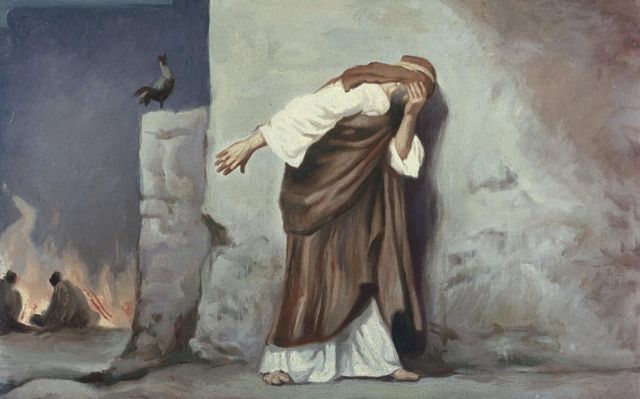
At first glance, Peter is a terrible choice to be the person on which Jesus would build his church. He is an uneducated, a simple fisherman. Shortly after the gospel reading above, Jesus accuses him of being controlled by Satan. He denied Jesus three times. When his life was threatened, he left Jerusalem, abdicating responsibility for the church there to James, the brother of Jesus.He fell into controversy with Paul in Antioch (see Letter to the Galatians), basically accused of being a hypocrite. The Acts of the Apostles pretty much loses interest in him after Paul is called to be an apostle.

Denial of Peter

Doesn’t sound too solid, does it? Is this really a rock?

And yet, according to the gospels, Simon son of Jonah was chosen by Jesus to be a leader. Jesus gave him the Aramaic nickname Cephas (pronounced “Kay-fas”, not “See-fas”), meaning “rock”, and this is the name Paul knew him by. In the gospels and Acts this is translated to the Greek  Πέτρος (Petros) and it comes down to us in English, via Latin, as “Peter”. And he does exhibit some rock-like  characteristics.

  1. He was the first male witness to the resurrection; in the gospels the resurrection announcement is “The Lord has risen indeed, and he has appeared to Simon!”.
  2. He organised the disciples in Jerusalem after the resurrection, and was the leader of the church from the time of the resurrection to about 42-44 – a period of some fifteen to seventeen years.
  3. After his departure from Jerusalem he continued to witness in Antioch and elsewhere. He probably made it to Rome -according to tradition, he was martyred there. Later tradition (2nd century) claims he was a founder and bishop of the church in Rome, although the evidence in the New Testament suggests that the church was  already in existence with multiple house-church congregations before he got there.
  4. The Gospel according to John knows that he died as a result of his witness (John 21.18-19)

So, while Peter is not a perfect rock, he is solid enough.

And now, what about us?

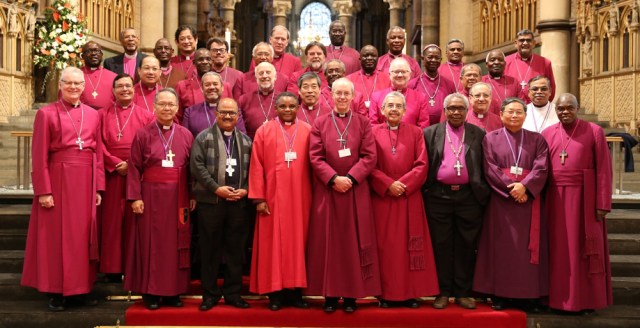
ens_011516_primates_group

You may have heard of the news about the Primates of the Anglican Communion meeting in Canterbury last week. The Anglican Communion is a federation of 38 autonomous churches, known as Provinces. Some of them you may know:
The Church of England,
the Church in Wales,
the Church of Ireland,
the Episcopal Church of Scotland,
the Episcopal Church of the USA,
the Anglican Church of Canada,
and the Church of the Province of Myanmar.

It also includes
the Church of Nigeria,
the Church of the Province of Uganda,
and the Church of Southern Africa.
Member provinces include post-colonial post-denominational unions such as
the Church of North India,
the Church of South India,
the Church of Pakistan,
and the Church of Bangladesh.

Now, each church is self-ruling, and all have the four marks of the Chicago-Lambeth Quadrilateral: the scriptures; baptism and eucharist;  the ordained ministry of bishops, priests, and deacons; and the creeds. ,they otherwise control their their internal organisation and patterns of worship. The leaders of each of the provinces is called a Primate – and in some cases they are hierarchical leaders, and in other cases, as in Canada and the USA, they have very limited power and authority, and are more like figureheads. Our primate is the Right Reverend Fred Hiltz. Since 1979 the Primates have come together for meetings, supposedly more for prayer and consultation than to actually decide or do anything.

Justin Welby, the current Archbishop of Canterbury and Primate of All England, met with each and every primate and invited them to Canterbury for this meeting. They discussed a number of issues (including setting a common date for Easter), but the issue that dominated the gathering was the marriage of same-sex couples. The Episcopal Church in the United States approved this in their General Convention in 2015. We in the Anglican Church of Canada will consider this in our General Synod this summer in Richmond Hill, Ontario. If our General Synod approves it, it will still require a second reading at the next General Synod in 2019 for it to become effective.The results are not very encouraging. On the one hand, the Primates have agreed to walk together despite tensions, primarily over the question about whether gays and lesbians can marry in the church.

Many of the primates and provinces are upset with The Episcopal Church because of the action they have taken. The Primate of Uganda walked out because he was unable to get the primates to consider a motion to condemn the Episcopal Church and to call them to repentance. The Primates did pass a motion requesting that for three years the Episcopal Church cease from representing the Anglican Communion standing committees or inter-provincial task forces, and that they not vote on matters of doctrine or polity. Arguably they have no authority to do this, but the various bodies in the Anglican Communion may well act on these requests.

So what does this mean? At the moment, not much. As my friend and colleague Winnie Verghese pointed out, only in the Anglican Church can not being allowed on a committee for three years be considered a punishment. Furthermore, both the Anglican Church of Canada and the Episcopal Church remain full members of the Anglican Communion. We do not have a governing body, and we do not have centralized power in the hands of a pope or a curia. We remain in relationship because the various parties want to be. We are less like a corporation or a hierarchical organization than a family where we argue a lot and sometimes we find we cannot sit down to dinner together.

It may come to mean more. Professor Ron Caldwell describes it as a “Faustian Bargain”. That said, Dean of Berkeley Divinity School at Yale Andrew McGowan points out that “we should assume that this outcome reflects serious efforts by numerous Primates to fend off worse outcomes”.

Well, it doesn’t sound very stable, does it? Is this the rock on which Jesus will build the church in the 21st century? But consider Peter – a pretty shaky foundation for the church, too. He was able to confess that Jesus was the Messiah, and we can as well. He was able to witness to the resurrection, and we can, too. He was able to repent from his denials and engage with the other pillars of the church to reconcile the radical Paul and the conservative James the Just. He was able to offer himself, his soul and body, to promote the good news of Jesus Christ, and so can we. The provinces of the Anglican Communion are a part of the visible church of Christ, and God has a mission in which we can participate. God is not done with us. The confession of Peter is not about getting the words right, it is about committing one’s whole life in service to Jesus, and we can and are doing this.

Curry-copy

The Presiding Bishop of the Episcopal Church Michael Curry wrote:

“This is not the outcome we expected,
and while we are disappointed,
it’s important to remember that the Anglican Communion
is really not a matter of structure and organization.
The Anglican Communion is a network of relationship
that have been built on mission partnerships;
relationships that are grounded in a common faith;
relationships in companion diocese relationships;
relationships with parish to parish across the world;
relationships that are profoundly committed
to serving and following the way of Jesus of Nazareth
by helping the poorest of the poor,
and helping this world to be a place
where no child goes to bed hungry ever.
That’s what the Anglican Communion is,
and that Communion continues and moves forward.”

May God continue to bless this fractious body of the Anglican Communion, and may it continue to be a rock upon which the church is built.


Posted in Sermons | Tagged , , , | Leave a comment

Fixing the Canadian Dollar

dominion-of-canada-1911-one-dollar-billI have a modest proposal.

We are all worried about the value of the Canadian dollar. We recently have watched its  decline in its value since 2013, when it was at par with the US dollar, to now under US$0.70. This is a result of the health of the US economy and the contrasting decline of the value of oil; the American economy does fine with cheap oil, but as net exporters of oil Canada suffers. The industrial heartland of Ontario and Quebec suffered setbacks in the economic crisis of 2008 and never bounced back to where it had been before. A low Canadian dollar may well encourage more development across the country, with the notable exception of the oil patch in Western Canada.

What I am more concerned about is the effect of inflation on the value of a dollar. I remember when I could buy a comic book for $0.12. New paperbacks could be had for $0.95. Movies were $0.50. Haircuts were $1.00. You could get a meal at a fast food restaurant for less than a dollar. Obviously, this was a while ago – I’m thinking the late ’60s and early ’70s, when I first started buying things on my own – but it still strikes me as a course of decreasing expectations as inflation slowly but surely reduces the value of our currency.

Indeed, according to the Bank of Canada inflation calculator a dollar in 1970 buys what $6.23 does now – a 523% change! It gets even worse. In 1962, the year of my birth, a dollar bought what cost us now $8.00 ($7.94, to be precise). When my parents were married in 1950 the dollar was worth about $10.00 in 2015 value. A hundred years ago, as the First World War began, a dollar bought the 2015  equivalent of $20.84, a change of 1984%.

So here’s what I suggest.

Let’s knock a zero off of our dollars, and make $10.00 the new $1.00.

A nice meal at a restaurant would then be $2.00 – $3.00. A good paperback would be less than a dollar, or less than two dollars if a trade edition. A Canadian dollar would be worth seven times more than a US dollar.

Of course, we’d need new currency – it’s not like our old dollars could magically increase in value ten-fold, after all. But a quarter, a dime, and a nickel would have real value. We’d have to reintroduce the penny, and who doesn’t want that!

Of course, some people wouldn’t like it. They’ll be upset that their million dollar homes in the suburbs are worth only $100,000. Median annual income for a family would go from $79,550 to $7955. That said, I suspect that the psychological effect would be to make us more thrifty, while at the same time making us feel very rich every time we exchange money when we visit the US.

Of course, some people would say that this is just smoke and mirrors – knocking off a zero will make no real difference to the true value of anything. Indeed, arguably,  other countries with far greater inflation do this on a regular basis, with no real effect on prices or the rate of inflation.  But those critics are overlooking the “cool” factor of resetting the value of our currency, and surely that’s important, too, eh? I look forward to hearing from the Prime Minister and the Governor of the Bank of Canada on this modest proposal.

Posted in Canadian Issues | Tagged , , , , | Leave a comment

A Few Thoughts on David Bowie

As someone who spent his adolescence in the 1970s, David Bowie (1947-2016) was unavoidable. My brothers brought his album Hunky Dory into the house and I listened to it repeatedly. Bowie made it big in Canada well before he had a number one hit in the USA (the same happened with other performers like Genesis and Peter Gabriel), so when he did break out in 1975 with Young Americans I felt hipsterishly superior in having already known about the man. At high school we danced to Diamond Dogs and Ziggy Stardust. I’m not sure I was ever a fan as such, but I sure liked the music. Herewith, then, a few thoughts on this icon.

  1. There was always something both repellent and alluring about Bowie, and it was that tension that made him so fascinating. I never wanted to be David Bowie, but I sure liked to see what he was up to. In the early ‘seventies androgyny was part of that, as was the nihilism that popped up in the lyrics of Diamond Dogs. “This ain’t rock’n’roll, this is genocide” was not your normal pop lyric.
  2. Bowie was a brilliant, charismatic performer brimming with confidence. Watch this video of Changes: https://www.youtube.com/watch?v=xMQ0Ryy01yE
  3. Bowie was a sponge. He heard the popular music of his day and then ran it through his own filters to create something new.
  4. Before he was a lead singer, Bowie’s instrument was the saxophone – loud and demanding all the attention. Sound familiar?
  5. Bowie was a collaborator. His look, his clothing, was often the result of his working with fashion designers encouraged to go beyond normal couture. In music he worked with Mick Ronson, John Lennon, Rick Wakeman, Bing Crosby, Sonic Youth, Robert Fripp, Iggy Pop, Luther Vandross, Brian Eno, Queen, Carlos Alomar, Adrian Belew, Tina Turner, David Sanborn, Arcade Fire, and many others. As an actor he worked in that supremely collaborative medium of film with luminaries such as Nicolas Roeg, Jim Henson, Ryuichi Sakamoto, Martin Scorcese, David Lynch, Christopher Nolan, and SpongeBob Squarepants.
  6. Bowie took risks, mainly because he frequently got bored with what he was doing and went off to do something he found more interesting. This led to one of the most diverse catalogues in popular music. Perhaps his most dramatic shift was in 1974-75, when he went from post-apocalyptic Diamond Dogs to the plastic soul of Young Americans and Station to Station. Now, not every shift was successful, but it always produced one or two songs that were more interesting than ninety percent of what other musicians were doing. Here’s a weird video of Bowie on Dick Cavett in November 1974 singing 1984 and Young Americans -weird because its clear in the following interview that he’s strung out on something (probably cocaine) and he’s lost a ton of weight – but he still manages to show up and give an outstanding performance. https://www.youtube.com/watch?v=P8TnXRBkYt8
  7. Even when at his lowest point, Bowie was doing interesting stuff. In LA in 1975, in the midst of his drug abuse, he came up with Station to Station. Only Bowie could meditate on the Stations of the Cross, mix in the return of Prospero from The Tempest, and morph that into a song about trains, cocaine, and love. https://www.youtube.com/watch?v=fDXBeu3198c
  8. Bowie got clean in the late ’70s. The two things that seem to have somehow done it was a geographic relocation to West Berlin and getting custody of his son. While he’s talked about his abuse of drugs I cannot seem to find much about how he got off of them. Changing locale, changing friends, and taking on responsibility seems to have been the major  part of it.  Was spirituality involved? Perhaps. The words of Word on a Wing (1975) are a clear cry for help:                                                                                                    Lord, I kneel and offer you
    my word on a wing
    And I’m trying hard to fit
    among your scheme of things.
  9. Even at his most popular, Bowie was doing some really weird things. Let’s look at the song Let’s Dance, his biggest, most popular hit. The verses are in B flat minor – a pretty dark key. The horns are staccato and discordant. Bowie’s voice is hardly alluring – more like directives from the high school principal. It resolves from the verse into a nice stable bridge in D flat major, but only for a bit. The tension between the verses and the bridge are probably what make the song.
  10. Hunk Dory is my favourite album by David Bowie. There isn’t a single bad song on it. Changes. Kooks. Any Warhol. Life on Mars. Oh You Pretty Things. Ahhh.
  11. David Bowie is not David Jones. Iman said somewhere that she did not marry David Bowie, but David Jones. Jones never legally changed his name – unlike Elton John he never became his created character. Somehow I knew that this was all an act.  His son, notably, did not remain “Zowie Bowie” but became the film director “Duncan Jones”. Towards the end of his life I suspect there was less of a distance between the man David Jones and his characters, but it was undoubtedly healthy to keep that distinction in his life.

Adieu, Mr. Jones. David Bowie lives on.

Posted in Poetry and Novels | Tagged , | Leave a comment

Christopher Page on “Successful Church”

Christopher Page is the rector of a “successful” church. This is his blog on what “success” looks like.

https://inaspaciousplace.wordpress.com/2015/09/15/successful-church/

Posted in Anglican Church of Canada | Tagged , , | Leave a comment

Me and Audrey

I haven’t posted much over the last two months. So here’s a picture of me and my dog Audrey.

Me and Audrey

We got Audrey from the Victoria BC SPCA apparently a “surrender” who spent most of her life in a laundry room. She was supposedly 12 then, so that makes her 14 now. She was incontinent, losing fur, and skin and bones. She’s put on 10 kilos since we got her, and she’s really not overweight. After a bit of medication she became continent and her fur is fine. We thought we’d have her for a short time, and we would make it a good time, but she’s gotten healthier and stronger, so who knows how long she’ll be with us?She does sleep a lot, though.

Posted in Random Personal Notes | Tagged | 1 Comment

Ten Canadians

Here’s a list of ten Canadians that I admire. Some might fit into a “Greatest Canadian” list and others not. None of them are perfect, and some unquestionably have their dark sides. But today I’ll focus on the positive. In alphabetical order . . .

None is Too ManyIrving Abella (1940 –  ) I  include Abella because his book “None is Too Many”(co-written with Harold Troper)  is a story that shocked many Canadians out of their self-righteous complacency. It came out in 1983 and I, like many young people, had been fed the story of Canada the Good, welcoming of strangers and managing a peaceful multicultural society. The book presented a dark history that we were not taught, namely the story of antisemitism in Canada and the resulting exclusion of Jews from Canada throughout the Nazi era and right up to the late ‘forties. As Abella himself has noted, advance chapters of the book influenced the welcoming of Vietnamese refugees in the late ’70s. If we are to be a mature nation we need to know our whole past, and not just the nice parts.

CalderFrank Calder (1915-2006) Frank Calder was a Prayer Book Anglican, but that’s not why he is here. He was also a graduate of the Anglican Theological College, a Nisga’a from the Nass River near the Alaska border, and an MLA in the British Columbia Legislature, but that’s not why he’s here. He’s in this list because of the case Calder v. British Columbia (AG) in which he sought to establish the claim of aboriginal title over the Nisga’a traditional lands, a title which had never been extinguished or negotiated away. He started the action in 1969 and by 1973 it had reached the Supreme Court of Canada, which ruled in his favour. It is the basis for subsequent decisions, including Guerin v. The Queen, [1984], Delgamuukw v. British Columbia [1997], and Tsilhqot’in Nation v. British Columbia [2014]. It led to the Province of BC, the Government of Canada, and the Nisga’a to negotiate the Nisga’a Treaty.

carrEmily Carr (1875-1941) I live in her neighbourhood. The house she was born in is down the road, the House of All Sorts (a boarding house she ran when money from art ran short) is around the corner, and she died in the building we now know as The James Bay Inn, also down the road. A statue of he and her monkey is at the corner of Douglas and Belleville, andshe’s in a mural on the side of Island Blue (an art and blueprint store). She was known in her late life as an award-winning author, but she was first and foremost an artist. She recently had her art exhibited in London and it was described as “riveting“. I agree.

carsonAnne Carson (1950 –  ) Anne Carson is probably the most important living Canadian poet (pace Atwood, et al). Her day job is being a Classics Professor at U of Michigan, as well as Visiting Professor at a host of universities. She was educated at the University of Toronto and taught at McGill before ending up in Ann Arbour. Her translation of Sappho is considered the standard, and it brings brilliance to the ancient fragments. A very private person, she nevertheless explored grief in Nox, a meditation on her brother’s death, using the Latin text of a poem by Catullus and her translation of it.

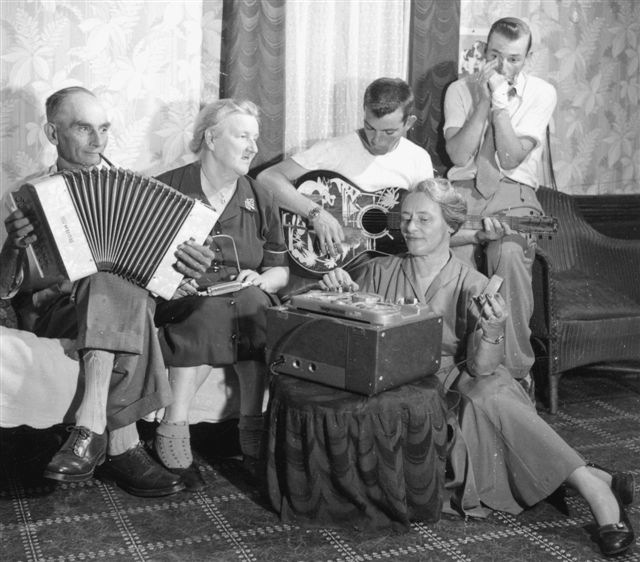
CreightonHelen Creighton (1899-1989) Helen Creighton scared the hell out of me. I’m sure she was a lovely person in the flesh, but as a folklorist she not only collected songs on her old reel to reel, but ghost stories. She published them in Bluenose Ghosts, and when I first read them I had trouble going to sleep. She’s probably best known for discovering Farewell to Nova Scotia, but to me she’ll always be Nova Scotia’s scariest lady.

Terry beacon-hill-parkTerry Fox (1958-1981) Terry Fox never made it to Mile Zero in Victoria, as his Marathon of Hope (1980) was cut short just outside of Thunder Bay by a recurrence of the cancer that had already taken his right leg. However, in 2005, the City of Victoria and private donors erected this statue, over the objections of some daft citizens who thought it did not belong in Beacon Hill Park. Fox had hoped to raise $24 million dollars for cancer research – one dollar for every Canadian. A telethon after he stopped his journey accomplished this goal, and he died in 1981. Since then the Terry Fox Run has raised over $650 million. But the thing that gets me is – the guy ran a marathon EVERY FRIGGIN DAY! Some people make running a marathon a life goal, and I haven’t even done that – the best I can do is run a slow 10k. But he ran a marathon, every day, until illness struck him down. To me he’ll always be Canada’s greatest athlete.

w-marshall-cp-880126Donald Marshall (1953-2009) Donald Marshall probably never wanted the notoriety, but he became an unlikely hero for two reasons. First, as a young man he was wrongfully convicted for murder. Because he was a Mi’kmaq and it was 1971, the police and crown attorneys had decided that he was already guilty, despite lying witnesses and exculpatory evidence. After eleven years the conviction was overturned, and resulted in changes to the rules of evidence. Courts of Appeals and the Nova Scotia provincial government minimized any persecution, and only after a Royal Commission was the truth unearthed and appropriate compensation offered. The Commission found that the legal system had failed Marshall at every step. Marshall subsequently challenged federal laws and regulations regarding fishing. He held that First Nations fishing rights were entrenched in treaties and could not be overruled by fiat of the federal Department of Fisheries. After being initially convicted, the Supreme Court of Canada found in his favour in R v Marshall (No 1) [1999] R v Marshall (No 2) [1999].

McClungNellie McClung (1973-1951) was born in Ontario and died in Saanich, BC, but she was a Prairie Pioneer. In her forties she became one of the leaders of the Woman’s Suffrage movement in Winnipeg, achieving success in 1916 with Manitoba being the first jurisdiction in Canada to enfranchise the female sex. She moved to Alberta, served as an MLA in the legislature, and devoted herself to campaigning for Temperance. In 1927 she one of the “Famous Five” women who sued to clarify the provision in the BNA Act about persons, and as to whether that included females, and thus whether women were eligible for high political office. The Supreme Court of Canada thought not, but in 1929 the Judicial Committee of the Privy Council argued that a strict reading of the Act was not correct, as “The exclusion of women from all  public offices is a relic of days more barborous than ours.”

ndp-leader-rachel-notley-wins-alberta-electionRachel Notley (1964 –  ) Anyone who can overturn forty-one years of a conservative  dynasty and establish a socialist paradise in Alberta gets my respect and admiration.

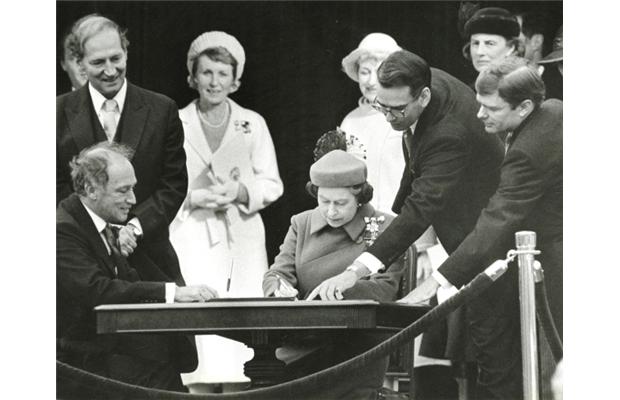
TrudeauPierre Elliott Trudeau (1919-2000) Based on his record from 1968-1979 Trudeau would have gone down, at best, as a middling Prime Minister. He had not really dealt with the issue of separatism, the hope for which so many votes in English Canada depended, and he was a lousy manager of the national economy (think “wage and price controls”).  After the brief interregnum of Joe Clark, he came back, immediately engaged in the 1980 Quebec Referendum and won a resounding victory for the “Non” side. Then he began the challenging task of “patriating” the Constitution. Canada had been independent of British rule since the 1931 Statute of Westminster, but the federal government and provincial governments had never agreed on an amending formula for the Constitution. As well, Trudeau was concerned with the fragility of human rights in Canada, having seen them abused during the Duplessis era in Quebec. In contrast to the communitarians of Quebec, where the intellectual and political elite claimed to speak for the people and demanded control over a plethora of rights and policies, Trudeau saw rights as inhering in individuals who might not want to be led by the nose. Thus the patriated constitution also had a Charter of Rights and Freedoms that owed a lot to Trudeau’s Personalist philosophy. Discrimination on the basis of sex was inserted as well, accomplishing in Canada what the movement for the Equal Rights Amendment in the USA could not. Finally, the patriated Constitution enshrined existing aboriginal and treaty rights. It all happened so fast – the Canada Act was proclaimed on Parliament Hill by the Queen in 1982. Without a doubt Trudeau is the most influential Prime Minister of my lifetime, and probably stands with Macdonald, Cartier, and Brown as the creators of the nation as we know it. All Prime Ministers since have lived in his shadow, and we might never see his like again.

Posted in Uncategorized | Tagged , , , | 2 Comments

What Does Kenosis Solve and Not Solve? Part 1

What Does Kenosis Solve & Not Solve?                                                                                 David Bruce Bryant-Scott BA MDiv ThM                                                                                     PhD student, Heythrop College, University of London                                                             June 5, 2015 11:00 am The Campion Room

kenosis

Good morning. My name is Bruce Bryant-Scott, and I am working on a dissertation under the supervision of Professor Johannes Hoff. I am one of those rare things here at Heythrop College,[1] a part-time distance research student. I live 7000 km away in Victoria British Columbia, Canada, where I am a priest in the Anglican Church of Canada at a parish church.[2]

My dissertation is about decolonizing theology. I want to find a theology that does not lend itself to justifying the colonization, exploitation, marginalization, and murder of people in the name of Jesus and progress. Kenotic theology may be a good candidate. This morning I want to talk about kenosis as it is discussed by New Testament scholars and by theologians, and then briefly say how I intend to use it.

  1. Kenosis and the New Testament Scholars

Discussion of kenosis is tied to Paul’s use of the word ἐκένωσεν in Philippians 2.7, as seen in Handout 1. For the record, ekenōsen is a 3rd person singular indicative active aorist of κενόω. Kenosis is a perfectly ordinary Greek word meaning “emptiness”; cognates translate into English as vacate, evacuate, deplete, and deplete.

Hand-Out 1 (Heythrop June 5 2015)

Why does Paul bring in this theme of self-emptying? In the context of Philippians it is evidently a form of encouragement to them, to, as the preceding verses put it,

be of the same mind, having the same love, being in full accord and of one mind. Do nothing from selfish ambition or conceit, but in humility regard others as better than yourselves. Let each of you look not to your own interests, but to the interests of others. (Philippians 2.2-4)

The exhortation continues afterwards:

Therefore, my beloved, just as you have always obeyed me, not only in my presence, but much more now in my absence, work out your own salvation with fear and trembling; for it is God who is at work in you, enabling you both to will and to work for his good pleasure. Do all things without murmuring and arguing, so that you may be blameless and innocent, children of God without blemish in the midst of a crooked and perverse generation, in which you shine like stars in the world. (2.12-15)

In the rhetorical structure of a letter the description of Christ’s kenosis is part of the paraenesis or moral exhortation. Paul writes the letter while he is in prison (1.13), and the Philippians are concerned and send financial aid (4.18). As well, Paul is opposed by Jewish-Christians having authority from the Jerusalem church, and this opposition is creating divisions in the churches for which Paul felt responsible.[3] This has not created divisions in Philippi yet, but Paul is worried about it, and so he mentions them in 1.15-17, 1.28, 3.2, and believes that only if the Philippians continue to follow Paul and the example of Jesus will they be able to work out their salvation with fear and trembling (1.12). Paul’s use of this passage, then, is primarily ethical – by being like this, his readers will have God working within them, enabling them “both to will and to work for his good pleasure” (2.13).

Following Lohmeyer’s essay Kyrios Jesus (1927) a majority of 20th century scholars and current scholarship would argue that Philippians 2.5b-11 is pre-Pauline and probably a hymn sung by the early Christians; this is still the belief of many influential living scholars, such James D. G. Dunn and John Reumann.[4] If this is so, then the immediate ethico-rhetorical use of Paul recedes, and it becomes more of a doxological, soteriological, and thus implicitly a Christological work (as the title of the 1998 collection Philippians 2: Where Christology Began suggests);[5] who Christ Jesus is becomes more important. Handout 2 reproduces a chart created by N. T. (Tom) Wright which presents the variety of opinion about the “Philippian hymn” and the impact it has on the translation into English of key words. Some see the hymn as being derived from pre-Christian gnostic mythology, others accept a Jewish gnostic influence, others regard it as more influenced by a transformation of Adamic typology, and “equality with God” is variously interpreted as referring to attributes, status, and humanity in the image of God.

Hand-Out 2 (Heythrop June 5 2015)

Now, N. T. Wright is not convinced that there ever was a “Philippian hymn”, and on the basis of linguistic and stylistic evidence questions those who construct a pre-Pauline Christology[6] (there is, of course, no documentary evidence for a pre-Pauline hymn). Likewise, Gordon D. Fee points out five problems with the case for the “pre-existence” of the hymn: 1) there’s really nothing like it in either Greek or Hebrew poetry; 2) poetic language is not necessarily poetry; 3) ὃς (hos or “who” in 2.6) is perfectly normal and not an awkward connective indicating a quotation (as in other supposed parallels); 4) these passages read as structured prose, not poetry; and 5) some of the “lines” lack verbs, and are likely more the product of biblical scholars than any ancient writer.[7] [8]

In a measured statement Peter Oakes (currently Greenwood Senior Lecturer in the New Testament at Manchester) writes:

I think that Paul has taken his beliefs about Christ’s self-lowering (2 Corinthians 8.9), his obedient death (Rom. 5.19), and his exaltation (1 Corinthians 15.24) and has carefully crafted a rhetorically powerful Christological reinforcement to his call in 1.27-2.4 to stand firm and united.[9]

While the New Testament scholarly consensus is less monolithic than it once was, it is clear that the passage does several things: it is doxological, an exhortation to particular ethical behaviour, and Christological.

Regardless of what one makes of the original text in Philippians, it is evident that the theme of humility and lowering oneself for others is present in other parts of the New Testament. Thus, Paul writes:

For you know the generous act of our Lord Jesus Christ, that though he was rich, yet for your sakes he became poor, so that by his poverty you might become rich. 2 Cor 8.9

For Jews demand signs and Greeks desire wisdom, but we proclaim Christ crucified, a stumbling-block to Jews and foolishness to Gentiles, but to those who are the called, both Jews and Greeks, Christ the power of God and the wisdom of God. For God’s foolishness is wiser than human wisdom, and God’s weakness is stronger than human strength. Consider your own call, brothers and sisters: not many of you were wise by human standards, not many were powerful, not many were of noble birth. But God chose what is foolish in the world to shame the wise; God chose what is weak in the world to shame the strong; God chose what is low and despised in the world, things that are not, to reduce to nothing things that are, so that no one might boast in the presence of God. 1 Cor 1.22-29

The synoptics have the theme as well:

Whoever wants to be first must be last of all and servant of all. Mark 9.35 & parallels

To the rich young man: You lack one thing; go, sell what you own, and give the money to the poor, and you will have treasure in heaven; then come, follow me. Mark 10. 21 & parallels (A very literal understanding of letting go!)

You know that among the Gentiles those whom they recognize as their rulers lord it over them, and their great ones are tyrants over them. But it is not so among you; but whoever wishes to become great among you must be your servant, and whoever wishes to be first among you must be slave of all. For the Son of Man came not to be served but to serve, and to give his life a ransom for many. Mark 10.42-45 & parallels

Throughout the Gospel according to Luke Jesus is presented as humble, obedient, and meek, and this quality is extolled in Mary and others. The Gospel according to John is fundamentally a gospel of glory, but glory is coincident in the cross. Kenotic humility, then, whether by that name or implicit, is found throughout the early Christian writings.

What is not clear is whether Paul has a belief in the pre-existence of Christ, and if so, what the nature of that pre-existence is. It is also not absolutely clear what the nature of “form” of God is and what “equality with God” entails; one can read a reconstruction of Middle Platonism into it, but that just begs the question.[10]

Next Post: Part 2, Kenosis and the Theologians.

[1] http://www.heythrop.ac.uk/

[2] The Parish of St. Matthias, Victoria, The Anglican Diocese of British Columbia
600 Richmond Avenue, Victoria, British Columbia, Canada V8S 3Y7
Parish Website: http://stmatthiasvictoria.com/
Cell: 250-889-8917    Parish Office: 250-598-2833
bbryantscott@bc.anglican.ca    Twitter: @bbryantscott
Blog: https://brucebryantscott.wordpress.com/

[3] Gerd Lüdemann, Opposition to Paul in Jewish Christianity (Minneapolis MN: Augsburg Press,1989), translated from Paulus, der Heidenapostel. Bd. 2: Antipaulinismus im frühen Christentum (Göttingen 1983).

[4] Carolyn Osiek calls it the “general consensus” in Philippans Philemon (Nashville TN: Abingdon Press, 2000), p. 56. See also R. P. Martin, Carmen Christi, Philippians ii.5-11 in Recent Interpretation and in the Setting of Early Christian Worship (Cambridge UK: Cambridge University Press, 1967); F. W. Beare, A Commentary on The Epistle to the Philippians (London: Adam & Charles Black, 1959); Ralph P. Martin & Brian J. Dodd, eds., Where Christology Began: Essays on Philippians 2 (Louisville KY: Westminster John Knox Press, 1998) (which includes an essay by James D. G. Dunn which affirms the pre-Pauline character); John Reumann, Philippians (Anchor Yale Bible Vol. 33B) (New Haven CN & London UK: Yale University Press, 2008).

[5] Ralph P. Martin & Brian J. Dodd, eds., Where Christology Began: Essays on Philippians 2 (Louisville KY: Westminster John Knox Press, 1998).

[6] N. T. Wright, “ἁρπαγμός and the Meaning of Philippians 2.5-11”, Journal of Theological Studies, New Series Vol. 37, Pt. 2, October 1986, pp. 321-343; 342-343.

[7] Gordon D. Fee, Paul’s Letter to the Philippians (The New International Commentary on the New Testament) (Grand Rapids MI: William B. Eerdmanns Publishing Company), pp. 40-46.

[8] A further problem for those who claim influence from “Gnosticism” is that the “Gnosticism” to which they refer in all probability also never existed as such, but is a scholarly reconstruction of the 19th and 20th Centuries that collects into one category a vast variety of writings that in retrospect came to be seen as not “orthodox” and “catholic”, thus reproducing the biases of the modern scholars. See Karen King, What is Gnosticism (Cambridge MA: Harvard University Press, 2005).

[9] Peter Oakes, Philippians: From people to letter (Cambridge UK: Cambridge University Press, 2001), p. 210.

[10] Probably the way forward into understanding the context of Hellenistic Judaism for Paul on this is found in Daniel Boyarin, “The Gospel of the Memra: Jewish Binitarianism and the Prologue to John”, The Harvard Theological Review, Vol. 94, No. 3 (Jul., 2001), pp. 243-284.

Posted in Uncategorized | Tagged , , , | Leave a comment

Victoria’s Two Bodies

queen-victoria

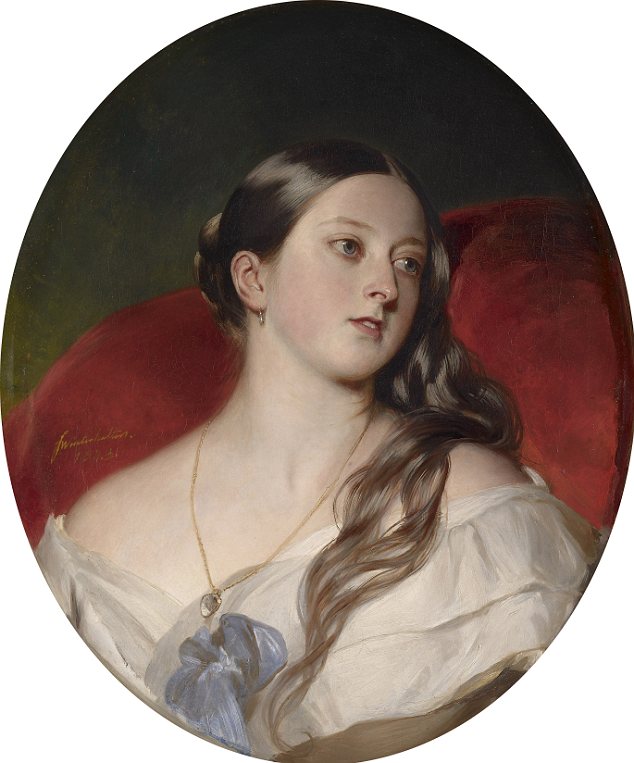
A portrait of Queen Victoria painted in 1843 by Franz Xaver Winterhalter.

I am a monarchist.

Not one of those singular people  who join the Monarchist League, or who buy Hello magazine with its cover picture of This week’s Royal. And while I admire our Sovereign Lady Queen Elizabeth II, it’s really not about her personally.

What convinces me to be a monarchist is the political idea that the monarch has two bodies. Not in the way Tatiana Maslaney plays multiple characters in Orphan Black, nor some weird science fiction idea of one person with two actual bodies, but in the way that the monarchy actually works in Canada, the United Kingdom, and other places.

Originally it was a theological idea used to support the rule of princes. The monarch had a physical body, which could be strong or frail and was identified with a particular person who was born, lived, and died. The other body was a spiritual one, which inhered in that particular individual while they reigned, but never died. When that monarch’s physical body died, the spiritual body continued on to the heir to the throne. Thus, the principle is that the throne is never empty, and the king never “dies”.

This theological abstraction became a rather secular principle in British and Canadian law. While the monarch may change, and may even be unknown, contested, a minor, or senile, the authority of the monarch remains the same and is continuous. In practical terms the authority is exercised by the Prime Minister and Premiers who “advise” the monarch or her representatives – advice that is always accepted. As the spiritual body, then, is controlled by elected representatives, the authority of the monarch is democratically controlled (including, as has happened in any number of Commonwealth states, the abolition of the monarchy for that country).

In Canada the physical body of the monarch is quite restricted. Because she is represented by the Governor General and Lieutenant Governor, there is no practical reason for her to be physically present. She (and members of her family) only come when invited by the governments, federal and provincial. She may be on our currency, but she will not set foot in Canada unless specifically requested by the Canadians who run the government. When she does come everything she says and does in public is arranged and vetted by Canadian officials.

It actually works very well. Everybody knows that the governments are ultimately responsible to the people, and every four to five years we electors have the opportunity to kick the bums out. Public land is called “Crown Land” and is in fact a trust held for the benefit of all (subject to the settlement of First Nations claims and the negotiation of treaties). We have all the benefits of the monarchy without too many of the hassles.

Some would advocate for Canada to become  republic. If we must, can we separate the Head of State from the Head of Government, as Germany, Ireland, Israel, and India do, with  figure-head presidents? The union of the Head of State and Head of Government in powerful presidents, as in Russia, the US, and France fills me with distaste. To attack the president would seem to also be an attack on the state and people as well – something that is not so much the case in these other previously mentioned nations.

Canada will probably not become a republic, though, as such a change would require the unanimous consent of the federal government and all ten of the provincial governments. As we have seen from Meech Lake (1987) and the Charlottetown Agreement (1992) unanimous consent is not easy, and many Canadians have a strong emotional attachment to the monarchy. Politicians may feel better at leaving sleeping dogs lie and use their political capital on more important issues.

On this official birthday of the Queen, Victoria Day, may we celebrate the two bodies of the Queen – the one long gone when Victoria herself died in 1901 and the other continuing on in her great-granddaughter, Elizabeth the Second.

Posted in Uncategorized | Tagged , , , , | Leave a comment