The Columbian Apocalypse

This post is a continuation of the second part of my dissertation Unsettling Theology.
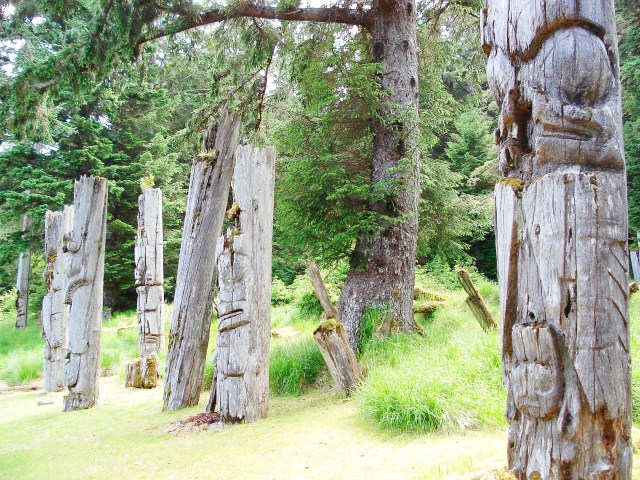
>Cutline topiaupeitaopwuetopawuetop iuawepo tuawope tuaopwietuopaiwu etopi uaweopitu aopweituopa wietuopaiuwetopuiawoeitataa

“The ruins of the Haida village of Ninstints, abandoned after a smallpox epidemic in the 1880s. When George Vancouver first came to the Strait of Georgia, a 1782 smallpox epidemic had littered the area with abandoned, overgrown villages.” National Post http://nationalpost.com/news/canada/everyone-was-dead-when-europeans-first-came-to-b-c-they-confronted-the-aftermath-of-a-holocaust

The next attempt to settle the Americas was that of Columbus.[1] Because of a miscalculation Columbus thought the earth was much smaller than it was, and so he believed that he had found a new route to the Orient when he arrived in the Bahamas in 1492. In his three further voyages of 1493, 1498, and 1502 he thoroughly explored the Caribbean and established colonies in Hispaniola, still thinking he was somewhere just east of Japan. Columbus captured a number of the Taino who lived on the island of Hispaniola, some of who were sexually and physically assaulted and transported back to Spain. Many of the Taino fought back against the Spanish settlements, destroying La Navidad established on Hispaniola in 1492. Subsequent settlements at Isabella and Santo Domingo enslaved some 400,000 of the Taino, whose rapidly died off. In order to work the farms in the new colonies the Spanish colonists brought slaves from Africa, starting in 1501. The Spanish conquered the Aztec Empire in Mexico in 1519-21, and the Inca Empire of Peru in 1532. Over the following decades of the 16th century the Spanish extended their rule to cover the West Indies, Mexico, Central America, all of South America except for what became Brazil (which was settled by Portugal), and into Florida, New Mexico, and California.

The overriding rationale for the Spanish to colonize the Americas was financial. Columbus’s initial goal was to find a maritime route to East Asia that did not have to use the Silk Road and was well away from attacks by hostile Muslims, who sought to interpose themselves between Europe and “the Indies”. Although Columbus did not find that route, the Spanish sought and found among their New World conquests gold, silver, and jewels. Bases were required to control the indigenous peoples and slaves, and as the economy expanded to include sugar and other agricultural exports, more colonists came over seeking new opportunities for wealth. In many ways the colonists simply sought to replicate what they had known in the Iberian peninsula – a nation which had only recently been completely re-conquered from the infidels, where slavery was practiced, and where there was significant stratification in society.

Part of that replication involved the Christian faith, for the Reconquista was very much framed as the crusade of Christian monarchs against Moslem unbelievers. Already an expanding Christian state, Spain took advantage of its technological superiority in arms and trade to continue its expansion into the Americas. The justification for this expansion was framed in theological terms.

Before examining these theological justifications, it is important to note the single most profound effect of contact on the indigenous peoples – the introductions of diseases to peoples who had no immunity to smallpox, measles, influenza, and tuberculosis. Scholars argue about the mortality rates in the decades after contact; in 1966 Henry F. Dobyns calculated it to be as high as 95%, with something between 80 and 100 million dying.[2] While these numbers are disputed, what is clear is that even a conservative estimate assumes that tens of millions of people lived in the Americas, and that at least a third to a half of them died off as these diseases raced ahead of the conquistadors and settlers.[3]

In 1519, central Mexico had an Indian population estimated to have been 25 million. By 1523 only 17 million Indians survived; in 1548, only 6 million; in 1568, 3 million. By the early seventeenth century, the number of Indians of central Mexico scarcely reached 750,000; that is, only three percent of the population before the conquest . . . It is estimated that the Indian population of Peru fell from 9 million before Columbus to 1.3 million by 1570 . . . This demographic disaster is without parallel.[4]

The epidemics appeared to have spread through indigenous peoples at various places and times, and amongst the last to be severely hit were the nations on the Pacific North-West.  At what later became known as Holland Point, in Victoria BC[5] (the southern end of Vancouver Island), there was a large fortified village of the Songhees that had been occupied off and on for some 800 years. According to Grant Keddle, curator of Archaeology at the Royal British Columbia Museum, a smallpox epidemic appears to have hit in the 1780s, resulting in its abandonment, some sixty years before the colonist of the Hudson’s Bay Company arrived: “In the 1920s Saanich Chief Tommy Paul recalled the stories of the “great plague . . . six generations back”, where so many died there was “nobody to nurse the sick or bury the dead”.[6] In 1792 Captain George Vancouver explored Puget Sound in what is now the State of Washington.

He found a charnel house: deserted villages, abandoned fishing boats, human remain “promiscuously scattered about the beach, in great numbers.” Everything they saw suggested “that at no very remote period this country had been far more populous than at present.” The few suffering survivors, noted Second Lieutenant Peter Puget, were “most terribly pitied . . . indeed, many have lost their Eyes.”[7]

After the colonies of Vancouver Island and British Columbia were established in 1849 another smallpox epidemic hit in 1862, during the Cariboo Gold Rush. “There are estimates that more than 30,000 of the approximately 50,000 people living in B.C. at the time died. First Nations believe there were many more, and the death toll much higher.”[8] At the northern end of Vancouver Island amongst the Kwakwaka’wakw people “epidemics caused an estimated population decline of up to 78 percent between the 1840s and 1881.”[9]

One cannot underestimate the upheaval that such mortality created, whether in the 16th century in Mexico or the 19th in British Columbia. It weakened the social structures in place, allowing the indigenous peoples to be more susceptible to conquest and removal. Cities, towns, and villages were abandoned as populations died off. Survivors from diverse peoples banded together, sometimes being adopted by the more powerful nation and given the names of families who had become extinct. Oral and cultural traditions that were handed on from one generation to another came to an abrupt end with so many sudden deaths. The traditions of the elders were called into question in the face of disease, and many chose to adopt what appeared to be the more powerful religious practices of the settlers. African slaves were imported to replace the indigenous people who were enslaved and died off; had the mortality not been so extreme the Atlantic slave trade would not have become so important to the colonization of the New World.

It is sometimes claimed that the settlers deliberately infected the indigenous peoples. There is only one fully documented example of such germ warfare, at Fort Pitt (later Pittsburgh) by the British in 1763, which involved the distribution of blankets and other goods infected by smallpox.[10] However, if it happened once it probably happened on other occasions. What is without doubt is that the colonizing authorities were not upset by the effects of disease, as the illnesses overwhelmed the indigenous peoples and made it easier to settle. In the case of the 1862 epidemic on Vancouver Island, while the principle of quarantine was well understood, colonial authorities nonetheless expelled infected indigenous peoples from Victoria and other settlements, thereby spreading the disease to the First Nations villages up island and beyond. As will be described later, some saw it as providential.

[1] His birth name in 1451 in Genoa was Christoforo Colombo, which was latinised as Christophorus Columbus, from which we get the English form Christopher Columbus. In Spain he was known as Cristóbal Colón. The South American nation of Colombia is named after him, as is the District of Columbia, Columbus, Ohio, and ten counties in the USA. The city and district of Colón in Panama is also named after him. In 1792 a ship named Columbia Rediva out of Boston sailed up a river on the west coast of North America, and the river was named after the ship; this then gave its name to the area, part of which became the colony and then province of British Columbia.

[2] Mann, 1491, p. 106.

[3] Mann, 1491, pp. 150-151.

[4] Thomas W. Berger, A Long and Terrible Shadow: White Values, Native Rights in the Americas since 1492 (Vancouver: Douglas & MacIntyre, 1999), pp. 28-29.

[5] This ancient village is some 600 metres from where this dissertation is being written.

[6] Grant Keddie, Songhees Pictorial: A History of the Songhees People as seen by Outsiders 1790 – 1912 (Victoria: Royal BC Museum, 2003), p. 16.

[7] Mann, 1491, p. 123.

[8] Dene Moore, “B.C. First Nations mark small pox anniversary” published in Metro News/Canadian Press, August 06 2012, http://www.metronews.ca/news/canada/2012/08/06/b-c-first-nations-mark-small-pox-anniversary.html accessed January 16, 2017.

[9] Leslie A. Robertson with the Kwagu’ł Gixsam Clan, Standing Up With Ga’axsta’las: Jane Constance Cook and the Politics of Memory, Church, and Custom (Vancouber: University of British Columbia Press, 2012), p. 121.

[10] Dixon, David, Never Come to Peace Again: Pontiac’s Uprising and the Fate of the British Empire in North America (Norman OK: University of Oklahoma Press, 2005), pp. 152-155.

Posted in Canadian Issues, Unsettling Theology | Tagged , , | Leave a comment

First Contact: Skraelings and Vikings

This is a continuation of the second part of my dissertation on the theological legacy of the Indian Residential Schools, Unsettling Theology.

Tenochtitlan-2

Tenochitlan

The indigenous peoples of what is now known as North and South America have lived there since “time immemorial”.[1] Archeological evidence suggests that earliest ancestors of the indigenous peoples arrived no later than 11,000 years before the present, and mitochondrial DNA evidence suggests it was probably more like 25,000 years ago, and quite possibly as much as 43,000 years ago.[2] Presumably there was not just one mass migration, but several waves that took place over many centuries, facilitated by the Beringia land bridge between Siberia and Alaska, created by the lowering of sea level during the Ice Ages. The last migration is thought to be that of the Inuit, who came out of Western Alaska and spread into Northern Alaska, Northern Canada, and Greenland from c. 200 to 1300; in this case they were replacing the earlier Dorset Culture.

South of the Inuit are the First Nations, whose ancestors developed over thousands of years into many peoples or nations with distinct cultures and languages. The variety of these languages and culture was and is huge; for example, the linguistic diversity of indigenous languages in what now called British Columbia is greater than that of the languages in modern Europe. The Pueblo peoples in what is now the US Southwest have fifteen languages in three utterly different language families.

Cahokia Aerial_HRoe_2015

Cahokia

In some places, such as the Mayan Peninsula, in Mexico, and in Peru, sophisticated cultures with forms of writing and architecture arose, namely the Mayan, the Aztec, and the Inca. In North America, on the east bank of the Mississippi, not far from where St. Louis was eventually built, a city now known as Cahokia was established between 600 and 1400, with some 40,000 inhabitants at its peak. The city of Tenochitlan (pre-conquest Mexico City) in 1520 had 20,000 people, which at that time made it bigger than Paris, Europe’s largest metropolis; by all accounts it was also cleaner and more livable than any European city. Many of the indigenous peoples were hunter-gathers, but just as many were sedentary, building cities, or travelling on their ancestral territories between winter and summer settlements. Social organization was diverse, ranging from small migratory tribes based on extended families to highly complex groups with hierarchies and clans. The nations had a variety of cosmologies and spiritual customs, and in some cultures a religious caste emerged. Warfare between adjacent peoples was common, and captives were often turned into slaves. Across the Americas the indigenous peoples transformed their territories through fire, irrigation, and the building of mounds and terraces.[3]

All of this belies the tendency by Europeans and European settlers until very recently to homogenize and discount the complexity and considerable achievements of the indigenous peoples. The story we tell of the “Indians” of the Americas is that they were ignorant savages, stuck in the stone age, scattered across the continents and islands in small nomadic groups. The story runs that they were peoples of simple beliefs and had no idea how to exploit the land and build up civilizations. The Hollywood image of Indians is of hostile enemies standing in the way of progress, or of noble savages in tune with the environment but slowly being ground down and assimilated by European culture. It is assumed that they have no history prior to contact in 1492, and that their oral traditions are myths and “old wives tales”. Whatever virtues they might have had, they were clearly inferior to the “white peoples” from Spain, Portugal, France, and Britain.

l-anse-aux-meadows

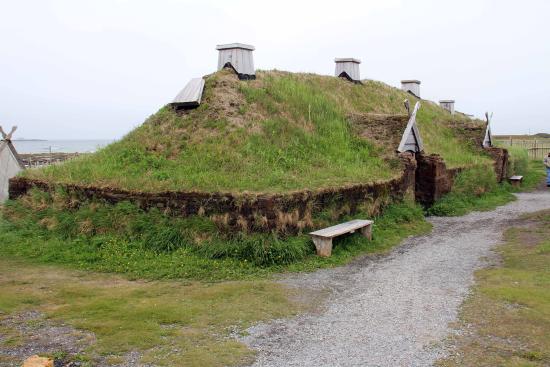
Reconstructed Sod House, L’Anse-aux-Meadows, Newfoundland and Labrador.

The first documented attempt by Europeans to settle in the Americas was that of Icelanders led by Leif Ericson around 1000[4]. The Saga of the Greenlanders and the Saga of Erik the Red describes the discovery and settlement of Vinland at a place named Leifsbudir. In the 1960s two Norwegian archeologists discovered a Viking settlement at the north end of the island of Newfoundland in what is now called L’anse aux Meadows; it is thought to be the site of Leifsbudir, or a depot for another colony further south that has not yet been identified. Iceland and the recently settled Greenland was in the process of accepting the Christian faith, so it is possible that Snorri Thorfinnsson, the first child born in the settlement, was also the first person baptized in the Americas.

However, this first European settlement was not successful. Contact with the local indigenous people, called Skraelings, was limited, but involved some bartering. Some of the settlers were aggressive, as one might expect from Vikings, and the Sagas record incidents of unprovoked violence that led to killings of the locals. They also record the exchange of milk products with the Skraelings, which, because they were lactose intolerant, led to them becoming ill and thinking that they were poisoned. In the end they attacked the Viking settlement, and the colonists retreated to Greenland and Iceland. Settlements in Greenland were more successful, but contact with the Inuit was limited, and the Greenlanders tried to replicate their Scandanavian society and did not adopt the locally-adapted ways of the indigenous. The settlements on Greenland died out in the 14th and early 15th centuries, and the colony in Vinland was forgotten by the rest of Europe.

Trade, conflict, and unintended illness – these three issues also characterized subsequent contact five centuries later.

[1] Time immemorial is an English legal phrase which means “Time whereof the Memory of Man runneth not to the contrary” (OED, cited from 1832). It is a phrase that in Canada is frequently used to describe the ancient roots of the indigenous peoples in the land, as contrasted with the historical, documented arrival of all other peoples.

[2] Charles C. Mann, 1491: New Revelations of the Americas Before Columbus, Second Edition (New York: Random House Inc., Vintage Books, 2011), pp. 187-190).

[3] Charles C. Mann, 1491: New Revelations of the Americas Before Columbus, Second Edition, p. 14, 211, 283-8.

[4] A bit old but useful is Frederick J. Pohl, The Viking Settlements of North America (New York: Clarkson N. Potter, Inc./Publisher, 1972).

Posted in Canadian Issues, Unsettling Theology | Tagged , , , | 1 Comment

Theologies of Mission and the Indian Residential Schools (Introduction)

The following is the introduction to the Second Part of my dissertation Unsettling Theology.

St. Michael's

St. Michael’s Indian Residential School, Alert Bay, BC, circa 1965. Operated by the Anglican Church of Canada on behalf of the federal government of Canada, the school opened in 1894. The building in the picture was erected in 1929. The federal government took direct control of the school in 1969, and it closed in 1975. The building was torn down in 2015. http://www.anglican.ca/tr/histories/st-michaels-alert-bay/

What were the theologies of mission which informed the operations of the Indian Residential Schools?

This is a simple question which does not yet have a standard, well documented answer. I will not attempt to provide such an academic history, as this dissertation is an interdisciplinary work integrating philosophy, history, and theology, and a full history awaits the work of academic historians working in archives with fonds of primary documents. Given the interdisciplinary nature of this dissertation, the historical aspect is necessarily derivative of other scholars’ work. That said, I will provide a provisional suggestion of what those theologies are, which is grounded in an inductive study of some primary literature with some verification by a brief excursion into archival documents. This will also be informed by the secondary literature.

In an attempt to keep the dissertation at a manageable size, I will only consider the Protestant theologies. An primary resource in determining such theology in the Canadian context is Canada’s Missionary Congress: Addresses Delivered at the Canadian National Missionary Congress, Held in Toronto, march 31 to April 4, 1909, With Reports of Committees.[1] On a more global level the records of the World Missionary Conference of 1910, held in Edinburgh, Scotland, provide a comprehensive overview of the theologies in operation across the Protestant world. The World Missionary Conference of 1910 produced 8 volumes of reports sent to all of the delegates, and a ninth volume recording the proceedings sent out after the conference. [2] From these texts I will derive a number of characteristics of these theologies. As well, I will examine a handful of books written at that time in preparation or under the influence of the Conference. To verify that there is a congruency between what is said at Edinburgh in 1910 and what was happening in the schools I will briefly examine some of the reports of missionaries from 1870s to 1910s, and addresses and sermons given in missionary societies in that era. [3] This verification will be less an endeavor of proving the congruency than checking to see if there is a lack of similarity, thus disproving my suggestion that the theologies discerned from the nine volumes of reports reflect the theologies at work among the leadership of the schools. As there is a growing number of recent secondary works on the conference and Victorian protestant theologies in general, these will also be considered.

This chapter will work backwards, first with a summary history which examines the context of the interactions of Europeans and Indigenous peoples in the Americas, in general, as they related to issues of religion and colonization, and then becoming more specific as it considers the interaction of French and British in New France and colonial North America (including the British colonies in Atlantic Canada and the activities of the Hudson’s Bay Company in Rupert’s Land), down through the Conquest of New France by the British and the subsequent American Revolution and entry of Loyalists into Canada and the colonies of Nova Scotia and New Brunswick. This brings us to the 19th century, where we can distinguish between two streams of English speaking Protestantism, namely the High Church/Anglo-Catholic tradition and Evangelicalism. After this summary I turn to examine the Edinburgh Conference of 1910, contemporary books, and the smattering of contemporary archival matter. I then make a theological summary of this excursion into historical texts. Finally, I submit these conclusions to the Levinasian matrix of Chapter One.

[1] Canada’s Missionary Congress: Addresses Delivered at the Canadian National Missionary Congress, Held in Toronto, march 31 to April 4, 1909, With Reports of Committees (Toronto: Canadian Council, Laymen’s Missionary Movement, 1909).

[2] The WMC Edinburgh 1910 produced 8 volumes of reports sent to all of the delegates, and a ninth volume recording the proceedings sent out after the conference: World Missionary Conference, 1910 Reports of Commissions I-VIII and vol. IX The History and Records of the Conference together with Addresses Delivered at the Evening Meetings (Edinburgh & London: Oliphant, Anderson, and Ferrier; and New York, Chicago, and Toronto: Fleming H. Revell Company, 1910). The standard history is Brian Stanley The World Missionary Conference 1910 (Grand Rapids MI: William B. Eerdmans Publishing Company, 2009). The chair of the conference, the American John H. Mott wrote The Decisive Hour of Christian Missions (Toronto: The Missionary Society of the Methodist Church, The Young People’s Forward Movement Department, 1910). Because of the centenary in 2010, a secondary literature contrasting missionary theology in 1910 and 2010 has emerged, including: Stephen Bevans, “From Edinburgh to Edinburgh: Toward a Missiology for a World Church” in Mission after Christendom: Emergent Themes in Contemporary Issues (Louisville KY: Westminster John Knox Press, 2010), pp. 1-11, and Ian M. Ellis, A Century of Mission and Unity: A Centenary Perspective on the 1910 Edinburgh World Missionary Conference (Dublin: The Columba Press, 2010).

[3] For illustrative purposes I will draw on: Proceedings of the Church Missionary Society Annual Sermons and Reports from North-West Canada Missions and British Columbia Missions in 1869, 1894, 1897, 1903, 1915; Society for the Propagation of the Gospel The Mission Field 1862, 1863, 1870; George Hills (1st Bishop of British Columbia) Columbia Mission Special Fund (London, 1860) and Diary 1860-1861; Diocese of New Westminster Monthly Record 1889, 1890, 1893, 1894, 1895; The Bishop’s Address to the Synod of the Diocese of New Westminster, 1902 Report of the Executive Committee to the Synod of the Diocese of New Westminster, 1901.

Posted in Anglican Church of Canada, Canadian Issues, Unsettling Theology | Tagged , , , , | 1 Comment

The Origins of Evensong

A Sermon preached
on
The Seventh Sunday after Trinity (Year I )
Evensong 7:00 PM, July 30, 2017
The Parish of St. John the Baptist, South Cowichan BC

800px-Baseball_(crop)

According to Wikipedia, a baseball is:

a ball used in the sport of the same name, baseball. The ball features a rubber or cork center, wrapped in yarn, and covered, in the words of the Official Baseball Rules “with two strips of white horsehide or cowhide, tightly stitched together.”

Sung Evening Prayer, or Evensong, is like a baseball in that it has three parts. I’m sure the similarity struck you, too.

9780193515918-us

The cork or rubber centre is the oldest part. It’s the sung parts – the versicles and responses, the preces, the psalms, and the canticles. Evening Prayer as we have it in the Book of Common Prayer (“BCP”) is derived from two old monastic services, namely Vespers and Compline. Vespers would have been sung at sunset and included the canticle Magnificat, or the Song of Mary. Compline would have been sung at the end of the day, just before bed, and it would have included the Nunc Dimittis, or the Song of Simeon. All of this would have been sung in Latin in plainsong, or some simple two- or four-part chants.

In the 16th century, in the reign of the boy-king Edward VI, son of Henry VIII and half-brother of Mary and Elizabeth, who succeeded him, the Archbishop of Canterbury, Thomas Cranmer, had the opportunity to reform the liturgy of the Church of England. Thomas Cranmer had been appointed as Archbishop by Henry VIII, but the old man was quite conservative – he liked the services in Latin, he wanted his clergy to be unmarried, and liked his bishops to be submissive to royal authority, and not to the pope. Cranmer had been married once before as a young man, but his bride died early, and Cranmer was subsequently ordained a priest. However, on a trip to Germany to advocate for the annulment of Henry VIII’s marriage to Katherine of Aragon he fell in with some Lutheran reformers, and secretly married. Cranmer, much to his and everybody else’s surprise, was then nominated by the King to be the Archbishop, so Cranmer kept his marriage secret from the king and just about everybody else. He wanted to have services in English, but the only thing he was able to get published and authorized in Henry VIII’s reign was The Great Litany. With the death of the old king and the sucession of his young son Edward VI, and the regency of dukes favourable to Reformation principles, Cranmer had his chance.

Cranmer was aware that in ancient times in cathedrals and other city churches there were two services of worship every day, one in the morning and one in the evening. However, so great was the influence of St. Benedict and monasticism in the Latin church that the forms of those services were lost and replaced by communities of religious who followed the Rule of Benedict: seven services daily, mostly psalms and canticles and what would seem to us exceedingly brief passages from scripture, a sentence or two at most. Cranmer wanted to have a Church of England where ordinary people could pray daily, and so he created Morning Prayer and Evening Prayer. Not having any models from ancient times, he reworked what he did know, namely the services of the monastics, which is how Vespers and Compline became Evening Prayer.

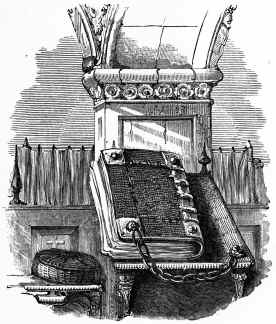
Frontispiece-chained-bible-q38-2080x2446As a good reformer he wanted the common people to become biblically literate, and so he set up a lectionary so that practically the whole of the Bible would be read in one year at the services of Morning Prayer and Evening Prayer. He trusted that the Bible could speak for itself, and did not make any provision for the clergy to preach at these services – they led the prayers, the scriptures were read, and God was thus worshipped. One might wonder why people could not just read the Bible at home, but in fact, despite the new technology of the printing press, books were still expensive and valuable; in Cranmer’s time most Bible were chained to the lecterns so that they could not be easily stolen. Many people could not read, so their exposure to scripture took place in the church building. Because this was a penitential time Cranmer also included a prayer of confession at the beginning, and said prayers at the end. All of this was included in the 1549 Book of Common Prayer, and that core format has not changed much since then in our own BCP.
So, in Evening Prayer we have the monastic core – the cork and rubber centre of the liturgical baseball – and then the Reformation prayers and readings – the twine going around the centre. The monastic core is what we chant, and the reformation additions are read and said. And, of course, all of this is now done in the language understood by the people, English.

The psalter in the BCP pre-dates the Authorized Version/ The King James Version, and is in fact essentially that of Miles Coverdale’s 1535 translation of the Bible, which it self was based on earlier English versions. The psalter in particular it was based on the Jerome’s Latin version of the Psalms, which was based on the Greek Septuagint. While Jerome translated all of the rest of the text of his Latin translation (“he Vulgate”) from the Hebrew and Greek originals, when it came to the psalms he produced no fewer than three translations. At the direction of church authorities one of these translations was translated from the Greek Septuagint and not the Hebrew original, and followed other ancient versions; this is the version that was included in the Vulgate and used in the monastic offices, and not one of the two he translated directly from Hebrew. Thus, in the BCP Psalter we have an English translation of a Latin translation of a Greek translation of the original Hebrew. You’ll appreciate that something might have been missed along the way, and so in our Canadian BCP of 1959/1962 Archbishop Carrington of Quebec gently revised it to bring the text more in accord with the original. That said, it’s still Tudor English, and has a bias towards patriarchal interpretations!

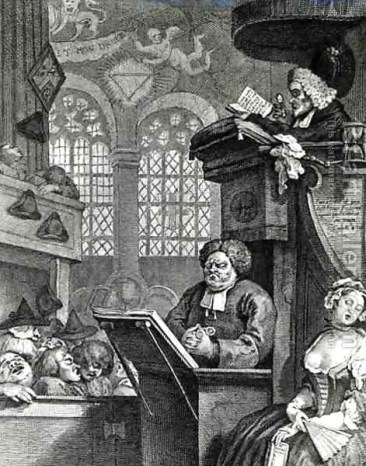
Sleeping ParishionersCranmer expected that Holy Communion would be the principal act of worship on Sunday, but in the medieval period it had become very uncommon for people to communicate, and this was still too revolutionary in 1549. So, Holy Communion was shortened, and turned into Ante-Communion. As well, the service tended to be shmushed together with Morning Prayer and the Litany, and thus morning worship would be this remarkably dull liturgy of two hours or more with repeated prayers for the monarch and typically dreadful long sermons unless one had the blessing of a great preacher like John Donne. It nearly killed the Church of England, and I suspect that this is why Methodism and other denominations proved to be so popular in comparison to the Established Church.
It was in this context that Evening Prayer became such a bright point in Anglican tradition, It wasn’t too long, it was an opportunity for the choirs to shine as they did old and new four-part chants, and as it was a Sunday clergy began to offer sermons, despite Cranmer having made no provision. For many people Evensong became the principal form of worship, a remarkable synthesis of music, scripture, and preaching.

As well, in the 18th century another innovation crept in – hymns. The original BCP made no provision for hymns, but by 1750 many clergy, especially Evangelicals, were incorporating hymns in the services in the morning and evening. So, with the introduction of hymns inspired by but not directly from scripture we arrive at the shape of Evening Prayer as most of us have known it.

The outermost layer, then, the stitched cowhide of the liturgical baseball, is preaching and hymnody.

There are, of course, alternatives to Sung Evening Prayer and Choral Evensong. The monastic services never ended, and whether in Roman Catholicism or Anglicanism one can find the old services in English translations. Communities such as Iona and Taize take a different approach to worship, grounding their services in repetitive chants or popular Celtic tunes. The Book of Alternative Services has contemporary language versions of Morning and Evening Prayer, and these have been set to music. But there is something striking and wonderful about this grand old service as it has evolved and become a familiar means of worship.

So come, hear the word of God.
Offer to God in Christ the praises due his name.
Proclaim the good news of Jesus Christ in word, chant, and hymn.
Worship the Lord in the beauty of holiness.

Posted in Anglican Church of Canada, Liturgy, Sermons | Tagged , , , , , | Leave a comment

Lee Aaron and Me

Lee Aaron is a Canadian musician who was quite popular in the 1980s and into the early 1990s. If you are of a certain age you might remember her – she was a female entry in the hair metal genre and did sexually charged songs like this:

While I have friends who followed her avidly, she was never on any of my cassette playlists. Back in the day I was more into singers like Jane Siberry, Holly Cole, and k. d. lang. Ms. Aaron really catered to some other type of guy. My kids suggest that when I was young I was some sort of proto-hipster, and most of Lee Aaron’s music is the antithesis of what would appeal to hipsters, proto- or otherwise. I’ll grant you that she was very successful, and very good at what she did, it just wasn’t my kind of music.

So why do I bring her up? What possible connection could she have with me?

Well, as it turns out, she and I were born on exactly the same day, July 21, 1962! We are exactly the same age, probably just a few hours apart, or maybe even just a few minutes. I am not aware of anyone else who was also born on this day, and so for that reason I feel I share some kind of special connection with her. Friday, July 21st, 2017 is our mutual 55th birthday.

Not that she has ever acknowledged or reciprocated the bond. She lives just over in the Lower Mainland, and I am on Vancouver Island, and I once tried to contact her and suggest that we should have coffee and compare life notes, but I never heard back. *sigh* Of course she has no obligation to reply. I suspect that over the years she’s been stalked by any number of creepy middle-aged men, and my communication to her might come across as just one more. She does have her own life. Last I heard she’s happily married to a drummer, has a daughter, and is doing as much jazz music as her old hits. She still tours and makes recordings.

But our common birthday does raise for me a question. If someone were to cast our horoscopes would they be the same? Because of our common day of birth, are we essentially the same person?

At first glance, maybe not. Lee Aaron has had, to say the least, a different career path from me. She’s been a rock music performer since her teens; I have been ordained since I was 25 and sing plainsong. She goes on tours across North America and Europe; I go to Britain to work on a PhD. Her biggest-selling album was called “Bodyrock”; I wrote a master’s thesis on the debate over the blessing of same-sex unions in the Anglican Diocese of New Westminster.  When she was younger she used her physicality and sexuality in her performances; I preside at worship under several layers of fabric. In recent videos she looks much younger than a woman in her mid-fifties; today I was offered the seniors’ discount.

An astrology site that claims to unlock these type of things suggests that people born on July 21 “cannot stay out of trouble for very long. Somehow a storm is usually brewing around them, often one with tragicomic overtones.” Is this me? Is this her? I don’t think of myself as very tragic or comic, and I don’t know if those terms apply to Ms. Aaron either. According to the website traits of us July 21 babies include being:

DARING
EXCITING
PHYSICAL
OBSESSIVE
SELF‑DESTRUCTIVE
ARGUMENTATIVE

Is this me? I don’t think so. Not too many people would describe me as “daring, exciting, physical, or obsessive.” After all, I was a rather dull ecclesiastical bureaucrat for nine years. The latter two traits did apply when I was younger, but that’s a average of .333 for the website, which is great for baseball but not so good for personality predictions. Between me and Lee Aaron maybe we raise the percentage, but I don’t know; maybe she gets the first three, but probably not the rest. Between the two of us maybe a majority  of the traits apply, but that may be true of any two random people, too. You don’t need to be born on the same day to have common traits.

There’s a whole bunch of famous people born on July 21st in other years including Ernest Hemingway, Cat Stevens/Yusuf Islam, Robin Williams, and Ken Starr. Frankly, I don’t see a lot of commonality amongst us, any more than any chance grouping of people. This just confirms my skeptical bias around horoscopes and astrology. Yes, some of the longer description in the website does apply, but a lot of it doesn’t, and the whole thing is hedged with weasel words like “often”, “usually”, “may be”, and “many”.

Of course, if I did have coffee with Lee Aaron I’d probably discover that she does believe in the predictive power of astrology, and undoubtedly state the case in a daring and exciting way. We would then get obsessive and argumentative about our entrenched positions, and the disagreement would escalate into something self-destructive and physical. So maybe its just as well she never replied to my communications, eh?

Posted in Random Personal Notes | Tagged , , , | Leave a comment

Canada 150 or Canada 15000?

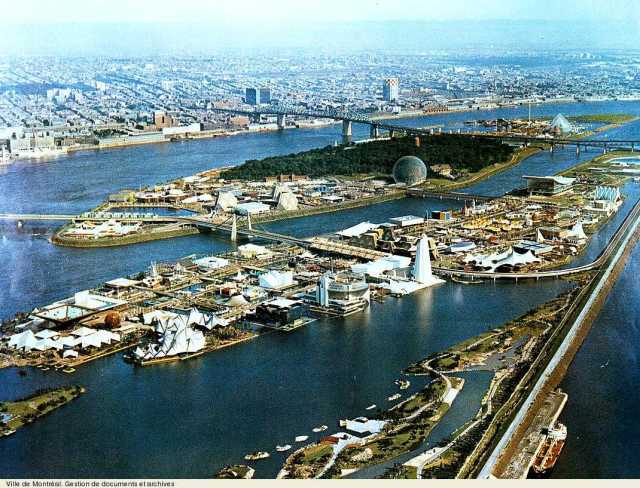
Expo 67I remember Expo 67. I was five years old, and my parents put me on a leash so that I would not get lost amidst the crowds of people who gathered on Île Sainte-Hélène. I remember seeing some innovative movies – which later influenced the creation of IMAX. I remember the monorail. I remember the Canada Pavilion, and upside down pyramid whose interior was decorated with various sculptures. I remember the Metro, my first experience of a subway system. It was all in celebration of 100th year of confederation, and it was a Very Big Thing.

centennial-logoAlong with Expo there were other things. In the garden in behind our house on 3rd Avenue in Geand-Mere Quebec one of my brothers grew a garden in the form of the centennial maple leaf.  My family went to Prince Edward Island for a vacation and there were Confederation displays there. I remember listening and singing along to Bobbie Jimby’s “Canada – We Love You”.
It feel different for our sesquicentennial.  Maybe I am just older. Then again, 150 years isn’t as evocative a number as 100. In a year that ends in a 50 there’s a feeling that we are half-way to something. A fifty year old celebrating a birthday is a middle-aged person, neither young or old. A centenarian is beyond the experience of most folk. So I approach the Canada 150 celebrations with less enthusiasm.

But part of it is also that the country has changed in the past 50 years. Our national story is no longer one of biculturalism and bilingualism, but one of immigration and multiculturalism, a policy that since 1982 has been enshrined in our constitution. Underlying that story is a parallel one of 500 years of colonialism by the French and British empires. The colonists took the land from the indigenous peoples by violence, was indifferent to major epidemics among the Inuit, Metis, and First Nations, confined them to marginal reserves, and sought to assimilate the survivors through the Indian Residential Schools. Many indigenous peoples and their allies are ambivalent about Canada 150 because much of the past century and a half represents a stage in the attempt to eradicate “the Indian problem forever.” While the past fifty years have also seen the recognition of the rights of indigenous peoples, and the reclaiming of their traditions and lands, this has been slow coming, compelled by court cases and the testimony of injustice.

The indigenous peoples have been here since “time immemorial”. Archaeologists suggest that the ancestors of the First Nations of British Columbia came to these shores somewhere between 14,000 and 20,000 years ago, and probably earlier. In all likelihood there were waves of migration, the most recent being the ancestors of the Inuit over 1000 years ago. In contrast my ancestors came to Canada East and New Brunswick about 180 years ago, and I only arrived in British Columbia in 1995.

josh-vickers-carved-tool

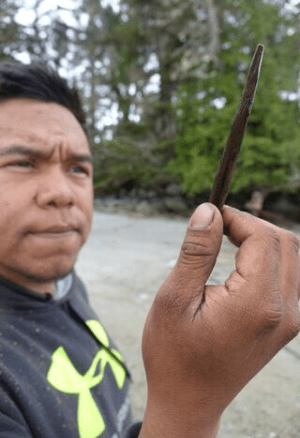
Josh Vickers, of the Heiltsuk First Nation and the archeological team, holds up a rare 6,500 year old carved wooden bi-point. (Joanne McSporran – CBC News)

Sea level was 100 metres lower 15,000 years ago, and so it is difficult to find sites of human habitation from that long ago in what is now the province of British Columbia. One site off the shore of Haida Gwaii has been dated to 13,800 before present, and a Heiltsuk village site has been dated to 14,000 years ago.

Let’s put this in perspective. This village is three times older than the pyramids. Great Britain and Ireland, from whence my people came, was not to be settled for another 5000 years. The roots of the Haida, the Heitsuk, the Kwakwa̱ka̱’wakw, Nuu-chah-nulth, and Coast Salish are deep in this land.

So, perhaps as we approach Canada 150, and give thanks for living in Canada, we can also celebrate Canada 15000. As Canada Day comes let us honour our nation by committing ourselves to a process of decolonization.


Posted in Canadian Issues | Tagged , , , , | 1 Comment

Whose Land Am I On?

The following is a continuation of the first draft of my dissertation Unsettling Theology. This is probably the most personal section.

At a G20 meeting on September 25, 2009 the Prime Minister of Canada, the Right Honourable Stephen Harper, stated that Canada has no history of colonialism; that it was a highly developed country without the baggage other countries carry.[1] While one can see what he meant – Canada has not gone overseas to conquer, exploit, and colonise other lands, like Britain, France, Spain, Portugal, Italy, Germany, the Netherlands, Belgium, Denmark, Sweden, the Russian Empire (and the USSR), and the USA[2] -it is demonstrably a colony that just happened to have quietly gained its independence. That said, the main languages spoken, French and English, are those of its old colonial masters. It maintains a monarchy that is resides in the capital of the old British Empire. The system of government is based on the Hoses of parliament in Westminster. The colonies and dominion took land from the indigenous population, drove them into poorly supported reserves, and sought to assimilate them. Canada is a former colony from which the colonists never left, and they will likely never leave. As the Chief Justice of Canada Antonio Lamer said, “After all, we are all here to stay”.[3]

1000px-Flag_of_Newfoundland_and_Labrador

Flag of Newfoundland and Labrador

One of the pre-judgements of this work is that one must keep in mind past history. Canada was not a blank slate on which a highly developed country was erected. The current situation is grounded in a history of colonialism that continued past independence in 1931.[4] Canada used a red ensign with the Union Jack in the upper left corner until 1965, when the Maple Leaf flag came into use. Four provinces continue to use the Union Jack in the design of their provincial flags; Alberta’s flag incorporates the English flag of St. George, Nova Scotia the blue St. Andrew’s cross of Scotland, and Quebec uses the Fleurdelisé, a variation on the old French Royal flag.

BritishColumbiaFlag

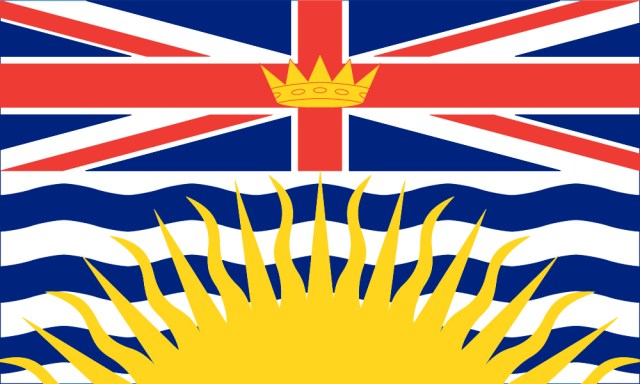
Flag of British Columbia

Up until recently all of the main ferry ships in the BC Ferries System were called “The Queen of . . . ”. The colonial legacy is everywhere and most Canadians are largely unconscious of it, leading to statements like the former Prime Minister.

It is therefore important to remind ourselves of this history. One way to do this is by remembering whose land we are on.

It is normal in British Columbia and in other parts of Canada to preface any lecture, sermon, speech, and address by acknowledging whose land one is standing on. For example, living in the city of Victoria British Columbia I might begin by saying, “I wish to acknowledged that we have gathered on the traditional and unceded territory of the Lekwungen, also known as the Songhees and Esquimalt First Nations, of the Coast Salish Peoples.” Someone from Calgary Alberta might say, “I grew up on Treaty 7 land, the traditional territory of the Blackfoot Confederacy.” While I live on the west coast of Canada, I grew up in a pulp-and-paper town on the St. Maurice River in Quebec, north of the St. Lawrence River. I had no idea whose land it had been, or what had happened to the indigenous people who lived there at contact.

I am the descendant of poor, pious Presbyterians who made their way from the border lands of Scotland and Protestant settlements in Ireland to the colonies of New Brunswick and Canada East[5], where they obtained the freeholds on farm land of varying quality. Those on marginal land also worked felling timber. After four generations some of my forebears were obtaining university degrees and moving into manufacturing and management, mirroring the gradual movement of Canada from farming and resource extraction to industrialization.

Grand-Mere Rock

The Grand-Mère Rock. Originally on a small island in the St. Maurice River (a tributary of the St. Lawrence), it was disassembled and moved to a park when a hydro-electric dam was built in 1916.

As a child in the 1960s and 1970s the “Indians” were a distant reality. The town in which I grew up, Grand-Mère, was named after a rock formation that looked like an old woman, supposedly an Indian woman who became old waiting by some waterfalls for her Indian brave to return. Who she was, what her name was, what language she spoke – these were all unasked and unanswered questions. The next door city, Shawinigan, where I was born, was named after an Indian name for the waterfalls on that part of the Riviere St. Maurice, but there was no context in terms of the indigenous peoples.[6]

In retrospect it is now clear to me that land had been part the original territory of a people whom later historians termed “St. Laurence Iroquoians”. It is thought that these people came into the St. Lawrence valley below Lake Ontario sometime around 1000 CE. They developed fortified villages within which they lived in the longhouses typical of Iroquoians. Their culture was based on corn, and every few years they would move their fields as the land became exhausted; their food was also supplemented by hunting, fishing, and gathering from the wild. In the 16th century, in 1535 and 1537 the French explorer encountered these people in the fortified villages of Stadacona (present day Quebec City) and Hochelaga (Montreal). The word “Canada” was the Laurentian term for “village” and Cartier applied it to both the land and the river. Cartier sought to establish a fort at Stadacona in 1541, but because the harshness of the winter, scurvy, and the hostility of the local St. Lawrence Iroquoians, the effort was abandoned.

Seventy-five years passed before another explorer came, this time Samuel Champlain, who, like Cartier, came from France. In between there had been limited contact between the native population and Basque fishermen, but apart from the drying of fish on the mainland and the obtaining of fresh water there was no attempt at landing. Champlain, after previous efforts in the Bay of Fundy, established the Habitation at the site of Stadacona in 1635, which eventually grew to become Quebec City. When Champlain came there was no village at the site, and indeed no sign whatsoever of the St. Lawrence Iroquoians; they had all disappeared. In their place the Haudenosaunee of the Five Nations (known by the French and English as the Iroquois) came from the south, from what is now present day New York. Also present were the Algonquins from the north and east were using the St. Lawrence River Valley. Both the Haudenosaunee and the Algonquians were using the St. Lawrence Valley as hunting grounds, and only gradually moving in to settle. There was no clear explanation at the time as to what had happened to the St. Lawrence Iroquoians. Later historians believed that in the intervening years they had been in conflict with the Iroquois of the Haudenosaunee and had been decimated and assimilated, but it seems to me that this assumption was based on a retro-projection of historical conflicts in the 17th and 18th century (the Huron and the Iroquois, mainly). In all likelihood they were destroyed by diseases from the “Old World” for which they had no acquired immunity. In other parts of the Americas there were mortality rates of 90%, and it is not hard to imagine something similar happening in the valley. What few survivors there were would have been assimilated into their neighbours. In the 1950s historians and philologists, examining Cartier’s records, determined that the peoples spoke a language related to those of the Haudenosaunee, but quite different in many respects. The word Canada, meaning “village” in St. Lawrence Iroquoian, has survived them. The river was renamed the Fleuve Saint-Laurent, but the land was still called Canada.[7] Shawinigan, where I was born and went to school, is an Abenaki name referring to a portage around waterfalls,[8] but the Abenaki only came into the St. Lawrence Valley from further south in the 17th century, at the urging of the French colonists. Likewise Grand-Mère is a translation for kokemesna, an Abenaki word for old woman.[9] The land I grew up on was the traditional and unceded territory of a people that were inadvertently wiped out by contact with Europeans, and ironically gave a name to the nation that came after them.

So, now I know what to say. I am a Canadian of British heritage who was born and raised on the traditional territories of the St. Lawrence Iroquois, who disappeared and were replaced by the Haudenosaunee, Abenaki, and Algonkians.

All of this may seem strange to a non-Canadian, and, indeed, it is not universal to do this the further east one goes in the country. However, it is important to say these things, because it acknowledges the colonial reality of modern day Canada. We are a colony from which the colonists never left. While the formal ties of government between Canada and the United Kingdom were severed in 1931 by the Statute of Westminster, culturally those ties remained strong until the 1970s. The official story taught children in elementary schools was that Canada was had two founding nations of the Britain and France. Multiculturalism, a policy of the federal government starting in the 1970s and enshrined in the Constitution in 1982, built upon the official bilingual and bicultural nature of the country, and was made concrete by significant immigration from countries other than the UK or France. That story now needs to be rewritten.

[1] Dwight Ljunggren, “Every G20 nation wants to be Canada, insists PM” from http://www.reuters.com/article/columns-us-g20-canada-advantages-idUSTRE58P05Z20090926 accessed June 7, 2017.

[2] Although it has sent troops overseas to South Africa in the Boer War, to France in WW I, Europe and Asia in WW II, Korea in 1950-53, the Gulf War in 1990-1991, and Afghanistan in 2001-2014.

[3] Chief Justice Antonio Lamer, Delgamuukw v. British Columbia 1997, para. 186 at https://scc-csc.lexum.com/scc-csc/scc-csc/en/item/1569/index.do accessed June 7, 2017.

[4] The cutting of colonial ties has been long process. Canada as a dominion of the British Empire was formed by an act of the UK Parliament, namely the British North America Act 1867 out of older colonies, each of which had a degree of autonomy in internal affairs. Other colonies and territories were added to create the current geographic entity. The Statute of Westminster of 1931 recognized the legislative independence of the British dominions – the Irish Free State, Canada, Australia, New Zealand, South Africa, and Newfoundland (not yet a part of Canada). Appeals from the Supreme Court of Canada to the Judicial Committee of the Privy Council in London ceased in 1949. Canada created its own citizenship in 1947, but Canadian passports continued to identify Canadians as British subjects up until the late 1970s. Canada never introduced an amending formula into its constitution, so changes had to be rubber-stamped by the UK parliament. Canada “repatriated” its constitution in 1982 when Prime Minister Pierre Trudeau forced through an agreement with nine out of ten provinces which the legislatures in London passed; this incorporated an amending formula, a Charter of Rights and Freedoms, and Article 35 which stated “The existing aboriginal and treaty rights of the aboriginal peoples of Canada are hereby recognized and affirmed” and that the “aboriginal peoples of Canada” includes the Indian, Inuit and Métis peoples of Canada.” I like to joke that growing up as an Anglophone of British decent in Quebec I was not aware that the British Empire was over.

[5] In 1867 the Province of Canada, consisting of Canada East and Canada West, became part of the Dominion of Canada, and were renamed the Provinces of Quebec and Ontario, respectively; the colonies of New Brunswick and Nova Scotia at this time confederated with Canada, and became provinces.

[6] Grand-Mère was absorbed into Shawinigan in 2002. Both cities, unusually late for Quebec, were founded at the turn of the 20th century; they were both situated to take advantage of waterfalls on the river to produce hydro-electricity. In addition to pulp and paper mills producing newsprint, the greater Shawinigan area was the first place in Canada to produce aluminum. Because it was anglophone Canadian and American interests that financed the industrialization, it was actually known as Shawinigan Falls until 1958 despite being 90% French speaking. The Prime Minister of Canada from 1993-2004, Jean Chretien OM (1934 – ), comes from Shawinigan.

[7] The term was extended in the late 18th century to include the land between the Great Lakes of Huron, Erie, and Ontario, and after 1867 it included everything within the new Dominion. The toponymn ultimately covered everything to the Arctic and Pacific Oceans.

[8] Commission de Toponymie de Québec, “Shawinigan” from http://www.toponymie.gouv.qc.ca/ct/ToposWeb/Fiche.aspx?no_seq=348209 accessed June 5, 2017.

[9] Commission de Toponymie de Québec, “Grand-Mère” from http://www.toponymie.gouv.qc.ca/ct/ToposWeb/Fiche.aspx?no_seq=179512 accessed June 5, 2017.

Posted in Canadian Issues, Random Personal Notes, Unsettling Theology | Tagged , , , , | Leave a comment

Method in Theology: Simple, Complex, Contested

The following is a continuation of the first draft of my dissertation Unsettling Theology. It probably needs more footnotes and a lot of rewriting.

peanuts-theology

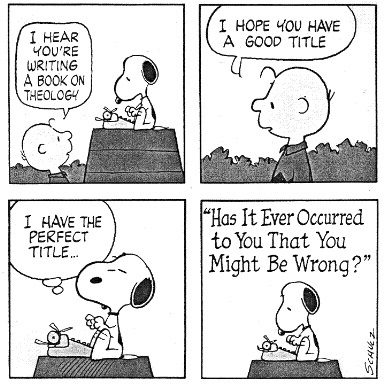
Contemporary theological method is relatively straight forward. Determine the topic or problem to be discussed. See what others have said about it. Determine the most important voices, and describe their positions, arguments, and evidence. Critique those positions, arguments, and evidence from a variety of well chosen perspectives, using well established criteria for evaluation. Summarise, describing the significance of what has been discussed. Suggest further avenues of study and discussion.

Canadian Catholic theologian Paul Allen describes contemporary theology in another way:

If I were to sum up in a single sentence what theological method is, I would say that it is a set of comparisons, contrasts and correlations – involving plenty of analogous language at certain stages of judgment – regarding four sources of theological content. Those sources of content are: scripture, reason, tradition and experience.[1]

That said, theological method is varied, and contested ground.

Throughout history theologians have used various genres to put forth their thoughts. Justin Martyr (2nd century) adopted the form of Platonic dialogues. Origen used commentaries on scripture to put forth his speculations, and this carried down to Martin Luther and Karl Barth, who both wrote theologies in the form of commentaries on Paul’s Letter to the Romans. Augustine wrote commentaries, an autobiography, polemical treatises, letters, and sermons. Thomas Aquinas in the Summa adopted the disputational model then used in universities in which a topic is named in the form of a question, arguments against a position are named, the position is argued for (starting with a quotation from scripture) in a series of brief arguments, and then the objections are answered. Aquinas also wrote hymns, which are another way of doing theology. Perhaps the most detailed modern exposition on method in theology is that of Method in Theology by Bernard Lonergan.[2]

One might think that the discipline of theology, which arguably has been around for at least two-thousand years (and as much as three thousand if one if one starts with Judaism), would have a clear methodology. It does not. Like philosophy, because it is concerned with basic human principles and “the meaning of life” it is constantly going back to first things. Dogma, doctrines, and schools of thought get established, only to be critiqued in the next generation; those bringing the critique are then likewise challenged by those holding to the older modes of thought. These schools reinvent themselves, and argue amongst themselves. Ancient texts are read anew, and old readings are found to be less than satisfactory. Every consensus is provisional, and scholars and theologians regularly transgress doctrinal norms, sometimes to ecclesiastical punishment, but as often as not with significant regard.

Unlike philosophy theology is not a “pure” discipline. Arguably it is divided into several interacting disciplines that overlap and influence each other. In the Divinity School in which I first studied there were four broad areas: Biblical Studies, History, Theology, and Pastoral Theology. These all bleed over into each other. A study of a New Testament text is necessarily an historical study of First Century Christian authors and communities interacting with Jewish and Gentiles. That same text has an explicit and implicit theology which a theologian may use as a central part of a systematic approach, as Luther made use of Romans. New Testament scholars write theology, as Rudolf Bultmann did. Liturgical studies are both historical and practical (if not experimental), and they have explicit and implicit theologies around the reading of scripture in the church, preaching, the meaning and purpose of prayer, the significance of the sacrament of the Lord’s Supper, and expectations around what happens to the people of God when they are dismissed. Theology becomes anthropology becomes ecclesiology becomes historiography becomes tactics and strategy in the community.

Furthermore, theology draws on other disciplines. It is deeply influenced by philosophy, and for almost every major philosophical movement there is a corresponding theological trend. In the Middle Ages theology was philosophy, and vice versa. Plato and Plotinus was read through the lens of the Cappadocians, Augustine, and Pseudo-Dionysius the Areopagite, and Aristotle through Aquinas and the Scholastics (and later on they were read through the filter of Neo-Scholasticism). Platonism, Aristotelian categories, Neo-Platonism, Aristotelian metaphysics, skepticism, Kantian morality and religion, Hegelianism, Marxism, Phenomenology, Existentialism, Feminism, Post-Modernism and a plethora of other systems have all had their effect.

But it is more than just philosophy. As is apparent to any sociologist, American fundamentalism took science as the model for doing theology, and then took a literal interpretation of the Bible as the primary evidence. As much as Marxists predicting the inexorable progress of humanity to harmonious anarchy, some Fundamentalists worked out a theory of dispensations that structured history and predicted events such as the Rapture and the Tribulation. This in turn has affected politics (especially in the United States) and politics has reciprocated by co-opting previously marginalized evangelicals into becoming advocates for low taxes, less government, opposition to climate change, and a strong military. In some ways this parallels earlier exchanges between politics and theology, such as the encounters of Christian thought with liberalism and socialism.

Events also influence the various disciplines of theology. The Holocaust challenged Christians to reassess how they read their scriptures, how they did their theology, how they worshipped, and how they did evangelism. In the post-war era the various denominations, largely anti-Jewish, became supportive of Judaism and suspended efforts to convert Jews to Christianity. The granting of full electoral and legal equality to women in many countries has led to their economic emancipation and a corresponding growth of women in leadership in many denominations; this has also been paralleled by a growth of LGBTQ2 explicitly present in various churches and their leadership. Not surprisingly, this means that two current hot areas of theological study are Queer Theology and Feminist Theology. The departure of colonial powers from colonies around the world has led to the rise of post-colonial theology, and in nations in Latin America where economic policies historically meant the impoverishment of the majority Liberation Theology has emerged. Black Theology and Womanist Theology grew in the United States out of the experience of African-American men and women, respectively. All of this new theology emerges out of lived experience of oppression and marginalization, and challenges the male dominated Divinity Schools in Europe and North America which project a supposedly objective approach to the various theological disciplines, and which resist politicization.

A particularly challenging issue is that theology no longer seems to be the respected discipline it used to be. Many academic institutions do not have faculties or departments of theology. In older universities where faculties or schools of divinity exist there is a push to suspend theology as a faith-based activity and to transform the places into centres for the study of religion (for example, the University of Chicago Divinity School, but also Harvard Divinity School, and the old McGill Faculty of Divinity which is now the School of Religious Studies). Some mainline divinity schools are closing or merging into more financially stable bodies: Andover Newton is moving from Massachusetts to the Yale campus, Episcopal Divinity School in Cambridge MA has suspended operations, and Heythrop College in London is likewise ending its teaching.

Was in reaction to this marginalization of theology that John Milbank developed his Radical Orthodoxy? Radical Orthodoxy calls into question the relevance of Kantian metaphysical critiques and secularism to theology. Rather than being subject to various social theories, Milbank argued that theology, envisioned by him as “a postmodern critical Augustinianism”, was self-sufficient and needed to purge itself of these influences and rightfully and righteously critique those same systems of thought. In an era when governments are cutting back on funding the liberal arts and promoting STEM (science, technology, engineering, and mathematics), it is exactly the kind of fighting back one might expect from a brilliant up-and-coming theologian in a provincial university.

In my experience the best theology is always aware of its context in history and its manifold influences and manifestations. Rather than start in the abstract it is better to start in the concrete, and then work towards abstraction, and then work back to the concrete. In this sense it is a complex maneuver, a hermeneutical circle that takes up the whole life of the one doing theology. It is very much an exercise of the incarnation, in that theology can never be divorced from the theologian who lives and dies. Theology is inherently subjective and objective, in that the subject is always present in the statement about God, but the theology is also an object for others to consider, critique, and make their own. Theology is inherently talk by humans about God, and the human quality is inescapable.

If good theology is then incarnated in historical individuals, then it also seems to be the case that good theology is created by concrete crises. Paradigmatically, the Council of Jerusalem was convened by dissension caused by Paul’s evangelism to the Gentiles. The orthodox canon of scripture was a reaction to Marcion’s limited one. Monasticism was a reaction to the lowering of expectations of Christians in 3rd century Egypt. The increasing significance of Christianity in the Roman Empire and the divergences about the nature of Christ within the church led to the calling of the oecumenical councils. Augustine wrote The City of God in defense of Christianity after the sack of Rome and the pagans blaming Christians for it. Aquinas sought to assist in the propagation of the gospel to newly conquered Moors in Spain by writing the Summa Contra Gentiles. Luther posted his 95 theses in reaction to corruption in the church, and developed his hermeneutics of sola fide and sola scriptura to found Christian authority in scripture, and not the institution of the church. Anglicanism emerged out of a conflict around royal succession. Liberal Christianity emerged in the 19th century as a reflection on the application of historico-critical methods to scripture. Bernard Lonergan wrote Method in Theology to orient theologians to the multiple forms of historical sciences that were challenging traditional Catholic theology in the 20th century.

Theology, then, is complex. It resists abstraction because of its carnal nature. It is a discussion, but after two-thousand years there are too many discussion partners. The intertexts are beyond the comprehension of any one individual. It takes decades to have read enough to say something that is well grounded. Rabbit holes that lead to Wonderland are everywhere.

In the next chapter I will state what I understand to be the method being used in this dissertation, as well as the biases underlying the method.

[1] Taede A. Smedes , “Does Theology Have a Method? An Interview with Paul Allen” at https://tasmedes.nl/does-theology-have-a-method-an-interview-with-paul-allen/ accessed June 3, 2017. Paul Allen, a theologian at Corcordia University, Montreal QC Canada, is the author of Theological Method: A Guide for the Perplexed (London: T&T Clark International/Continuum Books, 2012).

[2] Bernard Lonergan, Method in Theology (New York: The Seabury Press, 1972).

Posted in Unsettling Theology | Tagged | Leave a comment

Canada and the Refugee Crisis: Part Two

This is the second part of a talk I gave on Ascension Day 2017 at Christ Church Cathedral, Victoria, on Canada and the Refugee Crisis. The first part was where I give an overview of the history and current situation in the world today; this part zooms in on Canada’s response to refugees in the past couple of generations. I was the Refugee Coordinator for the Refugee Program of the Anglican Diocese of British Columbia from February 2015 until April 2017.

Canada’s Refugee Policy Evolves

Vietnamese Refugees

Vietnamese Refugees receiving their visas and plane tickets to Canada, late 1970s.

Up until the mid-1970s the immigration policy of Canada was based on quotas for countries of origin, and many of those quotas were racially and religiously based. In 1975 the Trudeau government introduced legislation that came into force in 1976, the Immigration Act. It abolished the quotas and created four categories of immigrants:

1.Independent immigrants were selected on the basis of the points system;
2.The Family class which included the immediate family members of Canadian citizens and permanent residents;
3.Refugees as defined by the United Nations Convention Relating to the Status of Refugees; and
4.Persecuted and displaced persons that did not qualify as refugees under the convention definition but could be admitted on humanitarian grounds.

This was the first formal recognition of refugees as a class of immigrants – before then they had been admitted on an ad hoc basis, and frequently with a calculation as to how well they would integrate into Canadian society and contribute to the economy. Refugees and persecuted & displaced persons would now be admitted on humanitarian grounds. At first the assumption was that these persons would be supported by the government as Government Assisted Refugees (“GARs”). However, in the late ‘seventies large numbers of refugees from South Vietnam were seeking permanent solutions in Western nations. The Canadian government was overwhelmed by the need to rapidly settle so many people, and so allowed for private Canadians in groups and for community organizations (often churches and other religious bodies) to sponsor refugees, providing virtually all the financial resources necessary for a year for an individual or family. Ultimately some 110,000 Vietnamese came to Canada between 1975 and 1985.

A major influence on this decision by the Clark government and carried on by the Trudeau government was the circulation in draft and the publication of the book None is Too Many.

None is Too ManyThis book, by Irving Abella and Harold Troper, detailed the problematic history of Canadian governments with regard to the immigration of Jews into Canada. Politicians and immigration officials became aware of the true history and swore that it would not happen again. The welcoming of refugees would be based on humanitarian grounds, not political expediency or economic advantage.

The program for Private Sponsorship of Refugees (“PSRs”) is so far unique to Canada. Most other countries continue mainly along the GAR route. While this is often subcontracted to settlement houses and religious organizations, Canada remains alone in allowing its citizens and residents to sponsor individuals and families. Sponsorship may be done by any group of five citizens or permanent residents, or by any community group, but they must apply and be accepted by the Ministry of Immigration, Refugees, and Citizenship of Canada (“IRCC”). While this happens, most PSRs are now admitted through groups that have made permanent arrangements with IRCC to sponsor refugees. These are called Sponsorship Agreement Holders (“SAHs”, pronounced “sawz”), and the Anglican Diocese of British Columbia is one of them. There are over 100 SAHs across the country.

Another aspect of Canadian policy is that we admit people as refugees who have not necessarily been assessed as such by the UNHCR or their host nation (i.e. at best, they are registered asylum seekers). The IRCC and its officials make their own determination. This is the category of persecuted and displaced persons who do not qualify as refugees but
+ are outside their home country, or the country where they normally live, and
+ have been seriously affected by civil war or armed conflict, or
+ have been denied basic human rights on an ongoing basis.
On that basis any person fleeing the war in Syria and makes it to another country qualifies prima facie.

Myanmar Refugees

A Refugee from Myanmar

Originally government  policy observed the Principle of Additionality, which asserted that the Canadian government would determine how many GARs it would support, and that PSRs were to be in addition to this number. Historically this turned out to be roughly 1:1. However, as time went on and successive governments reduced funding to IRCC’s predecessor ministries, a backlog of applications began to build up. The Harper government began including the PSRs in its calculations of total refugees to be admitted, and started putting caps on the numbers of refugees each SAH could sponsor (the only notable exception being that there was no cap on the number of Syrian and Iraqi refugees a SAH could sponsor). In particular, applications that would be processed by certain visa offices in high-risk areas – Cairo, Islamabad, and Nairobi, for example – were also “sub-capped”. SAHs complained about the restrictions, but worked within them.

Suddenly It All Changed

On September 2, 2015 there were over 4,000,000 refugees from the Syrian war. Not a few had relatives overseas, and one family, that of Abdullah Kurdi, submitted an application to the Canadian government for sponsorship by a group organized by Kurdi’s sister in Vancouver. For mainly bureaucratic reasons the application was rejected by IRCC’s predecessor ministry, Citizenship and Immigration Canada (“CIC”). After the rejection Kurdi decided to try to migrate to Europe and paid human smugglers to be taken from Turkey to Greece. However, they never made it – the boat capsized, and Kurd’s wife and two sons both died. The dead body of three-year old Alan Kurdi was photographed on a Turkish beach just before a police officer removed it.

The photograph was widely published in various media that day and went around the world in social media. In particular, because of the Canadian connection and the rejection of the application the then federal government and its minister, the Honourable Chris Alexander, questions were asked as to whether Canada could do better. As Canada was in the midst of a federal election, it became an issue, and indeed, it dominated the news media for a solid week, which is an eternity in politics. New Democrat leader Tom Mulcair said that he would bring an additional 10,000 Syrian refugees to Canada if elected. Prime Minister Harper defended the refugee process and the numbers being admitted, grudgingly suggesting that he could also bring 10,000 Syrians if re-elected.  Eventual election winner Justin Trudeau promised 25,000 by Christmas (later revised to the end of February) and, on this issue, effectively ran to the left of the NDP.

Sabine Lehr and Me

Dr. Sabine Lehr of the Inter-Cultural Association of Greater Victoria answers a question on refugee sponsorship in the Q&A after my presentation, September 8, 2015, St. Matthias Anglican Church, Victoria BC Canada.

Meanwhile rallies were held and people came together to form groups to sponsor refugees. I stood up at one rally in Victoria and announced that if anyone wanted to learn how to sponsor refugees they could come to my parish church on Tuesday, September 8. 350 people showed up at St. Matthias (I will never see that church so full!). I invited Sabine Lehr of the Inter-Cultural Association of Greater Victoria (the city’s oldest and largest immigration settlement agency), to help out, as they had just become a SAH also. Over 250 people volunteered to come together in groups. ICA and the Refugee Program of the Diocese of BC split the list of volunteers, and each of us then proceeded to form sponsorship groups to raise money, prepare and submit applications, and get trained to welcome refugees.

x_30_nn_canadarefugees_151211.nbcnews-ux-1080-600

Prime Minister Justin Trudeau welcomes some of the first refugees from Syria being airlifted and expedited by the Canadian government.

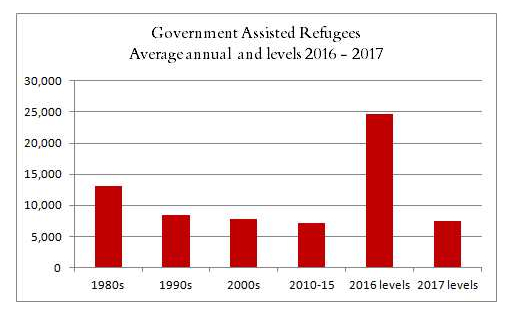
Let us fast forward to the end of 2016. As we know, the Canadian government flooded the Middle East with visa officers and arranged charters to bring Syrian refugees to Canada.  After twelve months over 47,000 refugees had come to Canada, at least 25,000 of whom were GARs. There was a spill over effect as many groups agreed to sponsor non-Syrian immigrants. According to the UNHCR, the top five countries of origin in 2016 were:
Syria: 33,266
Eritrea: 3,934
Iraq: 1,650
Congo: 1,644
Afghanistan: 1,354
To put this in context, there were 320,000 total immigrants in 12 months 2015-2016, of which 14.6% were refugees. This was three to four times as many refugees as would normally have come in a twelve month period.

GARS

The new Trudeau government did a remarkable thing in bringing in so many refugees so quickly. In particular, it looks far better than the United States, which took in only 10,000 Syrians. However, this needs to be put in perspective. At the same time that Canada took in 47,000 refugees (and processed a further 23,895 inland refugee claimants), Germany welcomed and processed over one million refugees. If Canada had processed a similar proportion it would have taken in 490,000, seven times the number that it actually did. As well, as the chart above shows, the Trudeau government has reverted to older levels of support for GARs. They also placed caps on the number on refugees any SAH could sponsor, arguing that they needed to further reduce the backlog of applications in the visa offices. The financial taps were turned off abruptly after the 25,000 Syrian refugees arrived in Canada, and the 500 semi-retired visa officers sent out in November 2015 were brought home. They also removed the exception for Syrians and Iraqis, including them under the caps for the first time, something not even Harper had done. Thus, arguably, right now the refugee process in Canada is even more restrictive than it was under Harper.

Inland Refugee Claimants

There is a distinction between overseas refugees and inland refugee claimants. Overseas refugees are not allowed to board a plane to Canada unless they have a visa. Because we are surrounded by oceans on three sides patrolled by the Coast Guard, and have a stable neighbour to the south, we do not get massive numbers of people migrating by land and water, as European countries do. Nevertheless, we do get a number of people entering Canada on visitor visas or student visas and then claiming refugee status. Under Canadian law the responsibility of the federal government is to hear the claim and to adjudicate it – and these are the Immigration & Refugee Boards that you sometimes hear about. The Board’s decisions can be appealed and they are also reviewable by the courts. As you can see from the numbers above from Statistics Canada, there was a rise in 2016, but nothing out of the ordinary compared to previous years. There will be more in 2017 because of migration by people from the United States over the undefended border as they live in fear of the new US federal government. IRCC will hear their claims and put the claimants through the same security and medical checks as overseas refugees, as well as use the same criteria to determine if they are legitimate refugees; roughly one in three is rejected and deported.

Diocesan Refugee Ministry

Diocese of BC Refugee Program

The Anglican Diocese of British Columbia has over 45 churches and a variety of non-parochial ministries all over Vancouver Island and the Gulf Islands. We have been a SAH since the late ‘seventies and have helped settle hundreds of people over the decades. We typically work through parishes, building up sponsorship groups to sponsor individuals and families.

Zack & Hind

Selfie of me with Zack and Hind, two newcomers from Iraqi

In early September 2015 we were not actively sponsoring anybody, although we had submitted several applications and were waiting. Since then we have, in total, settled or applied for 350 individuals through 75 sponsorship groups and well over 500 volunteers. We have raised over $2 million dollars. We will work with anybody, not just Anglicans, and so many of our groups are Roman Catholic, some are from other Protestant churches, many are basically groups of secular people who just want to work with us, and we even have a group through the Islamic Centre of Nanaimo. Without intending to, we have become the biggest outreach of the Anglican Diocese of BC.

Two Anglicans and Lama

Lama, who arrived from Syria in February 2015, standing between two Anglicans. On the right is Elizabeth May, MP for Saanich and the Gulf Islands, whose efforts to assist Lama and her family were great!

  • As of March 2017 we had completed the sponsorship of 58 people, representing six families in Victoria, five in Nanaimo, two in Ladysmith, and one in Comox.
  • We are actively settling 75 people, fourteen families in Victoria and five north of the Malahat. This includes 42 Syrians, 9 Colombians, 8 from Myanmar, 4 Liberians, 2 Iraqis, 1 Ethiopian, and 1 Gambian.
  • We have submitted applications for 145 more refugees, and they are being processed by IRCC. This represents 52 families or individuals, of whom 60 are Syrian, 45 Iraqi, 29 Eritrean, and the rest are from the Congo, Afghanistan, Ethiopia, Somalia, and one stateless. 31 of these families will be settled in Victoria, and 21 in the middle part of Vancouver Island.
  • IRCC has allocated 83 spots for individual refugees for us to sponsor. All of these will be used, and we are currently preparing 18 applications for 72 persons, mostly Syrians.
  • We have a waiting list of over 115 people who have asked us for sponsorship. We may get further spots allocated to us later in the year.

When I became the Refugee Coordinator in February 2015 I could never have imagined that the program would grow this large. This was supposed to be my contribution to the Diocese, as part of my work in the parish, perhaps five to eight hours a week, done in addition to my regular work. As the program grew it became apparent that it needed to move from being an amateurish organization (in the best sense of that word) to one with professional support. In October 2015 the Diocese hired Tony Davis to assist with sponsorship groups north of the Malahat and Rebecca Siebert to do the same in Victoria and the Gulf Islands, as well as assist me in the general oversight of the Refugee Program. Although I put in many hours in the Fall of 2015 and the first half of 2016, it gradually became clear to me that it was time to hand over the leadership in refugee program coordination to Rebecca; I resigned my role in April of this year.

I behooves me to state that while I had a role in all of this, I simply was the Refugee Coordinator at a time when tens of thousands of Canadians suddenly wanted the skills, knowledge, and training that the Refugee Program could provide them; we were in the right place at the right time. While I was fairly aggressive in taking advantage of the situation – one that comes only once in a generation – the hard work was really done by Rebecca and Tony, as well as Professor John McLaren as the Chair of the Refugee Committee. The Refugee Committee transformed itself from a listening group for the Refugee Coordinator into a working group where everybody had a responsibility and the whole established policies. Things changed every other week, it seemed, and the work of training and designing the training was massive. Our over-five hundred volunteers were the ones who really worked hard, selflessly giving hundreds of hours of volunteer time to help raise money and then help to settle the newcomers. Sometimes this was far more challenging than anyone had anticipated. Kudos to everyone in the program! As well, we had help from the politicians at the federal, provincial, and municipal level, and people working in various ministries and non-governmental agencies. ICA led the way in best practices for settling refugees as they received hundreds of GARs in addition to some 75 PSRs. The Victoria Immigrant and Refugee Centre Society (“VIRCS”) complemented the work of ICA and helped many of our sponsees in Victoria, as did the Central Vancouver Island Multicultural Society in Nanaimo and the Cowichan Valley Intercultural & Immigrant Aid Society. God bless you all!

Being part of the Refugee Program has been one of the most rewarding things I’ve ever done. I’ve had people – and not just refugees – come up to me and say, “You’ve changed my life!” I believe that as a Christian I and all who follow Jesus are called to work with others in being hospitable and caring, and that being so is indeed life-changing. I am grateful for the two-and-a-half years I had working in this ministry, and I pray that it may continue. When things are not going well I can always tell myself, “Well Bruce, there are over 350 people who will not be washed up dead on a foreign shore, and you had a hand in it.” My hope is that you might be inspired to sponsor refugees, if you are not already doing so, and help change people’s lives.

Posted in Anglican Church of Canada, Canadian Issues, Refugee Program | Tagged , , , , | Leave a comment

Canada and the Refugee Crisis: Part One

I gave a talk on Ascension Day 2017 at Christ Church Cathedral, Victoria, on Canada and the Refugee Crisis. Here’s the first part where I give an overview of the history and current situation in the world today; I’ll post Part Two in a bit. I was the Refugee Coordinator for the Refugee Program of the Anglican Diocese of British Columbia from February 2015 until April 2017.

Refugees from South Sudan

Refugee Children from South Sudan 2017

Good afternoon, and thank you for inviting me to speak to you about Canada and refugees. I’ve been asked to give the general overview, and I hope that it provides a context for speakers and discussions in the weeks ahead.

It’s Nothing New

Let’s begin with the fact that the current refugee crisis is another manifestation of a central fact of human nature, which is that we move. Humans moved out of Africa and migrated into Europe, Asia, Australia, and the Americas. Movement is caused by many things – a search for new resources, the following of animals, the discovery of fertile soil. Movement is also caused by more negative things, namely war, famine, and disease. Those of us who are of British and Irish descent (and we are Anglicans, so I assume many of us qualify) and the descendants and heirs of the stone and bronze age peoples who built stone circles, who then were transformed by the Indo-European Celtic speaking peoples who arrived in the First Millennium. Then came the Romans, then the Angles, Saxons, and Jutes, then the Vikings, then the Normans. In the heyday of the British Empire millions of people left to colonize other lands. More recently peoples from the old Empire and the European Union have come to settle in the United Kingdom and Ireland. Movement is not an anomaly, but normal and natural.

Ukranian orphans

Ukranian Orphans

A major part of this movement is refugees. There is nothing new about Canada welcoming refugees. Before the First World War Canada under Clifford Sifton (Minister of Interior under Wilfrid Laurier) welcomed Ukranian settlers to the Prairies. After the Great War Ukranians attempted to establish an independent state, but the Soviet Union invaded and there was civil war. Some 70,000 Ukranians came to Canada seeking refuge and a new life.

SS-St-Louis

The SS St. Louis 1939

With the rise of National Socialism in Germany in 1933 Jewish Germans were persecuted and encouraged to leave the country (provided they paid to do so, and left virtually everything behind). Many sought to emigrate from Europe, but were turned back by antisemitic governments and officials in the United States, Cuba, and Canada. A Canadian immigration official was asked in 1939 how many Jewish refugees Canada would take, and his reply has become legendary: “None is too many.” One of the ships that attempted to land these immigrants was the SS St Louis in 1939, sailing from Hamburg with over 900 passengers, most of whom were German Jews. Ultimately it returned to Europe with its Jewish passengers. The captain sought to find refuge for his passengers, but ultimately many of them were in countries that were conquered by the Nazis.  A quarter of them did not find a safe refuge, and died in the Holocaust.

Post WW II

Refugee Camp, Europe 1946

After the Second World War there were millions of refugees in Europe – the survivors of the Holocaust, ethnic Germans forced from their historic homelands, and millions of others (Poles, Russians, Ukranians) obliged to move because of border changes and displacement during the war. Canada was reluctant to accept Jewish Holocaust survivors (and only changed the policy after the establishment of the State of Israel, when the pressure to take Jewish refugees lessened), but after 1950 it welcomed some 400,000 German refugees. It also welcomed some 150,000 Dutch immigrants, many of whom were fleeing floods.

primer2

Palestinian Refugees, 1947

The creation of the state of Israel by the United Nations and its establishment in the Israeli War of Independence resulted in some 700,000 Palestinians fleeing or being expelled from their homes; this represented some 85% of the Palestinian population. As the war involved Arab countries attacking the new state, some 700,000 Jews were expelled from countries throughout the Arabic speaking world, nearly all of who settled in Israel. While the Jewish refugees became citizens of Israel, the Palestinian refugees remained stateless; through population growth they now number 4.2 million in the West Bank and Gaza; the total number of registered and unregistered Palestinian refugees is about 5.5 million.

The Soviet occupation of Eastern Europe resulted in the establishment of Soviet-friendly regimes that repressed the local populations. Hungarians revolted in 1956 and Czechoslovakians in 1968, but both revolutions were put down bloodily. As a result Canada took in 37,000 Hungarians and 11,000 Czechs and Slovaks. The dictator Idi Amin expelled Asians from Uganda in 1972 and Canada welcomed over 7000 refugees, over 4000 people arriving in specially chartered flights.

What is a Refugee?

UN Convention Refugees 1951

The signing of the UN Convention on Refugees, 1951

In 1951 the United Nations Convention on Refugees was agreed upon; it originally dealt with European refugees from the Second World War, although at the discretion of contracting nations it could be extended to other situations.  In 1967 it was extended by the Protocol, which had no geographic limitations. The Convention and Protocol consolidates and establishes the standard definitions of who qualifies as a refugee and the responsibilities of the contracting nations. The first article defines a refugee as:

A person who owing to a well-founded fear of being persecuted for reasons of race, religion, nationality, membership of a particular social group or political opinion, is outside the country of his nationality and is unable or, owing to such fear, is unwilling to avail himself of the protection of that country; or who, not having a nationality and being outside the country of his former habitual residence as a result of such events, is unable or, owing to such fear, is unwilling to return to it.

One needs distinguish between those who may qualify for refugee status and those who are registered with the United Nations High Commissioner for Refugees (“UNHCR”) as such. The latter have been evaluated by UNHCR staff, whereas the former are called asylum seekers and the UNHCR has not yet determined their status.

As one can see from the graph below, there are some 16.6 refugees – including both those registered and seeking registration. The biggest jump is with the Syrians, which has almost tripled from under 2 million refugees to almost 5.5 million in 2016. The next biggest source of refugees is Afghanistan, followed by Somalia, South Sudan, Sudan, Congo, Central African Republic, Myanmar, Eritrea, and Colombia.

Refugee Sources

By definition refugees are people who have fled their home country and are now in a second country. That second country may give them refuge but they may not be able to or want to give them a permanent solution to their situation. Thus, as can be seen from the map below, millions of refugees from Syria are in Turkey, Lebanon, and Jordan, but they are not immigrants to those countries and do not have the right to stay, work, and become citizens. The “permanent solution” to these refugees dilemma is for them either to return home when peace is declared or the source of their persecution is removed, or they are settled in a third country, such as Canada or the United States.

Where are they now?

As can be seen the war in Afghanistan has resulted in large numbers of refugees coming to Pakistan and Iran. The war in Somalia and persecution in Eritrea has resulted in large numbers of refugees in Ethiopia and Kenya. Venezuela and Ecuador still has large numbers of Colombia refugees despite the peace agreement in that country.

What is not included in these numbers, charts, and maps is the number of internally displaced people  (“IDPs”) – people who would qualify as refugees except for the fact that they are still in their home country. This describes many Syrians, 11 million, or one out of three who have seen their homes destroyed.

IDP

There are now over 34 million IDPs – more than two for every each refugee/asylum seeker. Not included in these numbers are the 5.2 million Palestinian refugees; they are governed by a separate UN agency that dates from 1948, the United Nations Relief and Works Agency for Palestine Refugees in the Near East (“UNRWA”). By the time one adds up all of the refugees and displaced persons one has something like 65 million people – the largest number of refugees since 1945.

In my next post, Part Two, I’ll describe Canada’s response to refugees in the recent past an say a little bit about the efforts of the Refugee Program of the Anglican Diocese of British Columbia. If there are any errors or omissions in the information provided, please note them in the blog below. Thank you for reading!

Posted in Canadian Issues, Refugee Program | Tagged , , | Leave a comment