“The Issue Before Us Is Death” – The Rev’d Chris Hedges

IMG_0835


In addition to giving the John Albert Hall lecture at the University of Victoria this past month, the journalist Chris Hedges, preached at Christ Church Cathedral in Victoria, British Columbia, on January 20, 2019. I am told that some people walked out, objecting to the political content of what Hedges said. In particular he denounced a) the corporate state culture as another idol, as nothingness opposed to God; religious fundamentalism as a heresy; and c) the liberal churches for failing to denounce the first two. He quotes Reinhold Niebuhr, Daniel Berrigan, Søren Kierkegaard, Aleksandr Solzenitsyn, the poet Linda Gregg, and scripture, too. As before, you may not agree with what he says, but he nevertheless well is worth listening to. Sermons are not just to reassure us, they are also to unsettle us. Chris Hedges does that.


Posted in Anglican Church of Canada, Sermons, Unsettling Theology | Tagged , , , , , | 1 Comment

Nunc Dimittis: Beyond “Lord, Now Lettest Thou Thy Servant Depart In Peace”

A Sermon preached on the Feast of The Presentation of Christ in the Temple (commonly called Candlemas) at St. Thomas, Kefalas, 11:00 am Feb 3, 2018 (transferred from Feb 2).


Perhaps the most beautiful setting among many beautiful setting of the Nunc Dimittis is the one above, by Geoffrey Burgon, originally composed, not for church, but for the end credits of the 1979 BBC TV adaptation of Tinker, Tailor, Soldier, Spy. The words may be familiar to many Anglicans or survivors of Anglican school chapel services.

Lord, now lettest thou thy servant depart in peace : according to thy word.
For mine eyes have seen : thy salvation;
Which thou hast prepared : before the face of all people;
To be a light to lighten the Gentiles : and to be the glory of thy people Israel.
Glory be to the Father, and to the Son : and to the Holy Ghost;
As it was in the beginning, is now, and ever shall be : world without end. Amen.

How many of us have fond memories of singing this at Evensong? The words are, of course, the 400 year old translation of the Authorised Version (i. e. the King James Version). They ring the changes on memory.

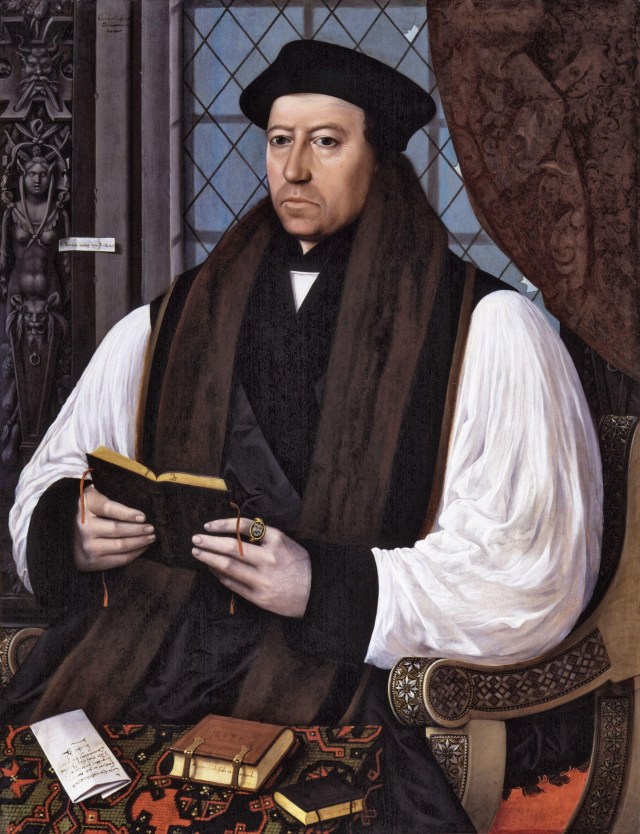
Thomas_Cranmer_by_Gerlach_Flicke

Thomas Cranmer, Archbishop of Canterbury, by Gerlach Flicke. Cranmer was the principal author of the Book of Common Prayer in its 1549 and 1552 editions. He would have come out with a third edition, but Queen Mary, a staunch Catholic, became Queen of England in 1553, and had Cranmer deposed, imprisoned, defrocked, tried, and finally in 1556, burned at the stake. They took liturgy seriously in those days.

For those of you not raised in the Anglican Church and have not spent much time in the daily offices of Morning and Evening Prayer, or haven’t attended Choral Evensong, allow me to explain. In the Book of Common Prayer of 1549 (revised in 1552, 1559, 1604, and lastly, in 1662) the authors set up two daily services. Thomas Cranmer, then the Archbishop of Canterbury, condensed the seven monastic services down into two, Morning Prayer and Evening Prayer. Evening Prayer combined two services, each of which had two canticles or songs from the New Testament. The two canticles are commonly known from their Latin first words, namely, the Magnificat (The Song of Mary), and the Nunc Dimittis (the Song of Simeon), or in crude choral usage, “the Mag and Nunc”.  The Nunc Dimittis is the second of two canticles from Luke, and is part of our gospel reading today, when Jesus is presented by his parents in the Temple and a sacrifice is made by which Mary is made ritually pure in accordance with the Jewish Torah. Now, today in Cathedrals and places where they sing there is a choice of many settings of the Mag and Nunc, including versions of the two by Thomas Tallis, Ralph Vaughan Williams, Herbert Sumsion, Charles Wood, Charles Villiers Stanford, Herbert Howells, and John Tavener The Magnificat, which in the context of the Gospel of Luke is sung by a young, pregnant Mary, is usually upbeat, loud and joyous, capturing the sense of exaltation she is experiencing. The Nunc Dimittis is sung by Simeon, an old man who has probably seen a lot in his life and is ready to die. As a result the musical setting is usually more meditative, moderately paced, frequently building to a climax. It is all very lovely.

But what does it mean?

In the Nunc Dimittis Jesus is presented as the glory of Israel, God’s salvation come to the Temple in Jerusalem, and one who would be a light to the nations of the world. Let’s parse that out.

Jesus is the glory of Israel. Jesus is a Jew, not a Roman, or a Gentile. He is a colonized indigenous person who ultimately is put to death by a great and terrible empire and their native collaborators. In his life and teachings he is the heir of Moses the giver of the Torah and David the king of Judah and Israel. He is the one foretold by Malachi – the Lord whom you seek will suddenly come to his temple. He is the servant foretold by Isaiah who would be a light to the nations. So, in that sense, he is the Messiah the fullfilment of the Law and the Prophets. And this glory is not seen in power, in the kind of terrible, violent strength held by the Romans, but in servanthood and care, of solidarity with the oppressed and suffering, and of sacrificial love even to the point of death.

He is God’s salvation because, as the passage from the Letter to the Hebrews describes it, in his life, death, and resurrection Jesus is in a cosmic battle with the powerful forces of darkness, described as the devil. He suffers the worst that can be thrown at him, death itself, and yet his sacrificial love is more powerful, and in the moment of grief and despair after death and burial he destroys death and all who are held in slavery by death. As the Christmas carol puts it, “Now we need not fear the grave.”

He is proclaimed by Simeon as the light to the Gentiles – the one through whom the promises God made to Israel are extended to the nations of the world, wild vines to be grafted on to the chosen people.

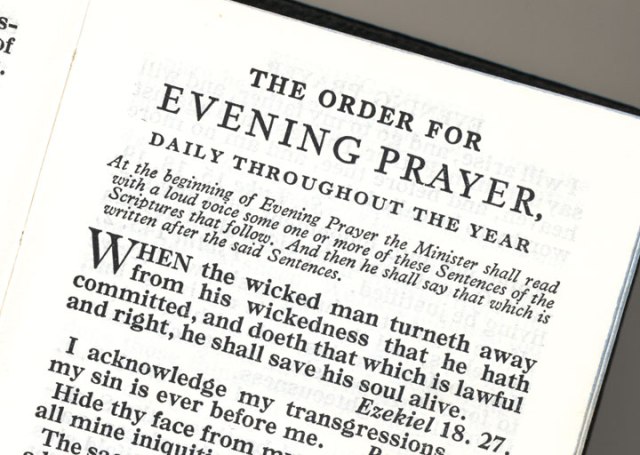
bcp-eveningThere is another person there who celebrates the coming of Jesus, and that is Anna, who if anything is even older and more pious than Simeon. She was excited as she spoke to those who looked for the redemption of Israel. Why was she excited? The word here, in Hellenistic Greek, is λύτρωσιν – which can mean redemption, as in paying money for something that perhaps has been ransomed, or paying the money to free a slave. In both cases of that meaning it means getting something back which was unjustly taken away, one’s freedom. In modern Greek the noun means “release”, and the verb means “to free”. So the coming of Jesus was good news to those who were looking for freedom, for release from being hostages of their oppressors, from being treated like slaves. Jesus is the glory of Israel, God’s salvation, and a light to the Gentiles, because Jesus is freedom.

So what does that mean for us?

  1. One way to understand this is that we are like Simeon and Anna. When Simeon and Anna see Jesus he is presumably being held by his mother, a scene represented on tens of thousands of icons and paintings presenting the mother and child.  Icons usually present people and occasions that actually happened. Icons of the infant Jesus and his mother Mary are recreations of what Simeon and Anna saw. Like them, we may worship the child in word and deed, in song and action, perhaps by joining with our Orthodox sisters and brothers by venerating an icon.
  2. Another way is to proclaim Jesus as light and salvation, and challenge people to personally accept him as that for them. This is basic evangelism.
  3. But we must go further, I think. A third way to understand it is that we are like Jesus, called to challenge the forces of evil in the world, not by power and violence, but through love and care, even if sacrifice is required. We are called to be lights in this world and speak truth to power, even if the emperors of our day and their collaborators do not like it.

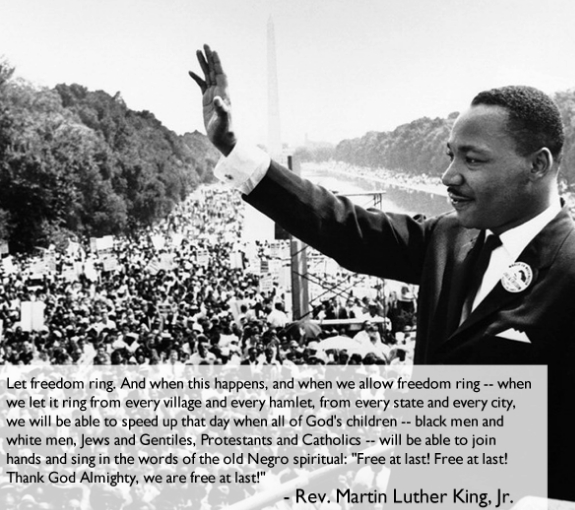
130828b MLKNow, we are not indigenous colonized people, as Jesus and his disciples were. But that does not mean that we can ignore the deeper meaning of the Nunc Dimmits, nor does it allow us to be dismissed, because with one or two exceptions we here are just not that old. We are generally comfortable people, guests here in a foreign land, often with more means than many here or in other parts of the world. We are called to worship, to proclaim Jesus, and to use our privilege, knowledge, and voice to advocate for those who are indigenous, colonized people, for those who are not being heard, for those who dwell in darkness, for those who despair of any succor. It’s not one over the other, it’s the whole deal.

Despite the average age here, God is not done with us, just as I hope each of us is not done with God. God has a mission, and part of that mission is freedom, May we join with Christ in defeating the forces of evil, and making people free.

sig short

Posted in Sermons | Tagged , , , , , | 1 Comment

Christian Fascism in the USA: Chris Hedges and Authentic Christianity

Chris-Hedges_2069_GUEST-768x432

The good does draw to the good. – Chris Hedges

Chris Hedges is an award-winning American journalist who this past January gave the John Albert Hall lecture at the University of Victoria, in Victoria, British Columbia, Canada. The organizers underestimated the interest, as there were people standing in the assigned lecture hall, and there was a video link to three more lecture halls for the overflow.

For fifteen years Hedges covered the Middle East and the war in the former Yugoslavia for the New York Times. He has written books on war, religion in the US, and politics. A quotation from his book War Is a Force That Gives Us Meaning (2002) was used at the beginning of the The Hurt Locker:

The rush of battle is often a potent and lethal addiction, for war is a drug.

Hedges is (like me!) a graduate of Harvard Divinity School where he received a Master of Divinity in 1983. He applied to be ordained after graduation in 1983, but apparently being a war correspondent was not considered to be a type of Presbyterian ministry. Eventually the leaders of the denomination changed their minds, and he was ordained in the Presbyterian Church (USA) in 2014.

Christopher Hedges – Christian Fascism and the Rise of Donald Trump from CSRS on Vimeo.

He has unconventional views. He is an old-fashioned social democrat who describes the United States as a failed democracy and believes that the United Kingdom on its way to being one. He has little time for politicians of either major party in the US who he sees as being in thrall to corporations. He has seen more corrupt politicians in more diverse places than anyone could wish, and yet still has hope for the future, and advocates resistance. He  quotes Dostoevsky to say that  if you want to see the soul of a nation look at its prison system. If Dostoevsky is right, then Hedges knows the soul of the US because he teaches courses at Princeton where half the students are undergraduates and the other half are serving time in prisons. He is grounded in the gospel faith and cannot see why the heresy of the Christian right is not denounced from pulpits and street corners. You may not agree with everything he says, but he is well worth listening to.

The John Albert Hall Lecture is co-sponsored by the Centre for Studies in Religion and Society at the University of Victoria and the Anglican Diocese of British Columbia. I spent much time as a liaison from the Diocese, sat on a couple of the Centre’s committees, and was a Fellow of the Centre in 2009 and 2012-2014. It is exactly what a a place for inter-disciplinary graduate research should be.

Posted in Anglican Church of Canada, War | Tagged , , , , , , | Leave a comment

It’s All Greek to Me: Nikos Kazantzakis & His Novel “Captain Michalis”

kapetan-michalis

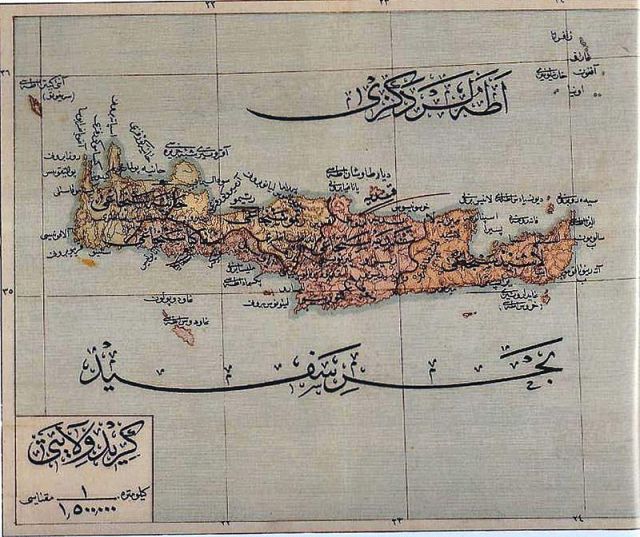
When Nikos Kazantzakis was a young boy he would have watched his father and his father’s friends fight in the Cretan rebellions against the Ottoman Turks, who then ruled Crete. As a teenager and a young adult, after Crete became all a sovereign state, nominally under the Ottomans but ruled by the brother of the Greek king, he would have heard the stories told by these old revolutionaries. Kazantzakis’s father was a Καπετάν (“Kapetan”) or a leader of a group of guerillas. Nikos and his family, headed by his father Mihalis, lived in what was then known to the Greeks as Megalo Castro, but is now known as Heraklion or Irakleio. When the rebellions occurred families would have gone up into the hills to the old family village, or even deeper into the wilderness and waited there until the fighting was over – or for the fighting to come to them. In young Kazantzakis’s case the family fled to the island of Naxos and the port of Piraeus, next to Athens. The elder Kanantzakis, a merchant in ordinary life, would have been out with his fighters leading them into opportunistic attacks upon soldiers and officials of the hated Ottomans. The younger Kazantzakis would have grown up amidst periods of tense peace broken by frequent outbreaks of violence, repeated on a large scale over and over until finally, in 1898, freedom was secured.

Crete_Vilayet_—_Memalik-i_Mahruse-i_Shahane-ye_Mahsus_Mukemmel_ve_Mufassal_Atlas_(1907)

When Crete was Turkish.

The Orthodox Greeks of Crete rebelled during the 1821-1830 Greek War of Independence. At that time perhaps as much as 45% of the population were followers of Islam, many of them immigrant Arabs and Turks, as well as other ethnicities within the Ottoman Empire. However, a large proportion of them were also converts from Greek Orthodoxy, perhaps out of genuine conviction, but many would have done so in order to escape the tax on non-Muslims and to receive the benefits of being of the same faith as the rulers. The converts continued speaking Greek and were still related to the Greek Orthodox, but the links across the religions was often overwhelmed by the antagonism created by colonialism. In that war of 1821-1830 it is thought that some 21% of the Orthodox population died, whereas, driven into plague-infested cities, as much as 60% of the Muslim population died. The Ottoman rulers executed a number of bishops from the island, just as they hanged the Ecumenical Patriarch of Constantinople, reasoning that they had failed in their jobs of keeping their people in line.

Cretan Insurgents 1898

Cretan Insurgents, 1898

Although the southern part of mainland Greece and some of the islands achieved independence after the intervention of the UK and France, Crete remained under the Ottomans. The Orthodox Cretans rebelled again in 1841 and 1858. The Great Rebellion began in 1866 and lasted until 1869. It ended, as usual, with a major effort at “pacification” combined with some concessions. Among the concessions was an agreement that the Greeks of Crete could have some limited self-government. There were smaller revolts in 1878 and 1889, both unsuccessful, and after which the Turks reneged on self-government. In 1895-1896 there was a final rebellion. As it continued into 1897  Britain, France, Italy, Russia, and Austro-Hungary concluded that the Turks needed to be forced to allow the Greek Cretans to rule themselves. Thus they sent their navies and armies to Crete to occupy the major towns. While there a Moslem mob attacked foreigners and troops in Megalo Castro, and they killed the British Consul. The Ottoman armed forces were obliged to leave the island, and as noted above, the Great Powers imposed sovereignty on the island by inviting Prince George of Greece to come over and be the High Commissioner of the Cretan State. In 1913 Crete formally became part of the Kingdom of Greece.

parade-1907-1908

A Parade of British Troops in Candia (i.e. Megalo Castro, or Heraklion) in 1907-1908, when foreign troops remained in Crete to ensure Cretan self-rule and to keep the Ottoman Turks out.

This was the local history that Nikos Kazantzakis grew up with. As a young man he went to Athens to study to be a lawyer, although I do not think he ever practiced as one. He then went to the Sorbonne in France and did a dissertation on Nietzsche. He returned to Greece and spent much of his time translating Greek and French works – mostly philosophy – into Greek. However, he was beginning to think that his real calling was to write, and that in Demotic Greek. After a few short works he spent fourteen years writing a sequel to The Odyssey in over 33,000 lines, more than twice as long as the original.  Published in 1938, it was not well received, perhaps suggesting that no one should try to outdo Homer. He was caught in Athens by World War II, and during the war he began the book Zorba the Greek, which was published in 1946 (English 1952). The immediate success of this led to a flurry of books, including novels about the Greek Civil War in Macedonia in the 1820s (The Fratricides, 1949/1954), the Catastrophe of 1921-23 in Anatolia (Christ Recrucified, 1948/1954), a fictional biography of St. Francis of Assisi (God’s Pauper, 1953), and The Last Temptation of Christ (1942; 1950-1951, 1955). Kazantzakis died in 1957, and is buried in the walls of Heraklion. His home has been recreated in a museum in Heraklion.

0*Ijbcf9cIswi8bHb9

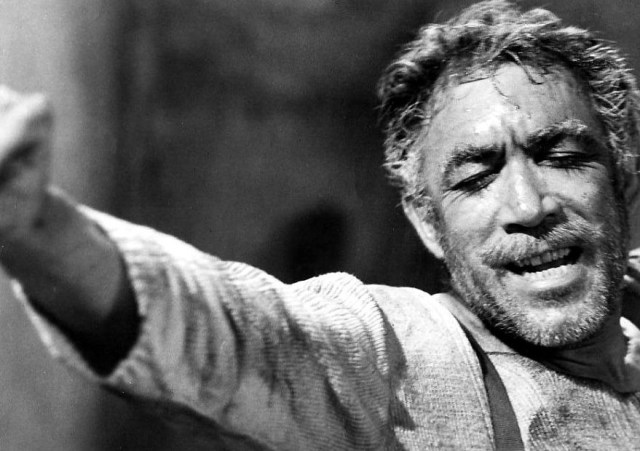
Hollywood made this Irish-Mexican actor, Anthony Quinn, the epitome of Greek manhood. You see his image everywhere on Crete, although even his character was not Cretan.

Zorba the Greek was adapted and made into an English-language film by the Greek Cypriot film-maker Michael Cacoyannis in 1964. The film did very well, earning three times its cost and meriting seven Oscar nominations, winning for Best Supporting Actress, Best Cinematography, and Best Art Direction. It was with this movie that Kazantzakis became well known to the English speaking world. In 1988 Martin Scorsese adapted The Last Temptation of Christ into a controversial movie; you’ve never seen John the Baptist and Pontius Pilate portrayed correctly until you’ve seen them done by Harry Dean Stanton and David Bowie, respectively!

1956-antibesoffice

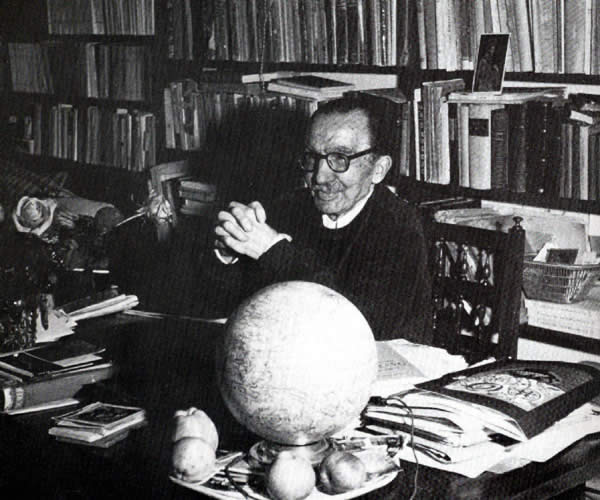
Kazantzakis in 1956 in his study in Antibes, France

A novel that has received less attention is Captain Michalis (written 1949-1950, published 1953), or as it is known in North America, Freedom or Death. It tells the story of the leaders of a guerrilla band in the unsuccessful rebellion of 1889. Set mostly in Megalo Castro and the hill villages around it, it tells the story from multiple perspectives, including that of Nuri Bey, the Muslim blood brother of Captain Michalis, and Pasha Effendi, the governor of Crete. Chapter 5 is a meandering through Megalo Castro with several dozen characters engaging in conversation, prayer, meals and other ordinary activities, as if in the calm before the storm. Perhaps influenced by James’s Ulysses, it shows how the Muslims and Christians overlapped, and how the tension was sometimes undone by good will. The main character, the Captain himself, is undoubtedly brave, but also monstrous in his unfeeling relations to his family, his need to drink alcohol, his intense desire for honour, and his inability to feel remorse for killing and murdering, even when the victim was accidental. I think that Kazantzakis wanted to deconstruct what “heroism” was, an ideal he would have received from his father and still lives in Crete and other parts of Greece – this combination of honour and horror. There is a strong theme of Cretan “machismo” throughout the book that would make it unpalatable to 21st century tastes, but I do not think Kazantzakis presents it uncritically – rather he shows it in all its brutal ugliness. Women’s voices are heard as well, in the Captain’s wife and daughter, in the mistress of Nuri Bey, and the women of the villages; however, it was a deeply patriarchal culture, and the women are overwhelmed by the needs of the patriarchs. There is also an aspect of folk tales and magical realism, as Stamatis Philippides noted in an article from 1997.

I am told by one of my neighbours that the book is hard to read, because large parts of it are in Cretan dialect (he grew up in Macedonia). I of course had to read it in an English translation (in a copy I bought in Russell’s, in Victoria, BC, Canada), but I look forward to having enough Greek that I can at least read a part of it. The translation I read, by A. N. Doolaard, had some obvious errors in it – the local clergy, for example, are referred to as “Pope”, which is a bit bizarre; the word should have been transliterated as “Pa-pass” or just translated as “Father”or “priest”. Some academic reviews also noted misunderstandings of the original Greek. Nevertheless, Kazantzakis’s genius shines through, despite any infelicities of the translator. It’s a good if challenging read. Despite some misreadings by some it is not an exaltation of Cretan heroism but a narrative analysis of it – its power, and its failings. In the end the Captain dies pointlessly. The reader knows from the other side of 1898 that this is the penultimate rebellion, but one of the least remembered among many. Michalis dies as much for his own honour as for the freedom of Crete, and to join with those who died violent deaths in the decades before. His type became unnecessary in Crete after 1898, and Kazantzakis seems to say, “We shall not see his like again. Amen.”

sig short


Posted in Uncategorized | Leave a comment

The Origins of the First World War

I have these three books in my bookshelf. They each discuss the origins of the First World War. They do not agree.
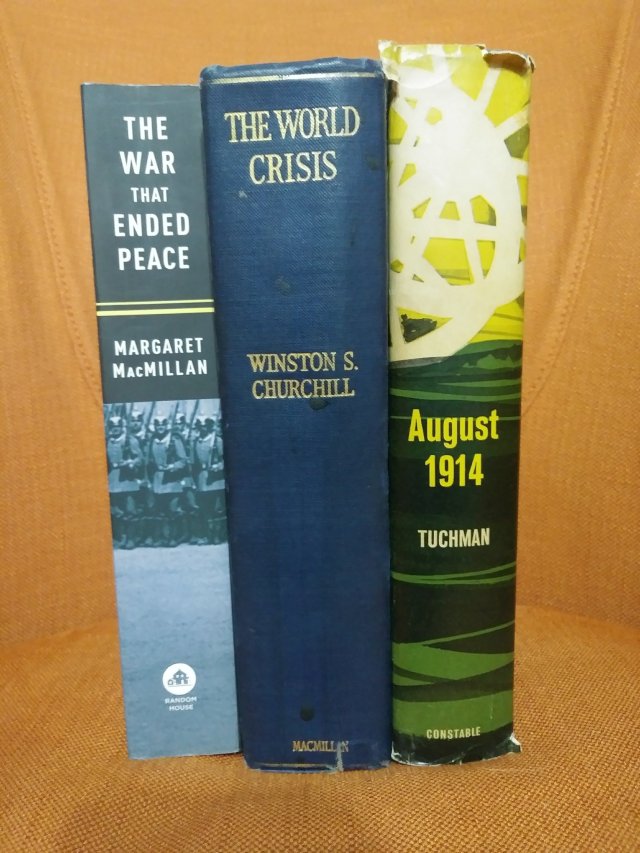
The oldest is The World Crisis by Winston Churchill, and it has my grandfather’s name in it indicating that he bought it in 1931, the year it was published. Churchill has few doubts about who caused the war – the Austro-Hungarian Empire, for the unreasonable ultimatum to Serbia following the assassination in Sarajevo of the heir to the throne, Archduke Franz Ferdinand, and the German Reich of Kaiser Wilhem, which abandoned the prudence of Bismarck in 1890 and provoked the world powers by an incresaing its already militarized nation and backing his allies in Vienna and Budapest. Churchill saw nothing inevitable to the war despite preparations on all sides. He believes that reason and diplomacy could have prevented the catastrophe, but the leaders of the German-speaking empires in Central Europe expected war, prepared for war, and pretty much welcomed it when it came. In comparison, the Russian Empire entered because of honour – they felt obliged to support their south Slavic counsins in Serbia – and of fear – that the more industrially advanced Germans and Austro-Hungarians sought to expand their territory at the expense of Russia, which was still largely rural and uneducated. The French also entered the war because of fear and honour – fear that they would be defeated as they were in 1870, but also because it presented an opportunity to regain Alsace-Lorraine and the lost honour of 44 years before. The British entered the war because they could not countenance a Europe dominated by a Germany even stronger than it was in 1870, and challenging British supremacy on the seas; the invasion of Belgium and an entente with France gave the UK government a cause to go to war. According to Churchill the war was caused by the Kaiser and the German Reich that supported him.

2000px-schlieffen_plan_fr.svg_

From the excellent article at Vox: “40 maps that explain World War I

Barbara Tuchman published The Guns of August in 1962 (also known as August 1914, the name by which my grandfather bought it). Tuchman, like Churchill, ascribes blame, and to do so carefully lays out the major decisions made by Russians, Germans, French, and British political and military leaders in order to explain how the war became a long one fought in trenches. She faults all sides equally for making errors in judgment. The German military planners were faulted for the Schlieffen Plan, in particular their assumption that they could invade neutral Belgium without any consequences. French military planners were faulted for their planning that put a premium on attack, and did not consider the devastating power of new artillery and machine guns. The Russians were faulted for fighting a war that they they were delusional about winning, given their strategic and technological backwardness. The British were faulted for not having made it plain to the Germans that they would support France in any conflict with Germany. Neither side was flexible in tactics or strategy, and so none of them could adapt well to unforeseen results. Both sides placed an emphasis on morale, but ultimately the major battles of the first few months were all determined by a concentration of soldiers and materiel. Both sides expected a short war with a single decisive battle, after which all would make peace; instead, after the “Miracle of the Marne” and the “Race to the Sea”, stalemate ensued, which was not broken until August 1918. Tuchman described the way in which politicians and generals make decisions to go to war without really understanding the cost. While November 1918 yielded victors and losers, the number of deaths of soldiers and civilians that it took to get there was unprecedented, and many after the war called into question the cost. Tuchman did not find any single villain, so much as describe a concert of folly.

5vsqc9kaof801

These guys who went to war all knew each other. Winston Churchill (then President of the Board of Trade in the UK Liberal Cabinet) with Kaiser Wilhelm II in 1909.

Margaret MacMillan is not so sweeping with blame as Tuchman or so definitive as Churchill. In her brilliant The War That Ended The Peace: The Road to 1914 she goes further back than Tuchman to examine the attitudes of the politicians and military prior to the outbreak. She writes at the very end:

And if we want to point fingers from the twenty-first century we can accuse those who took Europe into war of two things. First, a failure of imagination in not seeing how destructive such a conflict would be and second, their lack of courage to stand up to those who said there was no choice left but to go to war. There are always choices.

There are other approaches to understanding the origins of the war.

Marxists believed that the war was the inevitable result of capitalism. Lenin, in his 1917 book Imperialism, the Highest Stage of Capitalism considered the Great War to be the result of a late stage of capitalism. He believed that the proletariat would rise up in revolution and turn the war between imperialist powers into a civil war between classes. In the October Revolution of November 1917 he successfully carried this out in Russia. Things seemed to be moving along like clockwork in Germany and Hungary with seizure of power in Bavaria and Hungary by radical left-wing groups, but in the end the former soldiers of the German Reich, organized into Freikorps, ended such possibilities of communism. Lenin was wrong, of course. While the colonialism side of imperialism could be quite enriching, the all-out war of 1914-18 impoverished and destroyed the economies of the different belligerents. The reasons they went to war may have had the desire for territory behind much of it, but it ignored the non-economic rationale of the Allies and Central Powers. As it turned out, history was not determined by the struggle of classes after all. Countries devastated by the Great War turned not to communist revolt but to varieties of anti-democratic right-wing racist nationalism. Despite the obviousness of this, Marxist reductionism still holds much sway in certain places.

Niall Ferguson in The Pity of War (1998) (which I think I read as a library loan) goes further, and blames the long war on Britain. Had it not stepped in to defend its honour with Belgium and to assist France the war would have ended quickly with a German victory. Then something like the European Union would have emerged earlier, World War II would have been avoided, and the UK would not have been bankrupted. The cause of the Great War – the war we know, the one with trenches – was a massive miscalculation by the Liberal government led by Asquith.

I have not read it (yet), but Prof. Sean McMeekin of Bard College just outside New York City argued that it was really the fault of the Russians in his 2010 book The Russian Origins of the First World War.

While no longer acceptable, many Germans after the Great War, and especially after the imposition of the Versailles Treaty upon them, blamed France for having surrounded the Reich with the intention of gaining Alsace-Lorraine back. While this undoubtedly played a factor in the haste with which France went to war, the reality is that prior decisions of Germany – to back Austro-Hungary in its war against Serbia, encouraged the Russians to embark on their war against the two Central Powers.

You may be surprised to learn that no one has yet written a book blaming Canada for the First World War, but it may happen yet.

A little over twenty years ago the history professor and expert on Ancient Greece Donald Kagan published his masterful On the Origins of War and the Preservation of Peace. Going back to Thucydides (460 – 400 BCE) and his History of the Peloponnesian War, Kagan points out that the ancient Greek historian has someone state close to the beginning, “Why do people go to war? Out of fear, honor, and interest.” Kagan examines five different wars, and the First World War is one of them.

Kagan believes that honour played a larger role in the First World War than is usually thought. In the 1870s and 1880s the first chancellor of the German Empire Otto von Bismarck sought to establish peaceful relationships after unifying Germany and fighting three short wars against Denmark, Austro-Hungary, and France. Kaiser Wilhelm pushed Bismark and that policy aside and sought to expand the military, including the German Navy. This alarmed the British, who dominated the high seas with the Royal Navy, and so the two nations entered into an arms race. The French, resentful after the defeat in the Franco-Prussian war of 1870, sought to regain Alsace-Lorraine and French honour. The Russians, with long memories, feared another invasion from the west, and the growing German Army disturbed them. The French and the Russians entered into an alliance against the Germans, which only convinced Kaiser Wilhelm that the nations around him were ganging up on him. As well, the Russians sought some way of supporting their fellow Slavs and Orthodox peoples in Serbia. The Italians were bumping up against the Austro-Hungarian Empire, which ruled the Italian speaking areas of Trieste and was expanding into the Balkans against a weakened Ottoman Empire; this led them up against Serbia, which sought to expand its territory to include Serbs and Croats now under the rule of Vienna. Greece had just fought two wars, also significantly expanding its territory to the loss of the Ottomans, and saw little reason to stop; this brought them into competition with Albania and Bulgaria.

Kagan argues that the over-riding interest of all the nations was to maintain peace, perhaps an obvious point in retrospect knowing what the cost of the war was. Millions died. France was bled dry, the Austro-Hungarian Empire collapsed, Russia was hit with two revolutions, and the German Reich fell. For Russia, Greece, and Turkey the war did not really end for several years, and at the cost of millions more dead and millions displaced. The various nations were all too willing to go to war, and the leaders and the people – especially the people – suffered for it. Having failed to preserve peace in 1914 they failed to establish a strong peace afterwards. The United States sought to withdraw into isolation, Britain and France sought to expand their power in the Middle East, and the Soviet Union considered how to export revolution. In Germany the myth of “the stab in the back” arose and fueled a turn to the right wing, which promised to re-establish the honour of Germany by military means and re-determine the boundaries of Europe. After the Second World War the United States and its Allies ensured that this did not happen again.

It may be obvious from the review of the books above where I stand on some of these issues. Regardless of what I think, the causes of the Great War will be debated for many years to come. However, the various historians have revealed how complex these things can be. It is one thing to make a timetable after the fact and to see how certain decisions led to historic results, it is another to understand the motivations and thinking behind them. One thing seems clear to me – there was never anything inevitable about what happened. As Margaret MacMillan reminds us, “There are always choices.”

So what lessons might be learned now, some one hundred years after these momentous events? That will be the topic of another post.

sig short

Posted in War | Tagged , , , , , | Leave a comment

It’s All Greek To Me: Homeric Questions (Part Two)

avdo medjedovitch

Photograph by Albert Lord, then a student working with Milman Parry in 1934-1935. Part of Albert B. Lord’s Photo Album in the Milman Parry Collection at Harvard University.

In the summer of 1933, and then for a fifteen month period in 1934-1935, Milman Parry went to the southern part of the Kingdom of Yugoslavia. Born in 1902 in California, Parry was an associate professor at Harvard University, with a recent PhD in Classics from the Sorbonne. He went to Yugoslavia to record Serbian singers, men who specialized in telling long heroic stories of resistance by Serbs and Croatians against the Ottoman Turks. He recorded these singer of tales not only by making written transcriptions of the songs, but also by the use of the latest audio recording technology: a microphone, two turntables, and over 3500 78 rpm aluminum discs. Why was he there? While other classicists were preoccupied with textual analysis, Parry had the insight that if the Homeric epics were in origin sung in performance, then one needed to study contemporary oral traditions of singing or making poetry. In Yugoslavia the singers were illiterate, yet reportedly could faithfully reproduce long epic songs from memory. This was exactly what many Homer scholars had suggested was the origin of The Iliad and The Odyssey, but Parry was the first to test the idea against an actual oral practice.

Scholars of the two Homeric epics had noticed a number of things. First, there are descriptions in The Odyssey of a poet Demodocus who sings two stories. The first song is about the destruction on Troy by the subterfuge of a wooden horse.This is not the narrative of The Iliad – that story is about the anger of Achilles and takes place some time before the fall of Troy, although it knows about the eventual destruction of the city. The second song is a ribald story about Aphrodite and Ares being caught in flagrante delicto and literally manacled to the bed by Hephaestus, the jealous husband of the love goddess; he then invites all the the other gods to show up to make fun of them. Importantly, the poet is blind, just like Homer was supposed to be, and is clearly not reading from a text. Also, he sings the two stories while accompanying himself on the lyre.

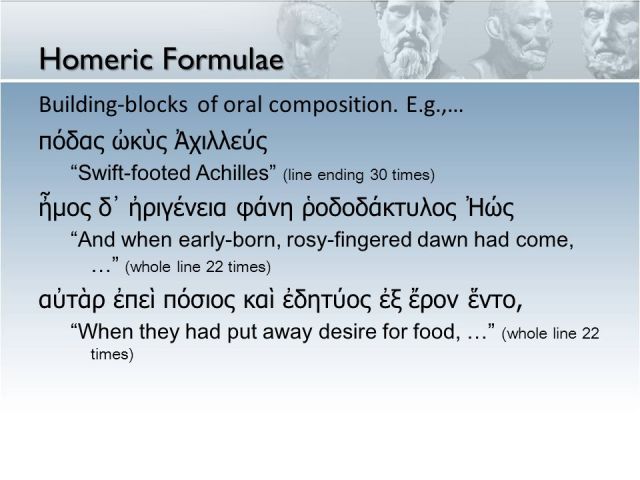
The second thing that any reader will notice is that throughout the epics are certain adjectives and phrases that are repeated over and over again. For example, the sea is “wine-dark”, Telemachus in The Odyssey is always “thoughtful”, and Penelope is always “prudent”. While it makes it easy for young students translating the text, it raises the question as to why the author(s) are so repetitive. Could they not think of some other way to describe things? Or was there a reason as to why the poet(s) returned again and again to these formulas?

Parry realized that the south Yugoslav singers also used formulas. The reason was that they were basically re-creating the epic songs as they sang them – creation-in-performance. The formulas were the means of ensuring that the right number of stresses and syllables showed up in a line. If you knew that you would be referring to “thoughtful Telemachus” then that dealt with five syllables and two stresses and you didn’t have to think about it too much, because you already knew how it would fit. Ancient Greek allowed for a fair amount of word-order flexibility, and so the story would flow along according to what the singer remembered, using certain standard ways of describing scenes and these formulas.

slide_12

Not sure who was the author of this, but I found it on the internet . . .

Parry died suddenly in 1935 in Los Angeles, and never published his research, but his student Albert Lord carried on where he left off. Lord returned to the Balkans both before and after the Second World War and continued to make recordings and transcriptions. His PhD thesis in 1949 argued that the two epics were originally these compositions in performance, and after further work this was published in 1960 as The Singer of Tales. This does not answer the question of whether there ever was someone named Homer, but it firmly established how the two long poems were created. It does not explain the process by which the ancient Greeks wrote it down, but it does explain why there are variations and why there are formulas. It also explains the unusual structures of The Iliad and The Odyssey, in that scenes and episodes could have been dropped in and expanded very easily into the structures of an earlier, shorter version of the poem.

the singer of tales

This is the edition I have. The CD is a real bonus. Lord writes clearly and engagingly.

Lord and Parry were influenced by the study of folklore and comparative literature at Harvard, and their efforts created the genre of the study of oral traditions in Asia and Africa, to supplement what they learned in Yugoslavia. No serious classical scholar contests the origins of the epics in oral recitation as described by Lord and Parry. While the details are still argued about, the reality is that after 2500 years of reading and study there are still new things to be learned from these old epics.

sig short

Posted in Greece, Poetry and Novels | Tagged , , , , | Leave a comment

It’s All Greek To Me: Homeric Questions (Part One)

homer

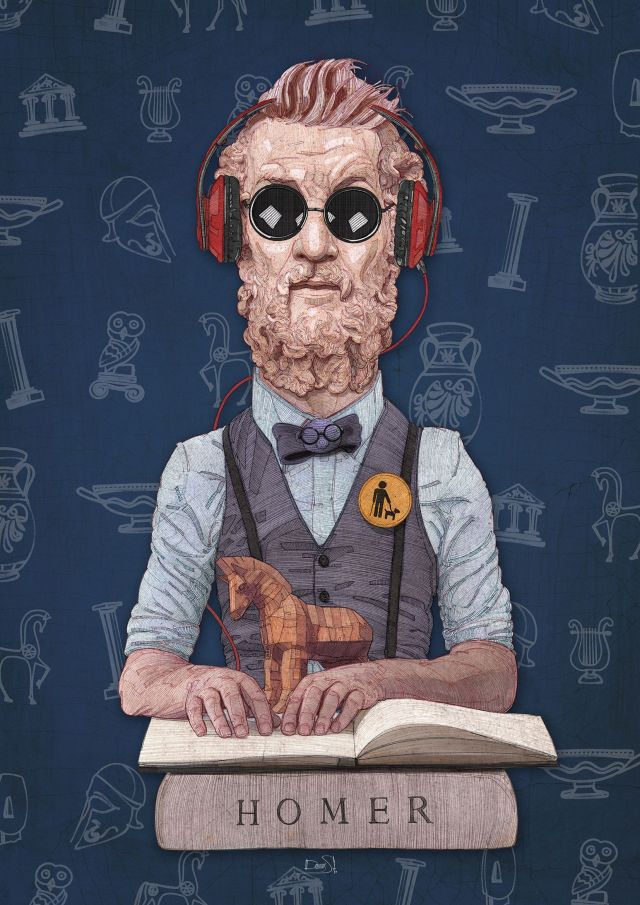
A 21st century interpretation of Homer by Stavros Damos of Thessaloniki, part of The Wise Reinvented Series.

Towering over all Greek culture past and present are two ancient epic poems, The Iliad and The Odyssey. Nikos Kazantzakis (1883-1957), the great Greek demotic writer, wrote a sequel to The Odyssey (it was not well received). Constatine Cavafy (1863-1933), the great Greek poet, wrote numerous poems with allusions to events and personages; perhaps his best known poem is “Ithaca”, a meditation on journeys and arriving at one’s destination.

The Iliad tells the story of a few weeks towards the end of a long, ten year war between the Greeks and the city-state of Troy. It features Achilles and Paris, Agamemnon and Odysseus, and Menelaus and Helen. The Greek gods are very active, above all Athena, but also Zeus and Poseidon, and Aphrodite and Hermes. The Odyssey is its sequel, telling the story of how Odysseus spent ten long years trying to get home to Ithaca.

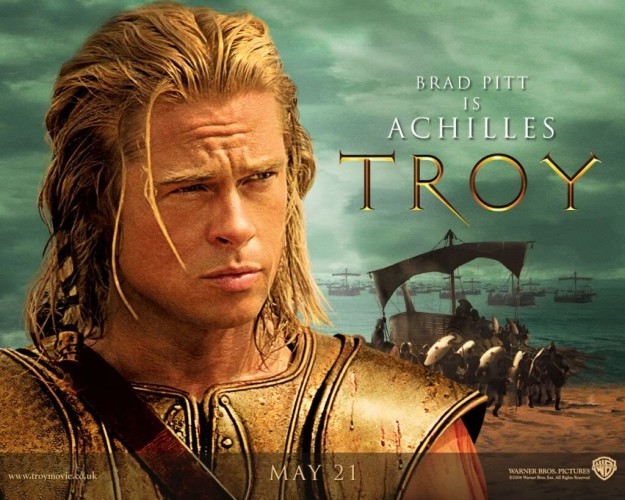
Arguably the two poems stand over all “Western” culture, too. Following the Renaissance the ancient classics of Greece and Rome were rediscovered, and these epics in the original archaic Greek were the focus of education for several centuries. It inspired paintings and sculptures. In the First Century CE Virgil could do no better than to emulate it in his Aeneid, which told of how Aeneas of Troy escaped from the ruins of Troy to found a new city in Italy, whose descendants would one day found Rome. The great Irish author James Joyce (1882-1941) spent the Great War writing Ulysses (1922) which at first glance told the story of one day in the life of two drunken men in Dublin, but in fact paralleled The Odyssey. The Coen Brothers Oscar-winning movie O Brother, Where Art Thou? (2000) was loosely based on The Odyssey. The movie Troy (2004) retold the story of The Iliad as an action movie, and it featured Brad Pitt, but was not as well received as the Coen Brothers’ movie, especially as it did not have any of the deities of Olympus showing up. Oh, and at least twenty-six places in the USA are named Troy.

img2.thejournal.ie

Hey, it’s got Brad Pitt in it – it must be good, eh?

Each of the epics is massive. The Iliad has 15,693 lines of non-rhyming dactylic hexameter, and The Odyssey has 12,110. In Emily Wilson’s recent brilliant English translation of The Odyssey (2018) the epic takes up 421 pages. The sheer size of it is, well, epic!

So who wrote these great and influential works? The tradition, which was believed as solid history up until the 19th century, was that they were written by a blind man named Homer, who may have come from Smyrna on the west coast of Anatolia but became known as a great poet on the Aegean island of Chios. Several lives were written in antiquity, but they contradicted each other.

ms.2 iliad

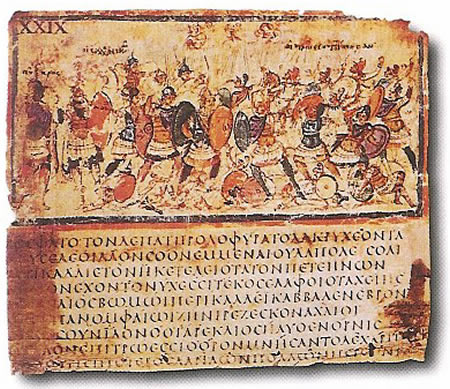
Homer’s Iliad, cod. F 205 inf. Late 5th-early 6th c. Milan, Biblioteca Ambrosiana. Source

“The Homeric Question” (which was really a whole series of questions relating to the author) emerged in the 19th century as German classicists began to apply historico-literary techniques to the texts (just as they were being applied to the texts of the Bible). It was noted that the texts had several dialects of archaic classical Greek, and occasionally seemed to contradict itself; could they be, in fact, composite works by different authors? Examination of other ancient authors seemed to suggest that there were variations in the manuscript that were not just scribal errors – so what was the history of the text, and was it “tidied up” at some point? Given the tradition that Homer was blind, was it in fact recited to an amanuensis, as Milton’s Paradise Lost was, or did it have a free-standing existence as an oral epic for a time before being put down on paper? Which of the two epics was written first? How does someone compose a work like The Iliad if you are blind? If it did have an oral existence prior to it being written down, how the heck do you remember something that long? How was it performed – was it spoken, read, or sung? Was writing in fact in existence when Homer supposedly lived (850 BCE, according to Herodotus)? Was there anything of historical value in the two epics? And, finally, was there ever actually someone named Homer?

I’ll look at these issues in the next post, and explain how it came to be that a revolution in the study of the Homeric epics took place in the middle of the 20th century – a revolution that has now created a new consensus and refashioned the Homeric Question.

Posted in Greece | Tagged , , | Leave a comment

It’s All Greek To Me: Modern Greek

epi_06

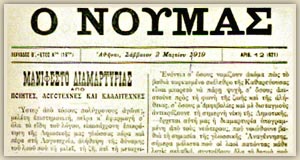
The periodical Noumas, issue no. 12 (621), 2 March 1919 in the first page of which the manifesto of protest of poets, writers amd artists for the defence of demotic Greek is published. Athens, Hellenic Literary and Historical Archive.

When Constantinople fell to the Ottoman Turks, Byzantine Greek did not cease to exist, even though it was no longer the tongue of an empire. It continued on as the form of used in the Greek-speaking part of the Eastern Orthodox church, and educated Greeks continued to write in it. However, there was a problem. Already by the 15th century the spoken language had diverged somewhat from the written language. This was not at all unusual. Formal, written Latin, or the Latin used in ancient Roman law courts, was already by the 1st Century CE somewhat different from informal, spoken Latin, as is demonstrated by some plays that portray lower-class Latin, and graffiti found in Pompeii. By the time western Europe was lost to the Roman Empire in the 5th Century Latin was already starting to evolve into French, Spanish, Portuguese, Italian, and Romanian. The fall of Constantinople simply accelerated the process for Greek.

By the time the 18th century came along there was a clear distinction between spoken Greek and written Greek. The former was called demotic Greek, from the word δήμος “people”. The written Greek was basically late Byzantine, hearkening back to Hellenistic and Classical Greek. There were some significant differences.

  • Whereas demotic had dispensed with the dative form, the written Greek retained it.
  • The system of accents, originally indicating tones, made less and less sense because tones had dropped out of the spoken language and had been replaced by stress, which usually but did not always relate to the ancient ways of writing accents.
  • Contact with the Middle East and the Ottomans meant that spoken Greek had many new words that the written Greek would not use.
  • Pronunciation had changed significantly, which meant that new ways to pronounce old sounds had to be found.
  • The old verb forms of the future, perfect, pluperfect tenses, and even the infinitive disappeared from spoken Greek, but continued to be used in written Greek.
  • These verbal forms and the dative meant that the same meanings were now conveyed with the use of prepositions and markers for modes and tenses (which is more like English).
  • As well, word order became far more important in spoken Greek, whereas the written Greek was more flexible.
  • In spoken Greek irregular verbs became more regular, whereas in written Greek they stayed in the old, confusing forms.
  • In Ancient Greek there was no indefinite article – one figured it out by context. The article in Ancient Greek – ὁ, ἡ, τό – simply directed the attention of the listener or reader to the word to which it referred – it might be definite, and usually was, but, again, that was more a matter of context. The ancient article evolved in Modern Spoken Greek into the definite article, but it still functioned a bit differently from the definite article in English. For example, in Η Ελένη πίνει ένα ποτήρι κρασί “Helen drinks wine”, Helen takes the definite article H. Note that in ένα ποτήρι “a glass” the indefinite neuter article ένα appears.

There are more differences, but you get the picture. Ordinary Greeks spoke demotic, while educated and moneyed Greeks learned to write in an archaic form. This is called diglossia, where there are two forms of the language in use. Amongst Greek-speakers this became known as the Greek language question – should the written language be adapted so that it reflects how people actually speak, or should the written language still maintain old forms so that the connection with the ancient forms, whether New Testament or the Classics, is maintained.

1903

The program of the performance Oresteia by Aeschylus, 1903 – translated into Demotic Greek. This was controversial. Archive of the Theatre Museum of Athens

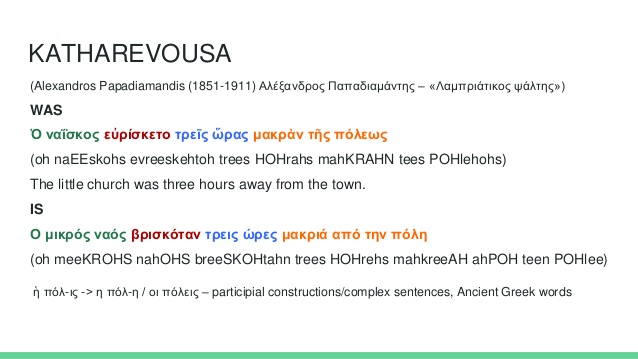
This came to a head when Greece became independent in the 1820s and 1830s. The new nation had to issue publications, and by then the default Byzantine forms were seen to be too problematic. While some advocated for a radical change to a form of demotic, the traditionalists won out by advocating for a form developed in the 1790s called Καθαρεύουσα “Katharevousa”, which means “purifying”. This was an idealization of what the Greek language should be – retaining ancient cases and forms, and driving out foreign loanwords. It meant that the written language, as used in official publications and in the universities and schools – was still quite different from the spoken language, but it was not exactly ancient or medieval Greek, either. Because there was no one body determining what Katharevousa should be, the people wanting it fell into intense arguments over what the correct form should be. Meanwhile, ordinary Greeks, who had difficulty understanding it, continued to use demotic, and the newspapers (and later, radio, films, and television) followed suit. By the 1880s some poets and novelists abandoned Katharevousa and began writing in demotic, to great consternation. Even in the 20th Century this was controversial, but this was the form Kazantzakis (Zorba the Greek, The Last Temptation of Christ) used. Cavafy the poet mostly used Demotic, but carefully used Katharevousa in the same poems with Demotic.

The use of Katharevousa became somewhat political, and when the Colonel’s Regime of 1967-1974 espoused the use of it a strong reaction ensued. The restored democracy under the centrist government of Konstantinos Karamanlis began the process of getting rid of it, and in 1976 they passed a law requiring that the schools use Standard Modern Greek in instruction. Forty years later Katharevousa is dead except in the Greek Orthodox Church (of course), and most Greeks under the age of sixty cannot read it except with difficulty. It sort of lives on in Standard Modern Greek, because Modern Greek incorporated some of the vocabulary of katharevousa, mostly formal words and types of address.

The last big step was in 1982 when the polytonic spelling was replaced by monotonic accents. This meant that the accent in any multi-syllable word was indicated, and it always indicated stress. A host of diacritical marks above and below the letters disappeared.

naps-2016-lilia-mouma-my-big-fat-greek-talk-9-638

An illustration comparing Kathervousa with Modern Standard Greek. From a talk by Lilia Mouma “My Big Fat Greek Talk” at North American Polyglot Symposium 2016 (NAPS)

Fortunately I am learning this fairly straightforward Standard Modern Greek. My old New Testament Greek pops up in my head every once in awhile – “What happened to the word οἶνος and why did it get replaced with κρασί?” or, “You mean I don’t have to learn the pluperfect subjunctive!?!” – but I am quite happy not to have to learn two forms of the language.

sig short

Posted in Greece | Tagged , , , , , | Leave a comment

The Shortest Sermon Ever

A sermon preached on The Fourth Sunday of the Epiphany at the Anglican Church of St. Thomas, Kefalas, Crete, Greece, 11:00 am January 27, 2018.

clock_22 minutes, 42 seconds.

Musicologists, using the power of computing, analyzed the top-rated, best-selling hit songs. They interviewed over 500 people on their personal preferences and analyzed the songs they liked. Their conclusions, then, are based on hard facts – weeks on the Billboard charts, sales, or nowadays, downloads. And amongst many conclusions one was paramount  – the perfect length of a pop song was 2 minutes 42 seconds. Popular songs can be shorter by a bit, longer by a bit, but not much. Bob Dylan’s great hits like A Hard Rain’s a-Gonna Fall at 6.55 is an outlier, the exception that proves the rule, not the norm.

By the way, the musicologists also found out the characteristics and the length of the worst possible song – 22 minutes – and then went ahead and composed it. It includes holiday music, bagpipes, pipe organ, a children’s chorus, a bossa-nova synth, and some unbelievable opera rapping.

Well, what’s the perfect length for a sermon?

About ten minutes and about God would be most people’s answer. At the other end of things I knew someone who justified 45 minute sermons on the basis that, “Sermonettes make for Christianettes.” And while I have been spellbound by preachers who go on that long, most of the time I am wondering when it will end. I know some people who would be just as happy with no sermons ever, because they are there for communion, and find the preaching just gets in the way; I sometimes wonder what kind of a spiritual life they have when they don’t need to be challenged by the preacher. If you know me you know that I appreciate good preaching and will preach at any service, even small mid-week liturgies.

great-isaiah-scroll-dss

The Great Isaiah Scroll, 1QIsa The Isaiah Scroll is the only complete biblical book surviving among the Dead Sea Scrolls. Found in Cave One at Qumran in 1947, it dates from about 120 B.C.E. Not the scroll from which Jesus read, but the one he used would have been almost the same.

Then there is Jesus. He preached the shortest sermon ever, on a text from Isaiah Chapter 61.

“Today this scripture has been fulfilled in your hearing.”

*Mic drop*

Short, eh? To the point. Now, when you hear the words of Isaiah, what do you hear?

“The Spirit of the Lord is upon me,
because he has anointed me
to bring good news to the poor.
He has sent me to proclaim release to the captives
and recovery of sight to the blind,
to let the oppressed go free,
to proclaim the year of the Lord’s favour.”

If this was fulfilled in the presence of those who heard Jesus, my question to you is this:

  • How is it being fulfilled among us?
  • How is the good news being brought to the poor among us?
  • How is release being proclaimed to those in captivity?
  • How in our hearing are is eyesight to the blind being proclaimed?
  • How are the oppressed among us being set free?
  • How is the year of the Lord’s favour being announced?

We are the body of Christ, so do not doubt – this is happening. But let these questions rest upon you, and let me know what you think, because with or without me, with or without you, with or without us, “Today this scripture has been fulfilled in your hearing.”

And for the record, that sermon was 7 minutes and 30 seconds.


NB The suggestion of *Mic drop* comes from Frances Bryant-Scott.

Posted in Sermons | Tagged , , | Leave a comment

When I Pray: Prayer Cycles

When I pray I have a number of ever-changing people, places, and things that I remember. In the congregation I now serve we have a Prayer Net and the person organizing it keeps track of people to pray for – usually people in some form of illness or distress. She sends out an e-mail every once in a while. A gentleman in my previous parish did the same, and I suspect most churches have someone doing this.

I also use prayer cycles. These are usually promulgated by institutions. The two main ones that I use are:

  • The Anglican Cycle of Prayer Each day this cycle provides the names of one or more dioceses and their bishops within the Anglican Communion. Over the course of a year every diocese and bishop will be prayed for.
  • The Prayer Diary for the Diocese in Europe, Church of England. Each day a different chaplaincy (i.e. parish) is remembered. Over two months every chaplaincy is prayed for. On Sundays partner churches in Europe with whom we are in communion are remembered.
diocese in europe

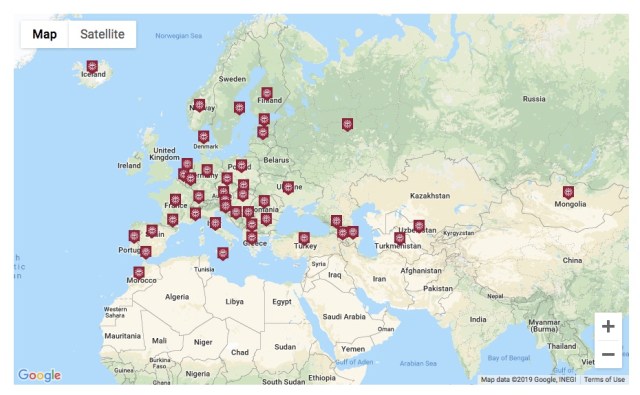
A map of the Diocese in Europe, which is a diocese of The Church of England. It serves Anglicans and all sorts of Christians outside of the British Isles in Europe, and stretches from Iceland to Mongolia and from Morocco to Moscow. It includes Turkey and some of the republics that were part of the old Soviet Union. There are almost 300 congregations in over 40 nations, with two bishops.

Many dioceses have something similar to the Prayer Diary of the Diocese in Europe. For example, the Diocese of British Columbia on Vancouver Island regularly issues Intercessions which name the various clergy and ministries.

I am an associate of two Anglican religious orders for women, and I pray for them daily.

header-pict09-who-we-are-2017

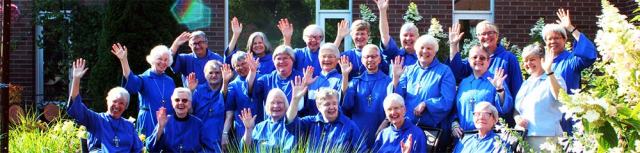
The Sisterhood of St. John the Divine

  • One is the Community of the Sisters of the Church (“CSC”) which has become well known through the television program Call the Midwife. They have four provinces – the UK, Australia, Canada, and the Solomon Islands. The CSC is very small in Canada, with only three sisters left, but I receive from them a monthly prayer cycle in which each day I pray for one or more of the sisters in a location, as well as some of the associates in Canada. I recognise many of the associates!
  • The other is the Sisterhood of St. John the Divine, which has a convent in Toronto and a house with two to four sisters in Victoria. They do not have a prayer cycle as such, but I receive their newsletter, and I copy the group photo that is taken at their annual chapter. I then mark it up by numbering off the sisters from one to twenty-five, and pray for them by name, giving me one sister a day to pray for. I already know many of them personally, but this exercise helps me to know all of their names and faces. I fill up the rest of the month by remembering people like the Oblates, the Associates, Benefactors, the Visitor, and so forth.

I have used other Prayer Cycles in the past. con20map_dec2018

  • I used to have one for the Council of the North, which is the organization of the “northern” dioceses of the Anglican Church of Canada which receives financial support from the General Synod of the Anglican Church of Canada. I used it until I knew that it was out of date, and it does not appear that they have issued an updated one.
  • At one time I also had one relating to the Anglican Council of Indigenous Peoples, but if I remember correctly it was a time limited thing and I haven’t seen a replacement.
  • The Rev. Canon Dr. John Steele, who attended many World Council of Churches (“WCC”) meetings on behalf of the Anglican Church of Canada, introduced me to their Ecumenical Cycle of Prayer, which is simply a cycle of prayers through the year on a weekly basis for every nation. This week, for example, we pray for Cyrus, Greece, and Turkey (hey, that includes us on Crete!)

Doing these cycles help me to be more other-minded. It does remind me of the extensive network that the church is, and of the many people I know within it. My hope in writing this down in some detail is to suggest to you that if you are trying to develop a discipline of prayer that the use of prayer cycles is one tool you might want to adopt. Again, as I said in my earlier post on prayer, this is not about changing God’s mind, but about changing mine – my soul and body. May you be changed, too.

Sig short

Posted in Anglican Church of Canada, Prayer | Tagged , , , , , | Leave a comment