I Will Do More

Through Lent with George Herbert
Wednesday after the Second Sunday of Lent

Icarus-720x540

Praise (1)

To write a verse or two is all the praise
That I can raise:
Mend my estate in any ways,
Thou shalt have more.

I go to Church; help me to wings, and I
Will thither fly;
Or, if I mount unto the sky,
I will do more.

Man is all weakness; there is no such thing
As Prince or King:
His arm is short; yet with a sling
He may do more.

An herb distill’d, and drunk, may dwell next door,
On the same floor,
To a brave soul: Exalt the poor,
They can do more.

O raise me then! poor bees, that work all day,
Sting my delay,
Who have a work, as well as they,
And much, much more.

If you have read some of my previous posts about the poetry of George Herbert you will see in today’s poem some themes that he has already addressed.

  • The first stanza speaks to the use of poetry in praise of God – Jordan (1).
  • The second stanza talks about having wings to fly to God – Easter-wings.
  • The final stanza refers to industrious bees – Employment (1).

This poem, then, is a good example of how Herbert uses the poems to build upon each other and interrelate.

The key word in the poem is “more”, being the final word of the fourth line of each stanza. With God the poet will be more. A person with short arms, with a sling, can do more than a prince or king. The poor can do more than someone who has taken a stimulant. The poet has a work greater than that of the bees – “much, much more.” There is aspiration, then, but also a recognition that without God the weak vessel of humanity cannot accomplish much.

The tone here is humble and critical. In the first stanza Herbert writes that if God mends his estate – his health perhaps? – he will be able to do more than write just a few verses. In the second stanza he receives wings to to go to church, but if he ascends to the divine, he will do more than merely attend worship. The third stanza is striking for a 17th century author, for he states, “Man is all weakness; there is no such thing / As Prince or King”. Of course, Herbert knew quite well that there were princes and kings, but in the weakness of humanity all are equal, and none have first dibs on God’s grace. He refers to David, who with a sling defeats Goliath, demonstrating how God works through the most unlikely of persons. The fourth stanza seems to refer to a person knocked out by some stimulant, with the bottle and person both on the floor, but the poet urges God to raise up the poor (which, of course, is a constant theme in scripture – God does so in people like: Mary, the mother of Jesus; the shepherds; Micah; the Corinthians; and so forth). The poet, who appears to have some issues with his “estate”, is slow to praise, and needs to be stung into action to fulfill his work and to do more.

“I will do more.” Often when I have wanted to do more it was connected with career or academic achievement. These are not bad things, but they unveiled a competitive streak in me which was sometimes ugly. Probably the most important thing I ever did in my life – working with the Refugee Program in the Diocese of British Columbia – came to be more or less by accident. When the wave of compassion came upon Canada in the Fall of 2015 I just happened to be the right person in the right place and right time to be able to grow the program so that after two years it was about ten times the size when I appointed to it. This came after a period of illness and was followed by another, and in both cases I wondered if I would be able to work again. As it turns out, I was able to return to work, and I am grateful for the patience of the Bishop and the parishes as I mended. I think what strikes me now, as I reflect on this poem, is that God meant for me to do “much, much more” but it was not the kind of thing I could have planned for or aimed at doing. And, when I was done that work I passed it off – I was no longer necessary, I had become redundant.

I now live in a different country 10,000 km away. I am sure God wants more from me as I settle in as a stranger in a strange land. As I praise God in word and deed, I look forward to having the wings of which Herbert speaks, and to work with God to exalt all humanity to their divine purposes. With these wings we will rise to God, and unlike that other resident of Crete, Icarus, we shall not fall.

Posted in Lent, Poetry and Novels | Tagged , , | 2 Comments

Delayed Dust: George Herbert’s “Employment (1)”

Through Lent With George Herbert
Tuesday after the Second Sunday of Lent

Dust

Employment (1)

If as a flower doth spread and die,
Thou wouldst extend me to some good,
Before I were by frost’s extremity
Nipt in the bud;

The sweetness and the praise were thine;
But the extension and the room,
Which in thy garland I should fill, were mine
At thy great doom.

For as thou dost impart thy grace,
The greater shall our glory be.
The measure of our joys is in this place,
The stuff with thee.

Let me not languish then, and spend
A life as barren to thy praise,
As is the dust, to which that life doth tend,
But with delays.

All things are busy; only I
Neither bring honey with the bees,
Nor flowers to make that, nor the husbandry
To water these.

I am no link of thy great chain,
But all my company is a weed.
Lord place me in thy consort; give one strain
To my poor reed.

The fundamental challenge of life is what to do with it. One can focus on obtaining one’s food, satisfying urges such as hunger, getting an education, finding a lover, learning how to calm oneself, enjoying the company of others, satisfying one’s curiosity, and so forth. At a certain point, though, one realises that one has only a certain amount of time between NOW and THE END of life. While this may simply be a recognition of mortality, it is also an opportunity to call into question what one has been doing up to this point, and frame a question – what do I do now?

For George Herbert this is the question of employment. We can put it into terms of vocation – what is my calling? – but it is not so much about a job so much as it is about the meaning of one’s life.

This poem is in six stanzas of four lines of rhyme ABAB,  but with a syllable count of 8..8.10.4. The short final line in each stanza is a kind of abrupt stop in the poem, a kind of metrical question to parallel the questions raised by the poem itself.

The first stanza seems to reflect the sense of a life that knows it will be short. The poet bid’s from God some good before his life, like a flower, is nipped in the bud by frost. He uses flowers a lot in this poem. In the second stanza God’s goodness is a garland, and in the fifth he compares himself to industrious bees. In the last verse he likens all his company to a weed.

bees-on-yellow-flowers

Herbert plays with the concept of space. The flower spreads, and Herbert bid God to “extend me some good.” This could be read simply as God extending to the speaker in the poet some good, but one might also read it as the poet asking God to spread him, kust as a flower opens up to release a fragrance. This second meaning seems borne out by the second stanza in which “the extension and the room . . . were mine”. Locational language is then used:with “this place” in the third stanza.

The key line, I think, is in the fourth stanza: “Let me not languish then, and spend / A life as barren to thy praise, / As is the dust”. The purpose of our lives, according to Herbert, is to praise God. Herbert wishes to be busy with that purpose. Undoubtedly, by ordinary standards, he had already been quite busy, but perhaps this reflects a time when Herbert was in between the university halls and the parsonage, presented with delays. Indeed, he magnifies the situation and describes life as “the dust, to which that life doth tend / But with delays.” It is a striking image – we are but delayed dust! As is said on Ash Wednesday, “Remember that you are dust, and to dust you shall return.”

A tone of humility begun here continues in the fifth stanza, where the poet compares himself unfavourably with the busy bees. He deprecates his humanity by removing himself from the great chain of being, where humanity is at the top, then the animals, then plants, then dust. This is the meaning of his words “all my company is a weed”, for that is the level he considers himself to be at, as that living, God-breathed dust. The last two lines shift from flowers to God’s band, and he bids God to make him part of it despite his weakness.

Christian tradition has always seen the praise of God as the primary vocation. In monastic tradition monks and nuns pray seven times a day, as well as once at night and at the Holy Eucharist as well. The day is structured by these hours of prayer, in between which other work is done. In the Anglican tradition we pray twice a day, at least, in Morning Prayer and Evening Prayer, supplemented perhaps by Communion, contemplative prayer, and Compline. This is not to negate other important things – work, preparation of food, leisure, time with family and friends, social work and charitable activities – but to order it in another chain of being. First things first, as the saying goes, especially for we who are delayed dust.

Posted in Lent, Poetry and Novels | Tagged , | 5 Comments

Is There in Truth No Beauty

Through Lent With George Herbert: “Jordan (1)”
Monday after the Second Sunday of Lent

Trek Beauty

Fans of Star Trek (the original one, usually denominated “The Original Series” or “Star Trek: TOS“) will recognise a line from Herbert’s poem “Jordan (1) in the title of one of its episodes: “Is There in Truth No Beauty?” It was not a bad episode, especially considering it came from the dreadful third season, when the writing staff had run out of good ideas and the pressure of cranking out a weekly series at a lower cost than the first two seasons was starting to show. The original script came from Jean Lisette Aroeste, a librarian Trek fan who came up with an unsolicited screenplay retelling the Medusa story. As the comprehensive Fan Wiki Memory Alpha  puts it,

Box

So hideous they kept them in a box.

Their appearance was so utterly hideous to humanoids that the sight of a Medusan rendered any viewer mad, and soon afterward caused death by massive organ failure. Vulcans were capable of viewing Medusans, but only with the use of a specially filtered visor. For these reasons, Medusans usually used an opaque carrier pod when interacting with other species. The Medusans were renowned for their navigational abilities.

Of course, when I first saw this episode in reruns in the early seventies my prepubescent self had no idea to what the reference in the title was – something in Shakespeare, I probably thought, if I thought about it at all. But it is a line from Herbert, although he was not thinking about ugly but brilliant aliens.

Jordan (1)
Who says that fictions only and false hair
Become a verse? Is there in truth no beauty?
Is all good structure in a winding stair?
May no lines pass, except they do their duty
Not to a true, but painted chair?
Is it no verse, except enchanted groves
And sudden arbours shadow coarse-spun lines?
Must purling streams refresh a lover’s loves?
Must all be veil’d, while he that reads, divines,
Catching the sense at two removes?
Shepherds are honest people; let them sing;
Riddle who list, for me, and pull for prime;
I envy no man’s nightingale or spring;
Nor let them punish me with loss of rhyme,
Who plainly say, my God, my King.

The poem is one of the short ones, fifteen lines, in the pattern ABABA, of ten syllables each (iambic pentameter, in poetry-speak). It is what the kids today might call meta – it “means about the thing itself. It’s seeing the thing from a higher perspective instead of from within the thing, like being self-aware.” It is a poem about poetry.

Herbert asks a question at the beginning, essentially saying: “Who says you can only write romantic poetry, where poets demonstrate their skill in writing about fake situations and non-existent people?” His slightly older contemporary poet and divine, John Donne, made his name with erotic poetry before being ordained and turning to religious themes. Donne was good at both, but there were many more poets writing at the time, now mostly forgotten, and those are the people Herbert is targeting. They used clichés such as “enchanted groves”, “sudden arbours”, “purling streams”, “nightingale”, and “spring”. It was largely about seeking favour, and they would bow and scrape before the empty chairs of their patrons, painted to look to be made of finer materials than they were. It was often obscure, using metaphors that only made sense (if at all) “at two removes”. Perhaps one had to have inside knowledge to understand what they were saying, and perhaps it was just gossip dressed up in nice clothes. It might be properly structured, like a winding stair, but the structure was stronger than the content.

Baptism Jordan

A Baptism in the Jordan River. I believe this is a baptism celebrated in the Orthodox tradition, at the traditional location of Jesus’s own baptism by John.

And so Herbert asks, “Is there in truth no beauty?” The “truth” here is God in Christ, who said, “I am the way, and the truth, and the life” (John 14.6), but is religious themes in general, as found in The Temple. The “true chair” to bow before is the throne of God, and the proper object of love. The title Jordan refers to the small river between what is now the Kingdom of Jordan and the State of Israel/Palestine, which in the Hebrew Bible signifies the division between the Promised Land and what leads to it. It is the place where Jesus was baptised by John, and people on pilgrimages will seek to wash themselves there or be baptised there still. As a “stream”, whether “purling” or not, the Jordan represents this movement to what is promised, to new life, to washing away sin; as a poem this text refreshes not “a lover’s love” but the believer’s attention to God.

Herbert states that he prefers the straight-forward songs and poems of shepherds who simply say, “My God, my King!” This seems like a reference back to Antiphon (1), a pretty plain but technically excellent piece of praise. But, of course, Herbert appears plain, but he has to work to achieve that effect. It was said of Gene Kelly that you saw how hard he worked in all his dances, whereas Fred Astaire made his dancing look oh so effortless. Herbert is like that. There is always more going on than it appears.

Life is like that, too. Simplicity of life, unadorned prayer, plain devotion – they only come with a fair amount of work and effort. It is very easy to have a complicated, complex life; it is not so easy to simplify it. The best prayers are those that are simple and direct. The best sermons are those are have a single idea and state it economically. There is a line attributed to someone famous saying, “This will be a long speech; I was going to write a short speech, but I didn’t have the time.” Of course, after a lifetime of discipline and practice – such as experienced by Herbert – it does come more easily. As you work through this Lent, may you be blessed with simplicity, and the Truth in which there is much beauty.

Posted in Lent, Poetry and Novels | Tagged , , , , | 3 Comments

St Patrick in Lent

A Sermon preached on the Second Sunday of Lent (Year C) at St. Thomas, Kefalas, Crete, Greece at 11:00 am on March 17, 2019 (which is also the feast day of Patrick of Ireland; which, in the Church of England, is a Lesser Feast, and, as it is a Sunday, is displaced by the celebration and readings for the Second Sunday in Lent and does not appear to be commemorated this year)

Readings for the Second Sunday of Lent

1280px-White_House_fountain_dyed_green_for_Saint_Patrick's_Day_2011

Are any Irish here? Any of you with Irish forebears?

Today is, of course, St. Patrick’s Day. People across the globe, whether they are Irish or not, will be wearing green. In Chicago they will dye the rivers green, and even the beer will be green. It’s an official holiday in the province of Newfoundland and Labrador. In New York, Boston, and Toronto they’ll be marching in St. Patrick’s Day Parades, and all the politicians will be out. The oldest parade is that of Montreal, I’ll have you know, and Irish soldiers first celebrated St. Patrick’s Day back in 1759. Even Dublin, which always treated the 17th of March as a religious holiday, has been obliged to put on a parade to satisfy all the American tourists making a pilgrimage to the Emerald Isle.

But it is also for us The Second Sunday of Lent. The challenge, for me as a preacher, is to make some connection. So, challenge accepted!

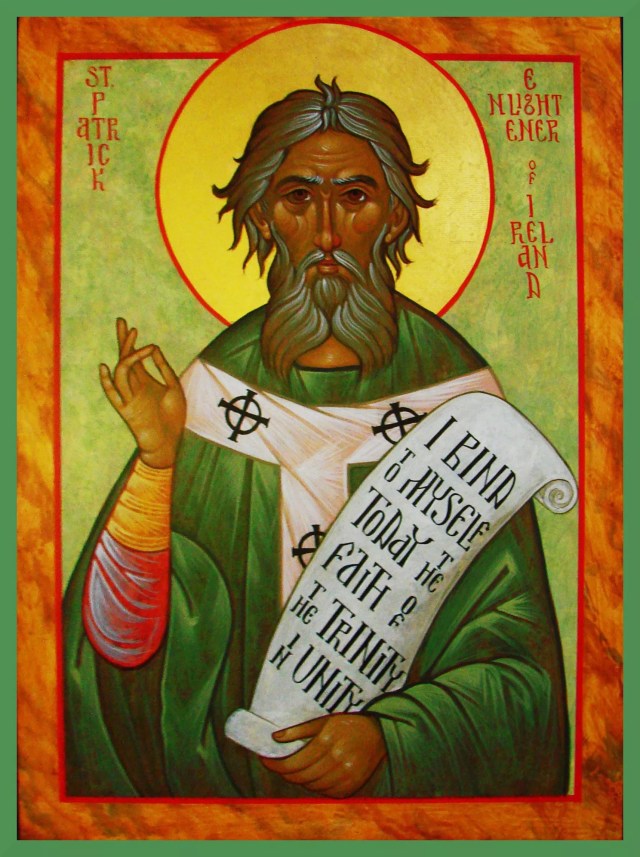
Let us consider for a moment the life of Patrick. Begin by forgetting all the mythology – all the stuff about snakes, shamrocks, and the hymn we know as St. Patrick’s Breastplate. All of that dates from centuries after the saint lived. We cannot prove that all those stories are false – it is hard to prove a negative fact – but I suggest that rather than look at what was written about him three hundred years after his death we look instead at primary evidence – what he actually wrote.


For we have two documents written by Patrick himself. First, The Confession or Confessio, a defense of his life written in response to attacks upon him. Second, a Letter to the Soldiers of Coroticus, the Epistola militibus Corotici. Both were written in Latin, and at one point Patrick apologises for his poor the Latin is, compared to that of his learned contemporaries. The irony is this apology is that these two documents are the only Latin documents written in Britain in this time – the 4th or 5th century – that has survived.

Patrick was British. That is, he was born perhaps in what we might call Cumbria, the son of a deacon and part of the Romanized British population. At home he probably spoke an archaic form of what we now call Welsh, which means that when he went to Ireland he could understand the different but related form of ancient Irish spoken there. He would have learned Latin, but his education was interrupted at the age of 16 when he was captured by slavers and taken to Ireland, where he was sold to a farmer. In modern day language, he was a victim of human trafficking. He was obliged to be a shepherd, and in the trauma of slavery he found himself falling back on the psalms and the God of his forebears. While much of Britain at the time was Christian, as was most of the Roman Empire, Ireland, having been outside the Empire, was relatively untouched by the faith. There may have been a missionary named Palladius, but his impact was relatively minor.

patrick21Patrick escaped from slavery and made his way, perhaps via Gaul and Brittany, back to his home. However, he did not escape his deep faith in Christ, and felt a call to return to the land of his slavery and to preach the freedom he had found in Jesus. In due course he was trained and ordained as a missionary bishop, and sent off to the wild island. The training he received and the tradition he was part of was that of Celtic Christianity, grounded in monasticism and the people.

Patrick believed that in so doing he was preaching to the edge of the world. He prayed and looked for the coming of Jesus by taking the gospel to the furthest corner of the known world. The response was good. He says he had baptized thousands. He did not convert the whole of the country, as later tradition held, but he did manage to establish a core of Christians whose influence in the decades and centuries following led the island to become thoroughly Christian.

Is it not astonishing that Patrick acted the way he did? He might have returned home and decided to have nothing to do with the Irish. He might have raised troops and returned to Ireland to attack those who had enslaved him. Instead he responded to adversity and the dehumanization of slavery by returning to them and preaching a gospel of love and acceptance, daring to meet with the high and lowly. He turned the other cheek, and gave the shirt off of his back.

What might this ancient saint have to say to us today? Well, there are many on both the left and the right who would advocate for hatred and animosity on the basis of ethnicity, religious origin, and of perceived wrongs. Exacerbated by the echo chambers and silos of online forums and non-stop commentary of cable news we have young people and old folk driven to believe that violence is the answer. And so we see massacres such as we have seen in Christ Church, New Zealand and Quebec City, Canada, Brussels and Paris, in London and Manchester. Obviously we need to defend ourselves against such attacks, but the Christian response is not to cease relations with those who differ from us, but to engage with them and to build relationships. As Patrick did, we need to take risks, knowing in advance that we will be unsettled, that it will not result in any predetermined outcome, but that in the long run a foundation of peace and love may be established.

When it comes to relations with other faiths we are called not to judge but perhaps to be encouraged how to be better at our own. When examining the customs of other faiths about food and clothing perhaps it would be best to look at what ours might say about us, for what we consider to be normal and natural may in fact prove to be anything but.

There are three world faiths that claim Abram, later to be named Abraham, as their forebear – a) Judaism by descent through Isaac and the promise we read about today in Genesis; b) Islam by descent through Ishmael and traditions connecting him to the Kaa’ba in Mecca; and c)  Christianity by claiming that Abraham is the “father of faith”, as Saint Paul puts it. And we are related. To me the most poignant scene in Genesis is when Abraham is buried alongside Sarah on the only land they owned, their graves, in Hebron. The two brothers come together to bury their father. Now, of course, brothers do not always get along – but that is not an excuse for violence and murder. The animosity between Jew, Muslim, and Christian too often leads to fratricide. In Genesis we heard, “Look toward heaven and count the stars, if you are able to count them.” Then he said to him, “So shall your descendants be.” In the Abrahamic religions this has come to pass. And he believed the Lord; and the Lord reckoned it to him as righteousness.

maxresdefault

Patrick followed in the footsteps of Jesus in being willing to accept suffering at the hands of those who opposed him. “Not a day passes but I expect to be killed or way-laid or taken into slavery or assaulted in some way (Confessio 55). Jesus broke the cycle of violence, and Patrick, the saints, and his holy ones today who follow in that way continue to break that same cycle.

only_love_can_break_the_cycle_of_violence_bishops_respond_to_violence_in_the_us

We Christians who claim decent from Abraham are made children of God and righteous by the faith of Christ. There are present day Herods who for political reasons would seek to kill the most vulnerable among us, whether it is Yemeni children, Syrian refugees, concert goers in Manchester, people on the London Underground, or people at worship in Quebec City and Christchurch. May we not be cast into fear, but continue to drive out all evil that is among us, heal the world, and finish the work of Christ.

1552718236743

Young women gathered for a vigil in Aotea Square, Christchurch NZ held signs hand painted with messages of unity and solidarity.


Bibliographic Note: The Confessio and the Epistola militibus Corotici can be found in a modern English translation, as well as with a learned discussion of what can be learned from them about the saint, in Thomas O’Loughlin, Discovering Saint Patrick (Mahwah NJ: Paulist Press, 2005).

Posted in Sermons | Tagged , , , , | 1 Comment

Let All The World In Every Corner Sing

W88

Antiphon (1)

Let all the world in ev’ry corner sing,
My God and King.

Vers. The heav’ns are not too high,
His praise may thither fly:
The earth is not too low,
His praises there may grow.

Cho. Let all the world in ev’ry corner sing,
My God and King.

Vers. The church with psalms must shout,
No door can keep them out:
But above all, the heart
Must bear the longest part.

Cho. Let all the world in ev’ry corner sing,
My God and King.

George Herbert could write very simple and effective praise, and this is an example of it. He sets it up as a call and response between a choir and a cantor, the choir singing the chorus and the cantor (or perhaps a second choir) singing the verses. Its title is Antiphon, which according to the Oxford English Dictionary comes from the Greek τὰ ἀντίϕωνα and means “things sounding in response”.

It has been set to music several times. As a hymn it is most commonly sung to the tune Luckington by the English organist and choirmaster Basil Harwood. This is it:

It was also set to music by Ralph Vaughn Williams. Vaughn Williams set five of Herbert’s poems to music in Five Mystical Songs, first performed in 1911. Antiphon (1) is the last of the five; this is that version:

The first stanza, building on the chorus, expresses the expansive nature of the praise of God. All are invited – nay, commanded – to sing praises to the Creator. Heaven is not too high and earth is not too low. The church is bursting with praise. I am not at all clear about what “the longest part” is that the heart must bear, but I suspect it simply means that the heart gets the longest and most difficult part of the chorus (remember, in The Altar the altar is built of a broken heart, and in in Prayer (1) the heart is on a pilgrimage, which is never too easy).

Posted in Lent, Music, Poetry and Novels | Tagged , , | 3 Comments

George Herbert at Prayer (1)

54da4ece5e0b5_-_best-dressed-intro-0908-lg

Some well dressed men, according to Esquire Magazine

Prayer (1)

This is another sonnet by George Herbert, but what a sonnet. Look for a controlling verb and you won’t find one. No, what we have here is a cascade of words creating  pictures of prayer. It sounds like a 16th Century version of Billy Joel’s We Didn’t Start the Fire.

The images are not cute or pious. They range from familiar to unsettling. In order they are:

Prayer

The first four lines are quite heavenly, and the second four are quite earthy. The imagery of warfare is quite jolting, except that in prayer one ought to truly bring one’s own self, as ugly as that might be; God accepts us with our imperfections.  At line nine, Softness, and peace, and joy, and love, and bliss, the tone changes again.

Bird

A Bird of Paradise

The final two words jump out as different. Something understood is not an image like the preceding twenty-six pictures. It is a continuation of the first word – Prayer. Prayer is something understood – by human beings, by God. It is paradoxical, a mystery. In my experience prayer is not about changing God’s mind, but about changing – transforming – ours. If I pray regularly I will become a different person. Prayer is taken so often for granted, and it can become perfunctory and rote. But, the way Herbert describes it, it sounds like the most wonderful thing possible. And so may it be for me and for you.

Posted in Lent, Poetry and Novels, Prayer | Tagged , , | 3 Comments

“The Affliction” of George Herbert

NPG D9432; William Crowe ('A celebrated public orator') by and published by Robert Dighton

William Crowe (1745–1829), Public Orator at the University of Oxford.

There are no fewer than five poems titled Affliction in The Temple; obviously, suffering is a major theme for George Herbert. In this post I will reflect on the first, usually identified as Affliction (1).

You can find the poem here. The critics I have read all agree that it is Herbert’s most autobiographical poem. Some suggest that it was written around 1625, when he was in the process of making a major change in his life. King James VI & I and two of his patrons died, and any hopes of a career at court or in politics appeared to be at an end. He could have remained at King’s College, Cambridge, but it his positions there, especially as Public Orator of Cambridge University, were always means to the end of political preferment. He was thirty-two, wanted to be married, but had not yet made a suitable match. Herbert was restless, and this is reflected in the poem. While normally I would eschew biography in attempting to assess a poem, this is one of those cases where the exception is admitted.

There are eleven stanzas of six lines each, making sixty-six lines in total; this is a medium size poem for Herbert. The syllables in the lines of each stanza are 10.6.10.6.10.10, with the rhyme ABABCC. As is usual in English poetry, it s iambic pentameter.

The first three and 2/3rds stanzas, twenty-two lines, are unusually positive. Herbert here is reflecting on his youth and his simple affection for the divine and all that went with it.

At first thou gav’st me milk and sweetnesses;
I had my wish and way;
My days were straw’d with flow’rs and happiness;
There was no month but May.

But in the fourth stanza it suddenly changes:

But with my years sorrow did twist and grow,
And made a party unawares for woe.

My flesh began unto my soul in pain,
“Sicknesses cleave my bones;
Consuming agues dwell in ev’ry vein,
And tune my breath to groans.”
Sorrow was all my soul; I scarce believ’d,
Till grief did tell me roundly, that I liv’d.

The poem continues in this vein for twenty-two lines, He writes about illness from which he temporarily recovers, then he turns to an academic career, although he was perhaps more inclined to a career in London:

Whereas my birth and spirit rather took
The way that takes the town;
Thou didst betray me to a ling’ring book,
And wrap me in a gown.

Frustrated from using his academic status as a launching platform for a political or diplomatic career, he nonetheless receives praise. But then illness returns:

Yet lest perchance I should too happy be
In my unhappiness,
Turning my purge to food, thou throwest me
Into more sicknesses.

The tone throughout is an indictment of God, a complaint by Herbert about what God has done with him. He writes as if he has been seduced by God, but his approach to the divine is pretty self-centered:

I looked on thy furniture so fine,
And made it fine to me;
Thy glorious household-stuff did me entwine,
And ‘tice me unto thee.

Illness, the death of his friends and family, and the frustration of a career at court led to an  end to the early, simple joy, but none of his self-concern. He felt less substantial (perhaps literally, because of tuberculosis), and perhaps subject to wild emotions.

My mirth and edge was lost, a blunted knife
Was of more use than I.
Thus thin and lean without a fence or friend,
I was blown through with ev’ry storm and wind.

He is restless, and doesn’t know whether to stay or go:

I could not go away, nor persevere.

At line fifty-five, the beginning of the second to last stanza, his reflection turns from the past to the present:

Now I am here, what thou wilt do with me
None of my books will show;
I read, and sigh, and wish I were a tree,
For sure then I should grow
To fruit or shade: at least some bird would trust
Her household to me, and I should be just.

All of Herbert’s learning is unhelpful in knowing what to do. He expresses a wish to move from the dead paper to the living tree from which it was made, so that he would have some kind of use. His lonely solitude is expressed in a desire that “some bird would trust/her household to me”. One is reminded of Jonah and his grumpiness about the repentance of Ninevah and his joy over the shade given by a plant. The poet remembers the necessity of humility:

Yet, though thou troublest me, I must be meek;
In weakness must be stout;
He resolves to change:
Well, I will change the service, and go seek
Some other master out.

This may be an indication in the poem that Herbert has decided to pursue ordination, thus taking God on as his new master, as opposed to the secular monarch, or the mistresses of rhetoric, rhyme, and reason.

The last two lines have generated much discussion. While the lines quoted above suggest a major change coming, it is still generated from a restlessness, the result of certain paths becoming blocked, of a sense of uselessness. It is not generated by what is the central underlying theme of poem, and the general theme of The Temple – the love of God, or God as love. The poem, then, has a quality of being unresolved, which is why the last line is so surprising. Instead of a loving commitment to the God of love the poet continues in his sharp, demanding tone, undermining the previous decision to find a new master:

Ah my dear God! though I am clean forgot,
Let me not love thee, if I love thee not.

He accuses God of having forgotten him, as though it were not Herbert resisting God, but God deliberately thwarting him. Herbert was happy when “I had my wish and way”, but he does not stop earlier to consider what God’s ways and wishes were for him. In modern language, Herbert considers his privilege as natural, and cannot see that the religion in which “Such stars I counted mine” was never his as a possession, but something calling to him. He was one of those who passed by in The Sacrifice and did not recognize the face of Christ calling to him.

lanyard-knot-feature-image-2xx9jd7yi8p3bq3l2ivjswLet me not love thee, if I love thee not.” This last line is confusing, but I think its meaning can be discerned. Inge Leimberg argues that Herbert may be writing English but thinking Latin in the last two lines. As evidence she points out that “clean forgot” is a Latinism for oblitus sum, where proper English would be “I am clean forgotten”. The last line can be read, then, with the first “not” applying, as it might in Latin, to “love” and not “Let” — “Let me love-not thee”. The last line, paraphrased, might read: “Let me still be your servant not loving you, for I may be incapable of loving you.” It is the cry of a sinner who has hit rock bottom and knows that in response to the absolute love of God his own love is faulty and “cross-biased” or knotty.

The emergence of the word love, twice, after 65 lines, indicates the real theme of the poem – the asymmetry of the love of God and the love of the human being. In the poem the poet misunderstands the love of God, is distracted from its proper meaning by subsuming it to his career, and confused and restless when what he thought he was both born to and qualified for does not come about. The station along the way to great heights, academia, turns out to be a terminus, and he is perturbed and disgruntled. His illnesses weaken him, and he is aware of the shortness of life. He calls himself into question, recognizes he needs to make a change, but now knows just how hard that change will be. In a sense, this is a poem about the conversion of a Christian, about being transformed by the sufferings and becoming more Christ-like because of them.

This is then a second theme of the poem – the meaning of suffering. He has already meditated on the suffering of Christ, he has announced his own, and in the rest of The Temple he will continue to explore.

This poem resonates with me the more I read it. After almost thirty years of ordained life in the Anglican Church of Canada I was restless. There was a career path in that church, but after a few tastes at power and honours (I had been a diocesan archdeacon and executive officer) I felt in my body a real hesitation to “climb the ladder” of ecclesiastical preferment. I was in a place where I was appreciated and loved, and “I could not go away, nor persevere.” I had been quite ill at times, and while never as severe as Herbert’s consumption, it shook me. I knew I needed a change, but had no idea what it was to be. Well, I have now made a change – with my wife I have moved to the island of Crete, where I now serve a small congregation of non-Greek English-speakers, a chaplaincy within the Diocese in Europe, part of the Church of England. It’s about as peripheral as you can get in the Church of England. Now, I am no George Herbert — I am not an academic as he was, Gavalohori is not Bemerton, and I cannot write poetry. But I feel that I have never been so open to “the wish and way” of God, and never so content. Like Herbert, I want to know God’s love despite my own failure in loving.


Posted in Lent, Poetry and Novels | Tagged , , , , | 2 Comments

A Lenten Study on the Book of Psalms

Psalms_Scroll-half

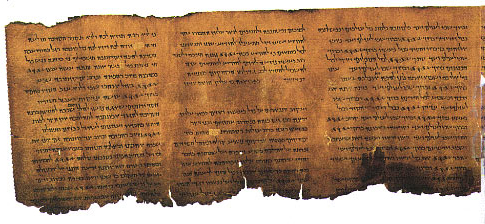
One of the many Psalm Scrolls from the Dead Sea

In the Anglican Chaplaincy of St. Thomas, Kefalas, here on the island of Crete, I am leading a Lenten study on the Book of Psalms. Here are a few notes on the first session, held on March 12, 2019.

Some Basic Context

  • They are written in Hebrew. The standard critical text of the Hebrew Bible uses the Lenigrad Codex of the Masoretic text. This dates from 1008 0r 1009 CE.
  • The Hebrew Bible is organized differently from the Bible Christians use. It has three sections, which appear to correlate with age and the stabilization of the text.
    • Torah: The oldest is the five books in the Torah, which consists of the continuous narrative of Genesis, Exodus, Leviticus, Numbers, and Deuteronomy. These five books are usually written on one scroll, one side only, without editorial vocalizations that are found in the Masoretic Text. In synagogues the Torah Scroll is kept in the ark above the Bema, the platform from which the Torah is read. Jewish synagogues read through the whole of the Torah in one year.
    • Nevi’im: The next section is the Prophets, or Nevi’im. This includes books Christians tend to consider more like history such as Joshua, Judges, 1 & 2 Samuel and 1 & 2 Kings. It also includes Isaiah, Jeremiah, Exekiel, and The Twelve.
    • Cethubim: The third section, called The Writings, or Cethuvim, still somewhat undefined during Jesus’s time, is a diverse group of texts, including 1 & 2 Chronicles, Daniel, Job, Proverbs, and the Psalms.
  • The Hebrew Bible is often referred to within Judaism as the Tanach, a word creating from the first initial of the three sections in Hebrew.
  • While the Torah would have been on one scroll and placed in a special location in the synagogue, the other books of the Bible would have been kept in a rack or box as independent scrolls. The Hebrew Bible was more of a library than a single book.
  • Only when the technology of binding sheets in codices (what we are used to as a book), using both sides of the paper, and easily used compared to rolling and unrolling scrolls, was the library that makes the Hebrew Bible put into a single book.
  • The Dead Sea Scrolls, discovered after World War I in caves in the Judean desert, contains many parchment and papyrus texts, including a virtually complete copy of Isaiah. There are many copies of psalms in the scrolls in various states of decay. Although a thousand years older than the Leningrad Codex the Dead Sea Scrolls did not dramatically change the critical text – the Masoretes had done a good job of transmitting the text.
  • Jewish people in Egypt translated the Bible into Hellenistic Greek about 150 BCE. This translation was widely used among Hellenistic Jews into the 2nd Century CE. Supposedly seventy scholars worked on the translation, so it is known as the Septuagint (“LXX”). Christians adopted it as their Bible, appending the much shorter New Testament to it. This remains the Bible of the Greek speaking part of the Orthodox Church (and not all that well understood by modern Greeks – it’s a bit like modern anglophones listening to Chaucer).
  • Modern translations in English are based on the Hebrew Masoretic text, with occasional emendations based on the Septuagint, the Dead Sea Scrolls, and other ancient texts that may preserve older readings.

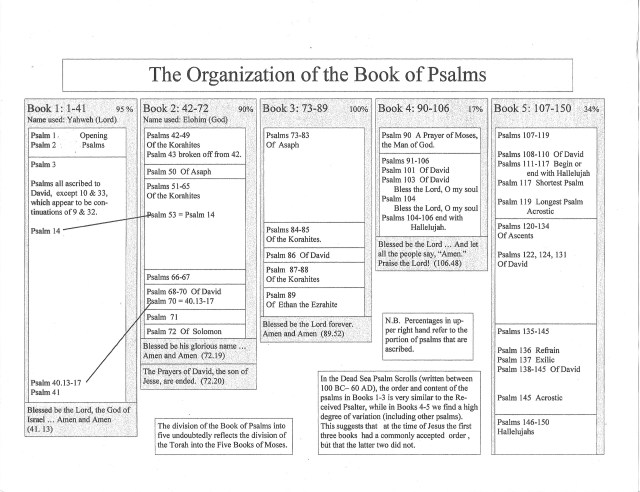
The Organization of the PsalmsThe Book of Psalms

  • The name in Hebrew is Tehillim, which means “Praises”. The name in the Septuagint is “Psalmoi” which means “Pluckings”, referring to the fact that when sung the psalms were accompanied by stringed instruments, such as a lyre.
  • One needs to distinguish between modern editorial additions in translations and ancient ascriptions in the ancient Hebrew manuscripts. This is not always obvious! For example, the New Revised Standard Version writes “The Divine Shepherd” above Psalm 23, but that is a modern title given to it by the translators and editors. There is also the ascription A Psalm of David, which is in the ancient Hebrew text.
  • The manuscripts divide the Book of Psalms into five “books”. This undoubtedly corresponds to the five books of the Torah – the psalms, although a different genre, are to be read as “Law” or “Instruction” (which is what Torah means). Each “book” ends with a doxology.
  • Many of the psalms have ascriptions at their beginnings, but not all. They identify the presumed author, perhaps a tune, and sometimes links it to a story found in Samuel or Kings. For example, Psalm 51 (the Miserere) has the words “To the leader. A Psalm of David, when the prophet Nathan came to him, after he had gone in to Bathsheba.”. Psalm 8 has “To the leader: according to The Gittith. A Psalm of David.” Nobody really knows what a Gittith is, but it is presumably a tune. Psalm 5 has “To the leader: for the flutes. A Psalm of David.” – indicating that a variety of instruments were used.
  • Psalms found in Christian prayer books or liturgical texts usually dispense with reproducing the ascriptions.
  • Psalms 1 and 2 do not have ascriptions. This seems to suggest that they are introductions to the rest of the Psalter. Psalms 146-150 are all filled with praise, with the word “Hallelujah” (which means “Praise the Lord” – a fitting way to conclude the Book of Psalms.
  • There is evidence that the Book of Psalms is a collection of collections. This is indicated by the fact that some psalms are repeated. Psalm 14 is more or less the same as Psalm 53.
  • The Dead Sea Psalm Scrolls are in the same order as the Masoretic text for the first three books, but begins to vary in Books 4 and 5. The order of the psalms change, and sometimes there are some otherwise unknown psalms in the scrolls. This suggests that while the Book of Psalms was considered inspired at the time of the hiding of the dead Sea Scrolls (around 66-70 CE), the precise contents were more variable than we might expect (or accept!). This suggests that the tail-end of the Book of Psalms was still in flux, and that the contents had not yet stabilized.
  • The ascriptions run over 90% in the first three books, but drops to 17% in Book 4. Not all the ascriptions are present in the Dead Sea Scrolls. This suggests that they  were added by ancient compilers and editors.
  • While many psalms are ascribed to David, many are also not. Psalm 89 is uniquely ascribed to an otherwise unknown Ethan the Ezrahite. It is arguably the angriest psalm in the whole book, calling God out for breaking his covenant with the heirs of David. The response is found in Psalm 90, which is ascribed to Moses – to such a devastating indictment they bring out the most important person in Israelite history.
Posted in Lent | Tagged , , , | Leave a comment

Easter Wings

Through Lent With George Herbert
(Wednesday after the First Sunday of Lent)

5139063073_533cd19e8e_b

Two poems, both named Easter Wings. Easter Wings (1) on the left, Easter Wings (2) on the right. From the first printing of The Temple. George Herbert: The Temple. [University of Cambridge: T. Buck and R. Daniel, 1635.] University of Glasgow Library. Sp Coll Bi6-l.30.

In The Altar George Herbert uses the layout of the poem to reinforce the idea in the text – the poem speaks of an altar, and it looks like an old pagan altar. Here are two more famous examples of these shape poems, both of which are called Easter Wings (and which some critics consider to be one poem). Apparently the use of such an image went back to one Simmias of Rhodes, who wrote in Greek and lived around 300 BCE; it is probable that Herbert knew his work, for he was a classically trained Englishman who wrote poetry in Greek and Latin. Here the two poems each consist of ten lines in the rhyme scheme ABABACDCDC.  The shape is created by the fall and rise of syllables in each verse: ten in line one, eight in line two, six in line three, four in line four, then just two in line five. Then in reverse order, two, four six, eight, and finally ten in line ten.

Building on the simile in line eight of Easter Wings (1), the wings have been identified by Joan Bennett in 1962 as “the rise and fall of a lark’s songs and flight.” It is probably more than that. C. C. Brown and W. P. Ingolds, in an article from 19721  go beyond Bennett to suggest that the key text behind the poems is Malachi 4.2:

But for you who revere my name the sun of righteousness shall rise, with healing in its wings.

This was read in ancient Judaism as a reference to the Messiah, and so for Christians is a reference to Jesus. Brown and Ingold also connect these wings with that of the two cherubim that sit on the cover of the Ark of the Covenant. Cherubs seem to come in pairs (Cherubim is the plural of Cherub in Hebrew), and the authors of the article note many instances of that in the Hebrew Bible and the New Testament.

Two of these instances is  the story of the resurrection in the Gospels according to Luke and John. Mark and Matthew each have one angel showing up, but in Luke 24.1-9 we read:

But on the first day of the week, at early dawn, they came to the tomb, taking the spices that they had prepared. They found the stone rolled away from the tomb, but when they went in, they did not find the body. While they were perplexed about this, suddenly two men in dazzling clothes stood beside them. The women were terrified and bowed their faces to the ground, but the men said to them, ‘Why do you look for the living among the dead? He is not here, but has risen. Remember how he told you, while he was still in Galilee, that the Son of Man must be handed over to sinners, and be crucified, and on the third day rise again.’ Then they remembered his words, and returning from the tomb, they told all this to the eleven and to all the rest.

Likewise in John 20.11-13:

But Mary stood weeping outside the tomb. As she wept, she bent over to look into the tomb; and she saw two angels in white, sitting where the body of Jesus had been lying, one at the head and the other at the feet. They said to her, ‘Woman, why are you weeping?’

I suspect that the presence of two angels at the resurrection is of greater significance to Herbert than the passage from Malachi. Now to the poems themselves.

Addressing God as Lord, the first Easter Wings describes in its first half, as the syllables descend from ten to two, the Fall of Humanity, alluding to the story in Genesis. But if there is a Fall, there is an ascent, which begins with the words “With thee”, two small but powerful words, pregnant with possibility. The seventh line, “O let me rise” signifies the beginning of the ascent. The simile to larks, both flying and singing, is made in the next line, and the final line refers to the felix culpa, that the further the fall the higher the ascent by the believer in Christ.

The second Easter Wings seems more personal. He starts by saying, “My tender age in sorrow did begin”, which may be a conventional reference to original sin, but perhaps is also a reference to his father’s death when Herbert was only three. We cannot tell when Herbert wrote his poems with any accuracy, but as a young man Herbert contracted tuberculosis, which contributed to his early death. Thus the words, “that I became/most thin” sound like a small self-portrait, ghastly and powerful in its economy of language. Again, line six begins the second half, the ascent, with the words, “With thee”, for only with God in Christ can the ascent take place.

The word “imp” in line nine is archaic and obsolete, but is taken from falconry. According to the Oxford English Dictionary it means:

To engraft feathers in the wing of a bird, so as to make good losses or deficiencies, and thus restore or improve the powers of flight; hence, allusively, with reference to ‘taking higher flights’, enlarging one’s powers, and the like.

It is apparently derived from the Greek, ἔμϕυτος, ἔμϕυτον “implanted”, “engrafted”. The speaker in the poem can only rise “if I imp my wing on” that of the resurrected Christ. Again, the theme of felix culpa emerges, and all of Christ’s sufferings – and the poet’s “sickness and shame/ thou didst to punish sin” – serve to “advance the flight in me.”

Just as two cherubim were set to guard Eden, but now announce Christ’s resurrection, so these two poems stand in Herbert’s The Temple to announce Fall and Flight. They are the wings of angels, but also the wings of sinner and redeemer.

Footnote

1. C. C. Brown and W. P. Ingolds (“George Herbert’s Easter-WingsHuntington Library Quarterly Vol. 35, No. 2 (Feb., 1972), pp. 131-142)

Posted in Lent, Poetry and Novels | Tagged , | 4 Comments

George Herbert’s “Redemption”

Through Lent With George Herbert
(Tuesday after the First Sunday of Lent)

After yesterday’s The Sacrifice Herbert has several shorter poems that try to respond to what is said in it. The sixth poem is this one:

Redemption

Having been tenant long to a rich lord,
    Not thriving, I resolvèd to be bold,
    And make a suit unto him, to afford
A new small-rented lease, and cancel th’ old.
In heaven at his manor I him sought;
    They told me there that he was lately gone
    About some land, which he had dearly bought
Long since on earth, to take possessiòn.
I straight returned, and knowing his great birth,
    Sought him accordingly in great resorts;
    In cities, theaters, gardens, parks, and courts;
At length I heard a ragged noise and mirth
    Of thieves and murderers; there I him espied,
    Who straight, Your suit is granted, said, and died.
Cottage

This might be a “new small-rented house”.

It is a sonnet, in the usual fourteen lines of ten syllables each in iambic pentameter. , with the rhyme scheme of ABAB CDCD EFFE GG. This might strike one as a bit unusual, as Shakespeare always used ABAB CDCD EFEF GG. However, Italian poets often used ABBA ABBA in the first eight lines, so Herbert using EFFE is not that much of an innovation, if one at all (I’m no expert on sonnets, and other English poets may have done this before him).

What I find striking about the poem is the way in which Herbert addresses the relationship of God and human in ordinary terms – a lease between a tenant and a landlord. Most of Herbert’s parishioners would have been tenants of a local lord, and would have immediately understood the worry of “not thriving” and the necessity to “cancel th’old” and get “A new small-rented lease”. The problem is that the tenant is undoubtedly bound by the old lease, and so it is at the discretion of the lord as to whether the old one can be replaced with the new, less expensive one.

Thus far the language is not theological, but in the next verse we read that the lord’s manor house is “In heaven”. Thus, this lord is The Lord. Somehow this tenant, as if in a dream, just pops up to heaven to look for the lord. And, in as matter-of-fact language as that in the first four verses, he is told he’s not there, he’s off to earth, you know, about a rather expensive piece of land.

Our narrator returns to earth and looks for him in places nobility, but does not find him. Then, hearing thieves and murderers and their “ragged noise and mirth”, he sees his lord, who says before a word is spoken, “Your suit is granted.”

There’s a lot of weird stuff going on here, but that’s typical of Herbert. The lord is found among thieves and murderers, just as Jesus would have been found with condemned rebels and robbers at his crucifixion. The land dearly bought is the redemption of humanity, and the tenant suing (i.e. requesting) for a change of tenancy is granted this request, and presumably receives that very expensive piece of land at little expense to him. Typically this is read very much along Lutheran terms (derived from Luther’s debatable reading of Paul) so that it implies a transfer from living under Law and living instead under Grace. However, it may be more ambiguous than that – it may simply be a move from sin and death to life and grace.

Another of the weird things is that the event in which the land “bought Long since on earth” turns out to be coincident with the moment when the tenant espies the lord, hears the lord speak, and then dies. There is no indication that the tenant spoke to the lord – it is as if the lord already knows all about it, and acts before a request is actually made. Time collapses, and the lord acts before being asked. This is the nature of the atonement of the cross – it is made available across time, and God acts without humanity asking him to do so, so caught up in our sins are we.

In other poems Herbert uses similarly ordinary images and relationships to convey the weird and wonderful nature of God’s salvation in Christ. Stay tuned.

Posted in Lent, Poetry and Novels | Tagged , | 2 Comments