Is the Holy Spirit Among Us?

A sermon preached (while wearing a mask) on
Pentecost Sunday: The Fiftieth Day of Easter at
The Anglican Church of St. Thomas the Apostle, Kefalas, Crete
May 31, 2020 11:00 am,
somewhat rewritten and expanded
.

The readings we used, from the choices appointed in the Revised Common Lectionary (“RCL”), Year A, were: Numbers 11:24-30, Psalm 104:25-35, 37, Acts 2:1-21, and John 7:37-39.

Pentecost Red Picture

Now he said this about the Spirit, which believers in him were to receive; for as yet there was no Spirit, because Jesus was not yet glorified.  John 7:39

Is the Holy Spirit at work in us today?

The answer for us is undoubtedly yes, but for many centuries there was a strong current of thought that the work of the Holy Spirit was done about a hundred years after the time of Christ. Certain Protestant churches, and in Anglicanism, as well, it was believed that the gifts of the Holy Spirit were restricted to the Apostolic era. Once the Holy Scriptures of the New Testament were done, sometime around 120 CE or so, the third person of the Trinity retired.  In fact, many Evangelicals across denominations continue to believe this.

So let us have a look at this belief and let me explain why I think it is wrong.

What, or Who, is the Holy Spirit

The Holy Spirit is God, one person of the Holy Trinity. God the Father is understood to be the Source of all things, who “begets” the Son and from whom the Spirit “proceeds”. The First Person of the Trinity is the one to whom Jesus prayed and who he obeyed. The Second Person is the Word of God, through whom the world was created, and in who all living things dwell. This Word became flesh in the person of Jesus of Nazareth, who preached. healed, drove out the evil things that posessed people, fed the hungry and reached out to the poor and marginalized, and ultimately was put to death by the Roman Empire and its collaborators among the Judean leadership and priesthood. This Jesus was raised from the dead to glory, and we believe him living still, and we look for his coming again.

So far so familiar (I hope). In the Gospel of John Jesus promises a Comforter for the disciples when he leaves them. This is the Spirit of God, which gives the people of God gifts for the building up of the church. Paul enumerates some of them in his First Letter to the Corinthians:

To each is given the manifestation of the Spirit for the common good. To one is given through the Spirit the utterance of wisdom, and to another the utterance of knowledge according to the same Spirit, to another faith by the same Spirit, to another gifts of healing by the one Spirit, to another the working of miracles, to another prophecy, to another the discernment of spirits, to another various kinds of tongues, to another the interpretation of tongues. All these are activated by one and the same Spirit, who allots to each one individually just as the Spirit chooses. (1 Corinthians 12:7-11)

This is not an exhaustive list of the gufts, but you get the picture.

Now, we Christians believe that the Holy Spirit was also active in the eras before Jesus.

  • Thus we hear in our first reading that the Spirit of God came upon the seventy elders, and even upon two who seemingly were not supposed to receive it.
  • In Exodus 25:10 we hear of Bezalel son of Uri son of Hur, of the tribe of Judah, who was filled with divine spirit to manufacture vessels and furnishings for the Tabernacle (i.e. the Temple).
  • When Saul was king of Judah and Israel he was told that,

    as you come to the town, you will meet a band of prophets coming down from the shrine with harp, tambourine, flute, and lyre playing in front of them; they will be in a prophetic frenzy. Then the spirit of the Lord will possess you, and you will be in a prophetic frenzy along with them and be turned into a different person. 1 Samuel 10:5-6

  • When Saul anointed David “the spirit of the Lord came mightily upon David” (1 Samuel 16:13), and he was seized with a similar frenzy when he brought the Ark of the Covenant into Jerusalem:

    David and all the house of Israel were dancing before the Lord with all their might, with songs and lyres and harps and tambourines and castanets and cymbals. 2 Samuel 6:5

  • The prophet Isaiah looked forward to a king of the House of David, and believed that:

    The spirit of the Lord shall rest on him,
    the spirit of wisdom and understanding,

    the spirit of counsel and might,

    the spirit of knowledge and the fear of the Lord. Isaiah 11:2

  • The prophets experienced the Spirit. For example, Ezekiel wrote,

    And when God spoke to me, a spirit entered into me and set me on my feet; and I heard him speaking to me. Ezekiel 2:2

While the Spirit came down upon a select few, one of the prophets believed that the ourpouring of the Spirit would be more general in the last days.

Then afterward
    I will pour out my spirit on all flesh;
your sons and your daughters shall prophesy,
    your old men shall dream dreams,
    and your young men shall see visions.
Even on the male and female slaves,
    in those days, I will pour out my spirit. Joel 2:28-29

The author of the Acts of the Apostles believed that this was fulfilled on the Day of Pentecost after the resurrection of Jesus. And it does seem, both from this book of the New Testament and from many others, that the coming of the Spirit was something shared by all Christians.

Suspicions

That said, there was seemingly some wariness of the Holy Spirit in ancient times. After all, when the Holy Spirit descended upon Jesus the first thing it did was drive him out into the desert to be tempted. The Gospel of John compares it to the wind, being equally unpredictable. Paul spends three chapters in his First Letter to the Corinthians addressing the relative importance of the gifts of the Spirit.

In the Second Century CE  a man named Montanus lived in ancient Phrygia, in what is now Turkey. He claimed to be inspired by the Holy Spirit, and a new prophet. Perhaps more disturbingly to others, he had two female followers named Prisca and Maximilla, who became co-equal leaders of the movement with him. They had ecstatic visions, spoke in tongues, and claimed a lineage of prophecy going back to the daughters of Philip. They encouraged ordinary laity to practice fasting and other ascetic behaviors. They believed that their leaders could pronounce the forgiveness of sins without having to be ordained. All of this was very disturbing to the ordained leadership of the church, who were unsettled by the uncontrollable women and men of what became known as Montanism. It was condemned by various bishops and synods in the Second Century and subsequent ones, and slowly they died out by the Seventh Century.

Fast forward to John Calvin (1509-1564), the man who launched the Reformed or Calvinist stream of Protestantism. Calvnism is the historic theology and doctrine of the Church of Geneva, a large part of German Protestantism, the Netherlands, Scottish Presbyterians (and Irish), and many evangelicals. The Puritans in England sought to impose Calvinism on what they considered to be an only partially reformed church.

Jean Calvin (or Jehan Cauvin, as his mother would have known him) was a French lawyer, and renounced Catholicism for the reformed faith being preached by Martin Luther and Zwingli in Zurich. Calvin disagreed with Luther on several points, and when he was the leading pastor in Geneva he wrote the Institutes of Christian Religion, initially in 1536 and revised and massively expanded several times before his death in 1564.

Calvin disliked many things about the Catholicism of his time. One was the claim of authority by the church by virtue of the Holy Spirit For Calvin there was one authority only, and that was scripture. The claim that the Holy Spirit was active in the church legitimated Roman authority. Calvin held that ever since the canon was closed, some hundred years after Jesus’s death and resurrection, the Holy Spirit was less active. Therefore, real Christians have not needed anything since; just read the book. As well, Calvin hated all the miracles and visions of Catholicism. These were not spiritual, but probably demonic, in his opinion.

For historians and sociologists this exaltation of reason and text over the spiritual led to the disenchantment of the world. In becoming less spiritual and deeply sceptical about miracles, and more about belief and assent to propositions, Reformed Christianity created the context for the emergence of the sciences, regarding the material world not as miraculous, but as rational and subject to exploitation.

This disenchanted approach to the material world dominated Christian thought for the next four centuries. Even Catholicism became more reticent in the works of miracles among us.

Revival

But then, about 120 years ago, a group of protestant Christians, who probably had not paid much attention to Calvin, if they knew him at all, came into being in a poor part of Los Angeles. They were African-Americans, not exactly well educated by middle-class white standards, and their pastors derived from what is known as Holiness Movement that put a premium on personal sanctity.

event_azusa_street_revivalIt was led by William J. Seymour, an African American preacher at the Azusa Street Mission. It started in 1906 and continued until roughly 1915. On the night of April 9, 1906, Seymour and seven men were waiting on God. “Suddenly, as though hit by a bolt of lightning, they were knocked from their chairs to the floor” and the other seven men began to speak in tongues and shout out loud praising God. The news quickly spread; the city was stirred; crowds gathered; and a few days later Seymour himself received the Holy Spirit; services were moved outside to accommodate the crowds who came from all around; people fell down under the power of God as they approached; people were baptized in the Holy Spirit and the sick were healed and sinners received salvation.
Azusa_RevivalThis was the beginning of what we now call Pentecostalism.  For much of the 20th century it was looked down upon by main-line denominations, especially Calvinists. They were Holy Rollers. They used popular music. Scandalously, many of their clergy were women. Could anything good come out of America – out of L.A.? They were accountable to no one, seemingly, because of their appeal that they were guided by God the Holy Spirit. They seemed less interested in theology than demonstrations of healing and speaking in tongues, which just seemed weird. It seemed wide open to abuse by fraudsters and hucksters. Their reading of the Bible seemed all too simple, with no nuance.

And yet, it grew. It spilled over into Catholicism and Anglicanism as the Charismatic movement, from the Greek word for “gifts” charismata. Arguably the majority of the growth of the church in the past 100 years has been due to the Pentecostal and Charismatic movements that had its source in Azusa Street in Los Angeles. As Christianity grew in Africa and Asia, and was remade in South America, Christians there looked back at North America and Europe and felt sorry for us here, seeing us as living in a spiritual wasteland. Finally, in the past twenty years, it has grown even in the Church of England, spreading through churches such as Holy Trinity Brompton and its Alpha course. We now have an Archbishop of Canterbury, Justin Welby, who admits that he speaks in tongues and does so as part of his personal prayers.

So where might that leave us?

The Holy Spirit For All of Us

I am not a Charismatic. I don’t speak in tongues. I claim no special gifts of healing. I am probably rather skeptical of many claims of inspiration, wanting to test them against scripture, tradition, reason, and experience.

However, I cannot discount the power of the Holy Spirit.

  • This is the same Spirit which propelled the small group in Jerusalem from some 120 souls to the current 2.3 billion.
  • This is the same Holy Spirit which inspired the authors of the Holy Scriptures and inspires modern day prophets and activists.
  • It is the Holy Spirit which reformed the church in the 16th century.
  • It opened up ministry to women, and encouraged the laity to claim their baptismal ministries.
  • This is the same Holy spirit that has allowed us in the past century to look across our differences as Christians and to create the ecumenical movements.
  • This is the same Holy Spirit which is at work in Eastern Orthodoxy, calling the faithful into a union with Christ that allows for believers to become ever more like Jesus, thus allowing the human to become divinized.
  • It is the same Holy Spirit we call down on the bread and wine so that it may be for us the body and blood of Jesus Christ.
  • It is that Holy Spirit which allows us to be the Body of Christ, a mystery that goes beyond propositions and text.

And, I suggest, it is that same power which founded the church here some seventeen years ago, and which will carry us on for years to come.

So, yes, the Holy Spirit is at work in us, even if we do not speak in tongues. Come Holy Spirit. Maranatha. Come Lord, come.

Posted in Sermons | Tagged , , , , | 1 Comment

Resources for Trinity Sunday

These are Trinity Sunday resources gathered from a variety of sources and meant mainly for The Anglican Church of St Thomas the Apostle, Kefalas, on the island of Crete in Greece, but others may find them helpful!

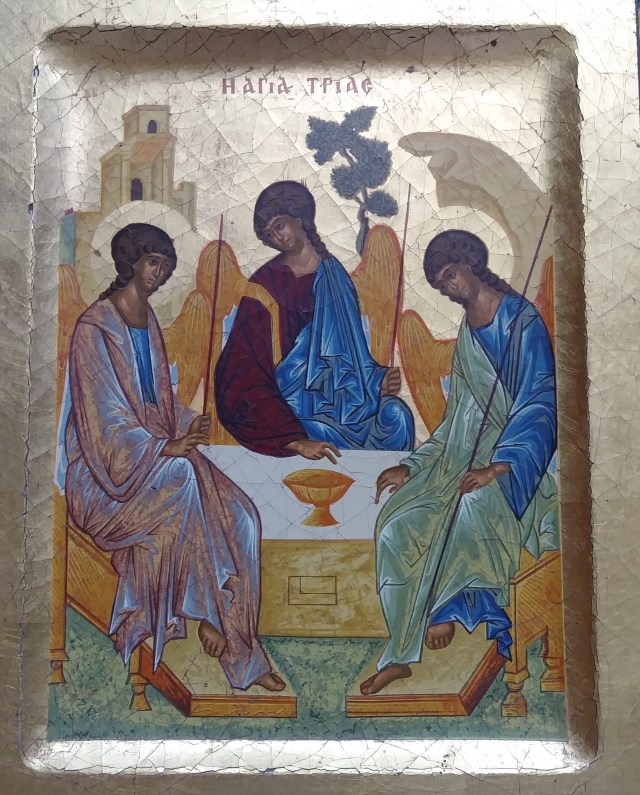
Η Αγία Τριάς

Η Αγία Τριάς (The Holy Trinity). A modern Greek copy after “Troitsa” 1411 or 1425–27 CE, by Andrei Rublev (Russian, c. 1365 – c. 1428). This is a photograph of the one that hangs in the Anglican Chapel of St Thomas, Kefalas. The original by Rublev is in the Tretyakov Gallery in Moscow.

Share

There are three ways you can use these resources.

First, you can join us for worship in person. We have resumed worship and will continue this coming Sunday, June 7, 2020 at 11:00 am EEST at the Tabernacle of the Church of St Thomas, Kefalas. It will be a Holy Communion according to Common Worship. People should come only if they are comfortable with being out and about as the pandemic restrictions are being lifted, and are in good health. Those of you were were there last week and are coming again, please remember to return with your hymn book, psalter, and service booklet!

Second, you can join us via ZOOM. We will livestream the service at the Tabernacle at 11:00 am EEST (9:00 am BST for you folk in England). The link is (as last week):
https://us02web.zoom.us/j/85044839927?pwd=TkQ1cHEzNUNjSjVCNTNJVUJwSkZaQT09
Meeting ID: 850 4483 9927 Password: 010209 .
For those joining from a distance the Order of Service can be downloaded here: Easter Holy Communion 2020; The Order of Service will be shared on Zoom, as will the hymns.

Third, you can simply do it all yourself – read the lessons and pray the prayers below, as well as listen to the recorded sermon, and intersperse it all by clicking on the links to the hymns.

Read

The readings appointed in the Common Worship Lectionary of the Church of England – Year A are:

The Revised Common Lectionary (“RCL”), Year A is identical, except that it has Genesis 1:1-2:4a as the first reading. I am not sure why the Church of England has a divergent reading.

Reflect

Our Curate, the Reverend Julia Bradshaw, will be preaching this Sunday. In the meantime, here is the sermon preached by John Donne on Trinity Sunday, 1627.

Pray

Collect
Almighty and everlasting God,
you have given us your servants grace,
by the confession of a true faith,
to acknowledge the glory of the eternal Trinity
and in the power of the divine majesty to worship the Unity:
keep us steadfast in this faith,
that we may evermore be defended from all adversities;
through Jesus Christ your Son our Lord,
who is alive and reigns with you,
in the unity of the Holy Spirit,
one God, now and for ever. Amen.

(or)

Holy God,
faithful and unchanging:
enlarge our minds with the knowledge of your truth,
and draw us more deeply into the mystery of your love,
that we may truly worship you,
Father, Son and Holy Spirit,
one God, now and for ever. Amen.

Intercession H1

We come boldly to the throne of grace,
praying to the almighty God, Father, Son, and Holy Spirit
for mercy and grace.
We plead before your throne in heaven.

Father of heaven, whose love profound
a ransom for our souls has found:
We pray for the world, created by your love,
for its nations and governments:

  • Στην Ελλάδα προσευχόμαστε Αικατερίνη Σακελλαροπούλου, Πρόεδρος, και Κυριάκος Μητσοτάκης, Πρωθυπουργός (In Greece we pray for Aikaterini Sakellaropoulou, President, and Kyriakos Mitsotakis, the Prime Minister).
  • In the UK we remember our Sovereign Lady Queen Elizabeth, Supreme Governor of the Church of England, and her government led by the Prime Minister, Boris Johnson.
  • In Canada we also pray for Elizabeth, Queen of Canada, Her Excellency Julie Payette, the Governor General, and Justin Trudeau, the Prime Minister.
  • In the European Union we pray for Ursula von der Leyen, President of the European Commission; Charles Michel, President of the European Council; and Josep Borrell, High Representative of the Union for Foreign Affairs & Security Policy.
  • In the United States of America, for the President, Congress, and the Supreme Court, and the governments and judiciaries of its fifty states and many territories – for compassion, restraint, and justice. We pray that the great power of the United States will be used with care and an eye to lifting oppression.
  • For government leaders around the world as lockdowns are raised.
  • We pray for peace around the world, especially in Yemen, Syria, Afhanistan.
  • For those facing devastation from cyclones and hurricanes in India and the Gulf of Mexico.

Extend to them your peace, pardoning love, mercy and grace.
We plead before your throne in heaven.

Almighty Son, incarnate Word,
our Prophet, Priest, Redeemer, Lord:
We pray for the Church, created for your glory,
for its ministry to reflect those works of yours:

  • Remember Justin Welby, Archbishop of Canterbury & Primate of All England, and Robert Innes & David Hamid, our Bishops here in the Diocese in Europe, and for Stephen Cottrell as he is enthroned as Archbishop of York.
  • We especially give thanks for John Sentamu in his ministry as Archbishop of York and Primate of England since 2005, and we pray for blessings upon him and his family as he moves into retirement.
  • In the World Council of Churches Ecumenical Prayer Cycle we remember the churches and peoples of Botswana and  Zimbabwe.
  • In the Anglican Cycle of Prayer we give thanks for Pray for La Iglesia Anglicana de Mexico and its Presiding Bishop, The Most Revd Francisco Moreno, Bishop of Northern Mexico
  • In the Prayer Diary of the Diocese in Europe we give thanks for:

Extend to us your salvation, growth, mercy and grace.
We plead before your throne in heaven.


Eternal Spirit, by whose breath
the soul is raised from sin and death:
We pray for families and individuals, created in your image,
for the lonely, the bereaved, the sick and the dying:
We pray for all those stricken with the coronavirus,
and those mourning the dead of this pandemic.
We give thanks for the front line workers in health care;
keep them safe.
Breathe on them the breath of life
and bring them to your mercy and grace.
We plead before your throne in heaven.

Thrice holy! Father, Spirit, Son,
Mysterious Godhead, Three in One:
We pray for ourselves,
for your Church, for all whom we remember before you.
Bring us all to bow before your throne in heaven,
to receive life and pardon, mercy and grace for all eternity,
as we worship you, saying,
Holy, holy, holy Lord,
God of power and might,
heaven and earth are full of your glory.
Hosanna in the highest. Amen.

Sing

Posted in Resources for Worship | Tagged | 1 Comment

Resources for Pentecost Sunday

These are Pentecost Sunday resources gathered from a variety of sources and meant mainly for The Anglican Church of St Thomas the Apostle, Kefalas, on the island of Crete in Greece, but others may find them helpful!

Pentecost Red Picture

Share

There are three ways you can use these resources.

First, you can join us for worship in person. We have resumed worship and will continue this coming Sunday, May 31, at 11:00 am EEST at the Tabernacle of the Church of St Thomas, Kefalas. It will be a Holy Communion according to Common Worship. People should come only if they are comfortable with being out and about as the pandemic restrictions are being lifted, and are in good health. Those of you were were there last week and are coming again, please remember to return with your hymn book, psalter, and service booklet! Oh, and maybe wear RED!

Second, you can join us via ZOOM. We will livestream the service at the Tabernacle at 11:00 am EEST (9:00 am BST for you folk in England). The link is (as last week):
https://us02web.zoom.us/j/85044839927?pwd=TkQ1cHEzNUNjSjVCNTNJVUJwSkZaQT09
Meeting ID: 850 4483 9927 Password: 010209 .
For those joining from a distance the Order of Service can be downloaded here: Easter Holy Communion 2020; The Order of Service will be shared on Zoom, as will the hymns.

Third, you can simply do it all yourself – read the lessons and pray the prayers below, as well as listen to the recorded sermon, and intersperse it all by clicking on the links to the hymns.

As an alternative, you might watch the service at 11:00 am EEST / 9:00 am BST for Thy Kingdom Come, an ecumenical prayer movement. The two Archbishops of the Church of England, along with Pope Francis and others, will be leading the liturgy.

Read

The readings appointed in the Revised Common Lectionary (“RCL”), Year A are:

At St Thomas’s Kefalas we will use the ones with the asterisks.

Reflect

As usual, I will upload my sermon as a separate post after the service sometime on Sunday afternoon.

In the meantime, here is a recording of the Rev Canon Leonard Doolan of St Paul’s, Athens, preaching about Pentecost.

Pray

Collect

God, who as at this time taught the hearts of your faithful people
by sending to them the light of your Holy Spirit:
grant us by the same Spirit to have a right judgement in all things
and evermore to rejoice in his holy comfort;
through the merits of Christ Jesus our Saviour,
who is alive and reigns with you, in the unity of the Holy Spirit,
one God, now and for ever. Amen.

(or)

Holy Spirit, sent by the Father, ignite in us your holy fire;
strengthen your children with the gift of faith,
revive your Church with the breath of love,
and renew the face of the earth,
through Jesus Christ our Lord. Amen.

Intercessions (H1)

We pray for God to fill us with his Spirit.

Generous God, we thank you for the power of your Holy Spirit.
We ask that we may be strengthened to serve you better.
Lord, come to bless us and fill us with your Spirit.

We thank you for the wisdom of your Holy Spirit.
We ask you to make us wise to understand your will.
Lord, come to bless us and fill us with your Spirit.

We thank you for the peace of your Holy Spirit.
We ask you to keep us confident of your love wherever you call us.
Lord, come to bless us and fill us with your Spirit.

We thank you for the healing of your Holy Spirit.
We ask you to bring reconciliation and wholeness
where there is division, sickness and sorrow.
Lord, come to bless us and fill us with your Spirit.

We thank you for the gifts of your Holy Spirit.
We ask you to equip us for the work which you have given us.
Lord, come to bless us and fill us with your Spirit.

We thank you for the fruit of your Holy Spirit.
We ask you to reveal in our lives the love of Jesus.
Lord, come to bless us and fill us with your Spirit.

We thank you for the breath of your Holy Spirit, given us by the risen Lord.
We ask you to keep the whole Church, living and departed,
in the joy of eternal life.
Lord, come to bless us and fill us with your Spirit.

Generous God,
you sent your Holy Spirit upon your Messiah at the river Jordan,
and upon the disciples in the upper room:
in your mercy fill us with your Spirit,
hear our prayer, and make us one in heart and mind
to serve you with joy for ever. Amen.

For the Church

  • Remember Justin Welby, Archbishop of Canterbury & Primate of All England, and Robert Innes & David Hamid, our Bishops here in the Diocese in Europe, and for Stephen Cottrell as he prepares to become the Archbishop of York.
  • We especially give thanks for John Sentamu in his ministry as Archbishop of York and Primate of England since 2005, and we pray for blessings upon him and his family as he moves into retirement.
  • In the World Council of Churches Ecumenical Prayer Cycle we remember the churches and peoples of Lesotho, Namibia, South Africa, and Eswatini (Swaziland).
  • In the Anglican Cycle of Prayer and on this we Anglican Communion Sunday we pray for the Anglican Church of Melanesia and The Most Revd Leonard Dawea, the Archbishop of the Anglican Church of Melanesia and Bishop of Temotu.
  • In the Prayer Diary of the Diocese in Europe we give thanks for

For Governments:

  • Στην Ελλάδα προσευχόμαστε Αικατερίνη Σακελλαροπούλου, Πρόεδρος, και Κυριάκος Μητσοτάκης, Πρωθυπουργός (In Greece we pray for Aikaterini Sakellaropoulou, President, and Kyriakos Mitsotakis, the Prime Minister).
  • In the UK we remember our Sovereign Lady Elizabeth II, Supreme Governor of the Church of England, and her government led by the Prime Minister, Boris Johnson.
  • In Canada we also pray for Elizabeth II, Queen of Canada, Her Excellency Julie Payette, the Governor General, and Justin Trudeau, the Prime Minister.
  • In the European Union we pray for Ursula von der Leyen, President of the European Commission; Charles Michel, President of the European Council; and Josep Borrell, High Representative of the Union for Foreign Affairs & Security Policy.
  • For government leaders around the world as lockdowns are raised.

Sing

Posted in Easter, Liturgy, Pentecost | Tagged , , | 2 Comments

The New Witnesses

A sermon preached (in a different form) on
The Seventh Sunday of Easter, May 24, 2020 11:00 am
at The Anglican Church of St. Thomas the Apostle, Kefalas, Crete
in the Year of the Great Pandemic

IMG_4061

But you will receive power when the Holy Spirit has come upon you; and you will be my witnesses in Jerusalem, in all Judea and Samaria, and to the ends of the earth.Acts 1.8

The Ends of the Earth

“The ends of the Earth.” For me this phrase brings the memory of my first flight west, around 1986, from Toronto to Vancouver. I had made many flights eastwards, to the United Kingdom, and a few south, but never west. It was a longish trip, some five hours, and we chased the sun as we flew over the rocks and trees and lakes of Northern Ontario, the flat fields of the Prairies, and then the astonishing ranges of mountains between Alberta and the Pacific Coast. Just as we came into Vancouver, I had the sudden sensation that we were flying off the edge of the world, that beyond us was nothing but the yawning expanse of the Pacific, so much larger than the Atlantic. We actually flew out past the edge of the mainland to turn and land at the airport, which is right on the ocean. I never quite shook the idea that I was on the edge of things.

(Of course, I did eventually discover that there were islands beyond Vancouver and the Lower Mainland of the province – the Gulf Islands, where we lived for ten years, and Vancouver Island and its capital city of Victoria, where we lived another fourteen.)

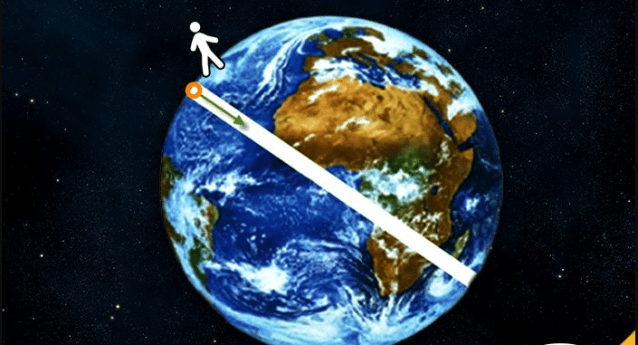
hole-through-the-earthWell, as we all know, there are no ends of the earth; that suggests the earth is flat, and it isn’t. But there are antipodes – places that are opposite to each other on the globe; by definition they are two points as far away from each other as can be and yet still be on the planet.  Any guess as to where the antipodes of Jerusalem is?
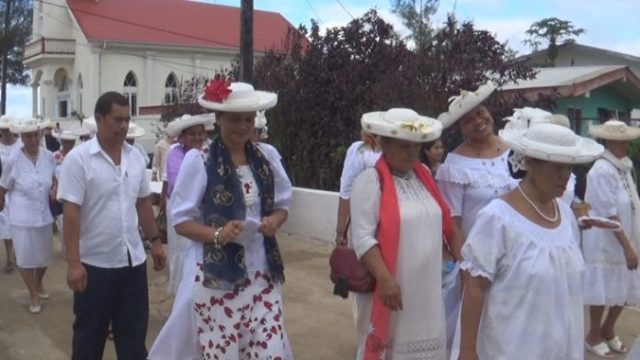
The antipodes of Jerusalem is in the south west Pacific, near an island called Rurutu, in French Polynesia. The village closest to the place in the ocean that is exactly opposite Jerusalem is called Moeri. And you know what – it has a church, built towards the end of the 19th century. So, in a real sense, the good news has been preached to the ends of the earth. So we’re done, right?

b458a5fc8e-696x392

Members of the Church of Ruruto on the day when “tithes” are traditionally paid. The island of Ruruto is the piece of land closest to the spot on Earth that is the farthest away from Jerusalem.


New Witnesses

Well, no.

In every generation we must have new witnesses. No one is “born” Christian; Christians are grown, whether by being suddenly born from above by the Holy Spirit, or by a seed planted in one that slowly grows, or some combination of the two.

Many people believe that they have had all the religion they need, especially in the countries of Europe, Canada, and increasingly in North America.

  • In some cases, people are recovering from spiritual abuse in religion, which relied on manipulation and control.
  • Others were literally physically and sexually abused.
  • Others are reductionist, blaming all of histories woes on religion – wars, conflict, divisions.
  • Some, like atheist Richard Dawkins, see no need for faith when one has science. Interestingly, this seems more true of the soft sciences – economics, sociology, and psychology – than the hard sciences of physics, chemistry, and biology. In the parish I worked before coming here one of the wardens was a physicist who taught at the local university and had worked at CERN.
  • And then there are those just can’t be bothered because the Christian faith causes too many problems, whether it is in the exploitation of people and the environment, or the making of money, or the focus on other people.

And we all know these people. Or we have raised them, and despite our best efforts, our children seem to have a mind of their own. Or they grew up in the same house with us, or we fell in love and married them, or we worked with them, or go to the tavernas with them. Some of us are these people, and we are wondering why we are in the church. In general, they are good people. They are our friends, or family, our neighbours, and ourselves.

So, what does it mean to witness? The Greek word here is μάρτυρες – martyrs in a direct transliteration. Μαρτυρώ is still the ordinary verb for bearing witness to something, and a μαρτυράς is somebody in a courtroom who gives evidence. But we hear μαρτυράς and we think somebody has to die.

How We Witness

13header

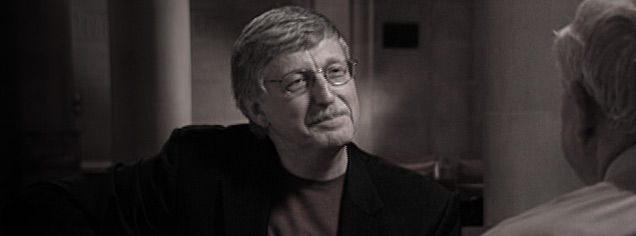
Francis S. Collins is the Director of the National Institutes of Health in the United States, and led the Human Genome Project. An avowed Christian, he recently won the Templeton Prize.

We bear witness in everything we do, how we do anything, everything we say, and how we say it. Inasmuch as we follow Christ, we witness to Jesus in our words and our deeds. And ultimately that witness is about how much Jesus is in our lives and we are formed by the Spirit. Jesus says,

All mine are yours, and yours are mine; and I have been glorified in them. And now I am no longer in the world, but they are in the world.

Jesus is glorified in us, and in the care we have for one another. As is said by the prophet Ezekiel,

“A new heart I will give you, and a new spirit I will put within you; and I will remove from your body the heart of stone and give you a heart of flesh. I will put my spirit within you . . .”

To go back to what I talked about last week, I want to be part of a church in which people knew their Bibles, would be comfortable in prayer, and knew how to share their faith in a transparent, non-threatening, and attractive way, over a cup of coffee, or in their actions.

Our proposed Vision Statement is that we “radiate God’s love in Jesus Christ, on this island, and beyond. May we continue to receive power, may the Holy Spirit come upon us; and we be Christ’s witnesses Kefalas, in Apokoronas and Crete, and to the ends of the earth.


Posted in Easter, Sermons | Tagged , , , | Leave a comment

Resources for the Seventh Sunday of Easter in the Year of the Great Pandemic 2020

These are resources meant mainly for The Anglican Church of St Thomas the Apostle, Kefalas, on the island of Crete in Greece, but others may find them helpful!

2013-Aerial-Mount_of_Olives

Sunset aerial photograph of the Mount of Olives in Jerusalem (view from the south, 2013). Photo credit: Andrew Shiva.

Share

There are three ways you can use these resources.

First, you can join us for worship in person. We have resumed worship and will continue this coming Sunday, May 24, at 11:00 am EEST at the Tabernacle of the Church of St Thomas, Kefalas. It will be a Holy Communion according to Common Worship. People should come only if they are comfortable with being out and about as the pandemic restrictions are being lifted, and are in good health.Those of you were were there last week and are coming again, please remember to return with your hymn book, psalter, and service booklet!

Second, you can join us via ZOOM. God and technology willing, we will livestream this at 11:00 am EEST (9:00 am BST for you folk in England). The link is (as last week):
https://us02web.zoom.us/j/85044839927?pwd=TkQ1cHEzNUNjSjVCNTNJVUJwSkZaQT09
Meeting ID: 850 4483 9927 Password: 010209 .
For those joining from a distance the Order of Service can be downloaded here: Easter Holy Communion 2020; this is the same as last week. The Order of Service will be shared on Zoom, as will the hymns.

Third, you can simply do it all yourself – read the lessons and pray the prayers below, as well as listen to the recorded sermon, with and intersperse it all by clicking on the links to the hymns.

Read

The readings appointed in the Revised Common Lectionary (“RCL”), Year A are

The optional reading from the Old Testament/Hebrew Bible is Ezekiel 36:24-28.

In our worship on Sunday we will use the optional reading from Ezekiel, as well as the Psalm, and the readings from Acts and John.

Reflect

I will be posting my sermon (or some version of it) after preaching it tomorrow. In the meantime, here is a sermon for Sunday from Fr Leonard Doolan, the chaplain at St Paul’s, Athens.

Pray

Collects
O God the King of glory,
you have exalted your only Son Jesus Christ
with great triumph to your kingdom in heaven:
we beseech you, leave us not comfortless,
but send your Holy Spirit to strengthen us
and exalt us to the place where our Saviour Christ is gone before,
who is alive and reigns with you,
in the unity of the Holy Spirit, one God, now and for ever. Amen.

(or)

Risen, ascended Lord, as we rejoice at your triumph,
fill your Church on earth with power and compassion,
that all who are estranged by sin
may find forgiveness and know your peace, to the glory of God the Father. Amen.

Intercessions
H1
We pray for God to fill us with his Spirit.

Generous God, we thank you for the power of your Holy Spirit.
We ask that we may be strengthened to serve you better.
Lord, come to bless us and fill us with your Spirit.

We thank you for the wisdom of your Holy Spirit.
We ask you to make us wise to understand your will.
Lord, come to bless us and fill us with your Spirit.

We thank you for the peace of your Holy Spirit.
We ask you to keep us confident of your love wherever you call us.
Lord, come to bless us and fill us with your Spirit.

We thank you for the healing of your Holy Spirit.
We ask you to bring reconciliation and wholeness
where there is division, sickness and sorrow.
Lord, come to bless us and fill us with your Spirit.

We thank you for the gifts of your Holy Spirit.
We ask you to equip us for the work which you have given us.
Lord, come to bless us and fill us with your Spirit.

We thank you for the fruit of your Holy Spirit.
We ask you to reveal in our lives the love of Jesus.
Lord, come to bless us and fill us with your Spirit.

We thank you for the breath of your Holy Spirit,
given us by the risen Lord.
We ask you to keep the whole Church, living and departed,
in the joy of eternal life.
Lord, come to bless us and fill us with your Spirit.

Generous God,
you sent your Holy Spirit upon your Messiah at the river Jordan,
and upon the disciples in the upper room:
in your mercy fill us with your Spirit,
hear our prayer,
and make us one in heart and mind
to serve you with joy for ever. Amen.

For the Church

  • Remember Justin Welby and John Sentamu, Archbishops of Canterbury & York, and Robert Innes & David Hamid, our Bishops here in the Diocese in Europe.
  • In the World Council of Churches Ecumenical Prayer Cycle we remember the churches and peoples of Angola and Mozambique.
  • In the Anglican Cycle of Prayer and on this we Anglican Communion Sunday we pray
    • for all members of the Anglican Communion around the world;
    • for Justin Welby and all primates and bishops;
    • for members of the Anglican Consultative Council
    • for the Secretary General, The Most Revd Dr Josiah Idowu-Fearon,
    • for the staff at the Anglican Communion Office in London and the UN offices in Geneva and New York
  • In the Prayer Diary of the Diocese in Europe we give thanks for
    • the Old Catholic Churches of the Union of Utrecht, Archbishop Bernd Wallet.
    • the Evangelical Lutheran Churches of Iceland, Latvia and Lithuania.
    • in London, our Chancellor, Mark Hill and our Registrar, Aiden Hargreaves-Smith, and in Brussels, the work of the Communications Director, Damian Thwaites.

For Governments:

  • Στην Ελλάδα προσευχόμαστε Αικατερίνη Σακελλαροπούλου, Πρόεδρος, και Κυριάκος Μητσοτάκης, Πρωθυπουργός (In Greece we pray for Aihaterini Sakellaropoulou, President, and Kyriakos Mitsotakis, the Prime Minister).
  • In the UK we remember our Sovereign Lady Elizabeth II, Governor of the Church of England, and her government led by the Prime Minister, Boris Johnson.
  • In Canada we also pray for Elizabeth II, Queen of Canada, Her Excellency Julie Payette, the Governor General, and Justin Trudeau, the Prime Minister.
  • In the European Union we pray for Ursula von der Leyen, President of the European Commission; Charles Michel, President of the European Council; and Josep Borrell, High Representative of the Union for Foreign Affairs & Security Policy.
  • For government leaders around the world as lockdowns are raised.

Sing

Posted in Easter | Tagged , , | Leave a comment

Lessons from the Areopagus

A sermon preached while wearing a PPE mask, on
The Sixth Sunday of Easter, May 17, 2020 11:00 am
at The Anglican Church of St. Thomas the Apostle, Kefalas, Crete

We used as our readings Acts 17:16-34 (expanded from what was appointed by the Revised Common Lectionary, which was Acts 17:22-31), Psalm 66:7-18, and John 14:15-21.

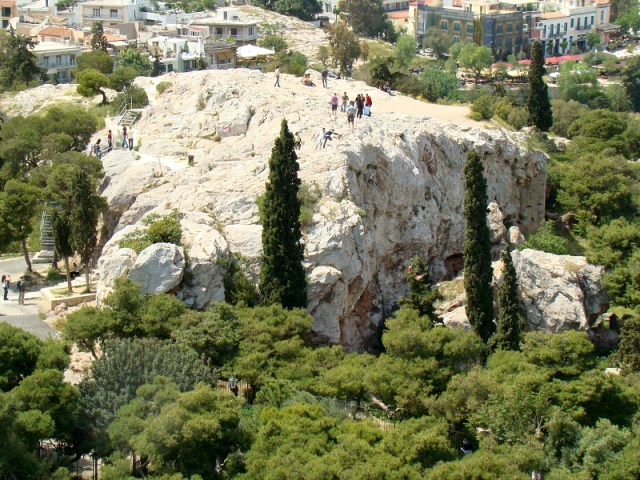
Areopagus_hill

The Areopagus in Athens from the Acropolis Credit: By O.Mustafin – Own work, CC0, https://commons.wikimedia.org/w/index.php?curid=17198122

 Athenians, I see how extremely religious you are in every way.  Acts 17.22

And we’re back!

Good morning, everybody. So, here we are – seven of us in the Tabernacle, all wearing surgical masks (and there is room for two more, you know) and eight of us scattered around outside. Five of you are in the porch there, like good Anglicans sitting in the back row, and three of you on the side, on the other side of the wall. And we have our beautiful reredos of the garden behind us, and a view of the Lefka Ori (White Mountains of Crete) in the distance. Plus, after a couple of weeks online we have people watching via Zoom – some in England, one off by Rethymno, and another all the way down the hill in Almyrida. Thank you all for joining us here today, after two months of suspending worship.

We are still working out what we need to do. We are starting with a strict interpretation of the rules from both the Greek government and the Diocese in Europe. On Tuesday in our Church Council meeting we’ll debrief on this experience. I must confess, this mask is a great distraction – it keeps falling off my nose. Maybe my head is too big, I don’t know.

Screenshot 2020-05-17 at 3.43.14 PM

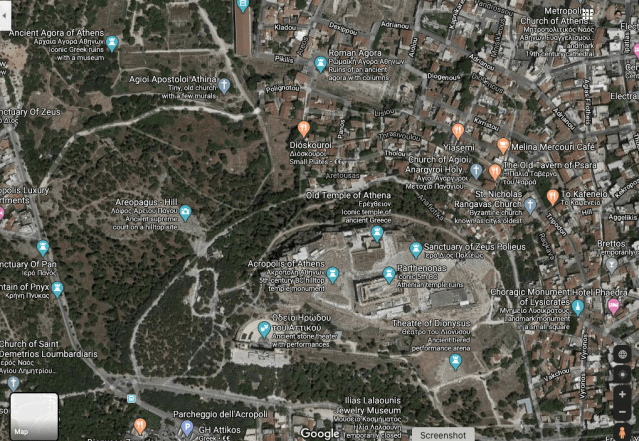
The Acropolis (right of centre) and the Areopagus (left of centre). Fromm Google Maps.

Paul Visits the Areopagus

It is kinda neat to read and listen about Paul in the Areopagus. That’s the big rock you can see to the northwest of the Acropolis, on the other side of the ticket booth there. We are told that Paul stood before the Areopagus, not on it, perhaps on the north side, towards the ancient Agora. We are told by that source of all things, Wikipedia, that the name means “Hill of Ares” (Ancient Greek: Ἄρειος Πάγος). In classical times, it functioned as the court for trying deliberate homicide, wounding and religious matters, as well as cases involving arson or olive trees (Greeks take olive trees seriously, as you know). If you have seen the ancient classical trilogy of plays by Aeschylus known as the Oresteia (458 BCE) you will know that Orestes was tried there for the murder of his mother Clytemnestra . . .  and her lover . . . after they murdered his father, Agamemnon (those ancient Greeks really knew how to do a tragedy).

So in that reading from Acts Paul comes to the heart of Athens, the centre of ancient civilization.

The passage is a lively one, as well. The author seems to know Athens: lots of idols; philosophers, including Epicureans and Stoics; the comment: “Now all the Athenians and the foreigners living there would spend their time in nothing but telling or hearing something new.”

He preaches the gospel to them. What can we learn?

Screenshot 2020-05-17 at 3.42.33 PM

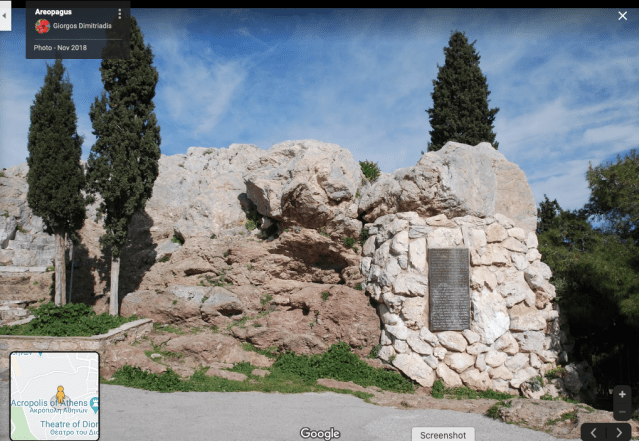
The Areopagus. The plaque reproduces Paul’s words to the Athenians, according to Acts.

Paul Among The Athenians

It is amazing that the Christian faith quickly jumped from being a sect within Judaism to being a religion that non-Jews could join. This was not normal for Jewish religious groups. We hear that some Jews, among them, the Pharisees, did proselytize, but the requirements to assimilate to Judaism was a great barrier to large-scale success; the dietary restrictions were strange to Greek and Roman cultures – “What do you mean, “No pork”” – and I suspect many pagan males would have found circumcision off-putting. John the Baptist’s disciples were Jews, and the people who wrote the Dead Sea Scrolls did not seek converts outside of Judaism. For the Zealots the Gentiles were the enemy oppressors, and the sooner they were thrown out of Israel the better.

But along comes Paul, telling non-Jews that they could receive the grace of God and avoid the wrath to come. Now, this was, is not, a succession thing. Paul was not saying that he had a new religion derived from Judaism, that somehow replaced the faith of the Jews. Indeed, Paul believed that he was born and would die a Jew. Rather, in Jesus Christ he found the fulfillment of the hopes of the prophets and the promises made by God in the Torah. Paul is absolutely clear in his Letter to the Romans that God would be faithful to the people of Israel. But in his words to the Athenians he was telling them that Gentiles were being grafted onto the tree of Israel, not replacing them. Their inclusion was an exceptional act of grace by the God of Abraham, and was the result of the faithfulness of Jesus.

1024px-V&A_-_Raphael,_St_Paul_Preaching_in_Athens_(1515)

It probably did not look like this. “St Paul Preaching in Athens” (1515) by Raphael (Raffaello Sanzio da Urbino, 1483-1520), from the Victoria and Albert Museum, London.

Lessons from Paul

So how did he proclaim the good news to them?

  • First, Paul recognised that the content of the good news could be translated into the vernacular. It was not preached in Aramaic or Hebrew, but Hellenistic Greek.

    This may sound normal to us, but there were and are those who disagreed with such a principle. In Islam one must learn Arabic to pray and to read the Qu’ran. During the Middle Ages Western Christianity held onto Latin until well into the 16th century, until Protestants like Martin Luther, Jean Calvin, and Thomas Cranmer said it was to be done in German, French, and English. The Roman Catholics made the change in 1969, and now celebrates the mass in hundreds of languages. As we know here in Greece, Greek Orthodox don’t use modern Greek, but the same version of Greek that the New Testament is written in – which modern Greeks cannot understand except with great difficulty. And lest we be too proud about our Anglican tradition, there were many evangelists in the 19th and 20th centuries who believed that indigenous languages in North America and Australia were incapable of conveying the good news.

    But time and again the good news is translated, and is welcomed with joy across languages. So the first thing, perhaps, is to share one’s faith in a language understood by one’s listeners.

  • Second, Paul starts with where the Athenians are. He talks about their statues. He talks about their piety. He recognises them as rational individuals.

    And so we must start with where people are today. For example, if people think they are spiritual but not religious, we must ask them about what spirituality means for them; we should not start off by being defensive of our institutions and buildings. Again, If people think they are secular, we must invite them to tell us  why they think they can do without religion and faith.

    The point about this is that sharing our faith is about making oneself vulnerable. We share our faith because we actually love people, not because we want them to become like us just to reinforce our beliefs.  If we are judgmental, they’ll catch the whiff of it in a heartbeat. Can we listen to them?

  • Third, the results are incremental. Paul only gets a handful – Dionysius, Damaris, and a few others. Sometimes we believe that evangelism looks like the events described in the beginning of the Acts of the Apostles, where thousands join in a day. But this is the exception, not the norm.

    In my experience the most effective sharing of faith takes place over a cup of coffee, in a kitchen, or perhaps a small group. It may be incremental, but like compound interest, it is growth that can become phenomenal over time.

  • Finally, Paul’s witness at the Areopagus ends up with Jesus. And that is what we are about.

    Regardless of what people might think of the Church or Christians, there is always interest in Jesus. It is not an accident that Mahatma Gandhi developed his non-violent civil disobedience after reading the Sermon on the Mount.

An Election Platform

Back in 2013 I was a candidate in the episcopal election for the Diocese of British Columbia.  A friend of mine asked me, “What is your vision for the diocese?” Now, when people ask that kind of question I think they are asking a number of things:

  • “How will you do things differently from the last guy?”
  • “How will you inspire people? Will you inspire me?”
  • “Are you going to be another managerial bureaucrat, or some other kind of church leader?”
  • “Are you going to change things the way I think they should be changed?”
  • “How will you fix everything in the Diocese?”

I replied that I really did not have a vision as such – no ten point program, nor even a clear idea about how to build such a vision. I was all too aware of the complexity of the church and its members. All I knew was that I wanted to be part of a church in which the ordinary people

  • knew their Bibles better,
  • were comfortable about praying to God, and
  • knew how to share their faith in a transparent, non-threatening, and attractive way.

My friend said that that was actually a pretty good vision for the Diocese. And, in retrospect, it is. It is about empowering lay people with the Spirit, and it is my hope for you.

So, take these lessons from Paul.  I do not suggest that you necessarily walk down to the Agora in Chania, or to the crossroads in Almyrida, and begin street preaching, as Paul did. That was an exceptional situation. But my hope and prayer is that as we regain our footing after this strange season of Coronatide that we can meet people where they are, speak their” language” and listen to them, and be patient with them and ourselves as we witness to the power of the resurrection of Jesus in our lives.


Posted in Easter, Sermons | Tagged , , , | 2 Comments

Resources for the Sixth Sunday of Easter in the Year of the Great Pandemic 2020

These are resources meant mainly for The Anglican Church of St Thomas the Apostle, Kefalas, on the island of Crete in Greece, but others may find them helpful!

Areopagus_hill

The Areopagus in Athens from the Acropolis Credit: By O.Mustafin – Own work, CC0, https://commons.wikimedia.org/w/index.php?curid=17198122

Share

There are three ways you can use these resources.

First, you can join us for worship in person. The Anglican Church of St Thomas will be having our first worship at the Tabernacle since March 15th this coming Sunday, May 17, 2020. It will be a Holy Communion according to Common Worship. People should come only if they are comfortable with being out and about as the pandemic restrictions are being lifted, and are in good health. For those joining from a distance the Order of Service can be downloaded here: Easter Holy Communion 2020

One advantage we have over almost any other church is that we can roll up the sides of the Tabernacle and effectively be outside. This allows for the breeze to mitigate any issues around being in a confined space.

There will be several restrictions, including:

  • Only nine persons (!) may be in the Tabernacle itself, although more can stand or sit outside and participate at a distance.
  • Attendees will be asked to wash their hands at the sink in the lavatory and use hand sanitizer. Masks are strongly encouraged.
  • The clergy, I and Julia Bradshaw, will be wearing masks, and prior to setting the table and administering communion I will wash my hands with soap and water.
  • Chairs are set out at a minimum of 1.5 metres (families and couples who are already in contact with each other may, of course, sit together).
  • Communion will be administered only in one kind, the bread; only I as celebrant will partake of the the two elements.
  • Singing will be quiet.
  • We will hand out books and leaflets – and, assuming that there will be other Sundays when you’ll be attending – we ask that you take them home with you, and bring them back.

Second, you can join us via ZOOM. God and technology willing, we will livestream this at 11:00 am EEST (9:00 am BST for you folk in England). The link is (as last week):
https://us02web.zoom.us/j/85044839927?pwd=TkQ1cHEzNUNjSjVCNTNJVUJwSkZaQT09
Meeting ID: 850 4483 9927 Password: 010209 .

The livestream will start about fifteen minutes before.

Since this is all new, there will undoubtedly be something that does not work, or we will change as time goes on. Please bear with us!

Third, you can simply do it all yourself – read the lessons and pray the prayers below, as well as listen to the recorded sermon, with and intersperse it all by clicking on the links to the hymns.

Read

The readings appointed in the Revised Common Lectionary (“RCL”), Year A are

The optional reading from the Hebrew Bible is Genesis 8:20-9:17. We will be using the readings from Acts, the Psalm, and John.

Reflect

I will be offering a homily in the service on Sunday, and posting it later that day on this blog.

In the meantime, here is this coming Sunday’s sermon from Fr Leonard Doolan, Chaplain of Greater Athens and Apokrisarios of the Archbishop of Canterbury to the Archbishop of Athens and All Greece.

Pray

Collect
God our redeemer,
you have delivered us from the power of darkness
and brought us into the kingdom of your Son:
grant, that as by his death he has recalled us to life,
so by his continual presence in us he may raise us to eternal joy;
through Jesus Christ your Son our Lord,
who is alive and reigns with you,
in the unity of the Holy Spirit,
one God, now and for ever. Amen.

(or)

Risen Christ,
by the lakeside you renewed your call to your disciples:
help your Church to obey your command
and draw the nations to the fire of your love,
to the glory of God the Father. Amen.

Intercessions
H3     Jesus, our exalted Lord, has been given all authority.
Let us seek his intercession that our prayers may be perfected by his prayer.

Jesus Christ, great high priest, living for ever to intercede for us,
pray for the Church, your broken body in the world.

  • Remember Justin Welby and John Sentamu, Archbishops of Canterbury & York, and Robert Innes & David Hamid, our Bishops here in the Diocese in Europe.
  • In the World Council of Churches Ecumenical Prayer Cycle we remember the churches and peoples of the Indian Ocean Islands: Comoros, Madagascar, Maldives, Mauritius, and the Seychelles.
  • In the Anglican Cycle of Prayer we pray for Pray for the Anglican Church of Korea and its primate, The Most Rev’d Moses Nagjun Yoo, Bishop of Daejeon.
  • In the Prayer Diary of the Diocese in Europe we give thanks for
    • the Rev’d Frances Hiller in her work as Bishop David’s Chaplain,
    • Bishop David’s ministry as Warden of Readers,
    • Paul Wignall work as Director of Reader Ministry
    • all those training to be Readers in the diocese;
    • Clare Amos, Director of Lay Discipleship
    • the work of the Friends of the Diocese in Europe, and its Secretary,Jeanne French.


Lord, hear us. Lord, graciously hear us.

Jesus Christ, King of righteousness,
enthroned at the right hand of the majesty on high,
pray for the world, and make it subject to your gentle rule.

      • Στην Ελλάδα προσευχόμαστε Αικατερίνη Σακελλαροπούλου, Πρόεδρος, και Κυριάκος Μητσοτάκης, Πρωθυπουργός (In Greece we pray for Aihaterini Sakellaropoulou, President, and Kyriakos Mitsotakis, the Prime Minister).
      • In the UK we remember our Sovereign Lady Elizabeth II, Governor of the Church of England, and her government led by the Prime Minister, Boris Johnson.
      • In Canada we also pray for Elizabeth II, Queen of Canada, Her Excellency Julie Payette, the Governor General, and Justin Trudeau, the Prime Minister.
      • In the European Union we pray for Ursula von der Leyen, President of the European Commission; Charles Michel, President of the European Council; and Josep Borrell, High Representative of the Union for Foreign Affairs & Security Policy.
      • For government leaders around the world as lockdowns are raised.

Lord, hear us. Lord, graciously hear us.

Jesus Christ, Son of Man,
drawing humanity into the life of God,
pray for your sisters and brothers in need, distress, or sorrow.

      • All those infected by the Coronavirus, and those in intensive care.
      • Health care workers, and all essential workers.
      • Those who are mourning the recently dead, in the midst of the lockdown.
      • Those who have been laid off and have lost income, and whose futures are in peril.
      • Teachers, students, and parents, struggling to learn from home.
      • Families overcome by stress.
      • Refugees, immigrants, migrants, the homeless, and other vulnerable populations.

Lord, hear us. Lord, graciously hear us.

Jesus, pioneer of our salvation,
bringing us to glory through your death and resurrection,
surround with your saints and angels those who have died trusting your promises.

      •  the 308,000 who have died from the Covid-19 pandemic.
      • Among the dead, the physicians, nurses, and health care workers.

Lord, hear us. Lord, graciously hear us.

Jesus Christ, Lord over all things,
ascended far above the heavens and filling the universe,
pray for us who receive the gifts you give us for work in your service.

      • for the Seven Gifts of the Holy Spirit: wisdom, understanding, counsel, fortitude, knowledge, piety, and fear of the Lord (Isaiah 11.1-2).
      • for the cardinal virtues of prudence, justice, fortitude, and temperance.
      • for the theological virtues of faith, hope, and love. (1 Corinthians 13.13).
      • spiritual gifts: prophecy, serving, teaching, exhortation, giving, leadership, mercy (Romans 12.6-8).

Lord, hear us. Lord, graciously hear us.

Jesus Christ,
keep the Church in the unity of the Spirit and in the bond of peace,
and bring the whole created order to worship at your feet;
for you are alive and reign with the Father and the Holy Spirit,
one God, now and for ever. Amen.

Sing

Posted in Uncategorized | 1 Comment

“Greater Works Than These”

A Reflection based on the discussion that was held during the online worship of
the Anglican Church of St Thomas, Kefalas,
in the regional municipality of Apokoronas, on the island of Crete, in Greece
on the Fifth Sunday of Easter, May 10, 2020, 11:00 am
in the Year of the Great Pandemic of 2020.

The readings we used were Acts 7:55-60, Psalm 31:1-5, 15-16, and John 14:1-14.

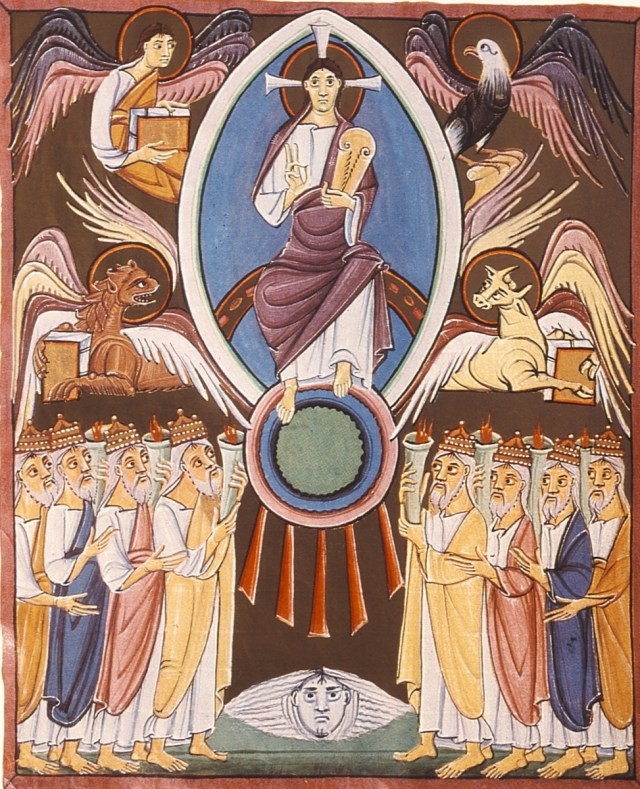
BambergApocalypseFolio010vWorshipBeforeThroneOfGod

“Worship before the Throne of God” from Bamberger Apokalypse Folio 10 verso, Bamberg, Staatsbibliothek, circa 1000.

“Very truly, I tell you, the one who believes in me will also do the works that I do and, in fact, will do greater works than these, because I am going to the Father.”  John 14.12

So.
What are these “greater works” that the disciples will do? One approach might be a list of accomplishments.

  • The growth of the church to 2.4 billion people, becoming the majority population in more than 125 countries.
  • The translation of the Bible into 698 languages, and the New Testament into 1548.
  • The wealth of sacred music from ancient Gregorian chant, through the contrapuntal Bach, the growth of hymnody beginning in the 18th century, and the vast variety of Christian influenced music of the present day.
  • The stunning architecture, from Justinian’s Hagia Sophia to Chartres Cathedral,  including small country churches and modern basilicas.
  • The abolition of slavery driven by radical Christians, beginning in the early 19th century.
  • The influence of Christianity on world history – giving rise to human rights and the sense that we have a responsibility to the poor and disadvantaged.
  • The efforts of Elizabeth Fry and others to make prisons more humane.
  • The invention of modern health care, as exemplified by Christians such as Florence Nightingale.
  • The founding of countless street-front operations seeking to assist the homeless and impoverished.
  • The leadership of Christians in the reception and settlement of refugees, beginning in the early part of the 20th century and continuing to the present.
  • Maybe even . . . gathering across vast distances for a Zoom conference in order to worship.

This list could be so much longer, a triumphalistic iteration of great things. But we need not go any further than our first reading today to find an example of someone who did the works of Jesus and, perhaps, greater things than these.

In that reading, Stephen, a deacon called by the apostles to serve the Greek-speaking Jewish Christians of the church in Jerusalem, has preached about his faith in Jesus, and now becomes the first to suffer death for it.

Filled with the Holy Spirit, Stephen gazed into heaven and saw the glory of God and Jesus standing at the right hand of God. “Look,” he said, “I see the heavens opened and the Son of Man standing at the right hand of God!” But they covered their ears, and with a loud shout all rushed together against him. Then they dragged him out of the city and began to stone him; and the witnesses laid their coats at the feet of a young man named Saul. While they were stoning Stephen, he prayed, “Lord Jesus, receive my spirit.” Then he knelt down and cried out in a loud voice, “Lord, do not hold this sin against them.” When he had said this, he died.    Acts 7:55-60

As he dies, he prays for his enemies. He requests that Jesus does not convict them of his murder.

Now, Jesus tells us in the Sermon on the Mount to pray for our enemies. Not many of us in St Thomas’s probably have enemies, so we probably do not think about this much. I do know that there are times when I have been in major conflict with individuals, and they were not to happy with me (this was when I was Executive Officer and Archdeacon of the Diocese of British Columbia, and I had to discipline clergy and lay leaders involved in schismatic behaviour or sexual misconduct), but even then, nobody wanted to kill me. But here we have Stephen, humbly, mercifully, begging Jesus to forgive what was being done.

In this, Stephen was following in the Way of Jesus, who as he was being taken to the Cross said, “Father, forgive them; for they do not know what they are doing” (Luke 23.34). And God does not hold it against his persecutors; indeed, one named at the end of the reading, Saul, whom we know better by his Roman name of Paul, eventually experiences a similar vision on the road to Damascus, and becomes the foremost of the apostles, even though, as he admits, “I am unfit to be called an apostle, because I persecuted the church of God.” (1 Corinthians 15.9).

In the letter to the Ephesians we read that Paul gives glory to God, “who by the power at work within us is able to accomplish abundantly far more than all we can ask or imagine.”(Ephesians 3.20) This power, the same as that which raised Jesus from the dead, is at work in us. It is by that Spirit living in us that we can hope to do more than we might ask or imagine.

And so we are called to be merciful, praying for enemies, for politicians we do not like, for those who irritate us, and learning patience. In the experience of many Christians praying for perceived enemies is an important spiritual discipline. One develops empathy and understanding, without losing a sense of the calls of justice. Anger may arise, but it is transformed into action. Instead of creating antagonism, one is rooted in the love and example of Christ.

So, on this Fifth Sunday of Easter in Coronatide, may the Holy Spirit be at work in us, so that we as the Body of Christ, the Church in dispersal, may yet do the works of Jesus, and greater ones yet.


Posted in Easter | Tagged , , | 1 Comment

Resources for the Fifth Sunday of Easter in the Year of the Great Pandemic 2020

These are resources meant mainly for The Anglican Church of St Thomas the Apostle, Kefalas, on the island of Crete in Greece, but others may find them helpful!

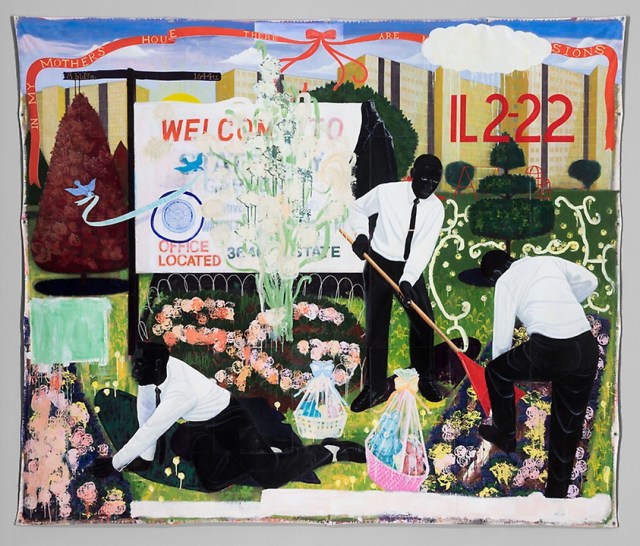
Many Mansions

“Many Mansions” (1994) by Kerry James Marshall, from the Art Institute of Chicago

Share

This Sunday, May 10th, 2020 we invite members and friends of the Anglican Church of St Thomas, to join us for a Service of the Word on Zoom.  Here is the information you need:

Join Zoom Meeting
https://us02web.zoom.us/j/85044839927?pwd=TkQ1cHEzNUNjSjVCNTNJVUJwSkZaQT09
Meeting ID: 850 4483 9927
Password: 010209
To maintain some order, there will be a “waiting room” and a password is required to get in. Please make sure that you fill in the option for naming yourself, so that I can know who is in the waiting room. I will be online at 10:40 am, and I ask that you try to log on and be ready at least five minutes before 11:00 am.
The Order of Service can be downloaded here: An Order for Worship on Easter 5, May 10 2020

Read

The appointed readings according to the Revised Common Lectionary (Year A) are:

Posted in Easter | Tagged , | Leave a comment

The Care of The Good Shepherd

A Reflection based on the discussion that was held during the online worship of
the Anglican Church of St Thomas, Kefalas,
in the regional municipality of Apokoronas, on the island of Crete, in Greece
on the Fourth Sunday of Easter, May 3, 2020, 11:00 am
in the Year of the Great Pandemic of 2020.

The readings we used were: Acts 2:42-47, Psalm 23, and John 10:1-10.

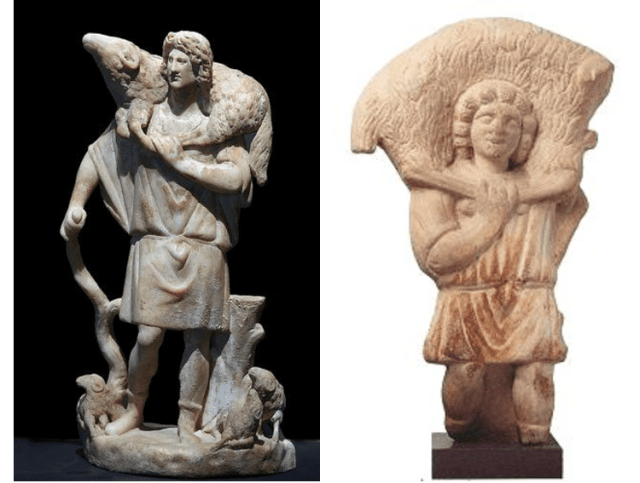
The-Good-Shepherd-A-Ancient-Greece-image-of-a-shepherd-carrying-a-sheep-over-his

Two ancient statues, one pagan, the other Christian. Left: Ancient Greek image of a shepherd carrying a sheep over his shoulders (3rd century BCE) Right: Statue from Rome, Italy, dated to the early period of Christianity, displaying the image of Jesus as the good shepherd.

Those who had been baptized devoted themselves to the apostles’ teaching and fellowship, to the breaking of bread and the prayers.

Awe came upon everyone, because many wonders and signs were being done by the apostles. All who believed were together and had all things in common; they would sell their possessions and goods and distribute the proceeds to all, as any had need. Day by day, as they spent much time together in the temple, they broke bread at home and ate their food with glad and generous hearts, praising God and having the goodwill of all the people. And day by day the Lord added to their number those who were being saved. Acts 2.42-47

Whoever enters by me will be saved, and will come in and go out and find pasture. . . . I came that they may have life, and have it abundantly. John 10.9-10

We gathered via the internet, and all told we were some sixteen souls gathered around by Zoom. We had an informal discussion about the texts, and these were some of the points made.

  • Sheep are a very common thing here on Crete, and we know by experience that different flocks will listen to the different voices of their shepherds and follow them.
  • In some places a shepherd will lie down at the opening to the fold, thereby becoming the “gate” to the fold, letting sheep in and keeping them in the pen.
  • Jesus is the Good Shepherd, who by his life and teaching, and especially in his death, demonstrates his care for all the people around him, for humanity, and for us.
  • The idea that God cares for us as a shepherd goes back ten centuries before Jesus, to the time of David, and the 23rd psalm.
  • As the Body of Christ, we in the church can be like the shepherd, caring for others.
  • This is shown in the passage from Acts, where Christians care for each other by sharing things in common. While this looks quite normal for us, this might be considered among the “many wonders and signs” in a society where such common concern was the exception rather than the norm.
  • While not intentional, this kind of care would have had an evangelistic result. Rodney Stark, in The Rise of Christianity, notes that the doctrine that Christians must care for each other and the stranger in need meant that in time of disease – such as a plague – Christians felt a divine moral obligation to do so; the traditional Greek and Roman temples and priesthoods did not have these teachings. Thus, in the time of a plague most non-Christians would get out of cities and take care of themselves but not others. Early Christian care – food, and very basic sanitation – appear to have increased (albeit, slightly) the survival rate of Christians and the non-Christians they cared for. This would have impressed the non-Christians , and increased the adherence of survivors to the Christian faith.
  • In the Fourth Century CE the Emperor Julian complained how Christians took care of all sick, regardless of religious adherence, and recommended that Roman and Greek priests begin to do the same. This did not happen, because the ancient religions had no dogmatic reason to teach such things.
  • This emphasis on care has been a part of Christian culture, and became a norm in our society, even when secularized. Medical care, especially for those who are not rich, was a central activity of churches through the medieval era and right into modern times.
  • Only since the rise of the national health care (in Britain in 1948; Canada in 1968; and in Greece, 1981) has there been an assumption that the whole of society has a care of duty towards the health of everybody, based on need and not ability to pay; while this is normal for us now, it was controversial in earlier times, and in the United States, still is.
  • Arguably, a modern Christian attitude must be concerned with the health of everybody, and whether by public or private means, or a combination of both, should consider how effectively medical care is provided, especially to the most vulnerable. This is part of what it means to “have life, and have it abundantly.

May we, then, follow in the way of the Good Shepherd. As we have been cared for protected, as we have been led to green pastures and quiet waters that refresh us, and as we have feasted at abundant tables, so may we do the same for others.

Posted in Easter, Sermons | Tagged , , | 1 Comment