I am a little anxious this morning. This happens every Christmas. It is a bit like what the late American literary critic Harold Bloom called “the anxiety of influence”: how can this preacher standing before you live up to this moment? How can I possibly do justice to the Christmas story? How might I say anything new, something you’ve not heard before? If you’re not a regular church goer, how might I say something that might inspire you to become one? If you are one of those people for whom this Christmas is hard, because you are missing loved ones, how might I comfort you? Ah, anxiety!
Or, I could just talk about the Bible and let God worry about what goes on in your hearts and minds. Let’s see how that goes.
It is Still Good News
Kelly Latimore’s 2016 icon of La Sagrada Familia
I want to suggest to you that the news of Jesus Christ is good news, and that it is news that this broken, fallen, sinful world needs.
In the Gospel of Matthew we hear of how that old tyrant King Herod the Great sought to destroy every person he thought might be a threat to his rule. Having heard that a king was to come from Bethlehem, he sought to kill that child. Thus, male children around Bethlehem suffered innocent deaths because of his depraved fears. Jesus and his parents became refugees, having been warned in a dream. Now, there is nothing sweet and heart-warming about this part of the story. What the story does tell us is that Jesus is with the innocent victims, with the murdered and displaced. At a time like this, the good news speaks to those suffering and says, God is on your side, and God will see justice done.
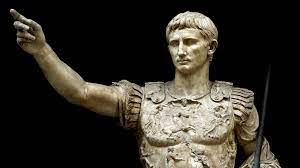
Have I shared with you the good news about Caesar Augustus, the Victorious Saviour, Son of God?
In this morning’s gospel reading from Luke we hear how “a decree went out from Emperor Augustus that all the world should be registered.” Isn’t that so typical of dictators? The imperial might of Rome exercises itself in a census of its subject peoples, creating great inconveniences. This Emperor Augustus is acclaimed in various obsequious inscriptions in the Greek language as a saviour, whose victories were considered to be good news, and he is described elsewhere as the adopted son of Julius Caesar, who was considered a god after his death; thus, Augustus was considered to be a son of God. It is not an accident that the humble birth of Jesus begins with this decree from Augustus, for in invoking his name it forces a contrast and the questions: who is the real saviour? Who is the true son of God? Whose coming is the real good news?
For people like the shepherds and those like Joseph and Mary, displaced by the whims of the powerful, the coming of Augustus is not good news. But the birth of the son of God in a humble stable is.
A Nativity Scene in the Lutheran Church of Bethlehem, 2023
We are now in a time when it is strange and hard for some to sing about Bethlehem. The Christian churches in Bethlehem, which are mostly Palestinian, have suspended public Christmas services in this time of war. How can we sing about the birth of Jesus when children are dying, when both sides are traumatized, and when their leaders are sending bombs and armed forces after each other?
Jesus offers an alternative to violence. All three of the Abrahamic faiths, Judaism, Christianity, and Islam have in common the values of care for others and living in peace with neighbours. The vast majority of the people in those religions do live and let live, getting on with life and seeking to live up to their ideals. All too often, though, extremists are allowed to prey on the fears of their co-religionists, and justify the violence of pogroms, crusades, and terrorism. Jesus, who suffered at the hands of violent Roman soldiers at the command of Pontius Pilate and with the encouragement of a collaborationist religious leadership, appears to have lost and been defeated. But the good news is that the love of God in Christ is stronger than death, greater than the violence that was meted out to him, and more powerful than any empire, authority, party, army.
The reading from Isaiah envisages a kingdom where the root of Jesse assembles the dispersed people of Israel and all the nations, and where all live in peace, even the animals and children:
The wolf shall live with the lamb; the leopard shall lie down with the kid . . . The nursing child shall play over the hole of the asp . . . the earth will be full of the knowledge of the Lord as the waters cover the sea.
We are not there yet. But God has begun to make all things new, beginning with the resurrection of Jesus, continuing on the day of Pentecost, and continuing through the past twenty centuries in the lives of holy men and women, people from every nation. We haven’t always got it right, and sometimes we have gotten it very wrong. But we hold before us this vision of what God calls us to be.
Questions
So, the question for us on this Christmas Eve morning, perhaps, is this: Are you going to be full of despair at the state of our fallen world, or do you have hope that God will break through? Do you continue in difference, or do we allow Christ, by the Holy Spirit, to fill our hearts with love, so that we can seek justice, and love kindness, and walk humbly with our God? Whose side are you on? Herod and Augustus? Or the babe born in Bethlehem?
The Anglican Church of St. Thomas the Apostle, Kefalas, Crete
24 December 2023 11:00 am
Open
I am a little anxious this morning. This happens every Christmas. It is a bit like what the late American literary critic Harold Bloom called the anxiety of influence: how can this preacher standing before you live up to this moment, and do justice to the Christmas story? How might I possibly say anything new? If you’re not a regular church goer, how might I say something that might inspire you to become one? If you are one of those people for whom this Christmas is hard, because you are missing loved ones, how might I comfort you? Ah, anxiety!
Or, I could just talk about the Bible and let God worry about what goes on in your hearts and minds. Let’s see how that goes.
Assertion
I want to suggest to you that the news of Jesus Christ is good news, and that it is news that this broken, fallen world needs.
In the Gospel of Matthew we hear of how that old tyrant King Herod the Great sought to destroy what he saw as a threat to his rule, and so tried to kill Jesus. His parents became refugees, and male children around Bethlehem suffered innocent deaths because of his depraved fears. There is nothing heart-warming about that. Jesus is with the innocent victims, with the murdered and displaced. At a time like this, the good news speaks to those suffering and says, God is on your side, and God will see justice done.
In this morning’s gospel reading from Luke we hear how “a decree went out from Emperor Augustus that all the world should be registered.” Isn’t that so typical of dictators? The imperial might of Rome exercises itself in a census of its subject peoples, creating great inconveniences. This Emperor Augusts claimed to be a saviour, whose victories were considered to be good news, and as the adopted son of Julius Caesar was considered to be a son of God. It is not an accident that the humble birth of Jesus begins with this decree from Augustus, for in invoking his name it forces a contrast and the question: who is the real saviour? Who is the true son of God? Whose coming is the real good news?
Jesus is on the side of people like the shepherds and those displaced by the whims of the powerful.
We are now in a time when it is strange and hard for some to sing about Bethlehem. The Christian churches in Bethlehem, which are mostly Palestinian, have suspended public Christmas services in this time of war. How can we sing about the birth of Jesus when children are dying, when both sides are traumatized, and when their leaders are sending bombs and armed forces after each other?
Jesus offers an alternative to violence. All three of the Abrahamic faiths, Judaism, Christianity, and Islam have in common the values of care for others and living in peace with neighbours. The vast majority of the people in those religions do live and let live, getting on with life and seeking to live up to their ideals. All too often, though, extremists are allowed to prey on the fears of their co-religionists, and justify the violence of pogroms, crusades, and terrorism. Jesus, who suffered at the hands of violent Roman soldiers at the command of Pontius Pilate and with the encouragement of a collaborationist religious leadership, appears to have lost and been defeated. But the good news is that the love of God in Christ is stronger than death, greater than the violence that was meted out to him, and more powerful than any empire, authority, party, army.
The reading from Isaiah envisages a kingdom where the root of Jesse assembles the dispersed people of Israel and all the nations, and where all live in peace, even the animals and children:
The wolf shall live with the lamb;
the leopard shall lie down with the kid . . .
The nursing child shall play over the hole of the asp . . .
the earth will be full of the knowledge of the Lord
as the waters cover the sea.
We are not there yet. But God has begun to make all things new, beginning with the resurrection of Jesus, continuing on the day of Pentecost, and continuing through the past twenty centuries in the lives of holy men and women, people from every nation. We haven’t always got it right, and sometimes we have gotten it very wrong. But we hold before us this vision of what God calls us to be.
Invitation
So, the question for us on this Christmas Eve, perhaps, is this: Are you going to be full of despair at the state of our fallen world, or do you have hope that God will break through? Do you continue in difference, or do we allow Christ, by the Holy Spirit, to fill our hearts with love, so that we can seek justice, and love kindness, and walk humbly with our God? Whose side are you on? Herod and Augustus? Or the babe born in Bethlehem?
Canadian. Husband. Father. Christian. Recovering Settler. A priest of the Church of England, Diocese in Europe, on the island of Crete in Greece.
More about me at https://www.linkedin.com/in/bruce-bryant-scott-4205501a/




 The Island Parson
Hello Bruce,
Thank you for sending me your various thoughtful sermons, which I have enjoyed.
Best wishes for the New Year,
David Jones