Day Fourteen of An Advent Calendar: Walking Contemplation

Saturday, December 10, 2016     Saturday after the Second Sunday of Advent
Isaiah 8.1–15
2 Thessalonians 3.6–18
Luke 22.31–38
The text of the readings follows after the comments.

walking-in-a-winter-wonderland

Walking in a Winter Wonderland

Lately I have been doing a lot of walking. Some of it takes the form of a contemplative walk. I pray St. Patrick’s Prayer, saying or singing it:

Christ be with me, Christ within me,
Christ behind me, Christ before me,
Christ beside me, Christ to win me,
Christ to comfort and restore me.

Christ beneath me, Christ above me,
Christ in quiet, Christ in danger,
Christ in hearts of all who love me,
Christ in mouth of friend and stranger.

Or I sing or say the lyrics of one of my favourite hymns:

A spendthrift lover is the Lord who never counts the cost
or asks if heaven can afford to woo a world that’s lost.
Our lover tosses coins of gold across the mid-night skies
and stokes the sun against the cold to warm us when we rise.

Still more is spent in blood and tears to win the human heart,
to overcome the violent fears that blow the world apart.
Behold the bruised and thorn-crowned face of one who bears our scars
and empties out the wealth of grace that’s hinted by the stars.

How shall we love this heart-strong God who gives us everything,
whose ways to us are strange and odd; what can we give or bring?
Acceptance of the matchless gift is gift enough to give.
the very act will shake and shift the way we love and live.

Or I pray the Jesus Prayer, as a kind of prayer phrase:

Lord Jesus Christ, Son of God, have mercy on me, a sinner.

I also use my walking time to memorize scripture. When I was in amateur theatrics I memorized all kinds of stuff, so I thought I might apply myself to chunks of the Bible. I’ve managed to memorize 1 Corinthians 13 (“If I speak in the tongues of mortals and of angels but have not love, I am a noisy gong or a clashing cymbal”). I’ve moved on to 1 Corinthians 15. Give me enough time I may memorize the whole letter! This is not an absurd idea. In the ancient and medieval times monks and hermits would memorize the whole of the 15o psalms, not because they necessarily wanted to do a great act of memory, but because they were illiterate and if they were to pray the psalms they really had to get them in their heads. This memorization and recitation is another form of prayer.

I say all of this not because I am a very holy person – it has taken me over five decades to get to the point of wanting to do anything like this – but because I believe that it is the central task of any Christian to pray, and I have struggled with it (despite ordination and presumed discipline), and only recently have I found it easier.

Paul in the reading from 2 Thessalonians today attacks those who are idle. It has been suggested that in anticipation of the return of Jesus some had stopped working, and were relying on other Christians for daily necessities. Presumably they were not absorbed in prayer.

Prayer is not idleness, although in the perspective of the modern world it might be viewed as such. After all, it is not productive, it doesn’t seem to provide any commodifiable service, and it can eat up a chunk of time that might be used in other ways. However, the subversive, counter-cultural claim of Christians is that prayer is a prerequisite to anything worthy being done.

Advent is often portrayed as a time of waiting, an anticipation. I’m really not waiting for Christmas, and I’m too old to feel any great anticipation. It’s going to be here in two weeks, one way or another. What I am doing is journeying towards the celebration of the Incarnation. It is active, like walking. It’s more than waiting. The journey is as important as the celebration. Let us walk on through two more Sundays in Advent, and the weeks that follow.

Isaiah 8.1–15
Then the Lord said to me, Take a large tablet and write on it in common characters, ‘Belonging to Maher-shalal-hash-baz’, and have it attested for me by reliable witnesses, the priest Uriah and Zechariah son of Jeberechiah. And I went to the prophetess, and she conceived and bore a son. Then the Lord said to me, Name him Maher-shalal-hash-baz; for before the child knows how to call ‘My father’ or ‘My mother’, the wealth of Damascus and the spoil of Samaria will be carried away by the king of Assyria.

The Lord spoke to me again: Because this people has refused the waters of Shiloah that flow gently, and melt in fear before Rezin and the son of Remaliah; therefore, the Lord is bringing up against it the mighty flood waters of the River, the king of Assyria and all his glory; it will rise above all its channels and overflow all its banks; it will sweep on into Judah as a flood, and, pouring over, it will reach up to the neck; and its outspread wings will fill the breadth of your land, O Immanuel.

Band together, you peoples, and be dismayed;
listen, all you far countries;
gird yourselves and be dismayed;
gird yourselves and be dismayed!
Take counsel together, but it shall be brought to naught;
speak a word, but it will not stand,
for God is with us.

For the Lord spoke thus to me while his hand was strong upon me, and warned me not to walk in the way of this people, saying: Do not call conspiracy all that this people calls conspiracy, and do not fear what it fears, or be in dread. But the Lord of hosts, him you shall regard as holy; let him be your fear, and let him be your dread. He will become a sanctuary, a stone one strikes against; for both houses of Israel he will become a rock one stumbles over—a trap and a snare for the inhabitants of Jerusalem. And many among them shall stumble; they shall fall and be broken; they shall be snared and taken.

2 Thessalonians 3.6–18
Now we command you, beloved, in the name of our Lord Jesus Christ, to keep away from believers who are living in idleness and not according to the tradition that they received from us. For you yourselves know how you ought to imitate us; we were not idle when we were with you, and we did not eat anyone’s bread without paying for it; but with toil and labour we worked night and day, so that we might not burden any of you. This was not because we do not have that right, but in order to give you an example to imitate. For even when we were with you, we gave you this command: Anyone unwilling to work should not eat. For we hear that some of you are living in idleness, mere busybodies, not doing any work. Now such persons we command and exhort in the Lord Jesus Christ to do their work quietly and to earn their own living. Brothers and sisters, do not be weary in doing what is right.

Take note of those who do not obey what we say in this letter; have nothing to do with them, so that they may be ashamed. Do not regard them as enemies, but warn them as believers.

Now may the Lord of peace himself give you peace at all times in all ways. The Lord be with all of you.

I, Paul, write this greeting with my own hand. This is the mark in every letter of mine; it is the way I write. The grace of our Lord Jesus Christ be with all of you.

Luke 22.31–38
‘Simon, Simon, listen! Satan has demanded to sift all of you like wheat, but I have prayed for you that your own faith may not fail; and you, when once you have turned back, strengthen your brothers.’ And he said to him, ‘Lord, I am ready to go with you to prison and to death!’ Jesus said, ‘I tell you, Peter, the cock will not crow this day, until you have denied three times that you know me.’

He said to them, ‘When I sent you out without a purse, bag, or sandals, did you lack anything?’ They said, ‘No, not a thing.’ He said to them, ‘But now, the one who has a purse must take it, and likewise a bag. And the one who has no sword must sell his cloak and buy one. For I tell you, this scripture must be fulfilled in me, “And he was counted among the lawless”; and indeed what is written about me is being fulfilled.’ They said, ‘Lord, look, here are two swords.’ He replied, ‘It is enough.’

Posted in Advent | Tagged , , , | Leave a comment

Day Thirteen of An Advent Calendar: The Hermeneutics of עַלְמָה

Friday, December 9, 2016     Friday after the Second Sunday of Advent
Isaiah 7.10–25
2 Thessalonians 2.13—3.5
Luke 22.14–30
The text of the readings follows after the comments.

handel-behold

The passage from Isaiah contains a well known verse, namely 7.14. In the translation of 1611 known as the Authorised Version/King James Version it reads: “Therefore the Lord himself shall give you a sign; Behold, a virgin shall conceive, and bear a son, and shall call his name Immanuel.” The New Revised Standard Version (the one used below) is significantly different: “Therefore the Lord himself will give you a sign. Look, the young woman is with child and shall bear a son, and shall name him Immanuel.” The Hebrew word עַלְמָה almah  is translated as “young woman” in the NRSV and other more recent versions, whereas the AV/KJV translates it as “virgin”. What’s going on?

The reason the AV/KJV and other translations translate it as “virgin” goes back to Septuagint, a Jewish Greek translation of the Hebrew Scriptures done 150 years before Jesus. It translated the Hebrew word as παρθένος parthenos, which does indeed mean “virgin” (“The Parthenon”, the temple of Athena in Athens, was called that because the goddess  was a virgin).

The passage was definitely read as “virgin” by the first Christians. Both of the infancy narratives of Matthew and Luke, while very different in many respects, agree that Mary, the mother of Jesus, was a virgin and gave birth miraculously. Luke alludes to Isaiah 7.14, but Matthew explicitly quotes the Septuagint version of Matthew 7.14, and adds an explanation of the name Immanuel: “”Look, the virgin shall conceive and bear a son,and they shall name him Emmanuel, which means, ‘God is with us.” The Matthean reading of Isaiah controlled future translations of the passage in Isaiah, including the Latin Vulgate and the AV/KJV. More recent translations have acknowledged that the ordinary meaning of the word is “young woman” – she might be a virgin, but the term does not imply virginity.

It is an open question, though, whether the passage was being read messianically before the time of Jesus. After all, the translators of the Septuagint did not have to use the term for “virgin” but could have simply used “young woman”. In Greco-Roman culture to be born of a virgin was not considered unthinkable. Any numbers of mythic heroes were supposedly born of virgins, and there were rumors that some of the Emperors also had miraculous births, indicating their divine origins. Might it be possible that some Jews began to believe that their anointed one might also have such a striking birth?

However it was being read in the time of Jesus, the passage is not about the birth of Jesus, at least not in its original context. Continuing from yesterday we have the prophet Isaiah prophesying to Ahaz about contemporary politics. The king of Syria and the king of the northern Hebrew Kingdom of Israel (which broke away from the united kingdom of David and Solomon after Solomon’s death_ were threatening to join forces and attack the southern Hebrew Kingdom of Judea. Ahaz was King of Judea, and was understandably concerned. But Isaiah tells him (and I paraphrase), “Look, see that young woman over there [possibly the prophet’s wife] – she’s going to conceive and have a child, and he’ll be named “God with us”. And before he’s four or five year old the two kingdoms of Syria and Israel will be overthrown by Assyria.” Which, by the way, is what happened. Assyria, in what is now northern Iraq, conquered first Syria and then neighbouring Israel. The ten tribes of Israel that made up the northern kingdom were exiled into other parts of the Assyria Empire, and disappeared from the pages of history. The few people left behind – the poor and the peasants – became the ancestors of what, after much many centuries of evolution, became the Samaritans (whose descendants live to this day in what is now the northern part of the modern State of Israel). .

So what can we say about this? Well, prophecy has a tendency to be recycled; after a prophecy has been fulfilled it may yet be used in new circumstances. To our modern way of thinking this is illegitimate – what did the author intend, and what would the original hearers have understood? Yet a post-modern perspective, with “The Death of the Author” might not find this quite so strange; the late 20th century and early 21st century may have more in common with the 1st century than we think.

The Christian faith does not stand or fall on the virgin birth. The gospels of Mark and John make no mention of it, and neither does Paul. I believe, with Paul in 1 Corinthians 15, that our faith does stand or fall with the Resurrection. With John I believe that in Jesus the Word was made flesh. So already I believe in a couple of miracles, things that make no sense in modern terms. After accepting these I personally don’t have a problem believing in the virgin birth, but I don’t get too upset with people who object. The virgin birth is an indicator of who Jesus is, and we can get to him in other ways. That said, I do wonder about how it was done in terms of modern genetics – where did Jesus get his DNA and that Y chromosome? I suppose that might be the working of the Holy Spirit, eh?

Isaiah 7.10–25
Again the Lord spoke to Ahaz, saying, Ask a sign of the Lord your God; let it be deep as Sheol or high as heaven. But Ahaz said, I will not ask, and I will not put the Lord to the test. Then Isaiah said: ‘Hear then, O house of David! Is it too little for you to weary mortals, that you weary my God also? Therefore the Lord himself will give you a sign. Look, the young woman is with child and shall bear a son, and shall name him Immanuel. He shall eat curds and honey by the time he knows how to refuse the evil and choose the good. For before the child knows how to refuse the evil and choose the good, the land before whose two kings you are in dread will be deserted. The Lord will bring on you and on your people and on your ancestral house such days as have not come since the day that Ephraim departed from Judah—the king of Assyria.’

On that day the Lord will whistle for the fly that is at the sources of the streams of Egypt, and for the bee that is in the land of Assyria. And they will all come and settle in the steep ravines, and in the clefts of the rocks, and on all the thorn bushes, and on all the pastures.

On that day the Lord will shave with a razor hired beyond the River—with the king of Assyria—the head and the hair of the feet, and it will take off the beard as well.

On that day one will keep alive a young cow and two sheep, and will eat curds because of the abundance of milk that they give; for everyone that is left in the land shall eat curds and honey.

On that day every place where there used to be a thousand vines, worth a thousand shekels of silver, will become briers and thorns. With bow and arrows one will go there, for all the land will be briers and thorns; and as for all the hills that used to be hoed with a hoe, you will not go there for fear of briers and thorns; but they will become a place where cattle are let loose and where sheep tread.

2 Thessalonians 2.13—3.5
But we must always give thanks to God for you, brothers and sisters beloved by the Lord, because God chose you as the first fruits for salvation through sanctification by the Spirit and through belief in the truth. For this purpose he called you through our proclamation of the good news, so that you may obtain the glory of our Lord Jesus Christ. So then, brothers and sisters, stand firm and hold fast to the traditions that you were taught by us, either by word of mouth or by our letter.

Now may our Lord Jesus Christ himself and God our Father, who loved us and through grace gave us eternal comfort and good hope, comfort your hearts and strengthen them in every good work and word.

Finally, brothers and sisters, pray for us, so that the word of the Lord may spread rapidly and be glorified everywhere, just as it is among you, and that we may be rescued from wicked and evil people; for not all have faith. But the Lord is faithful; he will strengthen you and guard you from the evil one. And we have confidence in the Lord concerning you, that you are doing and will go on doing the things that we command. May the Lord direct your hearts to the love of God and to the steadfastness of Christ.

Luke 22.14–30
When the hour came, he took his place at the table, and the apostles with him. He said to them, ‘I have eagerly desired to eat this Passover with you before I suffer; for I tell you, I will not eat it until it is fulfilled in the kingdom of God.’ Then he took a cup, and after giving thanks he said, ‘Take this and divide it among yourselves; for I tell you that from now on I will not drink of the fruit of the vine until the kingdom of God comes.’ Then he took a loaf of bread, and when he had given thanks, he broke it and gave it to them, saying, ‘This is my body, which is given for you. Do this in remembrance of me.’ And he did the same with the cup after supper, saying, ‘This cup that is poured out for you is the new covenant in my blood. But see, the one who betrays me is with me, and his hand is on the table. For the Son of Man is going as it has been determined, but woe to that one by whom he is betrayed!’ Then they began to ask one another which one of them it could be who would do this.

A dispute also arose among them as to which one of them was to be regarded as the greatest. But he said to them, ‘The kings of the Gentiles lord it over them; and those in authority over them are called benefactors. But not so with you; rather the greatest among you must become like the youngest, and the leader like one who serves. For who is greater, the one who is at the table or the one who serves? Is it not the one at the table? But I am among you as one who serves.

‘You are those who have stood by me in my trials; and I confer on you, just as my Father has conferred on me, a kingdom, so that you may eat and drink at my table in my kingdom, and you will sit on thrones judging the twelve tribes of Israel.

Posted in Advent, Uncategorized | Tagged , , | Leave a comment

Day Twelve of An Advent Calendar: The Coming of the Lawless One

Thursday, December 8, 2016     Thursday after the Second Sunday of Advent
Isaiah 7.1–9
2 Thessalonians 2.1–12
Luke 22.1–13
The text of the readings follows after the comments.

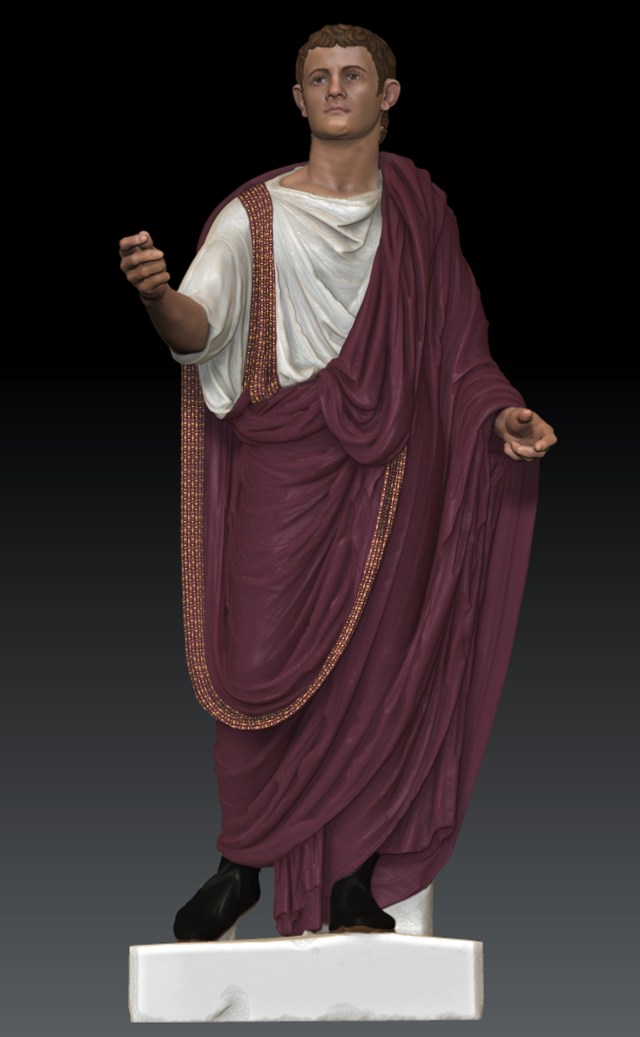
caligula_goldtrace_hires_final

This is what a statue would have looked like of the Emperor Caligula (born 12 AD, Emperor 37-41, died 41). Statues, even marble ones, were painted in ancient Greece and Rome.

We start Paul’s Second Letter to the Thessalonians today. It may be the earliest book in the New Testament. Now, that’s a controversial thing to say, as many biblical scholars would say that it is unlikely to have been written by Paul. They say this because it sounds an awful lot like Paul’s First Letter to the Thessalonians (and the consensus is that Paul did write it), and so these scholars get suspicious, wondering if the author is someone wanting to write in Paul’s name and use his authority. Indeed, the letter tells its recipients not to be alarmed by letter of word “as though from us” that the Day of the Lord has come, so it suggests that some people were already doing this.

However, my Paul Professor at Trinity College, Toronto believed that it was by Paul, and argued for the early date, and even claimed to be able to date it more or less exactly – 40 AD. This is because Hurd thought that all the details matched a particular well-attested event in history – the attempt by the Emperor Caligula to erect a statue of himself as a divine being in the Temple in Jerusalem. Judea and Jerusalem had been conquered for Rome by Pompey the Great in 69 BC, more than a hundred years earlier. While Pompey had profaned the Temple by entering into it and even going in to the Holy of Holies, only discover that it was an empty room, he immediately confirmed the High Priest in his office, ordered that Jews and the Jewish religion should be left alone and not be required to conform to Roman sacrificial expectations, and called for the regular sacrifices to continue. And so it continued until Caligula’s time (although Pompey’s career, up until that time unstoppable, started its long decline which ended in 48 BC with him assassinated and beheaded by followers of Julius Caesar in a boat off Egypt – coincidence, or punishment for having committed sacrilege?).

Caligula was not a good Emperor – no ancient writer says anything good about him. He either was a megalomaniac or he was a mischievous young man who enjoyed putting the senators and aristocrats through gross humiliations. Eventually he was assassinated, too, only by members of his own bodyguard. But Caligula clearly did not get why the Jews, out of all the subject peoples in the Empire, should have an exemption from Roman ritual practices, especially those around worshiping the genius of the Emperor, who just happened to be him. So he issued orders that a statue of himself erected in the Temple. The Roman governor of Syria, Petronius,  was told to make sure this happened, so he made his way to Judea. However, when he arrived he was told that the Jews opposed it and would rather die than let it happen; some ten thousand people came to protest Caligula’s order. He went to Tiberias, a Roman colony on the Sea of Galilee, and the same thing happened there. Even though he had two legions with him Petronius delayed, not seeing a whole lot of benefit changing something that seemed to work for a century. He eventually sent a letter to Caligula, saying that there there was some opposition, and did he really want him to go ahead? Of course, he knew full well what the answer was, but sending aletter to the Emperor in those days took time, and getting an answer also took time. Petronius was probably hoping for something from the gods, or maybe even the Jewish God. And then it happened – Caligula was murdered, and his uncle Claudius had no interest in setting up statues in Jerusalem, and instead went on to conquer Britain.

Think of this when you read over 2 Thessalonians 2.1-12. Who might the lawless one be? Caligula, perhaps, who “opposes and exalts himself above every so-called god or object of worship, so that he takes his seat in the temple of God, declaring himself to be God”? Sounds like it to me. His attempt to aggrandize himself in the face of the Jewish God was a “rebellion”, and perhaps in Paul’s mind this gross abomination would be the trigger for the Day of the Lord and the return of Jesus in glory as the Son of Man, destroying this blasphemer “with the breath of his mouth, annihilating him by the manifestation of his coming” and moving on to judge the quick and the dead.

But then Caligula was assassinated, and Paul had to revise the schedule. Paul’s First Letter to the Thessalonians, which according to Hurd is a somewhat later letter, perhaps a year or two after Caligula’s death, represents some of that revision, and is somewhat less precise than Second Thessalonians. As Paul wrote his others letters – First Corinthians, Galatians, Second Corinthians, Philippians, Philemon, Romans (and possibly Colossians and Ephesians – scholars are divided), the Day of the Lord becomes less important, although it never quite recedes completely.

And perhaps the message for us. Yes, we can get very excited by current events and look to them for signs of the return of the Son of Man. On the other hand, there are also other aspects of the Christian faith – say, “love” as described in First Corinthians 13 – that are equally if not more important. Yes, we need to be ready to meet the one through whom all things were made, but in a very real sense, we do that through prayer and contemplation, through reading and meditating on the scriptures, through participation in the Body of Christ in the church, and by reaching out to help the least of those among us. Don’t be “quickly shaken or alarmed.”

Isaiah 7.1–9
In the days of Ahaz son of Jotham son of Uzziah, king of Judah, King Rezin of Aram and King Pekah son of Remaliah of Israel went up to attack Jerusalem, but could not mount an attack against it. When the house of David heard that Aram had allied itself with Ephraim, the heart of Ahaz and the heart of his people shook as the trees of the forest shake before the wind.
Then the Lord said to Isaiah, Go out to meet Ahaz, you and your son Shear-jashub, at the end of the conduit of the upper pool on the highway to the Fuller’s Field, and say to him, Take heed, be quiet, do not fear, and do not let your heart be faint because of these two smouldering stumps of firebrands, because of the fierce anger of Rezin and Aram and the son of Remaliah. Because Aram—with Ephraim and the son of Remaliah—has plotted evil against you, saying, Let us go up against Judah and cut off Jerusalem and conquer it for ourselves and make the son of Tabeel king in it; therefore thus says the Lord God:
     It shall not stand,
and it shall not come to pass.
     For the head of Aram is Damascus,
and the head of Damascus is Rezin.

(Within sixty-five years Ephraim will be shattered, no longer a people.)
The head of Ephraim is Samaria,
and the head of Samaria is the son of Remaliah.
If you do not stand firm in faith,
you shall not stand at all.

2 Thessalonians 2.1–12
As to the coming of our Lord Jesus Christ and our being gathered together to him, we beg you, brothers and sisters, not to be quickly shaken in mind or alarmed, either by spirit or by word or by letter, as though from us, to the effect that the day of the Lord is already here. Let no one deceive you in any way; for that day will not come unless the rebellion comes first and the lawless one is revealed, the one destined for destruction. He opposes and exalts himself above every so-called god or object of worship, so that he takes his seat in the temple of God, declaring himself to be God. Do you not remember that I told you these things when I was still with you? And you know what is now restraining him, so that he may be revealed when his time comes. For the mystery of lawlessness is already at work, but only until the one who now restrains it is removed. And then the lawless one will be revealed, whom the Lord Jesus will destroy with the breath of his mouth, annihilating him by the manifestation of his coming. The coming of the lawless one is apparent in the working of Satan, who uses all power, signs, lying wonders, and every kind of wicked deception for those who are perishing, because they refused to love the truth and so be saved. For this reason God sends them a powerful delusion, leading them to believe what is false, so that all who have not believed the truth but took pleasure in unrighteousness will be condemned.

Luke 22.1–13
Now the festival of Unleavened Bread, which is called the Passover, was near. The chief priests and the scribes were looking for a way to put Jesus to death, for they were afraid of the people.

Then Satan entered into Judas called Iscariot, who was one of the twelve; he went away and conferred with the chief priests and officers of the temple police about how he might betray him to them. They were greatly pleased and agreed to give him money. So he consented and began to look for an opportunity to betray him to them when no crowd was present.

Then came the day of Unleavened Bread, on which the Passover lamb had to be sacrificed. So Jesus sent Peter and John, saying, ‘Go and prepare the Passover meal for us that we may eat it.’ They asked him, ‘Where do you want us to make preparations for it?’ ‘Listen,’ he said to them, ‘when you have entered the city, a man carrying a jar of water will meet you; follow him into the house he enters and say to the owner of the house, “The teacher asks you, ‘Where is the guest room, where I may eat the Passover with my disciples?’ ” He will show you a large room upstairs, already furnished. Make preparations for us there.’ So they went and found everything as he had told them; and they prepared the Passover meal.

Posted in Advent | Tagged , , , , , , , | Leave a comment

Day Eleven of an Advent Calendar: Calling, Vengeance, and Casting Stones

December 7, 2016     Wednesday after the Second Sunday of Advent
Isaiah 6.1–13
2 Thessalonians 1.1–12
John 7.53—8.11
The text of the readings follows after the comments.

nicea

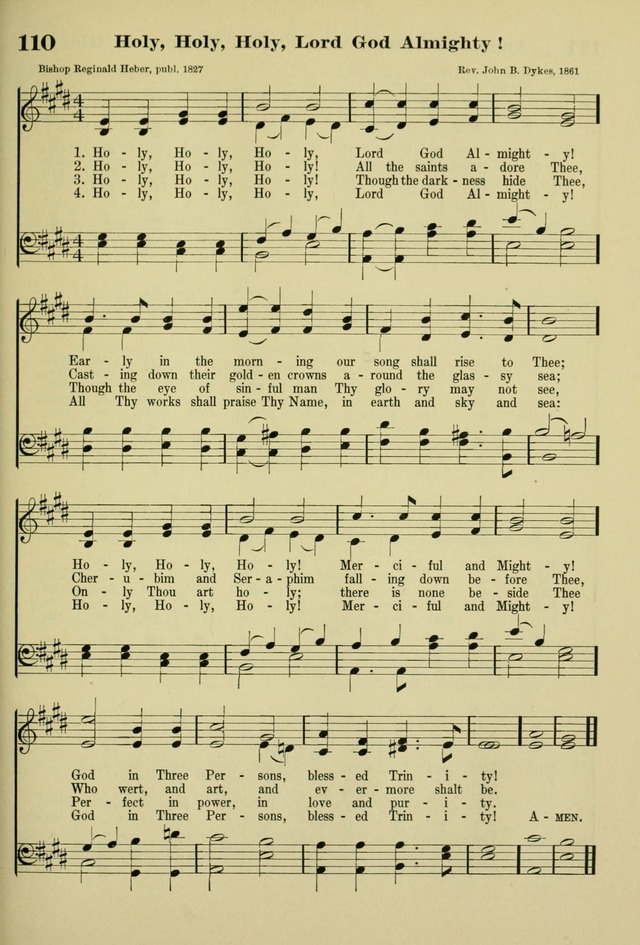
The first text from Isaiah is his call. If chapters one to  twelve of the book are indeed, as a professor of mine suggested, the historical core of the historical person named Isaiah, then this comes at the middle, which in Hebrew poetry and in narrative structure is a very important place in the structure of a text. It is some time around the year 742 BC. Isaiah, already someone of eminence in that he was a priest offering incense in the First Temple, experiences the glorious presence of God in a vision. He sees angels call to each other in words that would influence the ancient Christian hymn used in the Eucharist known as the Sanctus and the early 19th century Anglican Trinitarian hymn “Holy, Holy, Holy” (which has one of the more unusual metres in hymnody). In the face of God’s glory Isaiah feels ashamed and humble for himself and his people: “I am a man of unclean lips, and I live among a people of unclean lips.” He expects to die suddenly, for no one can see God and live. So the angels purify him, and God asks “Whom shall I send, and who will go for us?” Isaiah, newly purified, says in Hebrew: “Hinneni” – “Here I am – send me!” And God does send him with a message of warning about war and destruction that will fall upon Judea, events that will leave only a faithful remanant, a stump, which will sprout and grow into a new and transformed people of God.

These messages of doom and destruction never seem quite right to us modern people, and there is a very good reason for it. In the minds of the writers of scripture God created the world and can do what God wants to. As God is inherently just, whatever he does displays justice. Paul in the Second Letter to the Thessalonians (which we begin today) states that God will exact “vengeance on those who do not know God and on those who do not obey the gospel of our Lord Jesus.” These people “will suffer the punishment of eternal destruction, separated from the presence of the Lord and from the glory of his might”. We might protest that that a God who does this is not just, but in this pre-modern perspective a God who does not have the right to do this is not God, and God’s justice will be perverted if all these evil people are rewarded the same as the righteous who suffer. God is the measure of all things. But the modern perspective since the Enlightenment is that “Man is the measure of all things”.  Thus we can, as Kant and others succeeding him sought to do, construct a moral system on the basis of reason alone, without reference to the scriptures of any faith. The system that Kant devised ultimately wasn’t so different from the Christian morals that preceded him, but it had the advantage of universal appeal to all rational beings. Of course, ever since Kant people have provided rational arguments as to why his methodology and conclusions are wrong, and go on to devise alternative approaches to morals and ethics. But one result of this is that if there is some sense of justice and ethical behaviour that is independent of God, then we can judge God by it as well. Once this happens, people begin to call into question the divine authorship of scriptural texts that do not exhibit this high standard of justice, and God’s authority and relevance is called into question. Religion at best becomes a private matter, and humans look for other deities who can provide meaning and be broadly accepted by societies – for example, the gods known as “science,” or “nationalism,” or “dialectical materialism,” or “free markets,” or “racism,” or “the leader.”

I sometimes describe myself as post-modern, mainly because while I grew up in “the modern world” I certainly try not worship at the feet of these idols (although I sometimes slip and find myself saying things about which I know better).  rather, I think that reason is far more limited than the Enlightenment folks thought just over two centuries to go. But I cannot go pre-modern (as some conservative Christians do) and act as if the past two hundred years never happened. rather, I need to engage and be informed by this history, and recognise that some good points are made, but they are not the ultimate answer.

Which curiously, in a way, takes us back to God, but this time God in Christ. The third reading for today is the very strange passage found in the Gospel according to John. The passage is strange not because of the content, but because it is most definitely not written by the author of the Fourth Gospel – it is an interpolation that in time became part of the text, but is absent in many ancient manuscripts of the gospel. The language is utterly unlike anything else in the Johannine tradition. It shows up in some manuscripts in the Gospel according to Luke. All of this said, it appears to be an ancient tradition that was written down and at some point somebody said, “Well, it has to go somewhere” and so some editor or scribe stuck in between the seventh and eighth chapter of John.

You probably know it already, and if you don’t, well, that’s why I put the texts below. It’s the story of the woman caught in adultery. She is facing a horrific death by stoning. Jesus saves her life by challenging the angry mob by saying, “Let anyone among you who is without sin be the first to throw a stone at her.” Of course, none are without sin, and no one starts the stoning. Even Jesus, who is portrayed as without sin, refuses to condemn her.

So this is the post-modern part: Jesus represents the Father, but not as a judge or as one who wreaks just vengeance upon sinners, but as someone who does not condemn and simply calls the woman to refrain from sin. That’s it. He doesn’t even tell her she must repent, doesn’t even tell her she needs to make reparations – just, “Go your way, and from now on do not sin again.”  And this becomes the new standard of justice. “Forgive us our sins as we forgive others.” “Do not judge one another.”

We make judgments all the time. That’s how we get through the day. But there are an awful lot of things where judgmental attitudes and demands for punishment don’t really accomplish a whole lot. Prior to the middle of the 19th century capital punishment was executed on everything from petty theft, witchcraft, petty theft, and chopping down a tree. This did little to reduce the prevalence of crime. A new approach was needed, one that was more forgiving, and looked to reform and not destruction.

Christians are called to be messengers among a people of unclean lips. This does not really make us better than them, because it is only by the grace of God that we have any sense that there is another way to do things than the ones that get mobs of people righteously blood-thirsty. My prayer is that we are people of mercy ad forgiveness, and that God will fulfil by God’s  “power every good resolve and work of faith, so that the name of our Lord Jesus may be glorified in [us], and [us] in him, according to the grace of our God and the Lord Jesus Christ.”

Isaiah 6.1–13
In the year that King Uzziah died, I saw the Lord sitting on a throne, high and lofty; and the hem of his robe filled the temple. Seraphs were in attendance above him; each had six wings: with two they covered their faces, and with two they covered their feet, and with two they flew. And one called to another and said:
‘Holy, holy, holy is the Lord of hosts;
the whole earth is full of his glory.’
The pivots on the thresholds shook at the voices of those who called, and the house filled with smoke. And I said: ‘Woe is me! I am lost, for I am a man of unclean lips, and I live among a people of unclean lips; yet my eyes have seen the King, the Lord of hosts!’

Then one of the seraphs flew to me, holding a live coal that had been taken from the altar with a pair of tongs. The seraph touched my mouth with it and said: ‘Now that this has touched your lips, your guilt has departed and your sin is blotted out.’ Then I heard the voice of the Lord saying, ‘Whom shall I send, and who will go for us?’ And I said, ‘Here am I; send me!’ And he said, ‘Go and say to this people:
“Keep listening, but do not comprehend;
keep looking, but do not understand.”
Make the mind of this people dull,
and stop their ears,
and shut their eyes,
so that they may not look with their eyes,
and listen with their ears,
and comprehend with their minds,
and turn and be healed.’
Then I said, ‘How long, O Lord?’ And he said:
‘Until cities lie waste
without inhabitant,
and houses without people,
and the land is utterly desolate;
until the Lord sends everyone far away,
and vast is the emptiness in the midst of the land.
Even if a tenth part remains in it,
it will be burned again,
like a terebinth or an oak
whose stump remains standing
when it is felled.’
The holy seed is its stump.

2 Thessalonians 1.1–12
Paul, Silvanus, and Timothy,
To the church of the Thessalonians in God our Father and the Lord Jesus Christ:

Grace to you and peace from God our Father and the Lord Jesus Christ.

We must always give thanks to God for you, brothers and sisters, as is right, because your faith is growing abundantly, and the love of every one of you for one another is increasing. Therefore we ourselves boast of you among the churches of God for your steadfastness and faith during all your persecutions and the afflictions that you are enduring.

This is evidence of the righteous judgement of God, and is intended to make you worthy of the kingdom of God, for which you are also suffering. For it is indeed just of God to repay with affliction those who afflict you, and to give relief to the afflicted as well as to us, when the Lord Jesus is revealed from heaven with his mighty angels in flaming fire, inflicting vengeance on those who do not know God and on those who do not obey the gospel of our Lord Jesus. These will suffer the punishment of eternal destruction, separated from the presence of the Lord and from the glory of his might, when he comes to be glorified by his saints and to be marvelled at on that day among all who have believed, because our testimony to you was believed. To this end we always pray for you, asking that our God will make you worthy of his call and will fulfil by his power every good resolve and work of faith, so that the name of our Lord Jesus may be glorified in you, and you in him, according to the grace of our God and the Lord Jesus Christ.

John 7.53—8.11
Then each of them went home, while Jesus went to the Mount of Olives. Early in the morning he came again to the temple. All the people came to him and he sat down and began to teach them. The scribes and the Pharisees brought a woman who had been caught in adultery; and making her stand before all of them, they said to him, ‘Teacher, this woman was caught in the very act of committing adultery. Now in the law Moses commanded us to stone such women. Now what do you say?’ They said this to test him, so that they might have some charge to bring against him. Jesus bent down and wrote with his finger on the ground. When they kept on questioning him, he straightened up and said to them, ‘Let anyone among you who is without sin be the first to throw a stone at her.’ And once again he bent down and wrote on the ground. When they heard it, they went away, one by one, beginning with the elders; and Jesus was left alone with the woman standing before him. Jesus straightened up and said to her, ‘Woman, where are they? Has no one condemned you?’ She said, ‘No one, sir.’ And Jesus said, ‘Neither do I condemn you. Go your way, and from now on do not sin again.’

Posted in Advent | Tagged , , , , , | Leave a comment

Day Ten of an Advent Calendar: Santa Claus is a Klingon?

December 6, 2016     Tuesday after the Second Sunday of Advent (Feast of St. Nicholas)
Isaiah 5.13–17, 24–25
1 Thessalonians 5.12–28
Luke 21.29–38
The text of the readings follows after the comments.

santa-klingon

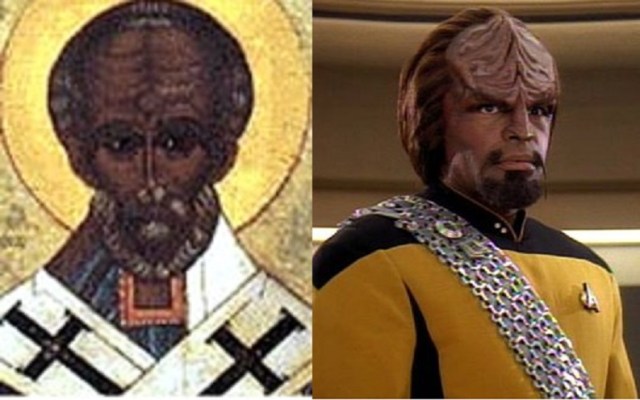
That moment you realise that Santa Claus is a Klingon. On the left, St. Nicholas of Myra, on the right, Worf, son of Mogh

Today is the Feast of St. Nicholas, who was known in the Netherlands and colonial New Amsterdam as as Sinterklass and morphed into Santa Claus. An Episcopalian priset, the Reverend Professor Clement Clarke Moore , wrote “A Visit from St. Nicholas” in 1823, and the cultural icon continued to grow in popularity. Despite his cultural significance, St. Nicholas is an optional observance, and while “For All the Saints” (a book covering all the commemorations in the calendar of the Anglican Church of Canada) provides special readings for the eucharist, St. Nick is not so important as to displace the lectio continuo of the daily offices. That said, I’ll take a break from commenting on the readings to think a bit about a recent event.

Social media went a bit nuts a few days ago when some racist bigots got upset that the mall of America in the Twin Cities of Minnesota hosted a Santa Claus of African-American ancestry. The idea that Santa Claus was anything but “white” really got their knickers in a knot. I am sure the kids lined up to talk to Santa did not care, but some adults seemed quite upset.

Of course, this just reminded me of an even earlier of another social media thing, the meme that I’ve reproduced above. Icons of St. Nicholas stereotypically have him with a furrowed brow  and really don’t care much about Aryan sensitivities to skin tone, and so St. Nicholas can look a bit like the actor Michael Dorn in costume as Worf from Star Trek: The Next Generation. You don’t think Santa Claus can be black? OK, maybe he’s really a Klingon.

To point out the obvious, we have no idea what St. Nicholas looked like, although it was probably something like what the people of south-western Turkey look like now – distinctly Mediterranean. We also have no idea what Jesus looked like. The earliest depictions from the 3rd century show him as a beardless young man – in other words, no different than the average male subject of Rome. Under the influence of depictions of Zeus and other male Greco-Roman gods Jesus began to be depicted with flowing long hair and a beard, because that’s what a god is supposed to look like. The simple outline of his appearance then developed into what we normally associate with him.

All we really know about his appearance is that he was indistinguishable from his disciples. When Judas Iscariot sought to betray him he had to indicate to the Roman soldiers who Jesus was by greeting him with a kiss. And so in all probability he looked like the inhabitants of Palestine since time immemorial – something like this:

jesus-real-three-sides

If racists in the US melted down over a black Santa, this should make them apolplectic. Jesus as a swarthy first century Jew, looking like a modern refugee from Syria or Iraq, is a good image for what we might imagine Jesus was like, for “Truly I tell you, just as you did it to one of the least of these who are members of my family, you did it to me” (Matthew 25.40). Ultimately the face of Jesus is not to be found in art or forensic reconstruction but in the face of those who are suffering and oppressed. And the face of St. Nicholas is the face of any follower of Jesus who has a care for children.

Isaiah 5.13–17, 24–25
Therefore my people go into exile without knowledge;
their nobles are dying of hunger,
and their multitude is parched with thirst.
Therefore Sheol has enlarged its appetite
and opened its mouth beyond measure;
the nobility of Jerusalem and her multitude go down,
her throng and all who exult in her.
People are bowed down, everyone is brought low,
and the eyes of the haughty are humbled.
But the Lord of hosts is exalted by justice,
and the Holy God shows himself holy by righteousness.
Then the lambs shall graze as in their pasture,
fatlings and kids shall feed among the ruins.
Therefore, as the tongue of fire devours the stubble,
and as dry grass sinks down in the flame,
so their root will become rotten,
and their blossom go up like dust;
for they have rejected the instruction of the Lord of hosts,
and have despised the word of the Holy One of Israel.
Therefore the anger of the Lord was kindled against his people,
and he stretched out his hand against them and struck them;
the mountains quaked,
and their corpses were like refuse
in the streets.
For all this his anger has not turned away,
and his hand is stretched out still.

Thessalonians 5.12–28
But we appeal to you, brothers and sisters, to respect those who labour among you, and have charge of you in the Lord and admonish you; esteem them very highly in love because of their work. Be at peace among yourselves. And we urge you, beloved, to admonish the idlers, encourage the faint-hearted, help the weak, be patient with all of them. See that none of you repays evil for evil, but always seek to do good to one another and to all. Rejoice always, pray without ceasing, give thanks in all circumstances; for this is the will of God in Christ Jesus for you. Do not quench the Spirit. Do not despise the words of prophets, but test everything; hold fast to what is good; abstain from every form of evil.
May the God of peace himself sanctify you entirely; and may your spirit and soul and body be kept sound and blameless at the coming of our Lord Jesus Christ. The one who calls you is faithful, and he will do this.
Beloved, pray for us.
Greet all the brothers and sisters with a holy kiss. I solemnly command you by the Lord that this letter be read to all of them.
The grace of our Lord Jesus Christ be with you.

Luke 21.29–38
Then he [Jesus] told them a parable: “Look at the fig tree and all the trees; as soon as they sprout leaves you can see for yourselves and know that summer is already near. So also, when you see these things taking place, you know that the kingdom of God is near. Truly I tell you, this generation will not pass away until all things have taken place. Heaven and earth will pass away, but my words will not pass away.
“Be on guard so that your hearts are not weighed down with dissipation and drunkenness and the worries of this life, and that day does not catch you unexpectedly, like a trap. For it will come upon all who live on the face of the whole earth. Be alert at all times, praying that you may have the strength to escape all these things that will take place, and to stand before the Son of Man.”
Every day he was teaching in the temple, and at night he would go out and spend the night on the Mount of Olives, as it was called. And all the people would get up early in the morning to listen to him in the temple.

Posted in Advent | Tagged , , | 3 Comments

Day Nine of an Advent Calendar: The Apocalypse as Justice

Monday December 5, 2016     Monday after the Second Sunday of Advent
Isaiah 5.8–12, 18–23
1 Thessalonians 5.1–11
Luke 21.20–28
The text of the readings follows after the comments.

batman-v-superman-dawn-of-justice-desert-vista

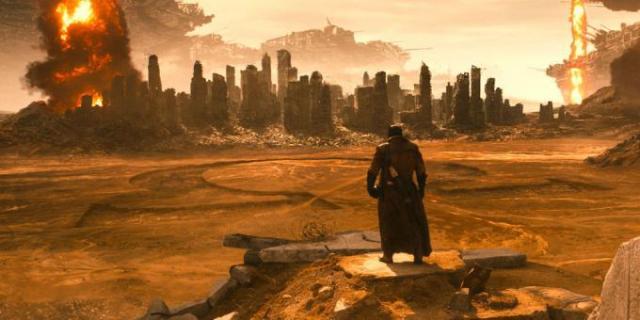
When you enter “Justice Apocalypse” as the search items in Google Image, you get Batman’s nightmare of a burning Gotham City.

When people hear the word “apocalypse” they usually understand it as this: “a disaster resulting in drastic, irreversible damage to human society or the environment, esp. on a global scale; a cataclysm” (OED 2008 Draft definition “b.”). So it doesn’t sound like a good thing.

However, to the first Christians the word ἀποκάλυψις simply meant “unveiling” or a “revealing”. The last book of the Bible in Greek is “Ho Apocalupsis” which is properly translated as “Revelation”. For these early readers an apocalypse is a good thing, because their “redemption is drawing near”, as the passage from Luke puts it.

This sounds surprising to us. Why would they want destruction to come upon the peoples of the world? Why would they accept “distress among the nations”? The answer is that they saw the world very differently from us. From the perspective of Paul, the Jews, or the early Gentile converts to Christianity, there was very little that was good about the rule of Rome and the culture of Gentiles. Rome was an imperial power that had no scruples about genocide, slavery, or sheer violence as means of achieving ends. Gentile worship of idols at best was foolish veneration of empty statues, but at worst it was a surrender to malevolent, demonic spirits. This led to corrupt morals, uncontrolled drunkenness, and preferring the cloak of darkness to the transparency of daylight. The “time of the Gentiles” was an evil time, and the sooner the end came the better.

This is why Paul’s mission to the Gentiles was so unusual – Jesus himself had said that he “was only sent to the lost sheep of Israel” (according to Matthew 15.24), but Paul claimed to have received a mission from God to take the good news to the unspeakable mass of Greeks, Romans, and barbarians. While we know that fairly soon there were more Gentile followers of Jesus than Jewish ones, Paul did not know that this would be the outcome. In his day the majority of Christians were still observant Jews (remember we are talking here of numbers probably at best of a few thousand Christians in the whole world, if that). His mission was the exception to the general expectation. It would have been unthinkable to Paul that a) the coming of the Son of Man would be delayed not just a few years but centuries, and that b) by about 300 AD possibly half of the population Roman Empire claimed to be Christian.

Today the followers of Jesus numbers some 2.2 billion, and make up 31.5% of the world’s population, thus being the largest religion on the planet. While Christianity in the West seems to be overwhelmed by agnosticism and the “spiritual but not religious”, in the rest of the world Christianity continues to grow, especially in Asia and Africa. As Vizzini would say, “Inconceivable!” For the early Christians the end of the world seemed a more likely outcome than the past twenty centuries of Christian history.

Where does this leave us with apocalypse? I think there are a few ways to go at it. One is to understand it literally, and basically say that Christ will come as the Son of Man in glory, and that there will be a judgment of the living and dead, which is great news for those of us who are faithful but not so good for those who are not. One can go further and say that it is thus the case that the Gospel will indeed be good news to those who are being oppressed and are suffering now, but bad news to those who are exploiting the poor and are callously indifferent to those not as fortunate as them.

Another way to approach this is to note that in the past sixty years we humans have been able to bring an apocalypse upon ourselves, either through nuclear war or global warming. God calls those of us who are Christians to warn people that there is time to change, to beat the swords into plowshares (as Isaiah puts it) and to learn to live in harmony with creation. The Apocalypse is now – the revealing of what will happen if we do not have a change of mind and repent of our ways. This is more social understanding of apocalyptic, less as a sure thing and more as a warning, like old time prophecy. Perhaps the exception that was granted in Christ to Gentile through the Pauline mission is now generalized as one that encompasses the whole of the world, not just a few.

Behind all of this is the demand for justice. The passage from Isaiah is a critique of those who accumulate wealth and then expend it in luxurious living. Isaiah predicts that this wealth will be destroyed by war, which is pretty much which happened in the generations after. In the same way Paul in Thessalonians and the author of Luke are critical of those who in their time ignore God and abhor justice (one leads to the other). The demand for justice from the oppressed and exploited of today is just as strong. In particular the indigenous peoples call into question the practices of those of us in the wealthy globalized world. Can we see apocalypse coming? Will we do what is necessary to avert it?

Isaiah 5.8–12, 18–23
Ah, you who join house to house,
who add field to field,
until there is room for no one but you,
and you are left to live alone
in the midst of the land!
The Lord of hosts has sworn in my hearing:
Surely many houses shall be desolate,
large and beautiful houses, without inhabitant.
For ten acres of vineyard shall yield but one bath,
and a homer of seed shall yield a mere ephah.

Ah, you who rise early in the morning
in pursuit of strong drink,
who linger in the evening
to be inflamed by wine,
whose feasts consist of lyre and harp,
tambourine and flute and wine,
but who do not regard the deeds of the Lord,
or see the work of his hands!
Ah, you who drag iniquity along with cords of falsehood,
who drag sin along as with cart-ropes,
who say, ‘Let him make haste,
let him speed his work
that we may see it;
let the plan of the Holy One of Israel hasten to fulfilment,
that we may know it!’
Ah, you who call evil good
and good evil,
who put darkness for light
and light for darkness,
who put bitter for sweet
and sweet for bitter!
Ah, you who are wise in your own eyes,
and shrewd in your own sight!
Ah, you who are heroes in drinking wine
and valiant at mixing drink,
who acquit the guilty for a bribe,
and deprive the innocent of their rights!

1 Thessalonians 5.1–11
Now concerning the times and the seasons, brothers and sisters, you do not need to have anything written to you. For you yourselves know very well that the day of the Lord will come like a thief in the night. When they say, ‘There is peace and security’, then sudden destruction will come upon them, as labour pains come upon a pregnant woman, and there will be no escape! But you, beloved, are not in darkness, for that day to surprise you like a thief; for you are all children of light and children of the day; we are not of the night or of darkness. So then, let us not fall asleep as others do, but let us keep awake and be sober; for those who sleep sleep at night, and those who are drunk get drunk at night. But since we belong to the day, let us be sober, and put on the breastplate of faith and love, and for a helmet the hope of salvation. For God has destined us not for wrath but for obtaining salvation through our Lord Jesus Christ, who died for us, so that whether we are awake or asleep we may live with him. Therefore encourage one another and build up each other, as indeed you are doing.

Luke 21.20–28
[Jesus said] “When you see Jerusalem surrounded by armies, then know that its desolation has come near. Then those in Judea must flee to the mountains, and those inside the city must leave it, and those out in the country must not enter it; for these are days of vengeance, as a fulfilment of all that is written. Woe to those who are pregnant and to those who are nursing infants in those days! For there will be great distress on the earth and wrath against this people; they will fall by the edge of the sword and be taken away as captives among all nations; and Jerusalem will be trampled on by the Gentiles, until the times of the Gentiles are fulfilled.

“There will be signs in the sun, the moon, and the stars, and on the earth distress among nations confused by the roaring of the sea and the waves. People will faint from fear and foreboding of what is coming upon the world, for the powers of the heavens will be shaken. Then they will see “the Son of Man coming in a cloud” with power and great glory. Now when these things begin to take place, stand up and raise your heads, because your redemption is drawing near.”

Posted in Advent | Tagged , | 1 Comment

Day Eight of An Advent Calendar: Good and Evil

Sunday, December 4, 2016     Second Sunday of Advent
Isaiah 5.1–7
2 Peter 3.11–18
Luke 7.28–35
The text of the readings follows after the comments.

red-vineyards-at-arles

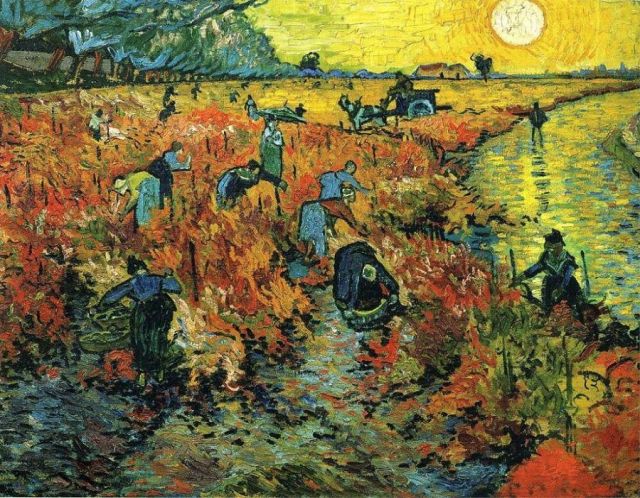
The Red Vineyard at Arles, by Vincent van Gogh, 1888

Why do people do the wrong thing? Why is there evil?

I’ve been mulling this over for many years. As some of you know, I’ve been working on a PhD through Heythrop College, the Jesuit college in the University of London. The topic of the dissertation is the theological legacy of the Indian Residential Schools (“IRS”) which were operated by the churches in Canada on behalf of the federal government from the 1880s until the 1970s. It was described in the recent Truth and Reconciliation Commission Final Report as “cultural genocide” and I would argue that the modifying term “cultural” can be left off, given the number of deaths and the fact that the  IRS was set up to assimilate the indigenous population (also, see the definition in the Genocide Convention). And yet the churches were enthusiastic supporters of the schools despite the evidence of their detrimental effect on the students and families. Most of the staff (with the exception of a small number of sexual predators) were what we would have called “good people”. In the dissertation I critique the theologies that informed the mission that justified the IRS, and then examine a type of theology that might not lead us down such paths again in other circumstances.

The study of evil in a theological or philosophical context is called a “theodicy”. One of the authors I am using as a critical tool, the French and Jewish philosopher Emmanuel Levinas (1906-1995), claims that after the Holocaust it is no longer possible to construct a theodicy on a rational basis. Christians have typically tended to not go so far.

Some would follow St Augustine in seeing evil as simply the privation of good. The evil we see in the world is real, but it is the result of ignorance or error. Everything that is created by God is created with the possibility of being good. This is, of course, a pre-modern perspective, and assumes that one sees the Creator as the Good to which all creation naturally aspires. A modern perspective suspends the question of belief in God and sees good and evil as a matter of human choice, and sometimes the difference between the two is impossible to discern. Goods such as family, nation, pleasure, security, the environment, privacy, other people, and so forth jostle for our attention, along with fears about our economic stability, threats to our lives, corruption, physical and sexual violence, bigotry, and competition. As the philosopher Isaiah Berlin pointed out these values (or rights) are incommensurable – they will conflict with each other and they are only resolved (if at all) after discussion and compromise. The good becomes more relative, as does evil.

An old way of understanding evil in the world is to see it as a force, driven by spirits or the devil. This sees the world as a battlefield of binary forces, good and evil. Some of this is present in the Scriptures, but it is in tension with another understanding, which is that God is in charge of everything. Isaiah 45.6-7 in the translation of the  Authorised Version/King James Version says: “I am the Lord, and there is none else.I form the light, and create darkness: I make peace, and create evil: I the Lord do all these things.” Thus when bad things happen to people some of them blame God, and question God’s world and the justice of it – and on the basis of this passage, they do seem to know who is responsible. Today’s reading from Isaiah describes a God who is punishing Israel and Judah for producing bloodshed instead of justice and righteousness. And the parable of God as the owner and builder of the vineyard, would suggest that God has every right to do what God wants with his own property. This is the theology of Isaiah – that God will chasten Israel and Judah in the hope that they will repent and return, that they will be purified and become holy (as yesterday’s reading suggests).

In contrast to this we have the Book of Job, which might be described as a dissenting  opinion. Job experiences great woes for no discernible (to him) reason at all, and four friends come to him to try and convince him that there is a good rational reason. He rejects them all, and demands his day in the court of the Lord. Then, miraculously, God does appear from the whirlwind – but does not justify the divine to humanity, but simply argues that the question is unanswerable.

My reading of the new testament is that it doesn’t really answer the question of evil either. Yes, God is just and will bring justice, but the cause of evil itself is not all clear (despite later theologians attempts to blame Adam and Eve). As the author of 2 Peter suggests, it is due to ignorance, error, and instability. Knowledge, truth, and stability is not just a matter of having the right opinions and propositions, it is more the relation of the faithful with God in Christ, as manifested in prayer and love. In the Gospel reading for today the Pharisees and Scribes, despite their great learning, are in error because they cannot see the justice of God at work in either John the Baptist and Jesus as the Son of Man. Whereas in love Jesus associates with tax collectors and sinners, their systems of knowledge and thought holds them aloof and condemning – cut off from opportunities of being with people, instead of their own self-satisfaction.

From my reading of history most people who do evil do not think they are doing bad things, but rather they think that, on balance, they are doing good things (although that good may be limited to themselves or to a group). They still aim at the good, although they miss the mark. I do not know the origin of evil in this world – I read Genesis 2-3 as a description of the way things are, broken and fallen, and not so much as an origin story. The Good News of Jesus Christ does not explain everything, but what it does tell me is that God is with us, in the flesh in Jesus suffering alongside humanity, and that God is in me by the Holy Spirit, and that however much I fall short of what it is that I have been created to be, God forgives me and seeks to transform me ever more into the divine likeness. So I worry less about why there is evil, and more about following Jesus, seeking to bring relief and do good.

Isaiah 5.1–7
Let me sing for my beloved
my love-song concerning his vineyard:
My beloved had a vineyard
on a very fertile hill.
He dug it and cleared it of stones,
and planted it with choice vines;
he built a watch-tower in the midst of it,
and hewed out a wine vat in it;
he expected it to yield grapes,
but it yielded wild grapes.

And now, inhabitants of Jerusalem
and people of Judah,
judge between me
and my vineyard.
What more was there to do for my vineyard
that I have not done in it?
When I expected it to yield grapes,
why did it yield wild grapes.

And now I will tell you
what I will do to my vineyard.
I will remove its hedge,
and it shall be devoured;
I will break down its wall,
and it shall be trampled down.
I will make it a waste;
it shall not be pruned or hoed,
and it shall be overgrown with briers and thorns;
I will also command the clouds
that they rain no rain upon it.

For the vineyard of the Lord of hosts
is the house of Israel,
and the people of Judah
are his pleasant planting;
he expected justice,
but saw bloodshed;
righteousness,
but heard a cry!

2 Peter 3.11–18
Since all these things are to be dissolved in this way, what sort of people ought you to be in leading lives of holiness and godliness, waiting for and hastening the coming of the day of God, because of which the heavens will be set ablaze and dissolved, and the elements will melt with fire? But, in accordance with his promise, we wait for new heavens and a new earth, where righteousness is at home.

Therefore, beloved, while you are waiting for these things, strive to be found by him at peace, without spot or blemish; and regard the patience of our Lord as salvation. So also our beloved brother Paul wrote to you according to the wisdom given to him, speaking of this as he does in all his letters. There are some things in them hard to understand, which the ignorant and unstable twist to their own destruction, as they do the other scriptures. You therefore, beloved, since you are forewarned, beware that you are not carried away with the error of the lawless and lose your own stability. But grow in the grace and knowledge of our Lord and Saviour Jesus Christ. To him be the glory both now and to the day of eternity. Amen.

Luke 7.28–35
[Jesus said] “I tell you, among those born of women no one is greater than John; yet the least in the kingdom of God is greater than he.”(And all the people who heard this, including the tax-collectors, acknowledged the justice of God, because they had been baptized with John’s baptism. But by refusing to be baptized by him, the Pharisees and the lawyers rejected God’s purpose for themselves.)
“To what then will I compare the people of this generation, and what are they like? They are like children sitting in the market-place and calling to one another,
We played the flute for you, and you did not dance; we wailed, and you did not weep.
For John the Baptist has come eating no bread and drinking no wine, and you say, “He has a demon”; the Son of Man has come eating and drinking, and you say, “Look, a glutton and a drunkard, a friend of tax-collectors and sinners!” Nevertheless, wisdom is vindicated by all her children.”

Posted in Advent | Leave a comment

Day Seven of an Advent Calendar: How to Read Prophecy

December 3, 2016     Saturday after the First Sunday of Advent
Isaiah 4.2–6
1 Thessalonians 4.13–18
Luke 21.5–19
The text of the readings follows after the comments.

cloud-and-fire

A naive understanding of prophecy assumes that it is always about the reader’s future, and that it is always fulfilled. In fact prophecy is sometimes fulfilled completely, sometimes not at all, sometimes partially, and sometimes in ways never expected. Prophecy is also recycled, so that something that referred to one situation is used to interpret another. Prophecy is fecund and can be read repeatedly in new contexts for new purposes. Not all these readings are legitimate, of course, and part of any reader’s challenge is to determine the criteria that make for a good reading.

The passage from Luke is a fulfilled prophecy. Jesus predicts the destruction of the Temple in Jerusalem, and by the time the author of the gospel put stylus to papyrus the Temple had been indeed destroyed in 70 AD, following the failed Jewish rebellion of 66-70 AD. Luke probably had the Gospel according to Mark in front of him, but he significantly rewrote Mark 13 in light of what had happened. Jesus speaks about other things that will happen – wars, insurrections, false messiahs – and none of these are signs that “the end” is near. Likewise famines and dread portents will happen around this time, “but the end will not follow immediately.” Persecution of Christians will also come, and Jesus encourages his followers to rely on him to provide words of defence. What is important to understand here is that the author is describing things that had already taken place or were taking place now. The end days were already here, and had been since the coming of Jesus; the culmination of these days was delayed, however.

This delay created a problem for the Thessalonians. This letter, written perhaps written as early as 41 AD (so little more than a decade after Jesus’ death and resurrection) is very much written in the context of the expectation of an imminent return of Jesus as the Son of Man in glory to judge “the quick and the dead”. In today’s reading Paul describes the return of Jesus and includes himself as “we who are alive, who are left,” who “will be caught up in the clouds together . . . to meet the Lord in the air; and so we will be with the Lord for ever.” But what about those followers of Jesus who had already died? Paul announces that they will be raised right at the time of the coming of Jesus; it sounds as though this is not the general resurrection of all humanity, but an anticipatory resurrection of those who died in Christ, and get a free pass on the judgment of the world. Clearly, this is a passage of unfulfilled passage, and we here we are twenty centuries later, still waiting. Paul in his later letters seems to have acknowledged that he would die before the second coming, and his themes in the letters are less eschatological.

The passage from Isaiah is both fulfilled and unfulfilled. I suspect this does go back to the 8th century BC, and the prophet is speaking of a time after great disaster comes to Judea and Jerusalem. A faithful remnant is left in Zion, and just as God dwelt among the people in the wilderness with “a cloud by day and smoke and the shining of a flaming fire by night” so it will be then. Well, the fulfilled part is that Jerusalem and Judea was conquered and the Temple destroyed in 586 BC, and it was probably this that the editors of Isaiah thought of when the book received its final form. Certainly Second Isaiah picks up on the hope of redemption from this earlier passage, and looks to the return of the Jews from exile in Babylon as the fulfillment. But it never quite happened. The Jewish priests and upper classes who had been exiled did more or less return, but they remained under foreign sovereignty, and were slow to rebuild the city and the Temple. Third Isaiah (chapters 56-66) seem to have been written in that time of disappointment, and looks to a more radical intervention of God.

Later Jewish authors, in the centuries immediately before Jesus, began to believe that this intervention would be in the form of the coming of the Son of Man, and that the dead would be raised and that they with the living would be judged, and that God would transform the world and invite the righteous to live and feast in a New Jerusalem. The resurrection was fundamentally an issue of God’s justice. A simple understanding of God’s justice was that in this world good things happen to good people, and that bad things happen to bad people. However, this understanding started to fray when  the righteous often suffered oppression and death at the hands of the unrepentant heathen. Resurrection corrected that imbalance. The resurrection of the dead followed by judgment was the time when God would make things right, and those who had been arrogant would be pulled down and the humble would be exalted, and the hungry fed and the rich sent empty away (as the Magnificat puts it). The resurrection of Jesus on Easter Sunday inaugurates God’s recreation of the cosmos, and the making things right.

Every day when I recite the Apostle’s Creed I say that I believe that Jesus “will come again
to judge the living and the dead” and that “I believe in . . . the resurrection of the body,
and the life everlasting.” For me this means that I live knowing that I am in the end days, and that I seek re-creation and justice, and rely on God’s Spirit to strengthen me when times are hard. I try to live as though I am already in the New Jerusalem with the presence of God.

Isaiah 4.2–6
On that day the branch of the Lord shall be beautiful and glorious, and the fruit of the land shall be the pride and glory of the survivors of Israel. Whoever is left in Zion and remains in Jerusalem will be called holy, everyone who has been recorded for life in Jerusalem, once the Lord has washed away the filth of the daughters of Zion and cleansed the bloodstains of Jerusalem from its midst by a spirit of judgement and by a spirit of burning. Then the Lord will create over the whole site of Mount Zion and over its places of assembly a cloud by day and smoke and the shining of a flaming fire by night. Indeed, over all the glory there will be a canopy. It will serve as a pavilion, a shade by day from the heat, and a refuge and a shelter from the storm and rain.

1 Thessalonians 4.13–18
But we do not want you to be uninformed, brothers and sisters, about those who have died, so that you may not grieve as others do who have no hope. For since we believe that Jesus died and rose again, even so, through Jesus, God will bring with him those who have died. For this we declare to you by the word of the Lord, that we who are alive, who are left until the coming of the Lord, will by no means precede those who have died. For the Lord himself, with a cry of command, with the archangel’s call and with the sound of God’s trumpet, will descend from heaven, and the dead in Christ will rise first. Then we who are alive, who are left, will be caught up in the clouds together with them to meet the Lord in the air; and so we will be with the Lord for ever. Therefore encourage one another with these words.

Luke 21.5–19
           When some were speaking about the temple, how it was adorned with beautiful stones and gifts dedicated to God, he said, ‘As for these things that you see, the days will come when not one stone will be left upon another; all will be thrown down.’
They asked him, ‘Teacher, when will this be, and what will be the sign that this is about to take place?’ And he said, ‘Beware that you are not led astray; for many will come in my name and say, “I am he!” and, “The time is near!” Do not go after them.
‘When you hear of wars and insurrections, do not be terrified; for these things must take place first, but the end will not follow immediately.’ Then he said to them, ‘Nation will rise against nation, and kingdom against kingdom; there will be great earthquakes, and in various places famines and plagues; and there will be dreadful portents and great signs from heaven.
‘But before all this occurs, they will arrest you and persecute you; they will hand you over to synagogues and prisons, and you will be brought before kings and governors because of my name. This will give you an opportunity to testify. So make up your minds not to prepare your defence in advance; for I will give you words and a wisdom that none of your opponents will be able to withstand or contradict. You will be betrayed even by parents and brothers, by relatives and friends; and they will put some of you to death. You will be hated by all because of my name. But not a hair of your head will perish. By your endurance you will gain your souls.

Posted in Advent | Leave a comment

Day Six of an Advent Calendar: Anthropology is Theology

December 2, 2016     Friday after the First Sunday of Advent
Isaiah 3.8–15
1 Th 4.1–12
Lk 20.41—21.4
The text of the readings follows after the comments.

trinity-sketch-william-blake

A Sketch of The Trinity, by William Blake

The thing about a lectionary is that it takes you places you don’t expect. I did not intend to spend yesterday musing about celibacy as a subversive act of faith challenging the role of marriage in a patriarchal society, but that’s where the readings seemed to lead me. And today is similar. In the second reading we find, “For this is the will of God, your sanctification: that you abstain from fornication; that each one of you knows how to control your own body in holiness and honour, not with lustful passion, like the Gentiles who do not know God; that no one wrongs or exploits a brother or sister in this matter . . .”. So, we’re back to sex, again. So why is Paul saying this?

When I was studying Divinity in 1987 I saw a course in the calendar listed with the name: “Ante-Nicene Anthropology, Part Two” It was such a bizarre title I had to take it. It was taught by Father John Egan SJ at Regis College, the Jesuit college within the Toronto School of Theology. The subject matter was really the theological writings of Origin of Alexandria,  who worked in the early party of the Third Century. One of the things that became very clear in this course is that how we think about God has implications for how we think about human beings, and vice versa. Genesis 1.27 reads: “So God created humankind in his image, in the image of God he created them; male and female he created them.” As a result of this theologians have reflected over thirty centuries about what this might mean. Some saw it in rationality, others in complementary masculine and feminine aspects, some in creativity, and still others in the ability to control the environment. So our anthropology says something about how we understand God, and our theology always has implications for how we understand humanity. Origin of Alexandria had some rather interesting ideas – the pre-existence of souls, and a double creation of the invisible and visible, for example – and these were all derived from his Neoplatonic conception of God.

Human beings are inherently sexual creatures. We don’t see God as sexual, but what is common to both human sexuality and the human relation to God is desire. Sarah Coakley in her recent book God, Sexuality, and the Self: An Essay on the Trinity  makes this point, and according to Tina Beattie in a recent review, “Coakley turns Freud “on his head” by insisting that God rather than sex is the source and focus of erotic desire: “Instead of ‘God’ language ‘really’ being about sex, sex is really about God” (316). If genital sex occupies a less central role in this than it does in our sex-obsessed culture, the eroticism associated with sexual desire is inseparable from our experience of desire for God.”

This puts today’s passage from 1 Thessalonians into perspective. Paul knows that in the past the recipients of his letters have been pagans and worshiped idols, and either knows or assumes that they followed a sexual morality at odds with what he knew of in Judaism. To his mind this kind of lustful passion is out of control, and I find it interesting that he wants his readers to avoid wronging or exploiting another member of the church. What that suggests is that he is fully aware of both the power and the danger that comes with sexual relations, and that there is always the possibility of harming another person through sexual assault or exploitation. In the rigidly hierarchical society of the ancient Roman Empire a woman or a slave had no rights over their bodies, and their “superiors” regularly used them for their own sexual gratification. Paul, as imperfect an egalitarian as he was, had a more non-hierarchical understanding of relations, in which in Christ there was no Jew or Greek, slave or free, male or female. In Paul’s view uncontrolled lust that led to exploitation came from worshiping idols, whereas a focus on the true God leads to the desire to be holy and honourable, with the expectation that one will not assault another person or sexually exploit them. The admonition against fornication is not prudery as such, it is about not harming another person, and about rightly using desire.

Let’s see where tomorrow takes us, eh? God be with you.

Isaiah 3.8–15
For Jerusalem has stumbled
and Judah has fallen,
because their speech and their deeds are against the Lord,
defying his glorious presence.

The look on their faces bears witness against them;
they proclaim their sin like Sodom,
they do not hide it.
Woe to them!
For they have brought evil on themselves.
Tell the innocent how fortunate they are,
for they shall eat the fruit of their labours.
Woe to the guilty! How unfortunate they are,
for what their hands have done shall be done to them.
My people—children are their oppressors,
and women rule over them.
O my people, your leaders mislead you,
and confuse the course of your paths.

The Lord rises to argue his case;
he stands to judge the peoples.
The Lord enters into judgment
with the elders and princes of his people:
It is you who have devoured the vineyard;
the spoil of the poor is in your houses.
What do you mean by crushing my people,
by grinding the face of the poor? says the Lord God of hosts.

1 Thessalonians 4.1–12
Finally, brothers and sisters, we ask and urge you in the Lord Jesus that, as you learned from us how you ought to live and to please God (as, in fact, you are doing), you should do so more and more. For you know what instructions we gave you through the Lord Jesus. For this is the will of God, your sanctification: that you abstain from fornication; that each one of you knows how to control your own body in holiness and honour, not with lustful passion, like the Gentiles who do not know God; that no one wrongs or exploits a brother or sister in this matter, because the Lord is an avenger in all these things, just as we have already told you beforehand and solemnly warned you. For God did not call us to impurity but in holiness. Therefore whoever rejects this rejects not human authority but God, who also gives his Holy Spirit to you.
Now concerning love of the brothers and sisters, you do not need to have anyone write to you, for you yourselves have been taught by God to love one another; and indeed you do love all the brothers and sisters throughout Macedonia. But we urge you, beloved, to do so more and more, to aspire to live quietly, to mind your own affairs, and to work with your hands, as we directed you, so that you may behave properly towards outsiders and be dependent on no one.

Luke 20.41—21.4
Then he said to them, ‘How can they say that the Messiah is David’s son? For David himself says in the book of Psalms,
“The Lord said to my Lord,
‘Sit at my right hand,
until I make your enemies your footstool.’ ”
David thus calls him Lord; so how can he be his son?’
In the hearing of all the people he said to the disciples, ‘Beware of the scribes, who like to walk around in long robes, and love to be greeted with respect in the market-places, and to have the best seats in the synagogues and places of honour at banquets. They devour widows’ houses and for the sake of appearance say long prayers. They will receive the greater condemnation.’
He looked up and saw rich people putting their gifts into the treasury; he also saw a poor widow put in two small copper coins. He said, ‘Truly I tell you, this poor widow has put in more than all of them; for all of them have contributed out of their abundance, but she out of her poverty has put in all she had to live on.’

Posted in Advent | Leave a comment

Day Five of An Advent Calendar: Sex and Idolatry

Thursday December 1, 2016     Thursday after the First Sunday of Advent
Is 2.12–22
1 Th 3.1–13
Lk 20.27–40The text of the readings follows after the comments.

YHWH & Asherah.jpg

The passage from Isaiah inveighs against the arrogant who follow idols. The people living in Judea and Israel in the 8th century BC worshiped YHWH (the name of God in the Hebrew Bible usually replaced in English translations with “the LORD”), but they also worshiped other gods, most notably Asherah, who many considered to be the consort of YHWH. Asherah seems to have been closely connected to trees and in imitation of the trees, posts in temples. David and Solomon sought to centralize the worship of YHWH in the Temple at Jerusalem, but this was resisted by the northern kingdom of Israel that broke away from Judea after Solomon; apart from Israel’s official temples in Shechem it appears that the ordinary people continued to worship idols in groves of trees and on high hills. I think this is why Isaiah challenges the cedars of Lebanon and the oaks of Bashan, and the high mountains and the lofty hills, because they represent to him idolatry and a turning away from YHWH, the one God, who cannot be represented by an idol. I love the idea that the idols will be tossed to the moles and the bats.

We have idols today as well, only they are not Asherah. Our idols are political, economic, and sociological. And just as YHWH and Asherah were combined and many saw no problem with that, so today people conform our religion to these dominant systems of thought. However, if one takes it apart we see that it is idolatry. The arrogant pride we have in the our nations can be idolatry. The material wealth we have accumulated can be idolatry. Our physical appearance, r our standing in the world can be idolatry. What is not idolatry is our relationship with God, without which we will find it hard to see creation in the right way. If we are idolatrous, we will privilege natural resource development over the long-standing grievances of indigenous people. If we are idolatrous we will emphasise security in immigration to the reduction or elimination of offering help to refugees.

In the reading from Luke Jesus is teaching in the Temple, and a series of people seek to confront Jesus and trap him into saying something that would justify action against him. In today’s reading the Sadducees  challenge him on a point about the logic of the resurrection. Among the Jewish people in general (and the surrounding Hellenistic and Roman cultures) marriage was a central value. The purpose of sexuality in First Century Palestine was not self-expression or even necessarily joy, but the making of alliances through marriage and the propagation of those relationships through the procreation of children. Marriage was such a central fact of society and such an important value that the Sadducees could not imagine that it would not persist into the resurrection (even though they did not believe in it). So they posed their question to Jesus, and you can see the response. Basically, marriage, which seems to be such a cosmically ordained factor in human existence, just will not be of any important in the the new creation.

Marriage, which is “an honorable estate”, can become an idol as well as anything. The kind of culture Jesus was in so valued marriage that it overwhelmed many other aspects of human relationships. We might not think of this as having much to do with “sexuality” as we understand it in the 21st century, but it does – who we are as sexual and gendered beings are determined by these kinds of relationships. Marriage as understood in the 1st century was not really about love, or sexual expression, human fulfillment, or care and affection, it was about the extended family. As a result some of these other aspects were repressed.

It’s in this light that we can see the emergence of celibacy as a virtue. Celibacy was a subversive challenge to the idolatry of marriage, the belief that nothing was more important than making a good marriage and having lots of children. It created a space in which other aspects of the individual could flourish in ways that they might not in a traditional marriage. It called into question the presumptions of patriarchy and clan association.

Such was the case in the early centuries of the faith. What are the idolatries of today that need to be challenged?

Isaiah 2.12–22
For the Lord of hosts has a day
against all that is proud and lofty,
against all that is lifted up and high;
against all the cedars of Lebanon,
lofty and lifted up;
and against all the oaks of Bashan;
against all the high mountains,
and against all the lofty hills;
against every high tower,
and against every fortified wall;
against all the ships of Tarshish,
and against all the beautiful craft.
The haughtiness of people shall be humbled,
and the pride of everyone shall be brought low;
and the Lord alone will be exalted on that day.
The idols shall utterly pass away.
Enter the caves of the rocks
and the holes of the ground,
from the terror of the Lord,
and from the glory of his majesty,
when he rises to terrify the earth.
On that day people will throw away
to the moles and to the bats
their idols of silver and their idols of gold,
which they made for themselves to worship,
to enter the caverns of the rocks
and the clefts in the crags,
from the terror of the Lord,
and from the glory of his majesty,
when he rises to terrify the earth.
Turn away from mortals,
who have only breath in their nostrils,
for of what account are they?

1 Thessalonians 3.1–13
            Therefore when we could bear it no longer, we decided to be left alone in Athens; and we sent Timothy, our brother and co-worker for God in proclaiming the gospel of Christ, to strengthen and encourage you for the sake of your faith, so that no one would be shaken by these persecutions. Indeed, you yourselves know that this is what we are destined for. In fact, when we were with you, we told you beforehand that we were to suffer persecution; so it turned out, as you know. For this reason, when I could bear it no longer, I sent to find out about your faith; I was afraid that somehow the tempter had tempted you and that our labour had been in vain.
But Timothy has just now come to us from you, and has brought us the good news of your faith and love. He has told us also that you always remember us kindly and long to see us—just as we long to see you. For this reason, brothers and sisters, during all our distress and persecution we have been encouraged about you through your faith. For we now live, if you continue to stand firm in the Lord. How can we thank God enough for you in return for all the joy that we feel before our God because of you? Night and day we pray most earnestly that we may see you face to face and restore whatever is lacking in your faith.
Now may our God and Father himself and our Lord Jesus direct our way to you. And may the Lord make you increase and abound in love for one another and for all, just as we abound in love for you. And may he so strengthen your hearts in holiness that you may be blameless before our God and Father at the coming of our Lord Jesus with all his saints.

Luke 20.27–40
Some Sadducees, those who say there is no resurrection, came to him and asked him a question, ‘Teacher, Moses wrote for us that if a man’s brother dies, leaving a wife but no children, the man shall marry the widow and raise up children for his brother. Now there were seven brothers; the first married, and died childless; then the second and the third married her, and so in the same way all seven died childless. Finally the woman also died. In the resurrection, therefore, whose wife will the woman be? For the seven had married her.’
Jesus said to them, ‘Those who belong to this age marry and are given in marriage; but those who are considered worthy of a place in that age and in the resurrection from the dead neither marry nor are given in marriage. Indeed they cannot die any more, because they are like angels and are children of God, being children of the resurrection. And the fact that the dead are raised Moses himself showed, in the story about the bush, where he speaks of the Lord as the God of Abraham, the God of Isaac, and the God of Jacob. Now he is God not of the dead, but of the living; for to him all of them are alive.’ Then some of the scribes answered, ‘Teacher, you have spoken well.’ For they no longer dared to ask him another question.

Posted in Advent | Leave a comment