George Herbert’s “To Saints and Angels”

Through Lent With George Herbert
Saturday after the Third Sunday of Lent

Coltrane

The images of the dancing saints are all from the icon in the rotunda of St. Gregory of Nyssa Episcopal Church in San Francisco. It is made up of ninety traditional and un-traditional holy people. A full list is here. George Herbert is not there, but Elizabeth I and William Shakespeare are. Oh, and so is John Coltrane.  

To All Angels and Saints

Oh glorious spirits, who after all your bands
See the smooth face of God, without a frown
Or strict commands;
Where ev’ry one is king, and hath his crown,
If not upon his head, yet in his hands:

Not out of envy or maliciousness
Do I forbear to crave your special aid:
I would address
My vows to thee most gladly, blessed Maid,
And Mother of my God, in my distress:

Thou art the holy mine, whence came the gold,
The great restorative for all decay
In young and old;
Thou art the cabinet where the jewel lay:
Chiefly to thee would I my soul unfold.

But now, alas, I dare not; for our King,
Whom we do all jointly adore and praise,
Bids no such thing:
And where his pleasure no injunction lays,
(‘Tis your own case) ye never move a wing.

All worship is prerogative, and a flower
Of his rich crown, from whom lies no appeal
At the last hour:
Therefore we dare not from his garland steal,
To make a posy of inferior power.

Although then others court you, if ye know
What’s done on earth, we shall not fare the worse,
Who do not so;
Since we are ever ready to disburse,
If any one our Master’s hand can show.

Herbert was raised in the first peaceful generation of the Church of England after the tumultuous years of Henry VIII, Edward VI, Mary I, and Elizabeth I. Henry VIII, in order to get an annulment of his marriage with Catharine of Aragon, broke with the Pope and the Roman Catholic Church, setting himself up as Supreme Head of the Church. While some aspects of the Reformation on the Continent were implemented, on the whole the English Church looked like the Church of the Pope – still using the Latin mass, the clergu remained unmarried, and communion was still only given to the people in the form of consecrated bread, not wine.  When he died in 1547 the advisors of his son, the boy-king Edward VI, initiated a broad reform of the Church of England – the Book of Common Prayer providing services in English came out in 1549 and then a revision in 1552; clergy, while still in the orders of bishops, priests, and deacons, were allowed to marry; and in the new communion both the consecrated bread and wine were given to the people. The Forty-Two Articles of 1553, among other things, rejected transubstantiation, purgatory, and the invocation of saints.

Following Edward VI’s death in 1553 his older half-sister succeeded to the throne, and being the faithful daughter of the very Catholic, very Spanish Catherine of ragon, she instituted a return to Rome. She married her cousin once removed, Philip II of Spain, and during her life they were to be considered co-rulers, although Philip spent much time in the lands in Europe to which he was heir. They were unable to produce an heir for England, and she died after just five years, in 1558. Henry’s second child, Elizabeth I, came to the throne, and reestablished the protestant reforms that took place under her brother, with a few minor changes.

DancingSaints

You would think that in her long reign this might have solidified things and the Church of England might have settled down, but a movement of English Protestants that came to be known as the Puritans arose, who felt that the work of Reformation was unfinished. They wanted to fashion the church more along Calvinistic lines, abolishing the episcopate, getting rid of the Book of Common Prayer, getting rid of the ecclesiastical calendar (including abolishing Christmas), denying the real presence of Christ in the Communion service, and not using the sign of the cross in baptism. Elizabeth sought to keep a middle way between those who wished the traditions of the medieval church and those who wanted a radical change. Having no heir, she was succeeded by her cousin twice removed, James VI of Scotland, who then became James I of England as well. The Church of Scotland was reformed along Calvinist lines, and the new king had no particular love for the Scots ministers. While leaving his northern realm to its Presbyterian ways, he confounded the Puritans of England by reaffirming the ecclesiastical policy of England. This continued under his son Charles I, although soon after Herbert’s death in 1633 Charles, with his new Archbishop of Catherbury, William Laud, was attempting to implement church policies in Scotland and England. These would lead to revolt, civil war, and the execution of the king and the establishment by Parliament of the Commonwealth. Herbert lived and died, then, in a moment of apparent quiet before the storms of religious war erupted.

bbd1bb980d71efa5818ce607c254853b--martha-graham-all-saints-day

This is the context in which he composed the poem above. It is an eloquent argument against the invocation of saints. Prayers had been made to saints for  over a thousand years, on the basis that if one asks living people on earth to pray for oneself and others, that one might also ask the saints and angels in heaven to do the same. Unfortunately, this became theologically complex. Some people spent more time praying to the saints than to God. The Iconoclastic controversy of the 8th Century in Eastern Orthodoxy highlighted the problem of distinguishing between the reverencing of holy people through images and idolatry. In the late medieval Latin Catholic Church it was thought that the prayers of the saints were useful in shortening the time of the somewhat-less-than-holy-but-still-redeemed souls in purgatory. This became associated with pilgrimages and the saying of masses in memory of the dead, and their substitution by payment of money to the Church. All of this was problematic and heretical for the reformed churches in the Lutheran, Calvinist, and Anglican churches.

There have been attempts by scholars to use this poem to categorize Herbert as a near-Catholic restrained by Puritan ideals, but this is a misreading. Through his time in Cambridge he would have known Puritans directly, in person (many of the settlers in Plymouth and Boston were graduates of that university), and through his reading he would have known the attitudes of the Roman Catholic Church. He was neither Catholic or Puritan, but something which combined elements of both – Anglican. He appreciated the material qualities of church buildings, such as stained glass and church monuments, as well as vestments and music. He was persuaded, however, of many problems in the Roman Church, including its devotion to Mary crossing a line into worship. He reveres the saints and the Mother of God, and addresses them in this poem. However, while he acknowledges that others do invoke the saints, he does not. He understands the motivation as to why some do so, but he does not go there himself.

The point about prayer, as I have said before, is not that it changes God’s mind, but that it changes ours. My own belief is that prayer is properly focused on God. Talking to the saints is not improper, whether they are alive or have transcended life, but we misunderstand such communication if we think that such communication can influence events. Fundamentally worship is about God, and while the saints may assist us in that worship and join with us, they are creatures and not the Creator. In Lent, as we travel with Jesus from ashes to Easter, may we keep our eyes on the one who created that with which we see.

 

Posted in Lent, Poetry and Novels, Prayer | Tagged , | 2 Comments

A Short One: “Anagram”

Through Lent with George Herbert
Friday after the Third Sunday of Lent

peek-clam-and-make-anagrams

Anagram

How well her name an Army doth present,
In whom the Lord of hosts did pitch his tent!

ARMY = MARY

This is probably the shortest poem in The Temple, and does not get much commentary by the critics, with good reason. The form of the poem is so slight it is barely light poetry. Herbert seems to find meaning in the idea that the Lord of Hosts (a title of God from the Hebrew Bible) is conceived and born in someone whose name in English can be rearranged to spell Army. He is referring, of course, to Mary, the mother of God. John Dryden (1631-1700), a poet and literary critic of the generation after Herbert, criticized Herbert for such playful poetry as the “Anagram,” “Acrostick,” “Wings,” and “Altars,” hating the ways such poets “torture one poor word Ten thousand ways.”

Of course, Dryden was writing for the educated elite. Herbert was always aware of the need to communicate the gospel to people in all stations of life, and did not abhor the simple gimmickry of poetry, provided it was not overdone. He had a genuine interest in ordinary sayings, and collected some 1024 epigrams in Outlandish Proverbs, published in 1640. In our egalitarian age this is something to be commended, not disparaged. Herbert noted the form, experimented with it, and as often as not, produced a good example of it.

Elvis Lives

Posted in Lent, Poetry and Novels | Tagged , | 2 Comments

The Value of Money: Herbert’s “Avarice”

Through Lent with George Herbert
Thursday after the Third Sunday of Lent

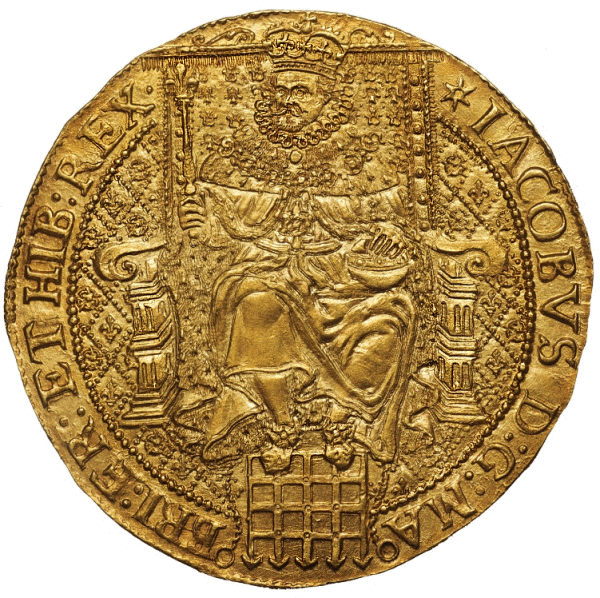
rose_ryal_obv

30 Shilling Coin of James I, third coinage, rose royal, mm. spur rowel (1619-1620).

Avarice

Money, thou bane of bliss, & source of woe,
Whence com’st thou, that thou art so fresh and fine?
I know thy parentage is base and low:
Man found thee poor and dirty in a mine.
Surely thou didst so little contribute
To this great kingdom, which thou now hast got,
That he was fain, when thou wert destitute,
To dig thee out of thy dark cave and grot:
Then forcing thee by fire he made thee bright:
Nay, thou hast got the face of man;  for we
Have with our stamp and seal transferr’d our right:
Thou art the man, and man but dross to thee.
Man calleth thee his wealth, who made thee rich;
And while he digs out thee, falls in the ditch.

George Herbert was no stranger to the need for money. He was the sixth child of ten, and the second son, so he knew that he would have to make his own way in the world. His mother came from a wealthy family, landed gentry on the cusp of becoming aristocracy – his cousin was made Baron Newport, and his brother Richard Herbert was created Baron Herbert of Cherbury. His appointments at Cambridge, first as a don and later as Orator, ensured that he had an income, but when he ceased that work he was once again dependent on his wealthier relatives. He was ordained a deacon and so received small incomes from two church positions with minimal responsibilities, but between ill health and the end of his hoped-for career at the royal court, he would not have had anything sure. Only when he was ordained a priest and took on the living at Bemerton did he receive some sort of security. When he died he had no children, and his widow, Jane Danvers, had to leave the rectory at Bemerton, and some six years later married again, and had a child by her second husband. While not without resources, the second marriage was probably as welcome for its financial security as the companionship.

Avarice is defined by the Oxford English Dictionary as “the inordinate desire of acquiring and hoarding wealth; greediness of gain, cupidity.” He is more than a little ambivalent about money in the sonnet above. He knows it to be a source of bliss, but also of woe. He contrasts its bright and shining appearance – Herbert’s knowledge of money would have been gold and silver coin – to the fact that it had to be dug out of the ground, and smelted. Human beings were too often considered of less value than money, and he understands that the value of gold and silver is given to it by human beings. While the law of supply and demand was not well understood, Herbert knows that the metal of coinage is valuable because humans make it so. This imputation of value by persons also gives rise to avarice, and so brings about the fall of many. Herbert would have known 1 Timothy 6:10

For the love of money is the root of all evil: which while some coveted after, they have erred from the faith, and pierced themselves through with many sorrows.

He also would have known this from the Sermon on the Mount (Matthew 6.24):

No man can serve two masters: for either he will hate the one, and love the other; or else he will hold to the one, and despise the other. Ye cannot serve God and mammon.

For Herbert the decision to enter parish ministry was a recognition that he would have to forgo the possibility of becoming wealthy by being employed at the royal court. While there was some security in the living at Bemerton, he and his family were living simply.

I, too, am ambivalent about money. I enjoy the freedom that comes with it, but I have little interest in being the kind of entrepreneur that sets up a business, or the sort of person who becomes wealthy through investment. It is not so much risk aversion as it is a complete disinterest in such things; turning a profit just does not turn my crank. I recognise the importance of this, and I am impressed when people do start businesses that serve real needs, employ dozens to thousands of people, and provides any number of social goods; I’m just not the sort that has any desire to do that kind of work. But some degree of wealth is helpful to achieve a few things – to raise children, to not be a burden on family or the state, and to be free to do something possibly useful, like taking on a half-time position at a church in Crete. I have been blessed with some funds from the inheritance from my parents, but I do not consider myself part of the 1% by any means; indeed, my current income is probably the lowest it has been in thirty years. However, I am blessed to be living here in Crete, figuring out how to serve God and my neighbour here. My hope and my prayer is that as time goes on I might learn to live with even less, and so be more generous, so that money has no power over me, and is merely a means to do things in the kingdom of God.

Posted in Lent, Poetry and Novels | Tagged , , | 2 Comments

Herbert through the Looking Glass

Through Lent with George Herbert
Wednesday after the Third Sunday of Lent

Caucus

Humility

I saw the Virtues sitting hand in hand
In sev’ral ranks upon an azure throne,
Where all the beasts and fowls by their command
Presented tokens of submission.
Humility, who sat the lowest there
To execute their call,
When by the beasts their presents tendred were,
Gave them about to all.

The angry Lion did present his paw,
Which by consent was given to Mansuetude.
The fearful Hare her ears, which by their law
Humility did reach to Fortitude.
The jealous Turkey brought his coral-chain;
That went to Temperance.
On Justice was bestow’d the Foxes brain,
Killed in the way by chance.

At length the Crow bringing the Peacocks plume,
(For he would not) as they beheld the grace
Of that brave gift, each one began to fume,
And challenge it, as proper to his place,
Till they fell out: which when the beasts espied,
They leapt upon the throne
And if the Fox had liv’d to rule their side,
They had depos’d each one.

Humility, who held the plume, at this
Did weep so fast, that the tears trickling down
Spoil’d all the train: then saying, Here it is
For which ye wrangle, made them turn their frown
Against the beasts: so jointly bandying,
They drive them soon away;
And then amerc’d them, double gifts to bring
At the next Session-day.

With today’s poem we are launched into Wonderland, 250 years before Lewis Carroll wrote about Alice falling down the rabbit hole. Herbert imagines a session-day, a court sitting, in which anthropomorphic Virtues are given tokens of submission by various animals. The Virtue of Humility executes the judgment of the empaneled beings.

The Virtues and the corresponding animals are:

  • Mansuetude (i.e. gentleness, meekness, docility) — the angry Lion’s paw
  • Fortitude — the fearful Hare’s ears
  • Temperance — the jealous Turkey’s chain (i.e. the wattle, the fleshy bit under the neck
  • Justice – the Fox’s brain (cunning)
  • Humility – the proud Peacock’s plume (brought by the Crow, in the Peacock’s absence)

Each of the tokens, while not always the exact opposite of the Virtue that receives it, is nevertheless some kind of appropriate gift of submission. Anger, fear, jealousy, cunning, and pride are all wounded by these judgments, which would make for a lovely allegory, only Herbert goes further. The Virtues get into an argument over the peacock’s plume, representing pride (or perhaps, beauty). They fall off the throne and the beasts, seeing their chance, jump up and try to take it for themselves. The poet notes that if the Fox had been present as something other than a dead brain they might have been successful. However, Humility, to whom the plume rightfully belongs, weeps at the fighting among the Virtues, and her tears fall upon the feathers and causes them to bleed. The Virtues, united by Humility’s tears, drive off the animals, and punish them (amerc’d) by requiring double the tokens the next time.

The image starts off in the first stanza rather amusingly, as in Aesop’s fables, but turns rather graphic withe second. These beasties are grievously harmed in their submission, which I suppose is the point. Then in the third stanza the Virtues are shown to be less than virtuous.

This is not just a paradoxical description. Herbert is here describing what 20th Century philosophers such as Isaiah Berlin called “the incommensurablity of values”.  There is no obvious hierarchy of values – or virtues; thus, they can conflict with each other. In modern philosophy “freedom” and “equality” are often found to be incommensurate. Radical libertarians would prioritize freedom above other values, so that taxation is effectively a form of theft. Egalitarians would emphasise the responsibility of governments and society to decrease inequality, usually by a restriction on the freedoms of others and a redistribution of wealth. The irony of the poem is that while receiving tokens of submission the Virtues do not submit to each other. Only Humility does so, and it is only by following Humility do the Virtues overcome the threats from the animals, those bearers of other values.

I like to contrast humility and humiliation. Humiliation is what another person does to you, to make you a lesser being, making you ashamed and perhaps resentful. It is cruel and mocking. Humility, on the other hand, is a reasonable self-appreciation of who one is, with all one’s gifts and all one’s failings. Humility is not showy, but humiliation seems to draw attention to the degraded person. One can be quite confident and strong in humility, but humiliation is a crisis of one’s self-worth. Humility is focused on others, whereas humiliation is all about how low one has fallen.

Those who crucified Jesus sought to humiliate him. He was a threat to the imperial power of Rome and their collaborators among the Jewish religious leaders, and so they killed him in a long, painful process, nailing him naked on the wood of a cross. That should have ended it there – except that there was in Jesus a humility deeper and more powerful than their power to humiliate. As Paul writes in Philippians 2.5b-10:

Let the same mind be in you that was in Christ Jesus,
who, though he was in the form of God,
did not regard equality with God
as something to be exploited,
but emptied himself,
taking the form of a slave,
being born in human likeness.
And being found in human form,
   he humbled himself
and became obedient to the point of death—
even death on a cross.

Therefore God also highly exalted him
and gave him the name
that is above every name,
so that at the name of Jesus
every knee should bend,
in heaven and on earth and under the earth,
and every tongue should confess
that Jesus Christ is Lord,
to the glory of God the Father.

Herbert is saying that if the virtues of gentleness, fortitude, temperance, and justice (and any other values) are to be meaningful they must submit to humility and work together, acknowledging their incommensurability. May each of us be just so.

Posted in Lent, Poetry and Novels | Tagged , , , | 2 Comments

I Am A Brittle, Crazy Glass: George Herbert’s “The Windows”

Through Lent with George Herbert
Tuesday after the Third Sunday of Lent

MAC29_ANGLICAN_CHURCH_CAROUSEL

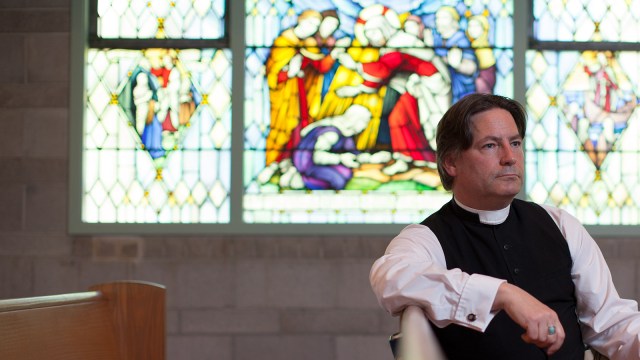
A picture of me in in 2014 in front of a stained glass window at St. Matthias Anglican Church, Victoria, British Columbia, Canada – a professional photo by Chad Hipoloto which appeared in Maclean’s Magazine, Canada’s news magazine.

The Windows

Lord, how can man preach thy eternal word?
He is a brittle crazy glass:
Yet in thy temple thou dost him afford
This glorious and transcendent place,
To be a window, through thy grace.

But when thou dost anneal in glass thy story,
Making thy life to shine within
The holy Preacher’s, then the light and glory
More rev’rend grows, and more doth win;
Which else shows watrish, bleak, and thin.

Doctrine and life, colors and light, in one
When they combine and mingle, bring
A strong regard and awe; but speech alone
Doth vanish like a flaring thing,
And in the ear, not conscience, ring.

I like to preach on the stained glass windows of a church. When a story arrives in the lectionary that links in with one of the windows in the church building I take advantage of it. St. Matthias Church in Victoria, BC, Canada, where I was the rector from 2014 to 2017, had a good collection of modern stained glass depicting stories from the Gospels and Genesis. The picture above was taken for an article about my lobbying around then-proposed legislation recriminalizing sex work, but the window behind it relates to refugee work. The window illustrates the story, originally from the Gospel according to Mark, of the Syrophonician woman, who begged Jesus to heal her daughter. The version in Matthew 15.21-28, where she is called a Canaanite woman, runs like this:

Jesus left that place and went away to the district of Tyre and Sidon. Just then a Canaanite woman from that region came out and started shouting, “Have mercy on me, Lord, Son of David; my daughter is tormented by a demon.” But he did not answer her at all. And his disciples came and urged him, saying, “Send her away, for she keeps shouting after us.” He answered, “I was sent only to the lost sheep of the house of Israel.” But she came and knelt before him, saying, “Lord, help me.” He answered, “It is not fair to take the children’s food and throw it to the dogs.” She said, “Yes, Lord, yet even the dogs eat the crumbs that fall from their masters’ table.” Then Jesus answered her, “Woman, great is your faith! Let it be done for you as you wish.” And her daughter was healed instantly.

In late February of 2015 I was asked if I would be the Refugee Coordinator for the Diocese of British Columbia. As a diocese we had sponsored hundreds of people, going back to the late ’70s with the exodus of Vietnamese fleeing oppression. With a Sponsorship Agreement with the federal government of Canada we had privately sponsored many individuals and families, raising money to settle them on Vancouver Island. When I took on the position we would sponsor some twenty people a year, creating one or two groups to sponsor them, applying on behalf of refugees, training volunteers, and waiting a long time – usually years – for approval to bring the refugees to Canada.

Then in September 2015 everything suddenly changed. A toddler died in the waters between Turkey and Greece. The toddler was Alan Kurdi, a Syrian refugee whose family had sought to find a home in Canada, but whose application was denied on technical grounds. So instead the family sought a home in Europe, and they attempted to cross the short distance between the mainland of Turkey to a Greek island. The boat was overloaded, and capsized. The child’s mother and sibling also died in the attempt to cross over. A photograph of the young child, dead on the beach, made the front covers of the newspapers, and circulated rapidly because of social media. Because of the connection to Canada there was a strong reaction. A well of compassion erupted, and I saw a once-in-a-lifetime opportunity for mobilizing people to privately sponsor Syrian refugees. We could not help little Alan Kurdi, but we could do our best to make sure that some Syrians would make it to Canada.

Long story short, after two years some 250 Syrians and refugees from other nations had come to Vancouver Island and the Gulf Islands, or were in process of being sponsored. We had somewhere between five-hundred and eight-hundred volunteers in over fifty groups up and down the islands. To set up these groups we worked with other churches, a group of doctors, and neighbourhood groups. Two staff were hired on to do the massively expanded work, and gradually my role became redundant – I worked myself out of a job. It’s probably the most important work I’ve done in my life.

The poem “The Windows” talks about the improbability of the good news being effectively preached by the fragile, imperfect person of the ordinary minister. Herbert compares the preacher to a window, who, although akin to brittle, crazy glass, can still show forth a story. The last stanza extols the values of imagery over mere speech. Speech is transitory and might not move one’s conscience to do good works for God and for one’s neighbour. Windows, for Herbert, were permanent, and had an eloquence that transcended long sermons. Herbert would have had in mind the centuries of beautiful stained glass in churches, chapels, and cathedrals, most of which were to be destroyed within a decade of his death by the iconoclastic Puritans of Oliver Cromwell and the English Commonwealth.

tpkMmGzk9MLsyA4os5nf_1082134299

The central window of St. Martin in-the Fields, London.

The life of a preacher is like that. They are to be windows into the divine, such that you forget the medium and see only the story being shone forth. In my work with refugees I sought to preach in my actions the good news of Jesus. Jesus, who in youth we are told was a refugee in Egypt, reached out to the Syrophonician woman. In our day we seek and seek to help refugees from the Syrian Civil War and others who are seeking safety from war. I am a brittle, crazy glass, and so are you, but I pray that our lives may show forth in word and deed the love of God in Christ.


Posted in Lent, Poetry and Novels | Tagged , | 2 Comments

The Church-floor

Through Lent with George Herbert
Monday after the Third Sunday of Lent

Squares

The Church-floor

Mark you the floor? that square and speckled stone,
Which looks so firm and strong,
Is Patience:

And th’ other black and grave, wherewith each one
Is checkered all along,
Humility:

The gentle rising, which on either hand
Leads to the Choir above,
Is Confidence:

But the sweet cement, which in one sure band
Ties the whole frame, is Love
And Charity.

Hither sometimes Sin steals, and stains
The marble’s neat and curious veins:
But all is cleansed when the marble weeps.
Sometimes Death, puffing at the door,
Blows all the dust about the floor:
But while he thinks to spoil the room, he sweeps.
Blessed be the Architect, whose art
Could build so strong in a weak heart.

It is never too clear when Herbert wrote his poems. St. Andrew, Bemerton, which was one of his church buildings when he was the incumbent there, would have had a dirt floor, although the chancel (where the communion table and seating for the clergy were) was made of stone. The pictures at the website of the chapel show a modern wooden parquet floor in the nave, and the chancel is stone, but that may be the result of some renovation done long after Herbert. As Herbert was using the church building metaphorically, he probably had in mind an idealized version of his own chapel, with elements from the many places he would have worshiped in his short life.

Because of the layout of the text the first twelve lines look unusual, but they are really just iambic pentameter where the the last word or two of the even lines is given its own line, to emphasise the focus of the couplet. Thus, stone is supposed to rhyme with one, and Patience with Confidence – ABACDBDC. The next eight lines are iambic tetrameter (i.e. eight syllables) in the rhyme EEFGGFHH. The first half of the poem uses the floor as an allegory for Patience, Humility, Confidence, and Charity (i.e. Love). The next six lines of the second half continues the allegory by describing the sweating marble as the response to sin staining the rock, and the wind coming in the door and blowing the dust about is like Death (and we’ve already seen death and dust related in Church Monuments and Employment (1)). The set of metaphors in the final couplet describe how God as an architect creates a strong building “in a weak heart”.

There are a couple of obscure things in here. Stones do not normally weep tears, but Ann Pasternak Slater suggests that this refers to what happens when a church becomes crowded and warm human breath condenses on cold stone. thus seeming to wash away any stains. The “weak heart” is the first reference to something outside of the firm strong building – and Pasternak Slater refers us to The Altar, which is built of a broken heart and cemented with tears.

queen-enjoys-double-take-with-elizabeth-i-at-new-westminster-abbey-gallery-136427687495502601-180608150051

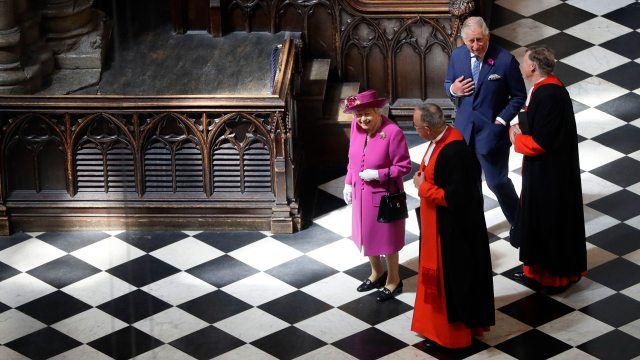
“The Queen can move in whatever direction she wants.” Her Majesty and the Prince of Wales with The Very Rev Dr John Hall, the Dean of Westminster, at Westminster Abbey on June 8, 2018, for the opening of The Queen’s Diamond Jubilee Galleries.

Patience, humility, and charity (love) are three virtues for which I seek, and which I see reflected in the kenotic theology, for which I advocate in my dissertation. Confidence flows from these three. Real humility is having a true understanding of oneself. Humility is being grounded – like a church floor.

Posted in Lent, Poetry and Novels | Tagged , | 2 Comments

The Confession of a Recovering Settler

A Sermon Preached on The Third Sunday of Lent
at St. Thomas, Kefalas 11:00 am March 24, 2019

The Readings appointed for the Third Sunday of Lent

“Unless you repent, you will all perish just as they did.” Luke 13.5
“Let the wicked forsake their way, and the unrighteous their thoughts; let them return to the LORD, that he may have mercy on them, and to our God, for he will abundantly pardon.” Isaiah 55.7

hair shirt

A hairshirt, or cilice, worn by a penitent Christian as an undergarment.

Repentance

When you hear the word, “Repent!” what do you think or feel?

Some think of clergy telling people to fix up their moral life. Others reflect on theirs sins. I associate repentance with visions of people in ashes and hairshirts, overwhelming remorse. The Greek word in the New Testament translated as “repentance” is μετανοώ. In ordinary Greek it just means “I change my mind”, which is a more useful way for me to understand it. Changing my mind does not involve outward signs of remourse like sitting in ashes, or a hidden punishment like a hairshirt. Rather, “changing my mind” is focused inward, and can be a series of decisions, small ones that accumulate in a dramatic change over time, like interest at a bank. For me repentance is not a one-time life event, but something I do all my life as I strive for an inward and spiritual change responding to outward and material facts. It is manifested in action towards anyone who has been harmed by my actions, a responsibility to the other, whether that is God or my neighbour.

Today’s gospel reading is about changing your mind. “Unless you repent, you will all perish just as they did.” The parable of the fig tree is all about the urgency of repentance. So, whether small steps or something dramatic, the time to act is now.

2018-02-21-sermon-image-job-surrender

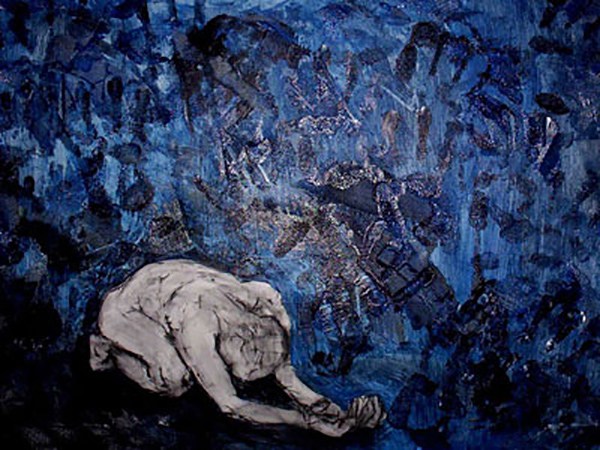
The Surrender of Job

The Ten Commandments as Confession

In the Orthodox tradition confession involves the priest reviewing the Ten Commandments with the penitent. Do you remember the Ten Commandments? We do not talk about it as much today in the Church of England, but it used to be part of the Communion Service in the Book of Common Prayer. It was a part of the Catechism that all Christians were expected to learn and memorize, and it was often written on the walls of churches to one side of the altar. Reflecting on them is not a bad way to begin one’s own repentance. Indulge, me then, while I run through them, in one of their shortened forms:

Then shall the Priest, turning to the People, rehearse distinctly The Ten Commandments; and the People, still kneeling, shall, after every Commandment, ask God mercy for their transgressions for the time past, and grace to keep the law for the time to come.

Ten_Commandments_altar_screen_in_the_Temple_Church_London

The Ten Commandments immediately above the Communion Table. The Temple Church, London.

GOD spake these words, and said:
I am the LORD thy God; Thou shalt have none other gods but me.
Lord, have mercy upon us, and incline our hearts to keep this law.

Do we have any other gods? We probably think ourselves as good monotheists, but it may be that we follow and worship other deities, only we call them other things.

Thou shalt not make to thyself any graven image, nor the likeness of any thing that is in heaven above, or in the earth beneath, or in the water under the earth; thou shalt not bow down to them, nor worship them:
Lord, have mercy upon us, and incline our hearts to keep this law.

What are our idols? Or better, who are our idols? Some of us idolize economic systems and see the invisible hand of God in capitalism (or socialism, or in earlier eras, mercantilism). Some of us blindly follow political leaders who can do no wrong. Some bow down to liberal values, not recognizing that non-Europeans may not see them as the verities.Buildings can become idols, things to preserve long after they have lost any function or historical significance. Even the institution of the church can become an idol. What human constructions do we treat as God-given?

american-idol-final-31-e1526999609646

One of them is work. Many professions demand that people work long hours, encouraging people to neglect their families and their own health. The result is often early heart attacks or burnout.

Thou shalt not take the Name of the Lord thy God in vain;
Lord, have mercy upon us, and incline our hearts to keep this law.

This is usually taken to be about blasphemy. I always distinguish between blasphemy and profanity, and I try to avoid the former, but may be known to do the latter. I do not swear much, mainly because when I do it is an expression of uncontrolled anger, and I do not like to lose control that way. It frightens people, and it makes me ashamed. Casual blasphemy and profanity is often used to emphasis a point being made, and I just wish people would be more imaginative and move on to using more than just the same one or two words as adjectives or adverbs.

Remember that thou keep holy the Sabbath-day.
Lord, have mercy upon us, and incline our hearts to keep this law.

The Jewish understanding of שַׁבָּתShabbat is that it is an echo of the seventh day of creation, on which God rested; shabbat means “to cease”. And, as we know from living in Greece, the Sabbath is the seventh day of the week, Saturday, or in Greek, Σάββατο. Today is Κυριακή, the Lord’s Day, or Sunday in ordinary English. However, Christianity somehow transferred the sabbath from Saturday to Sunday, and my father, growing up in a Calvinist household, was never allowed to do much on a Sunday other than to go to church or perhaps read a book. Certainly one did not play games, or go shopping. Things have loosened up up a bit.

However, this commandment not just about paying attention to God. It is also a matter of justice. God did not rest because God needed to, God rested because creation would need to. Everybody deserves a day off. The full text in Exodus 20 reads:

Remember the Sabbath day, to keep it holy. Six days you shall labor, and do all your work, but the seventh day is a Sabbath to the LORD your God. On it you shall not do any work, you, or your son, or your daughter, your male servant, or your female servant, or your livestock, or the sojourner who is within your gates. For in six days the LORD made heaven and earth, the sea, and all that is in them, and rested on the seventh day. Therefore the LORD blessed the Sabbath day and made it holy.

The text points out that everyone should be getting at least one day in seven off – including your children, your slaves and servants, or the foreigner among you.

Honour thy father and thy mother;
Lord, have mercy upon us, and incline our’ hearts to keep this law.

I have wondered about this one. It is often read as requiring obedience from children to their parents, but I think it is more. I suspect this is also a matter of justice. The Ten Commandments emerged at a time when there were no pensions and no social safety net. This is really about taking care of parents in their old age. Are we taking care of the vulnerable people closest to us?

Thou shalt do no murder.
Lord, have mercy upon us, and incline our hearts to keep this law.

Thou shalt not commit adultery.
Lord, have mercy upon us, and incline our hearts to keep this law.

Perhaps I am naive, but I suspect that neither of these are not big issues for most of you. Do I presume too much of this rather ordinary Anglican congregation?

Thou shalt not steal.
Lord, have mercy upon us, and incline our hearts to keep this law.

Again, this is presumably not too much of an issue for any of us – except when it comes to dealing with the Greek taxation system.

Thou shalt not bear false witness against thy neighbor.
Lord, have mercy upon us, and incline our hearts to keep this law.

This is probably about giving testimony in legal proceedings, but we may extend it to gossip. Do we tell stories, whether we know them to be true or false, simply for amusement?

Thou shalt not covet
Lord, have mercy upon us, and write all these thy laws in our hearts, we beseech thee.

And what do we covet? Most of us are at a point in life where we are getting rid of things, not acquiring them, but we might still be filled with jealousy and resentments.

I suspect that all of us, as I recired and reflected on these commandments, found something from which we needed to turn, something about which we need to change our minds. But most of this is at a personal level, and I think we can go beyond that.

The Confession of a Recovering Settler

I come from a land that was colonized for over four hundred years. My ancestors left the borderlands of Scotland in the 1830s. They looked to get land to farm, and the ownership of land was a dream beyond their poor means if they stayed in the old country. So they boarded ships and went to New Brunswick, then a colony in British North America. They cut down trees, they farmed their land, fished, and over just a few generations they received education that allowed them to become engineers, doctors and other such professions.

But where did the land come from that they settled? There were peoples there before them. In the region that my paternal forebears settled they were the Miꞌkmaq, a people who were are are still in eastern Quebec and the Atlantic provinces. The French government of New France and then their successors, the British colonial regimes, too the land from them and forced them to live on small reserves. Many died from disease and famine; numbers are contested, but anywhere from 50% to 90% of the population was killed off, either deliberately or but callous indifference. So, looking at historical facts, I have benefited from the theft of land and the genocide of indigenous peoples. I know people whose ancestors were the subjects of this colonial genocide, the trauma of which carries on to this day. Now, I am not the cause of this, so no personal guilt accrues to me – but perhaps the real issue is this: what is my responsibility? Is it not to try in Christian compassion to make things right? As Jesus proclaims in Luke 4, quoting from the prophet Isaiah:

The Spirit of the Lord is upon me,
   because he has anointed me
     to bring good news to the poor.
He has sent me to proclaim release to the captives
   and recovery of sight to the blind,
     to let the oppressed go free,
to proclaim the year of the Lord’s favour.

This may not be the personal repentance that we associate with the Ten Commandments, but it is a participation in God’s salvation that requires a change of mind on my part, a new perspective and an imaginative response. It is a matter which is of the greatest political significance today in my home of Canada, and I believe a real issue for Canadian Christians.

Mikmaq-Women-Face-Police-Elsipogtog-FN

A protest against fracking in 2013 led by the women of the Elsipogtog First Nation in Rexton, New Brunswick, Canada, near where my paternal forebears received land.

What is the correct response? Biblical scholars associate the passage above with the Jubilee, the time that comes every forty-nine years – a sabbath of sabbaths – in which things are returned to their rightful owners. If we are carrying on the mission of Christ, what does it mean to proclaim the year of the Lord’s favour? Now, obviously those descended from colonists and immigrants are not going to go back to where their ancestors came from, but is there a meaningful way to make things right for the descendants of the colonized? I believe the answer is yes, but it will require much negotiation, more listening than talking, and a willingness to let go rather than holding on for dear life. It means putting oneself in the other person’s position and thinking like them – creatively changing our minds. It means being in relationships, perhaps uncomfortable ones. It means going beyond apologies and acting to make amends.

Repentance – the Holy Spirit driven changing of mind –  is serious business, whether at the personal level or at a communal one. It is challenging and unsettling. But it is the means by which we draw close to God our creator and the neighbours with who we live. As we continue to walk from Ashes to Easter in this season of Lent, may we be drawn to the water which God so freely offers us in Christ Jesus.

Posted in Canadian Issues, Lent, Sermons, Unsettling Theology | Tagged , , , , | Leave a comment

Church Monuments

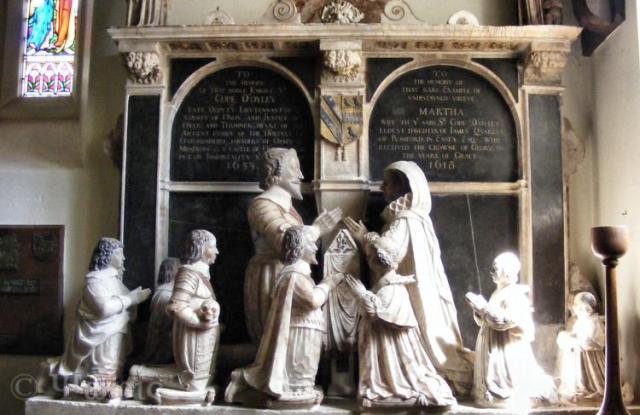
HambledenFamilyMonument

A memorial to Martha and Cope D’Oyley at St. Mary the Virgin, Hambleden, Oxfordshire, England, c. 1633.

Church Monuments

While that my soul repairs to her devotion,
Here I intomb my flesh, that it betimes
May take acquaintance of this heap of dust;
To which the blast of death’s incessant motion,
Fed with the exhalation of our crimes,
Drives all at last. Therefore I gladly trust

My body to this school, that it may learn
To spell his elements, and find his birth
Written in dusty heraldry and lines ;
Which dissolution sure doth best discern,
Comparing dust with dust, and earth with earth.
These laugh at jet, and marble put for signs,

To sever the good fellowship of dust,
And spoil the meeting. What shall point out them,
When they shall bow, and kneel, and fall down flat
To kiss those heaps, which now they have in trust?
Dear flesh, while I do pray, learn here thy stem
And true descent: that when thou shalt grow fat,

And wanton in thy cravings, thou mayst know,
That flesh is but the glass, which holds the dust
That measures all our time; which also shall
Be crumbled into dust. Mark, here below,
How tame these ashes are, how free from lust,
That thou mayst fit thyself against thy fall.

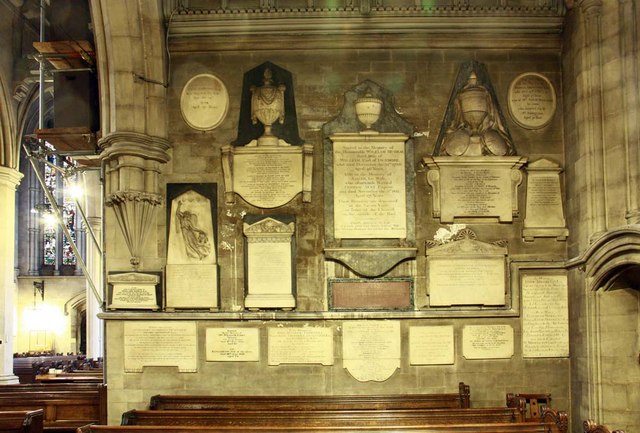
Church monuments are usually set up to commemorate the grief of the person who puts them up and to display the social status of the person being commemorated. They are not as common as they once were, but go into any old English church and it seems they are often crammed full of the darn things, so that the architecture or the place is overwhelmed.

St_Mary_Abbots,_Kensington_High_Street,_London_W8_-_Wall_monuments_-_geograph.org.uk_-_1590137

A corner of St. Mary Abbots, Kensington High Street, London England. The whole church is like this.

They existed in Herbert’s time, too, and he takes them as an opportunity to reflect on mortality. In the first stanza, Herbert imagines intombing his flesh within a monument (or perhaps nearby).  Remember that he had in another poem compared human beings to delayed dust, and he would be conscious of God’s words to Adam and Eve in Genesis 3.19:

By the sweat of your face
you shall eat bread
until you return to the ground,
for out of it you were taken;
you are dust,
and to dust you shall return.

Herbert’s flesh is intombed, and becomes well acquainted with the dust of death. He thinks of it as a fellowship of death in the third stanza, where all are equally dead and turning into the ground from which they came. Church monuments may state one’s high birth and achievements, but the reality of death makes a mockery of such proclamations in marble and jet. The dispassionate dust, the reality of death, counsels one to temper on’e cravings and to “fit thyself against the fall.”

Church monuments and gravestones sometimes have statements like this:

Remember Man as you go by
As you are now so once was I
As I am now so shall you be,
Prepare yourself to follow me

The poem is essentially saying the same thing in more elaborate speech. Herbert was aware of the fragility of his own life, and undoubtedly thought about his own death.

I am now old enough to realise that I could die at a relatively early age. My father died at the age of sixty-four, and I always thought that I would easily pass that. However, as I age the possibility of not making it to sixty-five or seventy becomes  more apparent. In all likelihood I will make it past that, as my mother did, but one never knows. I have spent enough time with dead bodies to know the starkness of death. Death reminds me, schools me, in the question: what am I doing with my life? And, so I pray, that my life will be devoted to God and my neighbour, and not merely about achievement, acquisition, and the satisfaction of cravings and lust.

Posted in Lent, Poetry and Novels | Tagged , | 3 Comments

Enclosed in the Ebony Box: George Herbert’s “Even-song”

Through Lent with George Herbert
Friday after the Second Sunday of Lent

Anglo Indian Intricately Carved Solid Ebony Glove Box, Ceylon, Circa 1850.

An elaborate & intricately carved solid ebony Anglo-Indian glove box with relief carving of scrolling foliate patterns, rectangular floral & patterned decoration on underside of the hinged, ebonized lid, sandal wood interior, working lock and key; Ceylon circa 1850; made for English market. height: 4 in. 10 cm., width: 14.5 in. 37 cm., depth: 5 in. 13 cm. Yours for $2500.

Even-song

Blest be the God of love,
Who gave me eyes, and light, and power this day,
Both to be busy, and to play.
But much more blest be God above,
Who gave me sight alone,
Which to himself he did deny:
For when he sees my ways, I die:
But I have got his son, and he hath none.

What have I brought thee home
For this thy love? have I discharg’d the debt,
Which this day’s favour did beget?
I ran; but all I brought, was foam.
Thy diet, care and cost
Do end in bubbles, balls of wind;
Of wind to thee whom I have crossed,
But balls of wild-fire to my troubled mind.

Yet still thou goest on,
And now with darkness closest weary eyes,
Saying to man, ‘It doth suffice:
Henceforth repose; your work is done.’
Thus in thy Ebony box
Thou dost enclose us, till the day
Put our amendment in our way,
And give new wheels to our disorder’d clocks.

I muse, which shows more love,
The day or night: that is the gale, this th’ harbour;
That is the walk, and this the arbour;
Or that is the garden, this the grove.
My God, thou art all love.
Not one poor minute scapes thy breast,
But brings a favour from above;
And in this love, more than in bed, I rest.

As one might have guessed, if Herbert did a poem entitled Mattins he was going to do one called Evensong. As the first dealt with waking and the light, this deals with weariness at the end of a day, and the reflections that come with the darkness. The four stanzas seem to vary from 6.11.8.6.8.8.10 in the first, 6.10.8.8.6.8.8.10  in the second,  6.10.8.8.6.8.8.9 in the third, and 6.11.9.9.6.8.10 in the fourth; it may be that the key property is not the syllables but the stresses, and I am not that good at those. The rhymes are ABBACDDA in the first and third stanzas, and ABBACDCD in the third and fourth (actually, ABBAACAC in the fourth).

He blesses God for love, the gift of eyes, light, and power, and especially for choosing to overlook the poet’s ways; God’s witness of him would kill him, just as one cannot see God and live. The poet has the Creator’s son, but the Creator has none, because he has surrendered him to humanity and sin and death, so much that the son cries out, “My God, my God, why have you forsaken me?”

The poet than asks himself what he has brought home at the end of the day, in response to God’s love. He describes himself as having run, but only to no obvious purpose other than to be like wind, or a bubble, or foam. But God says it is enough, and gives us rest to overcome the weariness. At the end of the day we are like broken clocks that cannot tell the time, but God repairs us. The poet muses which shows more love, God greeting us in the new day or taking us as we are at the end of it, and this is not resolved. Instead, the poet recognises that the whole day is filled with God’s love, and with that he falls asleep in his bed.

Although I post these reflections in the morning, I usually write most of this in the evning of the day before. When they show up at 7:00 am or 8:00 am in Greece it is 9:00 PM or 10:00 PM on the west coast of Canada, where I used to live. It is now a quarter to midnight here in London (I’m here on a trip), and I should go to sleep. Whenever you are, may you be able to let go of the day’s affairs, and rest in the ebony box that encloses us.

Posted in Lent, Poetry and Novels | Tagged , | 2 Comments

George Herbert’s Morning Prayer: “Mattins”

Through Lent with George Herbert:
Thursday after the Second Sunday of Lent

Mattins

I cannot ope mine eyes,
But thou art ready there to catch
My morning-soul and sacrifice:
Then we must needs for that day make a match.

My God, what is a heart?
Silver, or gold, or precious stone,
Or star, or rainbow, or a part
Of all these things or all of them in one?

My God, what is a heart?
That thou should’st it so eye, and woo,
Pouring upon it all thy art,
As if that thou hadst nothing else to do?

Indeed man’s whole estate
Amounts (and richly) to serve thee:
He did not heav’n and earth create,
Yet studies them, not him by whom they be.

Teach me thy love to know;
That this new light, which now I see,
May both the work and workman show:
Then by a sun-beam I will climb to thee.

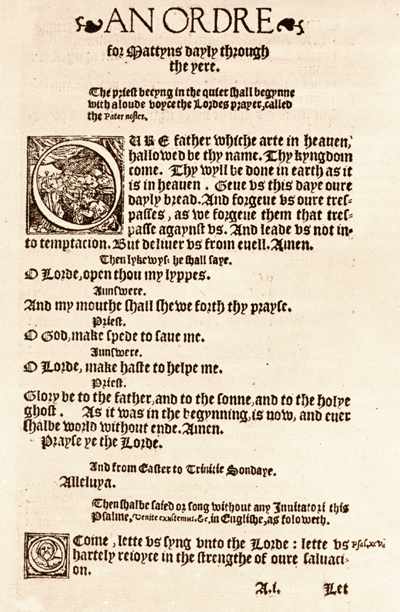
Matins1549

In pre-Reformation England monks, nuns, secular clergy, and pious laity would pray eight times in a twenty-four hour period. The services were, as the Wikipedia article points out:

  • Matins (during the night, at about 2 a.m.); also called Vigil and perhaps composed of two or three Nocturns
  • Lauds or Dawn Prayer (at dawn, about 5 a.m., but earlier in summer, later in winter)
  • Prime or Early Morning Prayer (First Hour = approximately 6 a.m.)
  • Terce or Mid-Morning Prayer (Third Hour = approximately 9 a.m.)
  • Sext or Midday Prayer (Sixth Hour = approximately 12 noon)
  • None or Mid-Afternoon Prayer (Ninth Hour = approximately 3 p.m.)
  • Vespers or Evening Prayer (“at the lighting of the lamps”, about 6 p.m.)
  • Compline or Night Prayer (before retiring, about 7 p.m.)

When the Reformation came to England Thomas Cranmer, the Archbishop of Canterbury, took the opportunity to create liturgies and services in English, the chief among them being Holy Communion and the two daily services of Morning Prayer and Evening Prayer. These were published in his lifetime as the Books of Common Prayer of 1549 and 1552, and remain more or less the same in the official Book of Common Prayer of today. In some respects the two daily services of the word replicated the recorded practices of cathedrals and churches some 1000 years before. However, there was very little preserved to say how these services were done before the Church in Western Europe adopted the more elaborate monastic practice of the eight offices. So Cranmer combined the services, and Morning Prayer had elements of matins, Lauds, and Prime. He also introduced the reading of large portions of scripture, so that over a year a church using the new English lectionary would have read through virtually the whole Bible.

Church people can be a bit conservative, and so the old name of Matins carried over to Morning Prayer, especially in its sung version with chants. The Morning Prayer service is still known as Mattins (a variant spelling), especially when it is the main service on a Sunday.

While the monastic Matins was held in the darkness of the night, never ending any later than sunrise, Morning Prayer is typically early in daylight, anywhere from 7:00 am to 11:00 am, depending on the community or person. Herbert’s poem speaks of the poet waking up to light in the morning, and meditation on the meeting of God and the believer first thing in the morning. So, that explains the name. It is not really about the service created by Cranmer which Herbert would have known intimately from having recited thousands of times over the years. The pattern is 5.8.8.10, and the rhyme is ABAB.

In the first stanza the poet speaks of God being there when he wakes up. God is ready to catch his “morning-soul and sacrifice”, which is an enigmatic turn of phrase. The sacrifice, as anyone accustomed to the Book of Common Prayer would know, is praise. God receives the poet’s praise, and thus his very self in the morning.

The next two stanzas, rather unusually, begin with the same line and question: “My God, what is a heart?” In truth, the “heart” is the same as the “morning-soul”, which is why this is the direction the poem takes. The fifth verse continues that meditation, only using the word “estate”. In the second stanza Herbert describes  the heart by asking if it is a number of no-flesh things, a cascade of similies. The third stanza reaches the most valuable and spiritual valuation of the heart, that by God’s own self. Why does the Divine concern itself so much with the attention of humans? It makes sense, as the next stanza points out, that humans should praise God, even though they do not do it always, but pay more attention to the Creation rather than the Creator. In the final stanza the poet prays that the new light of the day will show both Creation and Creator, and that by this revelation the poet may ascend to the Divine.

big_1434640298_image

These days when I wake up I grab the cell phone first thing in the morning, and are immediately greeted with notices of messages, Twitter alerts, Facebook posts, and notifications of articles in some on-line journals I subscribe to. This is the attention I pay to Creation. It usually takes me another twenty minutes – after the dog has been fed and let out and come back in, the coffee has been brewed, and personal necessities attended to – that I finally begin to “make a match” with God for the day. I do get there, but I am very good at not looking at the beauty of the day first thing in the morning. Perhaps, as we let go of things in Lent and take on new disciplines, I should first begin with a word of praise and thanksgiving, even a short one, and in seeing the light, greet its maker.

Posted in Lent | Tagged , | 4 Comments