A Common History

A Sermon Preached On
The Feast of All Saints and All Souls (transferred from November 1 & 2),
Sunday, November 3, 2019, 11:00 am
also being The Second Sunday in a Season of Visioning
at the Anglican Church of St Thomas, Kefalas, Crete, Greece

Readings: Daniel 7:1-3, 15-18, Psalm 149, Galatians 4: 12-20, and Luke 6: 20-31.
Key Questions: What is the story of the church? What is the story of this church?

Last week we began our Season of Visioning here at St Thomas. We will spend four Sundays with special readings and me preaching, and then on December 1, the First Sunday of Advent, beginning of the new church year, we will have an extended service in which we begin to work on what our vision is, and then what our mission is.

In our first service in this Season of VisioningI suggested that we begin with our own stories – our individual journeys in life, our pilgrimages in faith. This week I want to talk about the story of the church, or the story of our community. Next week we’ll talk about the story of God, and begin to reflect on how these three types of stories intersect.

Three Stories - Us, Our, God's

Here again is the diagram of these stories. As we see, there are point where two of the stories intersect, and where the set of all three overlap. We will find our vision and mission in the overlap of all three.

What is our story – the story of the Church?

To answer this question I can only give a caricature. Diarmuid MacCulloch, in his A History of Christianity, took 1216 pages to cover it. And, of course, arguably it is much longer than the two thousand years since the time of Jesus of Nazareth, as the subtitle of McCulloch’s book suggests: The First Three Thousand Years. We cannot understand Christianity and the Church unless we see it as a development from 1st century Judaism, which itself was a development of the Israelite religion that was already over a thousannd years old.

While Jesus was actually born somewhere around 1 CE (most likely 6 BCE), and died some thirty years later (best guess – 30CE), the history of Christianity requires a knowledge of the story of Israel and Judaism, which pushes us back another another millennium (more like 1400 years).  When I was at the Toronto School of Theology in the mid ’80s just an introduction to the history was covered in four thirteen-week courses. And while history is involved with people, events, and the forces that swept them along in time, there is also the consideration of the history of the scriptures, the development of its interpretation over time, the history of various institutions in Christendom that may or may not be explicitly religious, and so forth. It’s a big, long story. But let’s try and summarise it in a few paragraphs, shall we?

The simple character of this story may be found in Acts 1.8:

But you will receive power when the Holy Spirit has come upon you; and you will be my witnesses in Jerusalem, in all Judea and Samaria, and to the ends of the earth.

The story is that of the good news of Jesus spreading from Jerusalem to the ends of the earth.

In the Acts of the Apostles the story begins in Jerusalem and ends in Rome, which, as the centre of the Empire, paradoxically stands in for the farthest reaches of human habitation. The good news is challenged and persecuted, but continues outwards. It is a simple but powerful story. That said, even in the New Testament – the letters, Revelation, and reading between the lines to see the situation of the people who wrote the gospels – the narrative is more complex:

  • At first it made its way into Judea, the area around Jerusalem.
  • Then to Samaria, to the north, and into Galilee.
  • We hear of an Ethiopian receiving the good news from Philip while driving a chariot, and presumably he takes it south via the Nile River.
  • When Paul comes to Damascus there are already Christians there, the faith having been brought there by people whose names we know not.
  • Likewise both Paul and Peter are early members of the church in Antioch, in the southwest of what is now the part of Turkey bordering Syria, whose foundation also seems anonymous.
  • At a certain point quite early on, the gospel is preached to non-Jews and readily accepted by many of them. Paul sees himself as specially sent to tell them that, in Christ, they may be grafted as wild branches onto the sacred vine of Israel. This exception, that Gentiles may be saved as well without becoming Jews, is opposed by more conservative Jewish Christians in Jerusalem and Antioch.
  • As we heard in the readings today, Paul starts a church in Galatia, in what is now the middle of Turkey, pretty much by accident. He states that he, Paul, fell ill while travelling through, and is obliged to rest – but not so ill as to fail to communicate the gospel. By such accidents the good news proceeds.
  • The Letter of Titus witnesses to early Christians being here on Crete.
  • When Paul arrives in Corinth to start a church he finds Prisca and Aquilia, two Christians who were obligated to leave Rome by the emperor, presumably Nero. Thus, already, long before Paul goes there, we hear of congregations in Rome, a fact confirmed by his Letter to the Romans.

What I find most striking is that the faith was transmitted by hundreds of unknown individuals. While we celebrate Peter and Paul, the good news was propagated many whom we know at best as names, and often only by inference and guesses. From the small group in Jerusalem the church grew, so that after a couple of generations it numbered a few thousand, and had the resources and inspiration to write the gospels, preserve the letters of Paul and other authors in the New Testament. As well, there are a host of other writings from the post-apostolic age.

We know that there were Christians in the Roman province of Brittannia – what became England, Wales, and Scotland – by the fourth century. This is evident both from archaeology and written records of bishops attending synods. The Emperor Constantine was born in the Balkans, but his mother Helen was a Christian, and both were in Eboracum – better known to us as York – when he was proclaimed Emperor in 306 CE, and he began his campaign to be the sole ruler of the Roman Empire. As well, Augustine of Hippo, the greatest Latin theologian, found himself arguing in the early fifth century against the heretical opinions of Pelagius, a British Christian. Constantine’s converted to Christianity and was baptised shortly before his death,and he is venerated as a saint in Eastern Orthodoxy. Many scholars believed that his conversion resulted in the conversion of the Empire to Christianity, as if it would not have happened had he done so, but such an understanding belongs to an older historiography. The American sociologist Rodney Stark and others have argued that by the turn of the fourth century (i.e. 300 CE) the Christian faith may already have been the religion of a majority of the Empire’s subjects; Constantine was following where the people went, not the other way around.
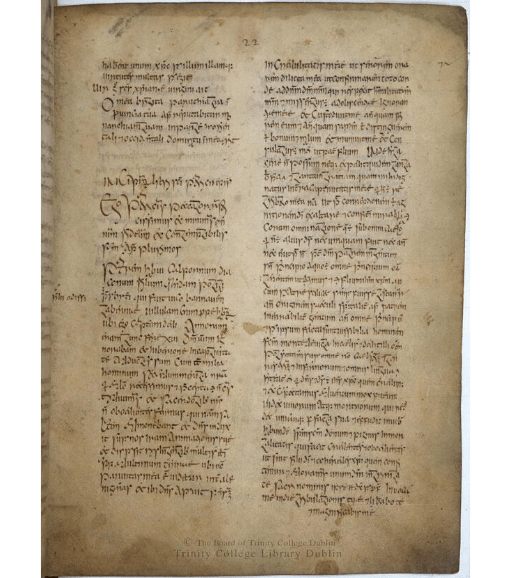
canvas

A manuscript of St Patrick’s Confessions from about about 830 CE, originally written c. 460-490 CE. From The Book of Armagh, Trinity College Library, Dublin, Ireland. Provenance: ca. 807 A.D., Armagh

In the fifth or sixth century the Christian faith reached what was thought to be the furthest ends of the earth. A young Roman Briton was kidnapped from the shores of what had recently been the Roman province of Britannia and taken to be a slave in Ireland. There he minded cattle and sheep. Being a Christian and the son of a deacon, he turned to his God, and in a vision saw a means of escape. He made his way to a port and took a ship, perhaps to Gallia (France), and then made his way home. Eventually he discerned a call to return to Ireland, to proclaim the faith to the people who had enslaved him. He was ordained a bishop by the church in Britain, and went across the sea. We have two writings from this man, whose name was Patricius, but whom we know as Patrick. In these writings he celebrates the fact that he had baptized thousands. He felt that his work of evangelism would hasten the coming of the Lord.

While pious tradition suggests that Patrick was responsible for the total conversion of Ireland, he was more likely just the best known of those who preached Jesus; because of his writings, he was remembered when others disappeared into the anonymity of time. In time Irish Christianity developed a strong culture centered on monasticism, which produced treasures such as The Book of Kells. Christianity moved north to evangelise the Picts and Gaelic speaking peoples of what later became known as Scotland. From there it moved south into the lands conquered by the Germanic-speaking invaders from the Angle, Jutland, and Saxony, and who were known as the English or Saxons. They were a polytheistic pagan people, speaking a strange language related to both Latin and Irish but unlike either. They came south through Northumbria.

68c2b80f6a254f1647912aa3ab4e1f70

The interior of the much remodelled and rebuilt St. Martin’s Church in Canterbury, Kent. The lower part of the walls are Roman.

There they met Christian missionaries from southern England, the second generation of Christians in what was now being called England. In 597 an Italian monk named Augustine came to Canterbury on a mission from the Pope. This Augustine (not the same as Augustine of Hippo) was ordained a bishop by Gregory the Great in Rome, and he and twenty other monks made their way to the capital of the Kingdom of Kent, in southeast England. King Æthelberht of Kent was not a Christian, but his Franksih wife from the Continent was, and Augustine and his companions were allowed to use an old British Christian church dedicated in honour of St Martin of Tours (it’s still there!). In time Æthelberht converted to Christianity. The monks started a monastery, and they built a wooden parish church with a seat or cathedra for Augustine. That parish church was eventually succeeded by grander buildings, and we know it as Canterbury Cathedral. Over the next two centuries Christianity made further inroads. When the pagan Norse attacked two centuries later the Christian faith was so well established that they could not dislodge it.

Fast forward to the fifteenth and sixteenth century, and Europe began to expand into the world. Christianity followed it, and the New World became effectively part of Christendom, while missions were planted in Asia and Africa. In the past century Europe seemed to take a turn to the secular, and the influence of the church on the state declined, and church attendance dropped like a rock. However, the faith grew by leaps and bounds in sub-Saharan Africa and parts of Asia. There are now more Presbyterians in South Korea than there are people in Scotland, and typical Anglican is African. There are now more than two billion Christians, and we are the largest faith group on the planet.

We must not get triumphalistic, for we have had our ups and downs. Christianity a thousand years ago was as wide-spread and prevalent through Asia as it was in Europe. The Church of the East, while always a minority among the many faiths and practices in Asis, spread through what is now Iraq to Iran, Afghanistan, and into China. In both North Africa and in Asia the Christian faith was pushed back or extinguished by various forms of Islam and Chinese religions. This was due not only because of the power of these other religious movements, but also because of the division and corruption among succeeding generations of Christian leaders.The Church has always needed reform.

As well, the history of the church is filled with stories of violence, slavery, murder, abuse, corruption, schism, genocide, and hatred. We do not have to look far to see the reason for this.  When people enter the church, they come as sinners and failures; we all fall short of the calling of the gospel. Perhaps more damning, we too often identify our native governments and cultures with the kingdom of God, justifying the very same forces that put our Lord to death.

The wonder of it all is that the high standards of the gospel and the demands for righteousness continue to ring out. As popular historian Tom Holland argues in his recent book, Dominion, what we consider to be the tenants of secular Western culture – human rights, democracy, the arts, the creation and sharing of wealth – are all derived from Christianity. If it is true, as Stephen Pinker suggests in The Better Angels of Our Nature, that the world has become less violent and more humane, then the rise of Christianity and the influence of its values has much to do with it. And, amazingly, it has inspired African-American slaves in their fight for freedom, both in the Civil War and Reconstruction, and in the 1960s Civil Rights era. It continues to inspire forces of liberation around the world.

This then is the story of the Church. It is not a simple story, and it is not a story of right overcoming evil, or progress – but it is the story of the growth.

What is our story – the story of this Church?

I asked people in the congregation what the story of St Thomas, Kefalas was. Here’s what they said (and if I have some facts wrong, pease let me know and I will correct them!):

  • It started with Tony Lane, who with his wife Suzanne, back in 2003, invited English-speaking people to their home next door for prayer and bible readings. The small Table Church grew, and in good weather, started meeting outside by the swimming pool, or in the carport.
  • After a year the group decided to formally affiliate with The Church of England’s Diocese in Europe. We came under the oversight of the Bishops of the Diocese in Europe – Geoffrey Rowell and David Hamid – and, more directly, Canon Malcolm Bradshaw of St Paul’s, Athens.
  • Tony Lane had studied some theology as a layman in Bristol. He trained as a Lay Reader, and was licensed as one in 2007. He was subsequently ordained a transitional deacon in 2009 and then a priest in 2010.
  • Canon Mike Peters from England came out in 2008 and supervised Tony’s training, while assisting the congregation in organizing itself as a proper church in the C of E.
  • Parallel to this was the development of some house groups, and Alison Collett played a leading role in the formation of these. Among other programmes, the Alpha Course was done.
  • When the congregation needed better space it tried meeting in the Kefalas community hall, but Tony decided to build a chapel on a property adjacent to his  the house. This chapel was dedicated to St Thomas the Apostle by Bishop Geoffrey in 2007. The area next to it was laid out as a patio, and after some experiments with large umbrellas, a permanent canvas tent structure was erected, with tough, plastic side-panels that could be rolled up in the summer. This was promptly christened, “The Tabernacle”.
  • Music varied over the years. Initially CDs were used, and then some people led with guitars, before we settled into using an organ. When Gina Zagni became our musician a few years ago she purchased an electric organ for use at the church services.
  • In the early years especially people would go out for meals afterwards. This helped to build up the sense of community.
  • There were some tensions between various people, as is normal in any organization. Some people left because they wanted a different style of worship.
  • Terry Wilcock served as the assistant chaplain from 2011 to 2014, and after a few months interregnum Philip Lambert succeeded him. As Philip’s wife became ill quite suddenly, he returned to England in June 2017, and there was a long interim period from then until October 2018 when Bruce Bryant-Scott was appointed. During that long period without a priest in charge, the Rev’ds Ian Brothwood and Tony Lane filled in, supported by a range of occasional clergy visiting Crete.
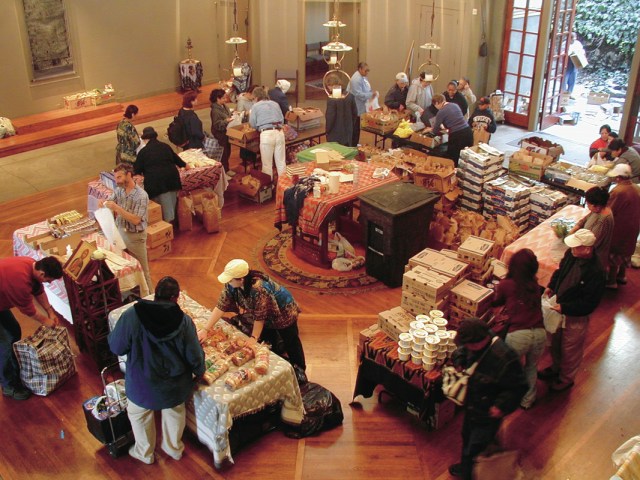
  • In Terry and Philip’s time “Helping Hands” began, which eventually evolved into the Social Supermarket.
  • Tony and Suzanne subdivided their property and sold their house, moving to a smaller place near Vrysses. Recently, they donated the church property and its buildings to The Anglican Church in Greece, which is the legal name for the Diocese in Europe as recognized by the Hellenic Republic. Thanks to this generous gift, we own and operate the property in which we worship.
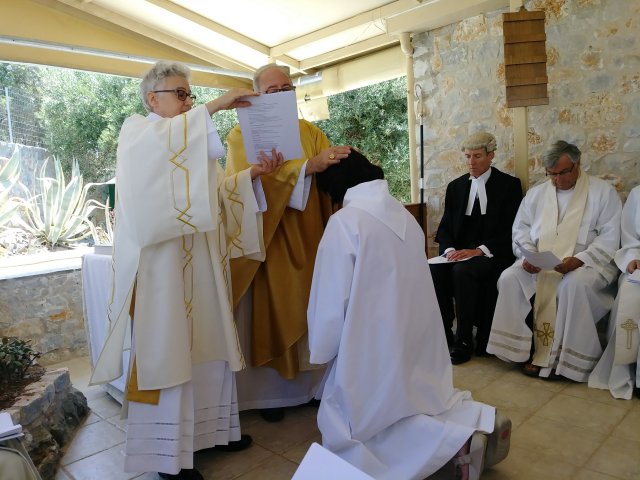
20190630_115522516813484.jpg

Bishop David Hamid, Suffragan Bishop of the Diocese in Europe, ordains Julia Bradshaw as a deacon in June 2019. Julia is now our deacon and assistant curate. The Rev’d Frances Hiller, deacon and assistant to the Suffragan Bishop,  is holding the service booklet while the Bishop lays hands on Julia. Mr Aiden Hargreaves-Smith, Registrar of the Diocese in Europe, is behind in his solicitor’s legal robes, and the Rev’d Ian Brothwood is seated beside him.

St Thomas is typical of many church plants, going through phases of “Forming, Storming, and Norming“. We are reasonably solid, with a strong core of members and the ability to attract seasonal residents of Crete and English-speaking tourists. While we are mostly from England, we do have people attending who are Scots, Irish, American, Canadian, Greek, German, Norwegian, Armenian, and other nationalities.

What is the next chapter going to be about?

The story of St Thomas’s in Kefalas is one small part of the larger story of the Church, which is part of the larger story of humanity. It is a story of saints and sinners, of people who are legends to us, and people whom we knew. We are a young congregation in a two-thousand year old institution. We know where we come from – do we know where we want to go next? Are we open to the surprising movements of the Holy Spirit? What will be the next chapter in this story?

Next Sunday, November 10, we will take a break from the Visioning process as such to mark Remembrance Sunday down at the Suda Bay War Cemetery. We will resume in the next two Sundays after that to consider God’s story, and the story of Jesus. On December 1 we will begin to dream dreams and see visions, by trying to answer some questions about ourselves. From that I hope we will develop our vision statement.


Posted in Crete, Sermons | Tagged , , | 1 Comment

A Witness and a Testimony

A Sermon Preached At
The Anglican Church of St. Thomas the Apostle, Kefalas, Crete, Greece
The Diocese in Europe | The Church of England

October 27, 2019, 11:00 am
[Expanded considerably for this blog]

Key Questions: What has been your journey in life? What has been your journey in faith?

A Season of Visioning

This morning we begin a Season of Visioning here at St. Thomas’s, Kefalas. We are moving towards coming up with the vision and mission that God wants us to carry out here. It begins with prayer, that God will give us the Holy Spirit to be able to see and think about this.

Three Stories - Us, Our, God's

How do we get a handle on our mission and vision? One way is to think of three intersecting stories. There is my story as an individual – or your story as an individual; this is the circle on the upper left.  There is the story of our community and our relationships – the upper right circle. Then there is God’s story – which is the circle on the bottom. These circles of narration all overlap, and in the centre is where we will find the vision and mission of the church.


Let us start with our stories as individuals, since in our individualistic society this is where many of us naturally begin.  To model how to do this I am going to give my testimony, not because I am a great saint or a terrible sinner who has experienced a stunning redemption, but because I may have had a few more opportunities to tell my story than you. As I talk about my own journey, I invite you now and in the week to come to think about your own.

Next week we’ll talk about the story of the Church – both local and global – and then after Remembrance Sunday, we’ll reconvene on November 17 to talk about the story of God. On November 24th we’ll see how these stories interact – us, the Church, and God. On the First Sunday of Advent, December 1, we’ll have an extended service where, as part of the Liturgy of the Word, we’ll be seated in table groups and write down our thoughts on vision and mission. Out of that we’ll develop the vision and mission, and then work out measurable goals and objectives. God willing, we will have a road map for the next few years of our common life here, although don’t be surprised if God has us taking a few side-trips here and there.

My Testimony

To get us started, I’m going to think a bit about some of the hymns that were important to me  over the span of my fifty-seven years. Let’s start with a well known Sunday hymn – well, at least, it’s well known in North America!

Jesus Loves Me

Jesus loves me, this I know,
for the Bible tells me so.
Little ones to him belong;
they are weak, but he is strong.
Yes, Jesus loves me! Yes, Jesus loves me!
Yes, Jesus loves me! The Bible tells me so.

I grew up in small churches in Grand-Mère, Quebec, Canada, although for two years in the early ‘seventies, when I was eight and nine years old, I was part of much larger church in Bathurst, New Brunswick. Both Grand-Mère and Bathurst were pulp and paper towns where my father worked in engineering and management in the local mill making newsprint for newspapers. I was baptised in Bethel United Church in Grand-Mère, a congregation in the United Church of Canada, a uniquely Canadian denomination that resulted from the merger in 1925 of Congregationalists, Methodists, and Presbyterians. The church in Grand-Mère was small, reflecting the small English speaking Protestant population in the midst of the 90% + Francophone Catholic majority. It shared a United Church minister with the United Church congregation in Shawinigan next door. When I turned eight we moved to Bathurst, New Brunswick, where First United Church was a large operation with two clergy and a host of activities. I attended Sunday School, participated in a Christian after-school program once a week, and sang in the children’s choir. Whatever the theology that was behind this denomination – Wesleyan, puritan, Scottish Calvinism – what I received  was an impression of a God who was loving, forgiving, and wondrous. Creation was good, although we human beings were often wayward and problematic. Jesus was a sign of God’s love for us, and although I did not understand it, I was much taken with the story of his birth, death, and resurrection.

Around the age of twelve or thirteen we had moved back to Grand-Mère and I was being prepared for confirmation. By then the two United congregations and the two Anglican parishes had joined in a shared ministry, sharing one Anglican priest who conducted Anglican and United services. In Grand-Mère and Shawinigan at the time we English-speaking people were so few that the Anglicans and Uniteds had agreed to share a minister. Thus, I was to be confirmed in both the Anglican and United Churches. At the time the United Church of Canada and the Anglican Church of Canada had a Plan of Union, to become one big church (although it fell apart in the mid-‘seventies). In the end the Bishop of Quebec, the Right Reverend Tim Mathews, on behalf of the Anglicans, and on behalf the Montreal Presbytery of the United Church, the Rev Mervyn Awcock – who was not a UCC minister but the Anglican priest of the shared ministry – both laid hands on me. This was my introduction to Anglicanism, and in the liturgies of the Book of Common Prayer I experienced a sense of tradition that was lacking in the UCC.

The key thing in all of this is that I never knew a time when I was not welcome in the church, and it was a place where I felt at home.

Morning Has Broken

As an adolescent I experienced faith and religion in music. I remember the first time I went to a school dance. I had great fun. Then I came home and played a 45 record of Cat Stevens’s “Morning Has Broken”, with its incredible piano introduction by Rick Wakeman. In the Fall of 1976, when I was fourteen, I went to a boarding school, Bishop’s College School in Lennoxville, Quebec. Over the next four years I sang in the chapel choir, acted in plays, marched in the cadet corp (and became an officer, shouting out drill commands), played Canadian football, hiked the Long Trail in Vermont, biked the Eastern Townships, and spent hours in the library reading books that had nothing to do with my courses. I did well in my classes, graduating top of my class (big fish, very small pool), but what remains with me about my time there was the broad range of activities I engaged in, and the opportunities to develop as a young leader.

In the chapel choir and in daily chapel services I learned to sing in harmony, and I mastered Anglican chant and the services of the Book of Common Prayer. For most people mandatory chapel was an inoculation against religious activity, but I somehow came away with a continued interest.

After BCS I went to the University of Toronto in 1980. I lived at Trinity College, which had the reputation of being the hardest college to get into, in the Canadian university with the highest admission requirements – so I thought I was hot stuff. Initially I was going to study sciences, but I really spent the first year drinking and failing two of my five courses.  I attended chapel and sang in the choir there, which did a much more challenging repertoire than at BCS; I also served at chapel services as an acolyte. After that first year I was put on academic probation and lost two scholarships.

Like most nineteen year old males I was pretty immature and incapable of being a decent human being, combining arrogance and ignorance in equal measures. I was in a relationship with a young woman, but it was foundering, and and in the Autumn of 1981 I found myself in the chapel at Hart House (a student centre), praying and wondering how I would get through it all. That night, while praying, I felt God as a presence in my life, one which I could not deny.  This did not fix my relationship with the girl, but I realized I needed to work on my faith more.

This fit in, sort of, with what I was studying. After that disastrous first year I had given up on sciences. Instead, I transferred into philosophy, which at the time in the early ’80s was set up to lead from the pre-Socratics through Plato and Aristotle to modern philosophy, starting with Descartes, Hume, Kant, and Hegel, and arriving at the Anglo-American analytic tradition, epitomised by the work of the later Wittgenstein. It was part of my exploration of The Meaning of Life, and I wasn’t exactly a natural at it, but I stuck with it. By my third year I was getting reasonably good at writing essays.

In the summer of 1982 I found myself traveling around Europe on the standard North American student’s backpacking tour. For me, it became a kind of pilgrimage, exploring different types of Christian faith.

  • I made my first private confession at Canterbury Cathedral.
  • I went to the High Kirk in Edinburgh (that would be Presbyterian, Church of Scotland).
  • I went to Chartres and marvelled at the stained glass windows.
  • Then I went south to Lourdes where I participated in massive Catholic liturgies and learned to say the Hail Mary.
  • In Rome I had an audience with the Pope – just me and five thousand others with John Paul II in St Peter’s Square.
  • In Switzerland I went to the American fundamentalist haven known as L’Abri, and if I had stayed longer than a week for the suggested three months I might have been turned into an evangelical.
  • I went to West Berlin and stayed with young German Baptists.

At the end of it all I knew that I definitely was a Christian. I admired the Evangelicals and their love of scripture, but I also knew enough about biblical hermeneutics that I could not swallow inerrancy or take a naive approach to problems in the texts. I also admired the Catholic Church’s grounding in tradition and education, but I was dismayed by its patriarchal, clericalized structure. So, I stayed an Anglican, and went back to Trinity College and U of T to finish my BA.

After the trip around Europe people asked me if I thought I might be ordained. I thought perhaps, “yes”, but I was not in any hurry to do so. I thought I might have a career in the hospitality industry, and perhaps eventually run a hotel. That hope fell apart in the year after I graduated with that BA in philosophy. I worked as a bus boy in a hotel restaurant, then I sold encyclopaedias from door to door (for about a week), and tried selling musical game software for the Apple IIe (I was terrible at it). My father suggested that he was retiring soon, and said that if I wanted help in paying for a divinity degree I should do it sooner rather than later. So I applied to Trinity College and its Faculty of Divinity, and was accepted.

Ordination June 5 1988 Three

Me after my ordination to the priesthood at St Jude’s, Oakville, Ontario. April 30, 1989. In the backyard of the suburban Oakville home of my brother Bill and his wife Yvonne.

I finished that three year degree without any problems, and along the way I married Frances.  I was ordained in the Diocese of Niagara and served as an assistant in parishes in Welland, Ontario and St Catharines, Ontario, two communities close to Niagara Falls, Canada. After six and a half years we had the mortgage, a child, two cars, two dogs, three cats, way too many books, and we felt it was time for an adventure. So in 1995 we upped stakes and moved west to Pender Island, British Columbia, where I served for ten years as rector of the tiny churches on Pender and Saturna Islands. Along the way our our second child was born. In 2002-2003 I took an unpaid sabbatical and we all went to Boston where I got a degree I did not need from Harvard University, a Master of Theology to go with my BA and Master of Divinity.

Ball's Falls

1992, The Fry House (1815), Jordan Historical Museum, Jordan, Ontario, Canada. Photo by Stephen Dominick.

Seven months after that I was appointed Archdeacon and Executive Officer of the Diocese of British Columbia, which is the Anglican diocese covering Vancouver Island and the Gulf Islands. At 41 I was the second-most senior priest in the diocese, and I was effectively the chief operating officer, managing the diocesan staff and dealing with any problems with clergy and laity. This meant I got to deal with bullying wardens and schismatic clergy, as well as cases of sexual misconduct. To my great surprise I was good at crisis management, and I became known as a good administrator and someone to call when conflict erupted. The previous Executive Officer had gone on to become the bishop of the diocese, and many people assumed that this was what would happen to me in due course. My career path seemed set. It was all very, very seductive.

Behind all of this there was a problem. The issues I had with alcohol in my first year of university had not gone away. While many people abuse alcohol in their teens and twenties, the majority of them are doing so because of peer pressure, or to rebel, or because they think it’s fun. As they mature they moderate their drinking, and drink normally – at most, maybe a glass or two a night at the end of a long day, or perhaps on special occasions. They might go weeks and months without drinking alcohol. They leave the stein of beer unfinished, or put the bottle of wine in the fridge for another time.

That was not me. I always finished the drink and usually wanted more. Blackouts were not uncommon. Someone challenged me in 1990, and asked me if I was an alcoholic. I said no, and stopped drinking for five years. After that, having demonstrated that I did not have a problem, I started drinking again. I started getting into hard liquor, and brewed my own wine and beer. I did not have much of a palate, but I did enjoy getting drunk. It went from occasional binges to a daily habit, and I started to organise my life around when I could get drunk. Nothing was more important to me. I kept my spiritual life in one silo and my drinking in another, and the two never met – although the reality is that you cannot drink heavily and develop spiritually. I was in denial in how it was affecting me – mostly in my home life, because that’s where I did my drinking. Finally, after one bender just before my 43rd birthday, I realized I had a problem. I went and got help, and started to work on being a sober alcoholic.

When a crazy alcoholic person sobers up, what you still have left is a very crazy sober alcoholic person. Stopping the alcohol did not make everything better. What followed was what I call “the long hangover”, where I needed to spend a fair amount of time on myself and my relations. Frances and I separated for a time, and then after a year and a half, began to put it back together. Marriage breakdown is never easy, but putting it back together is even harder. We love each other now, eleven years later, but I no longer take the marriage for granted, and I try to work at it every day. I now have over 5000 days of sobriety (over fourteen years), but this morning I woke up with this one day ahead of me, and God willing, I won’t take a drink before I go to bed.  As the old song goes, “I once was lost, but now am found; was blind, but now I see.”

“A Spendthrift Lover Is the Lord” by Thomas H. Troeger

A spendthrift lover is the Lord who never counts the cost
Or asks if heaven can afford to woo a world that’s lost.
Our lover tosses coins of gold across the midnight skies
And stokes the sun against the cold to warm us when we rise.

Still more is spent in blood and tears to win the human heart,
To overcome the violent fears that drive the world apart.
Behold the bruised and thorn-crowned face of one who bears our scars
And empties out the wealth of grace that’s promised by the stars.

How shall we love this heart-strong God who gives us ev’rything,
Whose ways to us are strange and odd, what can we give or bring?
Acceptance of the matchless gift is gift enough to give.
The very act will shake and shift the way we love and live.

After nine years as Archdeacon and Executive Officer I was ready for a change. I had recently received a legacy from my late mother, so in October 2012 I went on an unpaid leave of absence to begin work on a PhD dissertation. By the middle of next year I was preparing to go back to work, having written little but read a lot, but the bishop of my diocese had resigned, and I was approached to stand in the election for a new one. In the end, in October 2013, I came second in the voting, but there are no prizes for coming second in such things, and I needed paid employment. I became the rector of St Matthias, Victoria, in June 2014, a parish which had gone through a schism four years earlier. I was there for three years, but my intention to grow the parish into financial self sustainability did not come to pass. I encouraged the Bishop to find me something else to do, and to put someone else in the parish, somebody who could do what I evidently was not accomplishing.

Creation & Godly Play

Teaching children about God’s creation with Godly Play in the chapel at St Matthias, Victoria.

Part of the problem was illness, both physical and mental. In December 2014, less than a year into the new job, I came down with c. diff., an intestinal disease that knocks one flat and can kill infants and old people. I had to go on a leave of absence through the Christmas season and new year. I never really felt myself for several years afterwards, and I never seemed to get back on track in the parish. Further, in the autumn of 2015 I attempted to go off the antidepressants I had been on for some six years; while the first six months seemed to go all right, especially after the pinging in my brain stopped after the first month, in the next six months I slid into a slough of anxiety and depression that seemed overwhelming. I went on another leave of absence, and it was then that I told the Bishop it was time for a change. I went back on antidepressants, and I started to regain a level of mental balance.

The true bright spot in all of this happened without any planning on my part. Members of the Diocesan Refugee Committee came to me and asked if I would be the Diocesan Refugee Coordinator. I wasn’t the first person they had approached, but I was the first to agree to do it. The Diocese of British Columbia, like many churches and community organizations in Canada, had a sponsorship agreement with the federal Ministry of Citizenship and Immigration. Groups of people based in our parishes would raise money to bring over refugees from other countries. Once they arrived they committed to supporting them and their families for a year, helping them to settle in, begin English classes, eventually find work, and so forth. It was very hard work, and usually something between six and twenty people a year were sponsored. I started in February 2015, and experienced a steep learning curve as I found out about the complexities of immigration and settlement. I was supposed to spend five or six hours a week on this as my diocesan commitment.

In September 2015 the photograph of a dead Syrian toddler on a Turkish shore went around the world. There was a Canadian connection, for the family of the toddler had tried to come as privately sponsored refugees to the Vancouver area, but the application was rejected because of technical errors. The family, feeling they had nothing to lose, got into a flimsy boat with a bunch of other refugees to go the short distance to a Greek island, in the hopes of making their way into Europe. It sank, and the mother and two boys died, leaving only the father as a survivor from the family.

Canadians were shocked. In the midst of a federal election it became the dominant issue in the news cycle, and the different campaigns all tried to respond to this outpouring of compassion. Recognising that this was a unique opportunity, I went on the radio and went to protests and announced, “If you want to help sponsor refugees, come to an information meeting next Tuesday at St Matthias Anglican Church”. Some 325 people showed up,and probably 2/3rds ultimately volunteered. In the end, by the time I left this position, we had brought over or had committed to bring over some 250 people, mostly Syrian but from all the major sources of refugees around the world. Some 500 people across Vancouver Island were organised into constituent groups and were screened and trained. Two individuals making up a total 1.5 FTE (“Full Time Equivalent”) were hired. Over two million dollars in Canadian funds were raised. It is probably the most important thing I’ll ever do in my ordained life.

20150909_195247

The view at St Matthias on Sept 10, 2015. The choir pews behind were full, too, and people were standing on the side.

Of course, helping 250 people out of the 60-70 million refugees  around the world does not solve the fundamental problems that creates refugees. That said, there are some 250 people now living in Canada who will not be washed up dead on any shores. I continue to look with some pride and humility as so many of these new residents become citizens and contribute to the wealth and well-being of my country.

I had basically worked myself out of a job in growing the Refugee Program, and after my period of depression I decided I could let it go. The Bishop put me into two successive parishes as an interim, one of which had experienced serious conflict. I helped to calm the anxiety there, and when a colleague went from one parish to this one to be the new incumbent, I went to be his temporary replacement. Meanwhile I managed to squeeze out some 300 pages of my dissertation. It is entitled “Unsettling Theology” and examines the theologies that were used to justify the churches’ participation in the federally operated Indian Residential Schools in Canada between 1880 and 1970. I recently had the oral examination in London, England, and I have been asked to do a rewrite and resubmit, so I am still at it.

When I was engaged in the interim work on Vancouver Island I was feeling restless. I was not so much as worried about finding work – the interim gigs were working well for me – but I felt that I could do something else. Whereas in 2013 I really wanted to be a bishop, in 2018 I was not so sure. Both Frances and I had rewarding occupations, but with our children out of the house there was a feeling that it was time for another adventure. What was God calling me to know? I felt like I could wait to see if the next diocesan electoral synod would choose me – but the prospect of overseeing the Diocese was less and less attractive. After all, I had already done much of what a bishop does when I had been archdeacon. Did I really want to get back to travelling again, only even more, and did I want to spend my time dealing with people behaving badly? Did I have the quality of leadership that was needed in the future? Shouldn’t the diocese try to get someone other than another well-educated male of British descent to lead them?

It was in April of 2018 that a colleague and friend was having breakfast with Frances, and told her that she’d seen a job advertisement for a half-time, low-paying position at an Anglican Church in Crete, part of the Diocese in Europe and the Church of England. Within twenty-four hours I had the information package. I calculated on the back of an envelope that we could sell our house in Victoria, pay off the mortgage and any debts, and still have enough money to invest and live comfortably off the income, on top of the house, car, and €5000 that the church in Crete would give me. So, I applied, and here I am.

I am still not quite sure what God wants me to do. Obviously I need to finish my dissertation. I have a passion for helping and empowering others, especially the marginalized. My calling is involved in the calling and mission of this congregation. My story, and your story, and God’s story will come together, that I know. And God in Christ will surprise us.

I leave you with a song that seems to catch me where I am today. I pray that this testimony will inspire you to think of your own journey in faith.

Make me a channel of your peace:
Where there is hatred, let me bring love,
Where there is injury, your pardon, Lord,
And where there’s doubt, true faith in you

Make me a channel of your peace:
Where there’s despair in life, let me bring hope,
Where there is darkness, only light,
And where there’s sadness ever joy

Oh, Master, grant that I may never seek
So much to be consoled as to console,
To be understood as to understand,
To be loved as to love with all my soul.

Make me a channel of your peace:
It is in pardoning that we are pardoned;
It is in giving to all men that we receive;
And in dying that we are born to eternal life


Posted in Anglican Church of Canada, Music, Philosophy, Random Personal Notes, Refugee Program, Sermons, Unsettling Theology | Tagged , , , , , | 7 Comments

Notes on the Canadians Buried at Suda Bay Commonwealth War Graves Cemetery

Suda Bay Cemetery, Looking East

Suda Bay Cemetery, Looking East

Among the over 1700 graves at the Suda Bay Commonwealth War Graves Cemetery there are five Canadians. All five were airmen. While the Royal Canadian Navy and the Canadian Army functioned as discrete units in operations during the Second World War, the Royal Canadian Air Force was integrated with the RAF and other Commonwealth air forces. Thus, it was quite normal for the crew of a multi-person aircraft to be made up of men from Canada, Britain, South Africa, Australia, New Zealand, and so forth.

The Battle of Crete took place from May 20 to June 1, 1941, and the Allied defense largely featured British, Australian, and New Zealand troops, with some Greek military, and aided by many civilian combatants. The Greek armed forces were largely absent from Crete because military personnel had been deployed against the Italian invasion, which began in November 1940; indeed, the Italians were pushed back into Albania. In April 1941 the German armed forces intervened, and overwhelmed the Greek armed forces on the mainland. The Cretan infantry division was captured on the northern border of Greece, and so was not on the island for the Battle of Crete. No Canadians appear to have been involved in the Battle of Crete, and all the Canadians buried in Suda Bay died after June 1, 1941.

The five Canadians are listed in the order of date of death. The information is taken from the registry at the cemetery. DFM = Distinguished Flying Medal. AFM = Air Force Medal.

42 09 06 W J Porrit

PORRITT, Flight Sergeant, (Air Gunner), WILLIAM JEREMIAH, R/58432, D F M. 227 (R.A.F) Sqdn, Royal Canadian Air Force. 6 September 1942. Age 20. Son of William Joseph and Aida Edith Porritt, of Vancouver, British Columbia, Canada. Grave Reference: 16. C. 7.

42 11 23 E D Fleishman

FLEISHMAN, Flying Officer, EDMOND DAVID, J/10829. A F M. 37 (R.A.F) Sqdn., Royal Canadian Air Force. 23 November 1942. Grave Reference: Coll. Grave 16. C. 9.

42 11 23 L E Matthews

MATHEWS, Warrant Officer Class II, (Pilot), LAWRENCE EDGAR, R/97534, 37 (R.A.F.) Sqdn., Royal Canadian Air Force. 23 November 1942. Age 24. Son of Lemuel Bertus and Mary Elizabeth Mathews, of Trail, British Columbia, Canada. Grave Reference: Coll. Grave16. C. 9.

It would appear that Mathews and Fleishman were both part of the same six-person air crew that was downed on 23 November 1942, as they are all buried together.

44 02 03J A Goyer

GOYER, Pilot Officer, (Wireless Op./Air Gunner), JOSEPH ALEXANDER, J/85926. 24 (S.A.A.F.) Sqdn, Royal Canadian Air Force. 3 February 1944. Grave Reference: 4. D. 20.

44 02 16 W W Duncan

DUNCAN, Warrant Officer (Wireless Op/Air Gunner) William Walter, R/115792.162 (RAF) Sqdn., Royal Canadian Air Force. 16 February 1944. Age 24. Son of Harry and Hattie Duncan; husband of Lucy Irene Duncan, of Shell Lake, Saskatchewan, Canada. Grave Reference: Coll. Grave 13. E.2-8.

Map of the Suda Bay Cemetery

The above map is from the register in the register box, and it is oriented with west in the top.

The Commonwealth War Graves Commission employs two full-time grounds keepers at the Suda Bay War Cemetery. The Commission uses an older spelling of Σούδα, which is normally transliterated as Souda.

fullsizeoutput_12e0Following British custom, the commemoration of Remembrance Day is held annually on the Sunday closest to November 11; this year we meet on November 10, 2019, and people are encouraged to arrive by 10:40 am. The commemoration is organised by a group of UK citizens living in Apokoronas, Greece, working with the Anglican Church of St Thomas, Kefalas.
This year (2019), for the first time, the Band of the 5th (Cretan) Brigade – V Μεραρχία Κρητών, led by Major Christos Zagourakis and Captain Evangelos Pantazonis, will be present to lead us in music.

As well, His Excellency Mark Allen, Ambassador of Canada to Greece, will attend to read In Flanders Fields and lay a wreath on behalf of Canada.

Notes prepared by the Rev. Canon David Bruce Bryant-Scott, Assistant Chaplain at the Anglican Church of St Thomas, Kefalas, Apokoronas, Chania, Crete, Greece (Diocese in Europe – Church of England), November 5, 2019.

Posted in Canadian Issues, Crete, Greece, War | Tagged , , , , , | Leave a comment

The Blasphemy of Theodicy

A sermon preached on The Twelfth Sunday after Trinity at
The Anglican Church of St. Thomas the Apostle, Kefalas, Crete,
September 8, 2019 11:00 am (slightly expanded)

The Readings from Scripture were: Jeremiah 18:1-11, Psalm 139:1-5, 12-17, Philemon 1-21, Luke 14:25-33

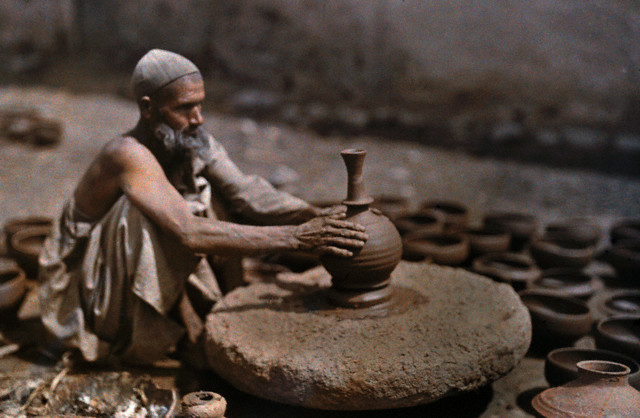
A man works at his potter's wheel Srinagar 1929

A man works at his potter’s wheel Srinagar, India 1929 – Franklin Price Knott, National Geographic Collection

The Problem of Evil

Thus says the Lord: Look, I am a potter shaping evil against you and devising a plan against you. Turn now, all of you from your evil way, and amend your ways and your doings. Jeremiah 18.11

Does God do evil? The reading from Jeremiah certainly seems to suggest as much. And it is not just Jeremiah. Isaiah suggests the same (especially in the AV/KJV translation):

I form the light, and create darkness: I make peace, and create evil: I the LORD do all these things. Isaiah 45:7

So, when bad things happen to us is it because God is punishing us? In Jeremiah the God is so great that everything that happens is attributed to God. Thus he appears to be the cause of suffering, or, at the very least, appearing to allow it. In this he comes across to us as an angry parent, a wrathful monarch, or a demanding teacher.

For many people this is sufficient reason not to believe in God. If God is responsible for everything, if God allows basically good people to suffer – a child killed in a car accident, or an infant murdered by an errant bullet, or an already oppressed woman taken out by a cluster bomb – if God can allow that, where is the justice? How could a God like that be loving and fair? If we are justly condemned for ours sins, how is it that God makes no distinction between the oppressed and the genocidal wicked?

This is the problem of evil. How do we reconcile the goodness and love of God with the wickedness in the world? If God is omnipotent, why does the divine allow sin and evil to reign?  The technical term for any attempt to deal with the problem of evil and God  is “theodicy,” which comes from two words for God and trial, θεός and δίκη.

Theodicy in the Bible

Scripture has several approaches to evil.

1: Good Things Happen to Good People, Bad Things to Bad People

The first approach is very simple, and might be described as the “majority” opinion. It is seen in parts of the Hebrew scriptures and in the New Testament. It is the idea that God is indeed in charge of everything as the creator of the universe and the maker of peoples and nations. As described in Genesis 2 and in Jeremiah 18, God is like a potter working with clay, and has the right to do with it as the deity chooses. So, when kings and the peoples depart from God’s ways, as shown in creation and revelation, then God will punish them, in the hope that they would repent and turn back. Paul notes, in the first chapter of the Letter to the Romans, that for the pagan idolators:

what can be known about God is plain to them, because God has shown it to them. 20 Ever since the creation of the world his eternal power and divine nature, invisible though they are, have been understood and seen through the things he has made. So they are without excuse; 21 for though they knew God, they did not honor him as God or give thanks to him, but they became futile in their thinking, and their senseless minds were darkened. 22 Claiming to be wise, they became fools; 23 and they exchanged the glory of the immortal God for images resembling a mortal human being or birds or four-footed animals or reptiles.

2b79f1ec-2779-5cd4-88ad-9d07cc751026_grande

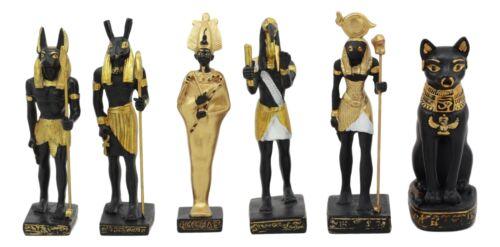
The gods of Egypt.

The Israelites had been given the Torah and were, as such, the chosen people of God, The non-Israelites should have known from the beauty and diversity of creation that there was a Creator, but instead began to worship the creation itself. Thus, they are depraved, and condemned.

The Israelites received the Torah from God, and agreed to be faithful to it. In the books of the so-called Deuteronomic History – Deuteronomy, Joshua, Judges, 1 & 2 Samuel, and 1 & 2 Kings – we see that God promises to bless Israel, but if they turned from him and followed other Gods he would chasten them. It is also the theology we see in many of the ancient Israelite prophets. It is a simple enough understanding: good things happen to good, faithful people, bad things happen to bad, faithless people. After David and Solomon the Israelite kingdom divided into two, sometimes antagonistic realms, the northern kingdom of Israel and the southern kingdom of Judah.  Israel, although perhaps more wealthy than Judah, followed other gods and set up idols in their places of worship. They also neglected the widows and orphans, took the land of the poor, and accepted bribes in courts of law, and used fraudulent weights in the market places. So God sent the Assyrians against Samaria and Israel, and the ten tribes of the north were exiled and disappeared from history. Likewise, several generations later, the Neo-Babylonian Empire conquered the Assyrians and came down and destroyed Jerusalem and the Temple, set up tributary kings and governors, and deported the ruling elite and skilled workers to the waters of Bablyon, in what is now Iraq. After forty years the Neo-Babylonians themselves were overcome by the Persians of Cyrus the Great, who told the transplanted Judahites – or, as we now would call them, Jews –  to return to Judah and rebuild the Temple in Jerusalem, and worship in peace. All of this, in Isaiah, Jeremiah, Ezekiel, and many of the Twelve Prophets, saw the hand of God in these historical events, first punishing faithlessness, and then relenting and acting once again to save the Chosen People.

2: Justice Delayed – Why Do Bad Things Happen to Good People, and Good Things to Bad People?

So far so good. But after the return to exile a problem with this relatively straight-forward approach was identified, and this led to a second approach to theodicy, which is a modification of the first. This is the recognition that bad things happen to good people, and good things happen to bad people. It seems fundamentally unjust, and cannot be explained away by saying that God is righteous, even if it that doesn’t appear to be so. Indeed, when the Persian Empire was conquered by the Greek speaking Macedonian Alexander the Great, his successors in the Middle East, the rulers of the Selucid Empire, persecuted the Jews for their fidelity to God, demanding that they conform to the imperial religions and customs. Many refused, and were martyred as a result. So where was God is this?

The solution had a couple of elements. During the Exile in Babylon the Jewish leaders and teachers were exposed to Zoroastrianism, the ancient religion of the Persians (which exists still as the faith of the Parsees). This ancient faith is more or less a monotheism and worship is offered to Ahura Mazda, but he is opposed by a demonic being. This may have been influenced the Jewish people into believing that there were evil forces working in opposition to their God. Late texts in the Hebrew Bible seem to bear that out.

Thus, evil in the present was attributed to Satan, whose name literally means “the tempter.” The second idea was that God was merely postponing justice for a bit. In time, perhaps very soon, when things got even worse, God would break into history and lift up the oppressed and pull down the evil, both the demonic and the human.

We see this theology in the later parts of Isaiah, in some of the later prophets like Zechariah and Haggai, and in the book of Daniel. It is the theology behind the growth in the belief in the general resurrection, when God will send the Son of Man to judge the quick and the dead. It is the belief behind the death and resurrection of Jesus, in which, in solidarity with suffering humanity, the Word becomes flesh and lives among us, and overcomes death and takes away the sins of the world, beginning a new creation. It is the power that takes Paul and transforms him from one who persecutes the followers of Jesus to being one of his most fervent apostles. For Paul the delay of justice was an occasion of grace, as it gave time to take the good news of Jesus Christ to the pagan world and perhaps save some who would otherwise be lost.  It is the theology that is behind the Book of Revelation, and John’s visions on Patmos. The message here is, Repent, and have faith, and in the fullness of time all shall be well.

3: From Out of the Whirlwind, The Incomprehensible and Our Incomprehension

But even this second approach is not satisfying. Why does God delay? After all, as Martin Luther King, Jr said, “Justice delayed is justice denied.” Why does God allow Antiochus Epiphanes, the Selucid emperor of the middle of the 2nd Century BCE, to kill the faithful Jews with such torture and suffering? Or, to bring it up into modern times, why did God allow the Atlantic slave trade, and the genocide of indigenous peoples in the Americas? Why did God allow the rise of Hitler in the the first half of the 20th century, and the loss of so many lives in war, and the murder of six million Jews? Why did God allow the rise of Communism in Russia, China, and Cambodia, where it allowed genocidal leaders like Stalin, Mao, and Pol Pot to murder tens of millions of their own people? Why does God allow civil wars in Syria, Afghanistan, Yemen, and the Congo? In the face of such suffering and death, delay seems unjust and unconscionable.

1018316866

Job Rebuked by His Friends, by William Blake (1757-1827)

The third biblical approach may be found in the Book of Job. In it we are introduced to the prose story of God and Satan having a contest and using Job as place of that testing. God celebrates the righteousness of Job, but Satan says that if bad things happened to him he would abandon the Lord. So God tests Job. Job loses everything – his belongings, his children, his health, and he finally breaks down. Poetry begins, and he sits in ashes – the equivalent of our garbage bins – and curses the day on which he was born.

Now, Job is described as having done nothing to incur his suffering, and he has no expectation of justice. Several friends come by and give him bad advice, but he replies that he is innocent – which God already confirmed in the first two chapters – and he demands that he be able to face God and put him in the dock, to put his ways on trial. So God appears in the whirlwind and says, “Where were you when I was making the universe” – not actually answering Job, but pulling rank, as it were. Job, overcome by the presence of God, humbles himself, acknowledges his presumption. In the words of the psalmist, “Such knowledge is too wonderful for me; it is so high that I cannot attain to it.” Afterwards, returning to prose, God gives him twice as many possessions and twice as many children, which seems to be some recompense.  But still, Job suffered and he never knows why. This long book, I think, develops in a poetic way the exasperation we have with God, and ultimately confesses that we cannot reconcile both the majesty and power of God and the reality of evil and suffering in our lives.

920x920Some of you may remember a story told by Elie Wiesel, the Nobel Prize winning author and Holocaust survivor. In Auschwitz he witnessed three Jews, close to death, conduct a trial against God. Inspired by this the English screenwriter and novelist Frank Cottrell Boyce created a play set in Auschwitz in the Second World War, which was dramatized as “God on Trial” and broadcast by the BBC in 2008.  God is put on trial, and in the end the vote is that God has indeed broken the covenant. Just before the vote a rabbi among them says, “God is not good. He was just on our side. But now he has broken the covenant with us. He has made one with somebody else.” A very stark conclusion. And then they ask, “So what do we do now?” The reply is: “Let us pray.” But then the Jewish prisoners are taken off to be murdered, and as they wait for the gas to overcome them, they begin to cry the Shema in Hebrew: Sh’ma Yisrael Adonai Eloheinu Adonai Eḥad: “Hear, O Israel: the LORD is our God, the LORD is One.”
This, then, is a third approach to the problem of evil, which we might call the minority opinion. It is the approach which says that we will never really have an answer, and any attempt at an answer is doomed. The French philosopher Emmanuel Levinas (1906-1995) said that theodicy after the Holocaust was a blasphemy. He should know – he lost almost all of his extended family in it (while he was a French POW in a German camp, his wife and daughter only survived because they were protected by nuns). We might give historical reasons as to why humans created the conditions in which such a thing happened, but we can never understand why God might allow it.

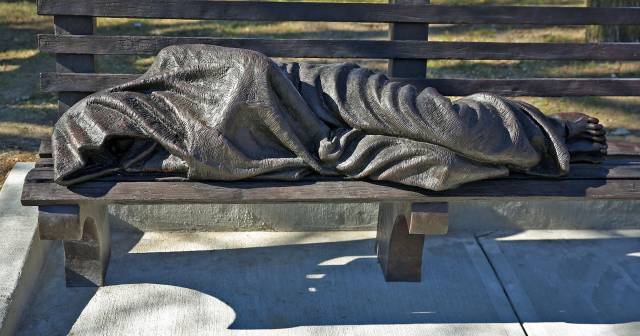
635830241142010733-HomelessJesusStatue-6

Homeless Jesus, by Canadian Catholic sculptor Timothy Schmaltz.

Christ and The Problem of Evil

I personally do not think it is possible to answer the question of why God allows evil.  Levinas, although a faithful Orthodox Jew, believed that on philosophical and purely rational grounds we humans find the divine fundamentally in the ethical responsibility we have towards others. We might sense it in creation, in the history of the world, but all of that can, and is, challenged and undermined. It is in our intuition of responsibility to others that we find the trace of the divine, and the source of meaning in life.

So where does that leave us as Christians today in the year of our Lord Two-Thousand and Nineteen? Ultimately we can never explain evil, or justify it from the perspective of God, because we can only see things from the human perspective, which is so limited. But in the revelation of God in Jesus we do see what we may be called to do and be in the face of evil. And what might that be?

  1. As Christians, although we may not ever be able to explain or “justify” the existence of evil, we can proclaim in Jesus of Nazareth the revelation of God as one who lives and dies with us, and who overcomes death, one who cares for us, and who loves us, one who calls us beyond death to life. In the drama of Holy Week we describe a deity that withholds nothing from us.
  2. As individuals and as communities we are called to amend our ways. We can hear this personally, but I suspect we need to hear it even more so communally. The apocalypse is upon us, whether we see it in environmental degradation, the rise of racism and anti-Semitism, the denial of facts in favour of spin and outright lies, or increasing inequality in incomes.

    But of course, the apocalypse has been always with us, whether it was the the threat of Assyria to Jerusalem in the 7th century BCE, or in the 20th century the rise of totalitarian, genocidal regimes through communism, the rise of murderous totalitarian regimes in Fascism and Nazism, or the challenge of nuclear war. Each generation has its challenges, but the call to repent and amend our ways remains in every era. And so we are called.

  3. And we are called to be in solidarity with the majority, the poor and the oppressed, as Jesus was. We cannot ignore them, or justify their suffering as the results of historical or economic processes, much less blame the victims and exculpate the oppressors. This is the practical theology behind Paul telling Philemon that he needs to free his slave Onesimus. He tells him to do it on the basis of love, not because Philemon owes him, although Paul feels quite justified in saying that he would be right to command him to do it. Also, behind this is the belief that in Christ there is no longer Jew and Greek, male and female, or free and slave.
  4. But this is costly. Freeing a slave was a costly thing to do. Working for justice may cost us relationships. In following Jesus we may lose relations with our relatives, and we may lose income and possessions. I think this is what Jesus is talking about in the gospel reading today – that being a Christian is a costly endeavour, that grace is not cheap, and following Jesus means taking up crosses. The parabolic language Jesus uses may seem over the top, but the blank stares we might get when we tell people we are Christians in this post-Christian society is a hint of the cost of discipleship. Christians, at cost to themselves, live the justice of God among themselves and with the strangers in their midst.
1640062

Traditional Zia Pueblo Small Polychrome Olla with Zia Sun Symbol (which is used on the flag of New Mexico). By Lois Medina (1959 – ).

What Kind Of A Vessel Are You?

As we remember the one who created us, and as we look back over our lives and see how we are like clay that a potter has refashioned time and again, may we recognise the cost that Jesus paid, and be ready for the calls coming to us to pay.  May we hear the call of God to turn now, all of us, from our evil ways, and amend our ways and our doings. And may God give us the Holy Spirit to have the grace so that the sharing of our faith may become effective.


Posted in Sermons | Tagged , , , , , , , | Leave a comment

A Sermon For The Blessing of Pets

A sermon preached on the Feast of St Francis of Assisi,
on September 29, 2019 (transferred from October 4, 2019)
at The Anglican Parish of St Thomas, Kefalas, Apokoronas, Chania, Crete, Greece,
part of the Anglican Church in Greece and
a chaplaincy of the Diocese in Europe, Church of England.

Strictly speaking it should have been either the Feast of St Michael and All Angels, or The 15th Sunday after Trinity, but next Sunday, October 6, is the Harvest Festival, and as I could not commemorate St Francis and have a blessing of animals then, I moved it forward, thereby bumping Michael and his colleagues. May the angels forgive me.
Also, much of this is stolen from the Wikipedia articles on St Francis and his writings.
Readings for the Sunday were:
Genesis 1.:1-2:4, Psalm 148, Galatians 6:14-18, and Luke 12:22-34.

Saint-Francis-of-Assisi-with-kingfisher-icon

Today we commemorate the life and witness of Saint Francis of Assisi. He lived in the late 12th century and into the first quarter of the 13th century. He was born wealthy and was expected to take over the family business of selling silk. Being of the upper classes, at the age of 19 through 23 he also served as an soldier. After a series of spiritual experiences he began to follow Christ in a radical fashion, by letting go of power and wealth, and adopting a life of poverty and humility. This disarmingly simple life, grounded in the gospels and especially the Sermon on the Mount, attracted others. This was the beginning of the Minor Brothers, better known as the Franciscans.

Francis supposedly talked to the animals because he believed they were creatures of God, like us.

One day, while Francis was traveling with some companions, they happened upon a place in the road where birds filled the trees on either side. Francis told his companions to “wait for me while I go to preach to my sisters the birds.” The birds surrounded him, intrigued by the power of his voice, and not one of them flew away.

He is often portrayed with a bird, typically in his hand. Another story goes like this:

In the city of Gubbio, where Francis lived for some time, was a wolf “terrifying and ferocious, who devoured men as well as animals”. Francis had compassion upon the townsfolk, and so he went up into the hills to find the wolf. Soon, fear of the animal had caused all his companions to flee, though the saint pressed on. When he found the wolf, he made the sign of the cross and commanded the wolf to come to him and hurt no one. Miraculously the wolf closed his jaws and lay down at Francis’ feet.

maxresdefault

“Brother Wolf, you do much harm in these parts and you have done great evil”, said Francis. “All these people accuse you and curse you … But brother wolf, I would like to make peace between you and the people.” Then Francis led the wolf into the town, and surrounded by startled citizens made a pact between them and the wolf. Because the wolf had “done evil out of hunger, the townsfolk were to feed the wolf regularly. In return, the wolf would no longer prey upon them or their flocks. In this manner Gubbio was freed from the menace of the predator. Francis even made a pact on behalf of the town dogs, that they would not bother the wolf again. Finally, to show the townspeople that they would not be harmed, Francis blessed the wolf.

While these stories may or may not be true, having been written down only some years after his death, what is true is that he wrote a poem in Italian, called the Canticle of the Sun. It is quite possibly the first piece of literature written in Italian, in the Umbrian dialect, more than a hundred years before Dante wrote the Divine Comedy:

Be praised, my Lord, through all your creatures,
especially through my lord Brother Sun . . .
Praised be You, my Lord, through Sister Moon. . .
Praised be you, my Lord, through Brother Wind, and through the air, cloudy and serene, and every kind of weather through which you give sustenance to your creatures.
Praised be You, my Lord, through Sister Mother Earth . . .
Praised be You, my Lord, through our Sister Bodily Death, from whom no one living can escape . . .

This is best known to us English speaking peoples as “All Creatures of Our God and King” paraphrased by the Rev’d William Draper, published in 1919, and usually sung to the German 1623 tune Lasst Uns Erfreuen:

Because of his association with animals, Francis is, among other things, the patron saint of the environmental movement. Pope Francis took his regnal name from him because of Francis’s concern for the poor and the environment, and his second encyclical, Laudato Si, concerning the dangers of climate change and its effect on the the most vulnerable on Earth, takes its name from a verse in The Canticle of the Sun.

Now, because of these stories about Francis and the animals, and his understanding that all creation worships God, it seems appropriate to bless animals and our pets, This is a growing liturgical act that is popular in Canada and the United States, and is sometimes celebrated in the Church of England and other English denominations. Many of you may recall an episode of The Vicar of Dibley in which this happens. At the Cathedral Church of St John the Divine in New York City it is a major event, with a special jazz setting for the Eucharist called Missa Gaia, which is unique in using a wolf call as the tune for the Kyrie.  The service there involves a broad range of animals, including elephants, camels, tortoises, parrots, cows, horses, and, of course, dogs and cats.


Now, dogs are mentioned more than a dozen times in the Bible. Cats, not so much, perhaps because the little guys are associated with the Egyptians, the people who enslaved the Israelites. The Bbible does mention big cats, including leopards lions, the reference to the Lion of Judah being the most obvious one.

The basic theological issue for me is whether we should bless the animals, because, after all, they already bless us with their presence and love. I resolve this by remembering that we bless God, so it is right that we should invite God’s blessing on these creatures who are so much a part of our lives.

As part of creation, they reflect the Creator. This is stated no better than in a song from ten years ago by the American Christian songwriter Wendy J. Francisco in her song G O D and D O G, so we’ll end with that.

I look up and I see God, I look down and see my dog.
Simple spelling G O D, same word backwards, D O G.
They would stay with me all day. I’m the one who walks away.
But both of them just wait for me, and dance at my return with glee.

Both love me no matter what – divine God and canine mutt.
I take it hard each time I fail, but God forgives, dog wags his tail.
God thought up and made the dog, dog reflects a part of God.
I’ve seen love from both sides now, it’s everywhere, amen, bow wow.

I look up and I see God, I look down and see my dog.
And in my human frailty . . . I can’t match their love for me.


Posted in Music, Sermons | Tagged , , , , , | Leave a comment

Anti-Christ Politics vs. the Politics of Jesus

“Everything Jesus said was exactly the opposite to the political environment in which we find ourselves.” – Jim Wallis

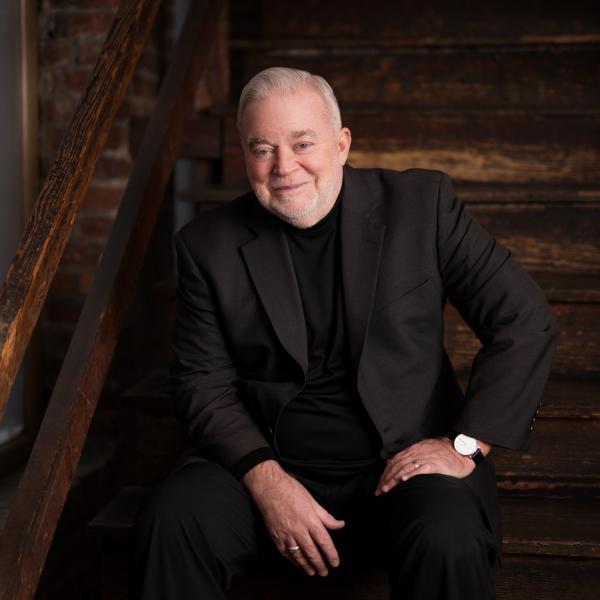
jim_wallis_high_resolution_

Jim Wallis is the editor of Sojourners, a justice oriented Christian magazine in the United States. Here is a column in which he sums up the antagonism against Jesus in the United States today. Yes, he’s flogging his book, but the points he makes are good ones. The column is here.

Posted in Uncategorized | Leave a comment

Kefalas Calling

A Sermon Preached on The Tenth Sunday after Trinity
The Anglican Church of St. Thomas the Apostle, Kefalas, Crete
August 25, 2019,  11:00 am

Readings: Jeremiah 25: 4-10, Psalm 71: 1-6, Luke 13: 10-17

telephone-operator

What are you called to? What are we called to?

When I was young I often wondered about what I would be when we grew up.

I thought that I was going to be a physicist and a science fiction author, winning the Nobel Prize in Physics for work I would do in my mid-twenties, as well as Hugo and Nebula prizes for my writing. I sustained this delusion through high school, but it fell apart in my first year at the University of Toronto. There were two reasons for this. First, I discovered beer, and I was far more interested in it than PHY 150 and CHM 150. Second, I realized that I was only above average in scientific smarts, and that there were lots of students who were much brighter than me. As a result I failed two courses, lost two scholarships, and was on academic probation for my second year.

That second year I started taking courses in philosophy, knowing that I would probably never become a professional philosopher. In due course my interests shifted to The Meaning of Life and God and Other Big Things, and some people suggested I could be ordained. And here I am, some thirty-eight years later, thirty of them as an ordained minister in the Anglican Church of Canada and one as a priest in the Church of England. It thought I had a call to be a priest, pastor, and preacher, and this call was affirmed by various committees and individuals before and after my ordinations.

Institutions talk about their calling, often in the language of vision and mission. What is the mission statement of this company? What is the vision of this leader for this corporation?

This congregation – the Anglican Church of St Thomas, Kefalas – has a mission statement, but it is now some nine years old. While it was undoubtedly accurate when it was written, I believe it is time to consider our vision and mission as a church now. To that end the Church Council has agreed to begin working on that with a season of prayer and reflection.

For four Sundays in late October and through November we will consider four  statements or questions that will lead us into prayerfully thinking about what it is God is asking us to do. The first two will be October 27 and November 3. We will take a break from this for the observance of Remembrance Sunday on November 10 down at the Souda Bay Commonwealth War Graves Cemetery, and then start up again for November 17 and 24. Then, on December 1 – the First Sunday of Advent – we will have a day of reflection in the context of the day’s liturgy. It will make for a different experience – we will be seated around tables and we will consider questions about what we like about church, why we are a part of it, what we are passionate about, and what God might be saying to us about being a church in Crete – but we will get important information about who we think we are and how the Holy Spirit is working through us. After we have some clarity about our vision and mission, we can set some measurable goals and objectives, and settle down to implement them.

We are, of course, a small church community. We can probably only do two or three things really well. One of them is probably worship, I hope. Another might be restarting home groups (church growth gurus says that if a church does nothing else other than starting home groups or small group ministries, you will grow). however, we cannot just sleepwalk our way into growth, but intentionally direct ourselves, so that when God chooses to surprise us with new opportunities, we are ready for them.

We are all called by God in our baptism, and confirmed in the promises and actions we take.

Prophetic Calling

In scripture there is a a pattern to the call to prophets.

  • The call is made.
  • The person being called tries to get out of it.
  • God affirms it.
  • Sometimes there is a purifying act.

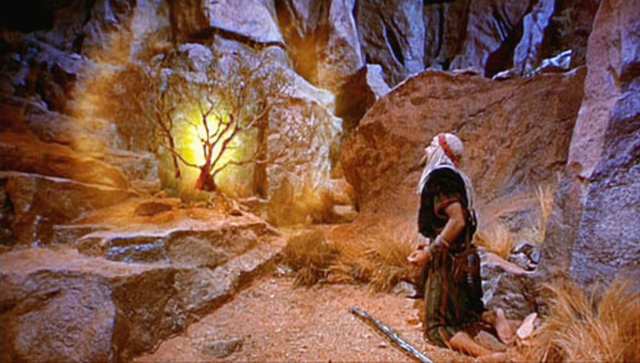
HestonMoses is the paradigm. In Exodus 3-4 we hear Moses’s objections and God’s response:
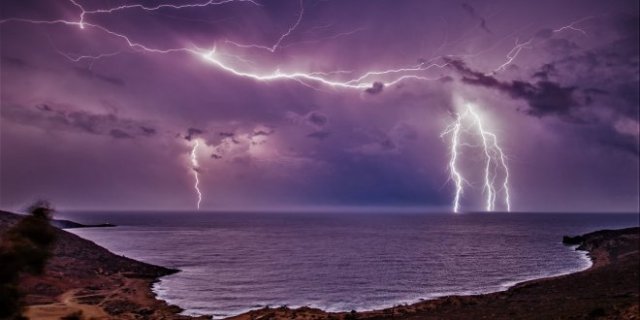

  1. “Who am I that I should go to Pharaoh, and bring the Israelites out of Egypt?” “I will be with you; and this shall be the sign for you that it is I who sent you: when you have brought the people out of Egypt, you shall worship God on this mountain.”
  2. “If I come to the Israelites and say to them, “The God of your ancestors has sent me to you”, and they ask me, “What is his name?” what shall I say to them?” God said to Moses, “I am who I am.”
  3. “But suppose they do not believe me or listen to me, but say, “The Lord did not appear to you.”” Staff that becomes a snake, and the hand that becomes leprous but is then healed.
  4. “O my Lord, I have never been eloquent, neither in the past nor even now that you have spoken to your servant; but I am slow of speech and slow of tongue.” “Now go, and I will be with your mouth and teach you what you are to speak.”
  5. Send someone else! “Your brother Aaron will speak for you.”

The call of Samuel is a little different: As a young boy he hears a voice calling for him in the night. “Samuel, Samuel” He thinks it is Eli the priest calling him. After three times of Samuel hearing the voice calling him, and then waking Eli, the old priest tells Samuel to say. “Here I am!” (Hineh” in Hebrew.) ”Speak Lord, for your servant is listening.”

The call of Isaiah is as an adult in chapter six of the Book of Isaiah: He is a priest, serving in the Temple in Jerusalem, and he has a vision of the Almighty, with Seraphs flying around and singing, “Holy, Holy, Holy”. He says, “Woe is me! I am lost, for I am a man of unclean lips, and I live among a people of unclean lips; yet my eyes have seen the King, the Lord of hosts!’” An angel takes one of the coals that is burning incence, and touches it to Isaiah’s lips, and says, “Now that this has touched your lips, your guilt has departed and your sin is blotted out.” Then he hears the voice of the Lord saying, ‘Whom shall I send, and who will go for us?’ And he says, ‘Here am I; send me!’

Then, a few generations after Isaiah, comes Jeremiah, a few years before the conquest of Jerusalem and Judea by the Babylonians, and who lived and prophesied through the destruction of the Temple and the deportation of the elite of Judea into exile. He is called by God, and he objects, “Ah, Lord God! Truly I do not know how to speak, for I am only a boy.” God basically tells him to be quiet, and somehow puts out his “hand” and somehow touches Jeremiah’s mouth, and says to him

Now I have put my words in your mouth.
See, today I appoint you over nations and over kingdoms,
to pluck up and to pull down,
to destroy and to overthrow,
to build and to plant.

How are we called?

Fundamentally our call is the same, only we hear it mostly through scripture, through the voices of others, and through the traditions and liturgies of the church.

First and foremost, we receive our calling in our baptism. If you were baptised according to the rite in the Book of Common Prayer 1662 we are commanded to confess the faith of Christ crucified, and to fight against sin, the world, and the devil. In Common Worship we have what is sometimes called the Baptismal Covenant:

Will you continue in the apostles’ teaching and fellowship,
in the breaking of bread, and in the prayers?
                  With the help of God, I will.
Will you persevere in resisting evil,
and, whenever you fall into sin, repent and return to the Lord?
                  With the help of God, I will.
Will you proclaim by word and example
the good news of God in Christ?
                  With the help of God, I will.
Will you seek and serve Christ in all people,
loving your neighbour as yourself?
                  With the help of God, I will.
Will you acknowledge Christ’s authority over human society,
by prayer for the world and its leaders,
by defending the weak, and by seeking peace and justice?
                  With the help of God, I will.

No matter what rite we are baptised with, we have the opportunity of affirming it and being empowered allover again  every time we gather around this table and partake of the Lord’s Supper.

Our callings may also be made in other ceremonies. We make it by particular by the vows we make. So, in marriage we promise to to love and to live with a particular person, in these impossible vows:

I, N, take you, N,
to be my wife/husband,
to have and to hold
from this day forward;
for better, for worse,
for richer, for poorer,
in sickness and in health,
to love and to cherish,
till death us do part . . .

I say these are impossible vows because who knows what they are getting themselves into in marriage. And yet we as Christians have these high standards to which we aspire.

Some of us are called to be ordained, in which we carry out servant ministries to empower all the baptised in their work. Some take vows in Religious Orders, in which men and women are set aside for particular types of prayer and ministry in the context of chastity, poverty, and obedience.

Sometimes our callings do not have any special religious rites or secular rituals. Instead, we just take them on. For some of us that is the having children, a vocation which, by the time we have it figured out, we are out of a job. For others it is taking on animals as pets, which has its own blessings and a few curses.And then, of course, for many of us, our jobs are not just a means to earn money, but something which gives our lives meaning. This, I find, is especially true of professions such as teachers, doctors, nurses, counselors, other helping professions, and lawyers and politicians (yes, really), but also carpenters, artists, builders, cooks, gardeners, those in the armed forces, and so many others. For many of us our profession is our identity, and it becomes a real challenge when we retire! We then find new vocations.

So . . .

I believe that all of this is the action of the Holy Spirit, whether explicitly identified as such or not. We have many callings, sometimes obviously so, and sometimes more subtle.

And so I return to the questions at the beginning of this talk:

  • What is God calling you to do?
  • What is God calling us to do?

May God in Christ lead us into some understanding of this. Amen!


Posted in Sermons | Tagged , , , | Leave a comment

Signs of the Times

A Sermon Preached on The Ninth Sunday after Trinity
The Anglican Church of St. Thomas the Apostle, Kefalas, Crete
August 18, 2019 11:00 am

The scripture readings were: Hebrews 11:29-12:2Psalm 80:1-2, 8-18, and Luke 12:49-56.

crete-lightning1

Jesus said, “You know how to interpret the appearance of earth and sky, but why do you not know how to interpret the present time?” Luke 12.56

What time is it?

We are inured to the precision of modern time. If a clock is off by a minute or two, we notice it. It wasn’t always this way.

Time used to be something local, and defined by what the sun was doing. When the sun came up, people woke up, and when it set, people went to bed. The day was broken up into hours and the night into watches, but the length of the hours and the watches varied by the season and who was keeping track of it. Events started when people arrived and all was ready, which could vary by hours, days, or in some cases, months. In some places the middle of the day would be signified by a cannon firing, or the drop of a ball on top of a pole or a building.

800px-Harrison's_Chronometer_H5

John Harrison’s second sea watch (H5), which was tested by King George III himself, and found after ten weeks to be accurate to 1/3 of a second per day.

Then, as society became more global and intertwined, establishing precise and accurate time became important. Shipping required ships to know where they were so they could avoid hazards and take the most expeditious routes. Latitude was easily reckoned, but longitude, the distance east and west, was difficult. Only when accurate chronometers were created, by 1760s, tough things that were portable and could be used in conjunction with astronomy, could position be established accurately. That happened in the 18th century. Then, in the 19th century, with the advent of fast travel on rail, the need for a standard time in a country or jurisdiction became important. If Cork had a noon time that was fifteen minutes later than Dublin, when did the train get in? This led to the twenty-four time zones being set up. Shortly after the Second World War atomic clocks came into use, and Universal Coordinated Time came into being. Now, with the use of satellites and adjusted for the effects of relativity, GPS allows us to be just about anywhere and know where that is, and what time it is.

Time Zones

Time Zones in Europe. Time zones and Universal Coordinated Time were proposed by the Scotland-born Canadian Sir Sandford Fleming in 1879.

But what time is it for God?

Human timekeeping is not God’s time. God is both outside of time and inside it, as the Creator. Outside of time God is eternal and non-temporal, and inside of time God is everlasting and behind all events. So the perspective is a bit different.

From the perspective of God, as given to us in Jesus Christ, we are living in the Last Days. We have been in the Last Days since the coming of Jesus. This is not something new in this generation or century. The Last Days have been two-thousand years long, and they will continue until the kingdom is here in its fullness. That’s as precise as we get.

And what are the signs of these Last Days? Throughout the Gospel according to Luke and in the Acts of the Apostles, and paralleled throughout the other gospels, letters, and Revelation we find:

La-Pentecoste

  • The Holy Spirit come upon people, seemingly indiscriminately. Mary, a young peasant from Galilee, of all people, is chosen to bear the Messiah by the power of the Holy Spirit, and full of the Holy Spirit she proclaims the Magnificat. Paul, who persecuted the early Church, is transformed into a preacher of the good news of the resurrection of Jesus, and filled with the Holy Spirit he speaks in tongues, prophesies, and preaches (and writes letters that are recognized as spirit-filled, and so become scripture). On the Day of Pentecost it is given to everyone who follows Jesus:

In the last days it will be, God declares,
that I will pour out my Spirit upon all flesh,
    and your sons and your daughters shall prophesy,
and your young men shall see visions,
    and your old men shall dream dreams.
Even upon my slaves, both men and women,
    in those days I will pour out my Spirit;
        and they shall prophesy.

The Spirit compels people to be as Jesus in the world: proclaiming the kingdom, healing the sick, and driving out evil.

02-1115-foodpantry07_orig

The Food Pantry at the Episcopal Church of St. Gregory of Nyssa, San Francisco CA. It is located in the same space as the table that is used for communion.

  • The kingdom has not arrived, but the people of God live as though it has, because of the Spirit. In stark contrast to the world around it, justice is lived out by the Christian community. This is seen at that most basic thing, food. We read in Acts how goods are shared, so that none go hungry. The sick are cared for and healed. Sins are forgiven, people repent and are changed, and old enemies reconciled.
OnesimosEnglishsmall__69838.1561594695

A modern icon of St. Onesimus. He was a slave of Philemon of Colossae (in what is now Turkey), who ran away to be with Paul in Ephesus. Paul, in his “Letter to Philemon”, tells him to free Onesimus. Christian tradition records that Onesimus became a bishop in Ephesus.

  • There is a radical inclusiveness. The Spirit is given to anyone who seeks it, including Greeks and Barbarians, and not just the people of Judea. Women in the early church appear to have been co-equal with the male disciples – Mary Magdalene is the first entrusted with the gospel of the resurrection. Slaves are considered to be the equal of their masters within the church, and as a logical consequence of this Paul encourages Philemon to free his slave Onesimus.
whitfield2

Simon Whitfield winning the gold medal in A Very Long Race, namely, the triathlon (swimming, cycling, and running) at the 2000 Sydney Olympics. I ran a race with him (well, me and a couple of thousand other people), the Canada Day 10K in Victoria BC back in 2008; he was somewhat faster than me.

  • All of these things are signs of God sanctifying and acting in the people of Jesus – and this is the fulfilling of God’s promises. As the author of Hebrews puts it, we are being made perfect, and we are running with perseverance the race set before us.

But there is a downside to this.

  • Persecution, beginning with Jesus and continuing with his disciple, initially within the varieties of Judaism compromised by alliances with Roman Imperium, and then later by pagan Roman rulers all on their own. This persecution has continued to this present day.
Westminster_Abbey_-_20th_Century_Martyrs

Statues of 20th-century martyrs on the façade above the Great West Door of Westminster Abbey. Those commemorated are Maximilian Kolbe, Manche Masemola, Janani Luwum, Grand Duchess Elizabeth of Russia, Martin Luther King, Óscar Romero, Dietrich Bonhoeffer, Esther John, Lucian Tapiedi, and Wang Zhiming.

  • Jesus says the gospel will set
    father against son
    and son against father,
    mother against daughter
    and daughter against mother,
    mother-in-law against her daughter-in-law
    and daughter-in-law against mother-in-law.
    Of course, some people would think that this is just the way things are, but in many societies family is everything. First century Palestine was like that, and so Jesus’s words were even more shocking then. Jesus here is not advocating division for the sake of enmity, but simply stating the fact that in a broken world we should not be surprised that we bring our brokenness into families. When it comes to the gospel, many within families would resist its radical call. This division extends to the family created by baptism, the church.  Some estimate that there are now some 43,000 different denominations of Christianity.  The letters of Paul and the John, as well as Revelation, all witness to these schisms from the beginning.

Schism-690x450

  • The power of the gospel has too often been allied with the powers of the world, beginning with Constantine the Great and through to the present day. This has led to imperialism, colonization, the justification of violence in ungodly pursuits, genocide, and support for violent and oppressive regimes. Church dignitaries have prefered to cover up abuses within the institution rather than bringing them out into the light of day.

And yet, despite all this,

  • The church perseveres and grows. While we might wonder about the future of Christianity in England and Europe, where “none of the above” is the fastest growing faith, the church is nevertheless growing by leaps and bounds in Africa and Asia.
  • The church reforms itself. It did this in the 3rd and 4th century, when Christianity had grown so much that it was becoming a means of social advancement. People like St. Antony heard the gospel as a call to renounce the world and live in the wilderness. He and those who followed him began monasticism. In the 12th and 13th century Dominic and Francis began preaching orders that were oriented to bringing a lively faith to ordinary people. In the 16th century the Protestant reformers went back to the Bible to transform the church into something more Christlike. In the late 19th century radical Christians called into question slavery and campaigned for its abolition. In the 20th century the Social Gospel movement advocated for the poor and the common person. Martin Luther King, Jr. led the Civil Rights movement, condemning segregation. Oscar Romero challenged despots and death squads. Desmond Tutu condemned apartheid as a heresy, and following its end, led the process of reconciliation in South Africa. Much of the church, in the wake of the Holocaust, has repented of its anti-semitism and supersessionism.

What do these signs say to us? How do we read them?

Rather than tell you how to read them, let me ask some questions.

  1. First, are we open to the Holy Spirit working within us? The foundation and growth of this little church seems to be an example of the Spirit – where will it drive us next? As our Church Council looks as our mission and tasks for the next few years, have we sought the Spirit?
  2. Second, are we living the kingdom of God now? Are we radically inclusive, and do we welcome and actively solicit the involvement of all sorts of people in our congregation and in our lives, and not just people who look and sound like us? Have we reached out beyond our ethnic group to invite others and make them feel welcome? I come from a part of the Anglican Communion (the Diocese of British Columbia in the Anglican Church of Canada) where we have married clergy in same sex unions, where we hung out rainbow flags over the front door, the Bishop marched in Pride parades,  and same-sex weddings are permitted. Now, I know that the Church of England has a different policy on this, and thus this congregation, being part of the Diocese in Europe, so do we. However, the three other Anglican churches in the British Isles – the Church of Ireland, the Church in Wales, and the Episcopal Church of Scotland – have all moved to be significantly more open on the marriage of same-sex couples. Do we need to look at this as well?

    Logan in Pride

    Some members of the Diocese of British Columbia preparing for the 2019 Pride Parade in Victoria, British Columbia, Canada. At right is the Right Rev Dr Logan McMenamie.

  3. Third, where are we with justice, and how do we fit that into our lives?
  • In the United States, Canada, and Ireland the largest denomination, the Roman Catholic Church, is in disrepute because of sexual scandals. On a smaller scale various provinces of the Anglican Communion, including the Church of England, have been dealing with sexual abuse. We have had a good response, but it could be better. Are we not only safeguarding, but are we being seen to be doing the right thing, so that the possibility of abuse of the most vulnerable among us by our entrusted leaders is made as difficult as possible? When will safeguarding be seen not as a bureaucratic add-on, but a central part of evangelism?
  • The American conservative evangelical movement is now strongly identified with
    • the denial of science and facts around climate change and gun violence,
    • the disparaging of non-white immigrants and refugees,
    • a rollback of achievements for gays and lesbians, and
    • the demeaning of women.

Many Christians in the historically African-American denominations no longer want to call themselves evangelicals because of the antagonism they receive in attacks from their white brothers and sisters. Furthermore, there is a growing movement of young ex-evangelicals who see themselves as Christians but cannot abide the narrow hypocrisy of their home churches. They love the people in the churches they have left, but they can no longer abide the debasement of ethics and morality in the name of political goals.

Screenshot 2019-08-18 at 15.45.04

The situation is different here in Europe and in the Church of England, and Evangelicals are not so likely to be aligned with one political party or set of social goals. That said, the challenge of the gospel – to show our faith in our works, by care for the poor and disenfranchised as if they were Jesus himself – remains. Our words must match our deeds.

And in the end . . .

Are we walking by faith, as our forebears did, as described in the Letter to the Hebrews, as Jesus and the disciples did? Are we Christ centered, seeking to conform our lives to his? Do we know what time it is?

May the words of the Psalmist be our prayer:

Turn now, O God of hosts, look down from heaven,
behold and tend this vine; *
preserve what your right hand has planted.
Restore us, O Lord God of hosts; *
show the light of your countenance, and we shall be saved.

Posted in Sermons | Tagged , , , , , , , , , , | 1 Comment

Prayer and Forgiveness

A sermon preached on The Sixth Sunday after Trinity
at The Anglican Church of St. Thomas the Apostle, Kefalas, Crete
July 28, 2019 11:00 am

The readings for the day were Colossians 2:6-15, Psalm 85 and Luke 11:1-13.

kneeling

Well, given these readings, shall I talk about prayer and forgiveness?

The disciples ask Jesus about how to pray. In the Gospel according to Luke he responds with one of the two version of the Lord’s Prayer. There are two versions in the New Testament, the one here in Luke, and another in the Gospel according to Matthew, and while they are not exactly the same they are close enough, and the slight differences suggest that they are rooted in an oral tradition that probably goes back to Jesus. The traditional form of the Lord’s Prayer which we use is a merger of these two, and in the English language tradition we add a doxology: For thine is the kingdom the power and the glory, for ever. Amen.

Postures

There are traditionally two positions for prayer, as described in scripture.

  1. On one’s knees. It is a position of humility and vulnerability. You cannot see well, your hands are fixed and you cannot defend yourself. It is very similar to kneeling before one’s lord and sovereign. One demonstrates one humility because when the Queen (or perhaps, more often these days, the Prince of Wales) knights you, a sword goes on either shoulder – when presumably the Sovereign could just as easily chop off your head. There is vulnerability, but also a possibility of receiving honour. From being vulnerabile one is open to things, to being taught.
  2. Standing with hands outraised. This is a position of receptive power, of joy and praise. It is something both Catholics and Charismatic Protestants do.
680x450_Box_Pilot_16114.jpg

Of course, nowadays, we most often pray sitting down, it seems. It used to be that Anglicans were distinguished for the amount of time they spent praying on their knees during the liturgies, but a more relaxed attitude has emerged. Where we used to claim we had callouses on our knees, old age and a lack of kneelers leads many congregations to adopt being seated as the norm.

For What Do We Pray?

And what do we pray for? In Luke we read:

  • Your kingdom come. We are not satisfied by what the world gives us, whether it is politicians and liberal democracy, economic well-being and the consumer society, or the distress of the world around us. Our hearts are restless until they can find rest in you, O God, as St Augustine put it in his Confessions (written 397-400 CE). The kingdom comes in Jesus, the kingdom of God is at hand, but it is not to be identified with the kingdoms of this world, nor is it identical with the institution of the church (although the kingdom is active within it). It is present whenever two or three gather in Jesus’s name, but it is also at the same time not yet here. In Matthew we also pray that God’s will would be done on earth as in heaven, and that implies that God’s will often is not done. So as Christians we are uncomfortable, restless, strangers in a strange land, legally citizens of the UK or Greece or Ireland or Canada, but in reality citizens of another place.
  • We pray for daily bread – minimal sustenance. We also have confidence that it will come. We are no longer faced with famines. We do not pray to be wealthy or powerful or famous.
  • We ask to be forgiven, about which I will say more in a moment, and God’s forgiveness of us is paralleled by our forgiveness of others.
  • Finally, in Luke we ask God to not bring us to the time of trial. Reframing this, we ask that those soul-challenging occasions where we are tempted are avoided, that we are not pushed to the breaking point.
  • Jesus then tells his disciples, in a brief parable and a few illustrations, to persist in prayer – presumably for these things.

The Power of Prayer

I often hear people talk about the power of prayer, as if it is the case that if we have enough faith God will do anything for us. But prayer is not about manipulating God, as if the Almighty is subject to the whims and will of human desires. Sometimes the answer to our prayers is positive, and they are granted. As often as not, the answer is a no. And then there are all those situations in which the answer is vague and uncertain. It is because we project our human malleability upon the divine, when it is in fact quite wholly other. No, the power of prayer, in my experience is different from this.

  • Fundamentally, the point of prayer is that it changes us. It may sound as if we are trying to change God’s mind, but it is actually our minds which will be transformed.
  • It is a spiritual habit and a practice. Just as if you change your diet you will see a change in your body, so if we pray we will see changes in our selves, our souls and bodies.
  • If we kneel in prayer we will feel humble and vulnerable, and open to teaching.
  • If we enter into contemplative prayer or meditation we will find ourselves becoming all too aware of the narcissistic monkey chatter of our minds. If we persist, we quiet the voices, and perhaps become attentive to the still, quiet voice of God.
  • If we pray for our enemies we will find ourselves moving from anger and vengeance to dispassionate analysis and wishing their welfare. This is not to say that we give up on bringing the consequences of their action upon them, but we so in order to force them to refrain from malevolent action, and perhaps to turn and repent.
  • If we meditate and reflect on the words of Jesus and the prophets in scripture, and think about the stories we hear and read about them, we will find our hearts shaped like that of the prophets and Jesus.
  • If we stand to praise God in Christ in voice and action we will find ourselves moving into joy and gratitude.
  • And so, forgiveness becomes a spiritual practice, similar to and complementary to that of prayer.

Now of course, many of us have been grievously hurt by others. So how can we forgive our offenders, especially if they do not acknowledge their suffering they have caused, if there is no repentance? Let me tell you a couple of stories.

[Trigger warning] A friend of mine back in Canada was sexually assaulted by her father, and needless to say, this was deeply traumatic. She told me about this – how she made a complaint to the police, and he was tried and convicted and sent to jail for a time. Then, after this, she said that she was able to forgive him?. “How?” I asked. “I had to forgive him, or else that suffering would continue to keep a hold on me. Only by forgiving him was I able to be free from the awful effects of his abuse.” Forgiveness is about us dealing with the past, not forgetting it but reducng its destructive power over us.

amish-school-shooting

A funeral procession following the West Nickel Mines School shooting in 2006.

One of the more horrific aspects of American gun culture is the frequency with which people kill children in schools. One example is the West Nickel Mines School shooting back in 2007. It was no different from so many other of these school shootings, except that in this case the victims were all Amish children, between the ages of 7 and 13. The Amish are a type of radical Anabaptists. While many of them accept some modern technology for farming and carpentry, they reject much that we take for granted – electricity, smartphones, television, automobiles, and factory-made clothing. They drive horse and buggies. They are radical pacifists, speak a form of German, and do not participate in national programs of social welfare.  When this tragedy came upon them they responded with sorrow and grief, and tore down the school and built a new one. The perpetrator, who was not Amish but was known to them, killed himself after shooting the children. Astonishingly, many members of he Amish community, including parents who had buried their daughters the day before, attended the funeral of the murderer, and expressed forgiveness. They even raised some money for his widow and children. A counselor who worked with many of those grieving, believes that

because the Amish can express that forgiveness, and because they hold no grudges, they are better able to concentrate on the work of their own healing.

This forgiveness is rooted in the Amish knowledge of Jesius’s teaching about forgiving others, and the fact that any undertaking begins and ends with the Lord’s Prayer.

The Power of Forgiveness

We are changed by God’s forgiveness given to us in Jesus. Likewise, we are changed by forgiving others.

enyu5tg8nd0uz15ksngb

This became an influential part of modern political life with the rise of  “Truth and Reconciliation”. While it arose in parts of Latin America, it became very prominent when  a commission was set up in South Africa by Archbishop Desmond Tutu at the request of Nelson Mandela. As the Wikipedia article states, its purpose was to bear witness to, record, and in some cases grant amnesty to the perpetrators of crimes relating to human rights violations, as well as offering reparation and rehabilitation to the victims. It was grounded in the Christian principle that a confession of violence could be forgiven, and it was a means for the nation to heal beyond the traumas of apartheid and violence committed on both sides. This became a model for other nations, including Australia, Chile, and Germany. My home country of Canada has had one as well, relating to the genocidal traumas of the Indian Residential Schools. An apology is not enough – there needs to be some form of reparation, to make things right, and an intention to do things to make sure that the damage is never done again. It is a slow, painful, and challenging process, and often fraught with controversy. That said, most places that have had one affirm the importance of truthtelling in the process of achieving justice.

Some people cannot see themselves as forgivable. And, indeed, it may be that some people will not forgive others. But God will always forgive us, and will not deny us. It does not erase the sin, there’s no forgive and forget, but there may be forgiveness and transformation.

Some people they read the version in Matthew quite literally – forgive us our debts as we forgive those who are indebted to us. Whether in the ancient world or the 21st century, the chronic persistence of debt is seen as an injustice. Bankruptcy was a novel concept that only came about in the modern era, and allowed individuals to get out from under the crush of owing money – or avoiding debtors prison, or quite literally becoming slaves.    or simply the redistribution of accumulated wealth, there is a sense in which our relations with others cannot be defined by economics. While now it may seem to be associated more with crooked politicians and large corporations, bankruptcy was originally an act of justice and forgiveness.

And so . . .

God calls us to pray, as Jesus prayed.

God calls us to be people of healing and reconciliation, grounded in being forgiven and forgiving others.

By the grace of God’s Holy Spirit may we be remade in the image of God, may we be vulnerable enough to be teachable, so that we may be living icons of the kingdom of God to this broken and fragile creation.

Posted in Sermons | Tagged , , , , , , , | Leave a comment

The Eagle Has Landed

A Sermon Preached On The Fifth Sunday after Trinity
The Anglican Church of St. Thomas the Apostle, Kefalas, Crete
July 21, 2019 11:00 am

Post

Well, fifty years ago yesterday humanity arrived on the moon, and today, going by Greenwich Mean Time (which is God’s time, right?), Neil Armstrong and Buzz Aldrin stepped out and walked on the lunar surface. It was my was seventh birthday that July 21, 1969, and it was a thrilling thing to watch. I had grown up with the Space Race, following the exploits of the Gemini project and then the Apollo.In 1967 I went to Expo 67 in Montreal, celebrating the 100th anniversary of Confederation, and there I saw in the US pavilion artifacts from NASA.

The moon landing was the culmination of a decade’s incremental advances in astronautics, involving 400,000 people, from the human calculators such as Katherine Johnson, featured in the movie Hidden Figures, to Chris Craft, the ubiquitous head of Mission Control in Houston, Texas. The computer software on the spacecraft was built from the ground up by a team headed by Margaret Hamilton, and never demonstrated any bugs or errors – which was a good thing, as there was little margin for error.

It was a tremendous achievement. While many people criticized it then and now as an unnecessary extravaganza, for others it demonstrated what humanity was capable of doing when it put its mind to it. As a child born in the ‘sixties it was a symbol of progress and human ingenuity. While an American endeavour, there was a real sense that all humanity was involved. It still fills me with wonder every time I look at the moon over these Cretan hills and thing, “Wow, we really went there.”

But first things first. When the Eagle had landed on the Sea of Tranquility the first thing Buzz Aldrin did was take communion. He had brought the elements from his Presbyterian Church, where he was an elder, and gave thanks to God for the life and death and resurrection of Jesus Christ.

Later, on Apollo 15, astronaut David Scott left a Bible on the Lunar Rover Vehicle, where it remains today.

Inked20190717_1020073_LI-600x600

The Bible left by David Scott is shown in the red circle. Photo: NASA via St. Christopher Episcopal Church


These things came to mind this week as the media was filled with the fifty year anniversary, and I came across the story of Martha and Mary in the Gospel of Luke, our gospel for this day.

“Martha, Martha, you are worried and distracted by many things; there is need of only one thing. Mary has chosen the better part, which will not be taken away from her.”

Doesn’t that sound familiar? It is so easy to be distracted from the divine. Do we pray? Do we meditate? Do we read our scriptures? Do we reflect on our faith in Jesus Christ? Do we attend to Jesus and rest in his presence? It is commendable that in the midst of the moon landing that some of the astronauts took the opportunity to focus on God, in the person of Jesus Christ.

But the optimism and excitement I and so many others felt fifty years ago is a stark contrast to the way we feel today. different today.

apollo08_earthrise

Taken aboard Apollo 8 by Bill Anders, this iconic picture shows Earth peeking out from beyond the lunar surface as the first crewed spacecraft circumnavigated the Moon. NASA

  • From Apollo 8 we saw the photograph of the Earth-rise and realized in a single picture, just one glimpse, the interconnectedness and fragility of creation. And today we find ourselves spoiling our planetary home, as the climate gets warmer and the weather more unpredictable. Politicians argue as they deny the science or acknowledge it, and find themselves trying to balance the immediate concerns of economics and jobs versus the long-term issues of global warming. And this comes home to us. Will we pay for the billion-euro power line to connect Crete to the continent of Europe, so that our power will not be generated by the burning of oil? Will we pay carbon taxes to encourage us to shift to renewable resources? Are we willing to forgo our flights on jets?
  • Or think of the leadership in our nations. I was probably naive then, or maybe I am getting old, but it did seem we had better politicians in days past. The words of the psalm might have been written today about them, rather than 2700 years ago:

Your tongue is like a sharpened razor, * O worker of deception.
You love evil more than good * and lying more than speaking the truth.
You love all words that hurt, * O you deceitful tongue.
“This is the one who did not take God for a refuge, *
but trusted in great wealth
and relied upon wickedness.”

Or the words of the prophet Amos:

you that trample on the needy
and bring to ruin the poor of the land,

  • Or consider the role of religion in our societies, so long in decline:

The time is surely coming, says the Lord God,
when I will send a famine on the land;
not a famine of bread, or a thirst for water,
but of hearing the words of the Lord.
They shall wander from sea to sea,
and from north to east;
they shall run to and fro, seeking the word of the Lord,
but they shall not find it.

To address all of these we need to keep first things first. God calls to us, in the midst of all of our distractions , not to simply dwell on these things and run to and fro trying to fix these things, but to set time aside to attend to God. There is time enough to attempt great things, necessary things, but as Christians we begin with Jesus, by gathering here, by listening and reflecting on scripture, by praying to God, and by sharing the meal that Jesus his son left us. Then, empowered by the Holy Spirit, we pray and read and preach the gospel in word and deed throughout the week.

Copy of Apollo 11

The recently communicated Buzz Aldrin.

We do these things, and through the faith that is in us we are changed, and so we are made capable of doing things that would have seemed impossible for us. And yet Jesus said in the Gospel of John that we would do greater things, and Paul writes that God, working in us, can do more than we can ask or imagine.

So, while we may want to be Marthas, may we, for a time, be Marys, that the better part may not be taken from us.


Posted in Prayer, Sermons | Tagged , , | Leave a comment