This Advent, in the Year of the Great Pandemic 2020, it seems appropriate to look at The Apocalypse – that is, The Revelation of John. This is the first of twenty-six short reflections.
Some people call it Revelations, others The Revelation to Saint John the Divine, and some simply Revelation. You will also hear people (often Catholics and Orthodox) refer to it as The Apocalypse.
Of course, the real title is there in the first two verses. In the Sinaiticus it is
αποκαλυψιϲ ιυ χυ ην εδωκεν αυτω ο θϲ δειξαι τοιϲ αγιοιϲ αυτου α δει γε>νεϲθαι εν ταχει και εϲημανεν αποϲτειλαϲ δια του αγγελου αυτου τω δουλω αυτου ϊωανει οϲ εμαρτυρη>ϲεν τον λογον του θυ και την μαρτυριαν ιυ χυ οϲα ϊδε
The revelation of Jesus Christ, which God gave him to show his servants what must soon take place; he made it known by sending his angel to his servant John,who testified to the word of God and to the testimony of Jesus Christ, even to all that he saw.
That’s is a little unweidy, so you can see why a shorter title is helpful. Above in the picture is the beginning of the book found in one of the great 4th century uncial manuscripts, the one known as Sinaiticus. There the title is Αποκαλυψις Ιωανου, Apocalipsis Ioanou. This is probably best translated at The Revelation to John, because Αποκαλυψις means “revelation” or “unveiling”.
As I have argued elsewhere in this blog, “Apocalyptic has negative connotations in English, but in Greek it is simply the ordinary word for revelation, or exposure. Think of the unveiling of a plaque or a statue – that is an apocalypse, a revelation.” Of course, part of the reason people have such a negative connotation is because of the contents of this book – readers read of death and destruction, judgement and punishment, and and the end of the world. This is terrifying to many people – perhaps they like the world as it is, or themselves as they are, and the changes that God will bring about on the Day of the Lord is perceived as a threat. As well, they see many innocent people being destroyed and punished through no fault of their own. We will deal with this in the days to come.
Revelation is a word derived from Latin through Anglo-Norman and Middle French, and seems not to have the negative connotations of Apocalypse, perhaps because the adjective “revelatory” is used differently from “apocalyptic”.
Other manuscripts expanded the title. Bruce Metzger in his Textual Commentary on the Greek New Testament refers to a scholar named Hoskier who found sixty different variations on the title. Calling it Revelation or The Apocalypse will do for us.
But who is this John? I’ll deal with that tomorrow.
I first heard Bad Religion‘s “Sorrow” on the radio in it’s acoustic version, sung and played solo by its lead singer Greg Graffin. To me it sounds like it could be a folk song from the ‘sixties. Only after I went to the internet did I find out that it was originally recorded with the full band in their standard punk arrangement. I like the version above. Here are the lyrics (for some reason the first verse is omitted in the version above):
[Father can you hear me? How have I let you down? I curse the day that I was born And all the sorrow in this world.]
Let me take you to the hurting ground Where all good men are trampled down Just to settle a bet that could not be won Between a prideful father and his son.
Will you guide me now, for I can’t see The reason for the suffering and this long misery. What if every living soul could be upright and strong? Well, then I do imagine There will be sorrow, There will be sorrow, And there will be sorrow no more.
When all the soldiers lay their weapons down, Or when all kings and all queens relinquish their crowns, Or when the only true messiah rescues us from ourselves, It’s easy to imagine There will be sorrow, There will be sorrow, And there will be sorrow no more, no more.
There will be sorrow, And there will be sorrow, And there will be sorrow no more. Yeah, there will be sorrow, And there will be sorrow, There will be sorrow no more, no more.
The first two verses describe a conflict between a son and a father, and the third line, “I curse the day that I was born” echoes what Job says at the beginning of his profound meditation on suffering in that ancient Biblical book. Then the song begins to shift to something hopeful. The lyrics describe a time when there would be “sorrow no more”, when the soldiers lay down their weapons, when the kings and queens lay aside their crown, the true messiah rescues us from ourselves – which all seems to be a reference to the eschatological vision from the Bible, especially Isaiah and Revelation:
So the ransomed of the Lord shall return . . . and sorrow and sighing shall flee away. (Isaiah 51.11)
I heard a loud voice from the throne saying, “See, the home of God is among mortals. He will dwell with them; they will be his peoples, and God himself will be with them; 4 he will wipe every tear from their eyes. Death will be no more; mourning and crying and pain will be no more, for the first things have passed away.” (Revelation 21:3-4)
All of which makes me think this would be a good song for Advent, especially in this long season of Covidtide. I could imagine, at the beginning of an Advent service, a soloist singing this song, perhaps even without accompaniment.
Despite their name, Bad Religion is not opposed to faith as such, but rather in unquestioning faith in institutions and religious leaders. Also, they’re a punk band, and the gimmick with a lot of punk is to be offensive. As one member put it,
The name Bad Religion and the crossbuster logo came to pass in the minds of two fifteen-year-olds who were trying to find the most offensive name and image they could possibly find for the punk band they were starting in their garage … These are not people who thought that 21 years later they would be on the telephone doing interviews.
No one will mistake Bad Religion for a Christian rock group, but I find it interesting that a bunch of people who are so suspicious of religion nevertheless make use of the themes of Christianity. Indeed, in 2013 they even did an album of Christmas songs.
Anyways, that’s what I’ve been thinking about as we approach the beginning of Advent. I hope you like the song.
These are resources for An Advent Service of Lessons and Carols which will be held online on the First Sunday of Advent, November 29, 2020. The resources are gathered from a variety of sources and, while assembled mainly for The Anglican Church of St Thomas the Apostle, Kefalas, on the island of Crete in Greece, others may find them useful.
A Note About This Service of Lessons and Carols, or, What’s an Advent Carol?
Those of us with a passing knowledge of liturgical calendar know that, at best, Christmas starts on Christmas Eve – not twelve days before, not on December 1st, or the day after American Thanksgiving, much less October or September. In the commercial world the stores may start playing Christmas carols at those times, and Christmas movies will start to show up weeks before Christmas Day, but in the church we do not normally sing Christmas carols until the night before Christmas. We prepare for Christmas with the season of Advent, which itself only starts four Sundays before.
That said, many churches have services of Nine Lessons and Carols for Christmas well before December 24. These services are largely in imitation of the one held annually at King’s College Chapel in Cambridge, England in the late afternoon of Christmas Eve. I confess that I am as guilty as anyone of this. People want to sing Christmas Carols before Christmas, not in the Twelve Days of Christmas following Christmas Day, so I have given in to popular pressure. So, I am planning on a Service of Nine Lessons and Carols for Christmas on the Fourth Sunday of Advent.
Another option is to have a Service of Lessons and Carols for Advent, and this has become a tradition in many places around the world. Christ Church Cathedral in Victoria BC was always packed with over a thousand attendees on the afternoon of the First Sunday of Advent, largely because of the creative use and lighting of hundreds of candles. The modern language resources of Common Worship in the Church of England provides four sequences of readings and themes for such an Advent service. I have decided to go with the theme of
A vigil for prisoners and those who sit in darkness
which seems appropriate in a time of lockdown and pandemic. So here is the rough draft of what we will do on Sunday.
An Advent Service of Lessons and Carols The Anglican Church of St Thomas, Kefalas, Crete, Greece The First Sunday of Advent 2020 11:00 am EET, November 29, 2020 Join us by clicking this link or by joining in your Zoom app Meeting ID: 850 4483 9927 Passcode: 010209.
Greeting
At the lighting of the first candle in an Advent Wreath
Blessed are you, sovereign Lord, God of our ancestors: to you be praise and glory for ever. You called the patriarchs to live by the light of faith and to journey in the hope of your promised fulfilment. May we be obedient to your call and be ready and watchful to receive your Christ, a lamp to our feet and a light to our path; for you are our light and our salvation. Blessed be God for ever.
In the name of God, who has delivered us from the dominion of darkness and made a place for us in the kingdom of his beloved Son, we welcome you: grace to you and peace.
As we meet to celebrate anew the coming of God’s kingdom, we hear revealed the mystery of God’s loving purpose for us – how that when we were far off, he met us in his Son and brought us home; how he humbled himself to take our human nature, that we might share his divine glory.
Let us then so celebrate this coming with our carols and hymns of praise, that our lives may be charged with his life; that we may bear witness to his glory and so bring light to those who sit in darkness. So first we pray for those among whom the Christ was born: the poor and helpless, the aged and young children; the cold, the hungry and the homeless; the victims of poverty, injustice and oppression, the sick and those who mourn, the lonely and the unloved; those in despair or in the shadow of death.
Then, as we hear again the message of peace on earth and goodwill among all his people, we pray for the leaders of the nations, that all may be inspired to work together for the establishment of justice, freedom and peace the world over.
And that we may bear true witness to this hope in a divided world, we pray for the peace and unity of Christ’s Body, the Church universal, that the whole earth may live to praise his name.
Finally, as we rejoice with the saints in heaven and on earth, we remember all who have gone before us with the sign of faith, whose hope was in the Word made flesh, Jesus Christ our Lord, through whom we offer up our prayers for the coming of his kingdom, in the words he himself has taught us, saying:
The Lord’s Prayer follows: Our Father, who art in heaven, hallowed be thy name; thy kingdom come; thy will be done; on earth as it is in heaven. Give us this day our daily bread. And forgive us our trespasses, as we forgive those who trespass against us. And lead us not into temptation; but deliver us from evil. For thine is the kingdom, the power and the glory, for ever and ever. Amen.
The whole congregation prays silently, after which the president draws the prayers together in the Collect of Advent Sunday
Almighty God, give us grace to cast away the works of darkness and to put on the armour of light, now in the time of this mortal life, in which your Son Jesus Christ came to us in great humility; that on the last day, when he shall come again in his glorious majesty to judge the living and the dead, we may rise to the life immortal; through him who is alive and reigns with you, in the unity of the Holy Spirit, one God, now and for ever. AllAmen.
And may the Lord when he comes find us watching and waiting, now and at all times. AllAmen.
The Lessons and Carols
Before each lesson the reader says, “The First Lesson (or Second, or Third . . . ) is taken from the nth chapter of the Book of N, beginning at the nth verse.”
At the end of the lesson the reader pauses, and then says, “This is the word of the Lord” to which the people respond, “Thanks be to God.”
The First Lesson Isaiah 43.1-7I have called you by name, you are mine
The Second Lesson Psalm 107.1-3, 10-16When they cried to the Lord, he delivered them from their distress
The Third Lesson Isaiah 61.1-3,11The spirit of the Lord is upon me
The Fourth Lesson Isaiah 42.5-9Bring the prisoners out of darkness
The Fifth Lesson Micah 4.1-5They shall beat their swords into ploughshares
The Sixth Lesson Ephesians 2.11-22 He is our peace, who has made us one
Benedictus (The Song of Zechariah) This metrical version can be sung to the tune “Forest Green”, which in England is the usual tune for “O Little Town of Bethlehem”.
Bless’d be the God of Israel, the ever-living Lord, who comes in pow’r to save his own, his people Israel. For Israel he raises up salvation’s tow’r on high in David’s house who reigned as king and servant of the Lord.
Through holy prophets did he speak his word in days of old, that he would save us from our foes and all who bear us ill. To our ancestors did he give his covenant of love; so with us all he keeps his word in love that knows no end.
Of old he gave his solemn oath to Father Abraham; his seed a mighty race should be and bless’d for evermore. He vowed to set his people free from fear of ev’ry foe that we might serve him all our days in goodness, love, and peace.
O tiny child, your name shall be the prophet of the Lord; the way of God you shall prepare to make his coming known. You shall proclaim to Israel salvation’s dawning day when God shall wipe away all sins in his redeeming love.
The rising sun shall shine on us to bring the light of day to all who sit in darkest night and shadow of the grave. Our footsteps God shall safely guide to walk the ways of peace. His name for evermore be bless’d who lives and loves and saves.
The Seventh and Final Lesson Matthew 25.31-46I was in prisonand you visited me
Conclusion
Restore us, O Lord God of hosts: Allshow the light of your countenance, and we shall be saved.
Will you not give us life again Allthat your people may rejoice in you?
Show us your mercy, O Lord, Alland grant us your salvation.
The Blessing
May God the Father, judge all-merciful, make us worthy of a place in his kingdom. Amen.
May God the Son, coming among us in power, reveal in our midst the promise of his glory. Amen.
May God the Holy Spirit make us steadfast in faith, joyful in hope and constant in love. Amen.
And the blessing of God almighty, the Father, the Son, and the Holy Spirit, be among you and remain with you always. Amen.
The Dismissal
As we await our coming Saviour, go in peace to love and serve the Lord. In the name of Christ. Amen.
This question is asked in various ways four times in our Gospel reading. But is raises the question for us, “What does Jesus look like?”
The correct answer is, “We don’t know.” We read in the gospels that Jesus taught with authority, which suggests that when he spoke there was a charisma about him which engendered respect. Otherwise he appears to have been indistinguishable from any other first century Jew, as Judas had to identify him to the soldiers. He did not stick out in a crowd.
At first Christianity seems not to have felt the need for pictures of Jesus. What Jesus taught and did was far more important than the superficial aspects of his likeness. As well, coming from Judaism, there was a strong imperative against the worship of images; the pagans used images, not the Jews and Christians.
Further, the churches met in homes and rented rooms, which did not encourage permanent decorations.
That said, the earliest depictions of Jesus were of someone who looked more like a “civilized” Greek or Roman man who shaved, rather than an observant Jew with a beard. The earliest portrayals ignore that, or have him as a young man.
The picture at left is from a third-century fresco from the Catacomb of Callixtus, and it portrays Jesus as the Good Shepherd.
Christ Almighty
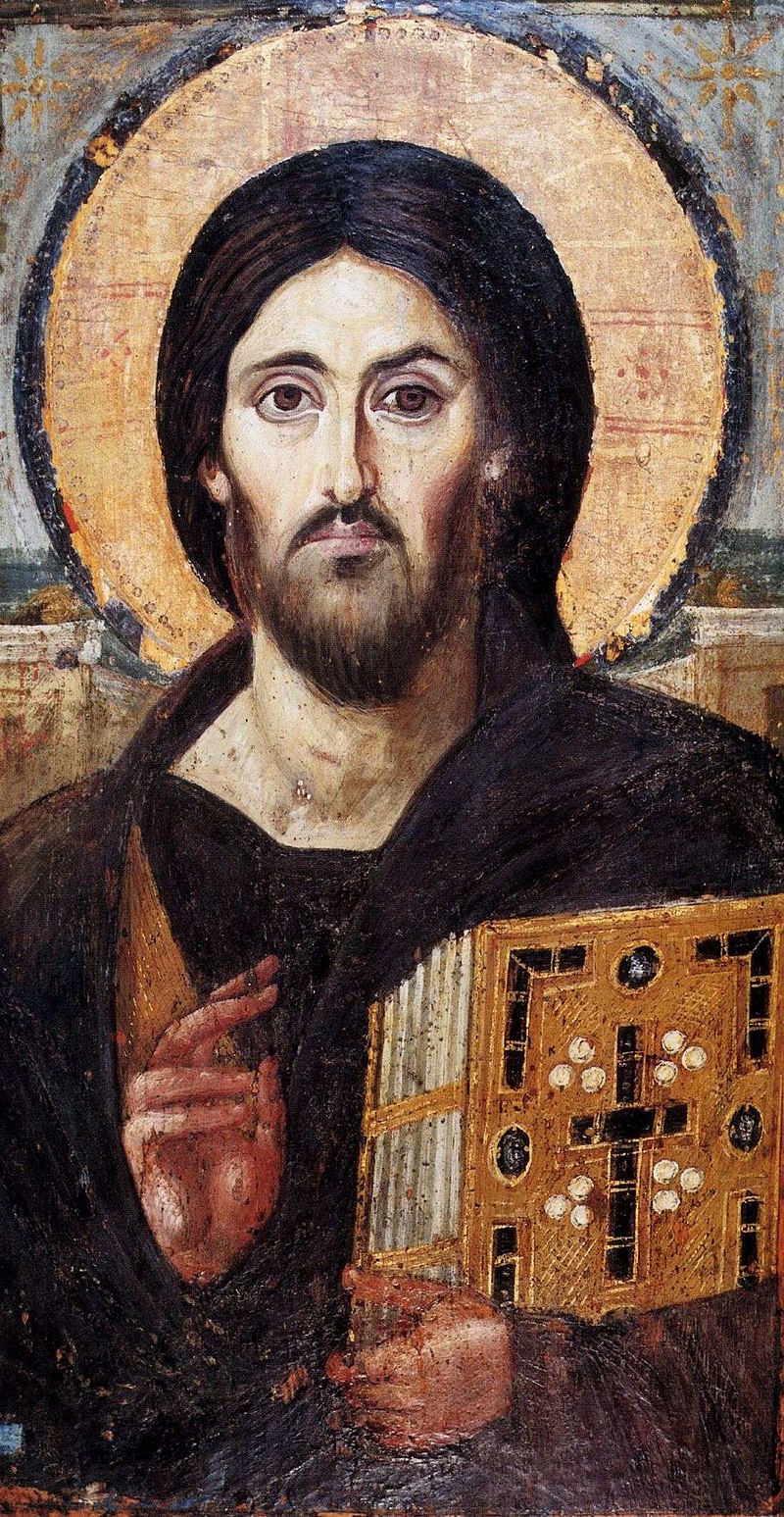
After Christianity was legalized by Constantine in 314 and began to be favoured by the Roman Empire, we see an explosion of images. The one below dates to the 6th or 7th century, and is made of wax on wood, what is called encaustic. It was a popular medium for icons in that era, although has been rarely used in the past thousand years.
This is the famous Christ Pantocrator icon at the Monastery of St Catherine, at the foot of a mountain traditionally identified as Mount Sinai. The monastery was founded by Christian emperors in the middle of the 6th century, and is surrounded by imposing fortress walls. It remains an active Greek Orthodox monastery to this day. In the 19th century the Codex Sinaiticus, an ancient 4th century manuscript of the Bible, and now in the British Library, was found in its library. Unlike the codex, the icon is still there.
Up until 1962 it was thought that the icon dated to the 13th century, because someone had painted over it then. However, professional conservators cleaned off that repainted to reveal the marvelously preserved encaustic underneath, and in the past 58 years the icon has become well known and reproduced. Pantocrator is the Greek word for “Almighty”, and it is a representation of Jesus in glory. Walk into any Orthodox church of a certain size and you may see a similar picture staring down at you from the dome.
The sheer artistry of the icon is striking, and one is arrested by the gaze of the figure.
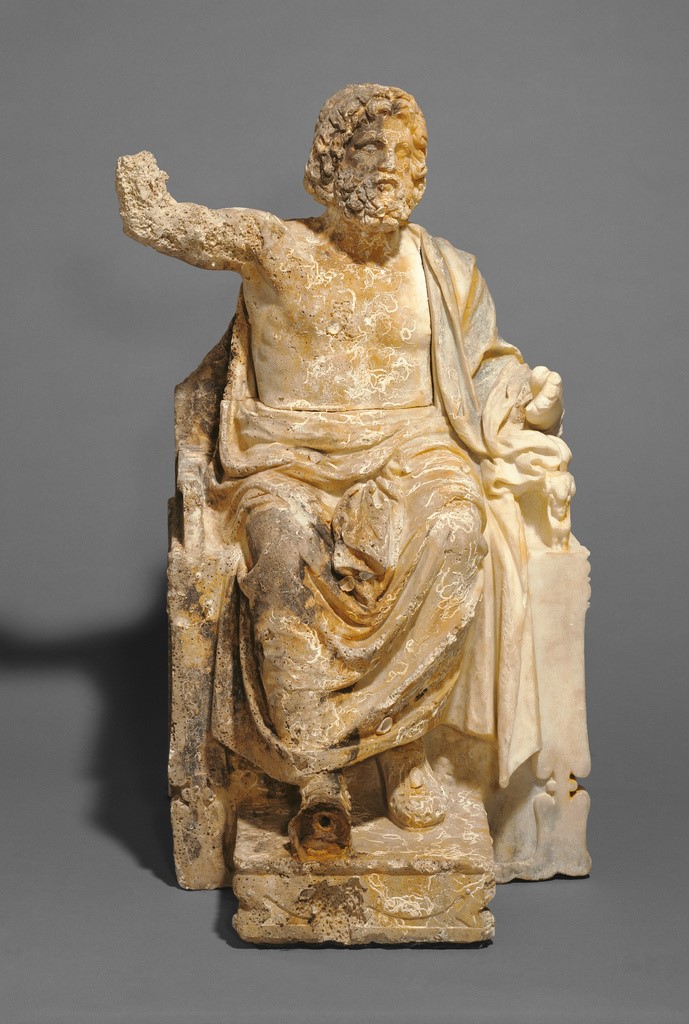
Why is Jesus shown with a light brown beard and long dark hair? The reason is not clear but it may have to do with Hellenistic and Roman preconceptions of what a male divine figure looks like. This image of Zeus on his throne, from the first century BCE in southern Italy, has a beard, robes, and is probably holding a now lost thunder bolt.
In the icon Jesus is not symmetrical. The eyes are quite different, and something is going on with his left cheek (on our right) that is not happening with his right (on his left). In his left hand he holds a bejewelled, gold covered book, and his right hand is raised in a blessing.
The difference in symmetry is more obvious below, where each side of the icon is matched with its mirror image.
The left shows the right side of Jesus mirrored, and it looks more or less like what we expect. Jesus has a long, narrow face often associated with intelligence. His eye is looking at the viewer. The eyebrow is finely curved. The other side is very different. The hair seems fuller, the ski tone darker, the eye is looking off to the side, the lips are fuller, the eyebrow more angular, and the beard is bushier. One commentator suggested that it was “hideous”, although that comment may have more to do with Eurocentric standards of beauty. What the two sides of the icon may represent are the two natures of Jesus, human and divine, with the human on Jesus’s left (our right) and the divine on his right (our left). Jesus’s left certainly looks more earthy, the kind of man one might find out harvesting olives. The man on the left (Jesus’s right side) looks more refined. Of course, we do not have the artist to question, so we will never really know.
Christ in Glory . . .in Coventry
Another image of Christ was erected in 1962, only this one was modern. The great mid-century British artist Graham Sutherland was commissioned to design a tapestry for the new Coventry Cathedral, the old medieval building having been destroyed by German bombers in the Second World War.
While very modern, the tapestry hearkens back to ancient predecessors. The tapestry, woven in one piece on a centuries old loom in France, is 23 metres tall (75 feet) and 12 metres wide (39 ft wide). Christ is seated on a throne, and the view is similar to that of the Pantocrator, only full bodied. The risen and ascended Christ is fully symmetrical, but bears the signs of crucifixion, especially on his feet.
While Sutherland contemplated a beardless Christ, he finally decided to go with tradition. Christ and his throne are in a mandorla, the vertical oval which is often seen in Orthodox icons, especially icons of the resurrection. The Holy Trinity is present, with the Holy Spirit in the form of a dove at the top, and the unrepresentable Father represented by rays of light. At the feet of Jesus is a lone human figure, presumably to stand for each one of us, huddling under his protection. Further down at the bottom, obscured by the altar cross, in grey, is the cross. Between the resurrection and cross is an image of the bread and wine of the eucharist, signifying the means by which we enter into his death and new life Sunday by Sunday.
Sutherland was told to include the four heavenly creatures from Revelation (and derived from Daniel). These are traditionally associated with the four evangelists – Mark the lion, Luke the bull, the angelic man with Matthew, and the eagle with John. Sutherland chose to simply see them as representatives of nature, and so tried for a naturalistic look. Thus it is called Christ in Glory in the Tetramorph (“tetramorph” = “four shapes”) and not Christ in Glory with the Four Evangelists. My own impression at first glance is that Jesus is seated in a kind of Cross of Lorraine, a version of the cross made famous by being the symbol of the Free French in the Second World War – but that may just be a happy accident.
This is a vision of a transcendent Christ. In our imagination, this is what the Son of Man seated in glory might look like.
The Most True Image of Christ
These are magnificent images. But, may I suggest to you, that these are not the most true images we might have of Jesus. Listen to the gospel again:
I was hungry and you gave me food, I was thirsty and you gave me something to drink, I was a stranger and you welcomed me, I was naked and you gave me clothing, I was sick and you took care of me, I was in prison and you visited me. . . . Truly I tell you, just as you did it to one of the least of these who are members of my family, you did it to me.” Matthew 25.35-36, 40.
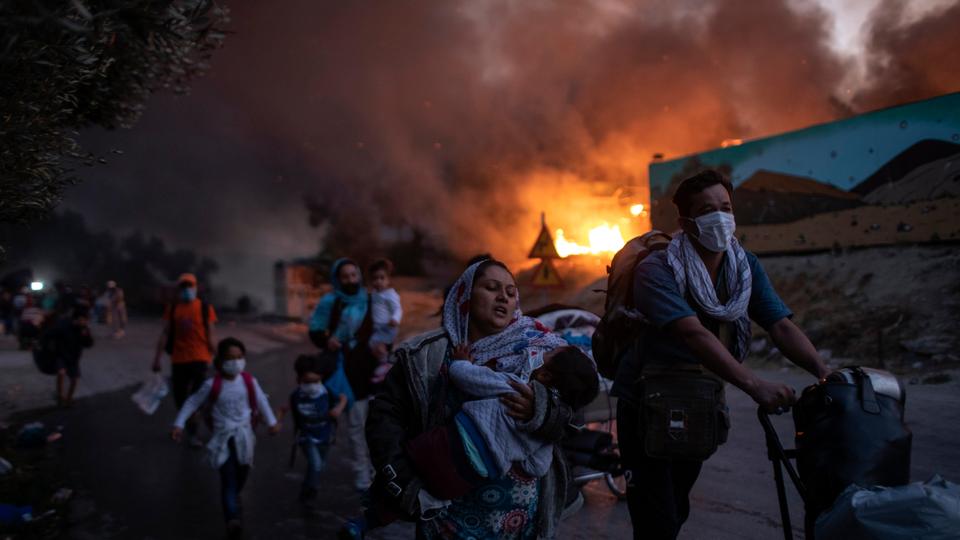
If we want to see Christ we need to look to those around us. We see Christ in the faces of those who look back at us from the Zoom screen. We see Christ in our neighbours as we wave at them from a safe distance in this lockdown. We especially see Jesus in those who are suffering, such as the refugees on Lesvos. They remain in limbo for years, not having any permanent solution to their refugee status, unwanted by the Greek government and many nations across the European Union. Their overcrowded camp has been burned down, and they continue to have only that which they can carry.
We can , of course, say that this is not our immediate responsibility, but the hyperbole of the story about the Great Judgment is that we are responsible for just these kind of people. If we wish to truly venerate Jesus we must do more than venerate an icon and light a candle, or meditate upon the meaning of a tapestry. These are important means for knowing God, just as we know God from nature, from the scriptures, from the traditions and liturgies of the church. But if we really want to know Jesus we must look for the hungry and thirsty, the stranger and the unclothed, the sick and those in prison. Some of us have been able to do this, and often it is the clergy who have the opportunity. But this is a ministry for all the baptised, part of the priesthood of all believers given to everyone in the Body of Christ.
In the portraits of Jesus in glory, whether in ancient icons or modern tapestries, we see Jesus as he is and what we will become in him, transformed and glorified. Let us also attend to the portraits of Christ in our sisters and brothers, so that we might be told, “Truly I tell you, just as you did it to one of the least of these who are members of my family, you did it to me.”
Very little of what I have written above is original. The information about the Sinai Christ Pantocrator icon is derived from lectures I attended in 2003 on the The Theology of the Icon by Prof. Nicholas Constas at Harvard (who became a monk on the Holy Mountain, Mount Athos, and is now Archimandrite Maximos Constas at Holy Cross Greek Orthodox School of Theology in Greater Boston). This is supplemented by information from Wikipedia. The Sutherland tapestry information comes from a pamphlet at the the Coventry Cathedral website, as well as Wikipedia.Any errors of fact are my own.
These are resources for the Sunday Next Before Advent: Christ the King (known as The Last Sunday after Pentecost: The Reign of Christ in the Anglican Church of Canada and The Last Sunday after Pentecost: Christ the King in The Episcopal Church in the USA) on Sunday, November 15, 2020. The resources are gathered from a variety of sources and, while assembled mainly for The Anglican Church of St Thomas the Apostle, Kefalas, on the island of Crete in Greece, others may find them useful.
A Note About the Feast of Christ the King
The observance of the Sunday before Advent as one about Christ the King is relatively new. It was instituted by the Pope in 1925 in the old Roman Calendar, and was initially observed on the Sunday before All Saints. In the revision of the calendar in 1969 it was moved to its current position. The Revised Common Lectionary is based on the Roman calendar, and from there it made its way into revised Anglican, Lutheran, and Protestant calendars in the 1970s and 1980s.
We continue in the lockdown here in Greece until at least the end of November. So, all our liturgies are online with Zoom. You can join us by clicking this link or entering this information in your Zoom app: Meeting ID: 850 4483 9927 Passcode: 010209.
You can also worship at home by yourself using the materials here, interspersing the readings, prayers, and recorded sermon with the hymns below.
Reflect
Last Advent I reflected on the Book of Isaiah, and one of the constant themes was the monarchy of Israel and Judah. One post that may help us as we head in to the Feast of Christ the King is this one.
I have not posted the sermon from last week, but I may get to it.
Pray
Collect Eternal Father, whose Son Jesus Christ ascended to the throne of heaven that he might rule over all things as Lord and King: keep the Church in the unity of the Spirit and in the bond of peace, and bring the whole created order to worship at his feet; who is alive and reigns with you, in the unity of the Holy Spirit, one God, now and for ever. Amen.
(or)
God the Father, help us to hear the call of Christ the King and to follow in his service, whose kingdom has no end; for he reigns with you and the Holy Spirit, one God, one glory. Amen.
Biddings I bid your prayers for the leaders and people of the nations; especially
Elizabeth, Queen of the United Kingdom of Great Britain and Northern Ireland, and her other realms, and also in her role as Governor of the Church of England;
and Boris Johnson, the Prime Minister of her British government;
In the European Union,
Ursula von der Leyen, President of the European Commission;
Charles Michel, President of the European Council; and
Josep Borrell, High Representative of the Union for Foreign Affairs & Security Policy;
for negotiations around Brexit;
for the peoples of the Republic of Ireland and Northern Ireland facing uncertainty over the fate of the Good Friday Accord;
the peoples of Belarus, Hong Kong, Nigeria, and Thailand as they continue to demonstrate for democracy and justice;
for the maintaining of peace between Azerbaijan and Armenia, and between Russia and Ukraine, and for a final, just resolution to their conflicts;
for the President-elect and peoples of the United States;
for a lessening of tensions between Turkey and Greece; and
for peace in Yemen, Libya, Afghanistan, Syria, and between Palestinians and Israelis.
I bid your prayers for the sick and suffering and all who minister to their needs;
remembering the nearly 16 million active cases of the novel coronavirus, and mourning with the families of the over 1.3 million who have died in the pandemic;
for the 1.4 million people in the UK with covid-19, the 52,147 who have died of it there, and the 65,000 active cases here in Greece, and the families of the over 1165 dead here;
and also remembering those ill with other diseases, and those whose operations have been postponed;
Intercession Let us with confidence present our prayers and supplications to the throne of grace.
We pray for all those in positions of power, that they may govern with wisdom and integrity, serving the needs of their people. May your reign come; Lord, hear our prayer.
We pray for the Church, the sign of your reign, that it may extend your welcome to people of every race and background. May your kingdom come; Lord, hear our prayer.
We pray for Christians of every denomination, that together we may come to understand the royal priesthood you bestowed on us in baptism. May your dominion come; Lord, hear our prayer.
We pray for those whose commitment to truth brings them into conflict with earthly powers, that they may have the courage to endure. May your rule come; Lord, hear our prayer.
We pray for this community of faith, that attentive to your word we may always worship in spirit and in truth. May your reign come; Lord, hear our prayer.
Here other intercessions may be offered.
Loving God, you have taught us that the power of the heart is greater than the power of wealth and might. Hear us as we pray for the fulfilment of your reign. We ask this through Jesus Christ our King; to him be glory and power for ever. Amen.
Sing
This coming Sunday in our online service we will sing the following hymns.
These are resources for the Second Sunday Before Advent (the Twenty-Fourth Sunday after Pentecost in the Anglican Church of Canada and The Episcopal Church in the USA) on Sunday, November 15, 2020. The resources are gathered from a variety of sources and, while assembled mainly for The Anglican Church of St Thomas the Apostle, Kefalas, on the island of Crete in Greece, others may find them useful.
All of Greece is in a lockdown until at least the end of November. As a result, all our liturgies will be online. You can join us by clicking this link or by joining by your Zoom app meeting ID: 850 4483 9927 with the passcode: 010209.
You can also worship at home by yourself using the materials here, interspersing the readings, prayers, and recorded sermon with the hymns below.
Reflect
I think I will be preaching on Zephaniah and the Day of the Lord, and relating that to our apocalyptic times (fun, wow, eh?). Last week’s sermon for Remembrance Sunday is here.
Pray
Collect Heavenly Father, whose blessed Son was revealed to destroy the works of the devil and to make us the children of God and heirs of eternal life: grant that we, having this hope, may purify ourselves even as he is pure; that when he shall appear in power and great glory we may be made like him in his eternal and glorious kingdom; where he is alive and reigns with you, in the unity of the Holy Spirit, one God, now and for ever. Amen.
(or)
Heavenly Lord, you long for the world’s salvation: stir us from apathy, restrain us from excess and revive in us new hope that all creation will one day be healed in Jesus Christ our Lord. Amen.
in the Anglican Communion, we remember the the Church of Ceylon and its bishops, The Rt Revd Dhiloraj Ranjit Canagasabey – Bishop of Colombo and The Rt Revd Keerthisiri Fernando – Bishop of Kurunegala; and
Elizabeth, Queen of the United Kingdom of Great Britain and Northern Ireland, and her other realms, and also in her role as Governor of the Church of England;
and Boris Johnson, the Prime Minister of her British government;
In the European Union,
Ursula von der Leyen, President of the European Commission;
Charles Michel, President of the European Council; and
Josep Borrell, High Representative of the Union for Foreign Affairs & Security Policy;
For negotiations around Brexit;
the peoples of Belarus, Hong Kong, Nigeria, and Thailand as they continue to demonstrate for democracy and justice;
for peace between Azerbaijan and Armenia, and between Russia and Ukraine;
for the peoples of the United States in the wake of the elections on Tuesday;
for a lessening of tensions between Turkey and Greece; and
for peace in Yemen, Libya, Afghanistan, Syria, and between Palestinians and Israelis.
I bid your prayers for the sick and suffering and all who minister to their needs;
remembering the over 14.6 million active cases of the novel coronavirus, and mourning with the families of the over 1.3 million who have died in the pandemic;
for the 1.2 million people in the UK with covid-19, the 50,900 who have died of it there, and the 55,600 active cases here in Greece, and the families of the almost 1000 dead here;
and also remembering those ill with other diseases, and those whose operations have been postponed;
Intercession We pray for the coming of God’s kingdom.
You sent your Son to bring good news to the poor, sight to the blind, freedom to captives and salvation to your people: anoint us with your Spirit; rouse us to work in his name. Father, by your Spirit bring in your kingdom.
Send us to bring help to the poor and freedom to the oppressed. Father, by your Spirit bring in your kingdom.
Send us to tell the world the good news of your healing love. Father, by your Spirit bring in your kingdom.
Send us to those who mourn, to bring joy and gladness instead of grief. Father, by your Spirit bring in your kingdom.
Send us to proclaim that the time is here for you to save your people. Father, by your Spirit bring in your kingdom.
Lord of the Church, hear our prayer, and make us one in mind and heart to serve you in Christ our Lord. Amen.
Sing
We will sing the four hymns following.
Here are also two versions of Dies Irae (“Day of Wrath”), which is a 13th century Latin Poem written by the Franciscan friar Thomas of Celano. It describes the Last Judgment on the Day of the Lord. It was originally sung with Gregorian Chant, but with the rise of orchestras and polyphonic choirs many great composers have tried their hand at it, including Mozart and Stravinsky, mainly because, up until the 1970s, it was a basic text of the Catholic requiem mass. Interestingly, the original theme is often quoted in many movie soundtracks, suggesting danger and doom.
In the version of Verdi’s Requiem the orchestra and choir are both massive, as is befitting the powerful message. And just look at that bass drum!
The version from Arvo Pärt is actually from his setting of Psalm 51, theMiserere. Traditionally Psalm 51 is a psalm of penitence, and most people know it from Allegri’s version, often sung on As Wednesday. Päert’s setting of the Miserere starts off with solo voices echoed by oboes and other wind instruments, sort of like Gregorian chant, but hesitant and relatively quiet. As the four soloists start singing together the tension builds, and then the fortissimo choir breaks in with the Dies Irae accompanied by the equally loud chamber orchestra and tubular bells; sticking the Dies Irae in the Miserere is a very unconventional but very dramatic move.
The soloists them seem to struggle back as they sing the rest of the penitential psalm, and it is resolved with a more comforting stanza from Dies Irae; whereas the first interpolation had a descending chorus, the concluding one ascends. The whole piece is here.
A Sermon Preached Online on Remembrance Sunday, November 8, 2020 With the People of The Anglican Church of St. Thomas the Apostle, Kefalas, Crete
But the souls of the righteous are in the hand of God, and no torment will ever touch them. In the eyes of the foolish they seemed to have died, and their departure was thought to be a disaster, and their going from us to be their destruction; but they are at peace. For though in the sight of others they were punished, their hope is full of immortality. Wisdom 3.1-4
In Britain, at 11 o’clock on 11 November 1919, the first two minute’s silence was used to mark the first anniversary of the Armistice. The idea came from Sir Percy Fitzpatrick who had served as high commissioner in South Africa during the First World War. He modelled the silence on a practice he had observed over there known as the ‘three minutes’ pause’:
“At noon each day, all work, all talk and all movement were suspended for three minutes that we might concentrate as one in thinking of those – the living and the dead – who had pledged and given themselves for all that we believe in.”
It seemed an ideal way to honour the dead, console the bereaved and recognise the sacrifices of servicemen and women. However, three minutes was deemed too long and on November 7 the plans for a two minute silence, to mark the armistice, were officially announced by King George V. The silence proved to be a great success. Almost everyone was keen to observe it and, particularly in the hustle and bustle of cities, the silence was deafening, as this report from Plymouth suggests:
“For two minutes after the hour of eleven had struck yesterday morning Plymouth stood inanimate with the nation… Two minutes before the hour the maroons boomed out their warning in one long drawn out note… As the hour struck a great silence swept of the town. People halted in their walks, chatter ceased as if by magic, traffic stopped and the rumbling note of industry stayed.”
The practice in the UK is now to observe the Two Minutes not only on Remembrance Sunday, but on November 11, at 11:00 am.
But we do it for a number of other reasons.
First, the silence is an inchoate moment of grief for the dead. Regardless of what we might think of the war goals set by politicians, the strategies of generals that led to victories and losses, there is sheer fact of the vast number of the dead. This is a moment simply to grieve the lives that have been lost, the potential that ended prematurely.
Second, we so rarely pause at anything in the world. This brief moment allows us to call into question the normal business of commerce, education, politics, and entertainment, and for a moment, to hallow human life.
Third, it is inclusive. Remembrance Day services tend to be very English, very “C of E”. A moment of silence is an opportunity for people of any faith or none to say a prayer, or to meditate on the losses.
Fourth, as Christians, we know that too often words fail us, but that God through the Holy Spirit prays within us. As Paul writes in Romans 8.26:
“Likewise, the Spirit helps us in our weakness; for we do not know how to pray as we ought, but that very Spirit intercedes with sighs too deep for words.”
Fifth, we believe that death is not the end, which is why the Two Minutes Silence is framed by Last Post and Reveille, symbolizing death and resurrection, respectively. In Christ we find the evidence of that new life. In Christ we hear see that “all things are being made new.” Through Christ we look forward to the time when “Death will be no more; mourning and crying and pain will be no more, for the first things have passed away.”
Sixth, in silence we meet God. The great mystics and monastics of past ages often sought the divine in wordless prayer, and these Two Minutes is but a brief taste of this, when the one who exceeds all our capacities meets us.
Finally, the silence we observe is an echo of the silence heard on November 11, 1918. It was strange for the soldiers and others at the front, after more than four years of war to have silence on the fronts. English poet Wilfred Owen called it the “monstrous anger ,of the guns.” Suddenly, it became so quiet you could hear a watch ticking.
We need more silences.
We need more silences like this – silence from the monstrosities of our day, opportunities to remember and to hope, times to find God. May you find them
May you remember in the silence – in the silences of Remembrance Sundays yet to come, or later today if you watch the broadcast from London or listen via internet radio, or on November 11th.
Since this was written and posted four days ago the Greek government has imposed a new lockdown, in the effort to “short circuit” the increasing infections of Covid-19. Therefore, we will not be meeting in person at The Tabernacle on Sunday, November 8.
You can also watch the Remembrance Sunday observances on British television and online; the broadcast starts around 12:30 PM EET (which is 10:30 GMT). A link with more information may be found at https://www.bbc.co.uk/programmes/m000pb0n .
The usual resources are below – links to readings, YouTube videos of the traditional Remembrance day hymns, a sermon on The Unknown Warrior I preached a few years ago, and prayers.
I have prepared a leaflet that can be printed on a single sheet and folded for anyone who wants to observe Remembrance Day on their own. It can be downloaded from here:
Thank you! I hope to see you on Zoom or to hear from you otherwise. Bruce +
These are resources for Remembrance Sunday, November 8, 2020. The resources are gathered from a variety of sources and, while assembled mainly for The Anglican Church of St Thomas the Apostle, Kefalas, on the island of Crete in Greece, others may find them useful.
A Note on Practices around Remembrance Day
The UK, Canada, and the United States all have similar different traditions around Remembrance Day.
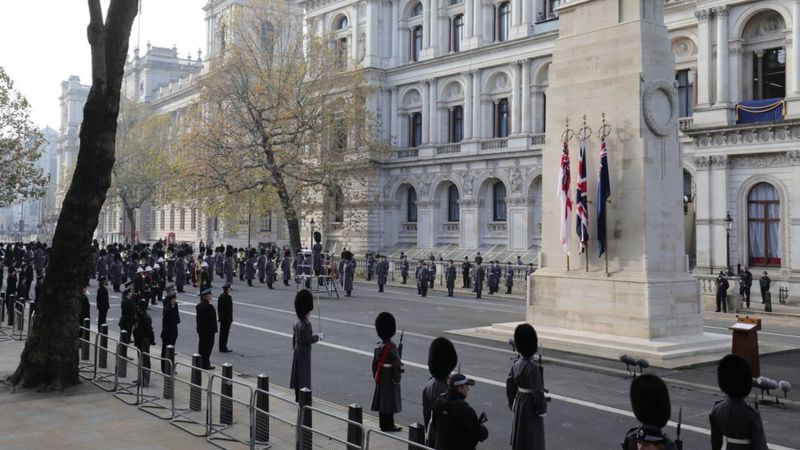
Her Majesty Queen Elizabeth lays a wreath at the Cenotaph in Whitehall, in 2010.
In the United Kingdom there is usually an short observance on November 11th at 11:00 am, involving two minutes silence. Buses and other vehicles will stop and in many shops and streets people will stop for the duration,and on the various media there is portrayed scenes of observance around the world. In some places wreaths are then laid. The main commemoration is usually on the Sunday closest to November 11, which is called Remembrance Sunday. That is when the National Service of Remembrance takes place at the Cenotaph in Whitehall, London.
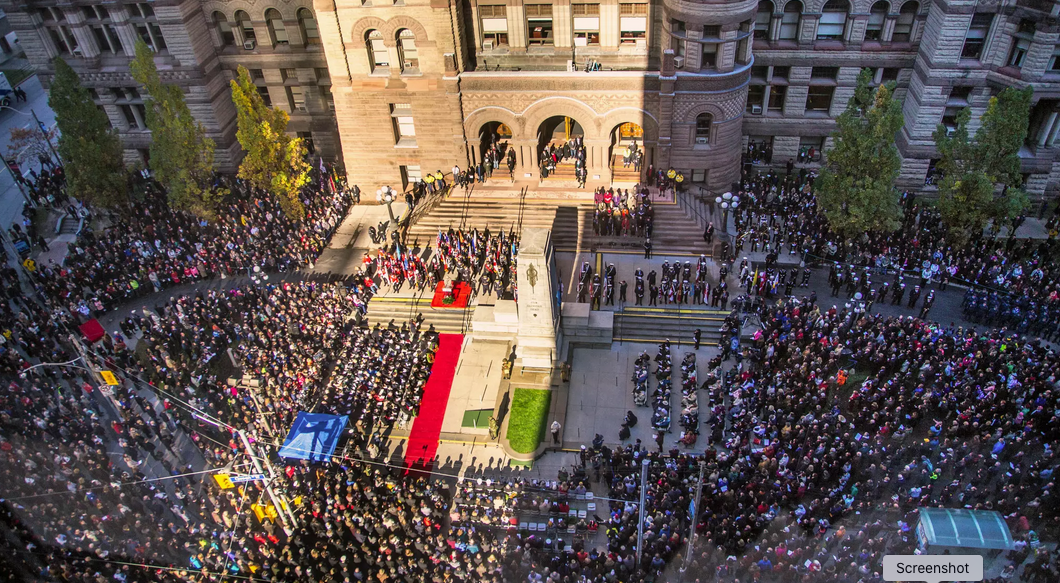
Remembrance Day in Toronto, Ontario in 2017
In Canada and other Commonwealth nations the main observances are all on November 11th. In Canada it is a federal holiday, as well as in six provinces and the three territories (not Ontario, Quebec, Nova Scotia, or Manitoba). Every community in Canada, no matter how small, seems to have a service of remembrance, and in the past decade numbers have only increased. Schools in the provinces where the day is not a provincial holiday typically have school assemblies. Some churches also have services on the Sunday closest to Remembrance Day which may or may not incorporate or replicate what happens on November 11th. Some have the Last Post, Two Minutes Silence, and Reveille, followed by wreath laying, others read off the names of person from the church that died in the war, and still others have readings and sermons relating to war and peace. In one church I served in we had an annual presentation from a local theatre school, which incorporated dramatic readings and music from the Second World War.
In the United States there already was a day for the commemoration of the dead, a federal holiday, namely Memorial Day, which began soon after the Civil War. It was formerly observed on May 30, but since 1970 it is on the last Monday of May (which often coincides with the Victoria Day holiday in Canada). The observance is marked by people going to cemeteries and decorating the graves with flags and wreaths of those who died while in the armed forces. It is also marked by parades and, rather incongruosly, sales in retail outlets. The observance of the Armistace in the US was transformed in 1954 to Veterans Day, and which honours all who have served in the US Armed Forces.
In Greece the major commemorations of the war dead are on March 25, Independence Day, which is the day that the War of Independence began in 1821, and October 28, Ohi Day, which remembers the one word response (Οχι, or “No”) supposedly uttered by Prime Minister Metaxas in 1941, when the Mussolini demanded that the Greeks allow Italian troops to occupy parts of the country. There are also local observances, such as the week long commemorations of the Battle of Crete held every year in late May. In Athens on Remembrance Sunday there is a gathering at the Phaleron War Cemetery, which is administered by Commonwealth War Graves. That service is officiated at by the chaplain of St Paul’s, Athens, and the service is well attended by the diplomatic corps in the capital and British, Greek, and Commonwealth citizens. Here on Crete we do the same annually at the Suda Bay War Cemetery, in a commemoration organized by a local committee.
Well, except this year. Typically we get several hundred people attending at Suda Bay War Cemetery, but with the pandemic on, this cannot be allowed to happen. As a result the organising committee (of which I am a part) encourages people who would normally attend to do a private observation of two minutes silence, and perhaps to visit the cemetery on Sunday or on Wednesday, November 11th. Wreaths will be laid by designated individuals at the Cross of Honour in the cemetery, but not at any one time.
Meanwhile, we at St Thomas, Kefalas will have a Sunday service of Holy Communion as normal, but with an observance of remembrance at the beginning. So as to have the silence at 11:00 am, we ask that people arrive no later than ten minutes before.
I preached this sermon on a Remembrance Sunday in Canada. I will post this Sunday’s sermon soon after I preach it. Last week’s sermon for All Saints can be found by clicking here.
A Collect Ever-living God, we remember those whom you have gathered from the storm of war into the peace of your presence; may that same peace calm our fears, bring justice to all peoples and establish harmony among the nations, through Jesus Christ our Lord. AllAmen.
An Intercession Let us pray for all who suffer as a result of conflict, and ask that God may give us peace: for the service men and women who have died in the violence of war, each one remembered by and known to God; may God give peace. AllGod give peace.
For those who love them in death as in life, offering the distress of our grief and the sadness of our loss; may God give peace. AllGod give peace.
For all members of the armed forces who are in danger this day, remembering family, friends and all who pray for their safe return; may God give peace. AllGod give peace.
For civilian women, children and men whose lives are disfigured by war or terror, calling to mind in penitence the anger and hatreds of humanity; may God give peace. AllGod give peace.
For peacemakers and peacekeepers, who seek to keep this world secure and free; may God give peace. AllGod give peace.
For all who bear the burden and privilege of leadership, political, military and religious; asking for gifts of wisdom and resolve in the search for reconciliation and peace; may God give peace. AllGod give peace.
O God of truth and justice, we hold before you those whose memory we cherish, and those whose names we will never know. Help us to lift our eyes above the torment of this broken world, and grant us the grace to pray for those who wish us harm. As we honour the past, may we put our faith in your future; for you are the source of life and hope, now and for ever. AllAmen.
for Fr Leonard Doolan, the Archbishop of Canterbury’s Apokrisiarios to the Archbishop of Athens and All Greece; and
for the Ministry Team: William Gulliford (Diocesan Director of Ordinands or “DDO”); Ulla Monberg (Director of Ministerial Development); and all those training for ordained ministry.
I bid your prayers for the leaders and people of the nations; especially
Elizabeth, Queen of the United Kingdom of Great Britain and Northern Ireland, and her other realms, and also in her role as Governor of the Church of England;
and Boris Johnson, the Prime Minister of her British government;
In the European Union,
Ursula von der Leyen, President of the European Commission;
Charles Michel, President of the European Council; and
Josep Borrell, High Representative of the Union for Foreign Affairs & Security Policy;
For negotiations around Brexit;
the peoples of Belarus, Hong Kong, Nigeria, and Thailand as they continue to demonstrate for democracy and justice;
for peace between Azerbaijan and Armenia, and between Russia and Ukraine;
for the peoples of the United States in the wake of the elections on Tuesday;
for a lessening of tensions between Turkey and Greece; and
for peace in Yemen, Libya, Afghanistan, Syria, and between Palestinians and Israelis.
I bid your prayers for the sick and suffering and all who minister to their needs;
remembering the over 12 million active cases of the novel coronavirus, and mourning with the families of the over 1.2 million who have died in the pandemic;
for the one million people in the UK with covid-19, the 47,000 who have died of it there, and the 31,000 active cases here in Greece, and the families of the over 640 dead here;
and also remembering those ill with other diseases, and those whose operations have been postponed;
We will be singing the Royal Anthem and the Greek National Anthem. In case you’ve forgotten them, here they are.
The Royal Anthem
God save our gracious Queen! Long live our noble Queen! God save the Queen! Send her victorious, Happy and glorious, Long to reign over us: God save the Queen!
The National Anthem of Greece
Ὕμνος εἰς τὴν Ἐλευθερίαν: Hymn of Liberty
Σε γνωρίζω από την κόψη Του σπαθιού την τρομερή, Σε γνωρίζω από την όψη, Που με βιά μετράει τη γη.
Απ’ τα κόκκαλα βγαλμένη Των Ελλήνων τα ιερά, Και σαν πρώτα ανδρειωμένη, Χαίρε, ω χαίρε, ελευθεριά!
Και σαν πρώτα ανδρειωμένη, Χαίρε, ω χαίρε, ελευθεριά!
Και σαν πρώτα ανδρειωμένη, Χαίρε, ω χαίρε, ελευθεριά!
Se gnorízo apó tin kópsi Tou spathioú tin tromerí, Se gnorízo apó tin ópsi, Pou me viá metráei ti gi.
Ap’ ta kókkala vgalméni Ton Ellínon ta ierá, Kai san próta andreioméni, Chaíre, o chaíre, eleftheriá!
Kai san próta andreioméni, Chaíre, o chaíre, eleftheriá!
Kai san próta andreioméni, Chaíre, o chaíre, eleftheriá!
We will not be singing the National Anthem of Canada this year, but we did so last year when the Canadian Ambassador to Greece came to Suda Bay to lay a wreath on behalf of the Government of Canada and all Canadians. Here is a version in eleven languages spoken in Canada.
We shall also sing some hymns traditionally sung at these times.
A Sermon Preached on the Feast of All Saints at The Anglican Church of St. Thomas the Apostle, Kefalas, Crete on November 1st, 2020 11:00 am
Blessed are the poor in spirit, for theirs is the kingdom of heaven. Matthew 5.11
Who is a saint?
A saint is any person who knows they need God. Knowledge of that need, understanding that God is not an option but an absolute necessity – that is what makes them holy. It means that God can work within them and through them.
I say this because this is the meaning of the first words Jesus speaks in Chapter 5 of the Gospel according to Matthew, the beginning of the Sermon on the Mount.
Blessed are the poor in spirit, for theirs is the kingdom of heaven.
Another translation (W. F. Albright & C.S. Mann, Matthew: A New Translation with Introduction and Commentary, Anchor Bible Volume 26 (New York: Doubleday, 1971), pp.45-46) puts it this way
Fortunate are the humble in spirit, for the the kingdom of heaven is made up of them.
Let us unpack this.
“Blessed” in this passage is the Greek word Μακάριοι – like the Greek name Makarios. We associate blessing with things done by clergy in churches, but that is not its original meaning. What it meant in Classical times through to the 1st century was the state of gods as opposed to us humans. Normally we humans live nasty, brutish, and short lives, filled with toil and sorrow; the live of the gods, on the other hand, was eternal, filled with blessing and power (or so the Greeks thought). So, when Jesus is saying “Blessed are the poor in spirit” he is saying “the ones who know they are humble and lacking in spirit, in the breath of God, are fortunate.” When he says that “theirs is the kingdom of heaven” he is saying that the kingdom of God will be made up of people like that – people who know they need God, who seek God’s spirit, and who become filled with it.
The rest of the beatitudes fill out this description. People who know they need God are:
meek;
they hunger and thirst for righteousness;
they are merciful;
they are pure in heart;
they are peacemakers, people of reconciliation;
they are aware of the suffering of creation, and so they mourn – the the death of a friend, or a family member, or those who they do not even know; and
because they are all these things they are often reviled and persecuted.
I once preached on this passage arguing that this is as much a description of Jesus, the original “Holy One”, as it is of those who heard the Sermon on the Mount. At the end of the passage it is clear that Jesus is addressing his listeners, when he addresses them directly as “you”. Inasmuch as hear his words as being addressed to us, then, we are all saints, too.
By this is do not mean that we are necessarily wonderful people, as much as so many of you are. The reality is that we are all sinners in need of some redemption and transformation. That is why we are here.
I do not mean that any of us here are particularly pious, although some of us may be more prayerful than others. The reality is that we can all grow in prayer and spirit, and that we need to pray with each other as the Body of Christ. That is why we are here.
I do not mean that as saints we are here because the church needs us, but rather that we need the church. We need each other to become more like Jesus Christ. That is why we are here.
By calling ourselves saints we do not mean that the world needs us, but rather that we need to serve the world to become the creatures that God made us to be. That is why we are here.
Saints on the Periphery
In commemorating this Feast of All Saints, then, we remember the greats of old. In most cases they are merely ordinary Christians in extraordinary situations. Let me mention some people who we may call saints, but of whom you may not have heard.
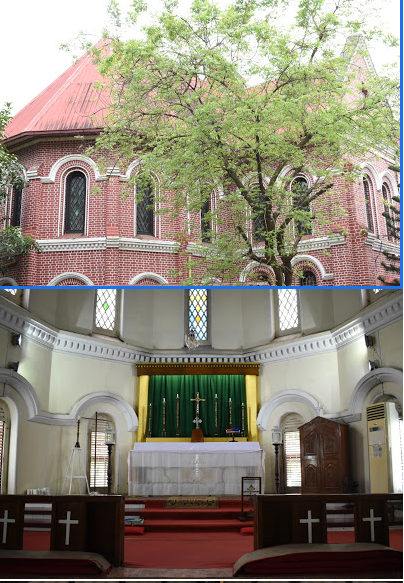
St Michael’s Church, Kyimyindaing, at which Daw Pwa Sein and her companions would have worshipped.
First, there is the Burmese Martyrs of 1942: Ma Pwa Sein and her five companions at the S. Mary’s Teachers’ Training School, Kemmendine in what was then Japanese occupied Burma. Stephen Reynolds in the book For All the Saints (Toronto: Anglican Book Centre, 1994) includes them as some of the “Martyrs of the Twentieth Century”, commemorated in some Anglican calendars on April 24. He writes (and I edit somewhat):
Pwa Sein was the daughter of a devout and highly respected Buddhist; while still in her teens she converted to the Christian faith and became an Anglican. She eventually rose to the position of headmistress of the Anglican mission school at Kemmendine (now called Kyimyindaing). Now, Burma then (and Myanmar now) is a complex pace; there are some 135 different ethnic groups among its over 50 million people. When Burma was invaded by the Japanese in 1941, she and her school evacuated to Nyaaugn-ngu, a village in the Irrawaddy delta, west of Rangoon (now called Yangon). The inhabitants of the village were Karen, a minority tribe often despised and discriminated against by many among the majority Burmans in Burma then and now. On June 5, 1942, this village was raided by brigands posing as the Burmese Independence Army. The raiders began to round up the Karen who were Christians. Though Burmese herself, Pwa Sein chose to stand with the threatened Karen;several others joined her. The brigands singled out Pwa Sein and her companions; they were given a few minutes to pray. Then the headmistress and five other teachers from Kemmendine – Ma Thit, Esther Sein Thit, Ma E Nyein, Ma Tin Shwe, and Hilda – were hacked to death. Altogether sixty Christians were killed in this Delta massacre, most of them Karen.
I had the privilege of going to Myanmar in 2010; the Diocese of British Columbia at the time was in a longtime relationship with the Church of the Province of Myanmar. I did not make my way out of Yangon into the Irrawaddy Delta, although I did fly north to Myitkyina, where the Kachin peoples live. It was striking to see how strong the faith of the Anglicans in Myanmar was. Despite political oppression, the loss of their schools (other than the theological college), the expulsion of foreign Anglicans, and being a minority, they were enthusiastic and positive about Jesus in their lives. The faith shown by the Burmese Martyrs continues today.
Li Tim-Oi, her mother, Bishop Mok, her father, and Archdeacon Lee Kow Yan, after her ordination as Deacon at St John’s Cathedral Hong Kong, Ascension Day 22 May 1941
Second, there is Florence Li Tim-Oi. As described in the appendix to For All the Saints:
At her birth in 1907 Li Tim-Oi’s father called her “Much Beloved.” When she was baptized as a student, Tim-Oi chose the name Florence from “The Lady of the Lamp.” Florence is celebrated worldwide for the witness to Christ that she lived out as the first female priest in the Anglican Communion. In 1931, at the ordination of a deaconess, she heard and responded to the call to ministry. She was made deacon in 1941, and was given charge of the Anglican congregation in the Portuguese colony of Macao, thronged with refugees from war-torn China.
When a priest could no longer travel from Japanese-occupied territory to preside for her at the eucharist, the Bishop of Hong Kong asked her to meet him in Free China, where on January 25, 1944 he ordained her “a priest in the Church of God.” To defuse controversy, in 1946 she surrendered her priest’s license, but not her Holy Orders, the knowledge of which carried her through Maoist persecution. For the next 39 years, she served faithfully under very difficult circumstances, particularly after the Communists took over mainland China. In 1971, when two more women were ordained in the Diocese of Hong Kong, she was recognised as a priest, although she remained in Communist China. In 1983, arrangements were made for her to come to Canada, where she was appointed as an honorary assistant at St. John’s Chinese congregation and St.Matthew’s parish in Toronto.
The Anglican Church of Canada had in 1976 approved the ordination of women to the priesthood, and so, in 1984, the 40th anniversary of her ordination, Ms. Li was, with great joy and thanksgiving, licensed as a priest. This event was celebrated not only in Canada but also at Westminster Abbey and at Sheffield in England, even though the Church of England had not yet approved the ordination of women.
From that date until her death in 1992, she exercised her priesthood with such faithfulness and quiet dignity that she won tremendous respect for herself and increasing support for other women seeking ordination. She was awarded Doctorates of Divinity by General Theological Seminary, New York, and Trinity College, Toronto.
The very quality of Ms. Li’s ministry in China and in Canada, and the grace with which she exercised her priesthood, helped convince many people throughout the Communion and beyond that the Holy Spirit was certainly working in and through women priests. Her contribution to the Church far exceeded the expectations of those involved in her ordination in 1944. She died on February 26, 1992.
I had the privilege of attending a Eucharist some thirty-six years ago at Trinity College, Toronto where she presided. She did not feel comfortable preaching in English, but she was fine with the written text of the liturgy. I count myself blessed to have been in the presence of such an historical personage.
Who Are You Calling a Saint?
I do not expect any of these women would have described themselves as saints, but we in the church can dare to call them that because of the example of their lives. Because of war, Daw Pwa Sein and the other Burmese Martyrs were put in the position of being executed for their faith. Again, because of war, Bishop Ronald Hall felt the necessity or ordaining Forence Li Tim-Oi, so that the Anglican Christians in Macau could have Holy Communion. They were ordinary Christians caught up in extraordinary events.
And what of us? I suspect none of us would be bold enough to call ourselves saints; our lives are too mundane, our faith falls short, and our accomplishments quite limited. Nevertheless, inasmuch as we know that we need God, that we invite God in Christ into our lives, and manifest good works as fruit of the Holy Spirit, we are saints, too. May we all be inspired by their examples, and so become like Jesus, the one who, though without sin and being the Word of God in human form, nevertheless sought the fullness of the Holy Spirit and was obedient to the Source of all being, and thus became a servant of all.
Clipart of some saints. From left to right: Peter, Catherine of Alexandria, Kevin of Glendalough (???), Mary of Egypt, and Francis (???).
These are resources for the Feast of All Saints on Sunday, November 1, 2020. The resources are gathered from a variety of sources and, while assembled mainly for The Anglican Church of St Thomas the Apostle, Kefalas, on the island of Crete in Greece, others may find them useful.
We will meet in the Tabernacle of The Anglican Church of St Thomas the Apostle, Kefalas. So please join us, if you can, at 11:00 am this Sunday, November 1, 2020.
If you cannot join in person you can participate on Zoom. Click this link, or enter the information at right into your Zoom app: Meeting ID: 850 4483 9927 Password: 010209. My thanks to Jan Lovell for being the Zoom host last week.
Of course, you can also throw your own service together with the materials on this page – read the readings, pray the prayers, and sing with the hymns.
Sunday, November 8 is the Sunday closest to November 11, and so it is Remembrance Sunday. Normally we would gather down at the Commonwealth War Graves Cemetery in Souda, but the group of us who plan the ceremony, considering the pandemic and ongoing restrictions, have decided that we simply cannot gather there as if this was an ordinary year. As a congregation we will instead have a simple Act of Remembrance at the Tabernacle that Sunday; please arrive no later than ten minutes before 11:00 am, so that we can observe two minutes silence precisely at the eleventh hour.
Reflect
I’m still not sure what I will be preaching on – probably the Beatitudes, but we shall see. In the meantime here is a sermon from 2009 by Rowan Williams, the former Archbishop of Canterbury, now the Master of Magdalene College, Cambridge, and Baron Williams of Oystermouth.
Pray
Collect Almighty God, you have knit together your elect in one communion and fellowship in the mystical body of your Son Christ our Lord: grant us grace so to follow your blessed saints in all virtuous and godly living that we may come to those inexpressible joys that you have prepared for those who truly love you; through Jesus Christ your Son our Lord, who is alive and reigns with you, in the unity of the Holy Spirit, one God, now and for ever. Amen.
(or)
God of holiness, your glory is proclaimed in every age: as we rejoice in the faith of your saints, inspire us to follow their example with boldness and joy; through Jesus Christ our Lord. Amen.
in the Anglican Communion, we remember the Church of the Province of West Africa and The Most Revd Dr Jonathan Bau-Bau Bonaparte Hart, serving as the Primate & Metropolitan, Church of the Province of West Africa and as Archbishop of the Internal province of West Africa and Bishop of Liberia; and
Elizabeth, Queen of the United Kingdom of Great Britain and Northern Ireland, and her other realms, and also in her role as Governor of the Church of England;
and Boris Johnson, the Prime Minister of her British government;
In the European Union,
Ursula von der Leyen, President of the European Commission;
Charles Michel, President of the European Council; and
Josep Borrell, High Representative of the Union for Foreign Affairs & Security Policy;
For negotiations around Brexit;
the peoples of Belarus, Hong Kong, Nigeria, and Thailand as they continue to demonstrate for democracy and justice;
for peace between Azerbaijan and Armenia, and between Russia and Ukraine;
for the peoples of the United States as they enter the last week before their elections;
for a lessening of tensions between Turkey and Greece; and
for peace in Yemen, Libya, Afghanistan, Syria, and between Palestinians and Israelis.
I bid your prayers for the sick and suffering and all who minister to their needs;
remembering the over 11 million active cases of the novel coronavirus, and mourning with the families of the almost 1.2 million who have died in the pandemic;
for the almost one million people in the UK with covid-19, the 46,000 who have died of it there, and the 25,000 active cases here in Greece, and the families of the over 615 dead here;
and also remembering those ill with other diseases, and those whose operations have been postponed;
Intercession United in the company of all the faithful and looking for the coming of the kingdom, let us offer our prayers to God, the source of all life and holiness.
Merciful Lord, strengthen all Christian people by your Holy Spirit, that we may live as a royal priesthood and a holy nation to the praise of Jesus Christ our Saviour. Lord, in your mercy Allhear our prayer.
Bless Robert and David our bishops and all ministers of your Church, that by faithful proclamation of your word we may be built on the foundation of the apostles and prophets into a holy temple in the Lord. Lord, in your mercy Allhear our prayer.
Empower us by the gift of your holy and life-giving Spirit, that we may be transformed into the likeness of Christ from glory to glory. Lord, in your mercy Allhear our prayer.
Give to the world and its peoples the peace that comes from above, that they may find Christ’s way of freedom and life. Lord, in your mercy Allhear our prayer.
Hold in your embrace all who witness to your love in the service of the poor and needy; all who minister to the sick and dying; and all who bring light to those in darkness. Lord, in your mercy Allhear our prayer.
Touch and heal all those whose lives are scarred by sin or disfigured by pain, that, raised from death to life in Christ, their sorrow may be turned to eternal joy. Lord, in your mercy Allhear our prayer.
Remember in your mercy all those gone before us who have been well-pleasing to you from eternity; preserve in your faith your servants on earth, guide us to your kingdom and grant us your peace at all times. Lord in your mercy AllHear our prayer.
Hasten the day when many will come from east and west, from north and south, and sit at table in your kingdom. Lord in your mercy AllHear our prayer.
We give you thanks for the whole company of your saints in glory, with whom in fellowship we join our prayers and praises; by your grace may we, like them, be made perfect in your love.
Blessing and glory and wisdom, thanksgiving and honour and power, be to our God for ever and ever. AllAmen.










 The Island Parson