These are resources for a Festival of Nine Lessons and Carols, which we will have on the Fourth Sunday of Advent, December 20, 2020 at 11:00 am. The resources are gathered from a variety of sources and, while assembled mainly for The Anglican Church of St Thomas the Apostle, Kefalas, on the island of Crete in Greece, others may find them useful.
This coming Sunday at 11:00 am we can meet online only, in accordance with the government restrictions. We will still have our annual Festival of Lessons and Carols, though, just online. You can join us by clicking this link or by entering the following into your Zoom application: Meeting ID: 850 4483 9927 Passcode: 010209. The order of service is below, and can also be downloaded (including the lyrics of the hymns as sung in the videos) as a PDF from here:
We will have three services of Holy Communion on Christmas Day at the Tabernacle of St Thomas, Kefalas:
9:15 am Said Book of Common Prayer Holy Communion 10:00 Said Common Worship Holy Communion 11:00 Said Common Worship Holy Communion with Hymns (also on Zoom)
If you wish to attend you must register in advance. To register please contact Pat Worsley by phone at +30 28257 71001 or by email at peter.worsley@btinternet.com; registration will be on a first come, first served basis. As of Thursday evening, December 16, we have two spaces available at the 9.15 service , one at the 10.00am service and the 11.00am service is full. You can attend the 11:00 am virtually on Zoom, and the Zoom link above will get you there.
Read & Reflect
Most parishes will not be having services of Lessons and Carols, but instead will be using the readings appointed for the Fourth Sunday of Advent, which can be found here. If you would like to listen to a sermon on the readings for Advent IV, Fr Leonard Doolan of St Paul’s Anglican Church in Athens has sent us a prerecorded one here:
As we are holding our service of Lessons and Carols for Christmas, our readings are below.
A Festival of Nine Lessons and Carols for Christmas
Opening Hymn: Once in Royal David’s City
Welcome, Bidding, and the Lord’s Prayer
Hymn: Joy to the World
The First Lesson
Genesis 3.8-14: The Disobedience of Adam and Eve.
Following the lesson (and after every lesson) the reader will say, “This is the word of the Lord” Please respond, “Thanks be to God.”
Hymn: God Rest You Merry, Gentlemen
The Second Lesson
Genesis 22.1-19: God tests Abraham, and promises that in him all the nations of the earth shall be blessed.
Hymn: The First Nowell
The Third Lesson
Isaiah 9.2,6,7: Isaiah foresees the coming Messiah.
Hymn: Unto Us a Boy is Born
The Fourth Lesson
Isaiah 11.1-9 – The prophecy of the Messiah’s kingdom of peace
Hymn: O Little Town of Bethlehem
The Fifth Lesson
Isaiah 60.1-6, 19 – The coming of the glory of the Lord
Hymn: Hark! The Herald Angels Sing
The Sixth Lesson
Matthew 1.18-23: The birth of Emmanuel.
Hymn: Away in a Manger
The Seventh Lesson
Luke 2.8-16: Jesus is born in Bethlehem.
Hymn: While Shepherds Watch Their Flocks By Night
The Eighth Lesson
Matthew 2.1-11: Wise men come from the east seeking Jesus.
Hymn 740: We Three Kings
The Ninth Lesson (Please stand, as you are able)
John 1.1-14: The Incarnation of the Word of God
Hymn: Adeste Fideles (O Come, All Ye Faithful)
The Blessing
May the Father, who has loved the eternal Son from before the foundation of the world, shed that love upon you his children. Amen.
May Christ, who by his incarnation gathered into one things earthly and heavenly, fill you with joy and peace. Amen.
May the Holy Spirit, by whose overshadowing Mary became the God-bearer, give you grace to carry the good news of Christ. Amen.
And the blessing of God, Father, Son, and Holy Spirit be amongst you, and remain with you always. Amen.
This Advent, in the Year of the Great Pandemic 2020, it seems appropriate to look at The Apocalypse – that is, The Revelation of John. This is the twentieth of twenty-six short reflections.
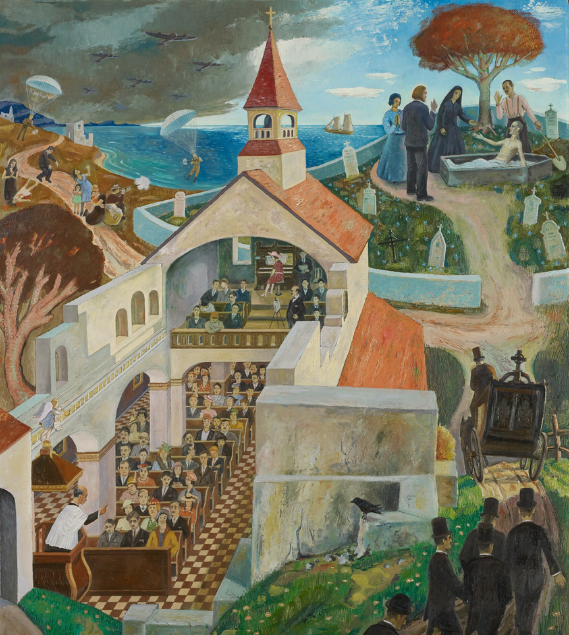
Jean Paul Lemieux (1904-1990) Lazare (Lazarus), 1941, from the Art Gallery of Ontario
How do the writings of Paul relate to the Revelation of John the Divine?
The answer is that in they are similar in their broad strokes, but they differ in details. Let’s start with Paul in First Corinthians.
In chapter 15 of Paul’s First Letter to the Corinthians (which is actually his second letter, at least – we just don’t have the earlier correspondence) Paul castigates some of the members of the church in Corinth for not believing in the resurrection of the dead. By this he means the general resurrection of all who have died, but he adds some details (capital letters added):
20 But in fact Christ has been raised from the dead, the first fruits of those who have died. .23 But each in his own order:
A Christ the first fruits, B then at his coming those who belong to Christ. E 24 Then comes the end, when he hands over the kingdom to God the Father, C after he has destroyed every ruler and every authority and power. 25 For he must reign until he has put all his enemies under his feet. D 26 The last enemy to be destroyed is death. 27 For “God has put all things in subjection under his feet.” F 28b so that God may be all in all.
We have here a structure of time. Christ has been raised from the dead (A) – that has already happened. Paul believes that Jesus will return, so that is the next step, or B. When Jesus comes the people “who belong to Christ” are raised. That has not happened yet, so the Corinthians would have known that they lived between A and B. The phrasing of the clauses in verse 24 can be confusing, but it seems that the sequence is that after Jesus comes (B) he judges and destroys “every ruler and every authority and power.” These are his enemies, and are not merely human powers but also the demonic powers. The last one is “death.” (D) What happens when death is defeated? All the dead are raised – the ones who were not raised when Jesus first came in glory – so this completes the general resurrection. Then the Son hands his kingdom over to the Father (E) and, in the obscure mystical language of verse 28, God is “all in all.”
In Revelation Jesus has already been raised from the dead. He has won the victory already, but it has not yet been implemented on earth. Where John differs from Paul is in the detailing of how Christ destroys “all his enemies”. And so we get the seven seals and the seven trumpets, the two beasts. Also, there appear to be two stages in the defeat. In the conclusion of chapter 19 the beast (a returned Nero) and the false prophet are thrown into the lake of fire, Jesus reigns, and you’d think that would be the end of things. However, in chapter 20 the dragon, Satan, is thrown into a pit for a thousand years, and Christ reigns with his saints during that time. Then Satan and his minions arise, besieges the beloved city (the New Jerusalem, not yet described), but fire consumes them, and then Satan gets tossed into the lake. Death and Hades are defeated, thrown into the lake of fire with the others, and the dead arise to be judged.
The structure of time in Revelation 19-20 (and other chapters) is more than a little confusing. What I think should be clear is that both Paul and John had an expectation that the end involved a battle between Christ and evil, and that there would be two resurrections.
This might strike us as a bit bizarre – Paul the Apostle and John the Divine both appear to be eschatological freaks. What we are to do with this is what I will examine tomorrow.
This Advent, in the Year of the Great Pandemic 2020, it seems appropriate to look at The Apocalypse – that is, The Revelation of John. This is the nineteenth of twenty-six short reflections.
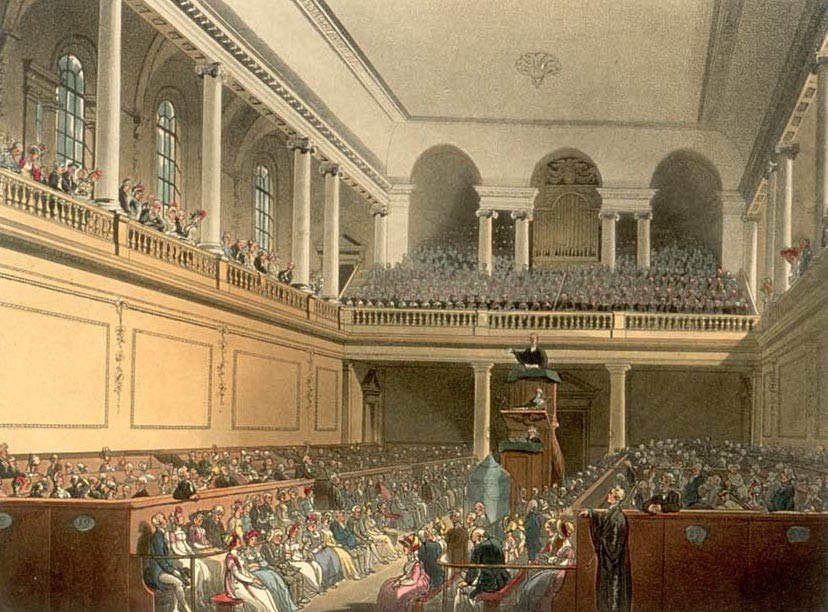
The Foundling Hospital Chapel, in London, where Messiah was regularly performed from 1750 to 1759 under the direction of Handel himself, and subsequently, after his death, from the manuscript score which the composer bequeathed to the Hospital.
Yesterday I said I would look at how G. F. Handel (1685-1759) uses Revelation in his Messiah. I wrote that thinking that there were all kinds of passages from the Apocalypse in there, but when I actually looked at the libretto I found that, actually, there are only two of the 53 movements (recitatives, aria, and chorales) in it that are actually Revelation.
But look where they are, and what they are! The Messiah is divided into three parts; parts two and three both conclude with lines from Revelation, namely the Hallelujah Chorus, and Worthy is the Lamb.
44. Chorus Hallelujah! for the Lord God Omnipotent reigneth. (Revelation 19 : 6) The kingdom of this world is become the kingdom of our Lord, and of His Christ; and He shall reign for ever and ever. (Revelation 11 : 15) King of Kings, and Lord of Lords. (Revelation 19 : 16) Hallelujah!
53. Chorus Worthy is the Lamb that was slain, and hath redeemed us to God by His blood, to receive power, and riches, and wisdom, and strength, and honour, and glory, and blessing. Blessing and honour, glory and power, be unto Him that sitteth upon the throne, and unto the Lamb, for ever and ever. Amen. (Revelation 5 : 12-13)
The videos above are both recent, the first being from a Austrian staged production in Vienna in 2009, and the latter from a concert in King’s College Chapel Cambridge sung by VOCES8 (I’m not sure how to pronounce that, either), with the VOCES8 Scholars and Apollo5, and the instruments of the Academy of Ancient Music.
Handel did not choose the texts, but rather, set a text to music. The English gentleman Charles Jennens (1700-1773) had previously worked with Handel, having supplied a libretto for Saul and possibly Israel in Egypt. Astonishingly, Handel set the whole thing to music in just twenty-four days – but apparently the musician always wrote that fast. That said, the speed concerned Jennens (pronounced “Jennings”) so much that he wrote Handel about the quality of the writing, and did not hesitate to suggest improvements. This led to a breach between the two for a short period, which was eventually patched up.
Jennens was an odd duck. While an active member of the Church of England, he was part of the Nonjurors, a group which felt that the Glorious Revolution of 1689 was nothing less than a repudiation of the oaths the political and ecclesiastical leadership had sworn to James II. Thus, despite the Stuarts being Catholic and pretenders to the thrones of Great Britain and Ireland, the Nonjurors supported them, feeling that the Divine Right of Kings had been challenged with James II overthrow. As he could not pledge fealty to the House of Hanover, Jennens could neither take a university degree or political office.
He was wealthy and theologically astute, having a large library of divinity at Gopsal Hall, his residence. He was also one of the most musically literate men in Britain, and his collection of musical texts was unparalleled. He patronized composers such as Handel, and became quite active in some of the works, as we have seen.
Messiah is in three parts. The Wikipedia article has a useful summary:
The oratorio’s structure follows the liturgical year:
Part I corresponding with Advent, Christmas, and the life of Jesus;
Part II with Lent, Easter, the Ascension, and Pentecost; and
Part III with the end of the church year—dealing with the end of time.
Revelation, then, is used to mark the triumph of Christ over death, and the quotations are not the apocalyptic passages about war in heaven or the beasts on earth, nor the fantastic images, but of the Lamb enthroned in heaven. They are doxological – praise choruses, if you will.
In the libretto Jennens’ agenda is the forceful assertion of Jesus as divine and as the Messiah, the Christ. He did this because of the rise in his day of Deism – the belief that there may be a God, who is indeed the Creator, but denies that Jesus was divine or the Son of God, or that there is such things as divine revelation or miracles. Deism, obviously, is a challenge to Christian orthodoxy, and both Handel and Jennens being orthodox Christians, felt the appropriateness of the fervent affirmations of Jesus as Christ in the piece. Jennens did not respond to Deism with logical arguments – that he left to theologians – but with the persuasion of familiar texts set to majestic music.
How does Revelation relate to other texts in the New Testament, and the whole idea of the end times? I’ll take that up tomorrow.
This Advent, in the Year of the Great Pandemic 2020, it seems appropriate to look at The Apocalypse – that is, The Revelation of John. This is the eighteenth of twenty-six short reflections.
The Left Behind series by Tim LaHaye and Jerry B. Jenkins, when it was only twelve novels. It is now up to sixteen. Then there are the forty short novels for children, a bunch of graphic novels, four motion pictures, and a video game.
In modern times the Book of Revelation has inspired certain kinds of evangelicals to embrace dispensationalism, a 19th century theology orginally propagated among the Plymouth Brethren, in which God carves up time into various eras or dispensations. In one of the last dispensations Christians are “raptured” or sucked up into the sky by a sacred vacuum cleaner, and those left behind deal with the “Beast” and the “false prophets” as they wreak all kinds of violence and evil on the Earth. Indeed, that’s the whole premise of the “Left Behind” series of books. If all of this is new to you, that’s because you haven’t been inside the bubble of Premillennial Evangelicalism. Tribulation sells really well, especially when it is turned into thriller fiction where new converts to the Christian faith are battling it out with the Antichrist and his new world order.
However, you do not have to be a Christian of this sort to be influenced by Revelation. In the middle of the 19th century, in the middle of the Civil War, Julia Ward Howe, the wife of a radical abolitionist – an American physician who fought in the Greek War of Independence, had sheltered runaway slaves in his home in Boston, and had helped fund John Brown in his raid upon Harpers Ferry – saw the campfires of Union troops and and was inspired to write a poem that celebrated the great conflict in Apocalyptic terms.
1 Mine eyes have seen the glory of the coming of the Lord; He is trampling out the vintage where the grapes of wrath are stored; He hath loosed the fateful lightning of His terrible swift sword: His truth is marching on. (Chorus) Glory, glory, hallelujah! Glory, glory, hallelujah! Glory, glory, hallelujah! His truth is marching on.
2 I have seen Him in the watch-fires of a hundred circling camps, They have builded Him an altar in the evening dews and damps; I can read His righteous sentence by the dim and flaring lamps: His day is marching on. (Chorus)
3 I have read a fiery gospel writ in burnished rows of steel: “As ye deal with my contemners, so with you my grace shall deal”; Let the Hero, born of woman, crush the serpent with his heel, Since God is marching on. (Chorus)
4 He has sounded forth the trumpet that shall never call retreat; He is sifting out the hearts of men before His judgment-seat; Oh, be swift, my soul, to answer Him! Be jubilant, my feet! Our God is marching on. (Chorus)
5 In the beauty of the lilies Christ was born across the sea, With a glory in His bosom that transfigures you and me. As He died to make men holy, let us die to make men free,[16] While God is marching on. (Chorus)
6 He is coming like the glory of the morning on the wave, He is Wisdom to the mighty, He is Succour to the brave, So the world shall be His footstool, and the soul of Time His slave, Our God is marching on. (Chorus)
If you’ve been reading through Revelation, it is pretty obvious that Julia Ward Howe had been, too, as well as other parts of the Bible. In just the first verse we sing:
the glory of the coming of the Lord Ward was describing the Second Coming, when Christ as the Son of Man would come to judge the world.
He is trampling out the vintage where the grapes of wrath are stored is an image derived from Revelation 14:19-20: “So the angel swung his sickle over the earth and gathered the vintage of the earth, and he threw it into the great wine press of the wrath of God. And the wine press was trodden outside the city, and blood flowed from the wine press, as high as a horse’s bridle, for a distance of about two hundred miles.”
He hath loosed the fateful lightning of His terrible swift sword. Revelation refers to a sword coming from the mouth of the judge in 19: 15: “From his mouth comes a sharp sword with which to strike down the nations, and he will rule them with a rod of iron; he will tread the wine press of the fury of the wrath of God the Almighty.” This seems to be derived from Isaiah 27: 1 “On that day the Lord with his cruel and great and strong sword will punish Leviathan the fleeing serpent, Leviathan the twisting serpent, and he will kill the dragon that is in the sea.”
Now, the abolition of slavery in the United States, before the Civil War, was thought to be a utopian dream, and was strongly challenged by slaveholders and racists. In fact, the opposition to it was so great that in reaction to the election of Abraham Lincoln, a moderate opponent of slavery who would have been satisfied with the prevention of its extension into any new states, nine slave states rebelled against the authority of the federal state and attempted to secede. The war to preserve the Union forced the issue of slavery, and Lincoln concluded that if he emancipated the slaves he would have a better chance of winning the war, crushing the rebellion, and preserving the Union. And so it came to pass that the slaves were freed, and the Reconstruction Amendments and the Civil Rights Act of 1875 (as well as some other federal legislation) forced the South to accept African-Americans as equals. This came to an ugly end after the presidency of U. S. Grant, when the federal government withdrew federal troops from the South, and allowed segregation and Jim Crow to arise.
At the time, in the midst of the war, all of this seemed quite astonishing. The only way Ward could make sense of it was to draw on the apocalyptic language of Revelation and other parts of scripture, and the result was a remarkable hymn that reverberated then among the scripturally knowledgeable population of the States.
In contrast to Howe who saw Revelation being worked out in the violence of war, there are Christian radicals who read Revelation in a non-violent manner, and then apply it in their own activism. Nick Megoran, a geographer (!) at Newcastle University, in an article from 2012 entitled “Radical politics and the Apocalypse: activist readings of Revelation” noted this in the writings of contemporary New Testament scholars such as N.T (Tom) Wright, Ben Witherington, Patricia McDonald, as well as theologians such as Mark Bredin and John Yoder. Megoran looks at the work of two individuals, namely Daniel Berrigan (1921-2016) and William Stringfellow (1928–1985).
Berrigan was a major anti-war activist and Jesuit priest who, with his brother Philip, also a priest, came to the notice of the US population and the FBI when he denounced US involvement in the Vietnam War. Megoran writes:
Using the imagery of Revelation, Berrigan adds that in [the CIA and the Pentagon] ‘A chief principality is horridly, boldly on display: obscene, unashamed, up front, the cosmic whore of Revelation bedizened with her resources and wares’. Berrigan thus reads Revelation as the unveiling of imperial power. This power is unveiled not only as violent, but also as arrogant in deluding itself that it plays a beneficent, even divine, role in human history. In terrorising the world’s poor by its foreign policy, and in claiming an exceptional role as a divine agent in spreading liberty, it is the USA par excellence that represents Revelation’s Babylon today.
This argument is developed in Berrigan’s 1983 book about Revelation, The Nightmare of God. A core theme is how the American empire remains oblivious to its identity as Babylon. He draws out how Revelation depicts the continued inability, the refusal, of Babylon to learn from the judgments of God:
“Babylon’s moral life is not a passage from crime to repentance, but only from crime to crime. Ourselves? From no-one do we hear, after Vietnam, ‘Remember, and repent.’ Only, ‘forget and forget.’ Thus our history becomes a progressive breakaway from all restraint. The empire rides and flogs the four horses: death, plague, famine, war in her wake. And we call it civilisation, sanity.”
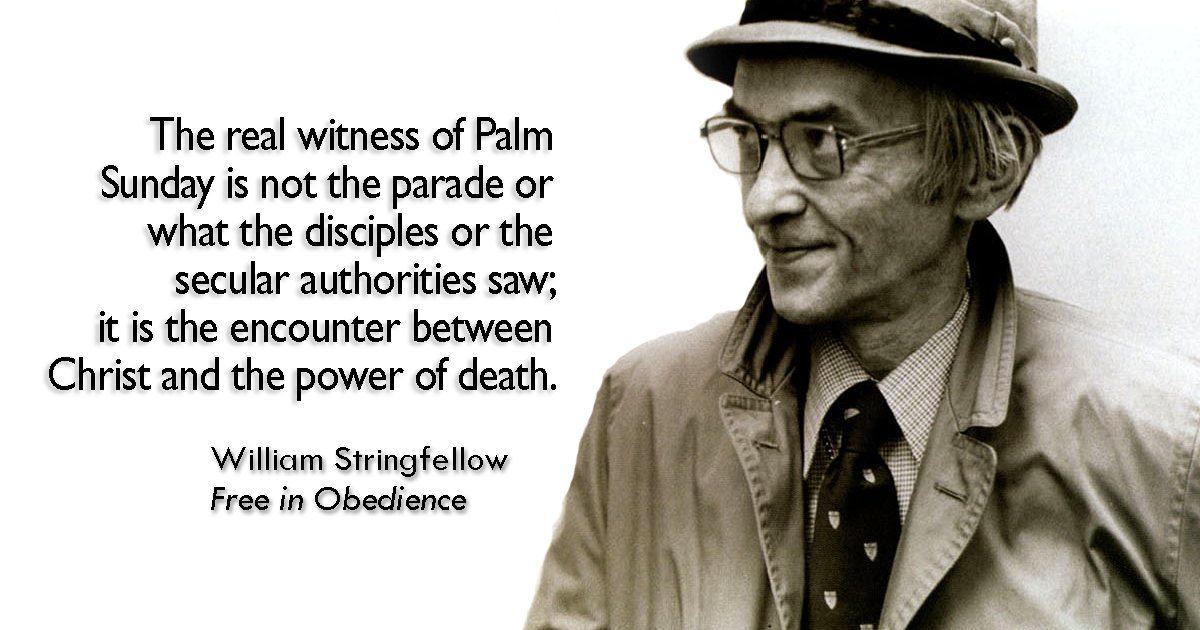
William Stringfellow was a lay Episcopalian, a lawyer, active in the Sojourners community, and involved in the World Council of Churches. Megoran writes that Stringfellow elucidated his position in
the 1973 text An Ethic for Christians and Other Aliens in a Strange Land. Here he writes that he wants to understand America Biblically, not construe the Bible ‘Americanly’, as has been the norm. The text majors on the Babylon passages in the book of Revelation, reading them as a parable of the operation of principalities and powers, primarily states, in any place in human history. Revelation reveals death as the social purpose behind such powers, and represents their traits. For Stringfellow, the conceit that America is the New Jerusalem is Biblical illiteracy: rather, America today stands in the place of Babylon in Revelation.
‘Stringfellow’s work was not commentary on Revelation, but the reverse: Revelation commenting on “us”’, write activists Howard-Brook and Gwyther. Stringfellow elucidates many aspects of contemporary American politics through appeals to the Babylon parable. Crises of foreign war, ecological corruption, racism, urban chaos, unemployment and deception make victims of the poor. But these forces also make victims of elites like Presidents who become pathetically dehumanised as captives to the power of death in the principalities that they work for. For Stringfellow, Revelation does not give ‘policy answers’: rather, it shows how to live ethically, how to hope and to celebrate human life, knowing that God has ultimately defeated death. This entails resisting the cultures of death, for resistance is the only way to live humanly. But, against much contemporary revolutionism, it is to resist without recourse back to death-dealing.
In his conclusion Megoran notes that Apocalypticism is a means of resistance to the powers of Empire. He gives the example of Allan Boesak, the South African anti-apartheid activist:
Boesak’s book, Comfort and protest (1987), is a commentary on Revelation, or, perhaps more accurately, a commentary on the Apartheid regime performed through a reading of the book of Revelation. He identifies specific Apartheid policies and official proclamations, comparing them to the Rome/Babylon of Revelation.
I suspect that it is tempting for many to abandon Revelation to the American right-wing evangelicals, with their incredibly profitable multimedia franchises which frame the judgement of God in speculative, poorly grounded fantasies of violence on liberals and the peoples of the world. However, the book is too important and powerful for responsible Christians to do that. We need to read it as John intended, as a critique of oppressive Empires, and as hope in the midst of much suffering.
Tomorrow I will look at how Handel used Revelation in The Messiah – a non-radical, non-left wing use of Apocalyptic.
This Advent, in the Year of the Great Pandemic 2020, it seems appropriate to look at The Apocalypse – that is, The Revelation of John. This is the seventeenth of twenty-six short reflections.
Not exactly something you’d want to read in bed, eh?
So, who gets to go to the New Jerusalem, according to John the Divine?
This is not a straightforward question. Some people approach this already having the answer.
A Protestant evangelical might say that it is anyone who has accepted Jesus as their personal Lord and Saviour, and perhaps accomplished by saying a prayer of repentance asking that Jesus’s death be fixed between them and what they should suffer.
A Catholic or an Orthodox person might say that it is anyone who is a baptised member of the church and who does not reject the saving grace offered in that baptism.
Some folk have a very narrow understanding, that only a small percentage of humanity will be saved, with the rest being damned.
Others, Universalists suggest that everyone will be saved, the whole of creation.
Some simply say Christians only, others extend it to good people regardless of faith or the lack of it.
Some, ignoring the history of Christian doctrine around salvation by faith, suggest that it is good people who do good things.
And then there are those who just shuffle their feet and hem and haw, not knowing how to answer.
Anglicans could be any of the above,
But if you read the text it is pretty clear what John’s understanding of salvation is.
First, let’s begin with chapters 21 and 22. The New Jerusalem is massive, far larger than any city on Earth today. One might argue that the city needs to be large, partly because there will be so many people in it.
As noted yesterday, the following are excluded: “the cowardly, the faithless, the polluted, the murderers, the fornicators, the sorcerers, the idolaters, and all liars.” (Revelation 21.8) This could be read as a reference to the world in general, but I think we need to read it in reference to the position of the churches in John’s time.
The “cowardly” are those who gave into pressure or fear and abandoned the faith.
The “faithless” are those who have no faith in the Lord God, much less in Jesus.
The “fornicators” may refer to the sexually promiscuous, but more likely, it is a way of describing those who worship the various gods and goddesses of the Greco-Roman world; their worship of idols makes them depraved, and so they are sexually licentious. In ancient times, those in power used and abused slaves, underlings, and other vulnerable people for sexual gratification – what we would now call sexual assault. It may be this that John is reacting to.
The sorcerers are those who try to use magic and the power of evil spirits.
The idolators are those who make and worship images of gods and goddesses.
Liars are those who uphold all of the above, including the emperor and all his imperial structures, and who proclaim a kingdom other than that of Jesus.
This is elaborated in verse 27 of chapter 21: “But nothing unclean will enter it [the city], nor anyone who practices abomination or falsehood.” So we see reiterated the liars, those who worship false gods, or those who have become unclean through association with those who lie or worship false gods.
Chapter 22, verse 15 states, “Outside are the dogs and sorcerers and fornicators and murderers and idolaters, and everyone who loves and practices falsehood.” Apart from the addition of dogs, this is the same list, with murderers added – presumably those who slay the saints of God. I am not sure why dogs are there – they are presumably not actual dogs, but the obsequious followers of the Empire.
Chapters 2 and 3 suggest that the following will receive blessings from God:
2:7b To everyone who conquers, I will give permission to eat from the tree of life that is in the paradise of God.
2:11b Whoever conquers will not be harmed by the second death.
2:17b To everyone who conquers I will give some of the hidden manna, and I will give a white stone, and on the white stone is written a new name that no one knows except the one who receives it.
2:26-28 To everyone who conquers and continues to do my works to the end, I will give authority over the nations; 27 to rule them with an iron rod, as when clay pots are shattered—28 even as I also received authority from my Father. To the one who conquers I will also give the morning star.
3:5 If you conquer, you will be clothed like them in white robes, and I will not blot your name out of the book of life; I will confess your name before my Father and before his angels.
3:12 If you conquer, I will make you a pillar in the temple of my God; you will never go out of it. I will write on you the name of my God, and the name of the city of my God, the new Jerusalem that comes down from my God out of heaven, and my own new name.
3:21 To the one who conquers I will give a place with me on my throne, just as I myself conquered and sat down with my Father on his throne.
The cumulative impression is that it is the one who conquers who will be in the New Jerusalem with Jesus, and whose name will be written in the Book of Life.
And who are those that conquer? In these chapters they are the ones who toil and endure patiently in Ephesus, and are bearing up for the sake of the name of Jesus. They are commanded to love one another, as their initial fellowship seems to have become stale. In Smyrna they are undergoing suffering and imprisonment, but are encouraged to be faithful until death. In Pergamum they do not deny their faith, although they are in danger of accepting false teachings. In Thyatira they are known for love, faith, service, and patient endurance. In Sardis there are a few who are “alive.” In Philadelphia they patiently endure. In Laodicea they need to turn from self-reliance and depend on Jesus.
The vision of heaven in the following chapters are more expansive. In chapter 5 we read of all creation worshiping Jesus:
Then I heard every creature in heaven and on earth and under the earth and in the sea, and all that is in them, singing, “To the one seated on the throne and to the Lamb be blessing and honor and glory and might forever and ever!”
In chapter 6, verse 9 we hear that under the heavenly altar are “the souls of those who had been slaughtered for the word of God and for the testimony they had given”. They all receive white robes, so those who suffer for Jesus are received into the New Jerusalem. There are, in 7:4 “one hundred forty-four thousand, sealed out of every tribe of the people of Israel”. There are 12,000 from each of the twelve tribes, not just the remnant of Judah and Levi that made up the Jewish people at the time of Jesus and John. So Israel is saved. The number should be read symbolically, and I suggest that it means that most of Israel is saved (and please note, acceptance of Jesus is not implied in the numbers). Then, in verse 7 we hear:
9 After this I looked, and there was a great multitude that no one could count, from every nation, from all tribes and peoples and languages, standing before the throne and before the Lamb, robed in white, with palm branches in their hands. 10 They cried out in a loud voice, saying, “Salvation belongs to our God who is seated on the throne, and to the Lamb!”
So, once again, we have an expansive vision of those who are saved by the Lamb. The angel guiding John describes them:
These are they who have come out of the great ordeal; they have washed their robes and made them white in the blood of the Lamb. 15 For this reason they are before the throne of God, and worship him day and night within his temple, and the one who is seated on the throne will shelter them. 16 They will hunger no more, and thirst no more; the sun will not strike them, nor any scorching heat; 17 for the Lamb at the center of the throne will be their shepherd, and he will guide them to springs of the water of life, and God will wipe away every tear from their eyes.”
There is no sense here that they have done anything in particular to merit salvation. They are simply a great mass of people who are hungry, who thirst, and who suffer from the heat of the sun – ordinary people, in other words. They worship the Lamb because they have been saved; the converse is not necessarily true, that they have been saved because they already worshiped the Lamb.
There are various plagues and other types of destruction that follow. Chapter 9 verses 20 – 21 notes that:
20 The rest of humankind, who were not killed by these plagues, did not repent of the works of their hands or give up worshiping demons and idols of gold and silver and bronze and stone and wood, which cannot see or hear or walk. 21 And they did not repent of their murders or their sorceries or their fornication or their thefts.
So idolatrous murderers, sorcerers, and fornicators are condemned, which is not surprising, but the idolatrous thieves are now added.
There are more passages, but for the most part they simply reinforce what we have already seen in what has been quoted above. To summarise, on the one hand the holy people of God, suffering but faithful and patient, will be saved. Likewise, I would argue that God is faithful to Israel and redeems its people. The flip side is that those who worship the beast – those who are hopelessly compromised with the Roman Empire, the cult of the Emperor, and who worship idols and are (as John sees it) consequently depraved – they are not saved. But then, on the other hand, we see an expansive vision of vast multitudes who are welcomed, who worship the Lamb because they are saved.
So within the Book of Revelation there is a tension. John has a two senses of justice: 1) justice for those who are persecuted for the sake of Jesus and because they follow him, and 2) justice for those who suffer as subjects of the Roman Empire. John is mostly concerned with the first, but I do not sense that he condemns people just because they have not heard the good news. He is almost as angry with those who should know better – “Jezebel”, those who follow the error of “Baalam,” and the Nicolaitans – as he is with those who persecute the followers of Jesus. He has strong words for most of the churches that he addresses. But he does still have this inclusive understanding of God’s grace.
Tomorrow I will look at how Revelation has inspired some radical Christians to do some amazing things for God and their fellow human being.
This Advent, in the Year of the Great Pandemic 2020, it seems appropriate to look at The Apocalypse – that is, The Revelation of John. This is the sixteenth of twenty-six short reflections.
Some of the most judgemental passages in Revelation are about who gets thrown into the Lake of Fire:
20 And the beast was captured, and with it the false prophet who had performed in its presence the signs by which he deceived those who had received the mark of the beast and those who worshiped its image. These two were thrown alive into the lake of fire that burns with sulfur. Revelation 19:24
10 And the devil who had deceived them was thrown into the lake of fire and sulfur, where the beast and the false prophet were, and they will be tormented day and night forever and ever. Revelation 20:24
14Then Death and Hades were thrown into the lake of fire. This is the second death, the lake of fire; 15 and anyone whose name was not found written in the book of life was thrown into the lake of fire. Revelation 20:14-15.
8 But as for the cowardly, the faithless, the polluted, the murderers, the fornicators, the sorcerers, the idolaters, and all liars, their place will be in the lake that burns with fire and sulfur, which is the second death. Revelation 21:8
If you are like me, you begin to imagine whether or not whether your name is in the Book of Life, or whether we would qualify for the Lake under one or more of the categories in Revelation 21:8.
Interestingly, the Lake of Fire is one of the few images John comes up with on his own – there is nothing like it in the Hebrew Bible. There is Gehenna in the gospels, which appears to have been a garbage dump outside Jerusalem that was invariably on fire, and in Jewish writing was used to representto Hades, or Sheol, the shadowy underworld for the dead, but that is not quite the same thing. Apparently there is an Egyptian text more than a thousand years earlier than John that talks about a Lake of fire, but it is unlikely that he knew of it. So where did he get the idea of this lake and it being a kind of punishment?
In an essay from 2007 the Dutch New Testament scholar George H. van Kooten suggests that it goes back to Nero. Following the fire in Rome at which Nero (doubtfully) fiddled, but which he blamed on the Christians (likely), he seized a vast amount of land adjacent to the Forum. There, according to Suetonius, he built an imperial palace, whose
entrance hall was designed for a colossal statue, 120 ft high, bearing Nero’s head. So vast were the grounds, that triple colonnades ran for a mile. There was, too, an enormous lake, surrounded by buildings made to look like cities (Nero 31.1).
The lake is where the Colosseum was eventually erected, so it was quite central; indeed, the name “Colosseum” appears to have been derived from the Colossus of Nero, for the massive statue stood for centuries, long after the pond was drained. Van Kooten suggests that John believed that Nero (or some version of the returned Nero) would be punished, and this is symbolized by the Beast – Nero – being tossed into the lake whose creation was facilitated by the historic fire. From there it was a short jump to throwing Death, Hades, and all unrepentant evildoers into it as well.
But who gets to escape the Lake of Fire? We’ll discuss this tomorrow.
This Advent, in the Year of the Great Pandemic 2020, it seems appropriate to look at The Apocalypse – that is, The Revelation of John. This is the fifteenth of twenty-six short reflections.
Daniel Hopfer‘s “the Parable of the Mote and the Beam” (c. 1530). Interior of the Church of Saint Katherine’s.
John the Divine gives the impression of being a pretty judgemental guy, and that’s because he is. He has little patience or toleration for those he disagrees with – you may remember that in chapters 2 and 3 he calls a prophet in Thyatira “Jezebel”, and a synagogue “the synagogue of Satan”. He has Jesus saying that he hates the Nicolaitans. Then there is the sheer number of people who seem to die of plagues, natural disasters, the destruction of Babylon (i.e. Rome), including the ten kings, various beasts, and merchants and sailors. That whole business of the lake of fire and the exclusion of sinners from the New Jerusalem again seems pretty harsh. Meanwhile the angels and martyrs are singing the praises of Jesus in victory over all these bad people. Where is God’s mercy?
And how does this sit with these well known passages from the Sermon on the Mount in the Gospel according to Matthew:
7 1“Do not judge, so that you may not be judged. 2 For with the judgment you make you will be judged, and the measure you give will be the measure you get. 3 Why do you see the speck in your neighbor’s eye, but do not notice the log in your own eye? 4 Or how can you say to your neighbor, ‘Let me take the speck out of your eye,’ while the log is in your own eye? 5 You hypocrite, first take the log out of your own eye, and then you will see clearly to take the speck out of your neighbor’s eye. – Matthew 7.1-5
6 12And forgive us our debts, as we also have forgiven our debtors. – Matthew 6.12
538 “You have heard that it was said, ‘An eye for an eye and a tooth for a tooth.’ 39 But I say to you, Do not resist an evildoer. But if anyone strikes you on the right cheek, turn the other also; 40 and if anyone wants to sue you and take your coat, give your cloak as well; 41 and if anyone forces you to go one mile, go also the second mile. 42 Give to everyone who begs from you, and do not refuse anyone who wants to borrow from you.
43 “You have heard that it was said, ‘You shall love your neighbor and hate your enemy.’ 44 But I say to you, Love your enemies and pray for those who persecute you, 45 so that you may be children of your Father in heaven; for he makes his sun rise on the evil and on the good, and sends rain on the righteous and on the unrighteous. 46 For if you love those who love you, what reward do you have? Do not even the tax collectors do the same? 47 And if you greet only your brothers and sisters, what more are you doing than others? Do not even the Gentiles do the same? 48 Be perfect, therefore, as your heavenly Father is perfect. – Matthew 538-48
First of all, I think we need to recognise that John is angry, and rightfully so. He has seen other Christians suffer physically and be killed. Recognising that vengeance belongs to God, he has a vision of that vengeance. Having never suffered the way that John has suffered, it is not up to me to judge whether another person’s anger is unrighteous. The anger we see expressed in Black Lives Matter, or in Indigenous Rights movements such as Idle No More, is powerful, and propels an activism that calls for justice. Rarely does it escalate into violence, but through various actions of civil disobedience it challenges the “white” liberal call for “healing and reconciliation” to be more radical and transformative, rather than incremental.
Second, sometimes we are in positions of responsibility where we are called to make judgements. I had to do this when I was the Executive Officer of the Diocese of British Columbia, and to respond when clergy or laity were acting in ways that required discipline. In these cases the judgements need to be made on principles informed by the duty to act fairly. The story about the speck and the beam is about ensuring that you are not a hypocrite, dealing in one type of justice for one set of people and another type for others, or disciplining others when one is guilty of far greater evils. Am I prepared to be judged by the standard by which I judged others? I answer with a yes, and pray that I am sufficiently self-aware that I am always taking that log out so that I might help others.
Third, Jesus in the Sermon on the Mount addresses his followers about how one deals with oppression – and it is largely about breaking the cycle of violence. Chapter 5:38-42 is a central passage in civil disobedience, describing exactly what Martin Luther King and John Lewis acted on when challenging segregation in the American South in the 1960s. Listen to the preaching that went on at the time, and it is propelled less by hate of people than a higher righteousness grounded in Jesus that loves people even as they attack you.
Meeting violence with violence will sometimes work to stop the other side from oppression – that’s what war is, after all, and some wars are arguably just – but sometimes it fails to stop that cycle of violence. Wars have a bad habit of spinning out of control, World War One being the prime example (but see Vietnam, Afghanistan (for both the USSR and NATO), and Iraq). Europe has been mostly free of wars between nations since 1945 because the trauma of the Second World War has provided a real impetus to create a lasting peace, this being accomplished through the European Union and other international bodies. The Troubles in Northern Ireland, which seemed interminable, did not end because either side was winning, but because both sides recognised that violence was not getting either of them anywhere. Sure, sometimes sheer violent force accomplishes a goal – the Nazis were defeated in World War Two, the North Koreans were stopped in their tracks by the United Nations, and the Serbs stopped their genocidal war because of NATO bombing – but these victories came at great costs, with many unresolved issues. We should be wary of rolling the dice of violence, especially in this era of nuclear weapons. Civil disobedience, legal challenges, building political alliances, and negotiations are all preferable to the use of arms and violence. Patience is necessary; communism in Eastern Europe and the Soviet Union was not overcome by war, but by containment and the patient waiting for the totalitarian system to finally fail on its own contradictions.
How does one love one’s neighbour who may be an enemy? In my experience, it begins by praying for them. I continue by working to establish a relationship despite the differences. I try to find common ground,
Of course, in some situations the person is so damaged that they cannot negotiate. They may be a psychopath, spouting lies, using and abusing others, and refusing to acknowledge facts (see the current American president). They may not be able to help themselves. In some cases we cannot help them much. A disloyal employee probably needs to be terminated, but the termination must be done in a compassionate and just way, as the power difference between the employer and employee is usually significant. A murderer or someone convicted of sexual assault needs to be removed from society, not only so that they can no longer do harm to others, but so that they might have access to opportunities to try and understand the damage they have done.
But coming back to John the Divine and Revelation, his judgement and the tone of his language can be disturbing. However, sometimes it inspires others to radical justice of a kind that I find agreeable with the instructions Jesus gives in the Sermon on the Mount. More on that tomorrow.
A detail from The Freedom Sculpture in Philadelphia PA by the American sculptor Zenos Frudakis
The Two Berlins
In the gospel reading today we read of how the priests and Levites from Jerusalem wanted to know just who John the Baptist thought he was. There were a little confused about his identity. Was he the Messiah? No. Was he Elijah? No. Are you the prophet? No.
This is a more recent story about a confusion of identity, involving Winston Churchill.
This occurred in the spring of 1944 – I should say February or March. What happened actually was this.
Mrs Churchill said to Winston:”Irving Berlin is in town, he has been very generous to us” – he’d given a large sum of money to – a war charity, I don’t know which, with which she was connected. “If you meet him, do tell him we are very pleased with him.” Mr Churchill said,”I want him to come to lunch.” She said, No, no, no, I did not mean that. I mean, if you meet him in the Churchill Club, just pat him on the shoulder and say we are very grateful to him.” “I want him to come to lunch,” he said, but she couldn’t understand why.
Well, Irving Berlin sat next to Winston Churchill, who said to him, “Mr Berlin, what is the most important piece of work you have done for us lately, in your opinion?“ Poor Berlin obviously couldn’t quite make out what this man had said. After some hesitation,”I don’t know, it should be A White Christmas, I guess.” And Winston said, “Are you an American?“- there was this thick American accent. Berlin said, “What? Why? Why? Yes.” Then Winston again turned to Mr Berlin and he said, “Do you think Roosevelt will be re-elected this year?“ Irving said, “Well, in the past I have voted for him myself, this year I am not so sure.” At this point Mr Churchill became rather gloomy, he couldn’t understand who he was dealing with. He still thought it was me (Isaiah Berlin, an Oxford Don who was working during the war in the British Embassy in Washington, and writing perceptive reports on American politics that the Prime Minister eagerly read). Obviously my despatches were quite coherent, but he obviously had an idiot before him. Finally Winston said, “Mr Berlin, when do you think the European War is going to end?“ Berlin said, “Sir, I shall never forget this moment. When I go back to my own country I shall tell my children and my children’s children that in the spring of 1944 the Prime Minister of Great Britain asked me when the European War was going to end.“
Winston was very displeased about this: he really more or less lost his temper, got up – lunch was over. Poor Irving Berlin went off to the Savoy, where he was sharing rooms with Sir Alexander Korda, and he said to Korda, [Eventually somebody explained that there were two Berlins – Irving Berlin the songwriter, and Isaiah Berlin the Oxford don and political philosopher). Winston immediately went to a Cabinet meeting, after lunch, told them the story with the greatest pleasure.
Negative Liberty and Positive Liberty
Isaiah Berlin, (later Sir Isaiah Berlin) who told this story on Desert Island Discs and many other occasions, may be less popular than Irving Berlin and White Christmas, but he is very well known among philosophers and political scientists. He wrote an essay in 1958 describing two kinds of freedom, positive liberty and negative liberty. Now, freedoms are guaranteed in a number of ways – from time immemorial by English common law, in the past century by international law, and enshrined in constitutions, such as the Charter of Rights and Freedoms in Canada, and the Bill of Rights in the USA. Here in Greece they are governed by the European Convention on Human Rights and enshrined in the Constitution.
Negative liberty is expressed in restrictions on governments, forbidding them from encroaching on the liberty of individual. Positive liberty is the freedom to do things as individuals and collectives, things which one might want to do but need not.
Thus, among the “freedoms from” there are:
freedom from torture;
freedom from discrimination according to sex, race, colour, language, religion, political or other opinions, national or social origin, association with a national minority, property, birth or other status;
freedom from slavery; and
freedom from detainment of imprisonment, except when accused according to due process of law and convicted in fair trials.
Among the “freedoms to” are:
the freedom of religion – to have a particular faith and to be able to practice it, or none at all;
the freedom to marry;
the freedom of expression; and
the freedom to associate and assemble, including the freedom to form trade unions;
Freedom for Isaiah and John the Baptist
In this morning’s readings we hear from the Book of Isaiah – the original one, not Isaiah Berlin:
The spirit of the Lord God is upon me, because the Lord has anointed me; he has sent me to bring good news to the oppressed, to bind up the brokenhearted, to proclaim liberty to the captives, and release to the prisoners; to proclaim the year of the Lord’s favour, and the day of vengeance of our God; to comfort all who mourn;
For Isaiah the freedom is quite literal – freedom from being a conquered people, transported and treated as slaves, by the waters of Babylon. It is a freedom to return to Jerusalem and Judea, to rebuild the Temple and the walls of the city. It is good news that heals broken hearts, shows God’s favour, forces those who have done wrong to deal with the consequences of their actions, and comforts those who have done wrong.
And, of course, as you no doubt remember, in the Gospel according to Luke, chapter 4, in what is portrayed as Jesus’s first day on the job, Jesus reads this passage in the synagogue in Nazareth, and then delivers a one line sermon: Today this scripture has been fulfilled in your hearing. Jesus is called to heal and to proclaim liberty to the people who are suffering, and to cast out the evil that besets us.
John the Baptist also proclaimed a message of freedom. By repentance and baptism people were freed from their sins. By doing so in the wilderness, by the river Jordan, he was proclaiming a freedom from the compromised religious hierarchy in Jerusalem. He did this, we are told, to prepare the way of the one who will baptise with the Holy Spirit, Jesus.
Now, if the removal of sin is accomplished through repentance and baptism, we might see this as a “freedom from” – a freedom from sin. The baptism with the Holy Spirit, which as Anglicans we hold may be coincident with Christian baptism, but may also happen apart from it – this baptism is more like a “freedom to”, so that we might do the things that God calls us to do.
Christian Freedom
There is a prayer in the Book of Common Prayer, the second collect in Morning Prayer, that starts:
O God, who art the author of peace and lover of concord, in knowledge of whom standeth our eternal life, whose service is perfect freedom . . .
The idea that God’s service – working for God – is perfect freedom, is one of those parodoxical ideas. We are freed from sin so that we might truly serve God. But we do not do it by compulsion, but gladly, by choice, knowing that this is what we have been called to do.
As Christians we are called to be like Christ, proclaiming liberty, healing the sick, and casting out all the evil around us. We do this by upholding the dignity of every human being. And so, in practical terms:
We care for the sick, the infirm, the housebound, the elderly, and call for equitable care for everybody, and the resources to do it.
We seek to empower young people and marginalized persons through education and skills training.
We provide tools and capital to the impoverished so that individuals and communities can create wealth and development.
We provide assistance and refuge for those fleeing wars and natural disasters.
We speak truth to power, not seeking to replace those in power, but to challenge them to rule for the common good, and not merely a sector of the population, or for the one percent.
We challenge abuses around the world – the imprisonment and enslavement of of Uyghers in western China; the discrimination against the Rohinga in Myanmar; the genocide and attempts at assimilation of Indigenous peoples; the attempts to crush democracy in Thailand, Belarus, Turkey, and Hong Kong; and the racism we know exists here and in our home countries.
We have hope, light in the midst of darkness, that God will make all things right, that the darkness will not overcome the light, that the arc of history tends towards justice and righteousness, and that the resurrection of Jesus Christ is but the beginning of God’s recreation of a new heaven and a new earth. As citizens of New Jerusalem, who know that we have been freed from sin and are free to serve God, our hymn is that of Isaiah:
I will greatly rejoice in the LORD, my whole being shall exult in my God; for he has clothed me with the garments of salvation, he has covered me with the robe of righteousness, as a bridegroom decks himself with a garland, and as a bride adorns herself with her jewels. For as the earth brings forth its shoots, and as a garden causes what is sown in it to spring up, so the Lord God will cause righteousness and praise to spring up before all the nations.
This Advent, in the Year of the Great Pandemic 2020, it seems appropriate to look at The Apocalypse – that is, The Revelation of John. This is the fourteenth of twenty-six short reflections.
Professor Michael Sandel inside Sanders Theatre at Harvard University, teaching his course on Justice. (Cambridge, MA – September 15, 2008)
Michael Sandel is a political philosopher at Harvard University, and annually teaches an introductory course on justice. In 2007 over 1000 students enrolled in it. It has been filmed and broadcast on public television, and the book version (which I have read but no longer seem to have) has been translated into at least thirteen languages. In both the course and the book he runs through a variety of approaches which have all had their proponents over the ages:
Justice is the greatest happiness for the most people. (Utilitarianism)
Justice is achieved by the maximum autonomy for the individual with the greatest freedom from interference from the state or any other external agent. (Libertarianism)
Justice is best achieved in the free market of ideas, or, actually, in any kind of market, and governments should refrain from limiting free speech and the regulation of the market place for goods and services. (Free Market Economics)
Justice is achieved by following carefully considered rules, such as the categorical imperative. (Kantian deontology)
Justice as fairness. (John Rawls)
Justice as achieved through the acquisition of virtues. (Aristotle & MacIntyre – Virtue Ethics)
Justice as being mainly loyal to ones family, friends, clan, and community. (Communal self-interest against outsiders)
Justice as a communal value, achieved through the best of virtue ethics, utilitarianism, deontology modified by circumstances, and managed markets (Sandel’s own approach)
This is not an exhaustive list of approaches by any means. Amartya Sen, who won the Nobel Prize in economics for his studies on the causes of famines, has developed what is known as the “capability approach” to ethics, essentially arguing that most of the approaches listed by Sandel do not mean much to individuals in extreme poverty, as they do not have the capabilities to develop anything other than survival as an approach to life. Thus, justice is that which first addresses the development of capabilities of human beings. This has since been developed by Martha Nussbaum, and I think it is an important corrective on Western political philosophy.
Another approach might be:
Justice is whatever God says it is.
Of course, this begs the question that what God says justice is can actually be determined. For some God’s justice means that access to abortion must be limited or made impossible. In other cases it involves genocide. The Catholic Church says that God’s justice demands that capital punishment be abolished. Others argue that God’s justice is about helping the poor and marginalized. Some see justice as something only derivable from scripture, others have a tradition of natural law that complements and orders scriptural injunctions.
The concept of justice has its limits. Certain legal scholars, for example, (some of them sitting on the Supreme Court of the United States) seem to think that justice in terms of legal practice means that one just has to read the text and interpret it the way the original writers thought about it. But that is a hopeless exercise – as if the original writers had a single idea of what the words meant, or as if the meaning was clear in their own minds. Being politicians, they booted many issues down the decades by being deliberately vague or brief. I suppose I am too much of a deconstructionist to believe that words have single, stable meanings; language really does subvert itself.
As well, the values that seem to be contained in any idea of justice are not themselves necessarily commensurable with each other (as Isaiah Berlin pointed out); when push comes to shove, our deeply held values themselves may be in conflict. What is more important, my religious commitment to pacifism, or the value of patriotism? The idea of justice itself may be inherently unstable, something that changes and is renegotiated in each generation, and never quite reaching the ideal we think it ought to be.
John the Divine had a certain idea of justice. He certainly thought that Rome and the Roman Empire was unjust. He thought that God’s wrath would be poured out on it, and correctly so. In chapter 21.8 he states that
the cowardly, the faithless, the polluted, the murderers, the fornicators, the sorcerers, the idolaters, and all liars, their place will be in the lake that burns with fire and sulfur, which is the second death
and, further, in 22.15, that
15 Outside are the dogs and sorcerers and fornicators and murderers and idolaters, and everyone who loves and practices falsehood.
which is a bit grim. John is certainly into divine punishment.
In chapter 18 he condemns all the merchants and those who trade with Rome. He condemns those who are responsible for the deaths of God’s holy people, the saints and the apostles.
But he also condemns people within the church, as can be seen in chapters 2 and 3: he criticises those “those who say that they are Jews and are not, but are a synagogue of Satan”, “some . . . who hold to the teaching of Balaam,” “that woman Jezebel, who calls herself a prophet and is teaching and beguiling my servants to practice fornication and to eat food sacrificed to idols,” and those who “say, ‘I am rich, I have prospered, and I need nothing.’” I get the feeling that if you were on the wrong side of John he would he quite scathing.
In this he is simply following in the path of Isaiah, Jeremiah, Ezekiel, and other prophets who spoke truth to power and condemned those leaders who failed to care for the orphans and widows, who compromised the worship of YHWH with idols and other gods, and who sought to enrich themselves and live in luxury.
So what do we do with the judgementalism of John the Divine, which seems to characterise the whole of the book? Well, again, I do several things.
My own approach is to say that we need to be eclectic. The concept of justice as revealed in scripture needs to be in dialogue with our experience and histories of how different societies have understood justice. The ultimate example of justice is to be found in Jesus Christ.
So, first, I read the book in dialogue with other parts of the New Testament, especially the gospels and the picture of Jesus that is described in it. Second, I consider how this passage has been read over the past 1900 years. And, third, I also see it in dialogue with the present day. John lived in a very different age and circumstances from me. History has unfolded in ways inconceivable to him.
So, taking all that into consideration, what are the insights and values that we find meaningful now? I will continue this tomorrow.
These are resources for the Third Sunday of Advent on December 13, 2020. The resources are gathered from a variety of sources and, while assembled mainly for The Anglican Church of St Thomas the Apostle, Kefalas, on the island of Crete in Greece, others may find them useful.
The Freedom Sculpture by the American sculptor Zenos Frudakis (yes, his parents are Greek, probably from Crete).
Share
The government of Greece released new directions yesterday (Friday, December 11). We will remain in lockdown until and including January 6, 2021, at least. We are not allowed to meet in person, except on Christmas Day, Friday December 25, and Epiphany, Wednesday January 6, 2021. We are limited to nine person in church on those days. So . . .
We will have two services of Holy Communion on Christmas Day, at 9:15 am and 11:00 am. If you wish to attend you must register in advance. To register please contact Pat Worsley by phone at +30 28257 71001 or by email at peter.worsley@btinternet.com; registration will be on a first come, first served basis.
If there is greater demand than can be accommodated by these two services, I am open to having more celebration of Holy Communion on that day.
The 11:00 am service will be on Zoom for those who do not wish to attend in person. We will definitely be singing hymns at that service! The 9:15 service will be a traditional Book of Common Prayer service of Holy Communion, with the 16th century Tudor English that many of you grew up with.
This Sunday, The Third Sunday of Advent, we will be on Zoom for a Service of the Word at 11:00 am EET (9:00 am GMT). You can join us by clicking this link or by entering the following into your Zoom application: Meeting ID: 850 4483 9927 Passcode: 010209.
I suspect that I will be preaching on the passage from Isaiah 61:
The spirit of the Lord God is upon me, because the Lord has anointed me; he has sent me to bring good news to the oppressed, to bind up the brokenhearted, to proclaim liberty to the captives, and release to the prisoners . . .
Pray
Collect
O Lord Jesus Christ, who at your first coming sent your messenger to prepare your way before you: grant that the ministers and stewards of your mysteries may likewise so prepare and make ready your way by turning the hearts of the disobedient to the wisdom of the just, that at your second coming to judge the world we may be found an acceptable people in your sight; for you are alive and reign with the Father in the unity of the Holy Spirit, one God, now and for ever. Amen.
(or)
God for whom we watch and wait, you sent John the Baptist to prepare the way of your Son: give us courage to speak the truth, to hunger for justice, and to suffer for the cause of right, with Jesus Christ our Lord. Amen.
Biddings I bid your prayers for the leaders and people of the nations; especially
Elizabeth, Queen of the United Kingdom of Great Britain and Northern Ireland, and her other realms, and also in her role as Governor of the Church of England;
and Boris Johnson, the Prime Minister of her British government;
In the European Union,
Ursula von der Leyen, President of the European Commission;
Charles Michel, President of the European Council; and
Josep Borrell, High Representative of the Union for Foreign Affairs & Security Policy;
for the closing negotiations around Brexit;
for the peoples of the Republic of Ireland and Northern Ireland facing uncertainty over the fate of the Good Friday Accord;
the peoples of Belarus, Hong Kong, Nigeria, Peru, and Thailand as they continue to demonstrate for democracy and justice;
for the maintaining of peace between Azerbaijan and Armenia, and between Russia and Ukraine, Palestinians and Israelis, North and South Korea, and for a final, just resolution to their conflicts;
for the President-elect and peoples of the United States;
for a lessening of tensions between Turkey and Greece; and
for peace in Yemen, Libya, Afghanistan, Syria, and Ethiopia.
I bid your prayers for the sick and suffering and all who minister to their needs;
remembering the 20 million active cases of the novel coronavirus, and mourning with the families of the 1.6 million who have died in the pandemic;
for the 1.8 million people in the UK who have had covid-19 or are recovering from it, the over 63,000 who have died of it there, and the over 121,000 active cases here in Greece, and the families of the over 3370 dead here;
remembering those ill with other diseases, and those whose operations have been postponed;
all those having issues with mental health;
those suffering from addiction, and those in recovery;
those who have been affected severely by the economic effects of the pandemic, especially in food services and tourism;
and giving thanks for the efforts of researchers in finding vaccines, and the rollout of vaccines across the world.
we pray especially for congregations that have been obliged to cease in-person services;
for the churches and peoples of China, Hong Kong, and Macau (World Council of Churches Ecumenical Prayer Cycle);
in the Anglican Communion, we remember the church in the Falkland Islands (Extra-Provincial to Canterbury and The Rt Revd Timothy Thornton, Bishop to the Forces and Bishop to the Falkland Islands;
Intercessions In joyful expectation of his coming to our aid we pray to Jesus.
Come to your Church as Lord and judge. Help us to live in the light of your coming and give us a longing for your kingdom. Maranatha: Amen. Come, Lord Jesus.
Come to your world as King of the nations. Before you rulers will stand in silence. Maranatha: Amen. Come, Lord Jesus.
Come to the suffering as Saviour and comforter. Break into our lives, where we struggle with sickness and distress, and set us free to serve you for ever. Maranatha: Amen. Come, Lord Jesus.
Come to us as shepherd and guardian of our souls. Give us with all the faithful departed a share in your victory over evil and death. Maranatha: Amen. Come, Lord Jesus.
Come from heaven, Lord Jesus, with power and great glory. Lift us up to meet you, that with Isaiah, John the Baptist, Thomas our patron and the rest of the Twelve, Paul, Mary of Magdala, Mary your mother, and all your saints and angels, we may live and reign with you in your new creation. Maranatha: Amen. Come, Lord Jesus.
Silence is kept.
Come, Lord Jesus, do not delay; give new courage to your people, who trust in your love. By your coming, raise us to share in the joy of your kingdom on earth as in heaven, where you live and reign with the Father and the Spirit, one God for ever and ever. Amen.