
This has been one of the harder posts to write because I’ve never really seen myself as an expert on analytic philosophy. It is probably because I am not overly sympathetic to it – while it strongly influenced the course of studies I did at the University of Toronto in my first degree, my subsequent studies led me to Continental philosophy and a critique of the methods and issues of analytic philosophy. Well, let’s have a go, eh?
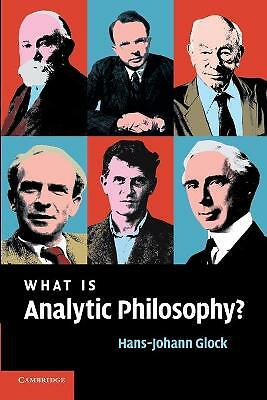
As far as I can tell, Levinas never read Wittgenstein and Wittgenstein never read Levinas, an example of the two silos of analytic and continental philosophy. Despite their lifespans overlapping and both being part of intellectual European society, they were in two very different philosophical camps. I should say something about these two philosophical approaches, as the difference between the them is undoubtedly the most important distinction between them. I will start with Wittgenstein and the Analytic tradition.
Wittgenstein is considered to be in the Anglo-American Analytical tradition, whereas Levinas is firmly in Continental phenomenology. Both traditions are well over a hundred years old, and while each has been obliged to defined itself against the other, it seems to me that Analytic philosophy spent far more time disparaging phenomenology than vice-versa. In this second decade of the Twenty-First Century we are very much in the post-analytical and post-continental phase, where philosophers from each camp are reading each other a little more generously than fifty years ago, although they can still be dismissive of each other. Now, as one might expect with anything that has gone on for over a century and has many participants, both traditions defy simple definitions. However, relying on my education some forty-five years ago, allow me to draw out some characteristics of each, beginning with Analytic philosophy.
There are two things one can point to in the history of analytic philosophy in its first fifty years.
The first is a that starting around 1900 there was reaction to the Idealism that was popular in 19th century Britain. Derived from Hegel, the Idealists challenged the Kantian irradicable separation between our knowledge of a thing, and the “thing in itself.” Kant believed that, as human beings, we have sensations and perceptions that are processed by our minds. A mind imposes itself on our perceptions so much that that, while we sense we are in the world, we can only know the world in the categories that our sense-perceptions and our brains use to interpret it. British philosophers such as Josiah Royce and F. H. Bradley attempted to bridge that gap by arguing for a reality they called “the Absolute”, a self-sufficient reality in which thought and being are one. This led to reflections on being and the categories of thought.
The first British analytic philosophers were influenced by Gottlob Frege (1848-1925), a German mathematician and philosopher who developed symbolic logic and sought to determine their relationship. Bertrand Russell (1872-1970) published The Principles of Mathematics and continued that work with Alfred North Whitehead (1867-1941) in the three volumes of Principia Mathematica (1910-1913). In these dense, difficult books Russell and Whitehead sought to prove that logic and mathematics were the same, to develop a system of symbols to do symbolic logic, and to analyse several logical puzzles.
In terms of epistemology, the early analytic philosophers rejected the Idealist notion of “the Absolute” in which things are known in the context of a whole. Instead, they focused on propositions and their relation to facts, and whether propositions could be reduced to a logical form and evaluated on the truth value of the various elements.
If matters could not be reduced to some form of logic, or if the propositions could not be verified or falsified, then the propositions stating them were nonsensical. They were not without meaning, but the meaning was untethered in the real world. Thus, metaphysics, theology, and ethics were all considered to not be in the field of philosophy, and most analytic philosophers went further and believed that metaphysics and theology, in particular, was nonsense. G. E. Moore, in his Principia Ethica (1903,) analyses the concept of “the good” and concludes that it has no single definition, and that what the good is in any particular situation depends on the context; in the end he appeals to common sense and human intuitions, rather than settling on a definition, rule, or essence. Ethics, then, is removed from the realm of logical philosophy, as is politics.
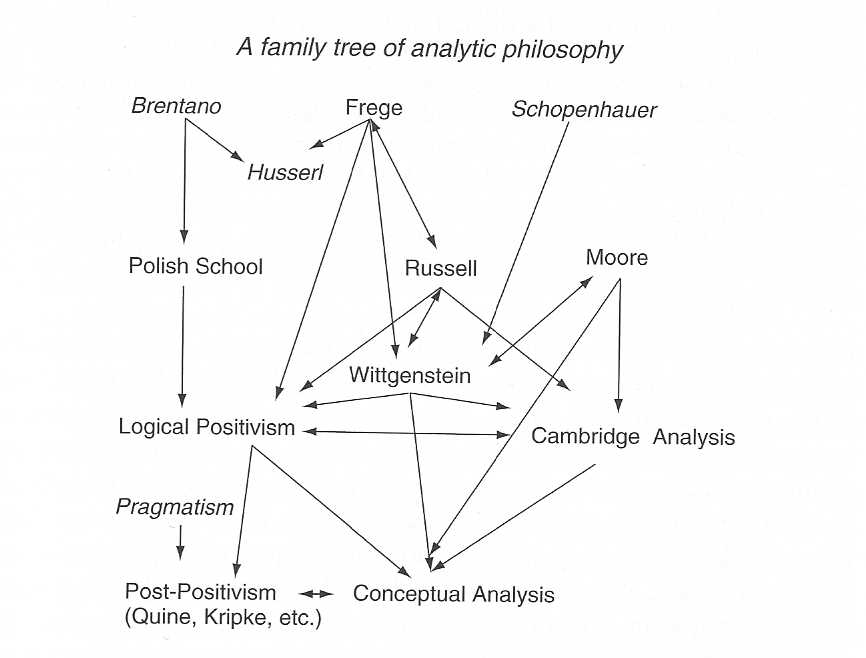
As you can see in the above diagram, Wittgenstein is in the middle. Following his studies with Russell and Moore at Cambridge he began writing the Tractatus Logico-Philosophicus in Norway in 1913, developing it in the German trenches and camps during the Great War, and publishing it in German shortly thereafter. In it he believed that he had solved the major problems of philosophy, and went on to do what he considered to be more important work, namely, teaching children in rural Austria. The Tractatus was translated into English and published at the behest of Russell, who considered it vitally important. The work was almost entirely concerned with propositions and their relation to the world of facts. Wittgenstein admitted the importance of ethics and morality, art and religion, but held that these were not matters that concerned philosophy; in the famous last line of the Tractatus, “About things we cannot speak of we must keep silent.”
The philosophy department at the University of Walamaloo.
In the 1920s and 1930s the group of philosophers known as Logical Positivists went further than Wittgenstein or Russell in holding that if something cannot be made in a verifiable statement, then it truly is meaningless. It was a profoundly empirical approach to things, rooted in the primacy of the scientific method, and they took the sparse logical approach of the Tractatus as a basic text. One portion of the Logical Positivists were based in Vienna, known as the Vienna Circle, and on a number of occasions Wittgenstein met with some of its members individually. Wittgenstein came to believe that he was misunderstood, and so, by the late 1929 he returned to Cambridge to do more research. Unusually, the university treated his now decade old Tractatus as a PhD dissertation, and Russell and Moore did a pro forma oral examination; this enabled him to teach, and by 1939 he succeeded Moore as the Professor of Philosophy.
Wittgenstein’s arrival in Cambridge signified the second moment in analytical philosophy, namely, the linguistic turn. Analytic philosophy became very much the philosophy of language.
Concluding that human language was not reducible to logical propositions, he struggled towards understanding the function of language and the way meaning worked in it. While typed out manuscripts circulated among his colleagues and students, his results were only published two years after his death in 1951 as Philosophical Investigations (1953). The key thing about any proposition or statement is that it is embodied in a human context, a form of life. The habit of prior philosophy is to abstract it out of that context, to remove it from its time and place, as if that its abstraction is somehow more true and real. Wittgenstein famously stated that the meaning of a word is its use – something seemingly obvious, but so often ignored, whether by language mavens with prescriptive definitions or by philosophers who would ascribe a type of being – essence – behind words. He described language as a kind of game, with rules like football, whereby something has meaning within those rules, but may not when taken out of the game. We know what a goal is in ice hockey, but what is its meaning in tennis?
This linguistic turn evolved into the analysis of linguistic puzzles, demonstrating that people often ask words or language to do things that they are not equipped to do. Conceptual analysis, which followed on from Wittgenstein, sought to take concepts apart and show what they could and could not do. In 1955 the analytic philosopher J.L. Austin developed the notion of speech acts, which examines the roles that vocal utterances play in human communication.
In the next post I will discuss Continental philosophy. After that, I will finally get to Levinas and Wittgenstein on language.


 The Island Parson