
A sermon preached on The First Sunday of Lent, 22 February 2026, at The Anglican Church of St Thomas the Apostle, Kefalas, Crete. The readings were: Genesis 2:15-17; 3:1-7, Psalm 32, Romans 5:12-19 and Matthew 4:1-11.

Most of the time when we watch a movie or a television show, or read a book or short story, we do not know how the story ends. This creates a kind of tension – what is going to happen? Will the hero prevail? Will the evildoers be punished? Will I be surprised by the twist ending? Who did the murder? Was it the butler? Or the vicar? Will Godot show up to see Estragon and Vladimir? Will Michael Corleone continue to turn away from his father Vito? What will the astronauts discover when they go to Jupiter in 2001: A Space Odyssey? Will Luke Skywalker give in to the Dark Side?
Obviously there are exceptions. People who read romance novels or watch Hallmark Christmas movies know that the couple will get together. People who watch formulaic horror movies know that the teenagers will get murdered, except for one who will wreak vengeance on the horrific villain. These kinds of books and stories are not <ahem> critically acclaimed, even if beloved by their fans. Most modern literature is not formulaic, or if it is in a genre, it plays with the norms to do something new and different.
This tension around the unknown in drama and literature is quite modern, and has not always been the case. In ancient Greek tragedy the audience always knew that it was going to end in tears, with Agamemnon dead, Oedipus blind, and Medea having murdered her children. The point in attending the drama was to see how the story was told – did the chorus dance and sing well, and did the three main actors convey the commissioned author’s words? Likewise, with the Homeric Epics everyone knew that Achilles would return to battle to avenge Patroclus, and that Odysseus would find his way home. The enjoyment was in the performance and the skill of the performer retelling the familiar episodes. In that respect it was a bit like modern day patrons of opera going off to see a performance of a work written a century ago – they know the score already and can probably hum the arias; they’re there to hear the divas and male soloists, and to take the measure of the music director, the orchestra and chorus, and the design.
The early Christians likewise, after accepting the gospel, knew the outline of the narrative. The Christian story is very simple. It is good news. Despite the evil in the world, good prevails. God wins in Jesus Christ. The victory is already predetermined, and while evil may persist much longer than we care, ultimately it will be overthrown.
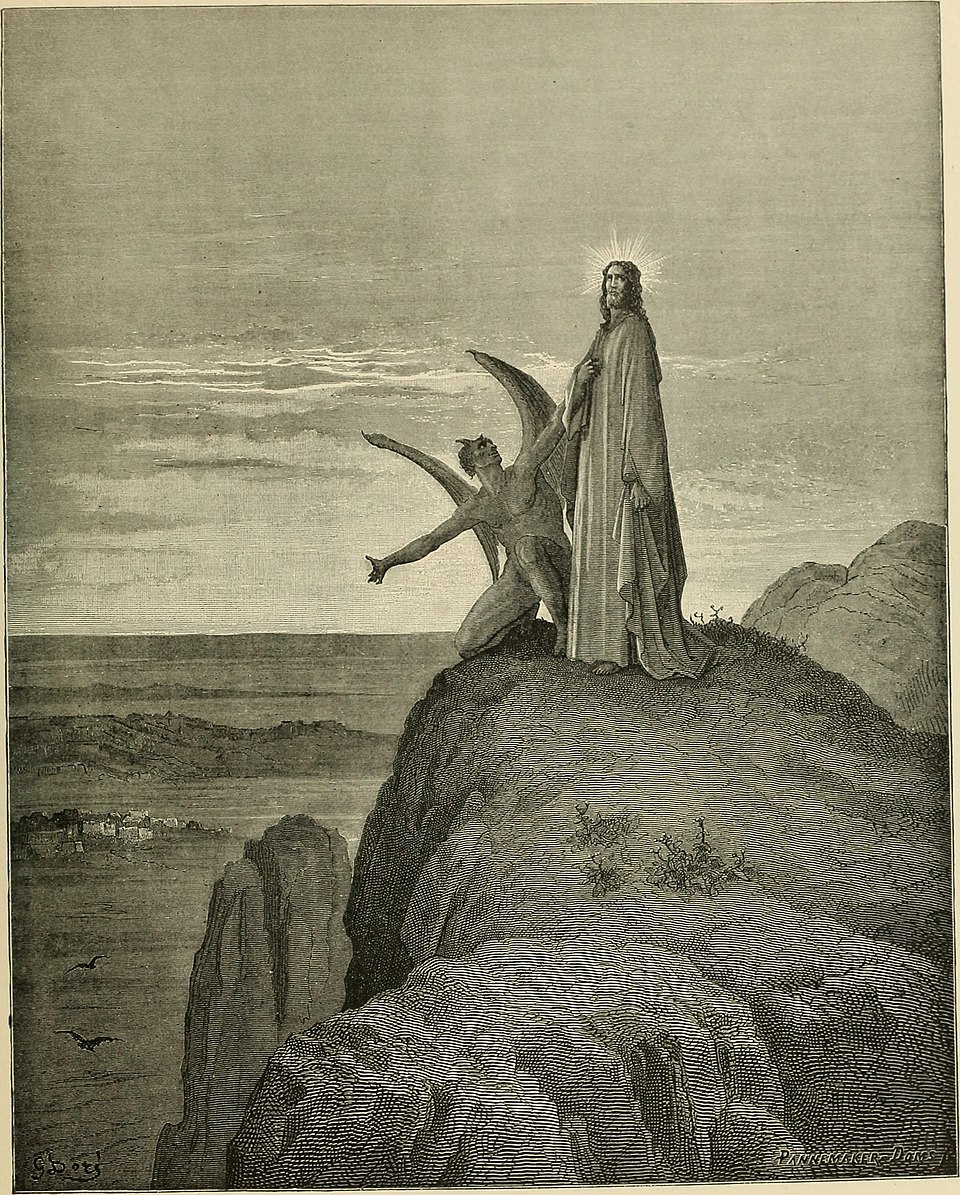
This is true in our gospel reading, in which Matthew tells of the three-fold temptation of Jesus. There really is no tension. I do not think that the first hearers of the Temptation of Christ were at all worried that Jesus might give in to Satan, that old snake, the tempter. It was how he overcame the temptation that was more important, and what it points to. The early Christians already knew that evil had been defeated in the death and resurrection of Christ.
As modern day Christians we are interested in the psychological state of Jesus in the wilderness. He is described as famished, and is undoubtedly physically weak (forty weeks without food is at the extreme end of what is humanly possible). The tempter tries to tempt Jesus. Is Jesus at all slightly persuaded? What was the internal thought process? This is exactly what Nikos Kazantzakis explored in his 1955 novel The Last Temptation of Christ, where Jesus wrestles with his divine nature, and is tempted in a dream to live an ordinary life without sacrifice and death on the cross. But Kazantzakis is a modern author, and the book speculate about the inner life of Jesus that the gospels barely attend to. So, while we might wonder what Jesus thought in his physically vulnerable state, that was not a concern to Matthew or the other evangelists.
The tempter tempts Jesus three times. First, he encourages him to show himself by turning stones into food – a demonstration of power. Then he suggests that he jump off a tall building, to see if the angels will save him – a demonstration of biblical fulfillment. Then, as if they belonged to him, he offers Jesus the kingdoms of the world.
Now, Satan here thinks he’s clever. He even quotes scripture to the Son of God, as if proof-texting necessarily leads to persuasion. But he’s really not that bright – his pride and arrogance overcomes what he should know. He thinks he might be able to persuade Jesus to turn against God the Father and instead show off his powers, test the promises of scripture about angels protecting the Messiah, and worship him instead. But he should know better, right? After all, he may be a fallen, but he is an angel, and so should have some insight into how the divine works. But he is wrong in his hopes, and fails miserably. He leaves to challenge Jesus again at the cross, through the Roman rulers of Judea and their collaborationist leaders of the Temple.
You see, this is where evil is so often very stupid. Evil can be crafty and clever, and it can marshal great resources and seduce good people, but so often the seeds of its inevitable destruction is found in what it thinks are its powers.
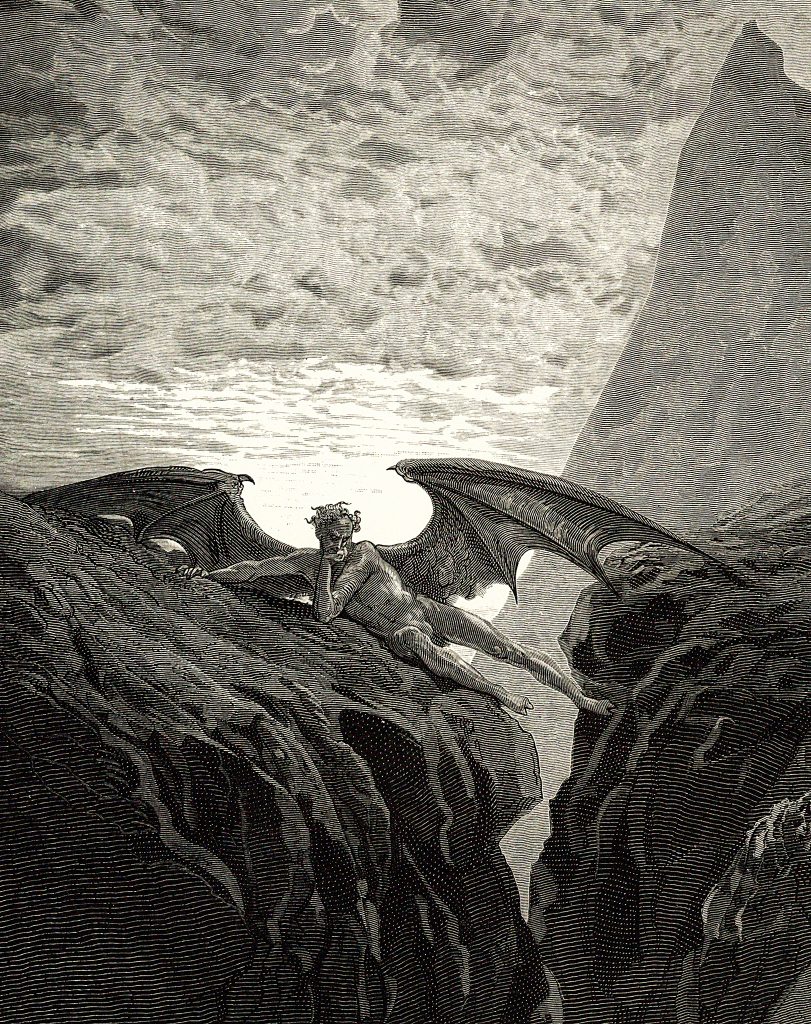
John Milton, the seventeenth century English poet, in the great epic poem Paradise Lost, has Satan as a major character. Milton makes him very eloquent, so much so that a century and a half afterwards the poet William Blake claimed that Milton was “of the Devil’s party without knowing it.” Blake thought that Milton had inadvertently made Satan the hero, and this character of Satan, who would rather reign in hell than serve in heaven, is a great and attractive protagonist. However, most scholars considering Blake’s claim believe that Milton knew exactly what he was doing – making Satan appear attractive and charismatic. Milton had lived through the overthrow of King Charles I and the English Civil Wars, and supported the Puritan Commonwealth, working as a diplomat. He then witnessed its descent into a centralised dictatorship under Oliver Cromwell, and its collapse after his death, with the Resoration and the return of the monarchy, the Book of Common Prayer, and bishops. Milton had had his hopes raised and confounded by eloquent politicians in Parliament and brilliant preachers, and seen it all go sideways.
We can see this in our world today and in the past. Politicians will use speeches and media to popularise of conspiracy theories, demonising those who are nor like them, and preying on the fears of those who are running into economic challenges. In an increasingly secular world the attraction of blood and soil, us against them, can be very appealing.
But, I tell you, they shall not, in the end, succeed, because evil is arrogant and stupid.
Take Hitler, for example. He was without question a charismatic figure who could win votes and attract fanatical followers. He and his propagandists understood how to use radio and film to popularise the Nazi party. His message that Germany had been stabbed in the back in the Great War went down well with the electorate, and sounded better than admitting that Germany’s military had lost the war. Blaming Communism and Jews for economic and nationalist problems meant that Germany did not have to accept responsibility for its own economic errors. When Hitler became Chancellor he gained control of what may have been the best military General Staff in Europe, and after massively enlarging the army and air force he was able to achieve some remarkable successes against Poland, Denmark, Norway, Belgium, the Netherlands, and France. Having defeated that old foe from the First World War, France, he believed that he was a military genius, and so attacked Soviet Russia and later declared war on the United States. But Hitler did not understand logistics or grand strategy. The United States was able to transform itself into a massive arms factory, supplying both itself and the Soviet Union, as well as keeping the United Kingdom supplied with food and supplies for it to carry on the fight. Even had the Germans somehow fought the Russians to a stalemate, or confined the western allies to France in 1944, the atomic bomb would have ended the war for Germany in defeat. And, of course, many of the people who worked on the Manhattan Project were Jewish refugees from Germany. Evil may see some spectacular success, but it will fail.
That’s one example. We can point to many other situations where totalitarians and dictators end badly, often at the hands of their own people. Think of Benito Mussolini, Muammar Gaddafi, Saddam Hussein, or Nicolae Ceaușescu. The French Marshal, President, and Nazi collaborator Philippe Petain, along with his Prime Minister Pierre Laval, were both condemned to death by a French Tribunal in 1945 (Because of his service in WW I, Petain’s sentence was commuted to life imprisonment; Laval was shot). Sometimes the evil leaders manage to die of natural causes, but in prison or in exile – again, think of Idi Amin, Hosni Mubarak, or Bashar Hafez al-Assad. The leaders of Germany and Japan in the Second World War were judged in the Nuremburg and Tokyo War Crimes Trials, and more recently military and politicians have faced war crimes tribunals for actions in Yugoslavia, Rwanda, and Sierra Leone, among others. The International Criminal Court has issued indictments against seventy-three individuals, including Vladimir Putin of the Russian Federation and person in sixteen other countries.
Of course, many evil people die in their beds, still in political power, but even then their legacies are challenged. Consider how quickly Stalinism was undone by his own party after he died, and the collapse of Russian communism in 1989-1990. Mao is revered as the unifier of China who established the Communist Party in power there, but since the overthrow of the Gang of Four after his death Mao has been roundly criticised for the failures of the Great Leap Forward and the Cultural Revolution.
The problem with evil is not whether it will ultimately be defeated – as Christians we know that it already has. As Martin Luther King so often pointed out, the arc of history bends towards justice. However, while evil will lose, and largely because evil leaders can be so stupid, but in the meantime the cost is so great. Good people, despite being fragile and sinful, must rise up time and again, speaking truth to power, countering the lies, emphasising human rights and democracy, championing empathy and kindness. The cost is in time and effort, and for some it involves imprisonment and even giving up one’s life, and it is a cost that Jesus was prepared to pay.
The attempt of Satan to tempt Jesus reminds me of the passage where Jesus tells his disciples, in Matthew chapter 20:25-27, “You know that the rulers of the gentiles lord it over them, and their great ones are tyrants over them. It will not be so among you, but whoever wishes to be great among you must be your servant, and whoever wishes to be first among you must be your slave”.
This is what Jesus is doing, having been driven by the spirit in the wilderness – voluntarily offering himself in service.
The tension, then, is not whether Jesus will resist the temptation, and it is not whether he will ultimately win the salvation of creation. We know he will resist, and we know he has won the victory. The tension is in our response. Will we turn and follow Jesus? Or are we so consumed with power and domination that we are more like the rulers of the gentiles? That is the challenge of Lent, to turn, and turn again. May we find ourselves on the side of the arc of history, working towards justice and righteousness in the servant rule of Christ. May God through the Holy Spirit empower us to know God’s will and to do it. May we always know that the love and wisdom of God will overcome the seductive temptation of evil. God wins.


 The Island Parson