
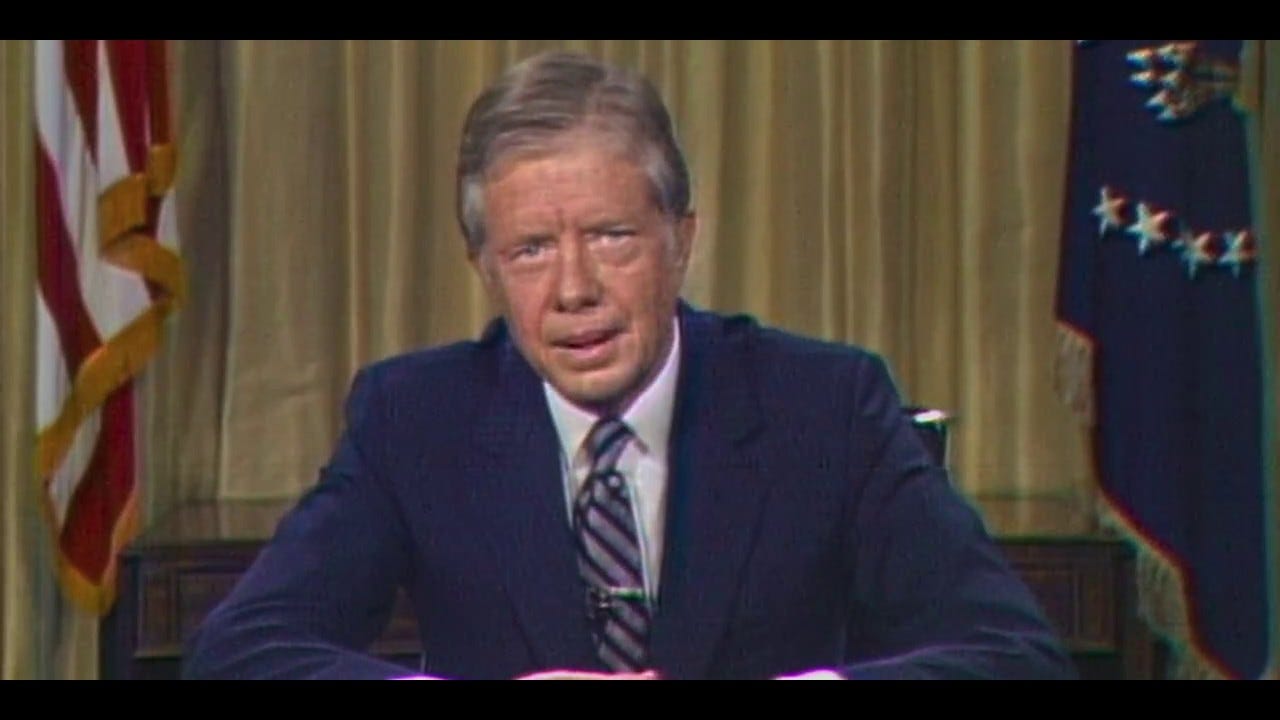
I was a teenager when Jimmy Carter was president of the United States. I became aware of US politics during the presidency of Richard Nixon, and the bad taste for Republicans that his corrupt leadership led to could not be overcome by the decency of Gerald Ford. Jimmy Carter was thus elected very much in reaction to a low point in American politics, when the lies of its leaders reduced confidence in government. Jimmy Carter came to political power promising never to lie and to be straight with the American public, and he was. On July 15, 1979 he gave his television talk that has become known as the Malaise speech, in which he tried to put the energy crisis of the ‘seventies on a moral and civic pane. He pointed out that change was required, and that this would demand some sacrifice from the US public. It was an address that was deeply rooted not only in his political values, but in his Christian values.
His failure to be reelected in 1980 demonstrated that the US public really did not want sacrifice, nor did the want some speaking the truth to them. Instead they elected in Ronald Reagan, a nominal Christian and a former actor, who promised a strong military and a balanced budget, and that economic recovery from stagflation and recession would come from his leadership. He told people what they wanted to hear, rather than what they needed to hear; the American public preferred a hopeful fantasy instead of the honest exhortation to hard work.
Ironically, it was Carter who had already begun that economic recovery. In appointing Paul Volcker to be chair of the Federal Reserve President Carter put in place an economist who would make the hard decisions to tame inflation that previous chairs had avoided because of the inevitable result of increased unemployment. Reagan wisely kept Volcker in place, and, after the Fed raised the prime interest rates, inflation fell from 14.8% to under 3% in three years.
In energy policy Carter deregulated much of the industry, beginning the movement towards the United States becoming a major oil producer again. He also recognised the importance of alternative energy sources, symbolised by placing solar energy panels on the White House.
Likewise, it was Carter who challenged the Soviet Union after the detente of the Nixon and Ford years. In the last two years of his administration the expenditure on the US military increased significantly, again a trend that Reagan continued. While there is a myth that Reagan’s military budget increases somehow caused the fall of the Soviet Union and the Berlin Wall, a real factor in the collapse of communism was that the Soviets lost the war in Afghanistan, and it was Carter who began aiding the Afghan militias and increasing the military budget.
It is hard to think of another President who had as much success in the politics of the Middle East than Carter. He brought together the leaders of Egypt and Israel and ensured that they made peace in the Camp David Accords. There has not been anything like this since.
Carter was unable to solve the problem of the Iranian Revolution and the kidnapping of hostages from the US Embassy in Tehran. Resentment at US interference in Iranian politics boiled over in 1977, and the new Iranian rulers would not negotiate in good faith or respect international norms. Carter did attempt a rescue operation, but the military failed to carry out the objective. The Iranian leadership cynically ensured that the hostages were not released until the day Reagan became president, denying Carter any kind of relief in the eyes of the American people.
With the election of Reagan the US public voted in a supposed Cold War warrior, whereas they replaced an Annapolis graduate and naval officer with someone who played naval officers in the movies. Whereas US Evangelicals, including Jerry Falwell, voted for Carter in 1976, they switched to the much more conservative Reagan in 1980 because he endorsed Southern white anger against welfare and civil rights under the rubrics of “less government” and “rule of law”. The “Southern Strategy” devised by the Nixon campaigns was perfected under Reagan, and the dominance of the South by Republicans began.
Since Carter US presidents have repeatedly lied and broken laws, or been compromised by their financial supporters. Reagan ordered that arms be illegally sold to Iran in the Iran-Contra scandal. George H. W. Bush, unable to convince a wary American public and Senate that it needed to liberate Kuwait from the Iraq invasion, repeatedly told an unfounded story about Iraqi soldiers killing babies, in order to inflame opinion. Bill Clinton sexually exploited a vulnerable intern and then lied about it. George W. Bush ignored intelligence about Saddam Hussein not having weapons of mass destruction, and about having no connections with Al Qaeda, and instead fabricated a justification for the conquest of Iraq. With both Obama and Biden we have individuals who are personally honest, but who hesitated to speak the truth about economics and civil rights to the US public, and are undoubtedly compromised by their dependence on the 1% for election campaigns, and are hamstrung by intransigent members of Congress. And Trump, of course, lies so much that not even his supporters believe him.
Thus we have our unhappy situation today in the United States with a polarised public and a divided opposition. The US public, in electing Trump, have demonstrated their preference for a lying nihilist, a convicted felon who in his business dealings repeatedly failed to pay his contractors; they prefer the liar who makes them feel good rather than a person who tells them the hard truth. This outcome has been in the making for forty-five years.
Today we mourn a president who is lauded for what he did after his presidency. Personally, I also mourn the death of a man who was a far better president than the American public want to admit. May Jimmy Carter rest in peace, and rise in glory.


 The Island Parson