
A Sermon preached on The Thirteenth Sunday after Trinity
at The Anglican Church of St. Thomas the Apostle, Kefalas, Crete
on September 3, 2023, at 11:00 am
The readings were Exodus 3.1-15, Psalm 105:1-6, 23-26, 45c, and Matthew 16:21-28.
“If they ask me, ‘What is his name?’ what shall I say to them?” God said to Moses, “I am who I am.”
Exodus 3.13-14

God has many names. God, Elohim, Θεός.
But in today’s first reading God identifies himself with a name that is pretty obscure to most people, or if they know it, follow the tradition of treating it as too holy to pronounce. That name is Yahweh, and in the Hebrew Bible that is the way the God of the Israelites is addressed. You may recall when Roman Catholic English translation of the Bible, The Jerusalem Bible, came out in 1966, it used that name. In the psalm as we read this morning we heard, as is found in the translation given in “Common Worhsip” (2000):
O give thanks to the Lord and call upon his name . .
Seek the Lord and his strength,
but in “The Jerusalem Bible” (1966) it reads
Give thanks to Yahweh, call his name aloud . . .
Seek Yahweh and his strength,
Yahweh is the name of God. It occurs over 6000 times in the Hebrew Bible, what we call the Old Testament. It even has a short form: Yah, and it shows up in the word “Hallelu-Yah” which simply means “Praise Yah”. Our reading from Exodus gives the name an origin. Moses asks, who shall I say sent me? And God answers, אֶהְיֶה אֲשֶׁר אֶהְיֶה ’ehye ’ăšer ’ehye, which is translated into English as, “I am who I am”. However, it’s a bit ambiguous in the original ancient Hebrew, and other scholars have translated it as: I am who is”, “I will become what I choose to become”, “I will be what I will be”, and even “I create what I create”. It is likely that the name “Yahweh” predates the story of Moses being commissioned by God, and the giving of the name ehye ’ăšer ’ehye; it is a etymology which sounds right and is theologically meaningful, but was probably a creation of the author of Exodus, or a tradition about the name which was passed down through the ages.
So, if God has a name, why do we not use it? Why do we not call the Divine Yahweh, or Yah? After all, Moses did, and all the prophets did so. What happened?
Sometime, perhaps three centuries before the time of Jesus, pious Jews began to feel that the personal name of God was so holy that it should not be spoke aloud, not even when reading the Torah in the Synagogue. In reading the Torah and other parts of the Hebrew Bible in the synagogue readers started to replace the name “Yahweh” with “Adonai”, which simply means, “the Lord”. This is what was carried over into the Septuagint, the Greek translation of Bible done a century or two before Jesus. Today pious Jews consider even Adonai too sacred, and will simply refer to God as “Ha shem”, or the Name. This practice was carried over into the Greek New Testament, and virtually all English translations. Look in the Old Testament of your Bible – a printed one, as digital ones may not be so precise, and you will see “The Lord” typically printed all in capital letters – and this signifies that it replaces Yahweh in the original Hebrew.

Now, I personally do not have a problem using the name of God, but I can understand that after more than twenty centuries some people find it a bit odd, if not sacrilegious. Certainly, many people found The Jerusalem Bible, with its consistent use of Yahweh, a bit disconcerting. Indeed, in 2008 Pope Benedict XVI had the Congregation for Divine Worship and the Discipline of the Sacraments instruct the Roman Catholic Church to cease using the divine name in translations, as well as songs and psalms.
There are two ways in which the name Yahweh carries over into the New Testament. First, the name Jesus. In Greek it is Ἰησοῦς, and over time, through Latin and Old Germanic, vowel shifts and so forth, it became our “Jesus. Ἰησοῦς is the Greek form of the Hebrew and Aramaic יֵשׁוּעַ (Yeshuaʿ/Y’shuaʿ), a shorter form of יְהוֹשֻׁעַ (Yehoshuaʿ), or Joshua. Now, all Biblical names seem to have meanings. יְהוֹשֻׁעַ is usually translated into English as “The Lord saves” but it literally is, “Yah saves” – that short name of God. So, every time we use the name Jesus, we use the personal name of God. It’s been garbled in its journey from Hebrew to English from Yeshuaʿ to Jesus, but it’s still there.
The other way in which “Yahweh” really shows up in the New Testament is in the Gospel according to John. There Jesus regularly makes what are called the “I am” statements. In the original Greek it is an emphatic I am: Ἐγώ εἰμί. And they are bold claims:
- I am the Bread of Life (John 6:35)
- I am the Light of the World (John 8:12)
- I am the Door (John 10:9)
- I am the Good Shepherd (John 10:11,14)
- I am the Resurrection and the Life (John 11:25)
- I am the Way and the Truth and the Life (John 14:6)
- I am the Vine (John 15:1,5)
- Unless you believe that I am, you will die in your sins” (John 8:24)
- Before Abraham was, I am (John 8:58)
In all these uses and appearances the author of the gospel is building on the claim that shows up at the start of the book:
In the beginning was the Word, and the Word was with God, and the Word was God.
John 1.1.
Jesus is not just the son of God, like the Roman Emperors of the time claimed, not is he somewhat semi-divine, like the Greek hero Hercules. He is not merely another prophet sent to save the people. The use of all these “I am” statements mean that he is God – he is fully divine. The continued use of Ἐγώ εἰμί I am is a reference back to ’ehye ’ăšer ’ehye, and the name has power. This is seen in chapter 18, when the police and the chief priests and the Pharisees arrest him.
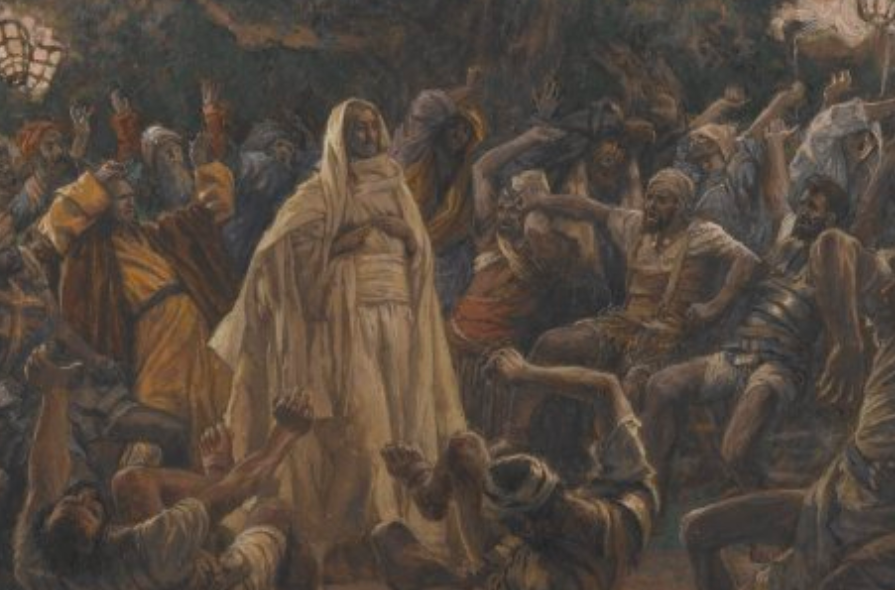
Jesus, knowing all that was to happen to him, came forward and asked them, ‘For whom are you looking?’ They answered, ‘Jesus of Nazareth.’ Jesus replied, ‘I am. Judas, who betrayed him, was standing with them. When Jesus said to them, ‘I am he’, they stepped back and fell to the ground.
John 18.4-6
Jesus in this telling literally knocks people of their feet with “I am.”
But our gospel reminds us of the nature of this power. It is a power which empties itself, and we have heard today,
Jesus began to show his disciples that he must go to Jerusalem and undergo great suffering at the hands of the elders and chief priests and scribes, and be killed, and on the third day be raised.
Matthew 16.21
and
If any want to become my followers, let them deny themselves and take up their cross and follow me. For those who want to save their life will lose it, and those who lose their life for my sake will find it.
Matthew 16.24-25
So, my friends, in Jesus we see the nature of the name of God, the one who is, the one who saves, the one who in human flesh pours out himself for all humanity. Let us let go of the temptations of power, and follow Jesus, the one through whom we know the true character of Divinity.


 The Island Parson