
A Sermon preached on The Second Sunday before Advent
at The Anglican Church of St. Thomas the Apostle, Kefalas, Crete
on the 19th of November, 2023, at 11:00 am
The readings were 1 Thessalonians 4:13-18, Psalm 90.1-12, and Matthew 25:1-13.
I am getting ahead of myself. In the Roman Catholic Church, and in many Anglo-Catholic parishes it used to be the case that on the four Sundays of Advent the sermons would be based on the Four Last Things, namely: death, judgement, heaven, and hell. Well, here it is, two weeks before Advent, and I am going to preach about death. Perhaps in two weeks I’ll preach about judgement, eh?
So. What happens when we die?
Well, obviously, we stop breathing and our body begins to decay, and if we have loved ones, they are greatly upset. The survivors may do a number of things – they may cremate the body (as is common in western Europe and in India), or expose it in special open-air buildings to be consumed by vultures (the practice of the Parsees), but the traditional thing to do for Christians, Jews, and Muslims is to bury the body. Here in Greece, after a period of time, we dig up the body and the bones are washed and placed in a silver box in the grave.
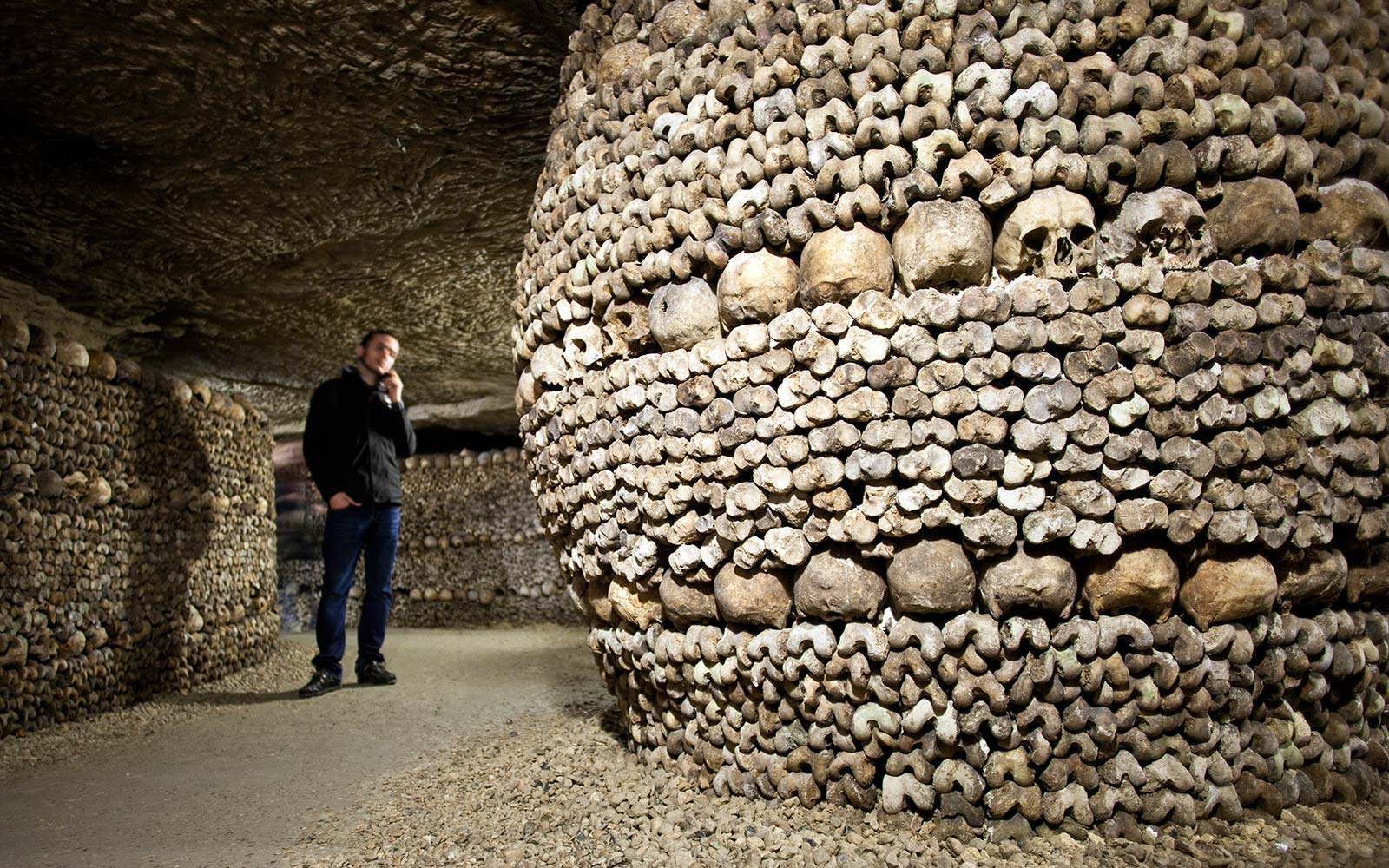
In Paris, by 1800 the graves had all become so full that the city authorities ordered that the graves be dug up and all the bones interred underground, in mines under the city excavated centuries before. It is estimated that between 1774 and around 1820 some six million people had their earthly remains reinterred. You can now visit the so-called “Catacombs of Paris” as my son and I did a decade ago. So, what happens when you die? Well, you may wind up being part of a tourist attraction.
Three Biblical Ideas about Death
Let us move from bones to the scriptures. There are varieties of ideas in the Bible about life after death. As is so often the case, the sacred texts speak in a polyphony, but the voices all point to a great sacred mystery, which is not so much a puzzle to be solved, but a meaning beyond ordinary human understanding.
First, the oldest parts of the Bible, in the Old Testament, simply refer to Sheol, a place of shadowy existence. Remember what it is like when we slowly die, slowly fade. Sheol is like that, only more so. It is only a partial kind of existence, and i the psalms we read that the dead in Sheol do not praise, they just are dead.
Second, there is heaven. Now, in the Hebrew Bible, heaven is where God is, and from whence come the angels, the messengers of God. It is not really a place for humans, although we do hear of a couple of people there – Enoch, and Elijah – but they are very special.
The idea of heaven developed in post-exilic Judaism, perhaps under the influence of Zoroastrianism. Sheol becomes not just the place where the dead normally go, but a place of punishment and pain. Heaven becomes a kind of Elysium, where the heroes go. Thus in the New Testament in the story of Lazarus and the Rich Man, the rich man, having enjoyed wealth in life but having had no mercy, goes to a rather hot hell. Lazarus, having enjoyed no riches in life, is in heaven, in the bosom of Abraham. So you can have a fun time imagining where you belong, and what one might have to do to avoid one and get in the other.

But a third fate after death is mentioned, and that is the resurrection of the dead. Resurrection was the post-exilic Jewish answer to what happens to good people who are faithful, and yet nevertheless suffer for doing the right thing. God will raise them up from death, whether conceived of as heaven and hell or from the more ambiguous existence of Sheol. God will raise up all who have lived for judgement, the judgement of the living and the dead. As we can see in our reading in 1 Thessalonians Jesus is described as coming in glory. The resurrection of all life is seen as a two-stage event – first those who have died in Christ, who are described in Greek as having fallen asleep, a nice image of death that is somewhat closer to Sheol than heaven and hell. The dead in Christ are raised up and those followers of Jesus who are alive at the time will join with them and meet the Lord in the air, and “we will be with the Lord forever.” Then will follow a more general resurrection, of all who have lived, and Jesus will judge them. I personally expect God will be mostly gracious and forgiving, but others through the ages have seemingly relished the vast numbers of people who will be condemned to eternal damnation and pain.
It all sounds quite fantastic, doesn’t it? In an age of technology and science can we really believe all this? I know that I do, and would be quite happy to take it all literally, but I know that not everyone does. The fact that scripture speaks in several voices about life after death suggests to me that whatever is meant by “He will come to judge the quick and the dead” and “I believe in the resurrection” is more complex and mind-blowing than we can imagine. However, it all points to the idea that when we die, God is not done with us.
If so, then parable of the wise and foolish bridesmaids in our gospel reading tells us the subsequent point. However we imagine it, we need to be ready. As followers of Jesus, we are called to prepare ourselves for death, and for the coming of Jesus.
How do we prepare?
- Practically, talk about death and what you want to have happen. Talk to your friends and children. Funeral arrangements. Have a will. For God’s sake, write down all your passwords! Perhaps have a look at the website GYST (Get your SH*T Together ) and work through its short checklist, or its longer one.
- Talk to me, or some other minister. What do you want to have happen at your funeral?
- How do you want to meet your maker? Is there anything unresolved that you need to deal with? Do you need to make a confession? Is there somebody with whom you need to be reconciled? Are there any amends you might want to make?
The parable tells us that time is short. The day is not long. Our psalm suggests that the normal life-span is three-score and ten, or maybe four-score – and some of us here have passed both of these numbers. So it is time. Prepare your lamps for the wedding feast. Let us be ready when the bridegroom knocks on the door.
For my reflections on the poem “Death” by George Herbert click here.


 The Island Parson
Pingback: Four Last Things: Judgement | The Island Parson